anaheim-gazette 1877-02-03
Scanned page
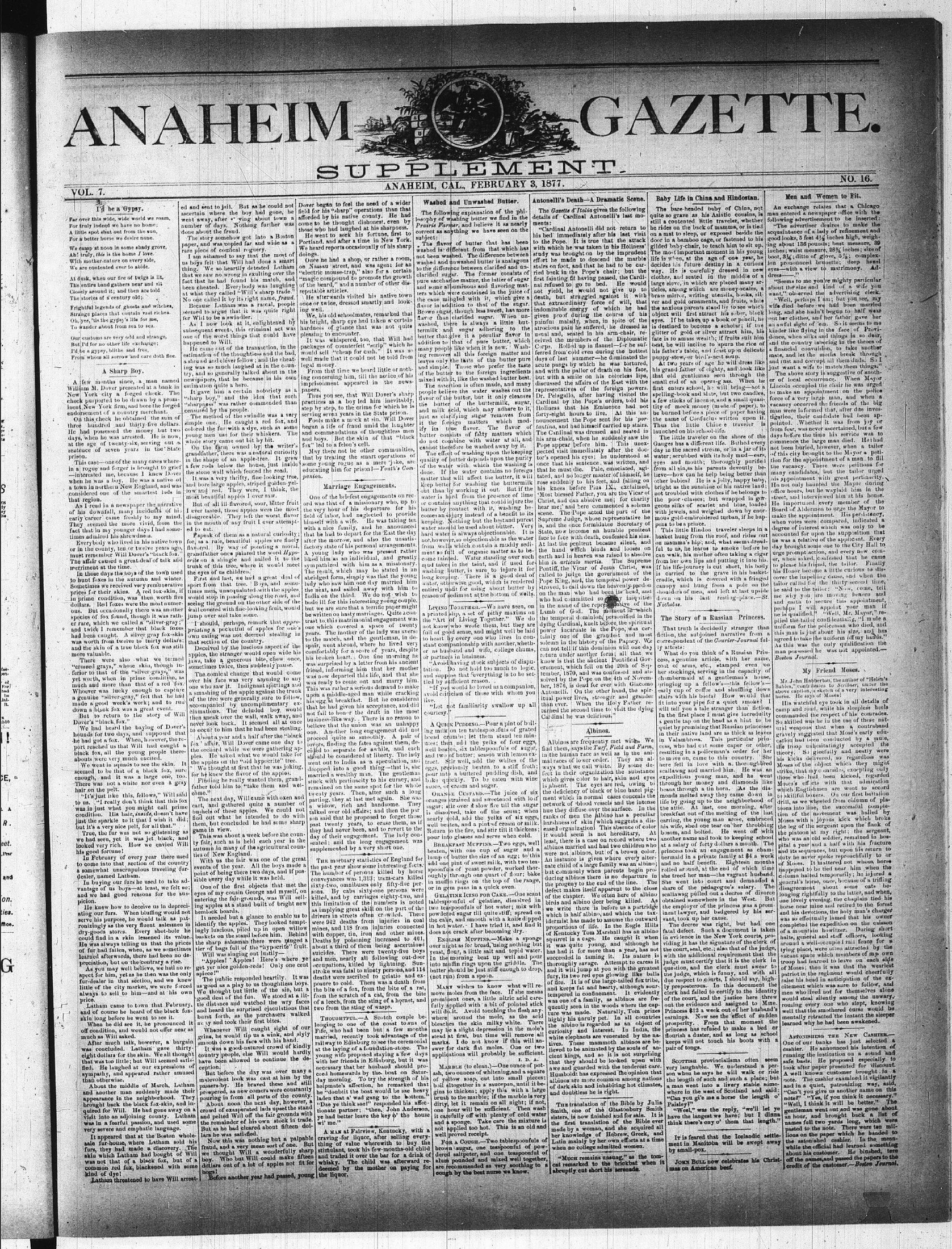
Searchable text
ANAHEIM
VOL. 7.
I'd be a Gypsy.
Far over this wide, wide world we roam,
For truly indeed we have no home;
A little spot shut out from the sun,
For a better home we desire none.
We camp at noon in some shady grove,
Ah! truly, this is the home I love.
With mother-nature on every side,
We are contented ever to abide.
At dusk, when our fire of twigs is lit,
The entire band gathers near and sit
Closely around it; and then are told
The stories of a century old;
Frightful legends of ghosts and witches,
Strange places that contain vast riches.
Oh, yes, 'tis the gypsy's life for me,
To wander about from sea to sea.
Our customs are very odd and strange,
But I'd for no other life exchange;
I'd be a gypsy, blithe and free,
From whom all sorrow and care doth flee.
A Sharp Boy.
A few months since, a man named William M. Dover presented at a bank in New York city a forged check. The check purported to be drawn by a prominent New York firm; and bore the forged endorsement of a country merchant.
On this check he obtained the sum of three hundred and thirty-five dollars. He had possessed the money but two days, when he was arrested. He is now, at the age of twenty-six, serving out a sentence of seven years in the State prison.
This case—one of the many cases where-
ed and sent to jail. But as he could not ascertain where the boy had gone, he went away, after aving about town a number of days. Nothing further was done about the fraud.
The story somehow got into a Boston paper, and was copied far and wide as a rare piece of comical rogery.
I am ashamed to say that the most of us boys felt that Will had done a smart thing. We so heartily detested Latham that we saw no wrong in exulting over the fact that he had found his match, and been cheated. Everybody was laughing at what they called "Will's sharp trade."
No one called it by its right name, fraud.
Because Latham was a rascal, people seemed to argue that it was quite right for Will to be a swindler.
As I now look at it, enlightened by subsequent events, this criminal act was one of the worst things that could have happened to Will.
He came out of the transaction, in the estimation of the thoughtless and the bad, a shrewd and clever fellow; and the cheating was so much laughed at in the country, and so generally talked about in the newspapers, that he became in his own estimation quite a hero.
It gave him a certain notoriety as a "sharp boy," and the idea that such "sharpness" was rather commended than censured by the people.
The method of the swindle was a very simple one. He caught a red fox, and colored the fur with a dye, such as some young men use for their whiskers. The whole story came out bit by bit.
On the farm owned by the writer's grandfather, there was a natural curiosity in the shape of an apple-tree. It grew a few reds below the house, just inside Dover began to feel field for his "sharp" afforded by his native come to be thought those who had laughte.
He went to seek Portland, and after a We heard reports occa-dings.
Once he had a show on Nassau street, and "electric mouse-trap" "magic compound to of the beard," and a reputable articles.
He afterwards visited once or twice, dressing well.
We, his old school, his bright, sharp eye hardness of glance pleasing to encounter.
It was whispered packages of counter would sell "cheap for well made that it co legal money.
From that time wring concerning him imprisonment appear papers.
Thus you see, that practices as a boy step by step, to the serving seven years.
Pools make a mo-began a life of frail and commendation-and boys. But the fox' led to a felon's May there not be that by treating them some young rogue.
A few months since, a man named William M. Dover presented at a bank in New York city a forged check. The check purported to be drawn by a prominent New York firm, and bore the forged endorsement of a country merchant.
On this check he obtained the sum of three hundred and thirty-five dollars. He had possessed the money but two days, when he was arrested. He is now, at the age of twenty-six, serving out a sentence of seven years in the State prison.
This case—one of the many cases where in a rogue and forger is brought to grief—interested me, because I knew Dover when he was a boy. He was a native of a town in northern New England, and was considered one of the smartest lads in that region.
As I read in a newspaper the narrative of his downfall, many incidents of his early career came freshly to my mind. They seemed the more vivid, from the fact that in my younger days I had sometimes admired his shrewdness.
Everybody who lived in his native town or in the county, ten or twelve years ago, must remember Will Dover's "black fox." The affair caused a great deal of talk and merriment at the time.
In those days the boys of the town used to hunt foxes in the autumn and winter. Sometimes we received very remunerative prices for their skins. A red fox-skin, if in prime condition, was then worth five dollars. Red foxes were the most numerous. But occasionally there was another species of fox found, though it was rather rare, which we called a "silver-gray;" and twice I remember that black foxes had been caught. A silver gray fox-skin was worth from twelve to thirty dollars; and the skin of a true black fox was still more valuable.
There were also what we termed "crossed grays," whose skin, though inferior to that of the "silver-grays," was yet worth, when in prime condition, as much and more than that of a red fox. Whoever was lucky enough to capture a genuine "silver-gray," felt that he had made a good week's work; and to run down a black fox was a great event.
But to return to the story of Will Dover's "black fox."
We had heard the baying of Dover's hounds for two days, and supposed that he had got a fox. When, however, the report reached us that Will had caught a black fox, all the young people thereabouts were very much excited.
We went in squads to see the skin. It seemed to be that of a black fox, sure enough, and it was a large one, too. There was not a white nor even a gray hair on the pelt.
"It's just like this, fellows," Will said to us. "I really don't think that this fox was in just what you might call prime condition. His hair, inside, doesn't have just the sparkle to it that I wish it did; but it's a very nice pelt, for all that."
True, the fur was not so glistening as we had seen, yet it was jet black, and looked very rich. How we envied Will his good fortune!
In February of every year there used to come into that section of the country a somewhat unscrupulous traveling fur-dealer, named Latham.
In buying our fur he used to take ad-
ing was so much laughter as in the newspapers, that he became in his own estimation quite a hero.
It gave him a certain notoriety as a "sharp boy," and the idea that such "sharpness" was rather commended than censured by the people.
The method of the swindle was a very simple one. He caught a red fox, and colored the fur with a dye, such as some young men use for their whiskers. The whole story came out bit by bit.
On the farm owned by the writer's grandfather, there was a natural curiosity in the shape of an apple-tree. It grew a few rods below the house, just inside the stone wall which fenced the road.
It was a very thrifty, fine-looking tree, and bore large apples, striped golden-yellow and red. They were, I think, the most beautiful apples I ever saw.
But of all ill-flavored, sour, bitter fruit I ever tasted, those apples were the most disagreeable. They left the worst flavor in the mouth of any fruit I ever attempted to eat.
I speak of them as a natural curiosity; for, as a rule, beautiful apples are finely flavored. By way of pointing a moral grandfather once painted the word Hyporile on a shingle and nailed it to the trunk of this tree, where it would meet the eyes of us children.
First and last, we had a great deal of sport from that tree. Boys, and sometimes men, unacquainted with the apples, would stop in passing along the road, and seeing the ground on the other side of the wall covered with fine-looking fruit, would jump over and take some.
I should, perhaps, remark that appropriating a pocketful of apples for one's own eating was not deemed stealing in that section of the country.
Deceived by the luscious aspect of the apples, the stranger would open wide his jaws, take a generous bite, chew once, sometimes twice, then suddenly pause.
The comical change that would come over his face was very amusing to any one who saw it. Indignant spittings and a smashing of the apple against the trunk of the tree were generally sure to follow, accompanied by uncomplimentary explanations. The deluded boy would then sneak over the wall, walk away, and never look back. It seemed all at once to occur to him that he had been stealing.
About a year and a half after the "black fox" affair, Will Dover came one day to the orchard while we were gathering apples. He asked what we would take for the apples on the "old hypocrite" tree.
We thought at first that he was joking, for he knew the flavor of the apples.
Flipping he really wanted them, grandfather told him to "take them and welcome."
The next day, Will came with oxen and cart, and gathered quite a number of bushels of these apples. We could not find out what he intended to do with them, but concluded he had some sharp game in view.
This was about a week before the county fair, such as is held each year in the autumn in many of the agricultural counties of New England.
With us the fair was one of the great events of the year. All the boys made a point of being there two days, and if possible every day while it was held.
From that time we being concerning himself imprisonment appear papers.
Thus you see, that practices as a boy step by step, to serve seven years.
Fools make a man began a life of fratricide and commendation and boys. But they fox led to a felon's May there not be that by treating them some young rogue educating him for punishment.
Marriage
One of the briefest ords was that of a man very hour of his field of labor, had himself with a wife with a nice family that he had to depart after the morrow, a factory state of his A young lady who liked him as an intympathized with The result which abridged form, siml lady who saw him in the next, and sailed India on the third bode ill for this inju but we are sure tha be written on hasty trast to this matrine one which covered years. The mother to the match,and spain went abroad comfortably for al his broken heart.was surprised by s friend informing w was now departed was ready to come This was rather as upon a middle-age his egg at breakfast that he had given not fail to honor business-like way.believe that the u one.Another lo proceed quite so lovers finding thie cided to separate should be considere went out to India dropped into a g married wealthy stuck with pertaining remained on th e twenty years.T Parting,they at la widow,rich talked over old ad son said that he p past twenty yei they had never be day of their engraved; and th ey supplemented by
It was about a week before the county fair, such as is held each year in the autumn in many of the agricultural counties of New England.
With us the fair was one of the great events of the year. All the boys made a point of being there two days, and if possible every day while it was held.
One of the first objects that met the eyes of my cousin George and myself, on entering the fair-grounds, was Will selling apples at a stand built of bright new hemlock boards.
It needed but a glance to enable us to identify the apples. They looked temptingly luscious, piled up in open willow baskets on the stand before him. Behind the sharp salesman there were ranged a tier of bags full of the "hypocrite" fruit.
Will was singing out lustily—
"Apples! Apples! Here's where ye get yer nice golden-reds! Only one cent apiece!"
The public responded heartily. It was as good as a play to us thoughtless boys. We thought but little of the sin, but a good deal of the fun. We stood at a little distance and watched the wry faces and heard the surprised ejaculations that burst forth, as the purchasers walked away and took their first bites.
Whenever Will caught sight of our grins, he would tip us a wink, and slyly smooth down his face with his hand.
It was a good-natured crowd of kindly country people, else Will would hardly have been allowed to continue the deception.
But before the day was over many malevolent look was cast at him by the passers-by. He braved these and still prospered, as new comers were constantly pouring in from all parts of the county.
About noon the next day, however, a crowd of exasperated lads upset the stand and pelted Will off the fair grounds with the remainder of his own stock in trade. But as he had cleared about fifteen dollars he was satisfied.
Now this was nothing but a palpable fraud, and a very mean sort of one. But we thought Will a wonderfully sharp boy. Who but Will could make fifteen dollars out of a lot of apples not fit for hogs!
Before another year had passed, young father told him to "take them and welcome."
The next day, Will came with oxen and cart, and gathered quite a number of bushels of these apples. We could not find out what he intended to do with them, but concluded he had some sharp game in view.
This was about a week before the county fair, such as is held each year in the autumn in many of the agricultural counties of New England.
With us the fair was one of the great events of the year. All the boys made a point of being there two days, and if possible every day while it was held.
One of the first objects that met the eyes of my cousin George and myself, on entering the fair-grounds, was Will selling apples at a stand built of bright new hemlock boards.
It needed but a glance to enable us to identify the apples. They looked temptingly luscious, piled up in open willow baskets on the stand before him. Behind the sharp salesman there were ranged a tier of bags full of the "hypocrite" fruit.
Will was singing out lustily—
"Apples! Apples! Here's where ye get yer nice golden-reds! Only one cent apiece!"
The public responded heartily. It was as good as a play to us thoughtless boys. We thought but little of the sin, but a good deal of the fun. We stood at a little distance and watched the wry faces and heard the surprised ejaculations that burst forth, as the purchasers walked away and took their first bites.
Whenever Will caught sight of our grins, he would tip us a wink, and slyly smooth down his face with his hand.
It was a good-natured crowd of kindly country people, else Will would hardly have been allowed to continue the deception.
But before the day was over many malevolent look was cast at him by the passers-by. He braved these and still prospered, as new comers were constantly pouring in from all parts of the county.
About noon the next day, however, a crowd of exasperated lads upset the stand and pelted Will off the fair grounds with the remainder of his own stock in trade. But as he had cleared about fifteen dollars he was satisfied.
Now this was nothing but a palpable fraud, and a very mean sort of one. But we thought Will a wonderfully sharp boy. Who but Will could make fifteen dollars out of a lot of apples not fit for hogs!
Before another year had passed, young father told him to "take them and welcome."
The next day, Will came with oxen and cart, and gathered quite a number of bushels of these apples. We could not find out what he intended to do with them, but concluded he had some sharp game in view.
This was about a week before the county fair, such as is held each year in the autumn in many of the agricultural counties of New England.
With us the fair was one of the great events of the year. All the boys made a point of being there two days, and if possible every day while it was held.
One of the first objects that met the eyes of my cousin George and myself, on entering the fair-grounds, was Will selling apples at a stand built of bright new hemlock boards.
It needed but a glance to enable us to identify the apples. They looked temptingly luscious, piled up in open willow baskets on the stand before him. Behind the sharp salesman there were ranged a tier of bags full of the "hypocrite" fruit.
Will was singing out lustily—
"Apples! Apples! Here's where ye get yer nice golden-reds! Only one cent apiece!"
The public responded heartily. It was as good as a play to us thoughtless boys. We thought but little of the sin, but a good deal of the fun. We stood at a little distance and watched the wry faces and heard the surprised ejaculations that burst forth, as the purchasers walked away and took their first bites.
Whenever Will caught sight of our grins, he would tip us a wink, and slyly smooth down his face with his hand.
It was a good-natured crowd of kindly country people, else Will would hardly have been allowed to continue the deception.
But before the day was over many malevolent look was cast at him by the passers-by. He braved these and still prospered, as new comers were constantly pouring in from all parts of the county.
About noon the next day, however, a crowd of exasperated lads upset the stand and pelted Will off the fair grounds with the remainder of his own stock in trade. But as he had cleared about fifteen dollars he was satisfied.
Now this was nothing but a palpable fraud, and a very mean sort of one. But we thought Will a wonderfully sharp boy. Who but Will could make fifteen dollars out of a lot of apples not fit for hogs!
Before another year had passed, father told him to "take them and welcome."
The next day, Will came with oxen and cart, and gathered quite a number of bushels of these apples. We could not find out what he intended to do with them, but concluded he had some sharp game in view.
This was about a week before the county fair, such as is held each year in the autumn in many of the agricultural counties of New England.
With us the fair was one of the great events of the year. All the boys made a point of being there two days, and if possible every day while it was held.
One of the first objects that met the eyes of my cousin George and myself, on entering the fair-grounds, was Will selling apples at a stand built of bright new hemlock boards.
It needed but a glance to enable us to identify the apples. They looked temptingly luscious, piled up in open willow baskets on the stand before him. Behind the sharp salesman there were ranged a tier of bags full of the "hypocrite" fruit.
Will was singing out lustily—
"Apples! Apples! Here's where ye get yer nice golden-reds! Only one cent apiece!"
The public responded heartily. It was as good as a play to us thoughtless boys. We thought but little of the sin, but a good deal of the fun. We stood at a little distance and watched the wry faces and heard the surprised ejaculations that burst forth, as the purchasers walked away and took their first bites.
Whenever Will caught sight of our grins, he would tip us a wink, and slyly smooth down his face with his hand.
It was a good-natured crowd of kindly country people, else Will would hardly have been allowed to continue the deception.
But before the day was over many malevolent look was cast at him by the passers-by. He braved these and still prospered, as new comers were constantly pouring in from all parts of the county.
About noon the next day, however, a crowd of exasperated lads upset the stand and pelted Will off the fair grounds with the remainder of his own stock in trade. But as he had cleared about fifteen dollars he was satisfied.
Now this was nothing but a palpable fraud, and a very mean sort of one. But we thought Will a wonderfully sharp boy. Who但Will could make fifteen dollars out of a lot of apples not fit for hogs!
Before another year had passed, father told him to "take them and welcome."
The next day, Will came with oxen and cart, and gathered quite a number of bushels of these apples. We could not find out what he intended to do with them, but concluded he had some sharp game in view.
This was about a week before the county fair, such as is held each year in the autumn in many of the agricultural counties of New England.
With us the fair was one of the great events of the year. All the boys made a point of being there two days, and if possible every day while it was held.
One of the first objects that met the eyes of my cousin George and myself, on entering the fair-grounds, was Will selling apples at a stand built of bright new hemlock boards.
It needed but a glance to enable us to identify the apples. They looked temptingly luscious, piled up in open willow baskets on the stand before him. Behind the sharp salesman there were ranged a tier of bags full of the "hypocrite" fruit.
Will was singing out lustily—
"Apples! Apples! Here's where ye get yer nice golden-reds! Only one cent apiece!"
The public responded heartily. It was as good as a play to us thoughtless boys. We thought but little of the sin, but a good deal of the fun. We stood at a little distance and watched the wry faces and heard the surprised ejaculations that burst forth, as the purchasers walked away and took their first bites.
Whenever Will caught sight of our grins, he would tip us a wink, and slyly smooth down his face with his hand.
It was a good-natured crowd of kindly country people, else Will would hardly have been allowed to continue the deception.
But before the day was over many malevolent look was cast at him by the passers-by. He braved these and still prospered, as new comers were constantly pouring in from all parts of the county.
About noon the next day, however, a crowd of exasperated lads upset the stand and pelted Will off the fair grounds with the remainder of his own stock in trade. But as he had cleared about fifteen dollars he was satisfied.
Now this was nothing but a palpable fraud, and a very mean sort of one. But we thought Will a wonderfully sharp boy. Who但Will could make fifteen dollars out of a lot of apples not fit for hogs!
Before another year had passed, father told him to "take them and welcome."
Dover began to feel the need of a wider field for his "sharp" operations than that afforded by his native county. He had come to be thought dishonest, even by those who had laughed at his sharpness.
He went to seek his fortune, first to Portland, and after a time in New York. We heard reports occasionally of his sharp doings.
Once he had a shop, or rather a room, on Naassau street, and was agent for an "electric mouse-trap," also for a certain "magic compound to promote the growth of the beard," and a number of other disreputable articles.
He afterwards visited his native town once or twice, dressed smartly and looking well.
We, his old schoolmates, remarked that his bright, sharp eye had taken a certain hardness of glance that was not quite pleasing to encounter.
It was whispered, too, that Will had packages of counterfeit "script" which he would sell "cheap for cash." It was so well made that it could not be told from legal money.
From that time we heard little or nothing concerning him, till the notice of his imprisonment appeared in the newspapers.
Thus you see, that Will Dover's sharp practices as a boy led him inevitably, step by step, to the crime for which he is serving seven years in the State prison.
Pools make a mock at sin. Will Dover began a life of fraud amid the laughter and commendations of thoughtless men and boys. But the skin of that "black fox" led to a felon's cell.
May there not be other communities, that by treating the smart operations of some young rogue as a mere joke, are
Washed and Unwashed Butter.
The following explanation of the philosophy of washing butter we find in the Prairie Farmer, and believe it as nearly correct as anything we have seen on the subject:
The flavor of butter that has been washed is different from that which has not been washed. The difference between washed and unwashed butter is analogous to the difference between clarified and unclarified sugar. The former consists of pure saccharine matter, the latter of sugar and some albuminous and flavoring matters which were contained in the juice of the cane mingled with it, which give a flavor in addition to that of the sugar. Brown sugar, though less sweet, has more flavor than clarified sugar. When unwashed, there is always a little buttermilk and sugar adhering to the butter that give it a peculiar flavor in addition to that of pure butter, which many people like when it is new. Washing removes all this foreign matter and leaves only the taste of the butter pure and simple. Those who prefer the taste of the butter to the foreign ingredients mixed with it, like the washed butter best.
The assertion is often made, and many people believe the water washes out the flavor of the butter, but it only cleanses the butter of the buttermilk, sugar, and milk acid, which may adhere to it, just as clarifying sugar removes from it the foreign matters which modify its true flavor. The flavor of butter consists of fatty matters which do not combine with water at all, and cannot therefore be washed away by it.
The effect of washing upon the keeping quality of butter depends upon the purity of the water with which the washing is done.
Antonelli's Death—A Dramatic Scene.
The Gazette d'Italia gives the following details of Cardinal Antonelli's last moments:
"Cardinal Antonelli did not return to his bed immediately after his last visit to the Pope. It is true that the attack with which he was taken in his Holiness' study was brought on by the imprudent effort he made to descend the marble stairs on foot, and that he had to be carried back in the Pope's chair; but the first fainting fit having passed, the Cardinal refused to go to bed. He would not yield, he would not give up to death, but struggled against it with that extraordinary force of will, that indomitable energy of which he had given proof during the course of his painful malady, when, in spite of the atrocious pain he suffered, he dressed as usual and, seated in his arm-chair, received the members of the Diplomatic Corps. Rolled up in flannel—for he suffered from cold even during the hottest days of last summer—he dominated the acute pangs by which he was tortured, and with the pallor of death on his face, but with a smile on his colorless lips, discussed the affairs of the East with the representatives of the foreign powers. Dr. Pelagallo, after having visited Cardinal by the Pope's orders, told his Holiness that his Eminence had not forty-eight hours to live. At this announcement the Pope sent for his portantina, and had himself carried up stairs. The Cardinal was dressed and seated in his arm-chair, when he suddenly saw the Pope appear before him. This unexpected visit immediately after the doctor's opened his eyes; he understood at once that his sentence was written, and
Baby.
The baby still a coot he rides on a mat life is waking up deceived way. His clothes large size ticles, brass mirror verandering and an anxious object wakes. It is destined glitter or fate is its beat; he his father puppy awakes. At two his grandmother old small child first spelling a few words of be burning the name Thus she launches.
The L Ganges day in water eyes
From that time we heard little or nothing concerning him, till the notice of his imprisonment appeared in the newspapers.
Thus you see, that Will Dover's sharp practices as a boy led him inevitably, step by step, to the crime for which he is serving seven years in the State prison.
Fools make a mock at sin. Will Dover began a life of fraud amid the laughter and commendations of thoughtless men and boys. But the skin of that "black fox" led to a felon's cell.
May there not be other communities, that by treating the smart operations of some young rogue as a mere joke, are educating him for prison?—Youth's Companion.
Marriage Engagements.
One of the briefest engagements on record was that of a missionary who, up to the very hour of his departure for his field of labor, had neglected to provide himself with a wife. He was taking tea with a nice family, and he announced that he had to depart for the East the day after the morrow, and also the unsatisfactory state of his personal arrangements. A young lady who was present rather liked him as an individual, and greatly sympathized with him as a missionary. The result, which may be stated in an abridged form, simply was that the young lady who saw him one day married him the next, and sailed away with him to India on the third. We do not wish to bode ill for this interesting young couple, but we are sure that a terrific paper might be written on hasty marriages. Quite a contrast to this matrimonial engagement was one which covered a space of twenty years. The mother of the lady was averse to the match, and the gentleman, spent abroad, where he lived very comfortably for a score of years, despite his broken heart. One fine morning he was surprised by a letter from his ancient friend, informing him that her mother was now departed this life, and that she was ready to come out and marry him. This was rather a serious demand to make upon a middle-aged man while cracking his egg at breakfast. But he considered that he had given his acceptance, and did not fail to honor the draft in the most business-like way. There is no reason to believe that the union was an unhappy one. Another long engagement did not proceed quite so smoothly. A pair of lovers, finding the fates against them, decided to separate for awhile, and each should be considered at liberty. The lady went out to India as a speculation, and dropped into a good thing—that is, she married a wealthy man. The gentleman stuck with pertinacity to his curacy, and remained on the same spot for the whole twenty years. Then, after such a long parting, they at last met again. She was a widow, rich and handsome. They talked over old affairs; and then the par son said that he proposed to forget those past twenty years, to erase them, as if they had never been, and to revert to the day of their engagement. The lady consented; and the long engagement was supplemented by a very short one.
The mortuary statistics of England for the past year show some interesting facts. The number of persons killed by horse conveyances was 1,313; tram-cars killed
Those who prefect the butter to the foreign ingredients mixed with it, like the washed butter best.
The assertion is often made, and many people believe the water washes out the flavor of the butter, but it only cleanses the butter of the buttermilk, sugar, and milk acid, which may adhere to it, just as clarifying sugar removes from it the foreign matters which modify its true flavor. The flavor of butter consists of fatty matters which do not combine with water at all, and cannot therefore be washed away by it.
The effect of washing upon the keeping quality of butter depends upon the purity of the water with which the washing is done. If the water contains no foreign matter that will affect the butter, it will keep better for washing the buttermilk out than by working it out. But if the water is hard from the presence of lime or contains anything that could injure the butter by contact with it, washing becomes an injury instead of a benefit to its keeping. Nothing but the best and purest water should be used about butter. Very hard water is always objectionable. It is not however, so objectionable as the water from wells which contain a muddy sediment so full of organic matter as to become tainted. Water standing over such mud takes in the taint, and if used for washing butter, is sure to injure it for long keeping. There is a good deal of water, otherwise good, which is rendered entirely untill for using about butter by reason of sediment at the bottom of walls.
LIVING TOGETHER.—We have seen, on a printed slip, a set of pithy maxims on the "Art of Living Together." We do not know who wrote them, but they are full of good sense, and might well be laid to heart by every one who lives in constant companionship with another, whether as husband and wife, college chums, or partners in business.
"Avoid having stock subjects of disputation. Do not hold too much to logic, and suppose that everything is to be settled by sufficient reason."
If you would be loved as a companion, avoid criticism of those with whom you live.
"Let not familiarity swallow up all courtesy."
A QUICK PUDDINO.—Pour a pint of boiling milk on ten tablespoonfuls of grated bread crumbs; let them stand ten minutes; then add the yelks of four eggs, well beaten; six tablespoonfuls of sugar, and two of butter; season with lemon extract. Skir well, add the whites of the eggs, previously beaten to a stiff froth; pour into a buttered pudding dish, and bake quickly. To be eaten with wine sauce, on cream and sugar.
ORANGE CUSTARD.—The juice of six oranges strained and sweetened with loof sugar; stir over a slow fire till the sugar is dissolved; take off the scum; when nearly cold, add the yelks of six eggs, well beaten, and a pint-of cream or milk. Return to the fire, and stir till thickens; pour into glasses and serve when cold.
BREAKFAST MUFFINS.—Two eggs, well beaten, with one cup of sugar and a lump of butter the size of an egg; to this add one pint of sweet milk, with two teaspoonfuls of yeast powder, worked thoroughly through one quart of flour; bake in muffin rings on the top of the range,
and with the pallor of death on his face, but with a smile on his colorless lips, discussed the affairs of the East with the representatives of the foreign powers. Dr. Pelagallo, after having visited the Cardinal by the Pope's orders, told his Holiness that his Eminence had not forty-eight hours to live. At this announcement the Pope sent for his portantina, and had himself carried up stairs. The Cardinal was dressed and seated in his arm-chair, when he suddenly saw the Pope appear before him. This unexpected visit immediately after the doctor's opened his eyes; he understood at once that his sentence was written,and that he must die. Pale, emaciated, agitated,and no longer master of himself,here suddenly to his feet,and falling on his knees before Pius IX.,exclaimed,"Most blessed Father,you are the Vicar of Christ,and can absolve me;for charity hear me;"and here commenced a solemn scene. The Pope acted part of the Supreme Judge,the whose representative he is,and the once formidable Secretary of State,now become an humble penitent face to face with death,confessed his sins.At last the penitent became silent,and the hand which binds and looses on earth and in heaven was raised to absolve him in articulo mortis.The Supreme Pontiff,the Vicar of Jesus Christ,被 called to judge the government of the Pope King,and,the temporal power destroyed,tocall downtheheavenpardononthemanwhohadbeenitshead,andwhohadcommittedsoveryiniquitiesinthenameoftherepresentativeoftheLambofGod.Themomentinwhichthe temporal dominionpersonifiedinthedyingCardinal,kneeltbeforethespiritualpowerincarnateinthePopewascertainoneofthegrandestandmostsolemninthehistoryofthePapacy.Wecannot tellifthisdominationwillonedayreturnunderanotherform;allthatweknowisthatthe ancient PontificalGovernment,mellownothethe20thofSeptember,1870,andwasconfessedabsolvedbythePopeonthe4thofNovember,1876.isdeadforseverwithGiacomoAntonelli.Ontheotherhand,thespiritualpowerlivesstrongerandgranderthanever。WhentheHolyFatherreturnedthesecondtimetovisitthe dyingCardinalhewasdelirious."
Albinos.
Albinos are frequently met with. We find them,saystheTurf,FieldandFarm,在thehumanraceaswellasinthermalracesoflowerorderTheyarealwayswhatwecallwhiteBysome defectin theirorganizationthesubstancewhichgivescolortohairskinandeyesisabsent.Theeyesarered,dwingothedeficiencyofblackorbluehazel pigmentwhichinnormalcasesconcealsthenetworkofbloodvesselsandtheintueyhediffuseoverthesurface.IntheranksofmenthealbinohasapeculiarharshnessofskinwhichsuggestsaidorganizationThisabsenceofcoloritwouldseemisnothereditary.Atleastthereisacaseoncoundwheretwoalbinosmarriedandhadtwobirdswhosewerenotalbinos,bofafrowncolor.Aninstanceisgivenwhereevery alternatechildofalargefamilywasanalbinobutcommonlywhenparentsbeginproducingalbinosthereisnodepartureinThegreatyearsmadeaandrolledsheShe
The mortuary statistics of England for the past year show some interesting facts. The number of persons killed by horse conveyances was 1,313; tram-cars killed sixty-two, omnibuses only fifty-five persons. By cabs sixty-one persons were killed, and by carriages eighty-two, and this limitation of the numbers is noted as implying great skill on the part of the drivers in streets often crowded. There were 942 deaths from injuries in coal mines, and 118 from injuries connected with copper, tin, iron and other mines. Deaths by poisoning increased to 461 about a third of them being ascertained suicides. There were twenty-five boys and men, nearly all following out-door occupations, killed by lightning. Sunstroke was fatal to ninety persons, and 114 deaths were ascribed to gelatin and exposure to cold. There was a death from the bite of a fox, from the bite of a rat, from the scratch of a cat, from the bite of a leech, from the sting of a hornet, and two from the sting of wasps.
Thoughtful.—A Scotch couple belonging to one of the coast towns of Fife, who had been but a few months married, recently took advantage of the railway to Edinburgh to see the ceremonial at the laying of a foundation-stone. The young wife proposed staying a few days with her friends in Edinburg, but it was necessary that her husband should proceed homewards by the boat on Saturday morning. To try the strength of his helpmate's affection, he remarked that he "doubtit the boat would be sae heavy laden that a' wad gang to the bottom." "Dae ye think sael!" responded his affectionate partner; "then, John Anderson, ye had better leave the key o' the house wil me."
A man at Fairview, Kentucky, with a craving for liquor, after selling everything of value wherewith to buy the stimulant, took his few-months-old child and traded it over the bar for a drink of whisky. The child was afterward redeemed by the mother on paying for the liquor.
Orange Custard.—The juice of six oranges strained and sweetened with lot of sugar; stir over a slow fire till the sugar is dissolved, take off the scum; when nearly cold, add the yolks of six eggs, well beaten, and a pint of cream or milk. Return to the fire, and stir till it thickens; pour into glasses and serve when cold.
Breakfast Muffins.—Two eggs, well beaten, with one cup of sugar and a lump of butter the size of an egg; to this add one pint of sweet milk, with two tea-spoonfuls of yeast powder, worked thoroughly through one quart of flour; bake in muffin rings on the top of the range, or in gem pans in a quick oven.
Gelatine Icing for CAKE.—One scant tablespoonful of gelatine, dissolved in two teaspoonfuls of hot water; mix with powdered sugar till quite stiff; spread on the cake, and smooth with a knife dipped in hot water. I have tried it, and find it does not crack after becoming dry.
English Muffins.—Make a sponge over night as for bread, using nothing but yeast, flour, a little salt and tepid water. In the morning beat up well and pour into muffin rings upon the griddle. The batter should be just stiff enough to drop (not run) from a spoon.
Mary wishes to know what will remove moles from the face. If she means prominent ones, a little nitric acid carefully applied with a bit of pointed stick will do it. Avoid touching the flesh anywhere around the mole, as the acid bleaches the skin milky white. There may be a slight depression in the mole's stead at first, but time will remove all marks. I do not know if this will answer for dark flat moles. One or two applications will probably be sufficient.
I.D.A.
Marble (to clean.)—One ounce of potash, two ounces of whitening, and a square of yellow soap, cut into small pieces; boil altogether in a saucepan, until it begins to thicken; apply this with a large brush to the marble; if the marble is very dirty, let it remain on all night; if not, one hour will be sufficient. Then wash it carefully off with plenty of cold water and a sponge. Take care the mixture is not applied too hot. This is an old and well proved receipt.
For A Cough.—Two tablespoonfuls of brown sugar, one teaspoonful of powdered saltpeter, and one teaspoonful of alum pounded and mixed well together, are recommended as very soothing to a cough by the best nurse we know.
The eyes are red, owing to the deficiency of black or blue hazel pigment which in normal cases conceals the network of blood vessels and the intense hue they diffuse over the surface. In the ranks of men the albino has a peculiar harshness of skin which suggests a diseased organization. This absence of color it would seem is not hereditary. At least, there is a case on record where two albinos married and had two children who were not albinos, but of a brown color. An instance is given where every alternate child of a large family was an albino; but commonly when parents begin producing albinos there is no departure in the progeny to the end of the line. The defect makes itself apparent to the close of the chapter. We often here of albino birds and albino deer being kiiled. As we write there is before us a partridge which is half albino, and which the taxidermist has made to assume the outward proportions of life. In the Eagle Hills of Kentucky Tom Marshall has an albino squirrel in a cage. He caught it when it was quite young, and although he has had it for more than a year, has not succeeded in taming it. Its nature is thoroughly savage. Attempt to caress it and it will jump at you with the greatest fury, its two red eyes glowing like balls of fire. It is of the large-tailed fox tribe, and keeps fat and hearty, although sour-tempered in confinement. It evidently was one of a family, as albinos are frequently seen in the woods where the capture was made. Naturally, Tom prizes highly his unruly pet. In all countries the albino is regarded as an object of curiosity and interest. In India, the white elephants are venerated by the natives. These mammoth albinos are believed to be animated by the souls of ancient kings, and so it is not surprising that they should be looked upon with awe and guarded with the tenderest care. Humboldt has expressed the opinion that albinos are more common among nations of dark skin and inhabiting hot climates, and doubtless he is right.
The translation of the Bible by Julia Smith, one of the Glastonbury Smith sisters, is now finished and for sale. It is the first translation of the Bible ever made by a woman, and she acquired all her knowledge of Hebrew, Greek, and Latin mainly by her own efforts at a time when no college admitted women.
"Mecn remains unsung," as the tomcat remarked to the brickbat when it abruptly cut short his serenade.
GAZETTE.
NO. 16.
Dramatic Scene.
lives the following Antonelli's last modid not return to after his last visit
he that the attack men in his Holiness'
by the imprudent ascend the marble
he had to be carchair; but the passed, the Cardibed. He would
not give up to against it with force of will, that
of which he had the course of his
in spite of the dred, he dressed as his arm-chair, reflecting the Diplomatic channel—for he suffduring the hottest—he dominated the he was tortured,
death on his face,
his colorless lips,
if the East with the foreign powers.
having visited the's orders, told his dominance had not
live. At this ansent for his porlielf carried up stairs.
based and seated in the suddenly saw the him.
This unex-
Baby Life in China and Hindostan.
The bare-headed baby of China, not quite so grave as his Asiatic cousins, is still a contented little traveler, whether he rides on the back of mamma, or is tied on a mat to sleep, or exposed beside the door in a bamboo cage, or fastened to his gilded baby-chair, to teach him to sit up. The most important moment in his young life is when, at the age of one year, he decides his future destiny in a curious way. He is carefully dressed in new clothes, and seated in the middle of a large sieve, in which are placed many articles, among which are money-scales, a brass mirror, writing utensils, books, silver and gold ornaments, and fruits, while the anxious parents stand by to see which object will first attract his sober, black eyes. If he takes up a book or pencil, he is destined to become a scholar; if the glitter of gold or silver attract him, his fate is to amass wealth; if fruits suit him best, he will incline to spurn the rice of his father's table, and feast upon delicate puppy-stew, or bird's-nest soup.
At two years of age he will dress like his grandfather of eighty, and look like that old gentleman seen through the small end of an opera-glass. When he first enters school, he will bring—not a spelling-book and slate, but two candles, a few sticks of incense, and a small quantity of mock money (made of paper), to be burned before a piece of paper having the name of Confucius written upon it. Thus the little Chinee traveler is launched on his school-life.
The little traveler on the shore of the Ganges has a different life. Bathed every day in the sacred stream, or in a jar of its water; scrubbed with its holy mud—ears, eyes and mouth; thoroughly purified
Men and Women to Fit.
An exchange relates that a Chicago man entered a newspaper office with the following advertisement to be inserted:
"The advertiser desires to make the acquaintance of a lady of refinement and good looks, 5 feet 4½ inches high, weighing about 136 pounds; bust measure, 39 inches; waist measure, 28½ inches; size of boot, 3¼; ditto of glove, 5⅛; complexion pronounced brunette; deep hazel eyes—with a view to matrimony. Address—."
"Seems to me you're mighty particular about the size and kind of a wife you want," observed the advertising clerk.
"Well, perhaps I am; but you see, my wife died before we had been married long, and she hadn't begun to half wear out her clothes, and her father gave her an awful sight of them. So it seems to me kinder like flying in the face of Providence, when silks and things is so dear, and the country laboring in the throes of a financial convulsion, to take another mate, and let the moths break through and rust and corrupt all their duds. So I just want a wife to match them things."
The above story is suggestive of another of local occurrence. When Mayor Lincoln occupied the chair he was urged to make an appointment on the police force of a very large man, and when a vacancy occurred the friends of the big man were informed that, after due investigation, their candidate had been appointed. Whether it was from joy or from fear, was never ascertained, but a few days before the time his service was to commence the large man died. He had not been buried, however, when a tailor of this city brought to the Mayor a petition for the appointment of a man to fill the vacancy. There were petitions for
death on his face,
his colorless lips,
of the East with the foreign powers.
having visited the
's orders, told his
Eminence had not
live. At this ansent for his porself carried up stairs.
leased and seated in
the suddenly saw the
him. This unexply after the doche he understood at
me was written, and
title, emaciated, agrimaster of himself, he
feet, and falling on
as IX., exclaimed,
you are the Vicar of
love me; for charity
commenced a solemn
part of the dese representative he
validable Secretary of
an humble penitent
man, confessed his sins,
became silent, and
bands and looses on
was raised to absolve
his. The Supreme
Jesus Christ, was
government of the
temporal power deheld been its head, and
so many iniquities
presentative of the
moment in which
personified in the
be before the spiritual
of the Pope, was cergrandest and most
of the Papacy. We
dominion will one day
form; all that we
patient Pontifical Govon the 20th of Sephas confessed and abbon the 4th of November ever with Giacomo
other hand, the spirstronger and grander
the Holy Father recome to visit the dying
curious."
The Story of a Russian Princess.
That truth is decidedly stranger than fiction, the subjoined narrative from a correspondent of the Courier-Journal fully attests:
What do you think of a Russian Princess, a genuine article, with her name, cost of arms, etc., stamped even on her stockings, serving in the capacity of chambermaid at a gentleman's house, bringing up a fellow's—this fellow's—early cup of coffee and shuffling down stairs with his boots! How would that fit into your pipe for a quiet smoke? I will tell you a tale stranger than fiction. In the first place I must give incredulity a gentle tap on the head as a hint to be quiet by premising that Russian princesses in their native land are as thick as leaves in Valambrosa. This particular princess, who had cut some caper or other, resulting in a policeman's order for her to move on, came to this country. She here fell in love with a thoroughbred scallawag and married him. He was an expeditious young man, and he went through her money and diamonds like beans through a tin horn. As the diamonds melted away they came down in life by going up to the neighborhood of the attic. At last, one morning, after breakfast out of the melting of the last carring, the young man arose, embraced his wife, shed one tear on her throbbing bosom, and bolted. He went off with another name and took to keeping school at a salary of forty dollars a month. The princess took an engagement as chambermaid in a private family at $4 a week and no half benefit. Eighteen months rolled around, at the end of which time she treed her man—the vagrant husband. She went into court and demanded a just want a wife to make them wait.
The above story is suggestive of another local occurrence. When Mayor Lincoln occupied the chair he was urged to make an appointment on the police force of a very large man, and when a vacancy occurred the friends of the big man were informed that, after due investigation, their candidate had been appointed. Whether it was from joy or from fear, was never ascertained, but a few days before the time his service was to commence the large man died. He had not been buried, however, when a tailor of this city brought to the Mayor a petition for the appointment of a man to fill the vacancy. There were petitions for many candidates, but the tailor urged his appointment with great pertinacity. He not only haunted the Mayor during office hours, but he waylaid him in the street, and interviewed him at his house. He importuned every member of the Board of Aldermen to urge the Mayor to make the appointment. His persistence, when votes were compared, indicated a degree of interest which was only to be accounted for upon the supposition that he was a relative of the applicant. Every day brought some one to the City Hall to urge prompt action, and every new comer, when asked, confessed that he came to please his friend, the tailor. Finally his Honor became a little curious to discover the impelling cause, and when the tailor called for the thirty second time, he said to the tailor: "Now, come, tell me why you are moving heaven and earth to secure this appointment, perhaps I will appoint your man if he is qualified." "Well, Mr. Mayor," replied the tailor confidentially, "I made a uniform for the policeman who died, and this man is just about his size, and has agreed to take the uniform off my hands." As this was the only qualification the man possessed he was not appointed—Boston Journal.
My Friend Moses.
Mr. John Habberton, the author of "Helen's Babies," contributes to Scribner, under the above caption, a sketch of a very interesting horse. He says of Moses:
His watchful eye took in all details of camp and road, while his sleepless heels commanded the respect of his comrades. So skilled was he in use of these natural weapons that when a contraband gravely suggested that Mose's early education had been conducted by a quile, the troop insensitably accepted the theory. So gleefully and neatly were his kicks delivered, so regardless was Moses of the object which they might strike, that my comrade, excepting only those who had been kicked, regarded Moses's efforts with that admiration which Englishmen are wont to accord to skillful boxers. On our first battalion drill, as we wheeled from column of platoons into line, the successful completion of the movement was halted by Moses with a joyous kick which broke the leg of the sergeant upon the flank of the platoon at my right; the sergeant, who was an old soldier, remained in hospital a year and a half with his fracture and its sequences, but upon his return to duty he never spoke reproachfully to or of Moses. It mattered not whose horse happened to be tied near him when the column halted temporarily; he injured a general's horse once, because of a trifling
These are red, owing to black or blue hazel pigment cases conceals the vessels and the intense heat on the surface. In the albino has a peculiar which suggests a discoloration. This absence of color is not hereditary. At one on record where two children who had two children who out of a brown color, when everywhere every alteration family was an albino; then parents begin proclaiming no departure in front of the line. The apparent to the close he often here of albino bear being killed. As before us a partridge and which the tax to assume the outward In the Eagle Hills Marshall has an albino He caught it when being, and although he more than a year, has not ing it. Its nature is Attempt to caress it at you with the greatest eyes glowing like balls the large-tailed fox tribe, hearty, although sourement. It evidently joy, as albinos are free woods where the cap Naturally, Tom prizes pet. In all countries guarded as an object of interest. In India, the are venerated by the naammoth albinos are beaten by the souls of an so it is not surprising be looked upon with with the tenderest care. Impressed the opinion that common among nations inhabiting hot climates, is right.
of the Bible by Julia Glastonbury Smith finished and for sale. It isitation of the Bible ever man, and she acquired all Hebrew, Greek, and other own efforts at a time admitted women.
unsung," as the tom- the brickbat when it hurt his serenade.
SCOTTISH provincialisms often seem very laughable. We understand a person when he says he will walk or ride the length of such and such a place; but a man went into a livery stable somewhere in the west of Scotland and said: "Can you gie me a horse the length of Paialey!"
"Weel," was the reply, "we'll let ye have the longest we have; but I dinna think there's any o' them that length."
It is feared that the Icelandic settlement in Manitoba will be swept away by small-pox.
JOHN BULL now celebrates his Christmas on American beef.
ASTONISHING THE NEW CASHIER—One of our banks has just selected a cashier. He announced his intention of running the institution on a sound and safe basis. He proposed especially to look after paper presented for discount. A well known customer brought in a note. The cashier examined it vigilantly and in a quiet, patronizing way, said, "Can't you give us another name on this note?" "Yes, if you think it necessary." "Well, I think it will be better." The gentleman went out and was gone about an hour, and brought back a list of names full two yards long, which were pasted to the note. There were ten millions on the paper which he handed to the astonished cashier. In the meanwhile the official had learned something about his customer. He blushed, tore off the names, and passed the papers to the credit of the customer.—Boston Journal.