anaheim-gazette 1877-01-06
Scanned page
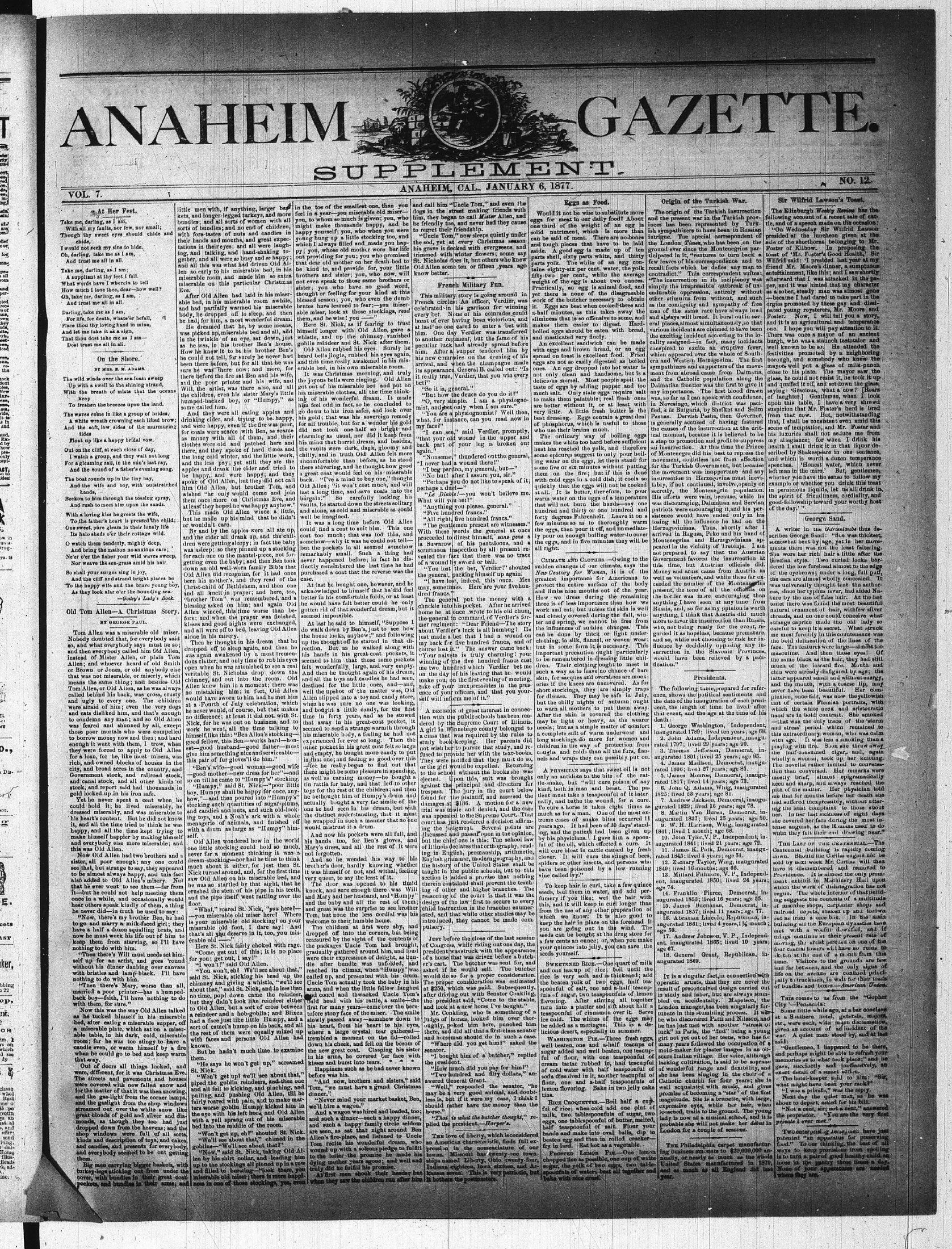
Searchable text
ANAHEIM
VOL. 7.
At Her Peet.
Take me, darling, as I am,
With all my faults, nor few, nor small;
Though thy sweet eyes should chide and chide,
I would not seek my sins to hide.
Oh, darling, take me as I am,
And trust me all in all.
Take me, darling, as I am;
A suppliant at thy feet I fall.
What words have I wherein to tell
How much I love thee, dear—how wall?
Oh, take me, darling, as I am,
And trust me all in all.
Darling, take me as I am,
For life, for death, what’s’er befall,
Place thou thy loving hand in mine,
And let me take it as a sign,
That thou dost take me as I am—
Doat trust me all in all.
On the Shore.
BY MRS. E. M. ADAMS.
The wild winds over the sea-foam sweep
Up with a swell to the shining strand,
With the breath of mists that the oceans keep
To freshen the breezes upon the land.
The waves come in like a group of brides,
A white wreath crowning each lifted brow;
And the soft, low sides of the murmuring tides
Float up like a happy bridal vow.
Out on the cliff, at each close of day,
I watch a group, and they wait not long
For a gleaming sail, in the sun's last ray,
little men with, if anything, larger bad kets, and longer-legged turkeys, and more bundles; and all sorts of women with all sorts of bundles; and no end of children, with fore-tastes of nuts and candies in their hands and mouths, and great expectations in their eyes; and all were laughing, and talking, and hand-shaking together, and all were so busy and so happy; and all this was what had driven Old Allen so early to his miserable bed, in his miserable room, and made him so extra miserable on this particular Christmas Eve.
After Old Allen had laid in his miserable bed, in his miserable room awhile, and had partially warmed his miserable body, he dropped off to sleep, and then he had, for him, a most wonderful dream.
He dreamed that he, by some means, was picked up, miserable bed and all, and in the twinkle of an eye, sat down just as he was, in his brother Ben's house. How he knew it to be his brother Ben's he could not tell, for surely he never had been there before, but for all that he was sure he was there now; and more, for there before the fire sat Ben and his wife, and the poor printer and his wife, and Will, the artist, was there also, and all the children, even his sister Mary's little humped-backed boy, or "Humpy," as some called him.
And they were all eating apples and drinking cider, and trying to be happy, and were happy, even if the fire was poor, for coals were scarce with Ben, as scarce as money with all of them, and their clothes were old and patched here and there, and they spoke of hard times and the long cold winter, and the little work, and the less pay; yet still they ate the
in the toe of the small feel in a year—you miss you, to whom so much might make thousand happy yourself; you, young hung up a little which I always filled uppy; you, whose old mind out providing for you that dear old mother can be kind to, and prove brothers and sister; not even speak to those sister; you who had thought or feeling for blessed season; you, brutes have learned to able miser, look at them, and be wise! you
Here St. Nick, as himself longer with his whistle, and up the goblin reindeer and S.
Old Allen rubbed his heard bells jingle, rude and this time really a terrible bed, in his own.
It was Christmas the joyous bells were got out of his miserable miserable clothes of his wonderfult him feel odd in fact; go down to his iron his gold; that was he for all trouble, but he did not look one-charming as usual; his mind that horrid the vaults were dark chilly, and in truth uncomfortable than
Old Tom Allen—A Christmas Story.
BY GEORGE PAUL
Tom Allen was a miserable old miser. Nobody doubted that, for everybody said so, and what everybody says must be so; and then everybody called him Old Allen, instead of Mister Allen, or plain Tom Allen; and whoever heard of old Smith or Brown or Jones, or old anybody else that was not miserable, or miserly, which means the same thing; and besides Old Tom Allen, or Old Allen, as he was always called behind his back, was cross, crusty and ugly to every one. The children were afraid of him; even the very dogs and cats disliked him, and that's enough to condemn any man; and so Old Allen was feared and shunned by all, except those poor mortals who were compelled to borrow money now and then; and hard enough it went with them. I trow, when they were forced to apply to Old Allen for a loan, for he, like most misers, was rich, and owned blocks of houses in the city, and broad acres in the country, and Government stock, and railroad stock, and canal stock, and all other kinds of stock, and report said had thousands in gold locked up in his iron safe.
Yet he never spent a cent when he could hold it; he lived miserably, he dressed miserably, and was miserable to his heart's content. But he did not know it, and all the time tried to think he was happy, and all the time kept trying to make himself happier by making himself and everybody else more miserable; and this was Old Allen.
Now Old Allen had two brothers and a sister, all poor enough; any one could see that, but strange to say, they appeared to be almost always happy, and this fact also added to Old Allen's misery. Not sure he was there now; and more, for there before the fire sat Ben and his wife, and the poor printer and his wife, and Will, the artist, was there also, and all the children, even his sister Mary's little humped-backed boy, or "Humpy," as some called him.
And they were all eating apples and drinking cider, and trying to be happy, and were happy, even if the fire was poor, for coats were scarce with Ben, as scarce as money with all of them, and their clothes were old and patched here and there, and they spoke of hard times and the long cold winter, and the little work, and the less pay; yet still they ate the apples and drank the cider and tried to be happy, and were happy; and they spoke of Old Allen, but they did not call him Old Allen, but brother Tom, and wished "he only would come and join them once more on Christmas Eve, at least they hoped he was happy anyhow."
This made Old Allen wince a little, but he made up his mind that he didn't or wouldn't care.
By and by the apples were all ate up, and the cider all drank up, and the children were getting sleepy; in fact the baby was asleep; so they pinned up a stocking for each one on the mantel-piece, not forgetting even the baby; and then Ben took down an old well-worn family Bible that Old Allen did recognize, for it had once been his mother's, and they read of the Christ-child of Bethlehem, and then one and all knelt in prayer; and here, too, "brother Tom" was remembered, and a blessing asked on him; and again Old Allen winced, this time worse than before; and when the prayer was finished, kisses and good nights were exchanged, and all were off to bed, leaving Old Allen alone in his misery.
Then he thought in his dream that he dropped off to sleep again, and then he was again awakened by a most tremendous clatter, and only time to rub his eyes open when he was astonished to see a real veritable St. Nicholas drop down the chimney, and out into the room. Old Allen knew him in a moment; there was no mistaking him; in fact, Old Allen would have sworn to him had he met him at a Fourth of July celebration, which he never would of course, but that makes no difference; at least it did not with St. Nick, for he was out on business, and to work he went, all the time talking to himself, like this: "Ben Allen's stocking—good fellow, this Ben—works hard—honest—good husband—good father—must give him something nice and serviceable—this pair of fur gloves'll do him."
"Ben's wife—good woman—good wife—good mother—new dress for her"—and so on till he came to "Humpy's" stocking.
"Humpy," said St. Nick—"poor little boy. Humpy shall be happy for once, anyhow,"—and then poured into "Humpy's" stocking such quantities of sugar-plums, candies and nuts, and such old-looking toys, and a Noah's ark with a whole menagerie of animals, and finished off with a drum as large as "Humpy" himself.
Old Allen wondered how in the world one little stocking could hold so much, never for a moment thinking it was a dream-stocking—nor had he time to think much about it either; for just then St. Nick turned around, and for the first time saw Old Allen on his miserable bed, and cure bed in his own ear.
It was Christmas the joyous bells were got out of his miserable clothes of his wonderful him feel odd in fact; go down to his iron gold; that was his gold; that was his for all trouble, but did not look one-charming as usual; his mind that horrid vaults were dark chilly, and in truth uncomfortable than there shivering; and a great coat would fit back. "I've a mind of Old Allen; "it won't last a long time, and bargain." So can vaults, he started downgoed alone, as cold as well be imagined.
It was a long time could find a coat to cover too much; thus somehow—why it wilt but the pockets in a remarkably small. Never happened because tinctly remembered purchased a coat this case.
At last he bought acknowledged to his better in his comfort he would have felt bad gotten rid of that we seemed impossible.
At last he said to do walk down by Belle house looks, any up the thought off her reaction. But as his hands in his gown seemed to him that felt wonderfully laud And then he thought all the toys destined for the life well the upshot of Allen slipped into it when he was sure and bought a little time in forty years that away in his seemed to send a stair his miserable body experienced for ever other pocket in his empty but he bought in such would mistrust it a.
And now his pooled his hands too for Mary's dress, and it not forgotten.
And so he went brother's door hand it was himself or not very queer; to say
Yet he never spent a cent when he could hold it; he lived miserably, he dressed miserably, and was miserable to his heart's content. But he did not know it, and all the time tried to think he was happy, and all the time kept trying to make himself happier by making himself and everybody else more miserable; and this was Old Allen.
Now Old Allen had two brothers and a sister, all poor enough; any one could see that, but strange to say, they appeared to be almost always happy, and this fact also added to Old Allen's misery. Not that he ever went to see them—far from it—but he could not help meeting them once in a while, and occasionally would hear others speak kindly of them, a thing he never did—in truth he used to say:
"Now, there's my brother Ben, he had to go and marry a milk-faced girl; they have a half a dozen squalling brats, and now he must work his life out of him to keep them from starving, so I'll have nothing to do with him.
'Then there's Mary, worse than all, married a poor printer—has a humped-back boy—faith, I'll have nothing to do with them, for sure.'"
Now this was the way Old Allen talked as he tucked himself in his miserable bed, after eating a miserable supper, off a miserable plate, which sat on a miserable table, in his dark, cold, miserable room; for he was too stingy to have a candle even, or warm himself by a fire when he could go to bed and keep warm that way.
Out of doors all things looked, and were different, for it was Christmas Eve. The streets and pavements and houses were covered with new fallen snow and for the matter of that it was then snowing, and the gas-light from the corner lamps, and the gaalight from the shop windows streamed out over the white snow like great clouds of gold and silver and diamonds, as though they too had just dropped down from the heavens; and the shop windows were full of all sorts, kinds and description of toys, and cakes, and candies, and presents for everybody, and everybody seemed to be out getting them.
Big men carrying bigger baskets, with turkey-leg sticking out from under the cover, with bundles in their great coat-pockets, and bundles in their arms; and "Humpy," said St. Nick—"poor little boy. Humpy shall be happy for once, anyhow,"—and then poured into "Humpy's" stocking such quantities of sugar-plums, and candies and nuts, and such old-looking toys, and a Noah's ark with a whole menagerie of animals, and finished off with a drum as large as "Humpy" himself.
Old Allen wondered how in the world one little stocking could hold so much, never for a moment thinking it was a dream-stocking—nor had he time to think much about it either, for just then St. Nick turned around, and for the first time saw Old Allen on his miserable bed, and he was so startled by that sight, that he crushed the stem of his pipe in his teeth, and the pipe itself went rattling over the floor.
"What," roared St. Nick, "you here?—you miserable old miser here! Where is your miserable old stocking? on your miserable old foot, I dare say! And that's all you deserve in it, too, you miserable old——"
Here St. Nick fairly choked with rage.
"Come, get out of this; it is no place for you; get out, I say!"
"I won't!" said Old Allen.
"You won't, eh! We'll see about that," said St. Nick, sticking his head up the chimney and giving a whistle, "we'll see about that," said St. Nick, and in less than no time, pop! down came the reindeer, but they didn't look like reindeer either to Old Allen, but a sort of cross between a reindeer and a hob-goblin; and Blixen had a face just like little Humpy, and a sort of camel's hump on his back, and all the rest of them were equally mixed up with faces and persons Old Allen had known.
But he hadn't much time to examine them.
"He says he won't get up," screamed St. Nick.
"Won't get up? we'll see about that," piped the goblin reindeers, and then one and all fell to kicking, and pinching, and pulling, and pushing Old Allen, till he fairly roared with pain, and to make matters worse goblin Humpy kicked him in the eye with his left hook and Old Allen with a yell sprang out of his miserable bed into the middle of the room.
"Won't get up, eh!" shouted St. Nick.
"We'll see about that," chimed in the gobblins—"We'll see about that!"
"Now," said St. Nick, taking Old Allen by his shirt collar, and leading him up to the stockings all pinned up in a row and filled to bursting—"look there, you miserable old miser; there is more happiness in one of those stockings, yes, even tin rattle for baby toys for the rest of me; he bethought him actually bought one he had seen in the distinct underwear he wrapped in such would mistrust it."
And now his pooh his hands too, for Mary's dress, and not forgotten.
And so he wore brother's door, hard it was himself or not very queer, to say
The door was knocked, and sure enlightened Mary and her baby and great was the Tom, but none the welcome to their home.
The children dropped off into the packages Uncle Gradually gathered were their expressions after bundle reached its climax called up, and pre-Uncle Tom actual arms, and when they cooed and thud'd head with first for many years to forestory face slowly passed away his heart from where a large corm trembled a mom down his cheek; as the new great cost in his arms, he kisses and burst into Happiness such before was his.
"And now brother Tom," we must dinner."
"Never mind you will hire a wagoon. And a wagon wagon such a dinner and such a happy are seen, as sat Allen's fire-places Tom recite his wound up with at to the letter the dying mother yet truly did he fulfill."
As first men when they saw th
IM GAZ
SUPPLEMENT.
ANAHEIM, CAL., JANUARY 6, 1877.
in the toe of the smallest one, than you feel in a year—you miserable old miser—you, to whom so much is given; you, who might make thousands happy, and be happy yourself; you, who when you were young hung up a little stocking too, and which I always filled and made you happy; you, whose old mother wore her life out providing for you; you who promised that dear old mother on her death-bed to be kind to, and provide for, your little brothers and sister; you, who now, will not even speak to those same brothers or sister; you who have no good word, thought or feeling for your kind at this blessed season; you, who even the dumb brutes have learned to fear;—you miserable miser, look at those stockings, read them, and be wise! you —"
Here St. Nick, as if fearing to trust himself long with Old Allen, gave a whistle, and up the chimney vanished goblin reindeer and St. Nick after them.
Old Allen rubbed his eyes. Surely he heard bells jingle, rubbed his eyes again, and this time really awakened in his miserable bed, in his own miserable room.
It was Christmas morning, and truly the joyous bells were ringing. Old Allen got out of his miserable bed and put on his miserable clothes, all the time thinking of his wonderful dream. It made him feel odd in fact, so he concluded to go down to his iron safes, and look over his gold; that was his sovereign remedy for all trouble, but for a wonder his gold did not look one-half so bright and charming as usual, nor did it keep from his mind that horrid dream, and besides, the vaults were dark, dark, gloomy and chilly, and in truth Old Allen felt more uncomfortable than before, as he stood in the toe of the smallest one, than you feel in a year—you miserable old miser—you, to whom so much is given; you, who might make thousands happy, and be happy yourself; you, who when you were young hung up a little stocking too, and which I always filled and made you happy; you, whose old mother wore her life out providing for you; you who promised that dear old mother on her death-bed to be kind to, and provide for, your little brothers and sister; you, who now, will not even speak to those same brothers or sister; you who have no good word, thought or feeling for your kind at this blessed season; you, who even the dumb brutes have learned to fear;—you miserable miser, look at those stockings, read them, and be wise! you —"
French Military Fun.
This military story is going around in French circles: An officer, Verdier, was celebrated in his garrison for winning every bet. None of his comrades could boast of ever having been victorious, and at last no one cared to enter a bet with him. One day Verdier was transferred to another regiment, but the fame of his peculiar luck had already spread before him. After a supper tendered him by his new comrades on the evening of his arrival, and when the champagne made its appearance General B. called out: "Is it really true, Verdier, that you win every bet?"
"So it is, general."
"But how the deuce do you do it?"
"O, very simple. I am a physiognomist, and met only when I am sure."
"You are a physiognomist? Well then, what, for instance, can you read now in my face?"
"I can see," said Verdier, promptly, "that your old wound in the upper and back part of your leg is broken out again."
"Nonsense," thundered out the general, "I never had a wound there!"
Eggs as Food.
Would it not be wise to substitute more eggs for meat in our daily food? About one third of the weight of an egg is solid nutriment, which is more than can be said of meat. There are no bones and tough pieces that have to be laid aside. A good egg is made up of ten parts shell, sixty parts white, and thirty parts yolk. The white of an egg contains eighty-six per cent. water, the yolk fifty-two per cent., while the average weight of the egg is about two ounces. Practically, an egg is animal food, and yet there is none of the disagreeable work of the butcher necessary to obtain it. Eggs are best when cooked three and a half minutes, as this takes away the slimness that is so offensive to some, and makes them easier to digest. Hard-boiled eggs should be eaten with bread, and masticated very finely.
An excellent sandwich can be made with eggs and brown bread, or an egg spread on toast is excellent food. Fried eggs are not so easily digested as boiled ones. An egg dropped into hot water is not only clean and handsome, but is a delicious morsel. Most people spoil the taste of eggs by adding pepper and too much salt. Only stale eggs require salt to make them palatable; real fresh ones are better without it, or at least with very little. A little fresh butter is the best dressing. Eggs contain a great deal of phosphorus, which is useful to those who use their brains much.
The ordinary way of boiling eggs makes the white too hard before sufficient heat has reached the yolk, and therefore some opicures suggest to only pour boiling water on the eggs, let them stand for a minute or so without putting them together.
It was Christmas morning, and truly the joyous bells were ringing. Old Allen got out of his miserable bed and put on his miserable clothes, all the time thinking of his wonderful dream. It made him feel odd in fact, so he concluded to go down to his iron safes, and look over his gold; that was his sovereign remedy for all trouble, but for a wonder his gold did not look one-half so bright and charming as usual, nor did it keep from his mind that horrid dream, and besides, the vaults were dark, dapp, gloomy and chilly, and in truth Old Allen felt more uncomfortable than before, as he stood there shivering, and he thought how good a great coat would feel on his miserable back. "I've a mind to buy one," thought Old Allen; "it won't cost much, and will last a long time, and save coals into the bargain." So carefully locking his vaults, he started down the streets solitary and alone, as cold and miserable as could well be imagined.
It was a long time before Old Allen could find a coat to suit him. This one cost too much; that was too thin, and somehow—why it was he could not tell—but the pockets in all seemed somehow remarkably small. Such a thing had never happened before; in fact he distinctly remembered the last time he had purchased a coat that the reverse was the case.
At last he bought one, however, and he acknowledged to himself that he did feel better in his comfortable folds, or at least he would have felt better could he only gotten rid of that wonderful dream, but it seemed impossible.
At last he said to himself, "Suppose I do walk down by Ben's, just to see how the house looks, anyhow;" and following up the thought off he started in that direction. But as he walked along with his hands in his great-coat pockets, it seemed to him that those same pockets felt wonderfully large, and very empty. And then he thought again of his dream, and all the toys and candies he had seen, destined for the little ones, and—and, well the upshot of the matter was, Old Allen slipped into a toy and candy store, when he was sure no one was looking, and bought a little candy, for the first time in forty years, and as he stowed that away in his great-coat pocket, it seemed to send a strange warmth through his miserable body, a feeling he had not experienced for ever so long. Then the other pocket in his great coat felt large and empty, he bought more candy to put in that one; and feeling so good over this—for he really began to find out that there might be some pleasure in spending, as well as earning money—he bought a tin rattle for baby, and that led to other toys for the rest of the children; and then he bethought him Humpy's drum and actually bought a very fac simile of the one he had seen in his dream, but with the distinct understanding, that it must be wrapped in such a manner that no one would mistrust it a drum.
And now his pockets were all full, and his hands too, for Ben's gloves, and Mary's dress, and all the rest of it were not forgotten.
And so he wended his way to his brother's door, hardly knowing whether it was himself or not, and withal, feeling very queer, to say the least of it.
General B. called out: "Is it really true, Verdier, that you win every bet?"
"So it is, general."
"But how the deuce do you do it?"
"O, very simple. I am a physiognomist, and bet only when I am sure."
"You are a physiognomist? Well then, what, for instance, can you read now in my face?"
"I can see," said Verdier, promptly,
"that your old wound in the upper and back part of your leg is broken out again."
"Nonsense," thundered out the general,
"I never had a wound there!"
"I beg pardon, my general, but—"
"No but! after I assure you, sir."
"Perhaps you do not like to speak of it; perhaps a duel—"
"Le Diable!" you won't believe me. What will you bet?
"Anything you please, general."
"五 hundred francs."
"All right, five hundred francs."
"The gentlemen present are witnesses." With these words the general at once proceeded to divest himself, sans gene à Suwarow, of his pantaloons, and a scrutinous inspection by all present revealed the fact that there was no trace of a wound by sword or ball.
"You lost the bet, Verdier!" shouted the general, packing himself up again.
"I have lost indeed, this once. Men may, sometimes. Here are your five hundred francs."
The general put the money with a chuckle into his pocket. After he arrived home at once wrote to his old chum, the general in command of Verdier's former regiment: "Dear Friend—The story about Verdier's luck is all humbug! He just made a bet that I had a wound on my back for five hundred francs, and of course lost it." The answer came back: "Your naivete is truly charming! your winning of the five hundred francs cost me two hundred which Verdier bet me on the day of his leaving that he would make you, on the first evening of meeting, take off your inexpressibles in the presence of your officers, and that you yourself will inform me of it."
A decision of great interest in connection with the public schools has been rendered by the Supreme Court of Illinois. A girl in Winnebago county belonged to a class that was required by the rules to study book-keeping. Her parents did not wish her to pursue that study, and refused to provide her with the text-books. They were notified that they must do so, or the girl would be expelled. Returning to the school without the books she was ejected. Upon this, suit was brought against the principal and directors for trespass. The jury in the court below found for the plaintiff, and assessed the damages at $136. A motion for a new trial was made and denied, and the case was appealed to the Supreme Court. That court has just rendered a decision affirming the judgment. Several points are discussed and passed upon in the opinion, but the chief one is this: The school law of Illinois declares that orthography, reading in English, penmanship, arithmetic, English grammar, modern geography, and the history of the United States shall be taught in the public schools, but to this section is added a proviso that nothing is contained within them.
An egg dropped into hot water is not only clean and handsome, but is much salt. Only stale eggs require salt to make them palatable; real fresh ones are better without it, or at least with very little. A little fresh butter is the best dressing. Eggs contain a great deal of phosphorus, which is useful to those who use their brains much.
The ordinary way of boiling eggs makes the white too hard before sufficient heat has reached the yolk, and therefore some epicures suggest to only pour boiling water on the eggs, let them stand for some five or six minutes without putting them on the fire; but if this is done with cold eggs in a cold dish, it cools so quickly that the eggs will not be cooked at all. It is batter; therefore, to pour warm water on the eggs of a temperature that will not burn the hands—say one hundred and thirty or one hundred and forty degrees Fahrenheit. Leave it on a few minutes so as to thoroughly warm the eggs; then pour it off; and immediately pour on enough boiling water to cover the eggs; and in five minutes they will be all right.
Climate AND Clothes.—Owing to the sudden changes of our climate, says the New Century for Women, it is of the greatest importance for Americans to protect the entire surface of the body and limbs nine months out of the year. How we dress during the remaining three is of less importance than how we work and eat; but unless the skin is well and closely covered during the fall, winter and spring, we cannot be free from the influences of sudden changes. This can be done by thick or light underclothing; in silk, flannel; or woven wear; but in some form it is necessary. Important precaution ought particularly to be remembered in dressing little children. Their clothing ought to meet in such a way as to leave no chance of bare skin; for sacques and overshoes are mockeries if the knees are uncovered. As for short stockings they are simply traps for disease. They may be safe in July, but the chilly nights of autumn ought to warn all mothers to put them away. After the skin is covered the clothing may be light or heavy, as the wearer needs; but as a simple matter of comfort a complete suit of warm underwear and long stockings do more for women and children in the way of protection from coughs and colds than all the furs, flannels and wraps they can possibly put on.
A physician says that sweet oil is not only an antidote to the bite of the rattle-snake, but "will cure poison of any kind," both in man and beast. The patient must take a teaspoonful of it internally, and bathe the wound; for a cure. To cure a horse it takes eight times as much as for a man. One of the most extreme cases of snake bites occurred 11 years ago. It had been of 30 days' standing,andthepatienthadbeengivenupbyhisphysicians.Iwerehimapoisonofthe油which effecteda cure.Iwillcurebloatin cattlecausedbyfresh clover.Iwillcuretheskingsofbees,spidersorotherinsects,andpersonwhohavebeenpoisonedbyalowrunningvinecalledivy."
And now his pockets were all full, and his hands too, for Ben's gloves, and Mary's dress, and all the rest of it were not forgotten.
And so he wended his way to his brother's door, hardly knowing whether it was himself or not, and withal, feeling very queer, to say the least of it.
The door was opened to his timid knock, and sure enough there was Will and Mary and her husband, and "Humpy" and the baby and all the rest of them; and great was the surprise to see brother Tom, but none the less cordial was his welcome to their humble home.
The children at first were shy, and dropped off into the corners, but being reassured by the sight of the contents of the packages Uncle Tom had brought, gradually gathered around him, and loud were their expressions of delight, as bundle after bundle was unfolded, and reached its climax, when "Humpy" was called up, and presented with his drum. Uncle Tom actually took the baby in his arms, and when the little fellow laughed and cooed and thwacked Uncle Tom's bald head with his rattle, a smile—the first for many years—came over the heretofore stony face of the miser. The smile slowly passed away—somehow down to his heart, from his heart to his eyes, where a large crystal tear gathered—trembled a moment on the lid—rolled down his cheek, and fell on the bosom of the new great coat. Clasping his sister in his arms, he covered her face with kisses and burst into tears.
Happiness such as he had never known before was his.
And now, brothers and sisters," said Tom, "we must have a grand Christmas dinner."
"Never mind your market basket, Ben, we'll hire a wagon."
And a wagon was hired and loaded, too; and such a dinner—such a happy dinner, and such a happy family circle seldom are seen, as sat that night around Ben Allen's fire-place, and listened to Uncle Tom recite his wonderful dream, who wound up with a solemn pledge to fulfill to the letter the promise he made his dying mother years ago; and well and truly did he fulfill his promise.
At first men shook their heady but when they saw the children run after him against the principal and directors for trespass. The jury in the court below found for the plaintiff, and assessed the damages at $136. A motion for a new trial was made and denied, and the case was appealed to the Supreme Court. That court has just rendered a decision affirming the judgment. Several points are discussed and passed upon in the opinion, but the chief one is this: The school law of Illinois declares that orthography, reading in English, penmanship, arithmetic, English grammar, modern geography, and the history of the United States shall be taught in the public schools, but to this section is added a proviso that nothing therein contained shall prevent the teaching of other and higher branches. The reasoning of the court is that it was the design of the law first to secure to every child instruction in the branches enumerated, and that while other studies may be introduced, they cannot be made compulsory.
Just before the close of the last session of Congress, while riding out one day, the president was struck with the appearance of a horse that was driven before a butcher's cart. The butcher was sent for, and asked if he would sell. The butcher would do so for a proper consideration. The proper consideration was estimated at $250, which was paid. Subsequently, after driving out with Senator Conkling, the president said, "Come to the stable, and look at a new horse I've bought."
Mr. Conkling, who is something of a judge of horses, looked him over thoroughly, poked him here, punched him there, and did all that a first-class senator and horseman should do in such a case.
"Where did you get him?" asked the senator.
"I bought him of a butcher," replied the president.
"How much did you pay for him?"
"Two hundred and fifty dollars," answered General Grant.
"Well," responded the senator, "he may be a very good animal, and doubtless is, but if it were my case, I think I should rather have the money than the horse."
"That is what the butcher thought," replied the president—Harper's.
The love of liberty, which is considered an American characteristic, finds full expression in the nomenclature of our towns. Missouri has twenty-one townships named Liberty, Ohio twenty-four Indiana eighteen Iowa sixteen Arkansas seven. This is very patriotic, but it bothers the postmaster.
To keep hair in curl, take a few quince seeds, boil them in water, and add perfumery if you like; wet the hair with this, and it will keep in curl longer than from the use of any other preparation of which we know: It is also good to keep the hair in place on the forehead if you are going out in the wind. The seeds can be bought at the drug store for a few cents an ounce; or, when you make your quinces into jelly, you can save the seeds yourself.
SWEETENED RICE.—One quart of milk and one teacup of rice; boil until the rice is very soft and is thickened; add the beaten yolk of two eggs, half teacupful of salt, one and a-half teacupfuls of sugar, two teaspoonfuls of lemon flavoring. After stirring all together turn into a platter and sift about half a teacupful of cinnamon over it. Serve ice cold. The whites of the eggs may be added as a meringue. This is a delicious desert, especially in summer.
WASHINGTON PIE.—Three fresh eggs, well beaten, one and a-half teacups of sugar added and well beaten, one teacupful of flour, with one teaspoonful of cream tartar rubbed in, half teacupful of cold water with half teaspoonful of soda dissolved in it; another teacupful of flour, one and a-half teacupfuls of lemon flovoring. Bake in two jelly cake tins.
RICE CROQUETTES.—Boil half a cupful of rice; when cold add one pint of milk, two tablespoonfuls of sugar, two eggs, one tablespoonful of butter,melted,half teacupful of salt. Flour your hands and make into oval balls,dip in beaten egg and then in rolled cracker—fry in lard. Eat hot as a vegetable.
FROWDED LEMON PIE.—One lemon chopped fine as possible,一杯cupofwhite sugar,the yolkoftwoeggs,twotablespoonfulsofwater,bastealltogetherandbakewithnicecrust.
GAZETTE.
NO. 12.
Food.
No substitute more easily food! About it of an egg is it is more than there are no bones have to be laid made up of ten white, and thirty of an egg con- tent water, the yolk while the average about two ounces. Animal food, and the disagreeable necessary to obtain cooked three and takes away the digestive to some, and digest. Hard-haten with bread, likely.
Which can be made bread, or an egg lent food. Fried ingested as boiled into hot water is handsome, but is a bit people spoil the pepper and too eggs require salt; real fresh ones or at least with fresh butter is the contain a great deal useful to those much.
Of boiling eggs before sufficient milk, and therefore to only pour boillet them stand for without putting
Origin of the Turkish War.
The origin of the Turkish insurrection and the present war in the Turkish provinces has been represented by Turkish sympathizers to have been in Russian intrigue. The special correspondent of the London Times, who has been on the ground ever since the Montenegrins participated in it, "ventures to turn back a few leaves of his correspondence and to recall facts which he defies any man to contradict." This correspondent writes: "The insurrection in its incipiency was simply the irrepressible outbreak of unendurable oppression, entirely without other stimulus from without, and such as the contiguity and sympathy of free men of the same race have always bred and always will breed. It burst out in several places, almost simultaneously, so that various incidents are claimed to have been the exciting incident according to the locality assigned—in fact, many incidents conspired to excite an eruptive fever, which appeared over the whole of Southern and Western Herzagovina. The first sympathizers and supporters of the movement from abroad came from Dalmatia, and the Catholic population along the Dalmatian frontier was the first to give it any importance. The first blood drawn was, so far as I can speak with confidence, in Nevesinge, which district was pacified, a la Bulgaria, by Shefket and Selim Pasnas. Dervish Pasha, then Governor, is generally accused of having fostered the causes of the insurrection at the critical moment, because it is believed to be a step to promotion and profit to suppress an insurrection. At this time the Prince of Montenegro did his best to repress the movement, doubtless not from affection for the Turkish Government, but because
Sir Wilfrid Lawson's Toast.
The Edinburgh Weekly Review has the following account of a recent sale of cattle, and of a speech made on the occasion:
"On Wednesday Sir Wilfrid Lawson presided at the luncheon given at the sale of the shorthorns belonging to Mr. Foster of Kilhow. In proposing the toast of 'Mr. Foster's Good Health,' Sir Wilfrid said: 'I presided last year at my friend Mr. Moore's dinner, a sumptuous entertainment, like this; and I saw shortly afterward that I was attacked in the paper, and it was hinted that my character as a sober, steady man was almost gone—because I had dared to take part in the orgies promoted by these gay and dissipated young roysters, Mr. Moore and Foster. Now, I will tell you a story, and it is an agricultural and temperance one. I hope you will pay attention to it. There was once a mayor of an ancient burgh, who was a staunch teetotaler and well known to be so. He attended the festivities promoted by a neighboring borough, and somebody who knew the mayor well put a glass of milk-punch close to his plate. The mayor saw the glass, he could not resist it, he took it up and quaffed it off, and set down the glass, saying: 'Gracious, what a cow!' [Roars of laughter.] Gentlemen, when I look upon this table, I have a very shrewd suspicion that Mr. Foster's herd is bred from that cow. But, notwithstanding that, I shall be consistent even amid this scene of temptation, and Mr. Foster and his luxuries shall not seduce me from my allegiance; for when I drink his health I shall drink it in that liquor described by Shakespeare in one sentence, and which is worth a dozen temperance speeches.'
of boiling eggs before sufficientolk, and therefore to only pour boillet them stand for less without putting out if this is done and dish, it cools so will not be cooked therefore, to pour eggs of a temperature the hands—say one one hundred and eit. Leave it on a thoroughly warm off, and immediate filling water to cover minutes they will be
Owing to the climate, says the man, it is of the for Americans to surface of the body is out of the year. Being the remaining chance than how we press the skin is well during the fall, win-not be free from even changes. This skink or light underdish, or woven wear; is necessary. This brought particularly pressing little chillought to meet in no chance of bare overcoats are mock-uncovered. As for are simply traps may be safe in July, of autumn ought to put them away. Covered the clothing lvy, as the wearer matter of comfort form underwear and care for women and of protection from all the furs, flaunan possibly put on.
That sweet oil is not the bite of the rat-cure poison of any and beast. The pa-poonful of it interwound, for a cure. Kinks eight times as One of the most ex-bites occurred 11 men of 30 days' stand-nd been given up gave him a spoon-effected a cure. It little caused by fresh stings of bees, rats, and persons who by a low running symptom from abroad came from Dalmatia, and the Catholic population along the Dalmatian frontier was the first to give it any importance. The first blood drawn was, so far as I can speak with confidence, in Nevesinge, which district was pacified, a la Butgaria, by Shefket and Selim Pashas. Dervish Pasha, then Governor, is generally accused of having fostered the causes of the insurrection at the critical moment, because it is believed to be a step to promotion and profit to suppress an insurrection. At this time the Prince of Montenegro did his best to repress the movement, doubtless not from affection for the Turkish Government, but because the movement was inopportune and any insurrection in Herzegovina must inevitably, if not continued, involve openly or secretly, the Montenegrin population. His efforts were vain, because, while he was discouraging, Dalmatian and Servian patriots were encouraging it, and his persistence would have ended only in his losing all the influence he had on the Herzegovinians. Thus, shortly after I arrived in Ragusa, Peko and his band of Montenegrins and Herzegovinians appeared in the vicinity of Trebinje. I am not prepared to say that the Austrian Government favored the insurrection at this time, but Austrian officials did. Money and arms came from Austria as well as volunteers, and while these far exceeded the number of the Montenegrins present, the tone of all the officials on the border was more encouraging than anything I have seen at any time from Russia, and, so far as my opinion is worth anything, I think that Austria did much more to favor the insurrection than Russia, who not being ready for the event, regarded it as hopeless, because premature, and so, while not choosing to risk her influence by decidedly opposing any insurrection in the Slavonic Provinces, would have been relieved by a pacification."
Presidents.
The following table, prepared for reference, shows the political sentiments and the date of the inauguration of each president, the length of time he lived after that event, and the age at the time of his death:
1. George Washington, Independent, inaugurated 1789; lived ten years; age 68.
2. John Adams, Independent, inaugurated 1797; lived 29 years; age 90.
3. Thomas Jefferson, Democrat, inaugurated 1801; lived 25 years; age 85.
4. James Madison, Democrat, inaugurated 1806; lived 27 years; age 85.
5. James Monroe, Democrat, inaugurated 1817; lived 14 years; age 73.
6. John Q. Adams, Whig, inaugurated 1825; lived 23 years; age 81.
7. Andrew Jackson, Democrat, inaugurated 1829; lived 16 years; age 78.
8. Martin Van Buren, Democrat, inaugurated 1837; lived 25 years; age 80.
9. W. H. Harrison, Whig, inaugurated 1841; lived 1 month; age 68.
10. John Tyler, V. P., Independent, inaugurated 1841; lived 21 years; age 72.
11. James K. Polk, Democrat, inaugurated 1845; lived 4 years; age 54.
12. Zachary Taylor, Whig, inaugurated 1849; lived 16 months; age 66.
13. Millard Fillmore, V. P., Independent, inaugurated 1850; lived 24 years;
close to his plate. The mayor saw the glass, he could not resist it, he took it up and quaffed it off, and set down the glass, saying: 'Gracious, what a cow! [Roar of laughter.] Gentlemen when I look upon this table, I have a very shrewd suspicion that Mr. Foster's herd is bred from that cow. But, notwithstanding that, I shall be consistent even amid this scene of temptation, and Mr. Foster and his luxuries shall not seduce me from my allegiance; for when I drink his health I shall drink it in that liquor described by Shakespeare in one sentence,and which is worth a dozen temperance speeches.' Honest water, which never left man in the mire.' But gentlemen whether you have the sense to follow my example or whether you drink this toast in pernicious liquids, let us all drink in the spirit of friendliness, cordiality,and good-fellowship toward your worthy host of the day."
George Sand.
A writer in the Guirenlaube thus describes George Sand: "Sue was thickset somewhat beat by age yet in her movements there was not the least faltering. Sue wore her rich hair a little after the grecian style. Two curled locks bordered the low forehead almost to the edge of the eyebrows; under a long full puff,the ears are almost wholly concealed. It was universally thought that the authoress since her typhus never had aided Nature by the use of false hair. At the last toilet there was found the most beautiful natural ornament of hair with few silver threads,and no one could conceive what strange caprice made the old lady so careful to keep it a secret. What struck me most forebly in this countenance was the bold delineation of the lines of the face.The features were large—almost too masculine.And then those eyes! Of the same black as-the hair,they had still much of the inward fire.Mouth and chin were already disfigured by age;the latter appeared small and without energy,and the mouth with a coarse lip,may never have been beautiful.Her complexion once-fair was now the yellowish tint of certain Flemish portraits.with which the white neck and aristocratic hand are in bold contrast.She smoked—that was the only trace of the 'storm and stress' period which remained to this extraordinary womanwho was calm with age。它 was less a smoking than a playing with fire.Soon she threw awaythe half consumed cigar,and again wholly a woman,took up her knitting.The novelist rather incited to conversation than conversed.Her remarks were mostly brief,simply epigramatically keen and sharp,and always reached the pith of the matter.Her physician told me that for months before her death she had suffered inexpressiblywithout utteringthe least complaintto those about her.In her last sickness of eight daysshe covered her face during the most intense anguish.as the Romans used to dowhen they felt their end drawing near."
THE LAST OF THE CENTENNIAL—The Centennial building is rapidly coming down.Should the Corlis engine not be sold by next week Mr. Corlis will then have it dismembered and removed to Providence.it is almost only prominent exhibit in Machinery Hall upon
One quart of milk price; boil until the and is thickened; add two eggs, half tea and a-half teacup-teaspoonfuls of lemon stirring all together and sift about half a lemon over it. Serve of the eggs mayague. This is a dearly in summer.
Three fresh eggs, add a-half teacups of oil beaten, one teacup-teacup of one teaspoonful of and in, half teacup-teacup of another teacup-teacup of half teacup-teacup of another teacup-teacup of half teacup-teacup of half teacup-teacup of half teacup-teacup of half teaccup-teacup of half teacup-teacup of half teaccup-teacup of half teaccup-teacup of half teaccup-teacup of half teaccup-teacup of half teaccup-teacup of half teaccup-teacup of half teaccup-teacup of half teaccup-teacup of half teaccup-teacup of half teaccup-teacup of half teaccup-teacup of half teaccup-teacup of half teaccup-teacup of half teaccup-teacup of half teaccup-teacup of half teaccup-teacup of half teaccup-teacup of half teaccup-teacup of half teaccup-teacup of half teaccup-teacup of half teaccup-teacup of half teACUP TEACUP TEACUP TEACUP TEACUP TEACUP TEACUP TEACUP TEACUP TEACUP TEACUP TEACUP TEACUP TEACUP TEACUP TEACUP TEACUP TEACUP TEACUP TEACUP TEACUP TEACUP TEACUP TEACUP TEACUP TEACUP TEACUP TEACUP TEACUP TEACUP TEACUP TEACUP TEACUP TEACUP TEACUP TEACUP TEACUP TEACUP TEACUP TEACUP TEACUP TEACUP TEACUP TEACUP TEACUP TEACUP TEACUP TEACUP TEACUP TEACUP TEACUP TEACUP TEACUP TEACUP TEACUP TEACUP TEACUP TEACUP TEACUP TEACUP TEACUP TEACUP TEACUPTE AC UP TEA AC UP TEA AC UP TEA AC UP TEA AC UP TEA AC UP TEA AC UP TEA AC UP TEA AC UP TEA AC UP TEA AC UP TEA AC UP TEA AC UP TEA AC UP TEA AC UP TEA AC UP TEA AC UP TEA AC UP TEA AC UP TEA AC UP TEA AC UP TEA AC UP TEA AC UP TEA AC UP TEA AC UP TEA AC UP TEA AC UP TEA AC UP TEA AC UP TEA AC UP TEA AC UP TEA AC UP TEA AC UP TEA AC UP TEA AC UP TEA AC UP TEA AC UP TEA AC UP TEA AC UP TEA AC UP TEA AC UP TEA AC UP TEA AC UP TEA AC UP TEA AC UP Tea ac up tea ac up tea ac up tea ac up tea ac up tea ac up tea ac up tea ac up tea ac up tea ac up tea ac up tea ac up tea ac up tea ac up tea ac up tea ac up tea ac up tea ac up tea ac up tea ac up tea ac up tea ac up tea ac up tea ac up tea ac up tea ac up tea ac up tea ac up tea ac up tea ac up tea ac up tea ac up tea ac up tea ac up Tea Ac Up Tea Ac Up Tea Ac Up Tea Ac Up Tea Ac Up Tea Ac Up Tea Ac Up Tea Ac Up Tea Ac Up Tea Ac Up Tea Ac Up Tea Ac Up Tea Ac Up Tea Ac Up Tea Ac Up Tea Ac Up Tea Ac Up Tea Ac Up Tea Ac Up Tea Ac Up Tea Ac Up Tea Ac Up Tea Ac Up Tea Ac Up Tea Ac Up Tea Ac Up Tea Ac Up Tea Ac Up Tea Ac Up Tea Ac Up Tea Ac Up Tea Ac Up Tea Ac Up TeaAcUpTeaAcUpTeaAcUpTeaAcUpTeaAcUpTeaAcUpTeaAcUpTeaAcUpTeaAcUpTeaAcUpTeaAcUpTeaAcUpTeaAcUpTeaAcUpTeaAcUpTeaAcUpTeaAcUpTeaAcUpTeaAcUpTeaAcUpTeaAcUpTeaAcUpTeaAcUpTeaAcUpTeaAcUpTeaAcUpTeaAcUpTeaAcUpTeaAcUpTeaAcUpTeaAcUpTeaAcUpTeaAcUpTeaAcUpTeaAcUpTeaAcUpTeaAcUpTeaAcUpTeaAcUpTeaAcUpTeaAcUpTeaAcUpTeaAcUpTeaAcUpTeaAcUpTeaAcUpTeaAcUpTeaAcUpTeaAcUpTeaAcUpTeaAcUpTeaAc_up TeaAc_up TeaAc_up Te茶Ac_up Te茶Ac_up Te茶Ac_up Te茶Ac_up Te茶Ac_up Te茶Ac_up Te茶Ac_up Te茶Ac_up Te茶Ac_up Te茶Ac_up Te茶Ac_up Te茶Ac_up Te茶Ac_up Te茶Ac_up Te茶Ac_up Te茶Ac_up Te茶Ac_up Te茶Ac_up Te茶Ac_up Te茶Ac_up Te茶Ac_up Te茶Ac_up Te茶Ac_up Te茶Ac_up Te茶Ac_up Te茶Ac_up Te茶Ac_up Te茶Ac_up Te茶Ac_up Te茶Ac_up Te茶Ace_up Te茶Ace_up Te茶Ace_up Te茶Ace_up Te茶Ace_up Te茶Ace_up Te茶Ace_up Te茶Ace_up Te茶Ace_up Te茶Ace_up Te茶Ace_up Te茶Ace_up Te茶Ace_up Te茶Ace_UP Te茶Ace_UP Te茶Ace_UP Te茶Ace_UP Te茶Ace_UP Te茶Ace_UP Te茶Ace_UP Te茶Ace_UP Te茶Ace_UP Te茶Ace_UP Te茶Ace_UP Te茶Ace_UP Te茶Ace_UP Te茶Ace_UP Te茶Ace_UP Te茶Ace_UP Te茶Ace_UP Te茶Ace_UP Te茶Ace_UP Te茶Ace_UP Te茶Ace_UP Te茶Ace_UP Te茶Ace_UP Te茶Ace_UP Te茶Ace_UP Te茶Ace_UP Te茶Ace_UP Te茶 ACE_UP Te茶 ACE_UP Te茶 ACE_UP Te茶 ACE_UP Te茶 ACE_UP Te茶 ACE_UP Te茶 ACE_UP Te茶 ACE_UP Te茶 ACE_UP Te茶 ACE_UP Te茶 ACE_UP Te茶 ACE_UP Te茶 ACE_UP Te茶 ACE_UP Te茶 ACE_UP Te茶 ACE_UP Te茶 ACE_UP Te茶 ACE_UP Te茶 ACE_UP Te茶 ACE_UP Te茶 ACE_UP Te茶 ACE_UP Te茶 ACE_UP Te茶 ACE_UP Te茶 ACE_UP Te茶 ACE_UP Te茶 ACE_UP