anaheim-gazette 1877-01-06
Scanned page
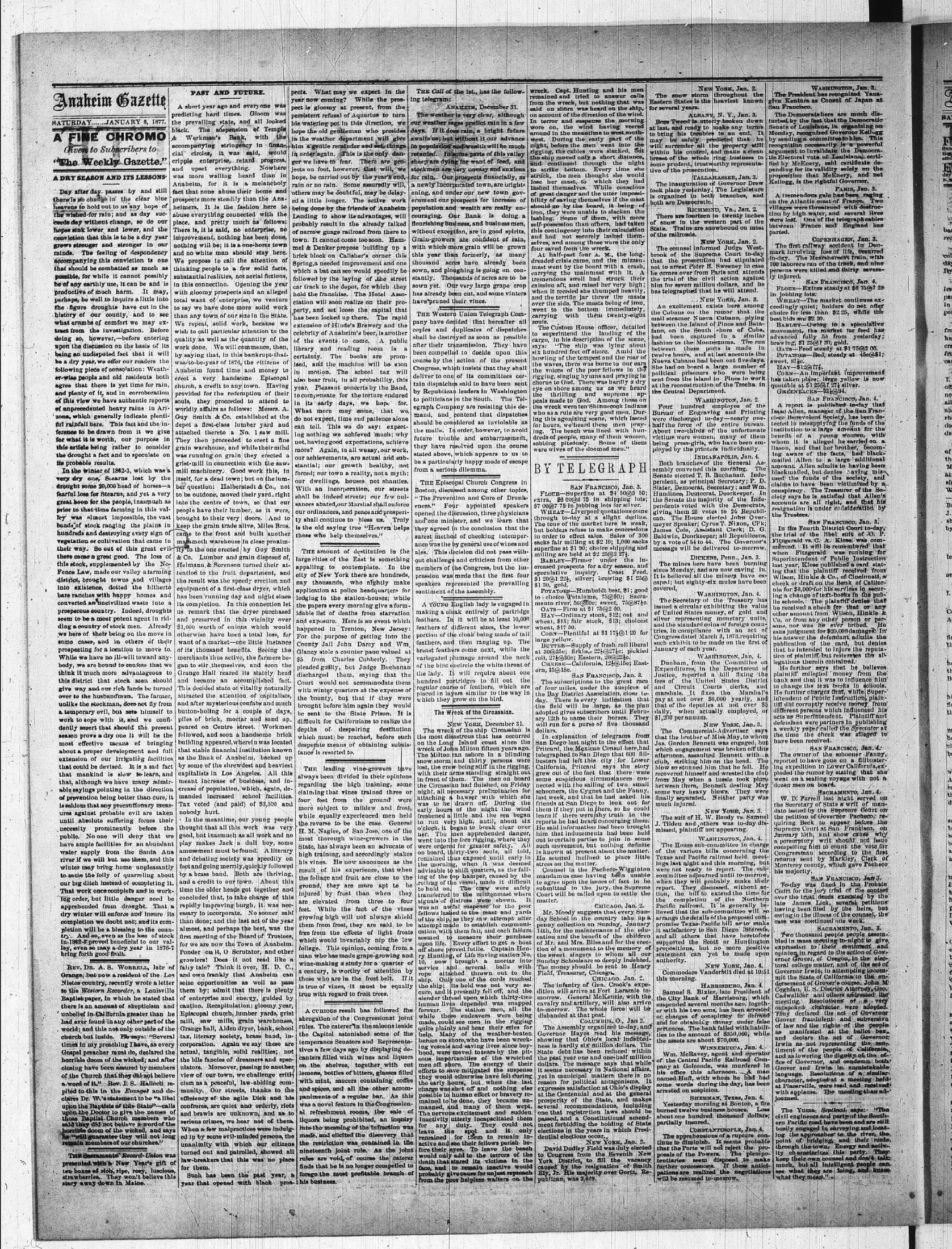
Searchable text
Anaheim Gazette
SATURDAY...JANUARY 5, 1877.
A FINE CHROMO
Given to Subscribers to
"The Weekly Gazette."
A DRY SEASON AND ITS LESSONS
Day after day passes by and still there is no change in the clear blue heavens to hold out to us any hope of the wished-for rain; and as day succeeds day without change, so do our hopes sink lower and lower, and the conviction that this is to be a dry year grows stronger and stronger in our minds. The feeling of despondency accompanying this conviction is one that should be combatted as much as possible, for while it cannot possibly be of any earthly use, it can be and is productive of much harm. It may, perhaps, be well to inquire a little into the figure droughts have cut in the history of our county, and to see what crumbs of comfort we may extract from the investigation. Before doing so, however,—before entering upon the discussion on the basis of its being an undisputed fact that it will be a dry year, we offer our readers the following piece of consolation: Weather-wise people and old residents both agree that there is yet time for rain, and plenty of it, and in corroboration of this view we have authentic reports of unprecedented heavy rains in Arizona, which generally indicate plentiful rainfall here. This fact and the inference to be drawn from it we give for what it is worth, our purpose in this article being rather to consider the drought a fact and to speculate on its probable results.
PAST AND FUTURE.
A short year ago and everyone was predicting hard times. Gloom was the prevailing state, and all looked black. The suspension of Temple & Workman's Bank, with the accompanying stringency in financial circles, it was said, would cripple enterprise, refard progress, and upset everything. Nowhere was more walling heard than in Anaheim, for it is a melancholy fact that none abuse their home and prospects more steadily than the Anaheimers. It is the fashion here to abuse everything connected with the place, and pretty much as follows: There is, it is said, no enterprise, no improvement, nothing has been done, nothing will be; it is a one-horse town and no white man should stay here. We propose to call the attention of thinking people to a few solid facts, substantial realities, not aerial fictions, in this connection. Opening the year with gloomy prospects and an alleged total want of enterprise, we venture to say we have done more solid work than any town of our size in the State. We repeat, solid work, because we wish to call particular attention to the quality as well as the quantity of the work done. We will commence, then, by saying that, in this bankrupt-that-was-to-be-year of 1876, the citizens of Anaheim found time and money to erect a very handsome Episcopal church, a credit to any town. Having provided for the redemption of their souls, they proceeded to attend to worldly affairs as follows: Messrs. A. Guy Smith & Co. established at the depot a first-class lumber yard and attached thereto a No. 1 saw mill. They then proceeded to erect a fine grain warehouse, and while their mind was running on grain they erected a grist-mill in connection with the saw-parts. What may we year now coming? The prospect is gloomy at present; refusal of A. his watering pot in the hope the old gentlemen in the weather depart him a gentle reminder in order again. This anger we have to fear. Objects on foot, however hope, be carried out by rain or no rain. Some others may be doubtful a little longer. The being done by the frisk Landing to show it probably result in the of narrow guage railroad town. It cannot come mel & Denker propose brick block on Calish Spring,a needed improv which a bat can see followed by the laying car track to the deposit hold the franchise. Citation will soon real property, and set loose has been locked up the extension of Hinde's celebrity of Anaheim of the events to library and reading certainty. The bookised, and the machine-in motion. The also bear fruit, in all year. Pleasant concludes to compensate for them in its early days. What more may do not expect, time can tell. This we ing nothing we achieve not having good exp more? Again, to all our achievements, and stantial: our growth.
following piece of consolation: Weather-wise people and old residents both agree that there is yet time for rain, and plenty of it, and in corroboration of this view we have authentic reports of unprecedented heavy rains in Arizona, which generally indicate plentiful rainfall here. This fact and the inference to be drawn from it we give for what it is worth, our purpose in this article being rather to consider the drought a fact and to speculate on its probable results.
In the winter of 1862-3, which was a very dry one, Stearns lost by the drought some 20,000 head of horses—a fearful loss for Stearns; and yet a very great boon for the people, inasmuch as prior to that time farming in this valley was almost impossible, the vast bands of stock ranging the plains in hundreds and destroying every sign of vegetation or cultivation that came in their way. So out of this great evil there came a great good. The loss of this stock, supplemented by the No-Fence Law, made our valley a farming district, brought towns and villages into existence, dotted the hitherto bare ranches with happy homes and converted an uncivilized waste into a prosperous country. Indeed, droughts seem to be a most potent agent in ridding a country of stock men. Already we here of their being on the move in some cases, and in others of their prospecting for a location to move to. While we have no ill-will toward anybody, we are bound to confess that we think it much more advantageous to this district that stock men should give way and our rich lands be turned over to the husbandman. The farmer, unlike the stockman, does not fly from a temporary evil, but sets himself to work to cope with it, and we confidently assert that should the present season prove a day one it will be the most effective means of bringing about a proper development and full extension of our irrigating facilities that could be devised. It is a sad fact that mankind is slow to learn, and that, although we have many admirable sayings pointing in the direction of prevention being better than cure, it is seldom that any precautionary measures against probable evil are taken until absolute suffering forces their necessity prominently before the public. No one will deny that we have ample facilities for an abundant water supply from the Santa Ana river if we will but use them, and this winter may bring home unpleasantly to some the folly of quarreling about our big ditch instead of compiling it.
Anahaim found time and money to erect a very handsome Episcopal church, a credit to any town. Having provided for the redemption of their souls, they proceeded to attend to worldly affairs as follows: Messrs. A. Guy Smith & Co. established at the depot a first-class lumber yard and attached thereto a No. 1 saw mill. They then proceeded to erect a fine grain warehouse, and while their mind was running on grain they erected a grist-mill in connection with the sawmill machinery. Good work this, in itself, for a dead town; but on the lumber question: Halberstadt & Co., not to be outdone, moved their yard right into the centre of town, so that our people have their lumber, as it were, brought to their very doors. And to keep the grain trade alive, Miles Bros. came to the front and built another marmoth warehouse in close proximity to the one erected by Guy Smith & Co. Lumber and grain disposed of, Heimann & Sorenson turned their attention to the fruit department, and the result was the speedy erection and equipment of a first-class dryer, which has been running day and night since its completion. In this connection let us remark that the dryer purchased and preserved in this vicinity over $1,000 worth of onions which would otherwise have been a total loss, for want of a market—one little instance of its thousand benefits. Seeing the merchants thus active, the farmers began to stir themselves; and soon the Grange Hall reared its stately head and became an accomplished fact. This decided state of vitality naturally attracted the attention of capitalists, and after mysterious confabs and much button-holling for a couple of days, piles of brick, mortar and sand appeared on Centre street. Workmen followed, and soon a handsome brick building appeared, wherein was located that stable financial institution known as the Bank of Anahaim, backed up by some of the shrewdest and heaviest capitalists in Los Angeles. All this meant increase of business, and increase of population, which again, demanded increased school facilities. Tax voted (and paid) of $3,500 and nobody hurt.
In the meantime, our young people thought that all this work was very good, but inasmuch as all work and no play makes Jack a dull boy, some amusement must be found. A literary and debating society was speedily on foot and going merrily, quickly followed by a brass band. Both are thriving, and a credit to our town. About this motion. The last also bear fruit, in all year. Pleasant condition to compensate for their in its early days.
What more may do not expect, time can tell. This we are doing nothing we achieve not having good experience? Again, to allow our achievements, an stantial; our growth forced; our town a real our dwelling; how With an incorporation shall be indeed streets sancies abated, our Mills our ordinances, and plenty shall continue to continue to those who help them.
The amount of large cities of the Happily appalling to county city of New York that may thousands, we application at police lodging in the state the papers every month idleable list of deaths and exposure. Here happened in Trenzil For the purpose of County Jail John Glancy stole a count $5 from Charles pleaded guilty, but discharged them; Court would not act with winter quarter the county, but that brought before him be sent to the State difficult for California depths of despair which must be read desperate means ofistance is resorted to.
The leading wives always been divided regarding the high claiming that vines four feet from the more subject to while equally expected the reverse to be H. M. Naglee, of S. most thorough wint State, has always been high training, and his vines. He now result of his exp ective foliage and fruiting
REV. DR. A. S. WOBRELL, late of Orange; but now a resident of the Los Nietos country, recently wrote a letter to the Western Recorder, a Louisville Baptist paper, in which he stated that there is an amount of skepticism and unbelief in California greater than he had ever found in any other part of the world; and this not only outside of the church but inside. He says: "Several times in my preaching I have, as every Gospel preacher must do, declared the horrible doom of the wicked; and after closing have been assured by members of the Church that they did not believe a word of it." Rev. I. S. Kalloch replied to this in the Evangelist and declares Dr. W.'s statement to be "a libel upon the Baptists of this State"—calls upon the Doctor to give the names of those Baptist Church members who said they did not believe a word of the horrible doom of the wicked, and says he "will guarantee they will not long remain members of our churches."
The Sacramento Record-Union was presented with a New Year's gift of ten boxes of rich ripe rosy luscious strawberries. They won't believe this story away down in Maine.
In the meantime, our young people thought that all this work was very good, but inasmuch as all work and no play makes Jack a dull boy, some amusement must be found. A literary and debating society was speedily on foot and going merrily, quickly followed by a brass band. Both are thriving, and a credit to our town. About this time the older heads got together and concluded that, to take charge of this rapidly improving burgh, it was necessary to incorporate. No sooner said than done; and the last act of the year almost, and perhaps the best, was the first meeting of the Board of Trustees, for we are now the Town of Anaheim. Ponder on it, O Scrutator, and other growlers! Does it not read like a fairy tale? Think it over, H. D. C., and own frankly that Anaheim can seize opportunities as well as pass them by; admit that there is plenty of enterprise and energy, guided by caution. Recapitulation: gloomy year, Episcopal church, lumber yards, grist mill, saw mills, grain warehouses, Grange hall, Alden dryer, bank, school tax, literary society, brass band, incorporation. Again we say these are actual, tangible, solid realities; not the idle fancies of dreamers and speculators. Moreover, passing to another view of our town, we challenge criticism as a peaceful, law-abiding community. Our streets, thanks to the efficiency of the agile Dick and his confreres, are quiet and orderly, riots and brawls are unknown, and as to serious crimes, we hear not of them. When a few malpractices were indulged in by some evil-minded persons, the unanimity with which our citizens turned out and patrolled, showed all law-breakers that this was no place for them.
Such has been the past year, a year that opened with black prosecutions of population, which again demanded increased school facilities. Tax voted (and paid) of $3,500 and nobody hurt.
In the meantime, our young people thought that all this work was very good, but inasmuch as all work and no play makes Jack a dull boy, some amusement must be found. A literary and debating society was speedily on foot and going merrily, quickly followed by a brass band. Both are thriving, and a credit to our town. About this time the older heads got together and concluded that, to take charge of this rapidly improving burgh, it was necessary to incorporate. No sooner said than done; and the last act of the year almost, and perhaps the best, was the first meeting of the Board of Trustees, for we are now the Town of Anaheim. Ponder on it, O Scrutator, and other growlers! Does it not read like a fairy tale? Think it over, H. D. C., and own frankly that Anaheim can seize opportunities as well as pass them by; admit that there is plenty of enterprise and energy, guided by caution. Recapitulation: gloomy year, Episcopal church, lumber yards, grist mill, saw mills, grain warehouses, Grange hall, Alden dryer, bank, school tax, literary society, brass band, incorporation. Again we say these are actual, tangible, solid realities; not the idle fancies of dreamers and speculators. Moreover, passing to another view of our town, we challenge criticism as a peaceful, law-abiding community. Our streets, thanks to the efficiency of the agile Dick and his confreres, are quiet and orderly, riots and brawls are unknown, and as to serious crimes, we hear not of them. When a few malpractices were indulged in by some evil-minded persons, the unanimity with which our citizens turned out and patrolled, showed all law-breakers that this was no place for them.
Such has been the past year, a year that opened with black prosecutions of population which again demanded increased school facilities. Tax voted (and paid) of $3,500 and nobody hurt.
In the meantime, our young people thought that all this work was very good, but inasmuch as all work and no play makes Jack a dull boy, some amusement must be found. A literary and debating society was speedily on foot and going merrily, quickly followed by a brass band. Both are thriving, and a credit to our town. About this time the older heads got together and concluded that, to take charge of this rapidly improving burgh, it was necessary to incorporate. No sooner said than done; and the last act of the year almost, and perhaps the best, was the first meeting of the Board of Trustees, for we are now the Town of Anaheim. Ponder on it, O Scrutator, and other growlers! Does it not read like a fairy tale? Think it over, H. D. C., and own frankly that Anaheim can seize opportunities as well as pass them by; admit that there is plenty of enterprise and energy, guided by caution. Recapitulation: gloomy year, Episcopal church, lumber yards, grist mill, saw mills, grain warehouses, Grange hall, Alden dryer, bank, school tax,literary society,brass band,incorporation。Again we say these are actual,tangible,solid realities;not the idle fancies of dreamers和speculators。Moreover,passing to another view of our town,we challenge criticism as a peaceful,law-abiding community。Our streets,thanks to the efficiency of the agile Dick和his confreres,are quiet和orderly,riots和brawls are unknown,andasto seriouscrimes,wehearnotofthem。Whena fewmalpracticeswereindulgedinbysomeevil-mindedpersons,theunanimitywithwhichourcitizensturnedoutandpatrolledshowedalllaw-breakersthatthiswasnoplaceforsomethingwithwhichourcitizensturnedoutandpatrolledshowedalllaw-breakersthatthiswasnoplaceforsomethingwithwhichourcitizensturnedoutandpatrolledshowedalllaw-breakersthatthiswasnoplaceforsomethingwithwhichourcitizensturnedoutandpatrolledshowedalllaw-breakersthatthiswasnoplaceforsomethingwithwhichourcitizensturnedoutandpatrolledshowedalllaw-breakersthatthiswasnoplaceforsomethingwithwhichourcitizensturnedoutandpatrolledshowedalllaw-breakersthatthiswasnoplaceforsomethingwithwhichourcitizensturnedoutandpatrolledshowedalllaw-breakersthatthiswasnoplaceforsomethingwithwhichourcitizensturnedoutandpatrolledshowedalllaw-breakersthatthiswasnoplaceforsomethingwithwhichourcitizensturnedoutandpatrolledshowedalllaw-breakersthatthiswasnoplaceforsomethingwithwhichourcitizensturnedoutandpatrolledshowedalllaw-breakersthatthiswasnoplaceforsomethingwithwhichourcitizensturnedoutandpatrolledshowedalllaw-breakersthatthiswasnoplaceforsomethingwithwhichourcitizensturnedoutandpatrolledshowedalllaw-breakersthatthiswasnoplaceforsomethingwithwhichourcitizensturnedoutandpatrolledshowedalllaw-breakersthatthiswasnoplaceforsomethingwithwhichourcitizensturnedoutandpatrolledshowedalllaw-breakersthatthiswasnoplaceforsomethingwithwhichourcitizensturnedoutandpatrolledshowedalllaw-breakersthatthiswasnoplaceforsomethingwithwhichourcitizensturnedoutandpatrolledshowedalllaw-breakersthatthiswasnoplaceforsomethingwithwhichourcitizensturnedoutandpatrolledshowedalllaw-breakersthatthiswasnoplaceforsomethingwithwhichourcitizensturnedoutandpatrolledshowedalllaw-breakersthatthiswasnoplaceforsomethingwithwhichourcitizensturnedoutandpatrolledshowedalllaw-breakersthatthiswasnoplaceforsomethingwithwhichourcitizensturnedoutandpatrolledshowedalllaw-breakersthatthiswasnoplaceforsomethingwithwhichourcitizensturnedoutandpatrolledshowedalllaw-breakersthatthiswasnoplaceforsomethingwithwhichourcitizensturnedoutandpatrolledshowedalllaw-breakersthatthiswasnoplaceforsomethingwithwhichourcitizensturnedoutandpatrolledshowedalllaw-breakersthatthiswasnoplaceforsomethingwithwhichourcitizensturnedoutandpatrolledshowedalllaw-breakersthatthiswasnoplaceforsomethingwithwhichourcitizensturnedoutandpatrolledshowedalllaw-breakersthatthiswasnoplaceforsomethingwithwhichourcitizensturnedoutandpatrolledshowedalllaw-breakersthatthiswasnoplaceforsomethingwithwhichourcitizensturnedoutandpatrolledshowedalllaw-breakersthatthiswasnoplaceforsomethingwithwhichourcitizensturnedoutandpatrolledshowedalllaw-breakersthatthiswasnoplaceforsomethingwithwhichourcitizensturnedoutandpatrolledshowedalllaw-breakersthatthiswasnoplaceforsomethingwithwhichourcitizensturnedoutandpatrolledshowedalllaw-breakers thatthiswasnoplaceforsomethingwithwhichourcitizensturnedoutandpatrolledshowedalllaw-brekers thatthiswasnoplaceforsomethingwithwhichourcitizensturnedoutandpatrolledshowedsllaw-brekers thatthiswasnoplaceforsomethingwithwhichourcitizensturnedoutandpatrolledshowedsllaw-brekers thatthiswasnoplaceforsomethingwithwhichourcitizensturnedoutandpatrolledshowedsllaw-brekers thatthiswasnoplaceforsomethingwithwhichourcitizensturnedoutandpatrolledshowedsllaw-brekers thatthiswasnoplaceforsomethingwithwhichourcitizensturnedoutandpatrolledshowedsllaw-brekers thatthiswasnoplaceforsomethingwithwhichourcitizensturnedoutandpatrolledshowedsllaw-brekers thatthiswasnoplaceforsomethingwithwhichourcitizensturnedoutandpatrolledshowedsllaw-brekers thatthiswasnoplaceforsomethingwithwhichourcitizensturnedoutandpatrolledshowedsllaw-brekers thatthiswasnoplaceforsomethingwithwhichourcitizensturnedoutandpatrolledshowedsllaw-brekers thatthiswasnoplaceforsomethingwithwhichourcitizensturnedoutandpatrolledshowedsllaw-brekers thatthiswasnoplaceforsomethingwithwhichourcitizensturnedoutandpatrolledshowedsllaw-brekers thatthiswasnoplaceforsomethingwithwhichourcitizensturnedoutandpatrolledshowedsllaw-brekers thatthiswasnoplaceforsomethingwithwhichourcitizensturnedoutandpatrolledshowedsllaw-brekers thatthiswasnoplaceforsomethingwithwhichourcitizensturnedoutandpatrolledshowedsllaw-brekers thatthiswasnoplaceforsomethingwithwhichourcitizensturnedoutandpatrolledshowedsllaw-brekers thatthiswasnoplaceforsomethingwithwhichourcitizensturnedoutandpatrolledshowedsllaw-brekers thatthiswasnoplacefors somethingwithwhichourcitizens turnover their lives from their roots into their future.
A curious result abrogation of the rules.The catererTthe Capitol astonishing SenatorTthe Temperance SenatorTthe few days ago canters filled with on the shelves lemons,bottles of wine with mint,saucers and spices,and all paniments.of.a regis was a novel feature refreshment room liquors being prob into the meaning o made,and elicited the restriction was nineteenth joint rule finds that be is no foreigno the most popular business.
pects. What may we expect in the year now coming? While the prospect is gloomy at present, from the persistent refusal of Aquarius to turn his watering pot in this direction, we hope the old gentleman who presides in the weather department will give him a gentle reminder and set things in order again. This is the only danger we have to fear. There are projects on foot, however, that will, we hope, be carried out by the year's end, rain or no rain. Some assuredly will, others may be doubtful, may be delayed a little longer. The active work being done by the friends of Anaheim Landing to show its advantages, will probably result in the already talked of narrow guage railroad from there to town. It cannot come too soon. Hammel & Denker propose building up a brick block on Callisher's corner this Spring, a needed improvement and one which a bat can see would speedily be followed by the laying of the street car track to the depot, for which they hold the franchise. The Hotel Association will soon realize on their property, and set loose the capital that has been locked up there. The rapid extension of Hinde's Brewery and the celebrity of Anaheim's beer, is another of the events to come. A public library and reading room is a certainty. The books are promised, and the machine will be soon in motion. The school tax will also bear fruit, in all probability, this year. Pleasant concerts by the Band, to compensate for the torture endured in its early days, we hope for. What more may come, that we do not expect, time and patience alone can tell. This we do say: expecting nothing we achieved much; why not, having good expectations, achieve more? Again, to all we say, our work, our achievements, are actual and substantial; our growth healthy.
The Call of the 1st., has the following telegram:
ANAHEIM, December 31.
The weather is very clear, although our weather sages predict rain in a few days. If it does rain, a bright future awaits us; but without it our advance in population and wealth will be much retarded. In some parts of this valley sheep are dying for want of feed, and stockmen are very uneasy and anxious for rain. Our prospects financially, as a newly incorporated town, are brightening, and under our new town government our prospects for increase of population and wealth are really encouraging. Our Bank is doing a flourishing business, and business men, without exception, are in good spirits. Grain-growers are confident of rain, with which more grain will be grown this year than formerly, as many thousand acres have already been sown, and ploughing is going on constantly. Thousands of acres are to be sown yet. Our very large grape crop has already been cut, and some vinters have pruned their vines.
THE Western Union Telegraph Company have decided that hereafter all copies and duplicates of dispatches shall be destroyed as soon as possible after their transmission. They have been compelled to decide upon this course by the action of the present Congress, which insists that they shall deliver to one of its committees certain dispatches said to have been sent by Republican leaders in Washington to politicians in the South. The Telegraph Company are resisting this demand, and contend that dispatches should be considered as inviolable as the mails. In order, however, to avoid future trouble and embarrassment, they have resolved upon the course stated above, which appears to us to be a particularly happy mode of escape
wreck. Capt. Hunting and his men remained and tried to answer calls from the wreck, but nothing that was said on shore was heard on the ship, on account of the direction of the wind. In terror and suspense the morning wore on, the wind having veered around in the meantime to west south-west. During the early part of the night, before the men went into the rigging, the cables were slacked, but the ship moved only a short distance, and continued through the night to strike bottom. Every time she struck, the men thought she would lose her mast, so which they had lashed themselves. While conscious of great danger and the utter impossibility of saving themselves if the mast should go by the board, it being of iron, they were unable to slacken the lashing. Some of them, with more self-possession than others, had taken this contingency into their calculation and had not securely lashed themselves, and among those were the only four saved from the wreck.
At half-past four A.M., the long-dreaded crisis came, and the mizzen-mast went by the board with a crash, carrying the mainmast with it. A tremendous swell had struck their caisson aft, and raised her very high; when it receded she thumped heavily, and the terrific jar threw the masts over the side. The masts being of iron, went to the bottom immediately, carrying with them twenty-eight souls.
The Custom House officer, detailed to superintend the landing of the cargo, in his description of the scene, says: "The ship was lying about six hundred feet off shore. Amid the howling of the tempest and the roar of the waves, there was borne to our ears the voices of the poor fellows in the rigging, singing hymns and praying in chorus to God. There was hardly a dry eye on shore among us as we heard the thrilling and supreme appeals made to God. Among those on the wreck were ton Shinnecook Indians who as a rule are very good men. During this agonizing scene, which lasted for hours, we heard these men praying. The beach was lined with hundreds of people, many of them women, sobbing piteously. Some of them were wives of the doomed men."
in motion. The school tax will also bear fruit, in all probability, this year. Pleasant concerts by the Band, to compensate for the torture endured in its early days, we hope for. What more may come, that we do not expect, time and patience alone can tell. This we do say: expecting nothing we achieved much; why not, having good expectations, achieve more? Again, to all wesay, our work, our achievements, are actual and substantial; our growth healthy, not forced; our town a reality, not a myth; our dwellings, houses not shanties. With an incorporation, our streets shall be indeed streets; our few nuisances abated, our Marshal shall enforce our ordinances, and peace and prosperity shall continue to bless us. Truly is the old saying true "Heaven helps those who help themselves."
The amount of destitution in the large cities of the East is something appalling to contemplate. In the city of New York there are hundreds, nay thousands, nightly make application at police headquarters for lodging in the station-houses; while the papers every morning give a formidable list of deaths from starvation and exposure. Here is an event which happened in Trenton, New Jersey: For the purpose of getting into the County Jail John Darcy and Wm. Glancy stole a counter pano valued at $5 from Charles Cubberly. They pleaded guilty, but Judge Buchanan discharged them, saying that the Court would not accommodate them with winter quarters at the expense of the county, but that if they were brought before him again they would be sent to the State Prison. It is difficult for Californians to realize the depths of despairing destitution which must be reached, before such desperate means of obtaining subsistence is resorted to.
The leading vine-growers have always been divided in their opinions regarding the high training, some claiming that vines trained three or four feet from the ground were more subject to mildew and frost, while equally experienced men held the reverse to be the case. General H. M. Naglee, of San Jose, one of the most thorough wine-growers in the State, has always been an advocate of high training, and accordingly stakes his vines. He now announces as the result of his experience, that when the foliage and fruit are close to the Congress, which insists that they shall deliver to one of its committees certain dispatches said to have been sent by Republican leaders in Washington to politicians in the South. The Telegraph Company are resisting this demand, and contend that dispatches should be considered as inviolable as the mails. In order, however, to avoid future trouble and embarrassment, they have resolved upon the course stated above, which appears to us to be a particularly happy mode of escape from a serious dilemma.
The Episcopal Church Congress in Boston, discussed among other topics, "The Prevention and Cure of Drunkenness." Four appointed speakers opened the discussion, three physicians and one minister, and we learn that they agreed in the conclusion that the surest method of checking intemperance was the by general use of wines and ales. This decision did not pass without challenge and criticism from other members of the Congress, but the impression was made that the first four speakers represented the prevailing sentiment of the assembly.
A young English lady is engaged in making a cloak entirely of partridge feathers. In it will be at least 10,000 feathers of different sizes, the lower portion of the cloak being made of tail feathers, and then ranging up. The breast feathers come next, while the variegated plumage around the neck of the bird encircle the white throat of the lady. It will require about one hundred partridges to fill out the regular course of feathers, which are placed in layers similar to the way in which they grow on the bird.
The Wreck of the Circassian.
New York, December 31.
The wreck of the ship Circassian is the most disastrous that has occurred on the Long Island coast since the wreck of John Milton fifteen years ago. The Milton ran ashore in a blinding snow storm and thirty persons were lost, the crew being stiff in the rigging, with their arms standing straight out in front of them. The men on board the Circassian had finished, on Friday night, all necessary preliminaries for attaching a hawser with which she was to be drawn off. During the early hours of the night the wind freshened a little and the sea began to run very high, until about six o'clock it began to break clear over her. The men apprehended danger, went into the fore rigging, where they were ordered for greater safety. All on board, thirty-two souls, all told, remained thus exposed until early in the morning, when it was deemed advisable to shift quarters, as the falling of the top hamper caused by the roiling of the vessel made it difficult
BY TELEGRAPH
SAN FRANCISCO, Jan. 3.
FLOUR—Superfine at $4 50@5 50; extra,$8 00@7 75 in shipping lots; $7 00@7 75 in jobbing lots for silver.
WHEAT—Liverpool quotations come through to-day at a slight decline. The tone of the market here is weak, but holders refuse to make concessions in order to effect sales. Sales of 300 sacks fair milling at $2 10; 1,000 sacks superline at $1 90; choice shipping and milling are held at $2 25@2 27.
BARLEY—Firmer under the increased prospects for a dry season, and speculative inquiry. Const Feed,$1 20@1 22; silver; brewing.$1 25@1 30; gold.
POTATOES—Humboldt best,$1; good choice Petaluma,$75@90; Sacramento river,$50@60; sweet,$75@87;
OATS—Firm at $1 75@2 00.
HAY—Ordinary stock,$12; oat and wheat,$15; fair stock,$13; choicest wheat,$17 50.
CORN—Plentiful at $1 17@1 20 for large yellow.
BUTTER—Supply of fresh roll liberal at 30@35c; firkin,$22@27c; pickled roll,$27@30c; Eastern,$20@22c.
CHISEE—California,$12@15e; Eastern,$15@18c.
SAN FRANCISCO, Jan. 3.
The subscriptions to the great race of four miles, under the suspices of the Bay District Association, close today. There is every indication that the field will be large, as the plan adopted gives subscribers until February 12th to name their horses. They will run for a purse of five thousand dollars.
In explanation of telegrams from San Diego last night to the effect that Pritcard, the Mexican Consul here, had telegraphed to San Diego that 600 filibusters had left this city for Lower California. Pritcard says the story grew out of the fact that there were some suspicious circumstances connected with the sailing of two small schooners, the Cygnet and the Fanny, last week, and that he had asked his friends at San Diego to look out for them if they put in there, so he could learn if there were any truth in the reports he had heard concerning them. He said information had been brought him that inducements had been held out to certain parties to join in some such movement, but nothing definite is known at present about the matter. He seemed inclined to place little stress on the matter.
Counsel in the Pacheco-Wigginton mandamus case having been unable to agree upon the issues of fact to be
A curious result has followed the abrogation of the Congressional joint rules. The caterer in the saloons inside the Capitol astonished some of the temperance Senators and Representatives a few days ago by displaying decanters filled with wines and liquors on the shelves, together with cut lemons, bottles of bitters, glasses filled with mint, saucers containing coffee and spices, and all the other accompaniments of a regular bar. As this was a novel feature in the Congressional refreshment rooms, the sale of liquors being prohibited, an inquiry into the meaning of the infraction was made, and elicited the discovery that the restriction was contained in the nineteenth joint rule. As the joint rules are void, of course the caterer finds that he is no longer compelled to forego the most profitable branch of his business.
The Circassian had finished, on Friday night, all necessary preliminaries for attaching a hawser with which she was to be drawn off. During the early hours of the night the wind freshened a little and the sea began to run very high, until about six o'clock, it began to break clear over her. The men apprehended danger, went into the fore rigging, where they were ordered for greater safety. All on board, thirty-two souls, all told, remained thus exposed until early in the morning, when it was deemed advisable to shift quarters, as the falling of the top hamper, caused by the rolling of the vessel, made it difficult to hold on. The crew were safely transferred to the mizzenmast where signals of distress were shown. It was an awful suspense for the poor fellows lashed to the mast and yards of the ship, as they saw attempt after attempt made to establish communication with them fail, and each failure seemed to measure their purchase upon life. Every effort to get a boat off shore proved futile. Captain Henry Hunting, of Life Saving station No. 10, now brought a mortar into service and several balls with rope attached thrown out to the ship. Only one of the cords reached the ship; its hold was not very secure, and it presently fell off, and the slender thread upon which thirty-two human lives depended was snapped forever. The station men, all the while these endeavors were being made, could see men in the rigging quite plainly and hear their cries for help. Many of the weather-beaten heroes on shore, who have been wrecking vessels and saving lives since boyhood, were moved to tears by the pitous importunities of the wretched men off shore. The energy of their efforts to save mitigated the suspense they would otherwise have felt during the early hours, but when the last charge was shot off and nothing else possible to human effort or bravery remained to be done, they became unmanned, and many of them wept. The nervous excitement and sudden inactivity utterly incapacitated them for any duty. They could not leave the spot and it only remained for them to remain inactive and see their fellows perish before their eyes. To leave the beach would only add to the terrors of the death that stared its victims in the face, and to remain inactive would probably give cause for unjust reproach from the poor helpless waiters on the
Chicago, Jan. 2.
Mr. Moody suggests that every Sunday School in the country take up a penny collection on Sunday, January 14th, for the maintenance of the education and benefit of the children of Mr. and Mrs. Bliss and for the erection of a monument to the memory of the sweet singers to whom all our Sunday Schools are so deeply indebted. The money should be sent to Henry Field, Treasurer, Chicago.
Chicago, Jan. 2.
The infantry of Gen. Crook's expedition will arrive at Fort Laramie. General McKenzie, with the cavalry and artillery, will also arrive to-morrow. The whole force will be disbanded at that post.
Columbus, O., Jan. 2.
The Assembly organized to-day, and Governor Hayes read his message, showing that Ohio's local indebtedness is hardly six million dollars. The State debt has been reduced within the past year one and one-half million dollars. The message says that while it seems necessary in National affairs, yet in municipal matters there is no reason for political antagonisms. It expresses satisfaction at Ohio's display at the Centennial and at the general prosperity of the State, and makes several recommendations, including one that registration laws should be passed, and a Constitutional amendment forbidding the holding of State elections in the years in which Presidential elections occur.
New York, Jan. 2.
David Dudley Field was duly elected to Congress from the Seventh New York District, to fill the vacancy caused by the resignation of Smith Ely Jr. His majority over Gortz, Republican, was 3,419.
NEW YORK, Jan. 2.
The snow storm throughout the Eastern States is the heaviest known for several years.
ALBANY, N. Y., Jan. 3.
Boss Tweed is utterly broken down at last, and ready to make any terms to bring his troubles to an end. It may be safely predicted that he will surrender all the property still within his control, and make a clean breast of the whole ring business to some prudent, trustworthy representative of the prosecution.
TALLAHASSEE, Jan. 3.
The inauguration of Governor Drew took place yesterday. The Legislature is organized in both branches, and both are Democratic.
RICHMOND, Va., Jan. 2.
There are fourteen to twenty inches of snow in the western part of the State. Trains are snowbound on most of the railroads.
NEW YORK, Jan. 2.
The counsel informed Judge Westbrook of the Supreme Court to-day that the prosecution had stipulated not to arrest Peter B. Sweeney in case he comes over Paris and attends the trial of the civil action against him for seven million dollars, and he has telegraphed that he will attend.
NEW YORK, Jan. 3.
An excitement exists here among the Cubans on the rumor that the mail steamer Nueva Cubano, plying between the Island of Pinos and Batafano, on the South shore of Cuba, had been captured in a similar fashion to the Montezuma. The run between these ports is made in twelve hours, and at last accounts the Nueva Cubano had been out five days. She had on board a large number of political prisoners who were being sent from the island to Pinos to work at the reconstruction of the Trocha in the Central Department.
WASHINGTON, Jan. 2.
Four hundred employees of the Bureau of Engraving and Printing were discharged to-day—nearly one-half the force of the entire bureau. About two-thirds of the unfortunate victims were women, many of them being press-girls, who have been employed by the printers individually.
INDIANAPOLIS, Jan. 4.
Both branches of the General Assembly have answered calls nothing that was heard on the ship, mentioning the wind, the morning having veered near to west southward part of the ship went into the are slacked, but short distance, though the night every time she might she would which they had While conscious the utter impossibility if the mast ward, it being of no to slacken the them, with more others, had taken their calculation by lashed themselves were the only creek.
M., the long-landed the mizzenmast with a crash, hast with it. A bad struck their her very high; pumped heavily, drew the masts being of iron, immediately, from twenty-eight officer, detailed landing of the son of the scene, was lying about more. Amid the mist and roar of ororne to our ears for fellows in this was hardly a dry dusk as we heard supreme ap- Among those on innecook Indians good men. Durante, which lasted these men prayed with hurry of them women. Some of them named men."
Fellows in the
council and praying in
the house was hardly a dry
husus as we heard
supreme appology among those on
Minneapolis Indians
for good men. Durance, which lasted
these men prayed
with hundred of them women,
Some of them
named men."
WASHINGTON, Jan. 2.
Four hundred employees of the Bureau of Engraving and Printing were discharged to-day—nearly one-half the force of the entire bureau. About two-thirds of the unfortunate veterans were women, many of them being press-girls, who have been employed by the printers individually.
INDIANAPOLIS, Jan. 4.
Both branches of the General Assembly convened this morning. The Senate elected T. R. Buchanan, Independent, as principal Secretary; P. D. Slater, Democrat, Secretary; and Wm. Hundines, Democrat, Doorkeeper. In the Senate the majority of the independents voted with the Democrats, giving them 20 votes to 24 Republicans. The House elected John Overmeyer Speaker; Cyrus T. Nixon, Clk; James Cola, Assistant Clerk; D. G. Baldwin, Doorkeeper; all Republicans, by a vote of 54 to 44. The Governor's message will be delivered to-morrow.
DICKENS, Penn., Jan. 3.
The mines here have been burning since Monday, and are now caving in. It is believed all the miners have escaped; but eighty-six mules have been covered.
WASHINGTON, Jan. 4.
The Secretary of the Treasury has issued a circular exhibiting the value of United States money, of gold and silver representing monetary units, and the standard coins of foreign countries, in compliance with an act of Congress dated March 3, 1873, requiring such exhibit to be made on the first of January of each year.
WASHINGTON, Jan. 4.
Dunham, from the Committee on Expenditures, in the Department of Justice, reported a bill fixing the fees of the United States District and Circuit Courts clerks, and marshals. It fixes the Marshal's pay at not over $6,000 yearly, and that of the deputies at not over $5 daily, when actually employed, or $1,200 per annum.
NEW YORK, Jan. 3.
The Commercial-Advertiser says that the brother of Miss May, to whom Jas. Gordon Bennett was engaged, but which engagement was broken off this afternoon, assaulted Bennett with a club, striking him on the head. The blow so stunned him that he fell. He recovered himself and wrestled the club from May when a tussle took place between them, Bennett dealing May some very heavy blows. They were finally separated. Neither party was much injured.
NEW YORK, Jan. 3.
The suit of H. W. Boody vs. Samuel J. Tilden and others was to-day dismissed, plaintiff not appearing.
WASHINGTON, Jan. 4.
The House sub-committee in charge of the various bills concerning the Texas and Pacific railroad held meetings last night and this morning, but were not ready to report. The sub-committee adjourned until to-morrow, when they will probably make their
CORN-An important improvement has taken place; large yellow is now quotable at $125@127 silver.
SAN FRANCISCO, Jan. 4.
A report is published to-day that Isaac Allen, manager of the San Francisco Berevolent Society, has been detected in misapplying the funds of the institution to a large amount for the benefit of a young woman, with whom it is alleged he carried on a liaison, and that her brother, becoming aware of the facts, had blackmailed Allen to a large additional amount. Allen admits to having been blackmailed, but denies having misused the funds of the society, and claims to have been victimized by a conspiracy. The Treasurer of the Society says he is satisfied that Allen's accounts are all right, and that his resignation is under consideration by the Trustees.
SAN FRANCISCO, Jan. 3.
In the Fourth District Court to-day, the trial of the libel suit of O. P. Fitzgerald vs. C. A. Klose was commenced. It will be remembered that when Fitzgerald was running for Superintendent of Public Instruction last year, Klose published a card stating that the plaintiff received from Wilson, Hinkle & Co., of Cincinnati, a check or draft on the Benk of California for $8,000 for his services in securing a change of text-books in the public schools. The plaintiff denies that he received a check for that or any other amount from Wilson, Hinkle & Co., or from any other person or persons, nor was he ever bribed. He asks judgment for $20,000 damages. In his answer the defendant admits the publication of the card, but denies that he intended to injure the reputation of plaintiff, but reiterates the allegations therein contained.
He further says that he believes plaintiff collected money from the bank and that it was to influence him to change the text books in schools. He further charges that while Superintendent of Public Instruction, plaintiff did corruptly receive money from different persons which influenced his acts as Superintendent. Plaintiff and defendant were partners in publishing a weekly paper called the Spectator at the time the check was alligned to have been received.
SAN FRANCISCO, Jan. 4.
The owner of the schooner Fanny, reported to have gone on a filibustering expedition to Lower California, exploded the rumor by stating that she went on a sealing voyage with not a dozen men on board.
SACRAMENTO, Jan. 4.
W. D. Farrell last night served on the Secretary of State a writ of mandate issued by the Supreme Court on the petition of Governor Pacheco; requiring Beck to appear before the Supreme Court at San Francisco, on January 15th, and show cause why a peremptory writ should not issue compelling him to count the vote for Congressman according to the first returns sent by Markley, Clerk of Monterey county, which gave Pacheco his majority.
SAN FRANCISCO, Jan. 3.
NEW YORK, Jan. 3.
The suit of H. W. Boody vs. Samuel J. Tilden and others was to-day dismissed, plaintiff not appearing.
WASHINGTON, Jan. 4.
The House sub-committee in charge of the various bills concerning the Texas and Pacific railroad held meetings last night and this morning, but were not ready to report. The sub-committee adjourned until to-morrow, when they will probably make their report. They discussed, without action, the bill to extend the time for the completion of the Northern Pacific railroad. It is generally believed that the sub-committee will arrange the details of the proposed compromise Texas-Pacific bill as to make it satisfactory to San Diego interests, and all others that have heretofore supported the Scott or Huntington propositions, but no more positive statement can yet be made upon authority.
NEW YORK, Jan. 4.
Commodore Vanderbilt died at 10:51 this morning.
HARRISBURG, Jan. 4.
Samuel S. Bixler, late President of the City Bank of Harrisburg, which suspended several months ago, together with his two sons, has been arrested on charges of conspiracy to defraud and for obtaining money under false pretences. The bank failed with liabilities to the amount of $350,000, while the assets are about $70,000.
WINNEMUCCA, Jan. 4.
Wm. McRavey, agent and operator of the Central Pacific Railroad Company at Golconda, was murdered in his office this afternoon. A man named Huff, with whom he had some words during the day, has been arrested on suspicion.
SHERMAN, Texas, Jan. 4.
Yesterday morning at Bonton, a fire burned twelve business houses. Loss about one hundred thousand dollars; partially insured.
CONSTANTINOPLE, Jan. 4.
The apprehensions of a rupture continue to diminish. It seems probable that the Porte will not reject the proposals of the Powers. The plenipotentiaries seem disposed to make further concessions. If these anticipations are realized the negotiations will be resumed to-morrow.
SACRAMENTO, Jan. 4.
W. D. Farrell last night served on the Secretary of State a writ of mandate issued by the Supreme Court on the petition of Governor Pacheco; requiring Beck to appear before the Supreme Court at San Francisco, on January 16th, and show cause why a peremptory writ should not issue compelling him to count the vote for Congressman according to the first returns sent by Markley, Clerk of Monferey county, which gave Pacheco his majority.
SAN FRANCISCO, Jan. 3.
To-day was fixed in the Probate Court for the jury trial of the contest over the trust deeds executed by the late James Lick, several petitions having been filed by the heirs, but owing to the illness of the counsel, the case was continued one week.
SACRAMENTO, Jan. 3.
Two thousand people assembled in mass meeting to-night to give expression to their sentiment and opinion in regard to the action of Governor Grover, of Oregon, in the electoral college matter, and of the act of Governor Irwin, in attempting to commit the State of California to the endorsement of Grover's course. John M. Coghlan, U.S. District Attorney, Geo. Cadwalder and others addressed the meeting. Resolutions of a very outspoken character were adopted. They declared the act of Governor Grover fraudulent and subversive of law and the rights of the people as manifested at the ballot box, and declare the act of Governor Irwin as not representing the sentiment of the people of California, and as lowering the dignity of the office of Governor, and condemn both Grover and Irwin in unmistakable language. Resolutions of a similar character, adopted at a meeting held at Placerville, were read and received with applause. The meeting than adjourned.
The Yuma: Septimal says: "The civil engineers and party of the Southern Pacific road have been and are still busily engaged in surveying and locating the approaches to the river, the point of bridging, and their routes through the town. Energy and activity characterizes this party. They keep their own counsel and don't talk much, but all intelligent people can see what they are doing, and know what they mean."