anaheim-gazette 1876-12-30
Scanned page
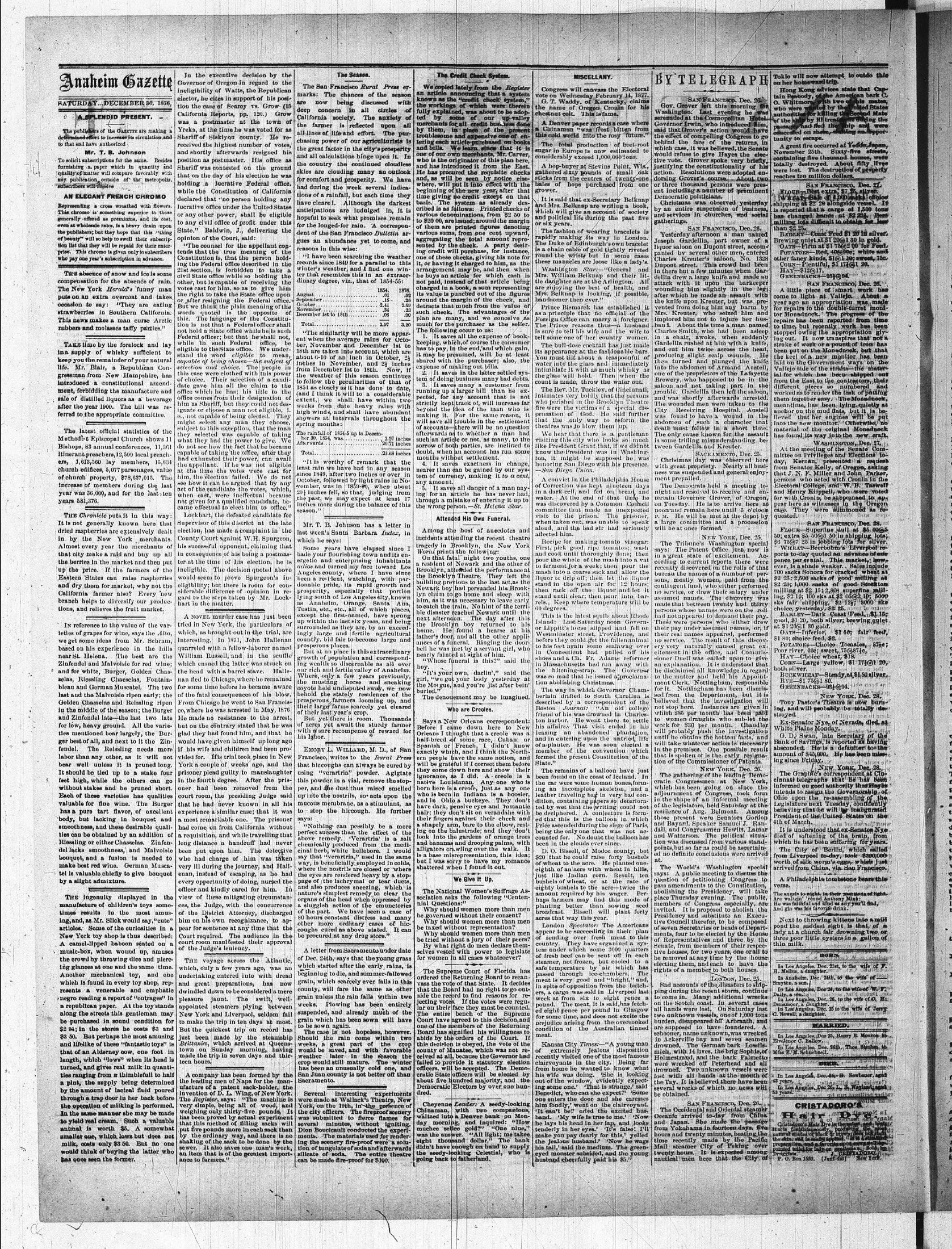
Searchable text
A SPLENDID PRESENT.
The publishers of the Gazette are making a determined effort to increase its circulation and to that end have authorized Mr. T. B. Johnson to solicit subscriptions for the same. Besides furnishing a paper which in quantity and quality of matter will compare favorably with any publication outside of the metropolis, subscribers will receive AM ELEGANT FRENCH CHROMO Representing a cross wreathed with flowers. This chromo is something superior to those generally offered as premiums, and its cost, even at wholesale rates, is a heavy drain upon the publishers; but they hope that this "thing of beauty" will so help to swell their subscription list that they will be repaid for their enterprise. This chromo is given only to subscribers who pay one year's subscription in advance.
The absence of snow and ice is some compensation for the absence of rain. The New York Herald's funny man puts on an extra overcoat and takes occasion to say: "They are eating strawberries in Southern California. This news makes a man curse Arctic rubbers and molasses taffy parties."
Take time by the forelock and lay in a supply of whisky sufficient to keep you the remainder of your natural life. Mr. Blair, a Republican Congressman from New Hampshire, has introduced a constitutional amendment, forbidding the manufacture and sale of distilled liquors as a beverage after the year 1900. The bill was referred to the appropriate committee.
The latest official statistics of the Methodist Episcopal Church shows 11 Bishops, 83 annual conferences, 11,361 itinerant preachers, 12,509 local preachers, 1,613,560 lay members, 15,634 In the executive decision by the Governor of Oregon in regard to the ineligibility of Watts, the Republican elector, he cites in support of his position the case of Scarcy vs. Grow (15 California Reports, pp. 120.) Grow was a postmaster at the town of Yreka, at the time he was voted for as Sheriff of Slaskiyou county. He received the highest number of votes, and shortly afterwards resigned his position as postmaster. His office as Sheriff was contested on the ground that on the day of his election he was holding a lucrative Federal office, while the Constitution of California declared that "no person holding any lucrative office under the United States or any other power, shall be eligible to any civil office of profit under this State." Baldwin, J., delivering the opinion of the Court, said:
"The counsel for the appellant contends that the true meaning of the Constitution is, that the person holding the Federal office described in the 21st section, is forbidden to take a civil State office while so holding the other, but is capable of receiving the votes cast for him, so as to give him the right to take the State office upon or after resigning the Federal office. But we think the plain meaning of the words quoted is the opposite of this. The language of the Constitution is not that a Federal officer shall not hold a State office while he is such Federal officer; but that he shall not, while in such Federal office, be eligible to the State office. We understand the word eligible to mean, capable of being chosen—the subject of selection and choice. The people in this case were clothed with this power of choice. Their selection of a candidate gave him all the claim to the office which he has; his title to the office comes from their designation of him as Sheriff, but they could not designate or choose a man not eligible, i.e., not capable of being elected. They might select any man they choose, subject to this exception, that the man they selected was capable of taking what they had the power to give. We do not see how the fact that he became capable of taking the office, after they had exhausted their power, can avail the appellant. If he was not eligible..."
The latest official statistics of the Methodist Episcopal Church shows 11 Bishops, 83 annual conferences, 11,361 litterant preachers, 12,509 local preachers, 1,613,560 lay members, 15,634 church edifices, 5,077 parsonages, value of church property, $78,637,015. The increase of members during the last year was 36,000, and for the last ten years 581,370.
The Chronicle puts it in this way: It is not generally known here that dried raspberries are extensively dealt in by the New York merchants. Almost every year the merchants of that city make a raid and buy up all the berries in the market and then put up the price. If the farmers of the Eastern States can raise raspberries and dry them for market, why not the California farmer also? Every new branch helps to diversify our productions, and relieves the fruit market.
In reference to the value of the varieties of grapes for wine, says the Alta, we get some ideas from Mr. Schram, based on his experience in the hills near St. Helena. The best are the Zinfendel and Malvoisie for red wine; and for white, Burger, Golden Chasselas, Riessling Chaeselas, Fontainbleau and German Muscatel. The two last and the Malvoisie ripen early; the Golden Chasselas and Relssling ripen in the middle of the season; the Burger and Zinfendel late—the last two late for low, heavy ground. All the varieties mentioned bear largely, the Burger best of all, and next to it the Zinfendel. The Relssling needs more labor than any other, as it will not bear well unless it is pruned long. It should be tied up to a stake four feet high, while the others can go without stakes and be pruned short. Each of these varieties has qualities valuable for fine wine. The Burger has a pure tart flavor, of excellent body, but lacking in bouquet and smoothness, and these desirable qualities can be obtained by an addition of Riessling or either Chasselas. Zinfendel lacks smoothness, and Malvoisie bouquet, and a fusion is needed to make best red wine. German Muscatel is valuable chiefly to give bouquet by a slight admixture.
A novel murder case has just been tried in New York, the particulars of which, as brought out in the trial, are interesting. In 1871, John Hallenan quarreled with a fellow-laborer named William Russell, and in the scuffle which ensued the latter was struck on the head with a barrel stave. Hallenan fled to Chicago, where he remained for some time before he became aware of the fatal consequences of his blow. From Chicago he went to San Francisco, where he was arrested in May, 1876. He made no resistance to the arrest, but on the contrary stated that he was glad they had found him, and that he would have given himself up long ago if his wife and children had been provided for. His trial took place in New York a couple of weeks ago, and the prisoner plead guilty to manslaughter in the fourth degree. After the prisoner had been removed from the court room, the presiding Judge said that he had never known in all his experience a similar case; that it was a most remarkable one. The prisoner had come on from California without a requisition, and while travelling that long distance a handcuff had never been put upon him. The detective who had charge of him was taken very ill during the journey, and Halleuan, instead of escaping, as he had every opportunity of doing nursed the people in this case were clothed with this power of choice. Their selection of a candidate gave him all the claim to the office which he has; his title to the office comes from their designation of him as Sheriff, but they could not designate or choose a man not eligible, i.e., not capable of being elected. They might select any man they choose, subject to this exception, that the man they selected was capable of taking what they had the power to give. We do not see how the fact that he became capable of taking the office, after they had exhausted their power, can avail the appellant. If he was not eligible at the time the votes were cast for him, the election failed. We do not see how it can be argued that by any act of the candidate the votes, which, when cast, were ineffectual because not given for a qualified candidate, became effectual to elect him to office."
Lockhart, the defeated candidate for Supervisor of this district at the late election, has made a complaint in the County Court against W.H. Spurgeon, his successful opponent, claiming that in consequence of his being a postmaster at the time of his election, he is ineligible. The decision quoted above would seem to prove Spurgeon's eligibility; but there is room for considerable difference of opinion in regard to the steps taken by Mr. Lockhart in the matter.
"It is worthy of least rain we have hitherto since 1849, after two Octobers," followed by November, "was in 1852-20 inches fell, so that past we may extense months more during season."
Mr. T. B. Johnson last week's Santa Clara which he says:
Some years have bade your flourishing ergetic and enterprising adios and turned my Angeles county; whence been a resident; wished donable pride; its prosperity; especially south of Los Angeles Anaheim Orlando Tustin; etc., etc., all except the first man up within the last six surrounded as they singly large and far country; bid fair to prosperous places.
But at no place is growth of population wealth so discernible our rich and fertile where only a few musting hour coyote held undisputed behind the stately prosperous farmers their large farms so of their last year's crop.
But yet there is no acres yet awaited with a sure recompute his labor.
EMORY L. WILLIAM Francisco writes to that hiccups can use "verartria" this powder in a visceral and dust thru up into the nostrils mucous membrane to stop the hiccups says:
Nothing can perp perfect success than above remedy. "Vit chemically produced cereal herb; white hair say that verartria way; is beneficially where the nostrills are the eyes are render page of the lachrywu
without stakes and be pruned short. Each of these varieties has qualities valuable for fine wine. The Burger has a pure tart flavor, of excellent body, but lacking in bouquet and smoothness, and these desirable qualities can be obtained by an addition of Riesling or either Chasselas. Zinfendel lacks smoothness, and Malvoisie bouquet, and a fusion is needed to make best red wine. German Musca-tel is valuable chiefly to give bouquet by a slight admixture.
The ingenuity displayed in the manufacture of children's toys sometimes results in the most amusing, and, as Mr. Slick would say, "cute" articles. Some of the curiosities in a New York toy shop is thus described: A camel-lipped baboon seated on a music-box, when wound up, amuses the crowd by throwing dice and piercing glances at one and the same time. Another mechanical toy, and one which is found in every toy shop, represents a venerable and emphatic negro reading a report of "outrages" in a republican paper. At the toy stands along the streets this gentleman may be purchased in sound condition for $2 94; in the stores he costs $3 and $3 50. But perhaps the most amusing and lifelong of these "fantastic toys" is that of an Alderney cow, one foot in length, which "lows" when its head is turned, and gives real milk in quantities ranging from a thimblefull to half a pint, the supply being determined by the amount of lacteal fluid poured through a trap door in her back before the operation of milking is performed. In the same manner she may be made to yield real cream. Such a valuable animal is worth $5. A somewhat smaller one, which lows but does not milk, costs only $3 50. But no one would think of buying the latter who has once seen the former.
The voyage across the Atlantic, which, only a few years ago, was an undertaking entered into with dread and great preparations, has now dwindled down to be considered a mere pleasure jaunt. The swift, well-appointed steamers plying between New York and Liverpool, seldom fail to make the trip in ten days at most. But the quickest trip on record has just been made by the steamship Brittania, which arrived at Queens-town on Sunday morning, having made the trip in seven days and thirteen hours.
A company has been formed by the leading men of Napa for the manufacture of a patent sack-holder, the invention of D. L. Wing, of New York. The Register, says: "The machine is very simple, being all of wood, and weighing only thirty-five pounds. It has been proved by actual experiment that this method of filling sacks will put five pounds more in each sack than by the ordinary way, and there is no shaking of the sack to be done by the sewer. It also saves one man's work, an item that is of the greatest importance to farmers."
The dust that up into the nostrils, mucous membrane, to stop the hiccups says:
"Nothing can perfect success than above remedy." "Vitamins produce cinal herb, white berry say that "verartria," way, is beneficially where the nostrils are the eyes are rendered page of the lachryma and also produces signature's simplest re organs of the head w a sluggish action o f the part. We have 80 hours constant other more ordine coughs cured as abo be procured at any o"
A letter from Sacramento of Dec. 24th, says that which started after beginning to die, and grain, which scarce county, will fare the grain unless the rain weeks. Plowing suspended, and almost grain which has been to be sown again.
The case is not Should the rain we weeks, a great pa would be saved, and weather later in crop would still ma has been an unusual San Juan county is Sacramento.
Several interests were made at Wall Street on the 19th, the city officers. This was submitted to several minutes, Dion Bouicault comments. The material ling the scenery fire tion of tungelate of silicate of soda. It can be made fire-pro
The Season.
The San Francisco Rural Press remarks: The chances of the season are now being discussed with deep concern in all circles of California society. The anxiety of the farmer is reflected upon all lines of life and effort. The purchasing power of our agriculturists is the great factor in the city's prosperity and all calculations hinge upon it. In the country the continued cloudless skies are clouding many an outlook for comfort and prosperity. We have had during the week several indications of a rainfall, but each time they have cleared. Although the darkest anticipations are indulged in, it is hopeful to seek what promises remain for the longed-for rain. A correspondent of the San Francisco Bulletin argues an abundance yet to come, and reasons in this wise:
"I have been searching the weather records since 1849 for a parallel to this winter's weather, and I find one winter that resembles this in an extraordinary degree, viz., that of 1854-55:
August ... .01 ... .02
September ... .15 ... .26
October ... .2.41 ... 2.69
November ... .34 ... .23
December 1st to 18th ... .06 ... .00
Total ... 2.97 ... 3.20
"The similarity will be more apparent when the average rains for October, November and December 1st to 18th are taken into account, which are about 6-10 of an inch in October, 2 inches in November, and 2 inches from December 1st to 18th. Now, if the weather of this season continues to follow the peculiarities of that of 1854 as closely as it has done to date, (and I think it will to a considerable extent,) we shall have within two weeks from date heavy rains with high winds, and shall have abundant showers at intervals throughout the spring months:
The rainfall of 1854-5 up to December 30, 1854, was ... 2.97 inches Afterwards ... 20.71 inches
Total ... 23.68 inches"
"It is worthy of remark that the Credit Check System.
We copied lately from the Register an article announcing that a system known as the "credit check system," the workings of which were therein fully explained, was about to be adopted by some of our up-valley merchants for all credit business done by them, in place of the present troublesome and expensive one of entering each article purchased on books and bills. We learn since that it is one of our own merchants, Mr. Carver, who is the originator of this plan here, and has introduced it from the East. He has procured the requisite checks and, as will be seen by notice elsewhere, will put it into effect with the beginning of the new year, after that time giving no credit except on that basis. The system as already described is as follows: Printed checks of various denominations, from $2.50 to $20.00, are issued; around the margin of them are printed figures denoting various sums, from one cent upward, aggregating the total amount represented by the check. A party desiring credit will purchase, for instance, one of these checks, giving his note for it, or having it charged to him, as the arrangement may be, and then when he buys an article for which cash is not paid, instead of that article being charged in a book, a sum representing its value is punched out of the figures around the margin of the check, and detracts that much from the value of such check. The advantages of the plan are many, and we conceive as much for the purchaser as the seller. The following occur to us:
1. It saves all the expense of bookkeeping, which, of course the consumer has to pay, in the end, and which gain, it may be presumed, will be at least shared with the purchaser; also, the expense of making out bills.
2. It saves in the latter settled system of doing business many bad debts.
3. It saves many a customer from running up a larger bill than he expected, for any account that is not strictly kept track of, will increase far beyond the idea of the man who is making it. For the same reason, it will save all trouble in the settlement of accounts—there will be no question afterwards as to whether a than had such an article or not, as many, to the sorrow of both parties, are inclined to doubt, when an account has run some months without settlement.
4. It saves exactness in change,
MISCELLANY.
Congress will canvass the Electoral vote on Wednesday February 14, 1877.
G. T. Waddy, of Kentucky, claims the name of Oregon Cronin for his chestnut colt. This is fame.
A Denver paper records a case where a Chinaman "was frost bitten from this cold world into the rosy future."
The total production of beet-root sugar in Europe is now estimated to considerably exceed 1,000,000 tons.
A hop-buyer at Stevens Point, Wis., gathered sixty pounds of small oak sticks from the centres of twenty-one bales of hops purchased from one grower.
It is said that ex-Secretary Belknap and Mrs. Belknap are writing a book, which will give an account of society and political life during the past five or six years.
The fashion of wearing bracelets is rapidly making its way in London. The Duke of Edinburgh's own bracelet is a chain cable of gold tightly riveted round the wrist but in some cases these manacles are loose like a lady's.
Washington Star: "General and Mrs. William Belknap and their little daughter are at the Arlington. All are enjoying the best of health, and Mrs. Belknap is looking, if possible, handsomer then ever."
Prince Bismarck has established it as a principle that no official of the Foreign Office can marry a foreigner. The Prince reasons thus—a husband is sure to tell his wife and the wife to tell some one of her country women.
The bull-dose cocktail has just made its appearance at the fashionable bars. You must tilt about a teaspoonful of water into the glass and immediately intimidate it with as much whisky as the glass will hold. Then when the count is made, throw the water out.
The Rev. Mr. Tuckley, of Cincinnati, intimates very boldly that the persons who perished in the Brooklyn Theatre fire were the victims of a special dispensation of God. He said further that the only way to reform thetheatres was to blow them up.
We hear that there is a gentleman visiting this city who looks so much like President Grant that, if we did not know the President was in Washington, it might be supposed he was honoring San Diego with his presence.
BY
Government serenade
Government said that
the effejustify action,
dorsing,
or threat
in DemocChris by an
and segatherer
YestJoseph liquor panied
Charles Dupon
Dupon in therelia attackwound after wthe knovvented Mrs.
Implosion ban I.
Charles in a Garden and produce then into therelia attackwound after wthe knovvented Mrs.
Brewery saloon troubled and wThe wCity was fom abdomen death.The oris is somewitness
from December 1st to 18th. Now, if the weather of this season continues to follow the peculiarities of that of 1854 as closely as it has done to date, (and I think it will to a considerable extent), we shall have within two weeks from date heavy rains with high winds, and shall have abundant showers at intervals throughout the spring months:
The rainfall of 1854-5 up to December 30, 1854, was... 2.97 inches Afterwards... 20.71 inches
Total... 23.68 inches
"It is worthy of remark that the least rain we have had in any season since 1849, after two inches or over in October, followed by light rains in November, was in 1859-60, when about 20 inches fell, so that, judging from the past, we may expect at least 17 inches more during the balance of this season."
Mr. T. B. Johnson has a letter in last week's Santa Barbara Index, in which he says:
Some years have elapsed since I bade your flourishing town and its energetic and enterprising inhabitants adios and turned my face toward Los Angeles county, where I have since been a resident, watching, with pardonable pride, its rapid growth and prosperity, especially that portion lying south of Los Angeles city, known as Anaheim, Orange, Santa Ana, Tustin, etc., all of which places, except the first named, have sprung up within the last six years, and being surrounded as they are, by an exceedingly large and fertile agricultural country, bid fair to become large and prosperous places.
But at no place is this extraordinary growth of population and corresponding wealth so discernable as all over our rich and fertile valley of Anaheim. Where, only a few years previously, the mustang horse and sneaking coyote held undisputed sway, we now behold the stately residences of the prosperous farmers looming up, and their large farms scarcely yet cleared of their last year's crop.
But yet there is room. Thousands of acres yet await the sturdy farmer with a sure recompense of reward for his labor.
EMORY L. WILLARD, M. D., of San Francisco, writes to the Rural Press that hiccups can always be cured by using "verartria" powder. Aglgate this powder in a vial, remove the stopper, and the dust thus raised smelled up into the nostrils, so acts upon the mucous membrane, as a stimulant, as to stop the hiccough. He further says:
"Nothing can possibly be a more perfect success than the effect of the above remedy. 'Verartria' is a salt chemically produced from the medicinal herb, white hellebore. I would say that "verartria," used in the same way, is beneficially employed in colds, where the nostrils are closed or where the eyes are rendered heavy by a stoppage of the lachrymal or tear ducts.
2. It saves in the latter settled system of doing business many bad debts.
3. It saves many a customer from running up a larger bill than he expected, for any account that is not strictly kept track of, will increase far beyond the idea of the man who is making it. For the same reason, it will save all trouble in the settlement of accounts—there will be no question afterwards as to whether a man had such an article or not, as many, to the sorrow of both parties, are inclined to doubt, when an account has run some months without settlement.
4. It saves exactness in change, nearer than can be gained by our system of currency, making it to a cent, any amount.
5. It saves all danger of a man paying for an article he has never had, through a mistake of entering it up to the wrong person. — St. Helena Star.
Attended His Own Funeral.
Among the host of anecdotes and incidents attending the recent theatre tragedy in Brooklyn, the New York World prints the following:
On that fatal night two youths, one a resident of Newark and the other of Brooklyn, attended the performance at the Brooklyn Theatre. They left the building previous to the last act, as the Newark boy had persuaded his Brooklyn chum to go home and sleep with him, as it was necessary to leave early to catch the train. No hint of the terrible disaster reached Newark until the next afternoon. The day after this the Brooklyn boy returned to his home. He found a hearse at his father's door, and all the other appliances of a funeral. Ringing the doorbell he was met by a servant girl, who nearly fainted at sight of him.
"Whose funeral is this?" said the boy.
"It's your own, darlin'," said the girl, "we got your body yesterday at the Morgue, and you're just after bein' buried."
The denouement may be imagined.
Who are Crcoles.
Says a New Orleans correspondent: Before I came down here to New Orleans I thought that a creole was a half-breed of some race, Cuban or Spanish or French, I didn't know exactly which, and I think the Northern people have the same notion, and will be grateful if I correct them before they come down here and show their ignorance, as I did. A creole is a native Louisiana. Any one who is born here is a creole, just as any one who is born in Indiana is a hoosier, and in Ohio a buckeye. They don't have dark, pensive eyes and romantic hair; they don't sit on verandahs with their fingers against their cheek and a shapely arm, bare to the elbow, resting on the balustrade; and they don't look into the gardens of orange trees and bananas and drooping palms, with alligators crawling over the walk. It is a base misrepresentation, this idea; but I was sorry to have my romance shattered when I found it out.
We Give It Up.
Intimidate it with as much whisky as the glass will hold. Then when the count is made, throw the water out.
The Rev. Mr. Tuckley, of Cincinnati, intimates very boldly that the persons who perished in the Brooklyn Theatre fire were the victims of a special dispensation of God. He said further that the only way to reform thetheatres was to blow them up.
We hear that there is a gentleman visiting this city who looks so much like President Grant that, if we did not know the President was in Washington, it might be supposed he was honoring San Diego with his presence. — San Diego Union.
A convict in the Philadelphia House of Correction was kept nineteen days in a dark cell, and fed on bread and water. At the end of that time he was discovered by a Common Council committee that made an unexpected visit to the prison. The prisoner, when taken out, was unable to speak aloud, and the bad air had seriously affected him.
Recipe for making tomato vinegar: First, pick good ripe tomatoes; wash and cook until thoroughly done; then pour the whole of the mash into a vat to ferment for a week; then pour the mash into a coarse sack and allow the liquor to drip off; then let the liquor stand in the open air for 12 hours; then rack off the liquor and let it stand until clear; then pour into barrels. Keep where temperature will be 60 degrees.
This is the latest squib about Rhode Island: Last Saturday noon Governor Lippitt's horse slipped and fell on Westminster street, Providence, and before they could get the fallen animal to his feet again some scalawag over in Connecticut had pulled off his shoes and a Ch. Fr. Adams reformer in Massachusetts had run away with the hitching-strap. The Governor was so mad that he issued approclamation abolishing Christmas.
The way in which Governor Chamberlain drifted to South Carolina is described by a correspondent of the Boston Journal: "An old college friend of his was drowned in Charlesboro. He went there to settle his affairs." That visit ended in his leasing an abandoned plantation, and in entering upon the untried life of a planter. He was soon elected a member of the convention which formed the present Constitution of the State."
The remains of a balloon have just been found on the coast of Ireland. In the car were some human bones forming an incomplete skeleton, and a leather traveling bag in very bad condition containing papers so deteriorated by wet that the writing could not be deciphered. A conjecture is formed that this is the balloon in which Price ascended during the siege of Paris, being the only one that was not accounted for. No doubt the balloon has been in the clouds ever since.
D. O. Bissell, of Modoc county, bet $20 that he could raise forty bushels of wheat to the acre. He planted one-eighth of an acre with wheat in hills, just like Indian corn. Result, ten bushels of wheat, or at the rate of
A letter from Sacramento under date of Dec. 24th, says that the young grass which started after the early rains, is beginning to die, and summer-fallowed grain, which scarcely ever fails in this county, will fare the same as other grain unless the rain falls within two weeks. Plowing has been entirely suspended, and already much of the grain which has been sown will have to be sown again.
The case is not hopeless, however. Should the rain come within two weeks, a great part of the crop would be saved, and with favorable weather later in the season the crop would still mature. The winter has been an unusually cold one, and San Juan county is not better off than Sacramento.
Several interesting experiments were made at Wallack's Theatre, New York, on the 19th, in the presence of the city officers. The fireproof scenery was submitted to fierce flames for several minutes, without igniting. Dion Boucicault conducted the experiments. The materials used for rendering the scenery fire-proof were a solution of tungelate of soda and afterwards silicate of soda. The entire theatre can be made fire-proof for $100.
Cheyenne Leader: A seedy-looking Chinaman, with two companions, waltzed into a Denver bank on Monday morning, and inquired: "How muchee sellse gold?" "One nine," was the answer. "All light; me takee eight thousand dollar." The bank didn't have enough on hand to supply the seedy-looking Celestial, who is going back to fatherland.
We Give It Up.
The National Women's Suffrage Association asks the following "Centennial Questions:"
Why should women more than men be governed without their consent?
Why should women more than men be taxed without representation?
Why should women more than men be tried without a jury of their peers?
By what right do men declare themselves vested with power to legislate for women in all cases whatsoever?
The Supreme Court of Florida has ordered the Returning Board to recanvass the vote of that State. It decides that the Board had no right to go outside the record to find reasons for rejecting votes. If the votes were regular on their face they must be counted. The entire bench of the Supreme Court have agreed to this decision, and one of the members of the Returning Board has signified his willingness to abide by the orders of the Court. If this decision is obeyed, the vote of the county of Manatee, which was not received at all, because the Governor had failed to provide it statutory election officers, will be accepted. The Democratic State officers will be elected by about five hundred majority, and the Democratic Electors by over one hundred.
London Spectator: The Americans appear to be succeeding in their plan of sending over fresh meat to this country. They have organized a system under which some 3000 quarters of fresh beef can be sent off in each steamer, not frozen, but cooled to a safe temperature by air which has passed through ice-chambers. The meat is very good and "bright," and in spite of opposition from the butchers, a cargo was sold in Liverpool last week at from six to eight pence a pound. The meat, it is said, has fetched eight pence per pound in Glasgow for some time, and does not excite the prejudice arising from the overcooked condition of the Australian tinned meat.
Kansas City Times:—"A young man of extremely jealous disposition recently visited one of the most famous clairvoyants in the city. Being far from home he wanted to know what his wife was doing. 'She is looking out of the window, evidently expecting some one.' 'That is strange,' said Benedict, who can she expect?' 'Some one enters the door and she caresses him fondly,' went on the clairvoyant. 'It can't be!' cried the excited husband. 'My wife is true to me.' Now he lays his head in her lap, and looks tenderly in her eyes.' 'It's false! I'll make you pay dearly for this,' yelled the jealous husband.' 'Now he wags his tail,' said the medium. The green-eyed monster subsided, and the young husband cheerfully paid his $5."
BYTEGRAPH
SAN FRANCISCO, Dec. 26.
Gov. Grover left this morning for Washington. Last evening he was serenaded at the Cosmopolitan Hotel Governor Irwin, who introduced him, said that Grover's action would have the effect of compelling Congress to go behind the face of the returns, in which case, it was believed, the Senate would refuse to give Hayes the elective vote. Grover spoke very briefly, justifying the constitutionality of his action. Resolutions were adopted endorsing Grover's course. About two or three thousand persons were present including a number of prominent Democratic politicians.
Christmas was observed yesterday by an entire suspension of business, and services in churches, and social gatherings.
SAN FRANCISCO, Dec. 26.
Yesterday afternoon a man named Joseph Gardellia, part owner of a liquor saloon on Dupont street, accompanied by several other men, entered Charles Kreuter's saloon, No. 1328 Dupont street. This crowd had been in there but a few minutes when Gardellia drew a large knife and made an attack with it upon the barkeeper wounding him slightly in the leg; after which he made an assault with the knife upon Kreuter, but was prevented from doing him any harm by Mrs. Kreuter, who seized him and implored him not to injure her husband. About this time a man named Charles Smith, who had been asleep in a chair, awoke, when suddenly Gardellia rushed at him with a knife, and cut him twice across the head, producing slight scalp wounds. He then turned and plunged the knife into the abdomen of Armand Austell, one of the proprietors of the Lafayette Brewery, who happened to be in the saloon and not taking part in the trouble. Gardellia then left the saloon, and was shortly afterwards arrested. The wounded men were taken to the City Receiving Hospital. Austell was found to have a wound in the abdomen of such a character that death must follow in a short time. The only cause known for the assault is some trifling misunderstanding between Gardellia and Kreuter.
SACRAMENTO, Dec. 25.
Christmas day was observed here with great propriety. Nearly all busi-
Toklo will now attempt to outdo this on her homeward trip.
Hong Kong advises state that Captain Pemody, of the American bark C.O. Whitmore, with two of his mates, who were weainted by the United States authorities for killing the Second Mate of the ship by ill treatment during the passage, had fled the ship and were concealed on shore, making an opportunity to escape.
A great fire occurred at Yedda, Japan, November 25th. Sixty-five streets containing five thousand houses were totally destroyed. About fifty lives were lost. The destruction of property reaches ten million dollars.
SAN FRANCISCO, Dec. 27.
HOUR—Best extra, $7.25 silver.
WEEK—Sale of 1,000 marks color shipping at $2.29 alongside vessel. It is reported that a cargo of 1,500 tons has changed hands at $2.224. Best milling lots difficult to obtain for less than $2.25.
BARLEY—Coast Feed $1.20 in silver; Brewing quiet at $1.20@1:30 in gold.
OATS—Firm at $1.75@2:00 for Feed.
POTATOES—Red, 40@90e; white and other fancy kinds, $1@1:10; sweet, 75c.
CORN—Plentiful, $1.17@1:20.
HAY—$12@17.
GREENBACKS—93l@94.
SAN FRANCISCO, Dec. 26.
A little piece of smart work has come to light at Vallejo. About a year ago an appropriation was made for repairs to the double-turret monitor Monadnock. The progress of the repairs has been reported from time to time, but recently work has been stopped owing the appropriation giving out. It now transpires that not a stroke of work or a pound of iron has been put on the Monadnock, but that the keel of a new monitor has been laid on the Government ways on the Vallejo side of the struts—the material for which has been shipped out from the East to the contractors, their different pieces so numbered and worked as to render the task of patting them together easy. The Monadnock, meantime, has been lying quietly at anchor on the mud flats, but it is believed that her engines will be put into the new monitor. Otherwise, no material of the original Monadnock has found its way into the new craft.
WASHINGTON, Dec. 27.
At the meeting of the Senate Committee on Privileges and Elections today, Kernan presented a request
Philadelphia House kept nineteen days on bread and of that time he Common Council was an unexpected prisoner, unable to speak their had seriously tomato vinegar: the tomatoes; wash roughly done; then mash into a vat; then pour the stock and allow the men let the liquor pair for 12 hours; liqueur and let it pour into bar temperature will be quib about Rhode Island noon Governed and fell on Providence, and the fallen animal scalawag over pulled off his Adams reformer run away with The Governor issued approclamations.
Governor Chamouth Carolina is respondent of the "An old college owned in Charles at there to settle suit ended in his owned plantation, the untried life has soon elected a convention which constitution of the balloon have just cast of Iceland. In human bones, form skeleton, and a very bad conspires so deteriorating could not conjecture is form-balloon in which the siege of Paris, that was not accidental the balloon has ever since. Godoc county, but rise forty bushels He planted one wheat in hills, corn. Result, ten at the rate of
The gathering of the leading Democratic Congressmen at New York, which has been going on since the adjournment of Congress, took form in the shape of an informal meeting of the legislators, held Saturday at the residence of Aug. Belmont. Among those present were Senators Gorpion and Bayard, Speaker Samuel J. Randall, and Congressmen Hewitt, Lamar and Watterson. The political situation was discussed from various standpoints, but so far as could be ascertained no definite conclusions were arrived at.
The World's Washington special says: A public meeting to discuss the question of petitioning Congress to
Vallejo side of the struts—the material for which has been shipped out from the East to the contractors, their different pieces so numbered and worked as to render the task of putting them together easy. The Monadhook, meantime, has been lying quietly at anchor on the mud flats, but it is believed that her engines will be put into the new monitor. Otherwise, no material of the original Monadhook has found its way into the new craft.
WASHINGTON, Dec. 27.
At the meeting of the Senate Committee on Privileges and Elections today, Kernan, presented a request from Senator Kelly, of Oregon, asking that J. N. F. Miller and John Parker, persons who acted with Cronin in the Electoral College, and W. B. Taswell and Henry Kippell, who were voted for with Cronin, be subpoenaed to appear here as witnesses in the Oregon case. They were summoned as requested.
SAN FRANCISCO, Dec. 28.
FLOUR—Superfine dull at $5.00@50; extra $5.50@6.50 in shipping lots; $6.75@7.25 in jobbing lots for silver.
WHEAT—Beerbohm's Liverpool reports to-day quoted an advance of one pence per cental. This market, however, is a shade weaker. Sales include 700 sacks Sonora for cracked wheat at $2.25; 2,500 sacks of good milling at $2.20; 1,000 sacks of good Stockton milling at $2.15; 2,808 superfine milling; $2.10; 100 skis at $2.05@2.10; 5000 skis fair shipping; $2.12; 3000 skis choice, yesterday; $2.25.
BARLEY—Dark Coast Feed, $1.15; good, $1.20; both silver; brewing quiet at $1.20@1.30 gold.
OATS—Inferior, $1.60; fair feed, $1.80; choice feed, $2.
POTATOES—Choice Tomales, 87½c; Poor river, 40e; sweet, 75@87½c.
HAY—Choice wheat, $18.
CORN—Large yellow, $1.17@1.20; both silver.
BUCKWHEAT—Stendy, at $1.50 silver.
RVE—$1.75@1.80.
GREENBACKS—98½@94.
NEW YORK, Dec. 28.
Tony Pastor's Theatre is now burning, and will probably be totally destroyed.
Ex-Senator Nye, of Nevada, died at White Plains Monday.
G. D. Swan, late Secretary of the Bank of Savings, is reported as having absconded. He is a defaulter to the amount of $45,000. He has been missing since Friday.
NEW YORK, Dec. 28.
The Graphite's correspondent at Cincinnati telegraphs that He has been informed on good authority that Hayes intends to resign the Governorship of Ohio upon the re-assembling of the Legislature next Tuesday, confidently believing that he will be inaugurated President of the United States on the 4th of March.
It is understood that ex-Senator Nye died of softening of the brain, from which he has been suffering for years.
The City of Berlin, which called from Liverpool to day, took $390,000 worth of silk worm's eggs, which just arrived from China via San Francisco.
A Philadelphia tombstone bears this
The Americans living in their plan fresh meat to this organized a system 3000 quarters sent off in each but cooled to a air which has chambers. The and "bright," and from the butchery in Liverpool last eight pence it is said, has fetch-ground in Glasgow does not excite the overcooked Australian tinned.
"A young manulous disposition of the most famous city. Being far used to know what she is looking evidently expect-that is strange," said he expect? "Some and she caresses the clairvoyant the excited hus-que to me." 'Now her lap, and looks 'It's false! I'll be for this,' yelled 'Now he wags medium. The green-ed, and the young said his $5.'
The World's Washington special says: A public meeting to discuss the question of petitioning Congress to pass amendments to the Constitution, abolishing the Presidency, will take place Thursday evening. The public, members of Congress especially, are invited. It is proposed to abolish the Presidency and substitute an Executive Council therefor, to be composed of seven Secretaries or heads of Departments, four to be elected by the House of Representatives and three by the Senate, from members of their respective houses, for two years, one or all to be removed at any time by the house electing them, and each to have the rights of a member to both houses.
LONDON, Dec. 25.
Sad accounts of the disasters to shipping during the recent storm, continue to come in. Many additional wrecks on the Scotch coast. In several cases all hands were lost. On Saturday last two unknown vessels, one of 1,000 tons burden, disappeared off Arbrainth, and are supposed to have foundered. A schooner, name unknown, was wrecked in Ackerville bay and seven seamen drowned. The German bark Lossfismich, with 14 lives, the brig Sophie, of Holmestrand, and the bark Palmetto were wrecked off Peterhead and all drowned. Two unknown vessels were lost with all hands at the mouth of the Tay. It is believed there have been several wrecks of which no news will be obtained.
SAN FRANCISCO, Dec. 26.
The Occidental and Oriental steamer Oceanic arrived to-day from China and Japan. She made the passage from Yokohama in fourteen days. Five hours and twenty minutes, beating the time recently made by the Pacific Mail steamer City of Peking over twenty hours. It is expected among nautical men here that the City of informed on good authority that Hayes intends to resign the Governorship of Ohio upon the re-assembling of the Legislature next Tuesday, confidently believing that he will be inaugurated President of the United States on the 4th of March.
It is understood that ex-Senator Nye died of softening of the brain, from which he has been suffering for years.
The City of Berlin, which sailed from Liverpool to-day, took $300,000 worth of silk worm's eggs, which just arrived from China via San Francisco.
A Philadelphia tombstone bears this verse.
The angels to-night, in their memorials of light- Are wallzin' round Anthony Mink:
He was faithful and kind as any you'll find,
And gin was his favorite drink.
Next to throwing kittens into a mill pond the saddest sight is that of a lady at a church fair drowning two or three poor little oystars in a gallon of thin milk.
BORN
In Los Angeles, Dec. 21st, to the wife of F. H. Mallus, a daughter.
In Anaheim, Dec. 24th, to the wife of Smytte, a son.
In Los Angeles, Dec. 28, to the wife of W. F. Daily, a son.
In Los Angeles, Dec. 26, to the wife of O. H. Dunamoor, a daughter.
In Los Angeles, Dec. 25 to the wife of Jerry O. Newell, a daughter.
MARRIED
In Los Angeles, Dec. 25, Henry B. Monroe to Elvelenor C. Ballow.
In Los Angeles, Dec. 24th, Thos Strohm to Miss E. M. Schuebnell.
DEW
In Los Angeles, Dec. 24-H. Newlaner aged 43 years.
In Los Angeles, Dec. 26-L. R. Wayland aged 53 years.
CRISTADORO'S Hair Dye
Cristadoro's Hair Dye is the latest and best it acts as disinfection powder; preserving the natural whiteness of black or brown hair; thus maintaining its shine and its beauty. It is a well-trained preparation and a favorite among women pointed toilet for ladies on gentlemen; solids are Druglets."
P. O. Box 1593. [Jan-12] New York.