anaheim-gazette 1876-12-16
Scanned page
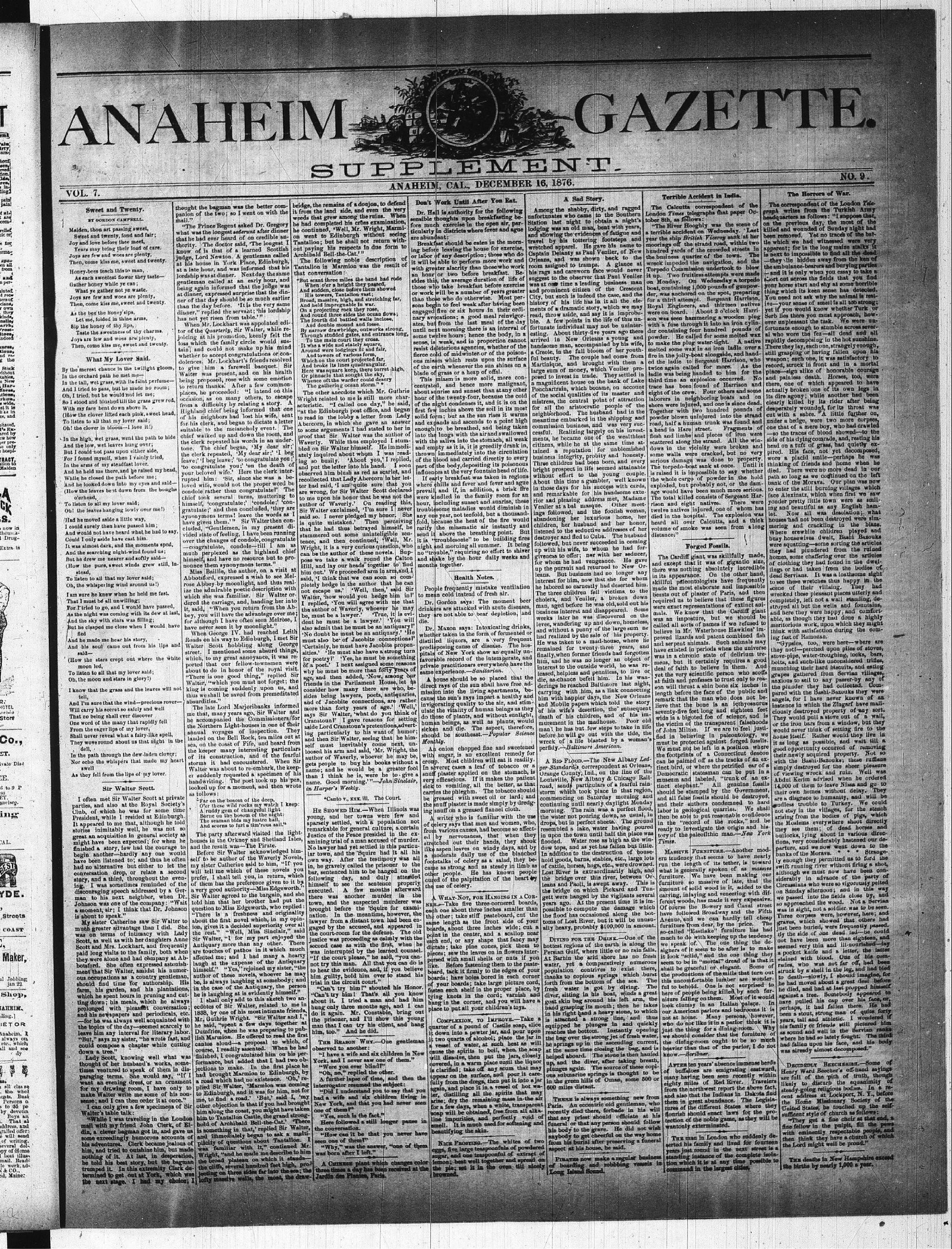
Searchable text
ANAHEIM
VOL. 7.
Sweet and Twenty.
BY GORDON CAMPBELL.
Malden, thou art passing sweet,
Sweet and twenty, fond and fair;
Joy and love before thee meet,
Years may bring their load of care.
Joys are few and woes are plenty,
Then, come kiss me, sweet and twenty.
Honey-bees teach this to man,
As each sweetest flower they taste—
Gather honey while ye can;
What ye gather not ye waste.
Joys are few and woes are plenty,
Then, come kiss me, sweet and twenty.
As the bee the honey'sips,
Let me, folded in thine arms,
Sip the honey of thy lips,
Taste the sweetness of thy charms.
Joys are few and woes are plenty,
Then, come kiss me, sweet and twenty.
What My Lover Said.
By the merest chance in the twilight gloom,
In the orchard path he met me—
In the tall, wet grass, with its faint perfume—
And I tried to pass, but he made no room;
Oh, I tried, but he would not let me;
So I stood and blushed till the grass grew red,
With my face bent down above it.
(How the clover lifted each pink, sweet head,
To listen to all that my lover said;
Oh! the clover in bloom—I love it!)
In the high, wet grass, went the path to hide
And the low, wet leaves hung over;
But I could not pass upon either side,
For I found myself, when I vainly tried,
In the arms of my steadfast lover,
thought the bagman was the better companion of the two; so I went on with the mail."
"The Prince Regent asked Dr. Gregory what was the longest sederunt after dinner that he had ever heard of on credible authority. The doctor said, 'The longest I know of is that of a learned Scottish judge, Lord Newton. A gentleman called at his house in York Place, Edinburgh, at a late hour, and was informed that his lordship was at dinner. Next day the same gentleman called at an early hour, and being again informed that the judge was at dinner, expressed surprise that the dinner of that day should be so much earlier than the day before. 'It is the very same dinner,' replied the servant; 'his lordship has not yet risen from table.'"
When Mr. Lockhart was appointed editor of the Quarterly, Sir Walter, while rejoicing at his promotion, keenly felt the loss which the family circle would sustain; and could not make up his mind whether to accept congratulations or condolences. Mr. Lockhart's friends resolved to give him a farewell banquet. Sir Walter was present, and on his health being proposed, rose with some emotion to return thanks. After a few commonplaces, he proceeded: "I intend on this occasion, as on many others, to escape from a difficulty by relating a story. A Highland chief being informed that one of his neighbors had lost his wife, sent for his clerk, and began to dictate a letter suitable to the melancholy event. The chief walked up and down the room, and the clerk repeated his words in an under-tone. The chief began, 'My dear sir,' the clerk repeated, 'My dear sir,' 'I beg leave,' 'I beg leave,' 'to congratulate you,' 'to congratulate you,' 'to congratulate you,' 'to congratulate you,' 'to congratulate you,' 'to congratulate you,' 'to congratulate you,' 'to congratulate you,' 'to congratulate you,' 'to congratulate you,' 'to congratulate you,' 'to congratulate you,' 'to congratulate you,' 'to congratuate you,' 'to congratuate you,' 'to congratuate you,' 'to congratuate you,' 'to congratuate you,' 'to congratuate you,' 'to congratuate you,' 'to congratuate you,' 'to congratuate you,' 'to congratuate you,' 'to congratuate you,' 'to congratuate you,' 'to congratuate you,' 'to congratuate you,' 'to congratuate you,' 'to congratuate you,' 'to congratuate you,' 'to congratuate you,' 'to congratuate you,' 'to congratuate you,' 'to congratuate you,' 'to congratuate you,' 'to congratuate you,' 'to congratuate you,' 'to congratuate you,' 'to congratuate you,' 'to congratuate you,' 'to congratuate you,' 'to congratuate you,' 'to congratuate you,' 'to congratuate you,' 'to congratuate...'
bridge, the remains of it from the land side, weeds that grew among he continued, 'Well, M on went to Edinburgh Tantallon; but he shall out paying his respect Archibald Bell-the-Catt The following noble Tantallon in Marmion that conversation:
"But scant three miles When o'er a height And sudden, close before His towers, Tantallon Broad, massive high, And held impregnable On a projecting rock t And round three sides The fourth did battles And double mound By narrow drawbridge Through studded gate To the main court It was a wide and state Around were lodging Which on the court p And broke its lines qu Here was square keep Or pinnacle that sou Whence off the warde The gathering ocean The other anecdote Wright related to meacteristic. "I called "at the Edinburgh po to read in the lobby y Abercorn, in which s to some arguments I proof that Sir Walt Waverly. While thubbed on Sir Walter hately inquired about ing so busily."
By the merest chance in the twilight gloom,
In the orchard path he met me—
In the tall, wet grass, with its faint perfume—
And I tried to pass, but he made no room;
Oh, I tried, but he would not let me;
So I stood and blushed till the grass grew red,
With my face bent down above it,
(How the clover lifted each pink, sweet head,
To listen to all that my lover said;
Oh! the clover in bloom—I love it!)
In the high, wet grass, went the path to hide
And the low, wet leaves hung over;
But I could not pass upon either side,
For I found myself, when I vainly tried,
In the arms of my steadfast lover.
And he held me there, and he raised my head,
While he closed the path before me;
And he looked down into my eyes and said—
(How the leaves beat down from the boughs o'erhead,
To listen to all my lover said;
Oh! the leaves hanging lowly over me!)
Had he moved aside a little way,
I could surely then have passed him;
And would not have heard what he had to say,
Could I only aside have cast him.
It was almost dark, and the moments spod,
And the searching night-wind found us;
But he drew me nearer and softly said—
(How the pure, sweet winds grew still, instead,
To listen to all that my lover said;
Oh, the whispering wind around us!)
I am sure he knew when he held me fast.
That I must be all unwilling;
For I tried to go, and I would have passed,
As the night was coming with its dew at last,
And the sky with stars was filling;
But he clasped me close when I would have fled
And he made me hear his story,
And his soul came out from his lips and said—
(How the stars crept out where the white moon led,
To listen to all that my lover said;
Oh, the moon and stars in glory!)
I know that the grass and the leaves will not tell,
And I'm sure that the wind—precious rover—
Will carry his secret so safely and well
That no being shall ever discover
One word of the many that rapidly fell
From the eager lips of my lover,
Shall never reveal what a fairy-like spell,
They wove round about us that night in the dell.
In the path through the dew-laden clover;
Nor echo the whispers that made my heart swell
As they fell from the lips of my lover.
Sir Walter Scott.
I often met Sir Walter Scott at private parties, and also at the Royal Society's Club, of which he was for some time President, while I resided at Edinburgh.
It appeared to me that, although he told stories inimitably well, he was not so great an acquisition in general society as might have been expected; for when he finished a story, few had the courage to begin another—hardly any one would have been listened to; and thus he often had no alternative but either to let the conversation drop, or relate a second story, and a third, throughout the even-
Far on the bosom of the deep,
O'er these wild rocks my watch I keep:
A ruddy gem of changeful light
Borne on the bosom of the night:
The seaman bids my lustre hall,
And scorns to furl a timorous sail.
The party afterward visited the light-houses in the Orkney and Shetland Isles, and the result was—the Pirate.
Before Sir Walter acknowledged himself to be author of the Waverly Novels, my sister Catherine said to him, "If you will tell me which of these novels you prefer, I shall tell you, in return, which has the preference given to it by Walter was present, and on his health being proposed, rose with some emotion to return thanks." After a few commonplaces, he proceeded: "I intend on this occasion, as on many others, to escape from a difficulty by relating a story. A Highland chief being informed that one of his neighbors had lost his wife, sent for his clerk, and began to dictate a letter suitable to the melancholy event. The chief walked up and down the room, and the clerk repeated his words in an under-tone. The chief began, 'My dear sir,' the clerk repeated, 'My dear sir,' 'I beg leave,' 'I beg leave,' 'to congratulate you,' 'to congratulate you,' 'on the death of your beloved wife.' Here the clerk interrupted him: 'Sir, since she was a beloved wife, would not the proper word be condole rather than congratulate?' The chief took several turns, muttering to himself, 'congratulate,' 'condole,' 'congratulate,' and then concluded, 'they are synonymous terms! Leave the words as I have given them.'" Sir Walter then concluded, "Gentlemen, in my present divided state of feeling, I have been running over the changes of condole, congratulate—congratulate, condole—till I am as much perplexed as the highland chief himself, and have no resource but to pronounce them synonymous terms."
Miss Baillie, the author, on a visit at Abbotsford, expressed a wish to see Melrose Abbey by moonlight, and thus realize the admirable poetic description with which she was familiar. Sir Walter ordered the carriage, and handing her into it, said, "When you return from the Abbey, you will have the advantage over me; for although I have often seen Melrose, I have never seen it by moonlight."
When George IV. had reached Leith Roads on his way to Edinburgh, I met Sir Walter Scott hobbling along George street. I mentioned some absurd things, which, to my great annoyance, it was reported that our fellow-townsmen were about to do in honor of the royal visit. "There is one good thing," replied Sir Walter, "which you must not forget; the king is coming suddenly upon us, and thus we shall be saved from premeditated absurdities."
The late Lord Marjoribanks informed me that, many years ago, Sir Walter and he accompanied the Commissioners for the Northern Light-houses in one of their annual voyages of inspection. They landed on the Bell Rock, ten miles out at sea, on the coast of Fife, and heard from the keeper many interesting particulars of its construction, and of the fearful storms it had encountered. When Sir Walter was about to re-embark, the keeper suddenly requested a specimen of his handwriting. The poet took up his pen, looked up for a moment, and then wrote as follows:
"Far on the bosom of the deep,
O'er these wild rocks my watch I keep:
A ruddy gem of changeful light
Borne on the bosom of the night:
The seaman bids my lustre hall,
And scorns to furl a timorous sail."
The party afterward visited the light-houses in the Orkney and Shetland Isles, and the result was—the Pirate.
Before Sir Walter acknowledged himself to be author of the Waverly Novels, my sister Catherine said to him, "If you will tell me which of these novels you prefer, I shall tell you, in return, which has the preference given to it by Walter was present, and on his health being proposed, rose with some emotion to return thanks." After a few commonplaces, he proceeded: "I intend on this occasion, as on many others, to escape from a difficulty by relating a story. A Highland chief being informed that one of his neighbors had lost his wife, sent for his clerk, and began to dictate a letter suitable to the melancholy event. The chief walked up and down the room, and the clerk repeated his words in an under-tone. The chief began, 'My dear sir,' the clerk repeated, 'My dear sir,' 'I beg leave,' 'I beg leave,' 'to congratulate you,' 'to congratulate you,' 'on the death of your beloved wife.' Here the clerk interrupted him: 'Sir, since she was a beloved wife, would not the proper word be condole rather than congratulate?' The chief took several turns, muttering to himself, 'congratulate,' 'condole,' 'congratulate,' and then concluded, 'they are synonymous terms! Leave the words as I have given them.'" Sir Walter then concluded, "Gentlemen, in my present divided state of feeling, I have been running over the changes of condole, congratulate—congratuate, condole—till I am as much perplexed as the highland chief himself, and have no resource but to pronounce them synonymous terms."
Miss Baillie, the author, on a visit at Abbotsford, expressed a wish to see Melrose Abbey by moonlight, and thus realize the admirable poetic description with which she was familiar. Sir Walter ordered the carriage, and handing her into it, said: "When you return from the Abbey, you will have the advantage over me; for although I have often seen Melrose, I have never seen it by moonlight."
When George IV. had reached Leith Roads on his way to Edinburgh, I met Sir Walter Scott hobbling along George street. I mentioned some absurd things, which to my great annoyance it was reported that our fellow-townsmen were about to do in honor of the royal visit. "There is one good thing," replied Sir Walter, "which you must not forget; the king is coming suddenly upon us, and thus we shall be saved from premeditated absurdities."
The late Lord Marjoribanks informed me that many years ago Sir Walter and he accompanied the Commissioners for the Northern Light-houses in one of their annual voyages of inspection. They landed on the Bell Rock, ten miles out at sea on the coast of Fife,and heard from the keeper many interesting particulars of its construction,and ofthe fearful storms it had encountered. When Sir Walter was about to re-embark,the keeper suddenly requested a specimen of his handwriting. The poet took up his pen,looked up for a moment,and then wrote as follows:
"Far on the bosom of the deep,
O'er these wild rocks my watch I keep:
A ruddy gem of changeful light
Borne on the bosom of the night:
The seaman bids my lustre hall,
And scorns to furl a timorous sail."
The party afterward visited the light-houses in the Orkney and Shetland Isles,and the result was—the Pirate.
Before Sir Walter acknowledged himself to be author of the Waverly Novels,my sister Catherine said to him,"If you will tell me which of these novels you prefer,I shall tell you,in return,which has the preference given to it by Walter was present,and on his health being proposed,rose with some emotion to return thanks." After a few commonplaces,he proceeded: "I intend on this occasion,as on many others,to escape from a difficulty by relating a story. A Highland chief being informed that one of his neighbors had lost his wife,sent for his clerk,and began to dictate a letter suitable to the melancholy event. The chief walked up and down the room,and the clerk repeated his words in an under-tone. The chief began,'My dear sir,'the clerk repeated,'My dear sir,'‘I beg leave,’‘I beg leave,’‘to congratulate you,’‘to congratulate you,’‘on the death of your beloved wife.’Here the clerk interrupted him:'Sir,since she was a beloved wife,would notthe proper word be condole rather than congratulate?' The chief took several turns,muttering to himself,'congratulate,’‘condole,’‘congratulate,’and then concluded,'they are synonymous terms!LeavethewordsaslitheruponthemainsbeinglawyerandofJacobitemorethanfortycowaysWalter,’‘Cranstoun?」I gaveasideLordCranstouningtogethertandthenSirWalterselfmisseiventohimandauthorofWaverlygetspeopletobutname;andhewohantherinkhename.GoodmorninginHarper'sWeekly."
*Canto v.*,
HE SHOWED HIS young,and her sparsely settled,fremable for gee Justice ofthePea amining trialofa No lawyerhadyes lar town,andthe own way.Afterin,his gravel call bar,sentencedhis following day.
Sir Walter Scott.
I often met Sir Walter Scott at private parties, and also at the Royal Society's Club, of which he was for some time President, while I resided at Edinburgh. It appeared to me that, although he told stories inimitably well, he was not so great an acquisition in general society as might have been expected; for when he finished a story, few had the courage to begin another—hardly any one would have been listened to; and thus he often had no alternative but either to let the conversation drop, or relate a second story, and a third, throughout the evening. I was sometimes reminded of the discouraging speech addressed by a German to his next neighbor, when Dr. Johnson was one of the company: "Wait a moment, sir; I think that Dr. Johnson is about to speak."
My sister Catherine saw Sir Walter to much greater advantage than I did. She was on terms of intimacy with Lady Scott, as well as with her daughters Anne Scott and Mrs. Lockhart, and frequently paid long visits to the family, both when they were alone and had company at Abbotsford. She often expressed astonishment that Sir Walter, amidst his numerous occupations as a country gentleman, should find time for authorship. His farm, his garden, and his plantations, which he spent hours in pruning and cutting down; his meals, which he always prolonged with pleasure; conversation; and his newspapers and periodicals, etc.—for he was always well acquainted with the topics of the day—seemed scarcely to leave him any interval for literary labor. "But," says my sister, "he wrote fast, and could compose a chapter while cutting down a tree."
Lady Scott, knowing well what was thought of her husband's works, sometimes ventured to speak of them in disparaging terms. She would say, "If I want an evening dress, or an ornament for my drawing room, I have only to make Walter write me some of his non-sease; and I can then order it at once."
I can only give a few specimens of Sir Walter's table talk:
"While I was traveling in the London mail with my friend John Clerk, of Eldin, a clever bagman got in, and gave us some exceedingly humorous accounts of his adventures. Clerk became jealous of him, and tried to outshine him, but made nothing of it. At last, in desperation, he told his best story, but the bagman trumped it. In this extremity Clark determined to get out at York, which was the next stage. I had my choice; I looked up for a moment, and then wrote as follows:
"Far on the bosom of the deep,
O'er these wild rocks my watch I keep:
A ruddy gem of changeful light
Borne on the bosom of the night:
The seaman bids my lustre hall,
And scorns to furl a tim'rous sail."
The party afterward visited the light-houses in the Orkney and Shetland Isles, and the result was—The Pirate.
Before Sir Walter acknowledged himself to be author of the Waverly Novels, my sister Catherine said to him, "If you will tell me which of these novels you prefer, I shall tell you, in return, which of them has the preference given to it by a very good authority—Miss Edgeworth." Sir Walter agreed to the bargain, and she told him that her brother had put the question to Miss Edgeworth, who replied: "There is a freshness and originality about the first novel which, in my opinion, gives it a decided superiority over all the rest." "Well, Miss Sinclair," said Sir Walter, "I for my part enjoyed the Antiquary more than any other. There are touches of pathos in it which much affected me; and I had many a hearty laugh at the expense of the Antiquary himself." "Yes," rejoined my sister, "the author of these novels, whoever he may be, is always laughing at somebody; and in the case of the Antiquary, the person he is laughing at is evidently himself."
I shall only add to this sketch two anecdotes of Sir Walter, related to me in 1838, by one of his most intimate friends, Mr. Guthrie Wright. "Sir Walter and I," he said, "spent a few days together at Dumfries, when he was preparing to publish Marmion. He offered to read the first cantos aloud—a proposal to which, of course, I readily assented. When he had finished, I congratulated him on his performance, but added that I had two objections to make. In the first place he had brought Marmion to Edinburgh, by a road which had no existence. 'Oh,' replied Sir Walter, 'Marmion was coming to Edinburgh, and it was for him, not for me, to find a road.' 'But,' said I, 'my other objection is that if you had brought him along the coast, you might have taken him to Tantallon Castle, the grand stronghold of Archibald Bell-the-Cat.' There is something in that,' replied Sir Walter, and immediately began to ask a multiplicity of questions about Tantallon. I was familiar with it," continued Mr. Wright, "and he made me describe to him the broad plateau on which it stands—the cliffs several hundred feet high, projecting on three sides far into the sea; the lofty massive walls,the most,the draw-
IM GAZ
SUPPLEMENT.
ANAHEIM, CAL., DECEMBER 16, 1876.
bridge, the remains of a donjon, to defend it from the land side, and even the very weeds that grew among the ruins. When he had completed his cross examination, he continued, "Well, Mr. Wright, Marmion went to Edinburgh without seeing Tantallon; but he shall not return without paying his respects in due form to Archibald Bell-the-Cat."
The following noble description of Tantallon in Marmion was the result of that conversation:
"But scant three miles the band had rode When o'er a height they passed, And sudden, close before them showed His towers, Tantallon vast; Broad, massive, high, and stretching far, And held impregnable in war. On a projecting rock they rose, And round three sides the ocean flows; The fourth did battled walls inclose, And double mound and fosse. By narrow drawbridge, outworks strong, Through studded gates, and entrance long, To the main court they cross. It was a wide and stately square, Around were lodgings fit and fair, And towers of various form, Which on the court projected far, And broke its lines quadrangular. Here was square keep, there turret high, Or pinnacle that sought the sky, Whence oft the warden could desry The gathering ocean storm."
The other anecdote which Mr. Guthrie Wright related to me is still more characteristic. "I called one day," he said, "at the Edinburgh post office, and began to read in the lobby a letter from Lady Abercorn, in which she gave an answer to some arguments I had stated to her in proof that Sir Walter was the author of Waverly. While thus employed I stumbled on Sir Walter himself. He immediately inquired about whom I was reading so busily. 'About you,' I replied,
Don't Work Until After You Eat.
Dr. Hall is authority for the following sensible thoughts upon breakfasting before much exercise in the open air, particularly in districts where fever and ague are abundant:
Breakfast should be eaten in the morning before leaving the house for exercise or labor of any description; those who do it will be able to perform more work and with greater alacrity than those who work an hour or two before breakfast. Besides this, the average duration of life of those who take breakfast before exercise or work will be a number of years greater than those who do otherwise. Most persons begin to feel weak after having been engaged five or six hours in their ordinary avocations; a good meal reinvigorates, but from the last meal of the day until next morning there is an interval of some twelve hours; hence the body, in a sense, is weak, and in proportion cannot resist deleterious agencies, whether of the fierce cold of midwinter or of the poisonous misam which rests upon the surface of the earth whenever the sun shines on a blade of grass or a heap of offal.
This misam is more solid, more concentrated, and hence more malignant, about sunrise and sunset than at any other hour of the twenty-four, because the cold of the night condenses it, and it is on the first few inches above the soil in its most solid form; but as the sun rises it warms and expands and ascends to a point high enough to be breathed, and being taken into the lungs with the air and swallowed with the saliva into the stomach, all weak and empty as it is, it is greedily drank in, thrown immediately into the circulation of the blood and carried directly to every part of the body depositing its poisonous
A Sad Story.
Among the shabby, dirty, and ragged unfortunates who came to the Southern Station last night to obtain a night's lodging was an old man, bent with years, and showing the evidences of fatigue and travel by his tottering footsteps and wretched apparel. He gave his name to Captain Delanty as Paul Veniler, of New Orleans, and was shown back to the room assigned to tramps. A glance at his rags and careworn face would never suggest to the observer that Paul Veniler was at once a leading business man and prominent citizen of the Crescent City, but such is indeed the case, and the history of his life has in it all the elements of a dramatic story, which we may read, throw aside, and say it is improbable. A few points in the life of this unfortunate individual may not be uninteresting. About thirty-five years ago there arrived in New Orleans a young and handsome man, accompanied by his wife, a Greole, in the full bloom of her youthful beauty. The couple had come from Martinique, and brought with them a large sum of money, which Veniler proposed to invest in trade. They settled in a magnificent house on the bank of Lake Ponchartrain, which became, on account of the social qualities of its master and mistress, the central point of attraction for all the aristocratic people of the neighborhood. The husband had in the meantime embarked in the shipping and commission business, and was very successful. Realizing largely on his investments, he became one of the wealthiest citizens, while he at the same time attained a reputation for unblemished business integrity, probity and honesty. Three children had been born, and every
Here was square keep, there turret high,
Or pinnacle that sought the sky,
Whence off the warder could desry
The gathering ocean storm."
The other anecdote which Mr. Guthrie Wright related to me is still more characteristic. "I called one day," he said, "at the Edinburgh post office, and began to read in the lobby a letter from Lady Abercorn, in which she gave an answer to some arguments I had stated to her in proof that Sir Walter was the author of Waverly. While thus employed I stumbled on Sir Walter himself. He immediately inquired about whom I was reading so busily. 'About you,' I replied, and put the letter into his hand. I soon observed him blush as red as scarlet, and recollected that Lady Aburcorn in her letter had said, 'I am quite sure that you are wrong, for Sir Walter Scott declared to me upon his honor that he was not the author of Waverly.' On reading this, Sir Walter exclaimed, 'I'm sure I never said so. I never pledged my honor. She is quite mistaken.' Then perceiving that he had thus betrayed himself, he stammered out some unintelligible sentence, and then continued, 'Well, Mr. Wright, it is a very curious question, who can be the author of these novels. Suppose we take a walk round the Calton Hill, and lay our heads together to find him out.' We proceeded arm in arm, and I said, 'I think that we can soon so completely hedge in the author that he cannot escape us.' 'Well, then,' said Sir Walter, 'how would you hedge him in?' I replied, 'You will agree with me that the author of Waverley, whoever he may be, must be a lawyer.' 'True, it is evident he must be a lawyer.' 'You will also admit that he must be an antiquary?' No doubt he must be an antiquary. 'He must also be of Jacobite connections?' Certainly, he must have Jacobite propensities. 'He must also have a strong turn for poetry?' Yes, he must be something of a poet. I next assigned some reasons why he must be more than forty years of age, and then added, 'Now, among our friends in the Parliament House, let us consider how many there are who, besides being lawyers, poets, antiquaries, and of Jacobite connections, are rather more than forty years of age.' 'Well,' says Sir Walter, 'what do you think of Cranstoun?' I gave reasons for setting aside Lord Cranstoun's pretensions, advertising particularly to his want of humor; and then Sir Walter, seeing that he himself must inevitably come next, unloosed his arm and said, 'Mr. Wright, the author of Waverly, whoever he may be, gets people to buy his books without a name; and he would be a greater fool than I think he is, were he to give a name. Good morning.'"—John Sinclair, in Harper's Weekly.
*Canto v., xxx ill. The Court.
He showed Him.—When Illinois was young, and her towns were few and sparsely settled, with a population not remarkable for general culture, a certain Justice of the Peace presided in the examining trial of a man accused of murder. No lawyer had yet settled in this particular town, and the Squire had it all his own way. After the testimony was all in, he gravely called the prisoner to the bar, sentenced him to be hanged on the following day, and duly attended
This misam is more solid, more concentrated, and hence more malignant, about sunrise and sunset than at any other hour of the twenty-four, because the cold of the night condenses it, and it is on the first few inches above the soil in its most solid form; but as the sun rises it warms and expands and ascends to a point high enough to be breathed, and being taken into the lungs with the air and swallowed with the saliva into the stomach, all weak and empty as it is, is greedily drank in, thrown immediately into the circulation of the blood and carried directly to every part of the body, depositing its poisonous influences at the very fountain head of life.
If early breakfast was taken in regions where chills and fever and fever prevail and if, in addition, a brisk fire were kindled in the family room for an hour, including sunset and sunrise, these troublesome maladies would diminish in any one year, not tenfold, but a thousand-fold, because the heat of the fire would rarify the miasmatic air instantly and send it above the breathing point. But it is "troublesome" to be building fires night and morning all summer. It being no "trouble," requiring no effort to shiver and shake by the hour daily weeks and months together.
Health Notes.
People frequently mistake ventilation to mean cold instead of fresh air.
Dr. Gordon says: The moment beer drinkers are attacked with acute diseases, they are not able to bear depletion, and die.
Dr. Maxon says: Intoxicating drinks, whether taken in the form of fermented or distilled liquors, are a very frequent predisposing cause of disease. The hospitals of New York show an equally unfavorable record of the intermarate, and private practitioners everywhere have the same experience.—Sanitarian.
A house should be so placed that the direct rays of the sun shall have free admission into the living apartments, because the sun's rays impart a healthy and invigorating quality to the air, and stimulate the vitality of human beings as they do those of plants, and without sunlight, human beings, as well as plants, would sicken and die. The aspect, therefore, should be southeast.—Popular Science Monthly.
An onion chopped fine and sweetened with sugar is an excellent remedy for group. Most children will eat it readily. In severe cases a leaf of tobacco or a snuff plaster applied on the stomach, is very efficacious. If it makes the patient sick to vomiting, all the better, as that carries the phlegm. The tobacco should be greased with sweet oil or lard; and the snuff plaster is made simply by dredging snuff on a greased flannel cloth.
A writer who is familiar with the use of celery says that men and women, who from various causes, had become so affected by nervousness, that when they stretched out their hands they shook like aspen leaves on windy days, and by a moderate daily use of the blanched footstalks of celery as a salad they became as strong and as steady in limb as other people. He has known people cued of the palpitation of the heart by large sum of money, which Veniler proposed to invest in trade. They settled in a magnificent house on the bank of Lake Ponchartrain, which became on account of the social qualities of its master and mistress, the central point of attraction for all the aristocratic people of the neighborhood. The husband had in the meantime embarked in the shipping and commission business, and was very successful. Realizing largely on his investments, he became one of the wealthiest citizens, while he at the same time attained a reputation for unblemished business integrity, probity and honesty. Three children had been born, and every bright prospect in life seemed attainable without effort to the young couple. About this time a gambler, well known in those days for his success with cards,and remarkable for his handsome exterior and pleasing address met. Madame Veniler at a bal masque. Other meetings followed,and the foolish woman abandoning her luxurious home,her children,her husband and her honor,listened to the seductive addresses of her destroyer and fled to Cuba.The husband followed,但 never succeeded in coming up with his wife,to whom he had forgiveness to offer;ner with her seducer,for whom he had vengeance.He gave up the pursuit and returned to New Orleans.But business had no longer any interest for him,now that she for whom he labored so earnestly had deserted him.The three children fell victims to the cholera,and Veniler,a broken down man,aged before he was old,sold out his business interest and disappeared.On weeks later he was discovered on the levee,wandering up and down,homeless,and without a penny of the large sum he had realized by the sale of his property.Hewas taken to a mad-house,where he remained for twenty-three years,and finally,the former friends had forgotten him,and he was no longer an object of interest to the outside world,he was released,helpless and penniless,to live or die,as chance befell him.In his wandering he reached Baltimore last night,carrying with him,as a link connecting him with happier days,the New Orleans and Mobile papers which told the story of his wife's desertion,the subsequent death of his children,and of his immeasurement in the madhouse.Poor old man he has but few steps to take in life before he will go out with the tide,the wreck of a life blasted by a woman's perfidy.—Baltimore American.
A Big Flood.-The New Albany Ledger Standards correspondent at Orleans Orange County Ind.,on the line of Louisville,新 Albany & Chicago Railroad,sends particulars of a fearful rainstorm which took place in that regioncommencing on Saturday morningand continuing until nearly daylight Monday morning.The rain was a perfect flood,the water not pouring down,as usual,introps,bbut in perfect sheets.The ground resembled a lake,水 having poured upon the town until halfthe place was flooded.Water rose as high as the window tops,and as yet has fallen but little.In addition to the destruction of household goods,barns,stables,etc.,large lots of cattle,horses,hugs etc.,were drowned.Lost River is extraordinarily high,and the bridge over this river between Orlando run what
HE SHOWED HIM.—When Illinois was young, and her towns were few and sparsely settled, with a population not remarkable for general culture, a certain Justice of the Peace presided in the examining trial of a man accused of murder. No lawyer had yet settled in this particular town, and the 'Squire had it all his own way. After the testimony was all in, he gravely called the prisoner to the bar, sentenced him to be hanged on the following day, and duly attended himself to see the sentence properly executed. A few months afterward there was another murder in the town, and the suspected murderer was brought before the 'Squire for examination. In the meantime, however, the lawyer from a distant town had been engaged by the accused, and appeared in the court-room for the defense. The old justice was proceeding as calmly with the second case as with the first, when he was interrupted by the learned counsel. "If the court please," he said, "you cannot try this man. All that you can do is to hear the evidence, and, if you believe him guilty, hold him over to stand his trial in the circuit court."
"Can't try him!" shouted his Honor. "Can't try him! That's all you know about it. I tried a man and had him hung only three months ago, and I can do it again. Mr. Constable, bring out the prisoner, and I'll show this young man that I can try his client, and hang him, too." And he did.
THE REASON WHY.—One gentleman observed to another:
"I have a wife and six children in New York, and I never saw one of them."
"Were you ever blind?"
"Oh, no," replied the other.
A further lapse of time, and then the interrogator resumed the subject:
"Did I understand you to say that you had a wife and six children living in New York, and that you had never seen one of them?"
"Yes, such is the fact."
Here followed a still longer pause in the conversation.
"How can it be that you never have seen one of them?"
"Why," was the answer, "one of them was born after I left."
A Chinense plant which changes color three times a day has been received at the Jardin des Plantes, Paris.
A writer who is familiar with the use of celery says that men and women, who from various causes, had become so affected by nervousness, that when they stretched out their hands, they shook like aspen leaves on windy days, and by a moderate daily use of the blanched footstalks of celery as a salad, they became as strong and as steady in limb as other people. He has known people cured of the palpitation of the heart by the use of celery.
A WHAT-NOT, FOR HANGING IN A CORNER.—Take five three-cornered boards, each one about three inches smaller than the other; take stiff pasteboard, cut the same length as the front side of your boards, about three inches wide; cut a point in the center, and a scallop near each end, or any shape that fancy may distate; take pine cones, pick them to pieces; sew the leaves on in flowers interposed with small shells or nuts if you like. Before fastening them to the pasteboard, tack it firmly to the edges of your boards; have holes bored in each corner of your boards; take large picture cord, fasten each shelf in the proper place, by tying knots in the cord; varnish and hang in the corner, and you will have a place to put all your children's toys.
COMPLEXION, TO IMPROVE.—Take a quarter of a pound of Castile soap, slice it down into a pewter jar, and pour upon it two quarts of alcohol; place the jar in a vessel of water, at such heat as will cause the spirits to boil, when the soap will dissolve, then put the jars closely covered, in a warm place until the liquor is clarified; take off any scum that may appear on the surface, and pour it carefully from the dregs, then put it into a jar again, and place it in a vessel of hot water, distilling all the spirits that may arise; dry the remaining mass in the air for a few days, when a white transparent soap will be obtained, free from all alkaline impurities, and perfectly void of smell. It is much used for softening and beautifying the skin.
NICE PROSTING.—The whites of two eggs, five large teaspoonfuls of powdered sugar, and one teaspoonful of extract of lemon; best well together and spread on the pie; set it in the oven till nicely browned.
Road, sends particulars of a fearful rain-storm which took place in that region, commencing on Saturday morning and continuing until nearly daylight Monday morning. The rain was a perfect flood, the water not pouring down as usual, in drops, but in perfect sheets. The ground resembled a lake, water having poured in upon the town until half the place was flooded. Water rose as high as the window tops, and as yet has fallen but little. In addition to the destruction of household goods, barns, stables etc., large lots of cattle, horses, hogs etc., were drowned. Lost River is extraordinarily high, and the bridge over this river between Orleans and Paoli is swept away. This is the bridge on which Pickard and Tunnell were hanged by the vigilants several years ago. At the present time it is impossible to compute the damage which the flood has occasioned along the bottom of Lost River, but it will be unusually heavy, probably $100,000 in amount.
DIVING FOR THE DRINK.—One of the hottest regions of the earth is along the Persian Gulf, where little or no rain falls. At Barhin the arid shore has no fresh water, yet a comparatively numerous population contrives to exist there thanks to copious springs which burst forth from the bottom of the sea. The fresh water is got by diving. The diver, sitting in his boat winds a great goat skin bag around his left arm, the hand grasping its mouth; then he takes in his right hand a heavy stone, to which is attached a strong line, and thus equipped he plunges in and quickly reaches the bottom. Instantly opening the bag over the strong jet of fresh water he springs up in the ascending current at the same time closing the bag, and is helped aboard. The stone is then hauled up, and the diver, after taking breath, plunges again. The source of these copious submarine springs is thought to be in the green hills of Oman, some 500 or 600 miles distant.
There is always something new from Paris. An eccentric old gentleman who recently died there, forbade in his will that any priest should officiate at his funeral or that any person should follow his body to the grave. He did not wish anybody to get cheerful on the way home from his burial after preserving a funeral aspect at his house, he said.
PIRATES now make a regular business of boarding and robbing vessels in Long Island Sound.
GAZETTE.
NO. 9.
Terrible Accident in India.
The Calcutta correspondent of the London Times telegraphs that paper October 8th, as follows:
"The River Hoogly was the scene of a terrible accident on Wednesday. Last year the ship British Viceroy sank at her moorings off the strand road, within two hundred yards of the crowded streets in the business quarter of the town. The wreck impeded the navigation, and the Torpedo Commission undertook to blow it up. Two fruitless attempts were made on Monday. On Wednesday a torpedo boat, containing 1,000 pounds of gunpowder, was anchored on the spot, preparing for a third attempt. Sergeant Harrison, Royal Engineers, and thirteen natives were on board. About 2 o'clock Harrison was seen hammering a wooden plug with a fuse through it into an iron cylinder containing four hundred pounds of powder. He called for some melted wax to make the plug water-tight. A native melted some wax in an iron ladle over a fire in the jolly-boat alongside, and handed the ladle to Sergeant Harrison, who twice again called for more. As the ladle was being handed to him for the third time an explosion occurred. No trace has been found of Harrison and eight of the crew. Four others and some laborers in neighboring boats and on shore were injured, and one is since dead. Together with two hundred pounds of powder blown uninjured into the strand road, half a human trunk was found and a head in Hare street. Fragments of flesh and limbs and pieces of iron were scattered along the strand. All the windows in the vicinity were broken and some walls were cracked, but no very serious damage was done to property."
The Horrors of War.
The correspondent of the London Telegraph writes from the Turkish Army headquarters as follows: "I suppose that, on the previous day, the most of the killed and wounded of Sunday night had been removed. Yet no traces of the battle which we had witnessed were very apparent; for in the long maize stalks it is next to impossible to find all the dead—they lie hidden away from the ken of the ambulance-bearers and burying parties—and it is only when you essay to take a short cut across the fields that you find your horse start and shy at some horrible thing which its keen sense has detected. You need not ask why the animal is restive—your sense of smell is all too strong; yet if you would know whether Turk or Serb lies there you must approach, however unpleasant the task. We were unfortunate enough to stumble across several who wore the fez—all dead and all rapidly decomposing in the hot sunshine. There they lay, each one, strangely enough, still grasping or having fallen upon his weapon; each one, it was satisfactory to record, struck in front and in a mortal place—sign alike of honorable courage and painless death. Horses, too, were there, one of which appeared to have actually broken one of its own legs in its dire agony; while another had been clearly killed by its rider after being desperately wounded, for its throat was cut with a sabre." A little further on, under a hedge, were two more corpses, one that of a mere boy, who had crawled—so the traces of blood showed—to the side of his dying comrade, and resting his head on a tuft of grass, had quietly expired. His face, not yet decomposed, wore a placid smile—perhaps he was thinking of friends and home when he
The bank of Lake Erie settled in the bank of Lake Erie, on account of its master and point of attraction. People of the island had in the shipping and land was very successfully on his investment of the wealthiest same time at unblemished utility and honesty. Born, and every seemed attainable as young couple. Rabler, well known success with cards, his handsome extense met, Madame Maude. Other meet-niece foolish woman, serious home, her husband and her honor, have addresses of her abba. The husband succeeded in coming whom he had for-ward with her seducer, angeance. He gave married to New Orleanaad no longer any what she for whom he had deserted him. Victim to the broken down was old, sold out his disappeared. Some discovered on the land down, homeless, of the large sum nee of his property. Had-house, where he over-three years, and friends had forgotten longer an object of the world, he was re-eniless, to live or him. In his wan-littimore last night, was a link connecting us, the New Orleans which told the story on, the subsequent man, and of his im-midhouse. Poor old steps to take in life with the tide, the usted by a woman's American.
The New Albany Led-dependent at Orleans, on the line of the many & Chicago Railways of a fearful rain-place in that region,ursday morning and early daylight Monday was a perfect flood, long down, as usual, in sheets. The ground water having poured till half the place was as high as the win-ness has fallen but little destruction of house-bables, etc., large lots, etc., were drowned.ordinarily high,and is river between Or-den.
Massive Furniture.-Another modern tendency that seems to have nearly run the length of its tether, is toward what is generally spoken of as massive furniture. We have been making our furniture so massive of late, that the place—sign alike of honorable courage and painless death. Horses, too, were there, one of which appeared to have actually broken one of its own legs in its dire agony; while another had been clearly killed by its rider after being desperately wounded, for its throat was cut with a sabre. A little further on, under a hedge, were two more corpses, one that of a mere boy, who had crawled—so the traces of blood showed—to the side of his dying comrade, and resting his head on a tuft of grass, had quietly expired. His face, not yet decomposed, wore a placid smile—perhaps he was thinking of friends and home when he died. There were no more dead in our path so long as we continued on the left bank of the Morava. Our plan was now to enter the still burning villages which face Alexinatz, which when first we saw younder pretty little town were as smiling and beautiful as any English hamlet. Now all was desolation; what houses had not been destroyed were simmering and crackling in the blaze. Where erewhile children played and busy housewives dwelt, Bashi Bazouks were squatting—some sorting the articles they had plundered from the ruined homes, some chaffering over the articles of clothing they had found in the dwellings or had taken from the bodies of dead Servians. It was a loathsome sight to see these wretches thus happy in the scene of their villainy. They had wrecked these pleasant places utterly and completely, left a wall standing, destroyed all but the wells and fountains, and here they were happy, and comfortable, as though they had done a highly meritorious work, upon which they might think with satisfaction during the coming fast of Ramozan.
"Gypsies, too, were here—where are they not!—perched upon piles of stoves, stove-pipe, water-troughing, locks, bars, bolts, and such-like unconsidered trifles, munching their hard biscuits, and eating grapes gathered from Servian villages, anxious to sail to any passer-by any of the plunder they had collected. Compared with the Bashi-Bazouks they were angels, for I have never known of an instance in which the Zingarf have maliciously destroyed property of any sort. They would pull a stove out of a wall, or the iron bars from a window, but they would never think of setting fire to the house itself. Rather would they live in it as long as possible, and wait till a good opportunity occurred of removing with the Bashi-Bazouks; these ruffans simply destroyed for the sheer pleasure of viewing wreck and ruin. Well was Abdul Kerim advised when he ordered 14,000 of them to leave Nissa and go to their own homes without delay. They are a disgrace to humanity, and will be endless trouble to Turkey. We could not stay in the villages, for the stench arising from the bodies of pigs, which the Moslems everywhere shoot directly they see them; of dead horses and bullocks, lying about in various directions, very considerably hastened our departure, and we now went down to the banks of the Morava.* Strangely enough they permitted us to ford the swift running river without firing a shot, although we must now have been considerably in advance of the party of
DRINK.—One of the earth is along the little or no rain falls. And shore has no fresh separatively numerous lives to exist there, springs which burst from the sea. The not by diving. The boat, winds a great and his left arm, the mouth; then he takes heavy stone, to which strong line, and thusages in and quickly Instantly opening strong jet of fresh water, the ascending current, closing the bag, and is the stone is then hauled after taking breath, the source of these copings is thought to be of Oman, some 500 or something new from historic old gentleman, who, forbade in his will should officiate at his every person should follow leave. He did not wish peaceful on the way home after preserving a funeral service, he said.
make a regular business and nobbbing vessels in land.
MASSIVE FURNITURE.—Another modern tendency that seems to have nearly run the length of its tether, is toward what is generally spoken of as massive furniture. We have been making our furniture so massive of late, that the amount of solid wood in it, added to the carving, inlaying and veneering with different woods, has made it very expensive. Of course the Bowery and Canal street have followed Broadway and the Fifth Avenue, and we can hardly tell cheap furniture from dear, by the price. The so-called "Eastlake" furniture lias had much to do with keeping up the tendency we speak of. The one thing the designers of it seem to be after is to make it look "solid," and the one thing they seem to be in "mortal" dread of is that it shall be graceful or elegant. Some of the productions of the mills that turn out this uncomfortable lumber are wonderful to behold. One is not surprised to here of people being killed by such furniture falling on them. Most of it would look clumsy in an Italian palace. In our American parlors and bedrooms it is not at home. Many persons, however, who do not like it in a parlor think it is just the thing for a dining-room. Why we should consider that the furniture of the dining-room ought to be so much heavier than that of the parlor, I do not know.—Scribner.
AFTER ten years' absence immense herds of buffaloes are emigrating eastward, many having been seen recently within eighty miles of Red River. Travelers from the northwest report the above fact, and also that the Indians in Dakota find them in great abundance. The Legislatures of the different States where they flourish should enact laws for the protection of the noble game, as they will be wantonly exterminated.
The man in London who suddenly deserted his family and lived for fourteen years just round in the next street is a standing instance of the complete isolation which it is at any time possible to command in the largest cities.
14,000 of them to leave Nissa and go to their own homes without delay. They are a disgrace to humanity, and will be endless trouble to Turkey. We could not stay in the villages, for the stench arising from the bodies of pigs, which Moslems everywhere shoot directly they see them; of dead horses and bullocks, lying about in various directions, very considerably hastened our departure, and we now want down to the banks of the Morava. * * Strangely enough they permitted us to ford the swift running river without firing a shot, although we must now have been considerably in advance of the party of Circassians who were so vigorously pelted on Sunday afternoon; and in this way we passed into the fields close by, and so approached the wood. Not a Servian was in sight, not a soldier was to be seen. Three corpses were, however, here; and graves, which showed that others had just been buried, were frequently passed. By the side of one dead lad—he could not have been more than eighteen, and seemed very thin and ill-nourished—lay a pocket knife and a letter, the latter stained with blood. One of his comrades, who was not far off, had been struck by a shell in the leg, and had bled to death—slowly, I should imagine, for he had moved about a great deal before he died, and had at last propped himself against a tree. Somebody appeared to have pulled his cap over his face, or perhaps, it had fallen there. He had been a stout, strong man of quite forty years, tall and athletic. I wondered if his family or friends still pictured him as sound and well in the Servian ranks where he had so lately fought. The third had fallen upon his face, and his body was already almost decomposed."
DECIDEDLY BEECHEKISK—Some of Henry Ward Beecher's off-hand sayings are full of the pith of truth, though likely to disturb the equanimity of steady-going religious bodies. In a recent address at Lockport, N.Y., before the Home Missionary Society of the United States, he touched up the self-sufficient style of church as follows:
"They get a fine choir at that end, a fine fellow in the pulpit, fill the pews with eminently respectable people, and then think they have a church of which the Lord might well be proud."
This deaths in New Hampshire exceed the births by nearly 1,000 a year.