anaheim-gazette 1876-12-09
Scanned page
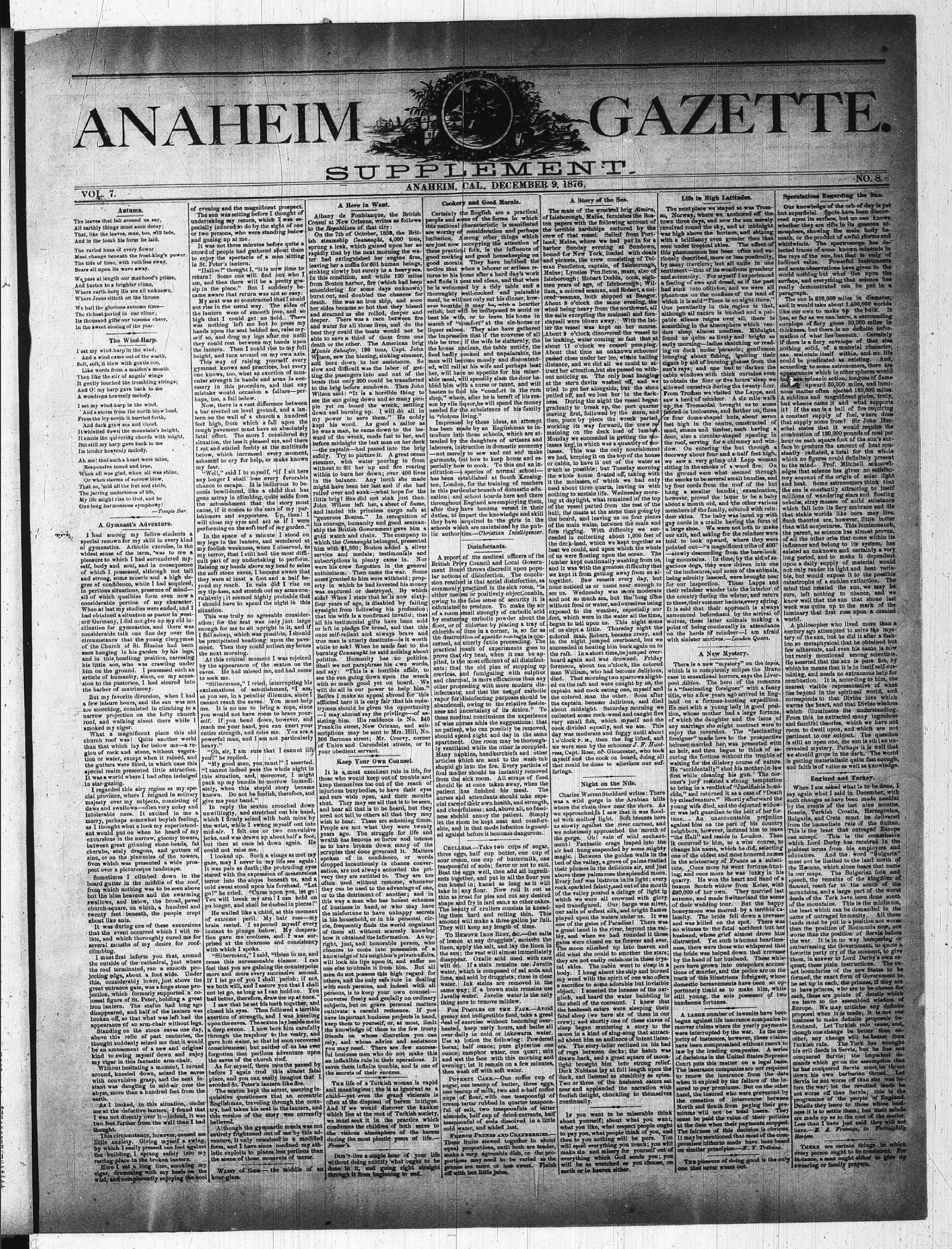
Searchable text
ANAHEIM
VOL. 7.
Autumn.
The leaves that fall around us say,
All earthly things must soon decay;
That, like the leaves, man, too, will fade,
And in the tomb his form be laid.
The varied hues of every flower
Must change beneath the frost-king's power.
The tide of time, with ruthless sway,
Bears all upon its wave away.
We pass at length our manhood's prime,
And hasten to a brighter clime,
Where earth-born ills are all unknown,
Where Jesus sitteth on the throne.
We hail the glorious autumn time—
The richest period in our clime;
Its thousand gifts our bosoms cheer,
In the sweet closing of the year.
The Wind-Harp.
I sat my wind-harp in the wind,
And a wind came out of the south,
Soft, soft, it blew with gentle coo,
Like words from a maiden's mouth.
Then like the stir of angels' wings
It gently touched the trembling strings;
And O! my harp gave back to me
A wondrous heavenly melody.
I set my wind-harp in the wind,
And a storm from the north blew loud,
From the ley north it hurried forth,
And dark grew sea and cloud.
It whistled down the mountain's height,
It smote the quivering chords with might,
But still my harp gave back to me
Its tender heavenly melody.
Ah me! that such a heart were mine,
of evening and the magnificent prospect.
The sun was setting before I thought of undertaking my return, which I was especially induced to do by the sight of one or two persons, who were standing below and gazing up at me.
It was not three minutes before quite a crowd of people had gathered about them to enjoy the spectacle of a man sitting in St. Peter's lantern.
"Halloo!" thought I, "it is now time to return! Some one will find out who I am, and then there will be a pretty gossip in the place." But I suddenly became aware that return was not so easy.
My seat was so constructed that I could not rise in the usual way. The sides of the lantern were of smooth iron, and so high that I could get no hold. There was nothing left me but to press my hands upon the seat behind me, raise myself so, and drag my legs after me until they could rest between my hands upon the lantern. Then I could rise to my full height, and turn around on my own axis.
This way of raising yourself every gymnast knows and practices, but every one knows, too, what an exertion of muscular strength in hands and arms is necessary in this procedure, and that any mistake would occasion a failure—perhaps, too, a fall below.
Now, there is a vast difference between a bar erected on level ground, and a lantern on the wall of a church a hundred feet high, from which a fall upon the rough pavement must have an absolutely fatal effect. The more I considered my situation, the less it pleased me, and there I sat and smiled feebly at the multitude below, which increased every moment, ashamed to cry for help, or make known...
A gymnast's Adventure.
I had among my fellow-students a special renown for my skill in every kind of gymnastics. Athletic exercise, in the widest sense of the term, was to me a pleasure to which I had surrendered myself, body and soul, and in consequence of which I possessed, although not tall and strong, some muscle; and a high degree of confidence, while I had acquired, in perilous situations, presence of mind—all of which qualities form even now a considerable portion of my character. When at last my studies were ended, and I had obtained a situation as pastor in western Germany, I did not give up my old inclination for gymnastics, and there was considerable talk one fine day over the circumstance that the young clergyman of the Church of St. Blasius had been seen hanging in his garden by his legs, and in this headlong position, caressing his little son, who was crawling under him on the ground. I possessed such an article of humanity, since, on my accession to the pastorate, I had steered into the harbor of matrimony.
But my favorite diversion, when I had a few leisure hours, and the sun was not too scorching, consisted in climbing to a narrow projection on the lofty church roof, and walking about there while I smoked my cigar.
What a magnificent place this old church roof was! Quite another world than that which lay far below me—a region of rock and stone, without vegetation or water, except when it rained, and the gutters were filled, in which case this special realm presented little attraction. It was a world where I had often indulged in star-gazing.
I regarded this airy region as my special province, where I reigned in solitary majesty over my subjects, consisting of daws and swallows—often very noisy and intolerable ones. It excited in me a merry, perhaps somewhat boyish feeling, as I thought what a look my superintendent would put on when he heard of my excursions in the narrow, gloomy towers, between great grinning stone-heads, fat cherubs, scaly dragons, and gutters of zine, or on the pinnacles of the towers, from which was presented a wide prospect over a picturesque landscape.
Sometimes I climbed down in the middle of the roof, then like the stir of angels' wings. It gently touched the trembling strings; And O! my harp gave back to me A wondrous heavenly melody.
I set my wind-harp in the wind,
And a storm from the north blew loud,
From the ice-north it hurried forth,
And dark grew sea and cloud.
It whistled down the mountain's height,
It amote the quivering chords with might,
But still my harp gave back to me Its tender heavenly melody.
Ah me! that such a heart were mine,
Responsive tuned and true,
When all was glad, when all was shine,
Or when storms of sorrow blew,
That so,'mild all the fret and strife,
The jarring undertones of life,
My life might rise to God, and be One long harmonious symphony!
—Temple Bar.
A gymnast's Adventure.
Now, there is a vast difference between a bar erected on level ground, and a lantern on the wall of a church a hundred feet high, from which a fall upon the rough pavement must have an absolutely fatal effect. The more I considered my situation, the less it pleased me, and there I sat and smiled feebly at the multitude below, which increased every moment, ashamed to cry for help, or make known my fear.
"Well," said I to myself, "if I sit here any longer I shall lose every favorable chance to escape. It is ludicrous to become bewildered, like a child that has gone astray in climbing, quite aside from the astonishment that the story must cause, if it comes to the ears of my parishers and supporters. Up, then! I will close my eyes and act as if I were performing on the soft turf of my garden."
In the space of a minute I stood on my legs in the lantern, and wondered at my foolish weakness, when I observed, to my terror, that I still had the most difficult part of my undertaking to perform. Raising my hands above my head to seize the soft stone eaves, I became aware that they were at least a foot and a half beyond my reach. In vain did I rise on my tip-toes, and stretch out my arms convulsively; it seemed highly probable that I should have to spend the night in this situation.
This was truly no agreeable consideration; for the seat was only just large enough for me to sit upright in it, and if I fell asleep, which was possible, I should be precipitated headlong upon the pavement. Then they could collect my bones next morning.
At this critical moment I was rejoiced by the appearance of the sexton on the eaves. He had missed me, and had come to seek me.
"Silbermann," I cried, interrupting his exclamations of astonishment, "I am, as you see, in a peculiar dilemma, since I cannot reach the eaves. You must help me. It is no use to bring a rope, since you would not have room to brace yourself. If you bend down, however, and reach me your hand, you can exert your entire strength, and raise me. You are a powerful man, and I am not particularly heavy."
"Oh,sir,I am sure that I cannot lift you!" he replied.
"My good man,you must!" I asserted. "I cannot indeed pass the whole night in this situation,and,moreover.I might pack up my bundle to morrow immediatelywhen this stupid story became known.Do not be foolish,thefore,and give me your hand."
In reply the sexton crouched down unwillingly,and stretched out his handwhich I firmly seized with both mine by the wrist,while I swung myself out into mid-air.I felt one or two convulsive jerks,and was drawn up about half a footbut then at once let down again.He could not raise me.
I looked up. Such a visage as met my gaze may I never in my life see again! It was pale as death;the protruding eyes stared with the expression of measureless terror into the abyss beneath us,and a gymnast knows and practises,but every one knows,toowhat an exertion of muscular strength in hands and arms is necessary in this procedure,and that any mistake would occasion a failure—perhaps too,a fall below.
Now there is a vast difference between a bar erected on level ground,and a lantern on the wall of a church a hundred feet high,从 which a fall upon the rough pavement must have an absolutely fatal effect.The more I considered my situation,the less it pleased me,and there I sat and smiled feebly at the multitude belowWhich increased every momentashamed to cry for help,或make knownmy fear.
"Well," said I to myself,"if I sit here any longer I shall lose every favorable chance to escape. It is ludicrous to become bewildered,Like a child that has gone astray in climbingquite aside fromthe astonishment that the storymust cause,如果它来到我的耳朵附近我就会感到害怕If it comes to the ears of my parishers和supportersUp then!I will close my eyesand act as ifI were performing onthe soft turfofmy garden."
In the space of a minuteI stood onmy legsinthelantern,andwonderedatmyfoolishweaknesswhenIobserved,towhetheritstillhadthemostdifficultpartofmyundertakingtoperform.Raisingmyhandsabovemyheadtoseizethesoftstoneeaves.Ibecameawarethattheywereatleastafootandahalfbeyondmyreach.InvaindidIriseonmytip-toes,andstretchoutmyarmsconvulsively;itseemedhighlyprobablethatIshouldhavetospendthenightinhissituation.
Thiswastrulynoagreeableconsideration;fortheseatwasonlyjustlargeenoughformeto坐uprightinit,andifIfallasleepwhichwaspossible.IshouldbeprecipitatedheadlonguponthepavementThentheycouldcollectmybonesnextmorning.
AtthiscriticalmomentIwasrejoicedbytheappearanceofthesextonontheeaves.Hewallhadmissedme,andhadcometosoekme.
"Silbermann,"Icriedinterruptinghisexclamationsofastonishment,"IamasyouseeinapeculiardilemmasinceIchannotreachtheeaves.Justhelpme.itisnousetocarryarope,sinceyouwouldnothavetoombraceyourselfIfyoubenddownhowever,andreachmeyourhandyoucanexertyourentirestrength,andraisemeYouareapowerfulman,andIamnotparticularlyheavy."
"Oh,sir,iam sure thatI cannot liftyou!"he replied.
"Imygoodman,youmust!"Iasserted."Icannotindeedpassthewholenightinthissituation,andmoreover.Imightpackupmybundletomorrowimmediatelywhenthisstupidstorybecameknown.Donotbefoolish,thefore,andgivemeyourhand."
Inreplythesextoncroucheddownunwillingly,andstretchedouthishandwhichIfirmlyseizedwithbothminebythewrist,whileIswungmyselfoutintomid-air.Ifeltoneortwoconvulsivejerks,andwasdrawnupabouthalefootbutthenatletdownagain.Hewouldnotraiseme.
Ilookedup.SuchavisageasmetmygazemayIneverinmylifeseeagain!Itwaspaleasdeath;theprotrudingeyestainedwiththeexpressionofmeasurelessterrorintotheabyssbeneathus,andagymnastknowsandpractices,buteveryoneknows,touwhatisoneknows,touwhatisoneknows,touwhatisoneknows,touwhatisoneknows,touwhatisoneknows,touwhatisoneknows,touwhatisoneknows,touwhatisoneknows,touwhatisoneknows,touwhatisoneknows,touwhatisoneknows,touwhatisoneknows,touwhatisoneknows,touwhatisoneknows,touwhatisoneknows,touwhatisoneknows,touwhatisoneknows,touwhatisoneknows,touwhatisoneknows,touwhatisoneknows,touwhatisoneknows,touwhatisoneknows,touwhatisoneknows,touwhatisoneknows,touwhatisoneknows,touwhatisoneknows,touwhatisoneknows,touwhatisoneknows,touwhatisoneknows,touwhatisoneknows,touwhatisoneknows,touwhatisoneknows,touwhatisoneknows,touwhatisoneknows,touwhatisoneknows,touwhatisoneknows,touwhatisoneknows,touwhatisoneknows,touwhatisoneknows,touwhatisoneknows,touwhatisoneknows,touwhatisoneknows,touwhatisoneknows,touwhatisoneknows,touwhatisoneknows,touwhatisoneknows,touwhatisoneknows,touwhatisoneknows,TOUWHISKINSTREETMARKS
A gymnast's Adventure.
Shall we not putand say: "Thesee太阳gowithso muchwilldoallinbeforeImakeafflictiedheroinetrymenshould-Imayalmostsistinghim.Franklinstreetscriptsmay306BaronnesandUnionandyourobedientpolitics.Hueshallwenotputand say: "Thesee太阳gowithso muchwilldoallinbeforeImakeafflictiedheroinetrymenshould-Imayalmostsistinghim.Franklinstreetscriptsmay306BaronnesandUnionandyourobedientpolitics.Hueshallwenotputand say: "Thesee太阳gowithso muchwilldoallinbeforeImakeafflictiedheroinetrymenshould-Imayalmostsistinghim.Franklinstreetscriptsmay306BaronnesandUnionandyourobedientpolitics.Hueshallwenotputand say: "Thesee太阳gowithso muchwilldoallinbeforeImakeafflictiedheroinetrymenshould-Imayalmostsistinghim.Franklinstreetscriptsmay306BaronnesandUnionandyourobedientpolitics.Hueshallwenotputand say: "Thesee太阳gowithso muchwilldoallinbeforeImakeafflictiedheroinetrymenshould-Imayalmostsistinghim.Franklinstreetscriptsmay306BaronnesandUnionandyourobedientpolitics.Hueshallwenotputand say: "Thesee太阳gowithso muchwilldoallinbeforeImakeafflictiedheroinetrymenshould-Imayalmostsistinghim.Franklinstreetscriptsmay306BaronnesandUnionandyourobedientpolitics.Hueshallwenotputand say: "Thesee太阳gowithso muchwilldoallinbeforeImakeafflictiedheroinetrymenshould-Imayalmostsistinghim.Franklinstreetscriptsmay306BaronnesandUnionandyourobedientpolitics.Hueshallwenotputand say: "Thesee太阳gowithso muchwilldoallinbeforeImakeafflictiedheroinetrymenshould-Imayalmostsistinghim.Franklinstreetscriptsmay306BaronnesandUnionandyourobedientpolitics.Hueshallwenotputand say: "Thesee太阳gowithso muchwilldoallinbeforeImakeafflictiedheroinetrymenshould-Imayalmostsistinghim.Franklinstreetscriptsmay306BaronnesandUnionandyourobedientpolitics.Hueshallwenotputand say: "Thesee太阳gowithso muchwilldoallinbeforeImakeafflictiedheroinetrymenshould-Imayalmostsistinghim.Franklinstreetscriptsmay306BaronnesandUnionandyourobedientpolitics.Hueshallwenotputand say: "Thesee太阳gowithso muchwilldoallinbeforeImakeafflictiedheroinetrymenshould-Imayalmostsistinghim.Franklinstreetscriptsmay306BaronnesandUnionandyourobedientpolitics.Hueshallwenotputand say: "Thesee太阳gowithso muchwilldoallinbeforeImakeafflictiedheroinetrymenshould-Imayalmostsistinghim.Franklinstreetscriptsmay306BaronnesandUnionandyourobedientpolitics.Hueshallwenotputand say: "Thesee太阳gowithso muchwilldoallinbeforeIMakeafflictiedheroinetrymenshould-Imayalmostsistinghim.Franklinstreetscriptsmay306BaronnesandUnionandyourobedientpolitics.Hueshallwenotputand say: "Thesee太阳gowithso muchwilldoallinbeforeIMakeafflictiedheroinetrymenshould-Imayalmostsistinghim.Franklinstreetscriptsmay306BaronnesandUnionandyourobedientpolitics.Hueshallwenotputand say: "Thesee太阳gowithso muchwilldoallinbeforeIMakeafflictiedheroinetrymenshould-Imayalmostsizinghim.Franklinstreetscriptsmay306BaronnesandUnionandyourobedientpolitics.Hueshallwenotputand say: "Thesee太阳gowithso muchwilldoallinbeforeIMakeafflictiedheroinetrymenshould-Imayalmostsizinghim.Franklinstreetscriptsmay306BaronnesandUnionandyourobedientpolitics.Hueshallwenotputand say: "Thesee太阳gowithso muchwilldoallinbeforeIMakeafflictiedheroinetrymenshould-Imayalmostsizinghim.Franklinstreetscriptsmay306BaronnesandUnionandyourobedientpolitics.Hueshallwenotputand say: "Thesee太阳gowithso muchwilldoallinbeforeIMakeafflictiedheroinetrymenshould-Imayalmostsizinghim.Franklinstreetscriptsmay306BaronnesandUnionandyourobedientpolitics.Hueshallwenotputand say: "Thesee太阳gowithso muchwilldoallinbeforeIMakeafflictiedheroinetrymenshould-Imayalmostsizinghim.Franklinstreetscriptsmay306Baronnes和Union和yourobedientpolitics.Hueshallwenotput和说: "Thesee太阳gowithso muchwilldoallinbeforeIMakeafflictiedheroinetrymenshould-Imayalmostsizinghim.Franklinstreetscriptsmay306Baronnes和Union和yourobedientpolitics.Hueshallwenotput和说: "Thesee太阳gowithso muchwilldoallinbeforeIMakeafflictiedheroinetrymenshould-Imayalmostsizinghim.Franklinstreetscriptsmay306Baronnes和Union和yourobedientpolitics.Hueshallwenotput和说: "Thesee太阳gowithso muchwilldoallinbeforeIMakeafflictiedheroinetrymenshould-Imayalmostsizinghim.Franklinstreetscriptsmay306Baronne;s和Union和yourobedientpolitics.Hueshallwenotput和说: "Thesee太阳gowithso muchwilldoallinbeforeIMakeafflictiedheroinetrymenshould-Imayalmostsizinghim.Franklinstreetscriptsmay306Baronne;s和Union和yourobedientpolitics.Hueshallwenotput和说: "Thesee太阳gowithso muchwilldoallinbeforeIMakeafflictiedheroinetrymenshould-Imayalmostsizinghim.Franklinstreetscriptsmay306Baronne;s和Union和yourobedientpolitics.Hueshallwenotput和说: "Thesee太阳gowithso muchwilldoallinbeforeIMakeafflictiedheroinetrymenshould-Imayalmostsizinghim.Franklinstreetscriptsmay306Baronne;s和Union和yourobedientpolitics.HueshallweNotput和说: "Thesee太阳gowithso muchwilldoallinbeforeIMakeafflictiedheroinetrymenshould-Imayalmostsizinghim.Franklinstreetscriptsmay306Baronne;s和Union和yourobedientpolitics.HueshallweNotput和说: "Thesee太阳gowithso muchwilldoallinbeforeIMakeafflictiedheroinetrymen Should-Allies-in-the-middle-of-the-road-Have-some-pictures-on-door-bench-and-window-where-it-is-flat-down-or-curved-down-into-a-door-with-a-window-where-it-is-open-to-the-bench-and-window-where-it-is-open-to-the-bench-and-window-where-it-is-open-to-the-bench-and-window-where-it-is-open-to-the-bench-and-window-where-it-is-open-to-the-bench-and-window-where-it-is-open-to-the-bench-and-window-where-it-is-open-to-the-bench-and-window-where-it-is-open-to-the-bench-and-window-where-it-is-open-to-the-bench-and-window-where-it-is-open-to-the-bench-and-window-where-it-is-open-to-the-bench-and-window-where-it-is-open-to-the-bench-and-window-where-it-is-open-to-the-bench-and-window-where-it-is-open-to-the-bench-and-window-where-it-is-open-to-the-bench-and-window-where-it-is-open-to-the-bench-and-window-where-it-is-open-to-the-bench-and-window-where-it-is-open-to-the-bench-and-window-where-it-is-open-to-the-bench-and-window-where-it-is-open-to-the-bench-and-window-where-it-is-open-to-the-bench-and-window-where-it-is-open-to-the-bench-and-window-where-it-is-open-to-the-bench-and-window-where-it-is-open-to-the-bench-and-window-where-it-is-open-to-the-bench-and-window-where-it-is-open-to-the-bench-and-window-where-it-is-open-to-the-bench-and-window-where-it-is-open-to-the-bench-and-window-where-it-is-open-to-the-bench-and-window-where-it-is-open-to-the-bench-and-window-where-it-is-open-to-the-bench-and-window-where-it-is-open-to-the-bench-and-window-where-it-is-open-to-the-bench-and-window-where-it-is-open-to-the-bench-and-window-where-it-is-open-to-the-bench-and-window-where-it-is-open-to-the-bench-and-window-where-it-is-open-to-the-bench-and-window-where-it-is-open-to-the-bench-and-window-where-it-is-open-to-the-bench-and-window-where-it-is-open-to-the-bench-and-window-where-it-is-open-to_the-bench-and-window-where_it-is-open-to_the-bench-and-window-where_it.is-open-to_the-bench_and_windows-down-or-curved-down-or-curved-down-or-curved-down-or-curved-down-or-curved-down-or-curved-down-or-curved-down-or-curved-down-or-curved-down-or-curved-down-or-curved-down-or-curved-down-or-curved-down-or-curved-down-or-curved-down-or-curved-down-or-curved-down-or-curved-down-or-curved-down-or-curved-down-or-curved-down-or-curved-down-or-curved-down-or-curved-down-or-curved-down-or-curved-down-or-curved-down-or-curved-down-or-curved-down-or-curved-down-or-curved下跌或爬行或走行或爬行或走行或爬行或走行或爬行或走行或爬行或走行或爬行或走行或爬行或走行或爬行或走行或爬行或走行或爬行或走行或爬行或走行或爬行或走行或爬行或走行或爬行或走行或爬行或走行或爬行或走行或爬行或走行或爬行或走行或爬行或走行或爬行或走行或爬行或走行或爬行或走行或爬行或走行或爬行或走行或爬行或爬行走或爬行走或爬行走或爬行走或爬行走或爬行走或爬行走或爬行走或爬行走或爬行走或爬行走或爬行走或爬行走或爬行走或爬行走或爬行走或爬行走或爬行走或爬行走或爬行走或爬行走或爬行走或爬行走或爬行走或爬行走或爬行走或爬行走或爬行走或爬行走或爬行走或爬行走或爬行走或爬行走或爬行走或者
I regarded this airy region as my special province, where I reigned in solitary majesty over my subjects, consisting of daws and swallows—often very noisy and intolerable ones. It excited in me a merry, perhaps somewhat boyish feeling, as I thought what a look my superintendent would put on when he heard of my excursions in the narrow, gloomy towers, between great grinning stone-heads, fat cherubs, scaly dragons, and gutters of zinc, or on the pinnacles of the towers, from which was presented a wide prospect over a picturesque landscape.
Sometimes I climbed down in the board gutter in the middle of the roof, from which nothing was to be seen above but the blue heavens and the swarming swallows, and below, the broad, paved church-square, on which, a hundred and twenty feet beneath, the people crept about like ants.
It was during one of these excursions that the event occurred which I will relate, and which thoroughly cured me for several months of my desire for roof-climbing.
I must first inform you that, around the outside of the cathedral, just where the roof terminated, ran a smooth projecting edge, about a foot wide. Under this, considerably lower, just above the great entrance gate, was a huge stone projection, which formerly supported a colossal figure of St. Peter, holding a great iron lantern. The statue had long ago disappeared; and half of the lantern was broken off, so that what was left had the appearance of an arm-chair without legs.
Standing on the stone eaves one day, above this relic of past centuries, the thought suddenly seized me that it would be an amusement of a new and original kind to swing myself down and enjoy my cigar in this fantastic arm-chair.
Without hesitating a moment, I turned around, kneeled down, seized the eaves with convulsive grasp, and the next instant was dangling in mid-air over the abyss, more than a hundred feet from the earth.
As I looked, in this situation, under me at the defective lantern, I found that I was not directly over it—indeed, it was two feet further from the wall than I had thought.
This circumstance, however, caused me little anxiety. Giving myself a swing, by which I easily pressed one foot against the building, I sprang safely into my resting-place in the broken lantern.
Here I sat a long time, smoking my cigar, drumming with my heels on the wail, and complacently enjoying the cool
In reply to the sexton crouched down unwillingly, and stretched out his hand, which I firmly seized with both mine by the wrist, while I swung myself out into mid-air. I felt one or two convulsive jerks, and was drawn up about half a foot, but then at once let down again. He could not raise me.
I looked up. Such a visage as met my gaze, may I never in my life see again! It was pale as death; the protruding eyes stared with the expression of measureless terror into the abyss beneath us, and a cold sweat stood upon his forehead. "Let go!" he cried. "Curse upon you, let go! You will break my arm! I can hold on no longer, and shall be dashed in pieces!"
He wailed like a child, at this moment of extreme peril. My hair rose—my brain reeled. I expected myself every instant to plunge below. My desperation gave me coolness, and I was surprised at the clearness and consistency with which I spoke.
"Silbermann," I said, "listen to me, and cease this unreasonable clamor. I can feel that you are gaining the counterpoise more and more every successive second. If I let go of you I shall perish; if not, we both will, and I assure you that I shall not let go, as long as I can hold on. You had better, therefore, draw me up at once."
I saw that he set his teeth together, and closed his eyes. Then followed a terrible exertion of strength, and I was kneeling upon the eaves. The sexton lay beside me in a deep swoon. I now bore him carefully through the trapdoor to the vestry, and gave him water, so that he soon recovered consciousness; but neither of us has ever forgotten that perilous adventure upon the eaves of the church roof.
As for myself, three months passed by before I again trod this almost fatal place, and you can easily imagine that I avoided St. Peter's lantern like fire.
The sexton kept the secret, assuring inquisitive questioners that an eccentric Englishman, traveling through the country, had taken his seat in the lantern, and this version of the story was currently believed.
Although the gymnastic mania was not entirely frightened out of me by this adventure, it only remained in a modified form, and I have since confined my athletic exploits to places less perilous than the scene of those moments of terror.
Waist of time—the middle of an hour-glass.
CIM GA
SUPPLEMENT.
ANAHEIM, CAL., DECEMBER 9, 1876.
A Hero in Want.
Albany de Fonblanque, the British Consul at New Orleans, writes as follows to the Republican of that city:
On the 7th of October, 1859, the British steamship Coonnaught, 4,000 tons, sprung a leak, which gained upon her so rapidly that by the next morning the water had extinguished her engine fires, leaving her a coffin for 601 human beings, sinking slowly but surely in a heavy sea. In this condition, and while 150 miles from Boston harbor, fire (which had been smouldering for some days unknown) burst out, and doubled the chances for death. She was an iron ship, and soon her sides became so hot that they hissed and steamed as she rolled, deeper and deeper. There was a race between fire and water for all those lives, and do the best they could the boats would not be able to save a third of them from one death or the other. The American brig Minnie Schoefer, 198 tons, Capt. John Wilson, saw the blazing, sinking steamer, and bore down to her assistance. So slow and difficult was the labor of getting the passengers into and out of the boats that only 200 could be transferred to the brig before sundown. Then John Wilson said: "It is a horrible thing to see the sun going down and so many people yet on board the wreck, settling down and burning up. I will do all in my power to save them." He nobly kept his word. As good a sailor as he was, he came down to the leeward of the wreck, made fast to her, and before midnight the last man on her deck—the captain—had passed into the brig safely. Try to picture it. A great ocean steamer, with water pouring in from town.
Cookery and Good Morals.
Certainly the English are a practical people and some of the forms in which this national characteristic is manifested are worthy of consideration and perhaps imitation. Among other things which are just now occupying the attention of these practical folk, is the influence of good cooking and good housekeeping on good morals. They have imbibed the notion that when a laborer or artisan returns to his home after a hard day's work and finds it neat and clean, and that when he is welcomed by a tidy table and a thoroughly well-cooked and palatable meal, he will not only eat his dinner, however humble, it may be, with a heartier relish, but will be indisposed to scold or beat his wife, or to leave his home in search of "comfort" at the ale-house or liquor saloon. They also have gathered the impression that if the converse of all this be true; if the wife be slatternly, the house unclean, the table untidy, the food badly cooked and unpalatable, the man will become moody and discontented, will rail at his wife and perhaps beat her, will have no appetite for his miserable meal, will speedily slam the door behind him with a curse or taunt, and will hasten to find his "comfort in the rum shop," where, after he is bereft of his reason by vile liquor, he will spend the money needed for the subsistence of his family in "riotous living."
Impressed by these ideas, an attempt has been made by an Englishman to introduce into those schools, which are attended by the daughters of artisans and laborers, instruction in domestic economy—not merely to sew and cut and make garments, but how to keep house and especially how to cook. To this end an in-
A Story of the Sea.
The mate of the wrecked brig Almira, of Isleborough, Maine, furnishes the Boston papers with the following account of the terrible hardships endured by the crew of that vessel. Sailed from Portland, Maine, where we had put in for a harbor Sunday evening at Sundown, bound for New York, loaded with deals and pickets, the crew consisting of Tolman Pendleton, captain, of Isleborough, Maine; Lyonies Pendleton, mate; also of Isleborough; Hobart Dodds, cook, eighteen years of age, of Isleborough; William a colored seaman, and Robert a colored seaman, both shipped at Bangor. About 8 o'clock the same evening, the wind being heavy from the northwest, all the sails excepting the mainsail and forestaysail were blown away. With the latter the vessel was kept on her course. About 9 o'clock discovered the vessel to be leaking, water coming so fast that at about 11 o'clock we ceased pumping. About that time an unknown schooner passed close under her lee, within hailing distance, and we did all we could to attract her attention, but she passed on without noticing us. The only boat hanging at the stern davits washed off, and we tried to get her alongside, but the stern pulled off, and we lost her in the darkness. During the night the vessel began gradually to break up, the port quarter leaving first, followed by the stern, and then, piece by piece the wreck parted working its way forward; the crew remaining on the deck load of lumber. Monday we succeeded in getting the mollasses keg in which was a quantity of molasses. This was the only nourishment we had, keeping it on the top of the house or cabin, to have it out of the water as
between and a landed hundred upon the absolutely considered my and there multitude moment, make known
If I sit here favorable to be that has beside from history must my parap, then! I if I were any garden.
I stood on wondered at observed, to most difficult to perform, to seize aware that a half be in I rise on arms contrabable that night in this consider just large it, and if, I should on the pave meet my bones was rejoiced exton and had come interrupting his ment, "I am,amma, since I should on the pave meet my bones was rejoiced exton and had come interrupting his ment, "I am,amma, since I should on the pave meet my bones was rejoiced exton and had come interrupting his ment, "I am,amma, since I should on the pave meet my bones was rejoiced exton and had come interrupting his ment, "I am,amma, since I should on the pave meet my bones was rejoiced exton and had come interrupting his ment, "I am,amma, since I should on the pave meet my bones was rejoiced exton and had come interrupting his ment, "I am,amma, since I should on the pave meet my bones was rejoiced exton and had come interrupting his ment, "I am,amma, since I should on the pave meet my bones was rejoiced exton and had come interrupting his ment, "I am,amma, since I should on the pave meet my bones was rejoiced exton and had come interrupting his ment, "I am,amma, since I should on the pave meet my bones was rejoiced exton and had come interrupting his ment, "I am,amma, since I should on the pave meet my bones was rejoiced exton and had come interrupting his ment, "I am,amma, since I should on the pave meet my bones was rejoiced exton and had come interrupting his ment, "I am,amma, since I should on the pave meet my bones was rejoiced exton and had come interrupting his ment, "I am,amma, since I should on the pave meet my bones was rejoiced exton and had come interrupting his ment, "I am,amma, since I should on the pave meet my bones was rejoiced exton and had come interrupting his ment, "I am,amma, since I should on the pave meet my bones was rejoiced exton and had come interrupting his ment, "I am,amma, since I should on the pave meet my bones was rejoiced exton and had come interrupting his ment, "I am,amma, since I should on the pave meet my bones was rejoiced exton and had come interrupting his ment, "I am,amma, since I should on the pave meet my bones was rejoiced exton and had come interrupting his ment, "I am,amma, since I should on the pave meet my bones was rejoiced exton and had come interrupting his ment, "I am,amma, since I should on the pave meet my bones was rejoiced exton and had come interrupting his ment, "I am,amma, since I should on the pave meet my bones was rejoiced exton and had come interrupting his ment, "I am,amma, since I should on the pave meet my bones was rejoiced exton and had come interrupting his ment, "I am,amma, since I should on the pave meet my bones was rejoiced exton and had come interrupting his ment, "I am,amma, since I should on the pave meet my bones was rejoiced exton and had come interrupting his ment, "I am,ama,since I should on the pave meet my bones was rejoiced exton and had come interrupting his ment,"I am,ama,since I should on the pave meet my bones was rejoiced exton and had come interrupting his ment,"I am,ama,since I should on the pave meet my bones was rejoiced exton and had come interrupting his ment,"I am,ama,since I should on the pave meet my bones was rejoiced exton and had come interrupting his ment,"I am,ama,since I should on the pave meet my bones was rejoiced exton and had come interrupting his ment,"I am,ama,since I should on the pave meet my bones was rejoiced exton and had come interrupting his ment,"I am,ama,since I should on the pave meet my bones was rejoiced exton and had come interrupting his ment,"I am,ama,since I should on the pave meet my bones was rejoiced exton and had come interrupting his ment,"I am,ama,since I should on the pave meet my bones was rejoiced exton and had come interrupting his ment,"I am,ama,since I should on the pave meet my bones was rejoiced exton and had come interrupting his ment,"I am,ama,since I should on the pave meet my bones was rejoiced exton and had come interrupting his ment,"I am,ama,since I should on the pave meet my bones was rejoiced exton and had come interrupting his ment,"I am,ama,since I should on the pave meet my bones was rejoiced exton and had come interrupting his ment,"I am,ama,since I should on the pave meet my bones was rejoiced exton and had come interrupting his ment,"I am,ama,since I should on the pave meet my bones was rejoiced exton and had come interrupting his ment,"I am,ama,since I should on the pave meet my bones was rejoiced exton and had come interrupting his ment,"I am,ama,since I should on the pave meet my bones was rejoiced exton and had come interrupting his ment,"I am,ama,since I should on the pave meet my bones was rejoiced exton and had come interrupting his ment,"I am,ama,since I should on the pave meet my bones was rejoiced exton and had come interrupting his ment,"I am,ama,since I should on the pave meet my bones was rejoiced exton and had come interrupting his ment,"I am,ama,since I should on the pave meet my bones was rejoiced exton and had come interrupting his ment,"I am,ama,since I should on the pave meet my bones was rejoiced exton and had come interrupting his ment,"I am,ama,since I should on the pave meet my bones was rejoiced exton and had come interrupting his ment,"I am,ama,since I should on the pawel counsel.
It is a most excellent rule in life, for those who would keep out of trouble and keep themselves too out of reach of injurious busybodies; to have their eyes and ears wide open, and their mouths shut. They may see all that is to be seen, and bear all that is to be heard, but they need not tell to others all that they may wish to hear. These are scheming times. People are not what they were twenty years ago. The struggle for life and wealth has become so fierce and intense as to have broken down many of the scruples that once governed it. Matters spoken of in confidence, or words dropped incautiously in chance conversation, are not always accorded the privacy they are entitled to. They are too often without remorse whenever
Keep Your Own Counsel.
It is a most excellent rule in life, for those who would keep out of trouble and keep themselves too out of reach of injurious busybodies; to have their eyes and ears wide open, and their mouths shut. They may see all that is to be seen, and bear all that is to be heard, but they need not tell to others all that they may wish to hear. These are scheming times. People are not what they were twenty years ago. The struggle for life and wealth has become so fierce and intense as to have broken down many of the scruples that once governed it. Matters spoken of in confidence, or words dropped incautiously in chance conversation are not always accorded the privacy they are entitled to. They are too often without remorse whenever
Disinfectants.
A report of the medical officers of the British Privy Council and Local Government. Board throws discredit upon popular notions of disinfection. The conclusion reached is that aerial disinfection as commonly practised in the sick room, "is either useless or positively objectionable, owing to the false sense of security it is calculated to produce. To make air of a room smell strongly of carbolic acid by scattering carbolic powder about the floor, or of chlorine by placing a tray of chloride of lime in a corner, is so far as the destruction of specific contagion is concerned, an utterly futile proceeding. The practical result of experiments goes to prove that dry heat, when it can be applied, is the most efficient of all disinfectants; that the old plan of stopping up crevices, and fumigating with sulphur and charcoal is more efficacious than any other proceeding with more modern disinfectants; and that the use of carbolic vapor for disinfecting purposes should be abandoned, owing to the relative feebleness and uncertainty of its action." To these medical conclusions the experience of wise nurses adds the suggestions: that no patient who can possibly be removed spend night and day in the same apartment. One room may be thoroughly ventilated while the other is occupied. Many napkins, handkerchiefs and other articles which are sent to the wash-tub should go into the fire. Every particle of foul matter should be instantly removed from the sick room. All scraps of food should be at once taken away when the patient has finished his meal. The nurses and attendants should take especial care of their own health, and strength,and cheerfulness;and above all,nousiness should annoy the patient. Simply let the room be kept neat and comfortable,and in that mode infection is guarded against before it becomes dangerous.
Crullers.
Take two cups of sugar three eggs,half cup butter,一杯 cup of sour cream,一杯 cup of buttermilk,一 teaspoonful of soda; flavor or not to suit. Beat the eggs well,则 add all ingredients together,and put in allthe flour you will
Night on the Nile.
Charles Warren Stoddard writes: There was a wild gorge in the Arabian hills where the chain drew near the shore. As we approached it I saw that it was flooded with mellow light. Soft breezes bore us slowly against the river current,and we noiselessly approached the mouth of the gorge. Oh! vale of wild enchantment! Fantastic crags leaped into the air and hung suspended by some mighty magic. Between the golden walls in the bed of the valley,a grove of palms rustled their plumes in the delicious air,and just above these palms rose the splendid moon. Every leaf was lustrous in its light; every
keep themselves too out of the reach of injurious busybodies, to have their eyes and ears wide open, and their mouths shut. They may see all that is to be seen, and hear all that is to be heard, but they need not tell to others all that they may wish to hear. These are scheming times. People are not what they were twenty years ago. The struggle for life and wealth has become so fierce and intense as to have broken down many of the scruples that once governed it. Matters spoken of in confidence, or words dropped incautiously in chance conversation, are not always accorded the privacy they are entitled to. They are too often used without remorse, whenever they can be used to the advantage of one, or to the detriment of another; and in this way a man who has honest schemes of business in hand, or who may have misfortune to have unhappy secrets in his household, or in his personal circle, frequently finds the world cognizant of them all without scarcely knowing how it obtained the information. An upright, just, and honorable person, who chances to come into possession of a knowledge of his neighbor's private affairs, will lock his lips upon it, and suffer no one else to obtain it from him. But all men do not possess this high regard for others, and the only safe rule in dealing with such persons, and indeed with all persons, is to keep your own counsel—converse freely and genially on ordinary subjects, but on grave personal matters cultivate a careful reticence. If you have important business projects in hand, keep them to yourself, or at most, limit the knowledge of them to the few trusty friends on whose discretion you can rely, and whose advice and assistance you may need. There are few successful business men who do not make this an inflexible rule in their operations. It saves them infinite trouble, and is one of the secrets of their success.
The life of a Turkish woman is vapid and meaningless; she is as ignorant as a child—yet even the grand vizierate is often at the disposal of barem intrigue. And if we would discover the kanker which lies at the root of Turkish society, we must seek it in the practice which condemns the children of both sexes to the vicious atmosphere of the harem during the most plastic years of life.
Don't live a single hour of your life without doing exactly what ought to be done in it, and going right straight through it from beginning to end.
Crullers.—Take two cups of sugar, three eggs, half cup butter, one cup of sour cream, one cup of buttermilk, one teaspoonful of soda; flavor or not to suit. Beat the eggs well, then add all ingredients together, and put in all the flour you can knead in; knead as long as it will take in any flour. Now roll it out thin as crust for pies and cut any desired shape and fry in lard sane as other cakes. The beauty of crullers consists in kneading them hard and rolling thin. This amount will make a three-gallon jar full. They will keep any length of time.
To Remove Iron Rust, &c.—Get salts of lemon at any druggists; moisten the linen, apply the salt, and lay the linen in the sun; the rust will almost immediately disappear. Oxalic acid used with care will do. If a stain remains use Javelle water, which is composed of sal soda and lime, and sold by druggists; rinse in clear water. Ink stains are removed in the same way; if a brown stain remains use Javelle water. Javelle water is the only thing sure to remove mildew.
For Pimples on the Face.—Avoid greasy and indigestible food, take a great deal of exercise without becoming overheated, keep early hours, and bathe all over daily in cold or lukewarm water. Use as lotion the following: Powdered borax half ounce; pure glycerine one ounce; camphor water, one quart; mix and wet the face with this morning and evening; let it remain on a few minutes, then wash off with soft water.
Poverty Cake.—One coffee cup of sugar, one teacup of butter, three eggs, one teacup of milk, two and a-half coffee cups of flour, with one teaspoonful of cream tartar rubbed in quarter teaspoonful of salt, two teaspoonfuls of bitter almonds, half cup of dried currants, half teaspoonful of soda dissolved in a little cold water, and added last.
French Prunes and Cranberries.—These fruits stewed together in about equal proportions, until both are tender, make a very agreeable dish, or the proportions may need to be varied as the prunes are more or less sweet. Finish off with but little juice.
Night on the Nile.
Charles Warren Stoddard writes: There was a wild gorge in the Arabian hills where the chain drew near the shore. As we approached it I saw that it was flooded with mellow light. Soft breezes bore us slowly against the river current, and we noiselessly approached the mouth of the gorge. Oh! vale of wild enchantment! Fantastic crabs leaped into the air and hung suspended by some mighty magic. Between the golden walls in the bed of the valley, a grove of palms rustled their plumes in the delicious air, and just above these palms rose the splendid moon. Every leaf was luscious in its light; every rock sparkled faintly,and out of the mouth of the valley poured a deluge of light ip which we were all crowned with glory and transfigured. Our barge was silver, our sails of softest silk,and bright flames played upon the waters under us. It was one of the gates of Paradise! There was a great bend in the river,beyond the valley,and when we had rounded it those gates were closed on us forever and ever. The moon climbed up into heaven and did what she could to smother the stars; they are not easily outshone in these crystal skies.The cabin went to sleep in a body.I hung about the ship and burned my weed with the spirit of one who offers a sacrifice to some adorable but invisible object.I scented the incense of the narglich,and heard the water bubbling in the shell of the cocaoanut.I knew that the hasheesh eaters were sleeping their fatal sleep (we have six of them in our crew);and shortly one of these slaves of sleep began muttering a story to the moon in a kind of sing-song that attracted about him an audience of intent listeners.The story-teller reclined on his bed of rugs between decks;the hatch was drawn back,and a great square of moonlight brought him into strong relief.Dark Nubians lay at full length upon the deck,and listened as stealthily as spies.Two or three of the hasheesh eaters sat near and applauded the narration with foolish delight, chuckling to themselves continually.
If you want to be miserable think about yourself; about what you want, what you like,what respect people ought to pay you,what people think of you,and then to you nothing will be pure.You will spoil everything you touch;you will make sin and misery for yourself out of everything which God sends you;you will be as wratched as you choose,on earth or in heaven either.
GAZETTE.
NO. 8.
of the Sea.
wrecked brig Almira,
one furnishes the Boat following account of trips endured by the Sailed from Portwe had put in for a evening at Sundown,
park, loaded with deals new consisting of Toltain, of Isleborough,
andleton, mate, also of Art Dodds, cook, eighof Isleborough; Wilman, and Robert, a colshipped at Bangor.
the same evening, the
from the northwest, all
the mainsail and foreaway. With the latkept on her course,
discovered the vessel to
coming so fast that at
we ceased pumping.
an unknown schooner
her lee, within hailing
all we could to atbut she passed on withThe only boat hanging
was washed off, and we
bongside, but the stern
lost her in the darknight the vessel began
up, the port quarter
awed by the stern, and
once the wreck parted,
forward, the crew redeck load of lumber.
ded in getting the moth was a quantity of mothe only nourishment
on the top of the house
out of the water as
Life in High Latitudes.
The next place we stayed at was Tromso, Norway, where we anchored off the town three days, and now the sun merely revolved round the sky, and at midnight was high above the horizon, and shipping with a brilliancy even greater than that seen under tropical skies. The effect of this phenomenon has been often and variously described, more or less poetically, by many travelers; but all unite in one sentiment—that of its wondrous grandeur and sullemnity. For myself I experienced a feeling of awe and dread, as if the past had sunk into oblivion, and we were all phantoms on the confines of the land of which it is said "There is no night there."
One peculiarity in this region is that although all nature is hushed and a palpable silence reigns over all, there is something in the atmosphere which renders sleep almost needless. Midnight found us quite as lively and bright as early morning—ladies sketching or reading on deck under parasols; gentlemen lounging about fishing, igniting their cigars by aid of burning glasses from the sun's rays; and one had to darken the cabin windows with thick curtains even to obtain the four or five hours' sleep we allowed ourselves during the twenty-four. From Tromso we visited the Lapps, and saw a herd of reindeer. A six-mile walk up the Tromsodal brought us to some fenced-in enclosures, and farther on, three or four dome-shaped huts, about seven feet high in the centre, constructed of mud, stones and timber, each having a door, also a circular-shaped opening in the roof, serving for a chimney and window. On entering the hut through a doorway about four and a-half feet high, we saw a very grimy old Lapp woman.
Speculations Regarding the Sun.
Our knowledge of the orb of day is yet but superficial. Spots have been discovered upon its surface, but no one knows whether they are rifts in its gaseous atmosphere, showing the main body beneath, or the product of awful storms and whirlwinds. The spectroscope has detected traces of some known minerals in the rays of the sun, but that is only of indirect value. Powerful instruments and acute observations have given to the world nothing but what lies upon the surface, and everything that science has really demonstrated can be put in a paragraph.
The sun is 856,000 miles in diameter, and it would take about 1,400,000 worlds like our own to make up the bulk. It has so far as we can learn, a surrounding envelope of fiery gases 50,000 miles in thickness, but there is no definite information of what lies beneath. Certainly if there is a fiery envelope of that size nothing solid, of a material character, can maintain itself within, and no life could be predicated as existing. And, according to some astronomers, there are appearances which in other spheres would include volcanic action, tongues of flame darting upward 50,000 miles, and luminous matter often ejected 160,000 miles. A sublime and magnificent globe, truly, but whence came it and what supports it! If the sun is a ball of fire requiring a constant supply of fuel, where does that supply come from? Sir John Herschel states that it would require the combustion of 130,000 pounds of coal per hour on each square foot of the sun's surface to produce the amount of heat constantly radiated, a total for the whole which no figures could definitely present to the mind. Prof. Mitchell acknowled-
but she passed on withThe only boat hanging
was washed off, and we
bongside, but the stern
lost her in the darknight the vessel began
up, the port quarter
saw by the stern, and
the wreck parted,
forward, the crew redeck load of lumber.
Indeed in getting the moth was a quantity of moth on the top of the house
out of the water as
but Tuesday morning
floated off, taking with
of which we had only
quarts, leaving us with
life. Wednesday mornthat remained of the top
from the rest of the
the same time going by
dwelling us on four pieces
between the main and
with difficulty we succring about 1,000 feet of
which we kept together as
and upon which the whole
ing upon the ocean. The
annually washing from us,
the greatest difficulty that
getting away from us alvevessels every day, but
her came near enough to
day was more moderate
in sea, but the long time
water, and ourselves being
weather, especially our
in the water all the time,
on us. This night some
one. Thursday night the
abert, became crazy, and
umped overboard, but we
going him back again on to
short time, he jumped overwas drowned. Friday
ten o'clock, the colored
who had become delirious,
nining two sparrows alightd were caught by us, the
kicking eating one, myself and
the other. Soon after
some delirious, and died
Saturday morning we
rock-weed and caught five
which myself and the
qually, and we ate. This
rise and foggy until about
when the fog lifted, and
the schooner J. F. Huntoff Gloucester, who took
cook on board, doing all
one to alleviate our suftion on the Nile.
Stoddard writes: There
isage in the Arabian hills
drew near the shore. As
it I saw that it was floodlight. Soft breezes bore
the river current, and
approached the mouth of
valle of wild enchantic crags leaped into the
aspended by some mighty
on the golden walls in the
fly, a grove of palms rustled
the delicious air, and just
rams rose the splendid moon.
Illustrous in its light; every
A New Mystery.
There is a new "mystery" on the tapis,
which is to completely eclipse the Bravo case in sensational horrors, says the Liverpool Albion. The hero of the romance is a "fascinating foreigner" with a fancy title, who a few years ago arrived in England on a fortune-hunting expedition. He met with a young lady in good position, whose mother had a large fortune, of which the daughter and the issue of any marriage she might contract were to enjoy the reversion. The "fascinating foreigner" made love to the prospective heiress married her, was presented with an heir, and then began to think of securing the fortune without the trouble of waiting for the dilatory course of nature. He "accidentally" shot his mother-in-law first while cleaning his gun. The coroner's jury resisted a strong temptation to bring in a verdict of "Justifiable homicide," and returned it as a case of "Death by misadventure." Shortly afterward the young wife died, and the dejected widower was left guardian to the heir of her fortune. An unaccountable prejudice against him on the part of his country neighbors, however, induced him to leave "the Hall" and reside in London. Then it occurred to him, as a wise course, to change his name, which he did, selecting one of the oldest and most honored names in the aristocracy of France as a substitute. Once more he went fortune-hunting, and once more he was lucky in his quarry. He won the heart and hand of a sun's rays; and one had to darken the cabin windows with thick curtains even to obtain the four or five hours' sleep we allowed ourselves during the twenty-four. From Tromsodal we visited the Lappa, and saw a herd of reindeer. A six-mile walk up the Tromsodal brought us to some fenced-in inclosures, and farther on, three or four dome-shaped huts, about seven feet high in the centre, constructed of mud, stones and timber, each having a door, also a circular-shaped opening in the roof, serving for a chimney and window. On entering the hut through a doorway about four and a-half feet high, we saw a very grimy old Lappa woman sitting in the smoke of a wood fire. On the ground were what seemed through the smoke to be several small bundles, and by four cords from the roof of the hut hung a smaller bundle; examination, however, proved the latter to be a baby about a month old, and the other various members of the family, covered with reindeer skins. The baby was laced up with gay cords in a cradle having the form of a large shoe. We were not loth to make our exit, and asking for the reindeer were told to look upward, where they were pointed out—"a magnificent tribe of 400"—slowly descending from the bare-looking mountains. In time, by the aid of sagacious dogs, they were driven into one of the inclosures, and some of the animals, being adroitly lasseoed, were brought near for our inspection. These Lapps and their reindeer wander into the interior of the country during the winter, and return to these,their summer haunts,every spring. It is said that their approach is always announced beforehand by the arrival of wolves, these latter animals making a point of being continually in attendance on the herds of reindeer—I am afraid with sinister motives.—London Queen.
A New Mystery.
There is a new "mystery" on the tapis,
which is to completely eclipse the Bravo case in sensational horrors, says the Liverpool Albion. The hero of the romance is a "fascinating foreigner" with a fancy title, who a few years ago arrived in England on a fortune-hunting expedition. He met with a young lady in good position, whose mother had a large fortune, of which the daughter and the issue of any marriage she might contract were to enjoy the reversion. The "fascinating foreigner" made love to the prospective heiress married her, was presented with an heir, and then began to think of securing the fortune without the trouble of waiting for the dilatory course of nature. He "accidentally" shot his mother-in-law first while cleaning his gun. The coroner's jury resisted a strong temptation to bring in a verdict of "Justifiable homicide," and returned it as a case of "Death by misadventure." Shortly afterward the young wife died, and the dejected widower was left guardian to the heir of her fortune. An unaccountable prejudice against him on the part of his country neighbors, however, induced him to leave "the Hall" and reside in London. Then it occurred to him, as a wise course, to change his name, which he did, selecting one of the oldest and most honored names in the aristocracy of France as a substitute. Once more he went fortune-hunting, and once more he was lucky in his quarry. He won the heart and hand of a sun's rays; and one had to darken the cabin windows with thick curtains even to obtain our four or five hours' sleep we allowed ourselves during the twenty-four. From Tromsodal we visited the Lappa, and saw a very grimy old Lappa woman sitting in the smoke of a wood fire. On the ground were what seemed through the smoke to be several small bundles, and by four cords from the roof of the hut hung a smaller bundle; examination, however, proved the latter to be a baby about a month old, and the other various members of the family, covered with reindeer skins. The baby was laced up with gay cords in a cradle having the form of a large shoe. We were not loth to make our exit, and asking for the reindeer were told to look upward, where they were pointed out—"a magnificent tribe of 400"—slowly descending from the bare-looking mountains. In time, by the aid of sagacious dogs, they were driven into one of the inclosures,and some of the animals,
being adroitly lasseoed, were brought near for our inspection. These Lapps and their reindeer wander into the interior of the country during the winter,and return to these,their summer haunts,every spring. It is said that their approach is always announced beforehand by the arrival of wolves,这些 latter animals making a point of being continually in attendance on the herds of reindeer—I am afraid with sinister motives.—London Queen.
England and Turkey.
When I am asked what is to be done, I say again what I said in December, with such changes as have been made needful by the events of the last nine months.Bosnia,Turkish Croatia,Herzegovina,Bulgaria,and Crete must be delivered from the immediate rule of the Sultan.This is the least that outraged Europe can accept. This is the commission which Lord Derby has received in theplainest terms from his employers and educators.And the word "Bulgaria"must not be limited to the land north ofthe Hamus which alone bears that namein our maps.The Bulgarian folkand speech,the remains ofthe kingdomof
Stoddard writes: There is large in the Arabian hills and drew near the shore. As it saw that it was flooded light. Soft breezes bore against the river current, and approached the mouth of the vale of wild enchantment crags leaped into the suspended by some mighty rays, a grove of palms rustled in the delicious air, and just rises the splendid moon. Illustrous in its light; everyaintly, and out of the month secured a deluge of light up all crowned with glory. Our barge was silver, finest silk, and bright flames on waters under us. It was of Paradise! There was no river beyond the valley we had rounded it those days on us forever and ever. We should to smother the stars; familiarly outshine in these crystals the cabin went to sleep in a about the ship and burned at the spirit of one who offers some adorable but invisible tainted the incense of the narration the water bubbling in the cocoonnut. I knew that natters were sleeping their have six of them in our shortly one of these slaves of muttering a story to the end of sing-song that attracts an audience of intent listener-teller reclined on his bed between decks; the hatch was and a great square of moonlight him into strong relief. He lay at full length upon the enclosed as stealthily as spies. Of the hasheesh eaters sat included the narration with chuckling to themselves
A large number of lawsuits have been begun against life insurance companies to recover claims where the yearly payments were interrupted by the war. In the majority of instances, however, these claims have been compromised without resort to law by the leading companies. A series of decisions in the United States Supreme Court puts this matter on a legal basis. The insurance companies are not required to renew the insurance from the date when it expired by the failure of the insured to pay premiums. But on the other hand, the insured who were prevented by the cessation of intercourse between North and South from paying their premiums will not be total losers. They must be paid the value of their policies at the date when their payments stopped. The fairness of this decision is obvious. It may be mentioned that most of the compromises hitherto made have been based on similar principles—N. Y. Tribune.
The pleasure of doing good is the only one that never wears out.
When I am asked what is to be done, I say again what I said in December, with such changes as have been made needful by the events of the last nine months. Bosnia, Turkish Croatia, Herzegovina, Bulgaria, and Crete must be delivered from the immediate rule of the Sultan. This is the least that outraged Europe can accept. This is the commission which Lord Derby has received in the plainest terms from his employers and educators. And the word "Bulgaria" must not be limited to the land north of the Hummus, which alone bears that name in our maps. The Bulgarian folk and speech, the remains of the kingdom of Samuel, reach far to the south of the mountains, and a large part of the worst deeds of the Turk have been done south of the mountains. This is the minimum, the least which can be demanded in the name of outraged humanity. All these lands must be put in a position not worse than the position of Roumania now, not worse than the position of Servia before the war. It is in no way hampering or embarrassing the Government, to quote a favorite party cry of the moment, to give them, in answer to Lord Derby's own request, these plain instructions. The exact boundaries of the new States to be formed, the exact form of Government to be set up in each, the princes, if they are to have princes, who are to be chosen for each, these are points of details which we leave to the assembled wisdom of Europe. We may criticise any definite proposal when it is made; it is not our business to make definite proposals beforehand. Let Turkish rule cease, and though one change be better than another, any change will be better than Turkish rule. The Turk has wrought his evil deeds in Servia, but he has not conquered Servia; the impatient demands which go on the assumption that he has conquered Servia must be thrust down his own barbarian throat. Let Servia be not worse off than Servia; this is the programme of the people of England. Details they leave to those whose business it is to settle them; but their minds are made up as to the root of the matter. Less than I have just said they will not have—E. A. Freeman, in Fortnightly Review.
There are certain things in which every person ought to be consistent. For instance, a man ought either to give up swearing or family prayers.