anaheim-gazette 1876-12-09
Scanned page
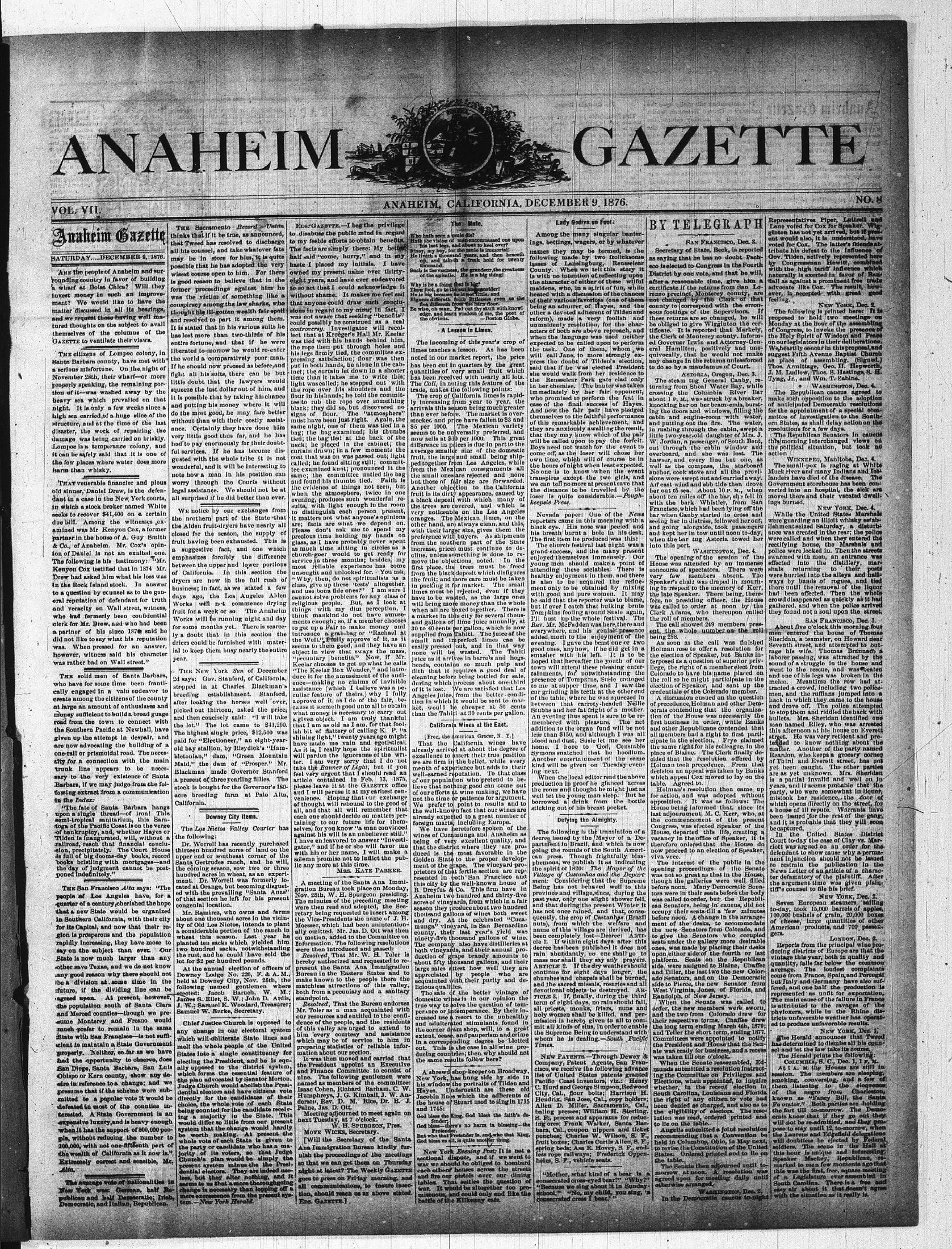
Searchable text
ANAHEIM
VOL. VII.
Anaheim Gazette
SATURDAY...DECEMBER 2, 1876.
Are the people of Anaheim and surrounding country in favor of building a wharf at Bolsa Chica? Will they invest money in such an improvement? We would like to have the matter discussed in all its bearings, and we request those having well matured thoughts on the subject to avail themselves of the column of the Gazette to ventilate their views.
The citizens of Lompoc colony, in Santa Barbara county, have met with a serious misfortune. On the night of November 28th, their wharf—or more properly speaking, the remaining portion of it—was washed away by the heavy sea which prevailed on that night. It is only a few weeks since a high sea carried off a huge slice of the structure, and at the time of the last disaster, the work of repairing the damage was being carried on briskly. Lompoc is a temperance colony, and it can be safely said that it is one of the few places where water does more harm.
The Sacramento Record - Union thinks that if it be true, as announced, that Tweed has resolved to discharge all his counsel, and take whatever fate may be in store for him, it is quite possible that he has adopted the very wisest course open to him. For there is good reason to believe that in the former proceedings against him he was the victim of something like a conspiracy among the law sharks, who thought his ill-gotten wealth fair spoil and resolved to part it among them. It is stated that in his various suits he has lost more than two-thirds of his entire fortune, and that if he were liberated to morrow he would re-enter the world a comparatively poor man. If he should now proceed as before, and fight all his suits, there can be but little doubt that the lawyers would squeeze the last dollar out of him, and it is possible that by taking his chance and putting his money where it will do the most good, he may fare better without than with their costly assistance. Certainly they have done him very little good thus far, and he has had to pay enormously for their doubtful services. If he has become disgusted with the whole tribe it is not worth it, and it will be interesting to discuss this matter further.
Eds.: GAZETTE. I hope to disabuse the public to my feeble efforts to inform you about the facts. The facts are simply the half said "come, hurry! hastie I placed my life owned my present nine years, and have no right to so act that I could without shame. It must that anyone could draw conclusions in regard to my case was not aware that secrecy could possibly be conserved controversy. Investigate that at Kroeger's was tied with his hand the rope then put through his legs firmly tied, pressing satisfaction; put in both hands, he laughed; the curtain let down time than it takes my light was called; he stitched the rope over his shirt flour in his hands; he teed to rub the rope black; they did so, but signs of flour. They must have been just ripe same night, one of the bag; the bag examined; the bag tied at neck; he placed in the curtain drawn; in a feather coat that was on was called; he found sitting
THAT venerable financier and plous old sinner, Daniel Drew, is the defendant in a case in the New York courts, in which a stock broker named White seeks to recover $41,400 on a certain due bill. Among the witnesses examined was Mr Kenyon Cox, a former partner in the house of A. Guy Smith & Co., of Anaheim. Mr. Cox's opinion of Daniel is not an exalted one. The following is his testimony: "Mr. Kenyon Cox testified that in 1874 Mr. Drew had asked him what his loss was in the Rock Island stock. In answer to a question by counsel as to the general reputation of defendant for truth and veracity on Wall street, witness, who had formerly been confidential clerk for Mr. Drew, and who had been a partner of his since 1874 said he did not like to say what his reputation was. When pressed for an answer, however, witness said his character was rather bad on Wall street."
THE solid men of Santa Barbara, who have for some time been frantically engaged in a valiant endeavor to create among the citizens of the county at large an amount of enthusiasm and money sufficient to build a broad guage road from the town to connect with the Southern Pacific at Newhall, have given up the attempt in despair, and are now advocating the building of a one-rail or prismoidal road. The necessity for a connection with the main trunk line appears to be necessary to the very existence of Santa Barbara, if we may judge from the following extract from a communication in the Index:
"The fate of Santa Barbara hangs upon a single thread—of iron! This semi-tropical sanitarium, this Saratoga of the Pacific Coast is on the verge of bankruptcy, and, whether Hayes or Tilden is inaugurated, will, without a railroad, reach that financial conclusion, precipitately. The Court House is full of big dooms-day books, record books bristling with mortgages—and the day of judgment cannot be postponed indefinitely."
WE notice by our exchanges from the northern part of the State that the Alden fruit-dryers have nearly all closed for the season, the supply of fruit having been exhausted. This is a suggestive fact, and one which emphasizes forcibly the difference between the upper and lower portions of California. In this section the dryers are now in the full rush of business; in fact, as we stated a few days ago, the Los Angeles Alden Works will not commence drying fruit for a week or so. The Anaheim Works will be running night and day for some months yet. There is scarce a doubt that in this section the driers could be furnished with material to keep them busy nearly the entire year.
THE New York Sun of December 2d says: Gov. Stanford, of California, stopped in at Charles Blackman's breeding establishment. Stanford, after looking the horses well over, picked out thirteen, asked the price, and then concisely said: "I will take the lot." The lot came to $41,200. The highest single price, $12,500 was paid for "Electioneer," an eight-year-old bay stallion, by Risydick's "Hambletonian," dam, "Green Mountain Maid," the dam of "Prosper." Mr. Blackman made Governor Stanford a present of three yearling fillies. The stock is bought for the Governor's 180-acre breeding farm at Palo Alta, California.
Downey City Items.
The Los Nietos Valley Courier has the following:
Dr. Worrell has recently purchased thirteen hundred acres of land on the upper end or southeast corner of the Santa Gertrudes ranch, and he will, the coming season, sow two or three hundred acres in wheat, as an experiment. Dr. Worrell was formerly foil all his suits, there can be but little doubt that the lawyers would squeeze the last dollar out of him, and it is possible that by taking his chance and putting his money where it will do the most good, he may fare better without than with their costly assistance. Certainly they have done him very little good thus far, and he has had to pay enormously for their doubtful services. If he has become disgusted with the whole tribe it is not wonderful, and it will be interesting to note how a man in his position can worry through the Courts without legal assistance. We should not be at all surprised if he did better than ever.
Please don't ask me precious time holding glass, as I have probes as much time sitting church-goer would service in three months most reliable expert unought and unlooked. "Why, then, do not s class, give up these " and use bona fide ones cannot solve problems religious people. But things with my di think mankind do m ents enough; so, if i get up a Fair to ma introduce a grab-bag the Well," I fully app seems to them good, object in view that it pecuniary benefits.
Keelar chooses to get "The Keelar Box Wonder it for the amuse- ence—making no cla ssistance (which I cullar feature of th e approve of it, as I do cause it seemeth good what money is neces- sive a given object. I am that I am as old as I lish bit of flattery o f shining light," twenty have made me vain. As it is, I really hope will pardon the ignorer. I am very sorry take the Banner of L feel very urgent that article contained in please leave it at th e and I will peruse it a venience. Hoping th ef thought will rebound all, and that all will each one should deci taining to our futu- selves, for you know" against his will is an I have en leavened to gator," and if he or she with his or her name solemn promise not tie any more at this t Mrs.
The fate of Santa Barbara hangs upon a single thread—of iron! This semi-tropical sanitarium, this Saratoga of the Pacific Coast is on the verge of bankruptcy, and, whether Hayes or Tilden is inaugurated, will, without a railroad, reach that financial conclusion, precipitately. The Court House is full of big dooms-day books, record books bristling with mortgages—and the day of judgment cannot be postponed indefinitely."
The San Francisco Alta says: "The people of Los Angeles have, for a quarter of a century, cherished the hope that a new State would be organized in Southern California, with their city for its Capital, and now that their region is prosperous and the population rapidly increasing, they have more to say on the subject than ever. Our State is now much larger than any other save Texas, and we do not know any good reason why there should not be a division at some time in the future, if the dividing line can be agreed upon. At present, however, the population south of Santa Clara and Merced counties—though we presume Monterey and Fresno would much prefer to remain in the same State with San Francisco—is not sufficient to maintain a State Government properly. Neither so far as we have had the opportunity to observe, does San Diego, Santa Barbara, San Luis Obispo or Kern county, show any desire in reference to a change; and we presume that if the scheme were submitted to a popular vote it would be defeated in most of the counties inhabited. A State Government is an expansive luxury, and is heavy enough when it has the support of 800,000 people, without reducing the number to 100,000, with not one-fifthth part of the wealth of California as it now is." Extremely correct and sensible, Mr. Alta.
The average vote of nationalities in New York was: German, half Republican and half Democratic; Irish, Democratic, and Italian, Republican.
EDS: GAZETTE.—I beg the privilege to disabuse the public mind in regard to my feeble efforts to obtain benefits. The facts are simply these: My better half said "come, hurry," and in my haste I placed my initials. I have owned my present name over thirty-eight years, and have ever endeavored to so act that I could acknowledge it without shame. It makes me feel sad that anyone could draw such conclusions in regard to my aims; in fact, I was not aware that seeking "benefits" could possibly be construed as a real controversy. Investigator will recollect that at Kroeger's Hall Mr. Keelar was tied with his hands behind him, the rope then put through holes and his legs firmly tied, the committee expressing satisfaction; flour was then put in both hands, be alone in the cabinet; the curtain let down in a shorter time than it takes me to write this; light was called; he stepped out with the rope over his shoulders and the flour in his hands; he told the committee to rub the rope over something black; they did so, but discovered no signs of flour. The "atmosphere" must have been just right. Again, the same night, one of them was tied in a bag; the bag examined; his thunbs tied; the bag tied at the back of the neck; he placed in the cabinet; the curtain drawn; in a few moments the coat that was on was passed out; light called; he found sitting still; commit-
The Male.
Who hath seen a male die?
Hath the vision of man encompassed one upon his last legs, and about to keel over?
Nixey, my boy, for the mule is immortal!
He liveth a thousand years, and then braceth up, and taketh a fresh hold for twenty thousand.
Such is the vastness, the grandeur, the greatness of the animal. He is a big thing!
Why is he a thing that is big?
Thou fool, go to the ant and ensnailer!
He is big because he is not little, and Bigness different from littleness even as the flea different from the barn door.
Be wise, oh man... Pad out thy skull with knowledge, and learn wisdom of me, the poet of the obvious.
A Lesson in Limes.
The incoming of this year's crop of limes teaches a lesson. As has been noted in our market report, the price has been cut in quarters by the great quantities of very small fruit which has been received with nearly all lots. The Call, in noting this feature of the trade, makes the following points:
The crop of California limes is rapidly increasing from year to year, the arrivals this season being much greater than ever before. The market is overstocked, and price have fallen to $3 and $5 per 1000. The Mexican variety seems to be universally preferred, and now sells at $10 per 1000. This great difference in prices is due in part to the average smaller size of the domestic fruit, the large and small being shipped together from Los Angeles, while
Lady Godiva on Foot:
Among the many singular banterings, beddings, wagers, or by whatever names they may be termed, is the following made by two frolicksome lasses of Lansingburg, Rensselaer County. When we tell this story it is with no intention of reflecting upon the character of either of these wilful malden, who, in a spirit of fun, while heated with a discussion of the chances of their various favorites (one of them being an admirer of Hayes), and the other a devoted adherent of Tilden and reform), made a very foolish and unmaidenly resolution, for the characters of both are above reproach, and when the language was used neither expected to be called upon to perform the task. One of them, whom we will call Jane, to more strongly express the doubt of Tilden's election, said that if he was elected President she would walk from her residence to the Rensselaer Park gate clad only in her chemise. The banter was taken immediately by her fair opponent, who promised to perform the feat in case of the final success of Hayes. And now the fair pair have pledged themselves to the faithful performance of this remarkable achievement, and they are anxiously awaiting the result, that they may know which of the pair will be called upon to pay the forfeit. Boys need not watch for the event to come off, as the loser will chose her own time, which will of course be in the hours of night when least expected.
BY
Secret as saying in District after a certificate renzo pr not change county these ree be obligate tiflate. The Clerk ed Governor H quivocal any chance to do so.
The st turning crossing about 1 knitting ing the cabin a and put in rushi little tw W. Jordan out overbona hawser, wa
the curtain let down in a shorter time than it takes me to write this; light was called; he stepped out with the rope over his shoulders and the flour in his hands; he told the committee to rub the rope over something black; they did so, but discovered no signs of flour. The "atmosphere" must have been just right. Again, the same night, one of them was tied in a bag; the bag examined; his thumbs tied; the bag tied at the back of the neck; he placed in the cabinet; the curtain drawn; in a few moments the coat that was on was passed out; light called; he found sitting still; committee examined knot; pronounced it the same; the committee untied the bag and found his thumbs tied. Faith is the evidence of things not seen, but when the atmosphere, twice in one evening, produces such wonderful results, with light enough in the room to distinguish each person present, it matters not what anyone's opinions are; facts are what we depend on. Please don't ask me to spend my precious time holding my hands on glass, as I have probably never spent as much time sitting in circles as a church-goer would to get ready for service in three months; besides, my most reliable experience has come unseen and unlooked for. You ask, "Why, then, do not spiritualists as a class, give up these 'tests' altogether, and use bona fide ones?" I am sure I cannot solve problems for any class of religious people. But, as I look at things with my dim perception, I think mankind do not have amusements enough; so, if a member chooses to get up a Fair to make money and introduce a grab-bag or "Rachael at the Well," I fully approve of it, as it seems to them good, and they have an object in view that sways the mass, "pecuniary benefits." Now, if Mr. Keelar chooses to get up what he calls "The Keelar Box Wonder," and introduce it for the amusement of the audience—making no claims of invisible assistance (which I believe was a peculiar feature of theirs) why I fully approve of it, as I do of the fair, because it seemeth good unto all to obtain what money is necessary to carry out a given object. I am truly thankful that I am as old as I am, for that foolish bit of flattery of calling K. P. "a shining light," twenty years ago might have made me vain and egotistical. As it is, I really hope the spiritualist will pardon the ignorance of the writer. I am very sorry that I do not take the Banner of Light, but if you feel very urgent that I should read an article contained in Feb. 13, 1875, please leave it at the GAZETTE office and I will peruse it at my earliest convenience. Hoping that our exchange of thought will rebound to the good of all, and that all will remember that each one should decide on matters pertaining to our future life for themselves, for you know "a man convinced against his will is an unbeliever still." I have en leavened to answer "Investigator," and if he or she will favor me with his or her name, I will make a solemn promise not to inflict the public any more at this time.
MRS. KATE PARKER.
California Wines at the East.
[From: the American Grocer, N. Y.]
That the California wines have already arrived at about the degree of excellence to assert their true position we are firm in the belief, while every month of experience but adds to their well-earned reputation. To that class of our population who pretend to believe that nothing good can come out of our efforts at wine making, we have not the time or patience for argument. We prefer to point to results and to the well-known fact that our wines are already exported to a great number of foreign marts, including Europe.
We have heretofore spoken of the wines of Cucumanga and Anaheim as being of very excellent quality, and that the district where they are produced is the most favorable in the Golden State to the proper development of the grape. The vineyard proprietors of that fertile section are represented in both San Francisco and well-known houses said that if he was elected President she would walk from her residence to the Reusslear Park gate clad only in her chemise. The banter was taken immediately by her fair opponent, who promised to perform the feat in case of the final success of Hayes. And now the fair pair have pledged themselves to the faithful performance of this remarkable achievement, and they are anxiously awaiting the result, that they may know which of the pair will be called upon to pay the forfeit. Boys need not watch for the event to come off, as the loser will chose her own time, which will of course be in the hours of night when least expected. No one is to know when the event transpires except the two girls, and we can tell no more at present save that the distance to be travelled by the loser is quite considerable.
Poughkeepsie Press.
Nevada paper: One of the News reporters came in this morning with a black eye. His nose was peeled and his breath burnt a hole in his desk. The first item he produced was this:
The church festival last night was a grand success, and the many present enjoyed themselves immensely. Our young men should make a point of attending these sociables. There is healthy enjoyment in them, and there is also to be acquired the refinement only to be obtained by mixing with good and pure women. It may be said that the reporter was to blame, but if ever I catch that hulking brute Tompkins fooling around Susie again, I'll bust up the whole festival. The Rev. Mr. McFadlen was here, there and everywhere, and his genial presence added much to the enjoyment of the evening. I gave the beast one or two good ones, anyhow, if he did get in a smasher with his left. It is to be hoped that hereafter the youth of our town will attend these pleasing entertainments, for notwithstanding the presence of Tompkins, Susie cottoped to me at supper time, and I saw the cur grinding his teeth at the other end of the table, where he was squeezed in between that carrot-headed Nellie Stubbs and her fat fright of a mother. An evening thus spent is sure to be remembered with pleasure. The net addition to the organ fund will not less than $150, and although I was all blood and dust, Susie let me see her home. I hope to God, Constable Symons snatched that he hoodlum. Another entertainment of the same kind will be given on Tuesday evening next.
When the local editor read the above production in proof he glanced across the room and thought he might just as well let the young man sleep. But he borrowed a drink from the bottle sticking out of his breast pocket.
Defying the Almighty.
The following is the translation of a decree issued by the Mayor of a Department in Brazil, and which is now going round of the South American press. Though frightfully blasphemous, we publish it as indicating the spirit of 1820: The Mayor of the Village of Castanhas and the Department: Considering that the Supreme
please leave it at the GAZETTE office and I will peruse it at my earliest convenience. Hoping that our exchange of thought will rebound to the good of all, and that all will remember that each one should decide on matters pertaining to our future life for themselves, for you know "a man convinced against his will is an unbeliever still." I have enleaved to answer "Investigator," and if he or she will favor me with his or her name, I will make a solemn promise not to inflict the public any more at this time.
MRS. KATE PARKER.
A meeting of the Santa Ana Immigration Bureau took place Monday, Nov. 28th, W. H. Spurgeon presiding. The minutes of the preceding meeting were then read and adopted, the Secretary being requested to insert among the Vice-Presidents the name of J. H. Moesser, which had been unintentionally omitted. Mr. Jas. D. Ott was then motion, added to the Committee on Information. The following resolutions were then introduced and passed:
Resolved, That Mr. W. H. Toler is hereby authorized and requested to represent the Santa Ana Immigration Bureau in the Eastern States and to make known to the people there the matchless attractions of this valley, both from a pecuniary and a sanitary standpoint.
Resolved, That the Bureau endorses Mr. Toler as a man acquainted with our resources and entitled to the confidence of the people, and the residents of this valley are urged to extend to him every courtesy and assistance which may be of service to him in preparing statistics of reliable information about our section.
It was then moved and carried that the President appoint an Executive and Finance Committee to consist of nine. The following gentlemen were named as members of the committee: Isaac Cohen, Richard Barham, C. W. Humphreys, J. G. Kimball, J. W. Anderson, Rev. D. M. Rice, Dr. R. J. Palne, Jas. D. Ott.
Meeting adjourned to meet again on next Tuesday, at 7 o'clock.
W. H. SPURGEON, Pres.
MOVE WICKS, Secretary.
[Will the Secretary of the Santa Ana Immigration Bureau kindly furnish the proceedings of the meetings so that we can get them on Thursday night at latest? The Weekly Gazette goes to press on Friday morning, and all communications, to insure insertion, should reach us as above stated.
EDG. GAZETTE.]
GAZETTE
NO. 8
1876.
BY TELEGRAPH
SAN FRANCISCO, Dec. 3.
Secretary of State, Beck, is reported as saying that he has no doubt Pacheco is elected to Congress in the Fourth District by one vote, and that he will, after a reasonable time, give him a certificate if the returns from San Lorenzo precinct, Monterey county, are not changed by the Clerk or that county to correspond with the erroneous footings of the Supervisors. If these returns are so changed, he will be obliged to give Wigginton the certificate. It is reported that Markely, the Clerk of Monterey county, informed Governor Irwin and Attorney-General Hamilton, positively and unequivocally, that he would not make any change in the returns unless forced to do so by a mandamus of Court.
ASTORIA, Oregon, Dec. 3.
The steam tug General Canby, returning from Shoal Water Bay, while crossing the Columbia River Bar about 1 P.M., was struck by a breaker, knocking her on her beam ends, bursting the doors and windows, filling the cabin and engine-room with water, and putting out the fire. The water, in rushing through the cabin, swept a little two-year-old daughter of Mrs. J. W. Jordan, a passenger of South Bent, out through the cabin window and overboard, and she was lost. The hawser, and every line but one, as well as the compass, the starboard Representatives Piper, Luttrall and Lane voted for Cox for Speaker. Wiginton has not yet arrived, but if present would also, it is understood, have voted for Cox. The latter's friends attribute his defeat to the influence of Gov. Tilden, actively represented here by Congressman Hewitt, combined with the high tariff influence which naturally is exerted in favor of Randall as against a prominent free trade advocate like Cox. The result, however, is accepted with great good feeling.
NEW YORK, Dec. 2.
The following is printed here: It is proposed to hold two meetings on Monday at the hour of the assembling of Congress, to invoke the presence of the Holy Spirit of Wisdom and Peace on our legislators in their deliberations. We heartily concur in this proposal, and suggest Fifth Avenue Baptist Church as place of assembling. (Signed.) Thos. Armitage, Geo. H. Hepworth, J. M. Ludlow, Thos. S. Hastings, S. H. Tyng, Jr., and Wm. T. Sabine.
WASHINGTON, Dec. 4.
The Republican caucus agreed to make such opposition to the adoption of anticipated Democratic resolutions for the appointment of a special committee of investigation to the Southern States, as shall delay action on the resolutions for a few days.
The Republican Senators in caucus this morning interchanged views on the political situation, but took no action.
WINNEPEG, Manitoba, Dec. 4.
The small-town railing at White
The steam tug General Canby, returning from Shoal Water Bay, while crossing the Columbia River Bar about 1 P.M., was struck by a breaker, knocking her on her beam-ends, bursting the doors and windows, filling the cabin and engine-room with water, and putting out the fire. The water, in rushing through the cabin, swept a little two-year-old daughter of Mrs. J. W. Jordan, a passenger, of South Bent, out through the cabin window and overboard, and she was lost. The hawser, and every line but one, as well as the compass, the starboard anchor, cook stove and all the provisions were swept out and carried away. A faint wind and ebb tide then drove her out to sea. About 10 P.M., when about ten miles off the bar, she fell in with the bark Whistler, from San Francisco, which had been lying off the bar when Ganby started to cross and seeing her in distress, followed her out, and going alongside, took passengers and kept her in tow until noon to-day, when the bar tug Astoria towed her into this port.
WASHINGTON, Dec. 4.
The opening of the session of the House was attended by an immense concourse of spectators. There were very few members absent. The Speaker's chair was draped in mourning in respect to the memory of Kerr, the late Speaker. There being, therefore, no presiding officer, the House was called to order at noon by the Clerk Adams, who thereupon called the roll of members.
The call showed 249 members present, the whole number on the roll being 288.
As soon as the call was finished Holman rose to offer a resolution for the election of Speaker, but Banks interposed as a question of superior privilege, the right of a member elect from Colorado to have his name placed on the roll so he might participate in the election of Speaker, and sent up the credentials of the Colorado member.
A discussion ensued on the question of precedence, Holman and other Democrats contending that the organization of the House was necessarily the first business in order, while Banks and other Republicans contended that all members had a right to first participate in the election. Frye claimed the same right for his colleague, in the place of Blaine. The Clerk finally decided that the resolution offered by Holman took precedence. From that decision an appeal was taken by Banks which appeal Cox moved to lay on the table. Agreed to.
Holman's resolution then came up for action, and was adopted without opposition. It was as follows: The House being informed that, since its last adjournment, M. C. Kerr, who, at the commencement of the present Congress, was elected Speaker of the House, departed this life, creating a vacancy in the office of Speaker, it is therefore ordered that the House do now proceed to an election of Speaker, viva voce.
The interest of the public in the opening proceedings of the Senate was not so great as that in the House, though the galleries were well filled.
ASTORIA, Oregon, Dec. 3.
The steam tug General Canby, returning from Shoal Water Bay, while crossing the Columbia River Bar about 1 P.M., was struck by a breaker, knocking her on her beam-ends, bursting the doors and windows, filling the cabin and engine-room with water, and putting out the fire. The water, in rushing through the cabin, swept a little two-year-old daughter of Mrs. J. W. Jordan, a passenger, of South Bent, out through the cabin window and overboard, and she was lost. The hawser, and every line but one, as well as the compass, the starboard anchor, cook stove and all the provisions were swept out and carried away. A faint wind and ebb tide then drove her out to sea. About 10 P.M., when about ten miles off the bar, she fell in with the bark Whistler, from San Francisco, which had been lying off the bar when Ganby started to cross and seeing her in distress, followed her out, and going alongside, took passengers and kept her in tow until noon to-day, when the bar tug Astoria towed her into this port.
WASHINGTON, Dec. 4.
The Republican caucus agreed to make such opposition to the adoption of anticipated Democratic resolutions for the appointment of a special committee of investigation to the Southern States, as shall delay action on the resolutions for a few days.
WINNEPEG, Manitoba, Dec. 4.
The small-pox is raging at White Muck river and many Indians and Icelanders have died of the disease. The Government storehouse has been converted into an hospital; the sick are moved there and their vacated dwellings burned.
NEW YORK, Dec. 4.
While the United States Marshals were guarding an illicit whisky establishment seized Saturday, a disturbance was created in the rear; the police were called and when they entered the rectifying house, the Marshals and police were locked in. Then the streets swarmed with men; an entrance was effected into the distillery; marshals returning to their posts were hurried into the alleys and hallways by bands of rogues, and tied there until the removal of the liquor had been effected. Then the whole crowd disappeared as quickly as it had gathered, and when the police arrived they found not a soul upon the street.
SAN FRANCISCO, Dec. 1.
About five o'clock this morning four men entered the house of Thomas Sheridan, a teamster, on Howard near Seventh street; and attempted to outrage his wife. Thomas Brunnan, a laborer passing, was attracted by the sound of a struggle in the house and went to the rescue, and was beaten and one of his legs was broken in the melee. Meantime the row had attracted a crowd, including two policemen; and the ruffians jumped into a hack in which they came to the house and drove off. The police attempted to stop them and riddled the hack with bullets. Mrs. Sheridan identified one man named Riley, who was arrested this afternoon at his house on Everett street. He was very reticent and pretended to know nothing about the matter. Another of the party named Reardon, who keeps a grocery corner of Third and Everett street, has not yet been caught. The other parties are as yet unknown. Mrs. Sheridan is a partial invalid and well on in years; and it seems probable that the party, who were somewhat in liquor, mistook her residence; the door of which opens directly on the street; for a house of ill repute. Warrants have been issued for the rest of the gang; and it is probable that they will soon be captured.
In the United States District Court to-day the case of Clay vs. Marriott was argued on an order for the defendant to show cause why a permanent injunction should not be issued to restrain the publication in the News Letter of an article of a character defamatory of the plaintiff. After
Holman's resolution then came up for action, and was adopted without opposition. It was as follows: The House being informed that, since its last adjournment, M. C. Kerr, who, at the commencement of the present Congress, was elected Speaker of the House, departed this life, creating a vacancy in the office of Speaker, it is therefore ordered that the House do now proceed to an election of Speaker, viva voce.
The interest of the public in the opening proceedings of the Senate was not so great as that in the House, though the galleries were well filled before noon. Many Democratic Senators were in their seats before the body was called to order, but the Republican Senators, being in caucus, did not occupy their seats till a few minutes before noon. A change in the arrangement of the desks, to accommodate the new Senators from Colorado, and to give the Senators who occupied seats under the gallery more desirable ones, was made by placing their desks upon either side of the fourth or last platform. Seats on the Republican side were assigned to Blaine, Chaffee and Tiller, the last two the new Colorado Senators, and on the Democratic side to Pierce, the new Senator from West Virginia, Jones, of Florida, and Randolph, of New Jersey.
When the Senate was called to order, the new members were sworn, and the two from Colorado drew for their respective terms. Chaffee drew the long term ending March 4th, 1879; and Teller the short term, ending 1877. Committees were appointed to notify the President and House that the Senate was ready for business, and a recess was taken till one o'clock.
When the Senate reassembled, Edmunds submitted a resolution instructing the Committee on Privileges and Elections, when appointed, to inquire whether, in the recent election in South Carolina, Louisiana and Florida the right of any citizen to vote had been denied as charged, and also as to the eligibility of electors. The resolution was read, ordered printed and to lie on the table.
The Senate then adjourned until tomorrow at noon. A resolution was agreed upon for meeting daily until otherwise arranged.
Washington, Dec. 2.
In the Democratic caucus to-night
years, and it seems probable that the party, who were somewhat in liquor, mistook her residence, the door of which opens directly on the street, for a house of ill repute. Warrants have been issued for the rest of the gang, and it is probable that they will soon be captured.
In the United States District Court to-day the case of Clay vs. Marriott was argued on an order for the defendant to show cause why a permanent injunction should not be issued to restrain the publication in the News Letter of an article of a character defamatory of the plaintiff. After the argument time was given plaintiff's counsel to file his brief.
NEW YORK, Dec. 2.
Seven European steamers, sailing to-day, took 15,000 barrels of apples, 100,000 bushels of grain, 20,000 boxes of cheese, large quantities of other American products, and 700 passengers.
LONDON, Dec. 2.
Reports from the principal wine producing districts of Europe are that the vintage this year, both in quality and quantity, falls far below the common average. The loudest complaints come from France, Spain and Portugal but Italy and Germany have also suffered, and one half the production is represented as unit for exportation. The main cause of the failure in France is attributed to the ravages of the phylloxera, while in the Rhine districts unfavorable weather has operated to produce unfavorable results.
NEW YORK, Dec. 1;
The Herald announces that Tweed has determined to dismiss all his counsel and let the law take its course.
The Herald prints the following:
COLUMBIA, S. C., Dec. 1, 1 p.m.
At 1 a.m. M. the Houses are still in session. The members are sleeping, smoking, conversing, and a few of them listening to the eloquence of the negro from Charleston, known as "Fancy Bill," the Santa Fe orator." Both parties are holding the fort till to-morrow. The Democrats know that if they go out they will not be re-admitted, and they propose to stay until 12 to-morrow, when the Laurens and Edgfield delegations will doubtless be ejected by Federal soldiers. The scene in the Hall at this hour is unique and interesting. Speaker Mackey, Republican, remarked to me a few moments ago that this was the first free square meeting of a Legislature ever assembled in South Carolina. There is a free and easy air about it that doesn't agree with the situation as it really is.