anaheim-gazette 1876-11-11
Scanned page
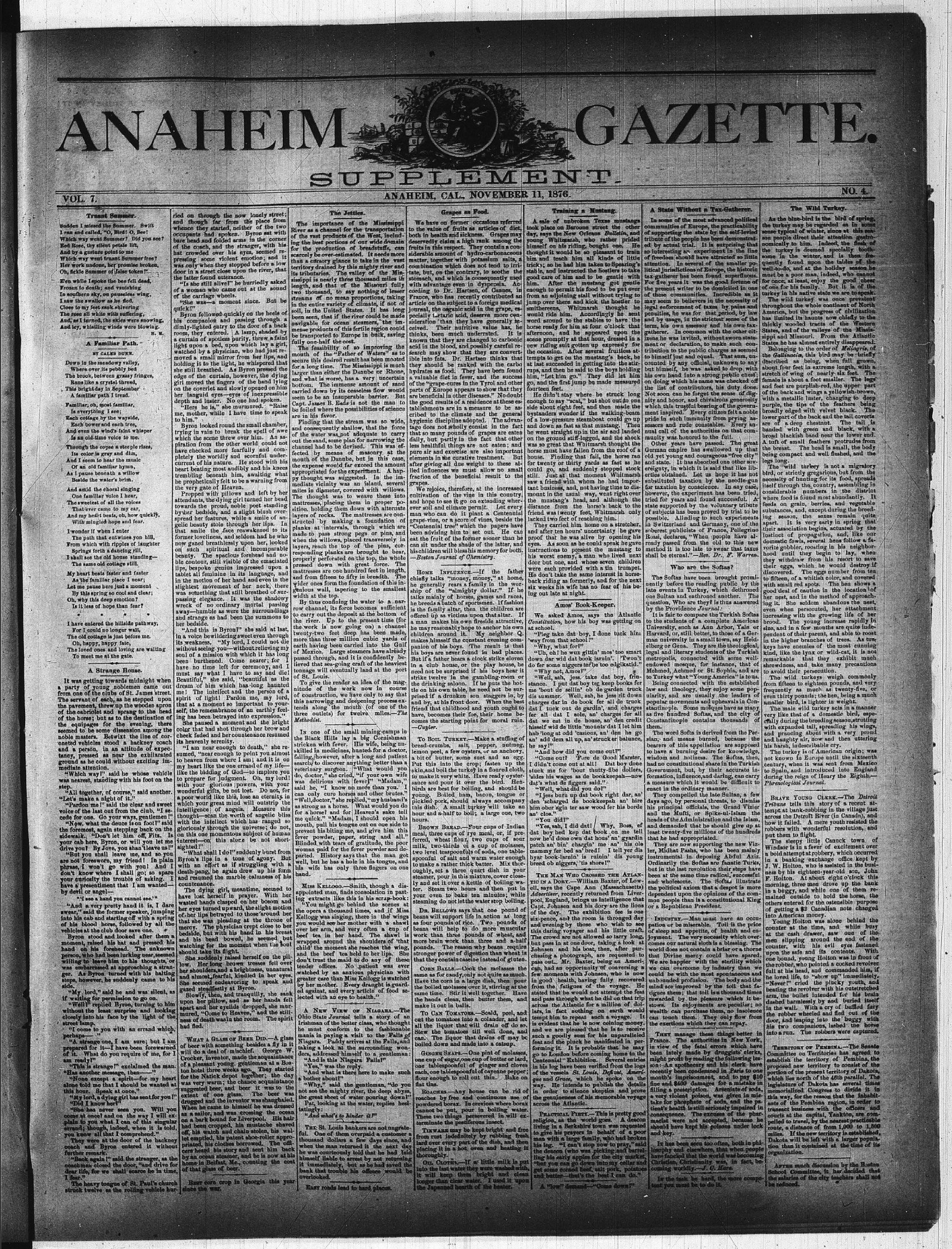
Searchable text
ANAHEIM
VOL. 7.
Traunt Summer.
Sudden I missed the Summer. Swift
I ran and called, "O, Bird! O, Bee!
Which way went Summer? Did you see?
Red Rose, thy silent petals lift,
And by a gesture point to me
Which way went truant Summer free?
Her work undone, her promise broken,
Oh, sickle Summer of false token!"
Wen while I spoke the bee fell dead,
Frozen to death; and vanishing
In southern sky, on pauseless wing,
I saw the swallow as he fled.
Close to my feet sank shivering
The rose all white with suffering,
And, as I turned, the skies were snowing,
And lay, whistling winds were blowing.
H. H.
A Familiar Path.
BY CALLED DUNN.
Down in the meadowy valley,
Where over its pebbly bed
The brook, between grassy fringes,
Runs like a crystal thread,
This bright day in September
A familiar path I tread.
Familiar, oh, most familiar,
Is everything I see;
Each cottage by the wayside,
Each bower and each tree,
And even the wind's faint whisper
Is an old-time voice to me.
Through the copse a steeple rises,
Its color is gray and dim,
And I seem to hear the music
ried on through the now lonely street;
and though far from the place from
whence they started, neither of the two
occupants had spoken. Byron sat with
bare head and folded arms in the corner
of the coach, and the stranger, with his
hat crowded over his eyes, seemed repressing some violent emotion; and it
was only when they stopped before a low
door in a street close upon the river, that
the latter found utterance.
"Is she still alive!" he hurriedly asked
of a woman who came out at the sound
of the carriage wheels.
"She was—a moment since. But be
quick."
Byron followed quickly on the heels of
his companion and passing through a
dimly-lighted entry to the door of a back
room, they entered. A lamp, shaded by
a curtain of spotless purity, threw a faint
light upon a bed, upon which lay a girl,
watched by a physician, who had just removed a small mirror from her lips, and holding it to the light, he whispered that
she still breathed. As Byron pressed the edge of the curtain, however, the dying girl moved the fingers of the hand lying
on the coverlet and slowly opened on him
her languid eyes—eyes of inexpressible depth and luster. No one had spoken.
"Here he is," she murmured. "Raise me, mother, while I have time to speak to him."
Byron looked round the small chamber,
trying in vain to break the spell of awe
which the scene threw over him. An aspiration from the other world could not have checked more fearfully and completely the worldly and scornful undercurrent of his nature. He stood with his
Where over its pobbly bed
The brook, between grassy fringes,
Huna like a crystal thread,
This bright day in September
A familiar path I tread.
Familiar, oh, most familiar,
Is everything I see;
Each cottage by the wayside,
Each bower and each tree,
And even the wind's faint whisper
Is an old-time voice to me.
Through the copse a steeple rises,
Its color is gray and dim,
And I seem to hear the music
Of an old familiar hymn,
As I pause beneath a willow
Beside the water's brim.
And amid the choral singing
One familiar voice I hear,
The sweetest of all the voices
That ever came to my ear,
And my heart beats, oh, how quickly,
With mingled hope and fear.
I wonder if when I enter
The path that entwines you hill,
From which with ripples of laughter
Springs forth a dancing rill,
I shall see the old house standing—
The same old cottage still.
My heart beats faster and faster
As the familiar place I near;
Let me pause here just a moment
By this spring so cool and clear;
Oh, why this deep emotion?
Is it less of hope than fear?
I have entered the hillside pathway;
For I could no longer wait,
The old cottage is just before me.
Oh, happy, happy fate,
The loved ones and loving are waiting
To meet me at the gate.
A Strange House.
It was getting towards midnight when a party of young noblemen came out from one of the clubs of St. James street.
The servant of each, as he stepped upon the pavement, threw up the wooden apron of the cabriolelet and sprang to the head of the horse; but as to the destination of the equipages for the evening, there seemed to be some dissension among the noble masters. Betwixt the line of cor-neted vehicles stood a hackney coach and a person, in an attitude of expectancy, pressed as near the exhilarated ground as he could without exciting immediate attention.
"Which way!" said he whose vehicle was nearest, standing with his foot on the step.
"All together, of course," said another. "Let's make a night of it."
"Pardon me!" said the clear and sweet voice of the last out from the club, "I secede for one. Go your ways, gentlemen!"
"Now, what the deuce is on foot!" said the foremost, again stepping back on the sidewalk. "Don't let him off, Fitz. Is your cab here, Byron, or will you let me drive you! By Jove, you shan't leave us!"
But you shall leave me, and so you are not foresworn, my friend! In plain phrase, I won't go with you! And I don't know where I shall go; so spare your curiosity the trouble of asking.
She paused a moment and the bright color that had shot through her brow and cheek faded and her countenance resumed its heavenly serenity.
"I am near enough to death," she resumed, "near enough to point you almost to heaven from where I am; and it is on my heart like the one errand of my life—like the bidding of God—to implore you to prepare for judgment. Oh, my lord! with your glorious powers, with your wonderful gifts, be not lost. Do not, for a poor world like this, lose an eternity in which your great mind will outstrip the intelligence of angels. Measure this thought—scan the worth of angelic bliss with the intellect which has ranged so gloriously through the universe; do not, on this one momentous subject of human interest—on this alone be not short-sighted!"
"What shall I do?" suddenly burst from Byron's lips in a tone of agony. But with an effort as if struggling with a death-pang, he again drew up his form and resumed the marble calmness of his she still breathed. As Byron pressed the edge of the curtain, however, the dying girl moved the fingers of the hand lying on the coverlet and slowly opened on him her languid eyes—eyes of inexpressible depth and luster. No one had spoken.
"Here he is," she murmured. "Raise me, mother, while I have time to speak to him."
Byron looked round the small chamber, trying in vain to break the spell of awe which the scene threw over him. An aspiration from the other world could not have checked more fearfully and completely the worldly and scornful undercurrent of his nature. He stood with his heart beating most audibly and his knees trembling beneath him, awaiting what he prophetically felt to be a warning from the very gate of Heaven.
Propped with pillows and left by her attendants, the dying girl turned her head towards the proud, noble poet standing by her bedside, and a slight blush over-spread her features, while a smile of angelic beauty stole through her lips. In that smile the face reawakened to its former loveliness, and seldom had he who now gazed breathlessly upon her, looked on such spiritual and incomparable beauty. The spacious forehead and noble contour, still visible of the emaciated lips, bespoke genius impressed upon a tablet all feminine in its language, and in the motion of her hand and even in the slightest movement of her neck, there was something that still breathed of surpassing elegance. It was the shadowy wreck of no ordinary mortal passing away—humble as were the surroundings and strange as had been the summons to her bedside.
"And this is Byron!" she said at last, in a voice bewildering sweet even through its weakness. "My lord, I could not die without seeing you—without relieving my soul of a mission with which it has long been burthened. Come nearer; for I have no time left for ceremony, and I must say what I have to say and die! Beautiful," she said, "beautiful as the dream of him which has long haunted me! The intellect and the person of a spirit of light! Pardon me, my lord, that at a moment so important to yourself, the remembrance of an earthly feeling has been betrayed into expression."
She paused a moment and the bright color that had shot through her brow and cheek faded and her countenance resumed its heavenly serenity.
"I am near enough to death," she resumed, "near enough to point you almost to heaven from where I am; and it is on my heart like the one errand of my life—like the bidding of God—to implore you to prepare for judgment. Oh, my lord! with your glorious powers, with your wonderful gifts, be not lost. Do not, for a poor world like this, lose an eternity in which your great mind will outstrip the intelligence of angels. Measure this thought—scan the worth of angelic bliss with the intellect which has ranged so gloriously through the universe; do not, on this one momentous subject of human interest—on this alone be not short-sighted!"
"What shall I do?" suddenly burst from Byron's lips in a tone of agony. But with an effort as if struggling with a death-pang, he again drew up his form and resumed the marble calmness of his she still breathed. As Byron pressed the edge of the curtain, however, the dying girl moved the fingers of the hand lying on the coverlet and slowly opened on him her languid eyes—eyes of inexpressible depth and luster. No one had spoken.
"Here he is," she murmured. "Raise me, mother, while I have time to speak to him."
Byron looked round the small chamber, trying in vain to break the spell of awe which the scene threw over him. An aspiration from the other world could not have checked more fearfully and completely the worldly and scornful undercurrent of his nature. He stood with his heart beating most audibly and his knees trembling beneath him, awaiting what he prophetically felt to be a warning from the very gate of Heaven.
Propped with pillows and left by her attendants, the dying girl turned her head towards the proud, noble poet standing by her bedside, and a slight blush over-spread her features, while a smile of angelic beauty stole through her lips. In that smile the face reawakened to its former loveliness, and seldom had he who now gazed breathlessly upon her, looked on such spiritual and incomparable beauty. The spacious forehead and noble contour, still visible of the emaciated lips, bespoke genius impressed upon a tablet all feminine in its language, and in the motion of her hand and even in the slightest movement of her neck, there was something that still breathed of surpassing elegance. It was the shadowy wreck of no ordinary mortal passing away—humble as were the surroundings and strange as had been the summons to her bedside.
"And this is Byron!" she said at last, in a voice bewildering sweet even through its weakness. "My lord, I could not die without seeing you—without relieving my soul of a mission with which it has long been burthened. Come nearer; for I have no time left for ceremony, and I must say what I have to say and die! Beautiful," she said, "beautiful as the dream of him which has long haunted me! The intellect and the person of a spirit of light! Pardon me, my lord, that at a moment so important to yourself, the remembrance of an earthly feeling has been betrayed into expression."
She paused a moment and the bright color that had shot through her brow and cheek faded和her countenance resumed its heavenly serenity.
"I am near enough to death," she resumed,“near enough to point you almost to heaven from where I am; and it is on my heart like the one errand of my life—like the bidding of God—to implore you to prepare for judgment. Oh,my lord!with your glorious powers,with your wonderful gifts,be not lost.Do not,for a poor world like this,lose an eternity in which your great mind will outstrip the intelligence of angels.Measure this thought—scan the worth of angelic bliss with the intellect which has ranged so gloriously through the universe;do not,on this one momentous subject of human interest—on this alone be not short-sighted!"
"What shall I do?" suddenly burst from Byron's lips in a tone of agony. But with an effort as if struggling with a death-pang,he again drew up his form and resumed the marble calmness of his she still breathed. As Byron pressed the edge of the curtain,however,the dying girl moved the fingers of his hand lying on the coverlet and slowly opened on him her languid eyes—eyes of inexpressible depth and luster. No one had spoken.
"Here he is," she murmured.“Raise me,mother,while I have time to speak to him.”
Byron looked round the small chamber,trying in vain to break the spell of awe which the scene threw over him. An aspiration from the other world could not have checked more fearfully and completely the worldly and scornful undercurrent of his nature. He stood with his heart beating most audibly upon her,looked on such spiritual and incomparable beauty. The spacious forehead and noble contour,still visible of the emaciated lips,bespoke genius impressed upon a tablet all feminine in its language,and in the motion of her hand and even in the slightest movement of her neck,there was something that still breathed of surpassing elegance. It was the shadowy wreck of no ordinary mortal passing away—humble as were the surroundings and strange as had been the summons to her bedside.
"And this is Byron!" she said at last,in a voice bewildering sweet even through its weakness. "My lord,I could not die without seeing you—without relieving my soul of a mission with which it has long been burthened. Come nearer;for I have no time left for ceremony,and I must say what I have to say和die! Beautiful,”she said,“beautiful as the dream of him which has long haunted me!The intellect and the person of a spirit of light!Pardon me,my lord,that at a moment so important to yourself,the remembrance of an earthly feeling has been betrayed into expression.”
She paused a moment and the bright color that had shot through her brow and cheek faded和her countenance resumed its heavenly serenity.
"I am near enough to death,” she resumed,“near enough to point you almost to heaven from where I am;and it is on my heart like the one errand of my life—like the bidding of God—to implore you to prepare for judgment. Oh,my lord!with your glorious powers,with your wonderful gifts,be not lost.Do not,for a poor world like this,lose an eternity in which your great mind will outstrip the intelligence of angels.Measure this thought—scan the worth of angelic bliss with the intellect which has ranged so gloriously through the universe;do not,on this one momentous subject of human interest—on this alone be not short-sighted!"
"What shall I do?" suddenly burst from Byron's lips in a tone of agony. But with an effort as if struggling with a death-pang,he again drew up his form and resumed the marble calmness of his she still breathed. As Byron pressed the edge of the curtain,however,the dying girl moved the fingers of his hand lying on the coverlet and slowly opened on him her languid eyes—eyes of inexpressible depth and luster. No one had spoken.
"Here he is," she murmured.“Raise me,mother,while I have time to speak to him.”
Byron looked round the small chamber,trying in vain to break the spell of awe which the scene threw over him. An aspiration from the other world could not have checked more fearfully and completely the worldly and scornful undercurrent of his nature. He stood with his heart beating most audibly upon her,looked on such spiritual and incomparable beauty. The spacious forehead and noble contour,still visible of the emaciated lips,bespoke genius impressed upon a tablet all feminine in its language,and in the motion of her hand and even in the slightest movement of her neck,there was something that still breathed of surpassing elegance. It was the shadowy wreck of no ordinary mortal passing away—humble as were the surroundings and strange as had been the summons to her bedside.
"And this is Byron!" she said at last,in a voice bewildering sweet even through its weakness. "My lord,I could not die without seeing you—without relieving my soul of a mission with which it has long been burthened. Come nearer;for I have no time left for ceremony,and I must say what I have to say和die! Beautiful,”she said,“beautiful as the dream of him which has long haunted me!The intellect and the person of a spirit of light!Pardon me,my lord,that at a moment so important to yourself,the remembrance of an earthly feeling has been betrayed into expression.”
She paused a moment and the bright color that had shot through her brow and cheek faded和her countenance resumed its heavenly serenity.
"I am near enough to death,” she resumed,“near enough to point you almost to heaven from where I am;and it is on my heart like the one errand of my life—like the bidding of God—to implore you to prepare for judgment. Oh,my lord!with your glorious powers,with your wonderful gifts,be not lost.Do not,for a poor world like this,lose an eternity in which your great mind will outstrip the intelligence of angels.Measure this thought—scan the worth of angelic bliss with the intellect which has ranged so gloriously through the universe;do not,on this one momentous subject of human interest—on this alone be not short-sighted!"
"What shall I do?" suddenly burst from Byron's lips in a tone of agony. But with an effort as if struggling with a death-pang,he again drew up his form and resumed the marble calmness of his she still breathed. As Byron pressedthe edgeofthecurtain,however,thedreamofhimwhichhaslonghauntedme!Theintellectualwhichhasrangedsogloriouslythroughtheuniverse;do.not,theismodeloussubjectofhumaninterest--onthisalonebenotshort-sighted!"
"All together, of course," said another. "Let's make a night of it."
"Pardon me!" said the clear and sweet voice of the last out from the club, "I secede for one. Go your ways, gentlemen!"
"Now, what the deuce is on foot?" said the foremost, again stepping back on the sidewalk. "Don't let him off, Fitz. Is your cab here, Byron, or will you let me drive you! By Jove, you shan't leave us!"
"But you shall leave me, and so you are not foresworn, my friend! In plain phrase, I won't go with you! And I don't know where I shall go; so spare your curiosity the trouble of asking. I have a presentiment that I am wanted—by devil or angel—"
"I see a hand you cannot see."
"And a very pretty hand it is, I dare swear," said the former speaker, jumping into his cab and starting off with a spring of his blood horse, followed by all the vehicles at the club door save one.
Byron stood and looked after them a moment, raised his hat and pressed his hand on his forehead. The unknown person, who had been lurking near, seemed willing to leave him to his thoughts, or was embarrassed at approaching a stranger. As Byron turned with his halting steps, however, he suddenly came to his side.
"My lord," said he and was silent, as if waiting for permission to go on.
"Well!" replied Byron, turning to him without the least surprise and looking closely into his face by the light of the street lamp.
"I come to you with an errand which, perhaps—"
"A strange one, I am sure; but I am prepared for it—I have been forewarned of it. What do you require of me, for I am ready!"
"This is strange!" exclaimed the man. "Has another message, then—"
"None except a spirit—for my heart alone told me that I should be wanted at this hour. Speak at once."
"My lord, a dying girl has sent for you!"
"Did I know her!"
"She has never seen you. Will you come at once! and on the way I will explain to you what I can of this singular errand; though indeed, when it is told, you know all that I comprehend."
They were at the door of the hackney coach and Byron entered it without further remark.
"Back again!" said the stranger, as the coachman closed the door, "and drive for dear life, for we shall source be in time, I fear."
The heavy tongue of St. Paul's church struck twelve as the rolling vehicle hurried with your glorious powers, with your wonderful gifts, be not lost. Do not, for a poor world like this, lose an eternity in which your great mind will outstrip the intelligence of angels. Measure this thought—scan the worth of angelic bliss with the intellect which has ranged so gloriously through the universe; do not, on this one momentous subject of human interest—on this alone be not short-sighted!"
"What shall I do?" suddenly burst from Byron's lips in a tone of agony. But with an effort as if struggling with a death-pang, he again drew up his form and resumed the marble calmness of his countenance.
The dying girl, meantime, seemed to have lost herself in prayer. With her wasted hands clasped on her bosom and her eyes turned upward, the slight motion of her lips betrayed to those around her that she was pleading at the throne of mercy. The physician crept close to her bedside, but with his hand in his breast and his head bowed, he seemed but watching for the moment when the soul should take its flight.
She suddenly raised herself on the pillow. Her long brown tresses fell over her shoulders and a brightness, unnatural and almost fearful, kindled in her eyes. She seemed endeavoring to speak and gazed steadfastly at Byron.
Slowly, then, and tranquilly, she sank upon her pillow, and as her hands fell apart and her eyelids dropped, she murmured, "Come to Heaven," and the stillness of death was in the room. The spirit had fled.
WHAT A GLASS OF BEER DID.—A glass of beer with something besides a fly in it will do a deal of mischief. George W. Crocker, inventor, made the acquaintance of a pleasant young gentleman at a Boston hotel three weeks ago. They started for the Natick depot together; the day was very warm; the chance acquaintance suggested beer, and beer it was to the extent of one glass. The beer was drugged and the inventor was shanghaied. When he came to himself he was dressed as a sailor, and was crossing the ocean on a bark bound for Liverpool. His hair had been cropped, his mustache shaved off, his watch and chain stolen, his wallet emptied, his patent shoe-roller appropriated, his clothes borrowed. The officers heard his story and sent him back by an ocean steamer, and he is now at his home in Belfast. Me., counting the cost of that glass of beer.
Beer core crop in Georgia this year since the war.
MISS KELLOGO—Smokingly appointed man, finds extracts like this.
“You might go behold the opera a thousand Kellogg was singing,” you would see her move over her arm, and veer beef tea in her hand wrapped around their child' moment she and the beef tea he don't trust the maid tender offices. No watched by an anxious greater care than Miss by her mother. Even against, and every lected with an eye to them.
A NEW VIEW OF Ohio State Journal
Irishman of the better man must conform to mania in paying a viti Niagara. Paddy arrives taking a look at these ders addressed himself.
“And is this Niagara?” was the reply.
“And what is there a bother about?”
Why,” said the not see the mighty rise the great sheet of wipe Pat, looking at the tatingly:
“And what's to him?
THE ST. LOUIS banful. One of them oo can only cure horses “Well, doctor,” she repuls as strong as a horse. For a horse! and for me quick.” “Madam mouth, pull his tongue prevent his biting me fever powder, paper Blinded with tears of woman paid for the fe parted. History says well, but he has a hold his wife has only two hand.
MISS KELLOGO—Smokingly appointed man, finds extracts like this.
“You might go behold the opera a thousand Kellogg was singing,” you would see her move over her arm, and veer beef tea in her hand wrapped around their child' moment she and the beef tea he doesn't trust the maid tender offices. No watched by an anxious greater care than Miss by her mother. Even against, and every lected with an eye to them.
A NEW VIEW OF Ohio State Journal
Irishman of the better man must conform to mania in paying a viti Niagara. Paddy arrives taking a look at these ders addressed himself.
“And is this Niagara?” was the reply.
“And what is there a bother about?”
Why,” said the not see the mighty rise the great sheet of wipe Pat, looking at the tatingly:
“And what's to him?
IM GAZ
SUPPLEMENT.
ANAHEIM, CAL, NOVEMBER 11, 1876.
The Jetties.
The importance of the Mississippi River as a channel for the transportation of the vast products of the West, including the best portions of our wide domain for the production of breadstuff, can scarcely be over-estimated. It needs more than a cursory glance to take in the vast territory drained by this mighty river and its tributaries. The valley of the Mississippi is nearly three thousand miles in length, and that of the Missouri fully two thousand, to say nothing of lesser streams of no mean proportions, taking in the entire variety of climate, if not of soil, in the United States. It has long been seen, that if the river could be made navigable for ocean steamers, the immense products of this fertile region could be transported to Europe in bulk, saving fully one-half the cost.
The feasibility of so improving the mouth of the "Father of Waters" as to secure this desired result has been mooted for a long time. The Mississippi is much larger than either the Danube or Rhone, and what is worse, has a very uncertain bottom. The immense amount of sand carried down by its ceaseless flow would seem to be an insuperable barrier. But Capt. James B. Eads is not the man to be foiled where the possibilities of science are in his favor.
Finding that the stream was so wide, and consequently shallow, that the force of the water was not adequate to carry out the sand, some plan for narrowing the channel had to be devised. This was effected by means of masonry at the mouth of the Danube, but in this case, the expense would far exceed the amount
Grapes as Food.
We have on former occasions referred to the value of fruits as articles of diet, both in health and sickness. Grapes may deservedly claim a high rank among the fruits in this respect. They contain a considerable amount of hydro-carbonaceous matter, together with potassium salts, a combination which does not tend to irritate, but, on the contrary, to soothe the stomach, and which is consequently used with advantage even in dyspepsia. According to Dr. Hartsen, of Cannes, in France, who has recently contributed an article on the subject to a foreign medical journal, the organic acid in the grape, especially tartaric acid, deserve more consideration than they have generally received. Their nutritive value has, he thinks, been much underrated. It is known that they are changed to carbonic acid in the blood, and possibly careful research may show that they are convertible into fats. Dr. Hartsen thinks that they should be ranked with the carbohydrates as food. They have been found a valuable diet in fever, and the success of the "grape-cures in the Tyrol and other parts of Europe appears to show that they are beneficial in other diseases." No doubt the good results of a residence at these establishments are in a measure to be ascribed to the climate and the general hygienic discipline adopted. The advantage does not wholly consist in the fact that so many pounds of grapes are eaten daily, but partly in the fact that other less healthful things are not eaten; and pure air and exercise are also important elements in the curative treatment. But after giving all due weight to these al-
Training a Mustang.
A sale of unbroken Texas mustangs took place on Baroone street the other day, says the New Orleans Bulletin, and young Whitmarsh, who rather prided himself on his riding, bought one. He thought it would be so pleasant to train him and teach him all kinds of little tricks; so he had him taken to Spearing's stable, and instructed the hostlers to take good care of him and to be gentle with him. After the mustang got gentle enough to permit his food to be put over from an adjoining stall without trying to jump over there and kick the hostler to smithereens. Whitmarsh thought he would ride him. Accordingly he sent word around to the stables to have the horse ready for him at four o'clock that afternoon, and he appeared upon the scene promptly at that hour, dressed in a new riding suit gotten up expressly for the occasion. After several fruitless attempts to get on the mustang's back, he at last succeeded in getting into the stirrups, and then he said to the boys holding him, "Let him go." They did let him go, and the first jump he made measured fourteen feet.
He didn't stay where he struck long enough to say "scat," but shot out to one side about eight feet, and then made the bystanders wonder if the walking-beam of a low-pressure steamboat could go up and down as fast as that mustang. Then he went straight up in the air and landed on the ground stiff-legged, and the shock was so great that Whitmarsh thought the horse must have fallen from the roof of a house. Finding that fail, the horse ran for twenty or thirty yards as fast as he
A State
In some communities of support for tribute of fledged by actual so interest of freedom attention. Litical juris-tax-gatherer. For five years the presence of these cows may seem legal enforcer penalties; and by name term, his gatherer. Zizens he wives ment or dribbling tribute to himself counted by himself but himself his own hand on doing with the list o-Not soon a city and which this ment inspire pride in such sessors and usual call on munity wr-Other y German enclo old yet you and state.
larger than either the Danube or Rhone,
and what is worse, has a very uncertain bottom.
The immense amount of sand carried down by its ceaseless flow would seem to be an insuperable barrier. But Capt. James B. Eads is not the man to be foiled where the possibilities of science are in his favor.
Finding that the stream was so wide, and consequently shallow, that the force of the water was not adequate to carry out the sand, some plan for narrowing the channel had to be devised. This was effected by means of masonry at the mouth of the Danube, but in this case, the expense would far exceed the amount appropriated for the experiment. A happy thought was suggested. In the immediate vicinity was an island, several miles in diameter, covered with willows. The thought was to weave these into mattresses, placing them in proper position, holding them down with alternate layers of rocks. The mattresses are constructed by making a foundation of planks at intervals, through which are made to pass strong pegs or pins, and when the willows, placed transversely in layers, reach the top of the pins, corresponding planks are brought to bear, properly perforated on the top, the whole pressed down with great force. The mattresses are one hundred feet in length, and from fifteen to fifty in breadth. The wider ones form the foundation of this ingenious wall, tapering to the smallest width at the top.
By thus confining the water to a narrow channel, its force becomes sufficient to carry out the deposit at the bottom of the river. Up to the present time (for the work is now going on) a channel twenty-two feet deep has been made, more than three million cubic yards of earth having been carried into the Gulf of Mexico. Large steamers have already passed through, and it is confidently believed that sea-going craft of the heaviest tonnage will eventually land at the port of St. Louis.
To give the reader an idea of the magnitude of the work now in course of construction, we have only to say that this narrowing and deepening process extends along the mouth (of one of the three outlets) for twelve miles.—The Methodist.
In one of the small mining camps in the Black Hills lay a big Cornishman stricken with fever. His wife, being unskilled in medicines, hunted for a doctor, failing, however, after a long and patient search to discover anything better than a veterinary surgeon. "What would you do, doctor," she cried, "if your own wife was delirious with fever!" "Madam," said he, "I know no more than you. I can only cure horses and other brutes." "Well, doctor," she replied, "my husband's as strong as a horse. What would you do for a horse? and for Heaven's sake tell me quick." "Madam, I should open his mouth, pull his tongue out on one side to prevent his biting me, and give him this fever powder, paper, string and all."
Blinded with tears of gratitude, the poor woman paid for the fever powder and departed. History says that the man got well, but he has a hole in his tongue, and his wife has only three fingers on one hand.
Home Influence.—If the father chiefly talks "money, money," at home, he generally rears a family in the worship of the "almighty dollar." If he talks mainly of horses, games and races, he breeds a batch of sportsmen. If fashion is the family altar, then the children are offered up as victims upon that altar. If a man makes his own fireside attractive, he may reasonably hope to anchor his own children around it. My neighbor Q. makes himself the constant evening companion of his boys. The result is that his boys are never found in bad places. But if a father bears a clock strike eleven in a club house, or the play house, he need not be surprised if his boys hear it strike twelve in the gambling-room or the drinking saloon. If he puts the bottle on his own table, he need not be surprised if a drunken son staggers in, by and by, at his front door. When the best friend that childhood and youth ought to have, becomes their foe, their home becomes the starting point for moral ruin.
To Boil Turkey.—Make a stuffing of bread-crumbs, salt, pepper, nutmeg, lemon peel, a few oysters, or an anchovy, a bit of butter, some suet and an egg. Put this into the crop; fasten up the skin, and boil the turkey in a floured cloth, to make it very white. Have ready oyster-sauce and pour it over the bird. Henbirds are best for boiling, and should be young. Boiled ham, bacon, tongue or pickled pork, should always accompany this dish. A small turkey will take an hour and a-half to boil; a large one, two hours.
Brown Bread.—Four cups of Indian meal, three cups of rye meal, or, if preferred, wheat flour, two cups of sour milk, two-thirds of a cup of molasses, two level teaspoonfuls of soda, one table-spoonful of salt and warm water enough to make a rather thick batter. Mix thoroughly, set a three quart dish in your steamer, pour it over a kettle of boiling waydrates as food. They have been found a valuable diet in fever, and the success of the "grape-cures in the Tyrol and other parts of Europe appears to show that they are beneficial in other diseases." No doubt good results of a residence at these establishments are in a measure to be ascribed to the climate and the general hygienic discipline adopted. The advantage does not wholly consist in the fact that so many pounds of grapes are eaten daily, but partly in the fact that other less healthful things are not eaten; and pure air and exercise are also important elements in the curative treatment. But after giving all due weight to these allied influences we must allow no small fraction of the beneficial result to the grapes.
We rejoice therefore, at the increased cultivation of the vine in this country, and hope to see it go on extending wherever soil and climate permit. Let every man who can do it plant a Centennial grape-vine, or a score of vines, beside the "Centennial tree" which the papers have been advising him to set out. He can eat the fruit of the former sooner than he can sit under the shade of the latter, and his children will bless his memory for both.
—Boston Journal of Chemistry.
Amos' Book-Keeper.
We asked Amos, says the Atlantic Constitution, how his boy was getting on at school.
"Pleg take dat boy, I done tuck him 'way from that school!"
"Why, what for!"
"Uh, oh! he wuz gittin' mos' too smart down dar wid dat book larnin.' Twon't do fer some niggers ter be too edgikatid."
"Why not, Amos?"
"Well, sah, jess. take dat boy, frinstance. I put dat boy ter keep books for me 'bout de sellin' ob de garden truck dis summer. Well, sah, he jess sit down charges dar in de book fer all de truck I tuck out de gardin', and charges for all dat I sole, an' charges for all dat we eat in de house, an' den credit fisself wid de little 'mounts' dut I let him hab 'long at odd 'cassions,' an' den he go an' add dem all up, an' struck er balance, he say!"
"And how did you come out?"
"Come out? Fore de Good Marster, I didn't come out at all! Dat boy done stuck me for 'bout thutty-fibe dollers,' sides his wages as de bookkeepah—now dat's what de figgers said."
"Well, what did you do?"
"I jess burn up dat book right dar, an' den 'scharged de bookkeepah an' hire him ober agin ter saw wood for his borde an' clos."
"You did?"
"Yes,sah,i did dat! Why,Boss,ef dat boy hed kep dat book on me tell now he'd done own dat hous'an' gyardin patch an' bin' chargin'me an' his ole mammy fer bed an' bred! I tell yer dis hyar book-larin' is ruinin' dis young breed ob niggers,' tis shore!"
THE MAN WHO CROSSED THE ATLANTIC IN DORY—William Baxter, of Low-witness
Miss Kellogg—Smith, though a disappointed man, finds consolation in pasting extracts like this in his scrap-book:
"You might go behind the scenes at the opera a thousand times, and if Miss Kellogg was singing, there in the wings you would see her mother with a shawl over her arm, and very often a cup of beef tea in her hand. The shawl is wrapped around the shoulders of 'that child' the moment she reaches the wing, and the beef tea held to her lips. She don't trust the maid to do any of these tender offices. No patient ever watched by an anxious physician with greater care than Miss Kellogg is watched by her mother. Every draught is guarded against, and every article of food selected with an eye to health."
A New View of Niagara—The Ohio State Journal tells a story of an Irishman of the better class, who thought he must conform to the fashionable mania in paying a visit to the Falls of Niagara. Paddy arrives at the Falls, and taking a look at the surrounding wonders, addressed himself to a gentleman:
"And is this Niagara Falls?"
"Yes," was the reply.
"And what is here to make such a bother about?"
"Why," said the gentleman, "do you not see the mighty river, the deep abyss, the great sheet of water pouring down?"
Pat, looking at the water, replies hesitatingly:
"And what's to hinder it?"
The St. Louis bankers are not ungrateful. One of them overpaid a customer a thousand dollars a few days since, and when the man returned it the next day he was courteously told that he had laid himself liable to arrest by not returning it immediately, but as he had saved the bank that trouble his offense would be overlooked.
Easy roads lead to hard places.
Brown Bread.—Four cups of Indian meal, three cups of rye meal, or, if preferred, wheat flour, two cups of sour milk, two-thirds of a cup of molasses, two level teaspoonfuls of soda, one table-spoonful of salt and warm water enough to make a rather thick batter. Mix thoroughly, set a three quart dish in your steamer, pour in this mixture, cover closely and set it over a kettle of boiling water. Steam two hours and then put in your oven to bake ten minutes; while steaming do not let the water stop boiling.
Dr. Bellows says that one pound of beans will support life in action as long as four pounds of rice. Two pounds of beans will help to do more muscular work than three pounds of wheat, and more brain work than three and a half pounds. The reason why beans require stronger power of digestion than wheat is that they contain caseine instead of gluten.
Corn Balls.—Cook the molasses the same as for candy, only not quite as much. Have the corn in a large dish, then pour the boiled molasses over it, stirring at the same time. Stir it well together. Have the hands clean, then butter them, and make it out in balls.
To Can Tomatoes.—Scald, peel, and cut the tomatoes into a colander, and let all the liquor that will drain off do so. Stew the tomatoes till well done, and can. The liquor that drains off may be boiled down and made into a catsup.
Ginger Snaps.—One pint of molasses, one cup of sugar, one cup of butter or lard, one tablespoonful of ginger and cloves each, one tablespoonful of cayenne pepper; flour enough to roll out thin. Bake on flat tins.
Roaches.—Any house can be rid of roaches by free and continuous use of powdered borax. In crevices where borax cannot be put, pour in boiling water. These two things persevered in will exterminate the pestiferous insect.
Tinware may be kept bright and free from rust indefinitely by rubbing fresh lard over every part of the dish, and then placing it in a hot oven and heating it thoroughly.
Oil Clothes.—If a little milk is put into the last water they were washed with, it will keep them bright and clean longer than clear water. I used it upon the Japanese hearth of the heater.
Well, what did you do?
"I jess burn up dat book right dar, an den 'scharged de bookkeepah an' hire him ober agin ter saw wood fer his borde an' clos."
"You did!"
"Yes, sah, I did dat! Why, Boss, if dat boy hed kep dat book on me tell now he'd done own dat hous'an' gyardin patch an' bin' chargin'me an' his ole mammy fer bed an' bred! I tell yer dis hyar book-larnin' is ruinin' dis young breed ob niggers,'tis shore!"
The Man Who Crossed The Atlantic in a Dory.—William Baxter, of Lowell, says the Cape Ann (Massachusetts) Advertiser, recently returned from Liverpool, England, brings us intelligence that Capt. Johnsen and his dory are the lions of the day. The exhibition fee is one sixpence, and the room is thronged day and evening by those who wish to see this daring voyager and his little craft. The crowd are not allowed so tarry long, but pass in at one door, taking a look at Johnsen and his boat, then, after purchasing a photograph, are requested to pass out Mr. Baxter, being an American, had an opportunity of conversing a few moments with Johnson, who is now in good health, having fully recovered from the fatigues of the voyage. He stated that he would not attempt the feat and pass through what he did on that trip across the Atlantic for a million of dollars, in fact nothing on earth would tempt him to repeat such a voyage. It is evident that he is now coining money, and we are pleased that he is to receive such a goodly sum for his unparalleled feat and the pluck he manifested in performing it. It is probable that he may go to London before coming home to the Centennial Exhibition. Several entries in his log have been verified from the logs of the vessels St. Louis, Defintt Amerique and Grace, which he spoke on the way. He intends to publish the details in order to silence skeptics and prove the genuineness of his memorable voyage across the Atlantic.
Practical Piety.—This is pretty good religion, as the world goes. A deacon living in a Berkshire town was requested to give his prayers in behalf of a poor man with a large family, who had broken his leg. "I can't stop now to pray," said the deacon (who was picking and barrelling his early apples for the city market), "but you can go down into my cellar and get some corned beef, salt pork, potatoes and butter—that's the best I can do."
A "low" demand—"Come down!"
GAZETTE.
NO. 4.
Mustang.
Texas mustangs meet the other Bulletin, and rather prided thought one. He pleasant to train kinds of little men to Spearing's hostlers to take the gentle with gang got gentle to be put over without trying to hit the hostler to thought he suddenly he sent letters to have the o'clock that beared upon the hour, dressed in a so expressly for rural fruitless attang'a back, he ing into the stirring boys holding any did let him made measured the struck long shot out to one then made the walking-beam boat could go up mustang. Then the air and landed, and the shock ash thought the vom on the roof of a pal, the horse ran as fast as he
A State Without a Tax-Gatherer.
In some of the most advanced political communities of Europe, the practicability of supporting the state by the self-levied tribute of the people has been demonstrated by actual trial. It is surprising that so interesting an experiment in the line of freedom should have attracted so little attention. In several of the smaller political jurisdictions of Europe, the historic tax-gatherer has been found superfluous. For five years it was the good fortune of the present writer to be domiciled in one of these communities. Incredible as it may seem to believers in the necessity of legal enforcement of taxes by pains and penalties, he was for that period, by law and by usage, in the strictest sense of the term, his own assessor and his own tax-gatherer. In common with the other citizens he was invited, without sworn statement or declaration, to make such contribution to the public charges as seemed to himself just and equal. That sum, uncounted by any official, unknown to any but himself, he was asked to drop with his own hand into a strong public chest; on doing which his name was checked off the list of contributors, his duty done. Not soon can he forget the sense of dignity and honor, and chivalrous generosity which this trustful bearing of the government inspired. Every citizen felt a noble pride in such immunity from prying assessors and rude constables. Every annual call of the authorities on that community was honored to the full.
Other years have passed. The great German empire has swallowed up that old yet young and courageous "free city" and state. It has absorbed one other sov-
The boys holding the toy did let him make measured but himself, he was asked to drop with his own hand into a strong public chest, on doing which his name was checked off the list of contributors, his duty done. Not soon can he forget the sense of dignity and honor, and chivalrous generosity which this trustful bearing of the government inspired. Every citizen felt a noble pride in such immunity from prying assessors and rude constables. Every annual call of the authorities on that community was honored to the full.
Other years have passed. The great German empire has swallowed up that old yet young and courageous "free city" and state. It has absorbed one other sovereignty, in which it is said that like liberties obtained. Let us hope it has not substituted taxation by the needle-gun for taxation by conscience. In any case, however, the experiment has been tried, tried for years and found successful. A state supported by the voluntary tribute of subjects has been proved by trial to be possible. Alluding to such experiments in Switzerland and Germany, one of the soberest publicists of France, Pellegrino Rossi, declares, "When people have already passed from the old to this new method it is too late to swear that taxes shall be eternal."—Rev. Dr. F. Warren.
Who are the Softas?
The Softas have been brought prominently before the reading public by the late events in Turkey, which dethroned one Sultan and enthroned another. The question, Who are they? is thus answered by the Providence Journal:
It is fair to compare the Turkish Softas to the students of a complete American University, such as Ann Arbor, Yale or Harvard, or, still better, to those of a German university in a small town, say Heidelberg or Gena. They are the theological, legal and literary students of the Turkish metropolis, connected with some well-endowed mosque, for instance, that of Mehmed, Achmed or St. Sophia, and are to Turkey what "Young America" is to us.
Being connected with the established law and theology, they enjoy some popularity, and are usually the leaders of popular movements and upheavals in Constantinople. Some mosques have as many as five hundred Softas, and the city of Constantinople contains thousands of them.
The word Softa is derived from the Persian, and means burned, because the bearers of this appellation are supposed to have a burning desire for knowledge, wisdom and holiness. The Softas, then, had no constitutional share in the Turkish Government, but, by their accurate information, influence,and daring,can carry a measure which it would be difficult to enact in the ordinary manner.
They compelled the late Sultan, a few days ago, by personal threats, to dismiss his principal officials, the Grand Vizier and the Mufti, or Spike-ul-Islam the heads of the Administration and the Islam, and demanded that he should give up at least twenty-five millions of the hundreds that he had appropriated.
They are now supporting the new Vizier, Midhat Pasha, who has been mainly instrumental in deposing Abdul Aziz. Ordinarily the Softas are fanatic Turks, but in the last revolution their steps have been at the same time radical, successful and wholesome. The Softa illustrate about four feet in extreme length, with a stretch of wing of nearly six feet. The female is about a foot smaller. The legs and feet are purplish-red, the upper part of the back and wings a yellowish-brown, with a metallic luster, changing to deep purple, the tips of the feathers being broadly edged with velvet black. The lower part of the back and the tail coverts are of a deep chestnut. The tail is banded with green and black, with a broad blackish band near the lower end. A tuft of small feathers protrudes from the breast. The head is small, the body being compact and well flushed, and the legs long.
The wild turkey is not a migratory bird, or strictly gregarious, but from the necessity of hunting for its food, spreads itself through the country, assembling in considerable numbers in the district where food is found most abundantly. It feeds on grain, berries, and vegetable substances, and except during the breeding season, the sexes remain quite apart. It is very early in spring that their association begins, actuated by the instinct of propagation, and, like our domestic fowls, several hens follow a favorite gobbler, roosting in his neighborhood until they begin to lay, when they withdraw from his resort to save their eggs, which he would destroy if discovered. The eggs number from ten to fifteen, of a whitish color, and covered with small red spots. The hen shows a good deal of caution in the location of her nest, and in the method of approaching it. She seldom abandons the nest even when persecuted; her attachment increasing with the growing life of her brood. The young increase rapidly in size, and in a few months are quite independent of their parent, and able to roost in the higher branches of trees. As turkeys have enemies of the most cunning kind, like the lynx or wild-cat, it is not remarkable that they exhibit much shrewdness, and take many precautions to avoid their persecution.
The wild turkeys weigh commonly from fifteen to eighteen pounds, and very frequently as much as twenty-five, or even thirty pounds; the hen being a much smaller bird, is lighter in weight.
The male wild turkey acts in a manner very like that of a domestic bird, especially during the breeding season; strutting with expanded tail, spreading his wings, and prancing about with a very proud and haughty air; now and then uttering his harsh, indescribable cry.
The turkey is of American origin; was not known in Europe until the sixteenth century, when it was sent from Mexico to Spain, and introduced into England during the reign of Henry the Eighth.—Phrenological Journal.
BRAVE Young Clerk.—The Detroit Tribune tells this story of a recent attempt at bank-robbing in the village just across the Detroit River (in Canada), and how it failed. A more youth resisted the robbers with wonderful resolution, and put them to flight.
The sleepy little Canuck town of Windsor is in a fever of excitement over a bold attempt at robbery, which occurred in a banking exchange office kept by J.W.Holton, who is assisted in the business by his eighteen-year-old son John F.Holton. At about eight o'clock this
They compelled the late Sultan, a few days ago, by personal threats, to dismiss his principal officials, the Grand Vizier and the Mufti, or Spike-ul-Islam the heads of the Administration and the Islam, and demanded that he should give up at least twenty-five millions of the hundreds that he had appropriated.
They are now supporting the new Vizier, Midhat Pasha, who has been mainly instrumental in deposing Abdul Aziz. Ordinarily the Softas are fanatic Turks, but in the last revolution their steps have been at the same time radical, successful and wholesome. The Softas illustrate the political axiom that a despot is more dependent upon the opinions of the common people than is a constitutional King or a Republican President.
Industry.—Man must have an occupation or be miserable. Toll is the price of sleep and appetite, of health and enjoyment. The very necessity which overcomes our natural sloth is a blessing. The world does not contain a briar or a thorne that Divine mercy could have spared. We are happier with the sterility which we can overcome by industry than we could be with the most spontaneous and unbounded profusion. The body and the mind are improved by the toil that fagiues them; that toil is a thousand times rewarded by the pleasure which it bestows. Its enjoyments are peculiar; no wealth can purchase them, no insolence can touch them. They only flow from the exertions which they can repay.
They manage these things better in France. The authorities in New York, in view of the fatal errors which have been lately made by druggists' clerks, might profit by reading the following lesson: An apothecary and his clerk have recently been condemned in Paris to one month's imprisonment, and to pay $10 fine and $400 damages for a mistake in filling a prescription. Arseniate of soda, a very violent poison, was given in mistake for phosphate of soda, and the patient's health is still seriously impaired in consequence. The excuses of the pharmacist were not accepted, because he should have kept his poisons under lock and key.
It has been seen too often, both in philosophy and elsewhere, that when people have fancied that the world was becoming Christian, Christianity was, in fact, becoming worldly—J. Q. Hare.
In the task he hard, the more competent you must be to do it.
BRAVE YOUNG CLERK.—The Detroit Tribune tells this story of a recent attempt at bank-robbing in the village just across the Detroit River (in Canada), and how it failed. A mere youth resisted the robbers with wonderful resolution, and put them to flight.
The sleepy little Canuck town of Windsor is in a fever of excitement over a bold attempt at robbery, which occurred in a banking exchange office kept by J. W. Holton, who is assisted in the business by his eighteen-year-old son, John F. Holton. At about eight o'clock this morning, three men drove up the bank in a buggy, and while one of them remained outside to hold the horse, the others entered for the ostensible purpose of getting a $2 Canadian note changed into American money.
Young Holton was alone behind the counter at the time, and while busy at the cash drawer, saw one of the men slipping around the end of the counter, with his evil eyes fastened upon the safe and its contents. With one bound, young Holton was in front of the robber, who pointed a cocked revolver full at his head, and commanded him, if he loved life, to "show up" immediately. "Never!" cried the plucky youth, and beating the revolver with his outstretched arm, the bullet intended for his brain dashed harmlessly by and buried itself in the wall. With a cry of baffled fury the robber wheeled and fled out of the door, and leaping into the buggy with his two companions, lashed the horse into a run. The robbers were captured.
TERRITORY OF PEMBINA.—The Senate Committee on Territories has agreed to establish the territory of Pembina, the proposed new territory to consist of the portion of the present territory of Dakota, which lies north of the 46th parallel. The legislature of Dakota has several times memorialized Congress to divide it in this way, for the reason that the inhabitants of the Pembina region, in order to transact business with the officers and courts at the capital, Yankton, are compelled to travel, by the nearest practicable route, a distance of from 1,000 to 1,500 miles. If the new territory is established, Dakota will be left with a larger population than it contained at the time of its organization.
After much discussion by the Boston School Committee, it has decided that the salaries of the city teachers shall not be reduced.