anaheim-gazette 1876-10-28
Scanned page
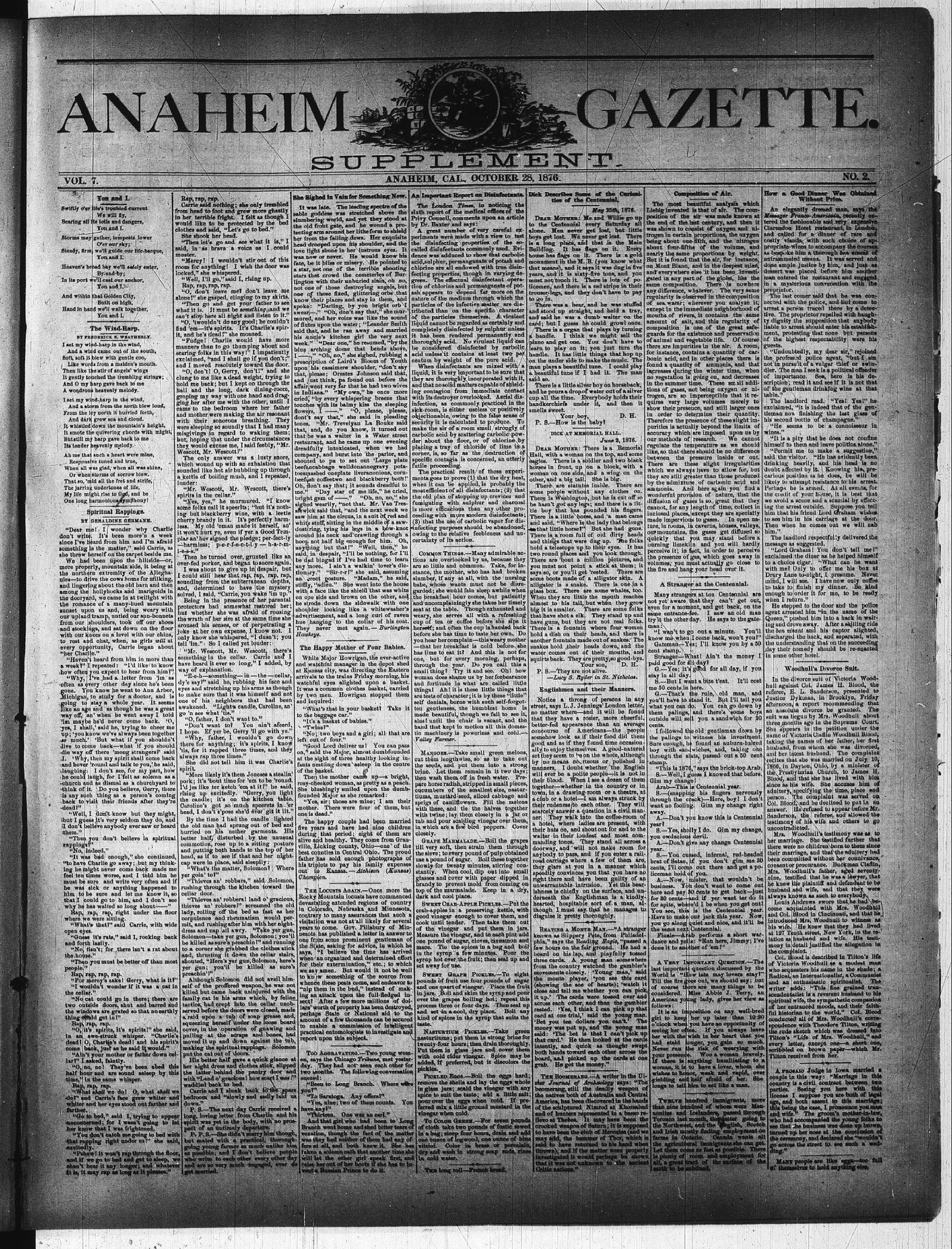
Searchable text
ANAHEIM
VOL. 7.
Yes and I
Swiftly o'er life's troubled current
We will fly,
Bearing all its toils and dangers,
You and I.
Storms may gather, tempests lower
O'er our sky;
Steady, firm, we'll guide our life-barque,
You and I.
Heaven's broad bay we'll safely enter,
By-and-by;
In its port we'll cast our anchor,
You and I.
And within that Golden City,
Built on high.
Hand in hand we'll walk together,
You and I.
The Wind-Harp.
BY FREDERICK M. WHATHERLY.
I set my wind-harp in the wind,
And a wind came out of the south,
Soft, soft it blew with gentle coo,
Like words from a malden's mouth.
Then like the stir of angels' wings
It gently touched the trembling strings;
And O my harp gave back to me
A wondrous heavenly melody.
I set my wind-harp in the wind,
And a storm from the north blew loud,
From the ley north it hurried forth,
And dark grew sea and cloud.
It whistled down the mountain's height,
It smote the quivering chords with might,
But still my harp gave back to me
Its tender heavenly melody.
Ah me that such a heart were mine,
Responsive tuned and true,
Rap, rap, rap.
Carrie said nothing; she only trembled from head to foot and grew more ghastly in her terrible fright. I felt as though I would like to be protected by the bed clothes and said, "Let's go to bed."
She shook her head.
"Then let's go and see what it is," I said, in as brave a voice as I could muster.
"Mercy! I wouldn't stir out of this room for anything! I wish the door was locked," she whispered.
"Well, I'll go," said I, rising up.
Rap, rap, rap, rap.
"O, don't leave me! don't leave me alone!" she gasped, clinging to my skirts.
"Then go and get your father to see what it is. It must be something," and we can't stop here all night and listen to it."
"O, 'twouldn't do any good; he couldn't find 'em—it's spirits. It's Charlie's spirit, and he's dead!" she moaned.
"Fudge! Charlie would have more manners than to go thumping about and scaring folks in this way!" I impatiently exclaimed, "and I shall go if you don't;" and I moved resolutely toward the door.
"O, don't! O, Gerry, don't!" and she clung to me like a dead weight, trying to hold me back; but I kept on through the hall and the long, dark dining-room, groping my way with one hand and dragging her after me with the other, until I came to the bedroom where her father and mother were making the air resonant with their sonorous breathing. They were sleeping so soundly that I had many misgivings in regard to waking them; but, hoping that under the circumstances they would excuse me, I said feebly, "Mr. Wescott, Mr. Wescott!"
The only answer was a lusty snore, which wound up with an exhaustion that She sighed in vain for.
It was late. The less sable goddess was stlumbering world, and the old front gate, andtecting arm around her from the falling dead drooped upon his love light shone in her was now or never. He fate, be it bliss or miss a star, not one of the stars that crowd the lington with their unbent not one of those destined one of those fixed, give their places and spoke: "Darling, by swear." "Oh, don't mured, and her voice wof flutes upon the water said that, and he ran his ancle's kitchen week." "Dear one," he blue arching dome to I —," "Oh no," she prescription of Laird's upon his cassimere shalt that, please; Orestes and just think, pa fou affair went very far thru Indiana." "My own cried, "by every whisp touches with its balmy flowers, I —." "Don't say that," she tones. "Mr. Trevelys that, and do you k that he was a waiter restaurant, and he can dreadfully intoxicated company, and burst in shouted to pa to se
Then like the stir of angels' wings
It gently touched the trembling strings;
And O my harp gave back to me
A wondrous heavenly melody.
I set my wind-harp in the wind,
And a storm from the north blew loud,
From the ley north it hurried forth,
And dark grew sea and cloud.
It whistled down the mountain's height,
It smote the quivering chords with might;
But still my harp gave back to me
Its tender heavenly melody.
Ah me that such a heart were mine,
Responsive tuned and true,
When all was glad; when all was shine,
Or when storms of sorrow blew.
That so, mid all the fret and strife,
The jarring undertones of life,
My life might rise to God, and be
One long harmonious symphony!
Spiritual Rappings.
BY GERALDINE GERMANE.
"Dear me! I wonder why Charlie don't write. It's been more'n a week since I've heard from him and I'm afraid something is the matter," said Carrie, as she threw herself on the carpet beside me.
We had been upon the hillside—or, more properly, mountain side, it being at the northern extremity of the Alleghanies—to drive the cows home for milking, and lingering about the old barn and then among the hollyhocks and marigolds in the dooryard, we came in at twilight with the romance of a many-hued mountain sunset upon us and, being weary with our upland tramp, untied our sun-bonnets from our shoulders, took off our shoes and stockings, and sat down on the floor with our knees on a level with our chins, to rest and chat, when, as girls will at every opportunity, Carrie began about "her Charlie."
"Haven't heard from him in more than a week?" I repeated: "I'd like to know how often you expect to hear from him?"
"Why, I've had a letter from 'im as often as every other day since he's been gone. You know he went to Ann Arbor, Michigan, to study for a doctor, and is going to stay a whole year. It seems like an age and as though he was a great way off, an' when he went away I told 'im maybe he'd never come back. 'O, yes, I shall,' said he, trying to cheer me up; 'you know we've always been together so much.' But what if you shouldn't live to come back—what if you should die way off there 'mong strangers?' said I. 'Why, then my spirit shall come back and hover 'round and talk to you,' he said, laughing. I don't see, for my part, how he could laugh, for I felt as solemn as a church and as dismal as a churchyard to think of it. Do you believe, Gerry, there is any such thing as a person's coming back to visit their friends after they're dead?
"Well, I don't know but they might, but I guess it's very seldom they do, and I don't believe anybody ever saw or heard them."
"Then you don't believe in spiritual rappings?"
"No, indeed."
"It was bad enough," she continued,
"to have Charlie go away; but my thinking he might never come back made me feel ten times worse, and I told him he must be sure and write very often and if
'O, don't! O, Gerry, don't!" and she clung to me like a dead weight, trying to hold me back; but I kept on through the hall and the long, dark dining-room, groping my way with one hand and dragging her after我 with the other, until I came to the bedroom where her father and mother were making the air resonant with their sonorous breathing. They were sleeping so soundly that I had many misgivings in regard to waking them; but hoping that under the circumstances they would excuse me, I said feebly, "Mr. Wescott, Mr. Wescott!"
The only answer was a lusty snore, which wound up with an exhalation that sounded like hot air bubbling up through a kettle of boiling mush, and I repeated, louder:
"Mr. Wescott, Mr. Wescott, there's spirits in the cellar."
"Yes, yes," he murmured. "I know some folks call it speerits; 'but it's nothing but blackberry wine, with a leet cherry brandy in it. It's perfectly harmless. My old 'oman made it herself, an' it won't hurt ye, even if yer a Good Templar'an' he signed the pledge; per-fect-ly—harmless; p-e-r-f-e-c-t-l-y — h-a-r-m-l-e-s-s."
Then he turned over, grunted like an over-fed porker, and began to snore again.
I was about to give up in despair, but I could still hear that rap, rap, rap, sounding from the subterranean depths, and determined to have the mystery solved, I said, "Carrie, you wake 'im up."
Being in the presence of her parental protectors had somewhat restored her; but whether she was afraid of rousing the wrath of her sire at the same time she aroused his senses, or of perpetrating a joke at her own expense, I know not. I only know she whispered; I don't; you tell 'im." So I called yet louder:
"Mr. Wescott, Mr. Wescott, there's something in the cellar. Carrie and I have heard it ever so long," I added, by way of explanation.
"E-e-h—something—in—the cellar, dy'e say?" said he, rubbing his face and eyes and stretching up his arms as though to make sure that it was himself and not one of his neighbors that had been awakened. "Light'a candle, Caroline, an' go'n see what 'tis."
"O, father, I don't want to."
"Don't want to? You ain't afeerd," I hope. Ef yer be, Gerry I'll go with ye."
"Why, father, I wouldn't go down there for anything; it's spirits, I know 'tis, for it rapped three times, and they always rap three times."
She did not tell him it was Charlie's spirit.
"More likely it's them Joneses a stealin' pork; it's 'bout time for 'em to be round. I'djes like ter ketch 'em at it!" he said, rising up excitedly. "Gerry, you light the candle; it's on the kitchen table. Caroline's got so much specerets in 'er head, I don't a'pose she'd ever git it lit."
By the time I had the candle lighted the old man had sprung out of bed and burried on his nether garments. His better half disturbed by the unusual commotion, rose up to a sitting posture and putting both hands to the top of her head, as if to see if that and her nightcap were in place, said sleepily:
"What's the matter, Solomon? Where yer goin' to!"
Thieves an' robbers," said Solomon,
upon his cassiere seated there; please; Orestes stood just think; pa four affairwent very far there in Indiana." "My owl cried; by every whispiness touches with its balmy flowers," I ——— "Don't say that," she tones. "Mr. Trevelye that,and do you knit that he was a waiter in restaurant,and he can dreadfully intoxicated company,and burst in shouted to pa to see beefcancabbage welldid toeasrashed one neck and boo not half big enough anything but that!" said in despair. "I'll be dad bingad if I've any more. I ain't a wristy." "Sir-r-r'l" an erect posture. "Stiffly," "adieu." She with a face like the shirt on one side and brown he strode down the shoulder looking like advertisement,and a hue hanging to the They never met at Hawkeye.
The Happy Mother:
While Major Howriw and watchful manager at Kansas city was dispatched to the trains watching eyes alight It was a common choice by two men. Howriw and inquired:
"What's that in you to the baggage car." "It's a basket of baskets." "Twins!" "No; two boys and left out of four." "Good Lord deliver on," said the Major,a at the sight of three fans nestling down\of the basket.
Then the mother crosy-cheeked woman She blushingly smile founded Major as she Yes,sir; those are mother There were one is dead."
The happy couple five years and have during that period alive and healthy The ville,Licking county best counties in Central father has sold enou his triplets to pay h out to Kansas.-Champion.
Well, I don't know but they might, but I guess it's very seldom they do, and I don't believe anybody ever saw or heard them."
Then you don't believe in spiritual rappings?
No, indeed.
"It was bad enough," she continued, "to have Charlie go away; but my thinking he might never come back made me feel ten times worse, and I told him he must be sure and write very often and if he was sick or anything happened to him to be sure and let me know it, so that I could go to him, and I don't see why he has waited so long about——"
Rap, rap, rap, right under the floor where we were sitting.
"What's that?" said Carrie, with wide open eyes.
"Guess it's rats," said I, rocking back and forth lazily.
"No, isn't; for there isn't a rat about the house."
Then you must be better off than most people!
Rap, rap, rap, rap.
"For mercy's sake! Gerry, what is it!"
"I wouldn't wonder if it was a cat in the cellar."
No cat could go in there; there are two outside doors, shut and barred and the windows are grated so that no earthly thing could get in!
Rap, rap, rap.
"O, it's spirits, it's spirits!" she said, in an awe-struck whisper. "Charlie's dead! O, Charlie's dead! and his spirit's come back, just as he said it would."
"Ain't your mother or father down cellar!" I asked, faintly.
"O, no, no! They've been abed this half hour and are sound asleep by this time," in the same whisper.
Rap, rap, rap.
"What shall we do! O, what shall we do!" and Carrie's face grew whiter and whiter and her eyes stood out farther and farther.
"Go to bed," said I, trying to appear unconcerned; for I wasn't going to let her know that I was frightened.
"You don't catch me going to bed with that rapping right under us!" she said, excitedly.
"Pshaw! It won't rap through the floor, and if we go to bed and get to sleep, we shan't hear it any longer; and whatever it is, if may rap as long as it pleases."
IM GAZE
SUPPLEMENT.
ANAHEIM, CAL., OCTOBER 28, 1876.
She Sighed in Vain for Something New.
It was late. The leading spectre of the sable goddess was stretched above the slumbering world, and yet they stood at the old froft gate, and he wound a protecting arm around her lithe form to shield her from the falling dews. Her exquisite head drooped upon his shoulder, and the love light shone in her lustrous eyes. It was now or never. He would know his fate, be it bliss or misery. He pointed to a star, not one of the terrible shooting stars that crowd the cemeteries of Burlington with their unburied slain, oh no, not one of those destroying angels, but one of those fixed, glittering orbs that know their places and stay in them, and spoke: "Darling, by you bright orb I swear—." "Oh, don't say that," she murmured, and her voice was like the sound of flutes upon the water; "Leander Smith said that, and he ran away and married his uncle's kitchen girl the very next week." "Dear one," he resumed, "by the blue arching dome that bends above, I——," "Oh, no," she sighed, rubbing a prescription of Laird's Bloom of Youth upon his cassimere shoulder, "don't say that, please; Orestes Johnson said that, and just think, pa found out before the affair went very far that he had two wives in Indiana." "My own," he once more cried, "by every whispering breeze that touches with its balmy kiss the sleeping flowers, I——," "O, please, please, don't say that," she said in pleading tones. "Mr. Trevelyan La Rouke said that, and do you know, it turned out that he was a waiter in a Water street restaurant, and he came up one evening dreadfully intoxicated, when we had company, and burst into the parlor, and shouted to pa to set out 'Large plate'."
An Important Report on Disinfectants.
The London Times, in noticing the sixth report of the medical offices of the Privy Council, comments upon an article by Dr. Baxter and says:
A great number of very careful experiments were made with a view to test the disinfecting properties of the so-called disinfectants commonly used. Evidence was adduced to show that carbolic acid, sulphur, permanganate of potash and chlorine are all endowed with true disinfecting properties, though in varying degrees. The effectual disinfectant operation of chlorine and premanganate of potash appears to depend far more on the nature of the medium through which the particles of the infective matter are distributed than on the specific character of the particles themselves. A virulent liquid cannot be regarded as certainly and completely disinfected by sulphur unless it has been rendered permanently and thoroughly acid. No virulent liquid can be considered disinfected by carbolic acid unless it contains at least two per centum by weight of the pure acid.
When disinfectants are mixed with a liquid, it is very important to be sure that they are thoroughly incorporated with it, and that no solid matters capable of shielding contagion from immediate contact with its destroyer overlooked. Aerial disinfection, as commonly practiced in the sick-room, is either useless or positively objectionable, owing to the false sense of security it is calculated to produce. To make the air of a room smell strongly of carbolic acid by scattering carbolic powder about the floor, or of chlorine by placing a tray of chloride of lime in a corner, is, so far as the destruction of specific contagia is concerned, an utterly futile proceeding.
Dick Desribes Some of the Carlesi ties of the Centennial.
May 25th, 1876.
DEAR MOTHER: Me and Willie go up to the Centennial every Saturday all alone. Men never get lost, but little boys get lost. We never get lost. There is a long place, and that is the Main Building. It has flags on it. Every house has flags on it. There is a gold monument in the M.B. (you know what that means), and it says it was dug in five years, and it is sixty-five tone, and you must not touch it. There is lots of policemen, and there is a red stripe in their trouser-legs, and they don't have to pay to go in.
There was a bear, and he was stuffed and stood up straight, and held a tray, and said he was a dumb waiter on the card; but I guess he could growl once.
There is a organ that plays by turning a handle. I think we might sell the piano and get one. You don't have to learn to play on it; you just turn the handle. It has little things that hop up on under side to make the music. The man plays a beautiful tune. I could play a beautiful tune if I had it. The man said so.
There is a little silver boy on horseback, and he pours a drop of water out of a silver cup all the time. Everybody holds their handkerchiefs under it, and then it smells sweet.
Your boy,
P.S.-How is the baby!
DICK AT MEMORIAL HALL.
June 2, 1876.
DEAR MOTHER: There is a Remorial Hall, with a woman on the top, and some eagles. There is a soldier and two black men Liebig invocation of the end o' life trogen in being about nearly the But it is fainted on Mont Loren gated in same company any different regularity of sea water except in mouths of amount of compositi guards for animals there are for instant tonic basilic acid no vegetation in the sun's rays of gtrogen and quires we show their order Therefore purities in accuracy our method regulate like so that between There are
The Happy Mother of Four Babies.
While Major Howrigan, the ever-active and watchful manager in the depot shed at Kansas city, was directing the Eastern arrivals to the trains Friday morning, his watchful eyes alighted upon a basket. It was a common clothes basket, carried by two men. Howrigan stopped them and inquired:
"What's that in your basket? Take it to the baggage car."
"It's a basket of babies."
"Twins?"
"No; two boys and a girl; all that are left out of four."
Good Lord deliver us! You can pass on," said the Major, almost dumbfounded at the sight of three healthy looking infants nestling down asleep in the centre of the basket.
Then the mother came up—a bright, rosy-cheeked woman, as pretty as a peach. She blushingly smiled upon the dumb-founded Major as she remarked:
"Yes, sir; those are mine; I am their mother. There were four of them, but one is dead."
The happy couple had been married five years and have had nine children during that period; eight of them are alive and healthy. They come from Granville, Licking county, Ohio—one of the best counties in Central Ohio. The proud father has sold enough photographs of his triplets to pay his family expenses out to Kansas. — Atchison (Kansas) Champion.
When dismantles are involved with liquid, it is very important to be sure that they are thoroughly incorporated with it, and that no solid matters capable of shielding contagion from immediate contact with its destroyer overlooked. Aerial disinfection, as commonly practiced in the sick-room, is either useless or positively objectionable, owing to the false sense of security it is calculated to produce. To make the air of a room smell strongly of carbolic acid by scattering carbolic powder about the floor, or of chlorine by placing a tray of chloride of lime in a corner, is so far as the destruction of specific contagia is concerned, an utterly futile proceeding.
The practical result of these experiments goes to prove (1) that the dry heat, when it can be applied, is probably the most efficient of all disinfectants; (2) that the old plan of stopping up crevices and fumigating with sulphur and charcoal is more efficacious than any other proceeding with more modern disinfectants; (3) that the use of carbolic vapor for disinfecting purposes should be abandoned; owing to the relative feebleness and uncertainty of its action.
Common Things.—Many admirable actions are overlooked by us, because they are so little and common. Take, for instance, the mother, who has had broken slumber, if any at all, with the nursing babe, whose wants must not be disgarded; she wouldain sleep awhile when the breakfast hour comes, but patiently and uncomplainingly she takes her timely seat at the table. Though exhausted and weary, she serves all with a refreshing cup of tea or coffee before she sips it herself; and often the cup is handed back before she has time to taste her own. Do you hear her complain—this weary mother—that her breakfast is cold before she has time to eat it? And this is not for one, but for every morning, perhaps, through the year. You call this a small thing? Try it and see. Oh! how woman does shame us by her forbearance and fortitude in what are called little things! Ah! it is these little things that are tests of character; it is by these "little" self denials, borne with such self-forgotten gentleness, the humbleest home is made beautiful, though we fail to see it, alas! until the chair is vacant, and the hand that kept in motion all this domestic machinery is powerless and coll.—Valley Farmer.
Mangoes.—Take small green melons, cut them lengthwise, so as to take out the seeds, and put them into a strong brine. Let them remain in it two days; then wash them off in fresh water. Prepare horse radish, stripped in small pieces, cucumbers of the smallest size, nasturtiums, mustard-seed, sliced cabbage and sprigs of cauliflowers. Fill the melons with these, and tie the halves together with twine; lay them closely in a jar or tub and pour scalding vinegar over them, in which are a few bird peppers. Cover closely.
Grape Marmalade.—Boil the grapes till very soft, then strain them through the sieve; to every pound of pulp obtained use a pound of sugar. Boil these together slowly for twenty minutes, stirring constantly. When cool, dip out into small glasses and cover with paper dipped in when dismantles are involved with liquid, it is very important to be sure that they are thoroughly incorporated with it, and that no solid matters capable of shielding contagion from immediate contact with its destroyer overlooked. Aerial disinfection, as commonly practiced in the sick-room, is either useless or positively objectionable, owing to the false sense of security it is calculated to produce. To make the air of a room smell strongly of carbolic acid by scattering carbolic powder about the floor, or of chlorine by placing a tray of chloride of lime in a corner, is so far as the destruction of specific contagia is concerned, an utterly futile proceeding.
The practical result of these experiments goes to prove (1) that the dry heat, when it can be applied, is probably the most efficient of all disinfectants; (2) that the old plan of stopping up crevices and fumigating with sulphur and charcoal is more efficacious than any other proceeding with more modern disinfectants; (3) that the use of carbolic vapor for disinfecting purposes should be abandoned; owing to the relative feebleness and uncertainty of its action.
Common Things.—Many admirable actions are overlooked by us, because they are so little and common. Take, for instance, the mother, who has had broken slumber, if any at all, with the nursing babe, whose wants must not be disgarded; she wouldain sleep awhile when the breakfast hour comes, but patiently and uncomplainingly she takes her timely seat at the table. Though exhausted and weary, she serves all with a refreshing cup of tea or coffee before she sips it herself; and often the cup is handed back before she has time to taste her own. Do you hear her complain—this weary mother—that her breakfast is cold before she has time to eat it? And this is not for one, but for every morning, perhaps, through the year. You call this a small thing? Try it and see. Oh! how woman does shame us by her forbearance and fortitude in what are called little things! Ah! it is these little things that are tests of character; it is by these "little" self denials, borne with such self-forgotten gentleness, the humbleest home is made beautiful, though we fail to see it, alas! until the chair is vacant, and the hand that kept in motion all this domestic machinery is powerless and coll.—Valley Farmer.
Notice a throng of persons in any street, says L.J. Jennings' London letter, no matter where—and it will be found that they have a roseri, more cheerful, better-fed appearance than an average concourse of Americans—the people somehow look as if their food did them good and as if they found time occasionally to enjoy themselves. A good-natured set they seem to be on the whole, although by no means courteous or polished in manners. I doubt whether the English will ever be a polite person—it is not in their blood. When I see a dozen of them together—whether in the country or in town, in a drawing-room or a theatre, at a club or a hotel—I am always struck by their rudeness to each other. They will scarcely answer a question in a civil manner. They walk into the coffee-room of a hotel, where ladies are present, with their hats on, and shout out for and to the waiter in their loudest and most commanding tones. They stand all across a doorway, and will not make room for anybody to pass, and if you enter a railroad carriage where a few of them are, they glare at you in a manner which speedily convinces you that you have no right there and have been guilty of an...
She blushingly smiled upon the dumb-founded Major as she remarked:
"Yes, sir; those are mine; I am their mother. There were four of them, but one is dead."
The happy couple had been married five years and have had nine children during that period; eight of them are alive and healthy. They come from Granville, Licking county, Ohio—one of the best counties in Central Ohio. The proud father has sold enough photographs of his triplets to pay his family expenses out to Kansas. — Atchison (Kansas) Champion.
The Locusts Again. Once more the Rocky Mountain locusts have commenced devastating extended regions of country in Colorado, Nebraska and Minnesota, contrary to many assurances that such a visitation was not at all likely for several years to come. Gov. Pillsbury of Minnesota has published a letter in answer to one from some prominent gentleman of the State, asking for advice, in which he says, "I believe the time has arrived when an organized and determined effort for their extermination," etc.; to which we say amen. But would it not be well to know something of the source from whence these pests come, and endeavor to "nip them in the bud," instead of making an attack upon the full-fledged insect? After a few more millions of dollars' worth of property has been destroyed, perhaps State or National aid to the amount of a few thousands can be secured to enable a commission of intelligent practical entomologists to investigate and report upon this subject.
Too Aggravating. Two young women, says the Chicago Tribune, met yesterday. They had not seen each other for two months. The following conversation ensued:
"Been to Long Branch. Where were you?"
"To Saratoga. Any offer!"
"Yes, nine; two of them counts. You have any?"
"Thirteen. One was an earl."
And that girl who had been to Long Branch went home and shed bitter tears of vexation, though the fact of the matter was they had neither of them had any offers at all, and both knew it. She has taken a solemn oath that another time she will let the other girl speak first, and raise her out of her boots if she has to invent a Russian Prince to do it.
GRAPE MARMALADE. Boil the grapes till very soft, then strain them through the sieve; to every pound of pulp obtained use a pound of sugar. Boil these together slowly for twenty minutes, stirring constantly. When cool, dip into small glasses and cover with paper dipped in brandy to prevent mold from coming on top of the marmalade. Keep in a dry, dark and cool place.
SWEET Crab-APPLE PICKLES. Put the crab-apples in a preserving kettle, with good vinegar enough to cover them, and cook until tender. Then take them out of the vinegar and put them in jars. Measure the vinegar, and to each pint add one pound of sugar, cloves, cinnamon and mace. Tie the spices in a bag and boil in the syrup a few minutes. Pour the syrup hot over the fruit; then seal up and set away for use.
SWEET GRAPE PICKLES. To eight pounds of fruit use four pounds of sugar and one quart of vinegar. Place the fruit in jars. Boil and skim the syrup and pour over the grapes boiling hot; repeat this process three or four days. Then seal up and set in a cool, dry place. Boil any kind of spices in the syrup that suits the taste.
NABURTIIUM PICKLES. Take green nasturtiums; put them in strong brine for twenty-four hours; then drain thoroughly. Put them in glass jars and cover them with cold cider vinegar. Spice may be added, if preferred, but it discolors the pickles.
PICKLED Eggs. Boil the eggs hard; remove the shells and lay the eggs whole in glass jars; scald the vinegar with any spice to suit the taste; add a little salt; pour over the eggs when cold. If preferred mix a little ground mustard in the vinegar when cold.
TO COLOR GREEN. For seven pounds of cloth take two pounds of fuscia saewed in a bag; steep four hours, drain and add one ounce of logwool, one ounce of blue vitriol. Color is brass or porcelain, dry and wash in strong soap suds, rinse in cold water.
THE LONG ROLL—French brand.
together—whether in the country or in town, in a drawing-room or a theatre, at a club or a hotel—I am always struck by their rudeness to each other. They will scarcely answer a question in a civil manner. They walk into the coffee-room of a hotel, where ladies are present, with their hats on, and shout out for and to the waiter in their loudest and most commanding tones. They stand all across a doorway, and 'will not make room for anybody to pass, and if you enter a railroad carriage where a few of them are, they glare at you in a manner which speedily convinces you that you have no right there and have been guilty of an unwarrantable intrusion. Yet this bearishness is chiefly on the surface, and underneath the Englishman is a kindly-hearted, hospitable sort of a man, although I must say that he manages to disguise it pretty thoroughly.
BEATING A Monte MAN. "A stranger known as Stipper Pete, from Philadelphia," says the Reading Eagle, "passed a few hours on the fair ground. He had a board on his lap, and playfully tossed three cards. A young man somewhere from the country watched the gambler's movements closely." "Young man," said the monte player, "you see this card (showing the ace of hearts); 'watch it close and tell me whether you can pick it up.' The cards were tossed over and across each other, and then the gambler rested." "Yes, I think I can pick up that card at one trial," said the young man. "Bet you ten dollars you can't." The money was put up, and the young man said: 'The bet is that I can't pick up that card.' He then looked at the cards intently, and quick as thought swept both hands toward each other across the board, and picked up the cards at one grab. He got the money."
THE BOOMERANG. A writer in the Ulster Journal of Archaeology says: "The boomerang still the deadly weapon of the natives both of Australia and Central America, has been discovered in the hands of the sculptured Nimrod at Khorasabad and of hunters represented in a baso relievo at Thebes. It may have been the crooked weapon of Saturn; it is supposed to have been the club of Hercules (and we may add, the hammer of Thor, which is said to have returned to his hand when throws), and if the matter were properly investigated it would perhaps be shown that it was not unknown to the ancient Celtic nations."
GAZETTE.
NO. 2.
Of the Curiositieterennial.
May 25th, 1876.
And Willie go up
very Saturday all
lost, but little
get lost. There
that is the Main
on it. Every
There is a gold
you know what
it was dug in five
tone, and you
are lots of posed stripe in their
don't have to pay
he was stuffed
and held a tray,
the waiter on the
should growl once.
plays by turning
might sell the
don't have to
just turn the
songs that hop up
like the music. The
mee. I could play
and it. The man
boy on horseback,
water out of a silver
body holds their
t, and then it
D. H.
AL HALL.
June 2, 1876.
He is a Remorial
the top, and some
ear and two black
black with a
Composition of Air.
The most beautiful analysis which Liebig invented is that of air. The composition of the air was made known at the end of the last century, and then it was shown to consist of oxygen and nitrogen in certain proportions, the oxygen being about one-fifth, and the nitrogen about four-fifths of the volume, and nearly the same proportions by weight. But it is found that the air, for instance, on Mont Blanc, and in the deepest mine, and everywhere else it has been investigated in any part of the globe, has the same composition. There is nowhere any difference, whatever. The very same regularity is observed in the composition of sea water; wherever you analyze it, except in the immediate neighborhood of mouths of rivers, it contains the same amount of salt, and this regularity of composition is one of the great safeguards for the existence and preservation of animal and vegetable life. Of course there are impurities in the air. A room, for instance, contains a quantity of carbonic acid, and in other places there is found a quantity of ammonia, and that increases during the winter time, when no vegetation is going on, and decreases in the summer time. These small additions of gases, not being oxygen or nitrogen, are so imperceptible that it requires very large volumes merely to show their presence, and still larger ones in order to determine their quantity. Therefore the presence of these slight impurities is actually beyond the limits of accuracy which are imposed upon us by our methods of research. We cannot regulate the temperature as we should like, so that there should be no difference between the pressure inside or out. There are these slight irregularities
How a Good Dinner Was Obtained Without Price.
An elegantly dressed man, says the Messager France-America, recently entered the fashionable and very expensive Clarendon Hotel restaurant, in London, and called for a dinner of rare and costly vials, with such choice of appropriate wines to accompany the courses as bespoke him a thorough ban of untrammeled means. It was served and done ample justice by him, and just as dessert was placed before him another man entered the restaurant and engaged in a mysterious conversation with the proprietor.
The last comer said that he was connected with the police, and had come to arrest a person traced there by a detective. The proprietor repelled with haughty dignity the supposition that anybody liable to arrest should enter his establishment, protesting that none but persons of the highest respectability were his guests.
"Undoubtedly, my dear sir," rejoined the professed police agent, "but I am not in pursuit of a vulgar thief or swindler. The man I seek is a political offender of importance. See, here is his description; read it and see if it is not that of the gentleman drinking wine at that table."
The landlord read: "Yes! Yes!" he exclaimed, "it is indeed that of the gentleman now finishing the last glass of his second bottle of champagne."
"He seems to be a connolsseur in wines."
"It is a pity that he does not confine himself to them and leave politics alone."
"Permit me to make a suggestion," said the visitor. "He has evidently been drinking heavily, and his head is no
D. H.
June 2, 1876.
There is a Remorial the top, and some over and two black blocks with a wing-on the base is big. Inside there are many clothes on. He is cut off so and there is a littered his fingers. And a man came suddenly that belongs to she had gone. Dirty heads up. The folks their eyes. It has you look through. On pictures, and stick at them; it stared. There are alligator skin. A there is one in a some whales, too. Mouth reaches when they grow we are some folks they stand up and not real folks. Here four women leads, and there is out of snakes. The down, and the their mouths, and pretty, so good-bye. D. H. live.
In St. Nicholas.
Their Manners.
Persons in any ages' London letter, it will be found more cheerful than an average man—the people their food did them and time occasion. A good-natured whole, although or polished in either the English people—it is not in use a dozen of them the country or in town or a theatre, at always struck by other. They willion in a civil man the coffee-room of are present, with out for and to the and most command all across a make room for if you enter a rail-few of them are, a manner which that you have no been guilty of an increases during the winter time, when no vegetation is going on, and decreases in the summer time. These small additions of gases, not being oxygen or nitrogen, are so imperceptible that it requires very large volumes merely to show their presence, and still larger ones in order to determine their quantity. Therefore the presence of these slight impurities is actually beyond the limits of accuracy which are imposed upon us by our methods of research. We cannot regulate the temperature as we should like, so that there should be no difference between the pressure inside or out. There are these slight irregularities which we always have to allow for, but they are still greater than those produced by the admixture of carbonic acid and ammonia. And here again you find a wonderful provision of nature, that the diffusion of gases is so great that they cannot, for any length of time, collect in inclosed places, except they are specially made impervious to gases. In open nature, in rooms, in caverns, houses, valleys, on mountains, the gases get diffused so quickly that you may stand before a burning limestone and you will hardly perceive it; in fact, in order to perceive the presence of gas, which goes away in volumes, you must actually go close to the fire and hang your head over it.
A Stranger at the Centennial.
Many strangers at the Centennial are not yet aware that they can't get out, even for a moment, and get back on the same entrance-fee. I saw an old man try it the other day. He says to the gateman:
"I wan't to go out a minute. You'll know me when I come back, won't you!" Gatoman—Yes! I'll know you by a 50 cent stamp.
Stranger—What! Ain't the money I paid good for all day?
G.-Yes; it's good for all day, if you stay in all day.
S.-But I want a bite t-eat. It'll cost me 50 cents in here.
G.-That's the rule, old man, and you'll have to stand it. But I'll tell you what you can do. You can go down by them palings, and there's some boys outside will sell you a sandwich for 20 cents.
I followed the old gentleman down by the palings to witness his investment. Sure enough, he found an auburn-haired boy with sandwiches, and, taking one through the slats, passed out a 50 cent stamp.
"This is 1876," says the brick-top Arab.
S.-Well, I guess I knew that before. Gim my change!
Arab—This is Centennial year.
S-(snapping his fingers nervously through the crack)—Here, boy! I don't want no fooling. Gim my change right away.
A.-Don't you know this is Centennial year?
S.-Yes, sholly I do. Gim my change, you owdacious devil.
A.-Don't give any change Centennial year.
S.-You cussed, infernal, red-headed brat of Satan, if you don't gim me 30 cents. I'll come out there and get a policeman hold of you.
A.-Now, master, that wouldn't be
Woodhull's Divorce Sult.
In the divorce suit of Victoria Woodhull against Col. James H. Blood, the referee, E. L. Sanderson, presented to Justice Dykman, in Brooklyn, Friday afternoon, a report recommending that an absolute divorce be granted. The suit was begun by Mrs. Woodhull about three months ago in the Supreme Court. She appears in the petition under the name of Victoria Chaffin Woodhull Blood, taking the names of her father, her first husband, from whom she was divorced, and her latest husband. The complaint recites that she was married on July 10, 1866, in Dayton, Ohio, by a minister of the Presbyterian Church, to James H. Blood, and that she has lived with him since as his wife. She accuses him of adultery, specifying the time, place and person. The complaint was served on Col. Blood, and he declined to put in an answer. He refused to appear before Mr. Sanderson, the referee, and allowed the testimony of his wife and others to go uncontradicted.
Mrs. Woodhull's testimony was as to her marriage. She testified further that there were no children born to them since their marriage, and that the adultery had been committed without her connivance, consent or procurance. Buckman Claflin, Mrs. Woodhull's father, aged seventy-nine, testified that he was a lawyer, that
A stranger came from Philadelphi Eagle, "passed a round. He had a playfully tossed man somewhere near the gambler's young man," said you see this card (hearts); "watch it when you can pick up the tossed over and then the gambler I can pick up that the young man, you can't. The old the young man that I can't pick up looked at the cards was thought swept with other across the cards at one way."
A writer in the Urology says: "The deadly weapon of Australia and Central Power in the hands of Khornabad hunted in a basse re-raven; it is supposed of Hercules (and we of Thor, which is to his hand when latter were properly perhaps be shown down to the ancient Arab—This is Centennial year.
S.—(snapping his fingers nervously through the crack)—Here, boy! I don't want no fooling. Gim my change right away.
A.—Don't you know this is Centennial year?
S.—Yes, sholly I do. Gim my change, you owdacious devil.
A.—Don't give any change Centennial year.
S.—You cussed, infernal, red-headed brat of Satan, if you don't gim me 30 cents, I'll come out there and get a policeman hold of you.
A.—Now, mister, that wouldn't be business. You don't want to come out here and pay 50 cents to get back—just for 30 cents—and if yer want ter do it for spite, where'd I be when you get out? You see, this is the Centennial year. Have to make our jack this year. Now, you go along quiet and nice, and it'll be the same next Centennial.
Finale—Arab performs a short wardance and yells: "Run here, Jimmy; I've done it to another of 'em!"
A VERY IMPORTANT QUESTION—The last important question discussed by the World is "How late may lovers stay?" Till the fire goes out, we should say; but of course there are many things to be considered. Miss Abbie J. Terry, an American young lady, gives her view as follows:
It is an imposition on any well-bred girl to keep her up later than 10:30 o'clock when you have an opportunity of seeing her often. If you always leave her with the wish in her heart that you had staid longer, you gain so much. Never run the risk of wearying with your presence. Woo a woman bravely. If there is anything humiliating to a woman, it is to have a lover, whom she wishes to honor, weak and vapid, over yielding and half afraid of her. She longs to tell him to act like a man.
Twelve hundred immigrants, more than nine hundred of whom were Menonites and Icelanders, passed through Toronto last month, the latter going to the Northwest, and the English, Scotch and Irish mostly finding employment on farms in Ontario. Canada wants all the agricultural immigrants she can get. Let them come as fast as possible. There is plenty of room and employment for all, a great tract of the surface of the earth to be subdued.
Mrs. Woodhull's testimony was as to her marriage. She testified further that there were no children born to them since their marriage, and that the adultery had been committed without her connivance, consent or procurance. Buckman Claflin, Mrs. Woodhull's father, aged seventy-nine, testified that he was a lawyer, that he knew the plaintiff and defendant to be husband and wife, and that they were always known as such to everybody.
Louis Andrews swore that he had become acquainted with Mrs. Woodhull and Col. Blood in Cincinnati, and that he introduced Mrs. Woodhull to witness as his wife. He knew that they had lived at 127 Tenth street, New York, in the relation as husband and wife. His testimony in detail justified the allegation in the complaint.
Col. Blood is described in Tilton's life of Victoria Woodhull as a modest man who sequesters his name in the shade; a Radical, an Internationalist, a Communist and an enthalastic spiritualist. The writer adds: "This fine grained transcendentalist is a reverent husband to his spiritual wife, the sympathetic companion of her entranced moods, and their faithful historian to the world." Col. Blood conducted all of Mrs. Woodhull's correspondence with Theodore Tilton, writing the rude sketch which was dressed into Tilton's "Life of Mrs. Woodhull," and every letter except one—a short one, scribbled on brown paper—which Mr. Tilton received from her.
A PROSAIO Judge in Iowa married a couple in this way: "Marriage in this country is a civil contract between two parties. Seeing you here with this license I suppose you are both of legal age, and both assent to this marriage; this being the case, I pronounce you man and wife." The groom's mother-in-law, who had accompanied the young folks to see that the business was done up brown, turned up her nose at the conclusion of the ceremony, and declared she "wouldn't go across the street to see such a wedding."
Many people are like eggs—too full of themselves to hold anything else.