anaheim-gazette 1876-10-14
Scanned page
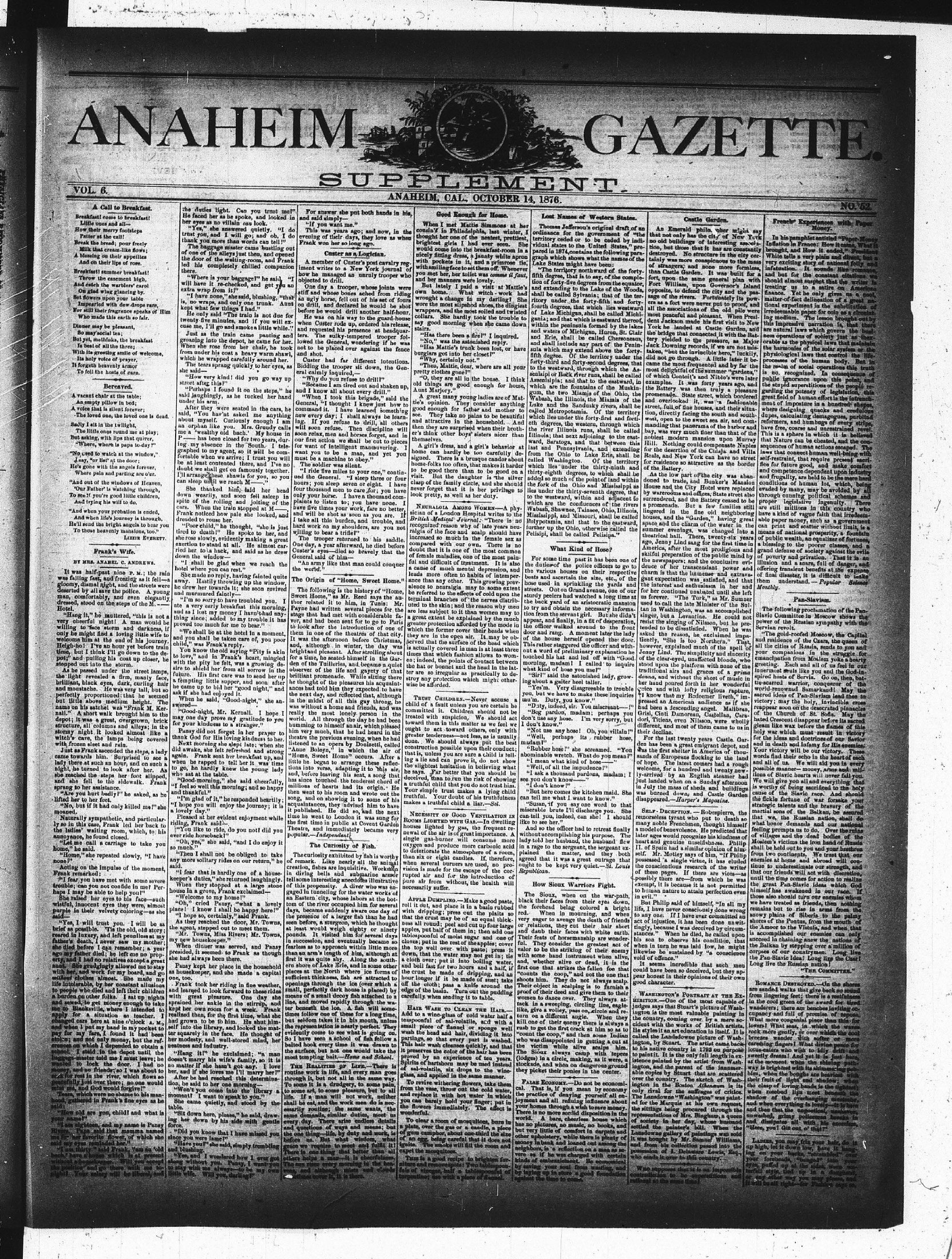
Searchable text
A Call to Breakfast.
Breakfast! come to breakfast!
Little ones and all—
How their merry footsteps
Patter at the call!
Break the bread; pour freely
Milk that cream-like flows;
A blessing on their appetites
And on their lips of rose.
Breakfast! summer breakfast!
Throw the casement high,
And catch the warblers' carol
On glad wing glancing by.
Set flowers upon your table
Impeared with dew-drops rare,
For still their fragrance speaks of Him
Who made this earth so fair.
Dinner may be pleasant,
So may social tea;
But yet, methinks, the breakfast
Is best of all the three;
With its greeting smile of welcome,
Its holy voice of prayer,
It forgetth heavenly armor
To foll the hosts of care.
Bereaved.
A vacant chair at the table;
An empty pillow in bed;
A voice that is silent forever;
The loved one, the loved one is dead.
Sadly I sit in the twilight,
The little ones round me at play;
But asking, with lips that quiver,
"Where, where is papa to-day?"
"No used to watch at the window,"
Asay, "or list" at the door;
He's gone with the angels forever,
the duties light. Can you trust me?
He faced her as he spoke, and looked in her eyes as no villain can look.
"Yes," she answered quietly. "I do trust you, and I will go; and oh, I do thank you more than words can tell."
The baggage master came bustling out of one of the alleys just then, and opened the door of the waiting-room, and Frank led his completely chilled companion there.
"Where is your baggage?" he said, "I will have it re-checked, and get you an extra wrap from it!"
"I have none," she said, blushing, "that is, no wraps, and only one trunk. Aunt kept what few things I had."
He only said "The train is not due for twenty-five minutes, and if you will excuse me, I'll go and smoke a little while."
Just as the train came panting and groaning into the depot, he came for her. When she rose from her chair, he took from under his coat a heavy warm shawl, which he wrapped carefully around her.
The tears sprang quickly to her eyes, as she said—
"How very kind! did you go way up street afteg this?"
"Perhaps I found it on the steps," he said laughingly, as he tucked her hand under his arm.
After they were seated in the cars, he said, "You haven't asked me anything about myself. Curiously enough I am an orphan like you. Mrs. Grundy calls me a 'wealthy old bach.' My house in P—— has been closed for two years, during my absence in the South. I telegrambed to my agent, so it will be comfortable when we arrive; I trust you will be at least contented there, and I've no doubt we shall get on forwards too."
For answer she put and said simply—
"If you want me."
This was years ago evening of their day.
Frank won her so long.
Caster as a member of Custum writes to a New York man who managed an objected to drill.
One day a trooper stiff and whose bones an ugly horse, fell out on drill, and declared before he would drill.
He was on his way when Custer rode up and requested his pretties. The sulky-temple lowed the General, who not to be placed over and shot.
Custer had far d Bidding the trooper seral calmly inquired,
"Why do you refuse?"
Because I am tired and I know all about it.
When I took this General, "I thought I command it. I have new every day; I shaking. If you refuse to will soon refuse. The soon relax, men and our first action we share for want of intelligent want you to be a must be a machine to do."
The soldier was silent.
Bereaved.
A vacant chair at the table; An empty pillow in bed; A voice that is silent forever; The loved one, the loved one is dead.
Sadly I sit in the twilight, The little ones round me at play; But asking, with lips that quiver, "Where, where is papa to-day?"
"No need to watch at the window," I say, "or list" at the door; He's gone with the angels forever, Where pain and parting are o'er.
"And out of the windows of Heaven, Our Father is watching through, To see if you're good little children, And trying his will to do."
"And when your probation is ended, And when life's journey is through, He'll send the bright angels to bear you To those heavenly mansions, too."
LIZZIE EVEHETT.
Frank's Wife.
BY MRS. ANABEL C. ANDREWS.
It was half-past nine P.M.; the rain was falling fast, and freezing as it fell—a gloomy, dismal night, and the streets were deserted by all save the police. A young man, comfortably, and even elegantly, dressed, stood on the steps of the M.-Hotel.
"Hang it," he muttered, "this is not a very cheerful night! A man would be willing to face storm and darkness, if only he might find a loving little wife to welcome him at the end of his journey. Heigh-ho! I've an hour yet before train time, but I think I'll go down to the depot;" and pulling his coat up closer, he stepped out into the storm.
As he passed under the street lamps, the light revealed a firm, manly face, brilliant, black eyes, dark, curling hair and moustache. He was very tall, but so perfectly proportioned that he seemed but little above medium height. The name on his satchel was "Frank M. Kernail." A short walk brought him to the depot; it was a great, overgrown, brick structure, all columns and alleys; in the stormy night it looked almost like a witch's cave, the lamps being covered with frozen sleet and rain.
Just as Frank ascended the steps, a lady came towards him. Surprised to see a lady there at such an hour, and on such a night, he turned to look after her. As she reached the steps her foot slipped, and she fell to the sidwalk. Frank sprang to her assistance.
"Are you hurt badly!" he asked, as he lifted her to her feet.
"No, but if it had only killed me!" she moaned.
Naturally sympathetic, and particularly so in this case, Frank led her back to the ladies' waiting room, which, to his annoyance, he found closed.
"Let me call a carriage to take you home," he said.
"Home," she repeated slowly, "I have none!"
Acting on the impulse of the moment, Frank remarked:
"I fear you have met with some severe trouble; can you not confide in me? Per-
she said—
"How very kind! did you go way up street after this?"
"Perhaps I found it on the steps," he said laughingly, as he tucked her hand under his arm.
After they were seated in the cars, he said, "You haven't asked me anything about myself. Curiously enough I am an orphan like you. Mrs. Grundy calls me a 'wealthy old bach.' My house in P—— has been closed for two years, during my absence in the South. I telegraphed to my agent, so it will be comfortable when we arrive; I trust you will be at least contented there, and I've no doubt we shall get on famously together. I'll arrange these shawls for you, so you can sleep until we reach M——."
She thanked him; laid her head down wearily, and soon fell asleep in spite of the rolling and jolting of the cars. When the train stopped at M—— Frank noticed how pale she looked, and dreaded to rouse her.
"Poor child," he thought, "she is just tired to death!" He spoke to her, and she rose slowly, evidently making a great exertion to stand at all. He almost carried her to a hack, and said as he drew down the window—
"I shall be glad when we reach the hotel where you can rest."
She made no reply, having fainted quite away. Hastily throwing up the window, he drew her towards it; she soon revived and murmured faintly—
"I'm so sorry to have troubled you. I ate a very early breakfast this morning, and as I lost my money I haven't anything since; added to my trouble it has proved too much for me to bear."
"We shall be at the hotel in a moment, and you shall be taken care of, you poor child," was Frank's reply.
You know the old saying "Pity is akin to love," and in Frank's heart, mingled with the pity he felt; was a growing desire to shield her from all sorrow in the future. His first care was to send her up a tempting little supper, and soon after he came up to bid her "good night," and ask if she had enjoyed it.
When he said, "Good-night," she answered—
"Good-night, Mr. Kernall. I hope I may one day prove my gratitude to you for your kindness to a stranger."
Pansy did not forget in her prayer to thank God for His loving kindness to her.
Next morning she slept late; when she did awake, she felt refreshed and strong again. Frank sent her breakfast up, and when he rapped to tell her it was time to go, he hardly knew the young lady who sat at the table.
"Good-morning," she said cheerfully,
"I feel so well this morning; and so happy and thankful."
"I'm glad of it," he responded heartily;
"I hope you will enjoy the journey; it is a lovely day."
Pleased at her evident enjoyment while riding, Frank said—
"You like to ride, do you not? Did you ever ride horseback?"
"Oh yes," she said, "and I do enjoy it so much."
Then I shall not be obliged to take any more solitary rides on our return," he said.
"I fear that is hardly one of a housekeeper's duties," she returned laughingly.
When they stopped at a large stone she said—
"How very kind! did you go way up street after this?"
"Perhaps I found it on the steps," he said laughingly, as he tucked her hand under his arm.
After they were seated in the cars, he said, "You haven't asked me anything about myself. Curiously enough I am an orphan like you. Mrs. Grundy calls me a 'wealthy old bach.' My house in P—— has been closed for two years, during my absence in the South. I telegraphed to my agent, so it will be comfortable when we arrive; I trust you will be at least contented there, and I've no doubt we shall get on famously together. I'll arrange these shawls for you, so you can sleep until we reach M——."
She thanked him; laid her head down wearily, and soon fell asleep in spite of the rolling and jolting of the cars. When the train stopped at M—— Frank noticed how pale she looked, and dreaded to rouse her.
"Poor child," he thought, "she is just tired to death!" He spoke to her, and she rose slowly, evidently making a great exertion to stand at all. He almost carried her to a hack, and said as he drew down the window—
"I shall be at the hotel in a moment, and you shall be taken care of, you poor child," was Frank's reply.
You know the old saying "Pity is akin to love," and in Frank's heart, mingled with the pity he felt; was a growing desire to shield her from all sorrow in the future. His first care was to send her up a tempting little supper, and soon after he came up to bid her "good night," and ask if she had enjoyed it.
When he said, "Good-night," she answered—
"Good-night, Mr. Kernall. I hope I may one day prove my gratitude to you for your kindness to a stranger."
Pansy did not forget in her prayer to thank God for His loving kindness to her.
Next morning she slept late; when she did awake, she felt refreshed and strong again. Frank sent her breakfast up,and when he rapped to tell her it was time to go,he hardly knew the young lady who sat at the table.
"Good-morning," she said cheerfully,
"I feel so well this morning; and so happy and thankful."
"I'm glad of it," he responded heartily;
"I hope you will enjoy the journey; it is a lovely day."
Pleased at her evident enjoyment while riding Frank said—
"You like to ride,do you not? Did you ever ride horseback?"
"Oh yes," she said,“and I do enjoy it so much.”
Then I shall not be obliged to take any more solitary rides on our return,” he said.
"I fear that is hardly one of a housekeeper's duties," she returned laughingly.
When they stopped at a large stone she said—
"How very kind! did you go way up street after this?"
"Perhaps I found it on the steps," he said laughingly,as he tucked her hand under his arm.
After they were seated in the cars,he said,"You havn't asked me anything about myself.Curiously enough I am an orphan like you.Mrs.Grundy calls me a 'wealthy old bach.'My house in P——has been closed for two years,during my absence in the South.I telegraphed to my agent,so it will be comfortable when we arrive;I trust you will be at least contented there,and I've no doubt we shall get on famously together.I'll arrange these shawls for you,so you can sleep until we reach M——."
She thanked him; laid her head down wearily,and soon fell asleep in spite of the rolling and jolting of the cars. When the train stopped at M—— Frank noticed how pale she looked,and dreaded to rouse her.
"Poor child," he thought,"she is just tired to death!" He spoke to her,and she rose slowly,evidently making a great exertion to stand at all. He almost carried her to a hack,and said as he drew down the window—
"I shall be at the hotel in a moment,and you shall be taken care of,you poor child," was Frank's reply.
You know the old saying "Pity is akin to love," and in Frank's heart,mingled with the pity he felt;was a growing desire to shield her from all sorrow in the future. His first care was to send her up a tempting little supper,and soon after he came up to bid her "good night," and ask if she had enjoyed it.
When he said,"Good-night," she answered—
"The Origin of "Home"
The following is the title of The Sweet Home," as Mr. thor related it to him.Payne had written several stage that had met with vor,and had been sent to look after the introduction them in one of the thues It was the afternoon bed,and although.in winter brightand pleasant.After for a time,the seated him den of the Tuilleries,and observer of the life and brilliant promenade.Whehhe thought of the pleasures had told him they were next day,and reflectin in the midst of all this was without a home and really the most lonely world.All through these hummingto himself an him very much,the that he theatrethe previous eventlistened to an opera byAnne Boleyn,"in whiAnne Boleyn,"in whiAnne Boleyn,"in whiAnne Boleyn,"in whiAnne Boleyn,"in whiAnne Boleyn,"in whiAnne Boleyn,"in whiAnne Boleyn,"in whiAnne Boleyn,"in whiAnne Boleyn,"in whiAnne Boleyn,"in whiAnne Boleyn,"in whiAnne Boleyn,"in whiAnne Boleyn,"in whiAnne Boleyn,"in whiAnne Boleyn,"in whiAnne Boleyn,"in whiAnne Boleyn,"in whiAnne Boleyn,"in whiAnne Boleyn,"in whiAnne Boleyn,"in whiAnne Boleyn,"in whiAnne Boleyn,"in whiAnne Boleyn,"in whiAnne Boleyn,"in whiAnne Boleyn,"in whiAnne Boleyn,"in whiAnne Boleyn,"in whiAnne Boleyn,"in whiAnne Boleyn,"in whiAnne Boleyn,"in whiAnne Boleyn,"in whiAnne Boleyn,"in whiAnne Boleyn,"in whiAnne Boleyn","in whiAnne BoleYN","in whiAnne BoleYN","in whiAnne BoleYN","in whiAnne BoleYN","in whiAnne BoleYN","in whiAnne BoleYN","in whiAnne BoleYN","in whiAnne BoleYN","in whiAnne BoleYN","in whiAnne BoleYN","in whiAnne BoleYN","in whiAnne BoleYN","in whiAnne BoleYN","in whiAnne BoleYN","in whiAnne BoleYN","in whiAnne BoleYN","in whiAnNE BoleYN","in whiANNE BoleYN","in whiANNE BoleYN","in whiANNE BoleYN","in whiANNE BoleYN","in whiANNE BoleYN","in WhiANNE BoleYN","In WhiANNE BoleYN","In WhiANNE BoleYN","In WhiANNE BoleYN","In WhiANNE BoleYN","In WhiANNE BoleYN","In WhiANNE BoleYN","In WhiANNE BoleYN","In WhiANNE BoleYN","In WhiANNE BoleYN","In WhiANNE BoleYN","In WhiANNE BoleYN","In WhiANNE BoleYN","In WhiANNE BoleYN","In WhiANNE BoleYN","In WhiANNE BoleYN","In WhiANNE BolesY","In WhiANNE BolesY","In WhiANNE BolesY","In WhiANNE BolesY","In WhiANNE BolesY","In WhiANNE BolesY","In WhiANNE BolesY","In WhiANNE BolesY","In WhiANNE BolesY","In WhiANNE BolesY","In WhiANNE BolesY","In WhiANNE BolesY","In WhiANNE BolesY","In WhiANNE BolesY","In WhiANNE BolesY","In WhiANNE BolesY","In WhiiANNE BolesY","In WhiiANNE BolesY","In WhiiANNE BolesY","In WhiiANNE BolesY","In WhiiANNE BolesY","In WhiiANNE BolesY","In WhiiANNE BolesY","In WhiiANNE BolesY","In WhiiANNE BolesY","In WhiiANNE BolesY","In WhiiANNE BolesY","In WhiiANNE BolesY","In WhiiANNEBolesY","In WhiiANNEBolesY","In WhiiANNEBolesY":"In WhiiANNEBolesY":"In WhiiANNEBolesY":"In WhiiANNEBolesY":"In WhiiANNEBolesY":"In WhiiANNEBolesY":"In WhiiANNEBolesY":"In WhiiANNEBolesY":"In WhiiANNEBolesY":"In WhiiANNEBolesY":"In WhiiANNEBolesY":"In WhiiANNEBolesY":"InWhiiANNEBolesY":"InWhiiANNEBolesY":"InWhiiANNEBolesY":"InWhiiLANEBcolesY":"InWhiiLANEBcolesY":"InWhiiLANEBcolesY":"InWhiiLANEBcolesY":"InWhiiLANEBcolesY":"InWhiiLANEBcolesY":" InWhiiLANEBcolesY":" InWhiiLANEBcolesY":" InWhiiLANEBcolesY":" InWhiiLANEBcolesY":" InWhiiLANEBcolesY":" InWhiiLANEBcolesY":" InWhiiLANEBcolesY":" InWhiiLANEBcolesY":" InWhiiLANEBcolesY":" InWhiiLANEBcolesY":" InWhiiLANEBcolesY": InWhiiLANEBcolesY": InWhiiLANEBcolesY": InWhiiLANEBcolesY": InWhiiLANEBcolesY": InWhiiLANEBcolesY": InWhiiLANEBcolesY": InWhiiLANEBcolesY": InWhiiLANEBcolesY": InWhiiLANEBcolesY": InWhiiLANEBcolesY": InWhiiLANEBcolesY": InWhIILANEBcolesY": InWhIILANEBcolesY": InWhIILANEBcolesY": InWhIILANEBcolesY": InWhIILANEBcolesY": InWhIILANEBcolesY": InWhIILANEBcolesY": InWhIILANEBcolesY": InWhIILANEBcolesY": InWhIILANEBcolesY": InWhIILANEBcolesY": InWHIILANEBcolesY": InWHIILANEBcolesY": InWHIILANEBcolesY": InWHIILANEBcolesY": InWHIILANEBcolesY": InWHIILANEBooksY": InWHIILANEBooksY": InWHIILANEBooksY": InWHIILANEBooksY": InWHIILANEBooksY": InWHIILANEBooksY": InWHIILANEBooksY": InWHIILANEBooksY": InWHIILANEBooksY": InWHIILANEBooksY": InWHIILANEBooksy": InWHIILANEBooksy": InWHIILANEBooksy": InWHIIlanesBooksy": InWHIIlanesBooksy": InWHIIlanesBooksy": InWHIIlanesBooksy": InWHIIlanesBooksy": InWHIIlanesBooksy": InWHIIlanesBooksy": InWHIIlanesBooksy": INWHIIlanesBooksy": INWHIIlanesBooksy": INWHIIlanesBooksy": INWHIIlanesBooksy": INWHIIlanesBooksy": INWHIIlanesBooksy": INWHIIlanesBooksy": INWHIIlanesBooksy": INWHIIlanesBooksy": INWHIIlanesBooksy": INWHIIlanesBooksy": INWHIIlanesBooksy": IN WHIIlanesBooksy": INWHIIlanesBooksy": INWHIIlanesBooksy": INWHIIlanesBooksy": INWHIIlanesBooksy": INWHIIlanesBooksy": INWHIIlanesBooksy": INWHIIlanesBooksy": INWHIIlanesBooksy": INWHIIlanesBooksy": INWHIIlanesBooksy": INWHIIlanesBooksy": IN WH IIlanes Booksy": INWH IIlanes Booksy": INWH IIlanes Booksy": INWH IIlanes Booksy": INWH IIlanes Booksy": INWH IIlanes Booksy": INWH IIlanes Booksy": INWH IIlanes Booksy": INWH IIlanes Booksy": INWH IIlanes Booksy": INWH IIlanes Booksy": IN WH IIlanes Booksy": IN WH IIlanes Booksy": IN WH II lanese Booksy": IN WH II lanese Booksy": IN WH II lanese Booksy": IN WH II lanese Booksy": IN WH II lanese Booksy": IN WH II lanese Booksy": IN WH II lanese Booksy": IN WH II lanese Booksy": IN WH II lanese Booksy": IN WH II lanese Booksy": IN WH II lanese Booksy:IN WH II lanese Booksy:IN WH II lanese Booksy:IN WH II lanese Booksy:IN WH II lanese Booksy:IN WH II lanese Booksy:IN WH II lanese Booksy:IN WH II lanese Booksy:IN WH II lanese Booksy:IN WH II lanese Booksy:IN WH II lanese Booksy:IN WH II lanese Booksy:IN WH II lanese Books y:IN WH II lanese Books y:IN WH II lanese Books y:IN WH II lanese Books y:IN WH II lanese Books y:IN WH II lanese Books y:IN WH II lanese Books y:IN WH II lanese Books y:IN WH II lanese Books y:IN WH II lanese Books y:IN WH II lanese Books y:IN WH II lanese Books y:IN WH II lanese Books y:IN WH III兰兰兰兰兰兰兰兰兰兰兰兰兰兰兰兰兰兰兰兰兰兰兰兰兰兰兰兰兰兰兰兰兰兰兰兰兰兰兰兰兰兰兰兰兰兰兰兰兰兰兰兰兰兰兰兰兰兰兰兰兰兰兰兰兰兰兰兰兰兰兰兰兰兰兰兰兰兰兰兰兰兰兰兰兰兰兰兰州兰州兰州兰州兰州兰州兰州兰州兰州兰州兰州兰州兰州兰州兰州兰州兰州兰州兰州兰州兰州兰州兰州兰州兰州兰州兰州兰州兰州兰州兰州兰州兰州兰州兰州兰州兰州兰州兰州兰州兰州兰州兰州兰州兰州兰州兰州兰州兰州兰州兰州兰州兰州兰州兰州兰州兰州兰州兰州兰州兰州兰州兰州兰州兰州兰州兰州兰州兰州兰州兰州兰州兰州兰州兰州兰州兰州兰州兰州兰州兰州兰州兰州兰州兰州兰州兰州兰州兰州兰州兰州兰州兰州兰州兰州兰州
ILIZIE EVERHETT
The curiosity exhibited of remark. Like nearly creation,fishes are inguiscent.in diving bells and suu tellsome interesting anecdote.of this propensity.A迪
"Are you hurt badly!" he asked, as he lifted her to her feet.
"No, but if it had only killed me!" she moaned.
Naturally sympathetic, and particularly so in this case, Frank led her back to the ladies' waiting room, which, to his annoyance, he found closed.
"Let me call a carriage to take you home," he said.
"Home," she repeated slowly, "I have none!"
Acting on the impulse of the moment, Frank remarked:
"I fear you have met with some severe trouble; can you not confide in me? Perhaps I may be able to help you!"
She raised her eyes to his face—such wistful, innocent eyes they were, almost purple in their velvety coloring—as she said—
"Yes, I will trust you. I will be as brief as possible. Tis the old, old story; reared in luxury, and left penniless at my father's death, I never saw my mother; she died before I can remember; a year ago my father died; he left me no property, and I had no relatives except a great aunt. She grudgingly allowed me to stay with her, and work for my board, and go without clothes almost. She made my life intolerable, by her constant allusions to people who died and left their children a burden on other folks. I sat up nights and sawed, to get money enough to take me to Blanksville, where I intended to apply for a situation as teacher. I changed cars here at nine o'clock A.M., and when I put my hand in my pocket to pay for my fare, I found it had been stolen; and not only money, but the references on which I depended to obtain a school. I staid in the depot until the language-master told me I must leave; he wanted to lock the door. I had no money, and no friends; so I was about to seek for rest in the river, which flows so peacefully just over there; no one would miss me, and God would forgive!"
Treasury, which were no shame to his manhood, gathered in Frank's fine eyes as he said:
"How old are you, child! and what is your name!"
"I am eighteen, and my name is Panay Rivers. Papa said that mamma named me for her favorite flower, of which she said my eyes reminded him."
"I am thirty," said Frank, "am an 'old hash' have a house which is at present without a houseman." Will you accept the positions and go there with sun tonight? Your salary will be liberal, and I'm glad of it," he responded heartily;
"I hope you will enjoy the journey; it is a lovely day."
Pleased at her evident enjoyment while riding, Frank said—
"You like to ride, do you not? did you ever ride horseback?"
"Oh, yes," she said, "and I do enjoy it so much."
"Then I shall not be obliged to take any more solitary rides on our return," he said.
"I fear that is hardly one of a housekeeper's duties," she returned laughingly.
When they stopped at a large stone house in a grove, Frank exclaimed—
"Welcome to my home!"
"Oh," cried Panay, "what a lovely place! I know I shall be happy here!"
"I hope so, certainly," said Frank.
As they reached the door, Mr. Towns, the agent, stepped out to meet them.
Mr. Towns, Miss Rivers; Mr. Towns, my new housekeeper.
When dinner was served, and Panay presided, it seemed to Frank as though she had always been there.
Panay kept her place in the household as housekeeper, and she made a capital one, too.
Frank took her riding in fine weather, and learned to look forward to these rides with great pleasure. One day she sprained her ankle in the stirrup, and kept her own room for a week. Frank realized then, for the first time, what she had grown to be to him. He shut himself into the library, and looked the matter squarely in the face. He thought of her modesty, and well-stored mind, her neatness and industry.
"Hang it!" he exclaimed; "a man doesn't marry his wife's family, so it is no matter if she hasn't got any. I love her, and if she loves me I'll marry her!"
After he had reached this determination, he said to her one morning—
"Won't you come into the library a moment? I want to speak to you."
She came quietly, and stood by the table.
"Sit down here, please," he said, drawing her down by his side with gentle force.
"Did you know that I have missed you since you were lame!"
"Have you?" she said simply trembling and blushing.
"Yes, and I wondered how I ever got along without you. Panay, I wait you to stay with me always—to be my own little wife. Will you darling!"
CIM GA
SUPPLEMENT.
ANAHEIM, CAL., OCTOBER 14, 1876.
For answer she put both hands in his, and said simply—
"If you want me."
This was years ago; and now, in the evening of their days, they love as when Frank won her so long ago.
Caster as a Logician.
A member of Custer's post cavalry regiment writes to a New York journal of how he managed an unruly trooper who objected to drill.
One day a trooper, whose joints were stiff and whose bones ached from riding an ugly horse, fell out of his set of fours on drill, and declared he would be shot before he would drill another half-hour.
He was on his way to the guard-house when Custer rode up, ordered his release, and requested his presence at headquarters. The sulky-tempered trooper followed the General, wondering if he was not to be placed over against the fence and shot.
Custer had far different intentions. Bidding the trooper sit down, the General calmly inquired,
"Why do you refuse to drill?"
Because I am tired out and shaken up, and I know all about every drill."
When I took this brigade," said the General, "I thought I knew just how to command it. I have learned something new every day; I shall always be learning. If you refuse to drill, all others will soon refuse. Then discipline will soon relax, men and horses forget, and in our first action we shall be cut to pieces for want of intelligent maneuvering. I want you to be a man, and yet you must be a machine to obey."
The soldier was silent.
Good Enough for Home.
When I met Mattie Simmons at her cousin's in Philadelphia, last winter, I thought her one of the neatest, prettiest, brightest girls I had ever seen. She would come into the breakfast-room in a nicely fitting dress, a jaunty white apron with pockets in it, and a primrose tie, with smiling face to set them off. Whenever you met her, her toilet was comme il faut, and her manners were lovely.
But lately I paid a visit at Mattle's own home. What witch-work had wrought a change in my darling! She wore the most slipshod shoes, the dingiest wrappers, and the most soiled and twisted collars. She hardly took the trouble to say good morning when she came down stairs.
"Has there been a fire?" I inquired.
"No," was the astonished reply.
"Has Mattie's trunk been lost, or have burglars got into her closet?"
"Why, certainly not."
Then, Mattie, dear, where are all your pretty clothes gone?
"O, they are all in the house. I think old things are good enough for home, Aunt Marjory."
A great many young ladies are of Mattle's opinion. They consider anything good enough for father and mother to see. They take no pains to be beautiful and attractive in the household. And then they are surprised when their brother's think other boys' sisters nicer than themselves.
A girl's dress, and a girl's behavior at home can hardly be too carefully designed. There is a brusque candor about home-folks too often, that makes it harder.
Lost Names of Western States.
Thomas Jefferson's original draft of an ordinance for the government of "the territory ceded or to be ceded by individual states to the United States," prepared in 1874, contains the following paragraph which shows what the names of the Lake States might have been:
"The territory northward of the forty-fifth degree, that is to say, of the completion of forty-five degrees from the equator, and extending to the Lake of the Woods, shall be called Sylvania; that of the territory under the forty-fifth and forty-fourth degrees, that which lies westward of Lake Michigan, shall be called Michigania; and that which is eastward thereof, within the peninsula formed by the lakes and waters of Michigan, Huron, St. Clair and Erie, shall be called Chernisones, and shall include any part of the Peninsula which may extend above the forty-fifth degree. Of the territory under the forty-third and forty-second degrees, that to the westward, through which the Assensiplior or Rock River runs, shall be called Assensiplior; and that to the eastward, in which are the fountains of the Muskinguum, the two Miamis of the Ohio, the Wabash, the Illinois, the Miamis of the Lake and the Sandusky rivers, shall be called Metropotamia. Of the territory which lies under the forty-first and forty-eighth degrees, the western, through which the river Illinois runs, shall be called Illinois; that next adjoining to the east-ward, Saratoga, and that between this last and Pennsylvania, and extending from the Ohio to Lake Erie, shall be called Washington. Of the territory which lies under the thirty-ninth and fourth-ninth degrees of which Gainesville is most delightful."
An Eagle that not only no old battle but destroyer tainly wields of strange fort upon Fort William opposite; sage of these all as the ass most pleasant Jack York he bridges tery yield Jack Down taken; "be did not get came the most delight of which Gainesville is most delightful." The Batterymen promenade and overlook street; full tion; direct west; open mandling bay; was v noblest m Hill. Not for the desire Reale, and for residence of the Battle.
eral calmly inquired,
"Why do you refuse to drill?"
"Because I am tired out and shaken up,
and I know all about every drill."
"When I took this brigade," said the General,
"I thought I knew just how to command it. I have learned something new every day; I shall always be learning. If you refuse to drill, all others will soon refuse. Then discipline will soon relax, men and horses forget, and in our first action we shall be cut to pieces for want of intelligent maneuvering. I want you to be a man, and yet you must be a machine to obey."
The soldier was silent.
"I ride five miles to your one," continued the General.
"I sleep three or four hours; you sleep seven or eight. I have four thousand men to care for; you have only my horse. I have a thousand complaints to listen to; you have none. I have five times your work, fare no better, and will be shot as soon as you are. If I take all this burden, and trouble, and hard work on my shoulders, are you not willing to bear a trifle?"
The trooper returned to his saddle. One day, a year afterward, he died before Custer's eyes—died so bravely that the General said of him—
"An army like that man could conquer the world."
The Origin of "Home, Sweet Home."
The following is the history of "Home, Sweet Home," as Mr. Reed says the author related it to him, in Tunis: Mr. Payne had written several pieces for the stage that had met with considerable favor, and had been sent for to go to Paris to look after the introduction of one of them in one of the theatres of that city. It was the afternoon before Christmas, and, although, in winter, the day was bright and pleasant. After strolling about for a time, he seated himself in the Garden of the Tuilleries, and became a quiet observer of the life and gayety of that brilliant promenade. While sitting there he thought of the pleasures his acquaintances had told him they expected to have the next day, and reflected that, although in the midst of all this gay throng, he was without a home and friends, and was really the most lonely person in the world. All through the day he had been humming to himself an air which pleased him very much, that he had heard in the theatre the previous evening, when he had listened to an opera by Donizetti, called "Anne Boleyn," in which the air of "Home, Sweet Home" occurs. After a little he began to arrange these reflections into verse, adapting it to this air, and, before leaving his seat, a song that has since touched the tenderest chord of millions of hearts had its origin. He then went to his room and wrote out the song, and on showing it to some of his acquaintances, they advised him to have it published. He did so, and the next time he went to London it was sung for the first time in public at Covent Garden Theatre, and immediately became very popular.
The Curiosity of Fish.
The curiosity exhibited by fish is worthy of remark. Like nearly all the animal creation, fishes are inquisitive. Workman in diving bells and submarine armor tells some interesting anecdotes illustrative of this propensity. A diver who was en-
pretty clothes gone?
"O, they are all in the house. I think old things are good enough for home, Aunt Marjorie."
A great many young ladies are of Mattie's opinion. They consider anything good enough for father and mother to see. They take no palms to be beautiful and attractive in the household. And then they are surprised when their brother's think other boys' sisters nicer than themselves.
A girl's dress, and a girl's behavior at home can hardly be too carefully designed. There is a brusque candoar about home-folks too often, that makes it harder to be good there than to be good on a visit. But the daughter is the silver clasp of the family circle, and she should never forget that it is her privilege to look pretty, as well as her duty.
NEURALGIA AMONG WOMEN—A physician of a London Hospital writes to the British Medical Journal: "There is no recognized reason why of late years neuralgia of the face and scalp should have increased so much in the female sex as compared with our own. There is no doubt that it is one of the most common of female maladies, one of the most painful and difficult of treatment. It is also a cause of much mental depression, and leads more often to habits of intemperance than any other. This growing prevalence to neuralgia may to some extent be referred to the effects of cold upon the terminal branches of the nerves distributed to the skin; and the reason why men are less subject to it than women may to a great extent be explained by the much greater protection afforded by the mode in which the former cover their heads when they are in the open air. It may be observed that the surface of the head which is actually covered in man is at least three times that which fashion allows to women; indeed, the points of contact between the hat or bonnet and the head in the latter are so irregular as practically to destroy any protection which might otherwise be afforded.
TRUST CHILDREN.—Never accuse a child of a fault unless you are certain he committed it. Children should not be treated with suspicion. We should act toward them in this matter as we feel we ought to act toward others, only with greater tenderness—not less, as is usually done. We should always put the best construction possible upon their conduct; that is, unless you are sure a child is telling a lie and can prove it, do not show the slightest hesitation in believing what he says. Far better that you should be deceived, than to run the risk of showing a truthful child that you do not trust him. Your simple trust makes a lying child truthful. Your doubt of his truthfulness makes a truthful child a liar.
NECESSITY OF GOOD VENTILATION IN ROOMS LIGHTED WITH GAS.—In dwelling houses lighted by gas, the frequent renewal of the air is of great importance. A single gas-burner will consume more oxygen and produce more carbonic acid to deteriorate the atmosphere of a room, than six or eight candles. If, therefore, when several burners are used, no provision is made for the escape of the corrupted air and for the introduction of pure air from without, the health will necessarily suffer.
O'The are all in the house. I think old things are good enough for home, Aunt Marjorie."
A great many young ladies are of Mattie's opinion. They consider anything good enough for father and mother to see. They take no palms to be beautiful and attractive in the household. And then they are surprised when their brother's think other boys' sisters nicer than themselves.
A girl's dress, and a girl's behavior at home can hardly be too carefully designed. There is a brusque candoar about home-folks too often, that makes it harder to be good there than to be good on a visit. But the daughter is the silver clasp of the family circle, and she should never forget that it is her privilege to look pretty, as well as her duty.
NEURALGIA AMONG WOMEN—A physician of a London Hospital writes to the British Medical Journal: "There is no recognized reason why of late years neuralgia of the face and scalp should have increased so much in the female sex as compared with our own. There is no doubt that it is one of the most common of female maladies, one of the most painful and difficult of treatment. It is also a cause of much mental depression, and leads more often to habits of intemperence than any other. This growing prevalence to neuralgia may to some extent be referred to the effects of cold upon the terminal branches of the nerves distributed to the skin; and the reason why men are less subject to it than women may to a great extent be explained by the much greater protection afforded by the mode in which the former cover their heads when they are in the open air. It may be observed that the surface of the head which is actually covered in man is at least three times that which fashion allows to women; indeed, the points of contact between the hat or bonnet and the head in the latter are so irregular as practically to destroy any protection which might otherwise be afforded.
TRUST CHILDREN.—Never accuse a child of a fault unless you are certain he committed it. Children should not be treated with suspicion. We should act toward them in this matter as we feel we ought to act toward others, only with greater tenderness—not less, as is usually done. We should always put the best construction possible upon their conduct; that is, unless you are sure a child is telling a lie and can prove it, do not show the slightest hesitation in believing what he says. Far better that you should be deceived, than to run the risk of showing a truthful child that you do not trust him. Your simple trust makes a lying child truthful. Your doubt of his truthfulness makes a truthful child a liar.
NECESSITY OF GOOD VENTILATION IN ROOMS LIGHTED WITH GAS.—In dwelling houses lighted by gas, the frequent renewal of the air is of great importance. A single gas-burner will consume more oxygen and produce more carbonic acid to deteriorate the atmosphere of a room, than six or eight candles. If, therefore, when several burners are used, no provision is made for the escape of the corrupted air and for the introduction of pure air from without, the health will necessarily suffer.
O'The are all in the house. I think old things are good enough for home, Aunt Marjorie."
A great many young ladies are of Mattie's opinion. They consider anything good enough for father and mother to see. They take no palms to be beautiful and attractive in the household. And then they are surprised when their brother's think other boys' sisters nicer than themselves.
A girl's dress, and a girl's behavior at home can hardly be too carefully designed. There is a brusque candoar about home-folks too often, that makes it harder to be good there than to be good on a visit. But the daughter is the silver clasp of the family circle, and she should never forget that it is her privilege to look pretty, as well as her duty.
NEURALGIA AMONG WOMEN—A physician of a London Hospital writes to the British Medical Journal: "There is no recognized reason why of late years neuralgia of the face and scalp should have increased so much in the female sex as compared with our own. There is no doubt that it is one of the most common of female maladies, one of the most painful and difficult of treatment. It is also a cause of much mental depression, and leads more often to habits of intemperence than any other. This growing prevalence to neuralgia may to some extent be referred to the effects of cold upon the terminal branches of the nerves distributed to the skin; and the reason why men are less subject to it than women may to a great extent be explained by the much greater protection afforded by the mode in which the former cover their heads when they are in the open air. It may be observed that the surface of the head which is actually covered in man is at least three times that which fashion allows to women; indeed, the points of contact between the hat or bonnet and the head in the latter are so irregular as practically to destroy any protection which might otherwise be afforded.
TRUST CHILDREN.—Never accuse a child of a fault unless you are certain he committed it. Children should not be treated with suspicion. We should act toward them in this matter as we feel we ought to act toward others, only with greater tenderness—not less, as is usually done. We should always put the best construction possible upon their conduct; that is, unless you are sure a child is telling a lie and can prove it, do not show the slightest hesitation in believing what he says. Far better that you should be deceived, than to run the risk of showing a truthful child that you do not trust him. Your simple trust makes a lying child truthful. Your doubt of his truthfulness makes a truthful child a liar.
NECESSITY OF GOOD VENTILATION IN ROOMS LIGHTED WITH GAS.—In dwelling houses lighted by gas, the frequent renewal of the air is of great importance. A single gas-burnner will consume more oxygen and produce more carbonic acid to deteriorate the atmosphere of a room, than six or eight candles. If, therefore, when several burners are used, no provision is made for the escape of the corrupted air and for the introduction of pure air from without, the health will necessarily suffer.
O'The are all in the house. I think old things are good enough for home, Aunt Marjorie."
A great many young ladies are of Mattie's opinion. They consider anything good enough for father and mother to see. They take no palms to be beautiful and attractive in the household. And then they are surprised when their brother's think other boys' sisters nicer than themselves.
A girl's dress, and a girl's behavior at home can hardly be too carefully designed. There is a brusque candoar about home-folks too often, that makes it harder to be good there than to be good on a visit. But the daughter is the silver clasp of the family circle, and she should never forget that it is her privilege to look like see her.
O'The are all in the house. I think old things are good enough for home, Aunt Marjorie."
A great many young ladies are of Mattie's opinion. They consider anything good enough for father and mother to see. They take no palms to be beautiful and attractive in the household. And then they are surprised when their brother's think other boys' sisters nicer than themselves.
A girl's dress, and a girl's behavior at home can hardly be too carefully designed. There is a brusque candoar about home-folks too often, that makes it harder to be good there than to be good on a visit. But the daughter isthe silver clasp ofthe family circle,and she should never forget that it is her privilege to look like see her.
O'The are all in the house. I think old things are good enough for home,Aunt Marjorie."
A great many young ladies are of Mattie's opinion. They consider anything good enough for father and mother to see. They take no palms to be beautiful and attractive inthe household.Fullestmomentofthehouse,andoverlittiestreet,finallymandertingthatthewaywaswornbestmomentofthehouse,andoverlittiestreet,finallymandertingthatthewaywaswornbestmomentofthehouse,andoverlittiestreet,finallymandertingthatthewaywaswornbestmomentofthehouse,andoverlittiestreet,finallymandertingthatthewaywaswornbestmomentofthehouse,andoverlittiestreet,finallymandertingthatthewaywaswornbestmomentofthehouse,andoverlittiestreet,finallymandertingthatthewaywaswornbestmomentofthehouse,andoverlittiestreet,finallymandertingthatthewaywaswornbestmomentofthehouse,andoverlittiestreet,finallymandertingthatthewaywaswornbestmomentofthehouse,andoverlittiestreet,finallymandertingthatthewaywaswornbestmomentofthehouse,andoverlittiestreet,finallymandertingthatthewaywaswornbestmomentofthehouse,andoverlittiestreet,finallymandertingthatthewaywaswornbestmomentofthehouse,andoverlittiestreet,finallymandertingthatthewaywaswornbestmomentofthehouse,andoverlittiestreet,finallymandertingthatthewaywaswornbestmomentofthehouse,andoverlittiestreet,finallymandertingthatthewaywaswornbestmomentofthehouse,andoverlittiestreet,f finallymandertingthatthewaywaswornbestmomentofthehouse,andoverlittiestreet,f finallymandertingthatthewaywaswornbestmomentofthehouse,andoverlittiestreet,f finallymandertingthatthewaywaswornbestmomentofthehouse,andoverlittiestreet,f finallymandertingthatthewaywaswornbestmomentofthehouse,andoverlittiestreet,f finallymandertingthatthewaywaswornbestmomentofthehouse,andoverlittiestreet,f finallymandertingthatthewaywaswornbestmomentofthehouse,andoverlittiestreet,f finallymandertingthatthewaywaswornbestmomentofthehouse,andoverlittiestreet,f finallymandertingthatthewaywaswornbestmomentofthehouse,andoverlittiestreet,f finallymandertingthatthewaywaswornbestmomentofthehouse,andoverlittiestreet,f finallymandertingthatthewaywaswornbestmomentoftthehouse,andoverlittiestreet,FULLESTMOMENTOFTHEHOUSE AND THE HOUSE AND THE HOUSE AND THE HOUSE AND THE HOUSE AND THE HOUSE AND THE HOUSE AND THE HOUSE AND THE HOUSE AND THE HOUSE AND THE HOUSE AND THE HOUSE AND THE HOUSE AND THE HOUSE AND THE HOUSE AND THE HOUSE AND THE HOUSE AND THE HOUSE AND THE HOUSE AND THE HOUSE AND THE HOUSE AND THE HOUSE AND THE HOUSE AND THE HOUSE AND THE HOUSE AND THE HOUSEANDTHEHOUSEANDTHEHOUSEANDTHEHOUSEANDTHEHOUSEANDTHEHOUSEANDTHEHOUSEANDTHEHOUSEANDTHEHOUSEANDTHEHOUSEANDTHEHOUSEANDTHEHOUSEANDTHEHOUSEANDTHEHOUSEANDTHEHOUSEANDTHEHOUSEANDTHEHOUSEANDTHEHOUSEANDTHEHOUSEANDTHEHOUSEANDTHEHOUSEANDTHEHOUSEANDTHEHOUSEANDTHEHOUSEANDTHEHOUSEANDTHEHOUSEANDTHEHOSEANDTHEHOSEANDTHEHOSEANDTHEHOSEANDTHEHOSEANDTHEHOSEANDTHEHOSEANDTHEHOSEANDTHEHOSEANDTHEHOSEANDTHEHOSEANDTHEHOSEANDTHEHOSEANDTHEHOSEANDTHEHOSEANDTHEHOSEANDTHEHOSEANDTHEHOSEANDTHEHOSEANDTHEHOSEANDTHEHOSEANDTHEHOSEANDTHEHOSEANDTHEHOSEANDTHEHOSEANDTHEROSEANDTHEROSEANDTHEROSEANDTHEROSEANDTHEROSEANDTHEROSEANDTHEROSEANDTHEROSEANDTHEROSEANDTHEROSEANDTHEROSEANDTHEROSEANDTHEROSEANDTHEROSEANDTHEROSEANDTHEROSEANDTHEROSEANDTHEROSEANDTHEROSEANDTHEROSEANDTHEROSEANDTHEROSEANDTHEROSEANDTHEROSEANDTHEROSEAndTHEROSEAndTHEROSEAndTHeroseAndTheroseAndTheroseAndTheroseAndTheroseAndTheroseAndTheroseAndTheroseAndTheroseAndTheroseAndTheroseAndTheroseAndTheroseAndTheroseAndTheroseAndTheroseAndTheroseAndTheroseAndTheroseAndTheroseAndTheroseAndTheroseAndTheroseAndTheroseAndTheroseAndTheroseAndTheroseAndTheroseAndTheroseAndTheroseAndTheroseAndTheroseAndTheroseAndTheroseAndTheroseAndTheroseAndTheroseAndTheroseAndTheroseAndTheroseAndTheroseAndTheroseAndTheroseAndTheroseAndTheroseAndTheroseAndTheroseAndTheroseAndTheroseAndTheroseAndTheroseAndTheroseAndTheroseAndTheroseAndTheroseAndTheroseAndTheroseAndTheroseAndTheroseAndTheroseAndTheroseAndTheroseAndTheroseAndTheroseAndTheroseAndTherose And Throsose And Throsose And Throsose And Throsose And Throsose And Throsose And Throsose And Throsose And Throsose And Throsose And Throsose And Throsose And Throsose And Throsose And Throsose And Throsose And Throsose And Throsose And Throsose And Throsose And Throsose And Throsose And Throsose And Throsose And Throsose And Thrososex And Thrososex And Thrososex And Thrososex And Thrososex And Thrososex And Thrososex And Thrososex And Thrososex And Thrososex And Thrososex And Thrososex And Thrososex And Thrososex And Thrososex And Thrososex And Thrososex And Thrososex And Thrososex And Thrososex And Thrososex And Thrososex And Thrososex And Thrososex And Thrososex And Thrososex And Thrososex And Thrososex And Thrososex And Thrososex And Thrososex And THROSOX AND THROSOX AND THROSOX AND THROSOX AND THROSOX AND THROSOX AND THROSOX AND THROSOX AND THROSOX AND THROSOX AND THROSOX AND THROSOX AND THROSOX AND THROSOX AND THROSOX AND THROSOX AND THROSOX AND THROSOX AND THROSOX AND THROSOX AND THROSOX AND THROSOX AND THROSOX AND THROSOX AND THROSOX AND THROSOX AND THROSOX AND THROSOX AND THROSOX AND THROSOX
NECESSITY OF GOOD VENTILATION IN ROOMS LIGHTED WITH GAS.BURNER IS consumes more oxygen and produces more carbonic acid to deterioratethe atmosphereofa room,tan six or eight candles.IIfthereforewhen several burners are used,noprovidenceismadeforthe escapeofthecorruptedairandfortheintroductionofpureairfromwithout,thehealthwillnecessarilysuffer.
O'THE ARE ALL IN THE HOUSE.I TINK OVERALL MONEY FOR AN OWNER TO MAKE THIS INQUIRIES MUCH EASHER.EVERYONE HAD BEEN A DANISH FRIEND IN WASHINGTON.A MAN OF BEAMS LOVED BY WASHINGTON.CANADA.OFFICE.HOME.ASTHORIZON.FARM.ACTIVITY.FOREIGN CLIENT.FOREIGN BUSINESS.FIREMAN.FIREFIGHTER.FIREMAN.FIREMAN.FIREMAN.FIREMAN.FIREMAN.FIREMAN.FIREMAN.FIREMAN.FIREMAN.FIREMAN.FIREMAN.FIREMAN.FIREMAN.FIREMAN.FIREMAN.FIREMAN.FIREMAN.FIREMAN.FIREMAN.FIREMAN.FIREMAN.FIREMAN.FIREMAN.FIREMAN.FIREMAN.FIREMAN.FIREMAN.FIREMAN.FIREMAN.FIREMAN.FIREMAN.FIREMAN.FIREMAN.FIREMAN.FIREMAN.FIREMAN.FIREMAN.FIREMAN.FIREMAN.FIREMAN.FIREMAN.FIREMAN.FIREMAN.FIREMAN.FIREMAN.FIREMAN.FIREMAN.FIREMAN.FIREMAN.FIREMAN.FIREMAN.FIREMAN.FIREMAN.FIREMAN.FIREMAN.FIREMAN.FIREMAN.FIREMAN.FIREMAN.FIREMAN.FIREMAN.FIREMAN.FIREMAN.FIREMAN.FIREMAN.FIREMAN.FIREMAN.FIREMAN.FIFREE.MAN.OFBEAMS.LOVEDBY.WASHINGTON.CANADA.OFFICE.HOME.ASTHORIZON.FARM.ACTIVITY.FOREIGN CLIENT.FOREIGN BUSINESS.FIRES.NEWORDER.SUPPLIES.PRESSURE.RELEASE.OFTHEBANK.OFBEAMS.LOVEDBY.WASHINGTON.CANADA.OFFICE.HOME.ASTHORIZON.FARM.ACTIVITY.FOREIGN CLIENT.FOREIGN BUSINESS.PRESSURE.RELEASE.OFTHEBANK.OFBEAMS.LOVEDBY.WASHINGTON.CANADA.OFFICE.HOME.ASTHORIZON.FARM.ACTIVITY.FOREIGN CLIENT.FOREIGN BUSINESS.PRESSURE.RELEASE.OFTHEBANK.OFBEAMS.LOVEDBY.WASHINGTON.CANADA.OFFICE.HOME.ASTHORIZON.FARM.ACTIVITY.FOREIGN CLIENT.FOREIGN BUSINESS.PRESSURE.RELEASE.OFTHEBANK.OFBEAMS.LOVEDBY.WASHINGTON.CANADA.OFFICE.HOME.ASTHORIZON.FARM.ACTIVITY.FOREIGN CLIENT.FOREIGN BUSINESS.PRESSURE.RELEASE.OFTHEBANK.OFBEAMS.LOVEDBY.WASHINGTON.CANADA.OFFICE.HOME.ASTHORIZON.FARM.ACTIVITY.FOREIGN CLIENT.FOREIGN BUSINESS.PRESSURE.RELEASE.OFTHEBANK.OFBEAMS.LOVEDBY.WASHINGTON.CANADA.OFFICE.HOME.ASTHORIZON.FARM.ACTIVITY.FOREIGN CLIENT.FOREIGN BUSINESS.PRESSURE.RELEASE.OFTHEBANK.OFBEAMS.LOVEDBY.WASHINGTON.CANADA.OFFICE.HOME.ASTHORIZON.FARM.ACTIVITY.FOREIGN CLIENT.FOREIGN BUSINESS.PRESSURE.RELEASE.OFTHEBANK.OFBEAMS.LOVEDBY.WASHINGTON.CANADA.OFFICE.HOME.ASTHORIZON.FARM.ACTIVITY.FOREIGN CLIENT.FOREIGN BUSINESS.PRESSURE.RELEASE.OFTHEBANK.OFBEAMS.LOVEDBY.WASHINGTON.CANADA.OFFICE.HOME.ASTHORIZON.FARM.ACTIVITY.FOREIGN CLIENT(FORMAL)OFBEAMS.LOVEDBY.WASHINGTON.CANADA.OFFICE.HOME.ASTHORIZON.FARM.ACTIVITY(FORMAL)OFBEAMS.LOVEDBY.WASHINGTON.CANADA.OFFICE.HOME.ASTHORIZON(FORMAL)OFBEAMS.LOVEDBY.WASHINGTON.CANADA.OFFICE.HOME.ASTHORIZON(FORMAL)OFBEAMS.LOVEDBY.WASHINGTON.CANADA.OFFICE.HOME.ASTHORIZON(FORMAL)OFBEAMS.LOVEDBY.WASHINGTON.CANADA.OFFICE.HOME.ASTHORIZON(FORMAL)OFBEAMS.LOVEDBY.WASHINGTON.CANADA.OFFICE.HOME.ASTHORIZON(FORMAL)OFBEAMS.LOVEDBY.WASHINGTON.CANADA
The Curiosity of Fish.
The curiosity exhibited by fish is worthy of remark. Like nearly all the animal creation, fishes are inquisitive. Workmen in diving bells and submarine armor tell some interesting anecdotes illustrative of this propensity. A diver who was engaged in tunneling for the water works of an Eastern city, whose labors at the bottom of the river occupied him for several days, became suddenly aware one day of the presence of a larger fish than he had seen before, a sturgeon, which he thought at least would weigh eighty or ninety pounds. It visited him for several days in succession, and eventually became so fearless as to approach within little more than an arm's length of him, although at first it was quite shy. Along the southern shore of Lake Erie, and in some other places at the North where ice forms of sufficient thickness, fish are attracted to openings through the ice (over which a small, perfectly dark house is placed) by means of a small decoy fish attached to a line, and moved rapidly through the water beneath the ice. A fish will sometimes follow one of these for a long time, but seldom takes it in his mouth, unless the representation is nearly perfect. They evidently come to see what is going on. So I have seen a school of fish follow a hailed hook every time it was drawn to the surface, but not one would take the most tempting bait—Hems and School.
The Reality of Life—There is routine work in life, and every man goes through it, but not all in the same way. To some it is a drudgery, to some pain, to some art, to some pleasure, but to all life. If a man will not work, neither shall he eat, and the work men do is necessarily routine; the same wants, the same demands, similar duties, meet no everyday. There arise endless details and questions of ways and means; but the one thing—life, by duty and work, is before us. But what wisdom, what grace we require to meet and fulfill it! There is one thing that better than all others helps a man—it is cheerfulness. The sun rises every morning in the heavens, and although mists and clouds sometimes occur it, it is there.
NECESSITY OF GOOD VENTILATION IN ROOMS LIGHTED WITH GAS.—In dwelling houses lighted by gas, the frequent renewal of the air is of great importance. A single gas-burner will consume more oxygen and produce more carbonic acid to deteriorate the atmosphere of a room, than six or eight candles. If, therefore, when several burners are used, no provision is made for the escape of the corrupted air and for the introduction of pure air from without, the health will necessarily suffer.
APPLE DUMPLING.—Make a good paste, roll it out, and place it in a basin rubbed with dripping; press out the plaits so that the crust may be of an equal thickness all round; peel and cut up four large apples, put half of them in; then add one tablespoonful of moist sugar and one of cloves; put in the rest of the apples; cover the top well over with paste; press it down, that the water may not get in; tie a cloth over; put it into boiling water, and boil fast for two hours and a half, if the crust be made of dripping, and an hour longer if it be made of snut; take off the cloth; pass a knife around the edge of the basin. Turn out the pudding carefully when sending it to table.
HAIR WASH TO CLEAN THE HAIR.—Add to a wine-glass of cold water half a teaspoonful of sal-volatile, and with a small piece of flannel or sponge well wash the head and hair, dividing it into partings, so that every part is washed. This hair wash cleanses quickly, and that it preserves the color of the hair has been proved by an experience of ten years. Spirits of hartahorn may be used instead of sal-volatile, six drops to the wine-glass, and applied in the same manner.
To revive withering flowers, take them from the vase, throw out the cold water, and replace it with hot water in which you can barely hold your finger; put in the flowers immediately. The effect is wonderful.
To clear a room of mosquitoes, burn in a plate, over the gas or a candle, a piece of gum camphor, about one-third the size of an egg, being careful that it does not ignite. The smoke will fill the room and capel the mosquitoes.
This is a good recipe to brighten furniture and remodels: Two tablespoonsful of vinegar, half a tablespoonful of turpentine; use with a piece of flame.
"But here comes the kitchen maid. She can tell me what I want to know."
"Susan, if you say one word to that miserable brute I'll discharge you. She can-tell you, indeed, can she! I should like to see her."
And so the officer had to retreat finally without accomplishing his purpose. The lady told her husband, the husband flew in a rage to the sergeant, the sergeant explained the matter, and they both agreed that it was a great outrage that ought to be kept very quiet.—St. Louis Republican.
How Sionx Warriors Fight.
The Sioux, when on the war-path, black their faces from their eyes down, the forehead being colored a bright red. When in mourning, and when very eager to avenge the death of friends or relations, they cut their hair short and daub their faces with white earth. Their feats of horsemanship are wonderful. They consider the greatest act of valor to be the striking of their enemy with some hand instrument when alive, and whether alive or dead, it is the first one that strikes the fallen foe that "counts the coop," and not the one that shoots him. They do not always scalp. Their object in scalping is to furnish a proof of their deed and give them to their women to dance over. They always attack in a sweeping, circling line, eagle-like, give a volley, pass on, circle and return on a different angle. When they kill one of their enemy there is always a rush to get the first crack at him so as to "count the coop," and then some Indian who was disappointed in getting a cut at the victim while alive scalps him. The Sioux always camp with tepees (lodges) in a circle, making as it were a stockade, and when on dangerous ground they picket their ponies in the center.
False Economy.—Do not be economical. That is, if you mean by economy the practice of denying yourself all enjoyment and all refining influence about your homes through a wish to save money. There is no more sordid disposition in the world. A bare cheerless house which has no pictures, no music, no books, and but very little of comfort in carpets and other upholstery; while there is plenty of money in bank and loaned out among the neighbors; is a reflection on a mass as severe as if he was charged with certain kinds of embezzlement. Be economical by saving your soul from wasting, and by laying up in store a good foundation against the time to come.
Self-Deceased remorseless tyranny many noble Kinsman later ages would heart and genius II.of Spain hung self. Mr.Moose possessed a sense of these pages possibly there except it is able to human nature in evil."
But Philip sife life, I have never to any one. Act of injustice tingly because stances." When his son to obey when in turn he likewise be sued void of offences.
It seems it could have been pear honest in good character.
Washington hibition.—On judges says thatington is the most country encountered with them home through a wish to save money. There is no more sordid disposition in the world. A bare cheerless house which has no pictures, no music, no books, and but very little of comfort in carpets and other upholstery; while there is plenty of money in bank and loaned out among the neighbors; is a reflection on a mass as severe as if he was charged with certain kinds of embezzlement. Be economical by saving your soul from wasting, and by laying up in store a good foundation against the time to come.
Who supposes contradictory national at
GAZETTE.
NO. 52
Eastern States.
Original draft of an government of "the state ceded by indicated States," pre-The following paraphrase the names of the been:
ward of the forty-day, of the complefrom the equator, lake of the Wooda;
that of the terfifth and forty-third lies westward be called Michieastward thereof, named by the lakes Huron, St. Clair, Chersonesus, part of the Peninabove the forty-territory under the second degrees, that in which the Assia, shall be called the eastward, in which the Muskkinof the Ohio, the Miamis of the rivers, shall be of the territory first and fortifithrough which shall be called to the east-between this and extending Erie, shall be of the territory thirty-ninth and
Castle Garden.
An Emerald philo, or might say that not only has the city of New York no old buildings of interesting association, but those that it has are constantly destroyed. No structure in the city certainly was more conspicuous to the mass of strangers; and none more formless, than Castle Garden. It was built for a fort, upon the same general plan with Fort William, upon Governor's Island opposite, to defend the city and the passage of the rivers. Fortunately its powers as a fort were never put to proof, and all the associations of the old pile were most peaceful and pleasant. When President Jackson made his first visit to New York he landed at Castle Garden, and the bridge that connected it with the Battery yielded to the pressure, as Major Jack Downing records, if we are not mistaken, "but the invincible hero," luckily, did not go through. A little later it became the most frequented and by far the most delightful of the summer "gardens," of which Contoit's and Niblo's were later examples. It was forty years ago, and the Battery was then truly a pleasure promenade.. State street, which bordered and overlooked it, was a fashionable street, full of fine houses, and their situation, directly facing the south and south-west, open to the sweet sea air, and commanding that panorama of the harbor and bay, was very much finer than that of the noblest modern mansion upon Murray Hill. Nothing could compensate Naples for the desertion of the Chiaja and Villa Reale, and New York can have no street for residence so attractive as the border of the Battery.
French Experiences with Paper Money.
In his pamphlet entitled "Paper-Money Inflation in France: How it came, What it brought, and How it ended," President White tells a very plain and direct, but a very exciting story of national folly and infatuation. It sounds like romance, and but for the constant dilations we should almost suspect that the writer is treating us to a satire on American finance. Yet he only gives us a cool, matter-of-fact delineation of a great national experiment in the substitution of irredeemable paper for coin as a circulating medium. The lesson brought out by this impressive narration is that there are natural laws which govern the business operations of society just as逊orable as the physical laws that maintain the harmonies of the solar system or the physiological laws that control the life-processes of the human body. But in the realm of social operations this truth is no recognized. In consequence of public ignorance upon this point, and the stupid superstititions of the people regarding the potency of legislation, this great field of human effort is the intrenchment of imposture in a hundred shapes, where designing quacks and credulous dupes, calculating demagogues, purblind reformers, and humbugs of every stripe, have free, coarse and unrestrained revel. This is a sphere in which it is believed that Nature can be cheated, and the consequences of human actions escaped. The laws that connect human well-being with self-restraint, that require present sacrifice for future good, and make comfort
Hose?
has been one of officers to go to their respective office, etc., of the yards and house, one of our long time at cratic mansion necessary informa-But she didn't of desperation, to the front later the lady used the door, officer and with explanation he with "Gooded" to inquire and lady, grower, able to trouble these inquiries perhaps you very sorry, but you villain!" rubber hose, named. "You do you mean?" face—"Jace!" madam; I en maid. She know." word to that urge you. She feel I should retreat finally purpose. The usband flew sergeant ex- they both courage that St. Louis Fight.
Self-Deception. Robespierre, the remorseless tyrant who put to death so many noble Frenchmen, thought himself a model of benevolence. He predicted that later ages would recognize his kindness of heart and genuine unselfishness. Philip II. of Spain had a similar opinion of himself. Mr. Motley says of him, "If Philip possessed a single virtue, it has eluded the conscientious research of the writer of these pages. If there are vices—as possibly there are—from which he was exempt, it is because it is not permitted to have any knowledge of the summer "gardens," of which Contoit's and Niblo's were later examples. It was forty years ago, and the Battery was then truly a pleasure promenade. State street, which bordered and overlooked it, was a fashionable street, full of fine houses, and their situation, directly facing the south and south-west, open to the sweet sea air, and commanding that panorama of the harbor and bay, was very much finer than that of the noblest modern mansion upon Murray Hill. Nothing could compensate Naples for the desertion of the Chiaja and Villa Reale, and New York can have no street for residence so attractive as the border of the Battery.
As the low part of the city was abandoned to trade, and Bunker's Mansion House and the City Hotel were replaced by warerooms and offices. State street also surrendered, and the Battery ceased to be a promenade. But a few families still lingered in the fine old neighboring houses, and the "Garden," having great space and the charm of the water in the summer evenings, was changed into a theatrical hall. There, twenty-six years ago, Jenny Lind sang for the first time in America, after the most prodigious and skilful preparation of the public mind by the newspapers; and the conclusive evidence of her transcendant power and charm is that the immense and extravagant expectation was satisfied, and that the interest and enthusiasm in her and for her continued unabated until she left us forever. "The Turk," as Mr. Sumner used to call the late Minister of the Sultan in Washington, was an accomplished singer, but a Levantine. He could not resist the singing of Nilsson, but he pretended to be dissatisfied. When he was asked the reason, he exclaimed impatiently, "She is too Northern." That, however, explained much of the spell of Jenny Lind. The simplicity and sincerity of the clear-eyed, unaffected blonde, who stood upon the platform with none of the traditional airs and graces of a prima donna, and without the sheet of music in her hand poured forth in her wonderful voice and with lofty religious rapture, "I know that my Redeemer liveth," impressed an American audience as if she had been a descending angel. Mallibran, Grisi, Cinti Damorean, Castellan, Caradori, Titiens, even Nilsson, were wholly different, and most of them came to us in their decline.
For the last twenty years Castle. Garden has been a great emigrant depot, and was the first shelter in America of thousands of Europeans flocking to the land of hope. The latest corners had a rough welcome, for a hundred and twenty-newly-arrived by an English steamer had just landed when on a Sunday afternoon in July the mass of sheds, and buildings was burned down, and Castle Garden disappeared.—Harper's Magazine.
SELF-DECEPTION. Robespierre, the remorseless tyrant who put to death so many noble Frenchmen, thought himself a model of benevolence. He predicted that later ages would recognize his kindness of heart and genuine unselfishness. Philip II. of Spain had a similar opinion of himself. Mr. Motley says of him, "If Philip possessed a single virtue, it has eluded the conscientious research of the writer of these pages. If there are vices—as possibly there are—from which he was exempt, it is because it is not permitted to have any knowledge of the summer "gardena," of which Contoit's and Niblo's were later examples. It was forty years ago, and the Battery was then truly a pleasure promenade. State street, which bordered and overlooked it, was a fashionable street, full of fine houses, and their situation, directly facing the south and south-west, open to the sweet sea air, and commanding that panorama of the harbor and bay, was very much finer than that of the noblest modern mansion upon Murray Hill. Nothing could compensate Naples for the desertion of the Chiaja and Villa Reale, and New York can have no street for residence so attractive as the border of the Battery.
As the low part of the city was abandoned to trade, and Bunker's Mansion House and the City Hotel were replaced by warerooms and offices. State street also surrendered, and the Battery ceased to be a promenade. But a few families still lingered in the fine old neighboring houses, and the "Garden," having great space and the charm of the water in the summer evenings, was changed into atheatrical hall. There, twenty-six years ago, Jenny Lind sang for the first time in America, after the most prodigious and skilful preparation of the public mind by the newspapers; and the conclusive evidence of her transcendant power and charm is that the immense and extravagant expectation was satisfied, and that the interest and enthusiasm in her and for her continued unabated until she left us forever. "The Turk," as Mr. Sumner used to call the late Minister of the Sultan in Washington, was an accomplished singer, but a Levantine. He could not resist the singing of Nilsson, but he pretended to be dissatisfied. When he was asked the reason, he exclaimed impatiently, "She is too Northern." That however, explained much of the spell of Jenny Lind. The simplicity and sincerity of the clear-eyed, unaffected blonde, who stood upon the platform with none of the traditional airs and graces of a prima donna, and without the sheet of music in her hand poured forth in her wonderful voice and with lofty religious rapture, "I know that my Redeemer liveth," impressed an American audience as if she had been a descending angel. Mallibran, Grisi, Cinti Damorean, Castellan, Caradori, Titiens, even Nilsson, were wholly different, and most of them came to us in their decline.
For the last twenty years Castle. Garden has been a great emigrant depot, and was the first shelter in America of thousands of Europeans flocking to the land of hope. The latest corners had a rough welcome for a hundred and twenty-newly-arrived by an English steamer had just landed when on a Sunday afternoon in July the mass of sheds, and buildings was burned down, and Castle Garden disappeared.—Harper's Magazine.
SELF-DECEPTION. Robespierre, the remorseless tyrant who put to death so many noble Frenchmen, thought himself a model of benevolence. He predicted that later ages would recognize his kindness of heart and genuine unselfishness. Philip II. of Spain had a similar opinion of himself. Mr. Motley says of him, "If Philip possessed a single virtue, it has eluded the conscientious research of the writer of these pages. If there are vices—as possibly there are—from which he was exempt, it is because it is not permitted to have any knowledge of the summer "gardena," of which Contoit's and Niblo's were later examples. It was forty years ago, and the Battery was then truly a pleasure promenade. State street, which bordered and overlooked it, was a fashionable street, full of fine houses,and their situation,directly facing the south and south-west,open to the sweet sea air,and commanding that panorama of the harbor和 bay,was very much finer than that of the noblest modern mansion upon Murray Hill.Nothing could compensate Naples for the desertion of the Chiaja和Villa Reale,and New York can have no street for residence so attractive as the border of the Battery.
As the low part of the city was abandoned to trade,and Bunker's Mansion House和the City Hotel were replaced by warerooms和 offices.State street also surrendered,andthe Battery ceased to be a promenade.But a few families still lingered inthe fine old neighboring houses,andthe "Garden," having great spaceandthe charmofthewaterinthesummerevenings,waschangedintoatheatricalhallThere,twenty-sixyearsagoJennyLindsangforthefirsttimeinAmericaafterthemostprodigiousandskilfulpreparationofthepublicmindbythenewspapers;andtheconclusiveevidenceofhertranscendantpowerandcharmisthattheimmenseandextrava-gentypeactionwassatisfied,andthatinterestandenthusiasminherandforhercontinuedunabateduntilsheleftusforever.“TheTurk,”asMr.SumnerusedtocallthelateMinisteroftheSultaninWashington,wasanaccomplishedsinger,butaLevantine.HewouldnotresiststhetsingofNilssonbutbepretendedtobdissatisfiedWhenhewaskeda reason,hengclaimedimpatiently,"SheistoowNorthern."ThathoweverexplainedmuchofthespellofJennyLind.Thesimplicityandsincerityoftheclear-eyed unaffectedblondewhostooduponplatformwithnoneofthetraditionalairsandgracesofaprimadonna,andwithoutthesheetofmusicinherhandpouredfortinhers wonderfulvoiceandwithloftyrigliousthisawakeandwithloftyrigliosthisawakeandwithloftyrigliosthisawakeandwithloftyrigliosthisawakeandwithloftyrigliosthisawakeandwithloftyrigliosthisawakeandwithloftyrigliosthisawakeandwithloftyrigliosthisawakeandwithloftyrigliosthisawakeandwithloftyrigliosthisawakeandwithloftyrigliosthisawakeandwithloftyrigliosthisawakeandwithloftyrigliosthisawakeandwithloftyrigliosthisawakeandwithloftyrigliosthisawakeandwithloftyrigliosthisawakeandwithloftyrigliosthisawakeandwithloftyrigliosthisawakeandwithloftyrigliosthisawakeandwithloftyrigliosthisawakeandwithloftyrigliosthisawakeandwithloftyrigliosthisawakeandwithloftyrigliosthisawakeandwithloftyrigliosthisawakeandwithloftyrigliosthisawakeandwithloftyrigliosthisawakeandwithloftyrigliosthisawakeandwithloftyrigliosthisawakeandwithloftyrigliosthisawakeandwithloftyrigliosthisawakeandwithloftyrigliosthisawakeandwithloftyrigliosthisawakeandwithloftyrigliosthisawakeandwithloftyrigliosthisawakeandwithloftyrigliosthisawakeandwithloftyrigliosthisawakeandwithloftyrigliosthisawakeandwithloftyrigliosthisawakeandwithloftyrigliosthisawakeandwithloftyrigliosthisawkeandofficialevidenceofhertranscendantpowerandcharmisthattheimmenseandextrava-gentypeactionwassatisfied,andthatinterest和enthusiasminherandforhercontinuedunabateduntilsheleftusforever.“TheTurk,”asMr.SumnerusedtocallthelateMinisteroftheSultaninWashington,wasanaccomplishedsinger,butaLevantine.HewouldnotresiststhetsingofNilssonbutbepretendedtobdissatisfiedWhenhewaskeda reason,hengclaimedimpatiently,"SheistoowNorthern."ThathoweverexplainedmuchofthespellofJennyLind.Thesimplicity和sincerityoftheclear-eyed unaffectedblondewhostooduponplatformwithnoneofthetraditionalairs和gracesofaprimadonna,andwithoutthesheetofmusicinherhandpouredfortinhers wonderfulvoice和withloftyrigliOSThisawakeandwithloftyrigliOSTthisawake和withloftyrigliOSTthisawake和withloftyrigliOSTthisawake和withloftyrigliOSTthisawake和withloftyrigliOSTthisawake和withloftyrigliOSTthisawake和withloftyrigliOSTthisawake和withloftyrigliOSTthisawake和withloftyrigliOSTthisawake和withloftyrigliOSTthisawake和withloftyrigliOSTthisawake和withloftyrigliOSTthisawake和withloftyrigliOSTthisawake和withloftyrigliOSTthisawake和withloftyrigliOSTthisawake和withloftyrIGLIOSTthisawake和withloftyrIGLIOSTthisawake和withloftyrIGLIOSTthisawake和withloftyrIGLIOSTthisawake和withloftyrIGLIOSTthisawake和withloftyrIGLIOSTthisawake和withloftyrIGLIOSTthisawake和withloftyrIGLIOSTthisawake和withloftyrIGLIOSTthisawake和withloftyrIGLIOSTthisawake和withloftyrIGLIOSTthisawake和withloftyrIGLIOSTthisawake和withloftyrIGLIOSTthisawake和withloftyrIGLIOSTthisawake和withLOFTYRIGLIOSTthisawake和 WITHLOFTYRIGLIOSTthisawake AND WITHLOFTYRIGLIOSTthis awake AND WITHLOFTYRIGLIOST this awkeandofficialevidenceofhertranscendantpowerandcharmisthattheimmenseandextrava-gentypeactionwassatisfied,andthatinterest和enthusiasminherandforhercontinuedunabateduntilsheleftusforever.“TheTurk,”asMr.SumnerusedtocallthelateMinisteroftheSultaninWashington,wasanaccomplishedsinger,butaLevantine.HewouldnotresiststhetsingofNilssonbutbepretendedtobdissatisfiedWhenhewaskeda reason,hengclaimedimpatiently,"SheistoowNorthern."ThathoweverexplainedmuchofthespellofJennyLind.Thesimplicity和sincerityoftheclear-eyed unaffectedblondewhostooduponplatform withnoneofthetraditionalairs和gracesofaprimadonna,andwithoutthesheetofmusicinherhandpouredfortinhers wonderfulvoice和WithLOFTYRIGLIOSTthis awkeandofficialevidenceofhertranscendantpowerandcharmisthattheimmenseandextrava-gentypeactionwassatisfied,andthatinterest和enthusiasminherlandforhercontinuedunabateduntilsheleftusforever.“TheTurk,”asMr.SumnerusedtocallthelateMinisteroftheSultaninWashington,wasanaccomplishedsinger,butaLevantine.HewouldnotresiststhetsingofNilssonbutbepretendedtobdissatisfiedWhenhewaskeda reason,hengclaimedimpatiently,"SheistoowNorthern."ThathoweverexplainedmuchofthespellofJennyLind.Thesimplicity和sincerityoftheclear-eyed unaffectedblondewhostooduponplatform withnoneofthetraditionalairs和gracesofaprimadonna,andwithoutthesheetofmusicinherhandpouredfortinhers wonderfulvoiceAnd WITHLOFTYRIGLIOSTthis awkeandofficialevidenceofhertranscendantpowerandcharmisthattheimmenseandextrava-gentypeactionwassatisfied,andthatinterest和enthusiasminherlandforhercontinuedunabateduntilsheleftusforever.“TheTurk,”asMr.SumnerusedtocallthelateMinisteroftheSultaninWashington,wasanaccomplishedsinger,butaLevantine.Hewouldnotresiststhet singingofNilssonbutbepretendedtobdissatisfiedWhenhewaskeda reason,hengclaimedimpatiently,"SheistoowNorthern."ThathoweverexplainedmuchofthespellofJennyLind.Thesimplicity和sincerityoftheclear-eyed unaffectedblendewhostooduponplatform withnoneofthetraditionalairs和gracesofaprimadonna,andwithoutthesheetofmusicinherhandpouredfortinhers wonderfulvoiceAnd WITHLOFTYRIGLIOSTthis awkeandofficialevidenceofhertranscendantpowerandcharmisthattheimmenseandextrava-gentypeactionwassatisfied,andthatinterest和enthusiasminherlandforhercontinuedunabateduntilsheleftusforever.“TheTurk,”asMr.SumnerusedtocallthelateMinisteroftheSultaninWashington,wasanaccomplishedsinger,butaLevantine.Hewouldnotresiststhet singingofNilssonbutbepretendedtobdissatisfiedWhenhewaskeda reason,hengclaimedimpatiently,"SheistoowNorthern."ThathoweverexplainedmuchofthespellofJennyLind.Thesimplicity和sincerityoftheclear-eyed unaffectedblendewhostooduponplatform withnoneofthetraditionalairs和gracesofaprimadonna,andwithoutthesheetofmusicinherhandpouredfortinhers wonderfulvoiceAnd WITHLOFTYRIGLIOSTthis awkeandofficialevidenceofhertranscendantpowerandcharmisthattheimmenseandextrava-gentypeactionwassatisfied,andthatinterest和enthusiasminherlandforhercontinuedunabateduntilsheleftusforever.“TheTurk,”asMr.SumnerusedtocallthelateMinisteroftheSultaninWashington,wasanaccomplishedsinger,butaLevantine.Hewouldnotresiststhet singingofNilssonbutbepretendedtobdissatisfiedWhenhewaskeda reason,hengclaimedimpatiently,"SheistoowNorthern."ThathoweverexplainedmuchofthespellofJennyLind.Thesimplicity和sincerityoftheclear-eyed unaffectedblendewho stooduponplatform withnoneofthetraditionalairs和gracesofaprimadonna,andwithoutthesheetofmusicinherhandpouredfortinhers wonderfulvoiceAnd WITHLOFTYRIGLIOSTthis awkeandofficialevidenceofhertranscendantpowerandcharmisthattheimmenseandextrava-gentypeactionwassatisfied,andthatinterest和enthusiasminherlandforhercontinuedunabateduntilsheleftusforever.“TheTurk,”asMr.SumnerusedtocallthelateMinisteroftheSultaninWashington,wasanaccomplishedsinger,butaLevantine.Hewouldnotresiststhet singingofNilssonbutbepretendedtobdissatisfiedWhenhewaskeda reason,hengclaimedimpatiently,"SheistoowNorthern."ThathoweverexplainedmuchofthespellofJennyLind.Thesimplicity和sincerityoftheclear-eyed unaffectedblendewho stooduponplatform withnoneofthetraditionalairs和gracesOfaprimadonna,andwithoutthesheetOfmusicInherHandPleasedWhenOnA SundayAfternoonInJulyThe Mass Of Sheds And Buildings Was Burned Down And Castle Garden Disappeared.-Harper's Magazine.
SELF-ODEPTION.-Robospierre,the remorseless tyrant who put to death so many noble Frenchmen,mought himself a model of benevolence.He predicted that later ages would recognize his kindness of heart and genuine unselfishness.Phillip II.of Spain had a similar opinion of himself.Mr Motley says of him,"If Philip possessed a single virtue,它 has eluded the conscientious research of the writer of these pages.I will have vices-aspossible there are-from which he was exempt,它 is because it is not permitted to have any knowledge of public ignorance upon this point,and over the ruins of villages and dead bodies of the Moslem's victims-the iron hand of Hussia shall be held out to you and your brethren from two continents.We trust that our enemies at home and abroad will continue to underestimate our strength,and that our friends will act with discretion,t Until time comes for action to realize The great Pan-Slavic ideas which God himself has assumed purpose.The martial sons of the Balkan,Bearse assured that we,the Russian nation,shauld do what honor demands and our national feeling prompt us to do.OVER THE RUINS OF villages and dead bodies of the Moslem's victims-the iron hand of Hussia shall be held out to you and your brethren from two continents.We trust that our enemies at home and abroad will continue to underestimate our strength,and that our friends will act with discretion,t Until time comes for action to realize The great Pan-Slavic ideas which God himself has assumed purpose.The martial sons of the Balkan,Bearse assured that we,the Russian nation,shauld do what honor demands and our national feeling prompt us to do.OVER THE RUINS OF villages and dead bodies of the Moslem's victims-the iron hand of Hussia shall be held out to you and your brethren from two continents.We trust that our enemies at home and abroad will continue to underestimate our strength,and that our friends will act with discretion,t Until time comes for action to realize The great Pan-Slavic ideas which God himself has assumed purpose.The martial sons of the Balkan,Bearse assured that we,the Russian nation,shauld do what honor demands and our national feeling prompt us to do.OVER THE RUINS OF villages and dead bodies of the Moslem's victims-the iron hand of Hussia shall be held out to you and your brethren from two continents.We trust that our enemies at home and abroad will continue to underestimate our strength,and that our friends will act with discretion,t Until time comes for action to realize The great Pan-Slavic ideas which God himself has assumed purpose.The martial sons of the Balkan,Bearse assured that we,the Russian nation,shauld do what honor demands and our national feeling prompt us to do.OVER THE RUINS OF villages and dead bodies of the Moslem's victims-the iron hand of Hussia shall be held out to you and your brethren from two continents.We trust that our enemies at home and abroad will continue to underestimate our strength,and that our friends will act with discretion,t Until time comes for action to realize The great Pan-Slavic ideas which God himself has assumed purpose.The martial sons of the Balkan,Bearse assured that we,the Russian nation,shauld do what honor demands and our national feeling prompt us to do.OVER THE RUINS OF villages and dead bodies of the Moslem's victims-the iron hand of Hussia shall be held out to you and your brethren from two continents.We trust that our enemies at home and abroad will continue to underestimate our strength,and that our friends will act with discretion,t Until time comes for action to realize The great Pan-Slavic ideas which God himself has assumed purpose.The martial sons of the Balkan,Bearse assured that we,the Russian nation,shauld do what honor demands and our national feeling prompt us to do.OVER THE RUINS OF villages 和 dead bodies Of moslem's victims-the iron hand Of Hussia shall be held out to you and your brethren from two continents.We trust that our enemies at home and abroad will continue to underestimate our strength,and that our friends will act with discretion,t Until time comes for action to realize The great Pan-Slavic ideas which God himself has assumed purpose.The martial sons Of The Balkan,Bearse assured that we,the Russian nation,shauld do what honor demands and our national feeling prompt us to do.OVER THE RUINS Of villages 和 dead bodies Of moslem's victims-the iron hand Of Hussia shall be held out to you and your brethren from two continents.We trust that our enemies at home and abroad will continue to underestimate our strength,and that our friends will act with discretion,t Until time comes for action to realize The great Pan-Slavic ideas which God himself has assumed purpose.The martial sons Of The Balkan,Bearse assured that we,the Russian nation,shauld do what honor demands and our national feeling prompt us to do.OVER THE RUINS Of villages 和 dead bodies Of moslem's victims-the iron hand Of Hussia shall be held out to you and your brethren from two continents.We trust that our enemies at home and abroad will continue to underestimate our strength,and that our friends will act with discretion,t Until time comes for action to realize The great Pan-Slavic ideas which God himself has assumed purpose.The martial sons Of The Balkan,Bearse assured that we,the Russian nation,shauld do what honor demands and our national feeling prompt us to do.OVER THE RUINS Of villages 和 dead bodies Of moslem's victims-the iron hand Of Hussia shall be held out to you and your brethren from two continents.We trust that our enemies at home and abroad will continue to underestimate our strength,and that our friends will act with discretion,t Until time comes for action to realize The great Pan-Slavic ideas which God himself has assumed purpose.The martial sons Of The Balkan,Bearse assured that we,the Russian nation,shauld do what honor demands and our national feeling prompt us to do.OVER THE RUINS Of villages 和 dead bodies Of moslem's victims-the iron hand Of Hussia shall be held out to you and your brethren from two continents.We trust that our enemies at home and abroad will continue to underestimate our strength,and that our friends will act with discretion,t Until time comes for action to realize The great Pan-Slavic ideas which God himself has assumed purpose.The mart
SELF-DECEPTION. — Robespierre, the remorseless tyrant who put to death so many noble Frenchmen, thought himself a model of benevolence. He predicted that later ages would recognize his kindness of heart and genuine unselfishness. Philip II. of Spain had a similar opinion of himself. Mr. Motley says of him, "If Philip possessed a single virtue, it has eluded the conscientious research of the writer of these pages. If there are vices—as possibly there are—from which he was exempt, it is because it is not permitted to human nature to attain perfection even in evil."
But Philip said of himself, "In all my life, I have never consciously done wrong to any one. If I have ever committed an act of injustice, it has been done unwittingly, because I was deceived by circumstances." When he died, he called upon his son to observe his condition, that when in turn he was laid low, he might likewise be sustained by "a conscience void of offence."
It seems incredible that such men could have been so deceived, but they appear honest in their opinions of their own good character.
WASHINGTON'S PORTRAIT AT THE EXHIBITION. — One of the most capable of judges says Stuart's picture of Washington is the most valuable painting in the country, coming over by a mere accident with the works of British artists. He styles it an art education in itself. It is called Landsdowne picture of Washington, by Stuart. The artist came back to his native country in 1793 on purpose to paint it. It is the only full length in existence painted by the artist from Washington, and the parent of the innumerable copies by Stuart that are scattered over the country. The sketch of Washington in the Boston Athenaeum is its only rival for the suffrages of critics. The Landsdowne "Washington" was painted for the Marquis at his own request, the sittings being procured through the representations of Mrs. Bingham, a queen of society in her day, whose husband settled the painter's bill. When the Landsdowne gallery of paintings was sold it was bought by Mr. Samuel Williams, and from his collection passed into the possession of L. Delaware Lewis, Esq., who sends it over to this country.
Who supposes that it is no impossible contradiction to be superstitious and national at the same time?
ROMANCE DESTROYED. — On the shore are sanded walks that give back no sound from lingering feet; there is a restful ease in the cool green of the award for third wanderers; there are benches inviting occupancy and full of promise of apples. What more congenial place than this for lovers? What seas, in which the waves rock more gently, or over which the cool breezes wander with softer or more caressing fingers! What divine pains for lotus-caters who wish to silly drift and sweetly dream! And yet it is just here, at the moment when the shining pathway is brightest with its shimmacing policles, when the boughes are heaviest with their fruit of light and shadow; when the clasp of loving hands is the tightest; when rosband lips meet beneath the shadow of the overhanging manslade, and when everything in landlady—it is here and then that the unexpected, unfastened, unwashed, grimy policeman husks in and dismastes all with his enosian, "Here, you! Git out o' that!"
LADIES, you may fit your hair, do it up high, let it down low, have it hanging on your backs, "scrambled" over your foreheads, "hangal" into your eyes, pulled up at the sides, worn waterfall style, tied up in a dongham; or any other way you may please, and it will be all right—for Panther's age