anaheim-gazette 1876-10-14
Scanned page
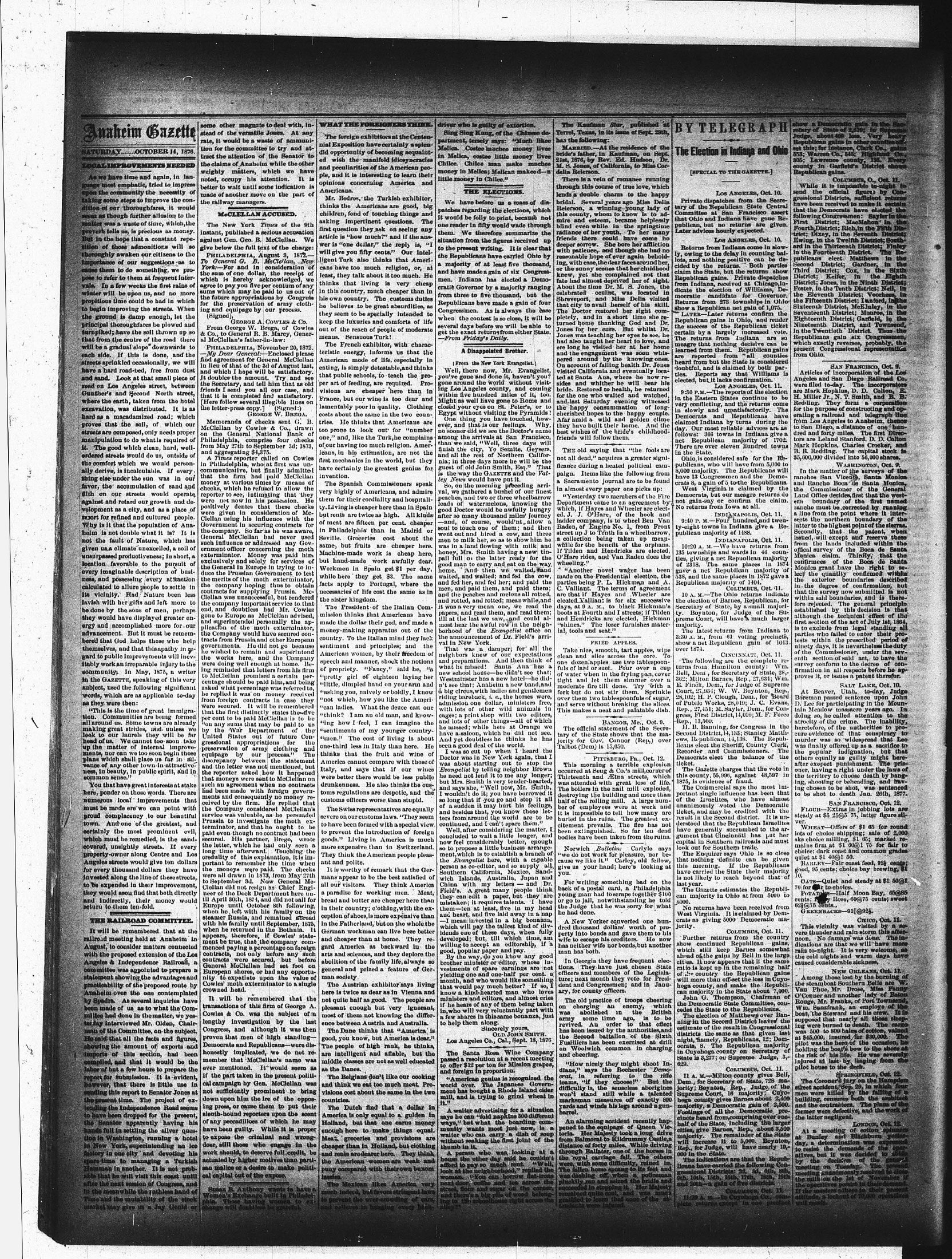
Searchable text
Anaheim Gazette
SATURDAY...OCTOBER 14, 1876.
LOCAL IMPROVEMENTS NEEDED
As we have time and again, in language most emphatic, tried to impress upon the community the necessity of taking some steps to improve the condition of our thoroughfares, it would seem as though further allusion to the matter was a waste of time, which, the proverb tells us, is precious as money. But in the hope that a constant repetition of those admonitions will so thoroughly awaken our citizens to the importance of our suggestions as to cause them to do something, we propose to refer to them at frequent intervals. In a few weeks the first rains of winter will be upon us, and no more propitious time could be had in which to begin improving the streets. When the ground is damp enough, let the principal thoroughfares be plowed and turnpiked; have the soil thrown up so that from the centre of the road there will be a gradual slope downwards to each side. If this is done, and the streets sprinkled occasionally, we will have a hard road-bed, free from dust and sand. Look at that small piece of road on Los Angeles street, between Gunther's and Second North street, where the earth, taken from the hotel excavation, was distributed. It is as hard as a macadamized road; which proves that the soil, of which our streets are composed, only needs proper manipulation to do what is required of it. The good which clean, hard, well-ordered streets would do us, outside of the comfort which we would personify.
some other magnate to deal with, instead of the versatile Jones. At any rate, it would be a waste of ammunition for the committee to try and attract the attention of the Senator to the claims of Anaheim while the other weighty matters, which we have noted, occupy his attention. It is better to wait until some indication is made of another move on the part of the railway managers.
McCLELLAN ACCUSED.
The New York Times of the 9th instant, published a serious accusation against Gen. Geo. B. McClellan. We give below the full text of the charge:
PHILADELPHIA, August 3, 1872—To General G. B. McClellan, New York:—For and in consideration of the sum of one dollar, the receipt of which is hereby acknowledged, we agree to pay you five per centum of any sums which may be paid to us out of the future appropriations by Congress for the preservation of army clothing and equipage by our process.
(Signed),
GEORGE A. COWLES & Co.
From George W. Brega, of Cowles & Co., to General R. B. Marcy, General McClellan's father-in-law:
PHILADELPHIA, November 20, 1872.
—My Dear General:—Enclosed please find agreement for General McClellan in lieu of that of the 3d of August last, and which I hope will be satisfactory. It doubles the amount. Try and see the Secretary, and tell him that as old friends I send you all our case, and that it is completed and satisfactory.
[Here follow several illegible lines on the letter-press copy.] (Signed):
GEORGE W. BREGA.
Memoranda of checks sent G. B. McClellan by Cowles & Co., drawn on the General National Bank of Philadelphia, comprise four checks from May 27th to September 3d; 1873, and aggregating $4,375.
A Times reporter called on Cowles in Philadelphia, who at first was uncommunicative but finally admitted...
Look at that small piece of road on Los Angeles street, between Gunther's and Second North street, where the earth, taken from the hotel excavation, was distributed. It is as hard as a macadamized road; which proves that the soil, of which our streets are composed, only needs proper manipulation to do what is required of it. The good which clean, hard, well-ordered streets would do us, outside of the comfort which we would personally derive, is incalculable. If everything else under the sun was in our favor, the accumulation of sand and flth on our streets would operate against and retard our growth and development as a city, and as a place of report for refined and cultured people.
Why is it that the population of Anaheim is not double what it is? It is not the fault of Nature, which has given us a climate unexcelled, a soil of unsurpassed productiveness; in short, a location favorable to the pursuit of every imaginable description of business, and possessing every attraction calculated to allure people to settle in its vicinity. Had Nature been less lavish with her gifts and left more to be done by the sons of men, perhaps they would have displayed greater energy and accomplished more for our advancement. But it must be remembered that God helps those who help themselves, and that this apathy in regard to public improvements will inevitably work an irreparable injury to the community. In May, 1875, a writer in the GAZETTE, speaking of this very subject, used the following significant words, which are as applicable to-day as they were then:
"This is the time of great immigration. Communities are being formed all around us. Some towns are already making great strides, and unless we look to our laurels they will be far head of us. We cannot too soon take up the matter of internal improvements, nor can we too soon begin those plans which shall place us far in advance of any other town in attractiveness, in beauty, in public spirit, and in common sense."
You that have great interests at stake here, ponder on those words. There are numerous local improvements that must be made ere we can point with proud complacency to our beautiful town. And one of the greatest, and certainly the most prominent evil, which must be remedied, is the sand-covered, unsightly streets. If every property-owner along Centre and Los Angeles streets would give ten dollars for every thousand dollars they have invested along the line of these streets, to be expended in their improvement,
Memoranda of checks sent G. B. McClellan by Cowles & Co., drawn on the General National Bank of Philadelphia, comprise four checks from May 27th to September 3d; 1873, and aggregating $4,375.
A Times reporter called on Cowles in Philadelphia, who at first was uncommunicative, but finally admitted that the firm had paid McClellan money at various times by means of checks, which he refused to allow the reporter to see, intimating that they were not now in his possession. He positively denies that these checks were given in consideration of McClellan using his influence with the Government in securing contracts for the company. So far as he was aware, General McClellan had never used such influence or addressed any Government officer concerning the moth exterminator. Money was paid him exclusively and solely for services of the General in Europe in trying to induce the Prussian Government to test the merits of the moth exterminator, the company hoping thus to obtain contracts for supplying Prussia. McClellan was unsuccessful, but rendered the company important service to that end, and doubtless had Mr. Cowles gone to Europe as McClellan advised, and superintended personally the application of the moth exterminator, the Company would have secured contracts from Prussia and other European governments. He did not go because he wished to remain and superintend the works here, and the Company were doing well enough at home. Being reminded that letters from his firm to McClellan promised a certain percentage should be paid him, and being asked what percentage was referred to, he replied it was on money received from foreign contracts in case they were secured. It will be remembered that the first distinctly states the five per cent to be paid McClellan is to be "on any sums that may be paid to us by the War Department of the United States out of future Congressional appropriations for the preservation of army clothing and equipage by our process." The discrepancy between the statement and the letter was not mentioned, but the reporter asked how it happened that moneys were sent to McClellan on such an agreement when no contracts had been made with foreign governments and consequently no money received by the firm. He replied that the Company considered McClellan's service was valuable, as he persuaded Prussia to investigate the moth exterminator, and that he ought to be paid even though no contract had been secured. His partner, Brego, wrote the letter, which he had only seen a long time afterward. Touching the credulity of this explanation, it is important to remember the time when the moneys were paid. The checks were all drawn in 1873, from May 27th to September 3d. Now General McClellan did not resign as Chief Engl.
GEORGE W. BREGA.
American speech and propriety "pretty girl little dimp asking you not which can ladies think? I am ing how I sentiments men." The one-third leans thins America can Italy, and were better drunkenness toms regular customs offi
The Swiss severe on our to have been prevent goods." Live more expense They think ant and polite It is worth man appeals all our visit
THE RAILROAD COMMITTEE.
It will be remembered that at the railroad meeting held at Anaheim in August, to consider matters connected with the proposed extension of the Los Angeles & Independence Railroad, a committee was appointed to prepare a statement showing the advantages and practicability of the proposed route by Anaheim over the one contemplated by Squadra. As several inquiries have been made of us as to what the Committee had done in the matter, we yesterday interviewed Mr. Olden, Chairman of the Committee, on the subject. He said that all the facts and figures, showing the amount of exports and imports of this section, had been compiled, and that it would be the labor of but a few hours to prepare the report for submission. It is evident, however, that there is little use in sending this report to Senator Jones at the present time. The project of extending the Independence Road seems to have been dropped for the present, the Senator apparently having his hands full in settling the silver question in Washington, running an ice factory in one city and devoting his spare time to managing a Turkish Hamman in another. It is not probable that he will visit this coast until after the next session of Congress, and in the meanwhile the ruthless hand of Time and the mutability of the stock market may give us a Jay Gould or
It will be remembered that the transactions of this firm of George A. Cowles & Co. was the subject of a lengthy investigation by the last Congress, and although it was then proven that men of high standing—Democrats and Republicans—were dishonestly implicated, we do not remember that McClellan's name was ever mentioned. It would seem as if the part taken in the present political campaign by Gen. McClellan was not sufficiently prominent to bring down upon him the lure of the opposing press, or cause them to put their aleuth-hound reporters upon the scent of any peccadilloes of which he may have been guilty. While it is proper to expose the criminal and wrongdoer, still those who engage in the work should, to deserve full credit, be actuated by higher motives than partisan malice or a desire to make political capital out of the exposé.
Susan B. Anthony wants to have a Women's Exchange built in Philadelphia. Those having women to exchange will doubtless be grateful.
WHAT THE FOREIGNERS THINK.
The foreign exhibitors at the Centennial Exposition have certainly a splendid opportunity of becoming acquainted with the manifold idiosyncracies and peculiarities of the American people, and it is interesting to learn their opinions concerning America and Americans.
Mr. Bedros, the Turkish exhibitor, thinks the Americans are good, big children, fond of touching things and asking impertinent questions. The first question they ask on seeing any article is "how much?" and if the answer is "one dollar," the reply is, "I will give you fifty cents." Our intelligent Turk also thinks that Americans have too much religion, or, at least, they talk about it too much. He thinks that living is very cheap in this country, much cheaper than in his own country. The customs duties he believes to be great absurdities, as they seem to be specially intended to keep the luxuries and comforts of life out of the reach of people of moderate means. Sensuous Turk!
The French exhibitor, with characteristic energy, informs us that the American mode of life, especially in eating, is simply detestable, and thinks that public schools, to teach the proper art of feeding, are required. Provisions are cheaper here than in France, but our wine is too dear and lamentably poor in quality. Clothing costs about the same in the two countries. He thinks that Americans are too prone to look out for "number one," and, like the Turk, he complains of our having too much religion. Americans, in his estimation, are not the first mechanics in the world, but they have certainly the greatest genius for driver who is guilty of extortion.
Sing Sing Kung, of the Chinese department, tenely says: "Much like Melica. Costee machee money lives in Melica, costee little money lives Chilee. Chilee man make muchee money in Melica; Melican makeed—n little money in Chilee."
THE ELECTIONS.
We have before us a mass of dispatches regarding the elections, which it would be folly to print, because not one reader in fifty would wade through them. We therefore summarize the situation from the figures received up to the present writing. It is clear that the Republicans have carried Ohio by a majority of at least five thousand, and have made a gain of six Congressmen. Indiana has elected a Democrat Governor by a majority ranging from three to five thousand, but the Republicans have made a gain of four Congressmen. As is always the case when the contest is so close, it will be several days before we will be able to get the exact returns from either State.
From Friday's Daily.
A Disappointed Brother.
[From the New York Evangelist.]
Well, there now, Mr. Evangelist, you've gone and done it, haven't you? gone around the world without visiting Los Angeles county, and coming within five hundred miles of it, too. Might as well have gone to Rome and closed your eyes on St. Peter's, or to Egypt without visiting the Pyramids!
One thing you have touched, however, and that is our feelings. Why, no sooner did we see the Doctor's name among the arrivals at San Francisco, than we said, "Well, three days will finish the city, Yo Semite, Geyserers, and all the rest of Northern California; in three days more he will be the guest of old John Smith, Esq." That
The Kaufman Star, published at Turrel, Texas, in its issue of Sept. 29th, has the following:
MARRIED...At the residence of the bride's father, In Kaufman, on Sept. 21st, 1876, by Rev. Ed. Hudson, Dr. M. S. Jones, of California, to Miss Cordella Reilerson.
There is a vein of romance running through this course of true love, which lends a double charm to the happy bridal. Several years ago Miss Della Reilerson, a winning young lady of this county, whom to know is to admire and esteem, became helplessly blind even while in the springtime radiance of her youth. To her many friends there could have come no deeper sorrow. She bore her affliction with patience, and though she had no reasonable hope of ever again beholding, with ease,the dear faces around her, or the sunny scenes that her childhood knew, yet she complained not that fate had almost deprived her of sight. About the time Dr. M. S. Jones, the celebrated oculist, was located in Shreveport, and Miss Della visited that city to avail herself of his skill. The Doctor restored her sight completely, and in a short time she returned home thanking God and Dr. Jones for her cure. But whilst Dr. Jones was teaching her eyes to see, he had also taught her heart to love,and ere long he visited her at her home and the engagement was soon whispered around by the knowing ones.
On account of failing health Dr. Jones visited California and eventually located at Santa Ana, where he now resides and whither he will bear his bride. Restored to health, he returned for the one who waited and watched,and last Saturday evening witnessed the happy consummation of long-cherished hopes to the happy couple.Afar amid a wild and golden clime they have built their home. And the best wishes of the bride's childhood-friends will follow them.
The old saying that "the fools are not all dead," acquires a greater significance during a heated political cam-
on Cowles first was un- admitted McClellan means of allow the that theycession. He these checks union of Mclellan with the contracts for moth was aware, never used any Gov't the moth is paid him services of worrying to inment to test terminator, to obtain Russia. McClerain rendered service to that Mr. Cowles man advised, fully the ap-trainerator, secured con-fer European go because superintend Company home. Be-der from his firm certain pern, and being referred to, they received case they remembered dates the five than is to be paid to us of the future Con-ference for the nothing and excess." The statement mentioned, but it happened McClellan on no contractsign government money re-replied that McClellan's no persuaded the moth ex-ought to be act had been rego, wrote only seen a touching theion, it is im- time when The checks from May 27th General McChief Engl-
It is worthy of remark that the Germans appear to be the best satisfied of all our visitors. They think America that public schools, to teach the proper art of feeding, are required. Provisions are cheaper here than in France, but our wine is too dear and lamentably poor in quality. Clothing costs about the same in the two countries. He thinks that Americans are too prone to look out for "number one," and like the Turk, he complains of our having too much religion. Americans, in his estimation, are not the first mechanics in the world, but they have certainly the greatest genius for invention.
The Spanish Commissioners speak very highly of Americans, and admire them for their cordiality and hospitality. Living is cheaper here than in Spain but rents are twice as high. All kinds of meat are fifteen per cent. cheaper in Philadelphia than in Madrid or Seville. Groceries cost about the same, but fruits are cheaper here. Machine-made work is cheap here, but hand-made work awfully dear. Workmen in Spain get $1 per day, while here they get $3. The same facts apply to Portugal, where the necessaries of life cost the same as in the sister kingdom.
The President of the Italian Commission thinks that Americans have made the dollar their god, and made a money-making apparatus out of the country. To the Italian mind they lack sentiment and principles; and the American women, by their freedom of speech and manner, shock the notions of propriety. "Fancy," said he, "a pretty girl of eighteen laying her little, dimpled hand on your arm and asking you, naively or boldly, I know not which, how you like the Ameri-can ladies. What the deuce can one think? I am an old man, and know-ing how I feel, I can imagine the 'sentiments of my younger countrymen.' The cost of living is about one-third less in Italy than here. He thinks that the fruit and wine of America cannot compare with those of Italy, and says that if our wines were better there would be less public drunkenness. He also thinks the customs regulations are despotic, and the customs officers worse than stupid.
The Swiss representatives are equally severe on our customs laws. "They seem to have been formed with a special view to prevent the introduction of foreign goods." Living in America is much more expensive than in Switzerland. They think the American people pleasant and polite.
It is worthy of remark that the Germans appear to be the best satisfied of all our visitors. They think America well, there now. Mr. Evangelist you've gone and done it, haven't you? gone around the world without visiting Los Angeles county, and coming within five hundred miles of it, too. Might as well have gone to Rome and closed your eyes on St. Peter's, or to Egypt without visiting the Pyramids! One thing you have touched, however, and that is our feelings. Why, no sooner did we see the Doctor's name among the arrivals at San Francisco, than we said, "Well, three days will finish the city, Yo Semite, Geysers, and all the rest of Northern California; in three days more he will be the guest of old John Smith, Esq." That is the way the GAZETTE and the Valley News would have put it.
So, on the morning preceding arrival, we gathered a bushel of our finest peaches, and two or three wheelbarrow loads of watermelons knowing the good Doctor would be awfully hungry after so many thousand miles' journey—and of course, wouldn't allow a soul to touch one of them; and then went out and hired a cow, and three men to milk her, so as to show him he was in a land flowing with milk and honey. Mrs. Smith having a new tin-pail full on the latter ready for the good man to carry and eat on the way home. And then we waited, and waited; and waited; and fed the cow, and fed her, and fed her; and paid the men, and paid them, and paid them; and the peaches and melons all rotted, and rotted, and rotted; meanwhile,and it was a very mean one, we read the papers, and read them, and read them; till at last we saw, and could almost hear the awful row in the neighborhood of the Evangelist office on the announcement of Dr. Field's arrival in New York.
That was a damper; for all neighbors knew of our expectations and preparations. And then think of what he missed! Santa Ana has a new school house—he didn't see that; Westminster has a new hotel—he didn't see that; Annaheim a new band,and a big circus,with ladies and gentlemen riding bareback,i.e.,the horses were admission one dollar,minders free with lots of other wild animals in cages,a print shop with two editors,and lots of other things—all of which he missed; while here at Orange we have a saloon,which he did not see.And yet doubtless he thinks he has seen a good deal of the world.
I was so cut up when I heard the Doctor was in New York again,that I was about starting out to stop the Evangelist by telling neighbor Brown he need not lend it to me any longer;but Mrs. Smith is very tender-hearted,and says she,"Well now,Mr. Smith.I wouldn't do it;you have borrowed it so long that if you go and stop it all of a sudden it may hurt his feelings,and besides that,you know those letters from around the world are to be continued,and I can't spare them."
Well, after considering the matter,I concluded to wait a little longer,and now feel considerably better,eough so to propose a little business arrangement,theis to establish a branch of the Evangelist here,以a capable person as co-editor,and so supply all,Southern California,Mexico,Sandwich Islands,AustraliaJapanChina with my letters—and Dr.
Well, there now.Mr. Evangelist you've gone and done it,haven't you? gone around the world without visiting Los Angeles county,and coming within five hundred miles of it.too.Might as well have gone to Rome and closed your eyes on St.Peter's,或to Egypt without visiting the Pyramids! One thing you have touched,however,and that is our feelings.Why,no sooner did we see the Doctor's name among the arrivals at San Francisco,than we said,"Well,三天days will finish the city,Yo Semite,Geysers,and all the rest of Northern California;在three days more he will be the guest of old John Smith,Esq."That is the way the GAZETTE and the Valley News would have put it.
So.on the morning preceding arrival,we gathered a bushel of our finest peaches,and two or three wheelbarrow loads of watermelons knowing the good Doctor would be awfully hungry after so many thousand miles' journey—and of course,wouldn't allow a soul to touch one of them;and then went out and hired a cow,and three men to milk her,sо as to show him he was in a land flowing with milk和 honey.Mrs.Smith having a new tin-pail full on the latter ready for the good man to carry and eat on the way.home.And then we waited,and waited;and waited;and fed the cow,and fed her,and fed her;and paidthe men,and paid them,and paid them;and the peaches and melons all rotted,and rotted,and rotted;meanwhile,and it was a very mean one,we read the papers,and read them,and read them;till at last we saw,and could almost hear the awful row in the neighborhood of the Evangelist office on the announcement of Dr.Field's arrival in New York.
That was a damper;for allthe neighbors knew of our expectations and preparations.And then think of what he missed! Santa Ana has a new school house—he didn't see that;Westminster has a new hotel—he didn't see that;Annaheim a new band,and a big circus,vith ladies and gentlemen riding bareback,i.e.,the horses were admission one dollar,minders free with lots of other wild animals in cages,a print shop with two editors,and lots of other things—all of which he missed;while here at Orange we have a saloon,which he did not see.And yet doubtless he thinks he has seen a good deal of the world.
I was so cut up when I heard the Doctor was in New York again,那我 about starting out to stop the Evangelist by telling neighbor Brown he need not lend it to me any longer;but Mrs. Smith is very tender-hearted,and says she,"Well now,Mr. Smith.I wouldn't do it;you have borrowed it so long that if you go and stop it all of a sudden it may hurt his feelings,and besides that,you know those letters from around the world are to be continued,and I can't spare them."
Well,after considering the matter,我 concluded to wait a little longer,and now feel considerably better,eough so to propose a little business arrangement,theis to establish a branch of the Evangelist here,以a capable person as co-editor,and so supply all,Southern California,Mexico,Sandwich Islands,AustraliaJapanChina with my letters—and Dr.
Well,after considering the matter,我 concluded to wait a little longer,and now feel considerably better,eough so to propose a little business arrangement,theis to establish a branch of the Evangelist here,以a capable person as co-editor,and so supply all,Southern California,Mexico,Sandwich Islands,AustraliaJapanChina with my letters—and Dr.
THE old saying that "the fools are not all dead," acquires a greater significance during a heated political campaign. Items like the following from a Sacramento journal are to be found in almost every paper one pick up:
"Yesterday two members of Fire Department came to an agreement by which,if Hayes and Wheeler are elected.J.J.O'Hare,the hook company,是to wheel Ben Van Raden.of Engine No.1,从 Front street up J To Tenth In a wheelbarrow,a collection being taken up meanwhile for the benefit of the orphans.If Tilden and Hendricks are elected'O'Hare rides,and Van Raden does the wheeling."
"Another novel wager has been made on the Presidential election,the parties being P.L.Hickman and A.C.Valliant.The terms of agreement are that if Hayes and Wheeler are elected Valliant is for six successive days.at 9 A.M.,to black Hickman's boots at Fourth and I streets;if Tilden and Hendricks are elected,Hickman's shines." The loser furnishes material,tools and seat."
FRIED APPLES.
Take nice,smooth,tart apples,wipe clean and slice across the core.To one dozen apples use two tablespoon-fills of lard or suet.Pour over a cup of water when in the frying pan,cover tight and let them simmer over a moderate fire till done.Try with a fork but do not stir them.Sprinkle over them two tablespoonfuls of sugar,and serve without breakingthe slicesThis makes a neat and palatable dish.
BANGOR,Me.,Oct.9.
The official statement of the Secretary of State shows thatthe majority for Gov.Connor (Rep),over Talbot(Dem) is 15,050.
PITTSBURG,Pa.,Oct.12.
This morning a terrible explosion occurred at Seug & Co.'s mill,cornerof Thirteenth and Etna streets,which was attended with great loss of life.The boilers in the nail mill exploded,destroyingthe buildingandmorethan halfofthe rolling mill.A large numberof employees were at workandit impossible to tellhow many are buriedinthe ruins.The greatest excitement prevails.The fire has not been extinguished..So far ten dead bodies have been taken fromthe ruins.
Norwich Bulletin: Carlyle says "we do not work for pleasure,nor because we like it."Carley,fellow,give us your hand;here's looking at you.
For writing something bad on back of a postal card,a Philadelphia
The Swiss representatives are equally severe on our customs laws. "They seem to have been formed with a special view to prevent the introduction of foreign goods." Living in America is much more expensive than in Switzerland. They think the American people pleasant and polite.
It is worthy of remark that the Germans appear to be the best satisfied of all our visitors. They think America a paradise for working men. Meat, bread and butter are cheaper here than in their country; clothing, with the exception of shoes, is more expensive than in the Fatherland, but on the whole the German workman can live here better and cheaper than at home. They regard America as backward in the arts and sciences, and they deplore the abolition of the family life, always so general and prized a feature of German society.
The Austrian exhibitor says living here is twice as dear as in Vienna and not quite half as good. The people are pleasant enough but very ignorant, most of them not knowing the difference between Austria and Australia.
The Dane thinks that "America is good, you know, but America is dear." The people of high rank, he thinks, are intelligent and affable, but the middle classes are not as well educated as the Danes.
The Belgians don't like our cooking and think we eat too much meat. Provisions cost about the same in the two countries.
The Dutch find that a dollar in America is only equal to a gulden in Holland, but that one earns money enough here to make things equal. Meats, groceries and provisions are cheaper than in Holland, but clothing and rents are dearer here. They think the American women are weak and puny compared with their own buxom ladies.
The Mexican likes America very much indeed, but favors stringent laws to prevent the over-crowding of care and believes in hanging every backyard.
I wouldn't do it; you have borrowed it so long that if you go and stop it all of a sudden it may hurt his feelings, and besides that, you know those letters from around the world are to be continued, and I can't spare them."
Well, after considering the matter, I concluded to wait a little longer, and now feel considerably better, enough so to propose a little business arrangement, which is to establish a branch of the Evangelist here, with a capable person as co-editor, and so supply all Southern California, Mexico, Sandwich Islands, Australia, Japan and China with my letters — and Dr. Field's. A great many people think they can edit a paper, but they are mistaken; it requires talents. I have them—ten at least, five in my head and heart, and five laid away in a nap—I mean invested in a big bonanza, which will pay the tallest kind of dividends one of these days, when fully developed; but, till which time, am willing to accept an editorship, if a good, popular paper and pay.
By the way, do you know any good brother minister or editor, whose investments of spare earnings are not yielding one and one-half per cent. a month, and who would like something that would pay much better? If so, I know a kind-hearted man who loves ministers and editors, and almost cries if he hears of any of them being taken in, who will very reluctantly part with a few shares in this same bonanza, just to help them along.
Sincerely yours,
OLD JOHN SMITH.
Los Angeles Co., Cal., Sept. 18, 1876
The Santa Rosa Wine Company passed a resolution at a recent meeting to offer $12 per ton for Mission grapes, and foreign in proportion.
"American genius is recognized the world over. The Japanese Government has bought a Rhode Island elder mill, and is trying to grind wheat in it."
A waiter advertising for a situation says he can "fold napkins 800 different ways," but what the boarding community wants most just now, is a waiter who can carry a dish of soup without soaking the first joint of the thumb in it.
A person who was looking at a house the other day said he couldn't afford to pay so much rent. "Well, look at the neighborhood," replied the woman. "You can borrow flat-rises next door, coffee and tea across the street, flowers and sugar on the corner, and there's a big pile of wood belonging to the schoolhouse right across the alley."
An alarming accident recently happened to the equipage of Queen Victoria. Her Majesty took a long drive from Balmoral to Kildrummy Castle, a distance of forty miles. While driving through Ballater, one of the horses in the royal carriage fell. The others were with some difficulty, reined in. The fallen horse sprang to its feet and was dashing off when a policeman pluckily ran and seized the bridle and succeeded in stopping it. Her Majesty remained quite cool, and was much gratified to learn that some of the animals were injured.
BY TELEGRAPH
The Election in Indiana and Ohio
[SPECIAL TO THE GAZETTE.]
LOS ANGELES, Oct. 10.
Private dispatches from the Secretary of the Republican State Central Committee at San Francisco assert that Ohio and Indiana have gone Republican, but no returns are given. Later advisers hourly expected.
LOS ANGELES, Oct. 10.
Returns from Indiana come in slowly, owing to the delay in counting ballots, and nothing positive can be decided by the returns. Both parties claim the State, but the returns show Republican gains. Private dispatches from Indiana, received at Chicago, indicate the election of Williams, Democratic candidate for Governor. Returns from 273 townships in Ohio show a Republican net gain of 1,075.
LATER—Later returns confirm the Republican gains in Ohio, and render the success of the Republican ticket certain by a largely increased vote. The returns from Indiana are so meagre that nothing decisive can be learned from them. Republican gains are reported from all counties heard from but the State is considered doubtful, and is claimed by both parties. Reports say that Williams is elected, but it lacks confirmation.
LOS ANGELES, Oct. 11.
9:30 P.M.—The reports of the election in the Eastern States continue to be very conflicting, and the returns come in slowly and unsatisfactorily. The Democrats and Republicans have claimed Indiana by turns during the day. Our most reliable advices are as follows: 346 towns in Indiana give a net Republican majority of 1702. There are over eleven hundred towns in the State.
Ohio is considered safe for the Republicans, who will have from 5,000 to 8,000 members.
COLUMBUS, O., Oct. 11.
While it is impossible to night to send the official figure by Congressional Districts, sufficient returns have been received to make it certain that the Democrats have elected the following Congressmen: Sayler in the First District; MacMahon in the Fourth District; Rich in the Fifth District; Dixey, in the Seventh District; Ewing, in the Twelfth District; Southard in the Thirteenth District; Finley in the Fourteenth District. The Republicans elect Matthews in the Second District; Gardner, in the Third District; Cox, in the Sixth District; Keifer, in the Eighth District; Jones, in the Ninth District; Foster, in the Tenth District; Neil, in the Eleventh District; Voorhees, in the Fifteenth District; Ianford, in the Sixteenth District; McKinley, in the Seventeenth District; Monroe, in the Eighteenth District; Garfield, in the Nineteenth District, and Townsend, in the Twentieth District. Thus the Republicans gain six Congressmen, which exactly reverses, probably, the present Congressional representation from Ohio.
SAN FRANCISCO, Oct. 9.
Articles of incorporation of the Los Angeles and San Diego Railroad Co. were filed to-day. The incorporators are Mark Hopkins, D. D. Colton, E. H. Miller Jr., N. T. Smith, and R. B. Redling. They form a corporation for the purpose of constructing and operating a railroad and telegraph line from Los Angeles to Anaheim, then to San Diego, a distance of one hundred and forty miles. The first Directors are Leland Stanford, D. D. Colton Mark Hopkins, Charles Crocker, and B. B. Redling. The capital stock is $5,600,000 divided into 56,000 shares.
WASHINGTON, Oct. 9.
Reports say that Williams is elected, but it lacks confirmation.
Los Angeles, Oct. 11.
9:30 P.M.—The reports of the election in the Eastern States continue to be very conflicting, and the returns come in slowly and unsatisfactorily. The Democrats and Republicans have claimed Indiana by turns during the day. Our most reliable advices are as follows: 346 towns in Indiana give a net Republican majority of 1702. There are over eleven hundred towns in the State.
Ohio is considered safe for the Republicans, who will have from 5,000 to 8,000 majority. The Republicans will have 13 Congressmen and the Democrats 8, a gain of 5 to the Republicans.
West Virginia is claimed by the Democrats, but our meagre returns do not gain-say or confirm the claim. No returns from Iowa at all.
Indianapolis, Oct. 11.
9:40 P.M.—Four hundred and twenty-eight towns in Indiana give a Republican majority of 1488.
Indianaapolis, Oct. 11.
10:20 A.M.—We have returns from 135 townships and wards in 46 counties, giving a net Republican majority of 2318. The same places in 1874 gave a net Republican majority of 538, and the same places in 1872 gave a Republican majority of 1404.
Columbus, Oct. 11.
10 A.M.—The Ohio returns indicate the election of Barnes, Republican, for Secretary of State, by a small majority. Boynton, for Judge of the Supreme Court, will have a much larger majority.
The latest returns from Indiana to 3:30 A.M., from 61 voting precincts, show a net Republican gain of 1043 over 1874.
Cincinnati, Oct. 11.
The following are the complete returns from Hamilton county: Wm. Bell, Dem., for Secretary of State, 28-362; Milton Barnes, Rep., 27,034; Wm. E. Finck, Dem., for Judge of Supreme Court, 27,934; W. W. Boynton, Rep., 28,102; H. P. Clough, Dem., for Board of Public Works, 28,019; J. C. Evans, Rep., 27,451; M. Saylor, Dem., for Congress, First District, 14,099; M. F. Force Rep., 13,500;
H. B. Banning, for Congress in the Second District, 14,133; Stanley Matthews, Republican, 14,138. The Republicans elect the Sheriff, County Clerk, Recorder and Commissioners. The Democrats elect the balance of the ticket.
The Gazette charges that the vote in this county, 55,996, against 48,597 in 1875, is evidence of fraud.
The Commercial says the most important single influence has been that of the Israelites, who have almost unanimously voted the Democratic ticket, and may be credited with the result in the Second district. It is understood that the Republican Israelites have generally succumbed to the argument that Cincinnati has put her capital in Southern railroads and must look out for Southern trade.
The Enquirer says Ohio is so close that nothing definite can be given this morning. If the Republicans have carried the State their majority is not likely to reach beyond that of last year.
Articles of Incorporation of the Los Angeles and San Diego Railroad Co. were filed to-day. The incorporators are Mark Hopkins, D. D. Colton, E. H. Miller Jr., N. T. Smith, and R. B. Redding. They form a corporation for the purpose of constructing and operating a railroad and telegraph line from Los Angeles to Anaheim, then to San Diego, a distance of one hundred and forty miles. The first Directors are Leland Stanford, D. D. Colton Mark Hopkins, Charles Crocker, and B. B. Redding. The capital stock is $5,600,000 divided into 56,000 shares.
WASHINGTON, Oct. 9.
In the matter of the surveys of the ranchos San Vicente, Santa Monica and Rancho Boca de Santa Monica, the Commissioner of the General Land Office decides first that the western boundary of the first named rancho must be corrected by running a line from the point where it intersects the northern boundary of the latter to the highest point of the Sierra Secondly, that the patent when issued will except and reserve these from the lands included within the official survey of the Boca de Santa Monica claim. Thinly; that the confirmees of the Boca de Santa Monica grant have the right to select the quantity confirmed within the exterior boundaries described in the degree of confirmation, but that the survey now submitted is not within said boundaries, and is therefore rejected. The general principle established by this decision is that although the technical effect of the first section of the act of July 1st, 1864, is to exclude from legal standing all parties who failed to enter their protests within the prescribed period of ninety days, it is nevertheless the duty of the Commissioner, under the seventh section of said act, to have the survey conform to the decree of confirmation in all respects before he approves it, or issues a patent therefor.
SALT LAKE, Oct. 10.
At Beaver, Utah, to-day, Judge Boreman passed sentence upon John D. Lee for participating in the Mountain Meadow massacre years ago. In doing so, he called attention to the atrocity of the crime. The inability, heretofore, of the authorities to procure evidence of that conspiracy to murder was so widespread that Lee was finally offered up as a sacrifice to the popular indignation, but that others equally as guilty might hereafter exact punishment. The prisoner having a right under the laws of the territory to choose death by hanging, shooting or beheadning, and having chosen to be shot was sentenced to be shot to death Jan. 26th, 1877.
SAN FRANCISCO, Oct. 12.
FLOUR—Extras in jobbing lots are steady at $5 25@5 75; latter figure silver.
WHEAT—Offers of $1 65 for round lots of choice shipping; sale of 2,000 skis choice milling; $1 65; market remains firm at $1 60@1 75 for fair to choice; dark coast and common grades quiet at $1 40@1 50.
BARLEY—Fair coast feed; 92 cents; good; 95 cents; choice bay brewing; $1 10.
OATS—Quilt and steady at $1 50@1 70 for choice.
Bulletin: Carlyle says work for pleasure, nor be it.” Carley, old fellow, hand; here’s looking at something bad on the vital card, a Philadelphia lead to scrape together $100 notwithstanding he told that he was sorry for what marker converted one hundred dollars’ worth of proceeds and gave them to his life nor bonds, but another.
They have frequent elec- have just chosen State members of the Legislature they vote for Preal-gressmen; and in Janu-uary officers.
Practice of troops cheering an enemy, which ended in the British time ago, is to be ordered to that effect by the authorities, and battallion of the Sixth has been exercised at drill with common in charging.
Only they might shoot In- the Rochester Demo- referring to the rifle they choose?” But the senseless aborigines still while a talented measures off exactly 800 bands his legs around a gun-
ing accident recently hap-equipage of Queen Victoria took a long drive to Kildrummy Castle, a forty miles. While driving later, one of the horses in marriage fell. The others some difficulty, reined in, horse sprang to its feet and off, when a policeman and seized the bridle and stopping it. Her Majesty this cool, and was much learn that some of the men injured.
Columbus, Oct. 11.
Further returns from the country show continued Republican gains, which still keep Barues somewhat ahead of the gains by Bell in the large cities. It now appears that if the same ratio is kept up in the remaining half of the country the Republican gains will more than offset the loss in Cuyohoga county, and make the Republican majority in the State about 7,000.
John G. Thompson, Chairman of the Democratic State Committee, concedes the State to the Republicans.
The election of Matthews over Banning in the Second District leaves the estimate of the result in Congressional districts the same as that given last night, namely, Republicans, 12; Democrates, 8. The Republican majority in Cuyohoga county on Secretary of State is 3,277; on Supreme Judge, 3,-629.
Columbus, Oct. 11.
11 A. M.—Milton county gives Bell, Dem., for Secretary of State, 728 majority; Boynton, Rep., Judge of the Supreme Court, 16 majority; Cuyohoga county gives Barnes about 2,400 majority, a Democratic gain of 2,500. Footings of all the Democratic precincts heard from, comprising over one-half of the State, including the larger cities, give Barnes, Rep., about 3,500 majority. The remainder of the State will increase it to 5,000. Boynton, Rep., for Judge, will have nearly 10,-000 in the State.
The indications are that the Republicans have carried the following Congressional Districts: 2d, 3d, 6th, 8th, 9th, 10th, 15th, 16th, 17th, 18th, 19th and 20th—a gain of five districts.
Columbus, Oct. 11.
11:20 A. M.—In Cuyohoga Co., complete returns except in one precinct to be shot to death Jan. 26th, 1877.
SAN FRANCISCO, Oct. 12.
FLOUR—Extras in jobbing lots are steady at $5 25@5 75, latter figure silver.
WHEAT—Offers of $1 65 for round lots of choice shipping; sale of 2,000 skis choice milling; $1 65; market remains firm at $1 60@1 75 for fair to choice; dark coast and common grades quiet at $1 40@1 50.
BARLEY—Fair coast feed, 92½ cents; good, 95 cents; choice bay brewing, $1 10.
OATS—Quiet and steady at $1 50@1 70 for ear to choice.
POTATOES—Half Moon Bay, 65@85 cents; Perry Rose, 60@75 cents; sweet 62½@75 cents.
GREENBACKS—91¼@92¾.
CHICO, Oct. 11.
This vicinity was visited by a severe thunder and rain storm this afternoon. No damage was done. The indications are that we will have more rain to-night. It is very welcome, as the cold nights and warm days have caused considerable sickness.
NEW ORLEANS, Oct. 11.
Among those lost by the burning of the steamboat Southern Belle are W. Van Phue, Mr. Drose, Miss Fanny O'Conner and another lady of Baton Rouge, Mr. Franks, of Port Townsend, Wm. Sanzfrank, an employe of the boat, the Steward and his crew. It is supposed that nearly all those sleeping were burned to death. The carne was 500 to 800 bales of cotton, valued at $45,000, insured for $30,000. The pilot was the base of the occasion; he holding the boat’s bow to the shore at the risk of his life. He was severely injured at last by leaping from the pilot house to the deck.
SPRINGFIELD, Oct. 12.
The Coroner’s jury on the Hampden street accident Sep. 29, in which four men were killed by the falling of a building; censures both the architect and the contractors. The plans of the former were defective, and the work of the latter negligent.
LONDON, Oct. 12.
At a meeting of cotton spinners at Banley and Blackburn yesterday, a determination was expressed to resist the demands of the operatives; but it was decided to abide by the decision of the general meeting on Tuesday. The present meeting unanimously resolved to close the million list of November if the operatives persist in their demand. If the masters adhere to their present attitude, a lockout of 70,000 operatives will result.