anaheim-gazette 1876-10-07
Scanned page
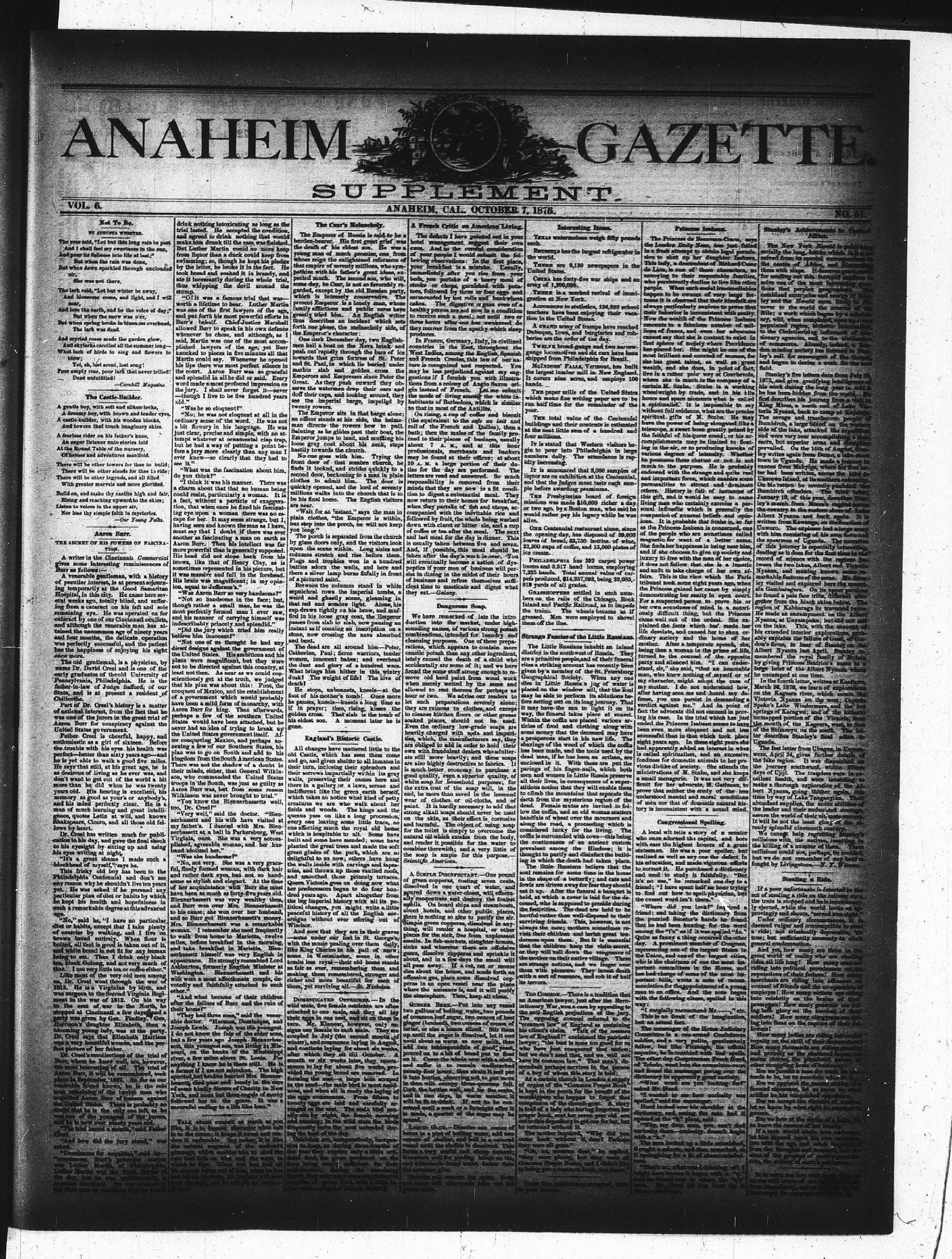
Searchable text
ANAHEIM
VOL. 6.
Not To Be.
BY ANGELA WHISTLER.
The rose said, "Let but this long rain be past
And I shall feel my sweetness in the sun,
And poor his fullness into life at last;"
But when the rain was done,
But when dawn sparkled through uncloaked air;
She was not there.
The lark said, "Let but winter be away,
And blossoms come, and light, and I will sore,
And lose the earth, and be the voice of day;"
But when the snow was o'er,
But when spring broke in blueness overhead,
The lark was dead.
And myriad roses made the garden glow,
And skylarks carolled all the summer long—
What lack of birds to sing and flowers to blow;
Yet, ah, lost acent, lost song!
Poor empty rose, poor lark that never trilled!
Dead unfailled!
Cornhill Magazine.
The Castle-Builder.
A gentle boy, with soft and silken locks,
A dreamy boy, with brown and tender eyes,
A castle-builder, with his wooden blocks,
And lowers that touch imaginary skies.
A fearless rider on his father's knee,
An eager listener unto stories told
At the Round Table of the nursery,
Of heroes and adventures manifold.
There will be other towers for these to build;
drink nothing intoxicating as long as the trial lasted. He accepted the condition,
and agreed to drink nothing that would make him drank till the case was finished.
But Luther Martin could no more keep from liquor than a duck could keep from swimming; so, though he kept his pledge by the letter, he broke it in the fact. He took bread and soaked it in brandy, and ate it incessantly during the whole trial, thus whipping the devil around the stump.
"Oh! It was a famous trial that was—worth a lifetime to hear. Luther Martin was one of the first lawyers of the age, and put forth his most powerful efforts in Burr's behalf. Chief Justice Marshall allowed Burr to speak in his own defence whenever he chose, and although, as I said, Martin was one of the most accomplished lawyers of the age, yet Burr knocked to pieces in five minutes all that Martin could say. Whenever he opened his lips there was most perfect silence in the court. Aaron Burr was so graceful and splendid in all he did or said. Every word made a most profound impression on the jury. I shall never forget it—never—though I live to be five hundred years old."
"Was he so eloquent?"
"No; he was not eloquent at all in the ordinary sense of the word. He was not a bit flowery in his language. He was just clear, precise and simple, with no attempt whatever at ornamental clap trap, but he had a way of putting a point before a jury more clearly than any man I ever knew—so clearly that they had to see it."
"The Cear's Mistake."
The Emperor of Heaven burden-bearer. His fiesta the death of his elder young man of much joy whose reign the enlightenment that empire of seventy years patinae with his father's pecked much. The see some day, be Cear, is not garded, except by the which is intensely present Emperor is a family afflictions and greatly tried him. A thus describes an incarnation forth one phase, the masters of the Emperor's character.
One dark December men hail a boat on the push out rapidly through towards that grim fort and St. Paul, in which marble slab and ginger Emperors and Empress Great. As they push serve the watermen drove off their caps, and look see the imperial bar twenty rowers.
The Emperor sits in an officer stands at his man directs the rowers Saluting as he glides past Emperor jumps to land loose gray coat about hastily towards the churn No one goes with him front door of that so finds it locked and str
The Castle-Builder.
A gentle boy, with soft and silken locks,
A dreamy boy, with brown and tender eyes,
A castle-builder, with his wooden blocks,
And towers that touch imaginary skies.
A fearless rider on his father's knee,
An eager listener unto stories told
At the Round Table of the nursery,
Of heroes and adventures manifold.
There will be other towers for thee to build;
There will be other steeds for thee to ride;
There will be other legends, and all filled
With greater marvels and more glorified.
Build on, and take thy castles high and fair,
Rising and reaching upward to the skies;
Listen to voices in the upper air,
Nor lose thy simple faith in mysteries.
—Our Young Folks.
Aaron Burr.
THE SECRET OF HIS POWERS OF FASCINATION.
A writer in the Cincinnati Commercial gives some interesting reminiscences of Burr as follows:
A venerable gentleman, with a history of peculiar interest, is at present sojourning temporarily at the Good Samaritan Hospital, in this city. He came here several weeks ago, totally blind, and suffering from a cataract on his left and sole remaining eye. He was operated on for cataract by one of our Cincinnati oculists, and although the vulnerable man has attained the uncommon age of ninety years and four months, the delicate operation was perfectly successful, and the patient has the happiness of enjoying his sight once more.
The old gentleman, is a physician, by name Dr. David Creel and is one of the early graduates of the old University of Pennsylvania, Philadelphia. He is the father-in-law of Judge Safford, of our State, and is at present a resident of Chilicothe.
Part of Dr. Creel's history is a matter of national interest, from the fact that he was one of the jurors in the great trial of Asron Burr for conspiracy against the United States government.
Father Creel is cheerful, happy, and enthusiastic as a girl of sixteen. Before the trouble with his eyes, his health was perfect—better than sixty years ago—and he is yet able to walk a good five miles. He says that still, at his great age, he is as desirous of living as he ever was, and don't want to get out of the world a hit more than he did when he was twenty years old. His hearing is excellent, his memory as good as your's or anybody's, and his mind perfectly clear. He is a man of much learning and great intelligence, quotes Latin at will, and knows Shakespeare, Cicero, and all those old fellows by heart.
Dr. Creel has written much for publication in his day, and gave the final shock to his eyewight by sitting up and using his eyes writing at night.
"It's a great shame I made such a blockhead of myself," says he.
This frisky old boy has been to the Philadelphia Centennial and doesn't see any reason why he shouldn't live ten years yet. He was asked if he would come back to court.
Aaron Burr was so graceful and splendid in all he did or said. Every word made almost profound impression on the jury. I shall never forget it—never though I live to be five hundred years old."
"Was he so eloquent!"
"No; he was not eloquent at all in the ordinary sense of the word. He was not a bit flowery in his language. He was just clear, precise and simple, with no attempt whatever at ornamental clap trap, but he had a way of putting a point before a jury more clearly than any man I ever knew—so clearly that they had to see it."
"What was the fascination about him, do you think!"
"I think it was his manner. There was a charm about that that no human being could resist, particularly a woman. It is a fact, without a particle of exaggeration, that when once he fixed his fascinating eye upon a woman there was no escape for her. It may seem strange, but I having seen and known them as I have must say that I doubt if there was ever another as fascinating a man on earth as Aaron Burr. Then his intellect was far more powerful than is generally supposed. His head did not slope back from his brows, like that of Henry Clay, as is sometimes represented in his picture, but it was massive and full in the forehead. His brain was magnificent; in my opinion, equal to Jefferson's."
"Was Aaron Barr so very handsome!"
"Not so handsome in the face; but, rather than a small man, he was the most perfectly formed man I ever saw, and his manner of carrying himself was indescribably principly and splendid."
"Did the jury which tried him really believe him innocent!"
"Not one of us thought he had any direct designs against the government of the United States. His ambitions and his plans were magnificent, but they were not to be directed against this country, at least not then. As near as we could conscientiously get at the truth, we judged that his plan was about this: First, the conquest of Mexico, and the establishment of a government which would probably have been a mild form of monarchy, with Aaron Burr for king. Then afterwards, perhaps a few of the southern United States would have been attached, but he never had an idea of trying to break up the United States government itself. After conquering Mexico, and perhaps annexing a few of our Southern States, his plan was to go on South and add to his kingdom from the South American States. There was not the shadow of a doubt in their minds, either, that General Wilkinson, who commanded the United States troops in the South, was just as guilty as Aaron Burr was, but from some reason Wilkinson was never brought to trial."
"You know the Blennnerhassett well, too, Dr. Creel!"
"Very well," said the doctor. "Blennnerhassett and his wife have visited at my father's. I danced with Mrs. Blennnerhassett at a ball in Parkersburg, West Virginia, once. She was a very accomplished, agreeable woman, and her husband idolized her."
"Was she handsome!"
"No, not very. She was a very graceful, finely formed woman, with dark hair and rather dark eyes, but not so handsome as stylish and elegant. At the time of her acquaintance with Burr she must be one with her."
His hearing is excellent, his memory as good as your's or anybody's, and his mind perfectly clear. He is a man of much learning and great intelligence, quotes Latin at will, and knows Shakespeare, Cicero, and all those old fellows by heart.
Dr. Creel has written much for publication in his day, and gave the final shock to his eyesight by sitting up and using his eyes writing at night.
"It's a great shame I made such a blockhead of myself," says he.
This frisky old boy has been to the Philadelphia Centennial and don't see any reason why he shouldn't live ten years yet. He was asked if he pursued any particular plan of diet or habits by which he kept his health and hopefulness in such a remarkable degree at this advanced age.
"No," said he, "I have no particular diet or habits, except that I take plenty of exercise by walking, and I live on brown bread entirely. When flour is boiled, all that is good is taken out of it, and while bread is not fit for any human being to eat. Then I drink only black tea, black Golong, and not very much of that. I use very little tea or coffee either."
Like most of the very old men among us, Dr. Creel went through the war of 1812. He is a Virghian by birth, and was surgeon to the Second Virginia Regiment in the war of 1812. On his way to the seat of war in the North, he stopped at Cincinnati a few days and a party was given by Gen. Findlay. Gen. Harrison's daughter Elizabeth, then a blooming young lady, was at the party. Dr. Creel says that Elizabeth Harrison was a very beautiful woman, and the perfect picture of her father.
Dr. Creel's recollections of the trial of Burr, when he knew well, are however, the most interesting of all. The trial of Aaron Burr, it will be remembered, took place in September, 1807. So far as our venerable friend knows, he is the sole man remaining of the twelve men who acquitted Aaron Burr of treason against the United States. There is probably no doubt that he is in the only one left, as he was one of the youngest of the jurors, and he is now over ninety years old.
"The trial lasted a month," said Father Creel.
"And how did the jury stand?" was asked.
"Unanimous for acquittal," said he.
"Unanimous. Burr's principal lawyer was Luther Martin, of Philadelphia. Luther Martin was the head lawyer in the day, but he was unfortunately, in however downfall. He was accused of the murders."
TAXX about consults as much as you like. It is to human character what salt is in the ocean; it keeps it sweet and renders it undurable. Say rather, it is like the natural magnets of the earth's plumage, which enables him to shed the rain that falls on him and the water in which he dries. When one has had all his recent learnings of him, when he has had all his illnesses, his diseases will always be milder and less painful than ever before."
IM GAZ
SUPPLEMENT.
ANAHEIM, CAL., OCTOBER 7, 1876.
The Emperor of Russia is said to be a burden-heavest. His first great grief was the death of his eldest son. He was a young man of much promise, one from whose reign the enlightened reformers of that empire of seventy millions, who sympathize with his father's great ideas, expected much. The second son, who will, some day, be Emperor, is not so favorably regarded, except by the old Russian party, which is intensely conservative. The present Emperor is a lonely man, whose family afflictions and public care have greatly tried him. An English writer thus describes an incident which sets forth one phase, the melancholy side, of the Emperor's character:
One dark December day, two Englishmen hail a boat on the Neva brink and push out rapidly through the bars of ice towards the grim fortress of St. Peter and St. Paul, in which lie buried under marble slab and golden cross the Emperors and Empresses since Peter the Great. As they push onward they observe the watermen drop their cars and doff their caps, and looking around, they see the imperial barge, impelled by twenty rowers.
The Emperor sits in that barge alone; an officer stands at his side, the helmsman directs the rowers how to pull. Saluting as he glides past their boat, the Emperor jumps to land, and muffling his loose gray coat about his neck, steps hastily towards the church.
No one goes with him. Trying the front door of that sombre church, he finds it locked and strides quickly to a
A French Critic on American Living.
The defects I have pointed out in your hotel management suggest their own cure. And to the careful consideration of your people I would submit the following observations: In the first place, your breakfast is a mistake. Usually, immediately after you rise from your beds, you partake of a heavy meal of steaks or chops, garnished with potatoes, followed by three or four eggs and surmounted by hot rolls and buckwheat cakes. The digestive organs even of a healthy person are not now in a condition to receive such a meal; not until two or three hours after one has awakened do they recover from the spathy which sleep produces.
In France, Germany, Italy, in civilized countries in the East, throughout the West Indies, among the English, Spanish and French Creoles, this law of our nature is recognized and respected. You may be less prejudiced against my suggestions if I furnish you with illustrations from a colony of Anglo-Saxon origin instead of French. Let me submit the mode of living among the white inhabitants of Barbados, which is similar to that in most of the Antilles.
On rising, a cup of coffee and biscuit (the equivalent to the cafe au lait) and roll of the French and Italian), then a bath; then the males of the family proceed to their places of business, usually about 7 A.M., and at this hour professionals, merchants and bankers may be found at their offices; at about 10 A.M. a large portion of their duties for the day are performed.
Interesting Items.
Texas watermelons weigh fifty pounds each.
Bremen has the largest refrigerator in the world.
There are 8,130 newspapers in the United States.
Chicago has forty-five war ships and an army of 1,200,000.
There is a marked revival of immigration at New York.
Accomaine to statistics, 126,822 school teachers have been enjoying their vacation in the United States.
A grand army of tramps have reached Dubuque, Iowa, and burglaries and robberies are the order of the day.
Twelve broad-gauge and two narrow-gauge locomotives and six cars have been shipped from Philadelphia for Brazil.
McKinney Falls, Vermont, has built the largest lumber mill in New England. It covers nine acres, and employs 100 hands.
The paper mills of the United States which make fine writing paper are to be run half time for the remainder of the year.
The total value of the Centennial buildings and their contents is estimated at the next little sum of a hundred and four millions.
It is stated that Western visitors begin to pour into Philadelphia in large numbers daily. The attendance is rapidly increasing.
In
The Emperor sits in that barge alone; an officer stands at his side, the helmsman directs the rowers how to pull. Saluting as he glides past their boat, the Emperor jumps to land, and muffling his loose gray coat about his neck, steps hastily towards the church.
No one goes with him. Trying the front door of that sombre church, he finds it locked, and strides quickly to a second door, beckoning to a man in plain clothes to admit him. The door is quickly opened, and the lord of seventy millions walks into the church that is to be his final home. The English visitors are near.
"Wait for an instant," says the man in plain clothes, "the Emperor is within, but step into the porch, he will not keep you long."
The porch is separated from the church by glass doors only, and the visitors look upon the scene within. Long aisles and columns stretch and rise before them. Flags and trophies won in a hundred battles adorn the walls, and here and there a silver lamp burns fitfully in front of a pictured saint.
Between the columns stand in white sepulchral rows the imperial tomba, a weird and ghastly scene, gleaming in that red and sombre light. Alone, his sap drawn tightly on his brow, and muffled in his loose gray coat, the Emperor passes from slab to slab, now pansing an instant as if conning an inscription on a stone, now crossing the nave absorbed and bent.
The dead are all around him—Peter, Catherine, Paul; fierce warriors, tender women, innocent babes; and overhead the dust and glory of a hundred wars. What brings him hither in this wintry dusk! The weight of life! The love of death!
He stops, unbonnets, kneels—at the foot of his mother's tomb! Once more he pauses, kneels—kneels a long time as if in prayer; then rising, kisses the golden cross. That alab is the tomb of his eldest son. A moment later he is gone.
England's Historic Castle.
All changes have mattered little to the old Castle, which has seen them come and go, and given shelter to all inmates in their turn, including their splendors and their sorrows impartially within its gray walls, preserving their names here and there in a gallery or a lawn, serene and indifferent like the green earth herself, which takes no notice what kind of petty creatures we are who walk about her fields and woods. The kings and the queens pass on like a long procession; every one leaving some little trace, no one affecting much the royal old house which is hospitable to all. Some have built and some have mended; some have planted the great trees and made the soft green glades of the park, which are so delightful to us now; others have hung the walls inside with carvings and tapestries, and thrown up those vaulted roofs, and smoothed those princely terraces.
Queen Victoria goes on doing now what her predecessors began to do four hunmaybe less prejudiced against my suggestions if I furnish you with illustrations from a colony of Anglo Saxon origin instead of French. Let me submit the mode of living among the white inhabitants of Barbados, which is similar to that in most of the Antilles.
On rising, a cup of coffee and biscuit (the equivalent to the café an lait) and roll of the French and Italian), then a bath; then the males of the family proceed to their places of business, usually about 7 A.M., and at this hour professionals, merchants and bankers may be found at their offices; at about 10 A.M. a large portion of their duties for the day are performed. The letters are read and answered. So much responsibility is removed from their minds that they are now in a fit condition to digest a substantial meal. They now return to their homes for breakfast, when they partake of fish and chops, accompanied with the inevitable rice and followed by fruit, the whole being washed down with claret or bitter ale, and a cup of coffee or tea after the meal. The next and last meal for the day is dinner. This is usually taken between five and seven. And, if possible, this meal should be taken after the day's work is over. You will eventually become a nation of dyspeptics if your men of business will persist in dining in the midst of their hours of business and refuse themselves sufficient time to masticate and digest what they eat—Galaxy.
Dangerous Soap.
We have remarked of late the introduction into the market, under high-sounding names, of various strong potash combinations, intended for laundry and cleansing purposes. One of these preparations, which appears to contain more cannic potash than any other ingredient, lately caused the death of a child who accidentally ate some of it; and we have found the same stuff strong enough to remove old hard paint from wood work when merely wetted by the same and allowed to rest thereon for perhaps an hour or two. We advise our readers to let such preparations severely alone; they are ruinous to clothes, and except to cleanse kitchen floors or other grease soaked places, should not be used. Even the ordinary low-grade soaps are heavily charged with soda and impurities, which, the manufacturers say, they are obliged to add in order to hold their own with frandulent dealers who adulterate still more heavily; and these soaps are also highly destructive to fabrics. It is much better economy to purchase a good quality, even a superior quality, of white soap for household purposes; for the extra cost of the soap will, in the end, be more than saved in the lessened wear of clothes or oil-cloths, and of paint. It is hardly necessary to add that strong alkali soaps should never be used on the skin, as their effect is corrosive and harmful. The object of using soap for the toilet is simply to overcome the natural oil which exudes from the body, and render it possible for the water to combine therewith; and a very little of the soap is simple for this purpose—Scientific American.
A Simple Disinfectant—One pound of green copperas, costing seven cents, dissolved in one quart of water, may be less prejudiced against my suggestions if I furnish you with illustrations from a colony of Anglo Saxon origin instead of French. Let me submit the mode of living among the white inhabitants of Barbadoes, which is similar to that in most of the Antilles.
On rising, a cup of coffee and biscuit (the equivalent to the café an lait) and roll of the French and Italian), then a bath; then the males of the family proceed to their places of business, usually about 7 A.M., and at this hour professionals, merchants and bankers may be found at their offices; at about 10 A.M. a large portion of their duties for the day are performed. The letters are read and answered. So much responsibility is removed from their minds that they are now in a fit condition to digest a substantial meal. They now return to their homes for breakfast, when they partake of fish and chops, accompanied with the inevitable rice and followed by fruit, the whole being washed down with claret or bitter ale, and a cup of coffee or tea after the meal. The next and last meal for the day is dinner. This is usually taken between five and seven. And if possible, this meal should be taken after the day's work is over. You will eventually become a nation of dyspeptics if your men of business will persist in dining in the midst of their hours of business and refuse themselves sufficient time to masticate and digest what they eat—Galaxy.
Strange Fancies of the Little Russians.
The Little Russians inhabit an inland district in the southwest of Russia. They are a primitive people,and of their funeral rites a striking account has recently been given by a member of the St.Petersburg Geographical Society. When any one dies in Little Russia a jug of water is placed on the window sill, that the soul may be able to perform its ablutions before setting out on its long journey. That it may have-the sun to light it on its way,the funeral takes place at sunset. Within the coffin are placed various articles of food and clothing along with some money that she deceased may have a prosperous start in his new life. The shavings of the wood of which the coffin has been made,and the tools used by the dead man,iif he has been an artisan,a enclosed in it. With these are put the parings of his finger-nails,both men and women in Little Russia preserve all their lives,在 consequence of a superstitious notion that they will enable them to climb the mountains that separate the earth from the mysterious region of the dead.Female mutes are invited to follow the coffin,and an old woman scatters handfuls of wheat over the mourners and along the road,a proceeding which is considered lucky for the living.The coffin is surrounded with cows—this being the continuance of an ancient custom prevalent among the Hindoos; it is thought to purify and disinfect the building in which the death had taken place.
The little Russians believe that the soul remains for some time in the house in shape of a butterfly; and cats and fowls are driven away for fear they should live in a raft where she captain M.Wheelwright hours and a spirituality without full personalities others.His gift,saint life does not fail until his companion comes forth.Offer as the Prince of people magnetic force She finds her alive if she coexists with luxury life does not fail until his companion comes forth.Offer as the Prince of people magnetic force She finds her alive if she coexists with luxury life does not fail until his companion comes forth.Offer as the Prince of people magnetic force She finds her alive if she coexists with luxury life does not fail until his companion comes forth.Offer as the Prince of people magnetic force She finds her alive if she coexists with luxury life does not fail until his companion comes forth.Offer as the Prince of people magnetic force She finds her alive if she coexists with luxury life does not fail until his companion comes forth.Offer as
indifferent like the green earth herself,
which takes no notice what kind of petty creatures we are who walk about her fields and woods. The kings and the queens pass on like a long procession,
every one leaving some little trace, no one affecting much the royal old house which is hospitable to all. Some have built and some have mended; some have planted the great trees and made the soft green glades of the park, which are so delightful to us now; others have hung the walls inside with carvings and tapestries, and thrown up those vaulted roofs, and smoothed those princely terraces.
Queen Victoria goes on doing now what her predecessors began to do four hundred years ago. Apart altogether from the big imperial history with all its political changes, you might write a little peaceful history of all the English sovereigns without ever stirring out of Windsor.
And now that they are in their graves—some under our feet in St. George's, with the music pealing over them daily, like King Charles in his pall of snow; some in Westminster, some in other tombs less royal—their old home stands as fair as ever, remembering them and making them remembered, stronger and richer and more beautiful for each of them, yet surviving all.—St. Nicholas.
DOMESTICATED OUTRICH.—In the wild state, five female catches are often attached to one male, and they all lay their eggs in one nest, and sit on them in turn. Mr. Kinnear, however, only signs one female to each male. They are coupled in July (the second month of winter), and commence laying in August, and continue laying for about six weeks after which they sit till October. A month or six weeks later, they recommence to lay for about five weeks, provided the young brood are removed. In forming the nest—a large hole scraped in the sand—the male bird is most attentive, and when all is ready the laying of the egg commences. From fifteen to twenty eggs are laid and carefully arranged in the nest. The male bird usually sits by night, the female morning and evening; in the wild state the bird frequently learns the next intended during the heat of the day.
Outrich are comparatively inexpensive to hunt, as during three-fourths of the year they require only a little artificial food, the grass produced on the farm being nearly sufficient for their sustenance. Like outrich, these remaining birds may take well into warm weather.
A SIMPLE DISINFECTANT.—One pound of green copperas, costing seven cents, dissolved in one quart of water, and poured down a water-closet, will effectually concentrate and destroy the foul-smells. On board ships and steamboats, about hotels, and other public places, there is nothing so nice to purify the air. Simple green copperas, dissolved in anything, will render a hospital, or other places for the sick, free from unpleasant smells. In fish markets, slangger houses, sinks and wherever there are offensive gases, dissolve copperas and sprinkle it about, and in a few days the smell will all pass away. If a cat, rat or mouse dies about the house, and sends forth an offensive gas, place some dissolved copperas in an open vessel near the place where the nuisance is, and it will purify the atmosphere. Then, keep all clean.
GINGER BEEK.—Put into any vessel two gallons of boiling water, two pounds of common loaf sugar, two ounces of hot ginger (brined), two ounces of cream of tartar, or else a lemon sliced. Stir them up until the sugar is dissolved, let it rest until about as warm as new milk, then add two tablespoons of good yeast, poured on to a bit of bread put to float on it. Cover the whole over with a cloth, and suffer it to remain undisturbed twenty-four hours; then strain it and put it into boiling, observing not to pick more than will occupy three-quantum full. Cork the hotter wall, and tie the corks, and in two days, in warm weather, it will be fit to drink. If not to be consumed until a weak or a fastnight after it is made, a quarter of the sugar may be spun.
LIGIO GENE.—Dissolve one ounce of borax in a pint of boiling water, add two ounces of sheller, and boil in a covered vessel until the sheller is dissolved. This forms a very mild and cheap cement; it suffers well for pending jellys on this and whiteboard hops unless faster than the common plan.
BORAX will remain for quite久矣。from time past with afterwards also on the same plan.
The little Russians believe that the soul remains for some time in the house in the shape of a butterfly; and cats and fowls are driven away for fear they should ent up. After the funeral a banquet is held at which a cover is laid for the deceased, who is supposed to preside during the festivities. The dead are held to be hurtful rather than well-disposed to their surviving friends. This, however, is not always the case; mothers sometimes revisit their children and lavish great tenderness upon them. But it is essential that the children keep the visits secret, or they will call down the vengeance of the mother on their native villages. These are strange notions, and we linger over them with pleasure. They invest death with a sort of romance, and rob it of half its terrors.
TOO COMMON.—There is a tradition that an American lawyer, just after the Revolutionary War, won a case by appealing to the anti-English prejudices of the jury. The opposing counsel referred to the "common law" of England as sustaining his client's claim: "Talk of the common law of England" exclaimed the patriotic lawyer; "the best is none too good for us who have just conquered that nation; but we don't need that, and we will not have its common law." That man's descendant perhaps survives in the person of a boy of whom this story is told:
At a certain church in London a supply of copies of the "Common Prayer Book" is kept in the porch for the benefit of the worshippers who happen to forget that companion of the church goose. A story is told of a lady who having forgotten her prayer book; sent her seventy-year-old son out to this dependency to get one for her, but he returned without it.
The mother required: "Why did you come back without it? dear! Perhaps they were all gone."
"Oh no, manna dee," she replied: "they were plenty, but they went all Common Prayer Books," and I didn't like to bring you a common book you hear."
A local wife who once adored with ease the statesman realized as well his education to correct it; it's no use; friend: "I have to find out how he caused wilt."
"Where did friend; and he puzzled among the 'Quite as funny day.' A promise representing of the Union, and who is the charismatic portman has had change portant bills; mandation for man to an off with the follow way:
"I corrigally." This is no but an actual Committee is soldier; and no follow; but he superior; he hawker.
The other department of Toledo was found and found this dictionary in:
"What was asked Mr. Hume." I wanted spelled;" said Hurd leatherman dictionary; again spawned at this.
"Why say correctly them with a 'k.'"
The man laughed thought a smile if unspoken me.
"That's no; might have been hard to understand me of men nor their tory is inconsistent."
GAZETTE.
NO. 51.
Princess Isabella.
The Princess de Bavonne-Craan, says the London Daily News, has just failed in a fresh attempt to obtain legal permission to shunt up her daughter Isabella. This lady, a descendant of Bishand Couser de Lion, is one of these characters, no annoying to their respectable families, who persistently decline to live like other people. When such social fraternities happen to be owners of very large fortunes it is observed that their kindfolk are always particularly anxious to prove that their behavior is inconsistent with sanity. Now the wealth of the Princess Isabella amounts to a fabulous number of millions of francs, and even her advocates cannot say that she is content to exist in that sphere of society where Providence has placed her. She might be one of the most brilliant and counted of women, for she has great talent, as well as great wealth, and she does, in point of fact, live in a rather poor way at Conderrole, where she is much in the company of a certain M. Stube. Stube is a working wheelwright by trade, and in his life hours and spare moments what is called a spiritualist. It is impossible to say without full evidence, what are the preacher spiritual gifts of M. Stube. He may have the power of being elongated like a telescope, a sweet boon greatly prized by the faithful of his queer creed; or his accomplishments may be limited to floating in the air, or to producing knocks of various degrees of intensity. Whether he possesses these charms or not is not much to the purpose. He is probably Stanley's Achievements in Central Africa.
The New York Harold is publishing seriously the long list which it has received from its special correspondent in the centre of Africa, and distributing them with maps. It deserves great credit for sending out this interpid explorer to solve one of the most interesting questions that perplex geographers. The combined enterprise and energy of Stanley and the Harold seem likely to discover to the world the sources of the Nile; a work which begins by a subsidiary will, when completed, open up a new populated region; further to Indian hills, to the Christianizing influence of colonial agencies, and to the civilization of commerce. Already indeed, a London mission society has listened to Stanley's call for messengers of the Congo and begun to devise a work for the new field.
Stanley's five laten date from July 29, 1875, and give gratifying intelligence of his work during the long year in which he has been hidden from the world. He first describes his journey from a visit to King Mtasa, a north end of Lake Victoria Nyanza, back to camp at Kajahila. The savage and treacherous people of Bumbirch, a large island on the western side of the lake, attacked the expedition and were very near accomplishing a masacre, but superior arms and diminished prevailed. On the 15th of August, Stanley writes again from Dumo, a lake-chorn town in Uganda. He made a journey in canoes from Mahyiga, where his first laten date.
live in a rather poor way at Corrhevole, where she is much in the company of a certain M. Stube. Stube is a working wheelwright by trade, and in his life hours and spare moments what is called a spiritualist. It is impossible to say without full evidence, what are the precise spiritual gifts of M. Stube. He may have the power of being elongated like a telescope, a sweet boon greatly prized by the faithful of his queer creed; or his accomplishments may be limited to floating in the air, or to producing knocks of various degrees of intensity. Whether he possesses these charms or not is not much to the purpose. He is probably endowed with the strange and quite real and important force, which enables some personalities to attract and dominate others. History is full of instances of this gift, and it would be easy to name living man who certainly exercise a personal influence which is generally the companion of unusual beliefs and opinions. It is probable that Stube is, so far as the Princess Isabeau is concerned, one of the people who are sometimes called magnetic for want of a better name. She finds her happiness in being near him, and if she chooses to give up society and luxury to live with the man of her choice, it does not follow that she is a innatic and unfit to take charge of her own affairs. This is the view which the Paris tribunal took some eight years ago, when the Princess gained her cause by simply demonstrating her sanity in open court. For a suspected person to prove his or her own soundness of mind is a notoriously difficult thing, but the Princess came well out of the ordeal. She explained the facts which has made her life desolate, and caused her to shun ordinary society and the home of her mother. After a temperate speech, she being then a woman in the prime of life, turned to the counsel of the opposite party and silenced him. "I can understand, sir," she said, "that an honorable man, who knew nothing of myself or of my character, might adopt the case of my mother. I do not understand how, after having seen me and heard my defense, you can persist in demanding a verdict against me." And in point of fact the advocate did not succeed in proving his case. In the trial which has just ended the Princess Isabeau seems to have been even more eloquent and not less successful than in that which took place eight years ago. In these eight years she had apparently added an interest in what is called spiritualism, and an excessive fondness for domestic animals to her previous dislike of society. She attends the ministrations of M. Stube, and she keeps a small menagerie. It was not very difficult for her advocate, M. Gatineau, to prove that neither the study of the less understood mental and moral conditions of men nor that of domestic natural history is inconsistent with a sound mind.
Congressional Spelling.
A local wit tells a story of a senator who once adorned the capital, and hone with ease the highest honors of a great statesman. He was a poor speller, but realized as well as any one the defect in his education, and made vigorous efforts to correct it. He purchased a dictionary and used to study it faithfully. "But it's no use," he remarked one day to a friend; "I have spent half an hour trying Stanley's five letters data from July 1875, and give gratifying intelligence of his work during the long year in which he has been hidden from the world. He first describes his journey from a visit to King Messa, a north end of Lake Victoria Nyanza, back to camp at Kajelilah. The savage and treacherous people of Bumbirch, a large island on the western side of the lake, attacked the expedition and were very near accomplishing a misacre, but superior arms and discipline prevailed. On the 15th of August, Stanley writes again from Dumo, a lake-short town in Uganda. He made a journey in canoes from Mahyiga, where his first letter had been written across the lake to Ukerewe Island, at its southern extremity. On his return he severely punished the Bumbirch offenders. The third letter; January 18, of this year, described Stanley's march from Masa's angikamana country to the eastern shore of Indian Albert Nyanza and back again. It is written from Kawanga, on the formation of Unworo. The explorer had a large army with him consisting of his own forces and the spearmen of Uganda. The narrative of this journey is especially interesting, dealing as it does for the first time in the record of science with the regions between the two lakes, Albert and Victoria Nyanza, and making known some remarkable features of the same. Mr. Stanley visited and explored here the mountain Gambaragara. On its upper portions he found a pale face tribe, different altogether from the black skies below. The region of Kabbaraga he traversed twice. He made an encampment on the Albert Nyanza, at Unyampaka; but did not call on the lake. This with the account of his extended interior explorations, probably explains the failure of Genel, of Gordon's force, to hear of Stanley on the Albert Nyanza last April. Stanley remembered the royal family of Britain by giving Princes Beatrice's name to a large inflet of the Albert Nyanza when he encamped at one time.
In the fourth letter, written at Kanfurro, March 26, 1878, we learn of explorations on the Kageera river, which enters Victoria Nyanza on the west; Captain Speke's Lake Windermer, and the hot springs of Karagwe; and of the hitherto unmapped portion of the Victoria from the mouth of the Kageera west to that of the Shimecyu on the south. The latter describes Stanley's final adience to Uganda.
The last letter from Ubagnee, in Unyameze, April 24 gives further details of the lake region. It was dispatched on the journey southward within fifteen days of Uijiji. The travelers were in excellent health, and were latening to make a thorough exploration of the Albert Nyanza going thither again this time by way of Lake Tanganyika. Their abundant supplies, the noble abilities of the leader and their undaunted courage assure the world their ultimate success. It will be not the least glory of the already splendid nineteenth century.
We cannot help regretting Stanley's collisions with the natives, resulting in the killing of a number of them. These collisions could not perhaps be avoided, but we do not remember any battles fought by Livingstone—N.Y.Witness.
Stealing A Hide.
If a poor importance is detained in
Congressional Spelling.
A local wit tells a story of a senator who once adorned the capital, and hone with ease the highest honors of a great statesman. He was a poor speller; but realized as well as any one the defect in his education, and made vigorous efforts to correct it. He purchased a dictionary and used to study it faithfully. "But it's no use," he remarked one day to a friend; "I have spent half an hour trying to find out how to spell physician, but the cursed word isn't there."
"Where did you look?" inquired a friend; and taking the dictionary from the puzzled Senator's hands he found that he had been hunting for the word among the "f's" as if it was spelled "fit." Quite as funny a thing occurred the other day. A prominent member of Congress, representing one of the largest States in the Union, and one of the largest cities, who is the chairman of one the most important committees in the House, has had charge of some of the most important bills, wrote a note of recommendation for the appointment of a young man to an office. And the note began with the following clause, spelled in this way:
"I corgially recommend Mr.——," etc.
This is no frank of the imagination, but an actual fact.
The messenger of the House Judiciary Committee in a one-armed Confederate soldier, and a very polite, gentlemanly fellow, but like Fitzhugh, his official superior, he is troubled with bad spells. The other day Congressman Frank Hunt, of Tolalo, went into the committee room and found the messenger perving over the dictionary in apparently great anxiety.
"What word are you looking for?" asked Mr. Hunt.
"I wanted to see how curiosity was spelled," said the messenger.
Hard looked over his shoulder at the dictionary, and seeing the man had it spread at the "k" plant, said:
"Why my dear man, you can't find curiosity there—curiosity doesn't begin with a 'k.'"
The man looked up a little astonished, thought a minute, and then smirked, so if spelling for such an almost mindless word?
"That's so; what would thinking all I might have known it begin with a 'k.'"
And he turned to where the "k" plant was.
In later times late with friends we are still aware of our family history, even though it is inconsistent with a sound mind.
Nyanza, going thither again, this time by way of Lake Tanganyika. Their abundant supplies, the noble abilities of the leader and their undaunted courage assure the world of their ultimate success. It will be not the least glory of the already splendid nineteenth century.
We cannot help regretting Hinley's collisions with the natives, resulting in the killing of a number of them. These collisions could not, perhaps, be avoided, but we do not remember any battles fought by Livingstone—N. Y. Witney.
Stealing a Ride.
If a poor unfortunate is detected in the act of stealing a ride on the railway train is stopped and he is incontinently ejected, while the world looks on approvingly and shouts, "sirved him right."
Under ordinary circumstances it is deemed vulgar and contemptible to steal a ride; not criminally deprived, its true; but sufficiently unseasonably adult general condemnation.
And yet, how many are there in the great world of reality who are stealing rides all life long! How many men are riding into political prominence on the reputations of their fathers! How many merchants are riding into affluence on counsel of friends and the co-operation of employees! How many writers are riding into celebrity on the brains of their promoters! How many generals are riding into glory on the armies of their soldiers! How many clergymen are riding into fame on the caprice of their followers!
How many ladies are riding into military royalty on the skill of their dramatists? How many thousands are riding greatly and probably on the shattered lives of stoic charms, the pious ideal person of other striving hearts of humanity!
Eve we lend a man for what let pardons to be, let us ascertain when he is.
Eve we applaud the manifestation of a favored spirit, let us know by which artillis he has vanquished organization.
Eve we accept the dictates of a rider, let us know by what right he summons in governors.
Eve we bow at the siren of a helmet, because we know the essence of her beauty.
If a man world attain true eminence let him depend upon his own resources live with the age, and match borne from the thoughts and senses, and sustain of his greatest of earth's goodness men, the sultant of earth's nobility.
In later times late with friends we are still aware of our family history, even though it is inconsistent with a sound mind.