anaheim-gazette 1876-10-07
Scanned page
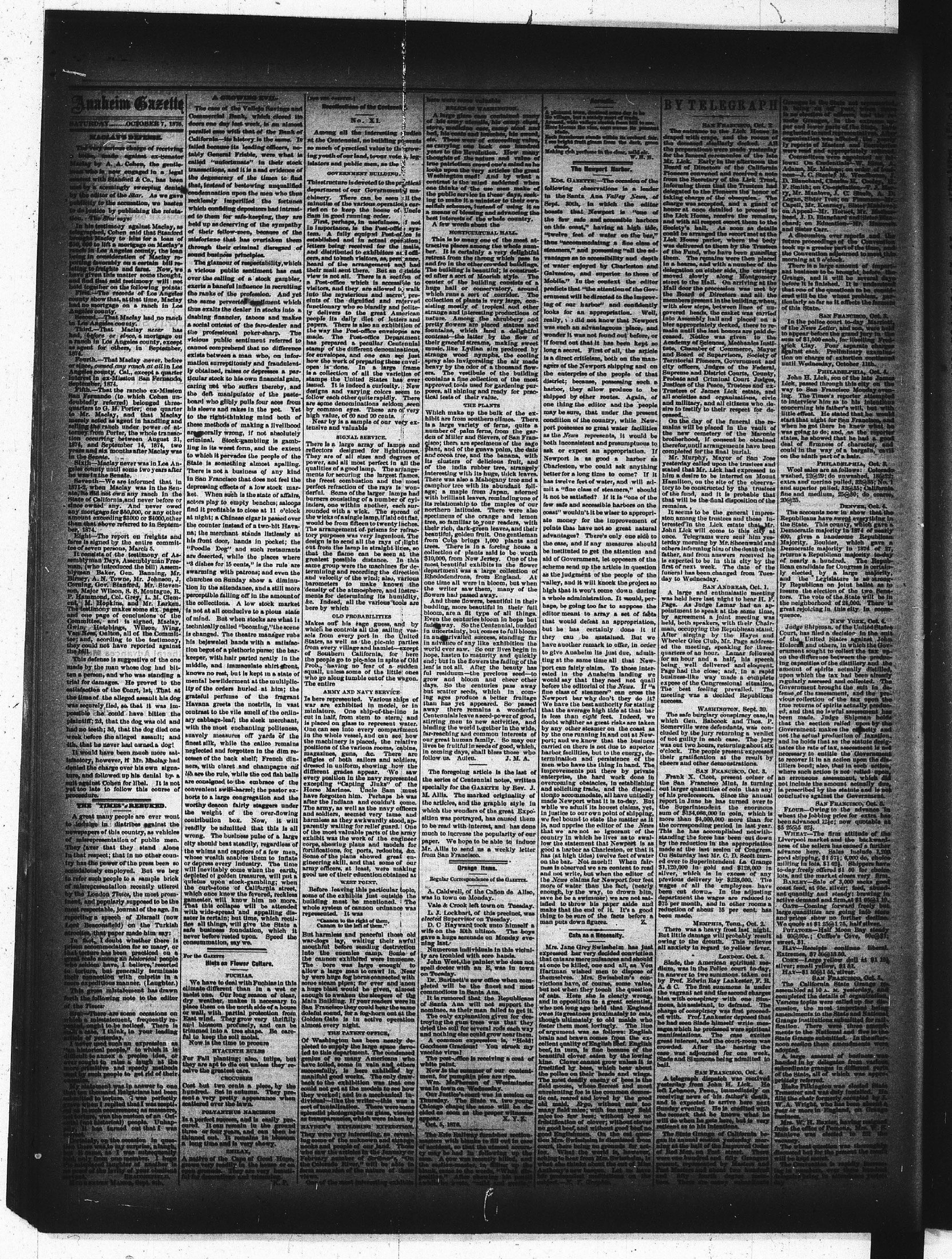
Searchable text
Anakeim Gazette
SATURDAY...OCTOBER 7, 1876.
MACLAY'S DEFENSE
The very serious charge of receiving a bribe, made against ex-teminator Maclay by A. A. Cohen, the gentleman who is now engaged in a legal contest with Stanford & Co., has been and by a seemingly sweeping denial by the editor of the Star. As we gave publicity to the accusation, we hasten to do justice by publishing the retutation. The Star says:
In his testimony against Maclay, as telegraphed, Cohen said that Stanford brought Maclay to him for a loan of $50,000 to lift a mortgage on Maclay's ranch in Los Angeles county, the loan being in consideration of Maclay reporting favorably on a certain bill relating to freights and fares. Now, we have given this matter some thought, and find that said testimony will not hold together on the following points:
First.—The records of Los Angeles county show that, at that time, Maclay had no mortgage on a ranch in Los Angeles county.
Second.—That Maclay had no ranch in Los Angeles county.
Third.—That Maclay never has had, before or since, a mortgage on a ranch in Los Angeles county, except as agent for others, in September, 1874.
Fourth.—That Maclay never, before or since, owned any ranch at all in Los Angeles county, Cal., except a quarter interest in ex-Mission San Fernando, September, 1874.
Fifth.—That the rancho ex-Mission San Fernando (to which Cohen undoubtedly referred) belonged three-quarters to G. H. Porter; one quarter to Mr. Maclay, and that Maclay merely acted as agent in handling and selling the ranch under power of attorney from Porter, the whole transaction occurring between August 31, 1874, and September 14, 1874, two years and six months after Maclay was in the Senate.
Sixth.—Maclay never was in Los Angeles county until some two years after
A GROWING NEW
The case of the Vallejo Savings and Commercial Bank, which closed its doors one day last week, is an almost parallel case with that of the Bank of California—its history is the same. It failed because its leading officers, notably General Friable, were what is called "unfortunate" in their stock transactions, and it is a sad evidence of the degeneracy of the times to find that, instead of bestowing unqualified condemnation upon the men who thus recklessly imperilled the fortunes which confiding depositors had intrusted to them for safe-keeping, they are held up as deserving of the sympathy of their fellow-men, because of the misfortune that has overtaken them through their criminal disregard of sound business principles.
The glamour of respectability, which a vicious public sentiment has cast over the calling of a stock gambler, exerts a baneful influence in recruiting the ranks of the profession. And yet the same perverted sentiment which thus exalts the dealer in stocks into a dashing financier, taboos and makes a social outcast of the faro-dealer and the professional poker-sharp. The vicious public sentiment referred to cannot comprehend that no difference exists between a man who, on information surreptitiously and fraudulently obtained, raises or depresses a particular stock to his own financial gain, caring not who suffers thereby, and the deft manipulator of the pasteboard who glibly pulls four aces from his sleeve and rakes in the pot. Yet to the right-thinking mind both of these methods of making a livelihood are morally wrong, if not absolutely criminal. Stock-gambling is gambling in its worst form, and the extent to which it pervades the people of the State is something almost apalling.
Among all those at the Centennial so much of practice youth of our insultors and public GOVERNMENT
This structure is department of our chinery. There is minute of the wried on to keep Sam in good run.
First, perhaps, in importance, lest tem. A fully established and letters being read and distributed cern, and to much heard of the mail sent this view is not all.
A Post-office was visitors, and they into the mysterious cints of the display functionary who delivers to people its daily papers. There is in the way the Post-male. The Post has prepared a stamp of the diff for envelopes, and how the work of opens is done.
Is a collection of stamps the Unis issued. It is indies designs and varies follow each other are some denominations by common eye high value, of 600.
Near by is a extensive and valuable SIGNAL
There is a large reflector design They are of all power, and all mualities of a good
Angles county, Cal., except a quarter interest in ex-Mission San Fernando, September, 1874.
Fifth—That the rancho ex-Mission San Fernando (to which Cohen undoubtedly referred) belonged three quarters to G. H. Porter; one quarter to Mr. Maclay, and that Maclay merely acted as agent in handling and selling the ranch under power of attorney from Porter, the whole transaction occurring between August 31, 1874, and September 14, 1874, two years and six months after Maclay was in the Senate.
Sixth—Maclay never was in Los Angeles county until some two years after he was in the Senate.
Seventh—We are informed that in 1871-2, when Maclay was in the Senate, he did not own any ranch in the State of California, and never before or since owned any. And never owed any mortgage for $50,000, or any other amount exceeding $3000 or $4000, other than that above referred to in September, 1874.
Eight—The report on freights and fares is signed by the entire committee of seven persons, March 5.
It consists of the testimony of Assemblyman Days, Assemblyman Freeman, who introduced the bill; Assemblyman Baker, Gen. Banning, Mr. Birney, A. N. Towne, Mr. Johnson, J. Corning, Gov. Stanford, Mr. Stevenson, Major Wilson, S. S. Montague, R. P. Hammond, Col. Grey, L. M. Clement, M. Hopkins, and Mr. Larken.
The testimony makes some six pages, and one page of conclusions of the Committee, and is signed, Maclay, Gwlin, Hutchings, Wilson, Wing, Van News, Oulton, all of the Committee; and, according to the testimony, they could not have reported against the bill.
This defense is suggestive of the one made by the man whose dog had bitten a person, and who was standing a trial for damages. He proved to the satisfaction of the Court, 1st That at the time of the alleged assault his dog was securely fled, so that it was impossible he could have bitten the plaintiff; 2d that the dog was old and had no teeth; 3d that the dog died one week before the alleged assault; and 4th that he never had owned a dog!
It would have been much more satisfactory, however, if Mr. Maclay had denied the charge over his own signature, and followed up his denial by a suit against Cohen for libel. It is not yet too late to follow this course of procedure.
THE "TIMES" REBUKED.
A great many people are ever wont to indulge in distribes against the newspapers of this country, as vehicles of misrepresentation of public men. They fixer that they stand alone in that respect; that in no other country has the power of the press been so soundlessly employed. But we beg to refer such people to a sample brick of misrepresentation recently uttered
There is a large number of reflectors designed. They are of all power, and all qualities of a good item for securing the freest comb perfect refraction derful. Some of burners consisting inders, one within rounded with a wick the wicks of ashing would be from flame The arrangement tory purposes was design is to send out from the lamp that the flame greatest possible same group were terminating and rewind velocity of the barometers to density of the attractions for determine &c. Indeed, all here by which
OLD PROB Makes out his which he controls sels from every States, as well as from every village of Southern Cove the people go to Prob, having m equall, unless some who go along tum The entire
ARMY AND Is here represented war are exhibited miniature. One cut in half, from one placed on glass One can see into in the whole vessel positions of the various magazines, gun eglies of both dressed in uniform different grades every position in excepting "Captain Horse Marines have forgotten him after the Indians The army, as well and soldiers, seem harmless as they are parentally waiting for of the most valuable exhibit was the w corps, showing pla fortifications, for Some of the plans gineering skill, and army officers at good use of their c
A great many people are ever wont to indulge in distribes against the newspapers of this country, as vehicles of misrepresentation of public men. They favor that they stand alone in that respect; that in no other country has the power of the press been so soundly employed. But we beg to refer such people to a sample brick of misrepresentation recently uttered by the London Times, the most prominent, and popularly supposed to be the most respectable, journal of the age. In reporting a speech of Diaraell (now Lord Beaconsfield) on the Turkish stricter, that paper made him say:
In fact, I doubt whether there is prison accommodation for so many, or that torture has been practiced on a great scale among an Historical people who soldom have, I believe, resorted to torture, but generally terminate their connection with culprits in a more expeditious manner. (Laughter.)
This gross misstatement has drawn forth the following note to the editor of the Times:
Syria—There are some occasions on which a misstatement frequently reappears ought to be noticed. There is such a case, I think, in your leading articles of yesterday.
I never used such an expression as then historical people," to which it is difficult to annex a precise idea, or ever sought to raise a laugh at the more primitive and speedy methods used by such people to get rid of their criminals.
My statement was in answer to one that ten thousand Bulgarians had been subduited to torture. I was perfectly grave when I replied that I was appalled at (brush circumstances) as mammery, not torture, was the custom of an Oriental (not historical) people. Unhappily, it has turned out that I was arrested.
Initially, on the occasion in question these were so my surprise, alright, but it same, as I was subsequently told only from one member. I hagged the misplaced laughter of another is not used of the lavity of your civilian servants.
BRACCHINELLI
BROOKLYN MANSION Sept. 6th.
For the GATEFTE
Hists as Flower Culture.
FUCHILAR.
We have to deal with Fuchias in this climate different than in a wet or moist one. Our long season of clear, dry weather, makes it necessary to place them on the north side of a house or wall, with partial protection from East wind. They grow very thrifty and blossom profusely, and can be trimmed into a tree shape. Be careful to keep the soil moist.
Now is the time to procure
HYACINTH BULBS
For Fall planting; also, tulips, but they are apt to die out unless they receive the greatest care.
CROCUSSES
Cost but two cents a piece, by the hundred. Set in autumn. They present a very pretty appearance when scattered over the lawn.
POLYANTHUS NARCISSUS
In a perfect success, and is easily procured. It can remain in the ground three or four years, and can then be thinned out. It remains in bloom a long time and is very showy.
SKILAX,
A native of the Cap of Good Hope, grows very readily in the house or on open grounds. They are very beautiful for decorations and trimming.
K. P.
RECITATIONS OF THE CENTENNIAL
No. XI.
Among all the interesting studies at the Centennial, no building presents so much of practical value to the growing youth of our land, to our voters, legislators and public men, as the GOVERNMENT BUILDING.
This structure is devoted to the practical department of our Governmental machinery. There can be seen all the minutiae of the various operations carried on to keep the house of Uncle Sam in good running order.
First, perhaps, in usefulness, if not in importance, is the Post-office system. A fully equipped Post-office is established and in actual operation; letters being received for the mails, and distributed to exhibitors and officers, and to such visitors, as per occasion, heard of the arrangement and had their mail sent there. But an outside view is not all. There is a section of a Post-office which is accessible to visitors, and they are allowed to walk into the mysterious and secret precints of the dignified and reserved functionary who so blandly and politely delivers to the great American people its daily diet of letters and papers. There is also an exhibition of the way the Post-office envelopes are made. The Post-office Department has prepared a peculiar Centennial stamp of the different denominations, for envelopes, and one can just how the work of preparing these envelopes is done. In a large frame is a collection of all the varieties of stamps the United States has ever issued. It is indeed a curiosity. New designs and varying colors seem to follow each other quite rapidly. There are some denominations seldom seen by common eyes. These are of very high value, of 60 and 90 cents.
Near by is a sample of our very extensive and valuable SIGNAL SERVICE.
There is a large array of lamps and reflectors designed for lighthouses. They are of all sizes and degrees of power, and all most perfect in all the qualities of a good lamp. The artistry here were most valuable.
RELICHT OF WASHINGTON.
A large glass case contained many of his army uniforms, his camp clothes, store, maintenance one, camp steel and bed, his coats and brushes, his sweat贴. These were of outstanding value, as carrying one back one hundred years to the Revolution. How many thoughts of the nature and value of true patriotism crowd one's mind as he looks upon the very articles the great Washington used! And by what a contrast is the mind addened when one thinks of the use man make of the public service in these days, seeking to make it a minister to their own selfish schemes, instead of using it as a means of blending and advancing the best interests of the whole country.
A few words about the MORTICULATURAL HALL.
This is to many one of the most attractive places among the whole number. It is certainly a very delightful retreat from the strong which pass to and fro in the other crowded buildings. The building is beautiful; is constructed after a sort of Moorish style. The center of the building consists of a huge hall or conservatory, around which runs a sort of corridor. The collection of plants is very large, consisting mostly of tropical and other strange and interesting productions of nature. Among the shrubbery and pretty flowers are placed statues and fountains, which land a delightful contrast—the latter by the flow of their graceful streams, making sweet music, like Lydian air produced by strange wood nymphs, the cooling spray also invigorating the air made heavy by the odor of a thousand flowers. The vestibule of the building contains a fine collection of the most approved tools used for gardening purposes, all shining and ready for practical tests of their value.
THE PLANTS
Which make up the bulk of the exhibit are from southern climes. There is a large variety of ferns, quite a number of palm ferns, from the garden of Miller and Sievers, of San Francisco; there are specimens of the sago plant, and of the guava palm, the date and cocoa tree, and the banana, with its clusters of delicious fruit, and of the india rubber tree, strangely
is a collection of all the varieties of stamps the United States has ever issued. It is indeed a curiosity. New designs and varying colors seem to follow each other quitter rapidly. There are some denominations seldom seen by common eyes. These are of very high value, of 60 and 90 cents.
Near by is a sample of our very extensive and valuable
SIGNAL SERVICE.
There is a large array of lamps and reflectors designed for lighthouses. They are of all sizes and degrees of power, and all most perfect in all the qualities of a good lamp. The arrangements for securing the largest flames, the freest combustion and the most perfect refraction of the rays is wonderful. Some of the larger lamps had burners consisting of a number of cylinders, one within another, each surrounded with a wick. The spread of the wicks of a single lamp, if laid out flat, would be from fifteen to twenty inches. The arrangement of prisms for refractory purposes was very ingenious. The design is to send all the rays of light out from the lamp in straight lines, so that the flame can be seen at the greatest possible distance. In this same group were the machines for determining and recording the direction and velocity of the wind; also, various barometers to make known the density of the atmosphere, and instruments for determining its humidity, &c. Indeed, all the various tools are here by which
OLD PROBABILITIES
Makes out his picture, and by which he controls all the sailing vessels from every port in the United States, as well as the pic-nile parties from every village and hamlet—except of Southern California, for here the people go to pic-niles in spite of Old Prob., having no fear of a sudden squall, unless some of the little ones who go along tumble out of the wagon. The entire
ARMY AND NAVY SERVICE.
Is here represented. Various ships of war are exhibited in model, or in miniature. One ship-of-the-line is cut in half, from stem to stern, and is placed on glass to represent water. One can see into every compartment in the whole vessel, and can see how the machinery is placed, the relative positions of the various rooms, cabins, magazines, guns, &c. There are eagles of both sailors and soldiers, dressed in uniform, showing how the different grades appear. We saw every position in the navy represented excepting "Capturing Jinks" of the Horse Marines. Uncle Sam must have forgotten him. Perhaps he was after the Indians and couldn't come. The army, as well as the navy officers and soldiers, seemed very tame and harmless as they awkwardly stood, apparently waiting for relief guard. One of the most valuable parts of the army exhibit was the work of the engineer corps, showling plans and models for fortifications, for ports, redoubts, &c. Some of the plans showed great engineering skill, and that some of our army officers, at least, were making good use of their education obtained at
WEST POINT.
Before leaving this particular table, The vestibule of the building contains a fine collection of the most approved tools used for gardening purposes, all shining and ready for practical tests of their value.
THE PLANTS
Which make up the bulk of the exhibit are from southern climes. There is a large variety of ferns, quite a number of palm ferns, from the garden of Miller and Sievers, of San Francisco; there are specimens of the sago plant, and of the guava palm, the date and cocoa tree, and the banana, with its clusters of delicious fruit, and of the india rubber tree, strangely interesting with its huge, thick leaves. There was also a Mahogany tree and a camphor tree with its abundant foliage; a maple from Japan, adorned with brilliant leaves, reminding one of its relationship to the maples of our northern latitudes. There were also specimens of the orange and lemon tree, so familiar to your readers, with their rich, dark-green leaves, and their beautiful golden fruit. One gentleman from Cuba brings 1,000 plants and trees. There is in a forcing house a collection of plants said to be worth $10,000, from New Jersey. One of the most beautiful exhibits in the flower department was a large collection of Rhododendrons, from England. At one time all were in bloom, but when the writer saw them, many of the flowers had passed away.
And these flowers, beautiful in their budding, more beautiful in their full bloom, are a fit type of all things. Even the centuries bloom in hope but fade away. So the Centennial, budded in uncertainty, but comes to full bloom in an avirulent success, standing far in advance of any like exhibition the world ever saw. So our lives begin in hope, hasten to maturity and quickly end; but in the flowers the fading of the leaf is not all. After the beauty has ful residuum—the precious seed—to grow and bloom and cheer other days. So the centuries pass away but scatter seeds, which in coming ages produce a better fruiting than has yet appeared. So passed away there remains a wonderful Centennials leave a seed-power of good, stirring men to new activities, and binding the world together in the wide, far-reaching and common interests of our great human family. So may our lives be fruitful in seeds of good, which in coming days shall bless those who follow us. Adieu.
J. M. A.
The foregoing article is the last of the series of Centennial notes, written specially for the Gazettee by Rev. J. M. Allis. The marked originality of the articles, and the graphic style in which the wonders of the great Exposition was portrayed, has caused them to be read with interest, and has done much to increase the popularity of our paper. We hope to be able to induce Mr. Allis to send us a weekly letter from San Francisco.
Orange Items.
Regular Correspondence of the Gazetteer.
Superior Press
Justice
All rights reserved
Johnson once more
Page quality exp
The first fun day
This stand by Owner
On Sunday evening
$1,125 silver prepaid wage
Before leaving this particular topic, some of the exhibits just outside the building must be mentioned. The whole system of cannon ordnance was represented. It was "Cannon to the right of them," Cannon to the left of them."
But harmless and peaceful those old war-dogs lay, waiting their awful mouthful before sending destruction into the enemies camp. Some of the cannon exhibited were immense. The bore was large enough to allow a large man to crawl in. Near by were huge fog horns connected with some steam pipes; for ever and anon a huge blast would be given, almost enough to awaken the sleepers of the Main Building. If your readers were in San Francisco they could hear the same doleful sound, for a fog-horn out at the Golden Gate is in active operation almost every night.
THE PATENT OFFICE,
Of Washington has been nearly depleted to supply the large space devoted to this department. The condensed genius of so many Americans who have fallen, some in vain and others successfully, is here exhibited by manifold good works. The only drawback to the exhibition was that one could not get at the models to see how they worked; and to a mechanical individual—like the writer—this was a sort of initialization. There were some splendid photographs on glass, viewed as transparency, which were taken by Mayden's exploring expedition.
They were very interesting; as revealing some of the unknown and strange noises and people of our land. Those who saw the articles in the January or February number of *Scribner's* "On the Colorado River," will be able to form some idea of the nature of these views.
One of the most interesting exhibits
M. Allis. The marked originality of the articles, and the graphic style in which the wonders of the great Exposition was portrayed, has caused them to be read with interest, and has done much to increase the popularity of our paper. We hope to be able to induce Mr. Allis to send us a weekly letter from San Francisco.
Orange Items.
Regular Correspondence of the Gazette.
A. Caldwell, of the Cafion de Allso, was in town on Monday.
Vale & Crook left town on Tuesday.
L. J. Lockhart, of this precinct, was elected Supervisor on Tuesday.
D. C Hayward took unto himself a wife on the 80th ultimo. The boys gave a huge serenade on Monday evening last.
Numerous individuals in this vicinity are troubled with sore hands.
John West, the painter who does not spell doctor with an E, was in town on Tuesday.
Dr. Burnett's new office when completed will be the finest and most commodious in Santa Ana.
It is rumored that the Republicans of Santa Ana will not support the nominee, as their man failed to get it.
The only explanation given for destroying the gum trees was that they dried the soil for several rods each way and nothing else could grow near them.
A common expression is, "Hold! Goodness Gracious! You struck my vaccine virus!
The post-office is receiving a coat of white paint.
Now is the summer of our contentment, for pumpkin plums are ripe.
Wm. McPherson of Westminster was in town on Wednesday.
Our Justice's court was in session on Thursday. The State vs. two young Chicago chapel the same will be decided as soon as the paper witnesses appear.
X. Y. Z.
Oct. 5, 1876.
The Erie Railway furnishes station-masters with blank to fill out in case of accident, so that the unseen accuracy may be had in following up the case. A cow was recently killed, and the station-master, in distress upon the blank, came to the word, "What disposition?"
After showing his means he wrote "child and greater." Mrs. Jane Grey Swimhelm has just expressed her very decided conviction that cats are mere nuisances and should at once be killed, one and all, as Von Hartman wished men to dispose of themselves. Mrs. Swisshelm's convictions have, of course, some value, but not when they touch the question of cats. Here she is clearly wrong, and in opposition to a great scientist, who not long ago held that England owes its greatness proximately to cats, though ultimately to old maids who foster them most lovingly. The line of argument was as follows: English brain and brawn comes from the excellent quality of English beef. English beef, in turn, is fine because of the beautiful clover eaten by the lowling kine. Clover cannot grow unless it is frustified by bees, which bear about the pollen on their heads and wings. The most deadly enemy of bees is the field mouse, whose furest and most unrelenting foe is the common domestic cat, reared and loved by the good old maid. Ergo, without cats too many field mice; with too many field mice too few bees; without bees no frustification of clover; without clover no good beef; without good beef no good Englishmen. On the cat question Mrs. Swimhelm is dismissed from court, there being no grounds for adjournment. What the world is, however, asking to hear from Mrs. Swimhelm, is what she thinks about the cut of Miss Anthony's new tenure. Let me have her professional meditations on the subject—M. Y. George.
BY TELEGRAPH
SAN FRANCISCO, Oct. 2
The entrance to the Link House is draped with drape, and the rooms of the deceased similarly darkened. All the preparations were made yesterday for the funeral ceremonies of the late Mr. Lick. Early in the afternoon the Board of Directors of the California Pioneers convened and received a note from the Secretary of the Lick Trust, informing them that the Trustees had delegated to the Pioneers the honor of taking charge of the obsequies. The charge was accepted, and a guard of honor at once detailed to proceed to the Lick House, receive the remains, and with all respect escort them to the Society's hall. As soon as details could be arranged the escort met at the Lick House parlor, where the body was delivered to them by the Trustees of the Fund, who have been guarding them. The remains were then placed in a hearse, and with a number of the delegation on either side, the carriage moved slowly along Montgomery street to the Hall. On arriving at the Hall door the procession was met by the Board of Directors and all the members present in the building, when, with slow steps, between lines of uncovered heads, the casket was carried into Assembly hall and placed on a bluer appropriately decked, there to remain until the last honors are paid deceased. Notice was given to the Academy of Sciences, Mechanics Institute, Chamber of Commerce, Mayor and Board of Supervisors, Society of Territorial Pioneers, Government and city officers, Judges of the Federal Supreme and District Courts, County Probate and Criminal Court Judges, Justices of the Peace, Trustees and ex-Trustees of James Lick estate, and all societies and organizations, civic and military, and all citizens who desire to testify to their respect for deceased.
On the day of the funeral the remains will be placed in the vault of the new cemetery of the Marionle brotherhood, if consent be obtained therefor, until arrangements have been completed for the final burial.
Mr. Murphy, Mayor of San Jose yesterday called upon the trustees and stated that Mr. Lick had appeared to be engaged in being all off year when there in no election of officers, and the remote Grange, in the extreme upper and lower parts of the State, has neglected to send representatives. After organization was affected, the weekly reports of Masters and Recorders were read and apparently returned.
Committees were appointed on follows: On Credentials—W. Slim A. Adams, Mr. Malage; on order of business—J. C. Steele M. Woodlosten J. D. Blanchard, Charles H. Osley B. F. Smith; on Co-operation—P. J. Murry, Mr. Manlove J. C. Shah A. D. Logan, Slater Ives; on Pinsman—Mr. Capell, Mr. Kearney, Slater Minbury; on Appeal—Mr. Hornet, Mr. Meadhead, J. D. Blanchard and filius Meadhard; on Education—Mr. Hammond and Sister Carr.
A discussion over reports and the future proceedings of the Convention took up a greater part of the time, and the Convention adjourned to meet this morning at 9 o'clock.
There is a large amount of important business to be brought before the Grunge, and it will be several days before it is finished. It is understood that one of the questions to be considered will be the wheat problem, particularly so far as it affects the farmers of this State.
SAN FRANCISCO, Oct. 2
In the police court today Marriott, of the News Letter, and son, were held to appear before the grand jury in the sum of $1,000 each; for libelling Frederick Clay. Four separate charges against each. Preliminary examination on charge of extortion continued until Wednesday, October 11th.
PHILADPHIA, Oct. 4
John H. Lick, son of the late James Lick, passed through this city on the way to San Francisco Monday evening. The Times's reporter attempted to interview him as to his intentions concerning his father's will, but with little effect. He stated that he would start that night for San Francisco, and when he got there he knew what he was going to do; and, as the reporter states, he showed that he had a good deal of firmness of character, and could in the way of a bargain, cavil on the ninth part of a hair.
PHILADPHIA, Oct. 5
Wool sales are as follows: Colorado
the people of that possessing such a now produce to be routes. Again, of vector and the people under the present country, while New-great water facilities presents, it would be and presumptuous to an appropriation. If good a harbor as should ask anything come to come? If it water, and will admit steamers," should it is "one of the possible harbors on theobe wiser to appropriate the improvement of not so great natural there's only one side to any measures should at the attention and let opposers of the article in question of the people of the knock the project so come down during station. It would, per far to suppose the murray a set of facts at an appropriation, mainly done it if sustained. But we mark to offer, in order just due, admit none all that New-amen. To those inter-helm landing we they need not quail of the News. If "a men" can cross the don't they do it? authority for stating high tide at that bar feet. Indeed, we great risks are taken near on the coast as in and out at New-that the business cannot due to superior out to the energy, de-persistence of the thing in hand. The there by private hard work done in cities, in establishing cities, and the disposition, all have unitedly that it is to-day. But honest claims, yet, an point of shipping, state the matter as it editor of the News no ignorant of the lives as to swal-that Newport is as Charleston, or that it twelve feet of water much!! When fair are content to read when the editor of our Newport four feet in the fact, (nearly Supreme and District Courts, County, Probate and Criminal Court Judges, Justices of the Peace, Trustees and ex-Trustees of James Lick estate, and all societies and organizations, civic and military, and all citizens who desire to testify to their respect for deceased.
On the day of the funeral the remains will be placed in the vault of the new cemetery of the Maronic brotherhood, if consent be obtained therefor, until arrangements have been completed for the final burial.
Mr. Murphy, Mayor of San Jose yesterday called upon the trustees and stated that Mr. Lick had expressed to him a desire to be intered on Mount Hamilton, on the site of the observatory to be constructed by the trustees of the fund, and it is probable that that will be the final disposition of the remains.
It seems to be the general impression among the trustees and those interested in the Lick estate that Mr. John Lick will come to this city at once. Telegrams were sent him yesterday morning by Mr. Shoenwald and others informing him of the death of his father, and from answers received he is expected to be in this city by the first of next week. The date of the funeral has been changed from Tuesday to Wednesday.
SAN ANDEAS, Oct. 1.
A large and enthusiastic meeting was held here last night to hear H. F. Page. As Judge Lamar had an appointment to speak at the same time, by agreement a joint meeting was held, both speakers, with their Chairman, occupying the Republican stand. After singing by the Hayes and Wheeler Glee Club, Mr. Page addressed the meeting, speaking for three quarters of an hour. Lamar followed for an hour and a half, his speech being well delivered and eloquent. Page had the close; and, in a rapid business-like way made a complete expose of the Congressional situation. The best feeling prevailed. The meeting was a decided Republican success.
WASHINGTON, Sept. 30.
The safe burglary conspiracy case, in which Gen. Babcock and Thos. P. Somerville were defendants, was concluded by the jury returning a verdict of not guilty in each case. The jury was out two hours, returning about six o'clock. The people present expressed their gratification at the result by cheers and other demonstrations.
SAN FRANCISCO, Oct. 3.
Frank X. Cloet, present colmer of the San Francisco Mint, is turning out larger quantities of coin than any of his predecessors. Since the annual report in June he has turned over to the Superintendent the enormous sum of $134,088,000 in coin, which is more than $4,000,000 more than for the corresponding period in last year. This he has accomplished notwithstanding the force has been cut down by the reduction in the appropriation made at the last session of Congress. On Saturday last Mr. C. D. Scott turned over to Superintendent La Grange $1,120,000 in gold and $128,000 in silver, which is in excess of any previous delivery by $228,000. The wages of all the employees have
PHILADELPHIA, Oct. 4.
John H. Lick, son of the late James Lick, passed through this city on the way to San Francisco Monday evening. The Times's reporter attempted to interview him as to his intentions concerning his father's will, but with little effect. He stated that he would start that night for San Francisco, and when he got there he knew what he was going to do; and, as the reporter states, he showed that he had a good deal of firmness of character, and could in the way of a bargain, earn on the ninth part of a hair.
PHILADELPHIA, Oct. 5.
Wool sales are as follows: Colorado washed, 22@29; do unwashed, 18@22; extra and merino pulled, 22@25; No. 1 and superior pulled, 32@35; California fine and medium, 25@30; do coarse, 20@25.
DENVER, Oct. 4.
The accounts now in show that the Republicans have swept everything in the State. This county, which gave a Democratic majority in 1874 of nearly 400, gives a handsome Republican Majority. Boulder, which gave a Democratic majority in 1874 of 27, returns a Republican majority to-day of nearly a hundred.
The Republican candidate for Congress is certainly elected by a large majority, and the Legislature is so strongly Republican on joint ballot as to insure the election of the two Senators. The vote of the State will be in the neighborhood of 24,000. There is great rejoicing in this city in consequence.
NEW YORK, Oct. 6.
Judge Shipman, of the United States Court, has filed a decision in the suit of the United States against John Holorde and others, in which the Government sought to collect tax upon the difference between the producing capacities of the distillery and the amount of spirits actually distilled upon which the tax had been already regularly assessed and collected. The Government brought the suit in defense of the assessment, and the previous collection of the tax upon the true returns of spirits actually produced; and that no lawful assessment has been made. Judge Shipman holds that the section rallied upon by the Government makes the capacity and not the actual production of taxation; and he holds that as the statute designates the rate of tax, assessment is not necessary to entitle the Government to recover it in an action upon the distillers bond; also, that in such action, where such action is not rallied upon an erroneous assessment, which did not include the amount actually due is proscribed by the statute and is not conclusive against the Government.
SAN FRANCISCO, Oct. 8.
FLOUR—Owing to the advance in wheat the Jobbing price for extra has been advanced 12½c; now quotable at $5 25@5 02¢.
WHEAT—The firm attitude of the Liverpool market and the backwardness of the sellers has caused a further advance here. Sales include 1,200 good shipping,$1 571; 6,000 do choice milling in lots,$1 02¢). Shipping have-to-day freely offered $1 60 for choice lots,and the market closes very firm.
BARLEY—Sale of 3,000 sacks good coast feed at 95c,silver feed,aound
Wisbethm has just decided conviction liances and should be and all, as Von men to dispose of Swisshelm's concurse, some value, touch the question is clearly wrong, a great scientist, held that England proximately to cats, to old maids who wringly. The line follows: English times from the ex-english厨. English use because of the len by the lowing at grow unless it is which bear about heads and wings, many of bees in the fiercest and most common demesneoved by the good without cats too with too many field without bees no ever; without clever without good beef no On the eat question is dismissed from grounds for not-gardd in, however, Mr. Swishelm, is out the cut of Miss Ms. Let us have distinctions on the polls.
MEMPHIS, Tenn., Oct. 2.
There was a heavy frost last night. But little damage will probably result owing to the drouth. This relieves all anxiety in regard to yellow fever.
LONDON, Oct. 3.
Slade, the American spiritual medium, was in the Police court to-day, in answer to two summons taken out by Prof. Edwin Ray Lankester, F.R.A. & C. The first summons is under the vagrant act and the second charges him with conspiracy with one Simmons, his assistant, to defraud. The charge of conspiracy was first proceeded with. Prof. Lankester deposed that he had seen Slade himself write messages which he professed were spiritual manifestations. The case excites great interest, and the court-room was crowded. After the hearing the case was adjourned for one week, Slade and Simmons being admitted to bail.
SAN FRANCISCO, Oct. 4.
A telegraph dispatch was received yesterday from John H. Lick. He left Lebanon, Penn., immediately on receiving news of his father's death, and is expected to arrive here next Sunday evening. He is credited with the remark that he knows what he will do when he gets here, but is very reluctant as to his intentions.
The State Grange of California began its annual session yesterday morning at the hall of the Improved Order of Bad Men, on Fort street. There were one hundred and fifty Grangers present, represented by Madam and Past Master and about two hundred and fifty fourth degree men. There are many salariates.
SAN FRANCISCO, Oct. 5.
The California State Grange assembled at 10 A.M. yesterday, and completed the details of organization. Various topics were called up for discussion, the most important being amendments to the State and National Grange institutions submitted for notification. There were three amendments to the National and five in the State Grange submitted. In the afternoon session these amendments were adopted.
A large amount of business was handed in by delegates from various subordinate granges in different parts of the State, all of which was appropriately referred.
Blake Pilkington was elected State Treasurer and was duly installed. His fills the chair formerly occupied by J.W.A.Wright, who has been absent a year or more in England, on Grange business.
Mrs W.H.Raxter having resigned from the office of Pomona, Mrs.W.K.Manlove was elected to fill the vacancy.
The wheat question was thoroughly discussed but for the present the result will be kept secret.
The situation is rapidly increasing in numbers over three hundred households living in allgemeine zeremonie.