anaheim-gazette 1876-09-30
Scanned page
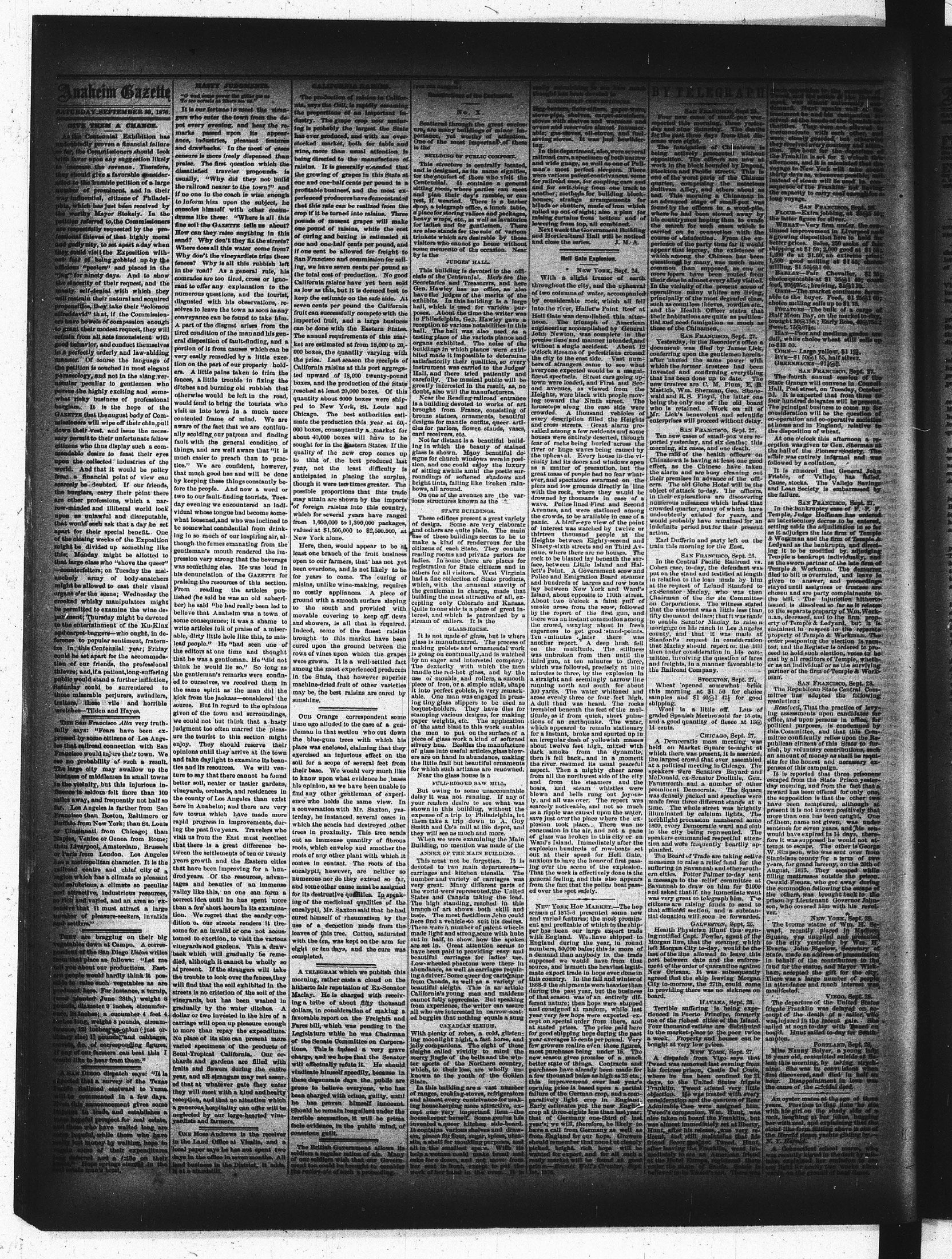
Searchable text
SATURDAY SEPTEMBER 20, 1876.
GIVE THEM A CHANCE.
As the Centennial Exhibition has undoubtedly proven a financial failure so far, the Commissioners should look with favor upon any suggestion likely to increase the revenue. Therefore, they should give a favorable consideration to the humble petition of a large number of prominent, and in their way influential, citizens of Philadelphia, which has just been received by the worthy Mayor Stokely. In the petition referred to, the Commissioners are respectfully requested by the professional thieves of that highly moral and godly city, to set apart a day when they could visit the Exposition without fear of being gobbled up by the officious "peelers" and placed in the "jug" for ninety days. And to show the sincerity of their request, and the manly self-denial with which they will restrain their natural and acquired propensities, they take their "solomon alfredavid" that, if the Commissioners have bowels of compassion enough to grant their modest request, they will refrain from all acts inconsistent with good behavior, and conduct themselves in a perfectly orderly and law-abiding manner. Of course the language of the petition is couched in most elegant phraseology, and not in the slang vernacular peculiar to gentlemen who pursue the highly exciting and somewhat risky business of professional burglar. It is the hope of the Gazette that the august body of Commissioners will wipe off their chin, pull down their vest, and issue the necessary permit to their unfortunate fellow citizens who thus display such a commandable desire to feast their eyes upon the collected industries of the world. And that it would be rolley
MASTY SUGGMENTS.
"O and some power the gifts pass us To see certain as there are."
It is our fortune to meet the managers who enter the town from the depot every evening, and hear the remarks passed upon its appearance, industries, pleasant features and drawbacks. In the most of cases censure is more freely dispensed than praise. The first question which the dissatisfied traveler propounds is usually, "Why did they not build the railroad nearer to the town?" and if no one in the coach is wise enough to inform him upon the subject, he consoles himself with other conundrums like these: "Where is all this fine soil the GAZETTE tells us about? How can they raise anything in this sand? Why don't they fix the streets? Where does all this water come from? Why don't the vineyardists trim these fences? Why is all this rubbish left in the road? As a general rule, his comrades are too tired, cross or ignorant to offer any explanation to the numerous questions, and the tourist, disgusted with his observations, resolves to leave the town as soon as any conveyance can be found to take him. A part of the disgust arises from the tired condition of the man and his general disposition of fault-finding, and a portion of it from causes which can be very easily remedied by a little exertion on the part of our property holders. A little pain taken to trim the fences, a little trouble in fixing the ditches and burning old rubbish that otherwise would be left in the road, would tend to bring the tourists who visit us into town in a much more contented frame of mind. We are aware of the fact that we are continually scolding our patrons and finding fault with the general condition of things, and are well aware that "it is much easier to preach than to practice." We are confident, however,
CALIFORNIA.
The production of California says the Call, in the proportions of its industry. The grape growing is probably the one ever produced, and stocked market, booming, more than usual being directed to raisins. It is generally the growing of grape one and one-half cent profitable business, and experienced producers that this rate can be crop if it be turned in pounds of muscat one pound of raisin of curing and boxing one and one-half cent if one cent be allowed San Francisco and coming, we have seven cents on the total cost of produce California raisins had as low as this, but it keep the estimate one seven cents per pound fruit can successfully imported fruit, and can be done with them. The annual requirement key are estimated at ten thousand boxes, the quantity the price. Last season California raisins at ted upward of 18,000 boxes, and the product reached at least 20,000 quantity about 6000 bred to New York, Chicago. The best mate the production 1000 boxes, consequently about 40,000 boxes sought for in the East quality of the new year, not the lea
The San Francisco Alta very truthfully says: "Fears have been expressed by some citizens of Los Angeles that railroad connection with San Francisco would injure the'r town. We see no probability of such a result. The large city may swallow up the business of middlemen in small towns in the vicinity, but this injurious influence is seldom felt more than 100 miles away, and frequently not half so far. Los Angeles is farther from San Francisco than Boston, Baltimore or Buffalo from New York; than St. Louis or Cincinnati from Chicago; than Naples, Venice or Genoa from Rome; than Liverpool, Amsterdam, Brussels or Paris from London. Los Angeles has a metropolitan character. It is the railroad centre and chief city of a region which has a climate so pleasant and salubrious, a climate so peculiar.
A little pains taken to trim the fences, a little trouble in fixing the ditches and burning old rubbish that otherwise would be left in the road, would tend to bring the tourists who visit us into town in a much more contented frame of mind. We are aware of the fact that we are continually scolding our patrons and finding fault with the general condition of things, and are well aware that "it is much easier to preach than to practice." We are confident, however, that much good has and will be done by keeping these things constantly before the people. And now a word or two to our fault-finding tourists. Tuesday evening we encountered an individual whose tongue had become somewhat loosened, and who was inclined to be somewhat confidential from drinking in so much of our inspiring air, although the fumes emanating from the gentleman's mouth rendered the impression very strong that the beverage was something else. He was loud in his denunciation of the GAZETTE for praising the resources of this section. From reading the articles published (he said he was an old subscriber) he said "he had really been led to believe that Anaheim was a town of some consequence; it was a shame to write articles full of praise of a miserable, dirty little hole like this, to mislead people." He "had seen one of the editors at one time and thought that he was a gentleman. He 'did not think he would lie so.' So long as the gentleman's remarks were confined to ourselves, we received them in the same spirit as the man did the kick from the jackass—considered the source. But in regard to the opinions given of the town and surroundings, we could not but think that a hasty judgment too often marred the pleasure the tourist to this section might enjoy. They should reserve their opinions until they arrive at the town and take daylight to examine its beauties and its resources. We will venture to say that there cannot be found better soil, neater or tastier gardens, vineyards, orchards, and residences in the county of Los Angeles than exist here in Anaheim; and there are very few towns which have made more rapid progress in improvements, during the past five years. Travelers who visit us from the East must recollect that there is a great difference between the settlements of ten or twenty years growth and the Eastern cities that have been improving for a hundred years. Of the resources, advantages and beauties of an immense ted upward of 18,000 boxes, and the produce reached at least 20,000 quantity about 6000 boxes sought for in the most quality of the new crop to that of the best year, not the least anticipated in place though it were ten times possible proportions may attain are shown of foreign raisins in which for several years from 1,000,000 to 1,350,000 valued at $1,500,000 in New York alone.
Here, then, would be least one branch of the open to our farmers, been overdone, and is for years to come. Raisins, unlike wine-no costly appliance ground with a smooth to the south and movable covering to and showers, is all true Indeed, some of the brought to this matured upon the groups of vines upon which were grown. It is a among the most expensive in the State, that machine-dried fruit may be, the best raisin sunshine.
Our Orange corn time ago alluded to the teleman in that section the blue-gum trees place was enclosed, clipped an injurious soil for a scope of six their base. We would know upon what eats his opinion, as we have find any other gentlece who holds the conversation with Misterday, he instanced which the acacia had trees in proximity. Out an immense quail roots, which envelope roots of any other plant comes in contact. The eucalypti, however numerous nor do they and some other cause
fluence is seldom felt more than 100 miles away, and frequently not half so far. Los Angeles is farther from San Francisco than Boston, Baltimore or Buffalo from New York; than St. Louis or Cincinnati from Chicago; than Naples, Venice or Genoa from Rome; than Liverpool, Amsterdam, Brussels or Paris from London. Los Angeles has a metropolitan character. It is the railroad centre and chief city of a region which has a climate so pleasant and salubrious, a climate so peculiar and attractive, industrious resources, so rich and varied, and an area so extensive that it must attract a large number of pleasure-seekers, invalids and settlers."
They are bragging on their big vegetables down at Campo. A correspondent of the San Diego Union writes from that place as follows: "Let me tell you about our productions. Eastern people would hardly think it possible to raise such vegetables as are produced here. For instance, a turnip (most planted June 28th.) weight 8 pounds, diameter 9 inches, circumference 28 inches; a cucumber 4 feet 4 inches long, weight 8 pounds, circumference 12 inches onion (just ordinary size) 11 pounder and cabbage, curtain, do, of corresponding figures. If any of our farmers can beat this I would like to hear from them."
A SAN DIEGO dispatch says: "It is expected that a survey of the Texas Pacific Railroad eastward to Yuma will be commenced in a few days. From this announcement gives some impressions to trade and establishes a wise hopeful prospect for real estate, and those who have waited long are often helpful, while those who have really lost money by waiting, hope to make some of their expenditures less deferral and a trifle on their income." Hone springs sternly in the real estate man's breast.
ONE Moss Andrews is the receiver in the Land Office at Visalia, and a local paper says he has not spent two days in the office in seven months. All land business in the District, it adds, is at a standstill.
vineyards, orchards, and residences in the county of Los Angeles than exist here in Anaheim; and there are very few towns which have made more rapid progress in improvements, during the past five years. Travelers who visit us from the East must recollect that there is a great difference between the settlements of ten or twenty years growth and the Eastern cities that have been improving for a hundred years. Of the resources, advantages and beauties of an immense valley like this, no one can form a correct idea until he has spent more than a few short hours in its examination. We regret that the sandy condition of our streets renders it tiresome for an invalid or one not accustomed to exertion, to visit the various vineyards and gardens. This a drawback which will gradually be remedied, although it cannot be wholly so at present. If the strangers will take the trouble to look over the fences, they will find that the soil exhibited in the streets is no criterion of the soil of the vineyards, but has been washed in gradually by the water ditches. A dollar or two invested in the hire of a carriage will open up pleasure enough to more than repay the expenditure. No place of its size can present more varied specimens of the products of Semi-Tropical California. Our orchards and gardens are filled with fruits and flowers during the entire year, and all strangers may rest assured that at whatever gate they enter they will meet with a kind and hearty reception, and that no attention which a generous hospitality can offer will be neglected by our large-hearted vineyardists and farmers.
The British Government soldiers a regular ratchet of our soldier wish the men could be brushed with the ruffles of such
CALIFORNIA RAILING.
The production of raisins in California, says the Call, is rapidly assuming the proportions of an important industry. The grape crop now maturing is probably the largest the State has ever produced, and with an over-stocked market, both for table and wine, more than usual attention is being directed to the manufacture of raisins. It is generally conceded that the growing of grapes in this State at one and one-half cents per pound is a profitable business, and the most experienced producers have demonstrated that this rate can be realized from the crop if it be turned into raisins. Three pounds of muscat grapes will make one pound of raisins, while the cost of curing and boxing is estimated at one and one-half cents per pound, and if one cent be allowed for freight to San Francisco and commission for selling, we have seven cents per pound as the total cost of production. No good California raisins have yet been sold as low as this, but it is deemed best to keep the estimate on the safe side. At seven cents per pound the California fruit can successfully compete with the imported fruit, and a large business can be done with the Eastern States. The annual requirements of this market are estimated at from 18,000 to 20,000 boxes, the quantity varying with the price. Last season the receipts of California raisins at this port aggregated upward of 18,000 twenty-pound boxes, and the production of the State reached at least 20,000 boxes. Of this quantity about 6000 boxes were shipped to New York, St. Louis and Chicago. The best authorities estimate the production this year at 60,000 boxes, consequently a market for about 40,000 boxes will have to be sought for in the Eastern States. If the quality of the new crop comes up to that of the best produced last year, not the least difficulty is
RESTRICTIONS OF THE CONFLICT.
No. X.
Sentured through the great enclosure, are many buildings of minor importance, yet worthy of attention. One of the most important of these is the
BUILDING OF PUBLIC COMFORE.
This structure is centrally located, and is designed, as its name signifies, for the comfort of those who visit the Centennial. It contains a general sitting room, where parties can meet and plan their day's ramble, or can rest, if wearied. There is a barber shop, a telegraph office, a lunch table, a place for storing valises and packages, heavy wraps, etc., as well as lavatories for ladies and for gentlemen. There are also stands for the sale of various trinkets which are desirable by those visitors who cannot go home without some memento of the occasion. Near by is the
JUDGES' HALL.
This building is devoted to the officials of the Centennial. Here are the Secretaries and Treasurers, and here Gen. Hawley has an office, as also have the Judges of the merits of the exhibits. In this building is a large hall, which is used for various purposes. About the time the writer was in Philadelphia, Gen. Hawley gave a reception to various notabilities in this hall. The hall was also used as a testing place of the various planes and organs exhibited. The noise of the buildings in which planes were exhibited made it impossible to determine satisfactorily their qualities, so every instrument was carried to the Judges' Hall, and there tried patiently and carefully. The musical public will be greatly interested in the result, as no doubt, also will the manufacturers.
Near the Reading railroad entrance is a building devoted to works of art brought from France, consisting of bronze statues, ornaments, beautiful designs for mantle outfits, queer articles for parlors, flower stands, vases, card receivers, etc.
Not far distant is a beautiful building in which the beauty of stained glass is shown. Many beautiful designs for church windows were in position, and one could enjoy the luxury of sitting within it.
HELL GATE EXPLOSION.
NEW YORK, Sept. 24.
With a slight tremor of earth throughout the city, and the upheaval of two columns of water, accompanied by considerable rock, which all fell into the river, Hallet's Point Reef at Hell Gate was demolished this afternoon. The triumph of American engineering accomplished by General John Newton, was complete in the precise time and manner intended, and without a single accident. About 12 o'clock streams of pedestrians crossed the city to the east side. Vast numbers of strangers came to see what everyone expected would be a magnificent spectacle. Street cars going up-town were loaded, and First and Second avenues, as viewed from the Heights, were black with people moving toward the Ninth street. The housetops along the east side were crowded. A thousand vehicles of every description filled the Heights and cross streets. Great alarm prevailed among a few residents and some houses were entirely deserted, through fear of rocks being hurled across the river or huge waves being caused by the upheaval. Every house is the vicinity had its doors and windows open as a matter of precaution, but the
ted upward of 18,000 twenty-pound boxes, and the production of the State reached at least 20,000 boxes. Of this quantity about 6000 boxes were shipped to New York, St. Louis and Chicago. The best authorities estimate the production this year at 60,000 boxes, consequently a market for about 40,000 boxes will have to be sought for in the Eastern States. If the quality of the new crop comes up to that of the best produced last year, not the least difficulty is anticipated in placing the surplus, though it were ten times greater. The possible proportions that this trade may attain are shown by the imports of foreign raisins into this country, which for several years have ranged from 1,000,000 to 1,300,000 packages, valued at $1,500,000 to $2,500,000, at New York alone.
Here, then, would appear to be at least one branch of the fruit business open to our farmers, that has not yet been overdone, and is not likely to be for years to come. The curing of raisins, unlike wine-making, requires no costly appliances. A piece of ground with a smooth surface sloping to the south and provided with movable covering to keep off dews and showers, is all that is required. Indeed, some of the finest raisins brought to this market have been cured upon the ground between the rows of vines upon which the grapes were grown. It is a well-settled fact among the most experienced producers in the State, that however superior machine-dried fruit of other varieties may be, the best raisins are cured by sunshine.
Our Orange correspondent some time ago alluded to the case of a gentleman in that section who cut down the blue-gum trees with which his place was enclosed, claiming that they exercised an injurious effect on the soil for a scope of several feet from their base. We would very much like to know what evidence he bases his opinion, as we have been unable to find any other gentleman of experience who holds the same view. In a conversation with Mr. Saxton, yesterday, he instanced several cases in which the acacia had destroyed other trees in proximity. This tree sends out an immense quantity of fibrous roots, which envelop and smother the roots of any other plant with which it comes in contact. The roots of the eucalypti, however, are neither so numerous nor do they extend so far, and some other cause must be assigned
Hall, and there tried patiently and carefully. The musical public will be greatly interested in the result, as no doubt also will the manufacturers.
Near the Reading railroad entrance is a building devoted to works of art brought from France, consisting of bronze statues, ornaments, beautiful designs for mantle outfits, queer articles for parlors, flower stands, vases, card receivers, etc.
Not far distant is a beautiful building in which the beauty of stained glass is shown. Many beautiful designs for church windows were in position, and one could enjoy the luxury of sitting awhile amid the poetic surroundings of softened shadows and bright tints, falling like broken rainbows, all around.
On one of the avenues are the various structures known as the
STATE BUILDINGS.
These edifices present a great variety of design. Some are very elaborate and others are quite plain. The main use of these buildings seems to be to make a kind of rendezvous for the citizens of each State. They contain reading rooms and private parlors for ladies. In some there are places for registration for State citizens and in others for all visitors. West Virginia had a fine collection of State products, which, with the unusual suavity of the gentleman in charge, made that building the most attractive of all, excepting only Colorado and Kansas. Quite to one side is a place of great interest, and which is patronized by a stream of callers. It is the
GLASS-HOUSE.
It is not made of glass, but is where glass is manufactured. The process of making goblets and ornamental work is going on continually,and is watched by an eager and interested company. The dexterity with which the men handle the red-hot glass, and by the use of moulds and rollers,a smooth piece of iron,or a simple stick,shape it into perfect goblets,is very remarkable. One man was engaged in pressing tiny glass slippers to be used as bouquet-holders. They have dles for stamping various designs,fork making paper weights,eetc.The application of the sand blast to this work enables them to put on the surface of a piece of glass work a kind of softened silvery hue.Besides the manufacture of glass into useful articles,glass blowers are on hand in abundance,making the little flail but beautiful ornaments for which such artizans are renowned.
Near the glass house is a
FULL-RIGGED SAW MILL,
But owing to some unaccountable delay it was not running. If any of your readers desire to see what was shown in this building without the expense of a trip to Philadelphia,tell them take a trip down to A.Guy Smith and Co's mill at the depot,and they will see as much and more.
When we were examining the Main Building,note mention was made of the
ANNEX OF THE MAIN BUILDING.
This must not be forgotten. It is devoted to two main departments—carriages and kitchen utensils.The number and variety of carriages was very great.Many different parts of everyone expected would be a magnificent spectacle. Street cars going up town were loaded,and First and Second avenues.as viewed from the Heights;were black with people moving toward the Ninth street.The housetops along the east side were crowded.A thousand vehicles of every description filled the Heights and cross streets.Great alarm prevailed among a few residents and some houses were entirely deserted through fear of rocks being hurled across the river or huge waves being caused by the upheaval.Every house lies in the vicinity had its doors and windows open as a matter of precaution,但the great mass of people had no fear whatever,and spectators swarmed on the piers and low grounds directly in line with the rock;where they would be drowned by thousands in case of a wave.Police lined First and Second Avenues,and were stationed among the crowds.to be available in case of a panic.A bird's eye view of the point of interest was watched by twelve or thirteen thousand people at the Heights between Eighty-second and Ninety-sixth streets and on Third Avenue;where there are no houses.The rock to be blasted lay beneath the surface,between Little Island and Hallett's Point.A Government scow and Police and Emigration Board steamers and hundreds of barges and row boats lay between New York and Ward's Island,the opposite to 110th street.About two o'clock a faint puff of smoke arose from the scow,followed by the report of the first gun,and there was an instant commotion among the crowd,swaying about in fresh eagerness to get good stand-points.Ten minutes later there was another report.A deep hush fell on the multitude.The stillness was unbroken from then until the third gun.at ten minutes to threewhich was followed,精exibly at nine minutes to three.by the explosion in a straight and seemingly narrow line running north and south for about 300 yards.The water whitened and arose evenly three or four feet high.A dull thud was heard.The rocks trembled beneath the feet of the multitude.as if from quick short pulsations of an earthquake.The waterwhich appeared to remain stationaryfor a instant,broke and spurted up in an irregular dash of yellowish massesabout twelve feet high,mixed with dark smoke from the dynamite,the it fell back,and in a momentthe river.resumed its usual peaceful aspect.Then a mighty cheer arosefrom all the northwest side of the cityand from the steamers andthe boats,and steam whistles were blown and bells rung out joyously,and all was over.The report was scarcely noticeable,and not so muchas a ripple was caused upon the water,save just over the place where the explosion took place..There was no concussion in the air,and not a paneof glass was broken in this city or on Ward's Island.Inmediately afterthe explosion hundreds of row-boats set out at their speed for Hell Gate,anxious to have the honor of first passing over the scene ofthe explosion.The work is effectively done isthe general feeling,and this also appears from the fact that the police boat pass-
find any other gentleman of experience who holds the same view. In a conversation with Mr. Saxton, yesterday, he instanced several cases in which the acacia had destroyed other trees in proximity. This tree sends out an immense quantity of fibrous roots, which envelop and smother the roots of any other plant with which it comes in contact. The roots of the eucalypti, however, are neither so numerous nor do they extend so far, and some other cause must be assigned for its destructive qualities. In speaking of the medicinal qualities of the eucalypti, Mr. Saxton said that he had cured himself of rheumatism by the use of a decoction made from the leaves of this tree. Cotton, saturated with the tea, was kept on the arm for eight or ten days, and the cure was completed.
A TELEGRAM which we publish this morning, rather casts a cloud on the hitherto fair reputation of Ex-Senator Maclay. He is charged with receiving a bribe of about fifty thousand dollars, in consideration of making a favorable report on the Freights and Fares bill, which was pending in the Legislature while he was Chairman of the Senate Committee on Corporations. This is indeed a very grave charge, and we hope that the Senator will effectually refute it. He should vindicate himself speedily, because in these degenerate days the public are prone to believe everyone, who has been charged with crime, guilty, until he has proven himself innocent. Should he remain long silent under the terrible accusation, it will be prima facie evidence, in the public mind, of consolida guilt.
The British Government allows its soldiers a regular ration of ale. Many of our soldiers wish that our Government too could be brought to consider the rotten sale of such a proceeding.
But owing to some unaccountable delay it was not running. If any of your readers desire to see what was shown in this building, without the expense of a trip to Philadelphia, let them take a trip down to A. Guy Smith and Co's mill at the depot, and they will see as much and more.
When we were examining the Main Building, no mention was made of the ANNEX OF THE MAIN BUILDING.
This must not be forgotten. It is devoted to two main departments—carriages and kitchen utensils. The number and variety of carriages was very great. Many different parts of the world were represented, the United States and Canada taking the lead. The high standing reached in this branch of art shows both skill and taste. The most fastidious Jehu could here find a vehicle to suit his desires. There were a number of patent wheels made light and strong, some with hubs cut in half, to show how the spokes are set in. Great attention seems to have been paid to providing easy and beautiful carriages for ladies' use. Low-wheeled phaetons were there in abundance, as well as carriages requiring a driver. Some queer dog cartgame from Canada, as well as a variety of beautiful sleighs. This is an article California's young men and maidens cannot fully appreciate. But speaking from experience, the writer can assure all who are interested in narrow-sented buggies that nothing equals a snug CANADIAN SLEIGH.
With plenty of robes, a cold, glistening moonlight night, a fast horse, and jolly companions. The sight of these sleighs called vividly to mind the merry jingle of the bells and the winter sports of the Northern country, whihh, to their loss, are wholly unknown to the youth of the Golden State.
In this building are a vast number of ranges, cooking-stoves, refrigerators and almost every contrivance for making housekeeping more attractive, except one very important item—the housekeeper herself. Some genius has invented a queer kitchen side-board. It contains various shelves and drawers, places for flour, sugar, spices, utensils, a shelf for moulding purposes, and all in the smallest space. With its help a woman could make bread and cake for a dozen, and not move from her seat in front, except to put the worth of her hand in the oven. It is blown and bells rung out joyously, and all was over. The report was scarcely noticeable, and not so much as a ripple was caused upon the water, save just over the place where the explosion took place. There was no concussion in the air, and not a pane of glass was broken in this city or on Ward's Island. Immediately after the explosion hundreds of row-boats set out at their speed for Hell Gate, anxious to have the honor of first passing over the scene of the explosion. That the work is effectively done is the general feeling, and this also appears from the fact that the police boat passed over the spot safely.
NEW YORK HOP MARKET—The hop season of 1875-6 presented some new and varied features; the most prominent and profitable of which to the shipper has been our large export trade with England. We have shipped to England during the year, in round numbers, 50,000 bales; this is more of a demand than anybody in the trade supposed we would have from that source, and is much the heaviest legitimate export trade in hops ever done in this country. In the fall and winter of 1868-9 the shipments were heavier than during the past year, but the business of that season was of an entirely different nature; then hops were shipped and consigned at random, while last year very few hops were exported except on special order from there, and at stated prices. The price paid here for good shipping hops during the past year averages 15 cents per pound. Very few growers realize even these figures, most purchases being under 15. The new season gives promise of a much better state of things. Contracts and purchases have already been made for a few thousand bales as high as 25 eta; this improvement over last year's opening price is based upon a partial failure of the German crop, and a comparatively light crop in England. Early estimates put the new English crop at three-eights less than last year; that of Germany one-third of last year'; we will therefore be likely to have a call from Germany as well as from England for our hopes. Growers should remember that none but cleanly picked, bright rich hops will be wanted for export, and for all such a ready market will be found at good prices—Emmit Well's Circular Sept. 1876.
BY TELEGRAPH
SAN FRANCISCO, Sept. 25.
Fear new cases of small-pox were reported this morning, three yesterday and nine Saturday. The deaths for the past three days from that disease were eight.
The infestation of Chinatown is being actively prosecuted without opposition. The officers are now at work in the block bounded by DuPont, Stockton and Pacific streets. This is one of the worst party of the Chinese quarter, comprising the notorious Sullivan Alley, and others about as bad. This morning a Chinaman in an advanced stage of small-pox was found by the officers in a wood-pile, where he had been stowed away by his countrymen hoping thus to evade the search for such cases which is carried on in connection with the course of disinfection. From the experience of the party thus far it would appear that leprowy, the existence of which among the Chinese has been questioned by many, was much more common than supposed, as one or more lepers have been routed from their dens in almost every alley visited. In the vicinity of the present some of operations many whites are living, principally of the most degraded class, such as countless thieves, rowdies etc., and the Health Officer states that their habitations are quite as pestilent and need fumigation as much as those of the Chinamen.
SAN FRANCISCO, Sept. 27.
Yesterday, in the Recorder's office a document was filed by James Lick, conferring upon the gentlemen hereinafter named the same power with which the former trustees had been invested and confirming everything that has been done up to date. The new trustees are C. M. Plum, E. B. Mastich, Wm. Sherman, Geo. Shonewald and R.S. Floyd, the latter one being the only one of the old board who is retained. Work on all of Mr. Lick's benevolent and scientific enterprises will proceed without delay.
SAN FRANCISCO, Sept. 27.
Ten new cases of small-pox were reported yesterday, and six deaths; this morning, six cases, and one death.
The raid of the health officers on Chinatown is having at least one good effect, as the Chinese have taken
each operation in the manner of Tweed and the action of the Fireman, was almost universally demanded. Hunt speaks well of the treatment he and his companion received at the hands of the Spanish authorities. They were not allowed to communicate with each other, and were closely guarded, but otherwise they received every courtesy and attention. The hour for the departure of the Franklin is set for 2 o'clock this afternoon, and it is calculated that voyage to New York will take almost thirty days as, whenever possible, instead of steam will be used in consequence of the Franklin not having the capacity to carry coal enough for a long voyage.
SAN FRANCISCO, Sept. 28.
FLOUR—Extra jobbing, at $2@50; the latter figure for silver.
WHAT—Very firm under the continued improvement in Liverpool and a growing disposition here to hold for better prices. Sales, 250 sacks of fine shipping at $1 60; 2,000 good at $1 85; 1,200 de at $1.90; an extreme price; 1,500 good milling at $1 65; choice milling; $1 50]@1.00.
BARLEY—Fair Chevallier, $1 85; choice quotable at $1 35@1 40; cheese feed, 90@95c.; brewing, $1@110.
OATS—The market continues favorable to the buyer. Feed, $1 25@1 60; choice milling sells up to $1 75.
POTATOES—The bulk of a cargo of Half Moon Bay, on the market to-day, brought 50@75c; Early Rose, 40@75c; Sweet, 75@67c.
HAY—Poor and medium grades are dull, while choice wheat still sells up to $13 50.
CORN—Large yellow, $1 12l.
Rye—$1 50@1 55; half silver.
GREENhACKs—91[@2].
SAN FRANCISCO, Sept. 27.
The fourth annual session of the State Grange will convene in Connell Hall, Post street, on Tuesday, October 2d. It is expected that from three to four hundred delegates will be present. The principal business to come up for consideration will be the question of co-operation and co-operative societies at home and in England, relative to the disposition of wheat.
At one o'clock this afternoon a reception was given to Gen. Sherman at the hall of the Pioneer Society. The affair was entirely informal and was followed by a collation.
be a magnificent cars going up the first and second from the fifth people move street. The east side were and vehicles of the Heights threat alarm presidents and some deserted, through hurled across the roving caused by the house in the window open antonion, but the road no fear what warmed on the directly in line they would be in case of a first and second stationed among available in case of a view of the point led by twelve or people at the eighty-second and land on Third Avenue houses. The beneath the surreal and Hall-moment scow and Board streamer lies and row boots work and Ward's to 110th street. A faint puff of the scow, followed first gun, and commotion among about in fresh and stand-points. There was deep hush fell. The stillness then until the minutes to three, precisely at nine the explosion in ugly narrow line south for about four whitened and four feet high ward. The rocks effect of the mulkick, short pulsake. The water, main stationary and spurted up in yellowish masses with mixed with the dynamite, in a moment unusual peaceful city cheer arose outside of the city farmers and the whistles were ring out joyous. The report was did not so much upon the water, where the ex-There was no and not a pane this city or on militarily after the row-boats set for Hell Gate, honor of first pass for the explosion. Velvy done is the also appears police boat pass-invested and confirming everything that has been done up to date. The new trustees are C. M. Plum, E. B. Mastich, Wm. Sherman, Geo. Shonewald and R.S. Floyd, the latter one being the only one of the old board who is retained. Work on all of Mr. Lick's benevolent and scientific enterprises will proceed without delay.
SAN FRANCISCO, Sept. 27.
Ten new cases of small-pox were reported yesterday, and six deaths; this morning, six cases, and one death.
The raid of the health officers on Chinatown is having at least one good effect, as the Chinese have taken the alarm and are busy cleaning out their premises in advance of the officers. The old Globe Hotel will be the object of attack to-day. The officers, in their explorations are discovering numerous nuisances which infest that crowded quarter, many of which have undoubtedly existed for years, and would probably have remained for an indefinite period but for their present action.
Earl Dufferin and party left on the train this morning for the East.
SAN FRANCISCO, Sept. 26.
In the Central Pacific Railroad vs. Cohen case, to-day, the defendant was put on the stand and testified at length in relation to the loan made by him at the request of Leland Stanford to ex-Senator Maclay, who was then Chairman of the Senate Committee on Corporations. The witness stated that the amount was a little less than fifty thousand dollars; that it was made to enable Senator Maclay to raise a mortgage on his ranch in Los Angeles county, and that it was made at Stanford's request in consideration that Maclay should report on the bill then under consideration in his committee, involving the question of fares and freights, in a manner favorable to the Railroad Company.
STOCKTON, Sept. 27.
Wheat opened somewhat brisk this morning at $1 50 for choice samples and $1 40@1 47 for good shipping.
Wool is a little off. Lois of graded Spanish Merino sold for 15 ots, and a good quantity of fleece at 13@14 cents.
CHICAGO, Sept. 27.
A Democratic mass meeting was held on Market Square to-night at which there was present. It is asserted, the largest crowd that ever assembled at a political meeting in Chicago. The speakers were Senators Bayard and McDonald, ex-Senator Doolittle, Gen-Farnsworth and a number of other prominent Democrats. The Square was densely packed and speeches were made from three different stands at a time. The whole street was brightly illuminated by calcium lights. The torchlight procession numbered some 1800, every Democratic ward and club in the city being represented. The speakers commanded respectful attention and were frequently heartily applauded.
The Board of Trade are taking active measures to raise a relief fund for the suffering in Savannah and other southern cities. Potter Palmer to-day sent a message to the relief committee at Savannah to draw on him for $1000
SAN FRANCISCO, Sept. 27.
The fourth annual session of the State Grange will convene in Council Hall, Post street, on Tuesday October 2d. It is expected that from three to four hundred delegates will be present. The principal business to come up for consideration will be the question of co-operation and co-operative societies at home and in England, relative to the disposition of wheat.
At one o'clock this afternoon a reception was given to Gen. Sherman at the hall of the Pioneer Society. The affair was entirely informal and was followed by a collation.
It is rumored that General John Frisbie, of Vallejo, has failed cause, stocks. The Vallejo Savings and Loan Society is embarrassed by the failure.
SAN FRANCISCO, Sept. 27.
In the bankruptley case of P. P. Temple, Judge Hoffman has entered an interlocutory decree to be entered setting aside the adjudication in so far as it adjudges the late firm of Temple & Workman and the firm of Temple & Ledyard as the bankrupts, and directing it to be modified by adjudging Temple a bankrupt individually, and as the sworn partner of the late firm of Temple & Workman. The demurrow filed to bill is overruled, and leave is given to answer, and proceedings stayed until assignee or trustees are chosen and are party complainants to the bill. The injunction hitherto issued is dissolved so far as it relates to the separate property of Wm. Workman, deceased, and to the firm property of Temple & Ledyard, but it is sustained in respect to the separate property of Temple & Workman. The order postponing the election is vandalized, and the Register is ordered to proceed to hold such election, votes to be cast by all creditors of Temple, whether as an individual or as the surviving partner of the firm of Temple & Workman.
SAN FRANCISCO, Sept. 28.
The Republican State Central Committee has adopted the following resolution:
Resolved That the practice of laying assessments upon candidates for office, and upon persons in office, for political purposes, is condemned by this Committee, and that this Committee confidently relies upon the Republican citizens of this State to furnish, by voluntary contributions, such an amount of money as shall be requisite for the honest and necessary expenses of this campaign.
It is reported that three prisoners escaped from the State Prison yesterday morning, and from the fact that a reward has been offered for only one, the supposition is that the other two have been recaptured, although at present it is not known positively that more than one has been caught. One of them, name not given, was under sentence for seven years, and his son would have expired in 14 days, therefore it was supposed he would not attempt to escape. The other is George W. Simpson, who was sent over from Stanislaw county for a term of two years, for grand larceny, on the 20th of August, 1875. They escaped while filling mattresses outside the prison. Oswald Frenza, who got away during the commotion following the escape of
The report was not so much upon the water, where the exThere was no and not a pane this city or on dilately after the row-boats set for Hell Gate, nor of first passvely done is the also appears police boat passMARKET. The hop rated some new the most prominge export trade have shipped to year, in round this is more of y in the trade leave from that heaviest legitops ever done in fall and winter of were heavier than out the business on entirely differs were shipped from, while last we exported exfrom there, and price paid here during the past over pound. Very on these figures, under 15. The rise of a much Contracts and been made for high as 25 eta.; war last year's upon a partial crop, and a comin England. The new English than last year; one-third of last ore, be likely to any as well as shops. Growers none but cleanly hopes will be for all such a found at good Circular, Sept.
The Square was densely packed and speeches were made from three different stands at a time. The whole street was brightly illuminated by calcium lights. The torchlight procession numbered some 1800, every Democratic ward and club in the city being represented. The speakers commanded respectful attention and were frequently heartily applauded.
The Board of Trade are taking active measures to raise a relief fund for the suffering in Savannah and other southern cities. Potter Palmer to-day sent a message to the relief committee at Savannah to draw on him for $1000 and asked that if the immediate want was very great to telegraph him. The citizens are raising funds to send to that afflicted section, and a substantial donation will soon be forwarded.
GALVESTON, Sept. 26.
Health Physician Blunt this evening notified Capt. Fowler, agent of the Morgan line, that the steamer which left Morgan City to-day, would be the last of the line allowed to leave this port between date and the enforcement of the order of quarantine against New Orleans. It was subsequently agreed that the ship leaving Morgan City to-morrow, the 27th, could come in providing there was no sickness on board.
HAVANA, Sept. 28.
Terrible suffering is being experienced in Puerto Principe, formerly one of the richest cities of the Island. Four thousand rations are distributed in the market-place to the poor twice a week. Property and houses can be bought at very low prices.
NEW YORK, Sept. 27.
A dispatch from Vigo says that Tweed was removed last evening from his fortress prison, Castle Del Coste, where he has been confined for 21 days, to the United States frigate Franklin. Tweed offered very little objection. He was treated with every consideration and the quarters of Bear Admirable Case were assigned him. Tweed's companion, Wm. Hunt, was also taken on board the Franklin, but was almost immediately set at liberty. Hunt, after his release, was very reductent, and still maintains that his friend Secor must not Tweed. Hunt, after leaving the Franklin, went immediately to see an American Grief at the Hotel Eunice, registered there under the name of Sardis. Sardis is believed in be Tweedman. There was reward has been offered for only one, the supposition is that the other two have been recaptured, although all present it is not known positively that more than one has been caught. One of them, name not given, was under sentence for seven years, and his son would have expired in 14 days, therefore it was supposed he would not attempt to escape. The other is George W. Simpson, who was sent over from Stanislaw county for a term of two years, for grand larceny, on the 20th of August, 1875. They escaped while filling mattresses outside the prison. Oswald Frenza, who got away during the commotion following the escape of the others, was brought back to the prison by Lieutenant Governor Johnson, who covered him with his revolver.
NEW YORK, Sept. 28.
The bronze statue of Wm. H. Seward, recently placed in Madison Square, was unveiled and presented to the city yesterday by Wm. H. Evarts. John Bigelow, Secretary of State, made an address of presentation in behalf of the contributors to the fund for the statue, and Mayor Wickham, accepted the gift for the city. There was a large number of people in attendance and much interest was manifested.
VIEGO, Sept. 28.
The departure of the United States frigate Franklin was delayed on account of the death of a sailor who was injured in the recent gale. She sailed at noon to-day with Tweed on board. Hunt sailed to-day for Southampton.
PORTLAND, Sept. 28.
Miss Nanny Bolyer, a young lady 18 years old, committed suicide at Salem this morning, by taking strychine. She was in convulsions when first discovered, and died in half an hour. Disappointment in love was the cause of her fatal dead.
An oyster mates at the age of three years. Previous to that time he simm with his girl on the shady side of a rock, laughing at her jokes, hugging her with zeal, and explaining that she cloud like form sitting above is one of the Herald steam yachts gliding by—N. Y. Harwood.
A Connecticut school marmor, who was recently killed in the dark by malicious explanation her emulsion in sea light for nearly two weeks after people on the ground of fun times.