anaheim-gazette 1876-09-16
Scanned page
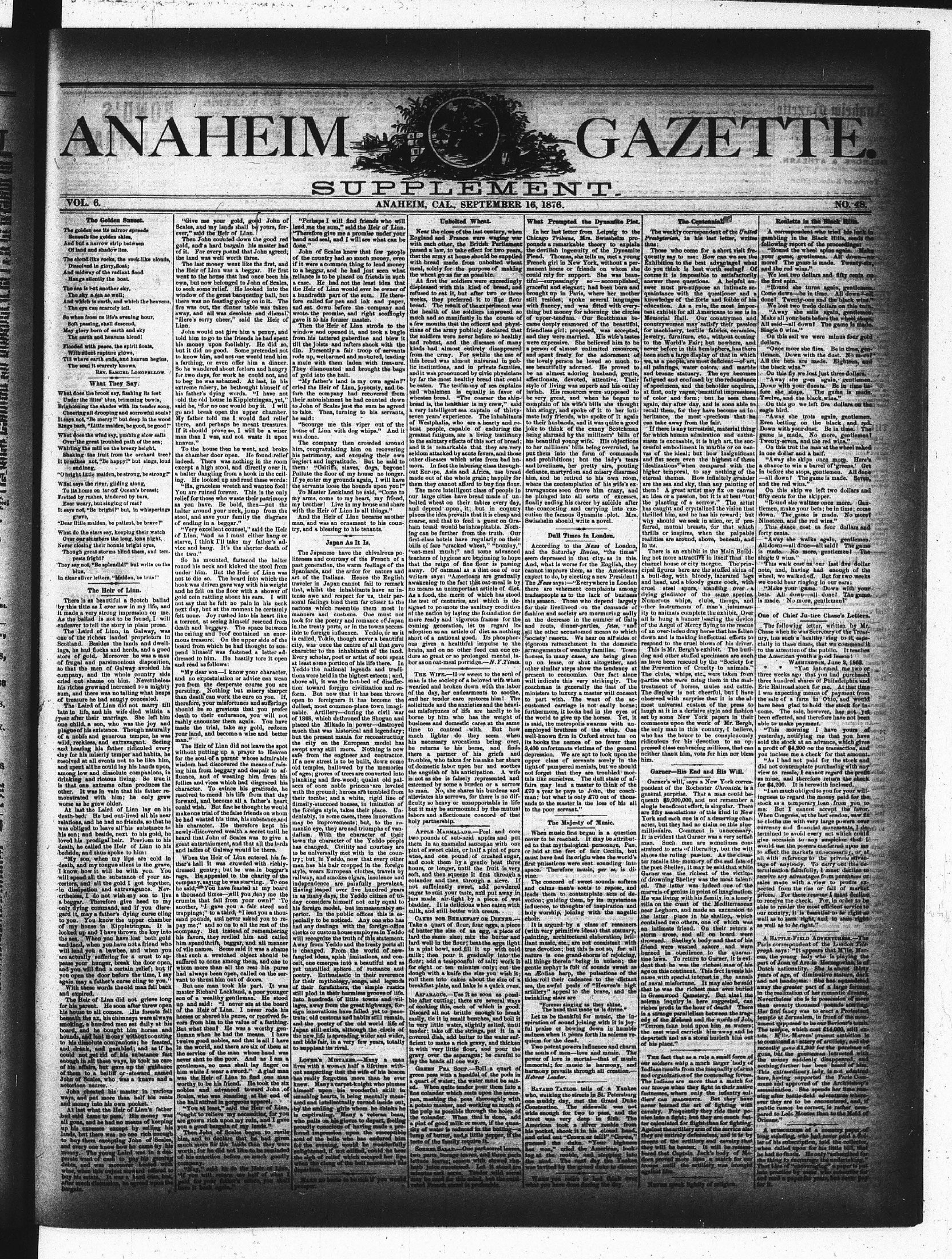
Searchable text
ANAHEIM
VOL. 6.
The Golden Sunset.
The golden sea its mirror spreads
Beneath the golden skies,
And but a narrow strip between
Of land and shadow lies.
The cloud-like rocks, the rock-like clouds,
Dissolved in glory, float;
And midway of the radiant flood
Hangs allently the boat.
The sea is but another sky,
The sky a sun as well;
And which is earth, and which the heavens,
The eye can scarcely tell.
So when from us life's evening hour,
Soft passing, shall descend,
May glory born of earth and sky
The earth and heavens blend!
Flooded with peace, the spirit floats,
With silent rapture glows,
Till where earth ends, and heaven begins,
The soul it scarcely knows.
Rev. Samuel Loxofellow.
What They Say:
What does the brook say, flashing its feet
Under the lilies' blue, brimming bowls,
Brightening the shades with its tender song,
Cheering all drooping and sorrowful souls?
It says not, "Be merry!" but deep In the wood
Rings back, "Little maiden, be good, be good!"
What does the wind say, pushing slow sails
Over the great troubled path of the sea;
Whirling the mill on the breezy height,
Shaking the fruit from the orchard tree?
It breathes not, "Be happy!" but sings, loud
and long.
"Give me your gold, good John of Scales, and my lands shall be yours, forever," said the Heir of Linn.
Then John counted down the good red gold, and a hard bargain his master had of it. For every pound that John agreed, the land was well worth three.
The last money went like the first, and the Heir of Linn was a beggar. He first went to the house that had once been his own, but now belonged to John of Scales, to seek some relief. He looked into the window of the great banqueting hall, but there was no feasting going on in it. The fire was out, the dinner table was taken away, and all was desolate and dismal. "Here's sorry cheer," said the Heir of Linn.
John would not give him a penny, and told him to go to the friends he had spent his money upon foolishly. He did so, but it did no good. Some pretended not to know him, and not one would lend him a farthing, or even offer him a dinner. So he wandered about forlorn and hungry for two days, for work he could not, and to beg he was ashamed. At last, in his extreme misery, he bethought himself of his father's dying words. "I have not old the old house in Kippletringan, yet," said he, "for no one would buy it. I will go and break open the upper chamber. My father told me I would find relief there, and perhaps he meant treasures. If it should prove so, I will be a wiser man than I was, and not waste it upon knaves."
To the house then he went, and broke the chamber door open. He found relief indeed. There was nothing in the room except a high stool, and directly over it,
"Perhaps I will find lend me the sum," said "Therefore give me a hand and seal, and I will done."
John of Scales knew of the country had so no if it were a common th to a beggar, and he reliance is to be placed a case. He had not th the Heir of Linn would a hundredth part of th fore called for pen and sat down before wrote the promise, and gave it to his former m Then the Heir of Linn window and opened it, from his tattered gaben till the joists and rafter din. Presently a fair rode up, well armed and a mule with them lad. They dismounted and of gold into the hall.
"My father's land is cried the Heir of Linn, fore the company had their astonishment he to John of Scales just to take. Then, turning he said:
"Scourge me this house of Linn with dog was done.
The company then him, congratulating his patrimony, and ex neglect and ingratitude them: "Caitiffs; slave
What They Say:
What does the brook say, flashing its feet
Under the lilies' blue, brimming bowls,
Brightening the shades with its tender song,
Cheering all drooping and sorrowful souls?
It says not, "Be marry!" but deep in the wood
Rings back, "Little malden, be good, be good!"
What does the wind say, pushing alow sails
Over the great troubled path of the sea;
Whirling the mill on the breezy height,
Shaking the fruit from the orchard tree?
It breathes not, "Be happy!" but sings, loud
and long,
"O bright little malden, be strong, be strong!"
What says the river, gliding along,
To its home on far-off Ocean's breast;
Fretted by rushes, hindered by bars,
Ever weary, but singing of rest?
It says not, "Be bright!" but, in whispering
grave,
"Dear little malden, be patient, be brave!"
What do the stars say, keeping their watch
Over our slumbers the long, lone night,
Never closing their bonnie bright eyes,
Though great storms blind them, and temppests fright?
They say not, "Be splendid!" but write on the
blue,
In clear silver letters, "Malden, be true!"
The Heir of Linn.
There is as beautiful a Scotch ballad
by this title as I ever saw in my life, and
it made a very strong impression on me.
As the ballad is not to be found, I will
endeaver to tell the story in plain prose.
The Laird of Linn, in Galway, was
one of the richest landed proprietors in Scotland.
Besides the lands and dwellings, he had flocks and herds, and a good store of gold.
Moreover he was a man of frugal and parsimonious disposition,
so that the men of Galway avoided his company, and the whole country side cried out shame on him.
Nevertheless his riches grew and increased to a mighty sum, and there was no telling what heaps of treasure he had sungly concealed.
The Laird of Linn did not marry till late in life, and his wife died within a year after their marriage. She left him one child, a son, who was the joy and plague of his existence. Though naturally of a noble and generous temper, he was wild, reckless, and extravagant. Seeing and hearing his father ridiculed every day for his miserly temper and habits, he resolved at all events not to be like him, and spent all he could lay his hands upon among low and dissolute companions, in drinking and riotous living. So true it is that one extreme often produces the other. It was in vain that his father remonstrated with him; he only grew worse as he grew older.
At last the Laird of Linn lay on his death-bed: He had out-lived all his near relations, and he had no friends, so that he was obliged to leave all his substance to his son; and beside, next to his gold, he loved his prodigal heir. Previous to his death, he called the Heir of Linn to his bedside, and thus spoke to him:
"My son, when my lips are cold in death, and my tongue silent in the grave,
I know how it will be with you. You will spend all the substance of your ancestors, and all the gold I got together,
in disillusion and extravagance."
When the Heir of Linn entered his father's hall it was crowded with richly-dressed gentry; but he was in beggar's rags. He appealed to the charity of the company, saying he was starving. To one he said: "You have feasted at my board for two days, for work he could not, and to beg he was ashamed. At last, in his extreme misery, he bethought himself of his father's dying words. "I have not old the old house In Kippletringan, yet," said he, "for no one would buy it. I will go and break open the upper chamber. My father told me I would find relief there, and perhaps he meant treasures. If it should prove so, I will be a wiser man than I was, and not waste it upon knaves."
To the house then he went, and broke the chamber door open. He found relief indeed. There was nothing in the room except a high stool, and directly over it, a halter dangling from a hook in the ceiling. He looked up and read these words:
"Ha, graceless wretch and wanton fool! You are ruined forever. This is the only relief for those who waste their patrimony as you have. Be bold, then—put the halter around your neck, jump from the stool, and save your family the disgrace of ending in a beggar."
"Very excellent counsel," said the Heir of Linn, "and as I must either hang or starve, I think I'll take my father's advice and hang. It's the shorter death of the two."
So he mounted, fastened the halter round his neck and kicked the stool from under him. But the Heir of Linn was not to die so. The board into which the hook was driven gave way with his weight and he fell on the floor with a shower of gold coin rattling about his ears. I will not say that he felt no pain in his neck next day, but at the moment he certainly felt none. Joy rushed into his heart like a torrent, at seeing himself rescued from death and beggary. The space between the ceiling and roof contained an enormous treasure. On the upper side of the board from which he had thought to suspend himself was fastened a letter addressed to him. He hastily tore it open and read as follows:
"My dear son—I know your character, and no expostulation or advice can wean you from the desperate course you are pursuing. Nothing but misfortunes and sufferings should be so grevious that you prefer death to their endurance; you will not rushly encounter them again. You have made the trial, take my gold, redeem your land, and become a wise and better man."
The Heir of Linn did not leave the spot without putting up a prayer to Heaven for the soul of a parent whose admirable wisdom had discovered the means of raising him from beggary and despair to affluence, and of weaning him from his follicles and vices which had disgraced his character. To evince his gratitude, he resolved to mend his life from that day forward, and become all a father's heart could wish. But first he thought he would make one trial of the false friends on whom he had wasted his time, his substance,and his character. He therefore kept his newly-discovered wealth a secret until he heard that John of Scales was to give a great entertainment, and that all the lords and ladies of Galway would be there.
When the Heir of Linn entered his father's hall it was crowded with richly-dressed gentry; but he was in beggar's rags. He appealed to the charity of the company, saying he was starving. To one he said: "You have feasted at my board for two days, for work he could not, and to beg he was ashamed. At last, in his extreme misery, he bethought himself of his father's dying words. "I have not old the old house In Kippletringan, yet," said he, "for no one would buy it. I will go and break open the upper chamber. My father told me I would find relief there, and perhaps he meant treasures. If it should prove so, I will be a wiser man than I was, and not waste it upon knaves."
So he mounted, fastened the halter round his neck and kicked the stool from under him. But the Heir of Linn was not to die so. The board into which the hook was driven gave way with his weight and he fell on the floor with a shower of gold coin rattling about his ears. I will not say that he felt no pain in his neck next day, but at the moment he certainly felt none. Joy rushed into his heart like a torrent, at seeing himself rescued from death and beggary. The space between the ceiling and roof contained an enormous treasure. On the upper side of the board from which he had thought to suspend himself was fastened a letter addressed to him. He hastily tore it open and read as follows:
"My dear son—I know your character, and no expostulation or advice can wean you from the desperate course you are pursuing. Nothing but misfortunes and sufferings should be so grevious that you prefer death to their endurance; you will not rushly encounter them again. You have made the trial, take my gold, redeem your land, and become a wise and better man."
The Japanese have this liteness and courtesy of past generation, the war Spanishards, and the ardor of the Italians. He traveler in Japan cannibalize feelings bind their nations which resemble manners and customs look for the poetry and in the treaty ports or in able to foreign influence is called; Tokio, though city was once the central character to the inhabited Every scholar, poet or at least some portion of Yedo-the national leagues were held in the high above all; it was the hot toward foreign form. But now that it is open to foreigners it dullest most commonable.
Artillery—during 1868, which dethroned placed the Mikado in much that was historic but the present mania in the city on Europe swept away still more safe from the engineers.
If a new street is to be built temples,hallowed of ages;groves of trees planking and fire-wood acres of once noble prairie with the ground;heroes their tombs;and a whimsily-stuccoed housethe foreign style,takes deniably,在some cases,may be improvementsmantic eye,they are sad dalism.With the chin townthe character of has changed.Civilityto be universally met try;but in Yedo,now man has his hair cropped style,wears European railway,and smokes cigar independence are paid.Having leaved over
It was in vain that his father remonstrated with him; he only grew worse as he grew older.
At last the Laird of Linn lay on his death-bed: He had out-lived all his near relations, and he had no friends, so that he was obliged to leave all his substance to his son; and beside, next to his gold, he loved his prodigal heir. Previous to his death, he called the Heir of Linn to his bedside, and thus spoke to him:
"My son, when my lips are cold in death, and my tongue silent in the grave, I know how it will be with you. You will spend all the substance of your ancestors, and all the gold I got together, in dissipation and extravagance. Nevertheless, I do not wish my son to live a beggar. Therefore give heed to my only dying command, and if you disregard it, may a father's dying curse cling to you. You know the upper chamber of my house in Kippletringan. It is locked up and I have thrown the key into the sea. When you have lost both gold and land, when you have not a friend who will lend you a bawbee, and when you are actually suffering for a crust to appease your hunger, break the door open, and you will find a certain relief; but if you open the door before the time, I say again may a father's curse cling to you."
With these words the old man fell back and expired.
The Heir of Linn did not grieve long for his parent. He soon after threw open his house to all comers. His forests fell beneath the ax, his chimneys were always smoking, a hundred men sat daily at his board, and he bought him horses and hounds, and lent money without counting to his dissolute companions; he feasted, and drank, and gambled; and as if he could not get rid of his substance fast enough in all these ways, he took no care of his affairs, but gave up the guidance of them to a bailiff or-steward named John of Scales, who was a knave and a notorious naurer.
John cheated his master in various ways, and put more than half his reats and money into his own pocket.
At last what the Heir of Linn's father had said came to pass. His money was all gone, and he had no means of keeping up his excesses except by selling his lands, but there was no one rich enough to buy them excepting John of Scales, and every one knew how he came by his money. The young Laird was in a desperate want of cash to pay his gaming debts, and was moreover heated with wine, when this unjust steward offered to buy his estate. It was a hard case, but after much discussion, he agreed upon the bargain.
When the Heir of Linn entered his father's hall it was crowded with richly-dressed gentry; but he was in beggar's rags. He appealed to the charity of the company, saying he was starving. To one he said, "You have feasted at my board a thousand times—will you deny me the crumbs that fall from your own?" To another, "I gave you a fair steed and trappings;" to a third, "I lent you a thousand pounds, and never asked you to repay me;" and so on to all the rest of the company. But instead of remembering his favors, they reviled him and called him spendthrift, beggar, and all manner of vile names. Some said it was a shame that such a wretched object should be suffered to come among them, and one to whom more than all the rest his purse had always been open, called on the servant to thrust him out of doors.
But one man took his part. It was master Richard Lackland, a poor younger son of a wealthy gentleman. He stood up and said: "I never ate at the board of the Heir of Linn. I never rode his horses or shared his purse, or received favors from him to the value of a farthing. But what then? He was a worthy gentleman when he had the means. I have twelve good nobles, and that is all I have in the world, and there are six of them at the service of the man whose hand was never shut to the poor. And as I am a gentleman, no man shall lay finger on him while I wear a sword." A glad man was the Heir of Linn to find one man worthy to be his friend. He took the six nobles and advanced toward John of Scales, who was standing at the end of the hall attried in gorgeous apparel.
"You at least," said the Heir of Linn, "ought to relieve my necessities, for you are grown rich upon my ruin, and I gave you a good bargain of my lands."
Then John of Scales began to revile him, and to declare that he had given much more for the lands than they were worth; for he did not like to be reminded of his extortion before so much goodly company.
"May," said he to the Heir of Linn, "if you will return me half of what I paid for your father's goods, you shall have it back again."
IM GAZ
SUPPLEMENT.
ANAHEIM, CAL., SEPTEMBER 16, 1876.
"Perhaps I will find friends who will lend me the sum," said the Heir of Linn. "Therefore give me a promise under your hand and seal, and I will see what can be done."
John of Scales knew that few people of the country had so much money, even if it were a common thing to lend money to a beggar, and he had just seen what reliance is to be placed on friends in such a case. He had not the least idea that the Heir of Linn would ever be owner of a hundredth part of the sum. He therefore called for pen and ink and paper, and sat down before the company and wrote the promise, and right scoffingly gave it to his former master.
Then the Heir of Linn strode to the window and opened it, and took a bugle from his tattered gaberdine and blew it till the joists and rafters shook with the din. Presently a fair troop of servants rode up, well armed and mounted, leading a mule with them laden with treasure. They dismounted and brought the bags of gold into the hall.
"My father's land is my own again!" cried the Heir of Linn, joyously, and before the company had recovered from their astonishment he had counted down to John of Scales just the sum he agreed to take. Then, turning to his servants, he said:
"Scourge me this viper out of the house of Linn with dog whips." And it was done.
The company then crowded around him, congratulating him on recovering his patrimony, and excusing their own neglect and ingratitude. But he said to them: "Caittifa, slaves, dogs, begone!"
Unbolted Wheat.
Near the close of the last century, when England and France were waging war with each other, the British Parliament passed a law, to take effect for two years, that the army at home should be supplied with bread made from unbolted wheat meal, solely for the purpose of making the wheat go as far as possible.
At first the soldiers were exceedingly displeased with this kind of bread, and refused to eat it, but after two or three weeks, they preferred it to fine flour bread. The result of the experiment was the health of the soldiers improved so much and so manifestly in the course of a few months that the officers and physicians of the army publicly declared that the soldiers were never before so healthy and robust, and the diseases of many kinds had almost entirely disappeared from the army. For awhile the use of this bread was almost universal in public institutions, and in private families, and it was pronounced by civic physicians by far the most healthy bread that could be eaten. The testimony of sea captains and whalemen is equally in favor of wheaten bread. "The coarser the ship-bread is, the healthier is my crew," said a very intelligent sea captain of thirty-seven years' experience. The inhabitants of Westphalia, who are a hearty and robust people, capable of enduring the greatest fatigues, are a living testimony to the salutary effects of this sort of bread; and it is remarkable that they are very seldom attacked by acute fevers, and those other diseases which arise from bad humors. In fact the laboring class through-
What Prompted the Dynamic Plot.
In her last letter from Leipzig to the Chicago Tribune, Mrs. Swisshelm propounds a remarkable theory to explain the devilish ingenuity of the Dynamite Fiend. Thomas, she tells us, met a young French girl in New York, without a permanent home or friends on whom she could rely for support. She was beautiful—surpassingly so—accomplished, graceful and elegant; had been born and brought up in Paris, where her mother still resides; spoke several languages with fluency, and was fitted with everything but money for adorning the circles of upper-tendum. Our Scotchman became deeply enamored of the beautiful, friendless girl; proposed, was accepted, and they were married. His wife's tastes were expensive. She believed him to be a person of almost unlimited resources, and spent freely for the adornment of the lovely person he loved so much to see beautifully adorned. He proved to be an almost aloring husband, gentle, affectionate, devoted, attentive. Their style of living was superb and his outlay lavish. His resources were supposed to be very great, and when he began to complain of his wife's bills she thought him stingy, and spoke of it to her intimate lady friends, who spoke of it again to their husbands, and it was quite a good joke to think of the canny Scotchman being alarmed by the milliners' bills of his beautiful young wife. His objections to her milliners' bills being overruled, he put them into the form of commands and prohibitions; but the lady's tears and loveliness, her pretty airs, pouting
The week Presbyterian thus:
Those wqnquently sai Exhibition do you thik course it i answer tha weer must quaintance knowledge education tant exhibit Memorial countryworl for machin jewelry,fu to the Wo never before been such as we,a pa oil painting and bronze fatigued an specimen at first on color oi again,day recall them heritance,can take av If there i for which siasm is execessful emblasm vas of thie and flat se idealization
"My father's land is my own again!" cried the Heir of Linn, joyously, and before the company had recovered from their astonishment he had counted down to John of Scales just the sum he agreed to take. Then, turning to his servants, he said:
"Scourge me this viper out of the house of Linn with dog whips." And it was done.
The company then crowded around him, congratulating him on recovering his patrimony, and excusing their own neglect and ingratitude. But he said to them: "Oaittifs, slaves, dogs, begone! Pollute the floor of my house no longer. If ye enter my grounds again, I will have the servants loose the hounds upon you!" To Master Lackland he said, "Come to my arms, come to my heart, my friend, my brother! Live in my house and share with the Heir of Linn in all things."
And the Heir of Linn became another man, and was an ornament to his country, and a blessing to his tenants.
Japan As It Is.
The Japanese have the chivalrous politeness and courtesy of the French of a past generation, the warm feelings of the Spaniards, and the ardor for nature and art of the Italians. Hence the English traveler in Japan cannot fail to remark that, whilst the inhabitants have an intense awe and respect for us, their personal feelings bind them far closer to the nations which resemble them most in manners and customs. One must not look for the poetry and romance of Japan in the treaty ports, or in the towns accessible to foreign influence. Yeddo, or as it is called, Tokio, though never a beautiful city, was once the centre of all that gave character to the inhabitants of the land. Every scholar, poet or artist of note spent at least some portion of his life there. In Yeddo the national legends and traditions were held in the highest esteem; and, above all, it was the hot-bed of disaffection toward foreign civilization and reform. But now that it has been thrown open to foreigners it has become the dullest, most common-place town imaginable. Artillery—during the civil war of 1888, which dethroned the Shogun and placed the Mikado in power—destroyed much that was historical and legendary; but the present mania for reconstructing the city on the European model has swept away still more. Nothing is now safe from the engineer and contractor. If a new street is to be built, down come old temples, hallowed by the memories of ages; groves of trees are converted into planking and fire-wood; quaint old palaces of once noble princes are leveled with the ground; heroes are tumbled from their tombs; and a white, rigid line of flimsily-stuccoed houses, in imitation of the foreign style, takes their place. Undeniably, in some cases, these innovations may be improvements; but, to the romantic eye, they are sad triumphs of vanalism. With the character of their town the character of the Yeddo people has changed. Civility and courtesy are to be universally met with in the country; but in Yeddo, now that every other man has his hair cropped in the foreign style, wears European clothes, travels by railway, and smokes cigars, insolence and independence are painfully prevalent. Having learned over five hundred years
THE WIFE—How sweet to the soul of man is the society of a beloved wife when wearied and broken down with the labor of the day, her endearments to soothe, and her tender care restores him! The solicitude and the anxieties and the heaviest misfortunes of life are hardly to be borne by him who has the weight of business and domestic cares at the same time to contend with. But how much lighter do they seem when his necessary avocations being over, he returns to his home, and finds there a partner of his griefs and troubles, who takes for his sake her share of domestic labor upon her and soothes the anguish of his anticipation. A wife is not as she is falsely represented and esteemed by some a burden or a sorrow to man. No, she shares his burdens and alleviates his sorrows, for there is no difficulty so heavy or unsupportable in life but it may be surmounted by the mutual labors and affectionate concord of that holy partnership.
APPLE MARMALADE—Peel and core two pounds of sub-acid apples and put them in an enameled saucepan with one pint of sweet cider, or half a pint of pure wine, and one pound of crushed sugar, and cook them by a gentle heat three hours, or longer, until the fruit is very soft, and then squeeze it first through a colander and then through a sieve. If not sufficiently sweet, add powdered oil to far the most healthy bread that could be eaten. The testimony of sea captains and whalemen is equally in favor of wheaten bread. "The coarser the shipbread is, the healthier is my crew," said a very intelligent sea captain of thirty-seven years' experience. The inhabitants of Westphalia, who are a hearty and robust people, capable of enduring the greatest fatigues, are a living testimony to the salutary effects of this sort of bread; and it is remarkable that they are very seldom attacked by acute fevers, and those other diseases which arise from bad humors. In fact the laboring class throughout Europe, Asia and Africa, use bread made out of the whole grain; happily for them they cannot afford to buy fine flour.
The more intelligent class of people in our large cities have bread made of unbolted wheat on their tables every day, and depend upon it; but in country places the idea prevails that it is cheap and coarse, and that to feed a guest on Graham bread would be inhospitable. Nothing can be further from the truth. Our first-class hotels have regularly on their bills of fare "cracked wheat," "hominy," "oat-meal mush;" and some advanced teachers of hygiene are beginning to hope that the reign of fine flour is passing away. Of oatmeal as a diet one of our writers says: "Americans are gradually awakening to the fact this oat-meal is by no means an unimportant article of diet. As a food, the merit of which has stood the test of centuries, and which is designed to promote the sanitary condition of the nation by laying the foundation for more ready and vigorous frames for the coming generation, let us regard its adoption as an article of diet as nothing short of a national good. Its phosphorus gives a healthful impulse to the brain, and on no other food can one endure so great or so prolonged mental labor as on oat-meal porridge." N.Y.Times.
THE WIFE—How sweet to the soul of man is the society of a beloved wife when wearied and broken down with the labor of the day, her endearments to soothe, and her tender care restores him! The solicitude and the anxieties and the heaviest misfortunes of life are hardly to be borne by him who has the weight of business and domestic cares at the same time to contend with. But how much lighter do they seem when his necessary avocations being over, he returns to his home, and finds there a partner of his griefs and troubles, who takes for his sake her share of domestic labor upon her and soothes the anguish of his anticipation. A wife is not as she is falsely represented and esteemed by some a burden or a sorrow to man. No, she shares his burdens and alleviates his sorrows, for there is no difficulty so heavy or unsupportable in life but it may be surmounted by the mutual labors and affectionate concord of that holy partnership.
Dull Times in London.
According to the News of London, and the Saturday Review,"the times" seem depressed in that city as in this. And what is worse for the English, they cannot improve them, as the Americans expect to do, by electing a new President! The News says:—"Everywhere in London there are vehement complaints among tradespeople as to the lack of business this season. Those who depend largely for their livelihood on the demands of fashion and society are murmuring sadly at the decrease in the number of calls and routs, dinner-parties, fetes, and all the other accustomed means to which society' resorts. We hear on all sides of vigorous retrenchment in the domestic arrangements of wealthy families. Town houses, in many cases, are being given up on lease, or shut altogether, and other similar steps show the tendency at present to economize. One fact alone will indicate this very strikingly. The coachman is generally the last of the ministers to luxury a master will consent to part with. The want of the accustomed carriage is not easily borne; furthermore, it looks bad in the eyes of the world to give up the horses. Yet, it is said, the metropolis swarms with unemployed brethren of the whip. One well-known firm in Oxford street has on its books the names of no fewer than 2,400 unfortunate victims of the general depression. We are apt to look upon the upper class of servants sorely in light of pampered menials, but we should not forget that they are troubled mortals like ourselves.
The dull state of affairs may lead a master to think of the £70 a year he pays to John, the coachman; but what is only £70 out of thousands to the master is the loss of his all to the poor servant."
The Majesty of Music.
When music first began is a question never to be reached. It may be attributed to that mythological personage Pan, or laid at the feet of fair Cecilia, but must have had its origin when the world's first pulsations were sent sounding into space. Therefore music per se is divine.
The concord of sweet sounds softens and calm's men's souls to repose,and bronze-fatigued at specimen at first onlyof colorand flat sexidealizationhigher temeralthesearethesea them! A planideaandtheplantinhas caughthim thrilledhim whyshouldferred,mustthrillorsorrealitiesinusin.
Thereisingnotmostchannelhoucipicalfiguresbulldogandhead,a cruelsteaddyglidingNumerousotherinstructiontoanimallishungoftheAngelofanoverlowdownandrespondtothemisternaturethamithem!
ThisisM DogandothashavebeenThePreventTheclubspartieswhotreatmentThedisplayobservewithmuistlaughatitsetbysomecommentsontheonlymanwhohastheridiculouspressedclassneitherthamithemisternaturethamithem!
Garner-Garner'spendentgowngeneralturquethoughtqealthq90singlebenefitarefiftyassayYorkandeasterbutthemillionaireItisevidentman.SuchstrainedtoshowtheretralstheworldrecallsthetpoetSheGarnerwasdrownedinEd.
with the ground; heroes are tumbled from their tombs; and a white, rigid line of climsily-stucced houses, in imitation of the foreign style, takes their place. Undeniably, in some cases, these innovations may be improvements; but, to the rantic eye, they are sad triumphs of vandalism. With the character of their town the character of the Yeddo people has changed. Civility and courtesy are to universally met with in the country; but In Yeddo, now that every other man has his hair cropped in the foreign style, wears European clothes, travels by railway, and smokes cigars, insolence and independence are painfully prevalent. Having leaped over five hundred years in as many days, the Yeddo citizen of today considers himself not only equal to his foreign model, but immeasurably superior. In the public offices this is especially to be noticed. Any one who has had any dealings with the foreign-office clerks or custom house employees in Yeddo will recognize the truth of this statement. Away from Yeddo and the treaty ports all is changed. From the world of new-fangled ideas, apish imitations, and conceit, one emerges into a beautiful and as yet unsullied sphere of romance and poetry. Enthusiastic in their reverence for their mythology, songs, and legends of their forefathers, the simple rustics still plod in their harmless groove of life. Into hundreds of little towns and villages, away from the great highways, foreign innovations have failed yet to penetrate; old customs and habits still remain, and the poetry of the old world life of Japan still exists, although the circle of the new life is spreading wider and wider, and bids fair, in a very few years, totally to supplant its rival.
LOVER'S MISTAKES—Many a man lives with a woman half a lifetime without suspecting that the wife of his bosom has really forgotten more than he ever knew. Many a carpet-knight who plumes himself upon his wonderful skill in smashing hearts, is being mentally measured and intellectually turned inside out, by the smiling girls whom he thinks he is captivating. Many a veteran bean, who pulls on his gloves to depart, feeling proudly conscious of having made a profound impression upon the susceptible soul of the halls who has endured him for the evening, would be wonderfully sighled, if not adlited, could he hear the sigh of railid which escaped her lips when she eldged the hall announced his departure.
MANAS HOME IS BUURH IF YOU WOULD GROW.
APPLE MARMALADE—Peel and core two pounds of sub-acid apples and put them in an enameled saucepan with one pint of sweet cider, or half a pint of pure wine, and one pound of crushed sugar, and cook them by a gentle heat three hours, or longer, until the fruit is very soft, and then squeeze it first through a colander and then through a sieve. If not sufficiently sweet, add powdered sugar to suit your taste, and put away in jars made air-tight by a piece of wet bladder. It is delicious when eaten with milk, and still better with cream.
CAKES FOR BREAKFAST OR DINNER.—Take a quart of flour, four eggs, a piece of butter the size of an egg, a piece of lard the same size; mix the butter and lard well in the flour; beat the eggs light in a pint bowl, and fill it up with cold milk; then pour it gradually into the flour; add a teaspoonful of salt; work it for eight or ten minutes only; cut the dough with a knife the size you wish it; roll them into cakes about the size of a breakfast plate, and bake in a quick oven.
APPARAGUS.—Use it as soon as possible after cutting; there are several ways of cooking this, each of which is good. Discard all not brittle enough to break easily, tie it in small bunches, and boil it in very little water, slightly salted, until tender; take off the strings, put it in a covered dish, add butter to the water sufficient to make a rich gravy, and thicken it with very little flour, and pour the gravy over the asparagus; be careful to lay the heads all one way.
GREEN PEA SOUP.—Boil a quart of green peas with a handful of the pods in a quart of water; the water must be salted. When quite tender pour them into a fine colander which rests upon the saucepan, mashing the peas thoroughly with a potato masher, and working as much of the pulp as possible through the holes of the colander. When that is done, add a pint of good milk or more, if the quantity of water is reduced in the boiling—a lump of butter, and a little pepper, if the taste of the family require it.
SOREN SALAD—One part savour leaves two parts storage leaves, and three parts lettuce leaves; seasons with stirred shunbär juices sustained. Let it stand ten minutes and serve. Tender wild sorrel may be used for this salad; let the cultivated Fennah sorrel is predable.
THE Majesty of Music.
When music first began is a question never to be reached. It may be attributed to that mythological personage, Pan, or laid at the feet of fair Cecilia, but must have had its origin when the world's first pulsations were sent sounding into space. Therefore music, per se, is divine.
The concord of sweet sounds softens and calms men's souls to repose, and leads them to contemplate acts of devotion; guiding them, by its mysterious influence, to thoughts of inspiration and holy worship, joining with the angelic choir.
It is argued by a class of reasoners (with very primitive ideas) that statuary, painting, architectural elaboration, brilliant music, etc., are not consistent with true devotion; but this is not so, for all nature is one grand-echoes of rejoicing, all things therein being in union; the gentle zephyr is full of sounds sweet as an Eolian harp; the pulsations of the tides roll their cadences to the distant sea; the awful peals of "Heaven's high artillery" appeal to the brave, and the twinkling stars are
"Forever singing as they shine," The hand that made us is divine.
Let us thankful for music, the inspiration of sound joining with it in joyful praise or bowing down in humble sadness when it pours forth its solemn requiem for the dead.
Two potent powers influence and charm the souls of men—love and music. The power of love is mortal—that of music immortal; for music is harmony, and harmony prevails through all creation.
HEBREW LEADER.
BAYARD TAYLOR tells of a Yankee who, walking the streets in St. Petersburg one muddy day, met the Grand Duke Constantine. The sidewalk was not wide enough for two passes, and the street was very deep in fifth. The American took a silver double from his pocket, shook it in his cloud hand, and cried out "Crown or tail!" "Crown," grinned the duke. "Your highness has won," cried the American, looking at the rebel, and stepping into the mind. The next day the Yankee was inviled by the grand date in dinner.
When you return to bed think over what you have done during the day.
GAZETTE.
NO. 48.
Dynamite Plot.
Leipsig to the Swisshelm provory to explain of the Dynamite
us, met a young
without a person whom she
She was beaaccomplished,
been born and
where her mother
several languages
settled with everymning the circles
Scotchman beof the beautiful,
was accepted,
His wife's tastes
believed him to be
limited resources,
adornment of
so much to
He proved to
unaband, gentle,
attentive. Their
and his outlay
are supposed to
he began to
she thought
it to her intitoke of it again
was quite a good
any Scotchman
inners' bills of
His objections
again overruled, he
of commands
the lady's tears
airs, pouting
The Centennial.
The weekly correspondent of the United Presbyterian, in his last letter, writes thus:
Those who come for a short visit frequently say to me: How can we see the Exhibition to the best advantage! what do you think is best worth seeing? Of course it is impossible to satisfactorily answer these questions. A helpful answer must pre-suppose an intimate acquaintance with the questioner and a knowledge of the forte and foible of his education. As a rule, the most important exhibit for all Americans to see is in Memorial Hall. Our countrymen and countrywomen may satisfy their passion for machinery, textile fabrics, ceramics, jewelry, furniture, etc., without coming to the World's Fair; but nowhere, and never before in this hemisphere, has there been such a large display of that in which we, as a people, are most deficient—of art, oil paintings, water colors, and marble and bronze statuary. The eye becomes fatigued and confused by the redundance of specimens, and the beholder acquires, at first, only vague, beautiful impressions of color and form; but he sees them again, day after day, and is soon able to recall them, for they have become an inheritance, the most precious that he can take away from the fair.
If there is any terrestrial, material thing for which human admiration and enthusiasm is excusable, it is high art, the successful embodiment in marble or on canvas of the ideal; but how insignificant and flat seem even the highest of these idealizations when compared with the
Roulette in the Black Hills.
A correspondent who tried his luck in gambling in the Black Hills, sends the following report of the proceedings:
"Round the wheel spins again. Make your game, gentlemen. All down—no more! The game is made. Twenty-sir, and the red wins."
We lost two dollars and fifty cents on the first spin.
"Round she turns again, gentlemen. Come down—be in time. All down—all done! Twenty-one and the black wins."
We lost two trade dollars on this turn.
"Away she smiles again, gentlemen. Make all your bets before the wheel stops. All said—all down! The game is made. Single 0 wins."
On this sail we were minus four gold dollars.
"Once more she flies. Be in time, gentlemen. Down with the dust. No more! All the bets are made. Eighteen, and the black wins."
On this fly we lost just three dollars.
"Away she goes again, gentlemen. Down with your dares. Be in time before she stops. The game is made. Twelve, and the black wins."
On this go we left five dollars on the eagle bird.
"Away she trots again, gentlemen. Even betting on the black and red. Down with your dust. Be in time. The game is made. No more, gentlemen! Twenty-seven, and the red wins."
On this trot the man at the wheel raked in one dollar and a half.
"Away she skips once more. Here's a chance to win a barrel of 'greens.' Get
and bronze statuary. The eye becomes fatigued and confused by the redundance of specimens, and the beholder acquires, at first, only vague; beautiful impressions of color and form; but he sees them again, day after day, and is soon able to recall them, for they have become an inheritance, the most precious that he can take away from the fair.
If there is any terrestrial, material thing for which human admiration and enthusiasm is excusable, it is high art, the successful emboliment in marble or on canvas of the ideal: but how insignificant and flat seem even the highest of these idealizations when compared with the higher temporal, to say nothing of the eternal themes. How infinitely grander are the sea and sky, than any painting of them! A great artist may fix on canvas an idea or a passion, but it is at best "but the planting of a sorrow." The artist has caught and crystallized the vision that thrilled him, and he has his reward; but why should we seek in allen, or, if preferred, mutual breasts, for that which thrills or inspires, when the palpable realities are around, above, beneath, and in us.
There is an exhibit in the Main Building not more attractive in itself than the channel house or city morgue. The principal figures here are the stuffed skins of a bull-dog, with bloody, lacerated legs and head, and a bloody game cock, with cruel steel spurs, standing over a dying gladiator of the same species. Numerous whips, clubs, thongs, and other instruments of man's humanity to animals complete the exhibit. Over all is hung a banner bearing the device of the Angel of Mercy flying to the rescue of an over-laden dray horse that has fallen down and is making ineffectual efforts to respond to the cruel blows of his driver.
This is Mr. Bergh's exhibit. The bulldog and other stuffed specimens are such as have been rescued by the "Society for the Prevention of Cruelty to animals."
The clubs, whips, etc., were taken from parties who were using them in the maltreatment of horses, mules and cattle. The display is not cheerful, but I have observed with surprise that it is the almost universal custom of the press to laugh at it in a derisive style and fashion set by some New York papers in their comments upon the work of Mr. Bergh, the only man in this country, I believe, who has the honor to be conspicuously ridiculous for his devotion to an oppressed class embracing millions, that can neither thank him, votes for him nor bless him.
Garner—His End and His Will.
Garner's will says a New York correspondent of the Rochester Chronicle, is a general surprise. That a man could be queath $9,000,000, and not remember a single beneficent effort, is singular. There are fifty associations of this kind in New York and each one is of a deserving character, but they had no claim on this nine-millionaire. Comment is unnecessary. It is evident that Garner was a very selfish man. Such men are sometimes constrained to acts of liberality, but the will shows the ruling passion. As the disaster recalls the memory of the sad fate of the poet Shelley, it may be said that while Garner was the richest of the victims of drowning Shelley was the most talented. The latter was indeed one of the On this fly we lost just three dollars.
"Away she goes again; gentlemen. Down with your deeds. Be in time before she stops. The game is made. Twelve, and the black wins."
On this go we left five dollars on the eagle bird.
"Away she trots again; gentlemen. Even betting on the black and red. Down with your dust. Be in time. The game is made. No more; gentlemen! Twenty-seven, and the red wins."
On this trot the man at the wheel raked in one dollar and a half.
"Away she skips once more. Here's a chance to win a barrel of greens.' Get in before she stops; gentlemen. All done—all down! The game is made. Seven, and the red wins."
On this skip we left two dollars and fifty cents for the skipper.
"Round she waltzes once more. Gentlemen, make your bets; be in time; come down. The game is made. No more! Nineteen, and the red wins."
This dance cost us four dollars and forty cents.
"Away she walks again; gentlemen. All down—all done—all said! The game is made. No more; gentlemen! The single 0 wins."
This walk cost us our last five dollar note, and having had enough of the wheel, we walked off. But for two weeks we could hear ringing in our ears:
"Make your game. Down with your bets. All down—all done! The game is made. No more; gentlemen!"
One of Chief Ju-tice Chase's Letters.
The following letter, written by Mr. Chase when he was Secretary of the Treasury, has such a healthy ring to it, especially in these times, that we command it to the attention of the public. It teaches the American youth a good lesson:
WASHINGTON, June 2, 1863.
"You informed me two or three weeks ago that you had purchased three hundred shares of Philadelphia and Erie Railroad stock for me. At that time I was expecting means of payment from the sale of a farm in Ohio, and would have been glad to hold the stock in income. The sale, however, has not yet been effected, and therefore have not been able to make payment.
This morning I have yours of yesterday, notifying me that you have sold the stock at an advance, which gives a profit of $4,200 on the transaction, and you inclose me a check for that amount.
As I had not paid for the stock and did not contemplate purchasing with any view to resale, I cannot regard the profit as mine, and therefore return the check for $4,200. It is herewith inclosed.
"I am much obliged to you for your willingness to regard the money paid for the stock as a temporary loan from you to me. But I cannot accept the favor. When Congress, at the last session, saw fit to clothes me with very large powers over currency and financial movements, I determined to avoid every act which could give occasion to any suspicion that I would use the powers concerned upon me to affect the markets unnecessarily, or at all with reference to the private advantage of anybody. To carry out this determination faithfully, I must decline to receive any advantages from purchases or sales made with a view to profits expected from rise or fall of market..."
A BATTLE-FIELD ADVENTURES—The Paris correspondent of the London Telegraph says: "It appears that Mlle. Marcus, the young lady who is playing the part of Joan of Arc in Hernagovina, is of Dutch nationality. She is about thirty years of age, of diminutive stature, dark and not handsome. She has squandered away the greater part of a large fortune in the realization of her romantic dreams. Nevertheless she is in possession of more than seventy thousand pounds sterling. Her first fancy was to erect a Protestant temple at Jerusalem, in front of the monument supposed to be our Saviour's tomb. The temple, which cost £14,000, still exists. Mlle. Marcus' present ambition is to command a artillery, and she recently gave £1,200 for the purchase of guns, but the gentleman intrusted with the money suddenly disappeared, and nothing further has been heard of him. This extraordinary lady is not admitted here, having supported the Paris Commune and approved of the Archbishop's assassination. She spends her time running after battle-field adventures wherever they are to be encountered, and, if public rumor be correct, is rather compared to Lola Monten than to the Maid of Orlans."
A manuscript of a country paper of longstanding, who had never paid a dollar of his subscription, told the collector, when called upon for his little bill, that he had no funds. He only subscribed for the thing to encourage the undertaking." That kind of "encouraging" a paper is put into practice by some who subscribe for and mail a paper five years, but never pay for it.