anaheim-gazette 1876-09-16
Scanned page
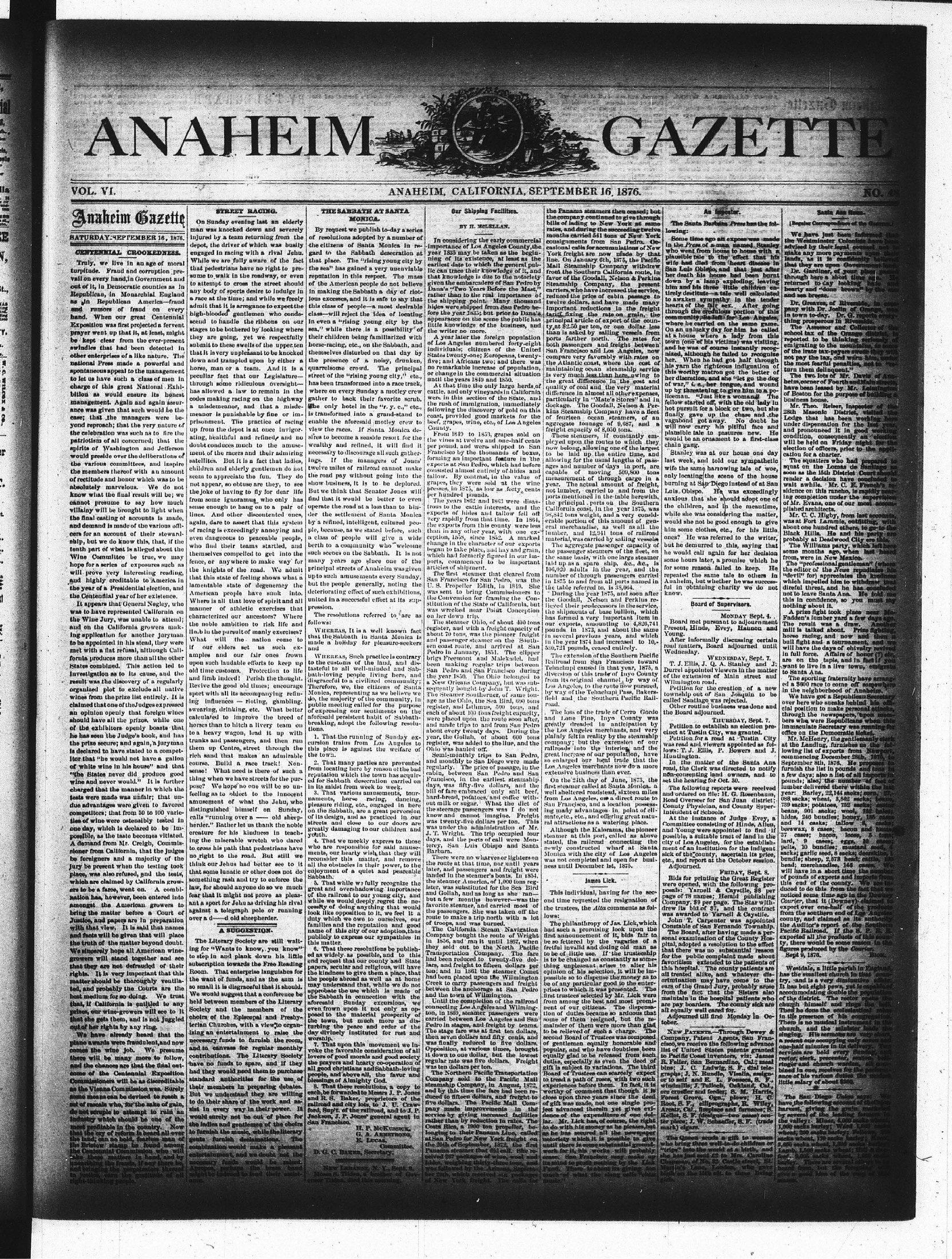
Searchable text
ANAHEIM
VOL. VI.
Anaheim Gazette
SATURDAY SEPTEMBER 16, 1876.
CENTENNIAL CROOKEDNESS.
Truly, we live in an age of moral turpitude. Fraud and corruption prevail on every hand, in Government and out of it, in Democratic counties as in Republican, in Monarchial England as in Republican America—fraud and rumors of fraud on every hand. When our great Centennial Exposition was first projected a fervent prayer went up that it, at least, might be kept clear from the ever-present swindles that had been detected in other enterprises of a like nature. The national Press made a powerful and spontaneous appeal to the management to let us have such a class of men in charge of this great National Exhibition as would ensure its honest management. Again and again assurance was given that such would be the case; that the managers were beyond reproach; that the very nature of the celebration was such as to fire the patriotism of all concerned; that the spirits of Washington and Jefferson would preside over the deliberations of the various committees, and inspire
STREET RACING.
On Sunday evening last an elderly man was knocked down and severely injured by a team returning from the depot, the driver of which was busily engaged in racing with a rival Jehn. While we are fully aware of the fact that pedestrians have no right to presume to walk in the roadway, or even to attempt to cross the street should any body of sports desire to indulge in a race at the time; and while we freely admit that it is arrogance to expect the high-blooded gentlemen who condeceend to handle the ribbons on our stages to be bothered by looking where they are going, yet we respectfully submit to these swells of the upper ten that it is very unpleasant to be knocked down and trampled upon by either a horse, man or a team. And it is a peculiar fact that our Legislature—through some ridiculous oversight—has allowed a law to remain in the codes making racing on the highway a misdemeanor, and that a misdemeanor is punishable by fine or imprisonment. The practice of racing up from the depot is at once invigorating, healthful and refined and no doubt conduces much to the amusement of the racers and their admiring satellites. But it is a fact that ladies, children and elderly gentlemen do not
THE SABER
By request we of resolutions among the citizens of San Bernardino that place. That the sea" has gained reputation in this of the American in making the serious excesses, and this class of people class—will reject in even a "rising sea," while they their children be horse-racing, etc., themselves distract the presence of quarrelsome street of the "riots has been transformed where on every gather to back The only hotel is transformed in enable the afloat view the races. sires to become a wealthy and renecessary to discourses. If the twelve miles of
spontaneous appeal to the management to let us have such a class of men in charge of this great National Exhibition as would ensure its honest management. Again and again assurance was given that such would be the case; that the managers were beyond reproach; that the very nature of the celebration was such as to fire the patriotism of all concerned; that the spirits of Washington and Jefferson would preside over the deliberations of the various committees, and inspire the members thereof with an amount of rectitude and honor which was to be absolutely marvelous. We do not know what the final result will be; we cannot presume to say how much villainy will be brought to light when the final casting of accounts is made, and demand is made of the various officers for an account of their stewardship, but we do know this, that, if the tenth part of what is alleged about the Wine Committee be true, we may hope for a series of exposures such as will prove very interesting reading, and highly creditable to America in the year of a Presidential election, and the Centennial year of her existence.
It appears that General Negley, who was to have represented California on the Wine Jury, was unable to attend; and on the California growers making application for another juryman to be appointed in his stead, they were met with a flat refusal, although California produces more than all the other states combined. This action led to investigation as to its cause, and the result was the discovery of a regularly organized plot to exclude all native wines from the prize list entirely. It is claimed that one of the Judges expressed an opinion openly that foreign wines should have all the prizes, while one of the exhibitors openly boasts that he has seen the Judge's book, and has the prize secure; and again, a Juryman is declared to have stated to a competitor that "he would not have a gallon of white wine in his house" and that "the States never did produce good wine and never would." It is further charged that the manner in which the tests were made was unfair; that undue advantages were given to favored competitors; that from 50 to 100 varieties of wine were ostensibly tested in one day, which is declared to be impossible, as the taste becomes vitiated. A demand from Mr. Creigh, Commissioner from California, that the Judges be foreigners and a majority of the jury be present when the testing took place, was also refused, and the tests, which are claimed by California growers to be a farre went on. A peculiar fact that our Legislature through some ridiculous oversight has allowed a law to remain in the codes making racing on the highway a misdemeanor, and that a misdemeanor is punishable by fine or imprisonment. The practice of racing up from the depot is at once invigorating, healthful and refined and no doubt conduces much to the amusement of the racers and their admiring satellites. But it is a fact that ladies, children and elderly gentlemen do not seem to appreciate the fun. They do not appear, so obtuse are they, to see the joke of having to fly for dear life from some ignoramus who only has sense enough to hang on to a pair of lines. And other discontented ones, again, dare to assert that this system of racing is exceedingly annoying and even dangerous to peaceable people, who find their teams startled, and themselves compelled to get into the fence, or anywhere to make way for the knights of the road. We admit that this state of feeling shows what a lamentable state of degeneracy the American people have sunk into. Where is all that love of spirit and all manner of athletic exercises that characterized our ancestors? Where the noble ambition to risk life and limb in the pursuit of manly exercises? What will the nation come to if our elders set us such examples and our fair ones frown upon such laudable efforts to keep up old time customs. Protection to life and limb indeed! Perish the thought. Revive the good old times; encourage sport with all its accompanying refining influences — rioting, gambling, swearing, drinking, etc. What better calculated to improve the breed of horses than to hitch a livery team on to a heavy wagon, load it up with trunks and passengers, and then run them up Centre street through the rich sand that makes an admirable course. Build a race track! Nonsense! What need is there of such a thing when we have streets for the purpose? We hope no one will be so unfeeling as to object to the innocent amusement of what the Jehu, who distinguished himself on Sunday, calls "running over a —— old sheep-herder." Rather let us thank the noble creature for his kindness in teaching the miserable wretch who dared to cross his path that pedestrians have no right to the road. But still we think our Jehus had better see to it that some lunatic or other does not do something rash and try to enforce the law, for should anyone do so we much street of the "risk has been transformed where on every gather to back it only hotel is transformed in enable the afloat view the races. Sires to become a wealthy and ree necessary to discourages. If the twelve miles of it the road pay well show business, but we think tha find that it would operate the road derer the settlement by a refined intellec because, as we a class of people berth to a comm such scenes on thm many years ago principal streets up to such amuse but the people die deteriorating effec united in a success pression.
The resolution follows:
WHEREAS, It that the Sabbath made a holiday and
WHEREAS, Suit to the customs o tasteful to all w bath-loving peo disgraceful to a Therefore, we, th Monica, represent do, the majority o public meeting o of expressing our aforesaid persiste breaking, adopt tions.
1. That the ru cursion trains in this place is ag ethe town.
2. That many y from locating her reputation which ed for Sabbath o in its midst from
3. That various naments, horse pleasure riding, on the Sabbath o of its design, and streets and clo greatly damaging youth.
4. That we me who are responses, our heart reconsider this all the obstacles enjoyment of a Sabbath.
5. That while great and overs
A demand from Mr. Creigh, Commissioner from California, that the Judges be foreigners and a majority of the jury be present when the testing took place, was also refused, and the tests, which are claimed by California growers to be a farce, went on. A combination has, however, been entered into amongst the American growers to bring the matter before a Court of Justice, and papers are in preparation with that view. It is said that names and facts will be given that will place the truth of the matter beyond doubt. We sincerely hope all American wine-growers will stand together and see that they are not defrauded of their rights. It is very important that this matter should be thoroughly ventilated, and probably the Courts are the best medium for so doing. We trust that, if California is entitled to any prizes, our wine-growers will see to it that she gets them, and is not jugged out of her rights by any ring.
We have already heard that the plane awards were fraudulent, and now comes the wine job. We presume there will be many more to follow, and the chances are that the final outcome of the Centennial Exposition Commissioners will be as discreditable as the Vienna Commission was. Surely some means can be devised to reach a set of ransoms who, for the sake of gain, do not scruple to attempt to ruin an industry which should be one of the most profitable in the country. Now that the cry of reform is heard all over the land; can no hold, fearless man of the Bristow stamp be found among the Centennial Commission who will take these matters in hand, and by unseeing the frauds, if any there be and bringing the perpetrators thereof to justice, save the gratitude of all right-thinking people.
The Literary Society are still waiting for "Wants to know, you know" to step in and plank down his little subscription towards the Free Reading Room. That enterprise languishes for the want of funds, and as the sum is so small it is disgraceful that it should. We would suggest that a conference be held between members of the Literary Society and the members of the choirs of the Episcopal and Presbyterian Churches, with a view to organizing an entertainment to raise the necessary funds to furnish the room, and to canvass for regular monthly contributions. The Literary Society have no funds to spare, and if they had they would need them to purchase standard authorities for the use of their members in preparing debates. But we understand they are willing to do their share of the work and assist in every way in their power. It would surely not be out of place for the ladies and gentlemen of the choirs to furnish the music, while the literary genres furnish declarations. The combination would make a pleasant entertainment, and we doubt not the necessary funds would be missed. Apart perhaps the less hand might be induced to lend their assistance.
3. That various naments, horse pleasure riding, on the Sabbath, of its design, and streets and closes greatly damaging youth.
4. That we meet who are responses, our heart reconsider this all the obstacles enjoyment of a Sabbath.
5. That while great and oversized of the railroad tide while we wouldcessity of doing look like opposition duty which we owe families and their name of this city publicly to express this matter.
6. That these red as widely as end request that papers, secular art the kindness to give the people abroad may understand approbate the use the Sabbath in a aforesaid Sunday even frown upon posed to the malthe town, but turbing the peace day divinely invoikship.
7. That upon toke the favorable lovers of good men the prayers and all good christians people, and above blessings of Alm.
8. That these reach be forwarded and R. S. Baker railroad and city food, Sup't. of the Jackson, J. P. Jenkins Francis.
D.G.C.BANK
New Larke Moe S.Tilden Tilden
ANAHEIM, CALIFORNIA, SEPTEMBER 16, 1876.
THE SABBATH AT SANTA MONICA.
By request we publish to-day a series of resolutions adopted by a number of the citizens of Santa Monica in regard to the Sabbath desecration at that place. The "rising young city by the sea" has gained a very unenviable reputation in this respect. The mass of the American people do not believe in making the Sabbath a day of riotous excesses, and it is safe to say that this class of people—a most desirable class—will reject the idea of locating in even a "rising young city by the sea," while there is a possibility of their children being familiarized with horse-racing, etc., on the Sabbath, and themselves disturbed on that day by the presence of a noisy, drunken, quarrelsome crowd. The principal street of the "rising young city," etc., has been transformed into a race track, where on every Sunday a motley crew gather to back their favorite scrub. The only hotel in the "r. y. c." etc., is transformed into a grand-stand to enable the aforesaid motley crew to view the races. If Santa Monica desires to become a seaside resort for the wealthy and refined, it will find it necessary to discourage all such gatherings. If the managers of Jones' twelve miles of railroad cannot make our shipping facilities.
BY H. MCLELLAN.
In considering the early commercial importance of Los Angeles County, the year 1835 may be taken as the beginning of its existence, at least as the earliest date to which the general public can trace their knowledge of it, and that knowledge is due to the notoriety given the embarcadero of San Pedro by Dana's "Two Years Before the Mast," rather than to the real importance of the shipping point. Many thousand bides were shipped from San Pedro before the year 1835; but prior to Dana's appearance on the scene the public has little knowledge of the business, and the writer no more.
A year later the foreign population of Los Angeles numbered forty-eight individuals; citizens of the United States twenty-one; Europeans, twenty-five; and Africans two; and there was no remarkable increase of population, or change in the commercial situation until the years 1849 and 1850.
At that time the only large herds of cattle, and only vineyards in California were in this section of the State, and the rush of immigration, immediately following the discovery of gold on this coast, provided good markets for the beef, grapes, wine, etc., of Los Angeles County.
From 1849 to 1853, grapes sold on the vines at twelve and one-half cents per pound, and were shipped to San Francisco by the thousands of boxes, forming an important feature in the exports at San Pedro, which had before connected ports farther north. The rates for both passengers and freight between San Francisco and Los Angeles now compare very favorably with rates on the Atlantic coast, where the cost of maintaining ocean steamship service is very much less than here, owing to the great difference in the cost and quality of coal and the very material difference in almost all other expenses, particularly in "Mate's Stores" and in dockage. The Goodall, Nelson & Perkins Steamship Company have a fleet of fourteen ocean steamers, of an aggregate tonnage of 9,087, and a freight capacity of 8,050 tons.
These steamers, if constantly employed upon the routes to which they now belong, allowing one of the largest to be laid up the entire time, and allowing for the usual lengths of passages and number of days in port, are
Where life truly has a pair of old ones, system being and people, need, and into the way for the admit what a fancy the exit into, and all supersion.
The resolutions referred to are as follows:
WHEREAS, It is a well known fact that the Sabbath in Santa Monica is made a holiday for pleasure-seekers and
WHEREAS, Such practice is contrary to the customs of the land, and disasteful to all well-minded and Sabbath-loving people living here, and disgraceful to a civilized community; Therefore, we, the citizens of Santa Monica, representing as we believe we do, the majority of the community, in public meeting called for the purpose of expressing our sentiments on the aforesaid persistent habit of Sabbath-breaking, adopt the following resolutions.
1. That the running of Sunday excursion trains from Los Angeles to this place is against the welfare of the town.
2. That many parties are prevented from locating here by reason of the bad reputation which the town has acquired for Sabbath desecration carried on in its midst from week to week.
3. That various amusements, tournaments, horse racing, dancing, pleasure riding, etc., engaged in here on the Sabbath, are a great perversion of its design, and as practiced in our streets and close to our doors are greatly damaging to our children and youth.
4. That we meekly express to those who are responsible for said amusements, our hearty wish that they will reconsider this matter, and remove all the obstacles in their power, to the enjoyment of a quiet and peaceable Sabbath.
5. That while we fully recognize the great and overshadowing importance street of the "rising young city," etc., has been transformed into a race track, where on every Sunday a motley crew gather to back their favorite scrub. The only hotel in the "r. y. c." etc., is transformed into a grand-stand to enable the aforesaid motley crew to view the races. If Santa Monica desires to become a seaside resort for the wealthy and refined, it will find it necessary to discourage all such gatherings. If the managers of Jones' twelve miles of railroad cannot make the road pay without going into the show business, it is to be deplored. But we think that Senator Jones will find that it would be better to even operate the road at a loss than to hinder the settlement of Santa Monica by a refined, intelligent, cultured people, because, as we stated before, such a class of people will give a wide berth to a community who welcome such scenes on the Sabbath. It is not many years ago since one of the principal streets of Anaheim was given up to such amusements every Sunday, but the people generally, noting the deteriorating effect of such exhibitions, united in a successful effort at its suppression.
The resolutions referred to are as follows:
WHEREAS, It is a well known fact that the Sabbath in Santa Monica is made a holiday for pleasure-seekers and
WHEREAS, Such practice is contrary to the customs of the land, and disasteful to all well-minded and Sabbath-loving people living here, and disgraceful to a civilized community; Therefore, we, the citizens of Santa Monica, representing as we believe we do, the majority of the community, in public meeting called for the purpose of expressing our sentiments on the aforesaid persistent habit of Sabbath-breaking, adopt the following resolutions.
1. That the running of Sunday excursion trains from Los Angeles to this place is against the welfare of the town.
2. That many parties are prevented from locating here by reason of the bad reputation which the town has acquired for Sabbath desecration carried on in its midst from week to week.
3. That various amusements, tournaments, horse racing, dancing, pleasure riding, etc., engaged in here on the Sabbath, are a great perversion of its design, and as practiced in our streets and close to our doors are greatly damaging to our children and youth.
4. That we meekly express to those who are responsible for said amusements, our hearty wish that they will reconsider this matter, and remove all the obstacles in their power, to the enjoyment of a quiet and peaceable Sabbath.
5. That while we fully recognize the great and overshadowing importance street of the "rising young city," etc., has been transformed into a race track, where on every Sunday a motley crew gather to back their favorite scrub. The only hotel in the "r. y. c." etc., is transformed into a grand-stand to enable the aforesaid motley crew to view the races. If Santa Monica desires to become a seaside resort for the wealthy and refined, it will find it necessary to discourage all such gatherings. If the managers of Jones' twelve miles of railroad cannot make the road pay without going into the show business, it is to be deplored. But we think that Senator Jones will find that it would be better to even operate the road at a loss than to hinder the settlement of Santa Monica by a refined, intelligent, cultured people, because, as we stated before, such a class of people will give a wide berth to a community who welcome such scenes on the Sabbath. It is not many years ago since one of the principal streets of Anaheim was given up to such amusements every Sunday, but the people generally, noting the deteriorating effect of such exhibitions, united in a successful effort at its suppression.
The resolutions referred to are as follows:
WHEREAS, It is a well known fact that the Sabbath in Santa Monica is made a holiday for pleasure-seekers and
WHEREAS, Such practice is contrary to the customs of the land, and disasteful to all well-minded and Sabbath-loving people living here, and disgraceful to a civilized community; Therefore, we, the citizens of Santa Monica, representing as we believe we do, the majority of the community, in public meeting called for the purpose of expressing our sentiments on the aforesaid persistent habit of Sabbath-breaking, adopt the following resolutions.
1. That the running of Sunday excursion trains from Los Angeles to this place is against the welfare of the town.
2. That many parties are prevented from locating here by reason of the bad reputation which the town has acquired for Sabbath desecration carried on in its midst from week to week.
3. That various amusements, tournaments, horse racing, dancing, pleasure riding, etc., engaged in here on the Sabbath, are a great perversion of its design, and as practiced in our streets and close to our doors are greatly damaging to our children and youth.
4. That we meekly express to those who are responsible for said amusements, our hearty wish that they will reconsider this matter, and remove all the obstacles in their power, to the enjoyment of a quiet and peaceable Sabbath.
5. That while we fully recognize the great and overshadowing importance street of the "rising young city," etc., has been transformed into a race track, where on every Sunday a motley crew gather to back their favorite scrub. The only hotel in the "r. y. c." etc., is transformed into a grand-stand to enable the aforesaid motley crew to view the races. If Santa Monica desires to become a seaside resort for the wealthy and refined, it will find it necessary to discourage all such gatherings. If the managers of Jones' twelve miles of railroad cannot make the road pay without going into the show business, it is to be deplored. But we think that Senator Jones will find that it would be better to even operate the road at a loss than to hinder the settlement of Santa Monica by a refined, intelligent, cultured people, because, as we stated before, such a class of people will give a wide berth to a community who welcome such scenes on the Sabbath. It is not many years ago since one of the principal streets of Anaheim was given up to such amusements every Sunday, but the people generally, noting the deteriorating effect of such exhibitions, united in a successful effort at its suppression.
The resolutions referred to are as follows:
WHEREAS, It is a well known fact that the Sabbath in Santa Monica is made a holiday for pleasure-seekers and
WHEREAS, Such practice is contrary to the customs of the land, and disasteful to all well-minded and Sabbath-loving people living here, and disgraceful to a civilized community; Therefore, we, the citizens of Santa Monica, representing as we believe we do,the majority of the community,in public meeting called forthe purposeof expressingoursentimentsontheaforesaidpersistenthabitofSabbath-breaking,adoptthefollowingresolutions.
1. ThattherunningofSundayexcursiontrainsfromLosAngelestothisplaceisagainstthewelfareofthetown.
2.ThatmanypartiesarepreventedfromlocatingherebyreasonofthebadreputationwhichthetownhasacquiredforSabbathdesecrationcarriedoninitsmidstfromweektoweek.
3.Thatvariousamusements,tournaments,horseracing,dancing,pleasureriding,ect.,engagedinheronontheSabbath,aGreatperversionofitsdesign,andaspracticedinourstreetsandclosetoourdoorsaregreatdamagingtoourchildrenandyouth.
4.Thatwemeeklyexpresstothosewhoareresponsibleforsaidamusements,ourheartywishthattheywillreconsiderthismatter,andremovealltheobstaclesin theirpower,totheenjoymentofaquietandpeaceableSabbath.
5.Thatwhilewefullyrecognizethegreatandovershadowingimportancestreetofthe"risingyoungcity","etc.,hasbeentransformedintoaracetrackwhereoneverySundayamotleycrewgathertocbacktheirfavoritescrub.Theonlyhotelin-theyear1849and1850.Atthattimetheonlylargeherdsof cattle,andonlyvineyardsinCaliforniawereinthissectionoftheState,andthe rushofimmigration,intimidelyfollowingthe discoveryofgoldonthiscoastprovidedgoodmarksforkethebeef,grapes wine,ect.,ofLosAngelesCounty.From1849to1853,grapes soldonthevinesattwelveandone-halfcentsperpound,andwereshippedtoSanFranciscobythe thousandsofboxesforminganimportantfeatureintheexportsatSanPedrowhichhadbeforeconsistedalmost entirelyofhideandtallow.BYcontrast,thevalueofgrapes,theyweresoldatthewinepresses.in1875.aslowasforty,centsperhundredpounds.
Theyears1862and1863weredisastroustothecattleinterests,andtheexportsofhidesandtallow felloffveryrapidlyfromthattime.In1864,theexportsfromthiscountywerelessthanin anyotheryear,以oneexception,1878since1852.Amarkedchangeinthecharacterofoursportsbegantotakeplace,andhayandgraindwhichhadformerlyfiguredin Importscommencedtobewantarticlesofshipment.
ThefirststeamerthatclearedfromSanFranciscoforSanPedrowastheU.S.PropellerEdith,in1849.Shewas senttobringCommissionerstoConventionforframingtheConstitutionoftheStateOfCalifornia,butwerekreckednearPointConceptiononherdowntriip.
ThesteamerOhio,ofabout400tonsregister,andwithafreightcapacityofabout70tonswasthe pioneerfreightandpassengersteamerontheSoutherncoastroute,andarrivedatSanPedroinJanuary,1851.TheclipperbrigsFreemontsandMalekadel.hadbeenmakingregulartripsbetweenSanPedroandSanFranciscoduringtheyear1850.TheOhio belongedtoANewOriensCompany,但was subsequently boughtbyJohnT.Wright.TheSteamerSouthner,n.ofsame-tongageastheOhio,theSeaBird,690tonsregister,andIsthmus,500tons,andeachofabout100tonsfreightcapacity were placed upontheroutesoonafter,andmadetripstoandfromSanPedroabouteverytwentydays.Duringtheyear,theGolliah,ofabout600tonsregister,andwasaddedtotheline,andtheOhiowashailedoff.
Semi-monthlytripstoSanPedro,andmonthlySanDiegoweremaderegularly.Thepriceofpassage,在thecabin,betweenSanPedro和SanFranciscoin,the earlieststeamshipdays.wasfifty-five dollars,andthebilloffareembracedonlysalt beef,hard-bread,potatoes,andcoffeewithoutmilkor sugarWhatthe dietofthesteeragepassengerswasIdo notknowandcannotimagine.Freewas twenty-five dollarspertonThiswasunderthe administrationofMr.J.T.Wright.The tripoccupiedtours,days,andtheportsofcallwereMonterey,SanLuisObispoandSantaBarbara.
There were no wharves or lightersontherouteatthattime,noruntilyearslater,andpassengersandfreewerelandedinthesteamer'sboats.In1854,thesteamerAmerica,of1,000tonsregister,andwas substitutedfortheSeaBird
James Lick.
3. That various amusements, tournaments, horse racing, dancing, pleasure riding, etc., engaged in here on the Sabbath, are a great perversion of its design, and as practiced in our streets and close to our doors are greatly damaging to our children and youth.
4. That we meekly express to those who are responsible for said amusements, our hearty wish that they will reconsider this matter, and remove all the obstacles in their power, to the enjoyment of a quiet and peaceable Sabbath.
5. That while we fully recognize the great and overshadowing importance of the railroad to our young city, and while we would deeply regret the necessity of doing anything that would look like opposition to it, we feel it a duty which we owe to ourselves, our families and the reputation and good name of this city of our adoption, thus publicly to express our sympathies in this matter.
6. That these resolutions be published as widely as possible, and to this end request that our county and State papers, secular and religious, will have the kindness to give them a place, that the people abroad as well as at home may understand that, while we do not approbate the use which is made of the Sabbath in connection with the aforesaid Sunday excursions, we even frown upon it not only as opposed to the material prosperity of the town, but much more as disturbing the peace and order of the day divinely instituted for rest and worship.
7. That upon this movement we invoke the favorable consideration of all lovers of good morals and good society the prayers and hearty co-operation of all good christians and Sabbath-loving people, and above all, the favor and blessings of Almighty God.
8. That these resolutions, a copy to each, be forwarded to Messrs J. P. Jones and R. S. Baker, proprietors of the railroad and city lots, to J. U. Crawford, Sup't. of the railroad, and to J. P. Jackson, J. P. Jones' general agent in San Francisco.
H. P. McKussick,
G. A. Armstrong,
E. Lucas,
Committee.
D. G. C. Baxter, Secretary.
New Lansing, N.Y., Sept. 8, 1908.
Moses S. Tilden, a brother of Governor Tilden, died this morning.
The California Steam Navigation Company bought the route of Wright in 1856, and ran it until 1867, when they sold out to the North Pacific Transportation Company. The fare had been reduced to twenty-five dollars, and freight to fifteen dollars per ton; and in 1861 the steamer Comet had been placed upon the Wilmington Creek to carry passengers and freight between the anchorage at San Pedro and the town of Wilmington.
Until the completion of the railroad connecting Los Angeles and Wilmington, in 1869, steamer passengers were carried between Los Angeles and San Pedro in stages, and freight by teams. The stage fare was at first ten dollars, then seven dollars and fifty cents, and was finally reduced to five dollars. Opposition, at various times, brought it down to one dollar, but the lowest regular rate was five dollars. Freight was ten dollars per ton.
The Northern Pacific Transportation Company sold to the Pacific Mail steamship Company, in August, 1872, and by this time the fare had been reduced to fifteen dollars, and freight to five dollars. The Pacific Mail Company made improvements in the service by giving increased facilities rather than by reduction in rates. The Costa Rica, a 1900 ton propeller, belonging to their Panama Line, called at San Pedro for New York freight on the 20th of September, 1872, the first Panama steamer that did sail. The received 207 packages of wine, wool and hides, weighing thirty-three tons, and was followed by the Arizona Semester 20th, which received six packages of New York freight. The calls for bill of fare embraced only salt beef, hard-bread, potatoes, and coffee without milk or sugar. What the diet of the steerage passengers was I do not know and cannot imagine. Frelight was twenty-five dollars per ton. This was under the administration of Mr. J. T. Wright. The trip occupied four days, and the ports of call were Monterey, San Luis Obispo and Santa Barbara.
There were no wharves or lighters on the route at that time, nor until years later, and passengers and freight were landed in the steamer's boats. In 1854, the steamer America, of 1,000 tons register, was substituted for the Sea Bird and Golliah, and as long as she ran—but a few months however—was the favorite steamer, and carried most of the passengers. She was taken off the route to make a trip north with a lot of troops, and was burned.
The California Steam Navigation Company bought the route of Wright in 1856, and ran it until 1867, when they sold out to the North Pacific Transportation Company. The fare had been reduced to twenty-five dollars, and freight to fifteen dollars per ton; and in 1861 the steamer Comet had been placed upon the Wilmington Creek to carry passengers and freight between the anchorage at San Pedro and the town of Wilmington.
Until the completion of the railroad connecting Los Angeles and Wilmington, in 1869, steamer passengers were carried between Los Angeles and San Pedro in stages, and freight by teams. The stage fare was at first ten dollars, then seven dollars and fifty cents, and was finally reduced to five dollars. Opposition, at various times, brought it down to one dollar, but the lowest regular rate was five dollars. Freight was ten dollars per ton.
The Northern Pacific Transportation Company sold to the Pacific Mail steamship Company, in August, 1872, and by this time the fare had been reduced to fifteen dollars, and freight to five dollars. The Pacific Mail Company made improvements in the service by giving increased facilities rather than by reduction in rates. The Costa Rica, a 1900 ton propeller, belonging to their Panama Line, called at San Pedro for New York freight on the 20th of September, 1872, the first Panama steamer that did sail. The received 207 packages of wine, wool and hides, weighing thirty-three tons, and was followed by the Arizona Semester 20th, which received six packages of New York freight. The calls for bill of fare embraced only salt beef, hard-bread, potatoes,and coffee without milk or sugar. What the diet of the steerage passengers was I do not know and cannot imagine. Frelight was twenty-five dollars per ton. This was under the administration of Mr. J. T. Wright.The trip occupied four days,and the ports of call were Monterey,San Luis Obispoand Santa Barbara.
There were no wharves or lighters on the route at that time,nor until years later,and passengers and freight were landed in the steamer's boats.In 1854,the steamer America.of 1,000 tons register.was substituted forthe Sea Birdand Golliah,and as long as she ran—but a few months however—wasthe favorite steamer,and carried mostofthe passengers.She was taken offtherouteto makea trip northwitha lotoftroops,andwasburned.
The California Steam Navigation Company boughtthe routeofWrightin1856,andranituntil1867whentheysoldouttotheNorthPacificTransportationCompany.Thefarehadbeenreducedtotwenty-fivedollars,andfreighttotwifentheddonstrengthofthepassengers.Shewastakenofftheroutetomakea tripnorthwitha lotoftroops,andwasburned.
The California Steam Navigation Company boughtthe routeofWrightin1856,andranituntil1867whentheysoldouttotheNorthPacificTransportationCompany.Thefarehadbeenreducedtotwenty-fivedollars,andfreighttotwifentheddonstrengthofthepassengers.Shewastakenofftheroutetomakea tripnorthwitha lotoftroops,andwasburned.
The California Steam Navigation Company boughtthe routeofWrightin1856,andranituntil1867whentheysoldouttotheNorthPacificTransportationCompany.Thefarehadbeenreducedtotwenty-fivedollars,andfreighttotwifentheddonstrengthofthepassengers.Shewastakenofftheroutetomakea tripnorthwitha lotoftroops,andwasburned.
The California Steam Navigation Company boughtthe routeofWrightin1856,andranituntil1867whentheysoldouttotheNorthPacificTransportationCompany.Thefarehadbeenreducedtotwenty-fivedollars,andfreighttotwifentheddonstrengthofthepassengers.Shewastakenofftheroutetomakea tripnorthwitha lotoftroops,andwasburned.
The California Steam Navigation Company boughtthe routeofWrightin1856,andranituntil1867whentheysoldouttotheNorthPacificTransportationCompany.Thefarehadbeenreducedtotwenty-fivedollars,andfreighttotwifentheddonstrengthofthepassengers.Shewastakenofftheroutetomakea tripnorthwitha lotoftroops,andwasburned.
The California Steam Navigation Company boughtthe routeofWrightin1856,andranituntil1867whentheysoldouttotheNorthPacificTransportationCompany.Thefarehadbeenreducedtotwenty-fivedollars,andfreighttotwifentheddonstrengthofthepassengers.Shewastakenofftherouteto makea tripnorthwitha lotoftroops,andwasburned.
The California Steam Navigation Company boughtthe routeofWrightin1856,andranituntil1867whentheysoldouttotheNorthPacificTransportationCompany.Thefarehadbeenreducedtotwenty-fivedollars,andfreighttotwifentheddonstrengthofthepassengers.Shewastakenofftherouteto makea tripnorthwitha lotoftroops,andwasburned.
The California Steam Navigation Company boughtthe routeofWrightin1856,andranituntil1867when theysoldouttotheNorthPacificTransportationCompany.Thefarehadbeenreducedtotwenty-fivedollars,andfreighttotwifentheddonstrengthofthepassengers.Shewastakenofftherouteto makea tripnorthwitha lotoftroops,andwasburned.
The California Steam Navigation Company boughtthe routeofWrightin1856,andranituntil1867when theysoldouttotheNorthPacificTransportationCompany.Thefarehadbeenreducedtotwenty-fivedollars,andfreighttotwifentheddonstrengthofthepassengers.Shewastakenofftherouteto makea tripnorthwitha lotoftroops,andwasburned.
The California Steam Navigation Company boughtthe routeofWrightin1856,andranituntil1867when theysoldouttotheNorthPacificTransportationCompany.Thefarehadbeenreducedtotwenty-fivedollars,andfreighttotwifentheddonstrengthofthepassengers.Shewastakenofftherouteto makea tripnorthwitha lotoftroops,andwasburned.
The California Steam Navigation Company boughtthe routeofWrightin1856,andranituntil1867when theysoldouttotheNorthPacificTransportationCompany.Thefarehadbeenreducedtotwenty-fivedollars,andfreighttotwifentheddonstrengthofthepassengers.Shewastakenofftherouteto makea tripnorthwitha lotoftroops,andwasburned.
The California Steam Navigation Company boughtthe routeofWrightin1856,andranituntil1867when theysoldouttotheNorthPacificTransportationCompany.Thefarehadbeenreducedtotwenty-fivedollars,andfreighttotwifentheddonstrengthofthepassengers.Shewastakenofftherouteto makea tripnorthwitha lotoftroops,andwasburned.
The California Steam Navigation Company boughtthe routeofWrightin1856,andranituntil1867when theysoldouttotheNorthPacificTransportationCompany.Thefarehadbeenreducedtotwenty-fivedollars,andfreighttotwifentheddonstrengthofthepassengers.Shewastakenofftherouteto makea tripnorthwitha lotoftroops,andwasburned.
The California Steam Navigation Company boughtthe routeofWrightin1856,andranituntil1867when theysoldouttotheNorthPacificTransportationCompany.Thefarehadbeenreducedtotwenty五dollar,since it is worthy of comment that though it is close upon three years since the deed of gift was made,the one single project advanced therein yet gives evidence of the expenditure of one dollar.Mr.Lick has.of course,the right to do with his money as he pleases,but as he has secured all the newspaper materials which it is possible to give until there is some substantial groundwork for it,his works will probably ensue.San Francisco may make up its mind to profit nothing by Mr.Lick.Public.Information having for the second time requested the resignation of the trustees,the Alta comments as follows:
The philanthropy of Jas.Lickwhich had such a promising look upon the first announcement of it,bids fair to be so fettered by the vagaries of a fretful invalid and doting old man as to be of little use.If the trusteeship is to be changed as constantly as something unpleasant arises alter his opinion of his selection,它 will be impossible so dispense the money as to be of any particular good to the enterprises to which it was presented.The first trustees selected by Mr.Lick were from among best and most prominent of our citizens.The dispensation of duties became so arduous that some of them resigned,但the remainder of them were more than glad to be relieved of such a charge.The second Board of Trustees was composed of gentlemen equally honorable和 popular,和who have doubtless been equally glad so be released from such duties especially as even the deed of gift is subject to variations.The third Board of Trustees can scarcely expect to tread a path of roses_with two such experiences before them.In fact,它 is worthy of comment that though it is close upon three years since the deed of gift was made,the one single project advanced therein yet gives evidence of the expenditure of one dollar.Mr.Lick has.of course,the right to do with his money as he pleases,but as he has secured all the newspaper materials which it is possible to give until there is some substantial groundwork for it,his works will probably ensue.San Francisco may make up its mind to profit nothing by Mr.Lick.Public.Information having for the second time requested the resignation of the trustees,the Alta comments as follows:
The philanthropy of Jas.Lickwhich had such a promising look upon the first announcement of it,bids fair to be so fettered by the vagaries of a fretful invalid and doting old man as to be of little use.If the trusteeship is to be changed as constantly as something unpleasant arises alter his opinion of his selection,它 will be impossible so dispense the money as to be of any particular good to the enterprises to which it is possible to give until there is some substantial groundwork for it,his works will probably ensue.San Francisco may make up its mind to profit nothing by Mr.Lick.Public.Information having for the second time requested the resignation of the trustees,the Alta comments as follows:
The philanthropy of Jas.Lickwhich had such a promising look upon the first announcement of it,bids fair to be so fettered by the vagaries of a fretful invalid and doting old man as to be of little use.If the trusteeship is to be changed as constantly as something unpleasant arises alter his opinion of his selection,它 will be impossible so dispense the money as to be of any particular good to the enterprises to which it is possible to give until there is some substantial groundwork for it,his works will probably ensue.San Francisco may make up its mind to profit nothing by Mr.Lick.Public.Information having for the second time requested the resignation of the trustees,the Alta comments as follows:
The philanthropy of Jas.Lickwhich had such a promising look upon the first announcement of it,bids fair to be so fettered by the vagaries of a fretful invalid and doting old man as to be of little use.If the trusteeship is to be changed as constantly as something unpleasant arises alter his opinion of his selection,它 will be impossible so dispense the money as to be of any particular good to the enterprises to which it is possible to give until there is some substantial groundwork for it,his works will probably ensue.San Francisco may make up its mind to profit nothing by Mr.Lick.Public.Information having for
GAZETTE
16. 1876.
An important issue:
The Santa Barbara Press has the following:
Some time ago an expanse was made in the Press of a man named Stanley who went from house to house with a plausible tale to the effect that his wife had died from heart disease in San Luis Obispo, and that just after her death his house had been burnt down by a lamp exploding, leaving him and his three little children entirely destitute—a tale well calculated to awaken sympathy in the tender hearts of the fair sex. After going through the credulous portion of this community he left for Los Angeles, where he carried on the same game. On an unlucky day for him he called at a house where a lady from this town (one of his victims) was visiting, and he was of course instantly recognized, although he failed to recognize her. When he had got half through his yarn the righteous indignation of this worthy matron got the better of her discretion, and she "let go the dog of war," i.e., her tongue, and wound up by threatening to give him to a policeman. "Just like a woman." The fellow started off, with the old lady in hot pursuit for a block or two, but she finally gave up the chase and the vagabond got away. No doubt he will now carry his pitiful face and plausible tale to pastures new. He would be an ornament to a first-class chain gang.
Stanley was at our house one day last week, and told our sympathetic wife the same harrowing tale of woe.
Santa Ana News:
[Regular Correspondence of the Station]
We have just been informed that the Westminster Colonists have joined advised by their legal counsel not to make any more payments upon their lands, as it is confidently believed that they are upon Government land.
Dr. Greaves, of Riverside, in company with Dr. Joslin of Orange, was in town to-day. Dr. G. reports everything prosperous in Riverside.
The Assessor and Collector of the school tax of the Orange district, is reported to be thinking seriously of emigrating to the mountains, as some of the frate tax-payers even they will not pay the tax, and warn him, under the most fearful penalties, not to "return them delinquent."
The two lots of Mr. Davis of Anaheim, corner of Fourth and Main streets have been leased by Mr. Lainston of Boston for the purpose of building a business house.
Mr. Theo. Reiser, Inspector of the 28th Masonic District, visited the Lodge that has been working here under dispensation for the last year, and pronounced it in good working condition, consequently an election will be held on Friday night for the election of officers, prior to the application for a charter.
The squatters who had prepared to squat on the Lomas de Santiago are increased the service, and have made manyrations in the freight rate on grain, theof export of the countryman, or one dollar lesssailing vessels from north. The rates forand freight betweenOld Los Angeles,nowcorally with rates onout,where the costof an steamship servicethan here,owingtoprice in the cost andthe very materialcost all other expenses,Mate's Stores" and inwoodall,Nelson & Per-Company have a fleetman steamers, of anage of 9,087,and aage of 8,050 tons.
If constantly emirates to which they living one of the largestthe entire time,and usual lengths of pass-of days in port,are
if constantly emeritus to which they bring one of the largest the entire time, and unusual lengths of passages of days in port, are driving 509,800 tons through cargo in an amount of freight, related to and from the table herewith, parts on the Southern in the year 1875, was not, and a very considerable amount of genesis, as well as all the 941 tons of railroaded by sailing vessels, passenger capacity of carriers of the fleet, on with one large steamer ship, &c., &c., is in the year, and the fifth passengers carried from all ports named in it, is 38,064.
In 1875, and soon after Nelson and Perkins recessors in the service, base bullion, which is important item in counting to 4,826,741 and about the same years, and which had increased to 10, released entirely.
Of the Southern Pacific in that year, 1875, a grade of Inyo County channel by way of the route now pursued, nachapi Pass, Bakers-southern Pacific Railroad trade of Cerro Gordo Inyo County was in anticipation by merchants, and very quickly by the steamship extension of our interior and the four population, have local trade that the inhabitants now do a more than ever.
On June, 1875, the land at Santa Monica, a widestead, sixteen miles on a direct route to and a location possesses in point of offering great natural watering place.
Atlorama, the pioneer port, called as above and connecting the main wharf at Santa City of Los Angeles and open for busier lst, 1875.
Board of Supervisers.
MONDAY Sept. 4.
Board met pursuant to adjournment Present, Hinds, Evey, Hannon and Young.
After informally discussing certain road matters, Board adjourned until Wednesday.
WEDNESDAY, Sept. 7.
T. J. Ellis, J. Q. A. Stanley and J. Durrel appointed viewers in the matter of the extension of Main street and Wilmington road.
Petition for the creation of a new township out of San Joaquin to be called Santiago was rejected.
Other routine business was done and the Board adjourned.
THURSDAY, Sept. 7.
Petition to establish an election precinct at Tustin City, was granted.
Petition for a road at Tustin City was read and viewers appointed as follows: T. J. Ellis, P. Bowers and J. Huntington.
In the matter of the Santa Ana road, the Clerk was directed to notify non-consenting land owners, and to set the hearing for Oct. 30.
The following reports were received and ordered on file: H. G. Rosenbaum, Road Oversee for San Juan district; County Physician, and County Superintendent of Schools.
At the instance of Judge Evey, a Committee consisting of Hinds, Allen, and Young were appointed to find if possible, a suitable tract of land in the city of Los Angeles, for the establishment of an institution for the indigenous sick of the county, ascertain its price, etc., and report at the October session.
Adjourned.
FRIDAY, Sept. 8.
Bids for printing the Great Register were opened, with the following programs:
- worthy matron got the better of her discretion, and she "let go the dog of war," I.e., her tongue, and wound up by threatening to give him to a police man.
- "Just like a woman."
- The fellow started off, with the old lady in hot pursuit for a block or two, but she finally gave up the chase and the vagabond got away.
- No doubt he will now carry his pitiful face and planable tale to pastures new. He would be an ornament to a first-class chain gagg.
Stanley was at our house one day last week, and told our sympathetic wife the same harrowing tale of woe, only locating the scene of the house burning at San Diego instead of at San Luis Obispo.
He was exceedingly anxious that she should adopt one of the children, and in the meantime, while she was considering the matter, would she not be good enough to give him some clothes, etc., for his little ones? He was referred to the writer, but he demurred to this, saying that he would call again for her decision some hours later, a promise which he for some reason failed to keep. He repeated the same tale to others in Anaheim, but whether he was successful in obtaining charity we do not know.
The "professional gentleman" (whom the editor of the News repudiates his "devil" for) appreciates the kindness which impelled him to withdraw that direful threat, and he has concluded not to leave Santa Ana. He told me this in confidence, so you must say nothing about it.
A prize fight took place near McFadden's lumber yard a few days ago. The result was a draw. Another mill is talked about. Prize fighting, horse racing, and now then a bull fight and a tournament, and we will have the days of chivalry revived in full force. Affairs of honor (7) are on the tapiis, and in fact if you want to live in a live town, entgrate to Santa Ana.
The sporting fraternity have arranged a $600 race to come off somewhere in the neighborhood of Anaheim.
We have got a Republican Secretary over here who sneaks behind his official position to make personal attacks through the newspapers upon members who were Republicans when this immaculate Secretary was running for office on the Democratic ticket.
Mr. McHenry, the gentleman clerk at the Landing, furnishes us the following list of exports from Newport, commencing December 29th, 1875, to September 8th, 1876. He proposes to furnish the list in pounds and tons in a few days; also a list of all imports in pounds; also the number of feet of lumber delivered there within the last year: Barley, 22,144 sacks; corn, 51-088 sacks; wheat, 3,802 sacks; beans, 739 sacks; potatoes, 752 sacks; oat beans, 901 sacks; wool, 752 bales; hides, 246 bundles; honey, 185 cans; and 14 casks; tallow 8 caskets; beeswax; 8 cases; bacon and ham; 37 cases; bacon loose; 6 fox lard; 9 cases; eggs; 10 mussels; pelle; 10 bundles; mustard seed; 4 sacks; garlic seed; 8 sacks; desiccating; 1 bundle; sheep; 2,573 head; cattle; 100 head; merchandise; 146 cases. We will have in a short time the number of pounds of exports from this end of the county. We are introduced to do this from the foot that we
having for the second resignation of Valta comments as follow:
y of Jas. Lick, which issuing look upon the suit of it, bids fair to the vagaries of a doting old man as if the trusteeship is constantly as some arises to alter his section, it will be immense the money as to ear good to the enter was presented. The led by Mr. Lick were best and most promising. The dispensaame so arduous that signed, but the rewere more than glad enough a charge. The trustees was composed really honorable and have doubtless been released from such as even the deed of variations. The third can scarcely expect roses, with two such them. In fact, it is not that though it is tears since the deed not one single proclaim yet gives exuditure of one dolio of course, the right key as he please, but all the newspaper is possible to give substantial groundworks will probably later may make up nothing by the Link shunt its gliding far into slang mills Felix
FRIDAY, Sept. 8.
Bids for printing the Great Register were opened, with the following proposals: Yarnell & Caystile, $8 per page of 78 names; Herald publishing Company, $9 per page. The Star withdrew its bid of $7, and the contract was awarded to Yarnell & Caystile.
John T. Carpenter was appointed Constable of San Fernando Township.
The Board, after having made a personal examination of the County Hospital, adopted a resolution to the effect that there was no substantial reason for the public complaint made about favoritism extended to the patients of this hospital. The county patients are all treated alike, and whatever discrimination may have come to the ears of the Grand Jury, probably arose from the fact that the Sisters also maintain in the hospital patients who are pay boarders. The county sick are all equally well cared for.
Adjourned till first Monday in October.
NEW PATENTS—Through Dewey & Company, Patent Agents, San Francisco, we receive the following advance list of United States patents granted to Pacific Coast inventors, viz: James R. Felter, San Bernardino, Cal.; meal bins; J. O. Ladwig, S. F., dial telegraphs; J. N. Rundle, Vlisla, assignor to self and E. L. Fonseca, S. F., windmills; J. Tulloch, Oakland, Cal.; orn crusier and feeder; S. M. Harris, Forest Grove, Ogn., plows; H. C. Root, S. F., ellipseographs, K. Wiley, Arentx, Cal., flimsane and furnaces; S. Kellot, S. F. (designs—two cases) center piece; J. W. Sahaoffer, S. F. (trade mark) cigars.
The Queen sends a gift to women who bring these well-made children or "trips" into the world at a birth, and she has just sent 42 to Mrs. Caroline Chippman, of No. 23 Castle street, St Martina's Lane, London, who gave birth on the fifth off in three living girls.
Barley, 22,144 snacks; corn, 27,088 snacks; wheat, 3,892 snacks; beans, 739 snacks; potatoes, 752 snacks; millet beans, 901 snacks; wool, 752 hales; hides, 246 bundles; honey, 185 cases and 14 casks; tallow 6 casks; beeswax, 8 cases; bacon and hamun 37 cases; bacon loose, 5 fams; lard, 9 cases; eggs, 10 pence pelle, 10 bundles; mustard seed, 4 sacks; garlic seed, 8 sacks; decumikin, 1 bundle; sheep, 2,578 head; cattle, 10 head; merchandise, 146 cases. We will have in a short time the number of pounds of exports and imports from this end of the county. We are introduced to do this from the fact that we noticed some time ago in the Downey Courier, that it (Downey) claimed to export over one-half of the profits from the southern end of Los Angeles county, and claimed as its authority the Auditor's report of the Southern Pacific Railroad. If the S. P. R. R. exported all the products of this country, there would be some reason in the figures produced by the Courier.
Sept 9, 1876.
Westdale, a little parish in England has the smallest church in that country, and is a very diminutive affair. It has but eight pews yet is capable accommodating double the population of the district. The restorers then church himself and rises the bell. Then he does the ecclesiastical mines in the presence of his congregation. There is no musical instrument in the church, and the minister holds singing. His sermons are very sharp: a ndent one occupying only seven and one-half minutes in its delivery. The services are held every Sunday: rector, clark, presenter, assistant binder ringer and church warden. All members in one receives for the performance of his various duties the middle-little salary of about $300.
The San Diego Union says: We have the following account of the fifty harvest: giving the grain maidens by several of the leading farmers for the valley: Miner, 4,000 maids when 1,000 maids harley; Ward 1,000 maids wheat; 200 maids harley; Follower 170 maids harley; Rendler 2,000 maids wheat; 1,000 maids harley; Lamb 1,000 maids wheat; 1000 maids feaf; 9,000 maids wheat; 1,000 maids harley. There are several other accounts given a great idea of the crop of natural resources.