anaheim-gazette 1876-09-09
Scanned page
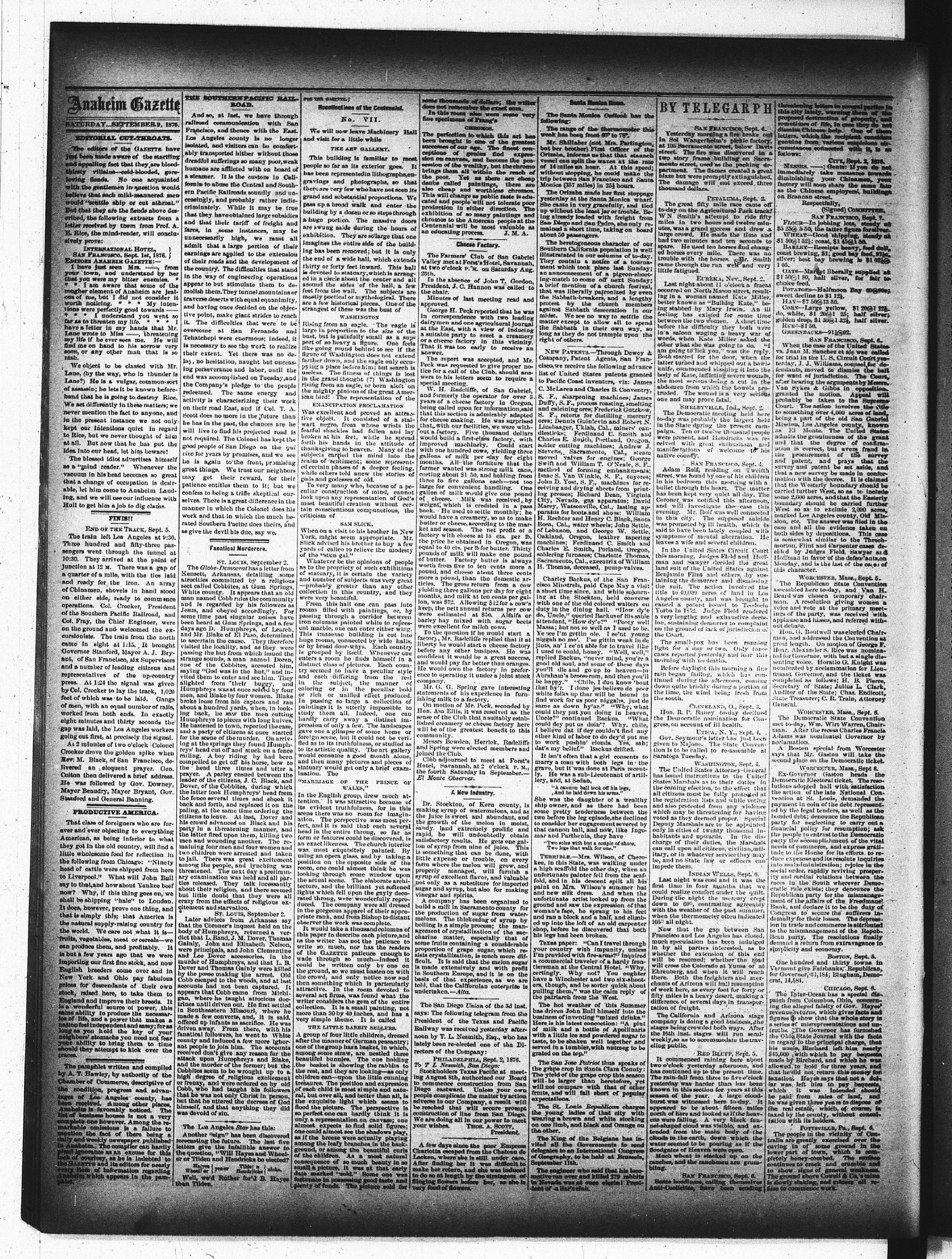
Searchable text
Anaheim Gazette
SATURDAY SEPTEMBER 9, 1876.
EDITORIAL OUT-THROAT
The editors of the Gazette have just been made aware of the startling and appalling fact that they are blood-thirsty villains—cold-blooded, gore-loving flends. No one acquainted with the gentlemen in question would believe that such mild-mannered men would "seattle ship or cut athroat." But that they are the flends above described, the following extracts from a letter received by them from Prof. A. E. Rice, the mind-reader, will conclusively prove:
INTERNATIONAL HOTEL,
SAN FRANCISCO, Sept. 1st, 1876.
EDITORS ANAHEIM GAZETTE:
I have just seen Mrs. — from your town, and understand by her that you were my bitter enemies. *
I am aware that some of the rougher element of Anaheim are jealous of me, but I did not consider it worth noticing. *
My intentions were perfectly good towards —
I understand you went so far as to threaten my life. *
I have a letter in my hands that Mr. Lane wrote to Miss —, threatening my life if he ever sees me. He will find me on hand to his sorrow very soon, or any other man that is so rash.
We object to be classed with Mr. Lane, (by the way, who in thunder is Lane?) He is a vulgar, common-sort of assassin; he lets it be known beforehand that he is going to destroy Rice. We act differently in these matters; we never mention the fact to anyone, and in the present instance we not only kept our intentions quiet in regard to Rice, but we never thought of him at all. But now that he has put the idea into our head, let him beware!
The blessed idiot advertises himself as a "mind reader." Whenever the
THE SOUTHERN PACIFIC RAIL ROAD.
And so, at last, we have through railroad communication with San Francisco, and thence with the East. Los Angeles county is no longer isolated, and visitors can be comfortably transported hither without those dreadful sufferings so many poor, weak humans are afflicted with on board of a steamer. It is the custom in California to abuse the Central and Southern Pacific Railroads soundly and unceasingly, and probably rather indiscriminately. While it may be true that they have obtained large subsidies and that their tariff of freight and fares, in some instances, may be unnecessarily high, we must all admit that a large portion of their earnings are applied to the extension of their roads and the development of the country. The difficulties that stand in the way of engineering operations appear to but stimulate them to demolish them. They tunnel mountains or traverse deserts with equal equanimity, and having once decided on the objective point, make giant strides to reach it. The difficulties that were to be overcome at San Fernando and Tehatchepi were enormous; indeed, it is necessary to see the work to realize their extent. Yet there was no delay, no hesitation, naught but uneasuring perseverance and labor, until the end was accomplished on Tuesday, and the Company's pledge to the people redeemed. The same energy and activity is characterizing their work on their road East, and if Col. T. A. Scott does no more in the future than he has in the past, the chances are he will live to find his projected road is not required. The Colonel has kept the good people of San Diego on the qui rice for years by promises, and we see he is again to the front, promising great things. We trust our neighbors.
RECENT ISSUES
No.
We will now leave and visit for a little time.
THE ART
This building has people so far as it has been represented gravings and plains there are very few grand and substantial pass up a broad wall building by a dozen a huge portico. Are swung aside or exhibition. They imagines the entire thing has been removed the end of a wide thirty or forty feet is devoted to status in a circle about around the sides feet from the walls mostly poetical or are a few historical strangest of these.
WASHINGTON
Rising from an exlarge in proportion bust, but is painful port of so heavy a like going round figure of Washington farther down, and pying a place before useless. The fitness in the grand though rising from an eagle the mighty pinion ican bird! The re-emancipation Was excellent and vive object. It c owart negro, from fearful shackles he broken at his feet forth his hands thanksgiving to be subjects carried to realm of sentimental certain phases o
Lane, (by the way, who in thunder is Lane?) He is a vulgar, common-sort of assassin; he lets it be known before-hand that he is going to destroy Rice. We act differently in these matters; we never mention the fact to anyone, and in the present instance we not only kept our intentions quiet in regard to Rice, but we never thought of him at all. But now that he has put the idea into our head, let him beware!
The blessed idiot advertises himself as a "pind reader." Whenever the vacuum in his head becomes so great that a change of occupation is desirable, let him come to Anaheim Landing, and we will use our influence with Hull to get him a job to dig claims.
FINIS!
END OF THE TRACK, Sept. 5.
The train left Los Angeles at 9:30. Three hundred and fifty-three passengers went through the tunnel at 10:30. They arrived at the point of junction at 12 M. There was a gap of a quarter of a mile, with the ties laid and ready for the iron. An array of Chinamen, shovels in hand stood on either side, ready to commence operations. Col. Crocker, President of the Southern Pacific Railroad, and Col. Fray, the Chief Engineer, were on the ground and welcomed the excursionists. The train from the north came in sight at 1:15. It brought Governor Stanford, Mayor A. J. Bryant, of San Francisco, six Supervisors and a number of leading citizens and representatives of the up-country press. At 1:24 the signal was given by Col. Crocker to lay the track, 1,020 feet of which was to be laid. Gangs of men, with an equal number of rails, worked from both ends. In exactly eight minutes and thirty seconds the gap was laid, the Los Angeles workers going out first, at precisely the signal.
At 2 minutes of two o'clock Colonel Crooker drove the golden spike when Mr. Black, of San Francisco, delivered an eloquent prayer. Gen. Colton then delivered a brief address. He was followed by Gov. Downey, Mayor Beaudry, Mayor Bryant, Gov. Stanford and General Banning.
PRODUCTIVE AMERICAThat class of foreigners who are forever and ever objecting to everything American, as being inferior to what they got in the old country, will find a little wholesome food for reflection in the following from Chicago: "Ninety head of cattle were shipped from here to Liverpool." What will John Bull say to that, and how about Yankee beef
Fanatical Murderers.
ST. LOUIS, September 2.
The Globe-Democrat has a letter from Kensett, Arkansas, detailing some atrocities committed by a religious sect called Cobbites, at Gum Springs, White county. It appears that an old man named Cobb rules the community and is regarded by his followers as Jesus, and obeyed accordingly. For some time past singular noises have been heard at Gum Springs, and a few days ago D. Humphreys, of Leach, and Mr. Blake of El Paso, determined to ascertain the cause. They therefore visited the locality, and as they were passing the hut from which issued the strange sounds, a man named Doren, one of the Cobbites, accosted him, saying "God was in the hut," and invited them to enter and see him. They alighted from their buggy, and Humphreys was at once seized by four men, and Blake by four women. Blake broke loose from his captors and ran about a hundred yards, when, in looking back, he saw the men cutting Humphreys to pieces with long knives. He hastened to town, reported the case, and a party of citizens at once started for the scene of the murder. On arriving at the springs they found Humphreys' head cut off and stuck on a fence railing. A boy riding by had been compelled to get off his horse, bow to the head three times and utter a prayer. A parley ensued between the leader of the citizens, J. C. Black, and Dover, of the Cobbites, during which the latter took Humphreys' head from the fence several times and shook it back and forth, and replaced it on the paling, at the same time ordering the citizens to leave. At last, Dover and his crowd advanced on Black and his party in a threatening manner, and the latter fired upon them, killing two men and wounding another. The remaining four men and four women and two children were arrested and taken to jail. There was great excitement among the people, and lynching was threatened. The next day a preliminary examination was held and all parties released. They talk incessantly about their religion, and there seemed no end was accomplished on Tuesday,and the Company's pledge to the people redeemed. The same energy and activity is characterizing their work on their road East, and if Col. T. A. Scott does no more in the future than he has in the past,the chances are he will live to find his projected road is not required. The Colonel has kept the good people of San Diego on the quiive for years by promises,and we see he is again tothe front,promising great things. We trust our neighbors may get their reward,for their patience entitles them to it;but we confess to being a trifle skeptical ourselves. There is a great difference in the manner in which the Colonel does his work and that in which the much beated Southern Pacific does theirs,and so give the devil his due,say we.
Fanatical Murderers.
ST. LOUIS, September 2.
The Globe-Democrat has a letter from Kensett, Arkansas, detailing some atrocities committed by a religious sect called Cobbites, at Gum Springs, White county. It appears that an old man named Cobb rules the community and is regarded by his followers as Jesus,and obeyed accordingly. For some time past singular noises have been heard at Gum Springs,and a few days ago D. Humphreys,of Leach,and Mr.Blake of El Paso,determined to ascertain the cause. They therefore visited the locality,and as they were passing the hut from which issued the strange sounds,a man named Doren,一名 of the Cobbites,accosted him,saying "God was in the hut,"and invited them to enter and see him. They alighted from their buggy,and Humphreys was at once seized by four men,and Blake by four women.Blake broke loose from his captors and ran about a hundred yardswhen,在looking back,他 sawthemencuttingHumphreystopieceswithlongknives.He hastenedtotown,reportedthecase,andapartofcitizensatoncestartedforthesceneofthemurder.OnarrivingatthespringstheyfoundHumphreys'headcutoffandstuckonafencerailing.Aboyridingbyhadbeencompelledtogetoffhishorse,bowtothethreetimesandutteraprayer.Aparleyensuedbetweentheleaderofthecitizens,j.C.Black,andDover.oftheCobbites,duringwhichthe lattertookHumphreys'headfromthefenceseveraltimesandshookitbackandforth,andreplaceditonthepaling.atthesametimeorderingthecitizenstoleave.Atlast,DoverandhiscrowdadvancedonBlackandhispartininathreateningmanner,andthelatterfireuponthem,killingtwomenandwoundinganother.TheremainingfourmenandfourwomenandtwobehildrenwerearrestedandtakentojailTherewasgreatexcitementamongthepeople,andlynchingswerethreatened.ThenextdayapreliminaryexaminationwasheldandallpartiesreleasedTheytalkincessantlyabouttheirreligion,andthereused
EXAMINATION
Was excellent and active object。它wart negro,从 fearful shackles he broken at his feet forthhis hands thanksgivingtohis subjects carriedthe realmofsentimented certain phases or while others told me gods和godesses e
To very many we culliar construction look upon any report most beautiful creaturetainconscientiouscriticismof
WAMS
When on a visit to York,might seem Slick advised his bury yards of calico to mark of "stun gal."
Whatever be thineas totheproprietyofstatuary,它iscoldandnumberofsubject—probablygreatercollectioninthiswereverybeautiful.Fromthishallroomrooms filledwithpassingthroughacarboncolumnspaintentmarble,一canbring huge rooms,连connectorbybroaddoor-westisgroupedbyitsentersa roomhedistinctclassofpiecetry seemedtohavetheach differinginthesubject,cOLORORrichorunifiedInpassingso largaintpaintingsitistuitedstudythemallhardlycarryawaypressionofonlyaforegaveoneaglimpseforeignscene,但itfiedastoitstruthfulnesstoartisticqualitywouldconsumeagoandthenmanypiecestatuarywouldgetgetainted.The"MARRIAGEOFWALL
IN THE ENGLISHGROUPTENTION
It was attests evident truthfulness there was no violation.Theperspective effect,anditis saidheadinthe entire formorfeaturescounAnexplicitness.Wasmostexquisitusinganoperaglasspositionontheopperoom,一couldaimlookingthroughsonetheactualscene.Thetecture,andthebrief
PRODUCTIVE AMERICA.
That class of foreigners who are forever and ever objecting to everything American, as being inferior to what they got in the old country, will find a little wholesome food for reflection in the following from Chicago: "Ninety head of cattle were shipped from here to Liverpool." What will John Bull say to that, and how about Yankee beef now? Why, if this thing goes on, we shall be shipping "hale" to Loudon. It does, however, prove one thing, and that is simply this: that America is the natural supply-raising country for the world. We care not what it is—fruits, vegetables, meat or cereals—we can produce them, and profitably. It is but a few years ago that we were importing our first fine stock, and now English breeders come over and in New York and Ohio pay fabulous prices for descendants of their own stock, raised here, to take them to England and improve their breeds. It is a wonderful source of power, this same ability to produce the necessaries of life, and a power that makes a nation feel independent and sassy; for as long as you hold the key of your neighbors' stomachs you need not fear your ability to bring them to time should they attempt to kick over the traces.
The pamphlet written and compiled by A. T. Hawley, by authority of the Chamber of Commerce, descriptive of the condition, progress and advantages of Los Angeles county, has been received. Among other places, Anaheim is favorably noticed. The list of business houses is not a very complete one however. Among the remarkable omissions is a failure to mention the fact of there being a daily and weekly newspaper published in Anaheim. The compiler can hardly plead ignorance as an excuse for this lack of courtesy, as he is indebted to the GARNET and its editors for nearly every item of information regarding Anaheim which appears in the pamphlet.
The Los Angeles Star has this:
Another "sign" has been discovered forecasting the future. The last five letters give the infallible answer to the question, "Will Hayes and Wheelor or Tilden and Hendrieka be elected?"
Well, we'd Rutherford'd B. Hayes than Tilden.
In the English group tention. It was attentive its evident truthful scene there was no indication. The perspective, and it is said head in the entire tree form or features could an exact likeness. It was most exquisite using an opera glass position on the open room, one could almost looking through so the actual scene. The texture, and the bright lights which fell uprated through, were reduced. The company in the gorgeous appropriate rank, and from observer the work was it would take a thistle this paper to describe is the writer has no write so much, nor of the GAZETTE paper wade through so could be written on the ground, so we may then something which attractive. In the several art firms, was writer considers these collection. It is a sort more than 30 by 40 very simple theme.
THE LITTLE BARN
A group of four little after the manner of one of the group has among some straw, beautiful bunnies, the basket is shown the rest, and they are children can—upon treasures. The positif of each child is most real, but over all, and the exquisite light flood the picture. To so perfect one can have only a representation almost expects to face one could almost see as if the breeze were among the leafy branch ground, or among the children. As consequence of so small a picture, it will date marked "sold." fortunate in possessing plenty of funds.
RECENTATIONS OF THE CENTennial.
NO. VII.
We will now leave Machinery Hall and visit for a little while.
THE ART GALLERY.
This building is familiar to most people so far as its exterior goes. It has been represented in lithographs, engravings and photographs, so that there are very few who have not seen its grand and substantial proportions. We pass up a broad walk and enter the building by a dozen or so steps through a huge portico. The massive doors are swung aside during the hours of exhibition. They are so large that one imagines the entire side of the building has been removed; but it is only the end of a wide hall, which extends thirty or forty feet inward. This hall is devoted to statuary, which is arranged in a circle about the center and all around the sides of the hall, a few feet from the wall. The subjects are mostly poetical or mythological. There are a few historical pieces. One of the strangest of these was the bust of WASHINGTON.
Rising from an eagle. The eagle is large in proportion to the size of the bust, but is painfully small as a support of so heavy a figure. One feels like going round behind to see if the figure of Washington does not extend farther down, and the eagle only occupying a place before him; but search is useless. The fitness of things is lost in the grand thought (?) Washington rising from an eagle, or born aloft on the mighty pinions of the great American bird! The representation of the EMANCIPATION PROCLAMATION
Was excellent and proved an attractive object. It consisted of a stalwart negro, from whose wrists the fearful shackles had fallen and lay broken at his feet, while he spread forth his hands in the attitude of thanksgiving to heaven. Many of the subjects carried the mind into the realm of sentiment; some represented certain phases of a deeper feeling.
some thousands of dollars; the writer does not remember the exact sum.
In this room also were some very fine specimens of Prang's chromosomes.
The perfection to which this art has been brought in one of the greatest successes of our age. The finest conceptions of genius find expression on canvas, and become the possession of the wealthy, but the chromo brings them all within the reach of the poor. Yet as there are cheap daubs called paintings, there are also cheap and worthless chromosomes. This will change as public taste is educated and people will not tolerate poor production in either direction. The exhibition of so many paintings and chromosomes to the American people at the Centennial will be most valuable as an educating process.
J. M. A.
Cheese Factory.
The Farmers' Club of San Gabriel Valley met at Forst's Hotel, Savannah, at two o'clock P.M. on Saturday Aug. 26th.
In the absence of John T. Gordon, President, J. C. Hannon was called to the chair.
Minutes of last meeting read and approved.
George H. Peck reported that he was in correspondence with two leading dairymen and one agricultural journal at the East, with a view of inducing a suitable party to erect a creamery or a cheese factory in this vicinity. That it was too early to receive an answer.
The report was accepted, and Mr. Peck was requested to give proper notice for a call of the Club, should answers to his letters seem to require a special meeting.
W. H. Radeliffe, of San Gabriel, and formerly the operator for over 3 years of a cheese factory in Oregon, being called upon for information, said that this section is admirably adapted for cheese making. He was surprised that, with our facilities, we were without a factory. Five thousand dollars would build a first-class factory, with improved machinery. Could start with one hundred cows, yielding three gallons of milk per day for eight months. All—the furniture that the farmer wanted was strong milk cans.
Santa Monica House.
The Santa Monica Outlook has the following:
The range of the thermometer this week has been from 60° to 78°.
Mr. Shillaber (not Mrs. Partington, but her brother) First Officer of the Orizaba, informs us that that staunch vessel can split the waves at the rate of 14 miles an hour. At this speed; without stopping, he could make the trip between San Francisco and Santa Monica (357 miles) in 25½ hours.
The Orizaba made her first stoppage yesterday at the Santa Monica wharf. She came in very gracefully, and tied up without the least jar or trouble. Being already loaded with freight from San Diego and San Pedro, she only remained a short time, taking on board about 50 passengers.
The heretogeneous character of our Southern California population is well illustrated in our columns of to-day. They contain a notice of a tournament which took place last Sunday; an announcement of a pigeon-shooting-match to come off next Sunday; a brief mention of a church festival; that was liberally patronized by even the Sabbath-breakers, and a lengthy protest by the church members against Sabbath desecration in our midst. We see no way to settle the matter except to allow all to spend the Sabbath in their own way, so long as they do not trample upon the right of others.
NEW PATENTS—Through Dewey & Company, Patent Agents, San Francisco, we receive the following advance list of United States patents granted to Pacific Coast inventors, viz: James C. McLaren and Charles B. Conventry, S. F., sharpening machines; James Duffy, S. F., process roasting, smelting and calcining ores; Frederick Gutzkow, S. F., retorts for distilling mercury ores; Dennis Guinlevin and Robert N. Linebaenger, Ukiah, Cal., miners' candlesticks; Ferdinand C. Smith and Charles E. Smith, Portland, Oregon, solder cutting machines; Andrew J. Stevens, Sacramento, Cal., steam moved valves for engines; George Swift and William T. O'Neale, S. F., method of forming man-made pipes.
The fitness of things is lost in the grand thought (?) Washington rising from an eagle, or born aloft on the mighty pinions of the great American bird. The representation of the EMANCIPATION PROCLAMATION
Was excellent and proved an attractive object. It consisted of a stalwart negro, from whose wrists the fearful shackles had fallen and lay broken at his feet, while he spread forth his hands in the attitude of thanksgiving to heaven. Many of the subjects carried the mind into the realm of sentiment; some represented certain phases of a deeper feeling, while others told anew the stories of gods and goddesses of old.
To very many who, because of a peculiar construction of mind, cannot look upon any representation of God’s most beautiful creation without certain conscientious compunctions, the criticism of SAM SLICK,
When on a visit to his brother in New York, might seem appropriate. Mr. Slick advised his brother to buy a few yards of calico to relieve the modesty of the “stun gal.”
Whatever be the opinions of people as to the propriety of such exhibitions of statuary, it is certain the variety and number of subjects was very great—probably greater than any other collection in this country, and they were very beautiful.
From this hall one can pass into rooms filled with paintings, or by passing through a corridor between iron columns painted white to represent marble, one can enter either wing. This immense building is cut into huge rooms, connected by wide halls, or by broad doorways. Each country is grouped by itself. Whenever one enters a room he finds himself in a distinct class of pictures. Each country seemed to have a peculiar style and each differing from the rest in the subject, the manner of coloring or in the peculiar bold or rich or unified effect produced. In passing so large a collection of paintings it is utterly impossible to study them all. Indeed, one can hardly carry away a distinct impression of only a few. The landscapes gave one a glimpse of some home or foreign scene, but it could not be verified as to its truthfulness, or studied as to its artistic quality. The art gallery would consume a good month alone, and then many pictures and pieces of statuary would get only a brief examination.
“The MARRIAGE OF THE PRINCE OF WALES,”
In the English group, drew much attention. It was attractive because of its evident truthfulness, for in this scene there was no room for imagination. The perspective was most perfect, and it is said that each several head in the entire throng, so far as form or features could be discovered, is an exact likeness. The church interior was most exquisitely painted. By using an opera glass, and by taking a position on the opposite side of the room, one could almost think he was looking through some window upon the actual scene. The elaborate architecture, and the brilliant yet softened
W. H. Radcliffe, of San Gabriel, and formerly the operator for over 3 years of a cheese factory in Oregon, being called upon for information, said that this section is admirably adapted for cheese making. He was surprised that, with our facilities, we were without a factory. Five thousand dollars would build a first-class factory, with improved machinery. Could start with one hundred cows, yielding three gallons of milk per day for eight months. All—the furniture that the farmer wanted was strong milk cans, costing about $1 50, and holding from three to five gallons each—not too large for convenient handling. One gallon of milk would give one pound of cheese. Milk was received, by weight, which is credited in a pass book. He used to settle monthly; he would have a creamery, so as to make butter or cheese, according to the market and season. The net profit of a factory with cheese at 18 cts. per lb, the price he obtained in Oregon, was equal to 40 cts. per lb for butter. Thirty pounds of milk will make one pound of butter. Factory butter is always worth from five to ten cents more a pound, and cheese about three cents more a pound, than the domestic articles. The gross return from a cow yielding three gallons per day for eight months, and milk at ten cents per gallon, was $72. Allowing $12 for a cow’s keep, the nett annual returns per cow were estimated at $50. Alfalfa or barley hay mixed with sugar beets were excellent for milch cows.
To the question if he would start a factory, Mr. Radcliffe replied that it at liberty he would start a cheese factory before any other business. He was confident it would be a great success, and would pay far better than oranges. He would own the factory in preference to operating it under a joint stock company.
Mr. G. G. Spring gave interesting statements of his experience in furnishing milk to a factory.
On motion of Mr. Peck, seconded by Hon. Asa Ellis, it was resolved as the sense of the Club that a suitably established creamery or cheese factory here will be of the greatest benefit to this community.
Messrs Bowden, Herrick, Radcliffe and Spring were elected members and joined the Club.
Club adjourned to meet at Forst’s Hotel, Savannah, at 2 o’clock P.M., the fourth Saturday in September.—El Monte Observer.
A New Industry.
Dr. Stockton, of Kern county, is making syrup of watermelons, and as the juice is sweet and abundant, and the growth of the melon in moist, sandy land extremely prolific and rapid, he will undoubtedly obtain satisfactory results. He gets one gallon of syrup from nine of juice. This is something that can be done, with little expense or trouble, on every farm where the melon will grow, and properly managed, will furnish a syrup of excellent flavor, and valuable not only as a substitute for imported sugar and syrup but also for making list of United States patents granted to Pacific Coast inventors, viz: James C. McLaren and Charles B. Conventry,
S. F., sharpening machines; James Duffy, S.F., process roasting, smelting and calcining ores; Frederick Gutzkow,
S. F., retorts for distilling mercury ores; Dennis Guinlevin and Robert N. Linebaenger, Ukiah, Cal., miners’ candlesticks; Ferdinand C. Smith and Charles E. Smith, Portland, Oregon,
solder cutting machines; Andrew J. Stevens, Sacramento, Cal., steam moved valves for engines; George Swift and William T. O’Neale, S.F., method of forming embankments; Isaac S. Van Winkle, S.F., tuyeres; John D. Yost, S.F., machines for receiving and drying sheets from printing presses; Richard Dean, Virginia City, Nevada, gas apparatus; David Marey, Watsonville, Cal., lasting apparatus for boots and shoes: William H. Rechtor and Henry C. Black, Santa Rosa, Cal., water wheels; John Settle, of Lebanon, and George W. Settle, Oakland, Oregon, leather tapering machines; Ferdinand C. Smith and Charles E. Smith, Porlane, Oregon,
soldering furnaces; Charlotte Thomas,
Sacramento, Cal., executrix of William H. Thomas, deceased, pump-valves.
Charley Backus, of the San Francisco Minstrels, paid Cape May a visit a short time since, and while sojourning at the Stockton, held converse with one of the old colored waiters on duty in the dining hall. “How dye’d do Uncle,” queried Backus of his sable attendant,“How dye’d” “Pooty well Massa; but not so well as I used to be.
Ye see I’m gettin ole. I ee’t young niggah no mo’. I see gittin weak in de jints, an’ I eee’t able for to travel like I used to could,honey.“ Well,well,” replied Backus,“never mind,你’re a good old soul,和some of these days you’ll die go up to heaven—to Abraham’s brooserum,and then you’ll be happy。”“Chile,I dun know‘bout that hy’r.I done Jes believe de poor white folks up thar will be bound to find work for us poor niggahs,just de same as down hy’ar.”“Why,what could they put you doing in heaven,Uncle?” continued Backus.“What could de yup put us doin’? Why,chile,I believe dat if dey couldn’t find any other kind of labor to do deyd’put me to work pushin’ clouds。Yes,sah;dat’s my belief.” Backus drifted.
It isn’t often that a girl consents to marry a man with both legs in the grave,但它 was done at Paris recently。He was a sub-Lieutenant of artillery,and,at Sedan,
“A cannon ball took off his legs,And he laid down his arms.” She was the daughter of a wealthy ship owner,and as there had been some pretty tenderness between the two before the leg episode,she declined to consider her engagement severed by that cannon ball,and now,like Ingomar and Parthenia,they have
“Two soles with but a couple of shoes,Two legs that walk for one.”
TERRIBLE—Mrs Wilson,of Cherokee,在 this State,was walking under a high scaffold the other day,when an unfortunate pain fell from the scaffold,和在 his descent split all his paint on Mrs.Wilson’s summer hat
In the English group, drew much attention. It was attractive because of its evident truthfulness, for in this scene there was no room for imagination. The perspective was most perfect, and it is said that each several head in the entire throng, so far as form or features could be discovered, is an exact likeness. The church interior was most exquisitely painted. By using an opera glass, and by taking a position on the opposite side of the room, one could almost think he was looking through some window upon the actual scene. The elaborate architecture, and the brilliant yet softened lights which fell upon the gayly decorated throne, were wonderfully reproduced. The company were all dressed in the gorgeous apparel of their appropriate rank, and from Bishop to distant observer the work was complete.
It would take a thousand columns of this paper to describe each picture, and as the writer has not the patience to write so much, nor has the readers of the GAZETTE patience enough to wade through so much—indeed it could be written only by one on the ground, so we must hasten on with the crowd, and only notice now and then something which is particularly attractive. In the room devoted to several art firms, was found what the writer considers the gem of the entire collection. It is a small painting, not more than 30 by 40 inches, and has a very simple theme. It is called
THE LITTLE BABBIT SELLERS.
A group of four little children, dressed after the manner of German peasantry; one of the group has a basket, in which, among some straw, are nestled three beautiful bunnies. The one holding the basket is showing the rabbits to the rest, and they are looking—as only children can—upon the little cunning treasures. The position and expression of each child is most simple and natural, but over all, and better than all, is the exquisite light which seems to flood the picture. The perspective is so perfect one can hardly think it is only a representation on canvas; one almost expects to find solid figures; one could almost see the shadows play, as if the breeze were actually playing among the leafy branches in the background, or among the beautiful curls of the children. As a most natural consequence of so much beauty in so small a picture, it was at that early date marked "sold." Some one was fortunate in possessing good taste and plenty of funds. The picture sold for
Dr. Stockton, of Kern county, is making syrup of watermelons, and as the juice is sweet and abundant, and the growth of the melon in moist, sandy land extremely prolific and rapid, he will undoubtedly obtain satisfactory results. He gets one gallon of syrup from nine of juice. This is something that can be done, with little expense or trouble, on every farm where the melon will grow, and properly managed, will furnish a syrup of excellent flavor, and valuable not only as a substitute for imported sugar and syrup, but also for making vinegar and spirits.
A company has been organized to build a mill in Sacramento county for the production of sugar from watermelons. The thickening of syrup by boiling is a simple process; the management of crystallization of the saccharine matter, especially that of some fruits containing a considerable proportion of grape sugar, which resists crystallization, is much more difficult. It is said that the melon sugar is made extensively and with profit in Southern Europe, and it is on the basis of that experience, as we are told, that the Californian enterprise is undertaken.
The San Diego Union of the 3d Inst. says: The following telegram from the President of the Texas and Pacific Railway was received yesterday afternoon by T. L. Nesmith, Esq., who has lately been re-elected one of the Directors of the Company:
PHILADELPHIA, Sept. 2, 1876.
To T. L. Nesmith, San Diego:
Stockholders Texas Pacific at meeting August 5th, authorized our Board to commence construction from San Diego eastward. Unless your own people complicate the matter by action adverse to our Company, a result will be reached that will secure prompt construction of line from San Diego. We are doing all in our power to meet your wishes.
Thos. A. Scott,
President.
A few days since the poor Empress Charlotte escaped from the Chateau de Lacken, where she is still under care. After finding her it was difficult to make her return, and she was induced to do so at length by the strategem of flinging flowers before her, as she is very fond of flowers.
She was the daughter of a wealthy ship owner, and as there had been some pretty tenderness between the two before the leg episode she declined to consider her engagement severed by that cannon ball, and now, like Ingomar and Parthenia, they have
"Two soles with but a couple of shoes,
Two legs that walk for one."
TERRIBLE—Mrs. Wilson, of Cherokee, in this State, was walking under a high scaffold the other day, when an unfortunate painter fell from the scaffold, and in his descent split all his paint on Mrs. Wilson's summer hat and new silk dress. And when the unfortunate artist looked up from the ground and saw the expression of that woman's face, he sprang to his feet and ran a block and a half, and climbed up into the loft of an old carpenter shop, before he discovered that both his legs had been broken.
Texas paper: "Can I travel through your country with impunity, unless I'm provided with fire-arms?" Inquired a commercial traveler of a hardy frontiersman at the Central Hotel. "Why, certingly. Why not? You ought have a Winchester and two six-shooters, though, and be sorter quick about pulling them," was the calm reply of the patriarch from the West.
The hot weather of this Summer has driven John Bull himself into the business of inventing "mixed drinks." Here is his latest concoction: "A pint of milk and a bottle of Apollinaris with a little ice and powdered sugar to taste, to be shaken well together and served in a tumbler, with nutmeg to be grated on the top."
The San Jose Patriot thus speaks of the grape crop in Santa Clara County: The yield of the grape crop this season will be larger than heretofore, yet will not compare with that of other fruits, and will fall short of popular expectations.
The St. Louis Republican charges the young ladies of that city with wearing a brown and white stocking on one limb, and black and Orange on the other.
The King of the Belgians has invited all the Governments to send delegates to an International Congress of Geography, to be held at Brussels, September 11th.
The engineer who said that his locomotive ran over and killed 279 rabbits in Nevada was at once elected President of a liar's club.
BY TELEGARPH
SAN FRANCISCO, Sept. 4.
Yesterday morning a fire broke out in Sol Wangerheim's pickle factory, at 105 Sacramento street, below Davis street. The fire was discovered in a two story frame building on Sacramento street, used as the packing department. The flames created a great blaze but were promptly extinguished. The damage will not exceed three thousand dollars.
PEBALUMA, Sept. 2.
The great fifty mile race came off to-day on the Agricultural Park track! WN Smith's attempt to ride fifty miles in two hours and twelve minutes, was a grand success and drew a large crowd. He made the time and had two minutes and ten seconds to spare. He used ten horses and changed horses every mile. There was no trouble with the horses. Mr. Smith came through the run well and very little fatigued.
EUREKA, Nev., Sept. 2.
Last night about 11 o'clock a fracas occurred on North Mason street, resulting in a woman named Kate Miller, better known as "Bulldog Kate," being stabbed by Mary Irwin. An ill feeling has existed for some time between the two women. As short time before the difficulty they both were in a saloon waging a heavy war of words, when Kate Miller asked the other what she was going to do. "I am going to kick you," was the reply. Both started for the door, when the latter turned and whipped out a bow knife, commenced slashing it into the body of Kate, inflicting severe wounds, the most serious being a cut in the abdomen from which the bowels protruded. The wound is a very serious one and may prove fatal.
SHELBYVILLE, Ind., Sept. 2.
The Democratic meeting held here to-day was probably the largest held in the State during the present campaign. Ten or twelve thousand people were present, and Hendricks was received with great enthusiasm and manifestations of welcome to his native county.
SAN FRANCISCO, Sept. 4.
threatening letters to several parties in this city lately, warning them of the proposed destruction of property, and sometimes of life, in case they do not dismiss Chinese help. One of these letters, which the recipient considers genuine from various suspicious circumstances connected with it, is as follows:
CITY, Sept. 2, 1876.
MESSERS. —; Gentle: If you do not immediately take measures towards diminishing your Chinamen, your factory will soon share the same fate as the Chinese employer, buildings on Brannan street.
Respectfully,
(Signed) COMMITTEE.
SAN FRANCISCO, Sept. 7.
FLOUR—In jobbing lots, steady at $5 25@5 50, the latter figure for silver.
WHEAT—Good shipping, steady at $1 50@1 52]; coast, $1 45@1 50.
BARLEY—Receipts heavy, feed dull, coast brewing, $1; good hay feed, 97%; silver; best hay brewing is $1 02@1 05.
OATS—Market liberally supplied at $1 50@1 80, halt silver, for fair to choice feed.
POTATOES—Halfmoon Bay 60@600; sweet decline to $1 12$.
HAY—$7 50@13 50.
CORN—Large yellow, $1 20@1 22$; do, white, $1 20@1 25; half silver; golden drop, $1 30@1 32$, half silver.
RYE—$1 50.
GREENBACKS—911@92.
SAN FRANCISCO, Sept. 6.
When the case of the United States vs. Juan M. Sanchez et al was called for trial in the U.S. Circuit Court yesterday, J. J. Williams, counsel for defendants, moved to dismiss the bail for want of jurisdiction. The Court after hearing the arguments by Messera Van Sykes & Gibbs in opposition granted the motion. Appeal will probably be taken to the Supreme Court. The action involves the title to something over 4,000 acres of land, being a part of the old San Gabriel Mission, Los Angeles county, known as El Monte. The United States admits the genuineness of the grant and that the degree of confirmation is correct, but avers fraud in the procurement of the survey and patent, and prays that the survey and patent be set aside, and
of the San Francisco Cape May visit and while sojourn, held converse colored waiters on hall. "How dye' backus of his sable?" "Pooty well as I used to be. Iee'n't young gittin weak in de for to travel like yay." "Well, well," ever mind, you're a name of these days up to heaven—to him, and then you'll I dun know 'bout us believe de poor will be bound to niggahs, just de r." "Why, what doing in heaven, Backus. "What run? Why, chile, couldn't find any do day'd put meouds. Yes, sah; backus drifted.
a girl consents to both legs in the case at Paris recent seutenant of artil
look off his legs, his arms."
ter of a wealthy there had been excess between the episode, she declined cement severed by now, like Ingo-hey have couple of shoes, or one."
Wilson, of Cheros walking under her day, when an ell from the scaffent split all his son's summer hat patents granted sentors, viz: James Charles B. Conventry, machines; James roasting, smelting Frederick Gutzkow, distilling mercuryevin and Robert N. Cal., miners' can- and C. Smith and Portland, Oregon, ohines; Andrew J. into, Cal., steam engines; George T. O'Neale, S.F., ing embankments; ee, S.F., tuyeres; machines for re-sheets from print-ed Dean, Virginia apparatus; David Cal., lasting ap- shoes: William C. Black, Santa heels; John Settle, George W. Settle, leather tapering and C. Smith and Portland, Oregon, Charlotte Thomas, neutrix of William L. pump-valves.
SHELBYVILLE, Ind., Sept. 2.
The Democratic meeting held here to-day was probably the largest held in the State during the present campaign. Ten or twelve thousand people were present, and Hendricks was received with great enthusiasm and manifestations of welcome to his native county.
SAN FRANCISCO, Sept. 4.
Adam Rolf, residing on Twelfth street, was found by one of his children in his bedroom this morning with a bullet through his heart. The matter has been kept very quiet all day. The Coroner was notified this afternoon, and will investigate the case this evening. Mr. Rolf was well connected in this city. The supposed suicide was promoted by ill health, which is said to have been lately coupled with symptoms of mental aberration. He leaves a wife and several children.
In the United States Circuit Court this morning, Judges Field and Hoffman and Sawyer decided the great land suit of the United States against Benjamin Flint and others, by sustaining the demurrer and dismissing the suit. The action involved the title to 40,000 acres of land in Los Angeles county, and was brought to cancel a patent issued to Teodocio Yorba in 1852. Judge Field rendered a very lengthy and exhaustive decision, sustaining demurrer to complaint on the ground of lack of jurisdiction of the Court.
The small-pox has been running light for a day or two. Only three cases reported yesterday and four this morning with no deaths.
Before daylight this morning a fine rain began failing, which has continued during the afternoon, coming down quite briskly during a portion of the time, the wind being fresh from the south.
CLEVELAND, O., Sept. 3.
Hon. R.P. Raney to-day declined the Democratic nomination for Congress, on account of ill health.
UTICA, N.Y., Sept. 4.
Gov. Seymour's letter has just been given to Majone. The State Convention is to be called to re-assemble at Saratoga Tuesday.
WASHINGTON, Sept. 4.
The United States Attorney-General has issued instructions to the United States Marshals as to their duties in the coming election, to the effect that all citizens must be fully protected at the registration lists and while voting and also protected from any violence which may be threatening for having voted as they deemed proper. Special Deputy Marshals are to be appointed only in cities of twenty thousand inhabitants and upwards. In the discharge of their duties, the Marshals can call upon all citizens, civilian,military, or in whatever service they may be, and no State law or officers can impede them.
INDIAN WELLS, Sept. 6.
Last night was cool and it was the first time in four months that we remaind moved to dismiss the bail for want of jurisdiction. The Court after hearing the arguments by Mason Van Sykes & Gibbs in opposition granted the motion. Appeal will probably be taken to the Supreme Court. The action involves the title to something over 4,000 acres of land being a part of the old San Gabriel Mission, Los Angeles county, known as El Monte. The United States admits the genuineness of the grant and that the degree of confirmation is correct, but avera fraud in the procurement of the survey and patent, and prays that the survey and patent be set aside, and that a new survey be made in conformation with the decree. It is claimed that the Westerly boundary should be carried further West, so as to include some 2,000 acres, and that the Easterly boundary should be carried further West so as to exclude 2,000 acres marked Los Angeles county, Old Mission, etc. The answer was filed in the case and all the evidence taken on both sides by depositions. This case is somewhat similar to the Throch-morton, Flint and Carpenter cases deli ed by Judges Field, Sawyer and Hoffman in favor of the defen-ants on Monday, and is the last of the case; of this character.
WORCESTER, Mass., Sept. 5.
The Republican State Convention assembled here to-day, and Van H. Beard was chosen temporary chairman. A resolution giving women a voice and vote at the primary meetings of the party, was received with applause and hisses, and referred without debate.
Hon. G.Boutwell was elected Chairman,and addressed the Convention at great length.On motion of George F.Hoor,Alexander S.Rice was nominated for Governor,with but a single dissenting voice.Horatio O.Knight was nominated by acclamation for Lieutenant Governor,and the ticket was completed as follows; H.R.PierceSecretary of State; Julius L.A ClarkAuditor of the State; Chas.EndlcottState Treasurer; C.R.Train,Attorney General.
WORCESTER,Mass., Sept. 6.
The Democratic State Convention met today.Wm.Wirt Warren,C chairman.After the recess Charles Francis Adams was nominated Governor by acclamation.A Boston special from Worcester says that Mr.Gaston will take the second place on the Democratic ticket.
WORCESTER,Mass., Sept 6.Ex-Governor Gaston heads the Democratic Electoral ticket.The resolutions adopted hail with satisfactionthe action of the late National Convention at St.Louis,demanded the payment in coin of the debt representedby the legal tenders,a well as the bonded debt;denounce the Republican party for neglecting to carry out a financial policy for resumption;askthe people to entrust to the Democratic party the accomplishment of the vital needs of commerce,and express gratitude to the House for its efforts.to reduce expenses and its resolve inquiriesinto maladministration;rejoice inthe social order,rapidly reviving prosperityand cordial relations betweenthe races inthe South wherever Democra-tic exists;they denounce
Wilson, of Cherokee walking under other day, when an ell from the scaffold split all his son's summer hat. And when the looked up from the expression of that rang to his feet half, and climb an old carpenter covered that both knees.
I travel through campunity, unless arms?" inquired of a hardy frontal Hotel. "Why, you ought to two six-shooter quick about the calm reply of West.
Of this Summer himself into the "mixed drinks." soction: "A pint of Apollinaris powdered sugar to sell together and with nutmeg to be thus speaks of Clara County: crop this season heretofore, yet that of other short of popular Republican charges that city with white stocking and Orange on Belgians has investments to send national Congress held at Brussels, sold that his localized 279 rabbits elected Prussian citizens must be fully protected at the registration lists and while voting and also protected from any violence which may be threatening for having voted as they deemed proper. Special Deputy Marshals are to be appointed only in cities of twenty thousand inhabitants and upwards. In the discharge of their duties, the Marshals can call upon all citizens, civilian, military, or in whatever service they may be, and no State law or officers can impede them.
INDIAN WELLS, Sept. 6.
Last night was cool and it was the first time in four months that we could realize comfort under the quilt. During the night the mercury crept down to 69°, contrasting agreeably with the weather of the past summer, when the thermometer often indicated 105° all night.
Now that the gap between San Francisco and Los Angeles has closed, much speculation has been indulged in by all parties interested, as to whether the extension of this end will be resumed; whether the road will cross the Colorado at Yuma or at Ehrenberg, and when it will reach there. Both the freighters and merchants of Arizona will hail resumption of work here, as every foot for forty or fifty miles is a heavy desert, making a difference of several days in transportation of freight.
The California and Arizona stage company is doing a good business, she stages being crowded both ways. After the 16th inst. stages will run semi-weekly, so as to accommodate the traveling public.
RED BLUFF, Sept. 5.
It commenced raining here about two o'clock yesterday afternoon, and has continued up to the present time. The rain-fall from three to five o'clock yesterday was harder than has been known in this section for years at this season of the year. A large cloudburst was witnessed here to-day. It appeared to be about fifteen miles north of here and looked as if the heavens were falling. A very black funnel-shaped cloud was visible, and extended from the main body of the clouds to the earth, down which the water seemed to be pouring as if the floodgates of Heaven were open.
Much wheat is stacked up on the ranches, and the ranchmen are grumbling.
SAN FRANCISCO, Sept. 6.
Some hoodlums, calling themselves Anti-Coolleten, have been sending
the action of the late National Convention at St. Louis, demanded the payment in coin of the debt represented by the legal tenders, as well as the bonded debt; denounce the Republican party for neglecting to carry out a financial policy for resumption; ask the people to entrust to the Democratic party the accomplishment of the vital needs of commerce, and express gratitude to the House for its efforts to reduce expenses and its resolute inquiries into maladministration; rejoice in the social order, rapidly reviving prosperity and cordial relations between the races in the South wherever Democratic rule exists; they denounce the Republican party for the mismanagement of the affairs of the Freedmans Bank, and declare it to be the duty of Congress to secure the sufferers indemnity for their losses. The depression in trade and commerce is attributed to the mismanagement of the Republican party. The resolutions finally demand a return from extravagance to simplicity and economy.
BOSTON, Sept. 5.
One hundred and thirty towns in Vermont give Fairbanks, Republican, for Governor, 31,184; Bingham, Democrat, 14,584.
CHICAGO, Sept. 6.
The Inter-Ocean has a special dispatch from Columbus, Ohio, concerning the alleged falsity of Gov. Hayes' revenue returns, which gives facts and figures to show that the whole story is a series of misrepresentations and untruths. The Governor has furnished the Ohio State Journal with the facts in regard to the principal charge, that his uncle, Birchard left him nearly $45,000 with which to pay bequests made by Birchard, and which he was allowed to hold for three years, and that he did not return this money for taxation. Hayes says that not a dollar was left him to pay bequests, which it was intended should be paid from sales of land, and he was given three years to dispose of the real estate, which, of course, is taxed by the county without consultation with its holders.
POTTSVILLE, Pa., Sept. 6.
The people in the vicinity of Centralla are greatly exercised over the caving in of some ground in the lower part of town, which is completely honey-combed. The surface continues to crack and crumble and to show signs of general weakness. The ground above Cowell & Co.'s mine is slowly slaking, and miners all refuse to commence work.