anaheim-gazette 1876-09-02
Scanned page
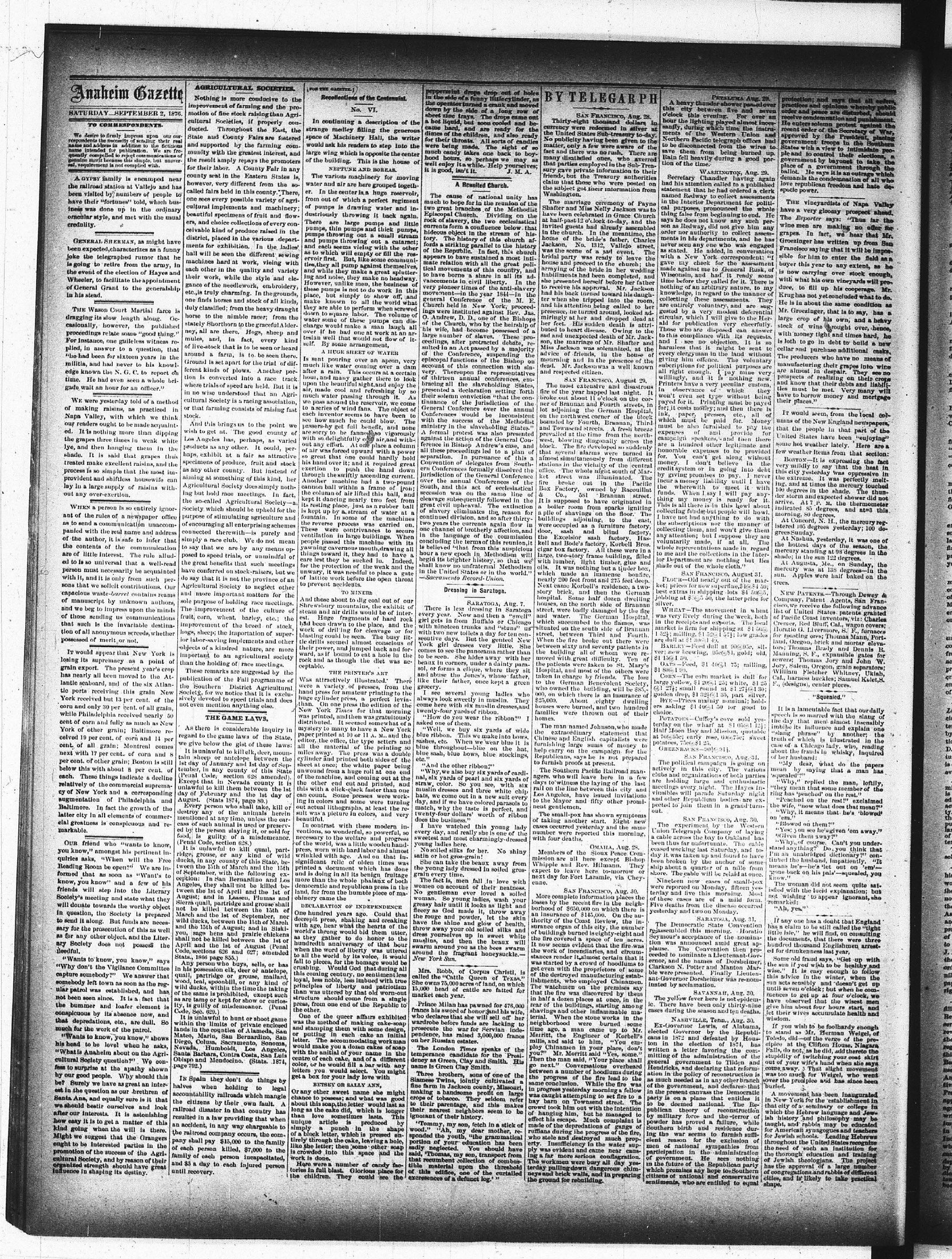
Searchable text
Anaheim Gazette
SATURDAY...SEPTEMBER 2, 1876.
TO CORRESPONDENTS
We desire to firmly impress upon our correspondents the necessity of sealing their real name and address in addition to the fictious name intended for publication. We are frequently compelled to reject communications of genuine merit because this simple, but universal, requirement is not complied with.
A gypsy family is encamped near the railroad station at Vallejo and has been visited by numbers of people to have their "fortunes" told, which business was done up in the ordinary oracular style, and met with the usual credulity.
General Sherman, as might have been expected, characterizes as a funny joke the telegraphed rumor that he is going to retire from the army, in the event of the election of Hayes and Wheeler, to facilitate the appointment of General Grant to the generalship in his stead.
The Wason Court Martial farce is dragging its slow length along. Occasionally, however, the published proceedings relate some "good thing." For instance, one guilleless witness replied, in answer to a question, that "he had been for sixteen years in the militia, and had never to his knowledge known the N. G. C. to report on time. He had even seen a whole brigade wait an hour for an officer."
We were yesterday told of a method of making raisins, as practiced in Napa Valley, with which we think our readers ought to be made acquainted. It is nothing more than dipping the grapes three times in weak white lye, and then hanging them in the shade. It is said that grapes thus treated make excellent raisins, and the
AGRICULTURAL SOCIETIES
Nothing is more conducive to the improvement of farming and the promotion of fine stock raising than Agricultural Societies, if properly conducted. Throughout the East, the State and County Fairs are fostered and supported by the farming community with the greatest interest, and the result amply repays the promoters for their labor. A County Fair in any county seat in the Eastern States is, however, very different from the so-called fairs held in this county. There, one sees every possible variety of agricultural implements and machinery; beautiful specimens of fruit and flowers, and choice collections of every conceivable kind of produce raised in the district, placed in the various departments for exhibition. In the ladies' hall will be seen the different sewing machines hard at work, vicing with each other in the quality and variety their work, while the style and elegance of the needlework, embroidery, etc., is truly charming. In the grounds, one finds horses and stock of all kinds, duly classified; from the heavy draught horse to the nimble racer; from the stately Shorthorn to the graceful Aldeney, all are there. Hogs, sheep and mules, and, in fact, every kind of live-stock that is to be seen or heard around a farm, is to be seen there. Ground is set apart for the trial of different kinds of plows. Another portion is converted into a race track where trials of speed are held. But it is in no wise understood that an Agricultural Society is a racing association, or that farming consists of raising fast stock.
And this brings us to the point we wish to get at. The good county of Los Angeles has, perhaps, as varied products as any other. It could, perhaps, exhibit at a fair as attractive specimens of produce, fruit and stock as any other county.
FOR THE GAZETTE
Recollection
In continuing strange medley space of Machin would ask his reel large wing which of the building.
NEITUNE
The various maize water and air areer. In the center from out of which of pumps is drawn dustriously throw There are large pumps, thin pump pumps throwing and pumps throwing and each seems as to which will enter first. But ties,they all pump and while they moving and noise,the However, unlike these pumps is no place, but simply make known to they are able to pull down to square la water some of the charge would make over if he had a tesian well that was self. By some ar
A HUGE SHIFT
Is sent pouring much like water after a rain. This hour, and many go upon the beautiful air, made cool and much water pass through to a series of wind each inventor seem see how much he passers-by get full are sorry to be faced with so delightful out any effort. A of air was forced up so great that one his hand over it; an exertion to push
WE were yesterday told of a method of making raisins, as practiced in Napa Valley, with which we think our readers ought to be made acquainted. It is nothing more than dipping the grapes three times in weak white lye, and then hanging them in the shade. It is said that grapes thus treated make excellent raisins, and the process is so simple that the most improvident and shiftless housewife can lay in a large supply of raisins without any over-exertion.
WHEN a person is so entirely ignorant of the rules of a newspaper office as to send a communication unaccompanied with the real name and address of the author, it is safe to infer that the contents of the communication are of little interest. The rule alluded to is so universal that a well-read person must necessarily be acquainted with it, and it is only from such persons that we solicit contributions. Our capacious waste-barrel contains reams of manuscript by unknown authors, and we beg to impress upon the minds of those sending us communications that such is the invariable destination of all anonymous screeds, whether possessed of merit or not.
It would appear that New York is losing its supremacy as a point of grain export. The present year's crop has nearly all been moved to the Atlantic seaboard, and of the six Atlantic ports receiving this grain New York received but 13 per cent. of the corn and only 30 per cent. of all grain, while Philadelphia received nearly 50 cent of corn and fully as much as New York of other grain; Baltimore received 19 per cent. of corn and 14 per cent. of all grain; Montreal comes next with 17 per cent. of corn and 8 per cent. of other grain; Boston is still below this with about a per cent. of each. These things indicate a decline relatively of the commercial supremacy of New York and a corresponding augmentation of Philadelphia and Baltimore. In fact the growth of the latter city in all elements of commercial greatness is conspicuous and remarkable.
OUR friend who "wants to know, you know," amongst his pertinent inquiries asks, "When will the Free Reading Room be open?" We are informed that as soon as "Want's to know, you know" and a few of his friends will start into the relevant kinds of plows. Another portion is converted into a race track where trials of speed are held. But it is in no wise understood that an Agricultural Society is a racing association, or that farming consists of raising fast stock.
And this brings us to the point we wish to get at. The good county of Los Angeles has, perhaps, as varied products as any other. It could, perhaps, exhibit at a fair as attractive specimens of produce, fruit and stock as any other county. But instead of aiming at something of this kind, her Agricultural Society does simply nothing but hold race meetings. In fact, the so-called Agricultural Society—a society which should be upheld for the purpose of stimulating agriculture and of encouraging all enterprising schemes connected therewith—is purely and simply a race club. We do not mean to say that we are by any means opposed to speed trials, or unmindful of the great benefits that such meetings have conferred on stock-raisers, but we do say that it is not the province of an Agricultural Society to neglect other and more important matters for the sole purpose of holding race meetings.
These remarks are suggested by the publication of the Fall programme of the Southern District Agricultural Society, for we notice that it is exclusively devoted to speed trials and does not even mention anything else.
THE GAME LAWS.
As there is considerable inquiry in regard to the game laws of the State, we give below the gist of these laws:
It is unlawful to kill elk, deer, mountain sheep or antelope between the 1st day of January and 1st day of September, in any county of this State (Penal Code, section 628 amended). Except that in Nevada county it is unlawful to kill them between the 1st day of February and the 1st day of August. (Stats 1874, page 80.)
Every person who shall take, kill or destroy any of the animals herein mentioned at any time, unless the carcass of such animal is used or preserved by the person slaying it, or sold for food, is guilty of a misdemeanor. (Penal Code, section 628.)
It is unlawful to kill quail, partridge, grouse, or any kind of wild ducks, in any county of this State, between the 15th March and the 15th September, with the following exception: In San Bernardino and Los Angeles, they shall not be killed before certain kinds of plows. Another portion is converted into a race track where trials of speed are held. But it is in no wise understood that an Agricultural Society is a racing association, or that farming consists of raising fast stock.
And this brings us to the point we wish to get at. The good county of Los Angeles has, perhaps, as varied products as any other. It could, perhaps, exhibit at a fair as attractive specimens of produce, fruit and stock as any other county. But instead of aiming at something of this kind, her Agricultural Society does simply nothing but hold race meetings. In fact, the so-called Agricultural Society—a society which should be upheld for the purpose of stimulating agriculture and of encouraging all enterprising schemes connected therewith—is purely and simply a race club. We do not mean to say that we are by any means opposed to speed trials, or unmindful of the great benefits that such meetings have conferred on stock-raisers, but we do say that it is not the province of an Agricultural Society to neglect other and more important matters for the sole purpose of holding race meetings.
These remarks are suggested by the publication of the Fall programme of the Southern District Agricultural Society, for we notice that it is exclusively devoted to speed trials and does not even mention anything else.
THE GAME LAWS.
As there is considerable inquiry in regard to the game laws of the State, we give below the gist of these laws:
It is unlawful to kill elk, deer, mountain sheep or antelope between the 1st day of January and 1st day of September, in any county of this State (Penal Code, section 628 amended). Except that in Nevada county it is unlawful to kill them between the 1st day of February and the 1st day of August. (Stats 1874, page 80.)
Every person who shall take, kill or destroy any of the animals herein mentioned at any time, unless the carcass of such animal is used or preserved by the person slaying it, or sold for food, is guilty of a misdemeanor. (Penal Code, section 628.)
It is unlawful to kill quail, partridge, grouse, or any kind of wild ducks, in any county of this State, between the 15th March and the 15th September, with the following exception: In San Bernardino and Los Angeles, they shall not be killed before certain kinds of plows. Another portion is converted into a race track where trials of speed are held. But it is in no wise understood that an Agricultural Society is a racing association, or that farming consists of raising fast stock.
And this brings us to the point we wish to get at. The good county of Los Angeles has, perhaps, as varied products as any other. It could, perhaps, exhibit at a fair as attractive specimens of produce, fruit and stock as any other county. But instead of aiming at something of this kind, her Agricultural Society does simply nothing but hold race meetings. In fact, the so-called Agricultural Society—a society which should be upheld for the purpose of stimulating agriculture and of encouraging all enterprising schemes connected therewith—is purely and simply a race club. We do not mean to say that we are by any means opposed to speed trials, or unmindful of the great benefits that such meetings have conferred on stock-raisers, but we do say that it is not the province of an Agricultural Society to neglect other and more important matters for the sole purpose of holding race meetings.
These remarks are suggested by the publication of the Fall programme of the Southern District Agricultural Society, for we notice that it is exclusively devoted to speed trials and does not even mention anything else.
THE PRINTS.
Was attractively written were a variety of hand press for amateur huge cylinder presses than On one press New York Times was printed, and then distributed. It seemed mystery to many to paper printed at 10 o'clock editor, the office; then all the material miles away. The pencil cylinder and printed sheet at once; the w unwound from a hugof machine; andthe other end cutthis with a click-clawcan count. Some printing in colors and so out actual lithographs suit was a picture in beautiful.
In contrast with ventions, so wonderfully necessary to the well-of the world, was a liftpress, worn with hard wrinkled with age,significant relicof printed a documentand is doing in all it more than the whole democratic and republic
Our friend who "wants to know, you know," amongst his pertinent inquiries asks, "When will the Free Reading Room be open?" We are informed that as soon as "Want's to know, you know" and a few of his friends will step into the Literary Society's meeting and state what they will donate towards the worthy object in question, the Society is prepared to send it along. But funds are necessary for the prosecution of this as well as for any other object, and the Literary Society does not possess the cleftful.
"Wants to know, you know," says "Why don't the Vigilance Committee capture somebody?" We answer that somebody left town as soon as the regular patrol was established, and has not been seen since. It is a fact that the bummer and loafer element is conspicuous by its absence now, and that depredations, etc., are dull. So much for the work of the patrol.
"Wants to know, you know," shows his head to be level when he asks, "What is Anaheim about on the Agricultural Society question?" We confess to surprise at the apathy shown by our good people. Why should this be? Surely we have as great an interest in the question as our brethren of Santa Ana, and equally sure is it that we should bestir ourselves and look after our interests. It is astonishing how easy it is to get a matter of this kind going when the will is there. Might we suggest that the Grangers ought to be interested parties in the promotion of the success of the Agricultural Society, and by reason of their organized strength should have great influence in shaping its destiny.
In Spain they don't do things by halves when holding to legal accountability railroads which mangle the citizens by their own fault. A railroad disaster in that country has resulted in a law providing that when an accident, in any way chargeable to the railroad company occurs, the company shall pay $15,000 to the family of each person killed, $7,000 to the family of each person incapacitated, and $5 a day to each injured person until recovery.
Every person who shall take, kill or destroy any of the animals herein mentioned at any time, unless the carcass of such animal is used or preserved by the person slaying it, or sold for food, is guilty of a misdemeanor. (Penal Code, section 628.)
It is unlawful to kill quail, partridge, grouse, or any kind of wild ducks, in any county of this State, between the 15th of March and the 15th of September, with the following exception: In San Bernardino and Los Angeles, they shall not be killed between the 1st of April and the 1st of August; and in Lassen, Plumas and Sierra quail, partridge and grouse shall not be killed between the 15th of March and the 1st of September, nor wild ducks, between the 15th of March and the 15th of August; and in Siskiyou, sage hens and prairie chickens shall not be killed between the 1st of April and the 1st of August (Penal Code, sections 626 and 627; amended Stats., 1866 page 855.)
Any person who buys, sells, or has in his possession elk, deer or antelope, quail, partridge or grouse, mallard, wood, teal, spoonbill, or any kind of wild ducks, within the time the taking of the same is prohibited, except such as are tame or kept for show or curiosity, is guilty of misdemeanor. (Penal Code, Sec. 629.)
It is unlawful to hunt or shoot game within the limits of private enclosed lands in the counties of Alameda, San Mateo, Marin, San Bernardino, San Diego, Colusa, Sacramento, Sonoma, Nevada, Humboldt, Los Angeles, Santa Barbara, Contra Costa, San Luis Obispo and Mendocino. (Stats. 1874, page 792.)
In Spain they don't do things by halves when holding to legal accountability railroads which mangle the citizens by their own fault. A railroad disaster in that country has resulted in a law providing that when an accident, in any way chargeable to the railroad company occurs, the company shall pay $15,000 to the family of each person killed, $7,000 to the family of each person incapacitated, and $5 a day to each injured person until recovery.
Every person who shall take, kill or destroy any of the animals herein mentioned at any time, unless the carcass of such animal is used or preserved by the person slaying it, or sold for food, is guilty of a misdemeanor. (Penal Code, section 628.)
It is unlawful to kill quail, partridge, grouse, or any kind of wild ducks, in any county of this State, between the 15th of March and the 15th of September, with the following exception: In San Bernardino and Los Angeles, they shall not be killed between the 1st of April and the 1st of August; and in Lassen, Plumas and Sierra quail, partridge and grouse shall not be killed between the 15th of March and the 1st of September, nor wild ducks, between the 15th of March and the 15th of August; and in Siskiyou, sage hens and prairie chickens shall not be killed between the 1st of April and the 1st of August (Penal Code, sections 626 and 627; amended Stats., 1866 page 855.)
Any person who buys, sells, or has in his possession elk, deer or antelope, quail, partridge or grouse, mallard, wood, teal, spoonbill, or any kind of wild ducks within the time the taking of the same is prohibited, except such as are tame or kept for show or curiosity, is guilty of misdemeanor. (Penal Code, Sec. 629.)
It is unlawful to hunt or shoot game within the limits of private enclosed lands in the counties of Alameda, San Mateo, Marin, San Bernardino, San Diego, Colusa, Sacramento, Sonoma,Nevada,Humboldt,Los Angeles,Santa Barbara,Contra Costa,San Luis Obispo and Mendocino.(Stats.1874.page792.)
RECOLLECTIONS OF THE CONFERENCE.
NO. VI.
In continuing a description of the strange meldy filling the generous space of Machinery Hall, the writer would ask his readers to step into the large wing which is opposite the center of the building. This is the house of NEUTUNE AND BOREAR.
The various machinery for moving water and air are here grouped together. In the center is a huge reservoir, from out of which a perfect regiment of pumps is drawing water and industriously throwing it back again. There are large pumps and little pumps, thin pumps and thick pumps, pumps throwing out a small stream and pumps throwing out a cataract; and each seems vieling with the other as to which will empty or fill the reservoir first. But, like some communities, they all pump against themselves, and while they make a great spluttering and noise, they make no headway. However, unlike men, the business of these pumps is not to do work in this place, but simply to show off, and make known to all the world what they are able to perform when screwed down to square labor. The volume of water some of these pumps can discharge would make a man laugh all over if he had one at work at an artesian well that would not flow of itself. By some arrangement,
A HUGE SHEET OF WATER
Is sent pouring over an apron, very much like water coming over a dam after a rain. This occurs at a certain hour, and many gather there to look upon the beautiful sight, and enjoy the air, made cool and refreshing by so much water passing through it. As we pass around the reservoir, we come to a series of wind fans. The object of each inventor seems to have been to see how much he could blow. The passers-by get full benefit, and none are sorry to be fanned so vigorously with so delightfully cold air, and without any effort. At one place a column of air was forced upward with a power so great that one could hardly hold his hand over it; and it required great exertion to push the hand down.
peppermint drops drop out of holes in the side of a funny little cylinder, as the operator turned a crank and moved down by the side of a long row of sheet zinc trays. The drops came out a hot liquid, but soon cooled and became hard, and are ready for the dims of the children, and also ready for their throats. All sorts of candies were being made. The sight of so much candy takes one back to boyhood hours, so perhaps we may as well enjoy it a while. Help yourselves; it is good, isn't it.
J. M. A.
A Renowned Church.
The cause of national unity has much to hope for in the reunion of the two great branches of the Methodist Episcopal Church. Dividing on the rock of slavery, the two ecclesiastical currents form a confluence below that hideous object in the stream of history. The history of this church affords a striking parallel to the history of the Republic. In fact, this church appears to have sustained a most intimate relation with all the great political movements of this country, and to have borne a share in all its advancements in civil liberty. In the very pioneer times of the anti-slavery movement—in the year 1844—in the general Conference of the M. E. Church held in New York, proceedings were instituted against Rev. Jas. O. Andrew, D. D., one of the Bishops of the Church, who by the heirship of his wife, had become possessed of a large number of slaves. These proceedings, after protracted debate, resulted in an Act passed by a majority of the Conference, suspending the episcopal functions of the Bishop on account of this connection with slavery. Thereupon she representatives of thirteen annual conferences, embracing all the slaveholding States, presented a declaration setting forth their solemn conviction "that the continuance of the jurisdiction of the General Conference over the annual Conferences would be inconsistent with the success of the Methodist ministry in the slaveholding States." A formal protest was also presented against the action of the General Conference in Bishop Andrew's case, and all these proceedings led to a plan of separation. In pursuance of this a Convention of delegates from Southern Conferences formally dissolved them.
BY TELEGARPH
SAN FRANCISCO, Aug. 28.
Thirty-eight thousand dollars in currency were redeemed in silver at the United States Sub-treasury to-day. No publicity having been given to the matter, only a few were aware of the fact and there was no rush. There are many disafflicted ones, who averred that parties employed in the Sub-Treasury gave private information to their friends; but the Treasury authorities claim that those who were posted on the subject got their information from Washington.
The marriage ceremony of Payne Shafter and Miss Nelly Jackson was to have been celebrated in Grace Church at half-past 12 o'clock to-day, and the invited guests had already assembled in the church. In the meantime, the home of the bride's father, Charles Jackson, No. 1312, Vallejo street, was the scene of a sad event. The bridal party was ready to leave the house and proceed to the church; the arraying of the bride in her wedding habiliments had been completed, and she presented herself before her father to receive his approval. Mr. Jackson had his back turned toward his daughter when she tripped into the room, and his attention being called to her presence, he turned around, looked admiringly at her and dropped dead at her feet. His sudden death is attributed to heart disease. Owing to the sad and unexpected death of Mr. Jackson, the marriage of Mr. Shafter and Miss Jackson was solemnized, at the advice of friends, in the house of mourning and in the presence of the dead. Mr. Jackson was a well known and respected citizen.
SAN FRANCISCO, August 29.
The most extensive and disastrous fire of the year happened last night. It broke out about 11 o'clock on the corner of Brannan and Fourth streets, in lot adjoining the German Hospital, on the northwest corner of the block bounded by Fourth, Brannan, Third and Townsend streets. A fresh breeze prevailed at the time from the north-west, blowing diagonally across the block. The fire developed so suddenly that several alarms were turned in almost simultaneously from different stations in the vicinity of the central office.
after a rain. This occurs at a certain hour, and many gather there to look upon the beautiful sight, and enjoy the air, made cool and refreshing by so much water passing through it. As we pass around the reservoir, we come to a series of wind fans. The object of each inventor seems to have been to see how much he could blow. The passers-by get full benefit, and none are sorry to be frowned so vigorously with so delightfully cool air, and without any effort. At one place a column of air was forced upward with a power so great that one could hardly hold his hand over it; and it required great exertion to push the hand down through the swiftly ascending current. Another machine had a two-pound cannon ball within a frame of iron; the column of air lifted this ball, and kept it dancing nearly two feet from its resting place, just as a rubber ball is kept up by a stream of water at a fountain. In some of the machines the reverse process was carried on. These were contrivances to secure ventilation in large buildings. When people passed this machine with its yawning cavernous mouth, drawing all things toward it, they had to have a care lest they be sucked in. Indeed, for the protection of the weak and the unwary, it was needful to place a gate of lattice work before the open throat to prevent accidents.
TO MINERS
And those about to dig coal out of our Shrewsbury mountains, the exhibit of steam and air drills would be of interest. Huge fragments of hard rock had been drawn to the place, and the work of drilling for cleavage or for blasting could be seen. The busy little drills seemed almost conscious of their power, and jumped back and forward, as if bound to eat a hole in the rock and as though the diet was acceptable.
THE PRINTER'S ART
Was attractively illustrated: There were a variety of presses, from the hand press for amateur printing to the huge cylinder press, a perfect leviathan. On one press the edition of the New York Times for that morning was printed, and then was gratuitously distributed. It seemed somewhat of a mystery to many to have a New York paper printed at 10 or 11 A.M., and the editor, the office, the type setters and all the material of the printing 80 miles away. The press was a double cylinder and printed both sides of the sheet at once; the white paper being unwound from a huge roll at one end of the machine, and coming out at the other end cut and printed, and this with a click-clack faster than one can count. Some presses were working in colors and some were turning out actual lithographs, at least the result was a picture in colors, and very beautiful.
In contrast with these modern inventions, so wonderful, so powerful, so necessary to the welfare and progress of the world, was a little wooden handpress, worn with hard labor and almost wrinkled with age. And on that insignificant relic of olden times was printed a document which has done and is doing in all its benign fruitage more than the whole phalanx of both democratic and republican press in the very Therupon the representatives of thirteen annual conferences, embracing all the slaveholding States, presented a declaration setting forth their solemn conviction "that the continuance of the jurisdiction of the General Conference over the annual Conferences would be inconsistent with the success of the Methodist ministry in the slaveholding States."
A formal protest was also presented against the action of the General Conference in Bishop Andrew's case, and all these proceedings led to a plan of separation. In pursuance of this a Convention of delegates from Southern Conferences formally dissolved the Jurisdiction of the General Conference over the annual Conferences of the South, and this act of ecclesiastical secession was on the same line of cleavage subsequently followed in the great civil upheaval. The extinction of slavery eliminates the reason for continued division, and so after thirty-two years the currents again flow in one channel of brotherly affection, and in the language of the commission concluding the terms of this reunion, it is believed "that from this auspicious hour a new epoch in Methodism will begin its brighter history, so that we shall know no unfraternal Methodism in the United States or in the world." —Sacramento Record-Union.
Dressing in Saratoga.
SARATOGA, Aug. 7.
There is less dressing in Saratoga every year. Now and then a "swell" girl gets in from Buffalo or Chicago with nineteen trunks and "stuns" us with two new toilets a day for ten consecutive days. But the genteel New York girl dresses very little. She comes to see the panorama rather than be seen. She hides away with her beaux in corners, under a dainty parasol, or forms a clique, where they sit and abuse the Jones's, whose father, like their father, once kept a green grocery.
I see several young ladies who always look sweetly in muslin. They come here with six muslin dresses,and twenty-four yards of ribbon.
"How do you wear the ribbon?" I asked one of them.
"Well, we buy six yards of wide blue ribbon. This we make into bows,sashes, etc. When we wear blue it is blue throughout—blue on the hat, blue sash, blue bows, blue stockings, etc."
"And the other ribbon?"
"Why, we also buy six yards of cardinal, six yards of pearl and six yards of straw color. So you see, with six muslin dresses and three white chip bats, we come out in a new suit every day, and if we have colored parasols to match, why the taste is perfect, and twenty-four dollars' worth of ribbon does the business."
I have watched this young lady every day, and really she is one of the sweetest and most charmingly-dressed young ladies here.
No solled silks for her. No shiny satin or hot gros-grain!
She can take the beaux away from the young lady dressed in soiled gros-grain every time.
The fact is, men fall in love with women on account of their neatness.
SAN FRANCISCO, August 29.
The most extensive and disastrous fire of the year happened last night. It broke out about 11 o'clock on the corner of Brannan and Fourth streets, in lot adjoining the German Hospital, on the northwest corner of the block bounded by Fourth, Brannan, Third and Townsend streets. A fresh breeze prevailed at the time from the northwest, blowing diagonally across the block. The fire developed so suddenly that several alarms were turned in almost simultaneously from different stations in the vicinity of the central office. The whole night south of Market street was illuminated. The fire broke out in the Pacific Box Factory, owned by Racouillat & Co., 581 Brannan street.
It is supposed to have originated in a boiler room from sparks igniting a pile of shavings on the floor. The buildings adjoining, to the east, were occupied as a furniture factory, door, sash and blind factory,the Excelsior sash factory,Haskell and Bode's factory.Korbell Bros.cigar box factory.All these were in a large,two-story frame building,filled with lumber light timber,g glue and oils. It was nothing but a tinder boxwhich made an immense bonfire,nearly 200 feet front and 275 feet deep.Next came Korbell's residence,a two-story brick,and then the German hospital.Some half dozen dwelling houses.on the north side of Brannan street.were badly damaged by the fire and water.The German Hospitalwhich succumbed to the flames.was situated on the south side of Brannan street.between Third and Fourth.When the fire broke out there were between sixty and seventy patients inthe building all of whom were removed with great difficulty.Ten ofthe patients were taken to St.Mary's Hospital,and most ofthe others were taken in charge by friends.The loss tothe German Benevolent Societywho owned the building,将be $85,-000.on which there is an insuranceof $25,000.About eighty dwellinghouses were burned,and two hundred families were thrown out.of their homes.
The man named Johnsonwho madethe extraordinary statement that Chinese and English capitalists were furnishing large sums of moneyto help carry onthe campaignforthe Republicans,says heis not prepared to furnish proofs at present.
The Southern Pacific Railroad managerswho will leave here in a few days to witnessthe layingofthe last rail onthe linebetweenthis cityandLos Angeles,have issued invitationstothe Mayorandfifty other prominent gentlemen.
The small-poxhas shown symptomsof taking another start.Eight new cases occurred yesterdayandthe same numberwere reported this morningwith four deaths.
OMAHA, Aug. 28.
Members of Sioux Peace Commissionare all here except Bishop Whipple和Rev.HilmannThey expect to leave here to-morrowornext day for Fort Laramie,via Cheyenne.
DECLARATION OF INDEPENDENCE
One hundred years ago. Could that decrepit press, shaking and creaking with age, hear what the hearts of the world's throng would bid them utter, as they gather to do honor to the hundredth anniversary of that hour when the word of liberty was uttered to all the world by its voice, it would fall to pieces, for the homage would be crushing. Would God that during all this coming century, no sentimentless loyal, less noble, less imbued with true principles of liberty and patriotism than was uttered by that old worn-out structure should come from a single press, from one end of the Republic to the other.
One of the queer affairs exhibited was the method of making cake-soap and stamping them with some design, or putting in each cake an initial letter. The accommodating workman would make you a dozen cakes of soap with the initial of your name in the centre of each cake, and of a different color, or he would fill a bar with any letters you would select. You might get a box for your lady love with BETSEY OR SALLY ANN,
Or any other sweet name she might chance to possess; and what was good about this soap, the letter would last as long as the cake did, which is longer than love sometimes lasts. This unique article is produced by simply a punch in the shape of a block letter, which is pressed entirely through the cake, leaving a hole, like the letter; then some other soap is crowded into this space and the work is done.
Here were a number of candy factories in full blast. Glorious place for the children. They could see the muslin dresses and three white chip hats, we come out in a new suit every day, and if we have colored parasols to match, why the taste is perfect, and twenty-four dollars' worth of ribbon does the business."
I have watched this young lady every day, and really she is one of the sweetest and most charmingly-dressed young ladies here.
No solled silks for her. No shiny satin or hot gros-grain!
She can take the beaux away from the young lady dressed in soiled gros-grain every time.
The fact is, men fall in love with women on account of their neatness. No gentleman ever loved a soiled woman. So young ladies, wash your greasy hair until it looks light and fleecy as God made it, throw away the rouge and powder, let the skin have the shine and glow of health, throw away your old soiled silks and dress yourselves up in sweet white muslins, and then the beaux will swarm around you as the bees swarm around the fragrant honeysuckle.
New York Sun.
Mrs. Robb, of Corpus Christi, is called the "Cattle Queen of Texas." She owns 75,000 acres of land, on which 15,000 head of cattle are fatted for market each year.
Prince Milan has pawned for 476,000 francs his sword of honor;and his wife, who declares that she will sell off her wardrobe before funds are lacking to prosecute the war for Servian independence, has raised 3,000,000 francs on her Russian estates.
The London Times speaks of the temperance candidate for the Presidency as Green, Clay and Smith. His name is Green Clay Smith.
Three brothers, sons of one of the Siamese Twins, jointly cultivated a fine farm in Jackson county, Missouri, making a handsome profit on large crops of tobacco. They seldom refer to their parentage, and this makes their nearest neighbors seem to be ignoant of their history.
"Tommy, my son, fetch in a stick of wood," "Ah, my dear mother, responded the youth," "the grammatical portion of your education has been sadly neglected. You should have said, 'Thomas, my son, transport from that recumbent collection of combustible material upon the threshold of this edifice,' one of the curtailed excrescences of a defunct log."
Omaha, Aug. 28.
Members of the Sioux Peace Commission are all here except Bishop Whipple and Rev. Hilmann. They expect to leave here to-morrow or next day for Fort Laramie, via Cheyenne.
SAN FRANCISCO, Aug. 30.
More complete information places the losses by the recent fire in the neighborhood of $650,000 on which there is an insurance of $145,000. On the authority of the Coast Review, the insurance organ of this city, the number of buildings burned is eighty-eight and the fire covered a space of ten acres. It now seems evident that the fire was the work of incendiaries, and circumstances render it almost certain that it was started by a crowd of hoodlums to get even with the proprietors of some of the destroyed manufacturing establishments, who employed Chinamen. The watchmen on the premises say that the fire was discovered by them in half a dozen places at once, in the rear of the buildings, starting among shavings and other inflammable material. When the stone works in the neighborhood were burned some time ago, a man came up to Mr. Meiritt, the Engineer of Korbell's mills, and said to him, "You employ Chinamen in your place, don't you?" Mr. Morritt said "Yes, some." Then the man said, "Your place shall go next." Conversations overheard between a number of hoodlums during the progress of the fire lead to the same conclusion. While the fire was in progress yesterday morning a fellow was caught attempting to set fire to a hay barn on Townsend street. The crowd took him out with the intention of hanging him, but he managed to effect his escape. Much complaint is made of the depredations of gangs of ruffians during the progress of the fire, who stole and destroyed much property. Insufficiency in the water supply was evident and came near causing a far more serious conflagration. The workmen were busy all day yesterday pulling down dangerous chimneys and brick walls, and in preparing the ground for rebuilding.
FRANCISCO, Aug. 28. Thousand dollars in treasury to-day, being given to the war were aware of the no rush. There are bones, who averred layed in the Sub-Treasury information to their Treasury authorities who were posted on their information from ceremony of Payne Nelly Jackson was to be in Grace Church clock to-day, and the already assembled the meantime, the wife's father, Charles 12, Vallejo street, a sad event. The ready to leave the to the church; the made in her wedding been completed, and self before her father naval. Mr. Jackson toward his daughter into the room, being called to her around, looked added dropped dead at ten death is attriase. Owing to the death of Mr. Jack- of Mr. Shafter and solemnized, at the house of the presence of the was a well known man.
FRANCISCO, August 29. Live and disastrous ped last night. It o'clock on the cor- Fourth streets, in German Hospital, corner of the block, Brannan, Third-sts. A fresh breeze came from the north-gonally across the developed so suddenly were turned in easily from different city of the central
PETALUMA Aug. 29. A heavy thunder shower passed over this city between five and seven o'clock this evening. For over an hour the lighting played almost incens-santly, during which time the instruments of the Western Union and Northern Pacific telegraph offices had to be disconnected from the wires to save them from being burned up. Rain fell heavily during a good portion of the time.
WASHINGTON, Aug. 29. Secretary Chandler having again had his attention called to a published statement that he had ordered a clerk named Redway to collect assessments in the Interior Department for political purposes, pronounced the whole thing false from beginning to end. He says he does not know any such person as Redway, did not give him any order nor authority to collect assessments in his departments, and he has never seen any one who was engaged as stated. He added, in conversation with a New York correspondent: "I gave my check for the assessment made against me to General Rusk, of Wisconsin, and had it ready some time before they called for it. There is nothing of an arbitrary nature, to my knowledge, in regard to the manner of collecting these assessments. They are entirely voluntary, and are suggested by a very modest deferential circular, which I will give to the Herald for publication very cheerfully. Those who are disposed can answer to this compliance with its requests, and I see no objection. It is so harmless that it might be sent to every clergyman in the land without giving him offence. The voluntary subscriptions for political purposes are all right enough. I pay mine very willingly, and it is nothing new. Printers have a very peculiar custom, in observance of which they won't even set type without being paid for it. Printing must be paid for; it costs money; and then there is ink, paper, presses, etc., all of which must be paid for. Money must be also furnished to pay the expenses of and provide for campaign speakers; and then there are a hundred other legitimate and honorable expenses to be provided for. You can't get along without money. I don't believe in the credit system or in going into debt protection; and says that all adults practices and opinions whereby public order and peace are disturbed, should receive condemnation and punishment. He enters solemn protest against the recent order of the Secretary of War, approved by the President, placing government troops in the Southern States with a view to intimidate people and to control their elections, a government by bayonet to take the place of a government through the ballot. He says it is an outrage which demands the condemnation of all who love republican freedom and hate despotic power.
The vineyardists of Napa Valley have a very gloomy prospect ahead. The Reporter says: "Thus far the wine men are making no offer for grapes. In fact, we hear that Mr. Groezinger has written up from San Francisco saying that it will be impossible for him to enter the field as a buyer this year to any extent, as he is now carrying over stock enough, with what his own vineyards will produce, to fill up his cooperage. Mr. Krug has not yet concluded what to do. He is in about the same condition as Mr. Groezinger, that is to say, has a large crop of his own, and a heavy stock of wine brought over, hence, with money tight and times hard, he is loth to go in debt to build a new cellar and purchase additional casks. The producers who have no means of manufacturing their grapes into wine are almost in despair. They see no prospects of realizing on their crops and know that their debts and liabilities must be met. Very many will have to borrow money and mortgage their places."
It would seem, from the local columns of the New England newspapers, that the people in that part of the United States have been "enjoying" some hot weather lately. Here are a few weather items from that section:
Boston—It is expressing the fact very mildly to say that the heat in
In the Pacific coast by Racouillat and Brannan street, have originated in German sparks igniting on the floor. The bug, to the east, furniture factory, blind factory, Hassory, Korbell Bros. All these were in a time building, filled timber, glue and but a tinder box, immense bonfire, and 275 feet deep residence, a two-when the German half dozen dwelling side of Brannan managed by the fire German Hospital, to the flames, was on slide of Brannan bird and Fourth. Out there were twenty patients in whom were rehabilitity. Ten of them to St. Mary's of the others were friends. The loss of unevolent Society, will be $85; is an insurance of eighty dwelling and two hundred out of their Johnson, who made statement that capitalists were uss of money to campaign for the is not prepared present.
Railroad man here in a few days of the last even this city and issued invitations other promi-shown symptoms art. Eight new day and the same this morning,
Maha, Aug. 28.
oux Peace Com-except Bishop Wilmann. They be to-morrow or amble, via Chey
San Francisco, August 31.
FLOUR—Old nearly out of the market; prices for new superline,$4@$1 50; best extras in shipping lots $4 50@5; jobbing at $5@5 50; the latter price for silver.
WHEAT—The movement in when was very lively during the week, both in the receipts and exports. The local market is firm for shipping at $1 56@1 52}; milling, $1 52@1 57]; low grades are dull at $1 39@1 49.
BARLEY—Feed dull at 90@95c, silver; new brewing, 95e@$1, gold; old, $1 15@1 39.
OATS—Feed, $1 40@1 75; milling, $1 80@1 99.
CORN—The corn market is dull for large yellow, $1 20@1 25; white, $1 25@1 27]; small round at $1 27@1 30; golden drop, $1 32@1 35; part silver.
RYE—Prices mainly nominal; holders asking $1 40@1 50 for good to choice.
POTATOES—Cuffey's cove sold yesterday on the wharf at $1 05@1 12]; Half Moon Bay and Mission, quotable at 70@95c; early rose, 60@75c; sweet potatoes, 75e@$1 25.
GREENBACKS—90@91l.
San Francisco, Aug. 31.
The political campaign is going on actively in this city. The various clubs and organizations of both parties are holding large and enthusiastic meetings every night. The Hayes invinibles will parade Saturday night and other Republican bodies are expected to join them in a grand turn-out.
San Francisco, Aug. 30.
The experiment by the Western Union Telegraph Company of laying a cable across the bay Oakland has been thus far unfortunate. The cable ceased working last Saturday, and today it was taken up and found to have been broken by the anchor of some ship about a quarter of a mile from shore. The cable will be relaid at once.
Nineteen new cases of small-pox were reported on Monday, fifteen yes-all right enough. I pay mine very willingly, and it is nothing new. Printers have a very peculiar custom, in observance of which they won't even set type without being paid for it. Printing must be paid for; it costs money; and then there is ink, paper, presses, etc., all of which must be paid for. Money must be also furnished to pay the expenses of and provide for campaign speakers, and then there are a hundred other legitimate and honorable expenses to be provided for. You can't get along without money. I don't believe in the credit system or in going into debt by giving promises to pay. I never incur a money liability until I have the wherewith to meet it with funds. When I say I will pay anything my money is ready for it. This is all there is in this howl about collecting fund-but people will howl. I have not had anything to do with the subscriptions nor the manner of collecting them, and won't give them any attention; but I suppose they are voluntarily made, if at all. The whole representations made in regard to me and the collections in the Interior Department are nothing but lies made out of the whole cloth."
SAN FRANCISCO, August 31.
FLOUR—Old nearly out of the market; prices for new superline,$4@$1 50; best extras in shipping lots $4 50@5; jobbing at $5@5 50; the latter price for silver.
WHEAT—The movement in when was very lively during the week, both in the receipts and exports. The local market is firm for shipping at $1 56@1 52}; milling, $1 52@1 57]; low grades are dull at $1 39@1 49.
BARLEY—Feed dull at 90@95c, silver; new brewing, 95e@$1, gold; old, $1 15@1 39.
OATS—Feed, $1 40@1 75; milling, $1 80@1 99.
CORN—The corn market is dull for large yellow, $1 20@1 25; white, $1 25@1 27]; small round at $1 27@1 30; golden drop, $1 32@1 35; part silver.
RYE—Prices mainly nominal; holders asking $1 40@1 50 for good to choice.
POTATOES—Cuffey's cove sold yesterday on the wharf at $1 05@1 12]; Half Moon Bay and Mission, quotable at 70@95c; early rose, 60@75c; sweet potatoes, 75e@$1 25.
GREENBACKS—90@91l.
San Francisco, Aug. 31.
The political campaign is going on actively in this city. The various clubs and organizations of both parties are holding large and enthusiastic meetings every night. The Hayes invinibles will parade Saturday night and other Republican bodies are expected to join them in a grand turn-out.
San Francisco, Aug. 30.
The experiment by the Western Union Telegraph Company of laying a cable across the bay Oakland has been thus far unfortunate. The cable ceased working last Saturday, and today it was taken up and found to have been broken by the anchor of some ship about a quarter of a mile from shore. The cable will be relaid at once.
Nineteen new cases of small-pox were reported on Monday, fifteen yes-all right enough. I pay mine very willingly, and it is nothing new. Printers have a very peculiar custom, in observance of which they won't even set type without being paid for it. Printing must be paid for; it costs money; and then there is ink, paper, presses, etc., all of which must be paid for. Money must be also furnished to pay the expenses of and provide for campaign speakers, and then there are a hundred other legitimate and honorable expenses to be provided for. You can't get along without money. I don't believe in the credit system or in going into debt by giving promises to pay. I never incur a money liability until I have the wherewith to meet it with funds. When I say I will pay anything my money is ready for it. This is all there is in this howl about collecting fund-but people will howl. I have not had anything to do with the subscriptions nor the manner of collecting them, and won't give them any attention; but I suppose they are voluntarily made, if at all. The whole representations made in regard to me and the collections in the Interior Department are nothing but lies made out of the whole cloth."
SAN FRANCISCO, August 31.
FLOUR—Old nearly out of the market; prices for new superline,$4@$1 50; best extras in shipping lots $4 50@5; jobbing at $5@5 50; the latter price for silver.
WHEAT—The movement in when was very lively during the week, both in the receipts and exports. The local market is firm for shipping at $1 56@1 52}; milling, $1 52@1 57]; low grades are dull at $1 39@1 49.
BARLEY—Feed dull at 90@95c, silver; new brewing, 95e@$1, gold; old, $1 15@1 39.
OATS—Feed, $1 40@1 75; milling, $1 80@1 99.
CORN—The corn market is dull for large yellow, $1 20@1 25; white, $1 25@1 27]; small round at $1 27@1 30; golden drop, $1 32@1 35; part silver.
RYE—Prices mainly nominal; holders asking $1 40@1 50 for good to choice.
POTATOES—Cuffey's cove sold yesterday on the wharf at $1 05@1 12]; Half Moon Bay and Mission, quotable at 70@95c; early rose, 60@75c; sweet potatoes, 75e@$1 25.
GREENBACKS—90@9lI.
San Francisco, Aug.
SAN FRANCISCO, Aug. 30.
The experiment by the Western Union Telegraph Company of laying a cable across the bay to Oakland has been thus far unfortunate. The cable ceased working last Saturday, and today it was taken up and found to have been broken by the anchor of some ship about a quarter of a mile from shore. The cable will be relaid at once.
Nineteen new cases of small-pox were reported on Monday, fifteen yesterday and five this morning. Most of these cases are of a mild form. Five deaths from the disease occurred yesterday and two on Monday.
SARATOGA, Aug. 31.
The Democratic State Convention reassembled this morning. Horatio Seymour's acceptance of the nomination was announced amid great applause. The Convention then proceeded to nominate a Lieutenant-Governor, and the names of Dorsheimer, Clarkson N. Potter and Manton Marble were presented. Finally Lieutenant-Governor Dorsheimer was re-nominated by acclamation.
SAVANNAH, Aug. 30.
The yellow fever here is not epidemic. There have been only thirty-nine cases during the season and ten deaths.
NASHVILLE, Tenn., Aug. 30.
Ex-Governor Lewis, of Alabama, elected Governor by the Republicans in 1872 and defeated by Houston in the election of 1874, has written a letter favoring the committing of the administration of the general government to Tilden and Hendricks, and declaring that reformation in the policy of reconstruction is as much needed as in any other branch of the government, and declares that in the present canvass the Democratic party is on a plane that entitles it to be deemed national. The Republican theory of reconstruction by military force and the terror of powder has proved a failure, while Southern birth and residence during the war seems to furnish sufficient reason for the exclusion of men of national sympathies from participation in the administration of government. He sees nothing in the future of the Republican party which promises any hope to Southern citizens of national and conservative sentiments, who are entitled to equal ring has 'peached' on the rest."
"Peached on the rest!" exclaimed the wife, "now what does that mean?"
"Why, it means that he's 'blowed' on 'em."
"Blowed on them?"
"Yes; you see he's given 'em away."
"Given them away?"
"Why, of course. Can't you understand anything? Do you think that I'm an unabridged dictionary?" continued the husband, impatiently. "It means he's—he's let out on 'em'—gone back on his pals'—squealed, you know."
The woman did not seem quite satisfied with the laid explanation; but not wishing to appear ignorant, she remarked:
"Ah, yes."
If any one has a doubt that England has a claim to be still called the "tight little island," he will find, on consulting the documents, that there were three hundred thousand Englishmen arrested for drunkenness last year.
Some old fraud says, "Get up with the sun if you wish to be healthy and wise." It is easy enough to follow this advice in the winter, when the sun acts sensibly and doesn't get up until seven o'clock; but when he commences to get up at four o'clock, we have observed that the wisest man give him about four hours start, and let their wives accumulate health and wisdom.
If you wish to be foolhardy enough to stand as Mr. Herman Weigel, of Toledo, did—of the verge of the precipice at the Clifton House, Niagara Falls, do not; as he did, add thereto the stupidity of twitching your coat skirt out of your wife's hand when she says come away. That slight movement was too much for Weigel, who went over the precipice and has since been buried.
A movement has been inaugurated in New York for the establishment in that city of a seminary or college in which the Hebrew language and Jewish history and philosophy may be taught, and rabbis may be educated for American synagogues and teachers for Jewish schools. Leading Hebrews throughout the United States recognize the need of such an institution for the thorough education and training of Jewish theologians. The project has the approval of a large number of congregations and rabbis of different cities, and is likely to take practical shape.