anaheim-gazette 1876-08-19
Scanned page
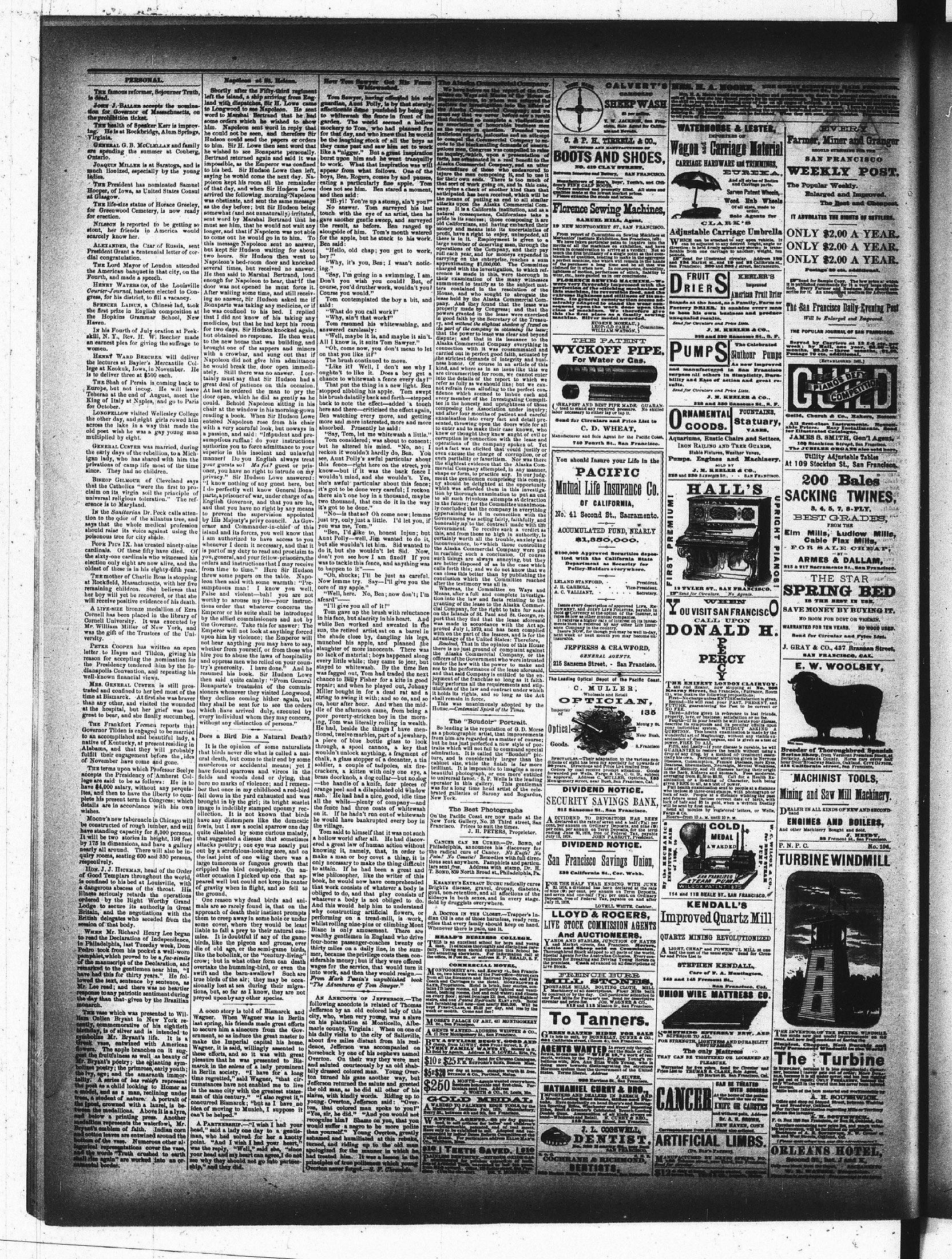
Searchable text
PERSONAL.
The famous reformer, Sojourner Truth, is dead.
John J. Ballen accepts the nomination for Governor of Massachusetts, on the prohibition ticket.
The health of Speaker Kerr is improving. He is at Rockbridge, Alum Springs, Virginia.
General G. B. McClellan and family are spending the summer at Couberg, Ontario.
Joaquin Miller is at Saratoga, and is much lionized, especially by the young ladies.
The President has nominated Samuel Hooper, of Iowa, as United States Consul at Glasgow.
The life-size statue of Horace Greeley, for Greenwood Cemetery, is now ready for erection.
Nilsson is reported to be getting so stout, her friends in America would scarcely know her.
Alexander, the Czar of Russia, sent President Grant a centennial letter of cordial congratulation.
The Lord Mayor of London attended the American banquet in that city, on the Fourth, and made a speech.
Henry Waterson, of the Louisville Courter-Journal, has been elected to Congress, for his district, to fill a vacancy.
Spencer Laisun, a Chinese lad, took the first prize in English composition at the Hopkins Grammar School, New Haven.
In his Fourth of July oration at Peekskill, N. Y., Rev. H. W. Beecher made an earnest plea for giving the suffrage to women.
Henry? Ward Beecher will deliver the lectures at Bayler's Mercantile College at Keokuk, Iowa, in November. He is to deliver three at $500 each.
The Shah of Persia is coming back to Europe, but not incog. He will leave Teheran at the end of August, meet the King of Italy at Naples, and go to Paris for October.
Lonofellow visited Wellesley College the other day, and eight girls rowed him across the lake in a way that made the old poet wish he was a gay young man multiplied by eight.
General Custer was married, during the early days of the rebellion, to a Michigan lady, who has shared with him the privations of camp life most of the time.
Napoleon at St. Helena.
Shortly after the Fifty-third regiment left the island, a ship arriving from England with dispatchers, Sir H. Lowe came to Longwood to see Napoleon. He sent word to Marshal Bertrand that he had some orders which he wished to show him. Napoleon sent word in reply that he could not be seen, and therefore Sir Hudson could send the papers or orders to him. Sir H. Lowe then sent word that he wished to see Bonaparte personally. Bertrand returned again and said it was impossible, as the Emperor was confined to his bed. Sir Hudson Lowe then left, saying he would come the next day. Napoleon kept his room all the remainder of that day, and when Sir Hudson Lowe arrived the following morning Napoleon was obstinate, and sent the same message as the day before; but Sir Hudson being somewhat (and not unnaturally) irritated, sent word by Marshal Bertrand that he must see him, that he would not wait any longer, and that if Napoleon was not able to come out he would go in to him. To this message Napoleon sent no answer, but kept Sir Hudson waiting for about two hours. Sir Hudson then went to Napoleon's bed-room door and knocked several times, but received no answer. He then said to Marshal Bertrand, loud enough for Napoleon to hear, that if the door was not opened he must force it. After waiting some time, and still receiving no answer, Sir Hudson asked me if Bonaparte was taking any medicine, or if he was confined to his bed. I replied that I did not know of his taking any medicine, but that he had kept his room for two days. Sir Hudson knocked again, but obtained no response. He then went to the new house that was building, and brought one of the sappers and miners with a crowbar, and sung out that if Napoleon did not give him admittance he would break the door open immediately. Still there was no answer. I certainly must say that Sir Hudson had a great deal of patience on this occasion. At last he ordered the man to pry the door open, which he did as gently as he could. Behold Napoleon sitting in his chair at the window in his morning-gown reading a book. When Sir Hudson Lowe entered Napoleon rose from his chair with a very scornful look, but noways in a passion, and said: "Impudent and presumptious ruffian! do your instructions authorize you to force admittance to your superior in this insolent and unlawful manner? Do you English always treat your guests so? Ma foi! guest or pris-
Tom Sawyer guardias; An affectionate dog to whitewash garden. The mockery to Tom for that day; be the laughter they came pay like a "niggers burst upon him to work. We appear from boys; Ben. R eating a parchment does not see him and then said: "Hi-yi! Ye No answer touch with them gave another result; an alongside of Ben for the apples Ben said: "Hello, old hey!"
"Why, it's ing."
"Say, I'm gon't you course you won't Tom contend said: "What do you? Why, sin! Tom resume answered car! Well, may All I know is Oh, come on that you lie The brush Like it?oughtn't to chance to whip That put tha stopped nibbly his brush dainting back to note here and there Ben watching more and more absorbed. P: Say, Tom Tom consider but he alterreckon it wou see; Aunt Polish this fence—r
The Shah of Persia is coming back to Europe, but not incog. He will leave Teheran at the end of August, meet the King of Italy at Naples, and go to Paris for October.
LONGFELLOW visited Wellesley College the other day, and eight girls rowed him across the lake in a way that made the old poet wish he was a gay young man multiplied by eight.
GENERAL CUSTER was married, during the early days of the rebellion, to a Michigan lady, who has shared with him the privations of camp life most of the time since. They had no children.
BISHOP GILMOUR of Cleveland says that the Catholics "were the first to proclaim on its virgin soil the principle of universal religious toleration." The reference is to Maryland.
IN the Sanitarian Dr. Peck calls attention to the odor of the alliantus tree, and says that the whole medical profession should raise its voice against using the poisonous tree for city shade.
POPE Pius IX. has created ninety-nine cardinals. Of these fifty have died. Of the sixty-one cardinals who witnessed his election only eight are now alive, and the oldest of these is in his eighty-fifth year.
The mother of Charlie Ross is stopping at Rockfield, Massachusetts, with her five remaining children. She believes that her boy will yet be recovered, or that she will receive positive evidence of his death.
A LIVE-SIZE bronze medallion of Ezra Cornell has been placed in the library of Cornell University. It was executed by Mr. William Miller of New York, and was the gift of the Trustees of the University.
PETER COOPER has written an open letter to Hayes and Tilden, giving his reason for accepting the nomination for the Presidency tendered him by the Indianapolis Convention, and repeating his well-known financial views.
MRS. GENERAL CUSTER is still prostrated and confined to her bed most of the time at Bismarck. At first she was braver than any other, and visited the wounded at the hospital, but her grief was too great to bear, and she finally succumbed.
THE FRANKfort Yoeman reports that Governor Tilden is engaged to be married to an accomplished and beautiful lady, a native of Kentucky, at present residing in Alabama, and that they will probably fulfill their engagement before the ideas of November have come and gone.
The terms upon which Professor Seelye accepts the Presidency of Amherst College are said to be as follows: He is to have $4,000 salary, without any perquisites, and then to have the liberty to complete his present term in Congress; which details are in accordance with his own wishes.
Moody's new tabernacle in Chicago will be constructed of rough lumber, and will have standing capacity for 8,300 persons. It will be two stories in height, 198 feet by 175 in dimensions, and have a gallery nearly all around. There will also be inquiry rooms, seating 600 and 350 persons, respectively.
HOW J. J. HICKMAN, head of the Order of Good Templars throughout the world, is confined to his bed at Louisville, with a dangerous abscess of the throat. Hisately. Still there was no answer. I certainly must say that Sir Hudson had a great deal of patience on this occasion. At last he ordered the man to pry the door open, which he did as gently as he could. Behold Napoleon sitting in his chair at the window in his morning-gown reading a book. When Sir Hudson Lowe entered Napoleon rose from his chair with a very scornful look, but noways in a passion, and said: "Impudent and presumptious ruffian! do your instructions authorize you to force admittance to your superior in this insolent and unlawful manner? Do you English always treat your guests so! Mafoi? guest or prisoner, you have no right to intrude on my privacy." Sir Hudson Lowe answered: "I know nothing of any guest here, but I do perfectly well know General Bonaparte, a prisoner of war, under charge of an English Governor, and that you are he, and that you have no right by any means to prevent the supervision appointed by His Majesty's privy council. As Governor and Commander-in-chief of this island and its forces, you well know that I am authorized to have access to you whenever I deem it necessary, and that it is part of my duty to read and proclaim to you, general, and your fellow-prisoners,the orders and instructions that I may receive from time to time." Here Sir Hudson threw some papers on the table. Napoleon then said with some warmth: "Presumptuous man! I know you well, False and violent—bah! you are not worthy to arouse my irre--your instructions order that whatever concerns the Emperor or his suite shall be introduced by the allied commissioners and not by the Governor. Take this for answer: The Emperor will not look at anything forced upon him by violence; the Emperor will not hear anything you may have to say, whether from yourself, or from those who hire you to abuse the laws of hospitality and oppress men who relied on your country's generosity. I have done." And he resumed his book. Sir Hudson Lowe then said quite calmly: "From General Bonaparte's treatment of the commissioners whenever they visited Longwood, they decline coming hither again, but they shall be sent for to see the orders which have arrived duly executed by every individual whom they may concern, without any distinction of persons."
Does a Bird Die a Natural Death?
It is the opinion of some naturalists that birds never die what is called a natural death, but come to their end by some murderous or accidental means; yet I have found sparrows and vireos in the fields and woods dead or dying, that bore no marks of violence; and I remember that once in my childhood a red-bird fell down in the yard exhausted and was brought in by the girl; its bright scarlet image is indelibly stamped uponmy reclection. It is not known that birds have any distempers like the domestic fowls, but I saw a social sparrow one day quite disabled by some curious malady, that suggested a disease that sometimes attacks poultry; one eye was nearly put out by a scrofulous-looking sore, and on the last joint of one wing there was a large tumorous or fungous growth that crippled the bird completely. On another occasion I picked up one that appeared well but could not keep its center of gravity when in flight, and so fell tooughtn't to chance to whistle. That put the stopped nibble his brush daunting back to note here and there Ben watching more and more absorbed. P
"Say, Tom," Tom consider but he altercation it would see, Aunt Polly this fence—know—but it wouldn't mind she's awful pity it's got to be she ain't one two thousand; it's got to he "No—is that just try, only you was me," "Ben, I'd Aunt Polly—but she would do it, but she don't you see was to tackle t o happen to it "Oh, shucks Now lemme try core of my appear "Well, here afeard"—— "I'll give you Tom gave up in his face, but while Ben wo sun, the retired munched his slaughter of m no lack of mat every little wha stayed to whie was fagged out chance to Billy repair; and while Miller bought string to swing on hour after dale of the after poor poverty-s ing,Tom was He had beside tioned,t twelve n piece of blu through,a spe wouldn't unlock chalk,a glass s soldier,a cou crackers,a ki brass doorknob—the handle o orange peel and sash. He had all the while—the fence had on it. If he haw he would have on it.The wise philosopher book,他 would that work consi
Moody's new tabernacle in Chicago will be constructed of rough lumber, and will have standing capacity for 8,300 persons. It will be two stories in height, 198 feet by 175 in dimensions, and have a gallery nearly all around. There will also be inquiry rooms, seating 600 and 350 persons, respectively.
Hon. J. J. Hickman, head of the Order of Good Templars throughout the world, is confined to his bed at Louisville, with a dangerous abscess of the throat. His illness seriously retards the operations ordered by the Right Worthy Grand Lodge to secure its authority in Great Britain, and the negotiations with the British delegates who seceded from the session of that body.
When Mr. Richard Henry Lee began to read the Declaration of Independence, in Philadelphia, last Tuesday week, Dom Pedro took from his pocket a well-worn pamphlet, which proved to be a facsimile of the manuscript of the Declaration, and remarked to the gentlemen near him, "I have had this for thirty years." He followed the text, sentence by sentence, as Mr. Lee read; and there was no heartier response to any patriotic sentiment during the day than that given by the Brazilian monarch.
The vase which was presented to William Cullen Bryant in New York recently, commemorative of his eightieth birthday, is of silver and is intended to symbolize Mr. Bryant's life. It is a Greek vase, entwined with American flowers. The apple branches on it suggest the fruitfulness as well as beauty of Mr. Bryant's poetry; the eglantine symbols poetry; the primrose, early youth; the ivy, age; and the amaranth immortality. A series of bas reliefs represent the post as a child looking to Homer as a model, and as a man, reclining under trees; a student of nature. A portrait of the poet, crowned with a laurel, is between the medallions. Above it is a lyre, and below a printing press. Another medallion represents the waterfowl, Mr. Bryant's emblem of faith. Indian corn and cotton leaves are entwined around the bottom of the vase. Numerous other allegorical representations cover the vase, and the words "Truth crushed to earth shall rise again" are worked into an ornamental border.
A good story is told of Bismarck and Wagner. When Wagner was in Berlin last spring, his friends made great efforts to secure him a sinecure from the Government, so as induce the great master to make the Imperial capital his home. Wagner, it is said, willingly assented to these efforts, and so it was with great pleasure that he was presented to Bismarck in the salons of a lady prominent in Berlin society. "I have for a long time regretted," said Wagner, "that circumstances have not enabled me to live in the same city with the greatest statesman of this century." "I also regret it," concurred Bismarck; "but as I have no idea of moving to Munich, I suppose it can't be helped."
A partnership—"I wish I had your head," said a lady one day to a gentleman, who had solved for her knotty point. "And I wish I had your heart," was the reply, "Well," said she, "since your head and my heart can agree, I do not see why they should not go into partnership," and they did.
An Anecdote following anecdotes Jefferson by an old city, who, when on his plantation marle county, Ville his daily visits to about five miles dence, Jefferson on horseback by one Overton. On this and saluted courteously dressed color ton turned his jefferson returned the old man, as he slaves, with kindly young. Overton, Jefferson that colored "Yes, sir, he did." recognize him! would suffer a new than yourself." Ashamed and humbled apologized for that had treated him. principles of true Overton never fugued.
New Tom Sawyer Got His Fence Whitewash.
Tom lawyer, having offended his sole guardian, Aunt Polly, is by that strayly affectionate dame punished by being set to whitewash the fence in front of the garden. The world seemed a hollow mockery to Tom, who had planned fun for that day, and who knew that he would be the laughing stock of all the boys as they came past and saw him set to work like a "nigger." But a great inspiration burst upon him and he went tranquilly to work. What that inspiration was will appear from what follows. One of the boys, Ben Rogers, comes by and panses, eating a particularly fine apple. Tom does not see him. Ben stared a moment, and then said:
"Hi-yi! You're up a stump, ain't you?"
No answer. Tom surveyed his last touch with the eye of an artist, then he gave another gentle sweep, and surveyed the result, as before. Ben ranged up alongside of him. Tom's mouth watered for the apple, but he stuck to his work. Ben said:
"Hello, old chap; you got to work, hey!"
"Why, it's you, Ben; I wasn't noticing."
"Say, I'm going in a swimming, I am. Don't you wish you could! But, of course, you'd druther work, wouldn't you Course you would."
Tom contemplated the boy a bit, and said:
"What do you call work?"
"Why, ain't that work!"
Tom resumed his whitewashing, and answered carelessly:
"Well, maybe it is, and maybe it ain't. All I know is, it suits Tom Sawyer."
"It come now, you don't mean to let on that you like it?"
The brush continued to move.
"Like it? Well, I don't see why I oughtn't to like it. Does a boy get a chance to whitewash a fence every day?"
That put the thing in a new light. Ben stopped nibbling his apple. Tom swept his brush daintily back and forth—stepped back to note the effect—added a touch here and there—criticised the effect again. Ben watching every move, and getting more and more interested, more and more absorbed. Presently he said:
"Say, Tom, let me whitewash a little."
Tom considered; was about to consent; but he altered his mind. "No, no; I reckon it wouldn't hardly do, Ben. You see, Aunt Polly's awful particular about this fence—right here on the street, you have before us the report of the Committee on Ways and Minors of the House of Representatives, to whom was referred the motion for investigation into the affairs of the Alaska Commercial Company; and we must say that we never before saw a result that furnished so complete a vindication of an association of honorable business men as the report in question. Founded upon malicious reports, jealousies and an attempt to compel the Commercial Company to accede to the blackmailing demands of insurgents men, Congress was compelled to raise an inquiry, which, upon a presentation of facts, has entertained in a real benefit to the Alaska Commercial Company, and an utter discomfiture of those who endeavored to injure the men composing it, and to use it for their own ends. There is too much of that sort of work going on, and in this case, we opine a check of another kind than that anticipated has been received, which will be the means of putting an end to all similar attacks upon the Alaska Commercial Company. It is a California institution, and as natural consequence, Californians take a pride in its success; those composing it are old Californians, and having embarked their money and means into its uncertainties of profit, have a right to enjoy, unimpeded, all there is in it. Employment is given to a large number of deserving man, through the operations of the Company, and their pay roll each year, and for moneys expended in carrying on the enterprise, reaches a sum approximating $1,000,000. The Committee charged with the investigation, to which reference is made in this were thorough in their examination of the many witnesses summoned to testify as to the subject matters contained in the resolution of the House, and who sought to abrogate the lease held by the Alaska Commercial Company. And they found that the lease was properly made by Congress; and that the powers granted in the lease were exercised in good faith by the Secretary of the Treasury, and without the slightest shadow of fraud on the part of the company in obtaining the lease; that the power to lease was clear and beyond dispute; and that in its issuance to the Alaska Commercial Company everything in connection with it was consummated and carried out in perfect good faith, actuated by the strictest demands of integrity and business honor. Of course in an article of this kind, and where as in an issue like this we are circumscribed for room, we cannot enter into the details of the report to which we refer as fully as we should like; but we cannot refrain from alluding to the perfect confidence which seemed to imbue each and every member of the Investigating Committee in the honesty and uprightness of those composing the Association under inquiry; and after four months of patient and careful examination into every fact and detail presented, throwing open the doors wide for all to enter and to make their case known, who knew or thought they knew aught of evil or corruption in connection with the lease and operations of the company spoken of. Yet not a fact was elicited that could justify or even excuse the charge of corruption, or of even partiality or favoritism. Nor was there the slightest evidence that the Alaska Commercial Company attempted in any manner...
I cannot provide the content of the image as it is not clearly visible. However, I can describe the layout and style typical of historical newspapers.
The header of the page includes:
- "FOR THE HALF YEAR ENDING WITH JUNE 30, 1876"
- "A dividend has been declared at the rate of $1.25 per annum on Ordinary Deposits, for the term ending June 30, 1876."
- "free of Federal Tax, payable July 12, 1876."
The body of the article discusses various topics related to governmental policies and financial matters in the late 19th century. It mentions the role of the United States in supporting prisoners and the importance of maintaining public health. The text also touches on economic issues such as poverty and unemployment.
The footer contains:
- "CHEAPEST AND BEST PIPE MADE. GUARANTEED TO stand any required pressure. No skilled labor necessary to either lay or tap it."
- "Send for Circulators and Price List to C. D. WHEAT, Manufacturer and Sole Agent for the Pacific Coast, 740 Fourth St., San Francisco."
The overall tone of the document is formal and informative, typical of historical newspapers.
AN ANECDOTE OF JEFFERSON.—The following anecdote is related of Thomas Jefferson by an old colored lady of this city, who, when very young, was a slave on his plantation at Monticello, Albemarle county, Virginia: When on one of his daily visits to the city of Salisville, about five miles distant from his residence, Jefferson was accompanied on horseback by one of his nephews named Overton. On their way they were met and saluted courteously by an old shabby dressed colored man. Young Overton turned his gaze another way, but Jefferson returned the salute and greeted the old man, as he did all other of his slaves, with kindly words. Riding up to young Overton, Jefferson said: "Overton, that colored man spoke to you!" "Yes, sir, he did." "And you would not recognize him! Shame on you, that you would suffer a negro to be more polite than yourself." Young Overton, greatly ashamed and humiliated at this rebuke turned, and riding up to the old man apologized for the manner in which he had treated him. It was a lament in the principles of true politeness which young Overton never forgot.—P. F. Churnett.
CALVERT'S CAMPAIGN
SHEEP WASH
In per gallon.
L. W. JACKLIN, San Francisco, Sale Agent for Calverts and Newells.
WATERHOUSE & LESTER,
IMPORTERS OF
Wagon & Carriage Material
CARRIAGE HARDWARE and TRIMMINGS,
EUREKA,
And all styles of Bedien and Carriage parts.
Sarven Patent Wheels,
Wood Hub Wheels
Of all sizes, made to order.
Sale Agents for
CLARK'S
Adjustable Carriage Umbrella
WHICH can be attached to any open vehicle.
It can be adjusted to any desired size or direction; is held firmly against any morsh; is transferable from one carriage to another; weight, ten pounds.
Send for Illustrated circular. Address 128 and 124 Market st., and 10 and 23 California st., San Francisco; 200 and 208 J street, Sacramento.
FRUIT DRIER
KEELER'S Improved American Fruit Drier
Stands at the head, as a Family, Farm or Factory DRIER. It enables every man to bess his own business and produce unequaled results.
Send for Circulars and Price Lists.
J. M. KEELER & CO.
528 and 530 Sansome St., S. P.
PUMPS
The Celebrated Sluthour Pumps
As now improved and manufactured in San Francisco surpass all others in Simplicity, Durability and Ease of action and great results.
Send for Circulars and Price Lists.
J. M. KEELER & CO.
528 and 530 Sansome St., S. P.
ORNAMENTAL GOODS.
FOUNTAINS, Statuary, VASES,
Aquariums, Rustic Chairs and Settees, IRON RAILING AND TREE GUARDS, Stable Fixtures, Weather Vanes, Pumps, Engines and Machinery,
SOLD BY
HIVIRY
Farmer, Miner and Granger
monthly for the San Francisco Weekly Post.
The Popular Weekly.
Enlarged and Improved.
The Best and Cheapest.
IT ADVOCATES THE RIGHTS OF SETTLERS.
ONLY $2.00 A YEAR.
ONLY $2.00 A YEAR.
ONLY $2.00 A YEAR.
Postage 70 ets, additional.
Send for Sample Copy. The low price at which it is published commands for it a very large circulation. Every Farmer and Business Man should subscribe for it. An unequaled medium for Advertising.
The San Francisco Daily Evening Post
Will be Enlarged and Improved.
THE POPULAR JOURNAL OF SAN FRANCISCO.
Serviced by Carriers at 12 1/2 ets. per week by Mail, one year, $9.00 three months, $9.50 Postage 70 ets, additional.
GIANTOS DEFY COMPETITION
Guild, Church & Co., Makers, Boston.
All anti-class Instruments. Removable Parts Easy Installments. Send illustrated Catalogue.
JAMES S. SMITH, Gen'l Agent,
100 Stockton Street, San Francisco.
The JUMILLE ORGANS also sold here.
Utility Adjustable Tables
At 109 Stockton St., San Francisco.
FIRST PREMIUM!
19 TYLER ST., SAN FRANCISCO.
EW Send for Circulation. No Agents.
WHEN YOU VISIT SAN FRANCISCO
CALL UPON DONALD H.
PERCY
THE EXINENT LONDON CLAIRVOYANT and Healer, now stopping at No. 206 Mearny Street, San Francisco, (Entrance, Room 1) who makes the following propositions:
First—No purchase ENTIRIATION is given.
Second—He will read your PAST, PRESENT, and FUTURE, guaranteeing the Past to be correct or NO FEEL.
Third—Advice given in reference to lost friends, property, love or business; satisfaction or no fee.
Fourth—If in poor health he will lodge your disease, describe its symptoms and its peculiar effects upon your individual system, WITHOUT ASKING A QUESTION. This health examination is made by the wonderful art of Magcoology, without any viable examination of diseased organs, and is given as a test of power, FREE TO ALL.
Fifth and Lastly—If your disease is curable, he will GUARANTEE to restore the health without using a drop of any drug, by a method of treatment essentially his own. Particular attention given to Nervous Diseases, Consumption, Fatal Disease, Jaws, Nerves, Deafness, Ihnennatism, Neuralgia, Mental Weakness, Loss of Memory, and all diseases having their origin in the Back, Kidneys and Stomach. Fees moderate averaging from $1.50 to $3.00. Call for a Health Examination or a Facility of Character, both being given FREE to all, as a test of power.
Full health examination sent to people at a distance who include $3 three-cent stamps, with photograph or lock of hair. People at a distance wishing the past and future must have correct date of birth, with lock of hair and $3 in gold, when a written Destiny will be sent by first mail.
Send all monies by registered letters, or Wells, Fargo & Co.
Hours—from 10 A.M. until 10 P.M.
GOLD MEDAL AWARDED
SAN FRANCISCO STEAM PUMP
WILLOW PATENT 875
PIANOS DEPT COMPETITION
Guild, Church & Co., Makers, Boston
All great-class Instruments. Recognizable Prices. Easy Installments. Send for Illustrated Catalogues.
JAMES S. SMITH, Gen'l Agent,
109 Stockton Street, San Francisco.
The JUBILEE ORGANS also sold here.
Utility Adjustable Tables At 109 Stockton St., San Francisco.
200 Bales SACKING TWINES,
3,4,5,7,8-PLY.
BEST GRADES,
FROM THE
Elm Mills, Ludlow Mills,
Cable Flax Mills,
FOR SALE CHEAP,
BYARMES & DALLAM,
215 & 217 Sacramento St., San Francisco.
THE STAR
SPRING BED
IS THE BEST IN USE.
SAVE MONEY BY BUYING IT.
NO ROOM FOR DUST OR VIBRATION.
WARRANTED FOR TEN YEARS. NO WOOD USED.
Send for Circular and Price List.
J. GRAY & CO., 487 Brannan Street,
SAN FRANCISCO, CAL.
E. W. WOOLSEY,
Breeder of Thoroughbred Spanish Merino Sheep, from Vermont Premium Stock at Berkeley, Alameda County. Home care every half hour through Broadway Station, Oakland, City Orion, 418 California street, San Francisco.
MACHINIST TOOLS,
Mining and Saw Mill Machinery.
DEALER IN ALL KINDS OF NEW AND SECOND-hand ENGINES AND BOILERS,
And other Machinery Bought and Sold.
J. MEHDY,
83 Fremont St., San Francisco.
P.N.P.C.
No. 106.
TURBINE WINDMILL
DEPOSITORS HAS BEEN OF seven and a half (7½) per minute Deposits, and nine (9) Term Deposits, for the term fee of Federal Tax, payable to JOHN PARROTT, President.
ENDING WITH JUNE is being declared at the rate annum on Term Deposit, 7½ per cent, on Ordinary Tax, payable on and after LOVELL WHITE, Cashier.
ROGERS, COMMISSION AGENTS TIONEERS.
JUNCTION OF HAYES San Francisco. Marcee held on Commission, headed to all parts of the world. Known Colquey. Every con- Driving Young Horse on advanced on all descriptions of
H BURR STONES, COLTING CLOTH, MILL Options. Floar Mills built Call particular attention to one good for descriptive JOSE WAGNER & CO., Mission St., San Francisco.
MIDES FOR SALE NELLY, DUNNE & CO., 4), San Francisco.
In every city throughout the State of Californias work of real estate Young's print Media Web Young who in integrating the strictious government of the United States J. SILVER, Prison St., San Francisco.
CURRY & BRO., KEEPS IN BREACH AND HUMAN, MILLS and PLAINS and BRANDY Ingesting Whale of all Kindes, who on K. CURRY & BRO., San Street, San Francisco.
COGSWELL, ANTIST, SAN FRANCISCO.
RICHMOND, RESTS,
MANUFACTURED BY MEXICO SPRING NO. 1065832000000000000000000000000000000000000000000000000000000000
COLD MEDAL AWARDED
SAN FRANCISCO STEAM PUMP
WILCOX PATENT 1875
114 and 118 DEALE ST., SAN FRANCISCO.
KENDALL'S Improved Quartz Mill
QUARTZ MINING REVOLUTIONIZED
A LIGHT, CHEAP and POWERFUL MILL at one half the cost of the usual style. Send for Circular and Price List to STEPHEN KENDALL,
Care of F. A. Nuttington,
143 and 145 Fremont St.
San Francisco, Cal.
UNION WIRE MATTRESS CO.
SOMETHING INTIMELY NEW, AND SUPERIOR TO ALL.
FOR STRENGTH, LIGHTNESS AND DURABILITY UNSURPASSED.
The only Mattress THAT CAN BE TIGHTENED OR LOOKENED AT PLEASURE.
Warranted for Every Use. Send for Circular and Price List to TRUMAR A. GLARK, Solic Agent,
29 Market St., San Francisco, Cal.
CANCER
CAN BE TREATED WITH SMORES
At the home of the patient Without the use of the KNIFE OR CAUSTICS and without pills. Address: Dr. A. B. GRINES, NEW RAVEN, CORK.
ARTIFICIAL LIMBS.
(Dr. Barry's Patent).
MANUFACTURED BY MEXICO SPRING NO. 106583200000000000000000000000000000000
THE INVENTOR OF THE BEXTER WINDMILL has made new and useful improvements on the mine, and now feels confident of having the Simplex. Chappotts. Most Burroughs and only Permanent Windmill in the World The Turbine In BRELNET, because it is less complicated; Consumers, because I never gets out of order; Moore Invaders, because it is in all under cover; and he just rigging the only Windmill in the world that has never been injured by storms. Mills built of the best material and workmanship by A. H. SOUTHWICK.
Office and shop on fenced street between Whitman bus and Broadway, Oakland. For further information regarding Mills or Turbine address the inventor.
A. H. SOUTHWICK.
F.O.B. Box 1888 San Frampton, or Box N. Oakland, Cal.
Circumscribing new prism bus, and much whirling information, will be furnished on application.
Buildings of A. H. SOUTHWICK, K.W. Garner at Hills and West Branch, Oakland, Cal.
ORLEANS HOTEL,
Second St., hot. J and K.
Only one room from the house.
W.M.W. WALTERSON.
Purchased in early spring. Preferred in the house.