anaheim-gazette 1876-08-12
Scanned page
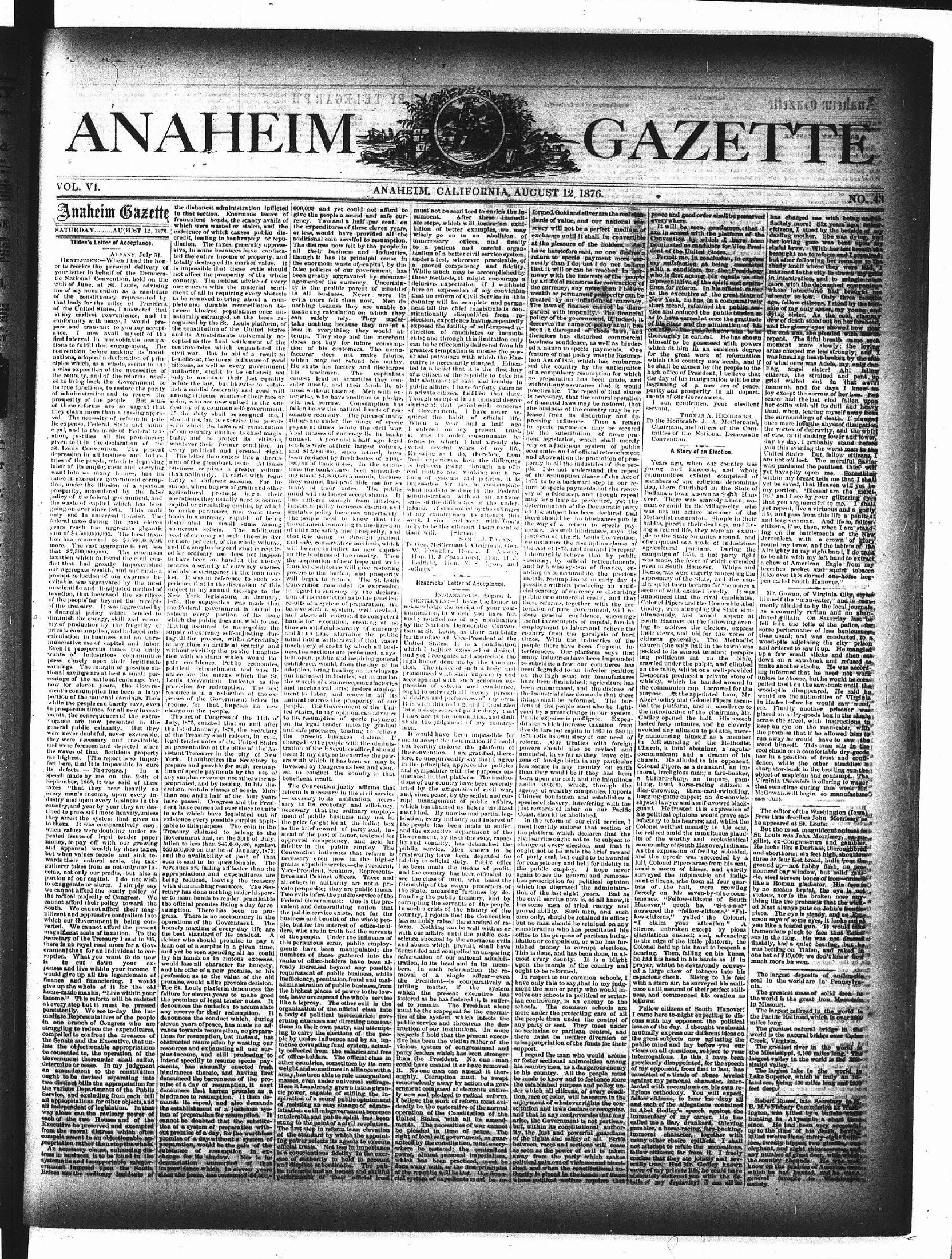
Searchable text
ANAHEIM GAZETTE
SATURDAY...AUGUST 12, 1876.
Tilden's Letter of Acceptance.
ALBANY, July 31.
GENTLEMEN: When I had the honor to receive the personal delivery of your letter in behalf of the Democratic National Convention, held on the 29th of June, at St. Louis, advising me of my nomination as a candidate of the constituency represented by that body for the office of President of the United States, I answered that at my earliest convenience, and in conformity with usage, I would prepare and transmit to you my acceptance. I now avail myself of the first interval in unavoidable occupations to fulfill that engagement. The convention, before making its nominations, adopted a declaration of principles which, as a whole, seems to me a wise exposition of the necessities of the country, and of the reforms needed to bring back the Government to its true functions, to restore the purity of administration and to renew the prosperity of the people. But some of these reforms are so urgent that they claim more than a passing approval. The necessity of reform in public expense, Federal, State and municipal, and in the mode of Federal taxation, justifies all the prominence given to it in the declaration of the St. Louis Convention. The present depression in all business and industries of the people, which is depriving labor of its employment and carrying the dishonest administration inflicted in that section. Enormous issues of fraudulent bonds, the scanty avails of which were wasted or stolen, and the existence of which causes public discredit, leading to bankruptcy or repudiation. The taxes, generally oppressive, in some instances have confiscated the entire income of property, and totally destroyed its market value. It is impossible that these evils should not affect the prosperity of the whole country. The noblest advice of every one concurs with the material sentiment of all in requiring every obstacle to be removed to bring about a complete and durable reconciliation between kindred populations once naturally estranged, on the basis recognized by the St. Louis platform, of the constitution of the United States and its Amendments universally accepted as the final settlement of the controversies which engendered the civil war. But in aid of a result so beneficent, the moral influence of good citizens, as well as every government authority, ought to be enlisted; not only to maintain their just equality before the law, but likewise to establish a cordial fraternity and good will among citizens, whatever their race or color, who are now united in the one destiny of a common self-government. If the duty shall be assigned me, I should not fail to exercise the powers with which the laws and constitution of our country clothes its chief magistrate, and to protect its citizens, whatever their former condition, in every political and personal right.
The letter then enters into a discussion of the greenback issue. At times business requires a greater volume.
000,000 and yet cannot give the people a source. Two and a half expenditures of this or less, would have no additional coin needles. The distress now felt all their business though it has its prologue. The enormous waste of false policies of our been greatly aggravation of the currency is the prolific pay in all business. No evils more felt than nothing because they make any calculation can safely rely. Take nothing because loss in everything tempt. They stop and dares not buy for the tion of his customer facturer does not which may not refute He shuts his factory his workmen. They cannot lend on security unsafe, and they most without interest, terprise, who have creep will not borrow. Co fallen below the nature sonable economy. Things are under the payment times before Nast masses of current unused. A year and a tenderers were at their lapse and $12,000,000 since been replaced by fresh 000,000 of bank notes, time the banks have
a wise exposition of the necessities of the country, and of the reforms needed to bring back the Government to its true functions, to restore the purity of administration and to renew the prosperity of the people. But some of these reforms are so urgent that they claim more than a passing approval. The necessity of reform in public expense, Federal, State and municipal, and in the mode of Federal taxation, justifies all the prominence given to it in the declaration of the St. Louis Convention. The present depression in all business and industries of the people, which is depriving labor of its employment and carrying want into so many homes, has its cause in excessive government corruption, under the illusion of a specious prosperity, engendered by the false policy of the federal government, and the waste of capital, which has been going on ever since 1865. This could only end in universal disaster. The federal taxes during the past eleven years reach the aggregate gigantic sum of $4,500,000,000. The local taxation has amounted to $1,500,000,000 more. The vast aggregate is not less than $7,500,000,000. The enormous taxation which followed the civil conflict that had greatly impoverished our aggregate wealth, and had made a prompt reduction of our expenses inevitable, was aggravated by the most unscientific and ill-adjusted method of taxation, that increased the saffriges of the people far beyond the receipts of the treasury. It was aggravated by a financial policy which tended to diminish the energy, skill and economy of production by the frugality of private consumption, and induced miscalculation in business and an unremunerative use of capital and labor. Even in prosperous times the daily wants of industrious communities press closely upon their legitimate earnings. The margin of possible national savings are at best a small percentage of the national earnings. Yet, now for cleven years, the Government's consumption has been a large portion of the national earnings. Then while the people can barely save, even in prosperous times, for all new investments, the consequences of the extravagance are now presented in the general public calamity. But they were never doubtful, never excusable, they were necessary and inevitable, and were foreseen and depicted when the waves of that fettitious property ran highest. [The report is so imperfect here, that it is impossible to cure its defects.] — Editors.
In a speech made by me on the 28th of September, 1868, it was said of these taxes "that they bear heavily on every man's income, upon every industry and upon every business in the country, and year by year they are destined to press still more heavily, unless they arrest the system that gives us to them. It was comparatively easy, when values were doubling under repeated issues of legal tender paper money, to pay off with our growing and apparent wealth by these taxes, but when values recede and sink towards their natural scale, the tax-gatherer takes from us not only our income, not only our profits, but also a portion of our capital. I do not wish to exaggerate or alarm. I simply say authority, ought to be enlisted; not only to maintain their just equality before the law, but likewise to establish a cordial fraternity and good will among citizens, whatever their race or color, who are now united in the one destiny of a common self-government. If the duty shall be assigned me, I should not fail to exercise the powers with which the laws and constitution of our country clothes its chief magistrate, and to protect its citizens, whatever their former condition, in every political and personal right.
The letter then enters into a discussion of the greenback issue. At times business requires a greater volume than ordinarily. It varies with regularity at different seasons. For instance, when buyers of grain and other agricultural products begin their operations,they usually need to borrow capital or circulating credits,by which to make purchases,and want these funds in a currency capable of being distributed in small sums among numerous sellers. The additional need of currency at such times is five or more per cent.of the whole volume,and if a surplus beyond what is required for ordinary use does not happen to have been on hand at the money centres,a scarcity of currency ensues,and also a stringency in the loan market. It was in reference to such experience that in the discussion of this subject in my annual message to the New York legislature,in January,1875,the suggestion was made that the Federal government is bound to redeem every portion of its issue which the public does not wish to use.Having assumed to monopolize the supply of currency self-adjusting during all the process without*creating at any time an artificial scarcity and without exciting the public imagination with an alarm which would impair confidence.Public economiespolitical retrenchment and wise finance are the means which the St. Louis Convention Indicates as the provision for redemption.The best resource is in a reduction of the expenses of the Government below its income.for that imposes no new charge on the people.
The act of Congress of the 11th of July,1875, enacted that on and after the 1st of January,1879,the Secretary of the Treasury shall redeem.in coinlegal tender notes of the United States on presentation at the office of the Assistant Treasurer in the city of New York.It authorizes the Secretary to prepare and provide for such resumption of specie payments by the use of any surplus revenues not otherwise appropriated,and by issuing.in his discretion,certain classes of bonds.More than one and a half of four years have passed.Congress and the President have consented ever since to unite in acts which have legislated out of existence every possible surplus applicable to this purpose.The coin in the Treasury claimed to belong to the Government had.on the 30th of July,fallen to less than $45,000,000 against$59,000,000 on the 1st of January,1875;and the availability of part of that sum is said to be questionable.The revenues are falling off faster than the appropriations and expenditures are being reduced.leaving the treasury with diminishing resources.The Sec-
The Convention justified reform is necessary in this—necessary to its unified sary to its economy and necessary that the ordinance of public business be approved competency,a fidility in the public Convention intimates that necessary even now includes grades of public service—the Vice-President,Senators,tives and Cabinet officersall others in authority are vate perquisite;they are
every man's income upon every industry and upon every business in the country, and year by year they are destined to press still more heavily, unless they arrest the system that gives us to them. It was comparatively easy, when values were doubling under repeated issues of legal tender paper money, to pay off with our growing and apparent wealth by these taxes, but when values recede and sink towards their natural scale, the tax-gatherer takes from us not only our income, not only our profits, but also a portion of our capital. I do not wish to exaggerate or alarm. I simply say we cannot afford the costly policy of the radical majority of Congress. We cannot afford their policy toward the South. We cannot afford their magnificent and oppressive centralism into which our Government is being converted. We cannot afford the present magnificent scale of taxation. To the Secretary of the Treasury I said in '65, there is no royal road more for a Government than for an individual to corruption. What you want to do now is to cut down your expenses and live within your income. I would give up all the legerdemain of finance and financiering. I would give up the whole of it for the old home-made maxim, "Live within your income." This reform will be resisted at every step but it must be pressed persistently. We see to-day the immediate Representatives of the people in one branch of Congress who are struggling to reduce the expenditures, compelled to confront the menaces of the Senate and the Executive, that unless the objectionable appropriations be consented to, the operation of the government thereunder shall suffer, determine or cease. In my judgment an amendment to the constitution ought to be devised separating into two distinct bills the appropriation for the various Departments of the Public Service, and excluding from each bill all appropriations for other objects, and all independent of legislation. In that way alone can the revisory power of each of the two Houses and of the Executive be preserved and exempted from the moral distress which often compels assent to an objectionable appropriation rather than stop the whole.
An necessary clause, enhancing distress in business, is to be found in the systematic and insupportable misgovernment imposed upon the South. Tribes are the ordinary incidents of
ANAHEIM, CALIFORNIA, AUGUST 12, 1876.
000,000 and yet could not afford to give the people a sound and safe currency. Two and a half per cent. on the expenditures of these eleven years, or less, would have provided all the additional coin needful to resumption. The distress now felt by the people in all their business and industries, though it has its principal cause in the enormous waste of capital, by the false policies of our government, has been greatly aggravated by mismanagement of the currency. Uncertainty is the prolific parent of mischief in all business. Never were its evils more felt than now. Men do nothing because they are unable to make any calculation on which they can safely rely. They undertake nothing because they are at a loss in everything they would attempt. They stop and the merchant dares not buy for future consumption of his customers. The manufacturer does not make fabrics, which may not refund his outlay. He shuts his factory and discharges his workmen. The capitalists cannot lend on securities they consider unsafe, and their funds lie almost without interest. Men with enterprise, who have creditors to pledge, will not borrow. Consumption has fallen below the natural limits of reasonable economy. The prices of many things are under the range of specie payment times before the civil war. Vast masses of currency lie in banks unused. A year and a half ago legal tenders were at their largest volume, and $12,000,000 since retired, have been replaced by fresh issues of $100,000,000 of bank notes. In the meantime the banks have hurt through an offence.
After these immediate steps, which will insure an exhibition of better examples, we may wisely go on to an abolition of unnecessary offices, and finally to a patient and careful organization of a better civil service system, under a test, wherever practicable, of a proved competency and fidelity. While much may be accomplished by these methods, it might encourage a delusive expectation if I withheld here an expression of my conviction that no reform of Civil Services in this country will be complete and permanent till the chief magistrate is constitutionally disqualified from re-election, experience having repeatedly exposed the futility of self-imposed restriction of candidates or incumbents; and through this limitation only can he be effectually delivered from his greatest temptation to misuse the power and patronage with which the Executive is necessarily charged. Educated in a belief that it is the first duty of a citizen of the republic to take his fair alotment of care and trouble in public affairs, I have for forty years as a private citizen, fulfilled that duty. Though occupied in an unusual degree during all that period with concerns of Government, I have never acquired the habit of official life. When a year and a half ago I entered on my present trust, it was in order consummate reforms to which I had already devoted several years of my life. Knowing as I do, therefore, from fresh experience, how the difference is between going through an offence formed.Gold and silver are the real standards of value, and our national currency will not be a perfect medium of exchange until it shall be convertible at the pleasure of the holders. As I have heretofore said, no one desires a return to specie payment more earnestly than I do; but I do not believe that it will or can be reached in harmony with the interests of the people by artificial measures for contraction of the currency, any more than I believe wealth or permanent prosperity can be created by an inflation of currency. The laws of finance cannot be disregarded with impunity. The financial policy of the government, if indeed, it deserves the name of policy at all, has been in disregard of those laws, and therefore has disturbed commercial business confidence, as well as hindered a return to specie payments. One feature of that policy was the Resumpion Act of 1875, which has embarrassed the country by the anticipation of a compulsory resumption for which no preparation has been made, and without any assurance that it would practicable. The repeal of that clause is necessary, that the natural operation of financial laws may be restored, that the business of the country may be released from its disturbing and depressing influence. Then a return to specie payments may be secured by the substitution of more prudent legislation, which shall merely rely on a judicious system of public economies and of official retrenchment and above all on the promotion of prosperity in all the industries of the people.
It will am in Convenient nomination of Permits my salutary who is represented for as the New York county thorough himself which filmed for the which thereto shall high office the day beginning purity andments of I am servant,
To the House Chairperson mittee Convene
Years n
The capitalists cannot lend on securities they consider unsafe, and their funds lie almost without interest. Men with enterprise, who have creditors to pledge, will not borrow. Consumption has fallen below the natural limits of reasonable economy. The prices of many things are under the range of specie payment times before the civil war. Vast masses of currency lie in banks unused. A year and a half ago legal tenders were at their largest volume, and $12,000,000, since retired, have been replaced by fresh issues of $100,000,000 of bank notes. In the meantime the banks have been surrendering about $4,800,000 a month, because they cannot find profitable use for so many of their notes. The public mind will no longer accept shams. It has suffered enough from illusions. Insincere policy increases distrust, and unstable policy increases uncertainty. The people need to know that the Government is moving in the direction of ultimate safety and prosperity, and that it is doing so through prudent and safe, conservative methods, which will be sure to inflict no new caprice on the business of the country. Then the inspiration of new hope and well-founded confidence will give restoring powers to the nation, and prosperity will begin to return. The St. Louis Convention concluded its expression in regard to currency by the declaration of its conviction as to the practical results of a system of preparation. We believe such a system, well devised, and above all entrusted to competent hands for execution, creating at no time an artificial scarcity of currency and at no time alarming the public mind into a withdrawal of that vaster machinery of credit by which all business transactions are performed, a system open, public and inspiring general confidence, would, from the day of its adoption, bring healing on its wings to our harrassed industries; set in motion the wheels of commerce, manufactories and mechanical arts; restore employment to labor, and renew in all its natural sources the prosperity of our people. The Government of the United States, in my opinion, can advance to the resumption of specie payment on its legal tender notes by gradual and safe processes, tending to relieve the present business distrust. If charged by the people with the administration of the Executive office, I should deem it my duty so to exercise the powers with which it has been or may be invested by Congress as best and soonest to conduct the country to that beneficent result.
The Convention justly affirms that reform is necessary in the civil service—necessary to its unification, necessary to its economy and efficiency, necessary that the ordinary employment of public business may not be the prize fought for at the ballot box as the brief reward of party zeal, instead of the post of honor, assigned for approved competency, and held for fidelity in the public employ. The Convention intimates that reform is necessary even now in the higher grades of public service—the President, Vice-President, Senators, Representatives and Cabinet officers. These and all others in authority are not a private perquisite; they are public trusts.
It would have been impossible for me to accept the nomination if I could not heartily endorse the platform of the convention. I am gratified, therefore, to unequivocally say that I agree in the principles, approve the policies and sympathize with the purposes enunciated in that platform. The institutions of our country have been severely tried by the exigencies of civil war, and since peace, by the selfish and corrupt management of public affairs, which has shamed us before civilized mankind. By unwise and partial legislation, every industry and interest of the people has been made to suffer, and the executive department of the Government, by its dishonesty, rapacity and venality, has debauched the public service. Men known to be trustworthy have been degraded for fidelity to official duty. Public office has been made the means of profit, and the country has been offended to see the class of men, who boast the friendship of the sworn protectors of the city.
When a year and a half ago I entered on my present trust, it was in order consummate reforms to which I had already devoted several years of my life. Knowing as I do, therefore, from fresh experience, how the difference between going through an official routine and working out a reform of systems and policies, it is impossible for me to contemplate what needs to be done in the Federal administration without an anxious sense of the difficulties of the undertaking. If summoned by the surrogates of my countrymen to attempt this work, I shall endeavor, with God's help, to be the efficient instrument of their will.
SANITI J. TRIDEN.
To Gen. McClernand, Chairman: Gen. W. Franklin, Hon. J. Abbott, Hon. H. J Spannhorst, Hon. H. J Redfield, Hon. N. S. Lyon, and others.
Headricks' Letter of Acceptance.
INDIANAPOLIS, August 4.
GENTLEMENT—I have the honor to acknowledge the receipt of your communication, in which you have formally notified me of my nomination by the National Democratic Convention at St. Louis, as their candidate for the office of Vice-President of the United States. It is a nomination which I neither expected or desired, and yet I recognize and appreciate the high honor done me by the Convention. The choice of such a body and pronounced with such unanimity and accompanied with such generous expression of esteem and confidence, ought to outweigh all merely personal desires and preferences of my own. It is with this feeling, and I trust also from a deep sense of public duty, that I now accept the nomination, and shall abide the judgment of my countrymen.
It would have been impossible for me to accept the nomination if I could not heartily endorse the platform of the convention. I am gratified, therefore, to unequivocally say that I agree in the principles, approve the policies and sympathize with the purposes enunciated in that platform. The institutions of our country have been severely tried by the exigencies of civil war, and since peace, by the selfish and corrupt management of public affairs, which has shamed us before civilized mankind. By unwise and partial legislation every industry and interest of the people has been made to suffer,andtheexecutivedepartmentoftheGovernmentbyitsdishonestyrapacityandvenalityhasdebauchedthepublicservice.Menknowntobstrustworthyhavebeendegradedfidelfailtotheofficialduty.Publicofficehasbeendmadethemeansofprofit,andthecountryhasbeenoffendedtoseetheclassofmenwhoboostthefriendshipoftheswornprotectorsofthecity.
Ofa citizenoftherepublictotakehisfairallotmentofcareandtroubleinpublicaffairs.Ihaveforfortyyearsasapricitizenoftherepublictotakehisfairallotmentofcareandtroubleinpublicaffairs.Ihaveforfortyyearsasapricitizenoftherepublicto takehisfairallotmentofcareandtroubleinpublicaffairs.Ihaveforfortyyearsasapricitizenoftherepublicto takehisfairallotmentofcareandtroubleinpublicaffairs.Ihaveforfortyyearsasapricitizenoftherepublicto takehisfairallotmentofcareandtroubleinpublicaffairs.Ihaveforforttyyearsasapricitizenoftherepublicto takehisfairallotmentofcareandtroubleinpublicaffairs.Ihaveforforttyyearsasapricitizenoftherepublicto takehisfairallotmentofcareandtroubleinpublicaffairs.Ihaveforforttyyearsasapricitizenoftherepublicto takehisfairallotmentofcareandtroubleinpublicaffairs.Ihaveforforttyyearsasapricitizenoftherepublicto takehisfairallotmentofcareandtroubleinpublicaffairs.Ihaveforforttyyearsasapricitizenoftherepublicto takehisfairallotmentofcareandtroubleinpublicaffairs.Ihaveforforttyyearsasapricitizenoftherepublicto takehisfairallotmentofcareandtroubleinpublicaffairs.Ihaveforforttyyearsasapricitizenoftherepublicto takehisfairallotmentofcareandtroubleinpublicaffairs.Ihaveforfortteryearsasapricitizenoftherepublicto takehisfairallotmentofcareandtroubleinpublicaffairs.Ihaveforfortteryearsasapricitizenoftherepublicto takehisfairallotmentofcareandtroubleinpublicaffairs.Ihaveforfortteryearsasapricitizenoftherepublicto takehisfairallotmentofcareandtroubleinpublicaffairs.Ihaveforfortteryearsasapricitizenoftherepublicto takehisfairallotmentofcareandtroubleinpublicaffairs.Ihaveforfortteryearsasapricitizenoftherepublicto takehisfairallotmentofcareandtroubleinpublicaffairs.Ihaveforfortteryearsasapricitizenoftherepublicto takehisfairallotmentofcareandtroubleinpublicaffairs.Ihaveforfortteryearsasapricitizenoftherepublicto takehisfairallotmentofcareandtroubleinpublicaffairs.Ihaveforfortteryearsasapricitizenoftherepublicto takehisfairallotmentofcareandtroubleinpublicaffairs.Ihaveforfortteryearsasapricitizenoftherepublicto takehisfairallotmentofcareandtroubleinpublicaffares.Ihaveforfortteryearsasapricitizenoftherepublicto takehisfairallotmentofcareandtroubleinpublicaffares.Ihavefor fortteryearsasapricitizenoftherepublicto takehisfairallotmentofcareandtruffleinthecountrytothatbeneficialresult.
Years are young community members; there Indiana over. The man or child was not in Metodist habit; was made even to So Democrat supremacy ally quiet scene of white announced Colonel Pipe (Godley) wasultaneously South Hamming to add their views citizens got church (they packed to ing political crawl united on table Democrat pt whisky; we communicatedDemocrat pt whisky; we communicatedDemocrat pt whisky; we communicatedDemocrat pt whisky; we communicatedDemocrat pt whisky; we communicatedDemocrat pt whisky; we communicatedDemocrat pt whisky; we communicatedDemocrat pt whisky; we communicatedDemocrat pt whisky; we communicatedDemocrat pt whisky; we communicatedDemocrat pt whisky; we communicatedDemocrat pt whisky; we communicatedDemocrat pt whisky; we communicatedDemocrat pt whisky; we communicatedDemocrat pt whisky; we communicatedDemocrat pt whisky; we communicatedDemocrat pt whisky; we communicatedDemocrat pt whisky; we communicatedDemocrat pt whisky; we communicatedDemocrat pt whisky; we communicatedDemocrat pt whisky; we communicatedDemocrat pt whisky; we communicatedDemocrat pt whisky; we communicatedDemocrat pt whisky; we communicatedDemocratptwhisky; we communicatedDemocratptwhisky; we communicatedDemocratptwhisky; we communicatedDemocratptwhisky; we communicatedDemocratptwhisky; we communicatedDemocratptwhisky; we communicatedDemagonptwhisky; we communicatedDemagonptwhisky; we communicatedDemagonptwhisky; we communicatedDemagonptwhisky; we communicatedDemagonptwhisky; we communicatedDemagonptwhisky; we communicatedDemagonptwhisky; we communicatedDemagonptwhisky; we communicatedDemagonptwhisky; we communicatedDemagonptwhisky; we communicatedDemagonptwhisky; we communicatedDemagonptwhisky; we communicatedDemagonptwhisky; we communicatedDemagonptwhisky; we communicatedDemagonptwhisky; we communicatedDemagonptwhisky; we communicatedDemagonptwhisky; we communicatedDemagonptwhisky; we communicatedDemagonptwhisky; we communicatedDemagonptwhisky; we communicatedDemagonptwhisky; we communicatedDemagonptwhisky; we communicatedDemagonptwhisky;
yearseventhheartilyendorsementforwhichnopreparationhasbeenmade,andwithoutanyassurancethatitwouldpracticable.Therepealofthatclauseisnecessary,thenaturaloperationofficiallawismmayberestored,andajudicioussystemoffublicaneconomiesandofficialretrenchmentandaboveallonthepromotionsproperty.inalltheindustriesofthepeopletherehavenoftenrequierences.theplatformoftheSt.LouisConvention,
wedenouncetheresumptionclauseoftheActof1875tobeabackwardstepinourreturntocpecilepayments,但recoveryofafalsestep,mayfora.timebe prevented,yetthedeterminationoftheDemocraticpartonthesubjecthasbeendeclaredthattheres shouldbenohindranceputinhowthereshouldbenohindranceputinhowthereshouldbenohindranceputinhowthereshouldbenohindranceputinhowthereshouldbenohindranceputinhowthereshouldbenohindranceputinhowthereshouldbenohindranceputinhowthereshouldbenohindranceputinhowthereshouldbenohindranceputinhowthereshouldbenohindranceputinhowthereshouldbenohindranceputinhowthereshouldbenohindranceputinhowthereshouldbenohindranceputinhowthereshouldbenohindranceputinhowthereshouldbenohindranceputinhowthereshouldbenohindranceputinhowthereshouldbenohindranceputinhowthereshouldbenohindranceputinhowthereshouldbenohindranceputinhowthereshouldbenohindranceputinhowthereshouldbenohindranceputinhowthereshouldbenohindranceputinhowthereshouldbenohindranceputinhowthereshouldbenohindrenceputinhowthereshouldbenohindrenceputinhowthereshouldbenohindrenceputinhowthereshouldbenohindrenceputinhowthereshouldbenohindrenceputinhowthereshouldbenohindrenceputinhowthereshouldbenohindrenceputinhowthereshouldbenohindrenceputinhowthereshouldbeno behindrenceputinhowthereshouldbeno behindrenceputinhowthereshouldbeno behindrenceputinhowthereshouldbeno behindrenceputinhowhereshouldbeno behindrenceputinhowhereshouldbeno behindrenceputinhowhereshouldbeno behindrenceputinhowhereshouldbeno behindrenceputinhowhereshouldbeno behindrenceputinhowhereshouldbeno behindrenceputinhowhereshouldbe no behindrenceputinhowhereshouldbe no behind Lawrenceopeningupdatesfrom five dollars per capita in 1800 to $80 in 1870 tells its own story of our need of reform.
Our treaties with foreign powers should also be revised and amended,在so far as they leave citizens of foreign birth in any particular less secure in any country on earth than they would be if they had been born upon our soil;而和inliquilious coolie system,which,通过 agency of wealthy companies,imports Chinese bondsmen and establishes a species of slavery,interfering with the just rewards of labor on our Pacific Coast,should be abolished.
In the reform of our civil service,我 most heartily endorse that section of the platform which declares that the civil service ought not to be subject to change at every election,和 that it ought not to be made the brief reward of party zeal,但 ought to be awarded for competency and held for loyalty in their just rewards of labor on our Pacific Coast,should be abolished.
In the reform of our civil service,我 most heartily endorse that section of the platform which declares that the civil service ought not to be subject to change at every election,和 that it ought not to be made the brief reward of party zeal,但 ought to be awarded for competency and held for loyalty in their just rewards of labor on our Pacific Coast,should be abolished.
In the reform of our civil service,我 most heartily endorse that section of the platform which declares that the civil service ought not to be subject to change at every election,和 that it ought not to be made the brief reward of party zeal,但 ought to be awarded for competency and held for loyalty in their just rewards of labor on our Pacific Coast,should be abolished.
In the reform of our civil service,我 most heartily endorse that section of the platform which declares that the civil service ought not to be subject to change at every election,和 that it ought not to be made the brief reward of party zeal,但 ought to be awarded for competency and held for loyalty in their just rewards of labor on our Pacific Coast,should be abolished.
In the reform of our civil service,我 most heartily endorse that section of the platform which declares that the civil service ought not to be subject to change at every election,和 that it ought not to be made the brief reward of party zeal,但 ought to be awarded for competency and held for loyalty in their just rewards of labor on our Pacific Coast,should be abolished.
In the reform of our civil service,我 most heartily endorse that section of the platform which declares that the civil service ought not to be subject to change at every election,和 that it ought not to be made the brief reward of party zeal,但 ought to be awarded for competency and held for loyalty in their just rewards of labor on our Pacific Coast,should be abolished.
In the reform of our civil service,我 most heartily endorse that section of the platform which declares that the civil service ought not to be subject to change at every election,和 that it ought not to be made the brief reward of party zeal,但 ought to be awarded for competency and held for loyalty in their just rewards of labor on our Pacific Coast,should be abolished.
In the reform of our civil service,我 most heartily endorse that section of the platform which declares that the civil serviceought not to be subject to change at every election,和 that it ought not to be made the brief reward of party zeal,但 ought to be awarded for competency and held for loyalty in their just rewards of labor on our Pacific Coast,should be abolished.
In the reform of our civil service,我 most heartily endorse that section of the platform which declares that the civil serviceought not to be subject to change at every election,和 that it ought not to be made the brief reward of party zeal,但 ought to be awarded for competency and held for loyalty in their just rewards of labor on our Pacific Coast,should be abolished.
In the reform of our civil service,我 most heartily endorse that section of the platform which declares that the civil serviceought not to be subject to change at every election,和 that it ought not to be made the brief reward of party zeal,但 ought to be awarded for competency and held for loyalty in their just rewards of labor on our Pacific Coast,should be abolished.
In the reform of our civil service,我 most heartily endorse that section of the platform which declares that the civil服务ought not to be subject到change at every election,和 that it ought not to be made的brief reward.of party zeal,但 ought to be awarded for competency和held for loyalty in their just rewards.of labor on our Pacific Coast,should be abolished.
In the reform of our civil service,我 most heartily endorse that section of the platform which declares that the civil服务ought not to be subject到change at every election,和 that it ought not to be made的brief reward.of party zeal,但 ought to be awarded for competency和held for loyalty in their just rewards.of labor on our Pacific Coast,should be abolished.
In the reform of our civil service,我 most heartily endorse that section OF THE PLATFORM WHICH DEFINES THE RESUMPTION OF POLICY OPERATION FOR FULTONIC OPERATION FOR FULTONIC OPERATION FOR FULTONIC OPERATION FOR FULTONIC OPERATION FOR FULTONIC OPERATION FOR FULTONIC OPERATION FOR FULTONIC OPERATION FOR FULTONIC OPERATION FOR FULTONIC OPERATION FOR FULTONIC OPERATION FOR FULTONIC OPERATION FOR FULTONIC OPERATION FOR FULTONIC OPERATION FOR FULTONIC OPERATION FOR FULTONIC OPERATION FOR FULTONIC OPERATION FOR FULTONIC OPERATION FOR FULTONIC OPERATION FOR FULTONIC OPERATION FOR FULTONIC OPERATION FOR FULTONIC OPERATION FOR FULTONIC OPERATION FOR FULTONIC OPERATION FOR FULTONIC OPERATION FOR FULTONIC OPERATION FOR FULTONIC OPERATION FOR FULTONIC OPERATION FOR FULTONIC OPERATION FOR FULTONIC OPERATION FOR FULTONIC OPERATION FOR FULTONIC OPERATION FOR FULTONIC OPERATION FOR FULTONIC OPERATION FOR FULTONIC OPERATION FOR FULTONIC OPERATION FOR FULTONIC OPERATION FOR FULTONIC OPERATION FOR FULTONIC OPERATION FOR FULTONIC OPERATION FOR FültTONIC OPERATION FOR FültTONIC OPERATION FOR FültTONIC OPERATION FOR FültTONIC OPERATION FOR FültTONIC OPERATION FOR FültTONIC OPERATION FOR FültTONIC OPERATION FOR FültTONIC OPERATION FOR FültTONIC OPERATION FOR FültTONIC OPERATION FOR FültTONIC OPERATION FOR FültTONIC OPERATION FOR FültTONIC OPERATION FOR FültTONIC OPERATION FOR FültTONIC OPERATIONFORFiltTONICOPERATIONFORFiltTONICOPERATIONFORFiltTONICOPerationFORFiltTONicOPerationFORFiltTONicOPerationFORFiltTONicOPerationFORFiltTONicOPerationFORFiltTONicOPerationFORFiltTONicOPerationFORFiltTONicOPerationFORFiltTONicOPerationFORFiltTONicOPerationFORFiltTONicOPerationFORFiltTONicOPerationFORFiltTONicOPerationFORFiltTONicOPerationFORFiltTONicOPerationFORFiltTONicOPerationFORFiltTONicOPerationFORFiltTONicOPerationFORFiltTONicOPerationFORFiltTONicOPerationFORFiltTONicOPerationFORFiltTONicOPerationFORFiltTONicOPerationFORFiltTONicOPerationFORFiltTONicOPerationFORFilttonicOPerationFORFilttonicOPerationFORFilttonicOPerationFORFilttonicOPerationFORFilttonicOPerationFORFilttonicOPerationFORFilttonicOPerationFORFilttonicOPerationFORFilttonicOPerationFORFilttonicOPerationFORFilttonicOPerationFORFilttonicOPerationFORFilttonicOPerationFORFilttonicOPerationFORFilttonicOPerationFORFilttonicOPerationFORFilttonicOPerationFORFilttonicOPerationFORFilttonicOPerationFORFilttonicOPerationFORFilttonicOPerationFORFilttonicOPerationFORFilttonicOPerationFORFilttonicOPerationFORFilttonicOPerationFORFilttonictopperiationFORFilttonictopperiationFORFilttonictopperiationFORFilttonictopperiationFORFilttonictopperiationFORFilttonictopperiationFORFilttonictopperiationFORFilttonictopperiationFORFilttonictopperiationFORFilttonictopperiationFORFilttonictopperiationFORFilttonictopperiationFORFilttonictopperiationFORFilttonictopperiationFORFilttonictopperiationFORFilttonictopperiationFORFilttonictopperiationFORFilttonictopperiationFORFilttonictopperiationFORFilttonictopperiationFORFilttonictopperiationFORFilttonictopperiationFORFilttonictopperiationFORFilttonictopperiationFORFilttonictopperiationFORFilttonictopperiationFORFilttonictopperiationFORFilttonictopperiationFORFilttonictopperiationFORFilttonictopperiationForFFlt tonicityOFFT tonicityOFFT tonicityOFFT tonicityOFFT tonicityOFFT tonicityOFFT tonicityOFFT tonicityOFFT tonicityOFFT tonicityOFFT tonicityOFFT tonicityOFFT tonicityOFFT tonicityOFFT tonicityOFFT tonicityOFFT tonicityOFFT tonicityOFFT tonicityOFFT tonicityOFFT tonicityOFFT tonicityOFFT tonicityOFFT tonicityOFFT tonicityOFFT tonicityOFFT tonicityOFFT tonicityOFFT tonicityOFFT tonicityOFFT tonicityOFFT tonicityOFFT tonicityOFFT tonicityOFFT tonicityOFFT tonicityOFFT tonicityOFFT tonicityOFFT tonicityOFFT tonicityOFFT tonicityOFFT tonicityOFFT tonicityOFFT tonicityOFFT tonicityOFFT tonicityOFFT tonicityOFFT tonicityOFFT tonicityOfft tonicityOfft tonicityOfft tonicityOfft tonicityOfft tonicityOfft tonicityOfft tonicityOfft tonicityOfft tonicityOfft tonicityOfft tonicityOfft tonicityOfft tonicityOfft tonicityOfft tonicityOfft tonicityOfft tonicityOfft tonicityOfft tonicityOfft tonicityOfft tonicityOfft tonicityOfft tonicityOfft tonicityOfft toninityOfft tenancyOfft tenancyOfft tenancyOfft tenancyOfft tenancyOfft tenancyOfft tenancyOfft tenancyOfft tenancyOfft tenancyOfft tenancyOfft tenancyOfft tenancyOfft tenancyOfft tenancyOfft tenancyOfft tenancyOfft tenancyOfft tenancyOfft tenancyOfft tenancyOfft tenancyOfft tenancyOfft tenancyOfft tenancy Offft tenancy Offft tenancy Offft tenancy Offft tenancy Offft tenancy Offft tenancy Offft十ness Offft十ness Offft十ness Offft十ness Offft十ness Offft十ness Offft十ness Offft十ness Offft十ness Offft十ness Offft十ness Offft十ness Offft十ness Offft十ness Offft十ness Offft十ness Offft十ness Offft十ness Offft十ness Offft十ness Of fftt十ness Of fftt十ness
reform is necessary in the civil service—necessary to its unification, necessary to its economy and efficiency, necessary that the ordinary employment of public business may not be the prize fought for at the ballot box as the brief reward of party zeal, instead of the post of honor, assigned for approved competency, and held for fidelity in the public employ. The Convention intimates that reform is necessary even now in the higher grades of public service—the President, Vice-President, Senators, Representatives and Cabinet officers. These and all others in authority are not a private perquisite; they are public trusts. Two evils infest the public service of the Federal Government: One is the prevalent and demoralizing notion that the public service exists, not for the business and benefit of the whole people, but for the interest of office-holders, who are in truth but the servants of the people. Under the influence of this pernicious error, public employments have been manipulated; the numbers of those gathered into the ranks of office-holders have been already increased beyond any possible requirement of public business, while inefficiency, peculation, fraud and mal-administration of public business, from the highest places of power to the lowest, have overspread the whole service like a leprosy. The other evil is the organization of the official class into a body of political mercenaries; governing caucuses and directing nominations in their own party, and attempting to carry the elections of the people by undue influence and by an immense corrupt fund system, actually collected from the salaries and fees of office-holders. The official class in other countries, sometimes by its own weight and sometimes in alliance with a army, has been able to rule unorganized masses, even under universal suffrage. Here it has already grown into a gigantic power, capable of stifling the inspiration of a sound public opinion and resisting an easy change of administration until misgovernment becomes intolerable and public spirit has been stung to the point of a civil revolution. The first step in reform is an elevation of the standard by which the appointing power selects its agents to execute official trusts. Not less in importance is a conscientious fidelity in the exercise of authority to hold to account and displace subordinates. The public interests and an honest and skillful performance of their official trusts by the exigencies of civil war, and since peace, by the selfish and corrupt management of public affairs, which has shamed us before civilized mankind. By unwise and partial legislation, every industry and interest of the people has been made to suffer, and the executive department of the Government, by its dishonesty, rapacity and venality, has debauched the public service. Men known to be trustworthy have been degraded for fidelity to official duty. Public office has been made the means of profit, and the country has been offended to see the class of men, who boast the friendship of the sworn protectors of the State, amassing fortunes by defrauding the public treasury, and by corrupting the servants of the people. In such a crisis of the history of the country, I rejoice that the Convention has so nobly raised the standard of reform. Nothing can be well with us or with our affairs until the public conscience, shocked by the enormous evils and abuses which prevail, shall have demanded and compelled an unsparing reformation of our national administration, in its head and in its members. In such reformation the removal of a single officer—even the President—is comparatively a trifling matter, if the system which the present executive has fostered as he has fostered it, is suffered to remain. The President alone must be the scapegoat for the enormities of the system which infects the public service and threatens the destruction of our institutions. In some respects I hold that the present executive has been the victim rather of the vicious system of congressional and party leaders which has been stronger than the President. No one man could have created it or have removed it. No one man can amend it thoroughly. Corruption must be swept remorselessly away by action of a government composed of elements entirely new and pledged to radical reform. I believe the work of reform must avidly be the restorative of the normal operation of the Constitution of the United States, with all its amendments. The necessities of war cannot be pleaded in time of peace. The right of local self-government, as guaranteed by the constitution, must everywhere be restored; the centralized power, almost personal imperialism, which has been practiced, must be done away with, or the first principles of the republic will be lost. Our financial system of expedients must be re-created by the exigencies of civil war, and since peace, by the selfish and corrupt management of public affairs, which has shamed us before civilized mankind. By unwise and partial legislation, every industry and interest of the people has been made to suffer, and the executive department of the Government, by its dishonesty, rapacity and venality, has debauched the public service. Men known to be trustworthy have been degraded for fidelity to official duty. Public office has been made the means of profit, and the country has been offended to see the class of men, who boast the friendship of the sworn protectors of the State, amassing fortunes by defrauding the public treasury, and by corrupting the servants of the people. In such a crisis of the history of the country, I rejoice that the Convention has so nobly raised the standard of reform. Nothing can be well with us or with our affairs until the public conscience, shocked by the enormous evils and abuses which prevail, shall have demanded and compelled an unsparing reformation of our national administration, in its head and in its members. In such reformation the removal of a single officer—even the President—is comparatively a trifling matter, if the system which the present executive has fostered as he has fostered it, is suffered to remain. The President alone must be the scapegoat for the enormities of the system which infects the public service and threatens the destruction of our institutions. In some respects I hold that the present executive has been the victim rather of the vicious system of congressional and party leaders which has been stronger than the President. No one man could have created it or have removed it. No one man can amend it thoroughly. Corruption must be swept remorselessly away by action of a government composed of elements entirely new and pledged to radical reform. I believe the work of reform must avidly be the restorative of the normal operation of the Constitution of the United States, with all its amendments. The necessities of war cannot be pleaded in time of peace. The right of local self-government, as guaranteed by the constitution, must everywhere be restored; the centralized power, almost personal imperialism, which has been practiced, must be done away with, or the first principles of the republic will be lost. Our financial system of expedients must be re-created by the exigencies of civil war, and since peace, by the selfish and corrupt management of public affairs, which has shamed us before civilized mankind. By unwise and partial legislation, every industry and interest of the people has been made to suffer, and the executive department ofthe Government, by its dishonesty, rapacity and venality, has debauched the public service. Men known to be trustworthy have been degraded for fidelity to official duty. Public office has been made the means of profit, andthe country has been offended to see the class of men, who boast the friendship ofthe sworn protectorsofthe State,amassing fortunes by defraudingthepublictreasury,andbycorruptingtheservantsofthepeople.I hope never again to seethe generalandremorselessprescriptionforpoliticalopinionwhichhasdisgracedtheadministrationofthelasteightyears.Badasthecivilservicenowis.asallknow.ithassomemenoftriedenergyandprovedability.Suchmen,andsuchmenonlyshouldberetainedinoffice;butnomanshouldberetainedonanyconsiderationwhohasprostitutedhiseofficetothepurposeofpartisanintimidationorcompulsion,rorwhohasfurnishedmoneytocorreptions.Thisisdone,andhasbeendone.inalmosteverycounty.Theitablignupwiththemalsothefinallyoncertainance.“FelHanover,”answeredthoselow-citizens,”“Iclaimsilence,unbringejaculationstotheedgeofColonelheldhehearing.Thehehdhisheprayer,whiliedalargechapaciouscheckwithasternuntceuntilassness,andcomefollows:
I regardthemanwouldarouseorfosterseccionalanimositiesamonghiscountrymen,asdangerousenemytohiscountry.Allthepeoplemustbemadetoknowandtofeeloncemoretheestablishedpurposeandpolicyunderwhichallcitizens,ofeverycondition,raceorcolor,willbesecureinthenjoymentof whateverrightstheconstitutionandlawdeclareorrecognize,andthatinanycontroversiesthatmayarise,theGovernmentisnotpartisan,butwithinitsconstitutionalauthority,thejustandpowerfulguardiansoftherightsandsafetyofall.Strifebetweenracesandsectionswillceaseas soonasthepowerofevilis takenawayfromthepartywhichmakespoliticalgainoutofviolenceandbloodhed,andwhentheconstitutionalauthorityisplacedintherandswhosepoliticalwelfarerequiresthat
GAZETTE
peace and good order shall be preserved everywhere.
It will be seen, gentlemen, that I am in accord with the platform of the Convention by which I have been nominated as candidate for Vice President of the United States.
Permit me, in conclusion, to express my satisfaction at being associated with a candidate for the Presidency who is first among his equals as the representative of the spirit and aspirations for reform. In his official career as the executive of the great State of New York, he has, in a comparatively short record, reformed the public service and reduced the public burden so as to have earned at once the gratitude of his State and the admiration of his country. The people know him to be thoroughly in earnest. He has shown himself to be possessed with powers which fit him in an eminent degree for the great work of reformation which this country now needs, and if he shall be chosen by the people to the high office of President, I believe that the day of his inauguration will be the beginning of a new era of peace, purity and prosperity in all departments of our Government.
I am, gentlemen, your obedient servant,
THOMAS A. HENDRICKS.
To the Honorable J. A. McClernand,
Chairman, and others of the Committee of the National Democratic Convention.
A Story of an Election.
Years ago, when our country was young and innocent and whole has charged me with being finally moral! Six years ago, fellow citizens, I stood by the bedside of my darling mother. She was dying, and her loving gaze was bent upon my sinful brow. With her last breath she brought me to reform and I promised; but after following her remains to the shady knoll where they were laid, I returned to the city to drown my grief in intoxication, and to mingle more with the debauched companions whose intercourse had brought me already so low. Only three months ago, fellow citizens, I stood by the bedside of my only sister, my young and dying sister. As the cold, clammy dew of death stood out on her forehead, and the glassy eyes showed how near the end was, she pleaded with me repent. The fitful breath came each moment more slowly; the loving arms clasped me less strongly; and I was kneeling heart-broken by the side of what once was Adele, my only darling, angel sister! Ah! fellow citizens, the strained and pent up grief walled out in that awful moment, and for days I knew no joy except the sorrow of her loss. But scarce had the last clod fallen upon her coffin with all its dull and heavy thud, when tearing myself away from the surroundings of death. I plunged once more into the abyss of disgust, the vortex of depravity, and the whirl of vice, until sinking lower and lower, day by day. I probably stand before you this evening the worst man in the United States. But, fellow citizens, I am not all lost. The merciful Savior who parled the penultent thief will
high office of President, I believe that the day of his inauguration will be the beginning of a new era of peace, purity and prosperity in all departments of our Government.
I am, gentlemen, your obedient servant,
THOMAS A. HENDRICKS.
To the Honorable J. A. McClernand,
Chairman, and others of the Committee of the National Democratic Convention.
A Story of an Election.
Years ago, when our country was young and innocent, and whole communities existed comprised of members of one religious denomination, there flourished in the State of Indiana a town known as South Hanover. There was scarcely a man, woman or child in the village-city who was not an active member of the Methodist connexion. Simple in their habits, pure in their dealings, and living a retired life, they were an example to the State for miles around, and often quoted as a model of industrious agricultural puritans. During the campaign of 1856, a hot party fight was made, the fever of which extended even to South Hanover. Whigs and Democrats were eagerly contesting the supremacy of the State, and the usually quiet town became for the nonce a scene of wild, excited revelry. It was announced that the rival candidates, Colonel Pipers and the Honorable Abel Godley, were stumping the State simultaneously, and would appear at South Hanover on the following evening to address the electors, express their views, and bid for the votes of citizens generally. The Methodist church (the only hall in the town) was packed to its utmost tension; perspiring politicians sat on the bible, crawled under the pulpit, and climbed on the table, whilst one well-provided Democrat produced a private store of whisky, which he handed around in the communion cup, borrowed for the purpose. At the appointed hour, Mr. Abel-Godley and Colonel Pipers ascended the platform, and in obedience to the introduction of the chairman, Mr. Godley opened the ball. His speech lasted forty minutes, and he cleverly avoided any allusion to politics, merely announcing himself as a member in full standing of the Methodist Church, a total abstainer, a regular communicant and a deacon of his church. He alluded to his opponent, Colonel Pipers, as a drunkard, an immoral, irreligious man; a faro-bucker, a billiard-sharp, an impure, gambling, lewd, horse-racing citizen; a dice-throwing, three-card-swindling, hogging-game carper; an ex-convict shyster lawyer and a self-avowed blackguard. He trusted this expression of his political opinions would prove satisfactory to his hearers; and, whilst the Colonel writhed uneasily in his seat, he retired amid the tumultuous pleaits of the worthy and ecclesiastical community of South Hanover, Indiana. As the expression of feeling subsided, and the uproar was succeeded by a lull, Colonel Pipers arose from his seat, amid a storm of hisses, and quietly surveyed the implacable and indignant citizens, who from all four quarters of the ball, were scowling
Mr. Gowan, of Virginia City, styles himself the "man-eater," and is commonly alluded to by the local journals as a cowardly ruffian and an abandoned villain. On Saturday last he fell into the toils of the police, for some performance of less leniency than usual; and was conducted to a wood-pile adjoining the city prison and ordered to saw it up. He mangled up a few small sticks and then down on a saw-buck and refused to make another stroke. He was according informed that he need not work unless he choose, but he would be compelled to sit on the saw-buck until the wool-pile disappeared. He said he would see the authorities of Virginia in Haules before he would saw wood, etc. Finally another prisoner was placed on a dry-goods box in the shade across the street, with instructions to keep an eye on the man-eater, with the promise that if he allowed him to run away he would have to saw the wood himself. This man sits in the cool shade on a comfortable dry-goods box in a position of trust and confidence, while the other straddles a sharp saw-buck in the broiling sun the object of suspicion and contempt. The Virginia Chronicle is offering to wager that sometime during this week Mr. McGowan will begin to manufacture saw-dust.
The editor of the Washington (Iowa) Press thus describes John Morrissey as he appeared at St. Louis:
But the most magnificent animal in St. Louis was John Morrissey, ex-publisher, ex-Congressman and gambler. He looks like a Durham thoroughbred and shorthorn; six feet high, shouldered three or four feet broad, built from the ground up—not flabby flesh, no pronounced bay window, but solid muscle; steel nerves; bones of iron—muscle like a Roman gladiator. His face is by no means brutal that we know.
The editor of the Washington (Iowa) Press thus describes John Morrissey as he appeared at St. Louis:
But the most magnificent animal in St. Louis was John Morrissey, ex-pulgist, ex-Congressman and gambler. He looks like a Durham, thoroughbred and shorthorn; six feet high, shouldered three or four feet broad, built from the ground up—not flabby flesh, no pronounced bay window, but solid muscle, steel nerves; bones of iron—muscle like a Roman gladiator. His face is by no means brutal, the eye is not vicious, nor is the broken nose anything like the proboscis that the wicked Nast always puts on John's fountain piece. The eye is steady, and as Emerson says of some eyes, it looks out at you like a loaded gun. It would take tremendous pluck to face that Colossus in the ring. He was not dramed flashily, had a quiet bearing, but he was betting on Tilden, and raked in one bet of $10,000; we don't know how much more he won.
The largest deposits of anthracite coal in the world are in Pennsylvania.
The greatest mass of solid iron in the world is the great Iron Mountain in Missouri.
The largest millroad in the world is the Pacific Railroad, which is over 2000 miles long.
The greatest natural bridge in the world is the natural bridge over Cedar Creek, Virginia.
The greatest river in the world is the Mississippi, 4,100 miles long. The largest valley in the world is the Mississippi valley.
The largest lake in the world is Lake Superior, which is truly an island sea, being 430 miles long and 1000 feet deep.
Robert Russell, late Secretary to H.B.M.'s Fishery Commission in Washington, was killed by a bullwhale hunting in Abyssinia a short time since. He had been very successful up to the time of his death, having killed twelve lions, thirty-eight bullboots, twenty bippers two giants, elephant, and eight rhinos, and any number of great deer, with which the country chounds. He was well known on the prairies of America, even which he had hunted, and he was a general favorite in Washington society.