anaheim-gazette 1876-08-05
Scanned page
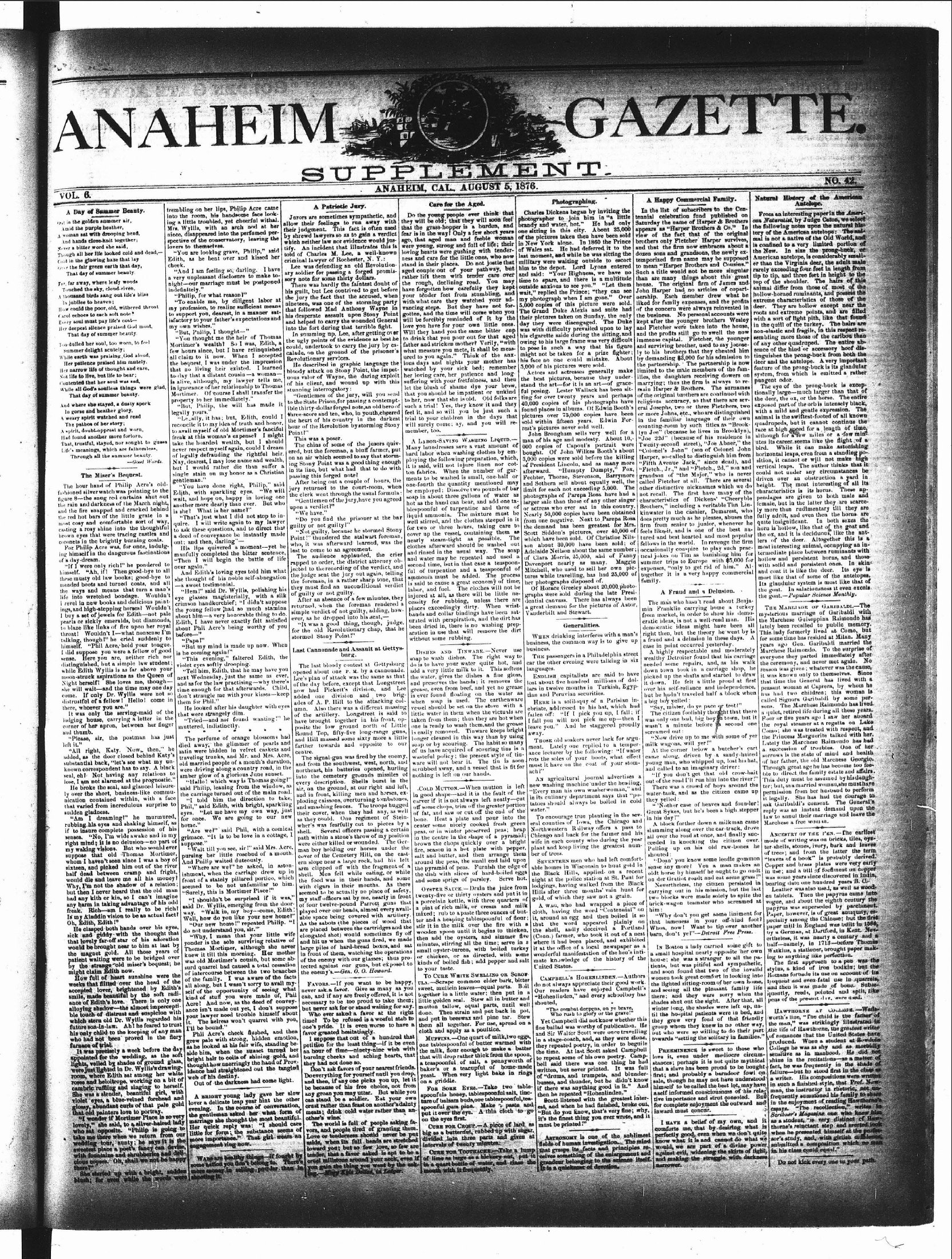
Searchable text
A Day of Summer Beauty.
Out in the golden summer air,
Amid the purple heather,
A woman sat with drooping head,
And hands close-knit together;
Never a bitter word she said,
Though all her life looked cold and dead,
Cold in the glowing haze that lay
Over the fair green earth that day,
That day of summer beauty.
For far away, where leafy woods
Touched the sky, cloud-riven,
A thousand birds sang out life's bliss
In jubilee to heaven;
How could the poor, old, withered throat
Carol echoes to each soft note?
Every soul must pay life's cost—
Her deepest silence praised God most,
That day of summer beauty.
Too dulled her soul, too worn, to feel
Summer delight acutely;
While earth was praising God aloud,
Her patience praised him mutely.
Her narrow life of thought and care,
Not life to live, but life to bear;
Contented that her soul was sad,
While all God's soulless things were glad,
That day of summer beauty.
And where she stayed, a dusty speech
In gorse and heather glory,
A weary spirit watched and read
The pathos of her story;
A spirit, doubt-opprest and worn,
Had found another more forlorn,
That, trustful, stayed, nor sought to guess
Life's meanings, which are fathomless,
Through all the summer beauty.
—Good Words.
trembling on her lips, Philip Acre came into the room, his handsome face looking a little troubled, yet cheerful withal.
Mrs. Wyllis, with an arch nod at her niece, disappeared into the perfumed perspective of the conservatory, leaving the lovers to themselves.
"You are looking grave, Philip," said Edith, as he bent over and kissed her cheek.
"And I am feeling so, darling. I have a very unpleasant disclosure to make tonight—our marriage must be postponed indefinitely."
"Phillip, for what reason?"
"To enable me, by diligent labor at my profession, to realize sufficient means to support you, dearest, in a manner satisfactory to your father's expectations and my own wishes."
"But, Phillip, I thought—"
"You thought me the heir of Thomas Mortimer's wealth? So I was, Edith, a few hours since, but I have relinquished all claim to it now. When I accepted the bequest, I was under the impression that no living heir existed. I learned to-day that a distant cousin—a woman—is alive, although, my lawyer tells me, in ignorance of her relationship to Thomas Mortimer. Of course I shall transfer the property to her immediately."
"But, Phillip, the will has made it legally yours."
"Legally, it has; but, Edith, could I reconcile it to my idea of truth and honor, to avail myself of old Mortimer's fanciful freak at this woman's expense? I might take the hoarded wealth, but I should never respect myself again, could I dream of legally defrauding the rightful heir. Nay, dearest, I may lose name and wealth, but I would rather die than suffer a..."
The Miser's Bequest.
The hour hand of Philip Acre's old-fashioned silver watch was pointing to the figure 8—the snug red curtains shut out the rain and darkness of the March night, and the fire snapped and cracked behind the red hot bars of the little grate in a most cosy and comfortable sort of way, casting a rosy shine into the thoughtful brown eyes that were tracing castles and coronets in the brightly burning coals.
For Philip Acre was, for once, indulging himself in the dangerous fascinations of a day-dream.
"If I were only rich!" he pondered to himself. "Ah, if! Then good-bye to all these musty old law books; good-bye to mended boots and turned coats, and all the ways and means that turn a man's life into wretched bondage. Wouldn't I revel in new books and delicious paintings, and high-stepping horses? Wouldn't I buy a set of jewels for Edith—not pale pearls or sickly emeralds, but diamonds, to blaze like links of fire upon her royal throat! Wouldn't I—what nonsense I'm talking, though!" he cried suddenly to himself. "Phil Acre—hold your tongue. I did suppose you were a fellow of good sense. Here you are, neither rich nor distinguished, but a simple law student; while Edith Wyllis is as far above your moon-struck aspirations as the Queen of Night herself! She loves me, though—she will wait—and the time may one day come. If only Dr. Wyllis were not so distrustful of a fellow! Hello! come in there, whoever you are."
It was only the serving-maid of the lodging house, carrying a letter in the corner of her apron, between her finger and thumb.
"Please, sir, the postman has just left it."
"All right, Katy. Now, then," he added, as the door closed behind Katy's substantial back, "let's see what my unknown correspondent has to say. A black seal, eh? Not having any relations to lose, I am not alarmed at the prognostic."
He broke the seal, and glanced leisurely over the short, business-like communication contained within, with a face that varied from incredulous surprise to sudden gladness.
"Am I dreaming?" he murmured, rubbing his eyes and shaking himself, as if to insure complete possession of his senses. "No, I'm wide awake and in my rights mind; it is no delusion—no part of my waking visions. But who would ever suppose that old Thomas Mortimer, whom I haven't seen since I was a boy of sixteen, and picked him out of the river half dead between cramp and fright, would die and leave me all his money! Why, I'm not the shadow of a relation;"
And where she stayed, a dusty speck in gorse and heather glory,
A weary spirit watched and read
The pathos of her story:
A spirit, doubt-opress and worn,
Had found another more forlorn,
That, trustful, stayed, nor sought to guess Life's meanings, which are fathomless,
Through all the summer beauty.
Good Words.
The Miser's Bequest.
The hour hand of Philip Acre's old-fashioned silver watch was pointing to the figure 8—the snug red curtains shut out the rain and darkness of the March night, and the fire snapped and cracked behind the red hot bars of the little grate in a most cosy and comfortable sort of way, casting a rosy shine into the thoughtful brown eyes that were tracing castles and coronets in the brightly burning coals.
For Philip Acre was, for once, indulging himself in the dangerous fascinations of a day-dream.
"If I were only rich!" he pondered to himself. "Ah, if! Then good-bye to all these musty old law books; good-bye to mended boots and turned coats, and all the ways and means that turn a man's life into wretched bondage. Wouldn't I revel in new books and delicious paintings, and high-stepping horses? Wouldn't I buy a set of jewels for Edith—not pale pearls or sickly emeralds, but diamonds, to blaze like links of fire upon her royal throat! Wouldn't I—what nonsense I'm talking, though!" he cried suddenly to himself. "Phil Acre—hold your tongue. I did suppose you were a fellow of good sense. Here you are, neither rich nor distinguished, but a simple law student; while Edith Wyllis is as far above your moon-struck aspirations as the Queen of Night herself! She loves me, though—she will wait—and the time may one day come. If only Dr. Wyllis were not so distrustful of a fellow! Hello! come in there, whoever you are."
It was only the serving-maid of the lodging house, carrying a letter in the corner of her apron, between her finger and thumb.
"Please, sir, the postman has just left it."
"All right, Katy. Now, then," he added, as the door closed behind Katy's substantial back, "let's see what my unknown correspondent has to say. A black seal, eh? Not having any relations to lose, I am not alarmed at the prognostic."
He broke the seal, and glanced leisurely over the short, business-like communication contained within, with a face that varied from incredulous surprise to sudden gladness.
"Am I dreaming!" he murmured, rubbing his eyes and shaking himself, as if to insure complete possession of his senses. "No, I'm wide awake and in my rights mind; it is no delusion—no part of my waking visions. But who would ever suppose that old Thomas Mortimer, whom I haven't seen since I was a boy of sixteen, and picked him out of the river half dead between cramp and fright, would die and leave me all his money! Why, I'm not the shadow of a relation;"
And where she stayed, a dusty speck in gorse and heather glory,
A weary spirit watched and read
The pathos of her story:
A spirit, doubt-opress and worn,
Had found another more forlorn,
That, trustful, stayed, nor sought to guess Life's meanings, which are fathomless,
Through all the summer beauty.
Good Words.
The Miser's Bequest.
The hour hand of Philip Acre's old-fashioned silver watch was pointing to the figure 8—the snug red curtains shut out the rain and darkness of the March night, and the fire snapped and cracked behind the red hot bars of the little grate in a most cosy and comfortable sort of way, casting a rosy shine into the thoughtful brown eyes that were tracing castles and coronets in the brightly burning coals.
For Philip Acre was, for once, indulging himself in the dangerous fascinations of a day-dream.
"If I were only rich!" he pondered to himself. "Ah, if! Then good-bye to all these musty old law books; good-bye to mended boots and turned coats, and all the ways and means that turn a man's life into wretched bondage. Wouldn't I revel in new books and delicious paintings, and high-stepping horses? Wouldn't I buy a set of jewels for Edith—not pale pearls or sickly emeralds, but diamonds, to blaze like links of fire upon her royal throat! Wouldn't I—what nonsense I'm talking, though!" he cried suddenly to himself. "Phil Acre—hold your tongue. I did suppose you were a fellow of good sense. Here you are, neither rich nor distinguished, but a simple law student; while Edith Wyllis is as far above your moon-struck aspirations as the Queen of Night herself! She loves me, though—she will wait—and the time may one day come. If only Dr. Wyllis were not so distrustful of a fellow! Hello! come in there, whoever you are."
It was only the serving-maid of the lodging house, carrying a letter in the corner of her apron, between her finger and thumb.
"Please, sir, the postman has just left it."
"All right, Katy. Now, then," he added, as the door closed behind Katy's substantial back, "let's see what my unknown correspondent has to say. A black seal, eh? Not having any relations to lose, I am not alarmed at the prognostic."
He broke the seal, and glanced leisurely over the short, business-like communication contained within, with a face that varied from incredulous surprise to sudden gladness.
"Am I dreaming!" he murmured, rubbing his eyes and shaking himself, as if to insure complete possession of his senses. "No, I'm wide awake and in my rights mind; it is no delusion—no part of my waking visions. But who would ever suppose that old Thomas Mortimer, whom I haven't seen since I was a boy of sixteen, and picked him out of the river half dead between cramp and fright,would die and leave me all his money! Why,I'm not the shadow of a relation;"
And where she stayed,a dusty speck in gorse和heather glory,
A weary spirit watched和read
The pathos of her story:
A spirit,doubt-opress和wear,
Had found another more forlorn,
That,trustful,snapped和cracked behind
the red hot bars of the little grate in a most cosy and comfortable sort of way,casting a rosy shine into the thoughtful brown eyes that were tracing castles和 coronets in the brightly burning coals.
For Philip Acre was,for once,indulging himself in the dangerous fascinations of a day-dream.
"If I were only rich!" he pondered to himself. "Ah,if!Then good-bye to all these musty old law books; good-bye to mended boots和turned coats,and all the ways和means that turn a man's life into wretched bondage." Wouldn't I revel in new books和delicious paintings,and high-stepping horses?Wouldn't I buy a set of jewels for Edith—not pale pearls or sickly emeralds,but diamonds,to blaze like links of fire upon her royal throat!Wouldn't I—what nonsense I'm talking,though!" he cried suddenly to himself. "Phil Acre—hold your tongue.I did suppose you were a fellow of good sense.Here you are,neither rich nor distinguished,但a simple law student;while Edith Wyllis is as far above your moon-struck aspirations as the Queen of Night herself!She loves me,though—she will wait—and the time may one day come. If only Dr. Wyllis were not so distrustful of a fellow!Hello!come in there,whoever you are."
It was only the serving-maid of the lodging house,carrying a letter in the corner of her apron,between her finger and thumb.
"Please,sir,the postman has just left it."
"All right,Katy.Now,then," he added,as the door closed behind Katy's substantial back,“let's see what my unknown correspondent has to say.A black seal,eh?Not having any relations to lose,I am not alarmed at the prognostic."
He broke the seal,and glanced leisurely over the short,business-like communication contained within,with a face that varied from incredulous surprise to sudden gladness.
"Am I dreaming!" he murmured,rubbing his eyes和shaking himself,as if to insure complete possession of his senses.“No,我 wide awake和in my rights mind;it is no delusion—no part of my waking visions.But who would ever suppose that old Thomas Mortimer,whom I haven't seen since I was a boy of sixteen,and picked him outofthe river半死betweencrampandfright.woulddieandleavemeallhismoney!Why,I'mnottheshadowofarelation;
But my mind is made up now。When is he coming again?
“This evening,” faltered Edith,the violet eyes softly drooping.
“Tell him,Edith,该他 may have you next Wednesday,justthe same as ever,and as forthelawpractising—whythere’stimeenoughforthatafterwards。Child,dontstranglemewithyourkisses—keepthemforPhil.”
He looked after his daughter with eyes that were strangely dim.
“Tried—andnotfoundwanting!”hemuttered_indistinctly.
“The perfumeoforangeblossomshad diedaway,theglimmerofpearlsandsatinwerehiddeninvelvetcasketsandtravelingtrunks,andMr.andMrs.Acreoldmarriedpeopleofamonth’sdurationweredrivingalongacountryroad,intheamberglowofagloriousJunesunset.
“Hallo!whichwayisThomasgoing?”saidPhil,leaningfromthewindow,asthecarriageturnedoutofthemainroad.
“I toldhimthe directiontotakePhil,”saidEdith,withbright,sparklingeyes。“Letmehaveownwayjustforonce.Wearegoingtoournewhome.”
“Arewe?”saidPhil,withcomicalgrimace.“Itistobeloveinacottage.Isuppose.”
“Wait tillyousee,sir!”saidMrs.Acre,pursuingherlittlerosebudofamouth.AndPhilwaitedduteously.
“Wherearewewell?”heasked.inastonishmentwhenthecarriage drewupintfrontofastatelypillaredportico,theseemedtobeuntfamiliartohim.”
The signal-gunwasandfromthesworthenjoymentofWay.Phil,basedowinthecemeterygiveneverydescription.Sair.ontheground,andinfront,killingplodlingcaissons,voverandsmashingfences.thecover,theastheycould.Oonewerwhatwasfearfullyyoushell.
Severalofficepathwithanstone’swereeitherkilledorwomanboyholdingourscoveroftheCemeteryerno slope neara largerarmclippedoffwithshell.Men fell whenthefoodwasintherichwithcigarsin their
ly over the short, business-like communication contained within, with a face that varied from incredulous surprise to sudden gladness.
"Am I dreaming?" he murmured, rubbing his eyes and shaking himself, as if to insure complete possession of his senses. "No, I'm wide awake and in my right mind; it is no delusion—no part of my waking visions. But who would ever suppose that old Thomas Mortimer, whom I haven't seen since I was a boy of sixteen, and picked him out of the river half dead between cramp and fright, would die and leave me all his money! Why, I'm not the shadow of a relation; but then I never heard that the old man had any kith or kin, so I can't imagine any harm in taking advantage of his old freak. Rich—am I really to be rich! Is my Aladdin vision to be an actual fact! Oh, Edith, Edith!"
He clasped both hands over his eyes, sick and giddy with the thought that that lovely far-off star of his adoration would be brought near to him at last by the magnet gold. All those years of patient waiting were to be bridged over by the strange old miser's bequest; he might claim Edith now.
How full of heart sunshine were the weeks that flitted over the head of the accepted lover, brightened by Edith's smile, made beautiful by the soft radiance of Edith's love. There is only one alloying shadow—the almost imperceptible touch of distrust and suspicion with which stern old Dr. Wyllis regarded his future son-in-law. Ah! he feared to trust his only child to the keeping of any man who had not been proved in the fiery furnace of trial.
It was precisely a week before the day appointed for the wedding, as the soft lights, velled by shades of ground glass, were just lighted in Dr. Wyllis's drawing-room, where Edith sat among her white roses and heliotrophe, working on a bit of cambric ruffling and singing to herself. She was a slender, beautiful girl, with violent eyes, a blue-veined forehead and glossy, abundant curls of that pale gold that old painters love to portray.
"I wonder if Mortimer Place is so very lovely," she said, to a silver-haired lady who sat opposite. "Philip is going to take me there when we return from our wedding tour, annuity; he says it is the sweetest place a poet's fancy can devise, with fountains and shrubberies and delicious copses." Oh, shall we not be happy there?"
She started up with a bright, sudden blush; for even while the words were
"I told him the direction to take, Phil," said Edith, with bright, sparkling eyes. "Let me have my own way, just for once. We are going to our new home."
"Are we?" said Phil, with a comical grimace. "It is to be love in a cottage, I suppose."
"Wait till you see, sir!" said Mrs. Acre, pursuing her little rosebud of a mouth. And Philip waited dutelyously.
"Where are we?" he asked, in astonishment, when the carriage drew up in front of a stately pillared portico, which seemed to be not unfamiliar to him. "Surely, this is Mortimer Place!"
"I shouldn't be surprised if it was," said Dr. Wyllis, emerging from the doorway. "Walk in, my boy—come, Edith! Well, how do you like your new home?"
"Our new home!" repeated Philip. "I do not understand you, sir."
"Why, I mean that your little wife yonder is the sole surviving relative of Thomas Mortimer, although she never it till this morning. Her mother was old Mortimer's cousin, but some aburd quarrel had caused a total cessation of intercourse between the two branches of the family. I was aware of the facts all along, but I wasn't sorry to avail myself of the opportunity of seeing what kind of stuff you were made of, Phil Acre! And now, as the deed of conveyance isn't made out yet, I don't suppose your lawyer need trouble himself about it. The heiress won't quarrel with you, I'll be bound."
Phil Acre's cheek flushed, and then grew pale with strong, hidden emotion, as he looked at his fair wife, standing beside him, when the suaset turned her bright hair to coils of shining gold, and thought how unerringly the hand of Providence had straightened out the tangled web of his destiny.
Out of the darkness had come light.
A night young lady gave her slow lover a delicate leap year hint the other evening. In this course of conversation, the gentleman asked her what form of marriage she thought the most beautiful. Her quick reply was: "I should care little for form; the substance seems of more importance." That girl wears an engagement ring now.
Wants are healthy things—if fought by some nation you don't belong to. There's much money in selling powder than in shaving it.
Several office path within a stone's trunk were either killed or worn boy holding our cover of the Cemetery slope near a large arm clipped off with shell. Men fell when the food was in their with cigars in their seemed to be actually my staff officers sat by four twelve-pound played over our headable space being covered As the sabots (the pear are placed between an elongated shot) wound and hit us when they large piles of hard-backed in front of them, wafted of the enemy with our teased against our enemy's.—Gen.
FAVORS.—If you never ask a favor can, and if any are necessary to be too but never ask for or Who ever asked a time? To be refused one's pride. It is not ask favors Doeverything for you and then, if any one any groan you may can stand be a solitary crust rather than meat; drink cold other's wine.
The world is full vorns, and people tie Love or tenderness aside when its fills toward you; but a leader, that a favorite crest millstone are you gain the thing—Mary Kate
A Patriotic Jury.
Jurors are sometimes sympathetic, and allow their feelings to run away with their judgment. This fact is often used by shrewd lawyers so as to gain a verdict which neither law nor evidence would justify. An incident that illustrates this is told of Charles M. Lee, a well-known criminal lawyer of Rochester, N.Y.:
Lee was defending an old Revolutionary soldier for passing a forged promissory note for some thirty dollars.
There was hardly the faintest doubt of his guilt, but Lee contrived to get before the jury the fact that the accused, when nineteen, was one of the storming party that followed Mad Anthony Wayne in his desperate assault upon Stony Point and helped to carry the wounded General into the fort during that terrible fight.
In summing up, Lee, after getting over the ugly points of the evidence as best he could, undertook to carry the jury by escalade, on the ground of the prisoner’s Revolutionary services.
He described in graphic language the bloody attack on Stony Point, the impetuous valor of Wayne, the daring exploit of his client, and wound up with this stunning interrogatory:
“Gentlemen of the jury, will you send to the State Prison, for passing a contemptible thirty-dollar forged note, an old hero of three-score and ten, who, in youth, cheered the heart of his country in the darkest hour of the Revolution by storming Stony Point?”
This was a poser.
The chins of some of the jurors quivered, but the foreman, a bluff farmer, put on an air which seemed to say that storming Stony Point was a good thing enough in its line, but what had to do with Care for the Aged.
Do the young people ever think that they will be old; that they will soon feel that the grass-hopper is a burden, and fear is in the way! Only a few short years ago, that aged man and feeble woman were young, strong and full of life; their loving hearts were gushing with tenderness and care for the little ones, who now stand in their places. Do not jostle that aged couple out of your pathway, but rather lift them with tender care over the rough, declining road. You may have forgotten how carefully they kept your tender feet from stumbling, and with what care they watched your advancing steps. But they have not forgiven, and the time will come when you will be forcibly reminded of it by the love you have for your own little ones. Will they hand you the same bitter cup to drink that you pour out for that aged father and stricken mother? Verily, “with what measure you mete, it shall be measured to you again.” Think of the anxious days and nights your mother has watched by your sick bed; remember her loving care, her patience and long-suffering with your fretfulness, and then let the blush of shame dye your brow, that you should be impatient or unkind to her, now that she is old. Old folks are such a trial! Yes, they know it and they feel it, and so will you be just such a trial to your children in the days that will surely come: ay, and you will remember, too.
A LABOR-SAVING WASHING LIQUID.—Many laundresses save a vast amount of hard labor when washing clothes by employing the following preparation, which it is said, will not injure linen nor cot-
Photographing.
Charles Dickens began by inviting the photographer to join him in “a little brandy and water, hot.” He had only one sitting in this city. About 25,000 of the pictures taken then have been sold in New York alone. In 1860 the Prince of Wales sat. He had deferred it to the last moment, and while he was sitting the military were waiting outside to escort him to the depot. Lord Lyons entered and said: “Your Highness, we have no time to spare, and there is a multitude outside anxious to see you.” “Let them wait,” replied the Prince; “they can see my photograph when I am gone.” Over 5,000 copies of this picture were sold. The Grand Duke Alexis and suite had their pictures taken on Sunday, the only day they were disengaged. The Duke was with difficulty prevailed upon to lay his cigarette aside during the sitting, and owing to his large frame was very difficult to pose in such a way that his figure might not be taken for a prize fighter; his face no one could mistake. About 5,000 of his pictures were sold.
Actors and actresses generally make the best pictures because they understand the art—for it is an art—of graceful posing. Lester Wallack has been sitting for over twenty years and perhaps 40,000 copies of his photographs have found places in albums. Of Edwin Booth’s pictures over 75,000 copies have been sold within fifteen years. Edwin Forrest’s pictures never sold well.
John Brougham sells very well for a man of his age and modesty. About 10,-000 copies of Capoul’s portrait were bought. Of John Wilkes Booth’s about 5,000 copies were sold before the killing of President Lincoln, and as many more
bloody attack on Stony Point, the impetious valor of Wayne, the daring exploit of his client, and wound up with this stunning interrogatory:
"Gentlemen of the jury, will you send to the State Prison, for passing a contemptible thirty-dollar forged note, an old hero of three-score and ten, who, in youth, cheered the heart of his country in the darkest hour of the Revolution by storming Stony Point!"
This was a poser.
The chins of some of the juzors quivered, but the foreman, a bluff farmer, put on an air which seemed to say that storming Stony Point was a good thing enough in its line, but what had that to do with passing this forged note!
After being out a couple of hours, the jury returned to the court-room, when the clerk went through the usual formula:
"Gentlemen of the jury, have you agreed upon a verdict?"
"We have."
"Do you find the prisoner at the bar guilty or not guilty?"
"Not guilty, because he stormed Stony Point!" thundered the stalwart foreman, who it was afterward learned, was the last to come to an agreement.
The audience applauded, the crier rapped to order, the district attorney objected to the recording of the verdict, and the judge sent the jury out again, telling the foreman, in a rather sharp tone, that they must find an unconditional verdict of guilty or not guilty.
After an absence of a few minutes, they returned, when the foreman rendered a simple verdict of not guilty, adding, however, as he dropped into his seat,
"It was a good thing, though, judge, for the old Revolutionary chap, that he stormed Stony Point!"
Last Cannonade and Assault at Gettysburg.
The last bloody contest at Gettysburg opened about one P.M. by a cannonade. Lee's plan of attack was the same as that of the day before, except that Longstreet now had Pickett's division, and Lee added one division and two brigades of A.P.Hill to the attacking column. Also there was a different massing of the artillery. Longstreet is said to have brought together in his front, opposite the low ground north of Little Round Top, fifty-five long-range guns, and Hill massed some sixty more a little farther towards and opposite to our centre.
The signal-gun was fired by the enemy, and from the southwest, west, north, and northeast, his batteries opened, hurling into the cemetery grounds missiles of every description. Shells burst in the air, on the ground, at our right and left, and in front, killing men and horses, exploding caissons, overturning tombstones, and smashing fences. The troops hugged their cover, when they had any, as well as they could. One regiment of Steinwher's was fearfully cut to pieces by a shell. Several officers passing a certain path within a stone's throw of my position were either killed or wounded. The German boy holding our horses under the cover of the Cemetery Hill, on the eastern slope near a large rock, had his left arm clipped off with the fragment of a shell. Men fell while eating, or while the food was in their hands, and some with cigars in their mouths. As there her loving care, her patience and long-suffering with your fretfulness, and then let the blush of shame dye your brow, that you should be impatient or unkind to her, now that she is old. Old folks are such a trial! Yes, they know it and they feel it, and so will you be just such a trial to your children in the days that will surely come; ay, and you will remember, too.
A LABOR-SAVING WASHING LIQUID. Many laundresses save a vast amount of hard labor when washing clothes by employing the following preparation, which it is said, will not injure linen nor cotton fabrics. When the number of garments to be washed is small, one-half one-fourth the quantity mentioned may be employed: Dissolve two pounds of bar soap in about three gallons of water as hot as the hand can bear, and add one tablespoonful of turpentine and three of liquid ammonia. The mixture must be well stirred, and the clothes steeped in it for two or three hours, taking care to cover up the vessel, containing them as nearly steam-tight as possible. The clothes afterward should be washed out and rinsed in the usual way. The soap and water may be repeated and used second time, but in that case a teaspoonful of turpentine and a teaspoonful of ammonia must be added. The process is said to cause a great economy of time, labor, and fuel. The clothes will not be injured at all, as there will be little necessity for rubbing, unless there are places exceedingly dirty. When wrist-bands and collar bindings have been saturated with perspiration, and the dirt has been dried in, there is no washing preparation in use that will remove the dirt without some rubbing.
DISHES AND TINWARE. Never use soap to wash dishes. The right way to do is to have your water quite hot, and add a very little milk to it. This softens the water, gives the dishes a fine gloss, and preserves the hands; it removes the grease, even from beef, and yet no grease is ever found floating on the water as when soap is used. The earthenware vessel should be set on the sieve with a little water in them when the victuals are taken from them; thus they are hot when one is ready to wash them and the grease is easily removed. Tinware keeps bright longer cleaned in this way than by using soap or by scouring. The habit so many of us have acquired of scouring tins is a wasteful policy; the present style of tinware will not bear it. The tin is soon scrubbed away, and a vessel that is fit for nothing is left on our hands.
COLD MUTTON. When mutton is left in good shape—and it is the fault of the carver if it is not always left neatly—cut off some chops, trim off the greater portion of fat, and saw or cut off the end of the bone. Heat a plate and pour into the center some nicely cooked fresh green peas; or in winter preserved peas; heap in the centre in the shape of a pyramid; brown the chops quickly over a bright fire, season in a hot plate with pepper, salt and butter; and then arrange them around the peas, the small end laid upon the pyramid of peas. Furnish the edge of the dish with slices of hard-boiled eggs and some sprigs of parsley. Serve hot.
OYSTER SAUCE. Drain the juice from her loving care, her patience and long-suffering with your fretfulness, and then let the blush of shame dye your brow, that you should be impatient or unkind to her, now that she is old. Old folks are such a trial! Yes, they know it and they feel it, and so will you be just such a trial to your children in the days that will surely come; ay, and you will remember, too.
A LABOR-SAVING WASHING LIQUID. Many laundresses save a vast amount of hard labor when washing clothes by employing the following preparation, which it is said, will not injure linen nor cotton fabrics. When the number of garments to be washed is small, one-half one-fourth the quantity mentioned may be employed: Dissolve two pounds of bar soap in about three gallons of water as hot as the hand can bear, and add one tablespoonful of turpentine and three of liquid ammonia. The mixture must be well stirred, and the clothes steeped in it for two or three hours, taking care to cover up the vessel, containing them as nearly steam-tight as possible. The clothes afterward should be washed out and rinsed in the usual way. The soap and water may be repeated and used second time, but in that case a teaspoonful of turpentine and a teaspoonful of ammonia must be added. The process is said to cause a great economy of time, labor, and fuel. The clothes will not be injured at all, as there will be little necessity for rubbing, unless there are places exceedingly dirty. When wrist-bands and collar bindings have been saturated with perspiration, and the dirt has been dried in, there is no washing preparation in use that will remove the dirt without some rubbing.
ACTORS AND ACTresses generally make best pictures because they understand the art—for it is an art—of graceful posing. Lester Wallack has been sitting for over twenty years and perhaps 40,000 copies of his photographs have found places in albums. Of Edwin Booth's pictures over 75,000 copies have sold within fifteen years. Edwin Forrest's pictures never sold well.
John Brougham sells very well for a man of his age and modesty. About 10,000 copies of Capoul's portrait were bought. Of John Wilkes Booth's about 5,000 copies were sold before the killing of President Lincoln, and as many more afterward. "Humpty Dumpty," Fox, Fechter Thorne, Stevenson, Barrynand Sothern sell about equally well,the limit for each not exceeding 5,000. The photographs of Parera Rosa have had a larger sale than those of any other singer or actress who ever sat in this country.Nearly 50,000 copies have been obtained from one negative.Next to Parepa Rosa Scott Siddon's pictures,over 40,000 which have been sold.Of Christine Nilson about 30,000 have been sold;Of Adelaide Neilson about the same number;Of Clara Morris,25,000,and Of Fanny Davenport nearly as many.Maggie Mitchell,who used to sell her own pictures while travelling,has had 25,000 of her photographs disposed of.
Of Horace Greeley about 20,000 photographs were sold during the late Presidential canvass. There has always been a great demand for the pictures of Astor,Vanderbilt and Stewart.
Generalities.
When drinking interferes with a man's business,the common way is to give business.
The passengers in a Philadelphia street car are other evening were talking in six languages.
Enolish capitalists are said to have lost about five hundred millions of dollars in twelve months in Turkish,Gypian and Peruvian securities.
Here is a soliloquy of a Parisian enbriate, addressed to his hat,which had fallen off: "If I pick you up,I fall;if I fall you will not pick me up—then I leave you." And he staggered proudly away.
Those old soakers never lack for argument.Lately one replied to a temperance lecturer by the following: "If water roses the soles of your boots,what effect must it have on the coat of your stomach?"
An agricultural journal advertises a new washing machine under the headling,"Every man his own washerwoman,"and in its culinary department says that "potatoes should always be boiled in cold water."
To encourage true planting in these several counties of Iowa,the Chicago and Northwestern Railway offers a pass to Chicago and back for the farmer and his wife in each county who during year plant and keep livingthe greatest number of trees.
SEVENTEEN men who had left comfortable homes in Wisconsin to hunt gold in the Black Hills,applied on a recent night at the police station at St.Paul for lodgings,having walked from the Black Hunt for
In front, killing men and horses, exploding caissons, overturning bombstones, and smashing fences. The troops hugged their cover, when they had any, as well as they could. One regiment of Steinwher's was fearfully cut to pieces by a shell.
Several officers passing a certain path within a stone's throw of my position were either killed or wounded. The German boy holding our horses under the cover of the Cemetery Hill, on the eastern slope near a large rock, had his left arm clipped off with the fragment of a shell. Men fell while eating, or while the food was in their hands, and some with cigars in their mouths. As there seemed to be actually no place of safety, my staff officers sat by me, nearly in front of four twelve-pound Parrott guns that played over our heads, almost every available space being covered with artillery. As the sabots (the pieces of wood that are placed between the cartridges and the elongated shot) would sometimes fly off and hit us when the guns fired, we made large piles of hard-bread boxes, and sat in front of them, watching the operations of the enemy with our glasses; thus protected against our guns, but exposed to the enemy's.—Gen. O. O. Howard.
FAVORS.—If you want to be happy, never ask a favor. Give as many as you can, and if any are freely offered, it is not necessary to be too proud to take them; but never ask for or stand waiting for any.
Who ever asked a favor at the right time? To be refused is a woeful stab to one's pride. It is even worse to have a favor granted hesitatingly.
I suppose that out of a hundred that petition for the least thing—if it be even an hour of time—ninety-nine wish with burning cheeks and aching hearts, that they had not done so.
Don't ask favors of your nearest friends. Do everything for yourself until you drop, and then, if any one picks you up, let it be because of his free choice, not from any groan you may utter. But while you can stand be a soldier. Eat your own crust rather than feast on another's dainty meals; drink cold water rather than another's wine.
The world is full of people asking favors, and people tired of granting them. Love or tenderness should never be put aside, when its full hands are stretched toward you; but so few love, so few are teased that a favor asked is apt to be a cruel millstone around your neck, even if you gain the thing you want by the making—Mary Kate Dallis, in Edgar.
OYSTER SAUCE.—Drain the juice from twenty-five or thirty oysters and put it in a porcelain kettle, with three quarters of a pint of rich milk, or cream and milk mixed; rub to a paste three ounces of butter and a heaping tablespoonful of flour; stir it in the milk over the fire with a wooden spoon until it begins to thicken, then add the oysters, and simmer five minutes, stirring all the time; serve in a small oyster-turceen, with boiled turkey or chicken, or as directed, with some kinds of boiled fish; add pepper and salt to your taste.
To CURE WHITE SWELLING OR SORBULA.—Scrape common elder bark, bitter sweet, mullet leaves—equal parts. Boil together in a little water; then put in a little golden seal. Stew all in butter and mutton tallow, equal parts, until well done. Then strain and put back in pot, and put in beeswax and pine tar. Stew them all together. For use, spread on a cloth and apply as a poultice.
MUFFINS.—One quart of milk,two eggs, one tablespoonful of butter warmed with the milk, flour enough to make a batter that will drop rather thick from the spoon,a teaspoonful of salt,a pennyworth of baker's or a teacupful of home-made yeast. When very light bake in rings on a griddle.
FOR SORE EYES.—Take two table-spoonsful honey,tablespoonful salt,tincture of balsam buds,一 tablespoonful tea-spoonful gum pine.Make a pasta and put it over the eye.A thin cloth to go on the eyes first.
CURE FOR CRUEU.—A piece of lard as big as a butterfut,rubbed up with sugar.divided into three parts and given at intervals of twenty minutes.
CURE FOR TOOTHACKE.—Take a lump of lime as large as a blackyart,put it in a quart bottle of water,and rinse the month with it frequently.
"Every man his own washer woman,"and in its culinary department says that "potatoes should always be boiled in cold water."
To encourage true planting in the several counties of Iowa,the Chicago and Northwestern Railway offers a pass to Chicago and back for the farmer and his wife in each county who during the year plant and keep living the greatest number of trees.
SEVENTEEN men who had left comfortable homes in Wisconsin to hunt gold in the Black Hills,applied on a recent night at the police station at St.Paul for lodgings,having walked from the Black Hills after three months' vain hunt for gold,of which they saw not a grain.
A WAG,who had wrapped a piece of cloth,having the word "Centennial" on it,around an egg and then boiled it so that the word appeared plainly on the shell,sadly deceived a Portland (Conn.) farmer,who took it out of a nest where it had been placed,and exhibited it at the office of a local newspaper as a wonderful manifestation of the hen's intimate knowledge of the history of the United States.
CAMPBELL'S HOENLINDEN.—Authors do not always appreciate their good work. Our readers have enjoyed Campbell's "Hohenlinden,"and every schoolboy has shouted,
"The combat deepens,on ye brave,
Who rush to glory or the grave."
Yet Campbell did not know whether this fine ballad was worthy of publication. He and Sir Walter Scott were once travelling in a stage-coach,and,as they were alone,the repeated poetry,在 order to beguile the time. At last Scott asked Campbell to repeat some of his own poetry.Campbell said there was one thing he had written,but never printed.It was full of "drums,and trumpets,and blunderbusses,and thunder,但他 didn't know if there was anything good in it."And then repeated "Hohenlinden."
Scott listened with the greatest interest,and when he had finished,broke out,"But do you know,that's very fine;why,'it's the finest thing you ever wrote,and it must be printed!"
ASTROOMY is one of the sublimest fields of human investigation.The mind that graps its facts and principles receives something of the enlargement and grandear belonging to the science itself.it is a quirkner of devotion.
GAZETTE.
NO. 42.
Inviting the in "a little life had only about 25,000 have been sold 100 the Prince saved it to the was sitting the hide to escort cons entered we have no multitude "Let them they can see grone." Over were sold. And suite had day, the only The Duke upon to lay the sitting, and very difficult that his figure orize fighter; take. About old. Generally make they under art—of grace has been sit and perhapsographs have Edwin Booth's lies have been Edwin Forwell. Well well for a day. About 10, portrait were Booth's about are the killing was many more Fox.
A Happy Commercial Family.
In the list of subscribers to the Centennial celebration fund published on Saturday the name of Harper & Brothers appears as "Harper Brothers & Co." In view of the fact that of the original brothers only Fletcher Harper survives, and that the firm now embraces about a dozen sons and grandsons, the newly extemporized firm name may be supposed to mean "Harper Brothers and Cousins." Such a title would not be more singular than are many things about this great house. The original firm of James and John Harper had no articles of copartnership. Each member drew what he liked for family expenses, and the profits of the concern were always reinvested in the business. No personal accounts were kept after the younger brothers Wesley and Fletcher were taken into the house, and the profits still go to swell the now immense capital. Fletcher, the younger and surviving brother, used to say jocosely to his brothers that they cheated him by demanding $3,000 for his admission to the partnership. The partnership is now limited to the male members of the families, the daughters receiving dowers on marrying; thus the firm is always to remain Harper & Brothers. The surnames of the original brothers are continued with religious accuracy, so that there are several Josephs, two or three Fletchers, two or more Johna, etc., who are distinguished in the familiar language of their own counting-room by such titles as "Brooklyn Joe" (because he lives in Brooklyn), "Joe 22d" (because of his residence in Twenty-second street), "Joe Abner," the "Colonel's John" (son of Colonel John Harper, so-called to distinguish him from "Fifth Avenue Jack," since dead), and "Fletch Jr." and "Fletch, 2d," son and Natural History of the American Antelope.
From an interesting paper in the American Naturalist, by Judge Caton, we select the following notes upon the natural history of the American antelope: The animal is not a native of the Old World, and is confined to a very limited portion of the New. In size the prong-buck, or American antelope, is considerably smaller than the Virginia deer, the adult male rarely exceeding four feet in length from tip to tip, and three feet in height to the top of the shoulder. The hairs of this animal differ from those of most of the hollow-horned ruminants, and possess the extreme characteristics of those of the deer. They are hollow except near the roots and extreme points, and are filled with a sort of light pith, like that found in the quill of the turkey. The hairs are non-elastic and fragile, in this respect resembling more those of the caribou than of any other quadruped. The entire absence of the hind or accessory hoof distinguishes the prong-buck from both the deer and the antelope. A very important feature of the prong-buck is its glandular system, from which it emitted a rather pungent odor.
The eye of the prong-buck is exceptionally large—much larger than that of the deer, the ox, or the horse. The entire exposed part of the orb is intensely black, with a mild and gentle expression. The animal is the swiftest-footed of all known quadrupeds, but it cannot continue the race at high speed for a length of time, although for a few miles or a few minutes its career seems like the flight of a bird. While it can make astonishing horizontal leaps, even from a standing position, it cannot or will not make high vertical leaps. The author thinks that it
A Fraud and a Delusion.
The man who hasn't read about Benjamin Franklin carrying home a turkey from market, in order to show his democratic ideas, is not a well-read man. His democratic ideas might have been all right then, but the theory he went by is a fraud and a delusion in these days. A case in point occurred yesterday.
A highly respectable and moderately wealthy Detroiter found that his carriage needed some repairs, and, as his walk down town took in a carriage shop, he picked up the shafts and started to draw it down. He felt a little proud at first over his self-reliance and independence, but he hadn't traveled half a block when a big boy yelled:
"Say, mister, do ye pace or trot!"
The citizen foolishly thought that there was only one bad, big boy in town, but it wasn't a minute before a second one screamed out:
"Now drive up to me with some of yer milk wagons, will yer!"
At the corner below a butcher's cart came along, driven by a sandy-haired young man, who whipped up, lost his hat, and called to an imaginary driver:
"If you don't get that old crow-bait out of the road I'll run him into the river!"
There was a crowd of boys around the water-tank, and as the citizen came up they yelled:
"Nother case of heaves and founder! Great Sykes, but he's been a high stepper in his day!"
A block further down a milkman came slamming along over the car-track, drove all over the road at once, and finally succeeded in knocking the citizen over. Pulling up on his old raw-bones he shouted:
"Don'n you know some lecdle gommon sense any more? Ven a man makes an old horse by himself he ought to go ont on der Gratiot road and eat some grass!"
Nevertheless, the citizen persisted in his mission, but the last limited to the male members of the families, the daughters receiving dowers on marrying; thus the firm is always to remain Harper & Brothers. The surnames of the original brothers are continued with religious accuracy, so that there are several Josephs, two or three Fletchers, two or more Johns, etc., who are distinguished in the familiar language of their own counting-room by such titles as "Brooklyn Joe" (because he lives in Brooklyn), "Joe 22d" (because of his residence in Twenty-second street), "Joe Abner," the "Colonel John" (son of Colonel John Harper, so-called to distinguish him from "Fifth Avenue Jack," since dead), and "Fletch., Jr." and "Fletch., 2d," son and grandson of "the Major," who is never called Fletcher at all. There are several other distinctive nicknames which we do not recall. The first have many of the characteristics of Dickens' "Cheeryble Brothers," including a veritable Tim Linkinwater in the cashier, Demarest, who does pretty much as he pleases, abuses the firm from senior to junior, whenever he feels like it, and is one of the best natured and best hearted and most popular fellows in the world. In revenge the firm occasionally conspire to play such practical jokes on Tim as banishing him for summer trips to Europe with $5,000 for expenses, "only to get rid of him." Altogether it is a very happy commercial family.
The eye of the prong-buck is exceptionally large—much larger than that of the deer, the ox, or the horse. The entire exposed part of the orb is intensely black, with a mild and gentle expression. The animal is the swiftest-footed of all known quadrupeds, but it cannot continue the race at high speed for a length of time, although for a few miles or a few minutes its career seems like the flight of a bird. While it can make astonishing horizontal leaps, even from a standing position, it cannot or will not make high vertical leaps. The author thinks that it could not under any circumstances be driven over an obstruction a yard in height. The most interesting of all its characteristics is its horns. These appendages are given to both male and female, but in the latter they are scarcely more than rudimentary till they are fully adult, and even then the horns are quite insignificant. In both sexes the horn is hollow, like that of the goat and the ox, and it is deciduous, like the antlers of the deer. Altogether this is a most interesting animal, occupying an intermediate place between ruminants with hollow and persistent horns, and those with solid and persistent ones. In skin and coat it is like the deer. Its eye is most like that of some of the antelope. Its glandular system is most like that of the goat. In salaciousness it even excels the goat. In salaciousness it even excels the goat.
THE MARRIAGE OF GARIBALDI — The mysterious marriage of Garibaldi with the Marchese Guiseppina Raimondo has lately been recalled to public memory. This lady formerly lived at Como, but for some time has resided at Milan. Many years ago Gen. Garibaldi married the Marchese Raimondo. To the surprise of everyone they parted immediately after the ceremony, and never met again. No reason was given; whatever was the cause, it was known only to themselves. Since that time the General has lived with a peasant woman at Caperna, by whom he has had two children; this woman is called Signora Garibaldi by some persons. The Marchese Raimondo has lived a quiet, retired life during all these years. Four or five years ago I saw her aboard the royal steamer at a regatta on Lake Como; she was treated with respect, and the Princess Marguerite talked with her. Lately the Marchese Raimondo has had a succession of troubles. One of her sorrows is the state of mind and health of her father, the old Marchese Georgio. Through great age he has become too folee to direct the family estate and affairs. This duty must be assumed by his daughter; but, as a married woman, she must have permission from her husband to perform it legally. She has had the courage to ask Garibaldi's consent. The General's reply was an instant demand upon the law to annul their marriage and leave the Marchese a free woman.
ANCESTRY OF THE PEN — The earliest mode of writing was on bricks, tiles, oyster-shells, stones, ivory, bark and leaves of trees; and from the latter the term "leaves of a book" is probably derived. Copper and brass plates were very early in use; and a bill of foefment on copper was some years since discovered in India, bearing date one hundred years B. C.
Leather was also used, as well as wood.
ANCESTRY OF THE PEN.—The earliest mode of writing was on bricks, tiles, oyster-shells, stones, ivory, bark and leaves of trees; and from the latter the term "leaves of a book" is probably derived. Copper and brass plates were very early in use; and a bill of foefliment on copper was some years since discovered in India, bearing date one hundred years B.C.
Leather was also used, as well as wooden tablets. Then the papyrus came into vogue, and about the eighth century the papyrus was superseded by parchment. Paper, however, is of great antiquity, especially among the Chinese; but the first paper mill in England was built in 1588, by a German, at Dartford, in Kent. Nevertheless, it was nearly a century and a half—namely, in 1713—before Thomas Watkins, a stationer, brought paper making to anything like perfection.
The first approach to a pen was the stylus, a kind of iron bodkin; but the Romans fortmade its use on account of its frequent and even-fatal use in quarrels, and then it was made of bone. Subsequently, reeds, pointed and split, like pens of the present day, were used.
HAWTHORNE AT COLLEGE.—Wadsworth's line, "The child is the father of the man," was strikingly illustrated in the life of Hawthorne, the greatest writer of romances that the United States have produced. When a student at Bowdoin College he was as shy and as morbidly sensitive as in manhood. He did not shine in the recitations—as a matter of fact, he was frequently in the shade of failure—but he stood first in the class as a writer. His compositions were written in such a finished style, that Prof. Newman, the instructor in rhetoric, not frequently summoned his family to share in the enjoyment of reading Hawthorne's essays. "The recollection," written in Seribner's Magazine one who knew him as a student, "is very distinct of Hawthorne's reluctant step and averted look when he presented himself at the professor's study, and with girlish diffidence submitted a composition which no man in his class equid equal."
Do not kick every one in your path.