anaheim-gazette 1876-07-29
Scanned page
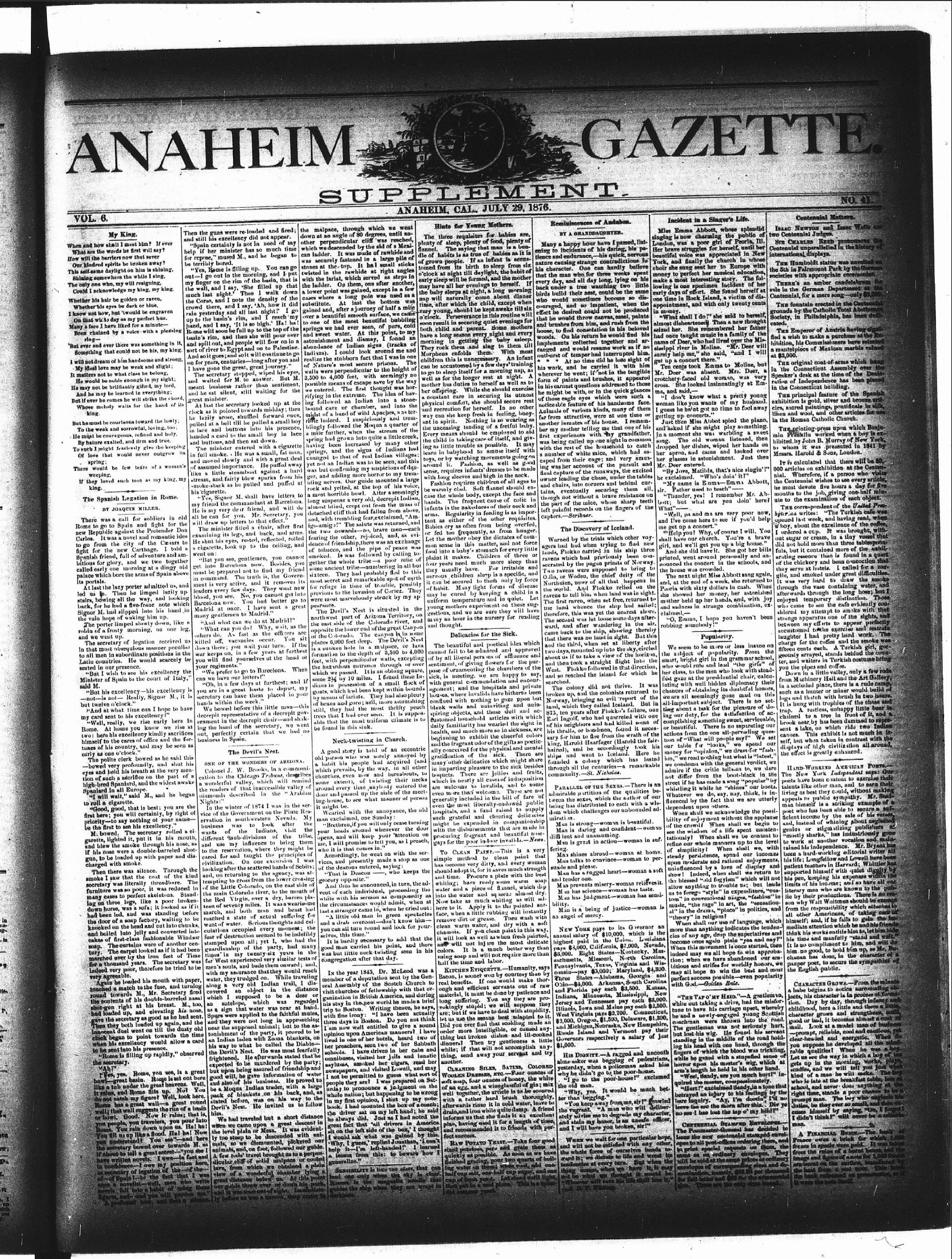
Searchable text
My King.
When and how shall I meet him? If ever
What are the words he first will say?
How will the barrers now that sever
Our kindred spirits be broken away?
This self-same daylight on him is shining,
Shining somewhere the while I sing.
The only one who, my will resigning,
Could I acknowledge my king, my king.
Whether his hair be golden or raven,
Whether his eyes be dark or blue,
I know not how, but 'twould be engraven
On that whit; day as my perfect haue.
Many a face I have liked for a minute—
Been chained by a voice with a pleasing ring—
'But ever and ever there was something in it,
Something that could not be his, my king.
I will not dream of him handsome and strong,
My ideal love may be weak and slight;
It matters not to what class he belong;
He would be noble enough in my sight;
He may not be brilliantly gifted, my lord,
And he may be learned in everything;
But if ever he comes he will strike the chord,
Whose melody waits for the hand of its king.
But he must be courteous toward the lowly;
To the weak and sorrowful, loving, too;
He must be courageous, refined and holy,
By nature exalted, and firm and true.
To such I might fearlessly give the keeping
Of love that would never outgrow its spring;
There would be few tears of a woman's
Then the guns were re-loaded and fired;
and still his excellency did not appear.
"Spain certainly is not in need of my help if her minister has so much time for repose," mused M., and he began to be terribly bored.
"Yes, Rome is filling up. You can go out—I go out in the morning, and I put my finger on the rim of the basin, that is the wall, and I say, 'She filled up that much last night.' Then I walk down the Corso, and I note the density of the crowd there, and I say, 'Ah, how it did rain yesterday and all last night!' I go up to the basin's rim, and I reach my hand, and I say, 'It is so high.' Ha! ha! Rome will soon be full up to the top of the basin's rim, and then she will pour over and spill out, and people will flow on in a sort of river to Egypt and on to Palestine. And so it goes; and so it will continue to go on for years, centuries—long after you and I have gone the great, great journey."
The secretary stopped, wiped his eyes, and waited for M. to answer. But M. meant business rather than sentiment, and he sat silent, still waiting for the great minister.
At last the secretary looked up at the clock as it pointed towards midday; then he lazily arose, shuffled forward once, pulled at a bell till he pulled a small boy in lace and buttons into his presence, handed a card to the small boy in lace and buttons, and then sat down.
The minister entered with a cigarette in full smoke. He was a small, fat man, and moved slowly and with a great deal of assumed importance. He puffed away the malpace, thrown down at an angle of other perpendicular which we descended can ladder. It was securely fastened stones at the top. Twisted in the raw with the lariat, while the ladder. On the a lower point was given cases where a long substitute. At his gained and, after a over a beautiful amide to one of the most springs we had ever and sweet water. astonishment and abundance of Indian Indians). I could realize the stubborn of Nature's most walls were perpendicular 3,500 to 4,000 feet possible means of we entered. The rifying in the extreme followed an bound cave or cliff midst of a band of rifle indeed. I s blingly followed to a mile further, when spring had grown having been incarnations, and the changed to that o yet not an Indian
It matters not to what class he belong,
He would be noble enough in my sight;
He may not be brilliantly gifted, my lord,
And he may be learned in everything;
But if ever he comes he will strike the chord,
Whose melody waits for the hand of its king.
But he must be courteous toward the lowly;
To the weak and sorrowful, loving, too;
He must be courageous, refined and holy,
By nature exalted, and firm and true.
To such I might fearlessly give the keeping
Of love that would never outgrow its spring;
There would be few tears of a woman's weeping.
If they loved such men as my king, my king.
The Spanish Legation in Rome.
BY JOAQUIN MILLER.
There was a call for soldiers in old Rome to go to Spain and fight for the new Republic against the Pretender Don Carlos. It was a novel and romantic idea to go from the city of the Caesars to fight for the new Carthage. I told a Spanish friend, full of adventure and ambitious for glory, and we two together called early one morning at a dingy old palace which bore the arms of Spain above its portals.
At last the lazy porter admitted us, and led us in. Then he limped lazily upstairs, bowing all the way, and looking back, for he had a five-france note which Signor M. had slipped into his hand in the vain hope of waking him up.
The porter limped slowly down, like a robin of a frosty morning, on one leg, and we went up.
The secretary of legation received us in that most obsequious manner peculiar to all men in subordinate positions in the Latin countries. He would scarcely be sented in our presence.
"But I wish to see his excellency the Minister of Spain to the court of Italy," said M.
"But his excellency—his excellency is—not—is not—It really, Signor M., it is but twelve o'clock."
"And at what time can I hope to have my card sent to his excellency?"
"Well, really, we rise early here in Rome. At home you know we rise at two: here his excellency kindly sacrifices himself to the cares of office and the fortunes of his country, and may be seen as early as one o'clock."
The polite clerk bowed as he said this—bowed very profoundly, and shut his eyes and held his breath at the very mention of such a sacrifice on the part of a high-bred Spaniard, and the widest awake Spaniard in all Europe.
"I will wait," said M., and he began to roll a cigarette.
"Good, good, that is best; you are the first here; you will certainly, by right of priority—to say nothing of your name—be the first to see his excellency."
M. bowed. The secretary rolled a cigarette, lighted it, put it in his mouth, and blew the smoke through his nose, as if his nose were a double-barreled shotgun, to be loaded up with paper and discharged with smoke.
Then there was silence. Through the smoke I saw that the coat of the kind secretary was literally threadbare. The fountain was so poor, it was reduced in
The secretary stopped, wiped his eyes, and waited for M. to answer. But M. meant business rather than sentiment, and he sat silent, still waiting for the great minister.
At last the secretary looked up at the clock as it pointed towards midday; then he lazily arose, shuffled forward once, pulled at a bell till he pulled a small boy in lace and buttons into his presence, handed a card to the small boy in lace and buttons, and then sat down.
The minister entered with a cigarette in full smoke. He was a small, fat man, and moved slowly and with a great deal of assumed importance. He puffed away like a little steamboat against a hard stream, and fairly blew sparks from his-smoke-stack as he pulled and puffed at his cigarette.
"Yes, Signor M. shall have letters to my friend the commandant at Barcelona. He is my very dear friend, and will do all he can for you. Mr. Secretary, you will draw up letters to that effect."
The minister filled a chair, after first examining its legs, and back, and arms. He shut his eyes, rested, reflected, rolled a cigarette, look up to the ceiling, and went on:
"But you see, gentlemen, you cannot get into Barcelona now. Besides, you must be prepared not to find my friend in command. The truth is, the Government is very active, and it removes its leaders every few days. They want new blood, you see. No, you cannot get into Barcelona now. You had better go to Madrid at once. I have sent a great many gentlemen to Madrid."
"And what can we do at Madrid?"
"What can you do? Why, wait, as others do. As fast as the officers are killed off, vacancies occur. You sit down there; you wait your turn. If the war keeps on, in a few years at furthest you will find yourselves at the head of your regiments."
"We prefer to go to Barcelona. When can we have our letters?"
"Oh, in a few days at furthest; and if you are in a great haste to depart, my secretary can have them placed in your hands within the week."
We bowed before this little man—this decrepit representative of a decrepit government in the decrepit chair—and shaking the hand of the secretary, we went out, perfectly certain that we had no business in Spain.
The Devil's Nest.
ONE OF THE WONDERS OF ARIZONA.
Colonel J. W. Brooks, in a communication to the Chicago Tribune, describes a wonderful valley, which will remind the readers of that inaccessible valley of diamonds described in the "Arabian Nights:"
In the winter of 1874 I was in the service of the Government on the Piute Reservation in southwestern Nevada. My business was to look after the wants of the Indians; visit the different sub-divisions of the tribe, and use my influence to bring them to the reservation, where they might be cared for and taught the principles of civilization. On one excursion I was looking after the scattered bands of Sebits; and, on returning to the agency, was attempting to cross from the lower crossing of the Little Colorado, on the east side of walls were perpendicular followed an hour bound cave or cliff midst of a band of rifle indeed. I s blingly followed to a mile further, whi spring had grown having been incrased springs, and that changed to that yet not an Indian who was but confirming ger, and adding more bulging nerves. Our rock and yelled, as a most horrible he long suspense a ve almost blind, creep detached cliff that and, with trembling igo-amigo!!" The two cowards fearing the other dence of friendship of tobacco,and smoked. It was gether the whole some ancient trilixteen. They had most secret and not for refuge in this previous to the in were most marvelous.
The Devil's Northwest part of the east side of opposite the lower of the Colorado places 6,000 feet is a sunken hole formation to this feet, with perplexe hazardous e which we passed some 2½ by 10 dians in possess goats which haw by means of hari of beans and goats still they had trees that I had able that they m
Neck-two.
A good story old parson who a habit his pope which prevails churches even some extent around every door and passing house, to sait it might be.
Wearied with man exclaimed:
"Brethren if your heads ad opensa,and will me I will prowl who it is that
Accordingly vices,and pref of deacomThat is D grocery oppose
And thus h
"I will wait," said M., and he began to roll a cigarette.
"Good, good, that is best; you are the first here; you will certainly, by right of priority—to say nothing of your name—be the first to see his excellency."
M. bowed. The secretary rolled a cigarette, lighted it, put it in his mouth, and blew the smoke through his nose, as if his nose were a double-barreled shotgun, to be loaded up with paper and discharged with smoke.
Then there was silence. Through the smoke I saw that the coat of the kind secretary was literally threadbare. The furniture was so poor, it was reduced in many cases to perfect skeletons. Standing on three legs, like a poor broken-down horse, was a sofa; it looked as if it had been led, and was standing before the door of a soap factory, waiting to be knocked on the head and cut into chunks, and boiled into jelly and converted into cakes of first-class fashionable Windsor soap. The curtains were of another century. The carpet looked as if it had been marched over by the iron feet of Time for a thousand years. The secretary was indeed very poor, therefore he tried to be very agreeable.
Again he loaded his mouth with paper, touched a match to the fuse, and turning round towards M., Mr. Secretary fired the contents of his double-barreled nasal shot-gun right at his breast. M., too, had loaded up, and elevating his nose, gave the secretary as good as he had sent. Then they both loaded up again, and the innocent duel went on till the dusty old clock began to point towards the time when his excellency would allow a card to be sent into his presence.
"Rome is filling up rapidly," observed the secretary.
"Ah!"
"Yes, yes. Rome, you see, is a great bowl—great basin. Rome is set out here like a tub under the great heavens. Wall, it rains, and Rome fills up. Not! You do not catch my figure! Well, look here. Rome has a great wall—a great round wall; that wall suggests the rim of a basin or bowl. Good. Now it rains; that is, you people, you travelers, you pour into Rome. You rain down upon us. Hal hal Now you understand! You see—and here the secretary bowed over towards M. as if about to tell a great secret—"you see I have written novels." I own—in fact and in confidence—I own my position here, as secretary of legation of the—of the—of Spain—to the fact that I was once a novelist—well, man who write novels, fell into a habit of using them figures, and—and you will pardon me."
A profound blow, and then a silence.
In the winter of 1874 I was in the service of the Government on the Piute Reservation in southwestern Nevada. My business was to look after the wants of the Indians, visit the different sub-divisions of the tribe, and use my influence to bring them to the reservation, where they might be cared for and taught the principles of civilization. On one excursion I was looking after the scattered bands of Sebits; and, on returning to the agency, was attempting to cross from the lower crossing of the Little Colorado, on the east side of the main Colorado river, to the mouth of the Red Virgin, over a dry, barren plateau of seventy miles. It was a wearisome march, and both man and beast had reached a state of actual suffering for want of water. Serious thoughts and calculations occupied every moment; the fear of destruction seemed to be indelibly stamped upon all; yet I, who had the guardianship of the party, had many times in my twenty-six years in the far West experienced very similar tests of men's souls, and bade them onward; and, with my assurance that they would reach water, they trudged on. While traveling along a very old Indian trail, I discovered an object in the distance which I supposed to be a deer or an antelope, which was regarded as a sign that water was near at hand. Spurs were applied to the faithful mules, and they were not long in approaching near the supposed animal; but to the astonishment of the party, it proved to be an Indian laden with Zaona blankets, on his way to what he called the Diablo—the Devil's Nest. He was most fearfully frightened. He afterwards stated that he expected to be murdered by the party; but upon being assured of friendship and good will, he gave information of water and also of his business. He proved to be a Moqua Indian trader, with a large pack of blankets on his back, and, as stated before, was on his way to the Davil's Nest. He invited us to follow him.
We had traveled but a short distance when we came upon a great descent in the level plain or Mesa. It was evidently too steep to be descended with animals, so we dismounted, picked our animals, and on foot followed our guide. A few rails' travel brought us to a perpendicular cliff of solid malpace or cooled lava, from which we obtained a plain view of a wonderful chamber lying a great distance below us. At this point our gale throw over or down his path, and it was soon out of sight. Immediately before us was a narrow deep crater in
IM GAS
SUPPLEMENT.
ANAHEIM, CAL. JULY 29, 1876.
fired; of my time can go I put that is up down of the it did I go much my hail of the hour over on in a lestine. Due to go you and they."
His eyes, But M. sentiment, for the do at the day; then once, small boy presence, in lace cigarette fat deal fled away the malpace, through which we went down at an angle of 80 degrees, until another perpendicular cliff was reached, which we descended by the aid of a Mexican ladder. It was made of rawhide and was securely fastened in a large pile of stones at the top. It had small sticks twisted in the rawhide at right angles with the lariat, which served as steps in the ladder. On them, one after another, a lower point was gained, except in a few cases where a long pole was used as a substitute. At last the bottom was gained and, after a journey of half a mile over a beautiful smooth surface, we came to one of the most beautiful bubbling springs we had ever seen, of pure, cold and sweet water. At this point, to my astonishment and dismay, I found an abundance of Indian signs (tracks of Indians). I could look around me and realize the stubborn fact that I was in one of Nature's most secure prisons. The walls were perpendicular to the height of 3,500 to 4,000 feet, with seemingly no possible means of escape save by the way we entered. The first thought was horrifying in the extreme. The idea of having followed an Indian into a stone-bound cave or chamber, and into the midst of a band of wild Apaches, was terrific indeed. I suspiciously and tremblingly followed the Moqua a quarter of a mile further, when the stream of the spring had grown into quite a little creek, having been increased by many other springs, and the signs of Indians had changed to that of real Indian villages: yet not an Indian was to be seen, and this was but confirming my suspicions of daim.
Hints for Young Mothers.
The three requisites for babies are plenty of sleep, plenty of food, plenty of flannel. The saying that man is a bundle of habits is as true of babies as it is of grown people. If an infant is accustomed from its birth to sleep from six o'clock at night till daylight, the habit of early sleep will be formed, and the mother may have all her evenings to herself. If the baby sleeps at night, a long morning nap will naturally come about dinner time, after which the child, except when very young, should be kept awake till six o'clock. Perseverance in this routine will soon result in securing quiet evenings for both child and parent. Some mothers have a long season every night and every morning in getting the baby asleep. They rock them and sing to them till Morpheus enfolds them. With most children this is unnecessary. An infant can be accustomed by a few days' training to go to sleep itself for a morning nap, as well as for the longer rest at night. A mother has duties to herself as well as to her offspring. While she should exercise a constant care in securing its utmost physical comfort, she should secure rest and recreation for herself. In no other way can she keep fresh in feeling, buoyant in spirit. Nothing is so wearing as the unceasing tending of a frettful baby. Every means should be employed to aid the child in taking care of itself, and giving as little trouble as possible. It may learn in babyhood to anuse itself with toys, or by watching movements going on around it. Fashion, as well as good infant dresses to be made
Reminiscences of Andabon.
BY A GRANDDAUGHTER.
Many a happy hour have I passed, listening to incidents of his daring, his patience and endurance,—his quick, nervous nature causing strange contradictions in his character. One can hardly believe that the man who for three weeks spent every day, and all day long, lying on his back under a tree watching two little birds build their nest, could be the same who would sometimes become so discouraged, and so impatient, when the effect he desired could not be produced that he would throw canvas, easel, paints and brushes from him, and rush from the house, to find consolation in his beloved woods.. On his return he would find his implements collected together and arranged and would resume work as if no outburst of temper had interrupted him.
* * * At no time did he lose sight of his work, and he carried it with him wherever he went; if not in the tangible form of paints and brushes, it appeared in his earnest questions addressed to those he might be with, or in the quick glances of those eagle eyes which were such noticeable feature of his handsome face. Animals of various kinds, many of them far from attractive, were at one time or another inmates of his house. I remember my mother telling me that one of his first experiences with my grandfather, was being called up one night in common with the rest of the household to catch a number of white mice, which had escaped from their cage; and very amusing was her account of the pursuit and
walls were perpendicular to the height of 3,500 to 4,000 feet, with seemingly no possible means of escape save by the way we entered. The first thought was horrifying in the extreme. The idea of having followed an Indian into a stone-bound cave or chamber, and into the midst of a band of wild Apaches, was terrific indeed. I suspiciously and tremblingly followed the Moqua a quarter of a mile further, when the stream of the spring had grown into quite a little creek, having been increased by many other springs, and the signs of Indians had changed to that of real Indian villages: yet not an Indian was to be seen, and this was but confirming my suspicions of danger, and adding more horror to my trembling nerves. Our guide mounted a large rock and yelled, at the top of his voice, a most horrible howl. After a seemingly long suspension a very old, decrepit Indian, almost blind, crept out from the mass of detached cliff that had fallen from above, and, with trembling fear, exclaimed, "Amigo-amigo!" The salute was returned, and the two cowards—no, brave men—each fearing the other, rejoiced, and, as evidence of friendship, there was an exchange of tobacco, and the pipe of peace was smoked. It was followed by calling together the whole tribe—a poor relic of some ancient tribe—numbering in all but sixteen. They had probably fled to this most secret and remarkable spot of earth for refuge in time of trouble, possibly previous to the invasion of Cortez. They were most marvelously struck by my appearance.
The Devil's Nest is situated in the northwest part of Arizona Territory, on the east side of the Colorado river, and opposite the lower end of the great Canyon of the Colorado. The canyon is in some places 6,000 feet deep. The Devil's Nest is a sunken hole in a mallace, or lava formation to the depth of 3,500 to 4,000 feet, with perpendicular walls, excepting the hazardous entrance through or over which we passed. It is an oblong square, some 2½ by 10 miles. I found these Indians in possession of a small flock of goats, which had been kept within bounds by means of hariats. They had also plenty of beans and gorn; and, more astonishing still, they had the most thrifty peach trees that I had ever seen. It is supposable that the most uniform climate is to be found in this sink.
Neck-twisting in Church.
A good story is told of an eccentric old parson who was sorely annoyed by a habit his people had acquired (and which prevails, by the way, in all other churches, even now and hereabouts, to some extent), of twisting their necks around every time anybody entered the door and passed up the aisle of the meeting-house, to see what manner of person it might be.
Wearied with the annoyance, the old man exclaimed, one Sunday:
"Brethren if you will only cease turning your heads around whenever the door opens, and will keep your attention on me, I will promise to tell you, as I preach, who it is that comes in."
Accordingly, he went on with the services, and presently made a stop as one of the deacons entered, saying:
"That is Deacon — , who keeps the grocery opposite."
And thus he announced, in turn, the admonition to go to sleep itself for a morning nap, as well as for the longer rest at night. A mother has duties to herself as well as to her offspring. While she should exercise a constant care in securing its utmost physical comfort, she should secure rest and recreation for herself. In no other way can she keep fresh in feeling, buoyant in spirit. Nothing is so wearing as the unceasing tending of a fretful baby. Every means should be employed to aid the child in taking care of itself, and giving as little trouble as possible. It may learn in babhood to amuse itself with toys, or by watching movements going on around it. Fashion, as well as good sense, requires infants' dresses to be made with long sleeves and high in the neck.
Fashion requires children of all ages to be warmly clad. Soft flannel should encase the whole body, except the face and hands. The frequent cause of colic in infants is the nakedness of their neck and arms. Regularity in feeding is as important as either of the other requisites. Babies cry as often from being overfed, or fed too frequently, as from hunger. Let the mother obey the dictates of common sense in this matter, and not force food into a baby's stomach for every little plaint it makes. Children of three or four years need much more sleep than they usually have. For irritable and nervous children sleep is a specific, and it can be secured to them only by force of habit. Many light forms of disease may be cured by keeping a child in a uniform temperature and in quiet. Let young mothers experiment on these suggestions, and we sure they will have many an hour in the nursery for reading and thought.
Delicacies for the Sick.
The beautiful and poetical idea which cannot fail to be admired and approved of by all liberal persons as affluence and sentiment of giving flowers for the purpose of ornamenting the chambers of the sick, is meeting. We are happy to say, with general commendation and encouragement; and the hospitals and private houses, where invalids have hitherto been confined with nothing to graze upon but blank walls and uninviting and uninspiring objects, and those dull and customized household articles with which daily familiarity has weared the sight in health, and much more so in sickness are beginning to exhibit the cheerful colors and the fragrant odor of the gifts so poetically conceived for the physical and mental gratification of the sick. There are many other delicacies which might share in imparting pleasure to the sick besides bouquets. There are jellies and fruits, which in nearly all cases of indisposition are welcome to invalids, and to some even more than welcomes. These are not generally included in the bill of fare of even the most liberally-endowed public hospitals, and a fund raised to supply such grateful and cheering delicacies might be expended in companionship with the disbursements that are made in procuring fragrant and beautiful nosogays for the poor in poor invailds.
To Clean Paint. This is a very simple method to clean paint that has become very dirty, and every woman should adopt it; for it saves much strength and time. Procure a plate with the best whiting; have ready some warm soap water and a piece of flannel, which dip wherever he went; if not in the tangible form of paints and brushes, it appeared in his earnest questions addressed to those he might be with, or in the quick glances of those eagle eyes which were such noticeable feature of his handsome face. Animals of various kinds, many of them far from attractive, were at one time or another inmates of his house. I remember my mother telling me that one of his first experiences with my grandfather was being called up one night in common with the rest of the household to catch a number of white mice, which had escaped from their cage; and very amusing was her account of the pursuit and final capture of the runaways, the excited owner leading the chase, under the tables and chairs, into corners and behind curtains, eventually securing them all, though not without a brave resistance on the part of the mice, whose sharp teeth left painful records on the fingers of the captors.
Scribner.
The Discovery of Iceland.
Warned by the trials which other voyagers had bad when trying to find new lands, Flokko carried in his ship three ravens which had previously been consecrated by the pagan priests of Norway. Two ravens were supposed to bring to Olín, or Woden, the chief deity of the Northuilenn; news of all that happens in the world. And Flokko relied on the ravens to tell him when land was in sight. The first raven, when set free, returned to land whence the ship had sailed; therefore this was yet the nearest shore. The second was let loose some days afterward, and after wandering in the air came back to the ship, showing thereby that there was no land in sight. But this and third, when set at liberty after two days, mounted up into the sky, circled about us if to take a view of the horizon,and then took a straight flight into the West. Flokko followed in that direction,and so reached the island for which he searched.
The colony did not thrive. It was broken up, and the colonists returned to Norway,bringing an evil report of the land,they called Iceland. But in 875,ten years after Flokko's failure,一 Earl Ingolf ,who had quarreled with one of his neighbors和had killed some of his thralls,或 bondmen,found it necessary for him to flee from the wrath of the king,Harold Haarfair (Harold hafairaid),and he accordingly took his ships and went to Iceland.Here he founded a colony which has lasted through all the centuries—a remarkable community.
St. Nicholas.
Parallele of The Sexes.—There is an admirable partition of the qualities between the sexes,whichthe authorof our being has distributedto eachwitha wisdomwhich challengesourunboundadmiration.
Man is strong—woman is beautiful.
Man is daring and confident—woman diff lent and unassuming.
Man is great in action—woman in suffering.
Man shines abroad—woman at home.
Man talks to convince—woman to persuade and please.
Man has a rugged heart—woman a soft tender one.
Man prevents misery-woman relieves it.
"Arabian door and passed up the aisle of the meeting-house, to see what manner of person it might be.
Wearied with the annoyance, the old man exclaimed, one Sunday:
"Brethren, if you will only cease turning your heads around whenever the door opens, and will keep your attention on me, I will promise to tell you, as I preach, who it is that comes in."
Accordingly, he went on with the services, and presently made a stop as one of the deacons entered, saying:
"That is Deacon —, who keeps the grocery opposite."
And thus he announced, in turn, the advent of each individual, proceeding the while with his sermon as composed as the circumstances would admit, when at last a stranger came in, when he cried out:
"A little old man in green spectacles and a drab overcoat—don't know him—you can all turn round and look for yourselves, this time."
It is hardly necessary to add that the good man carried his point, and there was but little neck-twisting seen in his congregation after that day.
In the year 1845, Dr. McLeod was a member of a deputation sent by the General Assembly of the Scotch Church to visit churches of fellowship with that organization in British America, and during his stay in the new world he made a brief trip to Boston. Writing thence, he says, with fine irony: "I have been actually three days in Boston. Do you not think I am now well entitled to give a sound opinion upon American manners? I have lived in one of her hotels, heard two of her preachers, seen two of her Sabbath schools. I have driven in her cabs and omnibuses, visited her jails and lunatic asylums, smoked her cigars, read her newspapers, and visited Lowell, and may not be permitted to guess what sort of people they are! I was prepared on Saturday to pronounce a judgment on the whole nation; but happening to be wrong in my first opinion, I shut up my notebook. I had mounted the box of a coach; the driver sat on my left hand; he said he always did. Just as I had noted the great fact that 'all drivers in America sit on the left side of the box,' I thought I would ask what was gained by this 'Why, I guess,' replied Jonathan, 'I can't help it—I'm left-handed.' I learned a lesson from this: to beware how I generalize."
Sensibility is like the stars, that can lead one only when the sky is clear. Rouses is the magnetic souls that guides the ship when they are wrought in darkness.
To Clean Paint. This is a very simple method to clean paint that has become very dirty, and every woman should adopt it, for it saves much strength and time. Procure a plate with the best whiting; have ready some warm soap water and a piece of flannel, which dip into the water and squeeze almost dry. Now take as much whiting as will adhere to it. Apply it to the painted surface, when a little rubbing will instantly remove dirt or grease. Then wash with clean warm water, and dry with a soft chamois. If you clean paint in this way, it will look as well as when fresh painted, and will not injure the most delicate colors. It is a much better way than using soap and will not require more than half the time and labor.
Kitchen Etiquette. Humanity says Bacon is sooner won by courtesy than by real benefits. If one would make thorough and efficient servants out of raw material, it must be done by patience and long suffering. You say they are provocingly stupid; we will suppose they are; but if we have to deal with stupidity, let us use the means best adapted to it. Did you ever find that scolding made an order more intelligible, or caused anything but broken dishes and ill-cooked dinners? Then try gentleness a little while; if that will not accomplish anything, send away your servant and try another.
Cleaning Silks, Satins, Colored Woolen Dresses, etc. Four ounces of soft soap, four ounces of honey, the white of an egg, and a wineglassful of gin; mix well together; the article is to be scoured with a rather hard brush thoroughly, afterwards rinse it in cold water, leave draina,and iron while quite damp. A friend informs us that she finds it an excellent plan, having used it for a length of time, and recommended it to friends with perfect success.
Raw Potato Yeast. Take four good sized potatoes, pinto and grain them as quickly as possible. As soon as we have finished grating, pour two quarts of boiling water on them when cool, add one half cup salt, one half cup sugar, and one cup of fresh yeast. Let stand until light, then put in a cool place. This is an unadmirable partition of the qualities between the sexes, which the author of our being has distributed to each with a wisdom which challenges our unbounded admiration.
Man is strong—woman is beautiful.
Man is daring and confident—woman difficult and unassuming.
Man is great in action—woman in suffering.
Man shines abroad—woman at home.
Man talks to convince—woman to persuade and please.
Man has a rugged heart—woman a soft and tender one.
Man prevents misery-woman relieves it.
Man has science—woman has taste.
Man has judgment—woman has sensibility.
Man is a being of justice—woman is an angel of mercy.
New York pays to its Governor an annual salary of $10,000, which is the highest paid in the Union. Louisiana pays $4,000, California $7,000, Nevada $6,000. Eight States—Kentucky, Massachusetts Missouri North Carolina Pennsylvania Texas Virginia Wisconsin pay $3,000 Maryland $4,800 Three States—Alabama Georgia Ohio $4,000 Arkansas South Carolina and Florida pay each $3,500 Kansas Indiana Minnesota Mississippi New Jersey and Tennessee pay each $3,000 Illinois Iowa Maine pay each $2,500 West Virginia pays $2,700 Connecticut $3,000 Oregon $1,503 Delaware $1,300 and Michigan Nebraska New Hampshire Rhode Island and Vermont pay their Governors respectively a salary of just $1,000.
His Dignity. A ragged and unconcil alms-maker was begging of pedestrians yesterday, when a policeman asked him why he didn't go to the poor-house. "I go to the poor-house!" exclaimed the old man.
"Why yes. It would be much better than begging."
"You keep away from me, sir!" growled the vulgar. "A man who will deliberately salve me to degrade my character,and stain my honor, is an unsafe officer,and I will have you broken,sir!"
When we wait for one particular hope,and will not be satisfied with any other,the whole force of ourselves hands toward it; we dictate to life and wrest his dominies at every turn. But when the thing comes when we have it it may not be what we thought it would be.Witness will save his life shall lose it."
GAZETTE.
NO. 41.
Of Andubon.
Daughter.
have I passed, listhis daring, his pahis quick, nervous
contradictions in
man hardly believe
three weeks spent
long, lying on his
watching two little
could be the same
become so dispatient, when the
not be produced
canvas, easel, paints
and rush from the
mention in his beloved
he would find his
together and arsume work as if no
had interrupted him.
should he lose sight of
carried it with him
not in the tangible
brushes, it appeared
was addressed to those
in the quick glances
which were such a
his handsome face.
minds, many of them
were at one time or
house. I rememning me that one of his
him grandfather,
one night in common
household to catch
ice, which had escure; and very amusof the pursuit and
Incident in a Singer's Life.
Miss Emma Abbott, whose splendid singing is now charming the public of London, was a poor girl of Pooria, Ill.
Her brave struggles for herself, until her beautiful voice was appreciated in New York, and finally the church in whose choir she sung sent her to Europe with money to perfect her musical education, make a most interesting story. The following is one specimen incident of her early days of effort. She found herself at one time in Rock Island, a victim of disappointment, and with only twenty cents in money.
“What shall I do!” she said to herself, almost disheartened. Then a new thought seized her. She remembered her father had once taught music in a family of the name of Deer, who had lived over the Mississippi river in Moline. “Mr. Deer will surely help me,” she said, “and I will get up a concert there.”
Ten cents took Emma to Moline, but Mr. Deer was absent. Mrs. Deer, a crotchety-faced old woman, was very cross. She looked insinuatingly at Emma, and said,
“I don't know what a pretty young woman like you wants of my husband. I guess he hasn't got no time to fool away getting up concerts.”
Just then Miss Abbot spied the piano, and asked if she might play something. In a moment she was warbling a sweet song. The old woman listened, then dropped her dishes, wiped her hands on her apron, and came and looked over her glasses in astonishment. Just then Mr. Deer entered.
Centennial Matters.
Isaac Newton and Isaac Watts are two Centennial Judges.
Sir Charles Reed pronounces the Centenual unparalleled in the history of international displays.
The Humboldt statue was unveiled on the 5th in Fairmount Park by the German societies with appropriate ceremonies.
There’s an amber candelabrum for sale in the German Department at the Centennial, for a mere song—only $2,000.
The fountain erected in the Centennial grounds by the Catholic Total Abstinence Society, in Philadelphia, has been dedicated.
The Emperor of Austria having signified a wish to make a purchase as the Exhibition, his Commissioners have selected a mantelpiece of Mexican marble valued at $3,000.
The original coat-of-arms which hang in the Connecticut Assembly over the Speaker's desk at the time of the Declaration of Independence has been placed in the Connecticut building.
The principal feature of the Spanish exhibition is gold, silver and bronze articles, sacred paintings, pontificals in silk, linen and wool, and other articles for use in the Roman Catholic Church.
The printing-press upon which Benjamin Franklin worked when a boy is exhibited by John B. Murray of New York, to whom it was presented in 1841 by Messrs. Harold & Sons, London.
It is calculated that there will be 60,000 articles on exhibition at the Centen-
Mr. Deer was absent. Mrs. Deer, a crotchety-faced old woman, was very cross. She looked insinuatingly at Emma, and said—
"I don't know what a pretty young woman like you wants of my husband. I guess he hasn't got no time to fool away getting up concerts."
Just then Miss Abbot spied the piano, and asked if she might play something. In a moment she was warbling a sweet song. The old woman listened, then dropped her dishes, wiped her hands on her apron, and came and looked over her glasses in astonishment. Just then Mr. Deer entered.
"By Jove, Matilda, that's nice singin'!" he exclaimed. "Who's doin' it?"
"My name is Emma—Emma Abbott, sir. Father used to teach"——
"Thunder, yeah! I remember Mr. Abbott; but what are you doin' here? What"——
"Well, pa and ma are very poor now, and I've come here to see if you'd help me get up a concert."
Help you? Why, of course I will. You shall have our church. You're a brave girl, and we'll get you up a big house."
And she did have it. She got her bills printed, went around personally and announced the concert in the schools, and the house was crowded.
The next night Miss Abbott sang again, and, at the end of a week, she returned to Peoria with sixty dollars in cash. When she showed her money, her astonished mother held up her hands, and, with joy and sadness in strange combination, exclaimed—
"O, Emma, I hope you haven't robbed somebody!"
Popularity.
We seem to be more or less insane on the subject of popularity. From the smart, bright girl in the grammar school, who would rule and lead "the girls" of her class, to the men who look with steadfast gaze at the presidential chair, calculating with well hidden diplomacy their chances of obtaining its doubtful honors, we are all seemingly gone mad on this all-important subject. There is no setting about a task for the pleasure of doing our duty, for the satisfaction of accomplishing something sweet, serviceable, or beautiful. There is no separating our actions from the one all-pervading question of "What will people say?" We set our table for "looks," we spend our money for "opinion," we dress for "fashion," we read nothing but what is "latest," we condemn with the general verdict, we admire if the critic tells us to, we dare not differ from the boot-black in the street if he has made a song "popular" by whistling it while he "shines" our boots. Whatever we do, say, nay, think, is influenced by the fact that we are utterly dependent upon others.
When shall we acknowledge the possibility of enjoyment without the applause of the crowd? When shall we begin to see the wisdom of a life spent unostentiously? When shall we be content to refine our whole manners up to the level of simplicity? When shall we, with steady persistence, spend our incomes upon moderate and rational enjoyments, unflouenced by a love of display and show! Indeed, when shall we return to the blessed "old fogyism" which will not allow anything to trouble us; but leads Mr. Deer was absent. Mrs. Deer, a crotchety-faced old woman, was very cross. She looked insinuatingly at Emma, and said—
"I don't know what a pretty young woman like you wants of my husband. I guess he han't got no time to fool away getting up concerts."
Just then Miss Abbot spied the piano, and asked if she might play something. In a moment she was warbling a sweet song. The old woman listened, then dropped her dishes, wiped her hands on her apron, and came and looked over her glasses in astonishment. Just then Mr. Deer entered.
"By Jove, Matilda, that's nice singin'!" he exclaimed. "Who's doin' it?"
"My name is Emma—Emma Abbott, sir. Father used to teach"——
"Thunder, yeah! I remember Mr. Abbott; but what are you doin' here? What"——
"Well, pa and ma are very poor now, and I've come here to see if you'd help me get up a concert."
Help you? Why, of course I will. You shall have our church. You're a brave girl, and we'll get you up a big house."
And she did have it. She got her bills printed, went around personally and announced the concert in the schools, and the house was crowded.
The next night Miss Abbott sang again, and at the end of a week, she returned to Peoria with sixty dollars in cash. When she showed her money, her astonished mother held up her hands, and, with joy and sadness in strange combination, exclaimed—
"O, Emma, I hope you haven't robbing somebody!"
Popularity.
We seem to be more or less insane on the subject of popularity. From the smart, bright girl in the grammar school, who would rule and lead "the girls" of her class, to the men who look with steadfast gaze at the presidential chair, calculating with well hidden diplomacy their chances of obtaining its doubtful honors, we are all seemingly gone mad on this all-important subject. There is no setting about a task for the pleasure of doing our duty, for the satisfaction of accomplish something sweet, serviceable, or beautiful. There is no separating our actions from the one all-pervailing question of "What will people say?" We set our table for "looks," we spend our money for "opinion," we dress for "fashion," we read nothing but what is "latest," we condemn with the general verdict, we admire if the critic tells us to, we dare not differ from the boot-black in the street if he has made a song "popular" by whistling it white he "shines" our boots. Whatever we do, say, nay, think, is influenced by the fact that we are utterly dependent upon others.
When shall we acknowledge the possibility of enjoyment without the applause of the crowd? When shall we begin to see the wisdom of a life spent unostentiously? When shall we be content to refine our whole manners up to the level of simplicity? When shall we, with steady persistence, spend our incomes upon moderate and rational enjoyments, unflouenced by a love of display and show! Indeed, when shall we return to the blessed "old fogyism" which will not allow anything to trouble us; but leads Mr. Deer was absent. Mrs. Deer, a crotchety-faced old woman, was very cross. She looked insinuatingly at Emma, and said—
"I don't know what a pretty young woman like you wants of my husband. I guess he han't got no time to fool away getting up concerts."
Just then Miss Abbot spied the piano, and asked if she might play something. In a moment she was warbling a sweet song. The old woman listened, then dropped her dishes, wiped her hands on her apron, and came and looked over her glasses in astonishment. Just then Mr. Deer entered.
"By Jove, Matilda, that's nice singin'!" he exclaimed. "Who's doin' it?"
"My name is Emma—Emma Abbott, sir. Father used to teach"——
"Thunder, yeah! I remember Mr. Abbott; but what are you doin' here? What"——
"We seem to be more or less insane on the subject of popularity." From the smart, bright girl in the grammar school, who would rule and lead "the girls" of her class, to the men who look with steadfast gaze at the presidential chair, calculating with well hidden diplomacy their chances of obtaining its doubtful honors, we are all seemingly gone mad on this all-important subject. There is no setting about a task for the pleasure of doing our duty, for the satisfaction of accomplish something sweet, serviceable, or beautiful. There is no separating our actions from the one all-pervailing question of "What will people say?" We set our table for "looks," we spend our money for "opinion," we dress for "fashion," we read nothing but what is "latest," we condemn with the general verdict, we admire if the critic tells us to, we dare not differ from the boot-black in the street if he has made a song "popular" by whistling it white he "shines" our boots. Whatever we do,say,naythinkis influencedbythefactthatweareutterlydependentupothers.
When shall we acknowledge the possibility of enjoyment without the applause of the crowd? When shall we begin to see the wisdom of a life spent unostentiously? When shall we be content to refine our whole manners up to the level of simplicity? When shall we,with steady persistence,spend our incomes upon moderate and rational enjoyments,unflouenced by a love of display and show!Indeed,when shall we return to the blessed "old fogyism"whichwillnotallowanythingtotroubleus;但leadsMr.Deerwasabsent.Mrs.Deer,acriotchetty-facedoldwoman,wasverycross.ShelookedinsinuatingatEmma,andsaid—
"Idonknowwhataprettyyouwantofmyhusband.Iguesshehainntogotoimeandbehindcurseuringthemall,braveresistance themall,braveresistance themall,braveresistance themmall,braveresistance themmall,braveresistance themmall,braveresistance themmall,braveresistance themmall,braveresistance themmall,braveresistance themmall,braveresistance themmall,braveresistance themmall,braveresistance themmall,braveresistance themmall,braveresistance themmall,braveresistance themmall,braveresistance themmall,braveresistance themmall,braveresistance themmall,braveresistance themmall,braveresistance themmall,braveresistance themmall,braveresistance themmall,braveresistance themmall,braveresistance themmall,braveresistance themmall,braveresistance themmall,braveresistance themmall,braveresistance themmall,braveresistance themmall,braveresistance themmall,braveresistance themmall,braveresistance themmall,braveresistance themmall,braveres resistance themmall,braveres resistance themmall,braveres resistance themmall,braveres resistance themmall,braveres resistance themmall,braveres resistance themmall,braveres resistance themmall,braveres resistance themmall,braveres resistance themmall,braveres resistance themmall,braveres resistance themmall,braveres resistance themmall,braveRESistance themmall,braVERESistance themmall, braVERESistance themmall, braVERESistance themmall, braVERESistance themmall, braVERESistance themmall, braVERESistance themmalldown,thecouncilbuilding.
The principal feature of the Spanish exhibition is gold,silverandbrassarticles,sacredpaintings,pontificalsinsilk,
littenandwool,andotherarticlesforuseintheRomanCatholicChurch.
The printing-press upon which Benjamin Franklin worked when a boy is exhibited.byJohnB.MurrayofNewYork.towhomitwaspresentedin1841byMessra.Harold&Sons,London.
It is calculated that there will be 6000 articles on exhibition at the Continental.Wherefore,fifa person who visitstheCentennialwishestoseeeveryarticlehemustdevotefivehoursa dayforfivemonthstothejob,givingone-halfminutetoexaminationofeachobject.
The correspondentoftheUnitedPriestwriter:“TheTurkishcafewasopenedlastweek,andhavingrealwhenboy,boyabouttheexcellenceofthecoffee.Iordereda cup.Rwasbroughtwithoutsugarorcream.ina tiny vesselthatdidnotholdmorethanthreetablespoons,butit containedmoreoftheexhibitingessencethanisfoundinaquartofthechickoryandbeanconceptionthattheyserveathotels.Icalledforanargile,andsmokedundergreatdifficultiesItwasveryhardtodrawthesmokethroughthevasecontainingwater,andafterwardsthroughthelonghouse;butIenjoyedtemporarydistinction.Thoeswho cametoseethecafeevidentlyconsideredmyattempttosmokewiththatstrangeapparatusoneofthesights,andbetweenmyeffortstoappearperfectlyaccustomedtotheexerciseandrestrain laughterIhadprettyhardwork.Thechargeforthecoffeeandthesmokewasfifteencenteseach.A Turkishgirl,gorgeouslyarrayed,sendsbehindthecounter,andwaitersinTurkishcostumebringyouthepipesandcoffee.
DowninalittlevalleyonlyafewrodsfromMachineryHallandtheArtGallery,naselocatedplace,thereisarudecampsuchasahunterorminerwouldbuildoflogsandthatchwithbrushintwoday.itishungwithbrotherintwohours.itishungwithbrotherintwohours.itishungwithbrotherintwohours.itishungwithbrotherintwohours.itishungwithbrotherintwohours.itishungwithbrotherintwohours.itishungwithbrotherintwohours.itishungwithbrotherintwohours.itishungwithbrotherintwohours.itishungwithbrotherintwohours.itishungwithbrotherintwohours.itishungwithbrotherintwohours.itishungwithbrotherintwohours.itishungwithbrotherintwohours.itishungwithbrotherintwohours.itishungwithbrotherintwohours.itishungwithbrotherintwohours.itishungwithbrotherintwohours.itishungwithbrotherintwohours.itishungwithbrotherintwohours.itishungwithbrotherintwohours.itishungwithbrotherintwohours.itishungwithbrotherintwohours.itishungwithbrotherintwohours.itishungwithbrotherintwohours.itishungwithbrotherin twohours.itishungwithbrotherin twohours.itishungwithbrotherin twohours.itishungwithbrotherin twohours.itishungwithbrotherin twohours.itishungwithbrotherin twohours.itishungwithbrotherin twohours.itishungwithbrotherin twohours.itishungwithbrotherin twohours.itishungwithbrotherin twohours.itishungwithbrotherin twohours.itishungwithbrotherin twohours.itisshungwithbrotherin twohours.itisshungwithbrotherin twohours.itisshungwithbrotherin twohours.itisshungwithbrotherin twohours.itisshurgingwithbrotherin twohours.itisshurgingwithbrotherin twohours.itisshurgingwithbrotherin twohours.itisshurgingwithbrotherin twohours.itisshurgingwithbrotherin twohours.itisshurgingwithbrotherin twohours.itisshurgingwithbrotherin twohours.itisshurgingwithbrotherin twohours.itisshurgingwithbrotherin twohours.它isasurveyingwithbrother.inbothcountries.administration.of Independencehas been placedintheConnecticutbuilding.
The principal feature of the Spanish exhibition is gold,silverandbrassarticles,sacredpaintings,pontificalsinnilklihtheexcellenceofthecoffee.Iordereda cup.Rwasbroughtwithoutsugarorcream.ina tiny vesselthatdidnotholdmorethanthreetablespoons,butit containedmoreoftheexhibitingessencethanisfoundinaquartofthechickoryandbeanconnectionthattheyserveathotels.Icalledforanargile,andsmokedundergreatdifficultiesItwasveryhardtodrawthesmokethroughthevasecontainingwater,andafterwardsthroughthelonghouse;butIenjoyedtemporarydistinction.Thoeswho cametoseethecafeevidentlyconsideredmyattempttosmokewiththatstrangeapparatusoneofthesights,andbetweenmyeffortstoappearperfectlyaccustomedtotheexerciseandrestrain laughterIhadprettyhardwork.Thechargeforthecoffeeandthesmokewasfifteencenteseach.A Turkishgirl,gorgeouslyarrayed,sendsbehindthecounter,andwaitersinTurkishcostumebringyouthepipes和coffee.
Hard-WorkingAmericanPoets—The New York Independent says: Our poets have been content to exercise their talents like other men,and to earn their living as best they could without making appeals to public sympathy.Mr.Steadman himself is a striking example of a poet who has been able to secure a sufficient income by the sale of his verses,and insteadof whiningaboutneglectedgeniusorstigmaticpublishersagmostly sharks,”hasindustriallygonetoworkatanothervocationandmaintainhis independence.Mr.Bryanthasbeenahard-workingseditorialwriterallhislife;LongfellowandLowellhavebeenpatientteachersinhardware;Whittlerhassupportedhimselfwithquiet dignitybyhispen,kissinghisexpenses withinthelimitsofhisincumene;andsohavethatallourpoetsmithareknowntousquareofthepublisher.
Hard-Working American Poets—The New York Independent says: Our poets have been content to exercise their talents like other men,and to earn their living as best they could without making appeals to public sympathy.Mr.Steadman himself is a striking example of a poet who has been able to secure a sufficient income by the sale of his verses,and insteadof whiningaboutneglectedgeniusorstigmaticpublishersagmostly sharks,”hasindustriallygonetoworkatanothervocationandmaintainhis independence.Mr.Bryanthasbeenahard-workingseditorialwriterallhislife;LongfellowandLowellhavebeenpatientteachersinhardware;Whittlerhas supported himselfwithquiet dignitybyhispen,kissinghisexpenses withinthelimitsofhisincumene;andsohavethatallourpoetsmithareknowntousquareofthepublisher.
Whatever we do, say, nay, think, is influenced by the fact that we are utterly dependent upon others.
When shall we acknowledge the possibility of enjoyment without the applause of the crowd? When shall we begin to see the wisdom of a life spent unostentiously? When shall we be content to refine our whole manners up to the level of simplicity? When shall we with steady persistence, spend our incomes upon moderate and rational enjoyments, uninfluenced by a love of display and show! Indeed, when shall we return to the blessed "old fogyism" which will not allow anything to trouble us; but leads us to forego "style" in expenditure, "custom" in conventional usage, "fashion" in music, "the rage" in art, the "sensational" in the drama, "place" in politics, and "theory" in religion?
When shall our use of language, which more than anything indicates the tendencies of any age, drop the superlatives and become once again plain "yea and nay?" When this movement is once started, then indeed may we all hope to win approbation; when we have abandoned our ambitions and strife for worldly honors, we may all hope to win the best and most perfect success possible—even popularity with God.—Golden Rule.
"The Tap o' My Heid."—A gentleman, while out taking a drive, had the misfortune to have his carriage upset, whereby he and a newly-engaged young Scottish coachman were thrown into the road. The gentleman was not seriously hurt, but lost his wig. He found his servant standing in the middle of the road holding his head with one hand, through the fingers of which the blood was trickling, while he gazed with a stunped sense of horror upon his master's wig, which at arm's length he held in his other hand.
"Weet, sandy, are you much hurt!" inquired the master, compassionately.
"Hurt!" exclaimed Sandy, in a tone that betrayed an injury to his feelings by the bare inquiry. "Ay, I'm dootie!" I no leave the morn after this. Daw ye no see I has lost the tap o' my heid!
CENTENIAL STAMPED ENVELOPE—The Postmaster-General has decided to issue the new centennial stamped envelope to all post-offices ordering them, and its print special requests on them. The same as an ordinary envelope. They will be sold at the same prices as ordinary envelopes of corresponding size and documentation, namely $10.20 per thousand for this letter and $20 for the commemorative note. There are the only three images.
Whatever we do, say, nay, think, is influenced by the fact that we are utterly dependent upon others.
Mr. Stallman himself is a striking example of a poet who has been able to secure a sufficient income by the sale of his verses, and instead of whining about neglected genius or stigmatizing publishers at "mostly sharks," has indisputably gone to work at another vocation and maintained his independence. Mr. Bryant has been a hard-working editorial writer all his life; Longfellow and Lowell have been patient teachers in Harvard; Whittier has supported himself with quiet diggity by his pen, keeping his expenses within the limits of his income; and so have all our literary men who are known to the public by their productions. There is no reason why Walt Whitman should be exempt from the responsibility which attaches to all other Americans, of taking care of himself; and if he falls to gain immediate attention which he and his friends think his works entitle him to, let him bide his time and manfully "stand and wait." It is no compliment to him, and will do him no good, to hold him up, as Mr. Buchanan has done, in the character of a pauper poet, to secure the sympathies of the English public.
CHARACTER GROWS.—From the minute a babe begins to notice surrounding objects, his character is in process of formation. Day by day, through infancy and childhood, here a little and there a little character grows and strengthens, until good or bad, it becomes almost a coat of mail. Look at a model man of business—prompt, reliable, cool and cautious yet clear-headed and energetic. When do you suppose he developed all the amiable qualities? When he was a boy Let us see the way in which a boy of targets up in the morning, works, plays, stands, and we will tell you just what kind of a man he will make. The boy who is late at the breakfast table, late at right time, stands a poor chance to be a prompt man. The boy who neglects his duties, as they ever so small, and thus causes himself by saying, "Oh, I forgot I didn't think!" will never be a reliance man.
A FINANCIAL BRACE—The bank of France owns a brink for which 1,000 francs in spare were paid. It was taken from the rules of a hurst house, and the image and figure of a note for 1,000 francs are inserted on the surface, transferred by the bank from a real note. This bank redenamed on presentation, or it was made the note final.