anaheim-gazette 1876-07-22
Scanned page
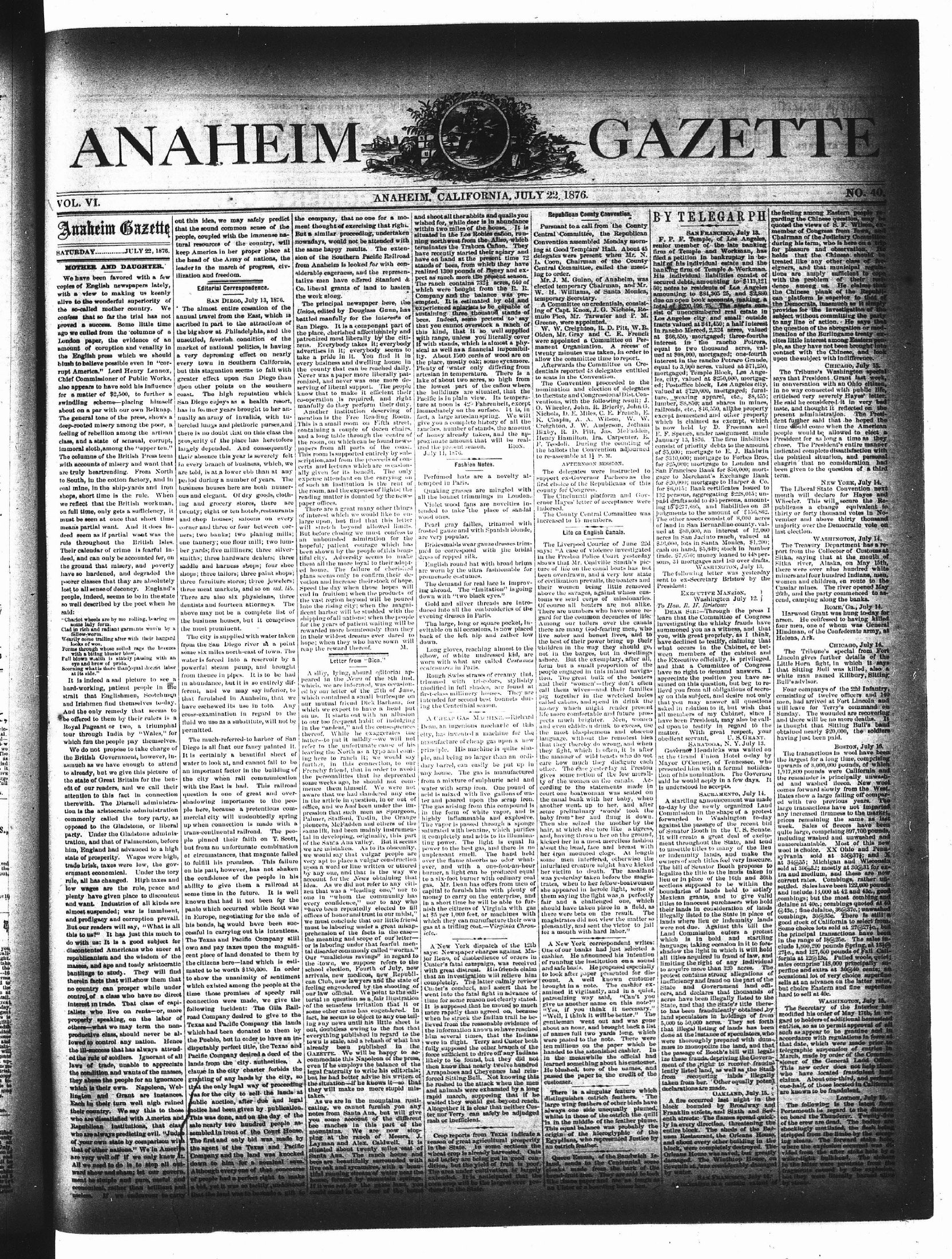
Searchable text
ANAHEIM
VOL. VI.
Anaheim Gazette
SATURDAY...JULY 22, 1876.
MOTHER AND DAUGHTER
We have been favored with a few copies of English newspapers lately, with a view to making us keenly alive to the wonderful superiority of the so-called mother country. We confess that so far the trial has not proved a success. Some little time ago we culled from the columns of a London paper, the evidence of an amount of corruption and venality in the English press which we should blush to believe possible even in "corrupt America." Lord Henry Lennox, Chief Commissioner of Public Works, also appears to have sold his influence for a matter of $2,500, to further a swindling scheme—placing himself about on a par with our own Belknap. The general tone of the press, shows a deep-rooted misery among the poor, a feeling of rebellion among the artisan class, and a state of sensual, corrupt, immoral sloth, among the "upper ten." The columns of the British Press teem with accounts of misery and want that out this idea, we may safely predict that the sound common sense of the people, coupled with the immense natural resources of the country, will keep America in her proper place at the head of the Army of nations, the leader in the march of progress, civilization and freedom.
Editorial Correspondence.
SAN DIEGO, July 13, 1876.
The almost entire cessation of the annual travel from the East, which is ascribed in part to the attractions of the big show at Philadelphia, and the unsettled, feverish condition of the market of national politics, is having a very depressing effect on nearly every town in Southern California, but this stagnation seems to fall with greater effect upon San Diego than upon other points on the southern coast. The high reputation which San Diego enjoys as a health resort, has in former years brought to her annually an army of invalids, with tubercled lungs and plethoric purses, and there is no doubt that on this class the prosperity of the place has heretofore largely depended. And consequently their absence this year is severely felt in every branch of business, which, we the company, that ment thought of exe But a similar process nowadays, would not the same happy reservation of the Southern from Anaheim is loosely siderable engerness, tative men have o Co. liberal grants on the work along.
The principal new Union, edited by Don battled manfully for San Diego. It is a place cherished patronized most liberals. Everybody takes advertisements in it; every business and the county that can Never was a paper ronized, and never serving of liberal sundown that to make co-operation is really manfully do they pay.
Another institution mention is the Free This is a small room containing a couple and a long table through the room, on which papers from all parts This room is support scripture, and from certs and lectures
rupt America." Lord Henry Lennox,
Chief Commissioner of Public Works,
also appears to have sold his influence
for a matter of $2,500, to further a
swindling scheme—placing himself
about on a par with our own Belknap.
The general tone of the press, shows a
deep-rooted misery among the poor, a
feeling of rebellion among the artisan
class, and a state of sensual, corrupt,
immoral sloth, among the "upper ten."
The columns of the British Press teem
with accounts of misery and want that
are truly heartrending. From North
to South, in the cotton factory, and in
coal mine, in the ship-yards and iron
shops, short time is the rule. When
we reflect that the British workman,
on full time, only gets a sufficiency,
it must be seen at once that short time
means partial want. And it does indedence seem as if partial want was the
rule throughout the British Isles.
Their calendar of crime is fearful indeed, and can only be accounted for, on
the ground that misery, and poverty
have so hardened, and degraded the
poorer classes that they are absolutely
lost to all sense of decency. England's
people, indeed, seems to be in the state
so well described by the poet when he
said:
"Charlot wheels are by me rolling, bearing on some lady form.
Clad in rich and radiant garments woven by a fellow-worm.
Wearily come trailing after with their haggard looks of woo.
Forms through whose soiled rags the breezes with a biting bluster blow.
Pull blown wealth is stately passing with an eye and brow of pride.
Scorning what is more than equal decent labor at its side."
It is indeed a sad picture to see a hard-working, patient people in the strait that Englishmen, Scotchmen and Irishmen find themselves to-day. And the only remedy that seems to be offered to them by their rulers is a Royal Pageant or two, a triumphal tour through India by "Wales," for which fun the people pay themselves.
We do not propose to take charge of the British Government, however, inasmuch as we have enough to attend to already, but we give this picture of the state of Great Britain for the benefit of our readers, and we call their attention to this fact in connection therewith. The Disraell administration is the aristocratic administration commonly called the tory party, as opposed to the Gladstone, or liberal party. Under the Gladstone administration, and that of Palmerston, before him, England had advanced to a high state of prosperity. Wages were high, trade brisk, taxes were low, the government economical. Under the tory rule, all has changed. High taxes and low wages are the rule, peace and but this stagnation seems to fall with greater effect upon San Diego than upon other points on the southern coast. The high reputation which San Diego enjoys as a health resort, has in former years brought to her annually an army of invalids, with tubercled lungs and plethoric purses, and there is no doubt that on this class the prosperity of the place has heretofore largely depended. And consequently their absence this year is severely felt in every branch of business, which, we are told, is at a lower ebb than at any period during a number of years. The business houses here are both numerous and elegant. Of dry goods, clothing and grocery stores, there are twenty; eight or ten hotels, restaurants and chop houses; saloons on every corner and three or four between corners; two banks; two planing mills; one tannery; one flour mill; two lumber yards; five milliners; three silver-smiths; three hardware dealers; three saddle and harness shops; four shoe shops; three tailors; three paint shops; three furniture stores; three jewelers; three meat markets, and so on ad.lib. There are also six physicians, three dentists and fourteen attorneys. The above may not be a complete list of the business houses, but it comprises the most prominent.
The city is supplied with water taken from the San Diego river at a point some six miles north-east of town. The water is forced into a reservoir by a powerful steam pump, and brought from thence in pipes. It is to be had in abundance, but it is so entirely different, and we may say inferior, to that furnished in Anaheim, that we have eschewed its use in toto. Any cross-examination in regard to the fluid we use as a substitute will not be permitted.
The much-referred-to harbor of San Diego is all that our fancy painted it. It is certainly a beautiful sheet of water to look at, and cannot fail to be an important factor in the building of the city when rail communication with the East is had. This railroad question is one of great and overshadowing importance to the people here, because a pretentious commercial city will undoubtedly spring up when connection is made with a trans-continental railroad. The people pinned their faith on T. Scott, but from an unfortunate combination of circumstances, that maguate failed to fulfill his promises. This failure on his patt, however, has not shaken the confidence of the people in his ability to give them a railroad at
Never was a paper writtenized, and never served of liberal superscript knowledge that to make co-operation is readily manfully do they present.
Another institution mentioned is the Free This is a small room containing a couple and a long table thru the room, on which papers from all parties This room is supported scripture,and from its certs and lectures wally given for its expense attendant to such an institute,the room,and the exeading matter is de paper offices.
There are a great amount of interest which would large upon it, but this will stretch beyond But before closing an unbounded hope; patient been shown by the faithful city. Adversions them all the more edged home.The faplans seems only the votion and increase Speed the day where end in fruition; while the vast region beyond into the rising city fleecent harbor will shipping of all matters for the years of pain rewarded more bound in their wildest drear hope; when they will reap the reward tha
Letter fro
A silly, lying, nape peared in the New which, we are informed by our letter of which contained an mutual friend which we expect them on us. It starts on to our too frequent in the "ardent," as thereof. While it latter—to put it in refer to the unfolding North ing here to rancher further, in this Frenchy friend, tha personalities some weeks ago,hence them him aware that we had in the article in office,and we hold pressure that such Palmer, Staaford,pioneers,McFaddis same ilk,had been tal in developing.of the Santa Ana we are mistaken. We would say that very apt to place upon a word or line by any one,and tha account for the A idea.As we did
attention to this fact in connection therewith. The Disraeli administration is the aristocratic administration commonly called the tory party, as opposed to the Gladstone, or liberal party. Under the Gladstone administration, and that of Palmerston, before him, England had advanced to a high state of prosperity. Wages were high, trade brisk, taxes were low, the government economical. Under the tory rule, all has changed. High taxes and low wages are the rule, peace and plenty have given place to discontent and want. Industries of all kinds are almost suspended; war is imminent, and profligacy and corruption prevail. But our readers will say, "What is all this to us?" It has just this much to do with us: It is a good subject for discontented Americans who sneer at republicanism and the wisdom of the masses, and apes and toady aristocratic bantlings to study. They will find therein facts that will show them that no country can prosper while under control of a class who have no direct interest in trade. That class of capitalists who live on rents—or, more properly speaking, on the labor of others—what we may term the non-productive class, should never be allowed to control any nation. Hence the ill-success that has always attended the rule of soldiers. Ignorant of all laws of trade, unable to appreciate the condition and wants of the masses, they abuse the people for an ignorance which is their own. Napoleon, Wellington and Grant are instances. Each in their turn well nigh ruined their country. We say this to those who are dissatisfied with America and Republican institutions, that class who are always predicting evil. "Judge of your own state by comparison with that of other nations." We in America are very well off if we only knew it. All we need to do is to stop all outward show and sham; let our government be simple and pure, useful and communal, rather than brilliant and naïve. If we endeavour to carry question is one of great and overshadowing importance to the people here, because a pretentious commercial city will undoubtedly spring up when connection is made with a transcontinental railroad. The people pinned their faith on T. Scott, but from an unfortunate combination of circumstances, that magnate failed to fulfill his promises. This failure on his part, however, has not shaken the confidence of the people in his ability to give them a railroad at some time in the future. It is well known that had it not been for the panic which occurred while Scott was in Europe, negotiating for the sale of his bonds, he would have been successful in carrying out his intentions. The Texas and Pacific Company still own and pay taxes upon the magnificent piece of land donated to them by the citizens here—land which is estimated to be worth $150,000. In order to show the unanimity of sentiment which existed among the people at the time those promises of speedy rail connection were made, we give the following lucident: The Gila Railroad Company desired to give to the Texas and Pacific Company the lands which had been donated to them by the Pueblo, but in order to have an indisputably perfect title, the Texas and Pacific Company desired a deed of the lands from the city authorities. A clause in the city charter forbids the granting of any lands by the city, so that the only legal way of proceeding was for the city to sell the lands at public auction, after due and legal notice had been given by publication. This was done, and on the day of the sale nearly two hundred people assembled in front of the Court House. The first and only bid was made by the agent of the Texas and Pacific Company and the land was knocked down to him for a nominal sum. Although everyone of that concourse of people had a perfect right to make a bid, yet it was no facility understood that the land was in hands a gift to
As we are in eating, we cannot notes from Sandy you some accoose bee ranches in mountains. We ping at the rear Layman and A sitimental about Santa Ana. Bees are beautiful live oak and sycful running stove house, formed If it was not for could stand in
ANAHEIM, CALIFORNIA, JULY 22, 1876.
the company, that no one for a moment thought of exercising that right. But a similar proceeding, undertaken nowadays, would not be attended with the same happy results. The extension of the Southern Pacific Railroad from Anaheim is looked for with considerable eagerness, and the representative men have offered Stanford & Co. liberal grants of land to hasten the work along.
The principal newspaper here, the Union, edited by Douglass Gunn, has battled manfully for the interests of San Diego. It is a component part of the place, cherished affectionately and patronized most liberally by the citizens. Everybody takes it; everybody advertises in it; everybody seems to take a pride in it. You find it in every business and dwelling house in the county that can be reached daily. Never was a paper more liberally patronized, and never was one more deserving of liberal support. The people know that to make it efficient their co-operation is required, and right manfully do they perform their duty.
Another institution deserving of mention is the Free Reading Room. This is a small room on Fifth street, containing a couple of dozen chairs, and a long table through the centre of the room, on which can be found newspapers from all parts of the coast. This room is supported entirely by subscription, and from the proceeds of concerts and lectures which are occasion-
and shoot all therabbits and quails you wished for, while deer is in abundance within two miles of the house. It is situated in the Los Robles cafion, running northwest from the Aliso, which terminates the Trabuca Caifon. They have recently started their apiary and have on hand at the present time 72 stands of bees, from which they have realized 1300 pounds of honey and expect as much more the present season. The ranch contains 732 acres, 640 of which were bought from the R. R. Company and the balance was preempted. It is estimated by old and experienced apiarists to be capable of sustaining three thousand stands of bees. Indeed, some pretend to say that you cannot overstock a ranch of this kind, that it so well supplied with range, unless you literally cover it with stands, which is almost a physical as well as a financial impossibility. About 1500 corrs of wood are on the place, mostly oak; some sycamore. Plenty of water only differing from artesian in temperature. There is a lake of about two acres, so high from the lowest part of the cafion where the buildings are situated, that the Pacific is in plain view. Its temperature at noon is 42° Fahrenheit, except immediately on the surface. It is, in fact, a large artesian spring. We will give you a complete history of all the ranches, number of stands, the amount of honey already taken, and the approximate amount that will be realized the present season.
July 11, 1876.
Fashion Notes.
Republican County Convention.
Pursuant to a call from the County Central Committee, the Republican Convention assembled Monday morning at Good Templars Hall. About 45 delegates were present when Mr. N. L. Coon, Chairman of the County Central Committee, called the meeting to order.
Mr. J. M. Guinn, of Anaheim, was elected temporary Chairman, and Mr. W. H. Williams, of Santa Monica, temporary Secretary.
A Committee on credentials, consisting of Capt. Knox, J. G. Nichols, Romulo Pico, Mr. Tarwater and P. M. Greene, were appointed.
W. W. Creighton, R. D. Pitt, W.R. Olden, Mr. Gray and C.E. French were appointed a Committee on Permanent Organization. A recess of twenty minutes was taken, in order to allow the committee time to report.
Afterwards the Committee on Credentials reported 43 delegates entitled to seats in the Convention.
The Convention proceeded to the nomination and election of delegates to the State and Congressional Dist.Conventions, with the following result: J. O. Wheeler, John. R. Brierly, John G. Nichols, D.E.Miles, C.E.French, E.K. Chapin, A.A.Wilson, W.W.Creighton, J.W.Anderson, Jotham Bixby, R.D.Pitt, Jas.Mcadden,Henry Hamilton.Ira.Carpenter.E.F.Teodoli. During the counting of the ballots the Convention adjourned to re-assemble at 1 P.M.
AFTERNOON SESSION.
Never was a paper more liberally patronized, and never was one more deserving of liberal support. The people know that to make it efficient their co-operation is required, and right manfully do they perform their duty.
Another institution deserving of mention is the Free Reading Room. This is a small room on Fifth street, containing a couple of dozen chairs, and a long table through the centre of the room, on which can be found newspapers from all parts of the coast. This room is supported entirely by subscription, and from the proceeds of concerts and lectures which are occasionally given for its benefit. The only expense attendant on the carrying on of such an institution is the rent of the room, and the expense of lights; the reading matter is donated by the newspaper offices.
There are a great many other things of interest which we would like to enlarge upon, but find that this letter will stretch beyond allowed limits. But before closing we must confess to an unbounded admiration for the hopeful, patient courage which has been shown by the people of this beautiful city. Adversity seems to make them all the more loyal to their adopted home. The failure of cherished plans seems only to confirm their devotion and increase their stock of hope. Speed the day when those hopes will end in fruition; when the products of the vast region beyond will be poured into the rising city; when the magnificent harbor will be studded with the shipping of all nations; when the people for the years of patient waiting will be rewarded more bountifully than they in their wildest dreams ever dared to hope; when they have sown will reap the reward thereof.
Letter from "Bion."
A silly, lying, absurd editorial appeared in the News of the 8th inst. which, we are informed, was occasioned by our letter of the 27th of June, which contained a small burlesque on our mutual friend Dick Barham, for which we expect to have a head put on us. It starts out with an allusion to our too frequent habit of indulging in the "ardent," and the consequences thereof. While he exaggerates the latter—to put it mildly—we will not refer to the unfortunate cause of his leaving the North as a type and coming here to ranch it; we would say further, in this connection, to our French friend, that in order to avoid personalities that he deprecated some weeks ago, he should not commence them himself. We were not aware that we had slandered any one in the article in question, in or out of office, and we had been under the impression that such men as Spurgeon, Palmer, Stalford, Tustlin, the Orange pioneers, McFadden and others of the same ilk, had been mainly instrumental in developing, originally, this part of the Santa Ana valley. But it seems we are mistaken. As to its obscenity, we would say that vulgar people are very apt to place a vulgar construction upon a word or line written or uttered by any one, and that is the way we account for the News obtaining that idea. As we did not refer to any citi-
Fashion Notes.
Perfumed hats are a novelty attempted in Paris.
Quaking grasses are mingled with all the bonnet trimmings in London.
Violet wood fans are novelties intended to take the place of sandal wood ones.
Pearl gray failles, trimmed with frosted gauze and with Spanish blonde, are very popular.
Bridesmaids wear gauze dresses trimmed to correspond with the bridal dress of reaped silk.
English round hat with broad brims are worn by the ultra fashionable for promenade costumes.
The demand for real lace is improving abroad. The "Limitation" is going down with "two black eyes."
Gold and silver threads are introduced into all the embroideries of the evening dresses in Paris.
Tha large, long or square pocket, inevitable on all occasions, is now placed back of the left hip and rather low down.
Long gloves, reaching almost to the elbow, of white undressed kid, are worn with what are called Custumes centenaires in Paris.
Rough Swiss straws of creamy that, trimmed with tri-colors, stylishly modified in full shades, are found at first-class millinery houses. They are intended for second best bonnets during the Centennial season.
A CHEAP GAS MACHINE—Richard Dean, an ingenious mechanic of this city, has invented a machine for the manufacture of cheap gas upon a new principle. His machine is quite simple, and being no larger than an ordinary barrel, can easily be put up in any house. The gas is manufactured from a mixture of sulphuric acid and water with scrap iron. One pound of acid is mixed with five gallons of water and poured upon the scrap iron. The gas arising from this compound is in the form of white vapor, and is highly inflammable and explosive. The vapor is passed through a sponge saturated with benzine, which purifies it completely and adds to its illuminating power. The light is equal in power to the best gas, and there is no unpleasant smell. The hand held over the flame absorbs no odor whatever, and with a one-foot-an-hour burner, a light can be produced equal to a six-foot burner with ordinary coal gas. Mr. Dean has offers from men of artesian in temperature. There is a lake of about two acres, so high from the lowest part of the caffion where the buildings are situated, that the Pacific is in plain view. Its temperature at noon is 42° Fahrenheit, except immediately on the surface. It is, in fact, a large artesian spring. We will give you a complete history of all the ranches, number of stands, the amount of honey already taken, and the approximate amount that will be realized the present season.
July 11, 1876.
Afternoon Session.
The delegates were instructed to support ex-Governor Pacheco as the first choice of the Republican Dist.Conventions, with the following result: J. O. Wheeler, John R. Brierly, John G. Nichols, D.E.Miles, C.E.French, E.K. Chapin, A.A.Wilson, W.W.Creighton, J.W.Anderson, Jotham Bixby, R.D.Pitt, Jas.McKadden,Henry Hamilton, Ira.Carpenter, E.F.Teedoli. During the counting of the ballots the Convention adjourned to re-assemble at 11 P.M.
Afternoon Session.
The delegates were instructed to support ex-Governor Pacheco as the first choice of the Republican Dist.Conventions, with the following result: J. O. Wheeler, John R. Brierly, John G. Nichols, D.E.Miles, C.E.French, E.K. Chapin, A.A.Wilson, W.W.Creighton, J.W.Anderson, Jotham Bixby, R.D.Pitt, Jas.McKadden,Henry Hamilton, Ira.Carpenter, E.F.Teedoli. During the counting of the ballots the Convention adjourned to re-assemble at 11 P.M.
Life on English Canals.
The Liverpool Courier of June 22d says: "A case of violence investigated in the Preston Police Court yesterday shows that Mr. Coalville Smith's picture of life on the canal boats has not been overdrawn, and a very low state of civilization prevails, the boaters and their women being little removed above the savages, against whose customs we send corps of missionaries. Of course all boaters are not alike. There are numbers who have some regard for the common decencies of life: Among our tollers over the canals there are many God-fearing men who live sober and honest lives, and to the best of their power bring up their children in the way they should go not in the barges, but in dwellings ashore. But the exemplary, after all, form but a small proportion of the people engaged in this land navigation. The great bulk of the boaters and their 'women'—they don't often call them wives—and their families pig together in the wretched holes called cabins,and spend in drink the money which might render present life more comfortable and future prospects much brighter. Men, women and even children drink to excess,use most blasphemous and obscene language,without the remotest idea that they thereby do wrong,and when they fight,which is often,它 after the manner of wild beasts who do not care how much they disfigure each other.The ease yesterday at Preston gives some notion of the low morality of the women on the canals.According to the statements made in court one boatwoman was seated on the canal bank with her baby,when another went up to her,and after some preliminary 'words' took the baby from her and flung it down. Then she seized the mother by the hair,at which she tore like a tigress,and having thrown her on the ground,kicked her in a most merciless fashion about the bread,face and breast with her iron mounted clogs.At length some men interfered,otherwise the infuriated creature might have kicked her victim to death.The assailant was yesterday taken before the magistrates,when to her fellow-boatwomen she appeared in her hero light,some
aware that we had slandered any one in the article in question, in or out of office, and we had been under the impression that such men as Spurgeon, Palmer, Stafford, Tustin, the Orange pioneers, McFadden and others of the same ilk, had been mainly instrumental in developing, originally, this part of the Santa Ana valley. But it seems we are mistaken. As to its obscenity, we would say that vulgar people are very apt to place a vulgar construction upon a word or line written or uttered by any one, and that is the way we account for the News obtaining that idea. As we did not refer to any citizen that was a "leading one," nor to one in "whom the community has every confidence," nor to any who "have been repeatedly elected to fill offices of honor and trust in our midst," we must conclude that our little friend must be laboring under a great misapprehension of the facts in the case—the meaning and scope of our letter—or is laboring under that fearful mental disorder commonly called "worms." Our "malicious ravings" in regard to the town, we suppose refers to the school election, Fourth of July, new arrivals, new medicos, new Republican Club, new lawyers and the state of feeling engendered by the shooting of our law official. We point to the editorial in question as a fair illustration of the senseless irritation that it or some other cause has engendered. In fact, he seems to object to any one telling any news until his little sheet is out, doubtless owing to the fact that everything published in regard to the town is stale, and a rehash of what has already been published in the Gazette. We will be happy to accommodate this Napoleon of the press, even if he employs the balance of the legal fraternity to write his editorials; but he had better advise his writers of the situation—if he knows it—so that they will make no more stupid mistakes.
As we are in the mountains rusticating, we cannot furnish you any notes from Santa Ana, but will give you some account of the different bee ranches in this part of the mountains. We are now stopping at the ranch of Messrs. J. Layman and Alex. Caldwell. It is situated about twenty miles east of Santa Ana. The ranch house and bees are beautifully surrounded with live oak and sycamores, with a beautiful running stream of water near the house, formed by mountain springs. If it were not for the mine laws, you could stand in the door of the house acid is mixed with five gallons of water and poured upon the scrap iron. The gas arising from this compound is in the form of white vapor, and is highly inflammable and explosive. The vapor is passed through a sponge saturated with benzine, which purifies it completely and adds to its illuminating power. The light is equal in power to the best gas, and there is no unpleasant smell. The hand held over the flame absorbs no odor whatever, and with a one-foot-an-hour burner, a light can be produced equal to a six-foot burner with ordinary coal gas. Mr. Dean has offers from men of capital to furnish him with plenty of money to carry on the enterprise, and in a short time he will be able to furnish the citizens of Virginia with gas at $5 per 1,000 feet, or machines with which they can manufacture their own gas at a trifling cost. Virginia Chronicle.
A New York dispatch of the 12th says: Newspaper charges against Major Reno, of disobedience of orders in Custer's fatal campaign, was received with great distrust. His friends claim that an investigation will relieve him completely. The latter calmly review Custer's conduct, and assert that he went into the fatal fight in advance of time for some reason not clearly stated. It is supposed that he moved so much more rapidly than agreed on, because when he struck the Indian trail he believed from the reasonable evidence of the information known to have reached him several times, that the Indians were in flight. Terry and Custer both fully supposed the other branch of the force sufficient to drive off any Indians likely to be found, but they did not then know that nearly twelve hundred Arrapahoes and Cheyennes had reinforced Sitting-Bull. Not knowing this he rushed to the attack when the men and animals were exhausted by a long rapid march, supposing that if he waited they would get beyond reach. Altogether it is clear that neither Custer nor Terry can safely be adjudged rash or inefficient.
Crop reports from Texas indicate a season of great agricultural prosperity in the State. In some sections the wheat crop is already harvested. Oats and barley are being gutted in good condition, but the yield of fruit is poor. The area under cultivation is largely extended. It is anticipated that the corn crop will be the largest ever produced in the State.
A New York correspondent writes: One of our banks had just selected a cashier. He announced his intention of running the institution on a sound and safe basis. He proposed especially to look after paper presented for discount. A well known customer brought in a note. The cashier examined it vigilantly, and in a quiet, patronizing way said, "Can't you give us another name on this note?" "Yes, if you think it necessary." "Well, I think it will be better." The gentleman went out and was gone about an hour, and brought back a list of names full two yards long, which were pasted to the note. There were ten millions on the paper which he handed to the astonished cashier. In in the meanwhile the official had learned something about his customer. He blushed, tore of the names, and passed the paper to the credit of the customer.
There is a singular feature which distinguishes ostrich feathers. The large wing feathers of other birds have always one side unequally plumed; whilst in those of the ostrich the quill is in the middle of the feather plume. This equal balance was probably the origin of the hieroglyphic of the Egyptians, who represented Justice by an ostrich feather.
Queen Emma, of the Sandwich Island, sends to the Centennial some cloaks made from the bark of the bread-fruit tree. They are mild to look like these paper and are so tough as an Ulster or a booming house hat.
GAZETTE
NO. 40.
BY TELEGARPH
SAN FRANCISCO, July 13.
F. P. F. Temple, of Los Angeles, senior member of the late banking firm of Temple and Workman, has filed a petition in bankruptcy in behalf of his individual estate and the banking firm of Temple & Workman. His individual liabilities consist of secured debts, amounting to $113,121.50; notes to residents of Los Angeles amounting to $84,305.25, and $2,880 due on open book accounts, making a total of $200,196.75. The assets consist of unencumbered real estate in Los Angeles city and small outside tracts valued at $41,450; a half interest in rancho Merced, 2,324 acres, valued at $66,550; mortgaged; three-fourths interest in the rancho Potrero Grande, equal to two thousand acres, valued at $98,000; mortgaged; one-fourth interest in the rancho Potrero Grande, equal to 3,000 acres, valued at $71,250; mortgaged; Temple Block, Los Angeles city, valued at $250,000; mortgaged; Postoffice block, Los Angeles city, valued at $120,000; mortgaged; furniture, wearing apparel, etc., $8,455; lumber, $8,850; and shares in mines, railroads, etc., $46,550; all the property except homestead and other property which is claimed as exempt, which is now held by D. Freeman and E. F. Spence, under assignment made January 13, 1876. The firm liabilities consist of priority debts to the amount of $5,000; mortgage to E. J. Baldwin for $310,000; mortgage to Forbes Bros. for $25,000; mortgage to London and New York Bank for $59,000; mortgage to the feeling among Eastern people regarding the Chinese question, may be quoted the views of S. F. Wilson, ex-member of Congress from Town, and Chairman of the Judiciary Committee during his term, who is here on a trip for pleasure and observation. He holds that the Chinese should be treated like any other class of foreigners, and that municipal regulations are amply sufficient to cope with the problem of their residence among us. He claims that the Chinese plank of the Republican platform is superior to that of the Democrats, inasmuch as it simply provides for the investigation of the subject without committing the party to any line of action. He says that the question of the abrogation or modification of the Burlingame treaty excludes little interest among Eastern people, as they have not been brought into contact with the Chinese, and look upon the subject with indifference.
CHICAGO, July 15.
The Tribune's Washington special says that President Grant last week, in conversation with an Ohio citizen, in no way connected with public life, criticised very severely Hayes' letter. He said he considered it in very bad taste, and thought it reflected on the present administration. The President further said that he hoped the time would come when the American people would be allowed to elect a President for as long a time as they chose. The President's entire manner indicated complete dissatisfaction with the political situation, and personal chagrin that no consideration had been given to the question of a third
The Tribune's Washington special says that President Grant last week, in conversation with an Ohio citizen, in no way connected with public life, criticised very severely Hayes' letter. He said he considered it in very bad taste, and thought it reflected on the present administration. The President further said that he hoped the time would come when the American people would be allowed to elect a President for as long a time as they chose. The President's entire manner indicated complete dissatisfaction with the political situation, and personal chagrin that no consideration had been given to the question of a third term.
New York, July 14.
The Liberal State Convention next month will declare for Hayes and Wheeler. This will secure the Republicans a change equivalent to thirty or forty thousand votes in November and above thirty thousand majority over the Democratic vote on last election.
WASHINGTON, July 14.
The Treasury Department has a report from the Collector of Customs at Sitka, saying that at the mouth of Sitka river, Alaska, on May 15th, there were over nine hundred white miners and four hundred Indians, men, women and children, en route to the Cassiar mines. The river opened May 20th, and the party commenced to ascend, camping along the banks.
ROME, Ga., July 14.
Harwood Grant was hung to-day for arson. He confessed to having killed four men, one of whom was General Hindman, of the Confederate army, at Helena, Ark.
CHICAGO, July 14.
The Tribune's special from Fort Lincoln gives further details of the Little Horn fight, in which it says that Sitting Bull was killed, also a white man named Killbury, Sitting Bull's advisor.
Four companys of the 22d Infantry, consisting of twelve officers and 140 men, had arrived at Fort Lincoln and will leave for Terry's command on Sunday. The wounded are recovering and there will be no more deaths. It is thought that Sitting Bull's band obtained nearly $20,000, the soldiers having just been paid.
BOSTON, July 16.
The transactions in wool have been the largest for a long time, comprising upwards of 8,000,000 pounds, of which 1,917,800 pounds were California and the remainder is principally unwashed and washed fleece. New wool comes forward slowly from the West Rates show a large falling off compared with two previous years. The large transactions have not imparted any increased firmness to the market; prices remaining the same as last week. Sales of fleeces have been quite large, comprising 897,700 pounds including washed and unwashed and unmerchanteable. Most of this new wool is choice. XX Ohio and Pennsylvania sold at 35@37; and X at 34@35; Michigan and Wisconsin sold at 30@32; mostly at 30@31 for extra and medium, and these are now current rates. Combines, rather unsettled. Sales have been 122,000 pounds
SACRAMENTO, July 14.
A startling announcement was made to-day by the newly organized Land Commission in the shape of a protest forwarded to Washington to-day against the passage of the recent bill of Senator Booth in the U.S. Senate. It will create a great deal of excitement throughout the State, and tend to unsettle titles to many of the lieu or indemnity lands, and make the owners of such titles feel very insecure. The bill of Senator Booth proposes to legalize the title to the lands taken in lieu or in place of the 16th and 20th sections supposed to be within the boundaries of lands held to satisfy Mexican grants, and to give valid titles to innocent purchasers who hold their lands in consideration of lands illegally listed to the State in place of lands where lieu or indemnity lands were not due. Against this bill the Land Commission enters a protest which is in bold and startling language, taking occasion in it to shadow the light in which it will hold all titles acquired in fraud of law, and limiting the right of any individual to acquire more than 320 acres. The protest contains strong allegations of inefficiency and fraud on the part of the State and Government land officers, and declares that thousands of acres have been illegally listed to the State, and that the State's title there has been fraudulently obtained by land speculators in holdings of from 5,000 to 50,000 acres. They set forth that illegal listing of lands has been done at the instance of speculators, who were thoroughly prepared with dummies to monopolize the land, and that the passage of Booth's bill will legalize these frauds, depriving the Government of the right to recover fraudulently listed land, as well as the Stath from recovering lands illegally taken from her. Other equally potent declarations are made.
OAKLAND, July 15.
A fire occurred last night in the block bounded by Broadway and Franklin streets, and Stath and Seventh streets. The flames spread quickly in every direction, threatening the entire block. The shods of the Barn Restaurant, the Orleans House, and about every other building in the block, were completely destroyed. The Orleans House was saved, but greatly damaged. The Winthrop House, on Seventh at, was considerably damaged by water.
SAN FRANCISCO, July 14.
A declaration in a cattle valet of Rates show a large falling off compared with two previous years. The large transactions have not imparted any increased firmness to the market, prices remaining the same as last week. Sales of fleeces have been quite large, comprising 807,700 pounds including washed and unwashed and unmerchantable. Most of this new wool is choice. XX Ohio and Pennsylvania sold at 35@37; and X at 34@35; Michigan and Wisconsin sold at 30@32; mostly at 30@31 for extra and medium, and these are now current rates. Combinings, rather unsettled. Sales have been 122,000 pounds and include 13,000 at 42 and 42c., good combings; but the most combing and delaine at 40c.; combings quoted at 40@43c.; fine delaine, 36@37c.; unwashed combings, 30@35c. There is still a good stock of California to select from. Some choice lots sold at 27@27c., but the principal transactions have been in the range of 18@25e. The sales include 1,800,290 pounds Spring, at 12@27c.; and 127,600 pounds of Fall California at 12@13c. Pulled wooly quiet; sales comprise 148,000 principally superfine and extra at 30@40 cents; an occasional lot of very choice superfine sells at an advance on the latter rates, but choice Eastern and fine superfine hard to sell at 40c.
WASHINGTON, July 15.
The Secretary of the Interior has modified his order of May 17th, in regard to holders of additional homestead entries, so as to permit approval of all such as appear to be genuine and in accordance with regulations in form at that date, which were made prior to telegraphic suspension of entries in March, made by order of the Commissioner of the General Land Office. This new order does not help those who have located fraudulent land claims. About one-third, and perhaps one-half, of those located in California are known to be fraudulent.
LONDON, July 15.
The following is the latest from Portsmouth in regard to the disaster on board the Thunderer. Twenty-five of the crew are dead. The bodies are shockingly mutilated, the flesh being stripped from the limbs by the escaping steam. The forward stoke hole where the explosion occurred was divided from the after stoke hole by a wafer-light bulbhead. The debris in the latter were probably from the fragments caused by the explosion but they were literally burned alive by stains.