anaheim-gazette 1876-07-08
Scanned page
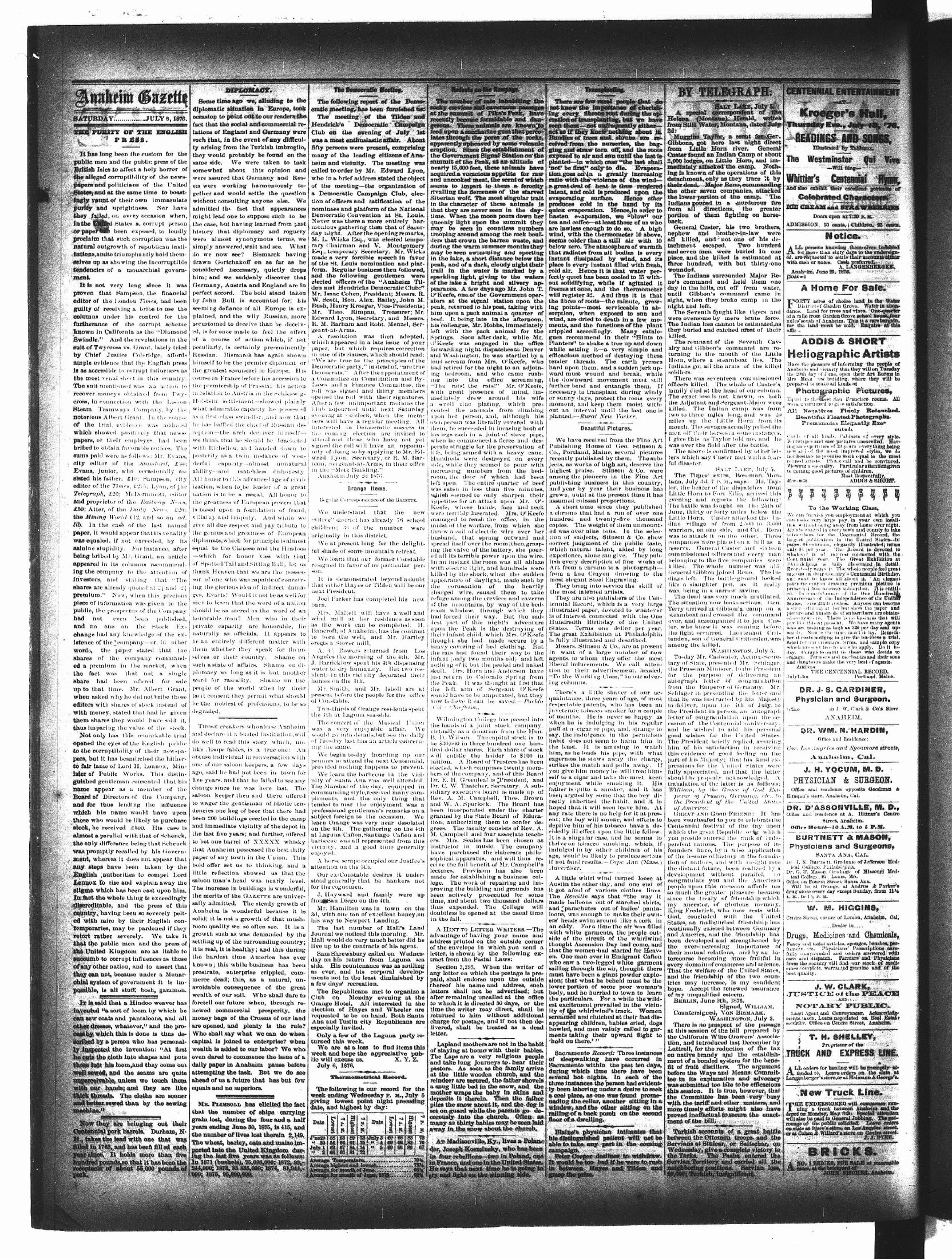
Searchable text
Anaheim Gazette
SATURDAY...JULY 8, 1876.
THE PURITY OF THE ENGLISH PRESS.
It has long been the custom for the public men and the public press of the British Isles to affect a holy horror of the alleged corruptibility of the newspapers and politicians of the United States, and at the same time to boastingly vaunt of their own immaculate purity and uprightness. Nor have they failed, on every occasion when, in the United States a, corrupt person or paper has been exposed, to loudly proclaim that such corruption was the natural outgrowth of republican institutions, and to triumphantly hold themselves up as showing the incorruptible tendencies of a monarchial government.
It is not very long since it was proven that Sampson, the financial editor of the London Times, had been guilty of receiving a bribe to use the columns under his control for the furtherance of the corrupt scheme known in California as the "Diamond Swindle." And the revelations in the suit of Twycross vs. Grant, lately tried by Chief Justice Coleridge, affords ample evidence that the English press is as accessible to corrupt influences as the most venal sheet in this country. The suit mentioned was an action to recover money obtained from Twycross, in connection with the Lasson Steam Trainways Company, by the notorious Albert Grant. In the course of the trial, evidence was adduced which showed positively that newspapers, or their employees, had been bribed to obtain favorable notices. The sums paid were as follows: Mr. Evans, city editor of the Standard, £50;
DIPLOMACY.
Some time ago we, alluding to the diplomatic situation in Europe, took occasion to point out to our readers the fact that the social and commercial relations of England and Germany were such that, in the event of any difficulty arising from the Turkish imbroglio, they would probably be found on the same side. We were taken to task somewhat about this opinion and were assured that Germany and Russia were working harmoniously together and would settle the question without consulting anyone else. We admitted the fact that appearances might lead one to suppose such to be the case, but having learned from past history that diplomacy and roguery were almost synonymous terms, we simply answered, wait and see. What do we now see? Bismarck having drawn Gortchakoff on as far as he considered necessary, quietly drops him; and we suddenly discover that Germany, Austria and England are in perfect accord. The bold stand taken by John Bull is accounted for; his seeming defiance of all Europe is explained, and the wily Russian, more accustomed to deceive than be deceived, is for once made to feel the effect of a course of action which, if not peculiarly, is certainly pre-eminently Russian. Bismarck has again shown himself to be the premier diplomat or the greatest scoundrel in Europe. His course in France before his accession to the premiership of Prussia; his action in relation to Austria in the schleswig-Holstein settlement—showed plainly what admirable capacity he possessed as a first-class swindler; and now that he has baffled the chief of Russian deception—the arch deceiver himself—we think that he should be bracketed with Richelieu, and handled down to posterity as a twin instance of wonderful capacity—almost unnatural.
The following cratic meeting:
The meeting Hendrick's Club on the was a most entwined fifty persons who many of the liebeim and vicinity called to order who in a brief of the meeting a Democratic motion of officers nominees and p Democratic Coordination Never was there monious gather day night. After M. L. Wicks Erary Chairman Esq., temporary made a very few of the St. Louis form. Regular and the follow elected officers den and Hendrick Mr. Isaac Cohore W. Scott, Hon. Bush, Henry K. Mr. Theo. R. Edward Lyon, R. M. Barham geant-at-Arms.
A resolution which appeared paper, but which in one of its class "We are true Democratic part Democrats."
A Committee of Laws and a F roll was signed opened the roll After a few un Club adjourned evening at voters will have interested in the coming election attend and they signed the rollity of doing so ward Lyon, S ham, Sergeant-in-the-Metz R
The suit mentioned was an action to recover money obtained from Twycross, in connection with the Lashon Steam Tramways Company, by the notorious Albert Grant. In the course of the trial, evidence was adjudged which showed positively that newspapers, or their employees, had been bribed to obtain favorable notices. The sums paid were as follows: Mr. Evans, city editor of the Standard, £60; Evans, junior, who occasionally assisted his father, £10; Sampson, city editor of the Times, £25; Lyon, of the Telegraph, £20; McDermott, editor and proprietor of the Railway News, £50; Atter, of the Daily News, £20; the Mining World £12, and so on ad lib. In the case of the last named paper, it would appear that its venality was equaled, if not exceeded, by its astonine stupidity. For instance, after being bribed by Mr. Grant, an article appeared in its columns recommending the company to the attention of investors, and stating that "The shares are already quoted at 24 and 24 premium." Now, when this precious piece of information was given to the public, the prospectus of the Company had not even been published, and no one on the Stock Exchange had any knowledge of the existence of the company—or, in other words, the paper stated that the shares of the company commanded a premium in the market, when the fact was that not a single share had been offered for sale up to that time. Mr. Albert Grant, when asked why he did not bribe those editors with shares of stock instead of with money, stated that had he given them shares they would have sold it, thus imparing the value of the stock.
Not only has this remarkable trial opened the eyes of the English public to the corruptibility of their newspapers, but it has beatenched the hitherto fair fame of Lord H. Lennox, Minister of Public Works. This distinguished gentleman consented that his name appear as a member of the Board of Directors of the Company, and for thus lending the influence which his name would have upon those who would be likely to purchase stock, he received £500. His case is almost a parallel with that of Schenck, the only difference being that Schenck was promptly recalled by his Government, whereas it does not appear that any steps have been taken by the English authorities to compel Lord Lennox to rise and explain away the alimone which has been used upon him.
Those croakers who abuse Anaheim and declare it a busted institution will do well to read this story which, unlike Esops fables, is a true one: An obtuse individual in conversation with one of our saloon keepers, a few days ago, said he had pot been in town for five years, and that he failed to see any change since he was here last. The saloon keeper then and there offered to wager the gentleman of idiotic tendencies one key of beer that there had been 200 buildings erected in the camp and immediate vicinity of the depot in the last five years; and further, offered to bet one barrel of XXXXX whisky that Anaheim possessed the best daily paper of any town in the Union. This bold offer set us to thinking, and a little reflection showed us that the saloon man's head was nearly level. The increase in buildings is wonderful.
Our ex-Constituted generally for the cognizance
It is said that a Hindoo weaver has invented "a sort of loom by which he can sew coats and pantaloons, and all other dresses, whatever," and the process by which this is done is thus described by a person who has personally inspected the invention: "At first he cuts the cloth into shapes and puts those into his loom, and they come out well sewed, and the seams are quite unperceivable, unless we touch them with our hands; and they are like thick threads. The cloths are sooner and better sewed than by the sewing machine."
Now they are bringing out their Centennial pork barrels. Durham, N.H., takes the lead with one that was filled in 1765, and has been filled each year since. It holds more than five hundred pounds so that it has been the receptacle of about 55,000 pounds of pork.
MR. PLIMSOLL has elicited the fact that the number of ships carrying grain lost, during the four and a half years ending June 30, 1875, is 415, and the number of lives lost therein 2,149. The wheat, barley, oats and maize imported into the United Kingdom during the last five years was as follows: In 1871 (bushels), 75,698,000; 1872, 93,-244,000; 1873, 83,835,000; 1874, 81,944,-000; 1875, 95,800,000.
The Democratic Meeting.
The following report of the Democratic meeting, has been furnished us:
The meeting of the Tilden and Hendrick's Democratic Campaign Club on the evening of July 1st was a most enthusiastic affair. About fifty persons were present, comprising many of the leading citizens of Anaheim and vicinity. The meeting was called to order by Mr. Edward Lyon, who in a brief address stated the object of the meeting—the organization of a Democratic Campaign Club, election of officers and ratification of the nominees and platform of the National Democratic Convention at St. Louis. Never was there a more entirely harmonious gathering than that of Saturday night. After the opening remarks, M. L. Wicks Esq., was elected temporary Chairman and V. Montgomery Esq., temporary Secretary. Mr. Wicks made a very forcible speech in favor of the St. Louis nomination and platform. Regular business then followed, and the following gentlemen were elected officers of the "Anaheim Tilden and Hendricks Democratic Club":
Mr. Isaac Cohen, President; Messrs. R. W. Scott, Hon. Alex. Bailey, John M. Bush, Henry Kroeger, Vice-Presidents; Mr. Theo. Rimpau, Treasurer; Mr. Edward Lyon, Secretary, and Messrs. R. M. Barham and Robt. Menzel, Sergeant-at-Arms.
A resolution was then adopted, which appeared in a late issue of your paper, but which requires correction in one of its clauses, which should read: "We are true to the principles of the Democratic party." Instead of "are true Democrats," after the appointment of a Committee on Constitution and By-laws and a Finance Committee, the roll was signed and thirty members opened the roll with their signatures. After a few unimportant motions the Club adjourned until next Saturday evening at no clock, when the members will have a regular meeting. All interested in Democratic success in the coming election are invited to attend and those who have not yet signed the roll will have an opportunity of doing so by applying to Mr. Edward Lyon, Secretary, or R. M. Barham, Sergeant-at-Arms, in their office in the Matzel Building.
Indents on the Campaigns.
The number of rats inhabiting the rocky cavities and swampom passages at the summit of Pike's Peak, have recently become formidable and dangerous. These animals are known to feed upon a cochaine gum that percolates through the pores of the rocks, apparently uphooved by some volcanic eruption. Since the establishment of the Government Signal Station on the summit of the Peak, at an altitude of nearly 15,000 feet, these animals have acquired a voracious appetite for raw and uncooked meat, the scent of which seems to impart to them a ferocity rivalling the fierceness of the starved Siberian wolf. The most singular trait in the character of these animals is that they are never seen in the daytime. When the moon pours down her queenly light upon the summit they may be seen in countless numbers trooping around among the rock boulders that crown the barren waste, and during the warm summer months they may be seen swimming and sporting in the lake, a short distance below the peak, and of a dark, cloudy night their trail in the water is marked by a sparkling light, giving to the waters of the lake a bright and silvery appearance. A few days ago Mr. John T. O'Keefe, one of the Government operators at the signal station upon the peak, returned to his post, taking with him upon a pack animal a quarter of beef. It being late in the afternoon, his colleague, Mr. Hobbs, immediately left with the pack animal for the Springs. Soon after dark, while Mr. O'Keefe was engaged in the office forwarding night dispatches to Denver and Washington, he was startled by a loud scream from Mrs. O'Keefe, who had retired for the night to an adjoining bedroom, and who came rushing into the office screaming, "The rats! the rats!" Mr. O'Keefe, with great presence of mind, immediately drew around his wife a scroll zinc plating, which prevented the animals from climbing upon her person, and, although his own person was literally covered with them, he succeeded in incasing both of his legs each in a joint of stove pipe, when he commenced a fierce and desperate struggle for the preservation of life, being armed with a heavy cane. Hundreds were destroyed on every side, while they seemed to pour with their arms.
Transplanting.
There are few rural people that do not know the importance of cherishing every fibrous root during the operation of transplanting, but we have seen them—not unfrequently either—as if they knew nothing about it. Bundles of trees and shrubs are received from the nurseries, the bagging and straw torn off, and the roots exposed to air and sun until the last is planted—in which case "the last shall not be first" only to die. Evaporation goes on in greatly increasing ratio with the violence of the wind—a great deal of heat is thus rendered latent, and cold is produced upon the evaporating surface. Hence other produces cold in the hand by its quick evaporation. Hence, in order to hasten evaporation, we "blow" our tea and coffee—at least those of us who are lawless enough to do so. A high wind, with the thermometer 10 above, seems colder than a still air with 10 below zero. The atmosphere of warmth that radiates from all bodies is every instant dissipated by wind, and its place is every instant filled with fresh, cold air. Hence it is that water perfectly quiet has been cooled to 15 without solidifying, while if agitated it freezes at once, and the thermometer will register 32. And thus it is that the fibres of roots—the minute growing points—most serviceable in absorption when exposed to sun and wind, are dried to death in a few moments, and the functions of the plant crippled accordingly. Many catalogues recommend in their "Hints to Planters" to shake a true up and down while setting it—a very simple and efficacious method of destroying these tender threads. The earth presses hard upon them, and a sudden jerk upward must wound and break, while the downward movement must still further bend and entangle them. If necessary to transplant during windy or sunny days, protect the roos every moment, and keep them moist without an interval until the last one is planted.
Beautiful Pictures.
We have received from The Fine Art Publishing House of Geo. Stinson & Co., Portland, Maine several pictures recently published by them. The subjects, as works of high art, deserve the
Democrats.” After the appointment of a Committee on Constitution and By-Laws and a Finance Committee, the roll was signed and thirty members opened the roll with their signatures. After a few unimportant motions the Club adjourned until next Saturday evening at 6:00, when the members will have a regular meeting. All interested in Democratic success in the coming election are invited to attend and those who have not yet signed the roll will have an opportunity of doing so by applying to Mr. Edward Lyon, Secretary, or R. M. Barham, Sergeant-at-Arms, in their office in the “Metz Building.”
Anaheim July 24 1976.
Orange Items.
Regular Correspondence of the Gazette.
We understand that the new “Olive” district has already 76 school children; 36 of the number were originally in this district.
We at present long for the delightful shade of some mountain retreat.
We learn that our former Constable resigned in favor of no particular person.
It is demonstrated beyond a doubt that either Hayes or Tilden will be our next President.
Joel Parker has completed his new barn.
Mrs. Mallett will have a well and wind mill at her residence as soon as the work can be completed. H. Bancroft, of Anaheim, has the contract to bore the well, and Mr. Hartley erects a Stover mill.
A. C. Bowers returned from Los Angeles the morning of the 4th. Mr. J. Harricklow spent his 4th dispensing water to dry humanity. But two residents in this vicinity decorated their homes on the 4th.
Mr. Smith, and Mr. Isbell are at present before the people for the office of Constable.
Two-thirds of Orange residents spent the 4th at Laguna sea-side.
The concert of the Musical Union was a very enjoyable affair. We would go into details, but see the daily of Tuesday last has an article concerning the same.
We begin to-day boarding up our pennies to attend the next Centennial, provided nothing happens to prevent.
We learn the barbecue in the vicinity of Santa Ana was well attended. The Marshal of the day, equipped in commanding style, received many compliments, and the only thing that tended to mar the enjoyment was a professional gentleman’s remarks on a subject foreign to the occasion.
We learn Orange was very near desolated on the 4th. The gathering on the 4th at Laguna Caflon, Santiago Caflon and barbecue was all represented from this vicinity, and a good time generally enjoyed.
A horse srape occupied our Justice’s attention on the 5th.
Our ex-Constable desires it understood generally that he hankers not for the cogmen.
Wilmington College has passed into the hands of a joint stock company, virtually as a donation from the Hon. B. D. Wilson. The capital stock is to be $30,000 in three hundred one hundred dollar shares. Each share of stock will entitle the holder to $100 in tuition. A Board of Trustees has been elected, which comprises twenty members of the company, and of this Board Dr. E. H. Greenleaf is President, and Dr. C. W. Thatcher. Secretary. A subsidiary executive board is made up of Rev. A. M. Campbell, Thos. Brown and W. A. Spurlock. The Board has been incorporated under the charter granted by the State Board of Education, authorizing them to confer degrees. The faculty consists of Rev. A. M. Campbell and four associate teachers. Mrs. Scales has been chosen as instructor in music. The company purchased the elaborate philosophical apparatus, and will thus receive the full benefit of Mr. Campbell’s lectures. Provision has also been made for establishing a business college. The work of repairing and improving the building and grounds has ing bedroom, and who came rushing into the office screaming, “The rats! the rats!” Mr. O’Keefe, with great presence of mind, immediately drew around his wife a scroll zinc plating, which prevented the animals from climbing upon her person, and, although his own person was literally covered with them, he succeeded in incasing both of his legs each in a joint of stove pipe, when he commenced a fierce and desperate struggle for the preservation of life, being armed with a heavy cane. Hundreds were destroyed on every side, while they seemed to pour with increasing numbers from the bedroom, the door of which had been left open. The entire quarter of beef was eaten in less than five minutes, which seemed to only sharpen their appetites for an attack upon Mr. O’Keefe, whose bands, face and neck were terribly lacerated. Mrs. O’Keefe managed to reach the office, in midst of the warfare, from which she threw a coil of electric wire over her husband, that sprung outward and spread itself over the room; then, grasping the valve of the battery, she poured all its terrible power upon the wire. In an instant the room was all ablaze with electric light, and hundreds were killed by the shock, when the sudden appearance of daylight, made such by the coruscation of the heavily charged wire, caused them to take refuge among the crevices and cavernas of the mountains, by way of the bedroom window, through which they had forced their way. But the sadest part of this night’s adventure upon the Peak is the destroying of their infant child, which Mrs. O’Keefe thought she had made secure by a heavy covering of bed clothing. But the rats had found their way to the infant (only two months old) and left nothing of it but the peeled and naked skull. Drs. Horn and Anderson have just return to Colorado Spring from the Peak. It was thought at first that the left arm of Sergeant O’Keefe would have to be amputated, but they now believe it can be saved.
Pacblo Colony Chaffinch.
Wilmington College has passed into the hands of a joint stock company, virtually as a donation from the Hon. B. D. Wilson. The capital stock is to be $30,000 in three hundred one hundred dollar shares. Each share of stock will entitle the holder to $100 in tuition. A Board of Trustees has been elected, which comprises twenty members of the company, and of this Board Dr. E. H. Greenleaf is President, and Dr. C. W. Thatcher. Secretary. A subsidiary executive board is made up of Rev. A. M. Campbell, Thos. Brown and W.A.Spurlock.The Board has been incorporated under the charter granted by the State Board of Education, authorizing them to confer degrees.The faculty consists of Rev.A.M.Campbellandfourassociateteachers.Mrs.Scaleshasbeenchosenassinstructorinmusic.Thecompanyhappenedtheelaboratephilosophicalapparatus,andwillthusreceivethefullbenefitofMr.Campbell'slectures.Provisionhasalsobeenmadeforestablishingabusinesscollege.Theworkofrepairingandimprovingthebuildingandgroundshaswardmustwoundandbreak,whilethedownwardmovementmuststillfurtherbendandentanglethemIfnecessarytotransplantduringwindyor sunnydays,protecttheroosevery moment,andkeepthemoistwithoutanintervaluntilthelastoneisplanted.-RuralNewYorker.
Beautiful Pictures.
We have received from the Fine Art Publishing House of Geo. Stinson & Co., Portland Maine several pictures recently published by them.Thesubjects,asworksofhighart,deservethehighestpraise。Stinson&Co.wereamongthepioneersintheFineArtpublishingbusinessinthiscountry,andyearbyyearthebusinesshasgrown,untilatthepresenttimeithassumedcolossalproportions.
A short time since they publisheda chromo thathada runofoveronehundredandtwenty-five thousandcopies.Theweightofthemunmountedwasoverninetons.Intheselectionofsubjects,Stinson&Co.showcorrectjudgmentofthepublictastewhichnaturaltalent,aidedbylongexperiencealonecangive Theypublisheverydescriptionof fineworksOfArtfromachromotoaphotograph—fromafineCrayondrawingtothemostelegantSteelEngraving.
They bringintoervicetheskillofthemosttalentedartists.
TheyarealsopublishersoftheCentennialRecord,whichisaverylargeillustratedpaper,devotedwhateverisofinterestconnectedwiththeOneHundredthBirthdayoftheUnitedStates.Termsonedollarperyear.ThegreatExhibitionatPhiladelphiaisfullyillustratedanddescribed.
Messrs.stinson&Co.,areatpresentinwantofa largenumberofnewagents,towhomtheyofferthemostliberalinducements.Wecallattentionto theiradvertisement,headed,“ToTheWorkingClass”,inouradvertingcolumns.
There’salittleshaverofouracquaintance,tthreeyearsofage,ofmostrespectableparents,whohasbeenanjuveteratetobaccosmokerforacoupleofmonths.Hieisneversohappyaswhenheisindulginginhisregularpuffatacigarorpipe,andstrangetosay,theindulgenceinthepermissionalhabitdoesnotseemtoharmhimintheleast。它isamusingtowatchhim_asheloadshispipe_withwhateagernesshestowsawaythecharge,strikesthematchandpullsaway.Iyougivehimmoneyhewilltrealthemselfoicarigarandtakethemostkeenenjoymentwhilesmokingit.Hisfatherisquitea smoker,andithasbeenguagedbysomethattheboydirectinherthehabit,anditishopedthatitwillsoonleavehim.Atanyratethereisnohelpforitatpresent;theboywillsmoke,andeffortstodeprivehimofhistobaccohaveadescidilyill effectuponthelittlefellow.
Itisa singularcase,andhesemtosthriveontobacco smokingwhich,ifindulgedinbyotherchildrenofhisage,wouldbelikelytoproduceseriousifnotfatalresults.-CopeAnn(Mass.)Advertiser.
A little whirl wind turned loose at Austintheotherday,andone endofitgreatofvariationsclothings
commanding style, received many compliments, and the only thing that tended to mar the enjoyment was a professional gentleman's remarks on a subject foreign to the occasion. We learn Orange was very near desolated on the 4th. The gathering on the 4th at Laguna Cafon, Santiago Cafon and barbecue was all represented from this vicinity, and a good time generally enjoyed.
A horse serape occupied our Justice's attention on the 5th.
Our ex-Constable desires it understood generally that he hankers not for the cognomen.
J. Hayward and family were up from San Diego on the 4th.
Mr. Hamilton was in town on the 3d, with one ton of excellent honey, on his way to Newport Landing.
The last number of Hall's Land Journal we noticed this morning. Mr. Hall would do very much better did he live up to the contracts of his agent.
Sam Shrewsbury called on Wednesday on his return from Laguna sea side. His countenance was as smiling as ever, and his corporal developments not in the least diminished by a few days' recreation.
The Republicans met to organize a Club on Monday evening at the Orange Hotel. All interested in the election of Hayes and Wheeler are requested to be on hand. Both Santa Ana and Tustin city Republicans are especially invited.
Only a few of the Laguna party returned this week.
We are at a loss to find items this week and hope the appreciative public will excuse us. X. Y. Z.
July 6, 1876.
Thermometrical Record.
The following is our record for the week ending Wednesday P. M., July 5 giving lowest point night preceding date, and highest by day:
| Date | Lowest | Highest | Date | Lowest | Highest |
| :--- | :--- | :--- | :--- | :--- | :--- |
| January 30 | 58 | 59 | July 3 | 60 | 61 |
| July 1 | 54 | 56 | July 4 | 54 | 56 |
| July 2 | 52 | 57 | July 4 | 54 | 56 |
Ar Madisonville, Ky., lives a Polander, Joseph Kosminsky, who has been in four rebellions—two in Poland, one in France, and one in the United States. He says that next time he is going to try and fight on the winning side.
A little whirl wind turned loose at Austin the other day, and one end of it got afoul of various clothes lines. The Reveille says that "the way it made balloons out of starched shirts, and parachutes out of ladies' pantaloons, was enough to make their owners' heads swim around like a cork in an eddy. For a time the air was filled with white garments, the people outside of the circuit of the whirlwind thought Ascension Day had come, and that the women had started for Heaven. One man over in Emigrant Cafon who saw a two-legged white garment sailing through the air, thought there must have been a giant powder explosion; that what he beheld must be the lower portion of some poor woman's body, and he hurried to town to learn the particulars. For a while the wildest excitement prevailed in the vicinity of the whirlwind's track. Women screamed and clutched at their fast disappearing children, babies cried, dogs howled, and men vainly called to garments taking their upward flight to 'hold on there.'"
Sacramento Record: Three instances of sleepwalking have occurred in Sacramento within the past ten days, during which time there have been several hot nights. In each of the three instances the person had evidently been laboring under a desire to seek a cool place, as one was found promanating the cellar, another sitting in a window, and the other sitting on the milling of a back porch on the second floor of a dwelling.
Blaine's physician intimates that his distinguished patient will not be able to take any part in the coming campaign.
Peter Cooper declines to withdraw. It would be too bad if he were to rush in between Hayes and Tilden and grasp the prize.
BY TELEGRAPH:
SALT LAKE, July 5.
A special correspondent of the Helena (Montana) Herald, writes from Still Water, Montana, dated July 2d:
Muggins Taylor, a scout for Ger. Gibbons, got here last night direct from Little Horn river. General Custer found an Indian Camp of about 2,000 lodges, on Little Horn, and immediately attacked the camp. Nothing is known of the operations of this detachment, only as they trace it by their death. Major Reno, commanding the other seven companies, attacked the lower portion of the camp. The Indians poured in a murderous fire from all directions, the greater portion of them fighting on horseback.
General Custer, his two brothers, nephew and brother-in-law were all killed, and not one of his detachment escaped. Two hundred and seven men were buried in one place, and the killed is estimated at three hundred, with but thirty-one wounded.
The Indians surrounded Major Reno's command and held them one day in the hills, cut off from water, until Gibbon's command came in sight, when they broke camp in the night and left.
The Seventh fought like tigers and were overcome by mere brute force. The Indian loss cannot be estimated, as they buried and catched most of their killed.
The remnant of the Seventh cavalry and Gibbon's command are returning to the mouth of the Little Horn, where a steamboat lies. The Indians got all the arms of the killed soldiers.
There was seventeen commissioned officers killed. The whole of Custer's family died at the head of our column. The exact loss is not known, as both the Adjutant and Sergeant-Major were killed. The Indian camp was from two to three miles long, and was 20 miles up the Little Horn from its mouth. The savages actually pulled the men off their horses in some instances. I give this as Taylor told me, and he was over the field after the battle.
The above is confirmed by other letters which say Custer met with a fearful disaster.
CENTENNIAL ENTERTAINMENT
AT Kroeger's Hall,
Thursday Even., July 19, '70.
READINGS AND SONGS.
Illustrated by Tablans.
The Westminster Quil Vive
Will SingWhittier's Centennial Hymn,
And also exhibit their excellent portraits of Celebrated Characters.
ICE CREAM and STRAWBERRIES
Doors open at 7:30 p.m.
ADMISSION. 50 cents; Children. 25 cents.
Notice.
All persons knowing them elves indented for more than sixty days to the undersigned are requested to settle their accounts either with cash or notes. Cash preferred.
A LANGENBERGIE.
Anahiem, June 29, 1876.
A Home For Sale.
FORTY acres of choice land in the Water District of Garden Grove. Water in abundance. Land for trees and vines. One-quarter of a mile from Garden Grove school house, four miles south of Anahiem. This is a rare bargain, for the land must be sold. Enquire at this office.
ADDIS & SHORT
Heliographic Artists
Have the pleasure of informing the people of Anahiem and vicinity that they will on Tuesday the 20th day of June, open their Art Rooms in Mrs Moe's new building, where they will be prepared to make all kinds of Photographic Pictures.
Equal to the finest San Francisco rooms. All work guaranteed to give satisfaction.
All Negatives Finely Retouched.
Beautiful Floated Photographs.
Promonades Elegantly Exposed.
Cards of all kinds. Cabinets of every style. Forotypes and case pictures unexcelled. Having an experience of 20 years everything being new and of the most improved styles, we do not hesitate to promise work equal to the most trained artists. Please call and be convinced. Viewing a specialty. Particular attention given
There was seventeen commissioned officers killed. The whole of Custer's family died at the head of our column. The exact loss is not known, as both the Adjutant and Sergeant-Major were killed. The Indian camp was from two to three miles long, and was 20 miles up the Little Horn from its mouth. The savages actually pulled the men off their horses in some instances. I give this as Taylor told me, and he was over the field after the battle.
The above is confirmed by other letters which say Custer met with a fearful disaster.
SALT LAKE, July 5.
The Times' extra, Bosman, Montana, July 3d, 7 P.M., says: Mr. Taylor, the bearer of the dispatches from Little Horn to Fort Ellis, arrived this evening and reports the following:
The battle was fought on the 25th of June, thirty or forty miles below the Little Horn. Custer attacked the Indian village of from 2,500 to 3,000 warriors, on one side, and Col. Reno was to attack it on the other. Three companies were placed on a hill as a reserve. General Custer and sixteen commissioned officers and every man belonging to the five companies were killed. The whole number was 315. General Gibbon joined Reno. The Indians left. The battle-ground looked like a slaughter pen, as it really was, being in a narrow ravine.
The dead was very much mutilated. The situation now looks serious. Gen. Terry arrived at Gibbon's camp on a steamboat and crossed the command over, and accompanied it to join Custer, who knew it was coming before the fight occurred. Lieutenant Crittenden, son of General Crittenden, was among the killed.
WASHINGTON, July 5.
To-day Mr. Cadwater, Acting-Secretary of State, presented Mr. Schlager, the Prussian Minister, to the President for the purpose of delivering an autograph letter of congratulation from the Emperor of Germany. Mr. Schlager in presenting the letter said that he was instructed by his Majesty to deliver upon the 4th of July, to the President in person, an autograph letter of congratulation upon the occasion of the Centennial anniversary, and he wished to add his personal good wishes for the United States. The President briefly replied, assuring him of his satisfaction in receiving this evidence of good feeling on the part of his Majesty; that his kind expressions for the United States were fully appreciated, and that the letter should be properly acknowledged. A translation of the letter is as follows: William, by the Grace of God Emperor of Prussia, Germany, etc., to the President of the United States of America;
GREAT AND GOOD FRIEND: It has been vouchesafted to you to celebrate the Centennial festival of the day upon which the great Republic over which you preside entered the rank of independent nations. The purpose of its founders have, by a wise application of the lessons of history in the foundation of nations, and with insight into the distant future, been realized by a development without parallel. To congratulate you and the American people upon this occasion affords me soldiers.
There was seventeen commissioned officers killed. The whole of Custer's family died at the head of our column. The exact loss is not known, as both the Adjutant and Sergeant-Major were killed. The Indian camp was from two to three miles long, and was 20 miles up the Little Horn from its mouth. The savages actually pulled the men off their horses in some instances. I give this as Taylor told me, and he was over the field after the battle.
The above is confirmed by other letters which say Custer met with a fearful disaster.
SALT LAKE, July 5.
The Times' extra, Bosman, Montana, July 3d, 7 P.M., says: Mr. Taylor, the bearer of the dispatches from Little Horn to Fort Ellis, arrived this evening and reports the following:
The battle was fought on the 25th of June, thirty or forty miles below the Little Horn. Custer attacked the Indian village of from 2,500 to 3,000 warriors, on one side, and Col. Reno was to attack it on the other. Three companies were placed on a hill as a reserve. General Custer and sixteen commissioned officers and every man belonging to the five companies were killed. The whole number was 315. General Gibbon joined Reno. The Indians left. The battle-ground looked like a slaughter pen, as it really was, being in a narrow ravine.
The dead was very much mutilated. The situation now looks serious. Gen. Terry arrived at Gibbon's camp on a steamboat and crossed the command over, and accompanied it to join Custer, who knew it was coming before the fight occurred. Lieutenant Crittenden, son of General Crittenden, was among the killed.
WASHINGTON, July 5.
To-day Mr. Cadwater, Acting-Secretary of State, presented Mr. Schlager, the Prussian Minister, to the President for the purpose of delivering an autograph letter of congratulation from the Emperor of Germany. Mr. Schlager in presenting the letter said that he was instructed by his Majesty to deliver upon the 4th of July, to the President in person, an autograph letter of congratulation upon the occasion of the Centennial anniversary, and he wished to add his personal good wishes for the United States. The President briefly replied, assuring him of his satisfaction in receiving this evidence of good feeling on the part of his Majesty; that his kind expressions for the United States were fully appreciated, and that the letter should be properly acknowledged. A translation of the letter is as follows: William, by the Grace of God Emperor of Prussia, Germany, etc., to the President of the United States of America;
GREAT AND GOOD FRIEND: It has been vouchesafted to you to celebratethe Centennial festival of the day upon which the great Republic over which you preside entered the rank of independent nations. The purpose of its founders have, by a wise application of the lessons of history in the foundation of nations, and with insight into the distant future, been realized by a development without parallel. To congratulate you and the American people upon this occasion affords me soldiers.
There was seventeen commissioned officers killed. The whole of Custer's family died at the head of our column. The exact loss is not known, as both the Adjutant and Sergeant-Major were killed. The Indian camp was from two to three miles long, and was 20 miles up the Little Horn from its mouth. The savages actually pulled the men off their horses in some instances. I give this as Taylor told me, and he was over the field after the battle.
The above is confirmed by other letters which say Custer met with a fearful disaster.
SALT LAKE, July 5.
The Times' extra, Bosman, Montana, July 3d, 7 P.M., says: Mr. Taylor, the bearer of the dispatches from Little Horn to Fort Ellis, arrived this evening and reports the following:
The battle was fought on the 25th of June, thirty or forty miles below the Little Horn. Custer attacked the Indian village of from 2,500 to 3,000 warriors, on one side, and Col. Reno was to attack it on the other. Three companies were placed on a hill as a reserve. General Custer and sixteen commissioned officers and every man belonging to the five companies were killed. The whole number was 315. General Gibbon joined Reno. The Indians left. The battle-ground looked like a slaughter pen, as it really was, being in a narrow ravine.
The dead was very much mutilated. The situation now looks serious. Gen. Terry arrived at Gibbon's camp on a steamboat and crossed the command over, and accompanied it to join Custer, who knew it was coming before the fight occurred. Lieutenant Crittenden, son of General Crittenden, was among the killed.
WASHINGTON, July 5.
To-day Mr. Cadwater, Acting-Secretary of State, presented Mr. Schlager, the Prussian Minister, to the President for the purpose of delivering an autograph letter of congratulation from the Emperor of Germany. Mr. Schlager in presenting the letter said that he was instructed by his Majesty to deliver upon the 4th of July, to the President in person, an autograph letter of congratulation upon the occasion of the Centennial anniversary,and he wished to add his personal good wishes for the United States.The President briefly replied,assuring him of his satisfaction in receiving this evidence of good feeling on the part of his Majesty; that his kind expressions for the United States were fully appreciated,and that the letter should be properly acknowledged.A translation of the letter is as follows: William,by the Grace of God Emperor of Prussia,Germany,elec.tothePresidentoftheUnitedStatesofAmerica;
GREAT AND GOOD FRIEND: It has been vouchesafted to you to celebratethe Centennial festival of the day upon which the great Republic over which you preside entered the rank of independent nations.The purpose of its founders have,by a wise application ofthe lessonsofhistoryinthefoundationofnations,andwithinsightintothedistinct,foundalienaturewithoutparallel.TocongratulateyouandtheAmericanpeopleuponthisoccasionaffordesthemselfunderthe20thdayofJune,opentheArtRoomsinMrsMozaewbuilding,where theywillbepreparedtomakeallkindsofPhotographicPictures,
EqualtotheGreatSanFranciscorooms.Allworkguaranteedgivesatisfaction.AllNegativesFinelyRetouched.BenefitfulFloatedPhotographsPromonadesElegantlyExecuted.Cardsofallkinds.Cabinetsofeverystyle.Fortotypesandcasepicturesunexcelled.Havinganexperienceof20yearseverythingbeingnewandofthemostimprovedstyles,wedo not hesitatetopromiseworkequaltothemostroundartists.Pleasecallandbe convinced.Viewingaspecial,Particularattentiongiventogettinggoodpicturesofchildren.
MostRespectfully,
dllwwt
TOtheWorkingClass,
Wecanfurnishyouemploymentatwhichyoucanmakeverylargepay.inyourownlocalities.withgoingawayfromhomeovernight.Agentss wantedineverytownandcountytakesubscribersfortheCentennialRecord,the largestpublicationintheUnitedStates-10pages;64columns,elegantlyillustrated;termsonly$1peryear.TheRecordisdevotedtowhateverisofinterestconnectedwiththeContinentalyear.TheGreatExhibitionatPhiladelphiaisfullyillustratedindetail.Everybodywanted!ThewholepeoplefeelgreatintherCountry'sCentennialBirthday,andwanttoknowallaboutit.Anlegiantpatrioteviewdrawingpremiumpictureispresentfreetoevery subscriber.itisentitledIntheConeHundredAnniversaryoftheIndependenceoftheUnitedStates.size22x18inches.Anyonecanbecustomeforbutshowthepaperandpictureandhundrespubscribersareobtainedeverywhere Thereisnobusinessthatwillpaythesisatpresent.Wehavemanyagentswhoaremakingashighas$20perdayandupward.Nowthere timingdon'tdlay.Rememberitcostnotgivethebusinessa trial.Sendforourcentennials terms,andsamplecopywhicharetostreetallwhoapply.DoItfoday.Completenottothosewhodecidetoengage.Farmersandmechanicsandtheirsonsanddaughtersmaketheverybestofagents.
Address:
THECENTENNIALRECORD,
July1st-ninth
Portland,Maine.
DR.J.S.GARDINER,
PhysicianandSurgeon,
inJ.W.W Clark&Co'sStore.
ANAHEIM.
DR.WM.N'HARDIN,
OfficeandResidence:
Cor.LosAngelesandSycamorestreets,
Anahheim,Cal.
J.H.YOCUM,M.D.
PHYSICIAN&SURGEON.
OfficeandresidenceoppositeGoodman&Himagan'sstore,Anhaim,Cal.
DR.D'ASSONVILLE,M.D.
OfficeandresidenceatA.Blittner'sCentreStreet,Anhaim.
officehours-10A.M.to5P.M.
BURTNETT&MASON,
PhysiciansandSurgeons,
SANTA ANA,CAL.
Dr.J.N.Burnett.T.GraduateofJeffersonMedicalCollege Philadelphia.
Dr.G.T.J.MasonGraduateofMissouriMedicalCollege St.Louis,Mo.
OfficeonFourthStreet,Santa Ana.
WillbeatOrange.atAndrus&Parker's
GREAT AND GOOD FRIEND: It has been vouchessafed to you to celebrate the Centennial festival of the day upon which the great Republic over which you preside entered the rank of independent nations. The purpose of its founders have, by a wise application of the lessons of history in the foundation of nations, and with insight into the distant future, been realized by a development without parallel. To congratulate you and the American people upon this occasion affords me so much the greater pleasure because since the treaty of friendship which my ancestor, of glorious memory, King Frederick, who now rests with God, concluded with the United States, an undisturbed friendship has continually existed between Germany and America, and the friendship has been developed and strengthened by the ever-increasing importance of their mutual relations, and by an intercourse becoming more fruitful in every domain of commerce and science. That the welfare of the United States, and the friendship of the two countries may increase, is my confident hope. Accept the renewed assurance of my unqualified esteem.
BERLIN, June 9th, 1876.
Signed, William.
Countersigned, Von Bismark.
WASHINGTON, July 3.
There is no prospect of the passage at this session of the bill prepared by the California Wine Growers' Association, and introduced last December by Luttrell, for the reduction of the tax on native brandy and the establishment of a bonded system for the benefit of fruit distillers. The argument before the Ways and Means Committee in its explanation and advocacy was submitted too late to be efficacious this session. It is true, however, that the Committee has been very busy with the tariff and other matters, and more timely efforts might also have proved ineffectual to secure the enactment of the bill.
Turkish accounts of a great battle between the Ottoman troops and the Servians at Stinicar, or Saltschar, on Wednesday, give a complete victory to the Turks. The Pasha entered the Servian Territory and carried all the neighboring positions. Servian loss, 29,000; Turkish insignificant.