anaheim-gazette 1876-07-01
Scanned page
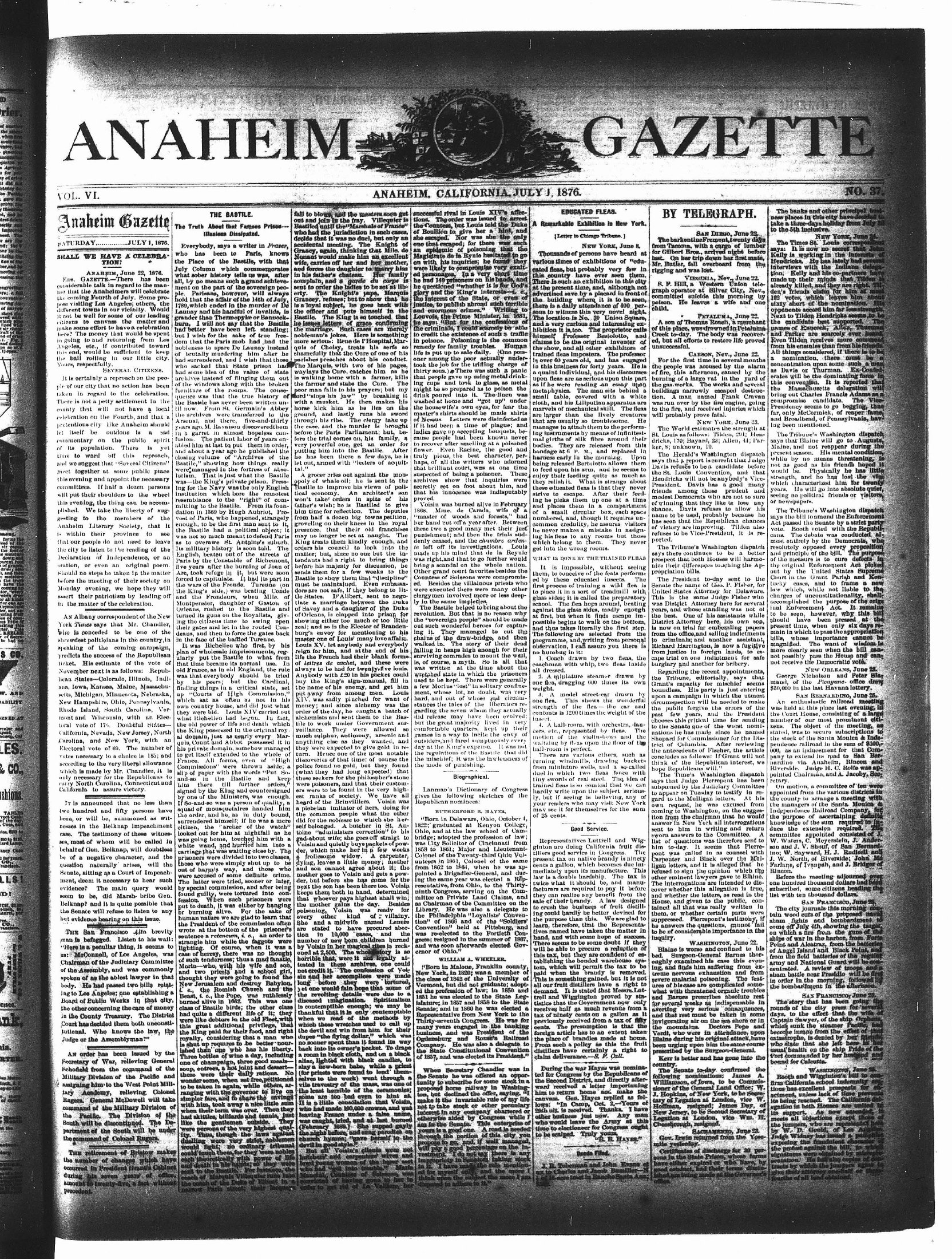
Searchable text
ANAHEIM
VOL. VI.
Anaheim Gazette
SATURDAY...JULY 1, 1876.
SHALL WE HAVE A CELEBRATION?
ANAHEIM, June 22, 1876.
EDS. GAZETTE.—There has been considerable talk in regard to the manner that the Anaheimers will celebrate the coming Fourth of July. Some propose visiting Los Angeles; others, the different towns in our vicinity. Would it not be well for some of our leading citizens to canvass the matter and make some effort to have a celebration here? The money that would be spent in going to and returning from Los Angeles, etc., if contributed toward this end, would be sufficient to keep the ball rolling in our little city. Yours, respectfully.
SEVERAL CITIZENS.
It is certainly a reproach on the people of our city that no action has been taken in regard to the celebration. There is not a petty settlement in the county that will not have a local celebration on the Fourth, and that a pretentious city like Anaheim should let itself be outdone is a sad commentary on the public spirit of its population. There is yet time to ward off this reproach, and we suggest that "Several Citizens"
THE BASTILE.
The Truth About that Famous Prison—Illusions Dissipated.
Everybody says a writer in Fraser, who has been to Paris, knows the Place of the Bastile, with that July Column which commemorates what sober history tells us was, after all, by no means such a grand achievement on the part of the sovereign people. Parisians, however, will always hold that the affair of the 14th of July, 1789, which ended in the murder of De Launay and his handful of invalids, is greater than Thermopylae or Bannockburn. I will not say that the Bastile had better have been left standing; but I wish for the sake of true freedom that the Paris mob had had the nobleness to spare De Launay instead of brutally murdering him after he had surrendered, and I wish that those who sacked that State prison had had some idea of the value of state archives instead of flinging them out of the windows along with the broken furniture of the rooms. The consequence was that the true history of the Bastile has never been written until now. From St. Germain's Abbey the archives were transferred to the Arsenal, and there, five-and-thirty years ago, M. Ravaison discovered them in a garret in almost hopeless confusion. The patient labor of years enabled him at last to put them in order, and about a year ago he published the closing volume of "Archives of the Bastile," showing how things really were managed in the fortress of also fall to blows, and then Bastiled until the "M" who had the jurisdiction decide that it was no accidental meeting. Grancy, again, thinks Nonant would make wife, carries off her and forces the daughter in his father's chateau complain, and a good sent to order the ladies. The Knight's Graney, refuses; but is a loyal subject, he the officer and puts Bastille. The King lays his issues letters of the marriage. Such nobleman's jokes. More serious: René quis of Cholsy, trays shamefully that the parishes preaches abo The Marquis, with their waylays the Cure, can is walking home with the farmer and stabs poor man falls to his word "stops his jaw" with a musket. He horse kick him as ground, and lastly through his ribs. The case, and the man before the Paris Parole fore the trial comes o very powerful one, putting him into the he has been there let out, armed with "tal."
It is certainly a reproach on the people of our city that no action has been taken in regard to the celebration. There is not a petty settlement in the county that will not have a local celebration on the Fourth, and that a pretentious city like Anaheim should let itself be outdone is a sad commentary on the public spirit of its population. There is yet time to ward off this reproach, and we suggest that "Several Citizens" meet together at some public place this evening and appoint the necessary committees. If half a dozen persons will put their shoulders to the wheel this evening, the thing can be accomplished. We take the liberty of suggesting to the members of the Anaheim Literary Society, that it is within their province to see that our people do not need to leave the city to listen to the reading of the Declaration of Independence, or an oration, or even an original poem. Should no steps be taken in the matter before the meeting of their society on Monday evening, we hope they will assert their patriotism by leading off in the matter of the celebration.
An Albany correspondent of the New York Times says that Mr. Chandler, who is conceded to be one of the shrewdest politicians in the country, in speaking of the coming campaign, predicts the success of the Republican ticket. His estimate of the vote of November next is as follows: Republican States—Colorado, Illinois, Indiana, Iowa, Kansas, Maine, Massachusetts, Michigan, Minnesota, Nebraska, New Hampshire, Ohio, Pennsylvania, Rhode Island, South Carolina, Vermont and Wisconsin, with an Electoral vote of 176. Doubtful States—California, Nevada, New Jersey, North Carolina, and New York, with an Electoral vote of 69. The number of votes necessary to a choice is 185; and according to the very liberal allowance which is made by Mr. Chandler, it is only necessary for the Republicans to carry North Carolina, Connecticut and California to assure victory.
It is announced that no less than two hundred and fifty persons have been, or will be, summoned as witnesses in the Belknap impeachment case. The testimony of these witnesses, most of whom will be called in behalf of Gen. Belknap, will doubtless be of a negative character, and the question naturally arises, will the Senate, sitting as a Court of Impeachment, deem it necessary to hear such evidences? The main query would had some idea of the value of state archives instead of flinging them out of the windows along with the broken furniture of the rooms. The consequence was that the true history of the Bastile has never been written until now. From St. Germain's Abbey the archives were transferred to the Arsenal, and there, five-and-thirty years ago, M. Ravaison discovered them in a garret in almost hopeless confusion. The patient labor of years enabled him at last to put them in order, and about a year ago he published the closing volume of "Archives of the Bastile," showing how things really were managed in the fortress of absolutism. That is just what the Bastile was—the King's private prison. Pressing for the Navy was the only English institution which bore the remotest resemblance to the "right" of committing to the Bastile. From its foundation in 1369 by Hugh Aubriot, Provost of Paris, who happened, strangely enough, to be the first man sent to it, the Bastile had a political object; it was not so much meant to defend Paris as to overwea St. Antone's suburb. Its military history is soon told. The English, beaten out of the streets of Paris by the Constable of Richemont, five years after the burning of Joan of Arc, took refuge in it, but were soon forced to capitulate. It had its part in the wars of the Fronde. Tureune (on the King's side) was beating Conde and the Frondeurs, when Mille of Montpensier, daughter of Gaston of Orleans, rushed to the Bastile and turned its guns on the Royalists, giving the citizens time to swing open their gates and let in the routed Condeans, and then to force the gates back in the face of the baffled Turenne.
It was Richelieu who first, by his plan of wholesale imprisonments, regularly put the Bastile to what from that time became its normal use. In old France, as in old England, the rule was that everybody should be tried by his peers; but the Cardinal finding things in a critical state, set up "Courts of High Commission," which sat as often as not in his own country house, and did just what they were bid. Louis XIV carried out what Richelieu had begun. In fact, the old power of life and death which the King possessed in the original royal domain, just as nearly every Marquis, Count and Abbot possessed it in his private domain, somehow managed to get itself extended to the whole of France. All forms, even of "High Commissions" were thrown aside; a slip of paper with the words "Put Soand-so in the Bastile and keep him there till further orders," signed by the King and countersigned by one of the Ministers, was enough. If So-and-so was a person of quality, a squad of mousquetaires handed him the order, and he, as in duty bound, surrendered himself; if he was a mere citizen, the "archer of the watch" looked out for him at nightfall as he was going home, touched him with a white wand, and hurried him into a carriage that was waiting close by. The prisoners were divided into two classes, those who were simply shut up to be out of harm's way, and those who were accused of some definite crime. The latter were tried, sooner or later, by special commission, and after being had some idea of the value of state archives instead of flinging them out of the windows along with the broken furniture of the rooms. The consequence was that the true history of the Bastile has never been written until now. From St. Germain's Abbey the archives were transferred to the Arsenal, and there, five-and-thirty years ago, M. Ravaison discovered them in a garret in almost hopeless confusion. The patient labor of years enabled him at last to put them in order, and about a year ago he published the closing volume of "Archives of the Bastile," showing how things really were managed in the fortress of absolutism. That is just what the Bastile was—the King's private prison. Pressing for the Navy was the only English institution which bore the remotest resemblance to the "right" of committing to the Bastile. From its foundation in 1369 by Hugh Aubriot, Provost of Paris, who happened, strangely enough, to be the first man sent to it, the Bastile had a political object; it was not so much meant to defend Paris as to overwea St. Antone's suburb. Its military history is soon told. The English, beaten out of the streets of Paris by the Constable of Richemont, five years after the burning of Joan of Arc, took refuge in it, but were soon forced to capitulate. It had its part in the wars of the Fronde. Tureune (on the King's side) was beating Conde and the Frondeurs, when Mille of Montpensier, daughter of Gaston of Orleans, rushed to the Bastile and turned its guns on the Royalists, giving the citizens time to swing open their gates and let in the routed Condeans, and then to force the gates back in the face of the baffled Turenne.
It was Richelieu who first, by his plan of wholesale imprisonments, regularly put the Bastile to what from that time became its normal use. In old France, as in old England,the rule was that everybody should be tried by his peers; butthe Cardinal,finding things in a critical state,set up "Courts of High Commission,"which sat as often as not in his own country house,and did just what they were bid.Louis XIV carried out what Richelieu had begun.In fact,the old power of life and death whichthe King possessed inthe original royaldomain,justasnearlyeveryMarquis,CountandAbbotpossesseditinhisprivatedomain,somethowmanagedtogetitselfextendedtothewholeofFrance.Allforms,evenof"HighCommissions"were thrownaside;a slipofpaperwiththewords"PutSoandsointheBastileandkeephimthere tillfurtherorders,"signedbytheKingandcountersignedbyoneoftheMinisterswasenoughIfSo-andsowasapersonofquality,aquadmousquetaireshandedhimtheorder,andheasindutybound,surrenderedhimself;ifhewasamercitizen,the"archerofthewatch"lookedoutforhimatnightfallashewasgoinghome,touchedhimwithawhitewand,andhurriedhimintoacarriagethatwaswaitingcloseby.TheprisonersweredividedintowhoclassesThosewhoweresimplyshutuptobeoutofharm'sway,andthosewhowereaccusedofsomedefinitecrime.Thelatterweretried,soonerorlater,byspecialcommission,andafterbeinghadsomeideaofthevalueofstatearchives insteadofflingingthemoutofthewindowsalongwiththebrokenfurnitureoftherooms.TheconsequencewasthatthetruehistoryoftheBastilehasneverbeenwrittenuntilnow.FromSt.Germain'sAbbeythearchivesweretransferredtotheArsenal,andthere,five-and-thirtyyearsago,M.Ravaisondiscoveredtheminagarretinallmosthopelessconfusion.Thepatientlaborofyearsenabledhimatlasttoputtheminorder,andaboutayearagobepublishedtheclosingvolumeof"ArchivesoftheBastile,"showinghowthingsreallyweremadeinthetomorrowfromthattimebecameitsnormaluse.InoldFranceasinoldEngland,therulewasthateverybodyshouldbettriedbyhispeers;buttheCardinal,findingthingsinacriticalstate,setup"CourtsofHighCommission,"whichsatasoftenasnotinhisowncountryhouse,anddidjustwhattheywerebid.LouisXIVcarriedoutwhatRichelieuhadbegin.Infact,theoldpoweroflifeanddeathwhichtheKingpossessedintherelationaldomain,justasnearlyeveryMarquis,CountandAbbotpossesseditinhisprivatedomain,somethowmanagedtogetitselfextendedtothewholeofFrance.Allforms,evenof"HighCommissions"were thrownaside;a slipofpaperwiththewords"PutSoandsointheBastileandkeephimthere tillfurtherorders,"signedbytheKingandcountersignedbyoneoftheMinisterswasenoughIfSo-andsowasapersonofquality,aquadmousquetaireshandedhimtheorder,andheasindutybound,surrenderedhimself;ifhewasamercitizen,the"archerofthewatch"lookedoutforhimatnightfallashewasgoinghome,touchedhimwithawhitewand,andhurriedhimintoacarriagethatwaswaitingclosebyTheprisonersweredividedintowhoclassesThosewhoweresimplyshutuptobeoutofharm'sway,andthosewhowereaccusedofsomedefinitecrime.Thelatterweretried,soonerorlater,byspecialcommission,andafterbeinghadsomeideaofthevalueofstatearchives insteadofflingingthemoutofthewindowsalongwiththebrokenfurnitureoftherooms.TheconsequencewasthatthetruehistoryoftheBastilehasneverbeenwrittenuntilnow.FromSt.Germain'sAbbeythearchivesweretransferredtotheArsenal,andthere,five-and-thirtyyearsago,M.Ravaisondiscoveredtheminagarretinallmosthopelessconfusion.Thepatientlaborofyearsenabledhimatlasttoputtheminorder,andaboutayearagobepublishedtheclosingvolumeof"ArchivesoftheBastile,"showinghowthingsreallyweremadeinthetomorrowfromthattimebecameitsnormaluse.InoldFranceasinoldEngland,therulewasthateverybodyshouldbettiredbyhispeers;buttheCardinal,findingthingsinacriticalstate,setup"CourtsofHighCommission,"whichsatasoftenasnotinhisowncountryhouse,anddidjustwhattheywerebid.LouisXIVcarriedoutwhatRichelieuhadbegin.Infact,theoldpoweroflifeanddeathwhichtheKingpossessedintherelationaldomain,justasnearlyeveryMarquis,CountandAbbotpossesseditinhisprivatedomain,somethowmanagedtogetitselfextendedtothewholeofFrance.Allforms,evenof"HighCommissions"were thrownaside;a slipofpaperwiththewords"PutSoandsointheBastileandkeephimthere tillfurtherorders,"signedbytheKing和countersignedbyoneoftheMinisterswasenoughIfSo-andsowasapersonofquality,a quadmousquetaireshandedhimtheorder,andheasindutybound,surrenderedhimself;ifhewasamercitizen,the"archerofthewatch"lookedoutforhimatnightfallashewasgoinghome,touchedhimwitha白色wand,andhurriedhimintoacarriagethatwaswaitingclosebyTheprisonersweredividedintowhoclassesThosewhoweresimplyshutuptobeoutofharm'sway,andthosewhowereaccusedofsomedefinitecrime.Thelatterweretried,soonerorlater,byspecialcommission,andafterbeinghadsomeideaofthevalueofstatearchives insteadofflingingthemoutofthewindowsalongwiththebrokenfurnitureoftherooms.TheconsequencewasthatthetruehistoryoftheBastilehasneverbeenwrittenuntilnow.FromSt.Germain'sAbbeythearchivesweretransferredtotheArsenal,andthere,five-and-thirtyyearsago,M.Ravaisondiscoveredtheminagarretinallmosthopelessconfusion.Thepatientlaborofyearsenabledhimatlasttoputtheminorder,andaboutayearagobepublishedtheclosingvolumeof"ArchivesoftheBastile,"showinghowthingsreallyweremadeinthetomorrowfromthattimebecameitsnormaluse.InoldFranceasinoldEngland,therulewasthateverybodyshouldbettiredbyhispeers;buttheCardinal,findingthingsinacriticalstate,setup"CourtsofHighCommission,"whichsatasoftenasnotinhisowncountryhouse,anddidjustwhattheywerebid.LouisXIVcarriedoutwhatRichelieuhadbegin.Infact,theoldpoweroflifeanddeathwhichtheKingpossessedintherelationaldomain,justasnearlyeveryMarquis,CountandAbbotpossesseditinhisprivatedomain,somethowmanagedtogetitselfextendedtothewholeofFrance.Allforms,evenof"HighCommissions"were thrownaside;a slipofpaperwiththewords"PutSoandsointheBastileandkeep himthere tillfurtherorders,"signedbytheKing和countersignedbyoneoftheMinisterswasenoughIfSo-andsowasapersonofquality,a quadmousquetaireshanded himtheorder,andheasindutybound,surrendered himself;ifhewasamercitizen,the"archerofthewatch"lookedoutforhimatnightfallashewasgoinghome,touched himwitha白色wand,andhurried himintoacarriage thatwaswaitingclosebyTheprisonersweredividedintowhoclassesThosewhoweresimplyshutuptobeoutofharm'sway,andthosewhowereaccusedofsomedefinitecrime.Thelatterweretried,soonerorlater,byspecialcommission,andafterbeinghadsomeideaofthevalueofstatearchives insteadofflingingthemoutofthewindowsalongwiththebrokenfurnitureoftherooms.TheconsequencewasthatthetruehistoryoftheBastilehasneverbeenwrittenuntilnow.FromSt.Germain'sAbbeythearchinesweretransferredtotheArsenal,andthere,five-and-thirtyyearsago,M.Ravaisondiscoveredtheminagarretinallmosthopelessconfusion.Thepatientlaborofyearsenabled himatlasttoputtheminorder,andaboutayearagobepublishedtheclosingvolumeof"ArchivesoftheBastile,"showinghowthingsreallyweremadeinthetomorrowfromthattimebecameitsnormaluse.InoldFranceasinoldEngland,therulewasthateverybodyshouldbettiredbyhispeers;buttheCardinal,findingthingsinacriticalstate,setup"Courts-ofHighCommission,"whichsatasoftenasnotinhisowncountryhouse,anddidjustwhattheywerebid.LouisXIVcarriedoutwhatRichelieuhadbegin.Infact,theoldpoweroflifeanddeathwhichtheKingpossessedintherelationaldomain,justasnearlyeveryMarquis,CountandAbbotpossesseditinhisprivatedomain,somethowmanagedtogetitselfextendedtothewholeofFrance.Allforms,evenof"HighCommissions"were thrownaside;a slipofpaperwiththewords"PutSoandsointheBastileandkeep himthere tillfurtherorders,"signedbytheKing和countersignedbyoneoftheMinisterswasenoughIfSo-andsowasapersonofquality,a quadmousquetaireshanded himtheorder,andheasindutybound,surrendered himself;ifhewasamercitizen,the"archerofthewatch"lookedoutforhimatnightfallashewasgoinghome,touched himwitha白色wand,andhurred himintoacarriage thatwaswaitingclosebyTheprisonersweredividedintowhoclassesThosewhoweresimplyshutuptobeoutofharm'sway,andthosewhowereaccusedofsomedefinitecrime.Thelatterweretried,soonerorlater,byspecialcommission,andafterbeinghadsomeideaofthevalueofstatearchives insteadofflingingthemoutofthewindowsalongwiththebrokenfurnitureoftherooms.TheconsequencewasthatthetruehistoryOfTheBrinceAndTheBrinceAndTheBrinceAndTheBrinceAndTheBrinceAndTheBrinceAndTheBrinceAndTheBrinceAndTheBriceAndTheBriceAndTheBriceAndTheBriceAndTheBriceAndTheBriceAndTheBriceAndTheBriceAndTheBriceAndTheBriceAndTheBriceAndTheBriceAndTheBriceAndTheBriceAndTheBriceAndTheBriceAndTheBriceAndTheBriceAndTheBriceAndTheBriceAndTheBriceAndTheBriceAndTheBriceAndTheBriceAndTheBriceAndTheBriceAndTheBriceAndTheBriceAndTheBriceAndTheBriceAndTheBriceAndTheBriceAndTheBriceAndTheBriceAndTheBriceAndTheBriceAndTheBriceAndTheBriceAndTheBriceAndTheBriceAndTheBriceAndTheBriceAndTheBriceAndTheBriceAndTheBriceAndTheBriceAndTheBrice And The Brice And The Brice And The Brice And The Brice And The Brice And The Brice And The Brice And The BrICE AND THE BRICE AND THE BRICE AND THE BRICE AND THE BRICE AND THE BRICE AND THE BRICE AND THE BRICE AND THE BRICE AND THE BRICE AND THE BRICE AND THE BRICE AND THE BRICE AND THE BRICE AND THE BRICE AND THE BRICE AND THE BRICE AND THE BRICE AND THE BRICEANDTHEBRICEANDTHEBRICEANDTHEBRICEANDTHEBRICEANDTHEBRICEANDTHEBRICEANDTHEBRICEANDTHEBRICEANDTHEBRICEANDTHEBRICEANDTHEBRICEANDTHEBRICEANDTHEBRICEANDTHEBRICEANDTHEBRICEANDTHEBRICEANDTHEBRICEANDTHEBRICEANDTHEBRICEANDTHEBRICEANDTHEBRICEANDTHEBRICEANDTHEBRICEANDTHEBRICEANDTHEBRICEANDTHERBCIDEANDTHERBCIDEANDTHERBCIDEANDTHERBCIDEANDTHERBCIDEANDTHERBCIDEANDTHERBCIDEANDTHERBCIDEANDTHERBCIDEANDTHERBCIDEANDTHERBCIDEANDTHERBCIDEANDTHERBCIDEANDTHERBCIDEANDTHERBCIDEANDTHERBCIDEANDTHERBCIDEANDTHERBCIDEANDTHERBCIDEANDTHERBCIDEANDTHERBCIDEANDTHERBCIDEANDTHERBCIDEANDTHERBCIDEANDTHERBCIDEANDBRCIDEANDTHERBCIDEANDTHERBCIDEANDTHERBCIDEANDTHERBCIDEANDTHERBCIDEANDTHERBCIDEANDTHERBCIDEANDTHERBCIDEANDTHERBCIDEANDTHERBCIDEANDTHERBCIDEANDTHERBCIDEANDTHERBCIDEANDTHERBCIDEANDTHERBCIDEANDTHERBCIDEANDTHERBCIDEANDTHERBCIDEANDTHERBCIDEANDTHERBCIDEANDBRCIDEANDBRCIDEANDBRCIDEANDBRCIDEANDBRCIDEANDBRCIDEANDBRCIDEANDBRCIDEANDBRCIDEANDBRCIDEANDBRCIDEANDBRCIDEANDBRCIDEANDBRCIDEANDBRCIDEANDBRCIDEANDBRCIDEANDBRCIDEANDBRCIDEANDBRCIDEANDBRCIDENGBCIDEANDBRCIDENGBCIDEANDBRCIDENGBCIDEANDBRCIDENGBC IDEANDBRCIDENGBC IDEANDBRCIDENGBC IDEANDBRCIDENGBC IDEANDBRCIDENGBC IDEANDBRCIDENGBC IDEANDBRCIDENGBC IDEANDBRCIDENGBC IDEANDBRCIDENGBC IDEANDBRCIDENGBC IDEANDBRCIDENGBC IDEANDBRCIDENGBC IDEANDBRCIDENGBC IDE AN DBRCIDENGBC IDE AN DBRCIDENGBC IDE AN DBRCIDENGBC IDE AN DBRCIDENGBC IDE AN DBRCIDENGBC IDE AN DBRCIDENGBC IDE AN DBRCIDENGBC IDE AN DBRCIDENGBC IDE AN DBRCIDENGBC IDE AN DBRCIDENGBC IDE AN DBRCIDENGBC IDE AN DBRCIDENGBC IDE AN DB RC IDENGBC IDE AN DB RC IDENGBC IDE AN DB RC IDENGBC IDE AN DB RC IDENGBC IDE AN DB RC IDENGBC IDE AN DB RC IDENGBC IDE AN DB RC IDENGBC IDE AN DB RC IDENGBC IDE AN DB RC IDENGBC IDE AN DB RC IDENGBC IDE AN DB RC IDENGBC IDE AN DB RC ID ENGBC IDE AN DB RC ID ENGBC IDE AN DB RC ID ENGBC IDE AN DB RC ID ENGBC IDE AN DB RC ID ENGBC IDE AN DB RC ID ENGBC IDE AN DB RC ID ENGBC IDE AN DB RC ID ENGBC IDE AN DB RC ID ENGBC IDE AN DB RC ID ENGBC IDE AN DB RC ID ENGBC IDE AN DB RC ID ENGBC IDE AN DRB CIDE AN DRB CIDE AN DRB CIDE AN DRB CIDE AN DRB CIDE AN DRB CIDE AN DRB CIDE AN DRB CIDE AN DRB CIDE AN DRB Cide An DRB Cide An DRB Cide An DRB Cide An DRB Cide An DRB Cide An DRB Cide An DRB Cide An DRB Cide An DRB Cide An DRB Cide An DRB Cide An DRB Cide An DRB Cide An DRB Cide An DRB Cide An DRB Cide An DRB Cide An DRB Cide An DRB Cide An DRB Cide An DRB Cide An DRB Cide An DRB Cide An DRB Cide An DRB Cide An DRB Cide An DRB Cide An DRB Cide An DRB Cide An DRB Cide An DRB Cide An DRB Cide An DRB Cide An DRB Cide An DRB Cide An DRB Cide An DRB Cide An DRB Cide An DRB Cide An DRB Cide An DRB Cide An DRB Cide An DRB Cide An DRB Cide An DRB Cide An DRB Cide An DRB Cide An DRB Cide An
It is announced that no less than two hundred and fifty persons have been, or will be, summoned as witnesses in the Belknap impeachment case. The testimony of these witnesses, most of whom will be called in behalf of Gen. Belknap, will doubtless be of a negative character, and the question naturally arises, will the Senate, sitting as a Court of Impeachment, deem it necessary to hear such evidence? The main query would seem to be, did Marsh bribe Gen. Belknap? and it is quite possible that the Senate will refuse to listen to any but evidence bearing on this issue.
The San Francisco Alta brevity man is befogged. Listen to his wall: "Here is a peculiar thing, it seems to us: McConnell, of Los Angeles, was Chairman of the Judiciary Committee of the Assembly, and was commonly spoken of as the ablest lawyer in that body. He had passed two bills relating to Los Angeles; one establishing a Board of Public Works in that city, the other concerning the care of money in the County Treasury. The District Court has decided them both unconstitutional. Who knows the law, the Judge or the Assemblyman?"
An order has been issued by the Secretary of War, relieving General Schofield from the command of the Military Division of the Pacific and assigning him to the West Point Military Academy, relieving Colonel Ruger. General McDowell will take command of the Military Division of the Pacific. The Division of the South will be discontinued. The Department of the South will be under the command of Colonel Ruger.
The retirement of Brislow makes the number of changes which have occurred in President Grant's Cabinet during his seven years' office, amount to twenty-five, a fact without precedent.
ANAHEIM, CALIFORNIA, JULY 1, 1876.
fall to blows and the master soon get out and join in the fray. Villequier is Bastiled until the "Marshals of France" who had the jurisdiction in such cases, decide that it was no duel, but only an accidental meeting. The Knight of Graney, again, thinking that Milie de Nonant would make him an excellent wife, carries off her and her mother, and forces the daughter to marry him in his father's chateau. Her family complain, and a garde du corps is sent to order the ladies to be set at liberty. The Knight's jaws, Marquis Grancery, refuses; but to show that he is a loyal subject, he goes back with the officer and puts himself in the Bastile. The King is so touched that he issues letters of grace confirming the marriage. Such cases are merely nobleman's jokes. Here is something more serious: Rene de l'Hospital, Marquis of Cholay, treats his serfs so shamefully that the Cure of one of his parishes preaches about his conduct. The Marquis, with two of his pages, waylays the Cure, catches him as he is walking home with a farmer, kills the farmer and stabs the Cure. The poor man falls to his prayers; but my word "stops his jaw" by breaking it with a musket. He then makes his horse kick him as he lies on the ground, and lastly runs his sword through his ribs. The clergy take up the case, and the murder is brought before the Paris Parliament; but, before the trial comes on, his family, a very powerful one, get an order for putting him into the Bastile. After he has been there a few days, he is let out, armed with "letters of acquittal."
successful rival in Louis XIV's affections. The order was issued to arrest the Countess, but Louis told the Duke of Boullion to give her a hint, and she escaped. Nor was she the only one that escaped; for there was such an epidemic of poisoning that the Magistrate de la Rynle hesitated to go on with his inquiries; he found they were likely to compromise very exalted personages. In a very short time he had 149 prisoners on his hands, and he questioned "whether it is for God's glory and the King's interests—f. e., the interest of the State, or even of Justice, to publish abroad such terrible and enormous crimes." Writing to Louvois, the Prime Minister, in 1681, he says: "But for the confessions of the criminals, I could scarcely be able to credit the existence of such a traffic in poisons. Poisoning is the common remedy for family troubles. Human life is put up to sale daily. (One poisoner among the poor actually undertook the job for the trifling charge of thirty sous.) There was such a panic that people gave up using metal drinking cups and took to glass, as metal might be so prepared as to poison the drink poured into it. The linen was washed at home and "got up" under the housewife's own eyes, for fear the master's shirts should be made shirts of Nessus. Letters were disinfected as if it had been a time of plague; and ladies gave up accepting bouquets, because people had been known never to recover after smelling at a poisoned flower. Even Racine, the good and truly pious, the best character, perhaps, of all the writers who adorned that brilliant court, was at one time educated fleas.
A Remarkable Exhibition in New York.
[Letter to Chicago Tribune.]
New York, June 8.
Thousands of persons have heard at various times of exhibitions of "educated fleas, but probably very few in this country have ever seen them. There is such exhibition in this city at the present time, and although not advertised save by a placard in front of the building where it is to be seen, there is a daily attendance of 400 persons to witness this very novel sight. The location is No. 39 Union Square, and a very curious and interesting exhibition it is too. The proprietor calls himself Professor Bestolotto, and claims to be the original inventor of the show, and all other exhibitors of trained fleas imposters. The professor is over 60 years old, and has engaged in this business for forty years. He is a quaint individual, and his discourses upon fleas are as serious upon this part as if he were reading an essay upon metaphysics. The man sits behind a small table, covered with a white cloth, and his Liliputian apparatus are marvels of mechanical skill. The fleas are larger than the lively creatures that are usually so troublesome. He manages to attach them to the performing instruments by means of infinitesimal girths of silk fibre around their bodies. They are released from this bondage at 6 P.M., and replaced in harness early in the morning. Upon being released Bertolotto allows them to feed upon his arm, and seems to
waylays the Cure, catches him as he is walking home with a farmer, kills the farmer and stabs the Cure. The poor man falls to his prayers; but my word "stops his jaw" by breaking it with a musket. He then makes his horse kick him as he lies on the ground, and lastly runs his sword through his ribs. The clergy take up the case, and the murder is brought before the Paris Parliament; but, before the trial comes on, his family, a very powerful one, get an order for putting him into the Bastile. After he has been there a few days, he is let out, armed with "letters of acquittal."
A grocer cries out against the monopoly of whale oil; he is sent to the Bastile to improve his views of political economy. An architect's son won't take orders in spite of his father's wish; he is Bastilled to give him time for reflection. The deputies from half a dozen big towns petition, groveling on their knees in the royal presence, that their old franchisee may no longer be set at naught. The King treats them kindly enough, and orders his council to look into the matter; but, since no one but the indentants had a right to bring things before his majesty for discussion, he sends them for a few weeks to the Bastile to show them that "discipline" must be maintained. Even embassadors are not safe, if they belong to little States.
D'Alibert, sent to negotiate a marriage between the Duke of Savoy and a daughter of the Duke of Orleans, is clapped into prison for showing either too much or too little zeal; and so is the Elector of Brandenburg's envoy for mentioning to his master one of Louis' many love affairs. Louis XV. let anybody and everybody reign for him, and at the end of his life the French had their blank forms of lettres de cachet, and these were always to be had for twenty-five louis. Anybody with £20 in his pocket could buy the King's sign-manual, fill in the name of his enemy, and get him put away from among men. Louis XIV. was sadly pinched for want of money; and since alchemy was the order of the day, he caught a batch of alchemists and sent them to the Bastile to work under Government surveillance. They were allowed so much sulphur, antimony, arsenic and anything else as they wanted, and they were expected to give gold in return. Hence one of the most notable discoveries of that time; of course the police found no gold, but they found (what they had long expected) that these seakers for the philosopher's stone were poisoners, and that their customers were to be found in the very highest ranks of society. We have all heard of the Brinvilliers. Volsin was a plebeian imitator of hers, doing for the common people what the other did for the noblesse to which she herself belonged. A butcher in St. Antone "administers correction" to his gad-about wife; she goes off straight to Volsin and quietly buys packets of powder, which make her in a few weeks a frolicsome widow. A carpenter, dying, leaves a little money; mother and son cannot agree about it; the mother goes to Volsin and gets a powder, but before she has come for the next son has been there too. Volsin
WHAT IS DONE BY THE TRAINED FLEAS
It is impossible, without seeing them, to conceive of the feats performed by these educated insects. The first process of training a wild flea is to place it in a sort of treadmill with glass sides; it is called the preparatory school. The flea hops around, beating against the glass sides, madly enough at first, but when it finds escape impossible begins to walk on the bottom, and thus takes literally the first step. The following are selected from the programme, and writing from personal observation, I can assure you there is no humbug in it:
1. Coach drawn by two fleas, the coachman with whip, two fleas inside all dressed.
2. A miliature steamer drawn by one flea, dragging 600 times its own weight.
3. A model street-car drawn by one flea. This shows the wonderful strength of the flea—the car and contents is 1200 times the weight of the insect.
4. A ball-room, with orchestra, dancers, etc., represented by fleas. The motion of the violin-bows and the waltzing by fleas upon the ball-room is perfect.
There are various others, such as turning windmills, drawing buckets from miniature wells, and a so-called duel in which two fleas fence with tiny swords of real steel. The idea of trained fleas is so comical that we can hardly write upon the subject seriously, but if seeing is believing, any of your readers who may visit New York may see it for themselves for the sum of 25 cents.
GOOD SERVICE
Representatives Luttrell and Wigginton are doing California fruit distillers good service in Congress. The present tax on native brandy is ninety cents a gallon, which becomes due immediately upon its manufacture. This law is a double hardship. The tax is twice what it should be, and manufacturers are required to pay it before a quaint individual, and his discourses upon fleas are as serious upon this part as if he were reading an essay upon metaphysics. The man sits behind a small table, covered with a white cloth, and his Liliputian apparatus are marvels of mechanical skill. The fleas are larger than the lively creatures that are usually so troublesome. He manages to attach them to the performing instruments by means of infinitesimal girths of silk fibre around their bodies. They are released from this bondage at 6 P.M., and replaced in harness early in the morning. Upon being released Bertolotto allows them to feed upon his arm, and he seems to enjoy their feeding quite as much as they relish it. What is strange about these educated fleas is that they never strive to escape. After their feeding he picks them up one at a time and places them in a compartment of a small circular box, each space numbered, and though it requires uncommon credulity, he assures visitors he never makes a mistake in assigning his fleas to any rooms but those which belong to them. They never get into the wrong rooms.
WHAT IS DONE BY THE TRAINED FLEAS
It is impossible without seeing them, to conceive of the feats performed by these educated insects. The first process of training a wild flea is to place it in a sort of treadmill with glass sides; it is called the preparatory school. The flea hops around, beating against the glass sides, madly enough at first, but when it finds escape impossible begins to walk on the bottom, and thus takes literally the first step. The following are selected from the programme, and writing from personal observation, I can assure you there is no humbug in it:
1. Coach drawn by two fleas, the coachman with whip, two fleas inside all dressed.
2. A miliature steamer drawn by one flea, dragging 600 times its own weight.
3. A model street-car drawn by one flea. This shows the wonderful strength of the flea—the car and contents is 1200 times the weight of the insect.
4. A ball-room, with orchestra, dancers, etc., represented by fleas. The motion of the violin-bows and the waltzing by fleas upon the ball-room is perfect.
There are various others such as turning windmills, drawing buckets from miniature wells, and a so-called duel in which two fleas fence with tiny swords of real steel. The idea of trained fleas is so comical that we can hardly write upon the subject seriously but if seeing is believing any of your readers who may visit New York may see it for themselves for the sum of 25 cents.
REGARDING THE TRUST GRANT'S BOUNDARIES UPON A CIRCUMSUM OF WINCH CHANCE: NAME TO HIS SECRET VIEWS OF VICTORY REFUSES PORTIONED.
THE TAYSAYS THAT SUBPOSED TO APPEAR GARDEN TO OWN COMMUNICATION FROM AN OFFICE: WILL RUN TO THE FIELD FOR WORK IN THE MAIN ROOM: WILL BE PREPARED TO SERVE WITH A MACHINE: WILL BE PROVIDED WITH A MACHINE: WILL BE PROVIDED WITH A MACHINE: WILL BE PROVIDED WITH A MACHINE: WILL BE PROVIDED WITH A MACHINE: WILL BE PROVIDED WITH A MACHINE: WILL BE PROVIDED WITH A MACHINE: WILL BE PROVIDED WITH A MACHINE: WILL BE PROVIDED WITH A MACHINE: WILL BE PROVIDED WITH A MACHINE: WILL BE PROVIDED WITH A MACHINE: WILL BE PROVIDED WITH A MACHINE: WILL BE PROVIDED WITH A MACHINE: WILL BE PROVIDED WITH A MACHINE: WILL BE PROVIDED WITH A MACHINE: WILL BE PROVIDED WITH A MACHINE: WILL BE PROVIDED WITH A MACHINE: WILL BE PROVIDED WITH A MACHINE: WILL BE PROVIDED WITH A MACHINE: WILL BE PROVIDED WITH A MACHINE: WILL BE PROVIDED WITH A MACHINE: WILL BE PROVIDED WITH A MACHINE: WILL BE PROVIDED WITH A MACHINE: WILL BE PROVIDED WITH A MACHINE: WILL BE PROVIDED WITH A MACHINE: WILL BE PROVIDED WITH A MACHINE: WILL BE PROVIDED WITH A MACHINE: WILL BE PROVIDED WITH A MACHINE: WILL BE PROVIDED WITH A MACHINE: WILL BE PROVIDED WITH A MACHINE: WILL BE PROVIDED WITH A MACHINE: WILL BE PROVIDED WITH A MACHINE: WILL BE PROVIDED WITH A MACHINE: WILL BE PROVIDED WITH A MACHINE: WILL BE PROVIDED WITH A MACHINE: WILL BE PROVIDED WITH A MACHINE: WILL BE PROVIDED WITH A MACHINE: WILL BE PROVIDED WITH A MACHINE: WILL BE PROVIDED WITH A MACHINE: WILL BE PROVIDED WITH A MACHINE: WILL BE PROVIDED WITH A MACHINE: WILL BE PROVIDED WITH A MACHINE: WILL BE PROVIDED WITH A MACHINE: WILL BE PROVIDED WITH A MACHINE: WILL BE PROVIDED WITH A MACHINE: WILL BE PROVIDED WITH A MACHINE: WILL BE PROVIDED WITH A MACHINE: WILL BE PROVIDED WITH A MACHINE: WILL BE PROVIDED WITH A MACHINE: WILL BE PROVIDED WITH A MACHINE: WILL BE PROVIDED WITH A MACHINE: WILL BE PROVIDED WITH A MACHINE: WILLBE PRODUCTION OF THE NEW YORK CITY CENTER FOR THE ARTS AND EDUCATION OF THE NEW YORK CITY CENTER FOR THE ARTS AND EDUCATION OF THE NEW YORK CITY CENTER FOR THE ARTS AND EDUCATION OF THE NEW YORK CITY CENTER FOR THE ARTS AND EDUCATION OF THE NEW YORK CITY CENTER FOR THE ARTS AND EDUCATION OF THE NEW YORK CITY CENTER FOR THE ARTS AND EDUCATION OF THE NEW YORK CITY CENTER FOR THE ARTS AND EDUCATION OF THE NEW YORK CITY CENTER FOR THE ARTS AND EDUCATION OF THE NEW YORK CITY CENTER FOR THE ARTS AND EDUCATION OF THE NEW YORK CITY CENTER FOR THE ARTS AND EDUCATION OF THE NEW YORK CITY CENTER FOR THE ARTS AND EDUCATION OF THE NEW YORK CITY CENTER FOR THE ARTS AND EDUCATION OF THE NEW YORK CITY CENTER FOR THE ARTS AND EDUCATION OF THE NEW YORK CITY CENTER FOR THE ARTS AND EDUCATION OF THE NEW YORK CITY CENTER FOR THE ARTS AND EDUCATION OF THE NEW YORK CITY CENTER FOR THE ARTS AND EDUCATION OF THE NEW YORK CITY CENTER FOR THE ARTS AND EDUCATION OF THE NEW YORK CITY CENTER FOR THE ARTS AND EDUCATION OF THE NEW YORK CITY CENTER FOR THE ARTS AND EDUCATION OF THE NEW YORK CITY CENTER FOR THE ARTS AND EDUCATION OF THE NEW YORK CITY CENTER FOR THE ARTS AND EDUCATION OF THE NEW YORK CITY CENTER FOR THE ARTS AND EDUCATION OF THE NEW YORK CITY CENTER FOR THE ARTS AND EDUCATION OF THE NEW YORK CITY CENTER FOR THE ARTS AND EDUCATION OF THE NEW YORK CITY CENTER FOR THE ARTS AND EDUCATION OF THE NEW YORK CITY CENTER FOR THE ARTS AND EDUCATION OF THE NEW YORK CITY CENTER FOR THE ARTS AND EDUCATION OF THE NEW YORK CITY CENTER FOR THE ARTS AND EDUCATION OF THE NEW YORK CITY CENTER FOR THE ARTS AND EDUCATION OFTHE NEW YORK CITY CENTER FOR THE ARTS AND EDUCATION OFTHE NEW YORK CITY CENTER FOR THE ARTS AND EDUCATION OFTHE NEW YORK CITY CENTER FOR THE ARTS AND EDUCATION OFTHE NEW YORK CITY CENTER FOR THE ARTS AND EDUCATION OFTHE NEW YORK CITY CENTER FOR THE ARTS AND EDUCATION OFTHE NEW YORK CITY CENTER FOR THE ARTS AND EDUCATION OFTHE NEW YORK CITY CENTER FOR THE ARTS AND EDUCATION OFTHE NEW YORK CITY CENTER FOR THE ARTS AND EDUCATIONOFTHE NEW YORK CITY CENTERFORTHENEWYorkCityCenterFORTheNewYorkCityCenterFORTheNewYorkCityCenterFORTheNewYorkCityCenterFORTheNewYorkCityCenterFORTheNewYorkCityCenterFORTheNewYorkCityCenterFORTheNewYorkCityCenterFORTheNewYorkCityCenterFORTheNewYorkCityCenterFORTheNewYorkCityCenterFORTheNewYorkCityCenterFORTheNewYorkCityCenterFORTheNewYorkCityCenterFORTheNewYorkCity CenterFORTheNewYorkCityCenterFORTheNewYorkCityCenterFORTheNewYorkCityCenterFORTheNewYorkCity中心FORTheNewYorkCity中心FORTheNewYork City中心FORTheNewYork City中心FORTheNewYork City中心FORTheNewYork City中心FORTheNewYork City中心FORTheNewYork City中心FORTheNewYork City中心FORTheNewYork City中心FORTheNewYork City中心FORTheNewYork City中心FORTheNewYork City中心FORTheNewYork City中心FORTheNewYork City中心FORTheNewYork City中心FORTheNewYork City中心FORTheNewYork City中心FORThe NewYork City中心FORThe NewYork City中心FORThe NewYork City中心FORThe NewYork City中心FORThe NewYork City中心FORThe NewYork City中心FORThe NewYork City中心FORThe NewYork City中心FORThe NewYork City中心FORThe NewYork City中心FORThe NewYork City中心FORThe NewYork City中心FORThe NewYork City中心FORThe NewYork City中心FORTHENEWYorkCity中心FORTHENEWYorkCity中心FORTHENEWYorkCity中心FORTHENEWYorkCity中心FORTHENEWYorkCity中心FORTHENEWYorkCity中心FORTHENEWYorkCity中心FORTHENEWYorkCity中心FORTHENEWYorkCity中心FORTHENEWYorkCity中心_FORTHENEWYorkCity中心_FORTHENEWYorkCity中心_FORTHENEWYorkCity中心_FORTHENEWYorkCity中心_FORTHENEWYorkCity中心_FORTHENEWYorkCity中心_FORTHENEWYorkCity中心_FORTHENEWYorkCity中心_FORTHENEWYorkCity中心_FORTHENEWYolkCity中心_FORTHENEWYolkCity中心_FORTHENEWYolkCity中心_FORTHENEWYolkCity中心_FORTHENEWYolkCity中心_FORTHENEWYolkCity中心_FORTHENEWYolkCity中心_FORTHENEWYolkcity center_FORtheNEWyolkcity center_FORtheNEWyolkcity center_FORtheNEWyolkcity center_FORtheNEWyolkcity center_FORtheNEWyolkcity center_FORtheNEWyolkcity center_FORtheNEWyolkcity center_FORtheNEWyolkcity center_FORtheNEWyolkcity center_FORtheNEWyolkcity center_FORtheNEWyolkcity center_FORtheNEWyolkcity center_FORtheNEWyolkcity center_FORtheNEWyolkcity center_FORtheNEWyolkcity center_FORtheNEWyolkcity center_FORtheNEWyolkcity center_FORtheNEWyolkcity center_FORtheNEWyolkcity center_FORtheNEWyolkcity center_FORtheNEWyolkcity center_FORtheNEWyolkcity center_FORtheNEWyolkcity center_FORtheNEWyolkcity center_FORtheNEWyolkcity center_FORtheNEWyolkcity center_FORtheNEWyolkcity center_FORtheNEWyolkcity center_FORtheNEWyolkcity center_FORtheNEWyolkcity center_FORtheNEWyolkcity center_FORtheNEWyolkcity center_FORtheNEWyolkcity center_FORtheNEWyolkcity center_FORtheNEWyolkcity center_FORtheNEWyolkcity center_FORtheNEWyolkcity center_FORtheNEWyolkcity center_FORtheNEWyolkcity center_FORtheNEWyolkcity center_FORthe_NEWyolk city center_FORtheNEWyolk city center_FORtheNEWyolk city center_FORtheNEWyolk city center_FORtheNEWyolk city center_FORtheNEWyolk city center_FORtheNEWyolk city center_FORtheNEWyolk city center_FORtheNEWyolk city center_FORtheNEWyolk city center_FORtheNEWyolk city center_FORtheNEWyolk city center_FORtheNEWyolk city center_FORtheNEWyoks city center_FORtheNEWyoks city center_FORtheNEWyoks city center_FORtheNEWyoks city center_FORtheNEWyoks city center_FORtheNEWyoks city center_for_the_NEWywoks city center_for_the_NEWywoks city center_for_the_NEWywoks city center_for_the_NEWywoks city center_for_the_NEWywoks city center_for_the_NEWywoks city center_for_the_NEWywoks city center_for_the_NEWywoks city center_for_the_NEWywoks city center_for_the_NEWywoks citycenter_for_the_NEWywoks citycenter_for_the_NEWywoks citycenter_for_the_NEWywoks citycenter_for_the_NEWywoks citycenter_for_the_NEWywoks citycenter_for_the_NEWywoks citycenter_for_the_NEWywoks citycenter_for_the_NEWywoks citycenter_for_the_NEWywoks citycenter_for_the_NEWywoks citycenter_for_the_NEWywoks citycenter_for_the_NEWywoks citycenter_for_the_NEWywoks citycenter_for_the_NEWywoks citycenter_for_the_NEWywoks citycenter_for_the_NEWywoks citycenter_for_the_NEWywoks citycenter_for_the_NEWywoks citycenter_for_the_NEWywoks citycenter_for_the_NEWywoks citycenter_for_the_NEWywoks citycenter_for_the_NEWywoks citycenter_for_the_NEWywoks citycenter_for_the_NEWywoks citycenter_for_the_NEwywoks citycenterFor_the_NEWywoks citycenterFor_the_NEWywoks城中For_the_NEWywoks城中For_the_NEWywoks城中For_the_NEWywoks城中For_the_NEWywoks城中For_the_NEWywoks城中For_the_NEWwyok城中For_the_NEWwyok城中For_the_NEWwyok城中For_the_NEWwyok城中For_the_NEWwyok城中For_the_NEWwyok城中For_the_NEWwyok城中For_the_NEWwyok城中For_the_NEWwyok城中For_the_NEWwyok城中For_the_NEWwyok城中For_the_NEWwyok城中For_the_NEWwyok城中For_the_NEWwyok城中For_the_NEWwyok城中For_the_NEWwyok城中For_the_NEWwyok城中For_the_NEWwyok城中For_the_NEWwyok城中For_the_Newwyok城中For_the_Newwyok城中For_the_Newwyok城中For_the_Newwyok城中For_the_Newwyok城中For_the_Newwyok城中For_the_Newwyok城中For_the_Newwyok城中For_the_Newwyok城中For_the_Newwyok城中For_the_Newwyok城中For_the_Newwyok城中For_the_Newwyok城中For_the_Newwyok城中For_the_Newwyok城中For_the_Newwyok城中For.the_Newwyok城中For.the_Newwyok城中For.the_Newwyok城中For.the_Newwyok城中For.the_Newwyok城中For.the_Newwyok城中For.the_Newwyok城中For.the_Newwyok城中For.the_Newwyok城中For.the_Newwyok城中For.the_Newwyok城中For.the_Newwyok城中For.the_Newwyok城中For.the_Newwyok城中For.the_Newwyok城中For.the_Newwyok城中For.the_Newwyok城中 For.the_Newwyok城中For.the_Newwyok城中For.the_Newwyok城中For.the_Newwyok城中For.the_Newwyok城中For.the_Newwyok城中For.the_Newwyok城中For.the_Newvyok城中For.the_Newvyok城中For.the_Newvyok城中For.the_Newvyok城中For.the_Newvyok城中For.the_Newvyok城中For.the_Newvyok城中For.the_Newvyok城中For.the_Newvyok城中For.the_Newvyok城中For.the_Newvyок城中 For.the_Newvyок城中 For.the_Newvyок城市 For.the_Newvyок城市 For.the_Newvyок城市 For.the_Newvyок城市 For.the_Newvyок城市 For.the_Newvyок城市 For.the_Newvyок城市 For.the_Newvyок城市 For.the_Newvyок城市 For.the_Newvyок城市 For.the_Newvyок城市 For.the_Newvyок城市 For.the_Newvyок城市 For.the_Newvyок城市 For.the_Newvyок城市 For.the_Newvyок城市 For.the_Newvyок城市 For.the_Newvyок城市 For.the.Needvyок城市 For.the.Needvyок城市 For.the.Needvyок城市 For.the.Needvyок城市 For.the.Needvyок城市 For.the.Needvyок城市 For.the.Needvyок城市 For.the.Needvyок城市 For.the.Needvyок城市 For.the.Needvyок城市 For.the.Needvyок城市 For.the.Needvyок城市 For.the.Needvyок城市 For.The.Needvyок城市 For.The.Needvyок城市 For.The.Needvyок城市 For.The.Needvyок城市 For.The.Needvyок城市 For.The.Needvyок城市 For.The.Needvyок城市 For.The.Needvyок城市 For.The.Needvyок城市 For.The.Needvyок城市 For.The.Needvyок城市 For.The.NeedvyOK城市 For.The.NeedvyOK城市 For.The.NeedvyOK城市 For.The.NeedvyOK城市 For.The.NeedvyOK城市 For.The.NeedvyOK城市 For.The.NeedvyOK城市 For.The.NeedvyOK城市 For.The.NeedvyOK城市 For.The.NeedvyOK城市 For.The.NeedvyOK城市 For.The.NeedvyOK城市 For.The.NeedvyOK城市 For.The.Nead vyOK城市 For.The.Nead vyOK城市 For.The.Nead vyOK城市 For.The.Nead vyOK城市 For.The.Nead vyOK城市 For.The.Nead vyOK城市 For.The.Nead vyOK城市 For.The.Nead vyOK城市 For.The.Nead vyOK城市 For.The.Nead vyOK城市 For.The.Nead vyOK城市 For.The.Nead vyOK城市 For.The.Nead vyOK城市 For.The.Nead vyOK城市
REPORTS
Luttrell and Wrightton are doing California fruit distillers good service in Congress. The present tax on native brandy is ninety cents a gallon, which becomes due immediately upon its manufacture. This law is double hardship. The tax is twice what it should be, and manufactures are required to pay it before
Good Services
Representatives Luttrell and Wrightton are doing California fruit distillers good service in Congress. The present tax on native brandy is ninety cents a gallon, which becomes due immediately upon its manufacture. This law is double hardship. The tax is twice what it should be, and manufactures are required to pay it before
A miliature steamer drawn by one flea, dragging 600 times its own weight.
A model street-car drawn by one flea.
This shows the wonderful strength of the flea—he car and contents are 1200 times the weight of the insect.
A ball-room, with Lieutenant Colonel of the Twenty-third Ohio Volunteer in 1861; Colonel of the same from 1862 to 1864; when he was appointed a Brigadier-General; during a same year was elected a Representative from Ohio; to the Thirty-fifth century.
Representatives from Ohio; to the Thirty-fifth century.
Representatives from Ohio; to the Thirty-fifth century.
Representatives from Ohio; to the Thirty-fifth century.
Representatives from Ohio; to the Thirty-fifth century.
Representatives from Ohio; to the Thirty-fifth century.
Representatives from Ohio; to the Thirty-fifth century.
Representatives from Ohio; to the Thirty-fifth century.
Representatives from Ohio; to thirteenth century.
Representatives from Ohio; to thirteenth century.
Representatives from Ohio; to thirteenth century.
Representatives from Ohio; to thirteenth century.
Representatives from Ohio; to thirteenth century.
Representatives from Ohio; to thirteenth century.
Representatives from Ohio; to thirteenth century.
Representatives from Ohio; to thirteenth century.
Representatives from Ohio; to thirteenth century.
Representatives from Ohio; to thirteenth century.
Representatives from Ohio; to thirteenth century.
Representatives from Ohio; to thirteenth century.
Representatives from Ohio; to thirteenth century.
Representatives from Ohio; thirteenth century.
Representatives from Ohio; thirteenth century.
Representatives from Ohio; thirteenth century.
Representatives from Ohio; thirteenth century.
Representatives from Ohio; thirteenth century.
Representatives from Ohio; thirteenth century.
Representatives from Ohio; thirteenth century.
Representatives from Ohio; thirteenth century.
Representatives from Ohio; thirteenth century.
Representatives from Ohio; thirteenth century
Born in Delaware, Ohio, October 4, 1822; graduated at Kenyon College, Ohio, and at the law school of Cambridge; adopted the profession of law; was City Solicitor of Cincinnati from 1858 to 1861; Major and Lieutenant-Colonel of the Twenty-third Ohio Volunteers in 1861; Colonel of the same from 1862 to 1864, when he was appointed a Brigadier-General, and during the same year was elected a Representative, from Ohio, to the Thirty-ninth Congress, serving on the Committee on Private Land Claims, and as Chairman of the Committee on the Library. He was also a delegate to the Philadelphia "Loyalists' Convention" of 1866 and of the "Soldiers' Convention" held at Pittsburg, and was re-elected to the Fortieth Congress; resigned in the summer of 1867, and was soon afterwards elected Governor of Ohio."
WILLIAM A. WHEELER
"Born in Malone, Franklin county, New York, in 1820; was a member of the class of 1842 of the University of Vermont, but did not graduate; adopted the profession of law; in 1850 and 1851 he was elected to the State Legislature; in 1857 and 1858 to the State Senate; and in 1860 he was elected a Representative from New York to the Thirty-seventh Congress. He was for many years engaged in the banking business, and was President of the Ogdenburg and Rouse's Railroad Company. He was also a delegate to the State Constitutional Convention of 1857, and was elected its President."
When Secretary Chandler was in the Senate he was offered an opportunity to subscribe for some stock in a proposed horse railway in Washington, but declined the offer, saying: "I make it the invariable rule of my life not to take stock or other pecuniary interest in any company chartered or otherwise aided by Congress while I am in the Senate. This enterprise of yours is a good one." A road is needed through the portion of this city you propose to go, and if well managed, will pay a good percentage on the investment. I do not say there is any imprecision in Senator taking stock in it. I have made the rule nominally for myself only, and the move I think men the subject the most I can dispense to them to it."
Representatives Luttrell and Wigginton are doing California fruit distillers good service in Congress. The present tax on native brandy is ninety cents a gallon, which becomes due immediately upon its manufacture. This law is a double hardship. The tax is twice what it should be, and manufacturers are required to pay it before they can realize any benefit from the sale of their brandy. A law designed to crush the business of fruit distilling could hardly be better devised for the purpose than this. We are glad to learn, therefore, that the Representatives named have taken the matter in hand, and with some hope of success. There seems to be some doubt if they will be able to procure a reduction of this tax, but they are confident of establishing the bonded warehouse system, which will permit the tax to be paid when the brandy is removed. This is something gained, but it is not all our fruit distillers have a right to demand. It is stated that Messrs. Luttrell and Wiggington proved by statistics that the Government now only receives half as much revenue from a tax of ninety cents on a gallon as it previously received from a tax of fifty cents. The presumption is that the foreign article has to an extent taken the place of brandies made at home. From such a policy as this the fruit distillers have certainly a right to claim deliverance.
R. B. HAYES
J. R. Toherman and John Erans of Charles and Jacob Burniller—N of 18-years lived in Hancha Santa Ana; Same.
GAZETTE
NO. 37.
BY TELEGRAPH.
SAN DIEGO, June 22.
The barkentine Fremont, twenty days from Tacoma, with a cargo of lumber for Gilbert Bros., arrived night before last. On her trip down her first mate, Mr. Butler, fell overboard from the rigging and was lost.
VIRGINIA, Nev., June 22.
S. P. Hill, a Western Union telegraph operator at Silver City, Nev., committed suicide this morning by poison. He leaves a wife and one child.
PETALUMA, June 22.
A son of Thomas Roch, a merchant of this place, was drowned in Petaluma Creek to-day. The body was recovered, but all efforts to restore life proved unsuccessful.
CAESON, Nev., June 22.
For the first time in several months the people was aroused by the alarm of fire, this afternoon, caused by the burning of a large vat in the yard of the gas works. The works and several buildings narrowly escaped destruction. A man named Frank Cravan was run over by the fire engine, going to the fire, and received injuries which will probably prove fatal.
NEW YORK, June 23.
The World estimates the strength at St. Louis as follows: Tilden, 291; Hendricks, 170; Bayard, 23; Allen, 44; Parker, 8; unknown, 19.
The Herald's Washington dispatch says that a report is current that Judge Davis refuses to be a candidate before the banks and other principal business places in this city have decided to take a three-days holiday from July 16 to the 5th inclusive.
NEW YORK, June 24.
The Times St. Louis correspondent says: It is now no secret that John Kelly is working in the interests of Hendricks. He has lately had several interviews with the Indiana delegation. Kelly and his co-partners have made up their minds that Tilden is already killed, and they are right. Tilden's friends claim for him at most 192 votes, which leaves him about sixty short of the nomination. His opponents accord him far less strength. Next to Tilden Hendricks seems to be the candidate best supported. The names of Eancock, Allan, Thurman and Parker are scarce ever heard. Even Tilden receives more commendation from his enemies than from his friends. All things considered, if there is to be a nomination, there must be a concentration upon some such a man as Davis or Thurman. Ex-Confederates will be the dominating force in this convention. It is reported that the Massachusetts delegation will bring out Charles Francis Adams as a compromise candidate. The Vice-Presidency seems to go begging, thus far, only McCormick, of reaper fame, and Broadhead, of Pennsylvania, having been mentioned.
The Tribune's Washington dispatch says that Blaine will go to Augusta, Maine, and not reappear during the present season. His mental condition, while by no means threatening, is not as good as his friends hoped it would be.
and his discourses
bus upon this part
an essay upon
man sits behind a
with a white
man apparatus are
skill. The fleas
lively creatures
broublesome. He
to the performmeans of infinitise around their
receded from this
and replaced in
morning. Upon
otto allows them
and he seems to
quite as much as
this strange about
that they never
after their feedone at a time
in a compartment
box, each space
which it requires unassures visitors
stake in assignrooms but those
they never
come.
NEW YORK, June 23.
The World estimates the strength at St. Louis as follows: Tilden, 291; Hendricks, 170; Bayard, 23; Allen, 44; Parker, 8; unknown, 19.
The Herald's Washington dispatch says that a report is current that Judge Davis refuses to be a candidate before the St. Louis Convention, and that Hendricks will not be anybody's Vice-President. Davis has a good many friends among those prudent and modest Democrats who are not so sure of winning that they like to lose any chance. Davis refuses to allow his name to be used, probably because he has seen that the Republican chances of victory are improving. Tilden also refuses to be Vice-Prestident, it is reported.
The Tribune's Washington dispatch says there continues to be a better prospect that both Houses will harmonize their differences touching the Appropriation bills.
The President to-day sent to the Senate the name of Geo. P. Fisher, for United States Attorney for Delaware. This is the same Judge Fisher who was District Attorney here for several years, and whose standing was not of the best. One of his assistants while District Attorney here, his own son, is now on trial for embezzling papers from the office, and selling indictments to criminals; and another assistant, Richard Harrington, is now a fugitive from justice in foreign lands, to escape trial on one indictment for safe burglary and another for bribery.
Regarding the recent appointments, the Tribune, editorially, says that Grant's capacity for mischief seems boundless. His party is just entering upon a campaign in which the utmost circumstances will be needed to make the public forgive the errors of the past few years, and the President chooses this critical time for sending to the Senate one of the worst nominations he has made since he named Shapard for Commissioner for the District of Columbia. After reviewing the antecedents of Fischer, the article concludes as follows: If Grant will not think of the Republican interest, we hope Republicans will."
The Time's Washington dispatch says that Judge Pierrepont has been subserved by the Judiciary Committee to appear on Tuesday to testify in regard to the Mulligan letters. At his own request, he was excused from coming to Washington, on the suggestion from the chairman that he would answer in New York all interrogations sent to him in writing and return sworn answers to the Committee. A list of questions was therefore sent to him to-day. It seems that Pierrepont was called in as counsel with Carpenter and Black over the Mulligan letters, and it is alleged that he refused to sign the opinion which tip other eminent lawyers gave to Bhine. The interrogations are intended to discover whether this allegation is true.
as Davis or Thurman.
the dominating force in this convention. It is reported that the Massachusetts delegation will bring out Charles Francis Adams as a compromise candidate. The Vice-Presidency seems to go begging, thus far, only McCormick, of reaper fans, and Broadhead, of Pennsylvania, having been mentioned.
The Tribune's Washington dispatch says that Blaine will go to Augusta, Maine, and not reappear during the present season. His mental condition, while by no means threatening, is not as good as his friends hoped it would be. Physically he has little strength, and he has lost the vim which characterized him for twenty years. He will go into absolute quiet, seeing no political friends or visitors, or newspapers.
The Tribune's Washington dispatch says the bill to amend the Enforcement Act passed the Senate by a strict party vote. Booth voted with the Republicans. The debate was conducted almost entirely by the Democrats, who resolutely opposed every proposition and principle of the bill. The purpose of the measure is to cure defects in the original Enforcement Act picked out by the United States Supreme Court in the Grant Parish and Kentucky cases, and to frame a new law which, while not liable to the charges of unconstitutionality, shall accomplish the purpose of the original Enforcement Act. It remains to be seen, however, why this bill should have been pressed at the present time, when only six days remain in which to pass the appropriation bills, whose importance cannot be magnified. The want of wisdom is more clearly seen when the bill cannot possibly pass the House and cannot receive the Democratic vote.
NEW ORLEANS, June 25.
George Nicholson and Peter Slimand, of the Picayuna office draw $50,000 in the last Havana lottery.
SAN BERNARDINO, June 25.
An enthusiastic railroad meeting was held at this place last evening, in the Court House, consisting of a large number of our most prominent citizens. The object of the meeting, as stated, was to secure subscriptions to the stock of the Santa Monica & Independence Railroad in the sum of $100,000, as an inducement for that Company to extend its road to San Bernardino via Anaheim, Rincon and Riverside. Judge H. C. Rolfe was appointed Chairman, and A. Jacoby, Secretary.
On motion, a committee of ten were appointed from the various districts in the county to arrange a meeting with the managers of the Santa Monica & Independence Railroad Company; for the purpose of ascertainting definite knowledge of the sum required to induce the extension required. The committee appointed consisted of J. W. Waters, C. Meyerstein, J. Anderson and J. V. Shouf, of San Bernardino; W. Sayward, H. J. Rudellell and J. W. North, of Riverside; John M Farlane, of Ivanpah, and J. Bridger of Rincon.
Before the meeting adjourned over one hundred thousand dollars had been subscribed, some citizens heading
to appear on Tuesday to testify in regard to the Mulligan letters. At his own request, he was excused from coming to Washington, on the suggestion from the chairman that he would answer in New York all interrogations sent to him in writing and return eworn answers to the Committee. A list of questions was therefore sent to him to-day. It seems that Pierrepont was called in as counsel with Carpenter and Black over the Mulligan letters, and it is alleged that he refused to sign the opinion which the other eminent lawyers gave to Blaine. The interrogations are intended to discover whether this allegation is true, and whether the letters, as read in the House, and given to the public, contained all that was really written in them, or whether certain parts were suppressed. Pierrepont's testimony, if he answers the questions, cannot fail to be of considerable importance in the inquiry.
WASHINGTON, June 22.
Blaine is worse and confined to his bed. Surgeon-General Barnes thoroughly examined his case this evening, and finds him suffering from extreme nervous exhaustion and from severe malarial poisoning. The features of his case are complicated somewhat with threatened organic troubles and Barnes prescribes absolute rest for several weeks as indispensable in averting very serious consequences, and that rest must be taken in some invigorating air on the sea shore or in the mountains. Doctors Pope and Verdi, who were in attendance upon Blaine during his original attack, have been urging upon him the same course prescribed by the Surgeon-General.
Kerr is better and has gone into the country.
The Senate to-day confirmed the following nominations: James A. Williamson, of Iowa, to be Commissioner of the General Land Office; W. J. Hopkins, of New York, to be Secretary of Legation at London, vice W. Hoffman, resigned; James Day, of New Jersey, to be Second Secretary of Legation at London, vice Wm. H. Chessbrough, resigned.
SACRAMENTO, June 22.
Gov. Irwin returned from the Yosemite yesterday.
Certificates of discharge for 20 persons in the State Prison, whose terms have either expired or who have, by good conduct, had their terms diminished being made at the Governor's office.
appointed from the various districts in the county to arrange a meeting with the managers of the Santa Monica & Independence Railroad Company, for the purpose of ascertaining definite knowledge of the sum required to induce the extension required. The committee appointed consisted of J. W. Waters, C. Meyerstein, J. Anderson and J. V. Shouf, of San Bernardino; W. Sayward, H. J. Rudlissell and J. W. North, of Riverside; John McFarlane, of Ivanpah, and J. Bridger of Rincon.
Before the meeting adjourned over one hundred thousand dollars had been subscribed, some citizens heading the list with ten thousand dollars.
SAN FRANCISCO, June 23.
The city journals this morning contain wood cuts of the proposed naval sham fights and bombardment to come off July 4th, showing the target, on which a fire from the guns of the ships of war in the harbor, from Port Point and Alcatraz, from the batteries of Angel Island and Black Point, and from the field batteries of the regular army and National Guard will be concentrated. A review of troops and a sham battle near Presidio will be first in order in the morning, followed by the bombardment in the afternoon.
SAN FRANCISCO, June 23.
The story that has been going round of the city press for several days, to the effect that the wife of Captain Sawyer, of the ship Orphans, which sunk the steamer Pacific, had become insane from the effect of that catastrophe, is denied by her filipii who state that she left here in her usual health on the ship Pride of the Port commanded by her husband and bound for Calcutta.
WASHINGTON, June 24.
Booth and Wigginton's bill to confirm California school indemnity sanctions has excellent prospects for enactment, unless lack of time prevents its being reached. The California delegation in both Homes are united in its support. As now announced, it meets all objections except those of the jumper, who are represented both by W. D. Gould, of Los Angeles Judg'd Widney has issued a petition exposing the fundamental character of the protest against the bill; to which signatures were obtained by misrepresentation. He has also copies of contracts by which the jumper agrees to give their attorney one half or three-fourths of all land obtained.