anaheim-gazette 1876-06-24
Scanned page
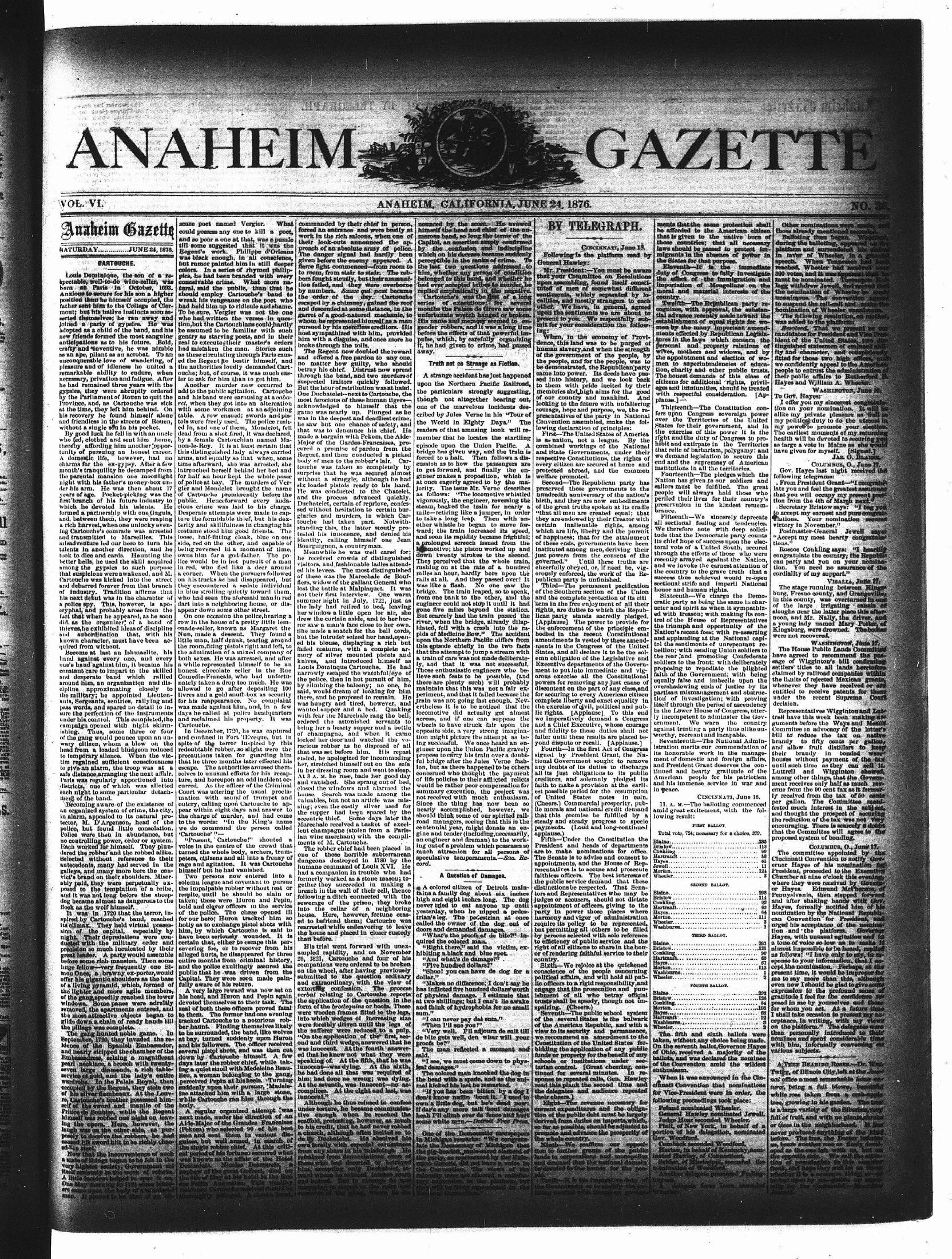
Searchable text
ANAHEIM GAZETTE
SATURDAY JUNE 24, 1876
CARTOUCHE.
Louis Dominique, the son of a respectable, well-to-do wine-seller, was born at Paris in October, 1853. Anxious to secure for his son a higher position than he himself occupied, the father sent him to the College of Clermont; but his native instincts soon asserted themselves; he ran away and joined a party of gypsies. He was adopted as a child of the band, and his new friends formed the most sanguine anticipations as to his future. Bold, crafty and inventive, he was nimble as an ape, pliant as an acrobat. To an unconquerable love of wandering, of pleasure and of idleness he united a remarkable ability to endure, when necessary, privation and fatigue. After he had remained three years with the gypsies, they were abruptly ordered by the Parliament of Rouen to quit the Province, and, as Cartouche was sick at the time, they left him behind. On his recovery he found himself alone and friendless in the streets of Rouen, without a single son in his pocket.
By good luck he fell in with an uncle who fed, clothed and sent him home, thereby affording him another opportunity of pursuing an honest career. A domestic life, however, had no charms for the ex-gypsey. After a few secure poet named Vergier. What could possess any one to kill a poet, and so poor a one at that, was a puzzle till some suggested that it was the Regent's work. Philippe d'Orleans was black enough, in all conscience, but rumor painted him in still deeper colors. In a series of rhymed philippics, he had been branded with every conceivable crime. What more natural, said the public, than that he should employ Cartouche's band to wreak his vengeance on the poet who had held him up to ridicule and shame. To be sure, Vergier was not the one who had written the verses in question, but the Cartouchians could hardly be assumed to be familiar with such gentry as starving poets, and in their zeal to execute their master's orders had mistaken the man. Stories such as these circulating through Paris caused the Regent Joa bestir himself, and the authorities loudly demanded Cartouche; but, of course, it was much easier to ask for him than to get him.
Another murder now occurred to add to the public agitation. Cartouche and his band were carousing at a cabaret, when they got into an altercation with some workmen at an adjoining table. A row ensued; swords and pistols were freely used. The police rushed in, and one of them, Mondelot, fell dead from a shot fired, it was declared, by a female Cartouchian named Manon-le-Roy. It is at least certain that this distinguished lady always carried arms, and equally so that when some time afterward, she was arrested, she was intrugged herself behind her bed and commanded by the forced an entrance work in the rich saitheir look-outs and proach of an absolu. The danger signal given before the en fierce fight commenced to mom, from stairbars fought stoutly, tion failed, and tha by numbers. Same the order of the escaped by a chimney and descended at so garret of a good-nail whom he represents pursued by his men host sympathized with him with a disguise broke through the wall.
The Regent now offered a free pity no matter how betray his chief. Through the band, no suspected traitors But the hour of retrie One Duchatelet—nearest most ferocious of the acknowledged to game was nearly uwas in the deepest ahe saw but one chlthat was to denounce made a bargain witMajor of the Garden cured a promise oRegent, and then body of men to the touche was taken
remarkable ability to endure, when necessary, privation and fatigue. After he had remained three years with the gypsies, they were abruptly ordered by the Parliament of Rouen to quit the Province, and, as Cartouche was sick at the time, they left him behind. On his recovery he found himself alone and friendless in the streets of Rouen, without a single son in his pocket.
By good luck he fell in with an uncle who fed, clothed and sent him home, thereby affording him another opportunity of pursuing an honest career. A domestic life, however, had no charms for the ex-gypsy. After a few months's tranquility he decamped from the parental mansion one moonlight night with his father's money-box under his arm. He was then about 17 years of age. Pocket-pickling was the first branch of his future industry to which he devoted his talents. He formed a partnership with one Gagulis, and between them, they were reaping a rich harvest, when one unlucky evening Cartouche's comrade was arrested and transmitted to Marseilles. This misadventure led our hero to turn his talents in another direction, and he took to dice and cards. Haunting the better hells, he used the skill acquired among the gypsies to such purpose that suspicions were awakened, and M. Cartouche was kicked into the street and deburred forever from that branch of industry. Tradition affirms that his next debut was in the character of a police spy. This, however, is apocryphal, and probably arose from the fact that when he appeared, as he soon did, as the organizer of a band of thieves, he exhibited ideas of discipline and subordination that, with his known character, must have been acquired from without.
Become at last an Ishmaellite, his hand against every one, and every one's hand against him, it became his constant care to impart to the skilled and desperate band which rallied around him, an organization and discipline approximating closely to the military; he appointed Lleutenants, Sergeants, sentries, rallying and pass words, and spared no detail to insure the perfection of the instruments under his control. This completed, the campaign opened with night skirmishing. Thus, some three or four of the gang would pounce upon an unwary citizen, whom a blow on the head from a loaded bludgeon reduced to temporary alliance. When the victim regained sufficient consciousness to give an alarm, the troop was at a safe distance, arranging the next affair. Paris was regularly apportioned into districts, one of which was allotted each night to some particular detachment of the band.
Becoming aware of the existence of an organized system of crime, the city, in alarm, appealed to its natural protector, M. D'Argenson, head of the police, but found little consolation. Police were then in abundance, but no controlling power, order or system. Each worked for himself. They plundered the robber and the robbed alike. Selected without reference to their antecedents, many had served in the galleys, and many more bore the convict's brand on their shoulders. Miserably paid, they were perpetually exposed to the temptation of a bride.
Another murder now occurred to add to the public agitation. Cartouche and his band were carousing at a cabaret, when they got into an altercation with some workmen at an adjoining table. A row ensued; swords and pistols were freely used. The police rushed in, and one of them, Mondelot, fell dead from a shot fired, it was declared, by a female Cartouchian named Manon-le-Roy. It is at least certain that this distinguished lady always carried arms, and equally so that when some time afterward, she was arrested, she intreached herself behind her bed and for half an hour kept the whole posse of police at bay. The murders of Vergler and Mondelot brought the name of Cartouche prominently before the public. Henceforward every audacious crime was laid to his charge. Desperate attempts were made to capture the formidable thief, but his dexterity and skillfulness in changing his costume stood him good friends. The loose, half-fitting cloak, blue on one side, red on the other, and capable of being reversed in a moment of time, owns him for a god-father. The police would be in hot pursuit of a man in red, who fled like a deer around a corner. When the pursuers followed on his tracks he had disappeared, but they encountered a sedate individual in blue strolling quietly toward them, who had seen the aforesaid man in red dart into a neighboring house, or disappear down some other street.
On one occasion the police, hearing a row in the house of a pretty little lemonade-seller, known as Margaret the Nun, made a descent. They found a little man, half drunk, tearing around the room,firing pistols right and left, to the admiration of a mixed company of both sexes. He was arrested,and after a while represented himself to be an honest chocolate seller in the Rue Comédie-Francals who had unfortunately taken a drop too much. He was allowed to go after depositing 100 livres and a gold sniff-box as security for his reappearance. No complaint was made against him,and in a few days he called at police headquarters and reclaimed his property. It was Cartouche.
In December, 1720, he was captured and confined in Fort 'Eveque,but in spite of the terror inspired by this redoubtable robber,solely were the precautions taken for guarding him that he three months later effected his escape.The authorities aroused themselves to unusual efforts for his recapture,and hereupon an odd incident occurred.As the officer of the Criminal Court was uttering the usual proclamation with sound of trumpet and outcry,calling upon Cartouche to appear within eight days and answer to the charge of murder,and had come to the words: "In the King's name we do command the person called 'Cartouche'."
"Present,' Cartouche!" shouted a voice in the centre of the crowd that turned the whole body,archers,triumpers,citizens and all into a frenzy of rage and agitation. It was Cartouche himself but he had vanished.
Two persons now entered into a solemn league and covenant to pursue the impalable robber without rest or beating his other hand.Both the hour of retaliation One Duchatelet—nearest most ferocious to any acknowledged to game was nearly unseen in the deepest part he saw but one chin that was to denounce made a bargain with Major of the Garden-cured a promise owed Begent,and then cried body of men to the touchohe was taken surprise that he woke without a struggle six loaded pistols rifeHe was conducted and the process of Duchatelet,certain sed without hesitate glaries and murder touche had taken standing this,the tested his innocence identity,calling H Bourguignon,a courteous meanwhile he was received crowds visitors,and fashioned his leeves.The off these was the Mifers widowofthe grief lostthe battle at Minnot their first interment summer night in Juleady had retired her window a little drew the curtain askor saw a man's faceShe made a snatch fi but the intruder seized his blouse,displayed costume,many oxy of silver mo knives,and introduced Louis Dominque Car narrowly escaped tha police,thein h by climbingthe ball said.would dream o there,and he proposed was hungry and tha wanted supper and tha with fear the Mare ordered bring her a hearty set of champagne,and locked her door and racious robber as he that was set before ended,hе apologized her,t stretched himself At 3 A.M.m he rose.land vanished.She closed the windows house.Search was valuables,但 not as sing;even the costlythe supper had been eccentric thief.So Marechale received lent champagne(stolen wine merchant)ments of M.Cartouche.
The robber chief I knew of those horn dungeons destroyed humane commandershad a companion in formerly worked as gether they succeed
Becoming aware of the existence of an organized system of crime, the city, in alarm, appealed to its natural protector, M. D'Argenson, head of the police, but found little consolation. Police were then in abundance, but no controlling power, order or system. Each worked for himself. They plundered the robber and the robbed alike. Selected without reference to their antecedents, many had served in the galleys, and many more bore the convict's brand on their shoulders. Miserably paid, they were perpetually exposed to the temptation of a bribe, and it was not long before the sheepdog became almost as dangerous to the flock as the wolf himself.
It was in 1720 that the terror, inspired by Cartouche's band, reached its climax. They held virtual possession of the capital, especially by night. Their depredations were conducted with the military order and precision so much inculcated by their great leader. A party would assemble before some rich mansion. Then some huge fellow—very frequently one Simon Once, a brawny ex-porter, would offer his gigantile shoulders as the base of a living pyramid, which, formed of the lighter and more agile members, of the gang speedily reached the lower windows. Some panes were adroitly removed, the apartments entered, and the most attractive objects began to glide down a chain of ready hands till the pillage was complete.
The gang hunted noble game. In September, 1720, they invaded the residence of the Spanish Embassador, and nearly stripped the chamber of the Embassadors, seizing a magnificent pearl necklace, a brooch with twenty-seven large diamonds, a rich table-service of gold, and the lady's entire wardrobe. In the Palais Royal, then occupied by the Regent, they stole two of his silver flambeaux. At the Louvre, Cartouche's brother possessed himself of the sword and mantle of the Prince de Sonbise, while the Regent himself was robbed one night on learning the opera. Here, however, the laugh was on the other side, as purposefully to devolve the robbers, he had caused his sword hilt to be richly chained-in steel.
Now that the insaneness of such a state of things begin to be felt in the very highest society; Government set itself seriously in the work of reform. A little incident helped to spur it on. One May morning at 1721 some librarians came upon the body of a man named Man.
Court was uttering the usual proclamation with sound of trumpet and outcry, calling upon Cartouche to appear within eight days and answer to the charge of murder, and had come to the words: "In the King's name we do command the person called 'Cartouche'."
"Present," Cartouche!" shouted a voice in the centre of the crowd that turned the whole body, archers, trumpeters, citizens and all into a frenzy of rage and agitation. It was Cartouche himself but he had vanished.
Two persons now entered into a solemn league and covenant to pursue the impalpable robber without rest or respite, until he should be slain or taken; these were Huron and Pepin, bold and clever officers in the service of the police. The chase opened ill for our hero; Huron tracked him so hotly as to exchange pistol shots with him, by which Cartouche is said to have been seriously wounded. It is certain that, either to escape this persevering foe, or to recover from his alleged hurts, he disappeared for three entire months from criminal history, and the police exultingly assured the public that he was driven from the Capital. They were soon made painfully aware of his return.
A very large reward was now set on his head, and Huron and Pepin again devoted themselves to their task. The zeal of both these officers proved fatal to them. The former had one evening tracked Cartouche to a notorious robber haunt. Finding themselves likely to be surrounded, the band, like wolves at bay, turned suddenly upon Huron and his followers. The officer received several pistol shots, and was then cut down by Cartouche himself. A few days later the robber chief, while taking a quiet stroll with Medeleine Beauilleu, a woman belonging to the gang, perceived Pepin at his heels. Turning suddenly upon their pursuer, Medeleine attacked him with a large stone, while Cartouche ran him through the body.
A regular organized attempt "was next made, under the direction of an Alda-Major of the Grandes Françaises (Fekom) who selected 90 of his best men and sent them in various disguises, but well armed, in search of the single robber chief. At this critical period of his fortune occurred what was known as the affair of the Hotel Desmarteux. Nicolas Desmarteux, a nephew of the great Golbert, died on the 5th of May at his hotel in the fine Paris Augustus. This wealthy mobster Cartouche resolved should be immediately put off.
His trial went forample rapidity, at 26, 1821; Cartouche companions were on on the wheel; after submitted to the extraordinary extorting confessional verbal relating to the application of the form of the brodeque were wooden frames into which wedged were forcibly driven; the sufferer were not "On the application oud and third wedge was innocent. Atted that he knew not speaking of. At this innocence—was dying he had done all that him; had done no wrong at the seventh, was complains. At the ninth innocent."
Although he thus under torture, he has live enough when scaffold protesting to his credit; that he a church although da by Duchatelet own family with son from any share in his refrained from denouncing those who had done him; accepting one ward whom he swift and baked. But he unimaginably let him unwind...
ANAHEIM, GALIFORNIA, JUNE 24, 1876.
commanded by their chief in person, forced an entrance and were badly at work in the rich saloons, when one of their look-outs announced the approach of an absolute army of police. The danger signal had hardly been given before the enemy appeared. A fierce fight commenced—from room to room, from stair to stair. The robbers fought stoutly, but their ammunition failed, and they were overborne by numbers. Sauve qui peut became the order of the day. Cartouche escaped by a chimney, gained the roof and descended at some distance. In the garret of a good-natured mechanic, to whom he represented himself as a man pursued by his merciless creditors. His host sympathized with him, provided him with a disguise, and once more he broke through the toils.
The Regent now doubled the reward and offered a free pardon to any one, no matter how guilty, who should betray his chief. Distrust now spread through the band, and two murders of suspected traitors quickly followed. But the hour of retribution was at hand. One Duchatelet—next to Cartouche, the most ferocious of these human tigers—acknowledged to himself that the game was nearly up. Plunged as he was in the deepest and deadliest crime, he saw but one chance of safety, and that was to denounce his chief. He made a bargain with Pekom, the Aide-Major of the Gardes-Franaises, procured a promise of pardon from the Regent, and then conducted a pickled body of men to the robber's lair. Cartouche was taken so completely by
nounced by the score. He avowed himself the head and chief of the numerous band, so long the terror of the Capitol, an assertion simply confirmed by the confusion and indiscipline which on his decease became suddenly perceptible in the ranks of crime. To the last two questions addressed to him, whether any person of condition belonged to this band, and whether he had ever accepted bribes to murder, he replied emphatically in the negative.
Cartouche's was the first of a long series of executions; for several months the Palsce de Greve saw some unfortunate wretch hanged or broken. His name and memory seemed to engender robbers, and it was a long time before the effects of that powerful impulse, which, by carefully organizing it, he had given to crime, had passed away.
Truth not so Strange as Fiction.
A strange accident has just happened upon the Northern Pacific Railroad, the particulars strongly suggesting, though not altogether bearing out, one of the marvelous incidents described by Jules Verne in his "Tour of the World in Eighty Days." The readers of that amusing book will remember that he locates the startling episode upon the Union Pacific. A bridge has given way, and the train is forced to a halt. Then follows a discussion as to how the passengers are to get forward and finally on
BY TELEGRAPH.
CINCINNATI, June 15.
Following is the platform read by General Hawley:
Mr. President:—You must be aware that your Committee on Resolutions upon assembling, found itself constituted of men of somewhat different sentiments, widely separated by localities, and mostly strangers to each other. We have, in general, agreed upon the sentiments we are about to present to you. We respectfully submit for your consideration the following:
When, in the economy of Providence, this land was to be purged of human slavery,and when the strength of the government of the people, by the people, and for the people, was to be demonstrated,the Republican party came into power. Its deeds have passed into history, and we look back to them with pride incited by their memories and high alms for the good of our country and mankind. And looking to the future with unfaltering courage, hope and purpose, we, the representatives of the party in National Convention assembled, make the following declaration of principles:
First—The United States of America is a nation, not a league. By the combined workings of the National and State Governments, under their respective Constitutions, the rights of every citizen are secured at home and protected abroad.
Distrust now spread through the band, and two murders of suspected traitors quickly followed. But the hour of retribution was at hand. One Duchatelet—next to Cartouche, the most ferocious of these human tigers—acknowledged to himself that the game was nearly up. Plunged as he was in the deepest and deadliest crime, he saw but one chance of safety, and that was to denounce his chief. He made a bargain with Pekom, the Aide-Major of the Gardes-Francaises, procured a promise of pardon from the Regent, and then conducted a picked body of men to the robber's hair. Cartouche was taken so completely by surprise that he was secured almost without a struggle, although he had six loaded pistols ready to his hand. He was conducted to the Chatelet, and the process advanced quickly. Duchatelet, certain of reprieve, confessed without hesitation to certain burglaries and murders, in which Cartouche had taken part. Notwithstanding this, the latter stoutly protested his innocence, and denied his identity, calling himself one Jean Bourguignon, a countryman.
Meanwhile he was well cared for; he received crowds of distinguished visitors, and fashionable ladies attended his levees. The most distinguished of these was the Marechale de Bouviers, widow of the gallant General who lost the battle at Malplaquet. It was not their first interview. One warm summer night in July, 1721, just as the lady had retired to bed, leaving her window a little open for air, she drew the curtain aside, and to her horror saw a man's face close to her own. She made a snatch for the bell cords, but the intruder seized her hand, opened his blouse, displaying a rich but faded costume, with a complete armory of silver mounted pistols and knives, and introduced himself as Louis Dominque Cartouche. He had narrowly escaped the watchful eye of the police, then in hot pursuit of him, by climbing the balcony; no one, he said, would dream of looking for him there, and he proposed to remain. He was hungry and tired, however, and wanted supper and a bed. Quaking with fear the Marechale rang the bell, ordered the astonished servants to bring her a hearty supper and a bottle of champagne, and when it came locked her door and watched the voacious robber as he disposed of all that was set before him. His repast ended, he apologized for incommoding her, stretched himself out on the sofa in her dressing room and went to sleep. At 3 A.M. he rose, bade her good day and vanished. She sprang out of bed, closed the windows and alarmed the house. Search was made among the valuables, but not an article was missing; even the costly silver used for the supper had been spared by the eccentric thief. Some days later the Marechale received a basket of excellent champagne (stolen from a Parisian wine merchant) with the compliments of M. Cartouche.
The robber chief had been placed in one of those horrible subterranean dungeons destroyed in 1780 by the humane command of Louis XVI. He had a companion in trouble who had formerly worked as a stone mason; together they succeeded in making a match in the dark alleys.
A strange accident has just happened upon the Northern Pacific Railroad, the particulars strongly suggesting, though not altogether bearing out, one of the marvelous incidents described by Jules Verne in his "Tour of the World in Eighty Days." The readers of that amusing book will remember that he locates the startling episode upon the Union Pacific. A bridge has given way, and the train is forced to halt. Then follows a discussion as to how the passengers are to get forward, and finally the engineer makes a proposition, which is at once eagerly agreed to by the majority. The issue Mr. Verne describes as follows: "The locomotive whistled vigorously, the engineer, reversing the steam, backed the train for nearly a mile—retiring like a jumper, in order to take a long leap. Then with another whistle he began to move forward; the train increased its speed, and soon its rapidity became frightful; a prolonged screech issued from the motive; the piston worked up and down twenty strokes to the second. They perceived that the whole train, rushing on at the rate of a hundred miles an hour, hardly bore upon the rails at all. And they passed over! It was like a flash. No one saw the bridge. The train leaped, so to speak, from one bank to the other, and the engineer could not stop it until it had gone five miles beyond the station. But scarcely had the train passed the river, when the bridge, already dilapidated, fell with a crash into the rapids of Medicine Bow."
The accident upon the Northern Pacific differs from this episode chiefly in the two facts that the attempt to jump a stream with a train of cars was not made deliberately, and that it was not successful. Those enthusiastic engineers who believe such feats to be possible (and there are plenty such) will probably maintain that this was not a fair experiment, and that it failed because the train was not going fast enough. Nevertheless it is to be noticed that the locomotive did actually get almost across, and if one can suppose the wheels to have struck fair upon the opposite side, a very strong imagination might pleture at being successful. We once heard an engineer upon the Union Pacific gravelly propose to carry his train over a doubtful bridge after the Jules Verne fashion, but as there happened to be others concerned who thought the payment of life policies to their afflicted relicts would be rather poor compensation for summary execution, the project was not received with much enthusiasm. Since the thing has now been so nearly accomplished, however, we should think some of our spirited railroad managers, seeing that this is the centennial year, might donate an engine and tender (including necessarily an engineer and fireman) to the working out of a problem which possesses so much attraction for all persons of speculative temperaments.
A Question of Damages.
A colored citizen of Detroit main-county
Search was made among the valuables, but not an article was missing; even the costly silver used for the supper had been spared by the eccentric thief. Some days later the Marechale received a basket of excellent champagne (stolen from a Parisian wine merchant) with the compliments of M. Cartouche.
The robber chief had been placed in one of those horrible subterranean dungeons destroyed in 1780 by the humane command of Louis XVI. He had a companion in trouble who had formerly worked as a stone mason; together they succeeded in making a breach in the wall of their cell, thence following a ditch connected with the sewerage of the prison, they broke into the cellar of a neighboring house. Here, however, fortune ceased to befriend them; Cartouche was rearrested while endeavoring to leave the house and placed in closer custody than before.
His trial went forward with unexampled rapidity, and on November 26, 1821, Cartouche and four of his companions were ordered to be broken on the wheel, after having previously submitted to the question ordinary and extraordinary, with the view of extorting confession. The process verbal relating to Cartouche reports the application of the question in the form of the brodequine or boots. These were wooden frames fitted to the legs, into which wedges of increasing size were forebly driven until the legs of the sufferer were reduced to a pulp. "On the application of the first, second and third wedge, answered that he was innocent. At the fourth answered that he knew not what they were speaking of. At the fifth, that he was innocent—was dying. At the sixth, he had done all that was required of him; had done no wrong; was dying. At the seventh, was innocent—no accomplices. At the eight and last, was innocent."
Although he thus refused to confess under torture, he became communicative enough when he reached the scaffold, protesting, however, as much to his credit, that he had never robbed a church, although often incited so to do by Duchatelet. He absolved his own family with especial care from any share in his misadventures. He refrained from demonstrations even of those who had deserved or betrayed him excepting only Duchatelet, inward whom he evidently stern and hated. But in revenge he was unwilling to return to the same and presumably to the compliments of M. Cartouche.
The robber chief had been placed in one of those horrible subterranean dungeons destroyed in 1780 by the humane command of Louis XVI. He had a companion in trouble who had formerly worked as a stone mason; together they succeeded in making a breach in the wall of their cell, thence following a ditch connected with the sewerage of the prison, they broke into the cellar of a neighboring house. Here, however, fortune ceased to befriend them; Cartouche was rearrested while endeavoring to leave the house and placed in closer custody than before.
His trial went forward with unexampled rapidity, and on November 26, 1821, Cartouche and four of his companions were ordered to be broken on the wheel, after having previously submitted to the question ordinary and extraordinary, with the view of extorting confession. The process verbal relating to Cartouche reports the application of the question in the form of the brodequine or boots. These were wooden frames fitted to the legs, into which wedges of increasing size were forebly driven until the legs of the sufferer were reduced to a pulp. "On the application of the first, second and third wedge, answered that he was innocent. At the fourth answered that he knew not what they were speaking of. At the fifth, that he was innocent—was dying. At the sixth, he had done all that was required of him; had done no wrong; was dying. At the seventh, was innocent—no accomplices. At the eight and last, was innocent."
Although he thus refused to confess under torture, he became communicative enough when he reached the scaffold, protesting, however, as much to his credit, that he had never robbed a church, although often incited so to do by Duchatelet. He absolved his own family with special care from any share in his misadventures. He refrained from demonstrations even of those who had deserved or betrayed him excepting only Duchatelet, inward whom he evidently stern and hated. But in revenge he was unwilling to return to the same and presumably to the compliments of M. Cartouche.
The robber chief had been placed in one of those horrible subterranean dungeons destroyed in 1780 by the humane command of Louis XVI. He had a companion in trouble who had formerly worked as a stone mason; together they succeeded in making a breach in the wall of their cell, thence following a ditch connected with the sewerage of the prison, they broke into the cellar of a neighboring house. Here, however, fortune ceased to befriend them; Cartouche was rearrested while endeavoring to leave the house and placed in closer custody than before.
His trial went forward with unexampled rapidity, and on November 26, 1821, Cartouche and four of his companions were ordered to be broken on the wheel, after having previously submitted to the question ordinary and extraordinary, with the view of extorting confession. The process verbal relating to Cartouche reports the application of the question in the form of the brodequine or boots. These were wooden frames fitted to the legs, into which wedges of increasing size were forebly driven until the legs of the sufferer were reduced to a pulp. "On the application of the first, second and third wedge, answered that he was innocent. At the fourth answered that he knew not what they were speaking of. At the fifth, that he was innocent—was dying. At the sixth, he had done all that was required of him; had done no wrong; was dying. At the seventh, was innocent—no accomplices. At the eight and last, was innocent."
Although he thus refused to confess under torture, he became communicative enough when he reached the scaffold, protesting, however, as much to his credit, that he had never robbed a church, although often incited so to do by Duchatelet. He absolved his own family with special care from any share in his misadventures. He refrained from demonstrations even of those who had deserved or betrayed him excepting only Duchatelet, inward whom he evidently stern and hated. But in revenge he was unwilling to return to the same and presumably to the compliments of M. Cartouche.
The robber chief had been placed in one of those horrible subterranean dungeons destroyed in 1780 by the humane command of Louis XVI. He had a companion in trouble who had formerly worked as a stone mason; together they succeeded in making a breach in the wall of their cell, thence following a ditch connected with the sewerage of the prison, they broke into the cellar of a neighboring house. Here, however, fortune ceased to befriend them; Cartouche was rearrested while endeavoring to leave the house and placed in closer custody than before.
His trial went forward with unexampled rapidity, and on November 26, 1821, Cartouche and four of his companions were ordered to be broken on the wheel, after having previously submitted to the question ordinary and extraordinary, with the view of extorting confession. The process verbal relating to Cartouche reports the application of the question in the form of the brodequine or boots. These were wooden frames fitted to the legs, into which wedges of increasing size were forebly driven until the legs of the sufferer were reduced to a pulp. "On the application of the first, second and third wedge, answered that he knew not what they were speaking of. At the fifth, that he was innocent—was dying. At the sixth, he had done all that was required of him; had done no wrong; was dying. At the seventh, was innocent—no accomplices. At the eight and last, was innocent."
Although he thus refused to confess under torture, he became communicative enough when he reached the scaffold, protesting, however, as much to his credit, that he had never robbed a church, although often incited so to do by Duchatelet. He absolved his own family with special care from any share in his misadventures. He refrained from demonstrations even of those who had deserved or betrayed him excepting only Duchatelet, inward whom he evidently stern and hated. But in revenge he was unwilling to return to the same and presumably to the compliments of M. Cartouche.
The robber chief had been placed in one of those horrible subterranean dungeons destroyed in 1780 by the humane command of Louis XVI. He had a companion in trouble who had formerly worked as a stone mason; together they succeeded in making a breach in the wall of their cell, thence following a ditch connected with the sewerage of the prison, they broke into the cellar of a neighboring house. Here, however, fortune ceased to befriend them; Cartouche was rearrested while endeavoring to leave the house and placed in closer custody than before.
His trial went forward with unexampled rapidity, and on November 26, 1821, Cartouche and four of his companions were ordered to be broken on the wheel, after having previously submitted to the question ordinary and extraordinary, with the view of extorting confession. The process verbal relating to Cartouche reports the application of the question in the form of the brodequine or boots. These were wooden frames fitted to the legs, into which wedges of increasing size were forebly driven until the legs of the sufferer were reduced to a pulp. "On the application of the first, second and third wedge, answered that he knew not what they were speaking of. At the fifth, that he was innocent—was dying. At the sixth, he had done all that was required of him; had done no wrong; was dying. At the seventh, was innocent—no accomplices. At the eight and last, was innocent."
Although he thus refused to confess under torture, he became communicative enough when he reached the scaffold,protesting,however,as much to his credit,that他had never robbeda church,although often incitedso治byDuchatelet。Heabsolvedhisownfamilywithspecialcarefromanyshareinhismisadventures.HesrefrainedfromdemonstrationsevenofthosewhohaddeservedorbetrayedinexceptingonlyDuchatelet,inwardwhohereidentifiedso治byDuchatelet。Heabsolvedhisownfamilywithspecialcarefromanyshareinhismisadventures.HesrefrainedfromdemonstrationsevenofthosewhohaddeservedorbetrayedinexceptingonlyDuchatelet,inwardwhohereidentifiedso治byDuchatelet。Heabsolvedhisownfamilywithspecialcarefromanyshareinhismisadventures.HesrefrainedfromdemonstrationsevenofthosewhohaddeservedorbetrayedinexceptingonlyDuchatelet,inwardwhohereidentifiedso治byDuchatelet。Heabsolvedhisownfamilywithspecialcarefromanyshareinhismisadventures.HesrefrainedfromdemonstrationsevenofthosewhohaddeservedorbetrayedinexceptingonlyDuchatelet,inwardwhohereidentifiedso治byDuchatelet。Heabsolvedhisownfamilywithspecialcarefromanyshareinhismisadventures.HesrefrainedfromdemonstrationsevenofthosewhohaddeservedorbetrayedinexceptingonlyDuchatelet,inwardwhohereidentifiedso治byDuchatelet。Heabsolvedhisownfamilywithspecialcarefromanyshareinhismisadventures.HesrefrainedfromdemonstrationsevenofthosewhohaddeservedorbetrayedinexceptingonlyDuchatelet,inwardwhohereidentifiedso治byDuchatelet。Heabsolvedhisownfamilywithspecialcarefromanyshareinhismisadventures.HesrefrainedfromdemonstrationsevenofthosewhohaddeservedorbetrayedinexceptingonlyDuchatelet,inwardwhohereidentifiedso治byDuchatelet。Heabsolvedhisownfamilywithspecialcarefromanyshareinhismisadventures.HesrefrainedfromdemonstrationsevenofthosewhohaddeservedorbetrayedinexceptingonlyDuchatelet,inwardwhohereidentifiedso治byDuchatelet。Heabsolvedhisownfamilywithspecialcarefromanyshareinhismisadventures.HesrefrainedfromdemonstrationsevenofthosewhohaddeservedorbetrayedinexceptingonlyDuchatelet,inwardwhohereidentifiedso治byDuchatelet。Heabsolvedhisownfamilywithspecialcarefromanyshareinhismisadventures.HesrefrainedfromdemonstrationsevenofthosewhohaddeservedorbetrayedinexceptingonlyDuchatelet,inwardwhohereidentifiedso治byDuchatelet。Heabsolvedhisownfamilywithspecialcarefromanyshareinhismisadventures.HesrefrainedfromdemonstrationsevenofthosewhohaddeservedorbetrayedinexceptingonlyDuchatelet,inwardwhohereidentifiedso治byDuchatelet。Heabsolvedhisownfamilywithspecialcarefromanyshareinhismisadventures.HesrefrainedfromdemonstrationsevenofthosewhohaddeservedorbetrayedinexceptingonlyDichotelet,inwardwhohereidentifiedso治byDichotelet。Heabsolvedhisownfamilywithspecialcarefromanyshareinhismisadventures.HesrefrainedfromdemonstrationsevenofthosewhohaddeservedorbetrayedinceptingonlyDichotelet,inwardwhohereidentifiedso治byDichotelet。Heabsolvedhisownfamilywithspecialcarefromanyshareinhismisadventures.HesrefrainedfromdemonstrationsevenofthosewhohaddeservedorbetrayedinceptingonlyDichotelet,inwardwhohereidentifiedso治byDichotelet。Heabsolvedhisownfamilywithspecialcarefromanyshareinhismisadventures.HesrefrainedfromdemonstrationsevenofthosewhohaddeservedorbetrayedinceptingonlyDichotelet,inwardwhohereidentifiedso治byDichotelet。Heabsolvedhisownfamilywithspecialcarefromanyshareinhismisadventures.HesrefrainedfromdemonstrationsevenofthosewhohaddeservedorbetrayedinceptingonlyDichotelet,inwardwhohereidentifiedso治byDichotelet。Heabsolvedhisownfamilywithspecialcarefromanyshareinhismisadventures.HesrefrainedfromdemonstrationsevenofthosewhohaddeservedorbetrayedinceptingonlyDichotelet,inwardwhohereidentifiedso治byDichotelet。Heabsolvedhisownfamilywithspecialcarefromanyshareinhismisadventures.HesrefrainedfromdemonstrationsevenofthosewhohaddeservedorbetrayedinceptingonlyDichotelet,inwardwhohereidentifiedso治byDichotelet。Heabsolvedhisownfamilywithspecialcarefromanyshareinhismisadventures.HesrefrainedfromdemonstrationsevenofthosewhohaddeservedorbetrayedinceptingonlyDichotelet,inwardwhohereidentifiedso治byDichotelet。Heabsolvedhisownfamilywithspecialcarefromanyshareinhismisadventures.HesrefrainedfromdemonstrationsevenofthosewhohaddeservedorbetrayedinceptingonlyDichotelet,inwardwhohereidentifiedso治byDichotelet。Heabsolvedhisownfamilywithspecialcarefromanyshareinhismisadventures.HesrefrainedfromdemonstrationsevenofthosewhohaddeservedorbetrayedinceptingonlyDichotelet,inwardwhohereidentifiedso治byDichotelet。Heabsolvedhisownfamilywithspecialcare从anyshareinthisisadventure。Hesrefrainedfromdemonstrationsevenfortheresumptionofthepublicserviceandtherightofallcitizenstoshareinthehonorofrenderingfaithfulservicetotheircountry。
Sixth—We rejoice atthequickenedconscienecohesionofthepeopleconcerningpoliticalaffairs,andwillholdallpublicofficerstoa rigid responsibility,andengagetheprosecutionandpunishmentofallwhobetrayofficialtrustsshallbe speedy,toughnotunswerving.(Cheers.)
Seventh—ThepublicschoolsystemoftheseveralStatesisbulwarkoftheAmericanRepublic,andwithaviewtoitssecurityandpermanence,therecommendationtotheconstitutionandpunishmentoftheallwhobetrayofficialtrustsshallbe speedy,toughnotunswerving.(Cheers.)
Seventh—We rejoice atthequickenedconscienecohesionofthepeopleconcerningpoliticalaffairs,andwillholdallpublicofficerstoa rigid responsibility,andengagetheprosecutionandpunishmentoftheallwhobetrayofficialtrustsshallbe speedy,toughnotunswerving.(Cheers.)
GAZETTE
NO. 36.
GRAPH.
MINNATI, June 15.
platform read by
You must be aware of Resolutions and itself constituted somewhat different separated by lo-strangers to each general, agreed we are about to respectfully sub-ration the follow-
economy of Provi-
to be purged of when the strength of the people, by the people, was to the Republican party deeds have pass-
and we look back is incited by their claims for the good mankind. And we with unfaltering purpose, we, the re-party in Nationalized, make the fol-
principles:
States of America league. By the of the National events, under their rights of secured at home and
ments that the same protection shall be afforded to the American citizen that is given to the native born of those countries; that all necessary laws should be passed to protect immigrants in the absence of power in the States for that purpose.
Eleventh—It is the immediate duty of Congress to fully investigate the effect of the immigration and importation of Mongolians on the moral and material interests of the country.
Twelfth—The Rejublican party recognizes, with approval, the substantial advance recently made toward the establishment of equal rights for women by the many important amendments effected by Republican Legislatures in the laws which concern the personal and property relations of wives, mothers and widows, and by the appointment and election of women to superintendencies of education, charity and other public trusts. The honest demands of this class of citizens for additional rights, privileges and immunities, should be treated with respectful consideration. [Applause.]
Thirteenth—The Constitution confers upon Congress sovereign power over the Territories of the United States for their government, and in the exercise of this power it is the right and the duty of Congress to prohibit and extirpate in the Territories that relic of barbarism, polygamy: and we demand legislation to secure this end and the supremacy of American institutions in all the territories.
Other nominations were made and those already mentioned seconded.
Balloting then began. Woodland during the balloting, appeared on the platform and surrendered his claim in favor of Wheeler, in a grand speech. When Tennessee had hand reached, Wheeler had received over 300 votes, and it was apparent that he must be nominated. Thousands Kahlogg withdraw Jewell, and moved that the nomination of Wheeler be made unanimous. The convention agreed to suspend the roll-call and make the nomination of Wheeler unanimous.
The following resolution, on motion, was added to the platform:
Resolved, That we present our candidates for President and Vice President of the United States, two distinguished statesmen of eminent ability and character, and conspicuously fitted for those two high offices, and we confidently appeal to the Americans people to entrust the administration of their public affairs to Rutherford B. Hayes and William A. Wheeler.
WASHINGTON, June 18:
To Gov. Hayes:
I offer you my sincere congratulation on your nomination. It will be alike my private pleasure as well as my political duty to do the utmost in my power to promote your election. The earliest moments of my returning health will be devoted to securing you as large a vote in Maine as she would have given for myself. [Signed.]
JAR. G. BLAINE.
COLUMBUS, O., June 17.
The Constitution confers upon Congress sovereign power over the Territories of the United States for their government, and in the exercise of this power it is the right and duty of Congress to prohibit and extirpate in the Territories that relic of barbarism, polygamy; and we demand legislation to secure this end and the supremacy of American institutions in all the territories.
Fourteenth—The pledges which the Nation has given to our soldiers and sailors must be fulfilled. The great people will always hold those who periled their lives for their country's preservation in the kindest remembrance.
Fifteenth—We sincerely deprecate all sectional feeling and tendencies. We therefore note with deep solicitude that the Democratic party counts its chief hope of success upon the electoral vote of a United South, secured through the efforts of those who were recently arrayed against the Nation, and we invoke the earnest attention of the country to the grave truth that a success thus achieved would re-open sectional strife and imperil National honor and human rights.
Sixteenth—We charge the Democratic party as being the same in character and spirit as when it sympathized with treason; with making its control of the House of Representatives the triumph and opportunity of the Nation's recent foes; with re-asserting and applauding at the National capitol the sentiments of unrepentant rebellion; with sending Union soldiers to the rear and promoting Confederate soldiers to the front; with deliberately proposing to repudiate the plighted faith of the Government; with being equally false and imbecile upon the overshadowing ends of justice by its partisan mismanagement and obstruction of investigation; with proving itself through the period of ascendency in the Lower House of Congress, utterly incompetent to administer the Government. We warn the country against trusting a party thus alike unworthy, recreant and incapable.
Seventeenth—The Administration merits our commendation of its honorable work in the management of domestic and foreign affairs, and President Grant deserves the continued and hearty gratitude of the American people for his patriotism and his immense service in war and in peace.
CINCINNATI, June 16.
11. A. M.—The balloting commenced amid great excitement, with the following result:
FIRST BALLOT.
Total vote, 754; necessary for a choice, 379.
Blaine.....285
Brislow.....113
Conkling.....99
Hartranft.....58
Hayes.....61
Jewell.....11
Morrison.....124
Wiseler.....8
SECOND BALLOT.
People to entrust the administration of their public affairs to Rutherford B. Hayes and William A. Wheeler.
WASHINGTON, June 10:
To Gov. Hayes:
I offer you my sincere congratulation on your nomination. It will be alike my private pleasure as well as my political duty to do the utmost in my power to promote your election. The earliest moments of my returning health will be devoted to securing you as large a vote in Maine as she would have given for myself. [Signed.]
JAR. G. BLANE.
Columbus, O., June 17.
Gov. Hayes last night received the following telegrams:
From President Grant—"I congratulate you and feel the greatest assurance that you will occupy my present position from the 4th of March next."
Secretary Bristow says: "I beg you to accept my earnest and pure congratulations. Your nomination assured victory in November."
Postmaster-General Jewell says: "Accept my most hearty congratulations."
Rosecoe Conkling says: "I heartily congratulate the country; the Republic can party and you on your nomination. You need no assurance of the cordiality of my support."
VISALLA, June 17.
The stage running between Kingsburg, Fresno county, and Grangeville, in this county, was overturned in one of the large irrigating canals of sloughs near the latter place this afternoon, and Mr. Nally, the driver, and a young lady named Mary Potter, of Kingsburg, were drowned. The bodies were not recovered.
WASHINGTON, June 17.
The House Public Lands Committee have agreed to recommend the passage of Wigginton's bill confirming settlers' titles to all lands hereof claimed by railroad companies within the limits of rejected Mexican grants, whenever they have received or are entitled to receive patents for them under the recent Supreme Court decision.
Representatives Wigginton and Luttrell have this week been making arguments before the Ways and Measures Committee in advocacy of the latter's bill to reduce tax on native brandy to fifty cents per gallon, and allow fruit distillers to keep their brandy in bonded warehouses without payment of the tax until such time as they can sell it. Luttrell and Wigginton showed, among other things, that the Government receives only half as much revenue from the 90 cent tax as it formerly received from the tax of 50 cents per gallon. The Committee manifested much interest in the subject, and thought the prospect of securing the reduction of the tax was not very encouraging. There is scarcely a doubt that the Committee will agree to the proposed system of bonding.
Columbus, O., June 17.
The committee appointed by the Cincinnati Convention to notify Governor Hayes of his nomination for President, proceeded to the Executive Chamber at nine o'clock this evening, where they were received by Governor Hayes. Edmund McPherson, of
CINCINNATI, June 16.
11. A. M.—The balloting commenced amid great excitement, with the following result:
FIRST BALLOT.
Total vote, 754; necessary for a choice, 379.
Blaine...285
Bristow...113
Conkling...99
Hartranft...58
Hayes...61
Jewell...11
Morton...124
Wheeler...3
SECOND BALLOT.
Blaine...298
Bristow...114
Conkling...93
Hartranft...63
Hayes...64
Morton...111
Wheeler...3
Washburne...1
THIRD BALLOT.
Blaine...293
Bristow...121
Conkling...90
Hartranft...68
Hayes...67
Morton...113
Washburne...1
Wheeler...2
FOURTH BALLOT.
Blaine...292
Bristow...126
Conkling...84
Morton...108
Bayes...68
Hartranft...12
Washburne...3
Wheeler...2
The fifth and sixth ballots were taken, without any choice being made. On the seventh ballot, Governor Hayes of Ohio, received a majority of the ballots, and was declared the nominee of the Convention amid the wildest enthusiasm.
When it was announced in the Cincinnati Convention that nominations for Vice-President were in order, the following proceedings took place:
Peland nominated Wheeler.
General Hawley nominated Jewell.
Judge Hoar seconded Wheeler.
Flatt, of New York, in behalf of a portion of his delegation, nominated Gov. Woodford.
Cumbuck seconded Woodford.
Harlan, in behalf of Kentucky, nominated Hawley, of Connecticut.
Settlen, of Mississippi, seconded the nomination of Woodford.
Another delegate presented Priling-hayes.
A delegate from town named Wheeler.
Columbus, O., June 17.
The committee appointed by the Cincinnati Convention to notify Governor Hayes of his nomination for President, proceeded to the Executive Chamber at nine o'clock this evening, where they were received by Governor Hayes. Edmund McPherson, of Pennsylvania, then stepped forward and after shaking hands with Gov. Hayes, formally notified him of his nomination by the National Republican Convention for President, and urged his acceptance of the nomination and the platform. Governor Hayes, with unusual agitation and in a tone of voice so low as to make if almost impossible to be heard, replied as follows: "I have only to say, in response to your information, that I accept the nomination. Perhaps, at the present time, it would be improper for me to say more than this, although even now I should be glad to give some expression to the profound sense of gratitude I feel for the confidence proposed in me by yourselves and them for whom you act. At a future time I shall take occasion to present my acceptance, in writing, with my views on the platform." The delegates were then personally introduced to their nominees and spent considerable time with him, informally convening on various subjects.
A TREE BEARING ROOM—Dr. Walt Twigg, of Illinois City, left at the Journal office a most remarkable home nature, being a full blown, beautiful while rose taken from a crab-apple tree, growing in his garden. The tree is a large variety of the Silberian very full of fruit, and with no plumshrub or trees in the neighborhood. It has never produced anything of the kind before. The tree, the Doctor informs us, bears another rose as finely developed as the one left with us, but on opposite side. We call the situation of presidentialists in this situation frankly and hope they will let us know whether it is a common thing or not.