anaheim-gazette 1876-06-17
Scanned page
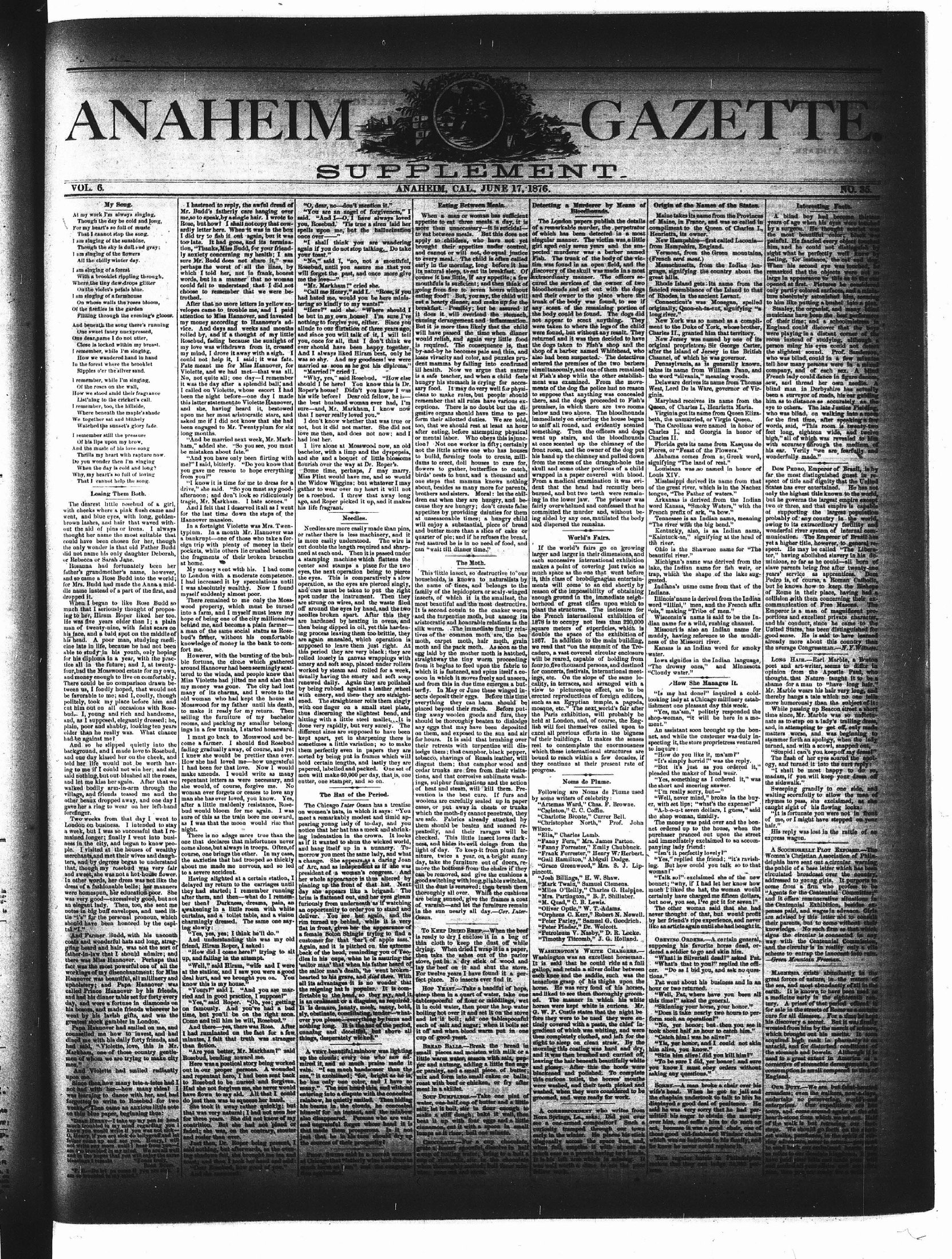
Searchable text
ANAHEIM
VOL 6.
My Song.
At my work I'm always singing,
Though the day be cold and long,
For my heart's so full of music
That I cannot stop the song.
I am singing of the sunshine,
Though the sky is dull and gray;
I am singing of the flowers
All the chilly winter day.
I am singing of a forest
With a brooklet rippling through,
Where the tiny dewdrops glitter
On the violet's petals blue.
I am singing of a farmhouse
On whose walls the roses bloom,
Of the fireflies in the garden
Flitting through the evening's gloom.
And beneath the song there's running
One sweet fancy unexpressed,
One dear name I do not utter,
Close is locked within my breast.
I remember, while I'm singing,
How we wandered hand in hand
In the forest where the brooklet
Ripples o'er the silver sand.
I remember, while I'm singing,
Of the roses on the wall,
How we stood amid their fragrance
Listening to the cricket's call.
I remember, too, the hillside,
Where beneath the maple's shade
We together sat and blithely
Watched the sunset's glory fade.
I remember still the pressure
Of his lips upon my brow,
And the music of his love-song
Thrills my heart with rapture now.
Do you wonder then I'm singing
When the day is cold and long?
I hastened to reply, the awful dread of Mr. Budd's fatherly care hanging over me, so to speak, by a single hair. I wrote to Rose, but how? I shall not copy that cowardly letter here. When it was in the box I did try to fish it out again, but it was too late. It had gone, and its termination, "Thanks, Miss Budd, for your friendly anxiety concerning my health; I am sure Mr. Budd does not share it," was perhaps the worst of all the lines, by which I told her, not in frank, honest words, but in a manner that no woman could fail to understand that I did not choose to remember that we were betrothed.
After that no more letters in yellow envelopes came to trouble me, and I paid attention to Miss Hannover, and invested my money according to Hannover's advice. And days and weeks and months rolled by, and if a thought of my little Rosebud, fading because the sunlight of my love was withdrawn from it, crossed my mind, I drove it away with a sigh. I could not help it, I said; it was fate. Fate meant me for Miss Hannover, for Violette, and we had met—that was all. No, not quite all; one day—I remember it was the day after a splendid ball; and I called on Violette, whose escort I had been the night before—one day I made this latter statement to Violette Hannover, and she, having heard it, bestowed upon me her most aristocratic stare, and asked me if I did not know that she had been engaged to Mr. Twentyplum for six long months.
"And be married next week, Mr. Markham," added she. "So you see, you must be mistaken about fate."
"And you have only been flirting with me!" I said, bitterly. "Do you know that"
"O, dear, no—don't"
"You are an angel said. "And I—O, I you, Rosebud." This spells upon me, but once over—"
"I shall think you again if you do not stay your toast."
"No," said I, "no Rosebud, until you will forget the past, me the love—"
"Mr. Markham!" or "Call me Henry," she had hated me, would tering so kindly to me.
"Here!" said she be but in my own home nothing to forgive you allude to our flirtation and since you will tae you, once for all, that ever should have been And I always liked it was so shy. And my married as soon as he "Married!" cried I.
"Why, yes," said R should I be here? Y Roper's house? Did his wife before? Desired the best husband woe sure—and, Mr. Markham that I never really loved.
I don't know whet not, but it did not m love me then, and do had lost her.
I live alone at Mo bachelor, with a limp and she and a boque flourish over the way
Losing Them Both.
The dearest little rosebud of a girl, with cheeks where a pink flush came and went, and blue eyes, with long, golden-brown lashes, and hair that waved without the aid of pins or irons. I always thought her name the most suitable that could have been chosen for her, though the only wonder is that old Father Budd did not name his only daughter Deborah, or Rebecca or Sarah Jane.
Rosanna had fortunately been her father's grandmother's name, however, and so came a Rose Budd into the world; for Mrs. Budd had made the Anna middle name instead of a part of the first, and dropped it.
When I began to like Rose Budd so much that I seriously thought of proposing to her, Hiram Roper liked her too. He was five years older than I; a plain man of twenty-nine, with faint scars on his face, and a bald spot on the middle of his head. A poor man, studying medicine late in life, because he had not been able to study in his youth, only hoping for his diploma in a year, with the practice all in the future; and I, at twenty-four, had the Mosswood estate for my own, and money enough to live on comfortably. There could be no comparison drawn between us, I fondly hoped, that would not be favorable to me; and I, coolly, though politely, took my place before him and cut him out on all occasions with Rosebud—I, young and rich and handsome, and, as I supposed, elegantly dressed; he, plain, poor and shabby, looking ten years older than he really was. What chance had he against me?
And so he slipped quietly into the background, and I made love to Rosebud, and one day kissed her on the cheek, and told her life would not be worth having to me if I could not win her; and she said nothing, but out-blushed all the roses, and let me kiss her again. After that we walked bodily arm-in-arm through the village, and friends teased me and the other beauties dropped away, and one day I gave her a ring to wear on her left-hand forefinger.
Two weeks from that day I went to London on business. I intended to stay a week, but I was so successful that I remained longer; finally I went into business in the city, and began to know people. I visited at the houses of wealthy merchants, and met their wives and daughters, and by degrees began to understand that, though my rosebud was very fair and sweet, she was not a hot-house flower. In other words, her dress was not like the dress of a fashionable belle; her manners
Viollette, and we had met—that was all. No, not quite all; one day—I remember it was the day after a splendid ball; and I called on Viollette, whose escort I had been the night before—one day I made this latter statement to Viollette Hannover, and she, having heard it, bestowed upon me her most aristocratic stare, and asked me if I did not know that she had been engaged to Mr. Twentyplum for six long months.
“And be married next week, Mr. Markham,” added she. “So you see, you must be mistaken about fate.”
“And you have only been flirting with me!” I said, bitterly. “Do you know that you gave me reason to hope everything from you?”
“I know it is time for me to dress for a drive,” she said. “So you must say good afternoon; and don't look ridiculously tragic, Mr. Markham. I hate scenes.”
And I felt that I deserved it all as I went for the last time down the steps of the Hannover mansion.
In a fortnight Violette was Mrs. Twentyplum. In a month Mr. Hannover was a bankrupt—one of those who take a foreign trip with plenty of money in their pockets, while others lie crushed beneath the fragments of their broken branches at home.
My money went with his. I had come to London with a moderate competence. I had increased it by speculations until I was absolutely wealthy. Now I found myself suddenly almost poor.
There remained to me only the Mosswood property, which must be turned into a farm, and I myself must leave my hope of being one of the city millionaires behind me, and become a plain farmer—a man of the same social status as Rosebud’s father, without his comfortable knowledge of money in the bank to comfort me.
However, with the bursting of the bubble fortune, the circle which gathered around Hannover had been seemingly scattered to the winds, and people knew that Miss Violette had jilted me and also that my money was gone. The city had lost many of its charms, and I wrote to the old woman who had kept the house at Mosswood for my father until his death, to make it ready for my return. Then selling the furniture of my bachelor rooms, and packing my smaller belongings in a few trunks, I started homeward.
I must go back to Mosswood and become a farmer. I should find Rosebud fading gradually away, of course, and yet I knew she would be prettier than ever. How she had loved me—how ungrateful I had been for that love. Now I would make amends. I would write as many repentant letters as were necessary, and she would, of course, forgive me. No woman ever forgets or ceases to love any man she has ever loved, you know. Yes, after a little maldenly resistance, Rosebud would bloom for me again. I was sure of this as the train bore me onward, as I was that the moon would rise that night.
There is no adage more true than the one that declares that misfortunes never come alone, but always in troops. Often, of course, one brings the other. In my case, the anxieties that had trooped so thickly about me made me nervous, and so led to a severe accident.
Having alighted at a certain station, I delayed my return to the carriages until Viollette, and we had met—that was all. No, not quite all; one day—I remember it was the day after a splendid ball; and I called on Viollette whose escort I had been the night before—one day I made this latter statement to Viollette Hannover, and she, having heard it, bestowed upon me her most aristocratic stare, and asked me if I did not know that she had been engaged to Mr. Twentyplum for six long months.
“And be married next week, Mr. Markham,” added she. “So you see, you must be mistaken about fate.”
“And you have only been flirting with me!” I said, bitterly. “Do you know that you gave me reason to hope everything from you!”
“I know it is time for me to dress for a drive,” she said. “So you must say good afternoon; and don't look ridiculous tragic, Mr. Markham. I hate scenes.”
And I felt that I deserved it all as I went for the last time down the steps of the Hannover mansion.
In a fortnight Violette was Mrs. Twentyplum. In a month Mr. Hannover was a bankrupt—one of those who take a foreign trip with plenty of money in their pockets, while others lie crushed beneath the fragments of their broken branches at home.
My money went with his. I had come to London with a moderate competence. I had increased it by speculations until I was absolutely wealthy. Now I found myself suddenly almost poor.
There remained to me only the Mosswood property, which must be turned into a farm, and I myself must leave my hope of being one of the city millionaires behind me, and become a plain farmer—a man of the same social status as Rosebud’s father, without his comfortable knowledge of money in the bank to comfort me.
However, with the bursting of the bubble fortune, the circle which gathered around Hannover had been seemingly scattered to the winds, and people knew that Miss Violette had jilted me and also that my money was gone. The city had lost many of its charms, and I wrote to the old woman who had kept the house at Mosswood for my father until his death, to make it ready for my return. Then selling the furniture of my bachelor rooms, and packing my smaller belongings in a few trunks, I started homeward.
I must go back to Mosswood and become a farmer. I should find Rosebud fading gradually away, of course, and yet I knew she would be prettier than ever. How she had loved me—how ungrateful I had been for that love. Now I would make amends. I would write as many repentant letters as were necessary, and she would, of course, forgive me. No woman ever forgets or ceases to love any man she has ever loved, you know. Yes,
after a little maldenly resistance,Rosebud would bloom for me again. I was sure of this as the train bore me onward,as I was that the moon would rise that night.
There is no adage more true than the one that declares that misfortunes never come alone,但always in troops。Often,of course,一人带得其他东西。
In my case,the anxieties that had trooped so thickly about我made我 nervous,和so ledtoa severe accident。
Having alighted at a certain station,I delayed my return to the carriages until Viollette,and we had met—that was all.No,not quite all;one day—I remember it was the day after a splendid ball;和I called on Viollette whose escortI had been the night before—one dayI made this latter statement to Viollette Hannover,andshe,having heard it,bestowed uponmehermostarcthefragmentsofthebrokenbranchesathome.
My money went with his.IhadcometoLondonwithamoderatecompetence.IhadincreaseditbyspeculationsuntilIwasabsolutelywealthy.NowIfoundmyself suddenlyalmostpoor.
ThereremaintedtomeonlytheMosswoodpropertywhichmustbeturnedinacountryandstampsintheeyes,thenextoperation.astheeyesandcaremustbettoundtheinsterarestrungonwires,toffaroundtheeyeshleneedlesbrokenapartierehardenedbyherthenbeingdippedin ingprocessleavingtheareagainannealed,supposedtoleavethethisperiodtheyarerolledlooselyingameemeryandsoftsoapworkedbysteamandusuallyhavingtheenewereddaily.Againbybeing rubbedagainwithemery,andtheened.Thestraightenerswithonefingeronthesuitedthischittingwitha littledveryrapidly,budgetdifferent sizesaresupeded apart,yetin somethingsa littlevariationevensortedbybeingputinholdcertainlengths,papered,Labelledandmenwillmake60000cutter,一ostamper,rereadthehatofTheChicagoInterviewonwomen'shats,intemetaremarkablymepearingyoung ladyynoticethatherhathingindentationintasifitwantedtothushandhangitsupilymorrowyoumeetthechangeachange.SheappearedofArc,andasindependentofAwomanwherelookappearingpinningupthefront
village, and friends teased me and the other beaux dropped away, and one day I gave her a ring to wear on her left-hand forsinger.
Two weeks from that day I went to London on business. I intended to stay a week, but I was so successful that I remained longer; finally I went into business in the city, and began to know people. I visited at the houses of wealthy merchants, and met their wives and daughters, and by degrees began to understand that, though my rosebud was very fair and sweet, she was not a hot-house flower. In other words, her dress was not like the dress of a fashionable belle; her manners were homespun, her education poor. She was very good—excessively good, but not an elegant lady. Then, too, she sent me notes in big buff envelopes, and used little "i's" for the personal pronoun, which should have been honored by the capital "I."
And Farmer Budd, with his uncounted coats and wonderful hats and long, straggling beard and hair, was not the sort of father-in-law that I should admire; and there was Miss Hannover. Perhaps that fact was the most powerful one of all the workings of my disenchantment; for Miss Hannover was beautiful, all millinery and upholstery; and Papa Hannover was called Prince Hannover by his friends, and had his dinner table set for forty every day, and wore a fortune in diamonds on his bonom, and made friends wherever he went by his lavish gifts, and was the greatest stock gambler in London.
Papa Hannover had smiled radiantly upon me.
Since then how many tete-a-tetes had I not had with her—how many rides! I was learning to dance with her, and had forgetting to write to Rosebud for two weeks. Then came an anxious little note on this blue paper, beginning thus:
"Dear Hannay—I take up my pen in hand much troubled in my mind regarding you I know you would write if you was not sick—O. Henry, if you are sick do tellgraft and let father come up and see you. Henry, I will not write any more until I hear from you—and I am troubled in my mind. We are all well and in the hopes that you will enjoy the same blissings I remain."
Papa Hannover
"Pilz—Do let you come if you are ill. I am so troubled in my mind."
IM GAS
SUPPLEMENT.
ANAHEIM, CAL., JUNE 17, 1876.
"O, dear, no—don't mention it."
"You are an angel of forgiveness," I said. "And I—O, I have always loved you, Rosebud." "Tis true a siren laid her spells upon me, but the hallucination once over—"
"I shall think you are wandering again if you do not stop talking. Do take your toast."
"No," said I, "no, not a mouthful, Rosebud, until you assure me that you will forget the past, and once more give me the love—"
"Mr. Markham!" cried she.
"Call me Henry," said I. "Rose, if you hated me, would you be here ministering so kindly to my wants?"
"Here?" said she. "Where should I be in my own house? I'm sure I've nothing to forgive you, either. Since you allude to our flirtation of three years ago, and since you will talk of it, I will tell you, once for all, that I don't think we ever should have been happy together. And I always liked Hiram best, only he was so shy. And my goodness! we were married as soon as he got his diploma."
"Married!" cried I.
"Why, yes," said Rosebud. "How else is he here? You know this is Dr. Roper's house? Didn't you know I was his wife before? Dear old fellow, he is—the best husband woman ever had, I'm sure—and, Mr. Markham, I know now that I never really loved you."
I don't know whether that was true or not, but it did not matter. She did not love me then, and does not now; and I had lost her.
I live alone at Mosswood now, an old bachelor, with a limp and the dyspepsia, and she and a boquet of little blossoms flourish over the way at Dr. Roper's.
Eating Between Meals.
When a man or woman has sufficient appetite to eat three meals a day, it is more than unnecessary—it is suicidal—to eat between meals. But this does not apply to children, who have not yet brought their appetites under control, and cannot or will not, do equal justice to every meal. The child is often called early in the morning, long before it has its natural sleep, to eat its breakfast. Of course it has little, if any appetite; a few monthfuls is sufficient; and then think of going from five to seven hours without eating food! But you say, the child will eat a hearty dinner, and make up for the breakfast. Possibly; but be assured if it does it will overload the stomach, causing derangement and inflammation. But it is more than likely that the child will have passed the time when dinner would relish, and again very little food is required. The consequence is, that by-and-by he becomes pale and thin, and loses vivacity and color, and puzzles prudent mamma by falling into confirmed ill health. Now we argue that nature is a safe teacher, and when a child feels hungry his stomach is crying for necessary food. It may do very well for physicians to make rules, but people should remember that all rules have various exceptions. There is no doubt but the digestive organs should have time to perform their allotted duties. We are told, too, that we should rest at least an hour after eating, before attempting physical or mental labor. Who obeys this injunction? Not one worker in fifty; certainly not the little active one who has houses to build, farming tools to create, mill-dams to erect, doll houses to care for, flowers to gather butterflies to catch.
Detecting a Murderer by Means of Bloodhounds.
The London papers publish the details of a remarkable murder, the perpetrator of which has been detected in a most singular manner. The victim was a little girl aged only seven years and the suspected murderer was a barber named Fish. The trunk of the body of the victim was found in an open field, and the discovery of the skull was made in a most extraordinary manner. The officers secured the services of the owner of two bloodhounds and set out with the dogs and their owner to the place where the trunk of the body was found, to see if any scent of the remaining portion of the body could be found. The dogs did not appear to scent anything. They were taken to where the legs of the child were found, but without any result. They returned and it was then decided to have the dogs taken to Fish's shop and the shop of a barber named Whitehead, who also had been suspected. The detectives entered the premises of the two barbers simultaneously, and one of them remained at Fish's shop while the other establishment was examined. From the movements of the dog she police had no reason to suppose that anything was concealed there, and the dogs proceeded to Fish's premises, in which there are two rooms below and two above. The bloodhounds immediately on entering the house began to sniff all round, and evidently scented something. Then the officers and dogs went up stairs, and the bloodhounds at once scented up the chimney of the front room, and the owner of the dog put his hand up the chimney and pulled down from the recess of the draught-hole the skull and some other portions of a child.
Original
Maine of Maine complains Henriett New Haven Vermont (French Massa guage), si great hill Rhode Island fancied raid of Rhode Island originally long river New Y ment to Charles New J original after the Channel Pennsy takes its tae word Delaware West, Lo ginia Maryla Queen oo Virginia beth, tha The Ca Charles Charles Florida Flores alabar signifying Louisiana
"Married!" cried I.
"Why, yes," said Rosebud. "How else should I be here? You know this is Dr. Roper's house? Didn't you know I was his wife before? Dear old fellow, he is—the best husband woman ever had, I'm sure—and, Mr. Markham, I know now that I never really loved you."
I don't know whether that was true or not, but it did not matter. She did not love me then, and does not now; and I had lost her.
I live alone at Mosswood now, an old bachelor, with a limp and the dyspepsia, and she and a boquet of little blossoms flourish over the way at Dr. Roper's.
Some time, perhaps, I may marry Miss Flint would have me, and so would the Widow Wiggins; but whatever I may gather to wear over my heart it will not be a rosebud. I threw that away long ago, and Roper picked it up, and it makes his life fragrant.
Needles.
Needles are more easily made than pins, or rather there is less machinery, and it is more easily understood. The wire is cut double the length required and sharpened at each end. Then it is passed under a stamping machine which flattens the center and stamps a place for the two eyes, the next operation being to pierce the eyes. This is comparatively a slow operation, as the eyes are pierced singly, and care must be taken to put the right spot under the instrument. Then they are strung on wires, and the waste filed off around the eyes by hand, and the two needles broken apart. After this they are hardened by heating in ovens, and then being dipped in oil, yet this harmlening process leaving them too brittle, they are again annealed, which operation is supposed to leave them just right. At this period they are very black; they are rolled loosely in canvas wrappings with emery and soft soap, placed under rollers worked by steam and rolled for a week, usually having the emery and soft soap renewed daily. Again they are polished by being rubbed against a leather wheel with emery, and then they are straightened. The straightener rolls them singly with one finger on a small steel plate, thus discerning the slightest bend, and hitting with a little steel mallet. It is done very rapidly, but very surely. The different sizes are supposed to have been kept apart, yet in sharpening there is sometimes a little variation; so to make them perfectly even in papers they are sorted by being put in frames which will hold certain lengths, and lastly they are papered, labelled and packed. One set of men will make 60,000 per day, that is, one cutter, one stamper, and so on.
The Hat of the Period.
The Chicago Inter Ocean has a treatise on women's hats, in which it says: "You meet a remarkably modest and timid appearing young lady of to-day, and you notice that her hat has a meek and shrinking indentation in the crown. It looks as if it wanted to shun the wicked world, and hang itself up in a nunnery. To morrow you meet the same lady, and what a change. She appears as a daring Joan of Arc, and as independent as if she was president of a woman's congress. And her whole appearance is thus altered by pinning up the front of that hat. Next
Now we argue that nature is a safe teacher, and when a child feels hungry his stomach is crying for necessary food. It may do very well for physicians to make rules, but people should remember that all rules have various exceptions. There is no doubt but the digestive organs should have time to perform their allotted duties. We are told, too, that we should rest at least an hour after eating, before attempting physical or mental labor. Who obeys this injunction? Not one worker in fifty; certainly not the little active one who has houses to build, farming tools to create, mill-dams to erect, doll houses to care for, flowers to gather, butterflies to catch, birds' nests to hunt, and a thousand and one steps that mamma knows nothing about, besides as many more for parents, brothers and sisters. Moral: let the children eat when they are hungry, and because they are hungry; don't create false appetites by providing dainties for them at unseasonable times; a hungry child will enjoy a substantial piece of bread and butter more than a slice of cake or quarter of pie; and if he refuses the bread, rest assured he is in no need of food, and can "wait till dinner time."
The Moth.
This little insect, so destructive to our households, is known to naturalists by the name of tinea, and belongs to the family of the lepidoptera or scaly-winged insects, of which it is the smallest, the most beautiful and the most destructive. It is second cousin to the canker worm and the turpentine moth, but among its aristocratic and honorable relations is the silk worm. The immediate family relatives of the common moth are the bee moth, carpet moth, hair moth, grain moth and the pack moth. As soon as the egg laid by the mother moth is hatched, straightway the tiny worm proceeding from it begins to feed upon the fabric to which it is fastened, and spins itself a cocoon in which it moves freely and unseen, and from this in due time emerges a butterfly. In May or June these winged insects deposit their eggs. Before this time everything they can harm should be placed beyond their reach. Before putting away woolen goods and furs, they should be thoroughly beaten to dislodge any eggs that may have been deposited on them, and exposed to the sun and air for hours. It is said that brushing over their retreats with turpentine will dislodge them; that camphor, black pepper, tobacco, shavings of Russia leather, will disgust them; that camphor wood and cedar trunks are free from their visitations, and that corrosive sublimate washings, sulphur fumigations and the action of heat and steam, will kill them. Prevention is the best cure. If furs and woolens are carefully sealed up in paper cases, or put away in chests or trunks which the moth-fly cannot penetrate, they are safe. Fabrics already attacked by them should be beaten and sunned repeatedly, and their ravages will be checked. This little insect loves darkness, and hides its evil doings from the light of day. To keep it from plush furniture, twice a year, on a bright sunny day, take the furniture out of doors, remove the bottoms from the chairs if they can be removed, and give the cushions a good switching with long, pliable switches, till the dust is removed: then brush them.
World's Fairs.
If the world's fairs go on growing larger and larger in their dimensions,and each successive international exhibition makes a point of covering just twice as much space as the one that went before it, this class of brodignagian entertainments will come to an end shortly by reason of the impossibility of obtaining enough ground in the immediate neighborhood of great cities upon which to plant the structures. The enclosure for the French international exhibition of 1878 is to occupy not less than 220,000 square meters of superficies, which is double the space of the exhibition of 1867. In addition to the main building,the read that "on the summit of the Trocadero,a vast covered circular enclosure will be reared,capable of holding from four to five thousand persons,and destined for concerts,festivals,intellectual meetings,e.t.on The slope of the locality,在 terraces,and arranged with a view to picturesque effect ,are to be erect reproductions of foreign edifices,such as an Egyptian temple,a pagoda,mosque etc." The next world's fair after the Paris exhibition,它will probably be held at London,and.of course,the English will feel themselves called upon to excel all previous efforts in the bigness of their buildings.It makes the senses reel to contemplate the enormousness which these international structures are bound to reach within a few decades,如果they continue at their present rate of progress.
Noms de Plume.
Following are Noms de Plume used by some writers of celebrity:
"Artemas Ward," Chas. F. Browne.
"Carleton," C. C. Coffin.
"Charlotte Bronte," Currer Bell.
"Christopher North," Prof. John Wilson.
"Elia," Charles Lamb.
"Fanny Fern," Mrs.James Parton.
"Fanny Forrester," Emily Chubbuck.
"Frank Forrester," Henry W.Herbert.
"Gail Hamilton," Abigail Dodge.
"Grace Greenwood," Mrs.S.J.Lippincott.
"Josh Billings," H.W.Shaw.
"Mark Twain," Samuel Clemens.
Marylis Queen.of Virginia,beth,the.Caesar Charles.Blair.Florida.Flores.oAlababan signifyingLouisia.Louis XII.Mississippi.ofthegreat tongue.,Arkansas word Kafka.French pencil.Tennessee"The river.KentuckyKaintuckthe riverOhioisbeautifulMichigan lake,the trap whiskeredIndianaIndiana.Illinoisword "illoa",massWisconsindiamondMissouri muddy,nessofKansaswater.IowaisThedraughtCloudy"
Is my looking like lishment?
Yes,我看店面好像在打字。
Yes,我 shop-work ment.
An assnet.net,和我 specting to inquiry?
How It's still being used.Buswoman?
Talk bonnet; talk bonnet; talk bonnet; talk bonnet; talk bonnet; talk bonnet; talk bonnet; talk bonnet; talk bonnet; talk bonnet; talk bonnet; talk bonnet; talk bonnet; talk bonnet; talk bonnet; talk bonnet; talk bonnet; talk bonnet; talk bonnet; talk bonnet; talk bonnet; talk bonnet; talk bonnet; talk bonnet;
The Chicago Inter Ocean has a treatise on women's hats, in which it says: "You meet a remarkably modest and timid appearing young lady of to-day, and you notice that her hat has a meek and shrinking indentation in the crown. It looks as if it wanted to shun the wicked world, and hang itself up in a nunnery. Tomorrow you meet the same lady, and what a change. She appears as a daring Joan of Arc, and as independent as if she was president of a woman's congress. And her whole appearance is thus altered by planing up the front of that hat. Next day she appears like a brigand. The brim is flattened out, and her eyes gleam furiously from underneath as if watching an opportunity to order you to stand and deliver. You see her again, and the rim turned up behind, while it is very flat in front, gives her the appearance of a female Solon Shingle trying to find a customer for that 'bar' of apple sass.' Again, and it is pitched on the extreme back of the head, reminding you of Teodles in his cups, when he is assuring the 'sailor man' that when his father heard of the sailor man's death, 'he went broken-hearted to his grave, and died there.' With all its advantages it is no wonder that the reigning hat is popular. It is comfortable to the head, so they say, and it is an ornament or a disguise, as required. It is demure, janaty, moak, sunny, bold, ally, obstinate, conciliating, tender—what ever you please—everything by turns and nothing long. It is the hat of the period, cunning and decadent, but above all things, desperately wicked."
A very beautiful rainbow was lighting up the clouds; every one who saw admired it, and so much praise made it vain. "I am much handsomer than the sun," it exclaimed; "for, bright as he is, he has only one color, and I have so many." The sun heard this, and without entering into a dispute with the conceived rainbow, he quietly smiled. Then hiding his beams in the clouds, he concealed himself for an instant, and the rainbow also disappeared. Pensons who are vain and ungrateful forget whose hand it is that made them prosperous. In it not just that he in his turn should dry up the source of their prosperity!
Panso Sarnas said in a casual manner at Chicago that Washurly wine and does as much harm as it does.
Following are Noms de Plume used by some writers of celebrity:
- Artemas Ward," Chas. F. Browne.
- Carleton," C. C. Coffin.
- Charlotte Bronte," Currer Bell.
- Christopher North," Prof. John Wilson.
- Ellia," Charles Lamb.
- Fanny Fern," Mrs. James Parton.
- Fanny Forrester," Emily Chubbuck.
- Frank Forrester," Henry W. Herbert.
- Gail Hamilton," Abigail Dodge.
- Grace Greenwood," Mrs. S. J. Lippincott.
- Josh Billings," H. W. Shaw.
- Mark Twain," Samuel Clemens.
- Miles O'Reilly," Charles G. Halpine.
- Mrs. Partington," B. P. Shillaber.
- M. Quad," C. B. Lewis.
- Oliver Optic," W.T. Adams.
- Orphus C. Kerr," Robert N. Newell.
- Peter Parley," Samuel G. Goodrich.
- Peter Pindar," Dr. Wolcott.
- Petroleum V. Nasby," D.R. Locke.
- Timothy Titcomb," J. G. Holland.
WASHINGTON'S WHITE CHANGERS — Washington was an excellent horseman. It is said that he could ride at a full gallop, and retain a silver dollar between each horse and the saddle, such was the tenacious grasp of his thighs upon the horse. He was very fond of his horses, and liked to see them thoroughly groomed. The manner in which his white horses were kept white is curious. Mr. G.W.P.Custis states that the night before they were to be used they were entirely covered with a paste, the chief ingredient of which was whiting, and were then completely clothed, and left for the night to sleep on clean straw. By the morning this coating was hard and dry, and it was brushed and carried off, leaving the hair beneath beautifully white and glossy. After this the hoofs were blackened and polished. To complete this curious toilet, the horns' mouths were washed, and their teeth picked and washed, when they were considered to be groomed, and were ready for work.
A COMMENDMENT WHO WRITES FROM NORA Springs, La., asks: Did you ever see a one-s armed compassor? Such a curiously tramped through our town early in the winter. He places his stick diagonally across the space he, and when fall swamp it with almost as much sense as a person having two hands it is lay left aside which is missing. It was well worth a glance at her fright like an archer.
OBEYING supposing derided a sword?
What?
What cer.
Dritions?
Pat we hour or t
Well,
this time
Skinn
Does form suce
No,
took about
Catch
Ya
him alive
Skin
To be you know asking ar
Somew wife's hail the chapel displayed said he wilted him over him but now,
the old never throb by her fright like an archer.
Obeying supposing derided a sword?
What?
What cer.
Dritions?
Pat we hour or t
Well,
this time
Skinn
Does form suce
No,
toook about
Catch
Ya
him alive
Skin
To be you know asking ar
Somew wife's hail the chapel displayed said he wilted him over him but now,
the old never throb by her fright like an archer.
Obeying supposing derided a sword?
What?
What cer.
Dritions?
Pat we hour or t
Well,
this time
Skinn
Does form suce
No,
toook about
Catch
Ya
him alive
Skin
To be you know asking ar
Somew wife's hail the chapel displayed said he wilted him over him but now,
the old never throb by her fright like an archer.
Obeying supposing derided a sword?
What?
What cer.
Dritions?
Pat we hour or t
Well,
this time
Skinn
Does form suce
No,
toook about
Catch
Ya
him alive
Skin
To be you know asking ar
Somew wife's hail the chapel displayed said he wilted him over him but now,
the old never throb by her fright like an archer.
Obeying supposing derided a sword?
What?
What cer.
Dritions?
Pat we hour or t
Well,
this time
Skinn
Does form suce
No,
toook about
Catch
Ya
him alive
Skin
To be you know asking ar
Somew wife's hail the chapel displayed said he wilted him over him but now,
the old never throb by her fright like an archer.
Obeying supposing derided a sword?
What?
What cer.
Dritions?
Pat we hour or t
Well,
this time
Skinn
Does form suce
No,
toook about
Catch
Ya
him alive
Skin
To be you know asking ar
Somew wife's hail the chapel displayed said he wilted him over him but now,
the old never throb by her fright like an archer.
Obeying supposing derided a sword?
What?
What cer.
Dritions?
Pat we hour or t
Well,
this time
Skinn
Does form suce
No,
toook about
Catch
Ya
him alive
Skin
To be you know asking ar
Somew wife's hail the chapel displayed said he wilted him over him but now,
the old never throb by her fright like an archer.
Obeying supposing derided a sword?
What?
What cer.
Dritions?
Pat we hour or t
Well,
this time
Skinn
Does form suce
No,
toook about
Catch
Ya
him alive
Skin
To be you know asking ar
Somew wife's hail the chapel displayed said he wilted him over him but now,
the old never throb by her fright like an archer.
Obeying supposing derided a sword?
What?
What cer.
Dritions?
Pat we hour or t
Well,
this time
Skinn
Does form suce
No,
toook about
Catch
Ya
him alive
Skin
To be you know asking ar
Somew wife's hail the chapel displayed said he wilted him over him but now,
the old never throb by her fright like an archer.
Obeying supposing derided a sword?
What?
What cer.
Dritions?
Pat we hour or t
Well,
this time
Skinn
Does form suce
No,
toook about
Catch
Ya
him alive
Skin
To be you know asking ar
Somew wife's hail the chapel displayed said he wilted him over him but now,
the old never throb by her fright like an archer.
Obeying supposing derided a sword?
What?
What cer.
Dritions?
Pat we hour or t
Well,
this time
Skinn
Does form suce
No,
toook about
Catch
Ya
him alive
Skin
To be you know asking ar
Somew wife's hail the chapel displayed said he wilted him over him but now,
the old never throb by her fright like an archer.
Obeying supposing derided a sword?
What?
What cer.
Dritions?
Pat we hour or t
Well,
this time
Skinn
Does form suce
No,
toook about
Catch
Ya
him alive
Skin
To be you know asking ar
Somew wife's hail the chapel displayed said he wilted him over him but now,
the old never throb by her fright like an archer.
Obeying supposing derided a sword?
What?
What cer.
Dritions?
Pat we hour or t
Well,
this time
Skinn
Does form suce
No,
toook about
Catch
Ya
him alive
Skin
To be you know asking ar
Somew wife's hail the chapel displayed said he wilted him over him but now,
the old never throb by her fright like an archer.
Obeying supposing derided a sword?
What?
What cer.
Dritions?
Pat we hour or t
Well,
this time
Skinn
Does form suce
No
toook about
Catch
Ya
him alive
Skin
To be you know asking ar
Somew wife's hail the chapel displayed said he wilted him over him but now,
the old never throb by her fright like an archer.
Obeying supposing derided a sword?
What?
What cer.
Dritions?
Pat we hour or t
Well,
this time
Skinn
Does form suce
No
toook about
Catch
Ya
him alive
Skin
To be you know asking ar
Somew wife's hail the chapel displayed said he wilted him over him but now,
the old never throb by her fright like an archer.
Obeying supposing derided a sword?
What?
What cer.
Dritions?
Pat we hour or t
Well,
this time
Skinn
Does form suce
No
toook about
Catch
Ya
him alive
Skin
To be you know asking ar
Somew wife's hail the chapel displayed said he wilted him over him but now,
the old never throb by her fright like an archer.
Obeying supposing derided a sword?
What?
What cer.
Dritions?
Pat we hour or t
Well,
this time
Skinn
Does form suce
No
toook about
Catch
Ya
him alive
Skin
To be you know asking ar
Somew wife's hail the chapel displayed said he wilted him over him but now,
the old never throb by her fright like an archer.
Obeying supposing derided a sword?
What?
What cer.
DritIONS?
Pat we hour or t
Well,
this time
Skinn
Does form suce
No
toook about
Catch
Ya
him alive
Skin
To be you know asking ar
Somew wife's hail the chapel displayed said he wilted him over him but now,
the old never throb by her fright like an archer.
Obeying supposing derided a sword?
What?
What cer.
DritIONS?
Pat we hour or t
Well,
this time
Skinn
Does form suce
No
toook about
Catch
Ya
him alive
Skin
To be you know asking ar
Somew wife's hail the chapel displayed said he wilted him over him but now,
the old never throb by her fright like an archer.
Obeying supposing derided a sword?
What?
What cer.
DritIONS?
Pat we hour or t
Well,
this time
Skinn
Does form suce
No
toook about
Catch
Ya
him alive
Skin
To be you know asking ar
Somew wife's hail the chapel displayed said he wilted him over him but now,
the old never throb by her fright like an archer.
Obeying supposing derided a sword?
What?
What cer.
DritIONS?
Pat we hour or t
Well,
this time
Skinn
Does form suce
No
toook about
Catch
Ya
him alive
Skin
To be you know asking ar
Somew wife's hail the chapel displayed said he wilted him over him but now,
the old never throb by her fright like an archer.
Obeying supposing derided a sword?
What?
What cer.
DritIONS?
Pat we hour or t
Well,
this time
Skinn
Does form suce
No
toook about
Catch
Ya
him alive
Skin
To be you know asking ar
Somew wife's hail the chapel displayed said he wilted him over him but now,
the old never throb by her fright like an archer.
Obeying supposing derided a sword?
What?
What cer.
DritIONS?
Pat we hour or t
Well,
this time
Skinn
Does form suce
No
toook about
Catch
Ya
him alive
Skin
To be you know asking ar
Somew wife's hail the chapel displayed said he wilted him over him but now,
the old never throb by her fright like an archer.
Obeying supposing derided a sword?
What?
What cer.
DritIONS?
Pat we hour or t
Well,
this time
Skinn
Does form suce
No
toook about
Catch
Ya
him alive
Skin
To be you know asking ar
Somew wife's hail the chapel displayed said he wilted him over him but now,
the old never throb by her fright like an archer.
Obeying supposing derided a sword?
What?
What cer.
DritIONS?
Pat we hour or t
Well,
this time
Skinn
Does form suce
No
toook about
Catch
Ya
him alive
Skin
To be you know asking ar
Somew wife's hail the chapel displayed said he wilted him over him but now,
the old never throb by her fright like an archer.
Obeying supposing derided a sword?
What?
What cer.
DritIONS?
Pat we hour or t
Well,
this time
Skinn
Does form suce
No
toook about
Catch
Ya
him alive
Skin
To be you know asking ar
Somew wife's hail the chapel displayed said he wilted him over him but now,
the old never throb by her fright like an archer.
Obeying supposing derided a sword?
What?
What cer.
DritIONS?
Pat we hour or t
Well,
this time
Skinn
Does form suce
No
toook about
Catch
Ya
him alive
Skin
To be you know asking ar
Somew wife's hail the chapel displayed said he wilted him over him but now,
the old never throb by her fright like an archer.
Obeying supposing derided a sword?
What?
What cer.
DritIONS?
Pat we hour or t
Well,
this time
Skinn
Does form suce
No
toook about
Catch
Ya
him alive
Skin
To be you know asking ar
Somew wife's hail the chapel displayed said he wilted him over him but now,
the old never throb by her fright like an archer.
Obeying supposing derided a sword?
What?
What cer.
DritIONS?
Pat we hour or t
Well,
this time
Skinn
Does form suce
No
toook about
Catch
Ya
him alive
Skin
To be you know asking ar
Somew wife's hail the chapel displayed said he wilted him over him but now,
the old never throb by her fright like an archer.
Obeying supposing derided a sword?
What?
What cer.
DritIONS?
Pat we hour or t
Well,
this time
Skinn
Does form suce
No
toook about
Catch
Ya himself alive
Skiin does form suce No
toook about
Catch
Ya himself alive
Skiin does form suce No
toook about
Catch
Ya himself alive
Skiin does form suce No
toook about
Catch
Ya himself alive
Skiin does form suce No
toook about
Catch
Ya himself alive
Skiin does form suce No
toook about
Catch
Ya himself alive
Skiin does form suce No
toook about
Catch
Ya himself alive
Skiin does form suce No
toook about
Catch
Ya himself alive
Skiin does form suce No
toook about
Catch
Ya himself alive
Skiin does form suce No
toook about
Catch
Ya himself alive
Skiin does form suce No
toook about
Catch
Ya himself alive
Skiin does form suce No
toook about
Catch
Ya himself alive
Skiin does form suce No
toook about
Catch
Ya himself alive
Skiin does form suce No
took about
Catch
Ya himself alive
Skiin does form suce No
took about
Catch
Ya himself alive
Skiin does form suce No
took about
Catch
Ya himself alive
Skiin does form suce No
took about
Catch
Ya himself alive
Skiin does form suce No
took about
Catch
Ya himself alive
Skiin does form suce No
took about
Catch
Ya himself alive
Skiin does form suce No
took about
Catch
Ya himself alive
Skiin does form suce No
took about
Catch
Ya himself alive
Skiin does form suce No
took about
Catch
Ya himself alive
Skiin does form suce No
took about
Catch
Ya himself alive
Skiin does form suce No
took about
Catch
Ya himself alive
Skiin does form suce No
took about
Catch
Ya himselfiale
Skiin does form suce No
took about
Catch
Ya himselfiale
Skiin does form suсе No
took about
Catch
Ya himselfiale
Skiin does form susсе No
took about
Catch
Ya himselfiale
Skiin does form susсе No
took about
Catch
Ya himselfiale
Skiin does form susсе No
tookAbout
CATCHEN'S WHITE CHANGERS — Washington was an excellent horseman. It is said that he could ride at a full gallop,and retrain it on the town easily in the winter.Here was very fond of his horses,and liked to see them thoroughly groomed.The manner in which his white horses were kept white in curious.Mr.G.W.P.Custis states that the night before they were to be used they were entirely covered with a paste,the chief ingredient of which was whiting,and were then completely clothed,and left for the night to sleep on clean straw.By the morning this coating was hard and dry,and it was then brushed and carried off,leaving the hair beneath beautiful white and glossy.After this the hoofs were blackened and polished.To complete this curious toilet,the horns' mouths were washed,and their teeth picked and washed,when they were considered to be groomed,and were ready for work.A COMMENDMENT who writes from Nora Springs,Lake asks:Did you ever see a one-s armed compassor! Such a curiously tramped through our town easily in the winter.Here was very fond of his horses,and liked to see them thoroughly groomed.The manner in which his white horses were kept white in curious.Mr.G.W.P.Custis states that the night before they were to be used they were entirely covered with a paste,the chief ingredient of which was whiting,and were then completely clothed,and left for the night to sleep on clean straw.By the morning this coating was hard and dry,and it was then brushed and carried off,leaving the hair beneath beautiful white and glossy.After this the hoofs were blackened and polished.To complete this curious toilet,the horns' mouths were washed,and their teeth picked and washed,when they were considered to be groomed,and were ready for work.A COMMENDMENT who writes from Nora Springs,Lake asks:Did you ever see a one-s armed compassor! Such a curiously tramped through our town easily in the winter.Here was very fond of his horses,and liked to see them thoroughly groomed.The manner in which his white horses were kept white in curious.Mr.G.W.P.Custis states that the night before they were to be used they were entirely covered with a paste,the chief ingredient of which was whiting,and were then completely clothed,and left for the night to sleep on clean straw.By the morning this coating was hard and dry,and it was then brushed and carried off,leaving the hair beneath beautiful white and glossy.After this the hoofs were blackened and polished.To complete this curious toilet,the horns' mouths were washed,and their teeth picked and washed,when they were considered to be groomed,and were ready for work.A COMMENDMENT who writes from Nora Springs,Lake asks:Did you ever see a one-s armed compassor! Such a curiously tramped through our town easily in the winter.Here was very fond of his horses,and liked to see them thoroughly groomed.The manner in which his white horses were kept white in curious.Mr.G.W.P.Custis states that the night before they were to be used they were entirely covered with a paste,the chief ingredient of which was whiting,and were then completely clothed,and left for the night to sleep on clean straw.By the morning this coating was hard and dry,and it was then brushed and carried off,leaving the hair beneath beautiful white and glossy.After this the hoofs were blackened and polished.To complete this curious toilet,the horns' mouths were washed,and their teeth picked and washed,when they were considered to be groomed,and were ready for work.A COMMENDMENT who writes from Nora Springs,Lake asks:Did you ever see a one-s armed compassor! Such a curiously tramped through our town easily in the winter.Here was very fond of his horses,and liked to see them thoroughly groomed.The manner in which his white horses were kept white in curious.Mr.G.W.P.Custis states that the night before they were to be used they were entirely covered with a paste,the chief ingredient of which was whiting,and were then completely clothed,and left for the night to sleep on clean straw.By the morning this coating was hard and dry,and it was then brushed and carried off,leaving the hair beneath beautiful white and glossy.After this the hoofs were blackened and polished.To complete this curious toilet,the horns' mouths were washed,and their teeth picked and washed,when they were considered to be groomed,and were ready for work.A COMMENDMENT who writes from Nora Springs,Lake asks:Did you ever see a one-s armed compassor! Such a curiously tramped through our town easily in the winter.Here was very fond of his horses,and liked to see them thoroughly groomed.The manner in which his white horses were kept white in curious.Mr.G.W.P.Custis states that the night before they were to be used they were entirely covered with a paste,the chief ingredient of which was whiting,and were then completely clothed,and left for the night to sleep on clean straw.By the morning this coating was hard and dry,and it was then brushed and carried off,leaving the hair beneath beautiful white and glossy.After this the hoofs were blackened and polished.To complete this curious toilet,the horns' mouths were washed,and their teeth picked and washed,when they were considered to be groomed,and were ready for work.A COMMENDMENT who writes from Nora Springs,Lake asks:Did you ever see a one-s armed compassor! Such a curiously tramped through our town easily in the winter.Here was very fond of his horses,and liked to see them thoroughly groomed.The manner in which his white horses were kept white in curious.Mr.G.W.P.Custis states that the night before they were to be used they were entirely covered with a paste,the chief ingredient of which was whiting,and were then completely clothed,and left for the night to sleep on clean straw.By the morning this coating was hard and dry,and it was then brushed and carried off,leaving the hair beneath beautiful white and
GAZETTE.
NO. 35.
Origin of the Names of the States.
Maine takes its name from the Provinces of Maine, in France, and was so called in compliance to the Queen of Charles I, Henrietta, its owner.
New Hampshire—first called Laconia—from Hampshire, England.
Vermont, from the Green mountains, (French serd mont.)
Massachusetts, from the Indian language, signifying the country about the great hills.
Rhode Island gets its name from the fancied resemblance of the Island to that of Rhodes, in the ancient Levant.
Connecticut's was Monegan, spelled originally, Quon-eh-ta-cut, signifying "a long river."
New York was so named as a compliment to the Duke of York, whose brother, Charles II., granted him that territory.
New Jersey was named by one of its original proprietors, Sir George Carter, after the Island of Jersey in the British Channel, of which he was governor.
Pennsylvania, as is generally known, takes its name from William Penn, and the word "silvania," meaning woods.
Delaware derives its name from Thomas West, Lord De la Ware, governor of Virginia.
Maryland receives its name from the Queen, of Charles I., Henrietta Maria.
Virginia got its name from Queen Elizabeth, the unmarried, or Virgin Queen.
The Carolinas were named in honor of Charles I., and Georgia in honor of Charles II.
Florida gets its name from Kasquas de Flores, or "Feast of the Flowers."
Alabama comes from a Greek word, signifying "The land of rest."
Interesting Facts.
A blind boy had become thirteen years of age when his eyes were touched by a surgeon. He thought mistakenly that the most beautiful color; black was painful. He fancied every object touching him, and he could not distinguish by sight what he perfectly well knew by feeling. For instance, the cat and dog. When his second eye was touched, he remarked that the objects were not so large in appearance to this as to the one opened at first. Pictures he considered only partly colored surfaces, and a minute absolutely astonished him, seeming to him like putting a bushel into a plan.
Stanley, the organist, and many blind musicians have been the best performer of their time; and a schoolmistress in England could discover that the boys were playing in a distant corner of the room instead of studying; although a person using his eyes could not detect the alightest sound. Prof. Sanderson, who was blind, could in a few minutes tell how many persons were in a mind company, and of each sex. A blind French lady could dance in figure dances, sew, and thread her own needle. A blind man in Derbyshire has actually been a surveyor of roads, his ear guiding him as to distance as accurately as the eye to others. The late Justice Fielding, who was blind, on walking into a room for the first time, after speaking a few words, said, "This room is twenty-two feet long, eighteen wide, and twelve high," all of which was revealed to him with accuracy through the medium of his ear. Verily "we are fearfully and wonderfully made."
From the move
lice had no reason
was concealed
proceeded to Fish's
are two rooms
the bloodhounds
the house began
evidently scented
officers and dogs
the bloodhounds
the chimney of the
herder of the dog put
and pulled down
draught-hole the
portions of a child
merged with blood.
Nation it was evidated recently been
were remainThe prisoner was
confessed that he
and without beutilized the body
ins.
go on growing
for dimensions,
national exhibition
just twice as
what went before
magician entertainan end shortly by
quality of obtaining
immediate neighness upon which to
the inclosure for
final exhibition of
less than 220,000
serices, which is
the exhibition of
the main building,
commit of the Trocircular enclosure
of holding from
seasons, and destined
international meetof the same loarranged with a
effect, are to be
foreign edifices,
example, a pagoda,
world's fair after
will probably be
course, the Engcalled upon to
is in the bigness
makes the senses
the enormousness
structures are
few decades, if
present rate of
de Plume used
ubility:
as. F. Browne.
fin.
currer Bell.
Prof. John
James Parton.
family Chubbuck.
Henry W. Herbert.
signal Dodge.
Mrs. S. J. LipV. Shaw.
del Clemens.
charles G. Halpin.
Delaware derives its name from Thomas West, Lord De la Ware, governor of Virginia.
Maryland receives its name from the Queen, of Charles I., Henrietta Maria.
Virginia got its name from Queen Elizabeth, the unmarried, or Virgin Queen.
The Carolinas were named in honor of Charles I., and Georgia in honor of Charles II.
Florida gets its name from Kasquas de Flores, or "Feast of the Flowers."
Alabama comes from a Greek word, signifying "The land of rest."
Louisiana was so named in honor of Louis XIV.
Mississippi derived its name from that of the great river, which is in the Nachez tongue, "The Father of waters."
Arkansas is derived from the Indian word Kansas, "Smoky Waters," with the French prefix of ark, "a bow."
Tennessee is an Indian name, meaning "The river with the big bend."
Kentucky, also, is an Indian name, "Kaintuck-ae," signifying at the head of the river.
Ohio is the Shawnee name for "The beautiful river."
Michigan's name was derived from the lake, the Indian name for fish weir, or trap, which the shape of the lake suggested.
Indiana's name came from that of the Indians.
Illinois' name is derived from the Indian word "Illini," men, and the French affix "ois," making "Tribe of men."
Wisconsin's name is said to be the Indian name for a wild, rushing channel.
Missouri is also an Indian name for muddy, having reference to the muddiess of the Missouri river.
Kansas is an Indian word for smoky water.
Iowa signifies in the Indian language, "The drowsy ones," and Minnesota "Cloudy water."
How She Manages It.
"Is my hat done?" inquired a cold-looking lady at a Chicago millinery establishment one pleasant day this week.
"Yes, ma'am," politely responded the shop-woman, "it will be here in a moment."
An assistant soon brought up the bonnet, and while the customer was duly inspecting it, the store proprietress ventured to inquire:
"How do you like it, ma'am?"
"It's simply horrid!" was the reply.
"But it's just as you ordered it," pleaded the maker of head wear.
"Yes, something as I ordered it," was the short and sneering answer.
"I'm really sorry, but—"
Well, never mind," broke in the buyer, with set lips; "what's the expense?"
"A-b-o-u-t seven dollars, I guess," said the shop woman, timidly.
The money was paid over and the bonnet ordered up to the house, when the purchaser pranced out upon the street and immediately exclaimed to an accompanying lady friend:
"Isn't it perfectly lovely?"
"Yes," replied the friend; "it's ravishing. But how could you talk so to that woman?"
"Talk so?" exclaimed she of the new bonnet; "why, if I had let her know how much I liked the hat the woman would take company, and or each sex. A blind man in Derbyshire has actually been a surveyor of roads, his ear guiding him as to distance as accurately as the eye to others. The late Justice Fielding who was blind, on walking into a room for the first time, after speaking a few words, said, "This room is twenty-two feet long, eighteen wide, and twelve high," all of which was revealed to him with accuracy through the medium of his ear. Verily "we are fearfully and wonderfully made."
Dom Pedro, Emperor of Brazil, is by far the most distinguished guest in respect of title and dignity that the United States has ever entertained. He has not only the highest title known to the world, but he governs the largest empire except two or three, and that empire is capable of supporting the largest population probably of any country in the world owing to its extraordinary fertility and wonderful river system of internal communication. The Emperor of Brazil has yet a higher title, however, to general respect. He may be called "The Liberator," having abolished slavery in his dominions, so far as he could—all born of slave parents being free after twenty-one years' service as apprentices. Dom Pedro is, of course, a Roman Catholic, but he knows how to keep the Blahops of Rome in their place, having had a collision with them concerning their excommunication of Free Masons. The Emperor is a man of magnificent proportions and excellent private character, and his conduct, since he came to the United States, has been distinguished for good sense. He is said to have learned already more about this country than the average Congressman.
Long Hair—Earl Marble, a Boston poet and art-writer, seems to differ in opinion from the Apostle Paul, who thought that Nature taught it to be a shame for a man to "have long hair." Mr. Marble wears his hair very long, and thereby hangs a tale which no one tells more humorously than the subject of it: While passing up Beacon street a short time since, Mr. Marble was so unfunctate as to step on a lady's trailing dress, and in attempting to get off only made matters worse, and was beginning to stammer forth an apology, when the lady turned, and with a scowl, snapped out.
"Stimpid can't you keep off my despair?"
The flash of her eyes soured the apology, and turned it into the curt reply:
"I shall be most happy to do so madam, if you will keep your dress off the sidewalk."
Sweeping grandly to one side, and waiting scornfully to allow the man of rhymes to pass, she exclaimed, as she caught sight of his flowing locks:
"It is fortunate you were not in front of me, or I might have stepped on your hair."
His reply was lost in the rattle of an express wagon.
A Scoundrelly Plot Exposed—The Women's Christian Association of Philadelphia have sent out a circular warning the public of a base letter which has been circulated broadcast over the country addressed to young girls. It purports to come from a firm who professes to be
"I'm really sorry, but—"
"Well, never mind," broke in the buyer, with set lips; "what's the expense?"
"A-b-o-u-t seven dollars, I guess," said the shop woman, timidly.
The money was paid over and the bonnet ordered up to the house, when the purchaser pranced out upon the street and immediately exclaimed to an accompanying lady friend:
"Isn't it perfectly lovely?"
"Yes," replied the friend; "it's ravishing. But how could you talk so to that woman?"
"Talk so?" exclaimed she of the new bonnet; "why, if I had let her know how much I liked the hat, the woman would certainly have charged me fifteen dollars, but now, you see, I've got it for seven!"
The other woman said that she had never thought of that, but would profit by her friend's ripe experience, and never like an article again until she had bought it.
OBEYING ORDERS.—A certain general, supposing his favorite horse dead, ordered a soldier to go and skin him.
“What! is Silvertall dead?” asked Pat.
“What's that to you?” replied the officer. “Do as I bid you, and ask no questions.”
Pat went about his business and in an hour or two returned.
“Well, Pat, where have you been all this time!” asked the general.
“Skinning your horse, your honor.”
“Does it take nearly two hours to perform such an operation?”
“No, yer honor; but then you see it took about half an hour to catch him.”
“Catch him! was he alive?”
“Ya, yer honor, and I could not skin him alive, you know.”
“Skin him alive! did you kill him!”
“To be sure I did, yer honor! and sure you know I must obey orders without asking any questions.”
Sorry.—A man broke a chair over his wife's head. When he got to jail and the chaplain undertook to talk to him he displayed a good deal of patience. He said he was very sorry that he had permitted his anger to obtain the mastery over him, and suffer him to do such an act, because it was a good chassis, one of those good old-fashioned Windsor chairs which was an inheritance in his family; and he knew he never would replace it.
Two regular hands in Philadelphia nation that they can judge $400 per person.
A SCUNDRELLY PLOT EXPOSED.—The Women's Christian Association of Philadelphia have sent out a circular warning the public of a base letter which has been circulated broadcast over the country, addressed to young girls. It purports to come from a firm who profess to be "Agents for the Centennial Committee;" and it offers remunerative situations in the Centennial Exhibition, besides expenses paid, and wages in advance. Girls are advised by this letter not to consult their parents, but to come without their knowledge. No such firm as that which signs the circular is connected in any way with the Centennial Commission, and the circular is in reality only a vile scheme to entrap the innocent into ruin.
GENESIS exists abundantly in the great forces of nature; in the waters of the sea, and most abundantly all in the earth. It is known to have been used as a medicine early in the eighteenth century. A price of that period offered it for sale in the streets of Rome as a certain cure for all diseases. For a time he kept his discovery a secret. But it was finally wrested from him by the march of science, which brought out his marbles. It soon acquired high rank in pharmacy as an antacid, and for disturbed conditions of the stomach and bowels. Although it is used to a great extent in America in a corrosive stomach disease management, its consumption is small compared to that of England.
OUR DUTY.—We are but fellow-hunted crusaders; even the walkers, now-a-day, undertake no persevering worldly and enterprising. Our expeditions are hot tuesdays, and come around again at the old hearth-stone from which we inhabit. Half of the walk is but retracing our first steps. We should go forth on the shortest walks, pardonances, in the splits of climbing adventure more to return—generally to sand bank our enclosed home only so reliant to our death in his sleep. We have paid your bills and made peace with our sadness all our affairs; and we have lost our lives.