anaheim-gazette 1876-06-10
Scanned page
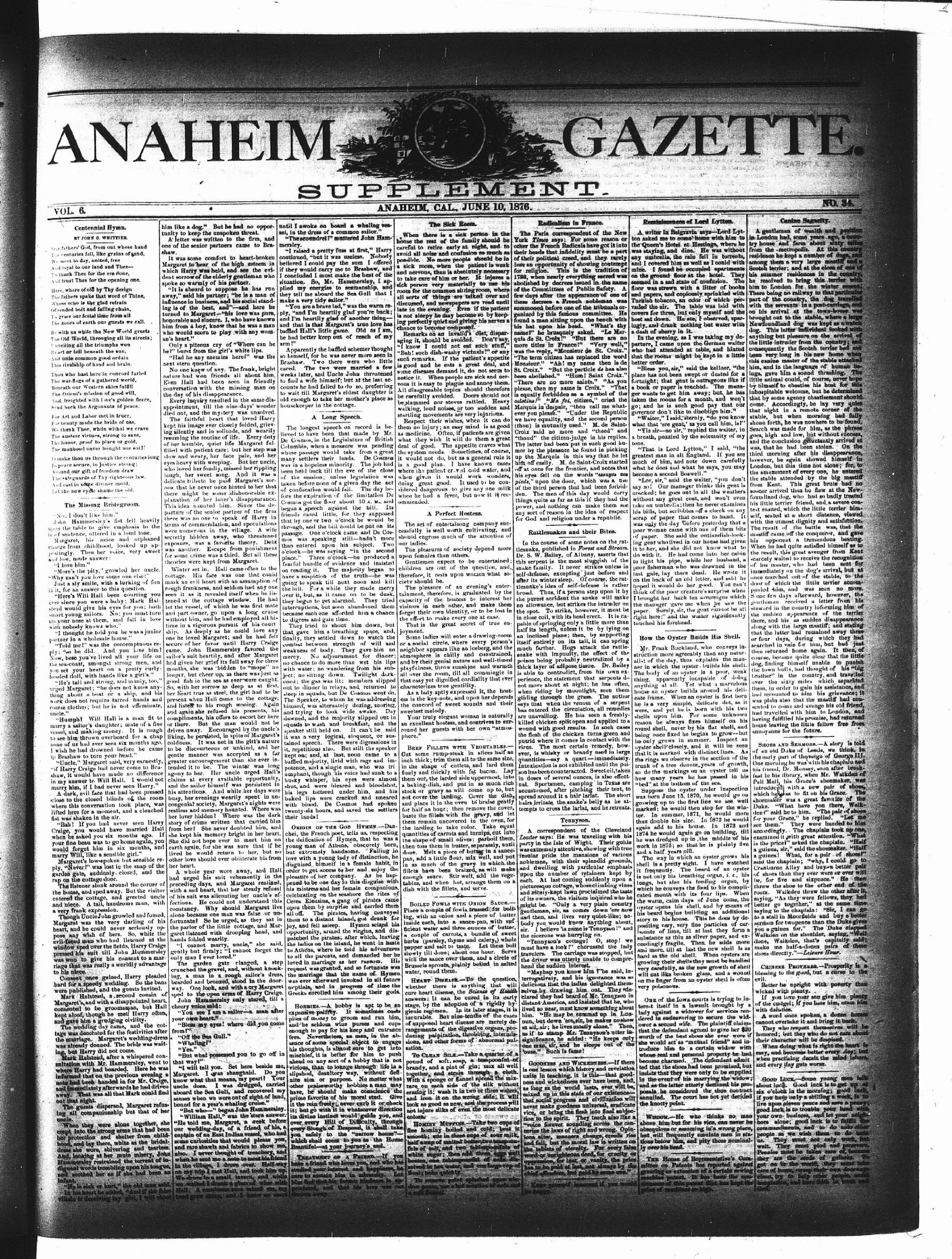
Searchable text
Centennial Hymn.
BY JOHN G. WHITTIER.
Our fathers' God, from out whose hand
The centuries fall, like grains of sand,
We meet to day, united, free
And loyal to our land and Thee—
To thank Thee for the era done,
And trust Thee for the opening one.
Here, where of old by Thy design
The fathers spake that word of Thine,
Whose echo is the glad refrain
Of rended bolt and falling chain,
To grace our festal time from all
The zones of earth our guests we call.
Be with us while the New World greets
The Old World, thronging all its streets;
Unveiling all the triumphs won
By art or foli beneath the sun,
And unto common good ordain
This rivalship of hand and brain.
Thou who hast here in concord furled
The war-flags of a gathered world,
Beneath our Western skies fulfill
The Orient's mission of good will,
And, freighted with love's golden fleece,
Send back the Argonauts of peace.
For Art and Labor met in truce,
For beauty made the bride of use,
We thank Thee, while withal we crave
The austere virtues, strong to save,
The honor, proof to place or gold,
The manhood never bought nor sold!
O make thou us through the centuries long
In peace secure, in justice strong;
him like a dog." But he had no opportunity to keep the unspoken threat.
A letter was written to the firm, and one of the senior partners came to Brashaw.
It was some comfort to heart-broken Margaret to hear of the high esteem in which Harry was held, and see the evident sorrow of the elderly gentleman who spoke so warmly of his partner.
"It is absurd to suppose he has run away," said his partner; "he is a man of influence in business, and his social standing is of the best, and"—and here he turned to Margaret—"his love was pure, honorable and sincere. I, who have known him from a boy, know that he was a man who would scorn to play with any woman's heart."
Only a piteous cry of "Where can he be?" burst from the girl's white lips.
"Had he any enemies here?" was the next stern question.
No one knew of any. The frank, bright nature had won friends all about him, Even Hall had been seen in friendly conversation with the missing man on the day of his disappearance.
Every inquiry resulted in the same disappointment, till the nine-days' wonder died out, and the mystery was unsolved.
The faithful heart that loved Harry kept his image ever closely folded, grieving silently and in solitude, and wearily resuming the routine of life. Every duty of her humble, quiet life Margaret fulfilled with patient care; but her step was slow and weary, her face pale, and her eyes heavy with weeping. But her uncle, who loved her fondly, missed her rippling until I awoke on board a sel, in the dress of a common mersey.
"I raised a pretty fuss at continued, "but it was useless believed I could pay the sage if they would carry me to I concluded I must make the situation. So, Mr. Hammer plied my energies to seach they tell me aboard the Sea make a very tidy sailor."
"You are a brave lad," was ply, "and I'm heartily glad and I'm heartily glad of an end that is that Margaret's baffled Hall's little game. He had better keep out of arm!"
Apparently the baffled schoo himself, for he was never Brashaw. Two there were cared. The two were many weeks later, and Uncle John to find a wife himself; but counts he had failed to do so to wait till Margaret's elders old enough to take her most housekeeper in the cottage.
A Long Speech
The longest speech on this lieved to have been that De Cosmos, in the Legislature Columbia, when a measure whose passage would take many settlers their lands was in a hopeless minority.
Thou who hast here in concord furled
The war-flags of a gathered world,
Beneath our Western skies fulfill
The Orient's mission of good will,
And, freighted with love's golden fleece,
Send back the Argonauts of peace.
For Art and Labor met in truce,
For beauty made the bride of use,
We thank Thee, while withal we crave
The austere virtues, strong to save,
The honor, proof to place or gold,
The manhood never bought nor sold!
O make thou us through the centuries long
In peace secure, in justice strong;
Around our gift of freedom draw
The safeguards of Thy righteous law,
And cast in some diviner mold,
Let the new cycle shame the old.
The Missing Bridegroom.
"No; I don't like him."
John Hammersley's fist fell heavily upon the table to give emphasis to the brief sentence, uttered in a loud tone.
Margaret, his niece and orphaned charge from childhood, looked up appearingly. Then her voice, very sweet and low, made answer:
"I love him."
"More's the pity," growled her uncle.
"Why can't you love some one else?"
Just a sly smile, with a lurking of fun in it, for an answer to this question.
"Here's Will Hall been courting you ever since you were a baby; Mark Halstead would give his eyes for you; both smart young sailors. No; you must turn up your nose at them, and fall in love with nobody knows who."
"I thought he told you he was a junior partner in a wholesale house."
"Told me!" was the contemptuous reply: "so he did. And you love him! Now, here you've lived all your life on the sea-coast, amongst strong men, and you set your heart on a pretty curly-headed doll, with hands like a girl's."
"He's tall and strong, and manly, too," urged Margaret; "he does not know anything about a boat or a ship, and his work does not require tarred hands and course clothes; but he is not effeminate, uncle."
"Humph! Will Hall is a man fit to marry a sailor's daughter; mate of a fine vessel, and making money. It is rough to see him thrown overboard for a chap none of us had ever seen six months ago. I wish he had drowned before he came to Brashaw to turn your head."
"Uncle," Margaret said, very earnestly, "if Harry Craige had never come to Brashaw, it would have made no difference in my answer to Will Hall. I would not marry him, if I had never seen Harry."
A dark, evil face that had been pressed close to the closed blinds of the room where this conversation took place, was lifted here for a moment, and a clenched fist was shaken in the air.
"Bah! If you had never seen Harry Craige, you would have married Hall when he asked you six months ago. If your fine beau was to go home again, you would forget him in six months, and marry Will, like a sensible girl."
Margaret's low-spoken but sensible reply, "Never!" was lost in the snap of the garden gate, suddenly closed, and the rap on the cottage door.
The listener slunk around the corner of
One year wore away, and Hall had urged his suit vehemently in the preceding days, and Margaret realized, with a heart that her steady refusal nature had won friends all about him. Even Hall had been seen in friendly conversation with the missing man on the day of his disappearance.
Every inquiry resulted in the same disappointment, till the nine-days' wonder died out, and the mystery was unsolved.
The faithful heart that loved Harry kept his image ever closely folded, grieving silently and in solitude, and wearily resuming the routine of life. Every duty of her humble, quiet life Margaret fulfilled with patient care; but her step was slow and weary, her face pale, and her eyes heavy with weeping. But her uncle, who loved her fondly, missed her rippling laugh, her sweet song. And it was a delicate tribute he paid Margaret's sorrow that he never once hinted to her that there might be some dislushonable explanation of her lover's disappearance. This idea haunted him. Since the departure of the senior partner of the firm there was no one to speak of Harry in terms of commendation, and speculations were numerous in the village. A wife secretly hidden away, who threatened exposure, was a favorite theory. Debt was another. Escape from punishment for some crime was a third. But all these theories were kept from Margaret.
Winter set in. Hall came often to the cottage. His face was one that could mask an evil heart with an assumption of rough frankness, and seldom had any one seen it as it revealed itself when he listened at the cottage window. He had let the vessel, of which he was first mate and part owner, go upon a long cruise without him, and he had employed all his time in a vigorous pursuit of his courtship. As deeply as he could love any one he loved Margaret; and he had felt secure of her favor until Harry Craige came. John Hammersley favored the sailor's suit heartily, and after Margaret had given her grief its full sway for three months, she was 'bidden to "mope" no longer, but cheer up, as there was just as good fish in the sea as ever were caught. So, with her sorrow as deep as at first, her heart true as steel, the girl had to be present when Hall came to the cottage, and listen to his rough wooing. Again and again she refused his presents, his compliments, his offers to escort her here or there. But the man would not be driven away. Encouraged by the uncle's liking, he persisted, in spite of Margaret's coldness. It was not in the girl's nature to be discourteous or unkind, and her gentle manner was accepted as a far greater encouragement than she ever intended it to be. The winter was long agony to her. Her uncle urged Hall's claims at every available opportunity, and the sailor himself was persistent in his attentions. And while her days were busy, her evenings wearily spent in incongenial society, Margaret's nights were restless and memory haunted. Where was her lover hidden? Where was the dark story of crime written that carried him from her? She never doubted him, and she kept his memory bright in her heart. She did not hope ever to meet him on earth again, for she was sure that if he lived he would return to her, but no other love should ever obliterate his from her heart.
A whole year wore away, and Hall had urged his suit vehemently in the preceding days, and Margaret realized, with a heart that her steadily refusal nature had won friends all about him. Even Hall had been seen in friendly conversation with the missing man on the day of his disappearance.
Every inquiry resulted in the same disappointment, till the nine-days' wonder died out, and the mystery was unsolved.
The faithful heart that loved Harry kept his image ever closely folded, grieving silently and in solitude, and wearily resuming the routine of life. Every duty of her humble, quiet life Margaret fulfilled with patient care; but her step was slow and weary, her face pale, and her eyes heavy with weeping. But her uncle, who loved her fondly, missed her rippling laugh, her sweet song. And it was a delicate tribute he paid Margaret's sorrow that he never once hinted to her that there might be some dislushonable explanation of her lover's disappearance. This idea haunted him. Since the departure of the senior partner of the firm there was no one to speak of Harry in terms of commendation, and speculations were numerous in the village. A wife secretly hidden away, who threatened exposure, was a favorite theory. Debt was another. Escape from punishment for some crime was a third. But all these theories were kept from Margaret.
Winter set in. Hall came often to the cottage. His face was one that could mask an evil heart with an assumption of rough frankness, and seldom had any one seen it as it revealed itself when he listened at the cottage window. He had let the vessel, of which he was first mate and part owner, go upon a long cruise without him, and he had employed all his time in a vigorous pursuit of his courtship. As deeply as he could love any one he loved Margaret; and he had felt secure of her favor until Harry Craige came. John Hammersley favored the sailor's suit heartily, and after Margaret had given her grief its full sway for three months, she was 'bidden to "mope" no longer, but cheer up, as there was just as good fish in the sea as ever were caught. So, with her sorrow as deep as at first, her heart true as steel, the girl had to be present when Hall came to the cottage, and listen to his rough wooing. Again and again she refused his presents, his compliments, his offers to escort her here or there. But the man would not be driven away. Encouraged by the uncle's liking, he persisted, in spite of Margaret's coldness. It was not in the girl's nature to be discourteous or unkind, and her gentle manner was accepted as a far greater encouragement than she ever intended it to be. The winter was long agony to her. Her uncle urged Hall's claims at every available opportunity, and the sailor himself was persistent in his attentions. And while her days were busy, her evenings wearily spent in incongenial society, Margaret's nights were restless and memory haunted. Where was her lover hidden? Where was the dark story of crime written that carried him from her? She never doubted him, and she kept his memory bright in her heart. She did not hope ever to meet him on earth again, for she was sure that if he lived he would return to her, but no other love should ever obliterate his from her heart.
A whole year wore away, and Hall had urged his suit vehemently in the preceding days, and Margaret realized, with a heart that her steadily refusal nature had won friends all about him. Even Hall had been seen in friendly conversation with the missing man on the day of his disappearance.
Every inquiry resulted in the same disappointment, till the nine-days' wonder died out, and the mystery was unsolved.
The faithful heart that loved Harry kept his image ever closely folded,grieving silently and in solitude,and wearily resuming the routine of life.Every duty of her humble,quiet life Margaret fulfilled with patient care;but her step was slow and weary,hers eye heavy with weeping.But her uncle,who loved her fondly,hers face pale,and hers eyes heavy with weeping.But her uncle,who loved her fondly,hers face pale,and hers eyes heavy with weeping.But her uncle,who loved her fondly,hers face pale,and hers eyes heavy with weeping.But her uncle,who loved her fondly,hers face pale,and hers eyes heavy with weeping.But her uncle,who loved her fondly,hers face pale,and hers eyes heavy with weeping.But her uncle,who loved her fondly,hers face pale,and hers eyes heavy with weeping.But her uncle,who loved her fondly,hers face pale,and hers eyes heavy with weeping.But her uncle,who loved her fondly,hers face pale,and hers eyes heavy with weeping.But her uncle,who loved her fondly,hers face pale,and hers eyes heavy with weeping.Buther uncle,who loved her fondly,hers face pale,and hers eyes heavy with weeping.Buther uncle,who loved her fondly,hers face pale,and hers eyes heavy with weeping.Buther uncle,who loved her fondly,hers face pale,and hers eyes heavy with weeping.Buther uncle,who loved her fondly,hers face pale,and hers eyes heavy with weeping.Buther uncle,who loved her fondly,hers face pale,and hers eyes heavy with weeping.Buther uncle,who loved her fondly,hers face pale,and hers eyes heavy with weeping.Buther uncle,who loved her fondly,hers face pale,and hers eyes heavy with weeping.Buther uncle,who loved her fondly,hers face pale,and hers eyes heavy with weeping.Buther uncle,who loved her fondly,hers face pale,and hers eyes heavy with weeping.Buther uncle,who loved her fondly,hers face pale,and hers eyes heavy with weeping.Buther uncle,who loved her fondly,hers face pale,and hers eyes heavy with weeping.Buther uncle,who loved her fondly,hers face pale,and hers eyes heavy with weeping.Buther uncle,who loved her fondly,hers face pale,and hers eyes heavy with weeping.Buther uncle,who loved her fondly,hers face pale,and hers eyes heavy with weeping.Buther uncle,who loved her fondly,hers face pale,and hers eyes heavy with weeping.Buther uncle,who loved her fondly,hers face pale,and hers eyes heavy with weeping.Buther uncle,who loved her fondly,hers face pale,and hers eyes heavy with weeping.Buther uncle,who loved her fondly,hers face pale,and hers eyes heavy with weeping.Buther uncle,who loved her fondly,hers face pale,and hers eyes heavy with weeping.Buther uncle,who loved her fondly,hers face pale,and hers eyes heavy with wepping.Buther uncle,who loved her fondly,hers face pale,and hers eyes heavy with wepping.Buther uncle,who loved她 fondely,hers face pale,and hers eyes heavy with我们嘴着,Buther uncle,who loved她 fondely,hers face pale,and hers eyes heavy with我们嘴着,Buther uncle,who loved她 fondely,hers face pale,and hers eyes heavy with我们嘴着,Buther uncle,who loved她 fondely,hers face pale,and hers eyes heavy with我们嘴着,Buther uncle,who loves她 fondely,hers face pale,and hers eyes heavy with我们嘴着,Buther uncle,who loves她 fondely,hers face pale,and hers eyes heavy with我们嘴着,Buther uncle,who loves她 fondely,hers face pale,and hers eyes heavy with我们嘴着,Buther uncle,who loves她 fondely,hers face pale,and hers eyes heavy with我们嘴着,Buther uncle,who loves她 fondely,hers face pale,and hers eyes heavy with我们嘴着,Buther uncle,who loves她 fondely,hers face pale,and hers eyes heavy with我们嘴着,Buther uncle,who loves她 fondely,hers face pale,and hers eyes heavy with我们嘴着,Buther uncle,who loves她 fondely,hers face pale,and hers eyes heavy with我们嘴着,Buther uncle,who loves她 fondely,hers face pale,and hers eyes heavy with我们嘴着,Buther uncle,who loves她 fondely,hers face pale,and hers eyes heavy with我们嘴着,Buther uncleshe,who loves她 fondely,hers face pale,and hers eyes heavy with我们嘴着,Buther uncleshe,who loves她 fondely,hers face pale,and hers eyes heavy with我们嘴着,Buther uncleshe,who loves她 fondely,hers face pale,and hers眼睛重而深而窄,Heruness is not known anywhere.
"A Long Speech"
The longest speech on this page has two lines: "De Cosmos," in line 1; "De Cosmos," in line 2.
De Cosmos is not known anywhere.
A Long Speech
The longest speech on this page has two lines: "De Cosmos," in line 1; "De Cosmos," in line 2.
De Cosmos is not known anywhere.
A Long Speech
The longest speech on this page has two lines: "De Cosmos," in line 1; "De Cosmos," in line 2.
De Cosmos is not known anywhere.
A Long Speech
The longest speech on this page has two lines: "De Cosmos," in line 1; "De Cosmos," in line 2.
De Cosmos is not known anywhere.
A Long Speech
The longest speech on this page has two lines: "De Cosmos," in line 1; "De Cosmos," in line 2.
De Cosmos is not known anywhere.
A Long Speech
The longest speech on this page has two lines: "De Cosmos," in line 1; "De Cosmos," in line 2.
De Cosmos is not known anywhere.
A Long Speech
The longest speech on this page has two lines: "De Cosmos," in line 1; "De Cosmos," in line 2.
De Cosmos is not known anywhere.
A Long Speech
The longest speech on this page has two lines: "De Cosmos," in line 1; "De Cosmos," in line 2.
De Cosmos is not known anywhere.
A Long Speech
The longest speech on this page has two lines: "De Cosmos," in line 1; "De Cosmos," in line 2.
De Cosmos is not known anywhere.
A Long Speech
The longest speech on this page has two lines: "De Cosmos," in line 1; "De Cosmos," in line 2.
De Cosmos is not known anywhere.
A Long Speech
The longest speech on this page has two lines: "De Cosmos," in line 1; "De Cosmos," in line 2.
De Cosmos is not known anywhere.
A Long Speech
The longest speech on this page has two lines: "De Cosmos," in line 1; "De Cosmos," in line 2.
De Cosmos is not known anywhere.
A Long Speech
The longest speech on this page has two lines: "De Cosmos," in line 1; "De Cosmos," in line 2.
De Cosmos is not known anywhere.
A Long Speech
The longest speech on this page has two lines: "De Cosmos," in line 1; "De Cosmos," in line 2.
De Cosmos is not known anywhere.
A Long Speech
The longest speech on this page has two lines: "De Cosmos," in line 1; "De Cosmos," in line 2.
De Cosmos is not known anywhere.
A Long Speech
The longest speech on this page has two lines: "De Cosmos," in line 1; "De Cosmos," in line 2.
De Cosmos is not known anywhere.
A Long Speech
The longest speech on this page has two lines: "De Cosmos," in line 1; "De Cosmos," in line 2.
De Cosmos is not known anywhere.
A Long Speech
The longest speech on this page has two lines: "De Cosmos," in line 1; "De Cosmos," in line 2.
De Cosmos is not known anywhere.
A Long Speech
The longest speech on this page has two lines: "De Cosmos," in line 1; "De Cosмос," in line 2.
De Cosмос is not known anywhere.
A Long Speech
The longest speech on this page has two lines: "De Cosмос," in line 1; "De Сосмос," in line 2.
De Сосмос is not known anywhere.
A Long Speech
The longest speech on this page has two lines: " De Сосмос," in line 1; " De Сосмос," in line 2.
De Сосмос is not known anywhere.
A Long Speech
The longest speech on this page has two lines: " De Сосмос," in line 1; " De Сосмос," in line 2.
De Сосмос is not known anywhere.
A Long Speech
De Сосмос is not known anywhere.
A Long Speech
De Сосмос is not known anywhere.
A Long Speech
De Сосмос is not known anywhere.
A Long Speech
De Сосмос is not known everywhere.
A Long Speech
De Сосмос is not known everywhere.
A Long Speech
De Сосмос is not known everywhere.
A Long Speech
De Сосмос is not known everywhere.
A Long Speech
De Сосмос is not known everywhere.
A Long Speech
De Сосмос is not known everywhere.
A Long Speech
De Сосмос is not known everywhere.
A Long Speech
De Сосмос is not known everywhere.
A Long Speech
De Сосмос is not known everywhere.
A Long Speech
De Сосмос is not known everywhere.
A Long Speech
De Сосмос is not known everywhere.
A Long Speech
De Сосмос is not known everywhere.
A Long Speech
De Сосмос is not known everywhere.
A Long Speech
De Сосмос is not known everywhere.
A Long Speech
De Сосмос is not known everywhere.
A Long Speech
De Сосмос is not known everywhere.
A Long Speech
De Сосмос is not known everywhere.
A Long Speech
De Сосмос is notknown everywhere.
A Long Speech
De Сосмос is notknown everywhere.
A Long Speech
De Сосмос is notknown everywhere.
A Long Speech
De Сосмос is notknown everywhere.
A Long Speech
De Сосмос is notknown everywhere.
A Long Speech
De Сосмос is notknown everywhere.
A Long Speech
De Сосмос is notknown everywhere.
A Long Speech
De Сосмос is notknown everywhere.
A Long Speech
De Сосмос is notknown everywhere.
A Long Speech
De Сосмосis notknown everywhere.
A Long Speech
De Сосмосis notknown everywhere.
A Long Speech
De Сосмосis notknown everywhere.
A Long Speech
De Сосмосis notknown everywhere.
A Long Speech
De Сосмосis notknown everywhere.
A Long Speech
De Сосмосis notknown everywhere.
A Long Speech
De Сосмосis notknown everywhere.
A Long Speech
De Сосмосis notknown everywhere.
A Long Speech
De Срос沫sis notknown everywhere.
A LongSpech
De Cрос沫sis notknown everywhere.
A LongSpech
De Cрос沫sis notknown everywhere.
A LongSpech
De Cрос沫sis notknown everywhere.
A长期Spech
De Cursos長Spech
De Cursos長Spech
De Cursos長Spech
De Cursos長Spech
De Cursos長Spech
De Cursos長Spech
De Cursos長Spech
De Cursos長Spech
De Cursos長Spech
De Cursos長Spech
De Cursos長Spech
De Cursos長Spech
De Cursos長Spech
De Cursos長Spech
De Cursos長Spech
DE Cursos長Spech
DE Cursos長Spech
DE Cursos長Spech
DE Cursos長Spech
DE Cursos長Spech
DE Cursos長Spech
DE Cursos長Spech
DE Cursos長Spech
DE Ccurso長Spech
DE Ccurso長Spech
DE Ccurso長Spech
DE Ccurso長Spech
DE Ccurso長Spech
DE Ccurso長Spech
DE Ccurso長Spech
DE Ccurso長Spech
DE Ccurso長Spech
DE Ccurso長Spech
DE Ccurso長Spech
DE Ccurso長Spech
DE Ccurso長Spech
DE Ccurso長Spech
DE Ccurso長Spech
DE C curso長Spech
DE C curso長Spech
DE C curso長Spech
DE C curso長Spech
DE C curso長Spech
DE C curso長Spech
DE C curso長Spech
DE C curso長Spech
DE C curso長Spech
DE C curso長Spech
DE C curso長Spech
DE C curso長Spech
DE C curso長Spech
DE C curso長Spech
DEC curso長Spech
DEC curso長Spech
DEC curso長Spech
DEC curso長Spech
DEC curso長SpeCh
DEC curso長SpeCh
DEC curso長SpeCh
DEC curso長SpeCh
DEC curso長SpeCh
DEC curso長SpeCh
DEC curso長SpeCh
DEC curso長SpeCh
DEC curso長SpeCh
DEC curso長SpeCh
DEC curso長SpеCH
DEC curso長SpеCH
DEC curso長SpеCH
DEC curso長SpеCH
DEC curso長SpеCH
DEC curso長SpеCH
DEC curso長SpеCH
DEC curso長SpеCH
DEC curso長SpеCH
DEC curso長SpеCH
DEC curso長SpеCH
DСcurso长短speCH
DСcurso长短speCH
DСcurso长短speCH
DСcurso长短speCH
DСcurso长短speCH
DСcurso长短speCH
DСcurso长短speCH
DСcurso长短speCH
DСcurso长短speCH
DСcursor长短speCH
DСcursor长短speCH
DСcursor长短speCH
DСcursor长短speCH
DСcursor长短speCH
DСcursor长短speCH
DСcursor长短speCH
DСcursor长短speCH
DСcursor长短speCH
DСcursor长短speCH
OrioiOf THE God chei,the French poet,tell de deification of Hymen young man of Athena,c but extremely handsome lovewith a young lady o disguised himself.in a order to get access to hire pencepenerin the cottage door.
The listener slunk around the corner of
A dark, evil face that had been pressed close to the closed blinds of the room where this conversation took place, was lifted here for a moment, and a clenched fist was shaken in the air.
"Bah! If you had never seen Harry Craige, you would have married Hall when he asked you six months ago. If your fine beau was to go home again, you would forget him in six months, and marry Will, like a sensible girl."
Margaret's low-spoken but sensible reply, "Never!" was lost in the snap of the garden gate, suddenly closed, and the rap on the cottage door.
The listener slunk around the corner of the house, and sped away. But the visitor entered the cottage, and greeted uncle and niece. A tall, handsome man, with a very frank expression.
Though Uncle John growled and fumed, Margaret was the very darling of his heart, and he could never seriously oppose any wish of hers. So while the evil-faced man who had listened at the window sped over the fields, Harry Craige pressed his suit till John Hammersley was won to give his consent to a marriage that was really a worldly advantage to his niece.
Consent once gained, Harry pleaded hard for a speedy wedding. So the bans were published, and the guests invited.
Mark Halstead, a second cousin of Margaret's, and with a disappointed heart, consented to be groomman, but Hall kept aloof, though he met Harry often, and gave him a grudging ovity.
The wedding day came, and the cottage was decorated for the festivities after the marriage. Margaret's wedding-dress was already donned. The bride was waiting, but Harry did not come.
Mark Halstead, after a whispered consultation with Mr. Hammersley, went to where Harry had boarded. Here he was informed that on the previous evening a note had been handed in for Mr. Craige, and immediately afterwards he had driven away. That was all that Mark could find out that night.
The guests dispersed, Margaret refusing all companionship but that of her uncle.
When they were alone together, she crept into the strong arms that had been her protection and shelter from childhood, and lay there, white as the bridal dress she wore, shivering and tearless. And looking at her mute misery, John Hammersley restrained the torrent of indignant words trembling upon his tongue, and soothed her as if she had been an infant.
"He is sick or hurt," the old man said.
In his heart he added, "And if the false villain is desolating my girl, I will shoot his attentions. And while her days were busy, her evenings wearily spent in incongenial society, Margaret's nights were restless and memory haunted. Where was her lover hidden? Where was the dark story of crime written that carried him from her? She never doubted him, and she kept his memory bright in her heart. She did not hope ever to meet him on earth again, for she was sure that if he lived he would return to her, but no other love should ever obliterate his from her heart.
A whole year wore away, and Hall had urged his suit vehemently in the preceding days, and Margaret realized, with a sad heart, that her steady refusal of his suit was alienating her uncle's affections. He could not understand this constancy. Why should Margaret live alone because one man was false or unfortunate? So he urged; as they sat in the parlor of the little cottage, and Margaret listened with drooping head, and hands folded wearily.
"I cannot marry, uncle," she said gently but firmly; "I cannot forget the only man I ever loved."
The garden gate clanged, a step crunched the gravel, and without knocking, a man in a rough sailor's dress, bearded and bronzed, stood in the doorway. One look, and with a cry Margaret sped to the open arms of Harry Craige.
John Hammersley only stared, till a cheery voice said:
"You see I am a sailor—a man after your own heart."
"Bless my eyes! where did you come from?"
"Off the Sea Gull."
"Whaling!"
"Yes."
But what possessed you to go off in that way?
"I will tell you. Set here beside me, Margaret. I was shanghald. Do you know what that means, my pearl? Your uncle does. I was drugged, carried aboard the Sea Gull, and recovered my senses when we were out of sight of land, bound for a year's whaling cruise."
"But who—" began John Hammersley.
"William Hall," was the stern answer.
"He told me, Margaret, a week before our wedding-day, of a friend of his, a captain of an East Indian vessel, who had some curiosities that would please you, and rare shawls and fabrics to show me also. I never thought of treachery, and when he sent me a note to meet his friend in the village, I drove over. Half-way on my trip I met Hall, and took him up. We drove to a small tavern, and while we waited I drank a glass of wine with Hall. A numbness soon ensued me, my hand grew dizzy, and I knew no man his legs tottered under his baked lips were cracked with blood. De Cosmos twenty-six hours, and saved their lands!
ORIGIN OF THE GOD
chei, the French poet, tells the deification of Hymen young man of Athens, but extremely handsome love with a young lady of disguised himself in a order to get access to her pleasure of her company. Pened to be one day in this mistress and her female celebrating on the seashore Ceres Eleusina, a gang o upon them by surprise all off. The pirates have them to a distant island joy,and fell asleep.H opportunity; armed the patched the pirates; after the ladies on the island,h to Athens;where he told to all the parents,and d loved in marriage as he request was granted,and the marriage that the man was ever afterward invoked nuptials,and in progress Greeks enrolled him among
Hornbites.-A hobby expensive palffy. It piles of money to groove and he seldom wins enough to pay for his fees.Nevertheless,a sense of some special o his thoughts.is almost a mischief.it is better forea ahead on any sort of a h vicious than to lounge his slipshod,destultory way nite aim or purpose. Other praiseworthy hold have,the should make prime favorite of his men it the rain freely;never it;but go with it in which its divine instinct would over every Hill of Dive every Slough of Despoor you safely to the which shall seem to you Beautiful-at your joys
Treatment of A Homan has a friend who loves studied your interest.a sure to sustain him in him feel that his fame prevailed,and that he knows away
until I awoke on board a whaling vessel, in the dress of a common sailor."
"The scoundrel!" muttered John Hammersley.
"I raised a pretty fuss at first," Harry continued, "but it was useless. Nobody believed I could pay the sum I offered if they would carry me to Brashaw, and I concluded I must make the best of the situation. So, Mr. Hammersley, I applied my energies to seamanship, and they tell me aboard the Sea Gull that I make a very tidy sailor."
"You are a brave lad," was the warm reply, "and I'm heartily glad you're back; and I'm heartily glad of another thing—and that is that Margaret's true love has baffled Hall's little game. Old as I am, he had better keep out of reach of my arm!"
Apparently the baffled schemer thought so himself, for he was never more seen in Brashaw. Two there were who little cared. The two were married a few weeks later, and Uncle John threatened to find a wife himself; but at the last accounts he had failed to do so, preferring to wait till Margaret's eldest daughter is old enough to take her mother's place as housekeeper in the cottage.
A Long Speech.
The longest speech on record is believed to have been made by Mr. De Cosmos, in the Legislature of British Columbia, when a measure was pending whose passage would take from a great many settlers their lands. De Cosmos was in a hopeless minority. The job had
The Sick Room.
When there is a sick person in the house the rest of the family should be careful to retire early at night, and to avoid all noise and confusion as much as possible. No more people should be in a sick room, when the patient is weak and nervous, than is absolutely necessary to take care of him or her. It injures a sick person very materially to use his room for the common sitting room, where all sorts of things are talked over and discussed, and newspapers are read until late in the evening. Even if the patient is not sleepy he may become so by keeping perfectly quiet and giving his nerves a chance to become composed.
Remarks on an invalid's diet, disparaging it, should be avoided. Don't say, "I know I could not eat such stuff," "Bah! such dish-washy victuals!" or any such remarks. If the patient's appetite is good and he eats a great deal, and some diseases demand it, do not seem to notice it. When people are sick and nervous it is easy to plague and annoy them. All disagreeable topics should therefore be carefully avoided. Doors should not be slammed nor stoves rattled. Heavy walking, loud noises, or too sudden and startling movements are very injurious.
Respect their wishes, when it can do them no injury; an easy mind is as good as medicine. Often, if patients are given what they wish it will do them a great deal of good. The appetite craves what the system needs. Sometimes, of course, it would not do, but as a general rule it is a good plan. I have known cases
Radicalism in France.
The Paris correspondent of the New York Times says: For some reason or other the French Radicals have got it into their heads that infidelity must be a part of their political creed, and they rarely lose an opportunity of showing contempt for religion. This is the tradition of 1798, when nearly everything sacred was abolished by decree issued in the name of the Committees of Public Safety. A few days after the appearance of one of these decrees a French nobleman was summoned before one of the tribunals organized by this famous committee. He found a man sitting upon the bench with his hat upon his head. "What's thy name!" he brusquely asked. "Le Marquis de St. Croix!" "But there are no more titles in France!" "Very well," was the reply, "Monsieur de St. Croix." "The term citizen has replaced the word Monsieur." "Ah! my name then is de St. Croix." "But the particle de has also been abolished." "Hum! Saint Croix." "There are no more saints." "As you please, then my name is Croix." "That is equally forbidden as a symbol of the calotins!" "Ma foi, citizen," cried the Marquis in despair, "then call me whatever you please." "Under the Republic we have equality, and the second person (thou) is mutually used." M. de Saint-Croix said no more and "thee" and "thoud" the citizen-judge in his replies. The latter had been put in such good humor by the pleasure he found in picking up the Marquis in this way that he let him off easily. M. de Saint-Croix started off once for the frontier, and notes that
Reminiscence.
A writer in Boston asked me to the Queen's House was staying, and any umbrella, and I covered him mine. I found on the ground seemed in a sand floor was strewn and papers, and Turkish tobacco vaded the air, covers for three host sat downingly, and drank a dash of sherry.
In the evening parture, I came who had attended the rooms better order.
"Bless you," a place has not been fortnight; that a book or paper wants to get taken the room go; and he is governor don't.
"Waiter," I ask what that 'ere is no breath, puzzling tone.
"That is Lo greatest man in much of him, what he does a
A Long Speech.
The longest speech on record is believed to have been that made by Mr. De Cosmos, in the Legislature of British Columbia, when a measure was pending whose passage would take from a great many settlers their lands. De Cosmos was in a hopeless minority. The job had been held back till the eve of the close of the session; unless legislation was taken before noon of a given day the act of confiscation would fail. The day before the expiration of the limitation De Cosmos got the floor about 10 A.M., and began a speech against the bill. Its friends cared little, for they supposed that by one or two o'clock he would be through, and the bill could be put on its passage. One o'clock came and De Cosmos was speaking still—hadn't more than entered upon his subject. Two o'clock—he was saying "in the second place." Three o'clock—he produced a fearful bundle of evidence and insisted on reading it. The majority began to have a suspicion of the truth—he was going to speak till next noon and kill the bill. For a while they made merry over it, but, as it came on to be dusk, they began to get alarmed. They tried interruptions, but soon abandoned them because each one afforded him a chance to digress and gain time.
They tried to shout him down, but that gave him a breathing space, and finally, they settled down to watch the combat between strength of will and weakness of body. They gavo him no mercy. No adjournment for dinner; no chance to do more than wet his lips with water; no wandering from his subject; no sitting down. Twilight darkened; the gas was lit; members slipped out to dinner in relays, and returned to sleep in squads, but De Cosmos went on. The Speaker, to whom he was addressing himself, was alternately dozing, soaring, and trying to look wide awake. Day dawned, and the majority slipped out in squads to wash and breakfast, and the speaker still held on. It can't be said it was a very logical, eloquent, or sustained speech. There were digressions in it, repetitions also. But still the speaker kept on; and, at last, noon came to a baffled majority, livid with rage and impotence, and a single man, who was triumphant, though his voice had sunk to a husky whisper, his eyes were almost shut, and were bleared and bloodshot, his legs tottered under him, and his baked lips were cracked and smeared with blood. De Cosmos had spoken twenty-six hours, and saved the settlers their lands!
ORIGIN OF THE GOD HYMEN.—Danchei, the French poet, tells us, respecting the deification of Hymen, that he was a young man of Athens, obscurely born, but extremely handsome. Falling in love with a young lady of distinction, he disguised himself in a female habit, in order to get access to her and enjoy the pleasure of her company. As he happened to be one day in this disguise with his mistress and her female companions,
Repect their wishes, when it can do them no injury; an easy mind is as good medicine. Often, if patients are given what they wish it will do them a great deal of good. The appetite craves what the system needs. Sometimes, of course, it would not do, but as a general rule it is a good plan. I have known cases where the patient craved cold water, and when given it would work wonders doing great good. It used to be considered dangerous to give any one milk when he had a fever, but now it is recommended.
A Perfect Hostess.
The art of entertaining company successfully is well worth cultivating, and should engross much of the attention of our ladies.
The pleasures of society depend more upon females than others.
Gentlemen expect to be entertained; children are out of the question; therefore, it rests upon women what society should be.
The pleasure of an evening's entertainment, therefore, is graduated by the capacity of the hostess to interest her visitors in each other, and make them forget their own identity, or to be lost in the effort to make every one at ease.
That is the great secret of true enjoyment.
Some ladies will enter a drawing-room or a social circle, where every person's neighbor appears like an iceberg, and the atmosphere is chilly and constrained, and by their genial nature and well-timed playfulness, throw sunshine and warmth all over the room, till all commingle in that easy yet dignified cordiality that ever characterizes true gentility.
As a lady aptly expressed it, the hostess is the key-note, and upon her depends the concord of sweet sounds and their sweetest melody.
Your truly elegant woman is naturally an excellent hostess, and contrives to surround her guests with her own "atmosphere."
BEER FILLETS WITH VEGETABLES.—Cut some rump-steak in slices half an inch thick; trim them all to the same size, in the shape of cutlets, and lard them finely and thickly with fat bacon. Lay them out, the larded side uppermost, into a baking-dish, and put in as much rich stock or gravy as will come up to, but not cover the larding. Cover the dish, and place it in the oven to braise gently for half an hour; then remove the cover, baste the fillets with the gravy, and let them remain uncovered in the oven, for the larding to take color. Take equal quantities of carrots and turnips, cut into the shape of small olives; parboil them then toss them in butter, separately until done. Melt a piece of butter in sauepan, add a little flour, mix well, and put in as much of the gravy in which the fillets have been brazied, as will make enough sauce. Stir well, add the vegetables, and when hot, arrange them on a dish with the fillets, and serve.
Rattlesnakes and their Bites.
In the course of some notes on the rattlesnake, published in Forest and Stream. Dr. S.W. Bailey, of Albany, asserts that this serpent is the most sluggish of the snake family. It never strikes unless in self-defense, excepting just before and after its winter sleep. Of course, the rattlesnake's idea of self-defense is rather broad. Thus, if a person step upon it by the purest accident the snake will make no allowance, but strikes the intruder on the spot. To strike, however, it must be in close coil with its head erect. It is capable of springing only a little more than half its length, unless it be by lying on an inclined plane; then, by supporting itself entirely on its tail, it can spring much farther. Hogs attack the rattlesnake with impunity, the effect of the poison being probably neutralized by a thick layer of adipose tissue. Dr. Bailey is able to contradict from his own experience, the statement that serpents do not move about at night; he has often when riding by moonlight, seen them gliding through the grass. The author says that when the venom of a serpent has entered the circulation, all remedies are unavailing. He has seen a freshly-killed chicken split open and applied to a wound with good results. In such cases the flesh of the chicken turns green and putrid where it comes in contact with the virus. The most certain remedy, however, is whisky or brandy used in large quantities—say a quart—immediately. Intoxication is not exhibited until the poison has been counteracted. Sweet oil,taken in doses of several ounces ,is also effectual. Sportamen, camping in Texas are accustomed, after pitching their tent, to spread around it a hair lariat. The short hairs irritate the snake's belly as he attempts to cross the lariat,and he retreats.
Tennyson.
A correspondent of the Cleveland Leader says: He was traveling with his party in the Isle of Wight. Their guide was extremely attentive, showing with true insular pride the manias of various noblemen, with their splendid grounds,and dwelling with particular emphasis upon the number of retainers kept by each. At last coming suddenly upon a picturesque cottage ,whose climbing vines
How the Orchid
Mr. Frank D'instruction more aliist of the daemon in which t he body of th i thing ,appear anything at al house an oyster cate frame .W he is a very were ,and ye shells upon hi do being once fixe oyster shell chet that it is mark th e rings we o trunk so do th e man how many "bed" at th e l wa ter Suppose th ey was born Jun g growing up t marked; he w ear.In sum than double h again add to 1874 he would he was dredged work in 1875 and a half year.
The way ln shell is a pre fect it frequently is not only hi lungs ,but al which he com
ORIIN OF THE GOD HYMEN.—Danchei, the French poet, tells us, respecting the deification of Hymen, that he was a young man of Athens, obscurely born, but extremely handsome. Falling in love with a young lady of distinction, he disguised himself in a female habit, in order to get access to her and enjoy the pleasure of her company. As he happened to be one day in this disguise with his mistress and her female companions, celebrating on the seashore the rites of Ceres Eleusina, a gang of pirates came upon them by surprise and carried them all off. The pirates, having conveyed them to a distant island, got drunk for joy, and fell asleep. Hymen seized his opportunity, armed the virginia, and dispatched the pirates; after which, leaving the ladies on the island, he went in haste to Athena, where he told his adventures to all the parents, and demanded her loved in marriage as her ransom. His request was granted, and so fortunate was the marriage that the name of Hymen was ever afterward invoked in all future nuptials, and in progress of time the Greeks enrolled him among their guds.
Hobbies.—A hobby is apt to be an expensive paltry. It sometimes costs piles of money to groom and run him, and he seldom wins purses and cups enough to pay for his keep and entrance fees. Nevertheless, as man, in the absence of some special object to engage his thoughts, is almost sure to get into mischief; it is better for him to push ahead on any sort of a hobby that is not vicious, than to lounge through life in a slipshod, desultory way, without definite aim or purpose. No matter what other praiseworthy hobbies a man may have, he should make conscience the prime favorite of his moral stud. Give it the rein freely; never curb it or check it; but go with it in whatever direction its divine instinct would guide you, and over every Hill of Difficulty, through every Slough of Despond, it shall take you safely to the "sarrow house"—which shall seem to you as the House Beautiful—at your journey's end.
Treatment of a Friend.—If you have a friend who loves you, and who studied your interest and happiness, he must to sustain him in adversity. Let him feel that his former kinship is apprehended, and that his love was not harmed away.
Boiled Fowls with Onion Sauce.—Place a couple of fowls trussed for boiling, with an onion and a piece of butter inside each, into a saucepan, with sufficient water and three ounces of butter, a couple of carrots, a bundle of sweet herbs (paralyx, thyme and calery), whole pepper and salt to taste. Let them boil slowly till done; about one hour. Serve with the sauce over them, and a circle of Brussels sprouts, plainly boiled in salted water, round them.
Heart Disease.—To the question, whether there is anything that will cure heart disease, the Science of Health answers: It can be cured in its early stage, by the adoption of a rigidly hygienic regimen. In its later stages, it is incurable. But nine-tenths of the cases of supposed heart disease are merely derangements of the digestive organs, producing palpitation, throbbing, intermittences, and other forms of abnormal pulsation.
To Clean Silk.—Take a quarter of a pound of soft soap, a temperamental brandy, and a pint of gin; mix all well together, and strain through a cloth. With a sponge or flannel spread the mixture on each side of the silk without erasing it; wash it in two or three waters, and iron it on the wrong side; it will look as good as new, and the process will not injure silks of even the most delicate colors.
Hominy Muffins.—Take two cups of fine hominy boiled and cold; beat it smooth; mix in three cups of sour milk, half a cup of malted butter; two temperaments of salt; and two tablespoons of white sugar; then add three well boasted one tablespoonful of soda dissolved in hot water; and one large cup of flour; bake quickly.
To remote point splashed upon window panes; use a hot solution of soda and a salt flume.
Tennyson.
A correspondent of the Cleveland Leader says: He was traveling with his party in the Isle of Wight. Their guide was extremely attentive, showing with true insular pride the manaons of various noblemen, with their splendid grounds, and dwelling with particular emphasis upon the number of retainers kept by each. At last coming suddenly upon a picturesque cottage, whose climbing vines and nicely-kept lawn proclaimed the taste of its owners, the visitors inquired who he might be. "Only a very plain country gentleman, air, as comes down 'ere now and then, and lives very quiet-like; nobody you would know anything about, sir. I believe 'is name is Tennyson!" and the cicerone was burrying on.
"Tennyson's cottage! O stop! we must have a look!" chorussed the lady travelers. The carriage was stopped, but the driver was utterly unable to comprehend the sudden interest.
"Mayhap you know him?" she said, interrogatively, and his ignorance was so delicious that the ladies delighted themselves by drawing him out. They declared they had heard of Mr. Tennyson in distant America, and insisted that he, who lived so near, must know something about him. "He may be summat up in Lunan, but down 'ere sir, he makes no show at all, sir; he lives mostly alone." Then, as if to stamp Mr. Tennyson's utter significance, he added: "He keeps only one man, sir, and he sleeps out of the 'ouse.' Such is fame!
Goodness and Wickedness.—If there is one lesson which history and revelation unite in teaching, it is this—that goodness and wickedness ever have been, and as long as the world lasts, ever will be mixed up in this state of our existence—that social progress and civilization will never make goodness universal, ardicate vice, or bring the flesh into final subjection to the spirit. They teach also like a "voice forever sounding across the centuries the laws of right and wrong. Opinions alter; manners change; creeds rise and fall; but the moral law is written on the tablets of eternity. For every false word or naughtous dead for cranium or oppression; for last or vanity, the price has to be paid at least not always by the child offenders; but paid by some one."
Knee yourself! If you would be hurry...
GAZETTE.
NO. $4.
Reminiscences of Lord Lytton.
A writer in Belgravia says—Lord Lytton asked me to come home with him to the Queen's Hotel at Hastings, where he was staying, and dine. He was without any umbrella, the rain fell in torrents, and I covered him as well as I could with mine. I found he occupied apartments on the ground floor at the hotel. They seemed in a sad state of confusion. The floor was strewn with a litter of books and papers, and copiously sprinkled with Turkish tobacco, an odor of which pervaded the air. The table was laid with covers for three, but only myself and the host sat down. He ate, I observed, sparingly, and drank nothing but water with a dash of sherry in it.
In the evening, as I was taking my departure, I came upon the German waiter who had attended at table, and hinted that the rooms might be kept in a little better order.
"Bless you, sir," said the kellner, "the place has not been swept or dusted for a fortnight; that gent is outrageous like if a book or paper is touched. The manager wants to get him away; but he has taken the rooms for a month, and won't go; and he is such good pay that our governor don't like to disoblige him."
"Waiter," I said, sternly, "do you know what that 'ere gent,' as you call him, is!"
"Yiz sir—no sir," replied the waiter, in a breath, puzzled by the solemnity of my tone.
"That is Lord Lytton," I said, "the greatest man in all England. If you see much of him, and note down carefully what he does and what he says, you may
Canine Sagacity.
A gentleman of wealth and position in London had, some years ago, a country house and farm about sixty miles from the metropolis. At this country residence he kept a number of dogs, and among them a very large mastiff and a Scotch terrier; and at the close of one of his summer residences in the country, he resolved to bring this terrier with him to London for the winter season. There being no railway to that particular part of the country, the dog travelled with the servants in a post-carriage, and on his arrival at the town-house was brought out to the stable, where a large Newfoundland dog was kept as a watchdog. This latter individual looked with anything but pleasure on the arrival of the little intruder from the country; and consequently the Scotch terrier had not been very long in his new home when this canine master of the stable attacked him, and in the language of human beings, gave him a sound thrashing. The little animal could, of course, never hope by himself to chastise his host for this inhospitable welcome, but he determined that by some agency chastisement should come. Accordingly, he lay very quiet that night in a remote corner of the stable, but when morning had fully shone forth, he was nowhere to be found. Search was made for him, as the phrase goes, high and low, but without success, and the conclusion果断antly arrived at was, that he had been stolen. On the third morning after his disappearance, however, he again showed himself in London, but this time not alone; for, to
How the Oyster Builds His Shell.
Mr. Frank Buckland, who conveys instruction more agreeably than any naturalist of the day, thus explains the manner in which the oyster builds his shell. The body of an oyster is a poor, weak thing, apparently incapable of doing anything at all. Yet what a marvelous house an oyster builds around his delicate frame. When an oyster is first born he is a very simple, delicate dot, as it were, and yet he is born with his two shells upon him. For some unknown reason he always fixes himself on his round shell, never by his flat shell, and being once fixed he begins to grow—but he only grows in summer. Inspect an oyster shell closely, and it will be seen that it is marked with distinct lines. As the rings we observe in the section of the trunk of a tree denote years of growth, so do the markings on an oyster tell us how many years he has passed in his "bed" at the bottom of the sea.
Suppose the oyster under inspection was born June 15, 1870, he would go on growing up to the first line we see well marked; he would then stop for the winter. In summer, 1871, he would more than double his size. In 1872 he would again add to his house. In 1873 and 1874 he would again go on building, till he was dredged up in the middle of his work in 1875; so that he is plainly five and a half years old.
The way in which an oyster grows his shell is a pretty sight. I have watched it frequently. The beard of an oyster is not only his breathing organ, i.e., his lungs, but also his feeding organ, by which he conveys the food to his compli-
ings, gave him a sound thrashing. The little animal could, of course, never hope by himself to chastise his host for this inhospitable welcome, but he determined that by some agency chastisement should come. Accordingly, he lay very quiet that night in a remote corner of the stable, but when morning had fully shone forth, he was nowhere to be found. Search was made for him, as the phrase goes, high and low, but without success, and the conclusion instantly arrived at was, that he had been stolen. On the third morning after his disappearance, however, he again showed himself in London, but this time not alone; for, to the amazement of every one, he entered the stable attended by the big mastiff from Kent. This great brute had no sooner arrived than he flew at the Newfoundland dog, who had so badly treated his little terrier friend, and a severe contest ensued, which the little terrier himself, seated at a short distance, viewed with the utmost dignity and satisfaction. The result of the battle was that the mastiff came off the conqueror, and gave his opponent a tremendous beating. When he had quite satisfied himself as to the result, this great avenger from Kent scarcely waited to receive the recognition of his master, who had been sent for immediately on the dog's arrival, but at once marched out of the stable, to the door of which the little terrier accompanied him, and was seen no more. Some few days afterward, however, the gentleman received a letter from his steward in the country informing him of the sudden appearance of the terrier there, and his as sudden disappearance along with the large mastiff; and stating that the latter had remained away three or four days, during which they had searched in vain for him, but had just returned home again. It then of course became quite clear that the little dog, finding himself unable to punish the town bully, had thought of his "big brother" in the country, and travelled over the sixty miles which separated them, in order to gain assistance, and had recounted to him his grievance; it was plain also that the mastiff had consented to come and avenge his old friend, had travelled with him to London, and having fulfilled his promise, had returned home leaving the little fellow free from annoyance for the future.
Shoes and Sermons.—A story is told of an old Duke of Leeds, we think, in the early part of their reign of George III. One morning he was with his chaplain and his friend, Dr. Moussey, soon after breakfast in his library, when Mr. Walkden of Pall Mall, his Grace's sheeemaker, was introduced with a new pair of shoes, which he was to fit on his Grace. The sheeemaker was a great favorite of the Duke. "What have you there," Walkden said he to him. "The pair of shoes for your Grace," he replied. "Let me see them." They were handed to him accordingly. The chaplain took up one examined it with great attention. "What is the price?" asked the chaplain. "Half a guinea, sir," said the sheeemaker. "Half a guinea! What, for a pair of shoes!" said the chaplain; "why, I could go to Cranburne Alley and buy a better pair of shoes than they ever were or ever will be, for five and sixpeace." He then threw the shoe to the other end of the place has not been swept or dusted for a fortnight; that gent is outrageous like if a book or paper is touched. The manager wants to get him away; but he has taken the rooms for a month, and won't go; and he is such good pay that our governor don't like to disoblige him."
Wait, there's a typo in my transcription: "the Governor don't like to disoblige him."
Actually, it's "the Governor don't like to disoblige him."
Let me re-read carefully.
"It waits," I said; sternly, "do you know what that 'ere gent,' as you call him, is?"
"Yiz sir—no sir," replied the waiter, in a breath, puzzled by the solemnity of my tone.
"The that is Lord Lytton," I said, "the greatest man in all England. If you see much of him, and note down carefully what he does and what he says, you may become a second Boswell."
"Lor, sir," said the waiter, "you don't say so! Our manager thinks this gent is cracked; he goes out in all the weatherers without any great cost, and won't even take an umbrella; then he never examines his bills, but scribbles off a check on any scrap of paper that comes to hand. It was only the day before yesterday that a poor woman came with one of them bits of paper. She said the outlandish-looking gent who lived in our house had given it to her, and she did not know what to do with it. He had come into her cabin to light his pipe, while her husband, a poor fisherman who was drowned in the last gale, lay there dead. He wrote it on back of an old letter, and said he hoped it would do her good. You can't think of the poor creature's surprise when I brought her back ten sovereigns which the manager gave me when she saw the paper. Surely, sir, the gent cannot be all right here;" and the waiter significantly touched his forehead."
How the Oyster Builds His Shell.
Mr. Frank Buckland, who conveys instruction more agreeably than any naturalist of the day, thus explains the manner in which the oyster builds his shell.
The body of an oyster is a poor, weak thing, apparently incapable of doing anything at all. Yet what a marvelous house an oyster builds around his delicate frame.
When an oyster is first born he is a very simple, delicate dot, as it were, and yet he is born with his two shells upon him. For some unknown reason he always fixes himself on his round shell, never by his flat shell, and being once fixed he begins to grow—but he only grows in summer.
Inspect an oyster shell closely, and it will be seen that it is marked with distinct lines. As the rings we observe in the section of the trunk of a tree denote years of growth, so do the markings on an oyster tell us how many years he has passed in his "bed" at the bottom of the sea.
Suppose the oyster under inspection was born June 15, 1870, he would go on growing up to the first line we see well marked; he would then stop for the winter. In summer, 1871, he would more than double his size. In 1872 he would again add to his house. In 1873 and 1874 he would again go on building,till he was dredged up in the middle of his work in 1875; so that he is plainly five and a half years old.
The way in which an oyster grows his shell is a pretty sight. I have watched it frequently. The beard of an oyster is not only his breathing organ,i.e.,his lungs ,but also his feeding organ ,by which he conveys the food to his compli-
ings,gave him a sound thrashing.The little animal could.of course,never hope by himself to chastise his host for this inhospitable welcome,but he determined that by some agency chastisement should come.Accordingly,hay lay very quiet that night in a remote corner of the stable,但when morning had fully shone forth,他was nowhere to be found.Search was made for him,as the phrase goes,高和low,但without success,and the conclusion indirectly arrived at was,那他had been stolen.On the third morning after his disappearance,however,the again showed himself in London,both this time not alone;for,tothe amazement of every one,he enteredthe stable attended bythe big mastifffrom Kent.This great brute had no sooner arrived than he flew atthe Newfoundland dog,谁had so badly treatedhis little terrier friend,anda severe contest encaused,whichthelittleterrierhimself,seatedatatshortdistance,viewedwiththeutmostdignityandsatisfaction.Theresultofthebattlewasthatthemastiffcameofftheconqueror,andgavehisopponentaremendousbeating-Whenhehadquite satisfiedhimselfastotheresult,这greatavengerfromKentscarcelywaitedtocreceivetherecognitionofhismaster,谁hadbeensentforsimmediatelyonthedog'sarrival,但atoncemarchedoutofthestable,tothedoorofwhichthelittleterrieraccompaniedhim,andwasseennomore.Somefewdaysafterward,hhowever,thegentlemanreceivedaletterfromhisstewardinthecountryinforminghimofthesuddenappearanceoftheterrierethere,andhisas Suddendisappearancealongwiththelargemastiff;andstatingthatthelatterhadremainedawaythreeorfourdays,duringwhichtheyhadsearchedinvainforhim,buthadjustthenurnerthedomeagain.Initethenurnerthedomeagain.Initethenurnerthedomeagain.Initethenurnerthedomeagain.Initethenurnerthedomeagain.Initethenurnerthedomeagain.Initethenurnerthedomeagain.Initethenurnerthedomeagain.Initethenurnerthedomeagain.Initethenurnerthedomeagain.Initethenurnerthedomeagain.Initethenurnerthedomeagain.Initethenurnerthedomeagain.Initethenurnerthedomeagain.Initethenurnerthedomeagain.Initethenurnerthedomeagain.Initethenurnerthedomeagain.Initethenurnerthedomeagain.Initethenurnerthedomeagain.Initethenurnerthedhomeagain.Initethenurnerthedhomeagain.Initethenurnerthedhomeagain.Initethenurnerthedhomeagain.Initethenurnerthedhomeagain.InitethenURNerthedhomeagain.INITETHENURNERTHDHEHOMEAGAIN.INITETHENURNERTHDHEHOMEAGAIN.INITETHENURNERTHDHEHOMEAGAIN.INITETHENURNERTHDHEHOMEAGAIN.INITETHENURNERTHDHEHOMEAGAIN.INITETHENURNERTHDHEHOMEAGAIN.INITETHENURNERTHDHEHOMEAGAIN.INITETHENURNERTHDHEHOMEAGAIN.INITETHENURNERTHDHEHOMEAGAIN.INITETHENURNERTHDHEHOMEAGAIN.INITETHENURNERTHDHEHOMEAGAIN.INITETHENURNERTHDHEHOMEAGAIN.INITETHENURNERTHDHEHOMEAGAIN.INITETHENURNERTHDHEHOMEAGAIN.INITETHENURNERTHDHEHOMEAGAIN.INITETHENURNERTHDHEHOMEAGAIN.INITETHENURNERTHDHEHOMEAGAIN.INITETHENURNERTHDHEHOMEAGAIN.INITETHENURNERTHDHEHOMEAGAIN.INITETHENURNERTHDHEHOMEAGAIN.INITETHENURNERTHDHEHOMEAGAIN.INITETHENURNERTHDHEHOMEAGAIN.INITETHENURNERTHDHEHOMEAGAIN.INITETHENURNERTHDHEHOMEAGAIN.INITETHENURNERTHDHEHOMEAGAIN.INITETHENURNERTHDHEHOMEAGAIN.INITETHENURNERTHDHEHOMEAGAIN.INITETHENURNERTHDHEHOMEAGAIN.INITETHENURNERTHDHEHOMEAGAIN.INITETHENURNERTHDHEHOMEAGAIN.INITETHENURNERTHDHEHOMEAGAIN.INITETHENURNERTHDHEHOMEAGAIN.INITETHENURNERTHDHEHOMEAGAIN.INITETHENURNERTHDHEHOMEAGAIN.INITETHENURNERTHDHEHOMEAGAIN.INITETHENURNERTHDHEHOMEAGAIN.INITETHENURNERTHDHEHOMEAGAIN.INITETHENURNERTHDHEHOMEAGAIN.INITETHENURNERTHDHEHOMEAGAIN.INITETHENURNERTHDHEHOMEAGAIN.INITETHENURNERTHDHEHOMEAGAIN.INITETHENURNERTHDHEHOMEAGAIN.INITETHENURNERTHDHEHOMEAGAIN.INITETHENURNERTHDHEHOMEAGAIN.INITETHENURNERtNDHHEHOMEAGAIN.HINITHЕННННННННННННННННННННННННННННННННННННННННН.Н.Н.Н.Н.Н.Н.Н.Н.Н.Н.Н.Н.Н.Н.Н.Н.Н.Н.Н.Н.Н.Н.Н.Н.И.И.И.И.И.И.И.И.И.И.И.И.И.И.И.И.И.И.И.И.И.И.И.И.И.И.И.И.И.И.И.И.И.И.И.И.И.И.И.И.И.И.И.И.И.П.П.П.П.П.П.П.П.П.П.П.П.П.П.П.П.П.П.П.П.П.П.П.П.П.П.П.П.П.П.П.П.П.П.П.П.П.П.П.П.П.П.П.П.П.П.П.П.П.П.П.П.П.П.П.П.П.П.P.P.P.P.P.P.P.P.P.P.P.P.P.P.P.P.P.P.P.P.P.P.P.P.P.P.P.P.P.P.P.P.P.P.P.P.P.P.P.P.P.P.P.P.P.P.P.P.P.P.P.P.P.P.P.P.P.P.P.P.P.P.P.P.P.P.P.P.P.P.P.P.P.P.P.P.P.P.P.P.P.P.P.P.P.P.P.P.M.M.M.M.M.M.M.M.M.M.M.M.M.M.M.M.M.M.M.M.M.M.M.M.M.M.M.M.M.M.M.M.M.M.M.M.M.M.M.M.M.M.M.M.M.M.M.M.M.M.M.M.M.M.M.M.M.M.M.M.M.M.М.М.М.М.М.М.М.М.М.М.М.М.М.М.М.М.М.М.М.М.М.М.М.М.М.М.М.М.М.М.М.М.М.М.М.М.М.М.М.М.М.М.М.М.М.М.М.М.М.М.М.ММММММММММММММММММММММММММММММММММММММММММММММММММММММММММммммммммммммммммммммммммммммммммммммمммمмمmmmmmmmmmmmmmmmmmmmmmmmmmmmmmmmmmmmmmmmmmmmmmmmmmmmmmmmmmmmmmmmmmmmmmmmmmmmmmmmmmmmmmmmmmmmmmmmmmmmmmmmmmmmmmmммммммммммммммммммммммммммммммммммммммммммммммммммммммммммммммммммммммммммммммммммммммммммммммfffffffffffffffffffffffffffffffffffffffffffffffffffffffffffffffffffffffffffffffffffffffffffffffffffffffffffffffffffffffffffffffffffffffffffffffffffffffffffffffffffffffffffffffffffffffffffffffffffffffffffffffffffffffffffffffffffffffffffffffffffffffffffffffffffffffffffffffffffffffffffffffffffffffffffffffffffffffffffffffffffffffffffffffffffffffffffffffffffffffffffffffffffffffffffffffffffffffffffffffffffffffffffffffffffffffffffffffffffffffffffffffffffffffffffffffffffffffffffffffffffffffffffffffffffffffffffffffffffffffffffffffffffffffffffffffffffffffffffffffffffffffffffffffffffffffffffffffffffffffffffffffffffffffffffffffffffffffffffffffffffffffffffffffffffffffffffffffffffffffffffffffffffffffffffffffffffffffffffffffffffffffffffffffffffffffffffffffffffff ff ff ff ff ff ff ff ff ff ff ff ff ff ff ff ff ff ff ff ff ff ff ff ff ff ff ff ff ff ff ff ff ff ff ff ff ff ff ff ff ff ff ff ff ff ff ff ff ff ff ff ff ff ff ff ff ff ff ff ff ff ff ff ff ff ff ff ff ff ff ff ff ff ff ff ff ff ff ff ff ff ff ff ft ft ft ft ft ft ft ft ft ft ft ft ft ft ft ft ft ft ft ft ft ft ft ft ft ft ft ft ft ft ft ft ft ft ft ft ft ft ft ft ft ft ft ft ft ft ft ft ft ft ftftftftftftftftftftftftftftftftftftftftftftftftftftftftftftftftftftftftftftftftftftftftftftftftftftftftftftftftftftftftftftftftftftftftftftftftftftftftftftftftftftftftftftftftftFTFTFTFTFTFTFTFTFTFTFTFTFTFTFTFTFTFTFTFTFTFTFTFTFTFTFTFTFTFTFTFTFTFTFTFTFTFTFTFTFTFTFTFTFTFTFTFTFTFTFTFTFTFTFTFTFTFTFTFTFTFTFTFT FT FT FT FT FT FT FT FT FT FT FT FT FT FT FT FT FT FT FT FT FT FT FT FT FT FT FT FT FT FT FT FT FT FT FT FT FT FT FT FT FT FT FT FT FT FT FT FT FT FT FT FT FT FT FT FT FT FT FT FT FT FT FT FT FT FT FT FT FT FT FT FT FT FT FT FT FT FT FC F F F F F F F F F F F F F F F F F F F F F F F F F F F F F F F F F F F F F F F F F F F F F F F F F F F F F F F F F F F F F F F F F F F F F F F F F F F F F F F F F F F F F F F F F F F F F f f f f f f f f f f f f f f f f f f f f f f f f f f f f f f f f f f f f f f f f f f f f f f f f f f f f f f f f f f f f f f f f f f f f f f f f f f f f f f f f f f f f f f f f f f f fl fl fl fl fl fl fl fl fl fl fl fl fl fl fl fl fl fl fl fl fl fl fl fl fl fl fl fl fl fl fl fl fl fl fl fl fl fl fl fl fl fl fl fl fl fl fl fl fl fl fl fl fl fl fl fl fl fl fl fl fl fl fl fl fl fl fl fl fl fl fl fl fl fl fl
fl
fl
fl
fl
fl
fl
fl
fl
fl
fl
fl
fl
fl
fl
fl
fl
fl
fl
fl
fl
fl
fl
fl
fl
fl
fl
fl
fl
fl
fl
fl
fl
fl
fl
fl
fl
fl
fl
fl
fl
fl
fl
fl
fl
fl
fl
fl
fl
fl
fl
FL FL FL FL FL FL FL FL FL FL FL FL FL FL FL FL FL FL FL FL FL FL FL FL FL FL FL FL FL FL FL FL FL FL FL FL FL FL FL FL FL FL FL FL FL FL FL FL FL FL FL FL FL FL FL FL FL Fl Fl Fl Fl Fl Fl Fl Fl Fl Fl Fl Fl Fl Fl Fl Fl Fl Fl Fl Fl Fl Fl Fl Fl Fl Fl Fl Fl Fl Fl Fl Fl Fl Fl Fl Fl Fl Fl Fl Fl Fl Fl Fl Fl Fl Fl Fl Fl Fl Fl Fl Fl Fl Fl Fl Fl Fl Fl Fl Fl Fl Fl Fl Fl Fl Fl Fl Fl Fl Fl Fl Fl Fl FlFlFlFlFlFlFlFlFlFlFlFlFlFlFlFlFlFlFlFlFlFlFlFlFlFlFlFlFlFlFlFlFlFlFlFlFlFlFlFlFlFlFlFlFlFlFlFlFlFlFlFlFlFlFlFlFlFlFlFlFlFlFlFLFLFLFLFLFLFLFLFLFLFLFLFLFLFLFLFLFLFLFLFLFLFLFLFLFLFLFLFLFLFLFLFLFLFLFLFLFLFLFLFLFLFLFLFLFLFLFLFLFLFLFLFLFLFLFLFLFLFLFLFLFLFLFLFLFLFLFLFLFLFLFLFLFLFLFL_FL_FL_FL_FL_FL_FL_FL_FL_FL_FL_FL_FL_FL_FL_FL_FL_FL_FL_FL_FL_FL_FL_FL_FL_FL_FL_FL_FL_FL_fl_fl_fl_fl_fl_fl_fl_fl_fl_fl_fl_fl_fl_fl_fl_fl_fl_fl_fl_fl_fl_fl_fl_fl_fl_fl_fl_fl_fl_fl_fl_fl_fl_fl_fl_fl_fl_fl_fl_fl_fl_fl_fl_fl_fl_fl_fl_fl_fl_fl_fl_fl_fl_fl_fl_fl_fl.fl.fl.fl.fl.fl.fl.fl.fl.fl.fl.fl.fl.fl.fl.fl.fl.fl.fl.fl.fl.fl.fl.fl.fl.fl.fl.fl.fl.fl.fl.fl.fl.fl.fl.fl.fl.fl.fl.fl.fl.fl.fl.fl.fl.fl.fl.fl-fl-fl-fl-fl-fl-fl-fl-fl-fl-fl-fl-fl-fl-fl-fl-fl-fl-fl-fl-fl-fl-fl-fl-fl-fl-fl-fl-fl-fl-fl-fl-fl-fl-fl-fl-fl-fl-fl-fl-fl-fl-fl-fl-fl-fl-fl-fl-fl-fl-fl-fl-fl-fl-fl-fl-fl-fl-fl-fl-fl-fl-fluid-fluid-fluid-fluid-fluid-fluid-fluid-fluid-fluid-fluid-fluid-fluid-fluid-fluid fluid fluid fluid fluid fluid fluid fluid fluid fluid fluid fluid fluid fluid fluid fluid fluid fluid fluid fluid fluid fluid fluid fluid fluid fluid fluid fluid fluid fluid fluid fluid fluid fluid fluid fluid fluid fluid fluid fluid fluid fluid fluid fluid fluid fluid fluid fluid fluid fluid fluid fluid fluid fluid fluid fluid fluid fluid fluid fluid fluid fluid fluid fluid fluid fluid fluid fluid fluid fluid fluid fluid fluid fluids fluids fluids fluids fluids fluids fluids fluids fluids fluids fluids fluids fluids fluids fluids fluids fluids fluids fluids fluids fluids fluids fluids fluids fluids fluids fluids fluids fluids fluids fluids fluids fluids fluids fluids fluids fluids fluids fluids fluids fluids fluids fluids fluids fluids fluids fluids fluids fluids fluids fluxes fluxes fluxes fluxes fluxes fluxes fluxes fluxes fluxes fluxes fluxes fluxes fluxes fluxes fluxes fluxes fluxes fluxes fluxes fluxes fluxes fluxes fluxes fluxes fluxes fluxes fluxes fluxes fluxes fluxes fluxes fluxes fluxes fluxes fluxes fluxes fluxes fluxes fluxes fluxes fluxes fluxes fluxes fluxes fluxes fluxes fluxes fluxes fluxes fluxesfluxesfluxesfluxesfluxesfluxesfluxesfluxesfluxesfluxesfluxesfluxesfluxesfluxesfluxesfluxesfluxesfluxesfluxesfluxesfluxesfluxesfluxesenuxuesuxuesuxuesuxuesuxuesuxuesuxuesuxuesuxuesuxuesuxuesuxuesuxuesuxUESUXUESUXUESUXUESUXUESUXUESUXUESUXUESUXUESUXUESUXUESUXUESUXUESUXUESUXUESUXUESUXUESUXUESUXUESUXUESUXUESUXUESUXUESUXUESUXUESUXUESUXUESUXUESUXUESUXUESUXUESUXUESUXUESUXUESUXUESUXUESUXUESUXUESUXUESUXUESUXUESUXUESUXUESUXUESUXUESUXUESUXUESUXUESUXUESUXUESXURESXURESXURESXURESXURESXURESXURESXURESXURESXURESXURESXURESXURESXURESXURESXURESXURESXURESXURESXURESXURESXURESXURESXURESXURESXURESXURESXURESXURESXURESXURESXURESXURESXURESXURESXURESXURESXURESXURRESXURRESXURRESXURRESXURRESXURRESXURRESXURRESXURRESXURRESXURRESXURRESXURRESXURRESXURRESXURRESXURRESXURRESXURRESXURRESXURRESXURRESXURRESXURRESxURREsxURREsxURREsxURREsxURREsxURREsxURREsxURREsxURREsxURREsxURREsxURREsxURREsxURREsxURREsxURREsxURREsxURREsxURREsxURREsxURREsxURREsxURREsxURREsxURREsxUReRsxUReRsxUReRsxUReRsxUReRsxUReRsxUReRsxUReRsxUReRsxUReRsxUReRsxUReRsxUReRsxUReRsxUReRsxUReRsxUReRsxUReRsxUReRsxUReRsxUReRrsxUReRrsxUReRrsxUReRrsxUReRrsxUReRrsxUReRrsxUReRrsxUReRrsxUReRrsxUReRrsxUReRrsxUReRrsxUReRrsxUReRrsxUReRrsxUReRrsxUReRrsxUReRrsxUReRRsxUReRRsxUReRRsxUReRRsxU
Suppose the oyster under inspection was born June 15, 1870, he would go on growing up to the first line we see well marked; he would then stop for the winter. In summer, 1871, he would more than double his size. In 1872 he would again add to his house. In 1873 and 1874 he would again go on building, till he was dredged up in the middle of his work in 1875; so that he is plainly five and a half years old.
The way in which an oyster grows his shell is a pretty sight. I have watched it frequently. The beard of an oyster is not only his breathing organ, i.e., his lungs, but also his feeding organ, by which he conveys the food to his complicated mouth with its four lips. When the warm, calm days of June come, the oyster opens his shell, and by means of his beard begins building an additional story to his house. This he does by depositing very, very fine particles of carbonate of lime, till at last they form a substance as thin as silver paper, and exceedingly fragile. Then he adds more and more till at last the new shell is as hard as the old shell. When oysters are growing their shells they must be handled very carefully, as the new growth of shell will cut like broken glass, and a wound on the finger from an oyster shell is often very poisonous.
One of the Iowa courts is trying to interest itself in a lawsuit brought by a lady against a widower for services rendered in endeavoring to secure the widower a second wife. The plaintiff claims that the defendant agrieal to give her $20 worth of the best shoes she ever wore if she would act as "mutual friend" and introduce him to a certain widow with whose real and personal property he had become charmed. The defendant admitted that the shoes had been promised, but insists that they were only to be supplied in the event of his marrying the widow; and as the latter utterly declined his proposals he considered the shoe contract annulled. The court has not yet decided the knotty point.
Wisdom—He who thinks no man above him but for his vice, can never be obsquious or assuming in a wrong place, but will frequently emulate men in stations below him, and pity those nominally over his head.
The House of Representative's Committee on Patents has reported against granting an extension of a certain sewing machine patent. It has been the continuation of this patent that has kept the price of machines on high.
Shoemaker was a great favorite of the Duke. "What have you there, Walkden?" said he to him. "The pair of shoes for your Grace," he replied. "Let me see them." They were handed to him accordingly. The chaplain took up one, examined it with great attention. "What is the price?" asked the chaplain. "Half a guinea, sir," said the shoemaker. "Half a guinea! What, for a pair of shoes!" said the chaplain; "why, I could go to Cranburne Alley and buy-a better pair of shoes than they ever were or ever will be, for five and sixpence." He then threw the shoe to the other end of the room. Walkden threw the other after it, saying, "As they were fellows, they had better go together," at the same time saying to the chaplain: "Sir, I can go to a stall in Moorfields and buy a better sermon for twopence than the Duke gives you a guinea for." The Duke clapped Walkden on the shoulder, saying, "Well done, Walkden, that's capitally said; make me half-a-dozen pairs of these shoes directly." —Leisure Hour.
Chinese Proverbs.—Prosperity is a blessing to the good, but a curse to the evil.
Better be upright with poverty than wicked with plenty.
If you love your son give him plenty of the cudgel; if you hate him, cram him with daimies.
A word once spoken, a dozen horses cannot overtake it and bring it back.
They who respect themselves will be honored; but they who do not care about their character will be despised.
When doing what is right the heart is easy, and becomes better every day; but when practising deceit the mind labors, and every day gets worse.
Good luck—Some young men talk about luck. Good luck is to get up at six o'clock in the morning; good luck, if you have only a shilling a week, is to live upon eleven pence and save a penny; good luck is to trouble your hand with your own business, and let your neighbors alone; good luck is to fulfill the commandments, and to do unto other people as we wish them to do unto us. They must not only work but wait. They must plod and persevere. Penalties must be taken care of because they are the snails of guinea. To get on in the world, they must take care of home; scrap their own doors away clean, try to help other people; avoid temptation, and have faith in truth and God.