anaheim-gazette 1876-06-03
Scanned page
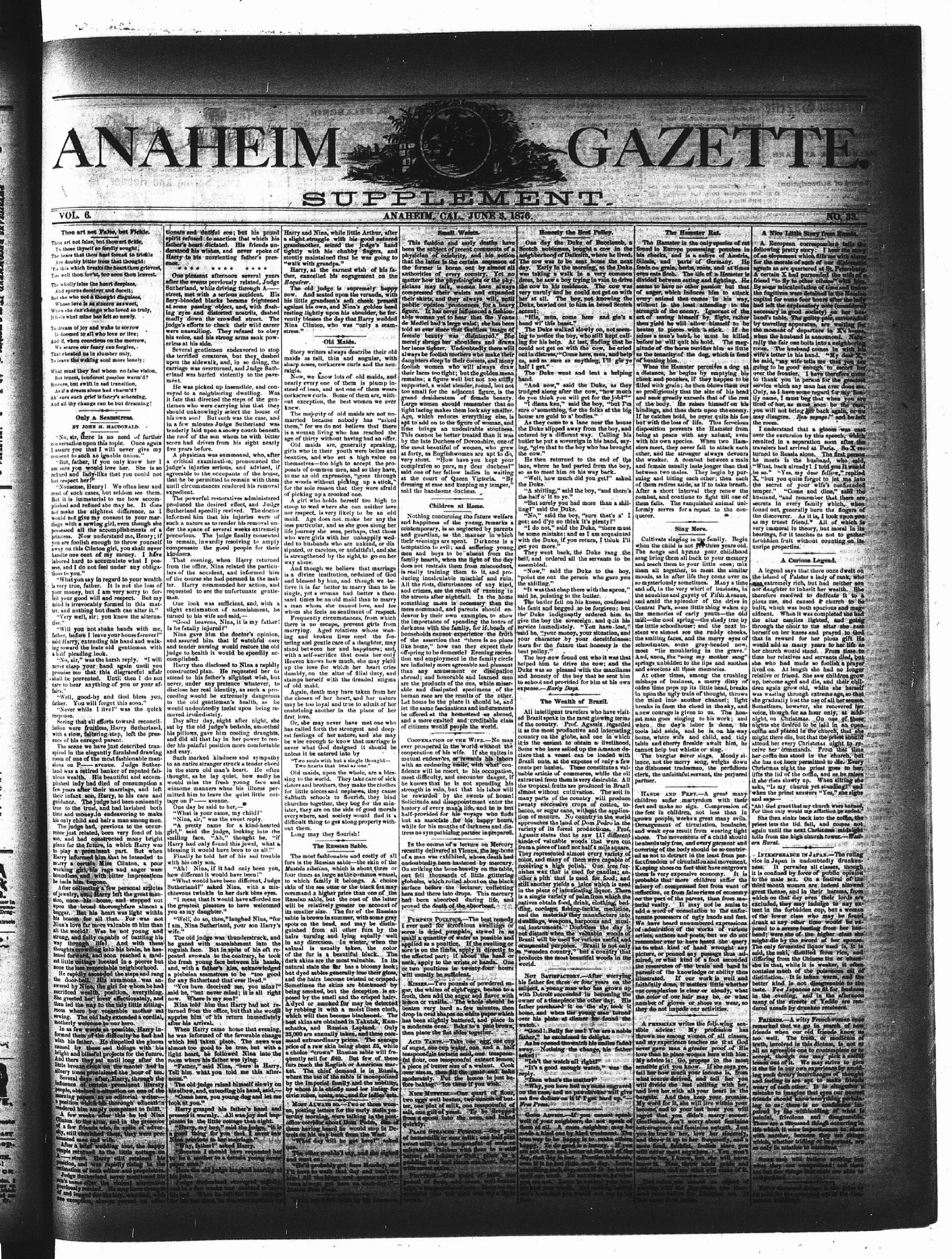
Searchable text
ANAHEIM
VOL. 6.
Thou art not False, but Fickle.
Thou art not false; but thou art sickle,
To those thyself so fondly sought;
The tears that thou hast forced to trickle
Are doubly bitter from that thought:
'Tis this which breaks the heart thou grieve,
Too well thou lov'at, too soon thou leavest.
The wholly false the heart despises,
And spurns deceiver and deceit;
But she who not a thought disguises,
Whose love is as sincere as sweet,
When she can change who loved so truly,
It feels what mine has felt so newly.
To dream of joy and wake to sorrow
Is doomed to all who love or live;
And if, when conscious on the morrow,
We scarce our fancy can forgive,
That cheated us in alumber only,
To leave the waking soul more lonely;
What must they feel whom no false vision,
But truest, tenderest passion warm'd?
Sincere, but swift in sad transition,
As if a dream alone had charm'd?
Ab' sure such grief is fancy's scheming,
And all thy change can be but dreaming!
Only a Seamstress.
BY JOHN M. MACDONALD.
"No, sir, there is no need of further conversation upon this topic. Once again I assure you that I will never give my consent to such an ignoble union."
"But, father, if you only knew her I am sure you would love her. She is so tionate and dutiful son; but his proud spirit refused to sanction that which his father's heart dictated. His friends understood his wishes, and never spoke of Harry in his unrelenting father's presence.
One pleasant afternoon several years after the events previously related, Judge Sutherland, while driving through A—street, met with a serious accident. His fiery-blooded blacks became frightened at some passing object, and, with flash-ing eyes and distorted nostrils, dashed madly down the crowded street. The judge's efforts to check their wild career were unavailing. They refused to obey his voice, and his strong arms sank powerless at his side.
Several gentlemen endeavored to stop the terrified creatures, but they dashed upon the sidewalk, and, in so doing, the carriage was overturned, and Judge Sutherland was hurled violently to the pavement.
He was picked up insensible, and conveyed to a neighboring dwelling. Was it fate that directed the steps of the gentlemen who were carrying him that they should unknowingly select the house of his own son? But such was the case, and in a few minutes Judge Sutherland was tenderly laid upon a snowy couch beneath the roof of the son whom he with bitter scorn had driven from his sight nearly five years before.
A physician was summoned, who, after a critical examination, pronounced the judge's injuries serious, and advised, if Harry and Nina, while little a slight struggle with his grandmother, seized the tightly with his chubby stoutly maintained that he "walk with grandpa."
Harry, at the earnest ther, cancelled his engagement.
The old judge is awake now. And seated upon the his little grandson's soft against his own, and Nina resting lightly upon his slovenly blesses the day that Nina Clinton, who was stress."
Old Maids.
Story writers always despair maids as tall, thin and sharp noses, corkscrew curtains.
Now, we know lots of nearly every one of them stead of lean, and not one corkscrew curls. Some of out exception, the best w knew.
The majority of old maids married because nobod them," for we do not belie is a woman living who ha age of thirty without having Old maids are, gener girls who in their youth w beauties, and who set a themselves—too high to a common man...
Only a Seamstress.
BY JOHN M. MACDONALD.
"No, sir, there is no need of further conversation upon this topic. Once again I assure you that I will never give my consent to such an ignoble union."
"But, father, if you only knew her I am sure you would love her. She is so refined and lady-like that you could not but respect her!"
"Nonsense, Henry! We often hear and read of such cases, but seldom see them. But it is immaterial to me how accomplished and refined she may be. It does not make the slightest difference, as I would not give my consent to your marriage with a sewing girl, even though she possessed all the accomplishments of a princess. Now understand me, Henry; if you are foolish enough to throw yourself away on this Clinton girl, you shall never handle one cent of my money. I have labored hard to accumulate what I possess, and I do not feel under any obligations to you."
"What you say in regard to your wealth is very true, father. It is not the loss of your money, but I am very sorry to forfeit your good will and respect. But my mind is irrevocably formed in this matter, and nothing but death can alter it."
"Very well, sir; you know the alternative."
"Will you not shake hands with me, father, before I leave your house forever?" said Harry, extending his hand and walking toward the irate old gentleman with a half pleading look.
"No, sir," was the harsh reply. "I will never clasp your hand again until you promise me that this disgraceful affair shall be prevented. Until then I do not care to hear anything of you or your affairs."
"Well, good-by and God bless you, father. You will forget this soon."
"Never while I live!" was the quick response.
Seeing that all efforts toward reconciliation were fruitless, Harry Sutherland, with a slow, faltering step, left the presence of his enraged parent.
The scene we have just described transpired in the elegantly furnished drawing room of one of the most fashionable manSIONs on P——avenue. Judge Sutherland was a retired banker of reputed fabulous wealth. His beautiful and accomplished lady had died of consumption a few years after their marriage, and left their infant son, Harry, to his care and guidance. The judge had been eminently true to the trust, and had lavished both time and money in endeavoring to make his only child and heir a man among men.
The judge had, previous to the occurrence just related, been very fond of his son, and had constructed many bright plans for the future, in which Harry was to play a prominent part. But when Harry informed him that he intended to marry a certain Miss Clinton, a poor working girl, his rage and anger were boundless, and with bitter imprecations he bade him begone.
After collecting a few personal articles
He was picked up insensible, and conveyed to a neighboring dwelling. Was it fate that directed the steps of the gentlemen who were carrying him that they should unknowingly select the house of his own son? But such was the case, and in a few minutes Judge Sutherland was tenderly laid upon a snowy couch beneath the roof of the son whom he with bitter scorn had driven from his sight nearly five years before.
A physician was summoned, who, after a critical examination, pronounced the judge's injuries serious, and advised, if agreeable to the occupants of the house, that he be permitted to remain with them until circumstances rendered his removal expedient.
The powerful restoratives administered produced the desired effect, and Judge Sutherland speedily revived. The doctor informed him that his injuries were of such a nature as to render his removal under the space of several weeks extremely precarious. The judge finally consented to remain, inwardly resolving to amply compensate the good people for their kindness.
That evening, when Harry returned from the office, Nina related the particulars of the accident, and informed him of the course she had pursued in the matter. Harry commended her action, and requested to see the unfortunate gentleman.
One look was sufficient, and with a slight exclamation of astonishment, he turned to his wife and said,
"Good heavens, Nina, it is my father! Is he fatally injured?"
Nina gave him the doctor's opinion, and assured him that if watchful care and tender nursing would restore the old judge to health it would be speedily accomplished.
Harry then disclosed to Nina a rapidly constructed plan. He requested her to attend to his father's slightest wish, but never, under any pretence whatever, to disclose her real identity, as such a proceeding would be extremely dangerous to the old gentleman's health, as he would undoubtedly insist upon being removed immediately.
Day after day, night after night, she sat by the old judge's bedside, smoothed his pillows, gave him cooling draughts, and did all that lay in her power to render his painful position more comfortable and easy.
Such marked kindness and sympathy to an entire stranger struck a tender chord in the stern old man's heart. He often thought, as he lay quiet, how sadly he would miss the fresh young face and winsome manners when his illness permitted him to leave the quiet little cottage on P——avenue.
One day he said to her,
"What is your name, my child?"
"Nina, sir," was the sweet reply.
"A pretty name for a kind-hearted girl," said the judge, looking into the smiling face. "Ah," thought he, "if Harry had only found this jewel, what a blessing it would have been to us all!"
Finally he told her of his sad trouble with his only son.
"Ah! Nina, if it had only been you, how different it would have been!"
What would have been different, Judge Sutherland! asked Nina, with a mis-
Now, we know lots of nearly every one of them stead of lean, and not one corkscrew curls. Some of them out exception, the best way knew.
The majority of old maids married because nobody them," for we do not believe is a woman living who has age of thirty without having Old maids are, generally girls who in their youth w beautyes,and who set at themselves—too high to ad posals of common men,and to use an old expression,the woods without picking for the sole reason that the of picking up a crooked one.
A girl who holds herself stoop to wed where she cannot respect,is very likely maid. Age does not make less particular,and as she life journey she sees,percipio who were girls with her used to husbands who are siped to husbands who are siped to husbands who are siped to husbands who are siped to husbands who are siped to husbands who are siped to husbands who are siped to husbands who are siped to husbands who are siped to husbands who are siped to husbands who are siped to husbands who are siped to husbands who are siped to husbands who are siped to husbands who are siped to husbands who are siped to husbands who are siped to husbands who are siped to husbands who are siped to husbands who are siped to husbands who are siped to husbands who are siped to husbands who are siped to husbands who are siped to husbands who are siped to husbands who are siped to husbands who are siped to husbonds who are siped to husbonds who are siped to husbonds who are siped to husbonds who are siped to husbonds who are siped to husbonds who are siped to husbondswho are siped tohusbondswhoaresidedtohusbondswhoaresidedtohusbondswhoaresidedtohusbondswhoaresidedtohusbondswhoaresidedtohusbondswhoaresidedtohusbondswhoaresidedtohusbondswhoaresidedtohusbondswhoaresidedtohusbondswhoaresidedtohusbondswhoaresidedtohusbondswhoaresidedtohusbondswhoaresidedtohusbondswhoaresidedtohusbondswhoaresidedtohusbondswhoaresidedtohusbondswhoaresidedtohusbondswhoaresidedtohusbondswhoisideasidedtohusbondswhoisideasidedtohusbondswhoisideasidedtohusbondswhoisideasidedtohusbondswhoisideasidedtohusbondswhoisideasidedtohusbondswhoisideasidedtohusbondswhoisideasidedtohusbondswhoisideasidedtohusbondswhoisideasidedtohusbondswhoisideasidedtohusbondswhoisideasidedtohusbondswhoisideasidedtohusbondswhoisideasidedtohusbondswhoisideasidedtohusbondswhoisideasidedtohusbondswhoisideasidedtohusboundswhoisideasidedtohusboundswhoisideasidedtohusboundswhoisideasidedtohusboundswhoisideasidedtohusboundswhoisideasidedtohusboundswhoisideasidedtohusboundswhoisideasidedtohusboundswhoisideasidedtohusboundswhoisideasidedtohusboundswhoisideasidedtohusboundswhoisideasidedtohusboundswhoisideasidedtohusboundswhoisideasiedtochesboundedtochesboundedtochesboundedtochesboundedtochesboundedtochesboundedtochesboundedtochesboundedtochesboundedtochesboundedtochesboundedtochesboundedtochesboundedtochesboundedtochesboundedtochesboundedtochesboundedtochesboundedtochesboundedtochesboundedtochesboundedtochesboundedtochesboundedtochesboundedtochesboundedtochesboundedtochesboundedtochesboundedtochesboundedtochesboundedtochesboundedtochesboundedtochesboundedtochesboundedtochesboundedtochesboundedtochesboundedtochesboundedtochesboundedtochesboundedtochesboundedtochesboundedtochesboundedtochesboundedtochesboundedtochesboundedtochesboundedtochesboundedtochesboundedtochesboundededochesboundededochesboundededochesboundededochesboundededochesboundededochesboundededochesboundededochesboundededochesboundededochesboundededochesboundededochesboundededochesboundededochesboundededochesboundededocchesboundededocchesboundededocchesboundededocchesboundededocchesboundededocchesboundededocchesboundDEDOCHESBOUNDDEDOCHESBOUNDDEDOCHESBOUNDDEDOCHESBOUNDDEDOCHESBOUNDDEDOCHESBOUNDDEDOCHESBOUNDDEDOCHESBOUNDDEDOCHESBOUNDDEDOCHESBOUNDDEDOCHESBOUNDDEDOCHESBOUNDDEDOCHESBOUNDDEDOCHESBOUNDDEDOCHESBOUNDDEDOCHESBOUNDDEDOCHESBOUNDDEDOCHESBOUNDDEDOCHESBOUNDDEDOCHESBOUNDDEDOCHESBOUNDDEDOCHESBOUNDDEDOCHESBUNDDEDOCHESBOUNDDEDOCHESBOUNDDEDOCHESBOUNDDEDOCHESBOUNDDEDOCHESBOUNDDEDOCHESBOUNDDEDOCHESBOUNDDEDCheSBoundDEDOCHESBoundDEDOCHESBoundDEDOCHE SBoundDEDOCHE SBoundDEDOCHE SBoundDEDOCHE SBoundDEDOCHE SBoundDEDOCHE SBoundDEDOCHE SBoundDEDOCHE SBoundDEDOCHE SBoundDEDOCHE SBoundDEDOCHE SBoundDEDOCHE SBoundDEDOCHE SBoundDEDOCHE SBoundDEDOCHE SBoundDEDOCHE SBoundDEDOCHE SBoundDEDOCHE SBoundDEDOCHE SBoundDEDOCHE SBoundDEDOCHE SBoundDEDOCHE SBoundDEDOCHE SBoundDEDOCHE SBoundDEDOCHE SBoundDEDODCheSBoundDEDODCheSBoundDEDODCheSBoundDEDODCheSBoundDEDODCheSBoundDEDODCheSBoundLEDODCheSBoundLEDODCheSBoundLEDODCheSBoundLEDODCheSBoundLEDODCheSBoundLEDODCheSBoundLEDODCheSBoundLEDODCheSBoundLEDODCheSBoundLEDODCheSBoundLEDODCheSBoundLEDODCheSBoundLEDODCheSBoundLEDODCheSBoundLEDODCheSBoundLEDODCheSBoundLEDODCheSBoundLEDODCheSBoundLEDODCheSBoundLEDDOChéSBoundLDDOChéSBoundLDDOChéSBoundLDDOChéSBoundLDDOChéSBoundLDDOChéSBoundLDDOChéSBoundLDDOChéSBoundLDDOChéSBoundLDDOChéSBoundLDDOChéSBoundLDDOChéSBoundLDDOChéSBoundLDDOChéSBoundLDDOChéSBoundLDDOChéSBoundLDDOChéSBoundLDDOChéSBoundLDDOChéSBoundLDDOChéSBoundLDDOChéSBoundLDDOChéSBoundLDDOChéSBoundLDDOChéSBoundLDDoChéSBoundLDDoChéSBoundLDDoChéSBoundLDDoChéSBoundLDDoChéSBoundLDDoChéSBoundLDDoChéSBoundLDDoChéSBoundLDDoChéSBindingLDDoChéSBindingLDDoChéSBindingLDDoChéSBindingLDDoChéSBindingLDDoChéSBindingLDDoChéSBindingLDDoChéSBindingLDDoChéSBindingLDDoChéSBindingLDDoChéSBindingLDDoChéSBindingLDDoChéSBindingLDDoChéSBindingLDDoChéSBindingLDDoChéSBindingLDDoChéSBindingLDDoCHÉSEBindEDOCHÉSEBindEDOCHÉSEBindEDOCHÉSEBindEDOCHÉSEBindEDOCHÉSEBindEDOCHÉSEBindEDOCHÉSEBindEDOCHÉSEBindEDOCHÉSEBindEDOCHÉSEBindEDOCHÉSEBindEDOCHÉSEBindEDOCHÉSEBindEDOCHÉSEBindEDOCHÉSEBindEDOCHÉSEBindEDOCHÉSEBindEDOCHÉSEBindEDOCHÉSEBindEDOCHÉSEBindEDOCHÉSEBindEDOCHÉSEBindEDOCHÉSEBindEDOCHÉSEBindEdOCHÉSEBindEdOCHÉSEBindEdOCHÉSEBindEdOCHÉSEBindEdOCHÉSEBindEdOCHÉSEBindEdOCHÉSEBindEdOCHÉSEBindEdOCHÉSEBindEdOCHÉSEBindEdOCHÉSEBindEdOCHÉSEBindEdOCHÉSEBindEdOCHÉSEBindEdOCHÉSEBindEdOCHÉSEBindEdOCHÉSEBindEdOOchêSeBindEdOOchêSe_bindEdOOchêSe_bindEdOOchêSe_bindEdOOchêSe_bindEdOOchêSe_bindEdOOchêSe_bindEdOOchêSe_bindEdOOchêSe_bindEdOOchêSe_bindEdOOchêSe_bindEdOOchêSe_bindEdOOchêSe_bindEdOOchêSe_bindEdOOchêSe_bindEdOOchêSe_bindEdOOchêSe_bindEdOOchêSe_bindEdOOchêSe_bindEdOOchêSe_bindEdOOchêSe_bindEdOOchêSe_bindEdOOchêSe_bindEdOOchêSe_bindEdOOchêSe_bindEdOOchêSe_bindEdOOchêSe_bindEdOOchêSe_bindEdOOchêSe_bindEdOOchêSe_bindEdOOchêSe_bindEdOOchêSe_bindEdOOchêSe_bindEdOOchêSe_bindEdOOchêSe_bindEdOOchêSe_bindEdOOchêSe_bindEdOOchêSe_bindEdOOchêSe_bindEdOOchêSe_bindEdOOchêSe_bindEdOOchêSe_bindEdOOchêSe_bindEdOOchêSe_bindEdOOchêSe_bindEdOOchêSe_bindEdOOchêSe_bindEdOOchêSe_bindEdOOchêSe_bindEdOOchêSe_bindEdOOchêSe_bindEdOOchêSe_bindEdOOchêSe bindEdODOchеSe bind EdODOchеSe bind EdODOchеSe bind EdODOchеSe bind EdODOchеSe bind EdODOchеSe bind EdODOchеSe bind EdODOchеSe bind EdODOchеSe bind EdODOchеSe bind EdODOchеSe bind EdODOchеSe bind EdODOchеSe bind EdODOchеSe bind EdODOchеSe bind EdODOchеSe bind EdODOchеSe bind EdODOchеSe bind EdODOchеSe bind EdODOchеSe bind EdODOchеSe bind EdODOchеSe bind EdODOchеSe bind EdODOchеSe bind EdODOchеSe bind EdODOchеSe bind EdODOchеSo bind EdODOchеSo bind EdODOchеSo bind EdODOchеSo bind EdODOchеSo bind EdODOchеSo bind EdODOchеSo bind EdODOchеSo bind EdODOchеSo bind EdODOchеSo bind EdODOchеSo bind EdODOchеSo bind EdODOchеSo bind EdODOchеSo bind EdODOchèSo bind EdODOchèSo bind EdODOchèSo bind EdODOchrёsebind EDODOchrёsebind EDODOchrёsebind EDODOchrёsebind EDODOchrёsebind EDODOchrёsebind EDODOchrёsebind EDODOchrёsebind EDODOchrёsebind EDODOchrёsebind EDODOchrёsebind EDODOchrёsebind EDODOchrёsebind EDODOchrёsebind EDODOchrёsebind EDODOchrёsebind EDODOchrёsebind EDODOchrёsebind EDODOchrёsebind EDODOchrёsebind EDODOchrёsebind EDODOchrёsebind EDODOchrёsebind EDODOchrёsebind EDODOchrёsebind EDODOchrёsebind EDODOchrёsebind EDODOchrёsebind EDODOchrёsebind EDODOchrёsebind EDodochrёsebind EDodochrёsebind EDodochrёsebind EDodochrёsebind EDodochrёsebind EDodochrёsebind EDodochrёsebind EDodochrёsebind EDodochrёsebind EDodochrёsebind EDodochrёsebind EDodochrёsebind EDodochrёsebind EDodochrёsebind EDodochrёsebind EDodochrёsebind EDodochrёsebind EDodochrёsebind EDodochrёsebind EDodochrёsebind EDodochrёsebind EDodochrёsebind EDodochrёрѣbind EDodohrѣbind EDodohrѣbind EDodohrѣbind EDodohrѣbind EDodohrѣbind EDodohrѣ.bind EDodohrѣ.bind EDodohrѣ.bind EDodohrѣ.bind EDodohrѣ.bind EDodohrѣ.bind EDodohrѣ.bind EDodohrѣ.bind EDodohrѣ.bind EDodohrѣ.bind EDodohrѣ.bind EDodohrѣ.bind EDodohrѣ.bind EDodohrѣ.bind EDodohrѣ.bind EDodohrѣ.bind EDodohrѣ.bind EDodohrѣ.bind EDITodocrьbind EDITodocrьbind EDITodocrьbind EDITodocrьbind EDITodocrьbind EDITodocrьbind EDITodocrьbind EDITodocrьbind EDITodocrьbind EDITodocrьbind EDITodocrьbind EDITodocrьbind EDITodocrьbind EDITodocrьbind EDITodocrьbind EDITodocrьbind EDITodocrьbind EDITodocrьbind EDITodocrьbind EDITodocrьbind EDITodocrьbind EDITodocrьbind EDITodocrьbind EDITodocrь binding EDITodocrь binding EDITodocrь binding EDITodocrь binding EDITodocrь binding EDITodocrь binding EDITodocrь binding EDITodocrь binding EDITodocrь binding EDITodocrь binding EDITodocrь binding EDITodocrь binding EDITодocrь binding EDITодocrь binding EDITодocrь binding EDITодocrь binding EDITодocrь binding EDITодocrъ binding EDITодocrъ binding EDITодocrъ binding EDITодocrъ binding EDITодocrъ binding EDITодocrъ binding EDITодocrъ binding EDITодocrъ binding EDITодocrъ binding EDITодocrъ binding EDITодocrъ binding EDITодocrъ binding EDITодocrъ binding EDITодocrъ binding EDITодocrъ binding EDITодocrъ binding EDITодocrъ binding EDITодocrъ binding EDITодocrъ binding EDITодocrъ bindingEDITодocrъ bindingEDITодocrъ bindingEDITодocrъ bindingEDITодocrъ bindingEDITодocrЁ bindingEDITодocrЁ bindingEDITодocrЁ bindingEDITодocrЁ bindingEDITодocrЁ bindingEDITодocrЁ bindingEDITодocrЁ bindingEDITодocrЁ bindingEDITодocrЁ bindingEDITодocrЁ bindingEDITодocrЁ bindingEDITодocrЁ bindingEDITодocrЁ bindingEDITодocrЁ bindingEDITодocrЁ bindingEDITодocrЁ bindingEDITодocrЁ bindingEDITодокрЁ bindingEDITодокрЁ绑定EDITodoxокрЁ绑定EDITodoxокрЁ绑定EDITodoxокрЁ绑定EDITodoxокрЁ绑定EDITodoxокрЁ绑定EDITodoxокрЁ绑定EDITodoxокрЁ绑定DITodoxокрЁ绑定DITodoxокрЁ绑定DITodoxокрЁ绑定DITodoxокрЁ绑定DITodoxокрЁ绑定DITodoxокрЁ绑定DITodoxоккрЁ绑定DITodoxоккрЁ绑定DITodoxоккрЁ绑定DITodoxоккрЁ绑定DITodoxоккрЁ绑定DITodoxоккрЁ绑定DITodoxоккрЁ绑定DITodoxоккрЁ绑定DITodoxоккрЁ绑定DITodoxоккрЁ绑定DITodoxоккрЁ绑定DITodoxоккрЁ绑定DITodoxоккрЁ
The most fashionable and furs is the Russian Sable—Mustela sibelina, which is four times as large as the tree Sabbath school so flourish churches together; they bear sister; they are on the side; everywhere and society will difficult thing get along out them.
Long may they flourish
The most fashionable and furs is the Russian Sable—Mustela sibelina, which is four times as large as the tree Sabbath school so flourish churches together; they bear sister; they are on the side; everywhere and society will difficult thing get along out them.
Long may they flourish
The judge had been eminently true to the trust, and had lavished both time and money in endeavoring to make his only child and heir a man among men.
The judge had, previous to the occurrence just related, been very fond of his son, and had constructed many bright plans for the future, in which Harry was to play a prominent part. But when Harry informed him that he intended to marry a certain Miss Clinton, a poor working girl, his rage and anger were boundless, and with bitter imprecations he hade him begone.
After collecting a few personal articles of jewelry, size, Harry left the great mansion, once his home, and stepped out upon the broad thoroughfare almost a beggar. But his heart was light within his bosom for all that. For was not Nina's love far more valuable to him than all the world! Was he not young and strong, and fully capable of battling his way through life! And with these thoughts crowding into his brain, he hastened forward, and soon reached a modest little cottage located in a poorer but none the less respectable neighborhood.
He rapidly ascended the steps and rang the door-bell. His summons was answered by Nina, the girl for whom he had sacrificed wealth, position, everything. She greeted her lover affectionately, and then led the way to the tidy little sitting room where her venerable mother sat sewing. The old lady extended a corollal, motherly welcome to our hero.
In as few words as possible, Harry informed them of the difficulty he had had with his father. He dispelled the gloom caused by these sad tidings with his bright and bizarre projects for the future. And there they sat until long after the little bronze clock on the mantel had in all very tunes proclaimed the hour of ten.
Several days after, Harry, through the influence of certain prominent literary people, obtained a situation on one of the morning papers as an editorial writer—a position which his thorough education rendered him amply competent to fulfill.
A few weeks after this he led Nina Clinton to the altar, and in spite of adversity, still charished them, they were presented man and wife.
After a brief wedding tour, the happy couple returned to the little cottage on Acre Street. Harry still remained his position, and was rapidly rising in the estimation of both editor and proprietor.
Judge Sutherland never mentioned his son's name after the violent altercation previously related. He may have thought of and leaped for the boy, who had, with one exception, always proved an offer permitted him to leave the quiet little cottage on P — avenue.
One day he said to her,
"What is your name, my child?"
"Nina, sir," was the sweet reply.
"A pretty name for a kind-hearted girl," said the judge, looking into the smiling face. "Ah," thought he, "if Harry had only found this jewel, what a blessing it would have been to us all."
Finally he told her of his sad trouble with his only son.
"Ah! Nina, if it had only been you, how different it would have been!"
"What would have been different, Judge Sutherland!" asked Nina, with a mischievous twinkle in her dark blue eyes.
"I mean that it would have afforded me the greatest pleasure to have welcomed you as my daughter."
"Well, do so, then," langhed Nina, "for I am Nina Sutherland, your son Harry's wife."
The old judge was thunderstruck, and he gazed with astonishment into the roguish face. But in spite of his oft repeated avowals to the contrary, he took the fresh young face between his hands, and, with a father's kiss, acknowledged a plebeian seamstress to be "too good for any Sutherland that ever lived."
"You have deceived me, you minx!" said he, "but never mind; it is all right now. Where is my son?"
Nina told him that Harry had not returned from the office, but that she would apprise him of his return immediately after his arrival.
When Harry came home that evening, he was informed of the favorable change which had taken place. The news was almost too good to be true, but with a light heart, he followed Nina into the room where his father was lying.
"Father," said Nina, "here is Harry. Tell him what you told me this afternoon."
The old judge raised himself slowly on his elbow, and extending his hand, said,
"Come here, you young dog and let me look at you."
Harry grasped his father's hand and pressed it warmly. All was joy and happiness in the little cottage that night.
"Harry, my boy," said the judge,
"It is a good thing for you that I never saw Nina preach to her marriage."
"Why, father!" asked Harry.
"Henna I should have requested her to be a mother to a certain young new paper man."
Have the old judge lamented heartily at his John.
Judge Sutherland announced regrettably and in a few words was enabled to hear his bad. When he left the little cottage on P — avenue,
permitted him to leave the quiet little cottage on P — avenue.
One day he said to her,
"What is your name, my child!"
"Nina, sir," was the sweet reply.
"A pretty name for a kind-hearted girl," said the judge, looking into the smiling face. "Ah," thought he, "if Harry had only found this jewel, what a blessing it would have been to us all."
Finally he told her of his sad trouble with his only son.
"Ah! Nina, if it had only been you, how different it would have been!"
"What would have been different, Judge Sutherland!" asked Nina, with a mischievous twinkle in her dark blue eyes.
"I mean that it would have afforded me the greatest pleasure to have welcomed you as my daughter."
"Well, do so, then," langhed Nina,
"for I am Nina Sutherland, your son Harry's wife."
The old judge was thunderstruck, and he gazed with astonishment into the roguish face. But in spite of his oft repeated avowals to the contrary, he took the fresh young face between his hands, and with a father's kiss, acknowledged a plebeian seamstress to be "too good for any Sutherland that ever lived."
"You have deceived me, you minx!" said he,
"but never mind; it is all right now. Where is my son?"
Nina told him that Harry had not returned from the office, but that she would apprise him of his return immediately after his arrival.
When Harry came home that evening, he was informed of the favorable change which had taken place. The news was almost too good to be true, but with a light heart, he followed Nina into the room where his father was lying.
"Father," said Nina,
"here is Harry. Tell him what you told me this afternoon."
The old judge raised himself slowly on his elbow,and extending his hand,said,
"Come here,you young dog and let me look at you."
Harry grasped his father's hand and pressed it warmly. All was joy and happiness in the little cottage that night.
"Harry my boy," said the judge,
"It is a good thing for you that I never saw Nina preach to her marriage."
"Why,father!" asked Harry.
"Henna I should have requested her to be a mother to a certain young new paper man."
Have the old judge lamented heartily at his John.
Judge Sutherland announced regrettably and in a few words was enabled to hear his bad. When he left the little cottage on P — avenue,
permitted him to leave the quiet little cottage on P — avenue.
One day he said to her,
"What is your name,your child!"
"Nina,sir," was the sweet reply.
"A pretty name for a kind-hearted girl," said the judge, looking into the smiling face. "Ah," thought he, "if Harry had only found this jewel, what a blessing it would have been to us all."
Finally he told her of his sad trouble with his only son.
"Ah! Nina, if it had only been you,how different it would have been!"
"What would have been different, Judge Sutherland!" asked Nina, with a mischievous twinkle in her dark blue eyes.
"I mean that it would have afforded me the greatest pleasure to have welcomed you as my daughter."
"Well.do so,thelenghedNina,"for I am,Nina Sutherland,your son Harry's wife."
The old judge was thunderstruck,and he gazed with astonishment into the roguish face. But in spite of his oft repeated avowals to the contrary,他 took the fresh young face between his hands,and with a father's kiss,acknowledged a plebeian seamstress to be "too good for any Sutherland that ever lived."
"You have deceived me,you minx!" said he,
"but never mind; it is all right now. Where is my son?"
Nina told him that Harry had not returned from the office,但that she would apprise him of his return immediately after his arrival.
When Harry came home that evening,他 was informed of the favorable change which had taken place.The news was almost too good to be true,但with a light heart,他 followed Nina into the room where his father was lying.
"Father," said Nina,
"here is Harry.Tell him what you told me this afternoon."
The old judge raised himself slowly on his elbow,and extending his hand,said,
"Come here,you young dog and let me look at you."
Harry grasped his father's hand and pressed it warmly.All was joy and happiness in the little cottage that night.
"Harry my boy," said the judge,
"It is a good thing for you that I never saw Nina preach to her marriage."
"Why,father!" asked Harry.
"Henna I should have requested her to be a mother to a certain young new paper man."
Have the old judge lamented heartily at his John.
Judge Sutherland announced regrettably and in a few words was enabled to hear his bad. When he left the little cottage on P — avenue,
permitted him to leave the quiet little cottage on P — avenue.
One day he said to her,
"What is your name,your child!"
"Nina,sir," was the sweet reply.
"A pretty name for a kind-hearted girl," said the judge, looking into the smiling face. "Ah," thought he, "if Harry had only found this jewel,what a blessing it would have been to us all."
Finally he told her of his sad trouble with his only son.
"Ah! Nina, if it had only been you,how different it would have been!"
"What would have been different,Judge Sutherland!" asked Nina,with a mischievous twinkle in her dark blue eyes.
"I mean that it would have afforded me the greatest pleasure to have welcomed you as my daughter."
"Well.do so,thelenghedNina,"for I am,Nina Sutherland,your son Harry's wife."
The old judge was thunderstruck,and he gazed with astonishment into the roguish face. But in spite of his oft repeated avowals to the contrary,他 took the fresh young face between his hands,and with a father's kiss,acknowledged a plebeian seamstress to be "too good for any Sutherland that ever lived."
"You have deceived me,you minx!" said he,
"but never mind; it is all right now. Where is my son?"
Nina told him that Harry had not returned from the office,但that she would apprise him of his return immediately after his arrival.
When Harry came home that evening,他 was informed of the favorable change which had taken place.The news was almost too good to be true,但with a light heart,他 followed Nina into the room where his father was lying.
"Father," said Nina,
"here is Harry.Tell him what you told me this afternoon."
The old judge raised himself slowly on his elbow,and extending his hand,said,
"Come here,you young dog and let me look at you."
Harry grasped his father's hand and pressed it warmly.All was joy and happiness in the little cottage that night.
"Harry my boy," said the judge,
"It is a good thing for you that I never saw Nina preach to her marriage."
"Why,father!" asked Harry.
"Henna I should have requested her to be a mother to a certain young new paper man."
Have the old judge lamented heartily at his John.
Judge Sutherland announced regrettably and in a few words was enabled to hear his bad. When he left the little cottage on P — avenue,
permitted him to leave the quiet little cottage on P — avenue.
One day he said to her,
"What is your name,your child!"
"Nina,sir," was the sweet reply.
"A pretty name for a kind-hearted girl," said the judge,looking into the smiling face. "Ah," thought he, "if Harry had only found this jewel,what a blessing it would have been to us all."
Finally he told her of its sad trouble with its smaller size.The fur sable is brown in summer,spots on head,and guished from all other hairs turning and lying.in any direction.In written animal is usually taken.of the fur is a beautiful dark skins are the most natural state she has but dyed sables generally,andthe hairs become twin.Sometimes the skins are being smoked,但the dye will reach the English or Russian Lions 25000 are annually taken.mand extraordinary prices.of a raw skin beinga choice "crown" Russian quently sell for £40.Before furs reachthe English or Russian Lions 25000 are annually taken.mand extraordinary prices.of a raw skin beinga choice "crown" Russian quently sell for £40.Before furs reachthe English or Russian Lions 25000 are annually taken.mand extraordinary prices.of a raw skin beinga choice "crown" Russian quently sell for £40.Before furs reachthe English or Russian Lions 25000 are annually taken.mand extraordinary prices.of a raw skin beinga choice "crown" Russian quently sell for £40.Before furs reachthe English or Russian Lions 25000 are annually taken.mand extraordinary prices.of a raw skin beinga choice "crown" Russian quently sell for £40.Before furs reachthe English or Russian Lions 25000 are annually taken.mand extraordinary prices.of a raw skin beinga choice "crown" Russian quently sell for £40.Before furs reachthe English or Russian Lions 25000 are annually taken.mand extraordinary prices.of a raw skin beinga choice "crown" Russian quently sell for £40.Before furs reachthe English or Russian Lions 25000 are annually taken.mand extraordinary prices.of a raw skin beinga choice "crown" Russian quently sell for £40.Before furs reachthe English or Russian Lions 25000 are annually taken.mand extraordinary prices.of a raw skin beinga choice "crown" Russian quently sell for £40.Before furs reachthe English or Russian Lions 25000 are annually taken.mand extraordinary prices.of a raw skin beinga choice "crown" Russian quently sell for £40.Before furs reachthe English or Russian Lions 25000 are annually taken.mand extraordinary prices.of a raw skin beinga choice "crown" Russian quently sell for £40.Before furs reachthe English or Russian Lions 25000 are annually taken.mand extraordinary prices.of a raw skin beinga choice "crown" Russian quently sell for £40.Before furs reachthe English or Russian Lions 25000 are annually taken.mand extraordinary prices.of a raw skin beinga choice "crown" Russian quently sell for £40.Before furs reachthe English or Russian Lions 25000 are annually taken.mand extraordinary prices.of a raw skin beinga choice "crown" Russian quently sell for £40.Before furs reachthe English or Russian Lions 25000 are annually taken.mand extraordinary prices.of a raw skin beinga choice "crown" Russian quently sell for £40.Before furs reachthe English or Russian Lions 25000 are annually taken.mand extraordinary prices.of a raw skin beinga choice "crown" Russia quently sell for £40.Before furs reachthe English or Russian Lions 25000 are annually taken.mand extraordinary prices.of a raw skin beinga choice "crown" Russia quently sell for £40.Before furs reachthe English or Russian Lions 25000 are annually taken.mand extraordinary prices.of a raw skin beinga choice "crown" Russia quently sell for £40.Before furs reachthe English or Russian Lions 25000 are annually taken.mand extraordinary prices.of a raw skin beinga choice "crown" Russia quently sell for £40.Before furs reachthe English or Russian Lions 25000 are annually taken.mand extraordinary prices.of a raw skin beinga choice "crown" Russia quently sell for £40.Before furs reachthe English or Russian Lions 25000 are annually taken.mand extraordinary prices.of a raw skin beinga choice "crown" Russia quently sell for £40.Before furs reachthe English or Russian Lions 25000 are annually taken.mand extraordinary prices.of a raw skin beinga choice "crown" Russia quently sell for £40.Before furs reachthe English or Russian Lions 25000 are annually taken.mand extraordinary prices.of a raw skin beinga choice "crown" Russia quently sell for £40.Before furs reachthe English or Russian Lions 25000 are annually taken.mand extraordinary prices.of a raw skin beinga choice "crown" Russia quently sell for £40.Before furs reachthe English or Russian Lions 25000 are annually taken.mand extraordinary prices.of a raw skin beinga choice "crown" Russia quently sell for £40.Before furs reachthe English or Russian Lions 25000 are annually taken.mand extraordinary prices.of a raw skin beinga choice "crown" Russia quently sell for £40.Before furs reachthe English or Russian Lions 25000 are annually taken.mand extraordinary prices.of a raw skin beinga choice "crown" Russia quently sell for £40.Before furs reachthe English or Russian Lions 25000 are annually taken.mand extraordinary prices.of a raw skin beinga choice "crown" Russia quently sell for £40.Before furs reachthe English or Russian Lions 25000 are annually taken.mand extraordinary prices.of a raw skin beinga choice "crown" Russia quently sell for £40.Before furs reachthe English or Russian Lions 25000 are annually taken.mand extraordinary prices.of a raw skin beinga choice "crown" Russia quently sell for £40.Before furs reachthe English or Russian Lions 25
Harry and Nina, while little Arthur, after a slight struggle with his good mature grandmother, seized the judge's hand tightly with his chubby fingers, and stoutly maintained that he was going to "walk with grandpa."
Harry, at the earnest wish of his father, cancelled his engagement on the Enquirer.
The old judge is supremely happy now. And seated upon the veranda, with his little grandson's soft cheek pressed against his own, and Nina's golden head resting lightly upon his shoulder, he fervently blesses the day that Harry wedded Nina Clinton, who was "only a seamstress."
Old Maids.
Story writers always describe their old maids as tall, thin and angular, with sharp noses, corkscrew curls and the neuralgia.
Now, we know lots of old maids, and nearly every one of them is plump instead of lean, and not one of them wears corkscrew curls. Some of them are, without exception, the best women we ever knew.
The majority of old maids are not unmarried because nobody has "asked them," for we do not believe that there is a woman living who has reached the age of thirty without having had an offer.
Old maids are, generally speaking, girls who in their youth were belles and beauties, and who set a high value on themselves—too high to accept the proposals of common men and so they have.
Small Waits.
This fashion and early deaths have been the subject of recent comments of a physician of celebrity, and his notion that the latter is the certain sequence of the former is borne out by almost all authorities of every country. Yet no matter how the physiologists or the physicians may talk, women have always compressed their waists and expanded their skirts, and they always will, until public opinion pronounces, for a heavy figure. It has never influenced a fashionable woman yet to hear that the Venus de Medici had a large waist; she has been told so ever since that faultless image of female beauty was disinterred." She merely shrugs her shoulders and draws her laces tighter. Undoubtedly there will always be foolish mothers who make their daughters sleep in their corsets, and many foolish women who will always draw their laces too tight; but the golden mean remains; a figure well but not too stiffly supported, a waist slender, round, but not too small for the adjacent figure, is the grand desideratum of female beauty. Large women should remember that no tight lacing makes them look any smaller. Age, which reduces everything else, is apt to add on to the figure of woman, and time brings an undesirable stoutness. This cannot be better treated than it was by the late Duchess of Devonshire, one of the most beautiful of women, who grew at forty, as Englishwomen are apt to do, very stout. "How have you kept your complexion so pure, my dear duchess?"
Honesty the Best Policy.
One day the Duke of Bucleuch, a Scotch nobleman, bought a cow in the neighborhood of Dalkeith, where he lived. The cow was to be sent home the next day. Early in the morning, as the Duke was taking a walk in a very common dress, he saw a boy trying in vain to drive the cow to his residence. The cow was very unruly and he could not get on with her at all. The boy, not knowing the Duke, bawled out to him in broad Scotch accent:
"His mun, come here and gie's a hand wi' this beast."
The Duke walked slowly on, not seeming to notice the boy, who still kept calling for his help. At last, finding that he could not get on with the cow, he cried out in distress: "Come here, mun, and help us, and as sure as anything, I'll gie ye half I get."
The Duke went and lent a helping hand.
"And now," said the Duke, as they trudged along after the cow, "how much do you think you will get for the job?" "I dinnna ken," said the boy, "but I'm sure o' something, for the folks at the big house are guild to a' bodies."
As they came to a lane near the house the Duke slipped away from the boy, and entered by a different way. Calling his butler he put a sovereign in his hand, saying, "give that to the boy who has brought the cow."
He then returned to the end of the lane, where he had parted from the boy,
The Hamster found in Earl his checks, and Silesia, and feeds on grain even eats flesh divided between seems to have of anger, when every animal without it strength of the art of saving has beaten to pluck seizes a man before he will nitude of them as the tenacity of hunting him.
When the Hamster distance, he cheek and poised with great prodigiousness and neck grease of the body. hindlegs, and if he catches but with the l disposition p being at peace with his own sters meet, then other, and thus the weaker. and female us.
Now, we know lots of old maids, and nearly every one of them is plump instead of lean, and not one of them wears corkscrew curls. Some of them are, without exception, the best women we ever knew.
The majority of old maids are not unmarried because nobody has "asked them," for we do not believe that there is a woman living who has reached the age of thirty without having had an offer.
Old maids are, generally speaking, girls who in their youth were belles and beauties, and who set a high value on themselves—too high to accept the proposals of common men, and so they have, to use an old expression, "gone through the woods without picking up a stick," for the sole reason that they were afraid of picking up a crooked one.
A girl who holds herself too high to stoop to wed where she can neither love nor respect, is very likely to be an old maid. Age does not make her any less particular, and as she goes along her life journey she sees, perhaps, that those who were girls with her unhappily wedded to husbands who are unkind, or disipated, or careless, or unfaithful, and she is strengthened by the sight to go on her way alone.
And though we believe that marriage is a divine institution, ordained of God and blessed by him, and though we believe it is far better to marry than to be single, yet a woman had better a thousand times be an old maid than to marry a man whom she cannot love, and for whom she feels no sentiment of respect.
Frequently circumstances, from which there is no escape, prevent girls from marrying. Aged relatives whose waning and broken lives need the fostering and gentle care of a daughter, may stand between her and happiness; and, with a self-sacrifice that costs her only Heaven knows how much, she may yield up the love for which her heart cries dumbly, on the altar of filial duty, and stamps herself with the dreaded stigma of old maid.
Again, death may have taken from her the chosen of her heart, and her nature may be too loyal and true to admit of her enshrining another in the place of her first love.
Or, she may never have met one who has called forth the strongest and deepest feelings of her nature, and she may be wise enough to know that marriage is never what God designed it should be unless it be entered into by
"Two souls with but a single thought—Two hearts that beat as one."
Old maids, upon the whole, are a blessing to the world. They take care of sick sisters and brothers, they make the clothes for little nieces and nephews, they cause Sabbath schools to flourish, they bind churches together, they beg for the minister, they are on the side of good morals everywhere, and society would find it a difficult thing to get along properly without them.
Long may flourish!
The Russian Sable.
The most fashionable and costly of all furs is the Russian sable—the skin of the Mustela sibelina, which is about three or four times as large as the common weasel, to which family it belongs. A choice skin of the sea otter or the black fox may
In the course of a lecture on Mercury recently delivered at Vienna, the leg-bone of a man was exhibited, whose death had undoubtedly been hastened by mercury. On striking the bone heavily on the table, out fell thousands of little glittering globules, which rolled about on the black surface before the lecturer, collecting their laces too tight; but the golden mean remains; a figure well but not too stiffly supported, a waist slender, round, but not too small for the adjacent figure, is the grand desideratum of female beauty. Large women should remember that no tight lacing makes them look any smaller. Age, which reduces everything else, is apt to add on to the figure of woman, and time brings an undesirable stoutness. This cannot be better treated than it was by the late Duchess of Devonshire, one of the most beautiful of women, who grew at forty, as Englishwomen are apt to do, very stout. "How have you kept your complexion so pure, my dear duchess?" said one of her fellow ladies in waiting at the court of Queen Victoria. "By dressing at ease and keeping my temper," said the handsome duchess.
Children at Home.
Nothing concerning the future welfare and happiness of the young, remarks a contemporary, is so neglected by parents and guardian, as the manner in which their evenings are spent. Dirkness is a temptation to evil; and suffering young men and boys to be absent from the family hearth, when the light of the day does not restrain them from misconduct, is really training them to it, and producing calculable mischief and ruin. All the riots, disturbances of any kind, and crimes, are the result of running in the streets after nightfall. In the home something more is necessary than the mere command, and parents should endeavor by their own examples, to show the importance of spending the hours of darkness with the family, for if heads of households cannot experience the truth of the assertion that "there is no place like home," how can they expect their offspring to be domestic? Even recreation and employment in the family circle are infinitely more agreeable and pleasant than any amusement or dissipation abroad; and honorable and learned men are the products of the one, while miserable and dissipated specimens of the human race are the results of the other. Let home be the place it should be, and let the same fascinations and inducements be offered at the homestead as abroad, and a more exalted and creditable class of citizens would people the world.
Cooperation of The Wife.—No man ever prospered in the world without the cooperation of his wife. If she unites in mutual endeavors or rewards his labors with an endearing smile, with what confidence will he resort to his occupation, meet difficulty, and encounter daiget, if he knows that he is not spending his strength in vain, but that his labor will be rewarded by the sweets of home! Solicitude and disappointment enter the history of every man's life, and he is but half-provided for his voyage who finds but an associate for his happy hours, while for his months of darkness and distress no sympathizing partner is prepared.
In the course of a lecture on Mercury recently delivered at Vienna, the leg-bone of a man was exhibited, whose death had undoubtedly been hastened by mercury. On striking the bone heavily on the table, out fell thousands of little glittering globules, which rolled about on the black surface before the lecturer; collecting their laces too tight; but the golden mean remains; a figure well but not too stiffly supported, a waist slender, round, but not too small for the adjacent figure, is the grand desideratum of female beauty. Large women should remember that no tight lacing makes them look any smaller. Age, which reduces everything else, is apt to add on to the figure of woman,and time brings an undesirable stoutness. This cannot be better treated than it was by the late Duchess of Devonshire, one of the most beautiful of women, who grew at forty, as Englishwomen are apt to do,very stout. "How have you kept your complexion so pure, my dear duchess?" said one of her fellow ladies in waiting at the court of Queen Victoria. "By dressing at ease and keeping my temper," said the handsome duchess.
"A shilling," said the boy,"and there's the half o' it to ye."
"But surely you had more than a shilling!" said the Duke.
"No," said the boy,"sure that's a' I got; and dye no think it's plenty!"
"I do not," said the Duke,"there must be some mistake; and as I am acquainted with the Duke, if you return I think I'll get you more."
They went back, the Duke rang the bell,and ordered all the servants to be assembled.
"Now," said the Duke to the boy,"point me out the person who gave you the shilling."
"It was that chap there with the apron," said he,pointing to the butterler.
The butter fell on his knees,confessed his fault and begged to be forgiven; but the Duke indignantly ordered him to give the boythe sovereignand quit his service immediately." You have lost," said he,money,your situation,and your character by your deceitfulness: learn forthe futurethat honestyisthebestpolicy."
The boy now found out who it was that helped him to drivethe cow;andthe Dukewasso pleasedwiththemanlinessandhonestyoftheboythathe senthimtoschoolandprovidedforhimathisownexpense.EarlyDays.
The Wealth of Brazil.
All intelligent travelers who have visited Brazil speak in the most glowing terms ofthe country. Prof. Agassiz regarded it asthemostproductiveandinterestingcountryontheglobe,andoneinwhichitisthe easiesttoobtaina livelihood,Somewhohave saileduptheAmazondeclarethata vesselcanbeloadedwithBrazilnuts.attheexpenseofonlya fewcentsperbushel.Theconstituteavaluablearticleofcommerce,而the油extractedfromtheismisverydesirable.AllthetropicalfruitsareproducedinBrazilalmostwithoutcultivation.Thesoilinmanypartsofthecountrywillproducetwenty successivecoprofecotton,tobacco,或sugarcane Withouttheapplicationofmanure.NocountryintheworldapproachesthelandofDomPedrointhevarietyofitsforestproductionsprof.Agassizstatesthathe saw117differentkindsofvaluablewoodsthatwerecutfromapieceoflandnothalfamile square.Theyrepresent almostevery varietyofcolor,andmanyofthemwerecapableofreceivingahighpolish.Onefreefurnisheswaxthatisusedforcandles;anotherpittthatisusedforfood;andstillanotheryieldsajuicewhichisusedintheplaceintermittentproductionsprof.Agassizstatesthathe saw117differentkindsofvaluablewoodsthatwerecutfromapieceoflandnothalfamile square.Theyrepresent almostevery varietyofcolor,andmanyofthemwerecapableofreceivingahighpolish.Onefreefurnisheswaxthatisusedforcandles;anotherpittthatisusedforfood;andstillanotheryieldsajuicewhichisusedintheplaceintermittentproductionsprof.Agassizstatesthathe saw117differentkindsofvaluablewoodsthatwerecutfromapieceoflandnothalfamile square.They represent almostevery varietyofcolor,andmanyofthemwerecapableofreceivingahighpolish.Onefreefurnisheswaxthatisusedforcandles;anotherpittthatisusedforfood;andstillanotheryieldsajuicewhichisusedintheplaceintermittentproductionsprof.Agassizstatesthathe saw117differentkindsofvaluablewoodsthatwerecutfromapieceoflandnothalfamile square.They represent almostevery varietyofcolor,andmanyofthemwerecapableofreceivingahighpolish.Onefreefurnisheswaxthatisusedforcandles;anotherpittthatisusedforfood;andstillanotheryieldsajuicewhichisusedintheplaceintermittentproductionsprof.Agassizstates thathe saw117differentkindsofvaluablewoodsthatwerecutfromapieceoflandnothalfamile square.They represent almostevery varietyofcolor,andmanyofthemwerecapableofreceivingahighpolish.Onefreefurnisheswaxthatisusedforcandles;anotherpittthatisusedforfood;andstillanotheryieldsajuicewhichisusedintheplaceintermittentproductionsprof.Agassizstates thathe saw117differentkindsofvaluablewoodsthatwerecutfromapieceoflandnothalfamile square.They represent almostevery varietyofcolor,andmanyofthemwerecapableofreceivingahighpolish.Onefreefurnisheswaxthatisusedforcandles;anotherpittthatisusedforfood;andstillanotheryieldsajuicewhichisusedintheplaceintermittentproductionsprof.Agassizstates thathe saw117differentkindsofvaluablewoodsthatwerecutfromapieceoflandnothalfamile square.They represent almostevery varietyofcolor,andmanyofthemwerecapableofreceivingahighpolish.Onefreefurnisheswaxthatisusedforcandles;anotherpittthatisusedforfood;andstillanotheryieldsajuicewhichisusedintheplaceintermittentproductionsprof.Agassizstates thathe saw117differentkindsofvaluablewoodsthatwerecutfromapieceoflandnothalfamile square.They represent almostevery varietyofcolor,andmanyofthemwerecapableofreceivingahighpolish.Onefreefurnisheswaxthatisusedforcandles;anotherpittthatisusedforfood;andstillanotheryieldsajuicewhichisusedintheplaceintermittentproductionsprof.Agassizstates thathe saw117differentkindsofvaluablewoodsthatwerecutfromapieceoflandnothalfamile square.They represent almostevery varietyofcolor,andmanyofthemwerecapableofreceivingahighpolish.Onefreefurnisheswaxthatisusedforcandles;anotherpittthatisusedforfood;andstillanotheryieldsajuicewhichis usedintheplaceintermittentproductionsprof.Agassizstates thathe saw117differentkindsofvaluablewoodsthatwerecutfromapieceoflandnothalfamile square.They represent almostevery varietyofcolor,andmanyofthemwerecapableofreceivingahighpolish.Onefreefurnisheswaxthatisusedforcandles;anotherpittthatisusedforfood;andstillanotheryieldsajuicewhichis usedintheplaceintermittentproductionsprof.Agassizstates thathe saw117differentkindsofvaluablewoodsthatwerecutfromapieceoflandnothalfamile square.They represent almostevery varietyofcolor,andmanyofthemwerecapableofreceivingahighpolish.Onefreefurnisheswaxthatisusedforcandles;anotherpittthatisusedforfood;andstillanotheryieldsajuicewhichis usedintheplaceintermittentproductionsprof.Agassizstates thathe saw117differentkindsofvaluablewoodsthatwerecutfromapieceoflandnothalfamile square.They represent almostevery varietyofcolor,andmanyofthemwerecapableofreceivingahighpolish.Onefreefurnisheswaxthatisusedforcandles;anotherpittthatisusedforfood;andstillanotheryieldsajuicewhichis usedintheplaceintermittentproductionsprof.Agassizstates thathe saw117differentkindsofvaluablewoods thatwerecutfroma pieceoflandnothalfamile square.They represent almostevery varietyofcolor,andmanyofthemwerecapableofreceivingahighpolish.Onefreefurnisheswax thatis used forcandles;anotherpitt that is used for food;and still another yield a juice which is used in this mishape or misuse of co
The Russian Sable.
The most fashionable and costly of all furs is the Russian sable—the skin of the Mustela sibelina, which is about three or four times as large as the common weasel, to which family it belongs. A choice skin of the sea otter or the black fox may command a higher price than one of the Russian sable, but the cost of the latter will be relatively greater on account of its smaller size. The fur of the Russian sable is brown in summer, with some gray spots on the head, and may be distinguished from all other furs by the hairs turning and lying equally well in any direction. In winter, when the animal is usually taken, the color of the fur is a beautiful black. The dark skins are the most valuable. In its natural state the fur has a bloomy look; but dyed sables generally lose their gloss, and the hairs become twisted or crisped. Sometimes the skins are blackened by being smoked, but the deception is exposed by the small and the crisped hairs. A dyed or smoked fur may be detected by rubbing it with a moist linen cloth, which will then become blackened. The best skins are obtained in Yakutsk, Kamchatka, and Russian Lapland. Only 25,000 are annually taken, and these command extraordinary prices. The average price of a raw skin being about £5, while a choice "crown" Russian sable will frequently sell for £40. But few of these furs reach the English or American market. The chief demand is in Russia, where the use of the sable is monopolized by the Imperial family and the mobility, by whom it is chiefly used for lining for civic robes, coats, etc., and for ladies' atta.
Most Akwana so—Two or three women, posting letters for the early mails yesterday morning, were talking in the post-office corridor about Dom Pulex, one of them having heard he would stop in Detroit on his way back from the West.
“What day will he get here!” asked one.
The other couldn’t say, and she sighed and went on;
“He’ll probably get here Monday, and I’ll have to walk that day and can’t mind! All the men and women always get here on weekday!”
Dalton Warner
In the course of a lecture on Mercury recently delivered at Vienna, the leg-bone of a man was exhibited, whose death had undoubtedly been hastened by mercury. On striking the bone heavily on the table, out fell thousands of little glittering globules, which rolled about on the black surface before the lecturer, collecting here and there into drops. This mercury had been absorbed during life, and proved the death of the absorbent.
Pumpkin Poultice—The best remedy I ever used for scrofulous swellings or sores is dried pumpkin, stewed in small a quantity of water as possible and applied as a poultice. If the swelling or sore is on the limbs, apply it directly to the affected part; if about the head or neck, apply to the wrists or hands. One or two poultices in twenty-four hours will usually be sufficient.
Kisses—Two pounds of powdered sugar, the whites of eight eggs, beaten to a froth, then add the sugar and flavor with lemon or vanilla. The whole should be beaten very hard a few minutes, then drop in oval shapes on white paper which has been slightly buttered, and place in a moderate oven. Bake to a pale brown, then place the flat sides together.
Acid Tartar—Take one egg, one cup of sugar, one cup water, one and a half teaspoonful tartar acid, one teaspoonful flour, one teaspoonful extract lemon, a piece of butter size of a walnut. Cook over steam, then fill the paste and bake moderately. Put the lemon in just before baking. Tee them if you wish.
Nich Muffin—One quart of flour, two eggs well beaten, two ounces of butter, one pint of milk, one teaspoonful salt, one gill of yeast. To be dropped from a spoon into the oven, and baked quickly.
Plain Stramon Punice—One pint of buttermilk or milk milk; one half pint sweet milk; one teaspoonful of ammonia salts. Thicken with flour to a stiff batter; add raindrops or fruit; place in a pudding dish and simmer one hour. Serve with sweet nuts.
Thirteen—One quart of milk; one pound of frozen even-aged bread dough; let it rest in warm air until almost without cultivation. The soil in many parts of the country will produce twenty successive crops of cotton, tobacco, or sugar cane, without the application of manure. No country in the world approaches the land of Dom Pedro in the variety of its forest productions. Prof. Agassiz states that he saw 117 different kinds of valuable woods that were cut from a piece of land not half a mile square. They represented almost every variety of color, and many of them were capable of receiving a high polish. One free furnishes wax that is used for candles; another a pith that is used for food; and still another yields a juice which is used in the place of intoxicating liquor. There is a single variety of palm from which the natives obtain food, drink, clothing, bedding, cordage, fishing-tackle, medicine, and the material they manufacture into dwellings, weapons, harpoons and musical instruments. Doubtless the day is not distant when the valuable woods of Brazil will be used for various useful and ornamental purposes. Brazil is not only a “wooden country,” but a country that produces the most beautiful woods in the world.
Not Satirical—After worrying his father for three or four years on the subject, a young man who has grown up with Detroit succeeded in becoming the owner of a timepiece the other day. His father purchased it on the ally, took it home, and when the young man turned over his plate at dinner he found the watch.
“Good! Bally for me! You are a noble father,” he enchained in delight.
As he opened the watch his smile faded away. Notizing the change, his father asked:
“I’m’the watch all right?”
“It’s a good enough watch,” was the reply.
“Then what’s the matter?”
“Why you have had my name engraved on the case, and no pawnbroker will give me five dollars on it if I get hard up.”—Frost Press.
Good Answer—If you cannot speak well of your neighbors, do not speak of them at all. A cross neighbor may be made a kind one by kind treatment. The true way to be happy is to make others happy. In doing so you are not wasteful at all the day that day in lost. Practise kindness even if it be but little each day. Learn something daily even if it be but for small ones worth doing. Do not waste too much time unless you really want to learn more.
HANDS AND children suffer feet and make feet in chin grown people. Derangement and weak eyes shoes. The man be absolutely covered of not to defect freedom or Keeping shoes them is very probable that misery of coiff reflection; or on the part of ternial vanity. Add a word to tuneface possession. We have heard of admiration artists; authors remember etwas as to what kind picture or perished; or what research pursuit of this illustrated faithfully done our complexion; the color of our number of gills they do not injure.
A PHYSICAL sible advice thrown me amon and my experience never gave me love than to put My advice is sensible girl tell her how what sources will divide them and love her bargain. And My word for income,and to regret that Gentleman,die entravagance you be true to and throw it will never make discoveries too.
MOST AKWANA SO—Two or three women, posting letters for the early mails yesterday morning; were talking in the post-office corridor about Dom Pulex, one of them having heard he would stop in Detroit on his way back from the West.
“What day will he get here!” asked one.
The other couldn’t say, and she sighed and went on;
“He’ll probably get here Monday; and I’ll have to wash that day and can’t mind! All the men and women always get here on whisky!”—Dalton Warner
GAZETTE.
NO. 23
Valley.
Bucceleuch, a cow in the here he lived, came the next as the Duke every common vain to drive. The cow was not get on with knowing the broad Scotch and gie's a son, not seeming to keep calling that he how much for the job" boy, "but I'm kicks at the big ear the house the boy, and Calling his is hand, says he has brought end of the from the boy,
The Hamster Rat.
The Hamster is the only species of rat found in Europe possessing pouchs in his cheeks, and is a native of Austria, Silesia, and parts of Germany. He feeds on grain, herbs, roots, and at times even eats flesh. The life of a Hamster is divided between eating and fighting. He seems to have no other passion but that of anger, which induces him to attack every animal that comes in his way, without in the least attending to the strength of the enemy. Ignorant of the art of saving himself by flight, rather than yield he will allow himself to be beaten to pieces with a stick. If he seizes a man's hand, he must be killed before he will quit his hold. The magnitude of the horse terrifies him as little as the tenacity of the dog, which is fond of hunting him.
When the Hamster perceives a dog at a distance, he begins by emptying his cheek and ponches, if they happen to be filled with grain; he then blows them out so prodigiously that the size of his head and neck greatly exceeds that of the rest of the body. He raises himself on his hindlegs, and thus darts upon the enemy. If he catches hold, he never quits his foe but with the loss of life. This ferocious disposition prevents the Hamster from being at peace with any animal, even with his own species. When two Hamsters meet, they never fail to attack each other, and the stronger always devours the weaker. A combat between a male and female usually lasts longer than that
A Nice Little Story from Russia.
A European correspondent tells the following pretty story: I hear the story of an elopement which falls me with alarm for the morals of such of our diplomatic agents as are quartered at St. Petersburg. A certain X had pursued the wife of a friend "to fly to other cities" with him. By some miscalculation of time and trains the fugitives were detained in the Russian capital for some four hours after the lady had left the explanatory note (considered necessary in good society) on her husband's table. The guilty pair, unarmed by travelling apparatus, are waiting for the moment of departure in X's house when the husband is announced. Naturally the fair one bolts into a neighboring room. The husband comes in with his wife's letter in his hand. "My dear X," he said, "my wife tells me that you are going to be good enough to escort her over the frontier. I have therefore come to thank you in person for the greatest service which any man has ever done me. Only, as I have some regard for my family name, I must beg that when you are tired of her, as must soon be the case, you will not bring her back again, or we may disagree." Bon voyage!" and he left the room.
I understand that a gloom was cast over the excursion by this speech, which resulted in a separation soon after the travelers had arrived at Paris. So X returned to Russia alone. The first person he meets is the husband, who said, "What, back already! I told you it would
at a helping
take, as they
"how much
for the job?"
"but I'm
kinds at the big
earth the house
the boy, and
Calling his
hand, sayhas brought
end of the
from the boy,
my back.
get?" asked
"and there's
that's a"
I tenty!
"there must
acquainted
I think I'll
rang the
vants to be
to the boy,
who gave you
the apron,"
is, confessed
given; but
dured him to
and quit his
have lost."
instation, and
receitfulness;
nesty is the
no it was that
now; and the
manliness
he sent him
at his own
razil.
no have visitowing terms
miz regarded
interesting
one in which
Livelhood,
Amazon deloaded with
of only a few
institute a valwhile the oil
resirable. All
used in Brazil.
The soil in will produce cotton, tothe application in the world Pedro in the nations. Prof.
117 different were cut smile square.
ery variety of one tree fur-candles; aner food; and which is used a distance, he begins by emptying his cheek and pouches, if they happen to be filled with grain; he then blows them out so prodigiously that the size of his head and neck greatly exceeds that of the rest of the body. He raises himself on his hindlegs, and thus darts upon the enemy. If he catches hold, he never quits his foe but with the loss of life. This ferocious disposition prevents the Hamster from being at peace with any animal, even with his own species. When two Hamsters meet, they never fail to attack each other, and the stronger always devoura the weaker. A combat between a male and female usually lasts longer than that between two males. They begin by pursuing and biting each other; then each of them retires aside, as if to take breath. After a short interval they renew the combat, and continue to fight till one of them falls. The vanquished animal uniformly serves for a repast to the conqueror.
Sing More.
Cultivate singing in the family. Begin when the child is not yet three years old. The songs and hymns your childhood sang bring them all back to your memory and teach them to your little ones; mix them all together, to meet the similar moods, as in after life they come over us so mysteriously sometimes. Many a time and oft, in the very whirl of business, in the sunshine and gayety of Fifth Avenue, and amid the splendor of the drive in Central Park, some little thing wakes up the memories of early youth—the old mill—the cool spring—the shady tree by the little schoolhouse; and the next instant we almost see the ruddy cheeks, the smiling faces, and the merry eyes of schoolmates, some gray-headed now, most "lie mouldering in the grave." And, anon, the "song my mother song" sprigs unbidden to the lips and soothes and sweetens all these memories.
At other times, among the crushing mishaps of business, a merry ditty of olden time pops up its little head, breaks in upon the ugly train of thought, throws the mind into another channel; light breaks in from the cloud in the sky, and new courage is given to us. The honest man goes singing to his work; and when the day's labor is done, his tools laid aside, and he is on his way home, where wife and child, and tidy table and cherry fireside await him, he cannot help but whistle or sing.
The burghlar never sings. Moody silence, not the merry song, welghs down the dishonest tradesman, the perfilidious clerk, the unaf faithful servant, the perjured partner.
Hands and Feet.—A great many children suffer martyrdom with their feet and make no sign. Compression of the feet in children, not less than in grown people, works a great many evils. Derangement of circulation, headache, and weak eyes result from wearing tight shoes. The movements of a child should be absolutely free, and every garment and covering of the body should be so contrived as not to detract in the least from perfect freedom of circulation and movement. Keeping shoes on feet that have outgrown them is very expensive economy. It is probable that more children suffer the misery of compressed feet from want of
over the frontier. I have therefore come to thank you in person for the greatest service which any man has ever done me. Only, as I have some regard for my family name, I must beg that when you are tired of hor, as must soon be the case, you will not bring her back again, or we may disagree. Bon voyage!" and he left the room.
I understand that a gloom was cast over the excursion by this speech, which resulted in a separation soon after the travelers had arrived at Paris. So X returned to Russia alone. The first person he meets is the husband, who said, "What, back already! I told you it would be so." "Yes, my dear fellow," replied X, "but you quite forgot to let me into the secret of your wife's confounded temper." "Come and dine," said the husband, "and remember that there are secrets in every family which, when found out, generally burn the fingers of the discoverer. As it is, I look upon you as my truest friend." All of which is very immoral in theory, but moral in its bearings, for it teaches us not to gather forbidden fruit without counting on its unripe properties.
A Curious Legend.
A legend says that there once dwelt on the island of Falster a lady of rank who was extremely rich, but had neither son nor daughter to inherit her wealth. She therefore resolved to dedicate it to a plous use, and caused & church to be built, which was both spacious and magnificent. When it was completed she had the altar candles lighted, and going through the choir to the altar she cast herself on her knees and prayed to God that in reward for her plous gift He would add as many years to her life as her church would stand. From time to time her relatives and servants died, but she who had made so foolish a prayer lived on. At length she had no longer relative or friend. She saw children grow up, become aged and die, and their children again grow old, while she herself was wasting through extreme age, so that she gradually lost the use of all her senses. Sometimes, however, she recovered her voice, though for an hour only, at midnight, on Christmas. On one of these nights she desired to be laid in an open coffin and placed in the church; that she might there die, but that the priest should attend her every Christmas night to receive her commands. From that time her coffin has stood in the church; but she has not been permitted to die. Every Christmas night the priest goes to her lifes the lid of the coffin, and as he raises it she rises slowly up. When sitting she asks, "Is my church yet standing?" and when the priest answers "Yes," she sighs and says—
Ah! God grant that my church were burned. For then only would my affection be ended."
She then sinks back into the coffin, the priest lets the lid fall, and comes not again until the next Christmas midnight tolls from the high church tower. Western Rural.
INTEMPERANCE IN JAPAN.—The ruling vice in Japan is undoubtedly drunkenness. It pervades all classes, though it is confined by force of public opinion to the male sex. On a festival of the third month women are indeed allowed
HANDS AND FEET.—A great many children suffer martyrdom with their feet and make no sign. Compression of the feet in children, not less than in grown people, works a great many evils. Derangement of circulation, headache, and weak eyes result from wearing tight shoes. The movements of a child should be absolutely free, and every garment and covering of the body should be so contrived as not to detract in the least from perfect freedom of circulation and movement. Keeping shoes on feet that have outgrown them is very expensive economy. It is probable that more children suffer the misery of compressed feet from want of reflection, or from false views of economy on the part of the parent, than from material vanity. It may not be amiss to add a word of consolation to the unfortunate possessors of ugly hands and feet. We have heard unnumbered expressions of admiration of the works of various artists, authors and poets, but we do not remember ever to have heard the query as to what kind of hand wrought any picture, or penned any passage thus admired, or what kind of a foot seconded the researches of the brain and hand in pursuit of the knowledge or ability thus illustrated. If our work is well and faithfully done, it matters little whether our complaxion is clear or cloudy, what the color of our hair may be, or what number of gloves or shoes we wear, so they do not impede our activities.
A physician writes the following sensible advice: My profession has thrown me among women of all classes, and my experience teaches me that God never gave man a greater proof of His love than to place woman here with him. My advice is: Go, propose to the most sensible girl you know. If she says yes, tell her how much your income is, from what source derived, and toll her you will divide the last shilling with her, and love her with all your heart in the bargain. And then keep your promise. My word for it, she will live within your income, and to your last hour you will regret that you didn't marry sooner. Gentleman, don't worry about feminine extravagance and feminine untruth. Just you be true to her, love her sincerely, and throw it up to her frequently, and a more find, faithful, foolish slave you will never meet anywhere. You won't disserve her. I know, but she will never know it. Now throw aside pride and selfishness, and we shall come of it.
FRIENDS.—A witty Frenchwoman once remarked that we go in search of new friends when our old friends know us too well. The truth, or modicum of truth, involved in this dictum, is not at all an agreeable one to contemplate or to accept, though one may pick a useful lesson out of it. We may strive to give it the tie in our own experience by avoiding such dreary interchanges of thought and feeling as are apt to make friends weary of each other. It is altogether a mistake to imagine that even our nearest friends should know everything pertaining to us; there is no confidence impaired by the withholding of what is painful, frivolous and disgrievable. There are a thousand things occurring in life which it were important to share with another, because they are things which whether trifling or important, are so only in relation to ourselves.
Grace man will believe nothing but what they can comprehend; and there are but few things that men are able to comprehend.