anaheim-gazette 1876-05-27
Scanned page
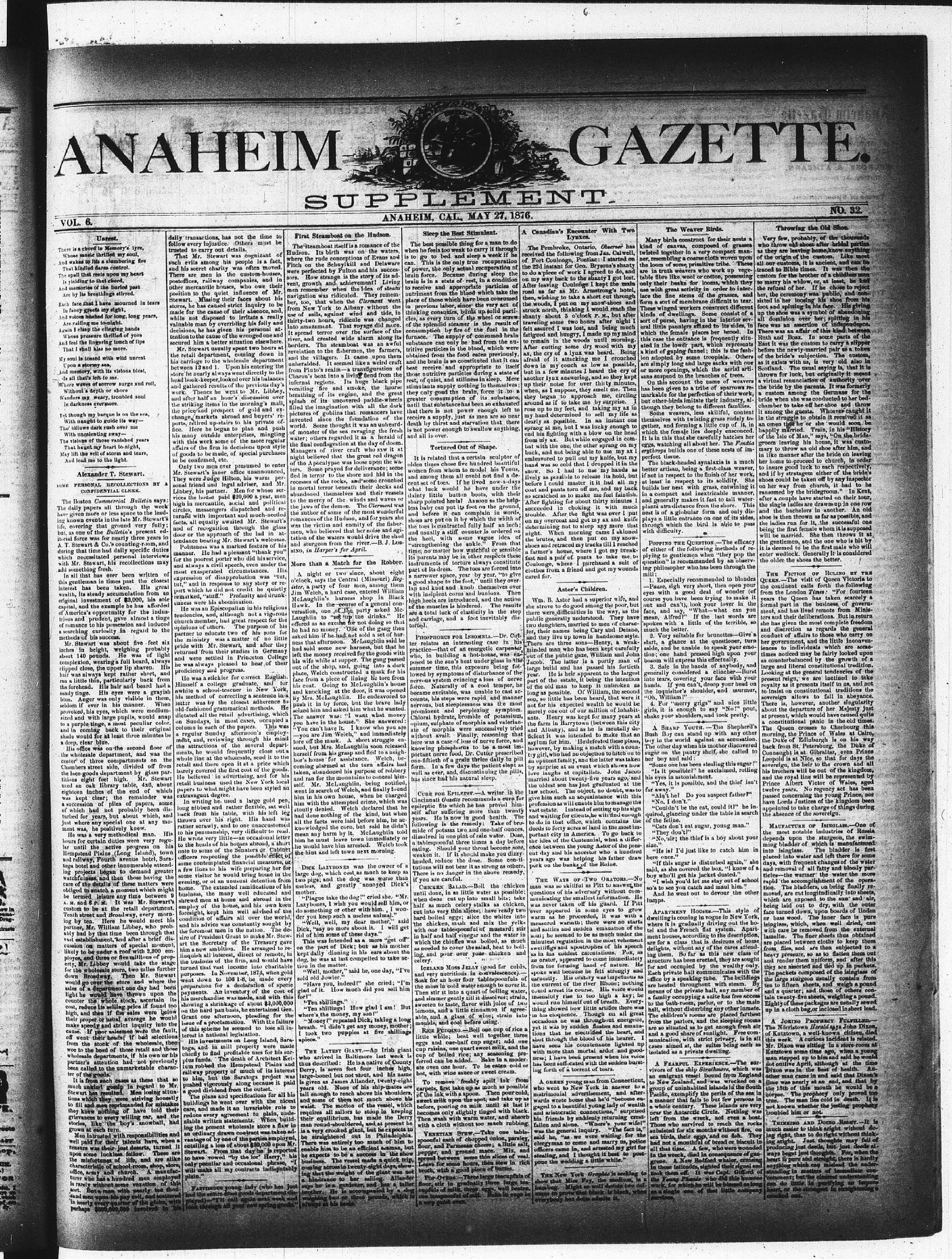
Searchable text
ANAHEIM
VOL. 6.
Unrest.
There is a chord in Memory's lyre,
Whose music thrilled my soul,
And wakes to life a slumbering fire
That kindled dares control.
The spell that rests upon my heart
Is yielding to that chord,
And memories of the buried past
Are by its breathings stirred.
Each face that I have mourned in tears
In fancy greets my sight,
And voices hushed for long, long years,
Are calling me to night.
Again I clasp the clinging hands
Whose pressure thrillad of yore
And feel the lingering touch of lips
That I shall kiss no more.
My soul is tossed with wild unrest
Upon a stormy sea,
And memory, with its visions bleat,
Is all that's left to me.
Where waves of sorrow surge and roll,
Without a depth or shore
Wanders my weary, troubled soul
In darkness evermore.
Yet though my barque is on the sea,
With naught to guide its way—
Tho' billows dark rush over me
With unralenting away—
The visions of those vanished years
That haunt my heart to-night,
May lift the veil of storm and tears,
And lead me to the light.
daily transactions, has not the time to follow every injustice. Others must be trusted to carry out details.
That Mr. Stewart was cognizant of such evils among his people is a fact, and his secret charity was often moved.
There are men in the custom-houses, postoffices, railway companies, and in other mercantile houses, who owe their position to the quiet influence of Mr. Stewart. Missing their faces about his stores, he has caused strict inquiry to be made for the cause of their absence, and, while not disposed to irritate a really valuable man by overriding his folly and decisions, he has given his personal attention to the cause of the wronged one and secured him a better situation elsewhere.
Mr. Stewart usually spent two hours at the retail department, coming down in his carriage to the wholesale department between 12 and 1. Upon his entering the store he nearly always went directly to the head book-keeper, looked over his balances and gathered results of the previous day's work. Thence he went to Mr. Libbey, and after half an hour's discussion over the striking items in the morning's mail, the price and prospect of gold and exchange markets abroad and buyers' reports, retired up-stairs to his private office. Here he began to plan and push his many outside enterprises, mingling with this work some of the more regular affairs of the firm in decisions upon style of goods to be made, of special purchases to be confirmed, etc.
Only two men ever presumed to enter First Steamboat on Hudson.
The steamboat itself is a Hudson. Its birth was where the rude conception Fitch on the Schuylkill were perfected by Fulton sors. How strange is the vent, growth and achieve men remember when the navigation was ridiculed ber, too, that when they from New York to Albany use of saills, against will thirty-two hours, ridiculed into amazement. That w It spread terror over the river, and created wide borders. The steamboat revelation to the fishermen and the villagers. It can unheralded. It seemed from Pluto's realm—a t Charon's boat into a living infernal regions. Its vomiting fire and smear breathing of its engine splash of its uncovered filled the imagination with pictures of goblins that invented since the four world. Some thought it of monster of the sea ra water; others regarded it the final conflagration at Managers of river craught believed that the of the Apocalypse was lea
Alexander T. Stewart.
Some personal collections by a confidential clerk.
The Boston Commercial Bulletin says: The daily papers all through the week have given more or less space to the leading known events in the late Mr. Stewart's life, covering that ground very fully; but, as one of the Bulletin's present editorial force was for nearly three years in A.T. Stewart & Co.'s counting-room, and during that time had daily specific duties which necessitated personal interviews with Mr. Stewart, his recollections may add something fresh.
In all that has ever been written of this gentleman in times past the closest interest has been taken. His great wealth, its steady accumulation from an original investment of $2,000, his sole capital, and the example he has afforded of America's opportunity for the industrious and prudent, gave almost a tinge of romance to his possession and induced a searching curiosity in regard to the methods of his success.
Mr. Stewart was about five feet six inches in height, weighing probably about 140 pounds. He was of light complexion, wearing a full beard, always clipped close, the upper lip shaven. His hair was always kept rather short, and ran a little thin, particularly back from the forehead. His hair and beard had a sandy tinge. His eyes were a grayish blue. Anger was only visible in them, seldom if ever in his manner. When provoked, his eyes, which were medium-sized and with large pupils, would snap to a purple tinge, a most peculiar color, and in coming back to their original shade would for at least three minutes be a deep, clear blue.
His office was on the second floor of the wholesale department, and was the center of three compartments on the Chambers street side, divided off from the lace-goods department by glass partitions eight feet high. Mr. Stewart used an oak library table, 4x6, about eighteen inches of the end of which was kept clear; the remainder was a succession of piles of papers, some of which had not probably been disturbed for years, but about which, and just where any special one at any moment was, he positively knew.
He was a very methodical man. His hours for certain duties were very regular until the active progress on his Hempstead Plains (Long Island), town and railway. Fourth avenue hotel, Saratoga hotel and other innumerable attending projects began to demand greater watchfulness, and then those having the care of the details of these matters were obliged to match a moment which might store he nearly always went directly to the head book-keeper, looked over his balances and gathered results of the previous day's work. Thence he went to Mr. Libbey, and after half an hour's discussion over the striking items in the morning's mail, the price and prospect of gold and exchange markets abroad and buyers' reports, retired up-stairs to his private office. Here he began to plan and push his many outside enterprises, mingling with this work some of the more regular affairs of the firm in decisions upon style of goods to be made, of special purchases to be confirmed, etc.
Only two men ever presumed to enter Mr. Stewart's inner office unannounced. They were Judge Hilton, his warm personal friend and legal adviser, and Mr. Libbey, his partner. Men for whose services the house paid $20,000 a year, men high in mercantile, social and political circles, messengers dispatched and returned with important and much-needed facts, all equally awaited Mr. Stewart's nod of recognition through the glass door or the approach of the lad in attendance bearing Mr. Stewart's welcome.
Politeness was a marked feature of his manner. He had a pleasant "thank you" for the poorest porter who did his service, and always a civil speech, even under the most exasperated circumstances. His expression of disapprobation was "tut, tut," and in response to any story or report which he did not credit he quietly remarked, "stuff." Profanity and drunkenness were his abomination.
He was an Episcopalian in his religious tendencies, and although not a vigorous church member, had great respect for the opinions of others. The purpose of his partner to educate two of his sons for the ministry was a matter of no little pride with Mr. Stewart, and after they returned from their studies in Germany and were settled in Princeton College he was always pleased to hear of their proficiency and progress.
He was a stickler for correct English. Himself a college graduate, and awhile a school-teacher in New York, his method of correcting a sentence in a letter was by the closest adherence to old-fashioned grammatical methods. He dictated all the retail advertising, which on Sundays, in most cases, occupied a column in each of the papers. This was a regular Sunday afternoon's employment, and reviewing through his mind the attractions of the several departments, he would frequently close out a whole line at the wholesale, send it to the retail and there open it at a price which barely covered the first cost of the goods. He believed in advertising, and for his retail business used the New York local papers to what might have been styled an extravagant degree.
In writing he used a large gold pen, long nibbed and rather flexible, sat well back from his table, with his left leg thrown over his right. His hand was rather scrawly, and to one unaccustomed to his penmanship, very difficult to read. He wrote very little—an occasional letter to the heads of his houses abroad, a short note to some of the Senators or Cabinet officers respecting the possible direct of some contemplated financial measures, or a few lines to his wife preparing her for some visitor he would bring home in the evening, or of an unusual detention from home. The extended ramifications of his
More than a Match for A night or two sixty-one clock says the Central sister, a party of four from Jim Welch, a hard case McLaughlin's harness Hawk. In the course versation, one of Higgins Laughlin to "set up" offered as an excuse for he had no money. One asked him if he had not met that afternoon. He had sold some new hats left the money received his wife while at supper out of the shop, and got place. Welch constructs face from a piece of linen his coat. Going to Mrs. Welch knocking at the door by Mrs. McLaughlin.push it in by force,based him and asked him.The answer was: "I love you have in the house."
"You can't have it." I—you are Jim Welch,tore off the mask.A sued, but Mrs. McLaughlin herself from his grasp borer's house for assistance coming alarmed at the taken, abandoned his pants and ran for the mountains self.Mr. McLaughlin went in search of Welch him in his own house,him with the attemptest stoutly denied.Welch had done nothing of that all the facts were laid knowledged the corn,many an harm by it.them must leave to him would have him arrivethe hint and left town
eighteen inches of the end of which was kept clear; the remainder was a succession of plies of papers, some of which had not probably been disturbed for years, but about which, and just where any special one at any moment was, he positively knew.
He was a very methodical man. His hours for certain duties were very regular until the active progress on his Hempstead Plains (Long Island), town and railway. Fourth avenue hotel, Saratoga hotel and other innumerable attending projects began to demand greater watchfulness, and then those having the care of the details of these matters were obliged to snatch a moment which might be termed leisure any time between 9 A.M. and 6 P.M. It was Mr. Stewart's custom to be at the retail department. Tenth street and Broadway, every morning by ten. Here he would meet his partner, Mr. William Libbey, who probably had by that time been through that vast establishment, and after a brief discussion on matters of special moment, likely to be under a roof with 2,300 employees, and three or five millions of property, Mr. Libbey would take the stage for the wholesale store, two miles further down Broadway. Then Mr. Stewart would go over the store and where the sales of a department one day had been light he would have thrown upon the counter the whole stock, ascertain its cost, reduce its selling price if found too high, and then if the sales were below their proper or usual average he would make speedy and strict inquiry into the cause. If poor salesmen were the fault, off went their heads; if bad selections from the stock of the wholesale, then woe to the head of those retail and those wholesale departments, if his own or his partner's attention had not previously been called to the unmarketable character of the goods.
It is from such cases as these that so much unkind good in regard to Mr. Stewart has resulted. Men losing altuations which they were striving honestly to fill and men reprimanded for mistakes they knew nothing of have told their grievances to every willing ear, and the stories, like the boy's snowball, had grown at each turn.
Men intrusted with responsibilities and well paid for their talents have, when a tenure was their just deserts, turned it upon some luckless fellow. These are the misfortunes of life, and are alike characteristic of school-room, shop, store, office, army and church. A manufacturer who has a hundred men employed is rarely without some vexation of this sort. But a man with nearly ten thousand man upon his pay roll, and scattered in nearly every quarter of the globe, with perhaps $800,000 involved in his papers to what might have been styled extravagant degree.
In writing he used a large gold pen, long nibbed and rather flexible, sat well back from his table, with his left leg thrown over his right. His hand was rather scrawly, and to one unaccustomed to his penmanship, very difficult to read.
He wrote very little—an occasional letter to the heads of his houses abroad, a short note to some of the Senators or Cabinet officers respecting the possible effect of some contemplated financial measures, or a few lines to his wife preparing her for some visitor he would bring home in the evening, or of an unusual detention from home. The extended ramifications of his business, the many well educated and shrewd men at home and abroad in the employ of the house, and his own keen foresight, kept him well advised of the condition of affairs all over the world, and his advice was constantly sought by the foremost men in the nation. The desire of President Grant to make Mr. Stewart the Secretary of the Treasury gave him a new ambition. He arranged to relinquish all interest, direct or remote, in the business of the firm, and would have turned that vast income into charitable purposes. In November, 1873, when gold went down to 106 l-8, he made every preparation for a declaration of specie payments. An inventory of the cost of his merchandise was made, and with this showing a shrinkage of about $2,000,000 on the hard pan basis, he entertained Gen. Grant one afternoon, pleading for the issue of a proclamation. With the failure of this scheme he seemed to lose all interest in national legislation.
His investments on Long Island, Saratoga, and in mill property were made chiefly to find profitable uses for his surplus funds. The death of Architect Kelum robbed the Hempstead Plains and railway property of much of its interest to him, but the Saratoga project was pushed vigorously along because it paid a good dividend from the outset.
The plans and specifications for all his buildings he went over with the nicest care, and made it an invariable rule to reduce every agreement to plain, undeniable written statements. When building the present wholesale store a flaw in an ordinary drawn contract was taken advantage of by one of the parties employed, entailing a loss of about $20,000 upon Mr. Stewart. From that day he is reported to have vowed "by the lor' Harry," his only peculiar and occasional phrase, "I will make all my contracts indispensably plain."
Partimous young lady (who has just had the entire dress goods department displayed)—"I'll call again next week and look through all your new spring goods."
First Steamboat on the Hudson.
The steamboat itself is a romance of the Hudson. Its birth was on the waters, where the rude conceptions of Evans and Pitch on the Schuylkill and Delaware were perfected by Fulton and his successors. How strange is the story of its advent, growth and achievement! Living men remember when the idea of steam navigation was ridiculed. They remember, too, that when the Clermont went from New York without the use of sails, against wind and tide, in thirty-two hours,ridienle was changed into amazement. That voyage did more. It spread terror over the surface of the river, and created wide alarm along its borders. The steamboat was an awful revelation to the fishermen, the farmers, and the villagers. It came upon them unheralded. It seemed like a weird craft from Pluto's realm—a transfiguration of Charon's boat into a living flend from the internal regions. Its huge black pipe vomiting fire and smoke, the hoarse breathing of its engine, and the great splash of its uncovered paddle-wheels filled the imagination with all the dark pictures of goblins that romancers have invented since the foundation of the world. Some thought it was an unheard-of monster of the sea ravaging the fresh water; others regarded it as a herald of the final conflagration at the day of doom. Managers of river craft who saw it at night believed that the great red dragon of the Apocalypse was loose upon the waters. Some prayed for deliverance; some
Sleep the Best Stimulant.
The best possible thing for a man to do when he feels too weak to carry it through is to go to bed and sleep a week if he can. This is the only true recuperation of power, the only actual recuperation of brain force. Because during sleep the brain is in a state of rest, in a condition to receive and appropriate particles of nutriment from the blood which take the place of those which have been consumed in previous labor, since the very act of thinking consumes, burds up solid particles, as every turn of the wheel or screw of the splendid steamer is the result of consumption by fire of the fuel in the furnace. The supply of consumed brain substance can only be had from the nutritive particles in the blood, which were obtained from the food eaten previously, and the brain is so constituted that it can best receive and appropriate to itself those nutritive particles during a state of rest, of quiet, and stillness in sleep. Mere stimulants supply nothing in themselves; they only goad the brain, force it to a greater consumption of its substance, until that substance has been so exhausted that there is not power enough left to receive a supply, just as men are so near death by thirst and starvation that there is not power enough to swallow anything, and all is over.
Tortured Out of Shape.
It is related that a certain sculptor of olden times chose five hundred beautiful women from whom to model his Venus.
A Canadian's Encounter With Two Lynxes.
The Pembroke, Ontario, Observer has received the following from Jas. Calwell, of Fort Coulonge, Pontiac: I started on the 22d instant for Geo. Brysons's shanty to do a piece of work I agreed to do, and on my way back to the shanty I got lost. After leaving Coulonge I kept the main road as far as Mr. Armstrong's hotel, then, wishing to take a short cut through the woods, I put on my snow-shoes and struck north, thinking I would reach the shanty about 5 o'clock P.M., but after traveling some two hours after night I felt assured I was lost, and being much fatigued and hungry, I made up my mind to remain in the woods until morning. After cutting some dry wood with my ax, the cry of a lynx was heard. Being afraid of it attacking me I crouched down in my couch as low as possible, but in a few minutes I heard the cry of another lynx answering, and so they kept up their noise for over thirty minutes, when, as I suppose, they smelt me. Then they began to approach me, circling around as if to take me by surprise. I rose up to my feet, and taking my ax in my hand determined to sell my life as dearly as possible. In an instant one sprang at me, but I was lucky enough to end his fighting with a blow on the head from my ax. But while engaged in combat with the one; the other sprang on my back, and not being able to use my ax endeavored to pull out my knife, but my hand was so cold that I dropped it in.
Many birds kind of care twisted together, resemble the loom of table fibre only their biceps lace the final form a sort. These winged kinds of ducks sort of pursue eral little pigs which this case they stated in the kind of gas jion adopted are simply borer or more open sans suspension. On this air has been given markable freedom but other birds though theySome were themselves gether,and which the fIt is in this eggs,watch erythropa be perfect tissue.The black better artists.
More than a Match for the Robber.
A night or two since, about eight o'clock, says the Central (Missouri) Register, a party of four men, among them Jim Welch, a hard case, entered William McLaughlin's harness shop in Black Hawk. In the course of a general conversation, one of the party asked McLaughlin to "set up the drinks." He offered as an excuse not doing so that he had no money. One of the gang then asked him if he had not sold a set of harness that afternoon. McLaughlin said he had sold some new harness, but that he left the money received for the goods with his wife while at supper. The gang passed out of the shop, and, going into a dark place, Welch constructed a mask for his face from a piece of lining he tore from his coat. Going to McLaughlin's house and knocking at the door, it was opened by Mrs. McLaughlin. He endeavored to push it in by force, but the brave lady seized him and asked him what he wanted. The answer was: "I want what money you have in the house." She answered: "You can't have it. I know who you are—you are Jim Welch," and immediately tore off the mask. A short struggle ensued, but Mrs. McLaughlin soon released herself from his grasp and fled to a neighbor's house for assistance. Welch, becoming alarmed at the turn affairs had taken, abandoned his purpose of robbing and ran for the mountains to conceal himself. Mr. McLaughlin, being notified, went in search of Welch, and finally found him in his own house, when he charged him with the attempted crime, which was stoutly denied. Welch declared that he had done nothing of the kind, but when all the facts were laid before him, he acknowledged the corn, but said he didn't mean any harm by it. McLaughlin told him he must leave town immediately or he would have him arrested. Welch took the hint and left town next morning.
Dick Lazybones was the owner of a large dog, which cost as much to keep as two pigs; and the dog was worse than useless, and greatly annoyed Dick's
Tortured Out of Shape.
It is related that a certain sculptor of olden times chose five hundred beautiful women from whom to model his Venus, and among them all could not find a decent set of toes. If he lived now-a-days what luck would he have under the dainty little button boots, with their sharp pointed heels? As soon as the helpless baby can put its foot on the ground, and before it can complain in words, shoes are put on it by which the width of the toes is contracted fully half an inch; and usually a stiff counter is ordered on the heel, with some vague idea of "strengthening the ankle." From that time, no matter how watchful or sensible its parents may be in other respects these instruments of torture always constitute part of its dress. The toes are forced into a narrower space, year by year, "to give a good shape to the foot," until they overlap and knot and knob themselves over with insipient corns and bunions. Then high heels are introduced, and the action of the muscles is hindered. The results are a total lack of elasticity in the step and carriage, and a foot inevitably distorted.
Phosphorus for Insomnia.—Dr. Cutter relates an interesting case in his practice—that of an energetic carpenter who, in building a hot-house, was exposed to the sun's heat under glass in the summer time, this exposure being followed by symptoms of disturbance of the nervous system evincing a loss of nerve force. Naturally of a cool temper, he became excitable, was unable to cast accounts, his steps were rapid and manner nervous, but sleeplessness was the most prominent and perplexing symptom. Chloral hydrate, bromide of potassium, opium, sulphate of morphia and valerianate of morphia were successively tried without await. Finally, reasoning that here was a case of loss of nerve force, and knowing phosphorus to be a most important nerve food, Dr. Cutter prescribed one-fifth of a grain thrice daily in pill form. In a few days the patient slept as well as ever, and, discontinuing the pills, has since had his natural sleep.
Cure for Epilepsy.—A writer in the Cincinnati Gazette recommends a cure for epileptic fits which he has proved himself after suffering more than twenty years. He is now in good health. The following is the remedy: Take of broth made of potassa two and one-half ounces, dissolved in one pint of rain water. Dose, a tablespoonful three times a day before eating. Should your throat become sore, weaken it. If it should make you dizzy-headed, reduce the dose. Some constitutions will not bear it as strong as others. There is no danger in the above remedy, if you are careful.
Chicken Salad.—Boil the chicken but in a few minutes I heard the cry of another lynx answering, and so they kept up their noise for over thirty minutes, when, as I suppose, they smelt me. Then they began to approach me, circling around as if to take me by surprise. I rose up to my feet, and taking my ax in my hand determined to sell my life as dearly as possible. In an instant one sprang at me, but I was lucky enough to end his fighting with a blow on the head from my ax. But while engaged in combat with the one; the other sprang on my back, and not being able to use my ax I endeavored to pull out my knife, but my hand was so cold that I dropped it in the snow. So I had to use my hands as lively as possible to release its hold, but before I could master it it had all my coat and pants torn off me, and my back so scratched as to make me feel faintish. After fighting for about thirty minutes I succeeded in choking it with much trouble. After the fight was over I put on my overcoat and got my ax and knife determining not to sleep any more that night. When morning came I skinned the brutes, and then put on my snowshoes and retraced my tracks till I reached a farmer's house, where I got my breakfast and a pair of pants to take me to Coulonge, where I purchased a suit of clothes from a friend and got my wounds cared for.
Astor's Children.
Wm. B. Astor had a superior wife, and she strove to do good among the poor, but there were difficulties in the way, as the public generally understood. They have two daughters, married to men of character, their names being Cary and Delano, and they live up town in handsome style. There are three sons—Henry, a weak-minded man who has been kept carefully out of the public gaze, William and John Jacob. The latter is a portly man of large build and has passed his fortieth year. He is heir apparent to the largest part of the estate; it being the intention of old man to keep it unbroken as long as possible. Of William, the second son, so little has been heard, that were it not for his expected wealth he would be merely one out of our million of inhabitants. Henry was kept for many years at the farm in Barrytown (between this city and Albany), and as he is mentally deficient it was intended to make that an asylum for him. He defeated these plans however, by making a match with a country girl who had no objection to hitch on an aptitude family, and the latter was taken by surprise at an event which shows how love laughs at capitalists. John Jacob married about twenty-five years ago, and the oldest son has just graduated at the law school. The object, no doubt, was to give him such an acquaintance with this profession as will enable him to manage the vast estate. Instead of setting up his sign and waiting for clients, he will find enough to do in that office, which contains the deeds to forty acres of land in the most important city in America. To go back to the idea of the Centennial, what a difference between the young Astor of the present day and his ancestor who a hundred years ago was helping his father draw pork on the banks of the Ruine.
The Ways of Two Orators—No man was so skillful as Pitt to answer the
DICK LAZYBONES was the owner of a large dog, which cost as much to keep as two pigs; and the dog was worse than useless, and greatly annoyed Dick's mother.
"Plague take the dog!" cried she. "Mr. Lazybones, I wish you would sell him, or do something or other with him. I wonder you keep such a useless animal."
"Well, well, my dear mother," said Dick, "say no more about it. I will get rid of him some of these days."
This was intended as a mere "get off" on the part of Dick; but as his mother kept daily dinning in his ears about the dog, he was at last compelled to take action in the matter.
"Well, mother," said he, one day, "I've sold old Jowler."
"Have you indeed?" she cried; "I'm glad of it. How much did you sell him for?"
"Ten shillings."
"Ten shillings! How glad I am! But where's the money, my son!"
"Money!" repeated Dick, taking a long breath. "I didn't get any money, mother; I took two puppies at five shillings apiece."
THE LATEST GIANT.—An Irish giant who arrived in Baltimore last week is thus described: He is a native of County Derry, is seven feet four inches high, large-boned but not stout, and his name is given as James Allander, twenty-eight years old. None of his ship-mates are tall enough to reach above his shoulders, and some of them not much above his waist. The motion of the vessel, which requires all sailors to stoop in keeping their equilibrium, has made the Derry man round-shouldered, and at present he is a very crooked giant, but he expects to be straightened out in Philadelphia. There was entirely too much of him to enable him to be an efficient seaman, but he expects to be a success in the show business. The vessel made a quick trip, coming across in twenty-sight days, showing that the weight of the giant was not a hindrance to her sailing. Allander says he is a gardener, and has a tall brother. He is accompanied by a dog weighing two or three pounds, which is always at his hands.
CURE FOR EPILEPSY.—A writer in the Cincinnati Gazette recommends a cure for epileptic fits which he has proved himself after suffering more than twenty years. He is now in good health. The following is the remedy: Take of bromide of potassium two and one-half ounces, dissolved in one pint of rain water. Dose, a tablespoonful three times a day before eating. Should your throat become sore, weaken it. If it should make you dizzy-headed, reduce the dose. Some conditions will not bear it as strong as others. There is no danger in the above remedy, if you are careful.
CHICKEN SALAD.—Boil the chicken until done, in as little water as possible; when done cut up into small bits; take half as much celery stalks as chicken, cut into very thin slices; have ready two hard boiled eggs; slice the whites into the chicken, mash and mix the yelks with one tablespoonful of mustard; stir in half and half vinegar and the water in which the chicken was boiled, as much as needed to cover the salad, heat to boiling, and pour over your chicken and celery.
ICELAND MOSS JELLY (good for colds, and very nutritious in convalescence).—Soak for an hour four tablespoonfuls of the moss in cold water enough to cover it. Then stir it into a quart of boiling water, and simmer gently till it dissolves; strain, sweeten to taste, flavor with juice of two lemons, and a little cinnamon, if agreeable, and a glass of wine; strain into moulds, and cool before using.
RICE PUDDING.—Boil one cup of rice a little while; beat well together three eggs and one-half cup sugar; add one cup raisins, one quart sweet milk, and the cup of boiled rice; any seasoning preferred can be added. Bake in a moderate oven one hour. To be eaten cold or hot, with wine sauce or sweet cream.
To remove freshly spilt ink from carpets, first take up as much as possible of the ink with a spoon. Then pour cold, sweet milk upon the spot, and take up as before, pouring on milk until at last becomes only slightly tinged with black. Then wash with warm water, and absorb with a cloth without too much rubbing.
VENETIAN STEW.—Take one table-spoonful each of chopped onion, parley, flour, and Parmesan cheese; a little salt, pepper, and ground maize. Mix, and spread between some thin slices of veal. Leave for some hours, then stew in rich broth with a good piece of butter.
POP-OVERS.—Three large tablespuffs of flour, stir in gradually three large tablespuffs of milk, three eggs, well beaten one teaspoonful of salt. Boil in cups in a very quick oven.
THE WAYS OF TWO ORATORS.—No man was so skilful as Pitt to answer the questions of his adversary without communicating the smallest information. He was never taken off his guard. If Pitt ever appeared in some eyes to grow warm as he proceeded, it was with a measured warmth; there were no starts and saliettes and sudden emanation of the soul; he seemed to be as much under the minuteest regulation in the most vehement swellifgs and apostrophes of his speech as in his coldest calcinations. Fox, as an orator, appeared to come immediately from the forming hand of nature. He spoke well because he felt strongly and earnestly. His oratory was impetuous as the current of the river Rhone; nothing could arrest its course. His voice would insensibly rise to too high a key; he would run himself out of breath. Everything showed how little artifice there was in his eloquence. Though on all great occasions he was throughout energetic, yet it was by sudden flashes and emanations that he electrified the heart, and shot through the blood of his hearer. I have seen his countenance lighted up with more than mortal ardor and goodness; I have been present when his voice has been suffocated with the sudden bursting forth of a torrent of tears.
A GREEN young man from Connecticut, who went to New York in answer to a matrimonial advertisement, and afterwards wrote home that he'd "become engaged to a beautiful young lady of wealth and aristocratic connections," surprised his friends by suddenly returning crestfallen and alone. "Where's your wife?" was the general inquiry. "The fact is," said he, "as we were waiting for the clergyman to come and marry us, police officers came in, and arrested my girl for stealing, and I thought it best to postpone the wedding a little while."
The New York Graphite is seeking to show that Miss Fay, the medium, is a hamburger. Might as well devote two columns to prove that black is black, when everybody but dolls admits it.
GAZETTE.
With Two
Observer has seen Jas. Calwell, who started on Clysons's shanty need to do, and Nancy I got lost. Kept the main strong's hotel, cut through snow-shoes and would reach the M., but after after night I being much up my mind until morning. Wood with my heard. Being one I crouched now as possible, hard the cry of sad so they kept activity minutes, melt me. Then me, circling by surprise. I taking my ax in well my life as an instant oneucky enough to show on the head engaged in com-spring on my to use my ax by knife, but my stopped it in the black-headed synalaxis is a much better artisan, being a first-class weaver.
The Weaver Birds.
Many birds construct for their nests a kind of canvas, composed of grasses twisted together in a very compact manner, resembling a coarse cloth woven upon the loom of some primitive tribe. These are in truth weavers who work up vegetable fibre like wool or cotton, possessing only their beaks for looms, which they use with great activity in order to interlace the fine stems of the grasses, and form a sort of membrane difficult to tear. These winged workers construct different kinds of dwellings. Some consist of a sort of purse, having in the interior several little panniers affixed to its sides, in which the female places her brood. In this case the entrance is frequently situated in the lower part, which represents a kind of gaping funnel; this is the fashion adopted by some troopials. Others are simply long and large sacks with one or more openings, which the aerial artisans suspend to the branches of trees.
On this account the name of weavers has been given to a tribe of sparrows remarkable for the perfection of their work, but other-birds imitate their industry, although they belong to different families.
Some weavers, less skillful, content themselves with twisting grass rudely together, and forming a little cup of it, in which the female lies deeply ensconced. It is in this that she carefully hatches her eggs, watching all about her. The Fondia erythropa builds one of these nests of imperfect tissue.
The black-headed synalaxis is a much better artisan, being a first-class weaver,
Throwing the Old Shoe.
Very few, probably, of the thousands who throw old shoes after bridal parties as they are leaving home, know anything of the origin of the custom. Like most all our customs, it is ancient, and can be traced to Bible times. It was then the custom for the brother of a childless man to marry his widow, or, at least, he had the refusal of her. If he chose to reject her, the ceremony was public, and consisted in her loosening his shoe from his foot and spitting in his face. His giving up the shoe was a symbol of abandoning all dominion over her; spitting in his face was an assertion of independence. There was an affair of this kind between Ruth and Boaz. In some parts of the East it was the custom to carry a slipper before the newly-married pair as a token of the bride's subjection. The customs, as it exists with us, is very old also in Scotland. The usual saying is, that it is thrown for luck, but originally it meant a virtual renunciation of authority over the bride by the parents. It was formerly a custom among the Germans for the bride when she was conducted to her bed-chamber to take off her shoe and throw it among the guests. Whoever caught it in the struggle to obtain it received it as an omen than he or she would soon be happily married. Train, in his "History of the Isle of Man," says, "On the bride-groom leaving his house, it was customary to throw an old shoe after him, and in like manner after the bride on leaving her home to proceed to church, in order to insure good luck to each respectively,
On this account the name of weavers has been given to a tribe of sparrows remarkable for the perfection of their work, but other birds imitate their industry, although they belong to different families.
Some weavers, less skillful, content themselves with twisting grass rudely together, and forming a little cup of it, in which the female lies deeply ensconced. It is in this that she carefully hatches her eggs, watching all about her. The Fondia erythropa builds one of these nests of imperfect tissue.
The black-headed synalaxis is a much better artisan, being a first-class weaver, if not in respect to the finish of her work, at least in respect to its solidity. She builds her nest with grass, entwining it in a compact and inextricable manner, and generally makes it fast to tall waterplants at distance from the shore. This nest is of a globular form and only displays a little entrance on one of its sides, through which the bird is able to pass with difficulty.
POPPING THE QUESTION.—The efficacy of either of the following methods of replying to gentlemen when "they pop the question" is recommended by an observing philosopher who has been through the mill:
1. Especially recommended to blondes — Pause, sigh very short, then open your eyes with a good deal of wonder (of course you have been trying to make it out and can't), look your lover in the face, and say, "What—what can you mean, Alfred?" If the last words are spoken with a little of the terrible, so much the better.
2. Very suitable for brunettes—Give a start, a glance at the questioner, turn aside, and be unable to speak your emotion; one hand pressed high upon your bosom will express this effectually.
3. Safe in the hands of anybody, and generally considered a clincher—Burst into tears, covering your face with your hands. If you can't, droop your head on the inquisitor's shoulder, and murmur, "Oh, William!"
4. For "merry grigs" and nice little girls, it is enough to say "No!" pout, shake your shoulders, and look pretty.
A SHARP YOUTH.—The Shepherd's Bush Boy can stand up with any other boy in the world against an accusation. The other day when his mother discovered sugar on the pantry shelf, she called to her boy and said:
"Some one has been stealing this sugar."
"Is it possible?" he exclaimed, rolling his eyes in astonishment.
"Yes, it is possible, and the thief isn't far away."
"Ain't he? Do you suspect father?"
"No, I don't."
"Couldn't be the cat, could it?" he inquired, glancing under the table in search of the feline.
"Cats don't eat sugar, young man."
"They don't!"
"No, sir; the thief is a boy about your size."
"He is? I'd just like to catch him in here once."
"If this sugar is disturbed again," she said, as she covered the box. "I know of a boy who'll get his jacket dusted."
"I wish you'd let me stay out of school so's to see you catch and maul him."
"Aln't be he? Do you suspect father?"
"No, I don't."
"Couldn't be the cat, could it?" he inquired, glancing under the table in search of the feline.
"Cats don't eat sugar, young man."
"They don't?"
"No, sir; the thief is a boy about your size."
"He is? I'd just like to catch him in here once."
"If this sugar is disturbed again," she said, as she covered the box. "I know of a boy who'll get his jacket dusted."
"I wish you'd let me stay out of school so's to see you catch and maul him."
And he went out to devour the other lumps.
APARTMENT HOUSES.—This style of dwelling is coming in vogue in New York, where it is gradually driving out the hotel and the French flat system. Apartment houses, according to the description, are for a class that is desirous of home delights, without any of the cares attending them. So far as this new class of structure has been erected, they are sought for and occupied by the wealthy only. Each private hall communicates with the office by a speaking tube. The buildings are heated throughout with steam. By means of the private hall, any member of a family occupying a suite has free access to the bath-room, parlor, or to the main hall, without disturbing any other inmate. The children's rooms are placed farthest from the parlors, and the sleeping rooms are so situated as to get enough fresh air and a good share of sunlight. Free communication, with strict privacy, is in all cases aimed at, the suites being each as isolated as a private dwelling.
A FEARFUL EXPERIENCE.—The survivors of the ship Strathmore, which was an emigrant vessel bound from England to New Zealand, and was wrecked on a group of uninhabited islands in the South Pacific, exemplify the perils of the sea in a manner that falls to but few persons in a whole century. These islands are very near the Antarctic Circle. Nothing was left from the wreck, not even a boat. Those who survived to reach the rocks subsisted for six months without fire, on sea birds, their eggs, and on fish. They had not a monthful of bread or biscuit in all that time. A few, who were wounded in the wreck, died in consequence of gangrene. A New Bedford whaler, arising in those latitudes, sighted their signal and took them off. It was Capt. Gifford of the Young Phinnie who did this human work, for which he will be blessed as long as a single one of that little company survives.
MAUFACTURE OF ISINGLASS.—One of the most notable industries of Russia depends upon the sturgeon, the swimming bladder of which is manufactured into isinglass. The bladder is first placed into water and left there for some days, with frequent changes of the water and removal of all fatty and bloody particles—the warmer the water the more rapid the accomplishment of the operation. The bladders, on being finally removed, are cut longitudinally into sheets, which are exposed to the sun and air, being laid out to dry; with the outer face turned down, upon boards of linden or bass wood. The inner face is pure isinglass, which, when well dried, can with care be removed from the external lamelline. The finer sheets thus obtained are placed between cloths to keep them from files, and are then subjected to a heavy pressure, so as to flatten them out and render them uniform, and after this they are assorted and tied up in packets. The packets composed of the isinglass of the large sturgeon usually contain from ten to fifteen sheets, and weigh a pound and a quarter; and those of others contain twenty-five sheets, weighing a pound. Eighty of these packages are usually sewed up in a cloth bag or inclosed in sheet lead.
A JOKING PROPHECY FULFILLED.—The Norristown Herald says John Dixon, of Kutztown, a well-known citizen, died this week. A curious incident is related. Mr. Dixon was sitting in a store-room at Kutztown some time ago, when a young man stepped up to him and said he would not outlive April, although at the time Dixon was in the best of health. Another man came in and said that Dixon's time was nearly at an end, and that by the 15th of this month he would be a corpse. The prophecy only proved too true. The man lies cold in death. It is not known whether the jesting prophacy troubled him or not.
THINKING AND DOING RIGHT.—It is much easier to think right without doing right, than to do right without thinking right. Just thoughts may fail of producing just deeds, but just deeds always beget just thoughts. For when the heart is pure and straight, there is hardly anything which can mislead understanding in matters of immediate concern; but the clearest understanding can do little in purifying as impure heart, or the strongest in straightening a crushed one.