anaheim-gazette 1876-05-20
Scanned page
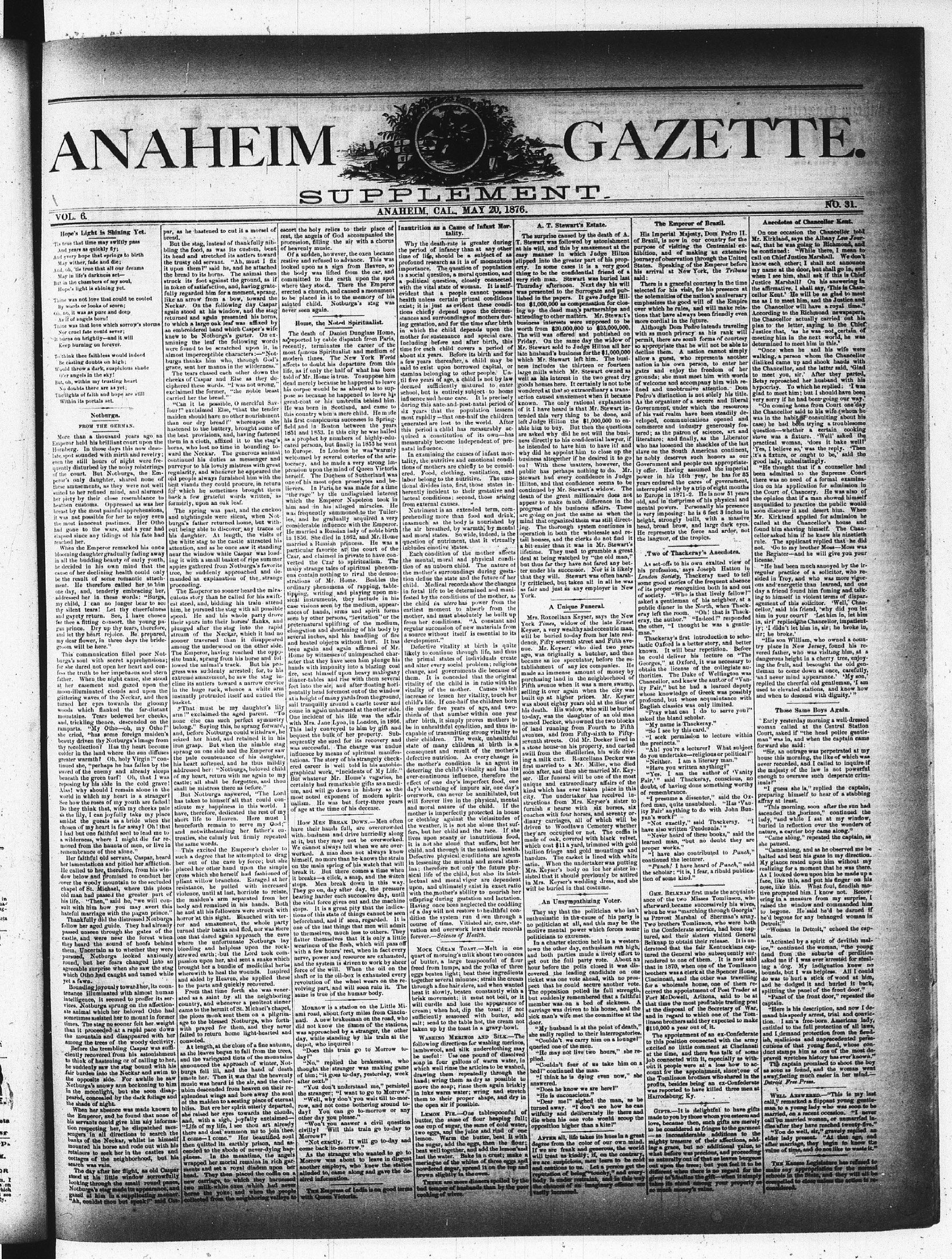
Searchable text
ANAHEIM
VOL. 6.
Hope's Light is Shining Yet.
This true that time may swiftly pass
And years as quickly fly;
And every hope that springs to birth
May wither, fade and die;
And, oh, 'tis true that all our dreams
May in life's darkness set—
But in the chambers of my soul,
Hope's light is shining yet.
Thine was not love that could be cooled
By words or looks of scorn;
Oh, no, it was as pure and deep
As if of angels born!
Thine was that love which sorrow's storms
Nor cruel fate could sever;
It burns on brightly—and it will
Keep burning on forever.
To think the faithless would indeed
Be casting doubts on high;
Would throw a dark, suspicious shade
Over angels in the sky!
But, oh, within my trusting heart
No doubts there are as yet;
The lights of faith and hope are still
Within its portals set.
Notburga.
FROM THE GERMAN.
More than a thousand years ago an
Emperor held his brilliant court upon the
Hornberg. In those days this now desolate spot sounded with mirth and revelry:
even the still hours of night were frequently disturbed by the noisy roisterings
par, as he hastened to cut it a morsel of bread.
But the stag, instead of thankfully nibbling the food, as was its custom, bent its head and stretched its antlers toward the trusty old servant. "Ah, must I fix it upon them?" said he, and he attached the bread to its horns. The animal then struck its foot against the ground, as if in token of satisfaction, and, having gratefully regarded him for a moment, sprang like an arrow from a bow, toward the Neckar. On the following day Caspar again stood at his window, and the stag returned and again presented his horns, to which a large oak leaf was affixed by an embroidered band which Casper's wife knew to be Notburga's garter. On examining the leaf the following words were found to be scratched upon it, in almost imperceptible characters:—"Notburga thanks him who, through God's grace, sent her manna in the wilderness."
The tears chased each other down the cheeks of Caspar and Else as they deciphered these words. "I was not wrong," exclaimed the former, "the noble beast carried her the bread."
"Can it be possible, O merciful Saviour!" exclaimed Else, "that the tender maiden should have no other nourishment than our dry bread?" whereupon she hastened to the buttery, brought some of the best provisions, and, having fastened them in a cloth, affixed it to the stag's horns, who lost no time in bounding toward the Neckar. The generous animal continued his duties as messenger and purveyor to his lovely mistress with great escort the holy relics to the rest, the angels of God accession, filling the air of heavenly music.
Of a sudden, however, the restive and refused to advance looked upon as a sign from the body was lifted from committed to the earth where they stood. There erected a church, and caused to be placed in it to the most sainted child. Notburga never seen again.
Home, the Noted Speller
The death of Daniel Duquesne reported by cable dispatch recently terminates the most famous Spiritualist and modern times. The New affects to doubt his departure life, as if only half of Mr. Home is true. He dead merely because he haphazardly corrupted his corpse would be as abject so because he happen great-coat or his umbrella. He was born in Scotland; this country when a mere capped person has first conspicuous success field and in Boston between 1851 and 1853. In this city as a prophet by numbers cated persons, but finally to Europe. In London he welcomed by several coteriesocracy, and he made a vow
Notburga.
FROM THE GERMAN.
More than a thousand years ago an Emperor held his brilliant court upon the Hornberg. In those days this now desolate spot sounded with mirth and revelry: even the still hours of night were frequently disturbed by the noisy roisterings of the court. But Notburga, the Emperor's only daughter, shared none of these amusements, as they were not well suited to her refined mind, and alarmed her piety by their close resemblance to heathen customs. Oppressed as was her breast by the most painful apprehensions, it was not possible for her to enjoy even the most innocent pastimes. The Otho had gone to the wars, and a year had elapsed since any tidings of his fate had reached her.
When the Emperor remarked his once blooming daughter gradually fading away in all the budding beauty of early youth, he decided in his own mind that the cause of her declining health could only be the result of some romantic attachment. He therefore called her to him one day, and tenderly embracing her, addressed her in these words: "Burga, my child, I can no longer bear to see thy silent tears! Let thy cheerfulness and gayety return. See, I have chosen for thee a fitting consort, the young pagan prince. Dry up thy tears, therefore, and let thy heart rejoice. Be prepared, my dear flower, in three days the bridegroom will be here."
This communication filled poor Notburga's soul with secret apprehensions; for she dared not open her heart and confess the truth to her impetuous and stern father. When the night came, she stood at her casement and gazed upon the moon-illuminated clouds and upon the glittering waves of the Neckar, and then turned her eyes towards the gloomy woods which flanked the far-distant mountains. Tears bedewed her cheeks, and trickling thence, descended on the ramparts. "My Otho—oh, my Otho!" she cried, "has some foreign maiden's beauty driven thy Notburga's image from thy recollection? Has thy heart become colder in the land where the sun diffuses greater warmth? Oh, holy Virgin!" continued she, "perhaps he has fallen by the sword of the enemy and already sleeps beneath the green turf! Oh, that I was reposing by his side in the cold grave! Alas! why should I remain alone in the world in which my heart is a stranger? See how the roses of my youth are faded! Do they think that, with my cheeks pale as the lily, I can joyfully take my place amidst the guests as a bride when the chosen of my heart is far away? Oh! that I had but one faithful soul to lead me to a wilderness, where I might die far removed from the haunts of men, or live in remembrance of those alone."
Her faithful old servant, Caspar, heard her lamentations and pitied her affliction. He called to her, therefore, from his window below and promised to conduct her over the woody mountain to the secluded chapel of St. Michael, where this pious
The tears chased each other down the cheeks of Caspar and Else as they deciphered these words. "I was not wrong," exclaimed the former, "the noble beast carried her the bread."
"Can it be possible, O merciful Saviour!" exclaimed Else, "that the tender maiden should have no other nourishment than our dry bread?" whereupon she hastened to the buttery, brought some of the best provisions, and, having fastened them in a cloth, affixed it to the stag's horns, who lost no time in bounding toward the Neckar. The generous animal continued his duties as messenger and purveyor to his lovely mistress with great regularity, and whenever he appeared the old people always furnished him with the best viands they could procure, in return for which he sometimes brought them back a few grateful words written, as formerly, upon an oak leaf.
The spring was past, and the cuckoo and nightingale were silent, when Notburga's father returned home, without being able to discover any traces of his daughter. At length, the visits of the white stag to the castle attracted his attention, and as he once saw it standing near the window while Caspar was loading it with a small basket of ripe summer apples gathered from Notburga's favorite tree, he suddenly approached and demanded an explanation of the strange proceeding.
The Emperor no sooner heard the miraculous story than he called for his swiftest steed, and bidding his train attend him, he pursued the stag with all possible speed. He and his whole party drove their spurs into their horses' flanks, and plunged after the stag into the rapid stream of the Neckar, which it had no sooner traversed than it disappeared among the underwood on the other side. The Emperor, having reached the opposite bank, sprang from his horse and followed the animal's track. But his progress was suddenly arrested; for, to his extreme amazement, he saw the stag incline its antlers toward a narrow crevice in the huge rock, whence a white arm instantly protruded itself and untied the basket.
"That must be my daughter's lily arm!" exclaimed the aged parent. "To none else can such perfect symmetry belong." Saying this, he sprang forward, and before Notburga could withdraw, he seized her hand, and retained it in his iron grasp. But when the nimble stag sprang on one side and the Emperor saw the pale countenance of his daughter, his heart softened, and he thus mildly addressed her: "Notburga, beloved child of my heart, return with me again to my castle; all shall be forgotten, and thou shall be mistress there as before."
But Notburga answered, "The Lord has taken to himself all that could constitute my happiness in this world. I have therefore dedicated the rest of my short life to Heaven. Here must I henceforth remain to serve my God; and notwithstanding her father's entreaties, she calmly but firmly repeated the same words.
This excited the Emperor's choler to such a degree that he attempted to drag her out of the cave by force; but she placed her other hand upon the simple cross which she herself had fashioned of pliant willow branches. Euraged at her resistance, he pulled with increased life, as if only the half of Mr. Home is true.
Dead merely because he haphazardly chose his corpse would be as abrupt as possible because he happen great-coat or his umbrella. He was born in Scotland; this country when a mere copy of his first conspicuous success field and in Boston between 1851 and 1853. In this city as a prophet by numbers caged persons, but finally joined Europe. In London he welcomed by several cottages and made a vocation upon the mind of herself. The Duchess of York one of his most open prospects. In Paris he was "the rage" by the undisciplined which the Emperor Named him and in his alleged mischiefs; and he gradually became considerable influence within He married a Russian princess particular favorite at Czar, and claimed in private verted the Czar to spite many strange tales of splendens contain nothing to rivals of Mr. Home ordinary phenomena of life tipping, writing and physical instruments; they case visions seen by their hands; arms are seen by other persons; "the preternatural uplifting of elongation and shortening several inches; and his head and heated objects without been again and again.
Home by witnesses of unaltered character that they have seen hands with impunity interself; seat himself upon dinner-tables and rise feet into the air; and afford zontally head foremost on at a height of many yards; sail tranquilly around a come in again unharmed. One incident of his life with Mrs. Jane Lyon; in This lady conveyed to be bequest the bulk of her sequent she sued for it was successful. The chief influence by means of stories. The story of his ered career is well told graphical work; "Incident But whatever Mr. Horne certainly had remarkably um; and will go down in most noted exponent of visualism. He was but one of age at the time of his death.
HOW MEN BREAK DOWN
have their hands full with business and drive at it; but they may not work. A man does himself no more than on main spring of break it. But there can be breaks—a click,a snatch.Men break down
Her faithful old servant, Caspar, heard her lamentations and pitied her affliction. He called to her, therefore, from his window below and promised to conduct her over the woody mountain to the secluded chapel of St. Michael, where this pious old man had passed the greater part of his life. "Then," said he, "we will consult with him how you may avert this hateful marriage with the pagan prince."
Thankfully did the distressed Notburga follow her aged guide. They had already passed unseen through the gates of the castle, and were near the forest when they heard the sound of hoofs behind them. Uncertain as to whether they were pursued, Notburga looked anxiously round, but her fears changed into an agreeable surprise when she saw the stag which Otho had caught and tamed while yet a fawn.
Bounding joyously toward her, its countenance illuminated with almost human intelligence, it seemed to proffer its services. Notburga sprung on the affectionate animal which her beloved Otho had sometimes assisted her to mount in former times. The stag no sooner felt her weight than it proceeded at a rapid pace down the mountain and disappeared with her among the trees of the woody declivity.
Before the trembling Caspar was sufficiently recovered from his astonishment to think of hastening or of calling to her, he suddenly saw the stag bound with his fair burden into the Neckar and swim to the opposite side. For awhile he saw Notburga's snowy arm beckoning to him in the moonlight, but she soon disappeared, concealed by the dark foliage and the shade of night.
When her absence was made known to the Emperor, and he found that none of his servants could give him any information respecting her, he dispatched messengers in all directions to search the banks of the Neckar, whilst he himself mounted his horse and rode out with his retainers to seek her in the castles and cottages of the neighborhood, but his search was vain.
The day after her flight, as old Caspar stood at his little window sorrowfully looking through the small round panes, Notburga's stag made its appearance, and gazed at him in a supplicating manner. "Ah, couldst thou but speak!" said Casp...
escort the holy relics to their place of rest, the angels of God accompanied the procession, filling the air with a chorus of heavenly music.
Of a sudden, however, the oxen became restive and refused to advance. This was looked upon as a sign from Heaven, so the body was lifted from the car, and committed to the earth upon the spot where they stood. There the Emperor erected a church, and caused a monument to be placed in it to the memory of his sainted child. Notburga's stag was never seen again.
Home, the Noted Spiritualist.
The death of Daniel Dunglass Home, as reported by cable dispatch from Paris, recently, terminates the career of the most famous Spiritualist and medium of modern times. The New York World affects to doubt his departure from this life, as if only the half of what has been told of Mr. Home is true. To suppose him dead merely because he happened to leave his corpse would be as absurd as to suppose so because he happened to leave his great-coat or his umbrella behind him. He was born in Scotland, and came to this country when a mere child. He made his first conspicuous successes in Springfield and in Boston between the years 1851 and 1853. In this city he was hailed as a prophet by numbers of highly-educated persons, but finally in 1855 he went to Europe. In London he was warmly welcomed by several coteries of the aristocracy, and he made a very strong impression upon the mind of Queen Victoria.
Innutrition as a Cause of Infant Mortality.
Why the death-rate is greater during the period of infancy than at any other time of life, should be a subject of profound research as it is of momentous importance. The question of population is a social question, a moral question, and a political question, closely connected with the vital state of woman. It is self-evident that a people cannot possess health unless certain primal conditions exist; it is just as evident these conditions chiefly depend upon the circumstances and surroundings of mothers during gestation, and for the time after birth in which the child depends upon the mother for sustance and special care. Including before and after birth, this time for each child covers a period of about six years. Before its birth and for a few years thereafter, a child may be said to exist upon borrowed capital, or stamina belonging to other people. Until five years of age, a child is not by law deemed sufficiently matured to enter school, but is entirely subject to home influence and home care. It is precisely during this ante-and-post-natal period of six years that the population lessens most rapidly—that one-half the children generated are lost to the world. After this period a child has measurably acquired a constitution of its own—has measurably become independent of prenatal influence.
In examining the causes of infant mortality, the nutritive and emotional conditions of mothers are chiefly to be considered by the death of A. T. Stewart was followed by astonishment at his will, and this by amazement at the easy manner in which Judge Hilton slipped into the greater part of his property. In some cases it is a very good thing to be the confidential friend of a very rich man. Stewart was buried last Thursday afternoon. Next day his will was presented to the Surrogate and published in the papers. It gave Judge Hilton $1,000,000 as compensation for closing up the dead man's partnerships and attending to other matters. Mr. Stewart's business interests were supposed to be worth from $20,000,000 to $25,000,000. The will was offered and published on Friday. On the same day the widow of Mr. Stewart sold to Judge Hilton all her late husband's business for the $1,000,000 which Mr. Stewart left him. The business includes the thirteen or fourteen large mills which Mr. Stewart owned as well as his interest in the two great dry goods houses here. It certainly is not to be wondered at that so extraordinary a transaction caused amazement when it became known. The only rational explanation of it I have heard is that Mr. Stewart intended this very thing to be done, and left Judge Hilton the $1,000,000 to enable him to buy. But then the questions are asked why did he not will the business directly to his confidential lawyer, if he intended to have him to have it? And why did he appoint him to close up the business altogether if he desired it to go on? With these matters, however, the
The E.
His Imperialism of Brazil, is no purpose of vignition, and no journey of obsequence. Speak his arrival at said:
There is a good selected for him the solemnities emphasizes that over which he tions that have more cordial relations.
Although D with as much permit, there is so appropriate decline them, allow a guest nation in his gates and grounds; she of welcome and fined and unPedro's distinctions. As the organic Government, of his vast real development, commerce and tered; as the literature; and who has loosened slave on the nobly deserved Government ad
HOW MEN BREAK DOWN.—Men often have their hands full, are overcrowded with business and drive hurriedly along at it, but they may not be overworked. We cannot always tell when we are overworked. A man does not always know himself, no more than he knows the strain on the main spring of his watch that will break it. But there comes a time when it breaks—a click, a snap, and the watch stops. Men break down in this way.
They are warmly welcomed by several coteries of the aristocracy, and he made a very strong impression upon the mind of Queen Victoria herself. The Duchess of Sutherland was one of his most open proselytes and believers. In Paris he was made for a time "the rage" by the undisguised interest which the Emperor Napoleon took in him and in his alleged miracles. He was frequently summoned to the Tuileries, and he gradually acquired a very considerable influence with the Emperor. He married a Russian lady of noble birth in 1856. She died in 1862, and Mr. Home married a Russian princess. He was a particular favorite at the court of the Czar, and claimed in private to have converted the Czar to spiritualism. The many strange tales of spiritual phenomena contain nothing to rival the demonstrations of Mr. Home. Besides the ordinary phenomena of rapping, table-tipping, writing and playing upon musical instruments, they include in his case visions seen by the medium, appearances of hands, arms and spirit forms seen by other persons, "levitation" or the preternatural uplifting of the medium, elongation and shortening of his body by several inches, and his handling of fire and heated objects without hurt. It has been again and again affirmed of Mr. Home by witnesses of unimpeached character that they have seen him plunge his hands with impunity into a blazing coal fire, seat himself upon heavy mahogany dinner-tables and rise with them several feet into the air, and after floating horizontally head foremost out of the window at a height of many yards from the ground, sail tranquilly around a castle tower and come in again unharmed at the other side. One incident of his life was the affair with Mrs. Jane Lyon, in London, in 1866. This lady conveyed to him by gift and bequest the bulk of her property. Subsequently she sued for its recovery and was successful. The charge was undue influence by means of spiritual manifestations. The story of his strangely checked career is well told in his autobiographical work, "Incidents of My Life." But whatever Mr. Home's vagaries, he certainly had remarkable gifts as a medium, and will go down in history as the most noted exponent of modern spiritualism. He was but forty-three years of age at the time of his decease.
A Unique Funeral.
Mrs. Roxcellana Keyser, says the New York Times, widow of the late Ernest Keyser, a very wealthy and eccentric man, will be buried to-day from her late residence, Fifty-seventh street and Fifth avenue. Mr. Keyser; who died two years ago, was originally a butcher, and then became an ice speculator; before the establishment of any ice companies. He made an immense amount of money by purchasing land in the neighborhood of Fifth avenue when it was a mere swamp, selling it over again when the city was built up at higher prices. Mr. Keyser was about eighty years old at the time of his death. His widow, who will be buried to-day, was the daughter of an old man named Decker, who owned the two blocks of land running from Fourth to Fifth avenues, and from Fifty-sixth to Fifth seventh streets. Old Mr. Decker lived in a stone house on his property, and carted swift from the distilleries, his wife driving a milk cart. Roxcellana Decker was first married to a Mr. Miller, who died soon after, and then she married Mr. Keyser. Her funeral will be one of the most unique and extraordinary affairs of the kind which has ever taken place in this city. The undertaker has received instructions from Mrs. Keyser's sister to furnish a hearse with six horses, six coaches with four horses, and seventy ordinary carriages, all of which will be driven to Woodlawn Cemetery whether they are occupied or not. The coffin is made of oak, covered with black velvet, which cost $11 a yard, trimmed with gold bullion fringe and gold mountings and handles. The casket is lined with white satin. When the undertaker was putting Mrs. Keyser's body on ice her sister insisted that it should previously be attired in Mrs. Keyser's wedding dress, and she will be buried in that costume.
Two of T
As set-offs his profession London Society some good stakes of society. As the organizer Government, of his vast real estate, commerce and catered; as the literature; and who has loosened slave on the Nebly dearest Government a loyalty offer. Has power in his years endured interrupted due to Europe in old, and in mental power is very impossibly height, strength head, broad He represents the languor,
gates and grounds; she welcomes an unfriendly friend; she finishes an unpleasant service; she offers welcome and fines; uncle Pedro's distinct gates and grounds; she welcomes an unfriendly friend; she finishes an unpleasant service; she offers welcome and fines; uncle Pedro's distinct gates and grounds; she welcomes an unfriendly friend; she finishes an unpleasant service; she offers welcome and fines; uncle Pedro's distinct gates and grounds; she welcomes an unfriendly friend; she finishes an unpleasant service; she offers welcome and fines; uncle Pedro's distinct gates and grounds; she welcomes an unfriendly friend; she finishes an unpleasant service; she offers welcome and fines; uncle Pedro's distinct gates and grounds; she welcomes an unfriendly friend; she finishes an unpleasant service; she offers welcome and fines; uncle Pedro's distinct gates and grounds; she welcomes an unfriendly friend; she finishes an unpleasant service; she offers welcome and fines; uncle Pedro's distinct gates and grounds; she welcomes an unfriendly friend; she finishes an unpleasant service; she offers welcome and fines; uncle Pedro's distinct gates and grounds; she welcomes an unfriendly friend; she finishes an unpleasant service; she offers welcome and fines; uncle Pedro's distinct gates and grounds; she welcomes an unfriendly friend; she finishes an unpleasant service; she offers welcome and fines; uncle Pedro's distinct gates and grounds; she welcomes an unfriendly friend; she finishes an unpleasant service; she offers welcome and fines; uncle Pedro's distinct gates and grounds; she welcomes an unfriendly friend; she finishes an unpleasant service; she offers welcome and fines; uncle Pedro's distinct gates and grounds; she welcomes an unfriendly friend; she finishes an unpleasant service; she offers welcome and fines; uncle Pedro's distinct gates and grounds; she welcomes an unfriendly friend; she finishes an unpleasant service; she offers welcome and fines; uncle Pedro's distinct gates and grounds; she welcomes an unfriendly friend; she finishes an unpleasant service; she offers welcome and fines; uncle Pedro's distinct gates and grounds; she welcomes an unfriendly friend; she finishes an unpleasant service; she offers welcome and fines; uncle Pedro's distinct gates and grounds; she welcomes an unfriendly friend; she finishes an unpleasant service; she offers welcome and fines; uncle Pedro's distinct gates and grounds; she welcomes an unfriendly friend; she finishes an unpleasant service; she offers welcome and fines; uncle Pedro's distinct gates and grounds; she welcomes an unfriendly friend; she finishes an unpleasant service; she offers welcome and fines; uncle Pedro's distinct gates and grounds; she welcomes an unfriendly friend; she finishes an unpleasant service; she offers welcome and fines; uncle Pedro's distinct gates and grounds; she welcomes an unfriendly friend; she finishes an unpleasant service; she offers welcome and fines; uncle Pedro's distinct gates and grounds; she welcomes an unfriendly friend; she finishes an unpleasant service; she offers welcome and fines; uncle Pedro's distinct gates和grounds;she welcomes an unfriendly朋友;she finishes an unpleasant服务;she welcomes an unfriendly朋友;she finishes an unpleasant服务;she welcomes an unfriendly朋友;she finishes an unpleasant服务;she welcomes an unfriendly朋友;she finishes an unpleasant服务;she welcomes an unfriendly朋友;she finishes an unpleasant服务;she welcomes an unfriendly朋友;she finishes an unpleasant服务;she welcomes an unfriendly朋友;she finishes an unpleasant服务;she welcomes an unfriendly朋友;she finishes an unpleasant服务;she welcomes an unfriendly朋友;she finishes an unpleasant服务;she welcomes an unfriendly朋友;she finishes an unpleasant服务;she weloves
How Men Break Down.—Men often have their hands full, are overcrowded with business and drive hurriedly along at it, but they may not be overworked. We cannot always tell when we are overworked. A man does not always know himself, no more than he knows the strain on the main spring of his watch that will break it. But there comes a time when it breaks—a click, a snap, and the watch stops. Men break down in this way. They go on day after day, the pressure bearing harder each successive day, until the vital force gives out and the machine stops. It is a great pity that the indications of this state of things cannot be seen beforehand, and if seen, regarded. It is one of the last things that men will admit to themselves, much less to others. They flatter themselves that it is only a little weariness of the flesh, which will pass off with a few hours’ rest, when in fact every nerve, power and resource are exhausted, and the system is driven to work by sheer force of the will. When the oil on the shaft or in the oil-box is exhausted every revolution of the wheel wears on the revolving part, and will soon ruin it. The same is true of the human body.
Morrow is a station on the Little Miami road, about forty miles from Cincinnati. A new brakesman on the road, who did not know the names of the stations, was approached by a stranger, the other day, while standing by his train at the depot, who inquired:
“Does this train go to Morrow today?”
“No,” replied the brakesman, who thought the stranger was making game of him; “it goes to-day, yesterday, week after next.”
“You don’t understand me,” persisted the stranger; “I want to go to Morrow.”
“Well, why don’t you wait till to-morrow, and not come bothering around today? You can go to-morrow or any other day you please.”
“Won’t you answer a civil question civily? Will this train go to-day to Morrow?”
“Not exactly. It will go to-day and come back to-morrow.”
As the stranger who wanted to go to Morrow was about to leave in disguise another employee, who knew the station alluded to, came along and gave the desired information.
The Empress of India is on good terms with Queen Victoria.
Mock Cream Toast.—Melt in one quart of morning’s milk about two ounces of butter, a large teaspoonful of flour freed from lumps, and the yolks of three eggs beaten light; beat these ingredients together several minutes; strain the cream through a fine hair sieve, and when wanted heat it slowly, beaten constantly with a brisk movement; it must not boil, or it will curdle and lose the appearance of cream; when hot, dip the toast; if not sufficiently seasoned with butter, add salt; send to the table hot, the cream not taken up by the toast in a gravity-bowl.
Washing Merinos and Silk.—The following directions for washing merinos, lambswool, and silk underclothing may be useful: Use one pound of dissolved soap in four gallons of warm water, in which well rinse the articles to be washed, drawing them repeatedly through the hand; wring them as dry as possible to move the soap; rinse them again briskly in luke warm water; wring and stretch them to their proper shape, and dry in the open air if possible.
Lemon Pie.—One tablespoonful of butter, the same of flour heaping full; one cup of sugar, the same of cold water, two eggs, and the juice and rind of one lemon. Warm the butter, beat it with the sugar, add the eggs, then the flour; beat well together, and add the lemon and last the water. Bake in a crust; make a meringue of the whites of three eggs and powdered sugar, spread it on the top and brown slightly in the oven.
There are more dinners spoiled by the bad temper of husbands than by the poor cooking of wives.
An Unsympathizing Voter.
They say that the politician who isn’t enthusiastic in the cause of his party is no politician at all, and this may be the motive mental power which forces some politicians to extremes.
In a charter election held in a western town the other day, enthusiasm ran high, and both parties made a lively effort to get out the full party vote. About an hour before the polls closed it was discovered the leading candidate on one ticket was one vote ahead, with no prospect that he could secure another vote. The opposition polled its full strength, but suddenly remembered that a faithful member was on a bed of sickness. A carriage was driven to his house, and the sick man’s wife met the committee at the door.
“My husband is at the point of death,” she sadly replied to their interrogatories.
“Couldn’t we carry him on a lounge?” queried one of the men.
“他 may not live two hours,” she replied.
“Couldn’t four of us take him on a bed!” continued the man.
“I think he is dying even now,” she answered.
“Does he know we are here!”
“He is unconscious.”
“Dear me!” sighed the man, as he turned away. “I don’t see how he can wilfully and deliberately lie there and die when his one vote would scoop the opposition higher than a kite!”
After all, life takes its hue in a great degree from the color of our own mind. If we are frank and generous, the world will treat us kindly; if, on the contrary, we are suspicious, men learn to be cold and cautious to us. Let a person get the reputation of being "touchy," and everybody is under restraint, and in this way the chances of an imaginary offense are vastly increased.
GAZETTE.
NO. 31.
The Emperor of Brazil.
His Imperial Majesty, Dom Pedro II. of Brazil, is now in our country for the purpose of visiting the Centennial exhibition, and of making an extensive journey of observation through the United States. Speaking of the Emperor before his arrival at New York, the Tribune said:
There is a graceful courtesy in the time selected for his visit, for his presence at the solemnities of the nation's anniversary emphasizes the good will of the Empire over which he rules, and will make relations that have always been friendly even more cordial in the future.
Although Dom Pedro intends traveling with as much privacy as his rank will permit, there are some forms of courtesy so appropriate that he will not be able to decline them. A nation cannot simply allow a guest, who represents another nation in his own person, to enter her gates and enjoy the freedom of her grounds; she must meet him with words of welcome and accompany him with refined and unobtrusive attention. Dom Pedro's distinction is not solely his title. As the organizer of a secure and liberal Government, under which the resources of his vast realm have been steadily developed, communications opened and commerce and industry generously fostered; as the patron of science, art and literature; and finally, as the Liberator who has loosened the shackles of the last slave on the South American continent, he nobly deserves such honors as our Government and people can appropriate in affair. Having assumed the imperial
Anecdotes of Chancellor Kent.
On one occasion the Chancellor told Mr. Kirkland, says the Albany Law Journal, that he was going to Richmond, and he continued: "While there, I mean to call on Chief Justice Marshall. We don't know each other; I shall not announce my name at the door, but shall go in, and when I see him, shall ask if this is Chief Justice Marshall? On his answering in the affirmative, I shall say, 'This is Chancellor Kent.' He will be as glad to meet me as I to meet him, and the Justice and the Chancellor will have a royal time." According to the Richmond newspapers, the Chancellor actually carried out his plan to the letter, saying to the Chief Justice that, 'as he was -not, certain of meeting him in the next world, he was determined to meet him in this.'
"Once when he and his wife were walking, a person whom the Chancellor disliked came up and shook hands with the Chancellor, and the latter said, 'Glad to meet you, sir.' After they parted, Betsy reproached her husband with his hypocrisy. To which he replied: 'I was glad to meet him; but I should have been very sorry if he had been-going our way.'"
"On coming home from Court one day the Chancellor said to his wife (whom he was in the habit of consulting about his case) he had been trying a troublesome question—whether a certain cooking stove was a fixture. 'Well' asked the practical woman, 'does it bake well?' Yes, I believe so,' was the reply. 'Then it's a fixture, or ought to be,' said the good lady, unhesitatingly.
"He thought that if a counsellor had
Two of Thackeray's Anecdotes.
As set-offs to his own exalted view of his profession, says Joseph Hatton in London Society, Thackeray used to tell some good stories of the frequent absence of its proper recognition both in and out of society. "Who is that lively fellow?" asked a gentleman of his neighbor, at a public dinner in the North, when Thackeray left the room. "Oh! that is Thackeray, the author." "Indeed!" responded the other, "I thought he was a gentleman."
Thackeray's first introduction to scholastic Oxford is a better story, and better known. It will bear repetition. Before he could deliver his lecture on "The Georges," at Oxford, it was necessary to obtain the license of the collegiate authorities. The Duke of Wellington was Chancellor, and knew the author of "Vanity Fair," but he had a learned deputy whose knowledge of Greek was possibly profound, but whose acquaintance with English classics was only limited.
"Pray what can I do to serve you?" asked the bland scholar.
"My name is Thackeray."
"So I see by this card."
"I seek permission to lecture within the precincts."
"Ah! you're a lecturer? What subject do you undertake—religious or political?"
"Neither. I am a literary man."
"Have you written anything?"
"Yes. I am the author of 'Vanity Fair,'" said Thackeray, conscious, no doubt, of having done something worthy of remembrance.
"I presume a dissenter," said the Oxford man, quite unsubdued. "Has 'Vanity Fair' anything to do with John Bunyan's work?"
"Not exactly," said Thackeray. "I have also written 'Pendennis.'"
"Never heard of these books," said the learned man, "but no doubt they are proper works."
"I have also contributed to Punch," continued the lecturer.
"Punch! I have heard of Punch," said the scholar; "it is, I fear, a ribald publication of some kind."
To meet you, sir.' After they parted, Betsey reproached her husband with his hypocrisy. To which he replied: 'I was glad to meet him; but I should have been very sorry if he had been going our way.'
On coming home from Court one day the Chancellor said to his wife (whom he was in the habit of consulting about his case) he had been trying a troublesome question—whether a certain cooking stove was a fixture. 'Well' asked the practical woman, 'does it bake well?' Yes, I believe so,' was the reply. 'Then it's a fixture, or ought to be,' said the good lady, unhesitatingly.
He thought that if a counsellor had been admitted to the Supreme Court there was no need of a formal examination on his application for admission in the Court of Chancery. He was also of the opinion that if a man showed himself unqualified to practice the public would soon discover it and desert him. When Mr. Kirkland applied for admission he called at the Chancellor's house and found him shaving himself. The Chancellor asked him if he knew his ninetieth rule. The applicant replied that he did not. 'Go to my brother Moss—Moss was the Register—and he will give you your license.'
He had been much annoyed by the irregular practice of a solicitor who resided in Troy, and who was more vigorous and energetic than learned, and one day a friend found him fuming and talking to himself in violent terms of disparagement of this solicitor. 'Well', Chancellor, said his friend, 'why did you let him in your court?' Let him in, sir? replied the Chancellor, impatiently; 'I didn't let him in, sir; he broke in, sir; he broke.'
His son William, who owned a country place in New Jersey, found his revered father, who was visiting him, at a dangerous height in a cherry tree, enjoying the fruit, and besought the old gentleman to come down at once, carefully, and never mind appearance.' My son, replied the cheerful old gentleman, 'I am used to elevated stations, and know how and when to descend with dignity.'
Those Same Boys Again.
Early yesterday morning a well-dressed woman called at the Central Station Court, asked if "the head police gentleman" was in, and when the captain came forward she said:
"Sir, an outrage was perpetrated at my house this morning, the like of which was never recorded, and I called to inquire if the majesty of the law is not powerful enough to overweave such desperate criminals?"
"I guess she is," replied the captain, preparing himself to hear of a stabbing affray at least.
"This morning, soon after the sun had ascended the horizon," continued the lady, "and while I sat at my window, buried in reflection over the wonders of nature, a carrier boy came along."
"Came along," repeated the captain, as she paused.
"Came along, and as he observed me he halted and bent his gaze in my direction. My glance rested upon him without my realizing for a moment that he was there. As I looked down upon him he made up a face, like this, and put his finger on his nose, like this. What foul, flendish mo-
"I presume a dissenter," said the Oxford man, quite unsubdued. "Has 'Vanity Fair' anything to do with John Bunyan's work?"
"Not exactly," said Thackeray. "I have also written 'Pendennis.'"
"Never heard of these books," said the learned man, "but no doubt they are proper works."
"I have also contributed to Punch," continued the lecturer.
"Punch! I have heard of Punch," said the scholar; "it is, I fear, a ribald publication of some kind."
GEN. BELKNAP first made the acquaintance of the two Misses Tomlinson, who afterward became successively his wives, when he was "marching through Georgia" as Provost Marshal of Sherman's army. Two brothers Tomlinson, who were both in the Confederate service, had been captured, and their sisters visited General Belknap to obtain their release. It is understood that the fair Kentuckians captured the General who subsequently surrendered to one of them. It is now said that in 1870, when one of the Tomlinson brothers was a clerk at the Spencer House, Cincinnati, and the other was travelling for a wholesale house, one of them received the appointment of Post Trader at Fort McDowell, Arizona, said to be at that time the most profitable trading post at the disposal of the Secretary of War, and in regard to which one of the Tomlinson brothers said they expected to make $110,000 a year out of it.
The appointment of an ex-Confederate to this position connected with the army excited no little comment at Cincinnati at the time, and there was talk of some job connected with it, especially as without it people were at a loss how to account for the appointment, since one of the Tomlinson brothers who shared in the profits, besides being an ex-Confederate was reported to have killed three men at Harrodburg, Ky.
Gifts.—It is delightful to have gifts made to you by those whom you esteem and love, because then, such gifts are merely to be considered as fringes to the garment — as inconsiderable additions to the mighty treasure of their affections, adding a grace, but no additional value, to what before was precious, and proceeding as naturally out of that as leaves burgeon out upon the trees; but you feel it to be different when there is no regard for the gift to idealize the gift—when it simply takes its stand among your property as so much money's value.
preparing himself to hear of a stabbing affray at least.
"This morning, soon after the sun had ascended the horizon," continued the lady, "and while I sat at my window, buried in reflection over the wonders of nature, a carrier boy came along."
"Came along," repeated the captain, as she paused.
"Came along, and as he observed me he halted and bent his gaze in my direction. My glance rested upon him without my realizing for a moment that he was there. As I looked down upon him he made up a face, like this, and put his finger on his nose, like this. What soul, flendish motive prompted him. I know not. Recovering in a measure from my surprise, I raised the window and commanded him to begone. He said he'd be darned if he'd begone for any behanged woman in Detroit."
"Woman in Detroit," echoed the captain.
"Actuated by a spirit of devilish malice," continued the woman, "the young hand from the suburbs of perdition asked me if I was ever arrested for stealing a dog. My indignation knew no bounds, but I was helpless. All I could do was to hurl a stick of wood at him, and he dodged it and hurled it back, splitting the panel of the front door."
"Panel of the front door," repeated the captain.
"Here is his description, and now I demand his speedy arrest, trial and conviction. I am a free-born American lady, entitled to the full protection of all laws, and I demand protection from the flendish malicious and unprecedented persecutions of that young flend, whose conduct stamps him as one of the most deprived wretches history has ever known."
The captain promised to shoot the boy as soon as found, and the woman went away feeling much easier in her mind—Detroit Free Press.
WELL ANSWERED—"This is my last call," remarked a slippant young gentleman to a young lady who was soon to be married, on a recent occasion. "I never call on married woman, or unmarried ladies after they have reached twenty-five."
"You do well, sir," gravely replied an elder lady present. "At that age, and after marriage, they begin to know the value of time, and do not like to waste it."
The Kansas Legislature has refused to make any appropriation for the normal schools in the state; and they will all be compelled to close unless the action is reconsidered.