anaheim-gazette 1876-05-20
Scanned page
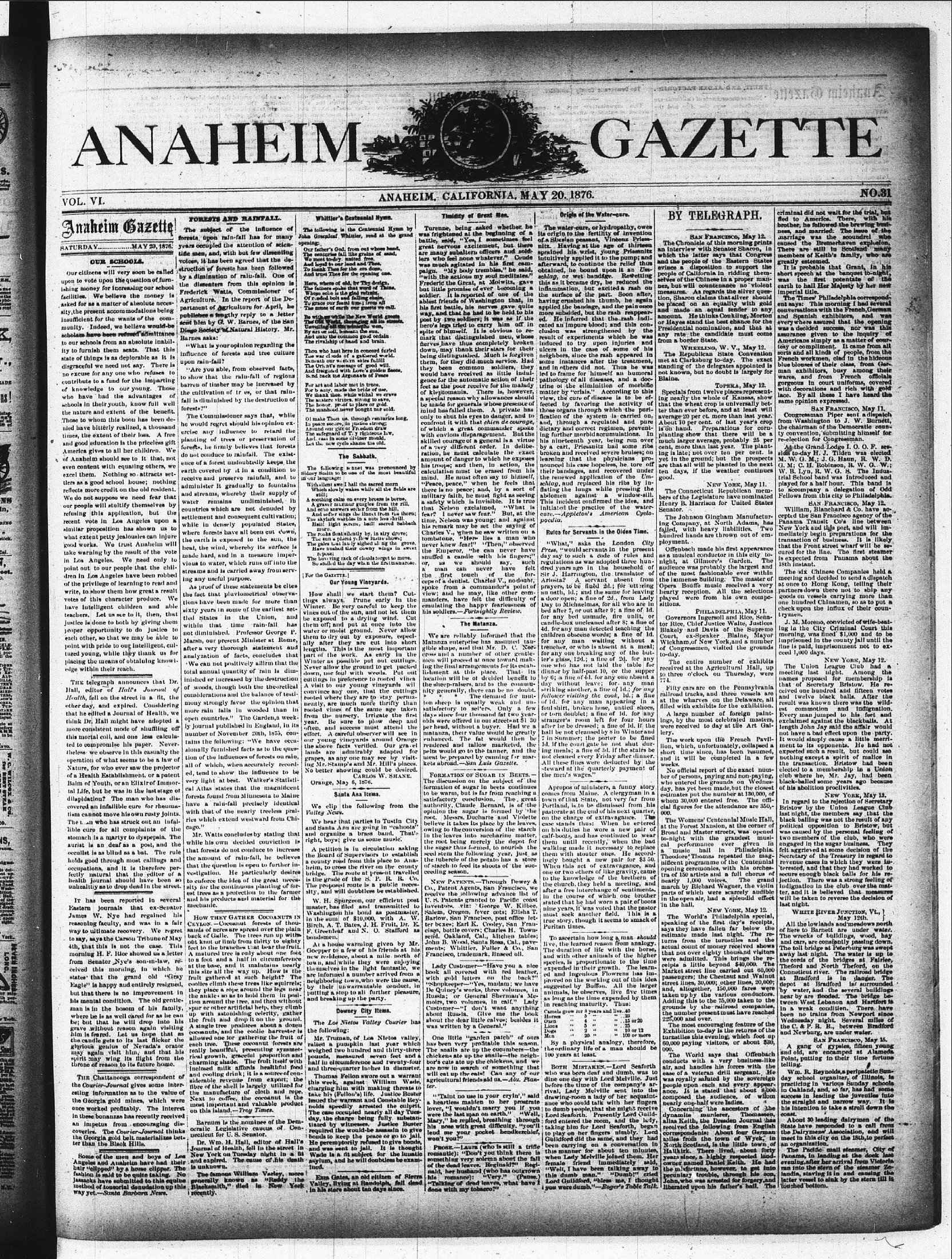
Searchable text
ANAHEIM
VOL. VI.
Anaheim Gazette
SATURDAY...MAY 20, 1876.
OUR SCHOOLS.
Our citizens will very soon be called upon to vote upon the question of furnishing money for increasing our school facilities. We believe the money is asked for as a matter of absolute necessity, the present accommodations being insufficient for the wants of the community. Indeed, we believe would-be scholars have been refused admittance to our schools from an absolute inability to furnish them seats. That this state of things is as deplorable as it is disgraceful we need not say. There is no excuse for any one who refuses to contribute to a fund for the imparting of knowledge to our young. Those who have had the advantages of schools in their youth, know full well the nature and extent of the benefit. Those to whom this boon has been denied have bitterly realized, a thousand times, the extent of their loss. A free and good education is the priceless gift America gives to all her children. We of Anaheim should see to it that, not even content with equating others, we
FORESTS AND RAINFALL.
The subject of the influence of forests upon rain-fall has for many years occupied the attention of scientific men, and, with but few dissenting voices, it has been agreed that the destruction of forests has been followed by a diminution of rain-fall. One of the dissenters from this opinion is Frederick Watts, Commissioner of Agriculture. In the report of the Department of Agriculture for April, he publishes a lengthy reply to a letter sent him by G. W. Barnes, of the San Diego Society of Natural History. Mr. Barnes asks:
"What is your opinion regarding the influence of forests and tree culture upon rain-fail?
"Are you able, from observed facts, to show that the rain-fall of regions barren of timber may be increased by the cultivation of trees, or that rainfall is diminished by the destruction of forests?"
The Commissioner says that, while he would regret should his opinion exercise any influence to retard the planting of trees or preservation of forests, he firmly believes that forests do not conduce to rainfall. The existence of a forest undoubtedly keeps the earth protected in a condition to whittler's Gentle.
The following is the John Greenleaf Whittle opening:
Our father's God, from The centuries fall like We most to-day, manit And loyal to our hand To thank Thee for the And trust Thee for th Here, where of old, The fathers spoke that Whose echo is the glade Of rended bolt and fa To grace our fossil t The scene of earth ow Be with us while th The Old World Unwilling all the By art we soll, basm And unto the common The rivalship of ha Thon who hast here Tue war clouds of a Beneath our westrn The Orient's message And freigated with L Sand back the Argos For art and labor me For basty, mads th We thank these. while The master virtues, The honor, proof to The manhood never Of make Thon us, th In peace secure, in ju Around our gift of F The safeguard of T And cast in some di Let the new cycle sh
no excuse for any one who refuses to contribute to a fund for the imparting of knowledge to our young. Those who have had the advantages of schools in their youth, know full well the nature and extent of the benefit. Those to whom this boon has been denied have bitterly realized, a thousand times, the extent of their loss. A free and good education is the priceless gift America gives to all her children. We of Anaheim should see to it that, not even content with equaling others, we excel them. Nothing so attracts settlers as a good school house; nothing reflects more credit on the old resident. We do not suppose we need fear that our people will stultify themselves by refusing this application, but the recent vote in Los Angeles upon a similar proposition has shown us to what extent petty jealousies can injure good works. We trust Anaheim will take warning by the result of the vote in Los Angeles. We need only to point out to our people that the children in Los Angeles have been robbed of the privilege of learning to read and write, to show them how great a result votes of this character produce. We have intelligent children and able teachers. Let us see to it, then, that justice is done to both by giving them proper opportunity to do justice to each other, so that we may be able to point with pride to our intelligent, cultured young, while they thank us for placing the means of obtaining knowledge within their reach.
The telegraph announces that Dr. Hall, editor of Hall's Journal of Health, fell on the street in a fit, the other day, and expired. Considering that he edited a Journal of Health, we think Dr. Hall might have adopted a more consistent mode of shuffling off this mortal coll, and one less calculated to compromise his paper. Nevertheless we observe in this casualty the operation of what seems to be a law of Nature, for who ever saw the projector of a Health Establishment, or a patent Balm of Youth, or an Elixir of Immortal Life, but he was in the last stage of dilapidation? The man who has discovered an infallible cure for rheumatism cannot move his own rusty joints. The man who has struck out an infallible cure for all complaints of the stomach is a martyr to dyspepsia. The aurist is an deaf as a post, and the occulist is as blind as a bat. The rule holds good through most callings and occupations, and it is therefore perfectly natural that the editor of a health journal should have been so unhealthy as to drop dead in the street.
Are you able, from observance here, to show that the rain-fall of regions barren of timber may be increased by the cultivation of trees, or that rainfall is diminished by the destruction of forests?”
The Commissioner says that, while he would regret should his opinion exercise any influence to retard the planting of trees or preservation of forests, he firmly believes that forests do not conduce to rainfall. The existence of a forest undoubtedly keeps the earth covered by it in a condition to receive and preserve rainfall, and to administer it gradually to fountains and streams, whereby their supply of water remains undiminished, in countries which are not denuded by settlement and consequent cultivation; while in densely populated States, where forests have all been cut down, the earth is exposed to the sun, the heat, the wind, whereby its surface is made hard, and in a measure impervious to water, which runs off into the streams and is carried away from serving any useful purpose.
As proof of these statements he cites the fact that pluviometrical observations have been made for more than sixty years in some of the earliest settled States in the Union, and within that time rain-fall has not diminished. Professor George P. Marsh, our present Minister at Rome, after a very thorough statement and analysis of facts, concludes that we can not positively affirm that the total annual quantity of rain is diminished or increased by the destruction of woods, though both the theoretical considerations and the balance of testimony strongly favor the opinion that more rain falls in wooded than in open countries.” The Garden,a weekly Journal published in England, in its number of November 20th, 1875, contains the following: “We have occasionally furnished facts as to the question of the influences of forests on rain, all of which, when accurately recorded, tend to show the influence to be very light at best. Walker’s Statistical Atlas states that the magnificent forests found from Minnesota to Maine have a rain-fall precisely identical with that of the nearly treeless prairies which extend westward from Chicago.”
Mr. Watts concludes by stating that while his own decided conviction is that forests do not conduce to increase the amount of rain-fall, he believes that the question is open to further investigation. He particularly desires to enforce the idea of the great necessity for the continuous planting of forests?”
The Commissioner says that, while he would regret should his opinion exercise any influence to retard the planting of trees or preservation of forests, he firmly believes that forests do not conduce to rainfall. The existence of a forest undoubtedly keeps the earth covered by it in a condition to receive and preserve rainfall, and to administer it gradually to fountains and streams, whereby their supply of water remains undiminished, in countries which are not denuded by settlement and consequent cultivation; while in densely populated States, where forests have all been cut down, the earth is exposed to the sun, the heat, the wind, whereby its surface is made hard, and in a measure impervious to water, which runs off into the streams and is carried away from serving any useful purpose.
As proof of these statements he cites the fact that pluviometrical observations have been made for more than sixty years in some of the earliest settled States in the Union, and within that time rain-fall has not diminished. Professor George P. Marsh, our present Minister at Rome, after a very thorough statement and analysis of facts, concludes that we can not positively affirm that the total annual quantity of rain is diminished or increased by the destruction of woods, though both the theoretical considerations and the balance of testimony strongly favor the opinion that more rain falls in wooded than in open countries.” The Garden,a weekly Journal published in England, in its number of November 20th, 1875, contains the following: “We have occasionally furnished facts as to the question of the influences of forests on rain, all of which, when accurately recorded, tend to show the influence to be very light at best. Walker’s Statistical Atlas states that the magnificent forests found from Minnesota to Maine have a rain-fall precisely identical with that of the nearly treeless prairies which extend westward from Chicago.”
Mr. Watts concludes by stating that while his own decided conviction is that forests do not conduce to increase the amount of rain-fall, he believes that the question is open to further investigation. He particularly desires to enforce the idea of the great necessity for the continuous planting of forests?”
The Commissioner says that, while he would regret should his opinion exercise any influence to retard the planting of trees or preservation of forests, he firmly believes that forests do not conduce to rainfall. The existence of a forest undoubtedly keeps the earth covered by it in a condition to receive and preserve rainfall, and to administer it gradually to fountains and streams, whereby their supply of water remains undiminished, in countries which are not denuded by settlement and consequent cultivation; while in densely populated States, where forests have all been cut down, the earth is exposed to the sun, the heat, the wind, whereby its surface is made hard, and in a measure impervious to water, which runs off into the streams and is carried away from serving any useful purpose.
As proof of these statements he cites the fact that pluviometrical observations have been made for more than sixty years in some of the earliest settled States in the Union, and within that time rain-fall has not diminished. Professor George P. Marsh, our present Minister at Rome, after a very thorough statement and analysis of facts, concludes that we can not positively affirm that the total annual quantity of rain is diminished or increased by the destruction of woods, though both the theoretical considerations and the balance of testimony strongly favor the opinion that more rain falls in wooded than in open countries.” The Garden,a weekly Journal published in England, in its number of November 20th, 1875, contains the following: “We have occasionally furnished facts as to the question of the influences of forests on rain, all of which, when accurately recorded, tend to show the influence to be very light at best. Walker’s Statistical Atlas states that the magnificent forests found from Minnesota to Maine have a rain-fall precisely identical with that of the nearly treeless prairies which extend westward from Chicago.”
Mr. Watts concludes by stating that while his own decided conviction is that forests do not conduce to increase the amount of rain-fall, he believes that the question is open to further investigation. He particularly desires to enforce the idea of the great necessity for the continuous planting of forests?”
The Commissioner says that, while he would regret should his opinion exercise any influence to retard the planting of trees or preservation of forests, he firmly believes that forests do not conduce to rainfall. The existence of a forest undoubtedly keeps the earth covered by it in a condition to receive and preserve rainfall, and to administer it gradually to fountains and streams, whereby their supply of water remains undiminished, in countries which are not denuded by settlement and consequent cultivation; while in densely populated States, where forests have all been cut down, the earth is exposed to the sun,the heat,the wind,whereby its surface is made hard,and in a measure impervious to water,which runs off into the streams and is carried away from serving any useful purpose.
As proof of these statements he cites the fact that pluviometrical observations have been made for more than sixty years in some of the earliest settled States in the Union,and within that time rain-fall has not diminished. Professor George P. Marsh,our present Minister at Rome,after a very thorough statement and analysis of facts,concludes that we can not positively affirm that the total annual quantity of rain is diminished or increased by the destruction of woods,though both the theoretical considerations and the balance of testimony strongly favor the opinion that more rain falls in wooded than in open countries.” The Garden,a weekly Journal published in England,in its number of November 20th,1875,contains the following: “We have occasionally furnished facts as to the question of the influences of forests on rain,all of which,when accurately recorded,tend to show the influence to be very light at best. Walker’s Statistical Atlas states that the magnificent forests found from Minnesota to Maine have a rain-fall precisely identical with that of the nearly treeless prairies which extend westward from Chicago.”
Mr. Watts concludes by stating that while his own decided conviction is that forests do not conduce to increase the amount of rain-fall,he believes that the question is open to further investigation. He particularly desires to enforce the idea of the great necessity for the continuous planting of forests?”
The Commissioner says that,while he would regret should his opinion exercise any influence to retard the planting of trees or preservationof forests,he firmly believes that forests do not conduce to rainfall. The existenceof a forest undoubtedly keepsthe earthcoveredbyitinaconditiontoreceiveandpreserverainfall,andtoadministeritgradualtowindstreams,andwherebytheirsupplyofwaterremainsundiminished.Incountrieswhicharenotdenudedbysettlementandconsequentcultivation;whileindenselypopulatedStates,theforestshaveallbeencutdown,theearthisexposedtothesun,theheat,thewind,nameobeyitsurfacemadehard,andinamewaterimpervioustowater,therunoffoffintothestreaksandiscarriedawayfromservinganyusefulpurpose.
As proofofthesestatementshecitesthefactthatpluviometricalobservationshavebeenmadeformorethansixtyyearsinsomeoftheearliestsettledStatesintheUnion,andwiththattimerainfallhasnotdiminished.ProfessorGeorgeP.Marsh,thepresentministeratRome,afteraverythoroughstatementandanalysisoffactsconcludesthatwecannotpositivelyaffirmthatthetotalannualquantityofrainisdiminishedorincreasedbythedestructionofwoodsthoughboththetheoreticalconsiderationsandthebalanceoftestimonystronglyfavortheoppositionthatmorerainfallsinwoodedthaninopencountries.”TheGarden,aweeklyJournalpublishedinEngland,在itsnumberofNovember20th,1875,containsthefollowing:“Wehaveoccasionallyfurnishedfactsastoothequestionoftheinfluencesofforestsonrainallofwhich,whenaccuratelyrecorded,tendtoshowtheinfluencetobewerylightatbest.Walker’sStatisticalAtlasstatesthatthemagnificentforestsfoundfromMinnesotatoMainehavearainfallpreciselyidenticalwiththatofthenearlytreelessprairieswhichextendwestwardfromChicago.”
Mr.Wattsconcludesbystatingthatwhilehisowndecidedconvictionisthatforestsdonotconducetoconsumethatthequestionisopentofurtherinvestigation.Heparticularlydesirestoenforcetheideaofthenewcessityforthecontinuousplantingofforests”
It has been reported in several Eastern journals that ex-Senator James W. Nye had regained his reasoning faculty, and was in a fair way to ultimate recovery. We regret to say, says the Carson Tribune of May 4th, that this is not the case. This morning H. F. Rice showed us a letter from Senator Nye's son-in-law, received this morning, in which he states that the grand old "Gray Eagle" is happy and entirely resigned, but that there is no improvement in his mental condition. The old gentleman is in the bosom of his family, where he is as well cared for as he can be; but that he will drop into his grave without reason again visiting him is feared. Let us hope that as the candle gets to its last flicker the glorious gonulus of Nevada's orator may again visit him; and that his spirit may wing its flight from the throne of reason to its future home.
The Chattanooga correspondent of the Courier-Journal gives some interesting information as to the value of the Georgia gold mines, which were once worked profitably. The interest in these bonanzas has recently received an impetus from encouraging discoveries. The Courier-Journal thinks the Georgia gold belt materializes better than the Black Hills.
Some of the men and boys of Los Angeles and Anaheim have had their hair "clipped" by a horse clipper. The fashion is said to be quite taking. No jassacks have submitted to this equine method of tonsorial denudation up this way yet.—Santa Barbara News.
ANAHEIM, CALIFORNIA, MAY 20. 1876.
Whittier’s Centennial Hymn.
The following is the Centennial Hymn by John Greenleaf Whittier, read at the grand opening:
Our father’s God, from out whose hand,
The centuries fall like grains of sand,
We meet today united free,
And loyal to our land and Them,
To thank Them for the arm done,
And trust Them for the opening one.
Here, where of old, by Thy design.
The fathers spake that word of Thine,
Whose sole is the glad refrain.
Of readed bolt and falling chain,
To grace our faecal time; from all
The names of earth our guests we call.
Be with us while the New World grants
The Old World, thriving all its splendour,
Unwelling all its wonders won,
By art we soll, benemind the sun,
And unto the common good ordain
The rivalship of hand and brain.
Thou who hast here in concord furled
Tue war clouds of a gathered world.
Beneath our western skies fullill
The Oriental message of good will.
And frightened with Love’s golden flame,
Send back the Argonauts of Peace
For art and labor met in truce,
For beauty, made the bride of use,
We thank these, while withal we crave
The masters virtues, strong to save,
The honor, proof to place or gold.
The manhood never bought nor sold.
Ol make Thon us, through centuries long.
In peace secure, in justice strong;
Around our gift of Freedom draw
The safeguard of Tey righteous law,
And cast in some diviner mould.
Let the now cycle shame the old.
The Sabbath.
The following script was pronounced by
Timidity of Great Men.
Turenne, being asked whether he was frightened at the beginning of a battle, said, “Yes, I sometimes feel great nervous excitement, but there are many subaltern officers and soldiers who feel none whatever.” Coude was much agitated in his first campaign, “My body trembles,” he said, “with the actions my soul meditates.”
Frederic the Great, at Molwitz, gave but little promise of ever becoming a soldier. It is reported of one of the ablest friends of Washington thus, in his first battle, his nerves gave quite way, and that he had to be held to his post by two soldiers; it was as if the hero’s legs tried to carry him off in spite of himself. It is obvious to remark that distinguished men, whose nerves have thus completely broken down, may thank their stars for their being distinguished. Much is forgiven them, for they did much service. Had they been common soldiers, they would have received as little indulgence for the automatic action of their feet as the poor receive for the malady of kleptomania. There is, however, a special reason why allowances should be made for generals whose presence of mind has failed them. A private has only to shut his eyes to danger, and to confront it with that chien de courage, of which a great commander spoke with envious disparagement. But the skilled courage of a general is a virtue of a very different order. In deliberation, he must calculate the exact amount of danger to which he exposes his troops; and then, in action, the Origin of the Water-cure.
The water-cure, or hydropathy, owes its origin to the fertility of invention of a Slavian peasant, Vincent Priess-nitz. Having at the age of thirteen sprained his wrist, young Priess-nitz intuitively applied it to the pump; and afterward, to continue the relief thus obtained, he bound upon it an Umschlag, or wet bandage. Revetting this as it became dry, he reduced the inflammation, but excited a rash on the surface of the part. Soon after, having crushed his thumb, he again applied the bandage, and the pain once more subsided, but the rash reappeared. He inferred that the rash indicated an impure blood; and this conclusion was strengthened by the result of experiments which he was induced to try upon injuries and ulcers in the case of some of his neighbors, since the rash appeared in some instances after the treatment, and in others did not. Thus he was led to frame for himself an humoral pathology of all diseases, and a doctrine of the elimination of morbific matter by “crisis.” According to this view, the cure of disease is to be effected by favoring the activity of those organs through which the purification of the system is carried on, and through a regulated and pure dietary and correct regimen, preventing further morbid accumulations. In his nineteenth year, being run over by a cart, Priess-nitz had some ribs broken and received severe bruises; on learning that the physicians pronounced his case hopeless, he tore off...
The Sabbath.
The following sunset was pronounced by Sidney Smith to be one of the most beautiful in our language:
With silent awe I hall the sacred morn.
Which slowly wakes while all the fields are still;
A soothing calm on every breeze is borne.
A graver murmur guagles from the rill,
And echo answers sober from the hill.
And softer sings the linnet from the thorn;
The skylark warbles in a note less shrill.
Hall light serene, hail sacred Sabbath more.
The rooks float silently by in airy drove;
The sun a placid yellow lustre shows;
The gales that laily sighed along the grove.
Have hushed their cowny wings in sweet repose;
The hovering rack of clouds forget to move.
So smiled the day when the first man rose.
[For the Gazette.]
Our Young Vineyards.
How shall we start them? Cuttings always. Prune early in the Winter. Be very careful to keep the vines out of the sun, and not let them be exposed to a drying wind. Cut them off; and put at once into the water or moist ground. Never allow them to dry out by exposure, especially after they are cut into short lengths. This is the most important part of the work. As early in the Winter as possible put out cuttings. Never allow the ground to get packed down, nor foul with weeds. Put out cuttings in preference to rooted vines. Visit to our young vineyards will convince any one, that the cuttings rooted where they are to stay permanently, are much more thrifty than rooted vines of the same age taken from the nursery. Irrigate the first year. Be sure to plow deep and often, and success must attend the effort. A careful observer will see in our young vineyards around Orange the above facts verified. Our gravel lands are admirably adapted for grapes, as any one may see by visiting Mr. Stamp's and Mr. Hill's places. No better showing could be desired.
CARLOS W. SHANE.
Orange, May 6, 1876.
Santa Ana Items.
We clip the following from the Valley News.
We hear that parties in Tustin City and Santa Ana are going in "cahoots" and organize a brass band. That's right, boys; give us some music.
A petition is in circulation asking the Board of Supervisors to establish a county road from this place to Anaheim, to cross the river on the county bridge. The route at present travelled is the grade of the S. P. R. R. Co. The proposed route is a public necessity would have received as little indulgence for the automatic action of their feet as the poor receive for the malady of kleptomania. There is, however, a special reason why allowances should be made for generals whose presence of mind has failed them. A private has only to shut his eyes to danger, and to confront it with that chien de courage, of which a great commander spoke with envious disparagement. But the skilled courage of a general is a virtue of a very different order. In deliberation, he must calculate the exact amount of danger to which he exposes his troops; and then, in action, the calculation must be erased from his mind. He must often say to himself, "Peace, peace," when he feels that there is no peace; and, by a sort of military faith, he must fight as seeing a safety which is invisible. It is true that Nelson exclaimed, "What is fear? I never saw fear." But, at the time, Nelson was young; and against his remark may be set the saying of Charles V., when he saw written on a tombstone, "Here lies a man who never knew fear!" "Then," observed the Emperor, "he can never have snuffed a candle with his fingers;" or, as we should say, such a man can never have felt the first touch of the forcels of a dentist. Charles V., no doubt, spoke from a commander's point of view; and he may, like other commanders, have felt the difficulty of emulating the happy fearlessness of his soldiers.—Fortnightly Review.
The Matanza.
We are reliably informed that the Matanza enterprise has assumed tangible shape, and that Mr. D. C. Norcross and a number of other gentlemen will proceed at once toward making the final arrangements for its establishment at this place. That its location will be of decided benefit to the sheep-raisers, and to the community generally, there can be no doubt. The demand for mutton sheep is equally weak and unsatisfactory to sellers. Only a few days since four thousand fat two years-olds were offered in our streets at $1 30 per head, without a buyer. Had we a matanza, their value would be greatly enhanced. The fat would then be rendered and tallow marketed, the pelts would go to the tanner, and the meat be prepared by canning for markets abroad.—San Luis Gazette.
FORMATION OF SUGAR IN BEETS.
The discussion on the subject of the formation of sugar in beets continues to be warm, but is far from reaching a satisfactory conclusion. The great authority, Claude Bernard, is of the opinion the sugar is formed by the root. Messrs. Ducharte and Violette believe it takes its place by the leaves, owing to the conversion of the starch in the leaves into saccharine matter, the root being merely the depot for the sugar thus formed, to nourish the seed stem the following year, just as the tubercle of the potato has a store of starch to feed its shoots of the succeeding season.
NEW PATENTS.—Through Dewey & Patent Agents, San Francisco, we would have received as little indulgence for the automatic action of their feet as the poor receive for the malady of kleptomania. There is, however, a special reason why allowances should be made for generals whose presence of mind has failed them. A private has only to shut his eyes to danger, and to confront it with that chien de courage, of which a great commander spoke with envious disarrayment. But the skilled courage of a general is a virtue of a very different order. In deliberation, he must calculate the exact amount of danger to which he exposes his troops; and then, in action, the calculation must be erased from his mind. He must often say to himself, "Peace, peace," when he feels that there is no peace; and by a sort of military faith, he must fight as seeing a safety which is invisible. It is true that Nelson exclaimed, "What is fear? I never saw fear." But, at the time, Nelson was young; and against his remark may be set the saying of Charles V., when he saw written on a tombstone, "Here lies a man who never knew fear!" "Then," observed the Emperor, "he can never have snuffed a candle with his fingers;" or, as we should say, such a man can never have felt the first touch of the forcels of a dentist. Charles V., no doubtroke for mutation sheep is equally weak and unsatisfactory to sellers. Only a few days since four thousand fat two years-olds were offered in our streets at $1 30 per head, without a buyer. Had we a matanza, their value would be greatly enhanced. The fat would then be rendered and tallow marketed, the pelts would go to the tanner, and the meat be prepared by canning for markets abroad.—San Luis Gazette.
APROPOS OF MINISTERS, a funny story comes from Maine. A clergyman in a town of that State, not very far from Portland, is to be dismissed from his pastorate at the end of his next quarter, on the charge of extravagance. The case stands thus: When he entered on his duties he wore a new pair of calf-boots, and has continued to wear them until recently; when the bad walking made it necessary to replace them with stouter ones. He accordingly bought a new pair for $3 50. When this act of extravagance, and one or two others of like gravity, came to the knowledge of the brethren of the church, they held a meeting, and free interchange of sentiments...
Santa Ana Items.
We clip the following from the Valley News.
We hear that parties in Tustin City and Santa Ana are going in "cahoots" and organize a brass band. That's right, boys; give us some music.
A petition is in circulation asking the Board of Supervisors to establish a county road from this place to Anaheim, to cross the river on the county bridge. The route at present travelled is the grade of the S. P. R. R. Co. The proposed route is a public necessity, and will doubtless be established.
W. H. Spurgeon, our efficient postmaster, has filed and transmitted to Washington his bond as postmaster, in the sum of $10,000, with A. W. Birch, A. T. Bates, J. H. Fruit, Dr. E. F. Greenleaf and N. O. Stafford as bondsmen.
At a house warming given by Mr. Goeper to a few of his friends at his new residence, about a mile north of town, and while they were enjoying themselves in the light fantastic, we are informed a number arrived from a neighboring town, who were the cause, by their unwarrantable conduct, in putting a stop to all further pleasure, and breaking up the party.
Downey City Items.
The Los Nietos Valley Courier has the following:
Mr. Truman, of Los Nietos valley, raised a pumpkin last year which weighed two hundred and thirty-three pounds, measured seven feet and a half in circumference and twenty-four and three-quarter inches in diameter.
Thomas Fellon swore out a warrant this week, against William Wade, charging him with making threats to take his (Pellon's) life. Justice Buster issued the warrant and Constable Reynolds speedily arrested the culprit. The case occupied nearly all day Tuesday, the charge being fully substantiated by witnesses. Justice Buster required the would-be assasin to give bonds to keep the peace or go to jail. He peremptorily refused to give bonds, and was sent to jail. It is thought Wade is a fit subject for the lunatic syllum, and he will doubtless be examined.
Eam Gates, an old citizen of Sierra Valley, living at Randolph, fell dead in his store about ten days since.
New Patents.-Through Dewey & Co., Patent Agents, San Francisco, we receive the following advance list of U.S. Patents granted to Pacific coast inventors, viz: George W. Kilbee, Salem, Oregon, fever cots; Elisha T. Barlow, San Francisco, post office letter boxes; Earl K. Cooley, San Francisco, bottle covers; Charles H. Townsend, Oakland, Cal., kitchen tables; John B. Wood, Santa Rosa, Cal., pavements; Whittier, Fuller & Co., San Francisco, trademark, linseed oil.
Lady Customer—"Have you a nice book all covered with red leather, with gold letters on the back?" "Shopkeeper—"Yes, madam; we have De Quincy's works, three volumes, in Russia; or General Sherman's Memoirs, two volumes, in calf." Lady Customer—"I don't want anything about Russia. Give me the book about the dear little calves; besides it was written by a General."
One little "garden patch" of ours has been very profitable this season. The snails ate up the cucumbers—the chickens ate up the snails—the neighbor's cats ate up the chickens, and we are now in search of something that will eat up the cats! Can any of our agricultural friends aid us—Ala. Planter.
"Taint no use in your cryin'," said a heartless maiden to her prostrate lover, "I wouldn't marry you if you were the last man on earth." "Well, Mary," he replied, breathing through his nose with great difficulty. "you'll lend me your pocket hendkerchief, won't you?"
Pronez.-Laura (who is still a trifle romantic): "Don't you think there is something very solemn about the fall of the dead leaves. Reginald?" Reginald, her husband (who has outgrown his romance): "Very." (Pause.) "Talking of dead leaves, what have I done with my tobacco?"
Comes from Maine. A clergyman in a town of that State, not very far from Portland, is to be dismissed from his pastorate at the end of his next quarter, on the charge of extravagance. The case stands thus: When he entered on his duties he wore a new pair of calf-boots, and has continued to wear them until recently, when the bad walking made it necessary to replace them with stouter ones. He accordingly bought a new pair for $350. When this act of extravagance, and one or two others of like gravity, came to the knowledge of the brethren of the church they held a meeting, and after a free interchange of sentiments, in the course of which one brother stated that he had worn a pair of boots nine years, it was voted that the pastor must seek another field. This is a true story, though it seems to smack of Puritan times.
To ascertain how long a man should live, the learned reason from analogy. The duration of life with the horse, and with other animals of the higher species, is proportionate to the time expended in their growth. The learned and ingenious Flowrens has improved on the working out of this idea suggested by Buffon. All the larger animals, he observes, live five times as long as the time expended by them in reaching maturity. Thus:
Camels grow for 8 years and live...40
Horses ...5 ...25
Oxen ...4 ...15 or 20
Lions ...5 ...25
Dogs ...2 ...10 or 12
Men ...20 ...100 or more
By a physical analogy, therefore, the ordinary life of a man should be 100 years at least.
Both Mistaken.-Lord Seaforth who was born deaf and dumb, was to dine one day with Lord Melville. Just before the time of the company's arrival, Lady Melville sent into the drawing-room a lady of her acquaintance who could talk with her fingers to dumb people, that she might receive Lord Seaforth. Presently Lord Guildford entered the room, and the lady taking him for Lord Seaforth began to play on her fingers nimbly. Lord Guildford did the same, and they had been carrying on a conversation in this manner for about ten minutes when Lady Melville joined them. Her female friend immediately said, "Well I have been talking away to this dumb man." "Dumb!" cried Lord Guildford, "bless me I thought you were dumb."—Roger's Table Talk.
GAZETTE
NO.31
BY TELEGRAPH.
SAN FRANCISCO, May 12.
The Chronicle of this morning prints an interview with Senator Sharon, in which the latter says that Congress and the people of the Eastern States evince a disposition to support the people of California in ridding themselves of the Chinese in a proper manner, but will countenance no violent measures. As regards the silver question, Sharon claims that silver should be placed on an equality with gold and made an equal tender to any amount. He thinks Conkling, Morton or Hayes stand the best chance for the Presidential nomination, and that at any rate the candidate must come from a border State.
WHEELING, W. V., May 12.
The Republican State Convention met at Clarksburg to-day. The exact standing of the delegates appointed is not known, but no doubt is largely for Blaine.
TOPEKA, May 12.
Specials from twelve places representing nearly the whole of Kansas, show that the wheat crop is universally better than ever before, and at least will average 20 per ct. more than last year. About 10 per cent. of last year's crop is on hand. Preparations for corn-planting show that there will be a much larger average, probably 25 per cent, more than last year. The planting is late; not over ten per cent. is yet in the ground; but the prospects are that all will be planted in the next criminal did not wait for the trial, but fled to America. There, with his brother, he followed the brewing business, and married: The issue of the marriage was the scoundrel who caused the Bremerhaven explosion. There are still in Scotland many members of Keith's family, who are greatly esteemed.
It is probable that Grant, in his short speech at the banquet to-night, was the first potentate of the earth to hall Her Majesty by her new imperial title.
The Times' Philadelphia correspondent says: This morning I had several conversations with the French, German and Spanish exhibitors, and was everywhere assured that the opening was a decided success, nor was this assurance given to the inquiry of Americans simply as a matter of courtesy or compliment. It came from all sorts and all kinds of people, from the French workmen, clad in the hideous blue blouses of their class, from German exhibitors, busy among their wares, and from French offlolals gorgeous in court uniforms, covered with decorations and rich with gold lace. By all these I have heard the same opinion expressed.
SAN FRANCISCO, May 11.
Congressman Piper sent a dispatch from Washington to J. W. Burnett, the chairman of the Democratic county convention, submitting himself for re-election for Congressman.
At the Grand-Lodge I. O. O. F. session to-day H. J. Tilden was elected M. W. G. M.; J. G. Haun, R. W. D. G. M.; C. H. Robinson, R. W. G. W.;
According to this disease is to be effective the activity of which the purification is carried on, regulated and pure regimen, prevent-acumulations. In ear, being run over it had some ribs and severe bruises; on physicians propelled, he tore off and recovered under medication of the Umland his ribs by in-while pressing the window-sill. Armed the idea, and vice of the water-American Cycloin the Olden Time.
The London Cityaints in the present code of rules and adopted three hundred at the household of the translator of grant absent from 2d.; for uttering the same for leaving of 2d., from Lady Lysis, for all who are in after 9; a fine of 1d. made, fire unlit, or used after 8; a fine of detected teaching the words; a fine of 1d. waiting without a absetment at a meal; any of the buttline of 2d. for any laid the table for 10, or the supper for any one absent a cake; for any man fine of 1d.; for any rice cook, 1d.; a fine man appearing in a nose, untied shoes, fine of 1d. for any left for four hours; a fine of 1d. If the old by 8 in Winter and porter to be fined be not shut dur-3d. if the stairs be Friday after dinner. Be deducted by the quarterly payment of masters, a funny story. A clergyman in a not very far from dismissified from his list of his next quarter, extravagance. The When he entered wore a new pair of shoes continued to wear gently, when the bad necessary to replace ones. He accorded new pair for $350. extravagance, and of like gravity, came of the brethren of field a meeting, and nature of sentiments.
TOPEKA, May 12.
Specials from twelve places representing nearly the whole of Kansas, show that the wheat crop is universally better than ever before, and at least will average 20 per ct. more than last year. About 10 per cent. of last year's crop is on hand. Preparations for corn-planting show that there will be a much larger average, probably 25 per cent, more than last year. The planting is late; not over ten per cent. is yet in the ground; but the prospects are that all will be planted in the next ten days, if the weather continues good.
NEW YORK, May 11.
The Connecticut Republican members of the Legislature have nominated Henry B. Harrison for United States Senator.
The Johnson Gingham Manufacturing Company, at North Adams, has failed, with heavy liabilities. Two hundred hands are thrown out of employment.
Offenbach made his first appearance as a musical conductor in this city tonight, at Gilmore's Garden. The audience was probably the largest and of the most fashionable ever within the immense building. The master of Opera Bouffe music received a very hearty reception. All the selections played were from his own compositions.
PHILADELPHIA, May 11.
Governors Ingersoll and Rice, Senator Rice, Chief Justice Walte, Justices Blakely and Davls of the Supreme Court, ex-Speaker Blaine, Mayor Wickham, of New York,and a number of Congressmen, visited the grounds to-day.
The entire number of exhibits received at the Agricultural Hall, up to three o'clock on Thursday, were 774.
Fifty cars are on the Pennsylvania railroad tracks, and three vessels are at the wharves on the Delaware, all filled with exhibits for the exhibition.
A large number of foreign paintings, by the most celebrated masters, were received to day at the Art Gallery.
The work upon the French Pavilion, which unfortunately, collapsed a short time since, has been resumed, and it will be completed in a few weeks.
No official report of the exact number of persons paying and non-paying, who entered the grounds on Wednesday, has yet been made,but the closest estimates put the number at 130,000,of whom 30,000 entered free. The official figures for the attendance are 350,-000.
The Womens' Centennial Music Hall, at the Forest Mansion, at the corner of Broad and Master streets, was opened to-night with the grandest musical performance ever given in a music hall in Philadelphia. Theodore! Thomas repeated the magnificent programme of the Centennial opening ceremonies, with his orchestra of 150 artists and a full chorus of nearly 1,000 voices. The grand march by Richard Wagner,the violin man exhibitors,buy among their wares,and from French officials gorgeous in court uniforms, covered with decorations and rich with gold lace. By all these I have heard the same opinion expressed.
SAN FRANCISCO, May 11.
Congressman Piper sent a dispatch from Washington to J.W.Burnett,the chairman of the Democratic county convention, submitting himself for re-election for Congressman.
At the Grand Lodge I.O.O.F.session to-day H.J.Tilden was elected M.W.G.M.;J.G.Haun,R.W.D.G.M;C.H.Robinson,R.W.G.W.;W.B.Lyn,R.W.G.S.The Industrial School band was introduced and played for a half hour. This band is to accompany a delegation of Odd Fellows from this city to Philadelphia.
SAN FRANCISCO, May 12.
William,Blanchard & Co.have accepted the San Francisco agency of the Panama Transit Co.'s line between New York and this port,and will immediately begin preparations for the transaction of business. It is likely that the Front street wharf will be secured for the line.The first steamer is expected from Panama about the 18th instant.
The six Chinese Companies held a meeting and decided to send a dispatch at once to Hong Kong,telling their partners down there not to ship any goods on vessels carrying more than one hundred Chinamen,sо as to put a check upon the influx of their countrymen.
J.M.Moreno,c convicted of wife-beating in the City Criminal Court this morning,was fined $1,000 and to be imprisoned in the county jail until the fine is paid,imprisonment not to exceed 1,000 days.
NEW YORK, May 12.
The Union League Club had a meeting last night.Among the names proposed for membership is that of Secretary Bristow.He received one hundred and fifteen votes and twelve black balls.After the result was known there was the wildest commotion and indignation.Every man jumped to his feet and exclaimed against the blackballs.At length John Jay said the affair would not have a bad effect upon the party.It would simply cause a little merriment to its opponents.He had not expected such a result,但 could see nothing except a spirit of malice in the transaction.Bristow had been elected to a membership in a Union club where he,Mr.Jay,had been black-balled some years ago because of his abolition proclivities.
NEW YORK, May 13.
In regard to the rejection of Secretary Bristow by the Union League Club last night,the members say that the black balling was not the result of any political opposition to Bristow,but was caused by the personal feeling of two members of the club,who were engaged in the sugar business.They felt aggrieved at some decision of the Secretary of the Treasury in regard to revenue cases in which they were interested,and that they had worked to secure enough black balls for his rejection.There was a strong feeling of indignation in the club over the mat-
When he entered
wore a new pair of
continued to wear
utility, when the bad
necessary to replace
ones. He accordnew pair for $350.
extravagance, and
of like gravity, came
of the brethern of
a meeting, and
range of sentiments,
which one brother
worn a pair of boots
voted that the pastor
field. This is a
it seems to smack of
The Womens' Centennial Music Hall,
at the Forest Mansion, at the corner of
Broad and Master streets, was opened
to-night with the grandest musical
performance ever given in
a music hall in Philadelphia.
Theodore Thomas repeated the magnificent programme of the Centennial opening ceremonies, with his orchestra of 150 artists and a full chorus of nearly 1,000 voices. The grand march by Richard Wagner, the violin parts of which were scarcely audible in the open air, had a splendid effect in the hall.
New York, May 12.
The World's Philadelphia special,
speaking of the first day's receipts,
says they have fallen far below the estimate made last night. The returns from the turnstiles and the actual count of money received shows that not over eighty thousand visitors were admitted. This brings the receipts a little beyond $40,000. The Market street line carried out 60,000 passengers; the Chestnut and Walnut street lines, 30,000; other lines, 20,000; and altogether, 150,000 fares were taken up by the various conductors. Adding this to the 75,000 taken to the grounds by the railroad companies, the number present must have reached 225,000 and over.
The most encouraging feature of the Exhibition to-day is the returns of the turnstiles this evening, which foot up 60,000 paying visitors, or about $30,000.
The World says that Offenbach conducts with a very business-like air, and handles his forces with the ease of a veteran drill sergeant. He was royally saluted by the sovereign people upon each and every appearance. It is stated that about 8,000 composed the audience, of whom nearly one-half were ladies.
Concerning the ancestors of the dynamite murderer, Thomassen, alias Keith, the Dresden Journal has received the following from English correspondents: About four German miles from the town of Wyck, in North Scotland, is the little town of Hallkirk. There lived, about forty years since, a highly respected landowner named Daniel Keith. He had the misfortune, however, to get into pecuniary trouble, through his son John, who was arrested for forgery, and liberated upon his father's ball. The
NEW YORK, May 13.
In regard to the rejection of Secretary Bristow by the Union League Club last night, the members say that the black balling was not the result of any political opposition to Bristow, but was caused by the personal feeling of two members of the club, who were engaged in the sugar business. They felt aggrieved at some decision of the Secretary of the Treasury in regard to revenue cases in which they were interested, and that they had worked to secure enough black balls for his rejection. There was a strong feeling of indignation in the club over the matter, and it is believed that measures will be taken to reverse the decision of last night.
WHITE RIVER JUNCTION, Vt.,}
May 12th.
All the lowlands and meadows north of here to Barnett are under water. The wrecks of buildings, wood, hay and cars, are constantly passing down. The toll bridge at Peterburg was swept away last night. The water is up to the cords of the bridges at Fairlee, Theford and North Theford, on the Connecticut river. The railroad bridge at Bradford is in danger. The depot at Bradford is surrounded by water, and the several buildings near by are flooded. The bridge between West Lebanon and Hartfort is in a weak condition. There have been no trains from Newport since Wednesday night. Several miles of the C. & P. R. R., between Bradford and Newburg, are under water.
SAN FRANCISCO, May 16.
A gang of gypsies, fifteen young and old, are encamped at Alameda Point, putting in their time fortune telling.
Wm. R. Reynolds, a peripatetic Sunday school organizer, of Illinois, is practicing in various Sunday schools in Oakland, and so far, has had some success in leading the juveniles into the straight and narrow way. It is his intention to take a stroll down the coast.
About 30 leading dairymen of the State have responded to a call from the Dairymans Association, and will meet in this city on the 18th to perfect an organization.
The Pacific mail steamer, City of Panama, in landing at the dock last evening after her arrival from Victoria ran into the stern of the steamer Zalandia, staving it in and causing the latter vessel to sink by the stern till it touched bottom.