anaheim-gazette 1876-05-13
Scanned page
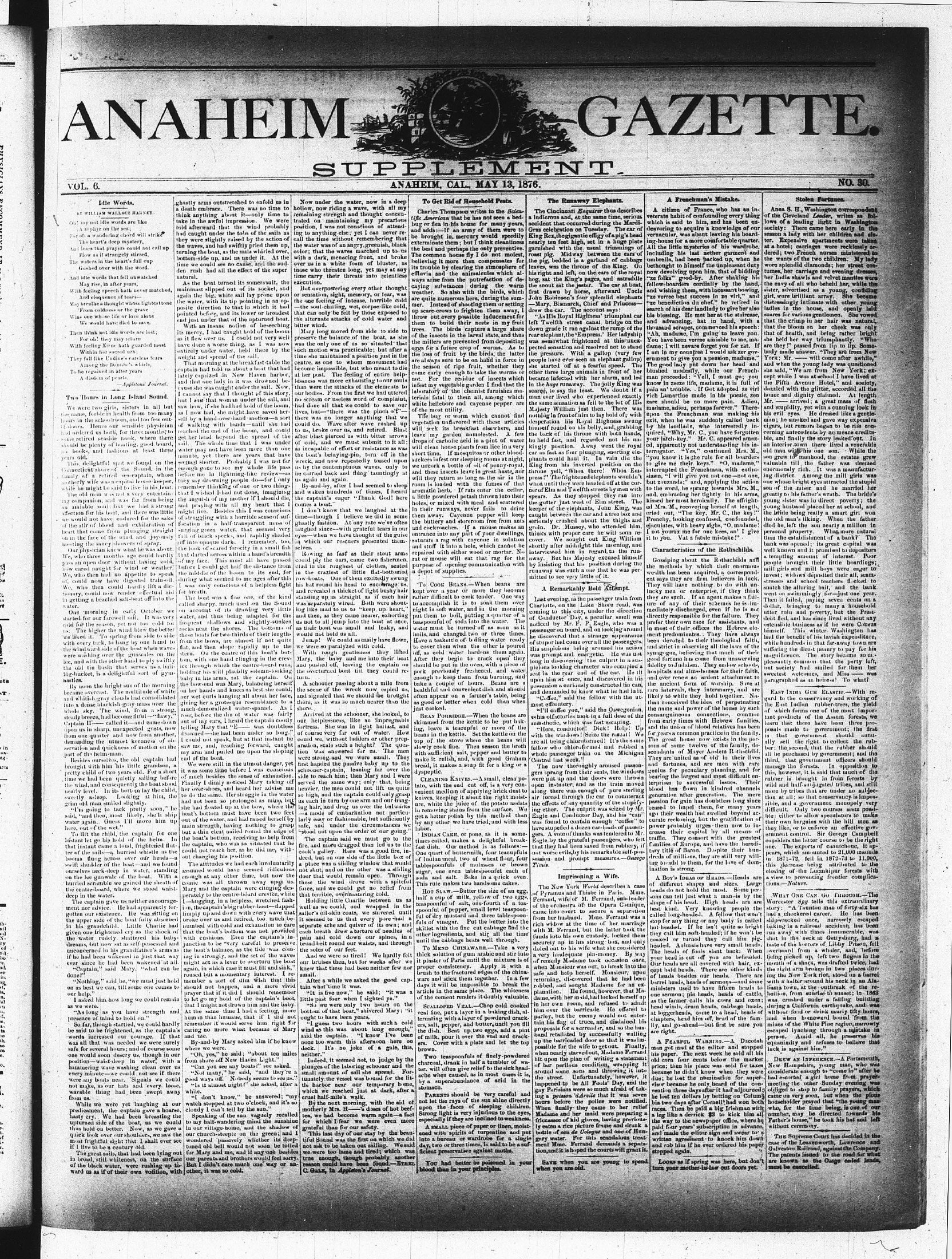
Searchable text
ANAHEIM
VOL. 6.
Idle Words.
BY WILLIAM WALLACE HARNEY.
Oh! say not idle words are like
A zephyr on the sea;
For oft a wandering chord will strike
The heart's deep mystery,
And bears that prayers could not call up
Flow as if strangely stirred,
The waters in the heart's full cup
Gushed over with the word.
And idle words that fell unwatched
May rise, in after years,
With feeling speech hath never matched,
And cloquence of tears—
May breathe a thought whose lightest tone
From coldness or the grave
Wins one whose life or love alone
We would have died to save.
Then think not idle words are lost;
For oh! they may return
With feeling Xirne hath guarded most
Within her sacred urn;
They fall like Undine's careless tears
Among the Danube's whirls,
To be regained in after years
A diadem of pearls.
—Appletons' Journal.
Two Hours in Long Island Sound.
We were two girls, sisters in all but
the name, feeble in health from too many
hours in the schoolroom, and too few outof doors. Hence our sensible physician
had ordered us both, for three months; to
some retired seaside nook, where there
should be plenty of boating, good board,
no books, and fashions at least three
years old.
This delightful spot we found on the
Connecticut shore of the Sound, in the
ghastly arms outstretched to enfold us in a death embrace. There was no time to think anything about it—only time to take in the awful impression. We were told afterward that the wind probably had caught under the tobs of the sails as they were slightly raised by the action of the waves, and had swiftly pried them up, turning the boat, as the sails whirled over, bottom-side up, and us under it. At the time we could see no cause, and the sudden rush had all the effect of the super natural.
As the boat turned its somersault, the mainmast slipped out of its socket, and again the big, white sail lay prone upon the water, with its tip pointing in an opposite direction to that in which it had pointed before, and its lower or broadest end just under that of the upturned boat.
With an insane notion of be-eeching its mercy, I had caught hold of the boom as it flew over us. I could not very well have done a worse thing, as I was now entirely under water, held there by the weight and spread of the sail.
That morning at the breakfast-table the captain had told us about a boat that had lately capsized in New Haven harbor, and that one lady in it was drowned because she was caught under the sail. Now, I cannot say that I thought of this story, but I saw that woman under the sail, and saw how, if she had had hold of the boom, as I now had, she might have saved herself by a hand-over-hand motion—a sort of walking with hands—until she had reached the end of the boom, and could get her head beyond the spread of the sail. The whole time that I was under water may not have been more than one minute, yet there are years that have seengl shorter. Probably I was not far enough gone to see my whole life pass
Now under the water hollow, now riding a wreath remaining strength and trated on maintaining position, I was not coming to anything else; yea call the time without the water was of an angel color; that the waves with a dark, menacing over us in a white foot those who threaten long time carry their thrust execution.
But overpowering even or sensation, sight, me the one feeling of introspection—the soul-chilling, we that can only be felt by the alternate attacks of bitter wind.
Mary long moved from preserve the balance owe was the only one of us such motion was practiced time she maintained a centre, as one to who become impossible, but at her post. The feellessness was more exhilarant than were the attacks on our bodies. From the first no scream or useless wreath did all that we lived, but—"there was there was no longer could do. Wave after us to us, broke over us, after blast pierced us of cold, and we must as incapable of effort on the boat's belaying-pin wreck, and now repeal us by the contemptuous
Two Hours in Long Island Sound.
We were two girls, sisters in all but the name, feeble in health from too many hours in the schoolroom, and too few out-of-doors. Hence our sensible physician had ordered us both, for three months to some retired seaside nook, where there should be plenty of boating, good board, no books, and fashions at least three years old.
This delightful spot we found on the Connecticut shore of the Sound, in the family of a retired sea-captain, whose motherly wife was a capital house-keeper, while he might be said to live in his boat.
The old man was not a very entertaining companion, and was far from being an amiable soul; but we had a strong affection for his boat, and there was little we would not have endured for the sake of the stir of blood and exhilaration of heart that come from plunging straight on in the face of the wind, and joyously meeting the sady showers of spray.
Our physician knew what he was about. We, who three months ago could hardly pass an open door without taking cold, now cared naught for wind or weather. We, who then had no appetite to speak of, could now have digested train-oil. We, who then could hardly lift a dictionary, could now render effectual aid in getting a beached sail-boat off into the water.
One morning in early October we started for our farewell sail. It was very cold for the season, yet not too cold for us. The higher the wind blew the better we liked it. To spring from side to side with every tack, to hang by one hand to the windward side of the boat when waves were washing over the gunwales on the lee, and with the other hand to ply swiftly the old tin basin that serves as a bailing-bucket, is a delightful sort of gymnastics.
By noon the bright sun of the morning became overcast. The multitude of white and whitish-gray clouds had consolidated into a dense blackish gray mass over the whole sky. The wind, from a strong, steady breeze, had become fitful—"flawy," Captain II——called it—and came down upon us in sharp, unexpected gusts, now from one quarter and now from another, demanding the utmost keenness of observation and quickness of motion on the part of the helm-sman.
Besides ourselves, the old captain had brought with him 'his little grandson,' a pretty child of two years old. For a short time we had been quietly sailing before the wind, and consequently the boat stood nearly level. In its bottom lay the child, sweetly asleep. Looking at him, the grim old man smiled slightly.
"I'm going to tack pretty soon," he said, "and then, most likely, she'll ship water again. Guess I'll move him up here, out of the wet."
To lift the child, the captain for one instant let go his hold of the helm. In that instant came a loud, frightened flutter of the sails—a hurried whistle as the booms flung across over our heads—a swift shudder of the boat—and we found ourselves neck-deep in water, standing on the lee gunwale of the boat. With a hurried scrambble we gained the sheath of the centre-board where we stood waist-
The captain had told us he was drowned because she was caught under the sail. Now, I cannot say that I thought of this story, but I said that woman under the sail, and saw how, if she had held hold of the boom, as I now had, she might have saved herself by a hand-over-hand motion—a sort of walking with hands—until she had reached the end of the boom, and could get her head beyond the spread of the sail. The whole time that I was under water may not have been more than one minute, yet there are years that have seemed shorter. Probably I was not far enough gone to see my whole life pass before me in lightning-like review—as they say drowning people do—for I only remember thinking of one or two things that I wished I had not done, imagining the anguish of my mother if I should die, and praying with all my heart that I might five. Besides this I was conscious of struggling with a horrible sense of suffocation in a half-transparent mass of surging green water, that seemed very full of black specks, and rapidly shaded off into opaque dark. I remember, too, the look of scared ferocity in a small fish that darted across within a hand's breadth of my face. This must all have passed before I could get half the distance from the middle of the boom to its end, for during what seemed to me ages after this I was only conscious of a helpless fight for breath.
The boat was a fine one, of the kind called sharpy, much used on the Sound on account of its drawing very little water, and thus being adapted for the frequent shallow and slightly-sunken rocks near the shores. The bottoms of these boats for two-thirds of their lengths from the bows, are almost if not quite flat, and then slope rapidly up to the stern. On the centre of this boat's bottom, with one hand clinging in the crevice through which the centre-board runs, holding his still placidly solemn-looking baby in his arms, sat the captain. On the bow-end was Mary, balancing herself on her hands and knees as best she could; her wet curls hanging all about her face, giving her a grotesque resemblance to a much-demoralized water-spaniel. As I rose, before the din ot water was fairly out of my ears, I heard the captain coolly telling Mary that "E——was doubtless drowned—she had been under so long." I could not speak, but at that instant he saw me, and reaching forward, caught my arm and pulled me upon the sloping end of the boat.
We were still in the utmost danger, yet it was some time before I was conscious of much besides the sense of exhaustion. Finally I dimly noticed Mary taking off her over-shoes, and heard her advise me to do the same. Her struggle in the water had not been so prolonged as mine but she had floated up at the bow, where the boat's bottom must have been two feet out of the water, and had raised herself by main strength, having nothing to grasp but a thin cleat nailed round the edge of the boat's bottom, receiving no help from the captain, who was so situated that he could not reach her, as he did me, without changing his position.
The attitudes we had each involuntarily assumed would have seemed ridiculous enough at any other time, but now the comic was all thrown away upon us. Mary and the captain were clinging des-
In its bottom lay the child, sweetly sleep. Looking at him, the grim old man smiled slightly.
"I'm going to tack pretty soon," he said, "and then, most likely, she'll ship water again. Guess I'll move him up here, out of the wet."
To lift the child, the captain for one instant let go his hold of the helm. In that instant came a loud, frightened flutter of the sails—a hurried whistle as the booms flung across over our beads—a swift shudder of the boat—and we found ourselves neck-deep in water, standing on the lee gunwale of the boat. With a hurried scramble we gained the sheath of the centre-board, where we stood waist-deep in the water.
The captain gave us neither encouragement nor advice. He had apparently forgotten our existence. He was sitting on the upper side of the boat fully absorbed in his grandchild. Little Charlie had given one frightened cry as the shock of the water rudely shattered his baby-dreams, but now sat as self-possessed and unconcerned in his grandfather's arms as if he had been wakened at all. "Captain," said Mary, "what can be done?"
"Nothing," said he, "we must just hold on as best we can, till some one comes to our help."
I asked him how long we could remain as we were.
"As long as you have strength and presence of mind to hold on."
So far, though startled, we could hardly be said to be frightened, as the captain's words increased our courage. If that was all that was needed we were surely safe for several hours; and of course some one would soon descrry us, though in our position—waist-deep in water, with a hammering wave washing clean over us every minute—we could not see if there were any boats near. Signals we could not make, as our hats and every loose, wavable thing had been swept away from us.
While we were yet laughing at our predicament, the captain gave a hoarse, hasty cry. We had been breasting the upturned side of the boat, as we could thus hold on better. Now, as we gave a quick look over our shoulders, we saw the most frightful sight that I shall ever see if I live to be a century old.
The great sails, that had been lying out in broad, still whiteness, on the surface of the black water, were rushing up toward us as if of their own volition, with her over-shear her over-shear her over-shear her over-shear her over-shear her over-shear her over-shear her over-shear her over-shear her over-shear her over-shear her over-shear her over-shear her over-shear her over-shear her over-shear her over-shear her over-shear her over-shear her over-shear her over-shear her over-shear her over-shear her over-shear her over-shear her over-shear her over-shear her over-shear her over-shear her over-shear her over-shear her over-shear her over-shear her over-shear her over-shear her over-shear her over-shear her over-shear her over-shear her over-shear her over-shear her over-shear her over-shear her over-shear her over-shear her over-shear her over-shear her over-sheareh
The attitudes we had each involuntarily assumed would have seemed ridiculous enough at any other time, but now the comic was all thrown away upon us. Mary and the captain were clinging desperately to the centre-board crevice, while I—hugging, in a helpless, wretched fashion, the captain's big rubber-boot—dapped limply up and down with every wave that broke over us and retired, too much numbed with cold and exhaustion to care that the boat's bottom was not provided with cushions. Even the captain's junction to be "very careful to preserve the boat's balance, as the tide was coming in strongly, and the set of the waves might act as a lever to overturn the boat again, in which case it must fill and sink," roused but a momentary interest. I remember a sort of dim wish that this should not happen, and a more vivid prayer that if it did I should remember to let go my hold of the captain's boot, that I might not drown him and the baby. At the same time I had a feeling, more human than humane, that if I did not remember it would serve him right for caring no more what became of Mary and me.
By-and-by Mary asked him if he knew where we were.
"Oh, yes," he said; "about ten miles from shore off New Haven Light."
"Can you see any boats?" she asked.
"Not many," he said, "and they're a good ways off. Nobody seems to see us."
"Is it almost night?" she asked, after a while.
"I don't know," he answered; "my watch stopped at two o'clock, and it's so cloudy I can't tell by the sun."
Speaking of the sun vaguely recalled to my half-wandering mind the sunshine in our village-home, and the shadow of our church-steeple on the green; and I wondered passively whether its deep-toned old bell would not soon be tollled for Mary and me, and if any one besides our parents and brothers would feel sorry. But I didn't care much one way or another, it was so cold.
The captain said we fire, and more dragged cook's galley. Here deed, but on one side a place was a sliding not shut, and on the door that would remind these the wind drive force, and we could that terrible, overwinter.
Holding little Chath well as we could, and sailor's oil skin coats it seemed to us that separate ache and quail each breath drew at pain and cold down broad belt round our soles of our feet.
And we were so tired our bruises then, but knew that these had small.
After a while we sat at what time it was. "It is five now," little past four when "So we were only bottom of that boat ought to have been y." "I guess two hour wind as this was also said the captain. none too warm this deck. It's no joie neither."
Indeed, it seemed plunges of the labor small amount of salt tunately the vessel w/the harbor near o which we reached cruel half-mile's way.
By the next morning motherly Mrs. H——tea, we had become for which I fear grateful than for our This last day of o tiful Sound was there not ask to be taken we were too lame a true enough, though reason could have C. Gaiz, in Applet
IM GAZ SUPPLEMENT.
ANAHEIM, CAL., MAY 13, 1876.
Now under the water, now in a deep hollow, now riding a wave, with all my remaining strength and thought concentrated on maintaining my precarious position, I was not conscious of attending to anything else; yet I can never recall the time without remembering that the water was of an angry, greenish, black color; that the waves marched up to us with a dark, menacing front, and broke over us in a white foam of bluster, as those who threaten long, yet may at any time carry their threats into relentless execution.
But overpowering every other thought or sensation, sight, memory, or fear, was the one feeling of intense, horrible cold—the soul-chilling, wet, corpse-like cold, that can only be felt by those exposed to the alternate attacks of cold water and bitter wind.
Mary long moved from side to side to preserve the balance of the boat, as she was the only one of us so situated that such motion was practicable; but after a time she maintained a position just in the centre, as one to whom movement had become impossible, but who meant to die at her post. The feeling of entire helplessness was more exhausting to our souls than were the attacks of the elements to our bodies. From the first we had uttered no scream or useless word of complaint, had done all that we could to save our lives, but—"there was the pinch off"—there was no longer anything that we could do. Wave after wave rushed up to us, broke over us, and retired. Blast after blast pierced us with bitter arrows of cold, and we must submit to it all; as incapable of effort or resistance as was the boat's belaying-pin, torn off in the wreck, and now repeatedly tossed upon us by the contemptuous waves, only to
To Get Rid of Household Pests.
Charles Thompson writes to the Scientific American that he has not seen a bedbug or flea in his house for many years, and adds:—If an army of them were to be brought in, mercury would speedily exterminate them; but I think cleanliness the best and perhaps the only preventive. The common house fly I do not molest, believing it more than compensates for its trouble by clearing the atmosphere of effluva and the animalcules which always arise from the putrefaction of decaying substances during the warm weather. So also with the birds, which are quite numerous here, during the summer. Instead of shooting them or setting up scare-crows to frighten them away, I throw out every possible inducement for them to build their nests in my fruit trees. The birds capture a large share of the insects in the larval state, and thus the millers are prevented from depositing eggs for a future crop of worms. As to the loss of fruit by the birds, the latter are always sure to be on hand in force in the season of ripe fruit, whether they come early enough to take the worms or not. For the residue of insects which infest my vegetable garden I find that the laboratory of the chemist furnishes materials fatal to them all, among which white hellebore and cayenne pepper are of the most utility.
The bug or worm which cannot find vegetation unflavored with these articles will seek its breakfast elsewhere, and leave my garden unmolested. A few drops of carbolic acid in a pint of water will clean house plants from lice in a very short time. If mosquitos or other blood-suckers infest our sleeping rooms at night, we uncork a bottle of oil of penny-royal.
The Runaway Elephants.
The Cincinnati Enquirer thus describes a ludicrous and, at the same time, serious accident that occurred during the Mardi-Gras celebration on Tuesday. The car of King Rex,the gigantic effigy of a pig’s head nearly ten feet high, set in a huge plate garnished with the usual trimmings of roast pig. Midway between the ears of the pig, bedded in a garland of cabbage leaves, was the throne of the King. On his right and left, on the ears of the royal hog, sat the King’s pages, and astraddle the snout sat the jester. The car at bust, first drawn by horse, afterward Uncle John Robinson’s four splendid elephants—Mary, Bismarck, Chief and Princess—drew the car. The account says:
"As His Royal Highness’ triumphal car left Twelfth street canal, bridge on the down grade it ran against the rump of the rear elephant,the ‘Empress.’ Her ladyship was somewhat frightened at this unexpected sensation and resolved not to stand the pressure. With a gallop (very few people have ever seen an elephant gallop) she started off at a fearful speed. The other three large animals in front of her became infected with her alarm, and led in the huge runaway. The jolly King was scared, to say the least. We doubt if a man ever lived who experienced exactly the same sensation as fell to the lot of His Majesty William just then. There was nothing in front of him to lay hold of; with desperation his Royal Highness swung himself round on his belly,and grabbing the back of his throne with both hands, he held fast, and regarded not his unkingly position. Away went the royal car as fast as four plunging, snorting elephants could haul it. In vain did the King from his inverted position on the A citizen veterate bark which is so deavoring vernacular-house All the life including umbrella,bethought now devour “ze folks’ fellow-boot and wish “ze benedict search of his blessing and advance thousand.”Ah,mad You have dame;I wam I am in my enmertment The good blushed man procured in zion pain an’t vich Lamzare show madame;upon there exit, whereby his lace quired,"“your later ed., apparel terrogorator”you know to give intermittent
The feeling of entire helplessness was more exhausting to our souls than were the attacks of the elements to our bodies. From the first we had uttered no scream or useless word of complaint, had done all that we could to save our lives, but—“there was the pinch off”—there was no longer anything that we could do. Wave after wave rushed up to us, broke over us, and retired. Blast after blast pierced us with bitter arrows of cold, and we must submit to it all; as incapable of effort or resistance as was the boat’s belaying-pin, torn off in the wreck, and now repeatedly tossed upon us by the contemptuous waves, only be carried back and flung tauntingly at us again and again.
By-and-by, after I had seemed to sleep and waken hundreds of times, I heard the captain’s eager “Thank God! here comes a boat.”
I don’t know that we laughed at the time—though I believe we did in some ghastly fashion. At any rate we’ve often laughed since—with grateful tears in our eyes—when we have thought of the guise in which our rescuers presented themselves.
Rowing as fast as their stout arms could ply the oars, came two fishermen, clad in the roughest of clothes, seated in the craziest of little flat-bottomed row-boats. One of them excitedly swung his hat round his head to encourage us, and revealed a thicket of light bushy hair standing up as straight as if each hair was separately wired. Both were shouting like mad to us to “keep up heart,” and then, as they came nearer, exhorting us not to all jump into the boat at once, as their boat was small and leaky, and would not hold us all.
Jump! We could as easily have flown, we were so paralyzed with cold.
With rough gentleness they lifted Mary, the baby and me into their boat and pushed off, leaving the captain on the overturned boat till they could return.
A schooner passing about a mile from the scene of the wreck now espied us, and signaled that we should be brought there, as it was so much nearer than the shore.
Arrived at the schooner, she looked to our helplessness, like an impregnable fortress. She was in light baitast, and of course very far out of water. How could we, without ladders or other preparation, scale such a height? The question was answered for us. The men were strong and we were small. They first handed the passive baby up to the schooner-captain, leaning tar over the side to reach him; then Mary and I were served the same way; only that, being heavier, the men could not lift us quite so high, and the captain could only grasp us each in turn by one arm and our hanging hair, and drag us over the bulwarks—a mode of embarkation not particularly easy or fashionable, but sufficiently safe, and under the circumstances we “stood not upon the order of our going.”
The captain said we must go to the fire, and more dragged than led us to the cook’s galley. Here was a good fire, indeed, but on one side of the little box of a place was a sliding window that would not shut, and on the other was a sliding door that would remain open. Through these the wind drove with a spiteful force, and we could get no relief from come early enough to take the worms or not. For the residue of insects which infest my vegetable garden I find that the laboratory of the chemist furnishes materials fatal to them all, among which white hellbore and cayenne pepper are of the most utility.
The bug or worm which cannot find vegetation unflavored with these articles will seek its breakfast elsewhere, and leave my garden unmolested. A few drops of carbolic acid in a pint of water will clean house plants from lice in a very short time. If mosquitoes or other blood-suckers infest our sleeping rooms at night, we uncork a bottle of oil of penny-royal, and these insects leave in great haste, nor will they return so long as the air in the room is loaded with the fumes of that aromatic herb. If rats enter the cellar, a little powdered potash thrown into their holes, or mixed with meal and scattered in their runways, never fails to drive them away. Cayenne pepper will keep the buttery and storeroom free from ants and cockroaches. If a mouse makes an entrance into any part of your dwellings, saturate a rag with cayenne in solution and stuff it into a hole, which cannot be repaired with either wood or mortar. No rat or mouse will eat that rag for the purpose of opening communication with a depot of supplies.
To Cook Beans.—When beans are kept over a year or more they become rather difficult to cook tender. One way to accomplish it is to soak them overnight in soft water, and in the morning put them to boil, putting a quarter of a teaspoonful of soda into the water. The water must be turned off as soon as it boils, and changed two or three times. Have a teakettle of boiling water ready to cover them when the other is poured off, as cold water hardens them again. After they begin to crack open they should be put in the oven, with a piece of pork previously freshened, and water enough to keep them from burning, and bake a couple of hours. Beans are a healthful and convenient dish and should often appear on a farmer’s table, being as good or better when cold than when just cooked.
BEAN POURRIDGE.—When the beans are skimmed from the kettle to be put baking, leave a teacupful or more of the beans in the kettle. Set the kettle on the top of the stove where the beans will slowly cook fine. Then season the broth with sufficient salt, pepper and butter to make it relish, and with good Graham bread, it makes a soup fit for a king or a dyspeptic.
CLEANING KNIVES.—A small, clean potato, with the end cut off, is a very convenient medium of applying brick dust to knives, keeping it about the right moisture, while the juice of the potato assists in removing stains from the surface. We get a better polish by this method than by any other we have tried, and with less labor.
INDIAN CAKE, or pone, as it is sometimes called, makes a delightful breakfast dish. Our method is as follows:—One quart of buttermilk, four teacupsfuls of Indian meal, two of wheat flour, four tablespoonfuls of molasses or brown sugar, one even tablespoonful each of soda and salt. Bake in a quick oven. This rule makes two handsome cakes.
A Remarkably Bold Attempt.
Last evening, as the passenger train from Charlotte, on the Lake Shore road, was coming to this city, under the direction of Conductor Day, a peculiar smell was noticed by Mr. F. P. Eagle, who was a passenger on board, and on looking around he discovered that a strange appearance of stupor had come over all the passengers. His suspicions being aroused his action was prompt and energetic. He was not long in discovering the culprit in a suspicious-looking character who occupied a seat in the rear end of the car. He hit upon him at once, and discovered in his possession a curiously constructed tin can, and demanded to know what he had in it.
“Coffee,” said the fellow with the utmost refortney.
“I’ll coffee you,” said the Oswegonian, ash his olfactories took in a full dose of the anaesthetic, which was fast escaping.
“Here, conductor! Dick! Help! Up with the windows! Seize the rassail! We are all being chlorinated! It’s the same fellow who chloroformed and robbed a whole passenger train on the Michigan Central last week.”
The now thoroughly aroused passengers sprang from their seats, the windows were put up and the doors were thrown open instanter, and as the train moved along there was enough of pure sterling air forced through the car to counteract the effects of any quantity of the stupifying ether. The culprit was seized by Mr. Eagle and Conductor Day, and his “can” was found to contain enough “coffee” to have stupefied a dozen car-locks of passengers. A vote of thanks was tendered to Mr. Eagle by the grateful passengers who left that they had been saved from robbery, if not worse evils; by his remarkable self-passion and prompt measures.—Oswego Times.
Imprisoning a Wife.
The New York World describes a case
The captain said we must go to the fire, and more dragged than led us to the cook's galley. Here was a good fire, indeed, but on one side of the little box of a place was a sliding window that would not shut, and on the other was a sliding door that would remain open. Through these the wind drove with a spiteful force, and we could get no relief from that terrible, overmastering cold.
Holding little Charlie between us as well we could, and wrapped in the sailor's oil-skin coats, we shivered until it seemed to us that every pore had a separate ache and quiver of its own; and each breath drew a torture of needles of pain and cold down our spines, in a broad belt round our waists, and through the soles of our feet.
And we were so tired! We hardly felt our bruises then, but for weeks after we knew that these had been neither few nor small.
After a while we asked the good captain what time it was.
"It is five now," he said; "it was a little past four when I sighted ye."
"So we were only two hours on the bottom of that boat," shivered Mary; "it ought to have been years."
"I guess two hours with such a cold wind as this was about long enough," said the captain. "I know I've been none too warm this afternoon here on deck. It's no joke of a gale, this, neither."
Indeed, it seemed not, to judge by the plunges of the laboring schooner and the small amount of sail she spread. Fortunately the vessel was bound for the little harbor near our temporary home, which we reached just at dark, after a cruel half-mile's walk.
By the next morning, with the aid of motherly Mrs. H——'s doses of hot beefeat, we had become warm again—a fact for which I fear we were even more grateful than for our safety.
This last day of our stay by the beautiful Sound was the first on which we did not ask to be taken out sailing. We said we were too lame and tired; which was true enough, though probably another reason could have been found—Ethel C. Gale, in Appleton's Journal.
You had better be poisoned in your blood than in your principles.
Imprisoning a Wife.
The New York World describes a case of Pyramus and Thisbe in Paris. Mune. Ferrand, wife of M. Ferrand, sub-leader of the orchestra of the Opera Comique, came into court to secure a separation from her husband. Mune. Ferrand was a rich widow at the time of her marriage with M. Ferrand, but the latter took the funds into his own custody, locked them securely up in his strong box, and only doled out to his wife what she considered a very inadequate pin-money. By way of remedy Madame took occasion once when Monseur was out, to break into the safe and help herself. Monseur; upon returning, di-covered that he had been robbed, and sought Madame for an explanation. He found, however, that Madame, with her insid, had locked herself up in her own room, and refused to admit him over the barricade. He offered to parley, but the enemy would not entertain his flag of truce, and disdained his proposals for a surrender, and so the husband retaliated by successfully walling up the barricaded door so that it was impossible for the wife to get out. Finally, when nearly starved out, Madame Ferrand hit upon the plan of writing a statement of her perilous condition, wrapping it around some sous and throwing it into the street. Unfortunately, however, it happened to be All Fools' Day, and the gay Parisians were so much afraid of taking a poison d'Arrive that it was seven hours before the police were notified. When finally they came to her relief Madame and her maid were preparing a fricassace of kid gloves, having previously eaten a rice picture frame and drank a bottle of eau de Cologne and one of Hungary water. For this scandalous treatment Mune. Ferrand demands a separation, and it is hoped the courts will grant it.
Save when you are young to spend when you are old.
GAZETTE.
Elephants.
Her thus describes same time, serious during the Mardi-
day. The car of juggy of a pig's head in a huge plate trimmings of between the ears of island of cabbage of the King. On ears of the royal sails, and astraddle The car at bust, afterward Unclelendid elephants of and Princess—ount says:
Is's triumphal car bridge on the rump of the ass.' Her ladyship had at this unexcived not to stand gallop (very few elephant gallop) cruel speed. The is in front of her alarm, and led the jolly King was We doubt if a experienced exactly to the lot of His men. There was lay hold of; with Highness swung by, and grabbing with both hands, did not his unwent the royal snort, snorting ele- In vain did the position on the Frenchman's Mistake.
A citizen of France, who has an in-veterate habit of confounding every thing which is said to him, and has been endeavoring to acquire a knowledge of our vernacular, was about leaving his boarding-house for a more comfortable quarter. All the little mysteries of his wardrobe, including his last nether garment and umbrella, had been packed up, when he bethought to himself the unpleasant duty now devolving upon him, that of bidding "ze folks" good-by. After shaking his fellow-boarders cordially by the hand, and wishing them, with incessant bowing, "ze verree beat success in ze viril," and "ze benediction du chef," he retired in search of his dear landlady to give her also his blessing. He met her at the staircase, and advancing, hat in hand, with a thousand scrapes, commenced his speech: "Ah, madame, I'm going to leave you. You have been verree amiable to me, madame; I will nevare forget you for zat. If I am in my countrie I would ask zer government to give you a pension, madame." The good lady put down her head and blushed modestly, while our Frenchman proceeded: "Vell, I must go; you know in zeeze life, madame, it is full of pain an' trouble. If Got adopted ze viril vich Lamartine made in his poesie, zen zare should be no more pain. Adieu, madame, adien, perhaps forever." Thereupon the Frenchman was making his exit, when he was suddenly called back by his landlady, who interestedly inquired, "Why, Mr. C., you have forgotten your latch-key." Mr. C. appeared amazed, apparently not understanding his interrogator. "Yes," continued Mrs. M., "you know it is the rule for all boarders to give me their keys." "O, madame," interrupted the Frenchman with entu-
Stolen Fortunes.
Anna S. H., Washington correspondent of the Cleveland Leader, writes as follows of a leading light in Washington society: There came here early in the season a lady with her children and sister. Expensive apartments were taken at a hotel; carriages were recklessly ordered; two French nurses ministered to the wants of the two children. My lady wore splendid diamonds; her street costumes, her carriage and evening dresses, her India shawls and velvet mantles were the envy of all who beheld her, while the sister, advertised as a young, confiding girl, wore brilliant array. She became distressingly intimate with other young ladies in the house, and openly laid snares for various gentlemen. She vowed that the crimp in her hair was natural, that the bloom on her cheek was only that of health, and being rather bright she held her way triumphantly. "Who are they!" passed from lip to lip. Somebody made answer. "They are from New York; Mr. — will come after awhile," and when the young lady was questioned she said, "We are from New York; except while I was at school I have lived at the Fifth Avenue Hotel," and society, dazzled with the glitter, accorded all the honor and dignity claimed. At length Mr. — arrived; a great mass of flesh and stupidity, yet with a cunning look in his evil eyes. He dressed like a gentleman; he smoked and gave way expensive cigars, but rumors began to be rife concerning antecedents by no means creditable, and finally the story leaked out. In an interior town there lived a venerable old man with his one son. While the son grew to manhood, the estates grew valuable till the father was deemed enormously rich. It was a manufactur-
In front of her alarm, and led the jolly King was We doubt if a experienced exactly to the lot of His men. There was day hold of; with Highness swung by, and grabbing with both hands, did not his unaware went the royal king, snorting elephant vain did the position on the street! Whoa Emphants wouldn't be off at the corners by men with and they ran into Elm street. The John King, was and a tree box and the thighs and attended him, he will soon re-excited himself motion during the that he was perished King William this morning, and reward to the run-excused himself motion during the that he was perished King William this morning, and reward to the run-excused himself motion during the that he was perished King William this morning, and reward to the run-excused himself motion during the that he was perished King William this morning, and reward to the run-excused himself motion during the that he was perished King William this morning, and reward to the run-excused himself motion during the that he was perished King William this morning, and reward to the run-excused himself motion during the that he was perished King William this morning, and reward to the run-excused himself motion during the that he was perished King William this morning, and reward to the run-excused himself motion during the that he was perished King William this morning, and reward to the run-excused himself motion during the that he was perished King William this morning, and reward to the run-excused himself motion during the that he was perished King William this morning, and reward to the run-excused himself motion during the that he was perished King William this morning, and reward to the run-excused himself motion during the that he was perished King William this morning, and reward to the run-excused himself motion during the that he was perished King William this morning, and reward to the run-excused himself motion during the that he was perished King William this morning, and reward to the run-excused himself motion during the that he was perished King William this morning, and reward to the run-excused himself motion during the that he was perished King William this morning, and reward to the run-excused himself motion during the that he was perished King William this morning, and reward to the run-excused himself motion during the that he was perished King William this morning, and reward to the run-excused himself motion during the that he was perished King William this morning, and reward to the run-excused himself motion during the that he was perished King William this morning, and reward to the run-excused himself motion during the that he was perished King William this morning, and reward to the run-excused himself motion during the that he was perished King William this morning, and reward to the run-excused himself motion during the that he was perished King William this morning, and reward to the run-excused himself motion during the that he was perished King William this morning, and reward to the run-excused himself motion during the that he was perished King William this morning, and reward to the run-excused himself motion during the that he was perished King William this morning, and reward to the run-excused himself motion during the that he was perished King William this morning, and reward to the run-excused himself motion during the that he was perished King William this morning, and reward to the run-excused himself motion during the that he was perished King William this morning, and reward to the run-excused himself motion during the that he was perished King William this morning, and reward to the run-excused himself motion during the that he was perished King William this morning, and reward to the run-excused himself motion during the that he was perished King William this morning, and reward to the run-excused himself motion during the that he was perished King William this morning, and reward to the run-excused himself motion during the that he was perished King William this morning, and reward to the run-excused himself motion during the that he was perished King William this morning, and reward to the run-excused himself motion during the that he was perished King William this morning, and reward to the run-excused himself motion during the that he was perished King William this morning, and reward to the run-excused himself motion during the that he was perished King William this morning, and reward to the run-excued himself motion during the that he was periled King William this morning, and reward to the run-excued himself motion during the that he was periled King William this morning, and reward to the run-excued himself motion during the that he was perilled King William this morning, and reward to the run-excued himself motion during the that he is perilled King William this morning, and reward to the run-excued himself motion during the that he is perilled King William this morning, and reward to the run-excued himself motion during the that he is perilled King William this morning, and reward to the run-excued himself motion during the that he is perilled King William this morning, and reward to the run-excued himself motion during the that he is perilled King William this morning, and reward to the run-excued himself motion duringthe that he is perilled King William this morning, and reward to the run-excued himself motion duringthe that he is perilled King William this morning, and reward to the run-excued himself motion duringthe that he is perilled King William this morning, and reward to the run-excued himself motionDuringthe that he is perilled King Williamthis morning,and rewardingto themfortheonekesanagainmentpropertyWhatmorenaturalthantheestablishmentofabank?Thebankwasopen;itsgreatcapitalwellknownanditpromisedtodepositorsa temptingamountofinterest.Poorpeoplebrought theirlittleboardings;millgirlsandmillboyswereeagertoinvest;widows depositedtheall,seamstressesandschoolteacherslockedtosnatchthealluringbait,andthebankwentonswimminglyforjustoneyear.Thenitfailed,payingsevencentsonadollar,bringingtomanyahouseholdutterruinandpovertybutthePresidentfled,andhassincelivedwithoutanyostensiblebusinessasifhewereCocushimself.ThiswinterWashingtonhadthebenefitofhislavishexpenditure whilehundredsinthatfarawaytownare sufferingthedirectpenurytopayforhismagnificence.Thestorybecausounpleasantlycommonthattherapyleftoutsocietyhadsmilledforthemhersweetestwelcomes,andMiss—wasparagraphedasanheirs!Towhat?
Characteristics oftheRothschilds.
GossipingabouttheRothschildsandthemethodsbywhichtheenormouswealthhasbeenacquired,a correspondentsaystheyarefirmbelieversin luck.Theywillhavethingstodowithunluckymenorenterprise,fiftheythinktheyaresuch.Ifanagentmakesafailureofanyoftheschemesheisimmediatelydischarged,evenifheisnotdirectlyresponsibleforthefailure.Theyprefer their ownraceforassistants,andinmostoftheofficestheHebrewelementpredominates.Theyhavealwaysbe devotedto theirtheologicalfaith,andstrictinobservingallthelawsofthesynagogue believingthatmuchof theirgood fortunehascomefromunswervingfidelitytoJudaism.Theyenowschools,hospitalsandalmshousesforkeih faith,andeverrenewanardentattachmenttocheancientformofworship.Saveatrareintervals,theintermarry,andarelikelytolwhiletheyholdtogether.Nathanconceivedideaofperpetuatingnameandpowerofthehousebysuchconsanguineousconnections.commonfromearlytimeswithHebrew families,andtheunionofbloodrelativeshasbeenforyearsacommonpracticeinthefamily.Thegreathousenowexistsinpersonsofsometwelveofthefamily,descendantsofMayerAnsemRothschild.Theyareunitedasoldinh民ivesandfortunes,andaremenwithraregeniusforpecuniaryplanning,andfor bearingthelargestandmostdifficententerprisestosuccessfulissues.Theirbloodhasflownkindredchannelsgenerationafter generation.Themepassionforgainhasdoubtlesslongsinceceasedtoimpelthem,farmanyagesago theirwealthhadswelled beyondaccuratereckoning,但thegratificationofpowerprobablyurgesthemennowtoincreasetheircapitalbyallmeansoftraffic.TheyconsortwiththegreatestfamiliesofEurope,andhavethehereditarytitleofBaron.Despite theirhundredsoff millions,theyare stillverywillingtoaddtothem.fortheloveofdominationisstrong.
A Boy'sIdeasOfHeads.-Headsareofdifferentshapesandsizes.Largeheadsdo notholdthemostSomewear
EASTINDIA GUMELASTIC.-Withregardtothe conservancyandworkingoftheEastIndian rubber-trees,they yieldofwhichformsoneofthe mostimportantproductsoftheAssumforests,thelearnthattherehavebeenthreeproposalsmade治government;thefirstthatgovernmentshouldannuallysellrichtothecollecttherubber;thesecondthatthe Rubbershouldallbepurchasedbygovernment;andthethirdthatgovernmentofficersshouldmanagetheforests.Inoppositiontothishoweveritis saidthatmuchoftherubberisbroughtinfromforestsbywildandhalf-subjugatedtribes,andstillmoreby Tribesthatareunderno subjectatall;sothat conservancyisimpossible,andagovernmentmonopolyverydifficult.Onlytwo coursesseempossible:eithertoallowspeculatorstomake theirownbargainswiththehillmenastheylike,或to enforcean-effectivegovernmentcontrol.SirGeorgeCampbellconsidersthelattercoursetobetherightone.Theexportsofcaouthome.itappearswhichamountedto21000mannails1871-72,fellin1872-73to11000thisdecreasebeingattributedtotheclosingoftheLucmkipurforestswithaviewtopreventingfrontications.-Nature.
A Boy's Ideas of Heads.—Heads are of different shapes and sizes. Large heads do not hold the most. Some persons can tell just what a man is by the shape of his head. High heads are best kind. Very knowing people the called long-headed. A fellow that won't stop for any thing or any body is called hot-headed. If he isn't quite so bright they call him soft-headed; if he won't be coaxed or turned they call him pig-headed. Animals have very small heads. The heads of fools slant back: When your head is cut off you are beheaded. Our heads are all covered with hair, except bald heads. There are other kinds of heads besides our heads. There are barrel heads, heads of sermons—and some ministers used to have fifteen heads to one sermon; pin heads, heads of cattle, as the farmer calls his cows and oxen; head winds, drum heads, cabbage heads, at loggerheads, come to a head, heads of chapters, head him off, head of the family, and go-ahead—but first be sure you are right.
A Fearful Warning.—A Dacotah man got mad at the editor and stopped his paper. The next week he sold all his old corn four cents below the market price; then his place was sold for taxes because he didn't know when they were due; he lost the nomination for supervisor because he only heard of the convention three days after it had adjourned; he lost ten dollars by betting on Column bis two days after Cornell had won both races. Then he paid a big Irishman with a leg like a derrick $3 to kick him all the way to the newspaper office, where he paid four years' subscription in advance, and made the editor sign and swear to a written agreement to knock him down and rob him if he ever ordered his paper stopped again.
Looks as if spring was here, but don't turn your mother-in-law out doors yet.
What One Can Go Through.—The Worcester Spy tells this extraordinary story: "A Taunton man of forty-six has had a checkered career. He has been shipwrecked once, narrowly escaped baking in a railroad accident, has been run away with times innumerable, was shot in the neck at Gettysburg, had a taste of the horrors of Libby Prison, fell overboard from a whaler, and before being picked up, left two fingers in the mouth of a shark, was drafted twice, had the right arm broken in two places during the New York riot, stood on a barrel with a halter around his neck in an Alabama town, at the outbreak of the rebellion, from sunrise to sunset; in 1863 was crushed under a falling building during a California earthquake, and was without food or drink nearly fifty hours, and when homeward bound from the mines of the White Pine region, narrowly escaped lynching through a mistake in person. Amid all, he preserves his equanimity and refuses to believe that luck is against him."
Drew An Inference.—A Portsmouth, New Hampshire, young man, who was considerate enough to "come in" after he had escorted a girl home from prayer meeting the other Sunday evening was obliged to stop to family prayers, which came on very soon, but when the plous householder prayed that "the young man who, for the time being, is one of our number, may be directed towards his Father's house," he took his hat and left without ceremony.
The Supreme Court has decided in the case of the Leavenworth, Lawrence and Galveston Railroad, against the Company. The patents issued to the road for what are known as the Onage caused lands, must be cancelled.