anaheim-gazette 1876-05-13
Scanned page
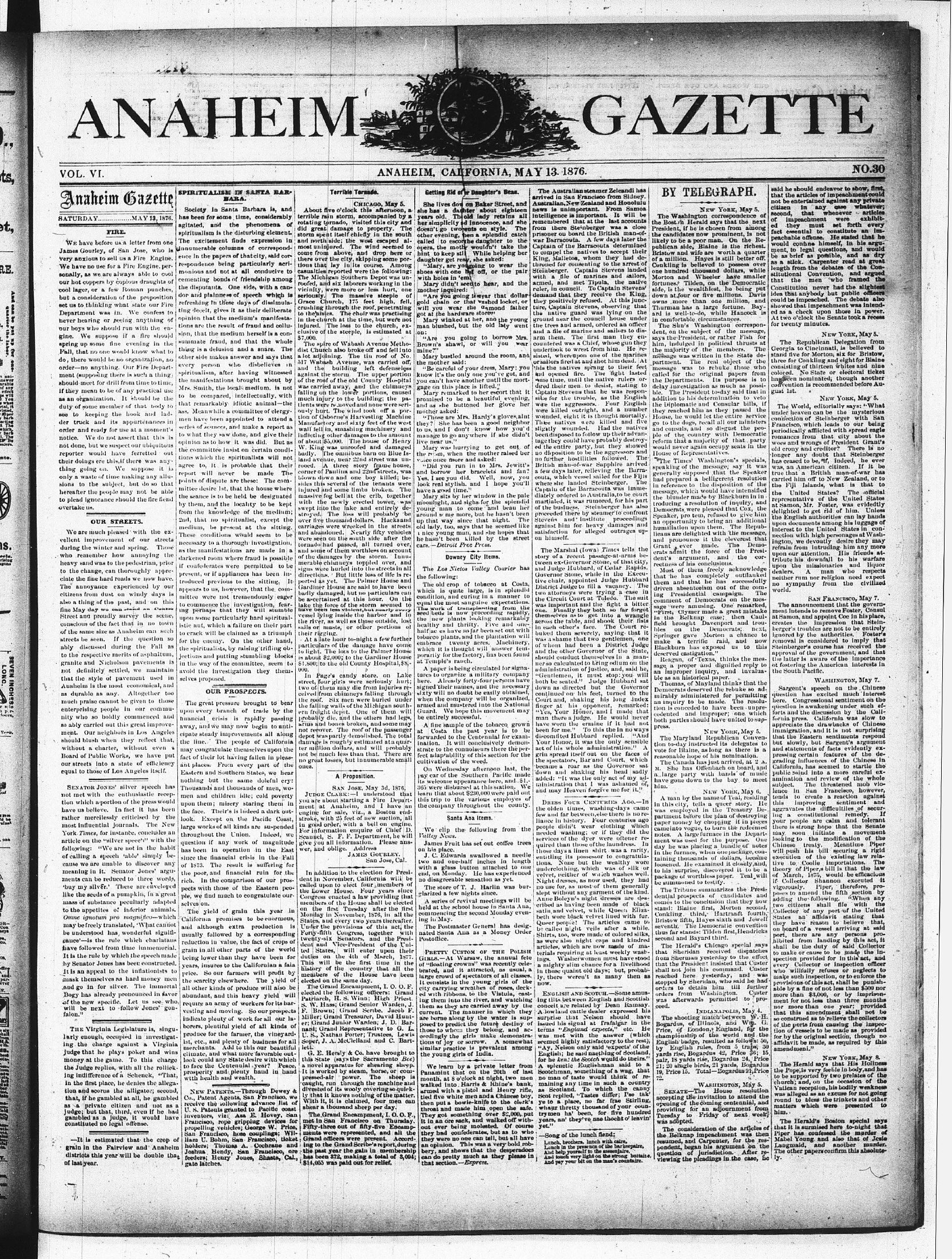
Searchable text
ANAHEIM GAZETTE
SATURDAY...MAY 13, 1876.
FIRE.
We have before us a letter from one James Gourley, of San Jose, who is very anxious to sell us a Fire Engine. We have no use for a Fire Engine, personally, as we are always able to cool our hot coppers by copious draughts of cool lager, or a few Roman punches, but a consideration of the proposition set us to thinking what state our Fire Department was in. We confess to never hearing or seeing anything of our boys who should run with the engine. We suppose if a fire should spring up some fine evening in the Fall, that no one would know what to do, there would be no organization, no order—no anything. Our Fire Department (supposing there is such a thing) should meet for drill from time to time, if they mean to be of any practical use as an organization. It should be the duty of some member of that body to see to keeping the hook and ladder truck and its appurtenances in order and ready for use at a moment's notice. We do not assert that this is not done, but we suspect our ubiquitous reporter would have ferretted out their doings ere this, if there was anything going on. We suppose it is
SPIRITUALISM IN SANTA BARBARA.
Society in Santa Barbara is, and has been for some time, considerably agitated, and the phenomena of spiritualism is the disturbing element. The excitement finds expression in innumerable columns of correspondence in the papers of that city, said correspondence being particularly acrimonious and not at all conducive to cementing bonds of friendship among the disputanta. One side, with a canard and plainness of speech which is refreshing In these days of dissimulating deceit, gives it as their deliberate opinion that the medium's manifestations are the result of fraud and collusion, that the medium herself is a consummate fraud, and that the whole thing is a delusion and a snare. The other side makes answer and says that every person who disbelieves in spiritualism, after having witnessed the manifestations brought about by Mrs. Smith, the locals medium, is not to be compared, intellectually, with that remarkably idiotic animal—the ass. Meanwhile a committee of clergymen have been appointed to attend a series of sciences, and make a report as to what they saw done, and give their opinion as to how it was did. But as the committee insist on certain conditions which the spiritualists will not agree to, it is probable that their
Terrible
About five o'clock terrible rain storm, rotating tornado, wilt great damage storm spent itself chilly and northside; the most uninjured. The come from above, there over the city, tensions that lay in casualties reported The Michigan South roofed, and six labor vicinity, were more seriously. The mans Grace Church, 177 crushing through the faits. The ceil in the church at the injured. The loss is elusive of the steeple $7,000.
The spire of Wabash dist Church also brood a lot adjoining. The 517 Wabash Avenue and the building against the storm. Of the roof of the old was carried away, falling on the lower much injury to the patients were removed ousely hurt. The winion of Osborne's H Manufactory and si wall fell in, smashing inflicting other damn of about $5,000. The W. King was unroof badly. The omnibound land avenue, near rooed. A three s
OUR STREETS.
We are much pleased with the excellent improvement of our streets during the winter and spring. Those who remember how annoying the heavy sand was to the pedestrian, prior to the change, can thoroughly appreciate the fine hard roads we now have. The annoyance experienced by our citizens from dust on windy days is also a thing of the past, and on this fine May day we can stand on Center Street and proudly survey the scene, conscious of the fact that in no town of the same size as Anaheim can such streets be seen. If the question so ably discussed during the Fall as to the respective merits of asphaltum, granite and Nicholson pavements is not definitely settled, we maintain that the style of pavement used in Anaheim is the most economical, and as durable as any. Altogether too much praise cannot be given to those enterprising people in our community who so boldly commenced and so ably carried out this great improvement. Our neighbors in Los Angeles should blush when they reflect that, without a charter, without even a Board of Public Works, we have put our streets into a state of efficiency equal to those of Los Angeles itself.
Senator Jones' silver speech has not met with the enthusiastic reception which a portion of the press would have us believe. In fact it has been rather mercilessly criticised by the most influential journals. The New York Times, for instance, concludes an article on the "silver speech" with the following: "We are not in the habit of calling a speech 'able' simply because we are unable to discover any meaning in it. Senator Jones' arguments can be reduced to three words, 'buy my silver.' These are enveloped spiritualism, after having witnessed the manifestations brought about by Mrs. Smith, the local medium, is not to be compared, intellectually, with that remarkably idiotic animal—the ass. Meanwhile a committee of clergy-men have been appointed to attend a series of seances, and make a report as to what they saw done, and give their opinion as to how it was did. But as the committee insist on certain conditions which the spiritualists will not agree to, it is probable that their report will never be made. The points of dispute are these: The committee desire 1st, that the house where the seance is to be held be designated by them, and the locality to be kept from the knowledge of the medium; 2nd, that no spiritualist, except the medium, be present at the sitting. These conditions would seem to be necessary to a thorough investigation, as the manifestations are made in a darkened room where fraud is possible if confederates were permitted to be present, or if appliances has been introduced previous to the sitting. It appears to us, however, that the committee were not tremendously eager to commence the investigation, fearing perhaps that they will stumble upon some particularly hard spiritualistic nut, which a failure on their part to crack will be claimed as a triumph for the enemy. On the other hand, the spiritualists, by raising trifling objections and putting stumbling blocks in the way of the committee, seem to avoid the investigation they themselves proposed.
OUR PROSPECTS.
The great pressure brought to bear upon every branch of trade by the financial crisis is rapidly passing away, and we may now begin to anticipate steady improvements all along the line. The people of California may congratulate themselves upon the fact of their lot having fallen in pleasant places. From every part of the Eastern and Southern States, we hear nothing but the same doleful cry: Thousands and thousands of men, women and children idle; cold poverty upon them; misery staring them in the face. Their's is indeed a dark outlook. Except on the Pacific Coast, large works of all kinds are suspended throughout the Union. Indeed, we question if any work of magnitude has been in operation in the East since the financial crisis in the Fall of 1873. The result is suffering for the poor, and financial ruin for the rich. In the comparison of our prospects with those of the Eastern peo-
A Prophecy
SAN JOSE
JUDGE CLARK:
you are about startling at Anaheim engine for sale, vested with 25 feet in good order, with For information enclosed, S. F. F., give you all informerwr, and oblige.
JA
In addition to the dent in November, called upon to elect
not met with the enthusiastic reception which a portion of the press would have us believe. In fact it has been rather mercilessly criticised by the most influential journals. The New York Times, for instance, concludes an article on the "silver speech" with the following: "We are not in the habit of calling a speech 'able' simply because we are unable to discover any meaning in it. Senator Jones' arguments can be reduced to three words, 'buy my silver.' These are enveloped like the seeds of a pumpkin, in a great mass of substance peculiarly adapted to the appetites of inferior animals. Omne ignotum pro magnifico—which may be freely translated, 'What cannot be understood has wonderful significance'—is the rule which charlatans have followed from time immemorial. It is the rule by which the speech made by Senator Jones has been constructed. It is an appeal to the inflationists to mask themselves as hard money men and go in for silver. The immortal Bogy has already pronounced in favor of the new specifie. Let us see who will be next to follow Jones' gonfalon."
The Virginia Legislature is singularly enough occupied in investigating the charge against a Virginia Judge that he plays poker and wins money at the game. To this charge the Judge replies, with all the rollicking indifference of a Schenck, "That, in the first place, he denies the allegation and scorns the alligator; second, that, if he gambled at all, he gambled as a private citizen and not as a judge; but that, third, even if he had gambled as a judge, it would have constituted no legal offense.
It is estimated that the crop of grain in the Fairview and Anaheim districts this year will be double that of last year.
NEW PATENTS.—Through Dewey & Co., Patent Agents, San Francisco, we receive the following advance list of U.S. Patents granted to Pacific coast inventors, viz: Asa E. Hovey, San Francisco, rope gripping devices for propelling vehicles; George W. Price, San Francisco, hose couplings; William U. Bohm, San Francisco, ticket holders; Thomas A. Cochrane and Joshua Hendy, San Francisco, ore feeders; Henry Jones, Shasta, Cal., gato latches.
JUDGE CLARK:—you are about starting at Anaheim engine for sale, vv stroke, with 25 feet in good order, with For information en Scannell, S. F. F. give you all informer and oblige.
In addition to the dent in November, called upon to elect the Lower House Congress enacted a members of the House on the first Tuesday Monday in November States, and every t Under the provision Forty-fifth Congre twenty-six Senate dent and Vice-President States, will duties on the 4th This will be the history of the co members of the elected on the same The Grand Encounter elected the following Patriarch, H. S. W. S. W. Hass; Grand F. Brown; Grand Miller; Grand Treasurer; Grand Junior Vandall; Grand Reprint U. S., Nathan Porto Soper, J. A. McClellan.
G. E. Hersly & Co. this State (says tha novel apparatus It is worked by stee pressed-air power caught, run through divested of its wood that it knows no With it, it is claim shear a thousand The Grand Encounter met in San Francisco Fifty-three out of mements were repressed Grand officers wer ing to the Grand Bury the past year the has been 872, mak $14,055 was paid o
CIM GA
ANAHEIM, CALIFORNIA, MAY 13. 1876.
Terrible Tornado.
Chicago, May 5.
About five o'clock this afternoon, a terrible rain storm, accompanied by a rotating tornado, visited this city and did great damage to property. The storm spent itself chiefly in the south and north side; the west escaped almost uninjured. The wind seemed to come from above, and drop here or there over the city, skipping some portions that lay in its course. Among casualties reported were the following: The Michigan Southern Depot was unroofed, and six laborers working in the vicinity, were more or less hurt, one seriously. The massive steeple of Grace Church, 175 feet high, fell, crushing through the roof, penetrating to the hives. The choir was practising in the church at the time, but were not injured. The loss to the church, exclusive of the steepe, is estimated at $7,000.
The spire of Wabash Avenue Methodist Church also broke off and fell into a lot adjoining. The tin roof of No. 517 Wabash Avenue, was carried off, and the building left defenseless against the storm. The upper portion of the roof of the old County Hospital was carried away, and the chimneys falling on the lower portions, caused much injury to the building; the patients were removed and none were seriously hurt. The wind took off a portion of Osborne's Harvesting Machine Manufactory and sixty feet of the west wall fell in, smashing machinery and inflicting other damages to the amount of about $5,000. The house of Henry W. King was unroofed and damaged badly. The omnibus barn on Blue Island avenue, near 22nd street was unrooed. A three story frame house,
Getting Rid of Daughter's Bean.
She lives down on Baker Street, and she has a daughter about eighteen years old. The old lady retains all her simplicity ad innocence, and she doesn't go two cents on style. The other evening, then a splendid catch called to escort the daughter to the opera, the mother wouldn't take the hint to keep still. While helping her daughter get ready, she asked:
"Mary, are you going to wear the shoes with one ball off, or the pair with holes in 'em?
Mary didn't seem to hear, and the mother inquired:
"Are you going to wear that dollar gold chain or that washed jacket, or will you wear the diamond father got at the hardware store?"
Mary winked at her, and the young man blushed, but the old lady went on:
"Are you going to borrow Mrs. Brown's shawl, or will you wear mine?"
Mary bustled around the room, and the mother said:
"Be careful of your dress; Mary; you know it's the only one you've got, and you can't have another until the mortgage on this place is lifted."
Mary remarked to her escort that it promised to be a beautiful evening, and as she buttoned her glove her mother asked:
"Those are Mrs. Hardy's gloves,aint they? She has been a good neighbor to us, and I don't know how you'd manage to go anywhere if she didn't live near us."
Mary was hurrying to get out of the room, when the mother raised her voice once more and asked:
"Did you run in to Mrs. Jewitt's
The Australian steamer Zeleandi has arrived in San Francisco from Sidney. Australian New Zealand and Honolulu news is unimportant. From Samoa intelligence is important. It will be remembered that at the last accounts from there Steinberger was a close prisoner on board the British man-of-war Barracouta. A few days later the Captain of the Barracouta determined to compel the natives to accept their King, Malietoa, whom they had throned for consenting to the arrest of Steinberger. Captain Stevens landed with a file of marines and sailors, armed, and met Tipula, the native ruler, in council. To Captain Stevens demand that they receive the King, they positively refused. At this juncture, Captain Stevens, observing that the native guard was lying on the ground near the council house under the trees and armed, ordered an officer and a file of marine and sailors to disarm them. The first man they encountered was a Chief, whose gun they undertook to wrest from him. He resisted, whereupon one of the marines or sailors fired at and shot him dead. At this the natives sprang to their feet and opened fire. The fight lasted same time, until the native rulers ordered their men to desist, stating to Captain Stevens that he was responsible for the trouble, as the English were the aggressors. Four English were killed outright, and a number wounded, eight it is thought mortally. Three natives were killed and five slightly wounded. Had the natives been disposed to follow up their advantage they could have probably destroyed the entire party, but they showed no disposition to be the aggressors and no further hostilities followed. The British man-of-war Sapphire arrived.
BY
The West President can likely publicize Bristow of a miracle one hour Morton fortune slide; is down own Thurman ard is in command.
The dent says thim him; in the message partme message called De delay in ble. The addition the Dip they re House; go to t and con ple of reform would House.
The speakki
The upper portion of the roof of the old County Hospital was carried away, and the chimneys falling on the lower portions, caused much injury to the building; the patients were removed and none seriously hurt. The wind took off a portion of Osborne's Harvesting Machine Manufactory and sixty feet of the west wall fell in, smashing machinery and inflicting other damages to the amount of about $5,000. The house of Henry W. King was unroofed and damaged badly. The omnibus barn on Blue Island avenue, near 22nd street was unroofed. A three story frame house, corner of Paulina and 22nd streets, was blown down and one boy killed; besides this several of the tenants were injured and some limbs broken. The massive fog bell at the crib, together with the newly erected tower, was swept into the lake and entirely destroyed. The loss will probably be over five thousand dollars. Hacks and carriages were wrecked in the streets and abandoned. Nearly fifty vehicles were seen on the south side after the tornado had passed, all turned over, and some of them worthless on account of the damages by the storm. Innumerable chimneys toppled over, and signs were hurled into the streets in all directions. But little loss of life is reported as yet. The Palmer House and Gardiner House are said to have been badly damaged, but no particulars can be ascertained at this hour. On the lake the force of the storm seemed to have been less violent, but nearly every vessel lying inside the harbor and in the river, as well as those outside, lost sails or mast, or other portions of their rigging.
At a late hour to-night a few further particulars of the damage have come to light. The loss to the Palmer House is about $2,000; to the Gardiner House $1,800; to the old County Hospital, $8,000.
In Page's candy store, on Lake street, four girls were seriously hurt; two of them may die from injuries received from chimneys falling through the roof. Six men were buried under the falling walls of the Michigan southern freight depot. One of them will probably die, and the others had legs, arms and bones broken, and some may not recover. The roof of the passenger depot was partly demolished. The total damage is roughly estimated at a quarter million dollars, and will probably not be much less than that. There are no great losses, but innumerable small ones.
A Proposition.
SAN JOSE, May 3d, 1876.
JUDGE CLARK:—I understood that you are about starting a Fire Department at Anaheim, and I have an engine for sale, viz., a Boston end-stroke, with 25 feet of new suction, all in good order, with a bell on engine. For information enquire of Chief D. Scannel, S. F. F. Department, he will give you all information. Please answer, and oblige. Address
JAMES GOURLEY.
San Jose, Cal.
In addition to the election for President in November, California will be called upon to elect four members of the Downey City Items.
The Los Nietos Valley Courier has the following:
The old crop of tobacco at Costa, which is quite large, is in splendid condition, and curing in a manner to equal the most sanguine expectations. The work of transplanting from the seed beds is now proceeding rapidly, the new plants looking remarkably healthy and thrifty. Five and one-half acres have so far been set out with tobacco plants, and the plantation will embrace twenty acres. Machinery, which it is thought will answer temporarily for the factory, has been found at Temple's ranch.
A paper is being circulated for signatures to organize a military company here. Already forty-four persons have signed their names, and the necessary sixty will no doubt be easily obtained, when the company will be organized, armed and mustered into the National Guard. We hope this movement may be entirely successful.
A fine sample of the tobacco, grown at Costa past year is to be forwarded to the Centennial for examination. It will conclusively demonstrate to the connoisseurs there the perfect adaptability of this section for the cultivation of the weed.
On Wednesday afternoon last, the pay car of the Southern Pacific made its welcome appearance here, and $1365 were disbursed at this station. We learn that about $230,000 were paid out this trip to the various employees of the company throughout the county.
Santa Ana Items.
We clip the following from the Valley News.
James Fruit has set out coffee trees on his place.
J. C. Edwards swallowed a needle two and one-half inches in length with a glass button attached to one end, on Monday. He has experienced no disagreeable sensation as yet.
The store of T. J. Harlin was burrowed it's the only one you've got, and you can't have another until the mortgage on this place is lifted."
Mary remarked to her escort that it promised to be a beautiful evening, and as she buttoned her glove her mother asked:
"Those are Mrs. Hardy's gloves,aint they? She has been a good neighbor to us, and I don't know how you'd manage to go anywhere if she didn't live near us."
Mary was hurrying to get out of the room, when the mother raised her voice once more and asked:
"Did you run in to Mrs. Jewitt's and borrow her bracelets and fan? Yes, I see you did. Well, now, you look real stylish, and I hope you'll have a good time."
Mary sits by her window in the pale moonlight, and sighs for the splendid young man to come and beau her around some more, but he hasn't been up that way since that night. The old lady, too, says that he seemed like a nice young man, and she hopes that he hasn't been killed by the street cars."—Detroit Free Press.
Downey City Items.
The Los Nietos Valley Courier has the following:
The old crop of tobacco at Costa, which is quite large, is in splendid condition, and curing in a manner to equal the most sanguine expectations. The work of transplanting from the seed beds is now proceeding rapidly, the new plants looking remarkably healthy and thrifty. Five and one-half acres have so far been set out with tobacco plants, and the plantation will embrace twenty acres. Machinery, which it is thought will answer temporarily for the factory, has been found at Temple's ranch.
A paper is being circulated for signatures to organize a military company here. Already forty-four persons have signed their names, and the necessary sixty will no doubt be easily obtained, when the company will be organized, armed and mustered into the National Guard. We hope this movement may be entirely successful.
A fine sample of the tobacco, grown at Costa past year is to be forwarded to the Centennial for examination. It will conclusively demonstrate to the connoiseurs there the perfect adaptability of this section for the cultivation of the weed.
On Wednesday afternoon last, the pay car of the Southern Pacific made its welcome appearance here, and $1365 were disbursed at this station. We learn that about $230,000 were paid out this trip to the various employees of the company throughout the county.
Dress Four Centuries Ago.-In the olden times, washing-days came few and far between; there is no reliance in history. Four centuries ago people didn't wear clothing which needed washing; or if they did the services of the dryer were oftener required than those of the laundress. In those days a linen shirt was a rarity, entailing its possessor to congratulations. None but the wealthy wore underclothing, which was of silk or velvet, neither of which washed well. Night dresses, as now used, they had no use for, as most of them generally
JUDGE CLARK:—I understood that you are about starting a Fire Department at Anaheim, and I have an engine for sale, viz., a Boston end-stroke, with 25 feet of new suction, all in good order, with a bell on engine. For information enquire of Chief D. Scannel, S. F. F. Department, he will give you all information. Please answer, and oblige. Address
JAMES GOURLEY.
San Jose, Cal.
In addition to the election for President in November, California will be called upon to elect four members of the Lower House. Four years since Congress enacted a law providing that members of the House shall be elected on the first Tuesday after the first Monday in November, 1876, in all the States, and every two years thereafter. Under the provisions of this act, the Forty-fifth Congress, together with twenty-six Senators, and the President and Vice-President of the United States, will enter upon their duties on the 4th of March, 1877. This will be the first time in the history of the country that all the members of the House have been elected on the same day.
The Grand Encampment, I. O. O. F. elected the following officers: Grand Patriarch, H. S. Winn; High Priest S. W. Haass; Grand Senior Warden, J. F. Brown; Grand Scribe, Jacob F. Miller; Grand Treasurer, David Hunter; Grand Junior Warden, J. D. Barnard; Grand Representative to G. L. U. S., Nathan Porter; Trustees, Lewis Soper, J. A. McClelland and C. Bartlett.
G. E. Hersly & Co. have brought to this State (says the Sacramento Bee) a novel apparatus for shearing sheep. It is worked by steam, horse, or compressed-air power. The sheep is caught, run through the machine and divested of its wooly covering so quickly that it knows nothing of the matter. With it, it is claimed, four men can shear a thousand sheep per day.
The Grand Encampment, I. O. O. F., met in San Francisco on Thursday. Fifty-three out of fifty-five Encampments were represented, and all the Grand officers were present. According to the Grand Scribe's report, during the past year the gain in membership has been $72, making a total of $3,094; $14,055 was paid out for relief.
We clip the following from the Valley News.
James Fruit has set out coffee trees on his place.
J. C. Edwards swallowed a needle two and one-half inches in length with a glass button attached to one end, on Monday. He has experienced no disagreeable sensation as yet.
The store of T. J. Harlin was burglared a few nights since.
A series of revival meetings will be held at the school house in Santa Ana, commencing the second Monday evening in May.
The Postmaster General has designated Santa Ana as a Money Order Postoffice.
PRETTY CUSTOM OF THE POLISH GIRLS.-At Warsaw, the annual fete of "floating crowns" was recently celebrated, and it attracted, as usual, a large crowd of spectators of all classes. It consists in the young girls of the city carrying wreathes of roses, decked with ribbons, to the Vistula, casting them into the river, and watching them as they are carried away by the current. The manner in which they are borne along by the water is supposed to predict the future destiny of those to whom they belong, and accordingly the girls make demonstrations of joy or sorrow. A somewhat similar practice is prevalent among the young girls of India.
We learn by a private letter from Panamint that on the 20th of last month, at 8 o'clock at night, two men walked into Harris & Rhine's bank, armed with a pistol and Henry rifle, tied five white men and a Chinese boy, then put a bowle-knife to the clerk's throat and made him open the safe. They got something over $2,000, put it in an ore sack, and walked off without ever being molested. Of course they had confederates, but as to who they were no one can tell, but all have an opinion. This was a very bold robbery, and shows that the desperadoes can do pretty much as they please in that section.-Express.
DRESS FOUR CENTURIES AGO.-In the olden times, washing-days came few and far between; else there is no reliance in history. Four centuries ago people didn't wear clothing which needed washing; or if they did the services of the dyer were oftener required than those of the laundress. In those days a linen shirt was a rarity, entitling its possessor to congratulations. None but the wealthy wore underclothing, which was of silk or velvet, neither of which washed well. Night dresses, as now used, they had no use for, as most of them generally slept without any garment of the kind. Anne Boleyn's night dresses are described as having been made of black satin and velvet, while Queen Elizabeth wore black velvet lined with fur. Queer people! The articles came to be called night veils after a while. Shirts, too, were made of colored silks, as were also night caps and skirts articles, which are now made of materials requiring at least weekly washings. Washerwomen must have stood a mighty slim chance for a livelihood in those quaint old days; but probably there weren't as many then as now.
ENGLISH AND SCOTCH.-Some amusing tilts between English and Scottish conceit are related by Dean Ramsay. Allowland cattle dealer expressed his surprise that Nelson should have issued his signal at Frafalgar in the terms "England expects," etc. He was met with the answer (which seemed highly satisfactory to the rest), "Ay, Nelson only said 'expects' of the English; he said naething of Scotland, for he ken't the Scotch would do tweirs."
A splenetic Englishman said to a Scotchman, something of a wag, that no man of taste would think of remaining any time in such a country as Scotland. To which the canny replied, "Tastes differ; I see tak' ye to a place, no far free Stirling, whaqr thretty thousand of your countrymen ha' been, for five hundred years, an' they've nane thocht o' leavin' yet."
Song of the lunch fiend:
Lunch, brothers, lunch with cairs,
Lunch in the presence of the barkeepaire,
And help yourself to the saassenjaire,
And touch very light on the strong buttie,
And pay your bit on the man's countaire.
GAZETTE
NO.30
BY TELEGRAPH.
NEW YORK, May 5.
The Washington correspondence of the Boston Herald says that the next President, if he is chosen from among the candidates now prominent, is not likely to be a poor man. On the Republican side, Blaine is the richest. Bristow and wife are worth a quarter of a million. Hayes is still better off. Conkling is believed to possess over one hundred thousand dollars, while Morton and Wheeler have smaller fortunes. Tilden, on the Democratic side, is the wealthiest, he being put down at four or five millions. Davis owns more than one million, and Thurman has a large fortune. Bayard is well-to-do, while Hancock is in comfortable circumstances.
The Slin's Washington correspondent, on the subject of the message, says the President, or rather Fish for him, indulged in political thrusts at the majority of the members. The message was written in the State department. The real object of the message was to rebuke those who called for the original papers from the Departments. Its purpose is to delay investigation as much as possible. The President to-day said that in addition to his determination to veto the Diplomatic and Consular bills, if they reached him as they passed the House, he would let the entire service go to the dogs, recall all our ministers and consuls, and so disgust the people of the country with Democratic reform that a majority of that party would never again occupy seats in the House of Representatives.
The Times' Washington's specials, speaking of the message; say it was said he should endeavor to show, first, that the articles of impeachment could not be entertained against any private citizen in any case whatever; second, that whenever articles of impeachment were exhibited they must set forth every fact essential to constitute an impeachable offense. He stated that he would continue himself, in his argument, to legal questions, and would be as brief as possible, and as dry as a stick. Carpenter read at great length from the debates of the Constitutional Convention, and argued that the men who framed the Constitution never had the slightest idea that anybody but public officers could be impeached. The debate also showed that impeachment was intended as a check upon those in power. At two o'clock the Senate took a recess for twenty minutes.
NEW YORK, May 5.
The Republican Delegation from Georgia to Cincinnati, is believed to stand five for Morton, six for Bristow, three for Conkling and eight for Blaine consisting of thirteen whites and nine colored. No State or electoral ticket has been nominated; though another convention is recommended before August 1st.
NEW YORK, May 5.
The World, editorially says: "What under heaven can be the mysterious connection of Steinberger with San Francisco, which leads to our being periodically afflicted with spread eagle romances from that city about the woes and wrongs of President Grant's old crony and creditor? There is no longer any doubt that Steinberger has ceased to be, if indeed, he ever was, an American citizen. If it be
The fight lasted native rulers or allies, stating he was responsible as the English Four English and a number thought mortally. He killed and five had the natives up their advantage probably destroying them showed the aggressors and followed. The Sapphire arrived saving the Barramail for the Fijis Steinberger. The bouta was immediate to be court honored, for his part Steinberger has alsoreamer to confront minute proceedings very damages and urged outrages up.
Times tells the message-at-arms bestone, of that city, of Celer Rapids. Made in the Executive Judge Hubbard a vacancy. The trying a case in Toledo. The suit the fight a bitter both so far forgot into a wrangle shook their lists. The Court reaffirming that it gentlemen, one a District Judge of the State, ourselves in a manning odium on the notice, and said he must stop: you will judge Hubbard sat at the Governor set, turned to the his long indexment, remarked: and I made that He would never come if it had not this the in no ways replied. "And the only sensible administration." A man on the faces of Land Court, which the Governor sat his head sadly only act of my adw was ashamed of, give me for it."
TURIES AGO.—In washing-days came elsewhere there is no rehearsal centuries ago clothing which if they did the were oftener rethe laundress. In shirt was a rarity, poor to congratulate wealthy wore was of silk or which washed well. Now used, they had of them generally called for the original papers from the Departments. Its purpose is to delay investigation as much as possible. The President to-day said that in addition to his determination to veto the Diplomatic and Consular bills, if they reached him as they passed the House, he would let the entire service go to the dogs, recall all our ministers and consuls, and so disgust the people of the country with Democratic reform that a majority of that party would never again occupy seats in the House of Representatives.
The Times' Washington's specials, speaking of the message, say it was generally supposed that the Speaker had prepared a belligerent resolution in reference to the disposition of the message, which would have intensified the blunder made by Blackburn in introducing a resolution of inquiry, and Democrats were pleased that Cox, the Speaker, pro tem, refused to give him an opportunity to bring an additional humiliation upon them. The Republicans are delighted with the message, and pronounce it the cleverest that Grant ever made. The Democrats admit the force of the President's argument, and the correctness of his conclusions.
Most of them freely acknowledge that he has completely outilanked them and that he has successfully driven absenteeism out of the coming Presidential campaign. The comment of Democrats on the message were amusing. One remarked, "First, Clymer made a great mistake in the Belknap case; then Caulfield brought Davenport and troubles on the Democrats; next, Springer gave Morton a chance to make a terrific raid, and now Blackburn has exposed us to this deserved castigation."
Reagan, of Texas, thinks the message, a proper and dignified reply to an improper inquiry, and invaluable as an historical paper.
Thomas, of Mayland thinks that the Democrats deserved the rebuke so admirably administered for permitting an inquiry to be made. The resolution is conceded to have been unprecedented and improper; one which both parties should have united to suppress.
NEW YORK, May 5.
The Maryland Republican Convention to-day instructed its delegates to vote for Blaine, as long as there is a reasonable hope of his nomination.
The Canada has just arrived, at 2 A.M. She has Offenbach on board, and a large party with bands of music have gone down to the bay to meet him.
NEW YORK, May 6.
A man by the name of Teal, residing in this city, tells a queer story. He was employed in the Treasury Department before the plan of destroying paper money by chopping it in pieces came into vogue, to burn the redeemed notes. A large furnace in the Department was used for the purpose. One day he was placing a bundle of notes in the furnace, when one package, containing thousands of dollars, became loosened. He examined it closely,and, to his surprise, discovered it to be a package of worthless paper. Teal will be summoned to testify.
THE Tribune summarizes the Pressi colored. No State or electoral ticket has been nominated; though another convention is recommended before August 1st.
NEW YORK, May 5.
The World, editorially says: "What under heaven can be the mysterious connection of Steinberger with San Francisco, which leads to our being periodically afflicted with spread eagle romances from that city about the woes and wrongs of President Grant's old crony and creditor? There is no longer any doubt that Steinberger has ceased to be,if indeed, he ever was, an American citizen. If it be true that a British man-of-war has carried him off to New Zealand, or to the Fiji Islands, what is that to the United States? The official representative of the United States at Samon, Mr. Foster, was evidently delighted to get rid of him. Unless the English authorities can lay hands upon documents among his luggage of interest to the United States in connection with high personages at Washington, we devoutly desire they may refrain from intruding him any more upon our attention. His friends attribute his downfall to his warfare upon the missionaries and liquor dealers. A man who respects neither rum nor religion need expect no sympathy from the civilized world.
SAN FRANCISCO, May 7.
The announcement that the government intends to remove Foster, Consult at Samon, and appoint Coe in his place, creates the impression that Steinberger's troubles are not to be entirely ignored by the authorities. Foster's removal is considered to imply that Steinberger's course has received the approval of the government; and that the latter is aware of the importance of fostering the American interests in the South Pacific.
WASHINGTON, May 7.
Sargent's speech on the Chinese question has excited much interest here. Congressional sentiment on the question is awakening under such efforts and the discussion by the California press. California was slow to appreciate the drawbacks of Chinese immigration, and it is not surprising that the Eastern sentiments respond but slowly, but Sargent's argument and statements of facts evidently expressing certain features of the degrading influences of the Chinese in California, has seemed to startle the public mind into a more careful examination and review of the whole subject. The threatened mob violence in San Francisco, however,tends to create a reaction against this improving sentiment and aggravates the difficulties of securing a constitutional remedy. If your people are calm and tolerant there is strong hope that the Senate may soon initiate a movement looking to the modification of the Chinese treaty. Meantime Piper will push his bill securing a rigid execution of the existing law relative to Coolie importations. The theory of Piper's bill is that the law of March, 1875, would be efficacious if Collector Shannon executed it vigorously. Piper, therefore, pro-
NEW YORK, May 6.
A man by the name of Teal, residing in this city, tells a queer story. He was employed in the Treasury Department before the plan of destroying paper money by chopping it in pieces came into vogue, to burn the redeemed notes. A large furnace in the Department was used for the purpose. One day he was placing a bundle of notes in the furnace, when one package containing thousands of dollars became loosened. He examined it closely, and, to his surprise, discovered it to be a package of worthless paper. Teal will be summoned to testify.
The Tribune summarizes the Presidential prospects of candidates and comes to the conclusion that they now stand: Blaine first, Morton second, Conkling third, Hartranft fourth, Bristow fifth, Hayes sixth and Jewell seventh. The Democratic convention thus far stands: Tilden first, Hendricks second and Bayard third.
The Herald's Chicago special says that Sheridan received dispatches from Sherman yesterday to the effect that the President insisted that Custer shall not join his command. Custer reached here yesterday, and was stopped by Sheridan, who said he had orders to detain him till further orders from Washington. Custer was afterwards permitted to proceed.
INDIANAPOLIS, May 4.
The shooting match between W. H. Bogardus, of Illinois, and Wm. G. Price, of London, England, for the championship of the world and the English badge, resulted as follows: 50, by English rules, from 5 traps; 30 yards rise, Bogardus 42, Price 26; 15 pair, 18 yards rise, Bogardus 24, Price 21; 20 single birds, 21 yards, Bogardus 19, Price 15. Total—Bogardus 91, Price 72.
WASHINGTON, May 5.
SENATE—The House resolution accepting the invitation to attend the opening of the coming centennial, and providing for an adjournment from Tuesday to Friday of next week, was adopted.
The consideration of the articles of the Belknap impeachment was then resumed, and Carpenter, for the respondent, began his argument on the question of jurisdiction. After reviewing the pleadings in the case, he
lance in San Francisco, however, tends to create a reaction against this improving sentiment and aggravates the difficulties of securing a constitutional remedy. If your people are calm and tolerant there is strong hope that the Senate may soon initiate a movement looking to the modification of the Chinese treaty. Meantime Piper will push his bill securing a rigid execution of the existing law relative to Coolie importations. The theory of Piper's bill is that the law of March, 1875, would be efficacious if Collector Shannon executed it vigorously. Piper, therefore, proposes to amend the fifth section by adding the following. "When any two citizens shall file with the Collector of any port of the United States an affidavit stating that they have reason to believe that, on board of a vessel arriving at said port, there are any persons prohibited from landing by this act, it shall be the duty of said Collector to make or cause to be made the inspection provided for in this act, and every Collector or inspection officer who willfully refuses or neglects to make such inspection, or to enforce the provisions of this act, shall be punishable by a fine of not less than $500 nor more than $3,000, or by imprisonment for not less than three months nor more than one year; provided that this amendment shall not be so construed as to relieve the collectors of the ports from causing the inspection of vessels to be made as provided for by the original section, though no affidavit be made, as required by this amendmeni."
NEW York, May 8.
The Herald says that His Holiness the Pope is very seeble in body, and has to be supported by two prelates of the church; and, on the occasion of the Vatican reception, his bodily weakness was alleged as an excuse for not going round to bless the trinkets and other matters which were presented to him.
The Herald's Boston special says that it is surmised here to-night that Piper has confessed the murder of Mabel Young and also that of Jesse Langmaid, and another murder. The other papers confirm this absolutely.