anaheim-gazette 1876-05-06
Scanned page
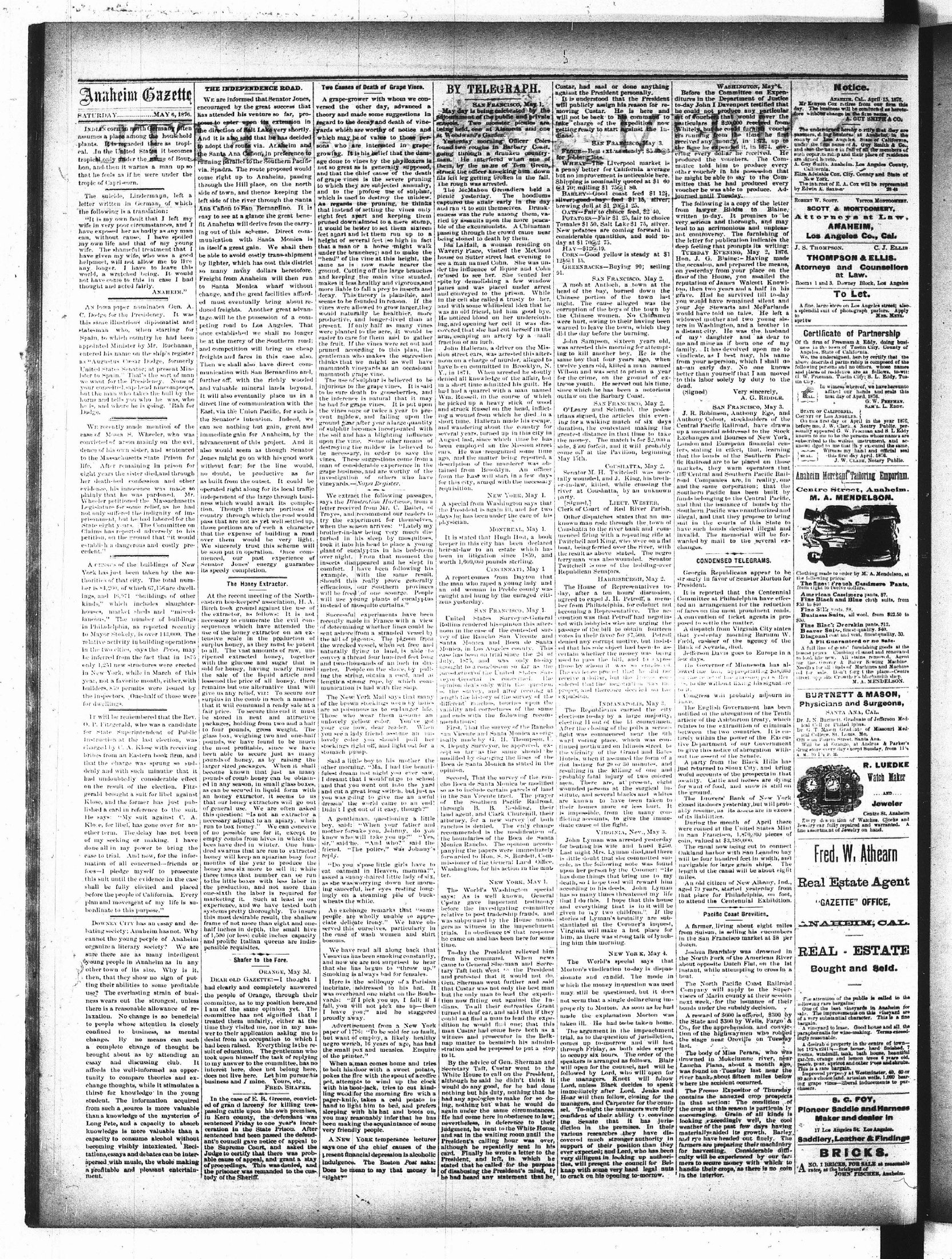
Searchable text
Anheim Gazette
SATURDAY...MAY 6, 1876.
Indian corn in north Germany often assumes a place among the household plants. It is regarded there as tropical. In the United States it becomes tropical only under the name of Bourbon, and then it warms a man up so that he feels as if he were under the tropic of Capri-corn.
The suicide, Lindermann, left a letter written in German, of which the following is a translation:
"It is my own fault that I left my wife in very poor circumstances, and I have exposed her as badly as any man can, without cause. I have spoiled my own life and that of my young wife. The shameful treatment that I have given my wife, who was a good helpmeet, will not allow me to live any longer. I have to leave this world, a wretched being. It would not have come to this in case I had thought and acted fairly."
ANAHEIM."
An Iowa paper nominates Gen. A. C. Dodge for the Presidency. It was this same illustrious diplomatist and statesman who, when starting for Spain, to which country he had been appointed Minister by Mr. Buchanan, entered his name on the ship's register as "Augustus Caesar Dodge," formerly United States Senator; at present Minister to Spain." That's the sort of man we want for the Presidency. None of your conceived sap-head nincompoops, but the man who takes the bull by the horns and tells you who he was, who he is, and where he is going. "Rah for Dodo."
We recently made mention of the case of Moses S. Wheeler, who was convicted of arson mainly on the evidence of his own sister, and sentenced to the Massachusetts State Prison for life. After remaining in prison for
THE INDEPENDENCE ROAD.
We are informed that Senator Jones, encouraged by the great success that has attended his venture so far, proposes to enter upon its extension in the direction of Salt Lake very shortly. And it is also said that he has decided to adopt the route via Anaheim and the Santa Ana Canion, in preference to running parallel to the Southern Pacific via Spadra. The route proposed would come right up to Anaheim, passing through the Hill place, on the north side of town, and thence keeping the left side of the river through the Santa Ana Canion to San Bernardino. It is easy to see at a glance the great benefit Anaheim will derive from the carrying out of this scheme. Direct communication with Santa Monica is in itself a great gain. We shall then be able to avoid costly trans-shipment by lighter, which has cost this district so many many dollars heretofore. Freight from Anaheim will then run to Santa Monica wharf without change, and the great facilities afforded must eventually bring about reduced freights. Another great advantage will be the possession of a competing road to Los Angeles. That once established we shall no longer be at the mercy of the Southern road; and competition will bring us cheap freights and fares in this case also. Then we shall also have direct communication with San Bernardino and further off, with the richly wooded and valuable mineral lands beyond. It will also eventually place us in a direct line of communication with the East, via the Union Pacific, for such is the Senator's intention. Indeed, we can see nothing but gain, great and immediate gain for Anaheim, by the advancement of this project. And it also would seem as though Senator Jones might go on with his good work without fear; for the line would,
Two Cases
A grape-grower versed the theory and more regard to the yards which may be grown. It is age done to win not so great and that the grape vine to which they are used.
As regards that instead of eight feet a pruned down it would be but feet apart and height of set that a man or under the branch "head" of the same as is in ground. Cutting and keeping makes it less more liable to decay. This seems to be five vines were a would natural productive, to present. If were planted easier to care the fruit. If pruned accustomed gentleman will thinks that mammoth vines mammoth gives.
The use of injurious to be sure due to the infertility be bad for grape vines on ground grass of sulphur bar the soil and upon the vine destroying to be necessary vines. The man of conscience
We recently made mention of the case of Moses S. Wheeler, who was convicted of arson mainly on the evidence of his own sister, and sentenced to the Massachusetts State Prison for life. After remaining in prison for eight years the sister died, and through her death-bed confession and other evidence, his innocence was made so plainly that he was pardoned. Mr. Wheeler petitioned the Massachusetts Legislature for some relief, as he had not only suffered the indignity of imprisonment, but he had labored for the State eight years. The Committee on Claims has reported adversely to his petition, on the ground that "it would establish a dangerous and costly precedent."
A census of the buildings of New York has just been taken by the authorities of that city. The total number is 84,200, of which 67,156 are dwellings, and 13,971 "buildings of other kinds," which includes slaughterhouses, market sheds and "miscellaneous." The number of buildings in Philadelphia, as reported recently to Mayor Stokely, is over 143,000. The relative activity in building operations in the two cities, says the Press, may be inferred from the fact that in 1875 only 1,251 new structures were erected in New York, while in March of this year, not a favorite month, either, with builders, 859 permits were issued by the inspectors. One-half of those were for dwellings.
It will be remembered that the Rev. O. P. Fitzgerald, who was a candidate for State Superintendent of Public Instruction at the last election, was charged by C. A. Klose with receiving bribes from an Eastern book firm, and that the charge was sprung so suddenly and with such minutiae that it had undoubtedly considerable effect on the result of the election. Fitzgerald brought a suit for libel against Klose, and the former has just published a card in reference to the suit. He says: "My suit against C. A. Klose, for libel, has gone over for another term. The delay has not been of my seeking or making. I have done all in my power to bring the case to trial. And now, for the information of all concerned—friends or foes—I pledge myself to prosecute this suit until the evidence in the case shall be fully elicited and placed
The Honey Extractor.
At the recent meeting of the North-eastern bee-keepers' association, H. A. Birch took ground against the use of the extractor, as follows: It is not necessary to enumerate the evil consequences which have attended the use of the honey extractor on an extensive scale in the production of surplus honey, as they must be patent to all. The vast amounts of raw, unripened extracted honey, together with the glucose and sugar that is sold for honey, having nearly ruined the sale of the liquid article and lessened the price of all honey, there remains but one alternative that will give us any relief, viz: To secure our surplus in the comb in such a manner that it will command a ready sale at a fair price. To secure this end it must be stored in neat and attractive packages, holding from two and a half to four pounds, gross weight. The glass box, weighing two and one-half pounds, we have found to be much the most profitable, since we have been able to secure just as many pounds of honey, as by raising the larger sized packages. When it shall become known that just as many pounds of comb honey can be obtained in any season, in small glass boxes, as can be secured in liquid form with an honey extractor, it seems to us that our honey extractors will go out of general use. We are often asked this question: "Is not an extractor a necessary adjunct to an apiary, when run to box honey?" We can conceive of no possible use for it, except to empty combs from hives in which the bees have died in winter. One hundred swarms that are run to extracted honey will keep an apiarian busy four months of the year to produce the honey and six more to sell it; while three times that number can be run to the little boxes with less labor in the production, and not more than
Downey City has an essay and debating society; Anaheim has not. Why cannot the young people of Anaheim organize a literary society? We are sure there are as many intelligent young people in Anaheim as in any other town of its size. Why is it then, that they show no sign of putting their abilities to some profitable use? The everlasting strain of business wears out the strongest, unless there is a reasonable allowance of relaxation. No change is so beneficial to people whose attention is closely confined to business, as mental change. By no means can such a complete change of thought be brought about as by attending an essay and discussing club. It affords the well-informed an opportunity to compare theories and exchange thoughts, while it stimulates a thirst for knowledge in the young student. The information acquired from such a source is more valuable than a knowledge of the mysteries of Long Pete, and a capacity to absorb knowledge is more valuable than a capacity to consume alcohol without becoming visibly intoxicated. Recitations, essays and debates can be interspersed with music, the whole making a profitable and pleasant entertainment.
DEAR OLD GAZETTE:—I thought I had clearly and completely answered the people of Orange, through their committee, as to my position here, and I am of the same opinion yet. The committee has not signified that I treated them unfairly, either at the time they visited me, nor in my answer to their application asking me to desist from an occupation to which I had been raised. Everything is the result of education. The gentleman who took upon himself the task of replying to my answer to the committee, has no interest here, does not belong here, does not live here. Let him pursue his business and I mine. Yours, etc.,
FRED SHAFER.
In the case of E. R. Greene, convicted of grand larceny for killing trespassing cattle upon his own premises, in Kern county, the defendant was sentenced Friday to one year's incarceration in the State Prison. After sentenced had been passed the defendant's council gave notice of appeal to the Supreme Court, and asked the Judge to certify that there was probable cause of appeal, and grant a stay of proceedings. This was denied, and the prisoner was remanded to the custody of the Sheriff.
Two Cases of Death of Grape Vines.
A grape-grower with whom we conversed the other day, advanced a theory and made some suggestions in regard to the decay and death of vineyards which are worthy of notice and which may be of value to those persons who are interested in grape-growing. It is his belief that the damage done to vines by the phylloxera is not so great as is generally supposed, and that the chief cause of the death of grape vines is the severe pruning to which they are subjected annually, and to the profuse use of sulphur, which is used to destroy the mildew. As regards the pruning, he thinks that instead of setting the vines only eight feet apart and keeping them pruned down almost to a mere stump, it would be better to set them sixteen feet apart and let them run up to a height of several feet (so high in fact that a man or a horse might walk under the branches;) and to make the "head" of the vine at this height, the same as is now made near the ground. Cutting off the large branches and keeping the main vine stunted makes it less healthy and vigorous, and more liable to fall a prey to insects and decay. This theory is plausible, and seems to be founded in reason. If the vines were allowed to grow larger, they would naturally be healthier, more productive, and longer-lived than at present. If only half as many vines were planted to the acre, it would be easier to care for them and to gather the fruit. If the vines were set out and pruned according to this plan, the gentleman who makes the suggestion thinks that we might as well have mammoth vineyards as an occasional mammoth grape vine.
The use of sulphur is believed to be injurious to the grape vines. It is said to be sure death to gooseberries, and the inference is natural that it may be bad for grape vines. It is put upon the vines once or twice a year to prevent mildew, and failing upon the ground after year a large quantity of sulphur becomes incorporated with the soil and has a blighting influence upon the vine. Some other means of destroying the mildew is believed to be necessary, in order to save the vines. These suggestions come from a man of considerable experience in the
BY TELEGRAPH.
SAN FRANCISCO, May 1.
May day is being celebrated by the adjournment of the public and private meetings. Two monster picnics are being held, one at Alameda and one at Woodward's Garden.
Yesterday morning Officer Coles found two roughs in Barbary Coast, going through a drunken countryman. He interfered when one of them, by the name of Tom Green, struck the officer knocking him down kills left leg getting broken in the fall. The rough was arrested.
The McMahon Grenadiers held a picnic yesterday. The hoodlums captured the affair early in the day and ran it to suit themselves. Drunkness was the rule among them, varied by assaults upon the more peacable of the excursionists. A Chinaman passing through the crowd came near being stoned to death by them.
Ida LaHall, a woman residing on Waverly Place, visited the McCloud house on Sutter street last evening to see a man named Cohn. She was under the influence of liquor and Cohn refused to see her. She vented her spite by demolishing a few window panes and was placed under arrest and conveyed to the prison. While in the cell she called a trusty to her, and with some whimsical idea that he was an old friend, bid him goodbye. He noticed blood on her underclothing, and opening her cell it was discovered that she had cut herself in the arm, escaping an artery by a small fraction of an inch.
John Halleran, a driver on the Mission street cars, was arrested this afternoon on a charge of murder, alleged to have been committed in Brooklyn, N.Y., in 1871. When arrested he stoutly denied all knowledge of the affair, but in a short time admitted his guilt. He had had a quarrel with a man named Wm. Russell, in the course of which he picked up a heavy stick of wood and struck Russel on the head, inflicting a wound from which he died in a short time. Halleran made his escape and wandering about the country for several years, turned up in this city in August last, since which time he has been employed on the Mission street cars. He was recognized some time ago, and the matter being reported, a description of the murderer was obtained from Brooklyn.
Custar, had said or done anything against the President personally.
It is understood that the President will publicly assign his reason for removing Custar. He is here and will not be back to his command to take charge of the expedition now getting ready to start against the Indians.
SAN FRANCISCO, May 3.
FLOUR—Best extra-ready; $50@3 for jobbing lots.
WHEAT—The Liverpool market is a penny better for California average but no improvement is noticeable here. Shipping is nominally quoted at $1 60 @170; milling $1 75@180.
BARLEY—Good coast feed $1 124; silver; good hay feed $1 16; silver; brewing dull at $1 20@125.
OATS—Fair to choice feed; $2 40.
POTATOES—Fair $1 25; fair to choice Tomales $1 50; Salt Lake $1 75; silver.
New potatoes are coming forward in considerable quantities, and sold today at $1 70@2 75.
HAY—$12@19.
CORN—Good yellow is steady at $1 12@1 15.
GREENBACKS—Buying 90; selling 91.
SAN FRANCISCO, May 2.
A mob at Antioch, a town at the head of the bay, burned down the Chinese portion of the town last night. The cause alleged was the corruption of the boys of the town by the Chinese women. No Chinamen were hurt, owing to their having been warned to leave the town, which they did the day before the burning.
John Sampson, sixteen years old, was arrested this morning for attempting to kill another boy. He is the same boy that four years ago, when twelve years old, killed a man named Wilson and was sent to prison a year for the crime, on the ground of extreme youth. He served out his time, since which he has been a notorious outlaw on the Barbary Coast.
O'Leary and Schmehl, the pelestrians signed, this evening for a walking match of six days duration, the contestant making the greatest distance in that time to take the money. The match is for $2,000 a side; $400 forfeit, and it will probably come off at the Pavilion, beginning May 15th.
COUSHATTA, May 2.
The use of sulphur is believed to be injurious to the grape vines. It is said to be sure death to gooseberries, and the inference is natural that it may be bad for grape vines. It is put upon the vines once or twice a year to prevent mjeldw, and failing upon the ground after year a large quantity of sulphur becomes incorporated with the soil and has a blighting influence upon the vine. Some other means of destroying the mildew is believed to be necessary, in order to save the vines. These suggestions come from a man of considerable experience in the grape business, and are worthy of the investigation of others who have vineyards.—Nopa Register.
We extract the following passages, says the Illustration Hartcour, from a letter received from Mr. C. Baitet, of Troyes, and recommend our readers to try the experiment for themselves when the season arrives: "Lately my brother-in-law being very much disturbed in his sleep by mosquitoes, took it into his head to place a young plant of cucalyptus in his bed-room over night. From that moment the insects disappeared and he slept in comfort. I have been following his example, with the same result. Should this really prove generally efficacious, our Southern provinces will be freed of one scourge. People will use young plants of cucalyptus instead of mosquito curtains."
Successful experiments have been recently made in France with a view of determining whether lines could be sent ashore from a stranded vessel by the aid of pigeons. The pigeon from the wrecked vessel, when set free and naturally flying to land, is able to convey a thread four hundred feet long and two-thousands of an inch in diameter. People on the shore, by polling the string, obtain a cord, and at length a strong rope, by which communication is had with the ship.
The New York Mail says that many of the brown stockings worn by ladies are so poisonous as to enlanger life. Those who wear them assume an unlovely yellow color. You've got your cue now, dear reader. When you see a lady friend assume an unlovely color you should pull her stockings right off, and light out for a stomach pump.
Said a little boy to his mother the other morning. "Ma, I had the beautiful dream last night you ever saw. I dreamt that I wouldn't go to school and that you went out into the yard and cut a great long switch, but just as you was going to give me an awful dress" the world came to an end! Didn't I get out of it easy, though?
A gentleman, questioning a little boy, said: "When your father and mother forsake you, Johnny, do you know who will take you up?" "Yes, sir," said he. "And who?" said the friend. "The police," was Johnny's reply.
"Do you spose little girls have to eat oatmeal in Heaven, mamma?" asked a sunny-haired little lady of six, as she was worrying down her morning sancerful, her eyes resting long-mammoth grape vine.
The use of sulphur is believed to be injurious to the grape vines. It is said to be sure death to gooseberries, and the inference is natural that it may be bad for grape vines. It is put upon the vines once or twice a year to prevent mjeldw, and failing upon the ground after year a large quantity of sulphur becomes incorporated with the soil and has a blighting influence upon the vine. Some other means of destroying the mildew is believed to be necessary, in order to save the vines. These suggestions come from a man of considerable experience in the grape business, and are worthy of the investigation of others who have vineyards.—Nopa Register.
We extract the following passages, says the Illustration Hartcour, from a letter received from Mr. C. Baitet, of Troyes, and recommend our readers to try the experiment for themselves when the season arrives: "Lately my brother-in-law being very much disturbed in his sleep by mosquitoes, took it into his head to place a young plant of cucalyptus in his bed-room over night. From that moment the insects disappeared and he slept in comfort. I have been following his example, with the same result. Should this really prove generally efficacious, our Southern provinces will be freed of one scourge. People will use young plants of cucalyptus instead of mosquito curtains."
Successful experiments have been recently made in France with a view of determining whether lines could be sent ashore from a stranded vessel by the aid of pigeons. The pigeon from the wrecked vessel, when set free and naturally flying to land, is able to convey a thread four hundred feet long and two-thousands of an inch in diameter. People on the shore, by polling the string, obtain a cord, and at length a strong rope, by which communication is had with the ship.
The New York Mail says that many of the brown stockings worn by ladies are so poisonous as to enlanger life. Those who wear them assume an unlovely yellow color. You've got your cue now, dear reader. When you see a lady friend assume an unlovely color you should pull her stockings right off, and light out for a stomach pump.
Said a little boy to his mother the other morning. "Ma, I had the beautiful dream last night you ever saw. I dreamt that I wouldn't go to school and that you went out into the yard and cut a great long switch, but just as you was going to give me an awful dress" the world came to an end! Didn't I get out of it easy, though?
A gentleman, questioning a little boy, said: "When your father and mother forsake you, Johnny, do you know who will take you up?" "Yes, sir," said he. "And who?" said the friend. "The police," was Johnny's reply.
"Do you spose little girls have to eat oatmeal in Heaven, mamma?" asked a sunny-haired little lady of six, as she was worrying down her morning sancerful, her eyes resting long-mammoth grape vine.
The use of sulphur is believed to be injurious to the grape vines. It is said to be sure death to gooseberries, and the inference is natural that it may be bad for grape vines. It is put upon the vines once or twice a year to prevent mjeldw, and failing upon the ground after year a large quantity of sulphur becomes incorporated with the soil and has a blighting influence upon the vine. Some other means of destroying the mildew is believed to be necessary, in order to save the vines. These suggestions come from a man of considerable experience in the grape business, and are worthy of the investigation of others who have vineyards.—Nopa Register.
We extract the following passages, says the Illustration Hartcour, from a letter received from Mr. C. Baitet, of Troyes, and recommend our readers to try the experiment for themselves when the season arrives: "Lately my brother-in-law being very much disturbed in his sleep by mosquitoes, took it into his head to place a young plant of cucalyptus in his bed-room over night. From that moment the insects disappeared and he slept in comfort. I have been following his example, with the same result. Should this really prove generally efficacious, our Southern provinces will be freed of one scourge. People will use young plants of cucalyptus instead of mosquito curtains."
Successful experiments have been recently made in France with a view of determining whether lines could be sent ashore from a stranded vessel by the aid of pigeons. The pigeon from the wrecked vessel, when set free and naturally flying to land, is able to convey a thread four hundred feet long and two-thousands of an inch in diameter. People on the shore, by polling the string, obtain a cord, and at length a strong rope, by which communication is had with the ship.
The New York Mail says that many of the brown stockings worn by ladies are so poisonous as to enlanger life. Those who wear them assume an unlovely yellow color. You've got your cue now, dear reader. When you see a lady friend assume an unlovely color you should pull her stockings right off, and light out for a stomach pump.
Said a little boy to his mother the other morning. "Ma, I had the beautiful dream last night you ever saw. I dreamt that I wouldn't go to school and that you went out into the yard and cut a great long switch, but just as you was going to give me an awful dress" the world came to an end! Didn't I get out of it easy, though?
A gentleman, questioning a little boy, said: "When your father and mother forsake you, Johnny, do you know who will take you up?" "Yes, sir," said he. "And who?" said the friend. "The police," was Johnny's reply.
"Do you spose little girls have to eat oatmeal in Heaven, mamma?" asked a sunny-haired little lady of six, as she was worrying down her morning sancerful, her eyes resting long-mammoth grape vine.
The use of sulphur is believed to be injurious to the grape vines. It is said to be sure death to gooseberries, and the inference is natural that it may be bad for grape vines. It is put upon the vines once or twice a year to prevent mjeldw, and failing upon the ground after year a large quantity of sulphur becomes incorporated with the soil and has a blighting influence upon the vine and has a blighting influence upon the vine.
These suggestions come from a man of considerable experience in the grape business, and are worthy of the investigation of others who have vineyards.
New York Mail
A special from Washington says that the President is again ill; and for two days he has been under the care of his physician.
Montreal Mail
It is stated that Hugh Host, a book keeper in this city has been declared heir-at-law to an estate which has been in litigation since 1859, and worth 1,000,000 pounds sterling.
Cincinnati Mail
A report comes from Dayton that the man who raped a young lady and an old woman in Preble county was caught and hung by the enraged citizens yesterday.
San Francisco Mail
United States Surveyor-General Rollin rendered his opinion this afternoon in the case of the contested survey of the Rancho San Vicente and Santa Monica and Boea de Santa Monica in Los Angeles county. This case has been on trial since the 24th July, 1875, and was only too-day brought to a conclusion so far as the paraphrase of the United States Surveyor-General is concerned. The opinion deals only with the question on the survey; and after reciting at length their history of the survey of the different ranches; touches upon their validity and correctness of the same and ends with the following recommendations:
First: That the survey of the Rancho San Vicente and Santa Monica be modified so as include certain parcels of land in the San Vicente tract. The prayer of the Southern Pacific Railroad through B. B. Eddling; their land agent; and Clark Churchill; their attorney; for a new survey of both ranches is denied. The only change recommended is the modification of the boundaries of the Boea de Santa Monica Rancho. The opinion accompanying papers were immediately forwarded to Hon., S.-B. Burdett; Commissioner of the General Land Office Washington; for his action in the matter.
New York Mail
When arrested he stoutly denied all knowledge of the affair, but in short time admitted his guilt. He had had a quarrel with him named Wm. Russell; in the course of which he picked up a heavy stick of wood and struck Russel on the head; inflicted a wound from which he died in short time. Haileran made his escape; and wandering about the country for several years; turned up in this city in August last; since which time he has been employed on the Mission street cars. He was recognized some time ago; and the matter being reported; a description of the murderer was obtained from Brooklyn. An officer from East Will start in a few days for this city; armed withthe enraged citizens yesterday.
SAN FRANCISCO Mail
United States Surveyor-General Rollin rendered his opinion this afternoon in the case of the contested survey of the Rancho San Vicente and Santa Monica in Los Angeles county. This case has been on trial since the 24th July, 1875; and was only too-day brought to a conclusion so far as include certain parcels of land in the San Vicente tract. The prayer of the Southern Pacific Railroad through B. B. Eddling; their land agent; and Clark Churchill; their attorney; for a new survey of both ranches is denied. The only change recommended is the modification ofthe boundaries ofthe Boea de Santa Monica Rancho. The opinion accompanying papers were immediately forwarded to Hon., S.-B. Burdett; Commissioner ofthe General Land Office Washington; for his action inthe matter.
NEW YORK Mail
When arrested he stoutly denied all knowledge ofthe affair; but in short time admittedhis guilt. He had had a quarrel with him named Wm. Russell; inthe courseofwhichhe pickedupaheavystickofwoodandstruckRusselonthehead;inflicteda woundfromwhichhe diedinshorttime.Basedonthiscasehasbeenontilastimeinbetweenthecityandthestateofthecontestedinstitutionamongthepeoplewhoseurgentlyrequestedthepassageofthebilltoobtainfourteenvotesin their favorfor$7500.Petron deniedanycorruptmotive,bustinsistedthathissoleobjecthadbeentoascertainwhetherthemoneywasbeingusedtopassthebill,andtoexposethebillwithoutreceiveitbuthe didnotreceiveitprotecthethebillwithoutrecoveriedthatthenegationisimprovedepositionofthefight.
VIRGINIA Mail
John Lyman was arrested yesterday for beating his wife and fined $250.Last night Mrs.Lyman died; there is little doubt that she committed suicide; asthefollowingnote was found uponherpersonbytheCoroner:"Hehasdonethingsthatbringmetomydeath,solomGodwillrewardhimaccordingtohisdeeds.JohnLyman
A gentleman, questioning a little boy, said: "When your father and mother forsake you, Johnny, do you know who will take you up?" "Yes, sir," said he. "And who?" said the friend. "The police," was Johnny's reply.
"Do you spose little girls have to eat oatmeal in Heaven, mamma?", asked a sunny-haired little lady of six, as she was worrying down her morning saucerful, her eyes resting longingly on a steaming pile of buck-wheats the while.
An exchange remarks that "some people are wholly unable to appreciate delicate irony." We have observed this ourselves, particularly in the case of wash women and shirt bosons.
We have read all along back that Vesuvius has been smoking constantly, and now we are not surprised to hear that she has begun to "throw up." Smoking is always bad for females.
Here is the soliloquy of a Parisian inebriate, addressed to his hat. It was overheard one night on the Boulevards: "If I pick you up, I fall; if I fall, you will not pick me up—then I leave you;" and he staggered proudly away.
Advertisement from a New York paper of 1776: "To be sold for no fault, but want of employ, a likely healthy negro wench, 16 years of age, has had the small pox and measles. Enquire of the printer."
When a man comes home and tries to bolt his door with a sweet potato, pokes the fire with the spout of a coffee pot, attempts to wind up the clock with his boot-jack, tries to cut kindling wood for the morning fire with a paper knife, takes a cold potato in hand to light him to bed, and prefers sleeping with his hat and boots on, you may reasonably infer that he has been making the acquaintance of some very friendly people.
A New York temperance lecturer says one of the chief causes of the present financial depression is alcoholic indulgence. The Boston Post asks: Does he mean to say that money is "tight"?
The World's Washington special says: As is well known, General Custar gave important testimony before the investigating committee relative to post-tradership frauds, and was subpoenaed by the House managers as witness in the impeachment trials. In obedience to that response he came on and has been here for some time.
To-day the President relieved him from his command. When news came to General Sherman and Secretary Taft both went to the President and protested that it would not do Gen. Sherman went further and said that Custar was not only the best man but the only man to lead the expedition now fitting against the Indians. To all their entreaties Grant turned a deaf ear, and said that if they could not find a man to lead the expedition he would find one; that this man Custar had come here both as a witness and prosecutor in the Belknap matter to besmirch his administration and he proposed to put a stop to it.
By the advice of Gen. Sherman and Secretary Taft, Custar went to the White House to call on the President, although he said he didn't think it would do any good, for he had done nothing but his duty, nothing that he had any apologies to make for so doing, nothing but what he would do again under the same circumstances. He had come here in obedience to law; nevertheless, in deference to their judgment, he went to the White House and sat in the waiting room until the President's calling hour was over, although he repeatedly sent in his card. Finally he wrote a letter to the President, and left, in which he stated that he called for the purpose of disbusing the President's mind, if he had heard any statement that he,
so as to include certain parcels of land in the San Vicente tract. The prayer of the Southern Pacific Railroad through B. B. Holding, their land agent, and Clark Churchill, their attorney, for a new survey of both ranches is denied. The only change recommended is the modification of the boundaries of the Boea de Santa Monica Rancho. The opinion accompanying the papers were immediately forwarded to Hon. S. S. Burdett, Commissioner of the General Lard Office. Washington, for his action in the matter.
NEW YORK, MAY 1.
The World's Washington special says: As is well known, General Custar gave important testimony before the investigating committee relative to post-tradership frauds, and was subpoenaed by the House managers as witness in the impeachment trials. In obedience to that response he came on and has been here for some time.
To-day the President relieved him from his command. When news came to General Sherman and Secretary Taft both went to the President and protested that it would not do Gen. Sherman went further and said that Custar was not only the best man but the only man to lead the expedition now fitting against the Indians. To all their entreaties Grant turned a deaf ear, and said that if they could not find a man to lead the expedition he would find one; that this man Custar had come here both as a witness and prosecutor in the Belknap matter to besmirch his administration and he proposed to put a stop to it.
By the advice of Gen. Sherman and Secretary Taft, Custar went to the White House to call on the President, although he said he didn't think it would do any good, for he had done nothing but his duty, nothing that he had any apologies to make for so doing, nothing but what he would do again under the same circumstances. He had come here in obedience to law; nevertheless, in deference to their judgment, he went to the White House and sat in the waiting room until the President's calling hour was over, although he repeatedly sent in his card. Finally he wrote a letter to the President, and left, in which he stated that he called for the purpose of disbusing the President's mind, if he had heard any statement that he,
so as to include certain parcels of land in the San Vicente tract. The prayer of the Southern Pacific Railroad through B. B. Holding, their land agent, and Clark Churchill, their attorney, for a new survey of both ranches is denied. The only change recommended is the modification of the boundaries of the Boea de Santa Monica Rancho. The opinion accompanying the papers were immediately forwarded to Hon. S. S. Burdett, Commissioner of the General Lard Office. Washington, for his action in the matter.
VIRGINIA, NEV., May 3.
John Lyman was arrested yesterday for beating his wife and tamed $250. Last night Mrs. Lyman died,and there is little doubt that she committed suicide; as the following note was found upon her person by the Coroner: "He has done things that bring me to my death,so I hope God will reward him according to his deeds. John Lyman has so many times threatened my life that I do this. I hope that this house and everything that is in it will be given to say two children." If the stories of Lyman's brutality are substantiated at the Coroner's inquest,Virginia will make a hot place for him; as there was strong talk of lynching him this morning.
NEW YORK, MAY 4.
The World's special says that Morton's vindication to-day is dispassionate and candid. The mode in which the money in question was used may still be questioned,but it does not seem that a single dollar clung improperly to Morton.As soon as he had made the explanation Morton was taken ill.He had to be taken home.The argument in the impeachment trial,a so to question of jurisdiction,commes up to-morrow and will last through Friday,a both sides expect to occupy six hours.The order of the speakers is arranged as follows.Blair will open for the counsel,and will be followed by Lord,who will open for the managers.Knott will follow Lord.unless Black decides to speak immediately after Lord.Jenks and Hoar will then follow.closing for the managers,and Carpenter for the counsel.To-night the managers were fully confident of their abilityto convince Senate that it has jurisdictionin the premises.In their various researches they have discovered much stronger authority in support of their position than they ever expected;and Lord,who has been very diligent in looking up authorities.will presentthe councilfor Belknap with some very hard legal nuggetsto crack on his opening-to-morrow.
WASHINGTON, May 4.
Before the Committee on Expenditures in the Department of Justice to-day John I Davenport testified that he could not produce any particular set of voucher that would cover the particulars of $20,000 received from Whitely, but he could furnish vouchers running from the time he first received any money, in 1872, up to the time he expended it, in 1874, covering every dollar he received. He produced the vouchers. The Committee told him to produce every other voucher in his possession that he might be able to say to the Committee that he had produced every voucher he was able to produce. Adjourned until Tuesday.
The following is a copy of the letter from lawyer Riddie to Blaine; written to-day. It promises to be very serious and thorough, and may lead to an acrimonious and unpleasant controversy. The furnishing of the letter for publication indicates the deep feeling that prompts its writing:
TUESDAY EVENING, May 2, 1876.
Hon. J. G. Blaine: Having made the occasion, and prepared the means, on yesterday from your place on the floor of the House, you assailed the reputation of James Walcott Knowlton, then two years and a half in his grave. Had he survived till to-day you would have remained silent and your Joe Stewarts and McFarlands would have told no tales. He left a widowed mother and two young sisters in Washington, and a brother in a distant city. He was the husband of my daughter and as dear to me and mine as if born one of my family. It has devolved upon me to vindicate, as I best may, his name from your asperion, which I shall do at-an early day. No one knows better than yourself that I am moved to this labor solely by duty to the dead.
(Signed)
A. G. RIDDLE.
SAN FRANCISCO, May 3.
J. R. Robinson, Anthony Ege, and Anthony Coloot, stockholders of the Central Pacific Railroad, have drawn up a memorial addressed to the Stock Exchanges and Bourses of New York, London and European financial centers, stating in effect that, learning that the bonds of the Southern Pacific Railroad are to be placed on those markets, they warn operators that
Notice.
ANAHEIM, Cal., April 15, 1876.
Mr Kenyon Cox retires from our firm this day. The business will be conducted as heretofore without change in the firm name.
A. GUY SMITH & CO.
The underwritten hereby certify that they are partners, ding businesses at Anaheim, in the county of Los Angeles, State of California, under the firm name of A. Guy Smith & Co., and thus the name in full of all the members of such corporation and their place of residence are signed hereto.
A. Guy Smith, Anaheim, Los Angeles County,
Eliza Adelable Cox, City. County and State of New York.
The interest of E. A. Cox will be represented by Elwin A. Saxman.
ROBERT W. SCOTT.
VICTOR MONTGOMERY.
SCOTT & MONTGOMERY,
Attorneys at Law,
ANAHEIM,
Los Angeles Co., Cal.
J. S. THOMPSON.
C. J. ELLIS
THOMPSON & ELLIS.
Atorneys and Counsellors at Law.
Rooms 1 and 3, Downey Block, Los Angeles
To Let.
A fine large store on Los Angeles street; also a splendid suit of photograph parlor. Apply to Mrs. Merrill.
Certificate of Partnership
Of the firm of Freemam & Eddy, doing business in the town of Tustin City, County of Angeles, State of California.
We, the undersigned, hereby by certify that the above described partnership is composed of the following persons and no others whose names and places of residence are as follows: to-wit:
G. W. Freeman, Tustin City; S. L. Eddy, Tustin City.
In witness whereof we have hereunto affixed our hands and seals this first day of April, 1876.
G. W. Freeman.
SAM L. L. EDDY.
STATE OF CALIFORNIA,
COUNTY OF Los ANGELES.
On this first day of April in the year 1876, before me, J. W. Clark, a Notary Public, personally appeared G. W. Fooseman and S. L. Eddy known to me to be the persons whose names are subscribed to the valid instrument, and acknowledged to me that they executed the same.
Witness my hand and official seal this first day April, 1876.
J. W. Clark, Notary Public.
SAN FRANCISCO, May 2.
and Schmehl, the pedesthe articles this evenking match of six days
contestant making the
nce in that time to take
the match is for $2,000 a
feit, and it will probably
the Pavilion, beginning
COUSHATTTA, May 2.
H. Twitchell was morlal, and J. King, his brothled, while crossing the
ushatta, by an unknown
LIEUT. WESTER,
at of Red River Parish.
matches states that an unode through the town of
the river bank and coming with a repeating rifle at
Al King, who were on a flat
carried over the river, with
above stated. The negro
was also wounded. Senator
one of the holding-over
senators.
HARRISBURGH, May 2.
of Representatives to
a ten hours' discussion,
del J. H. Petroff, a memmatealthia, for conduct not
representative. The act that Petroff had negotiaists who are urging the
bill to obtain fourteen
favor for $7,500. Petroff
corrupt motive, but instible object had been to assume the money was being
the bill, and to exposion it was so emploproof that he did not
ear, but the house contreated the negotiation was therere decried on the
INDIANAPOLIS, May 3.
Indians carried the city day by a large majority,
out of the 13 councilmen,
passing of the polls a seriocommenced near the 9th
place, which was conward on Illinois street to
of the Grand and Batesin it assumed the form of a
for 20 or 30 minutes, and
the killing of one and
eight persons at the surgical inseveral blacks and whites
to have been taken to
more or less hurt. It
from the many counrants, to give the immeneur of the fight.
VIRGINIA, Nev., May 3.
Can was arrested yesterday
his wife and fined $250.
years. Lyman died,and there
that she committed suollowing note was found
son by the Coroner: "He
ings that bring me to my
ope God will reward him
this deeds." John Lyman
The Brovers' Bank of New York closed its doors yesterday, but will probably resume as its assets are in excess of its liabilities.
During the month of April there were coined at the United States Mint in San Francisco, 1,870,000 pieces of coin, valued at $3,389,000.
The canal now being cut to connect Oakland harbor with San Leandro bay will be four hundred feet in width, and navigable for large grain ships. The length of the canal will be about eight miles.
An old citizen of New Albany, Ind., aged 79 years, started yesterday from that place for Philadelphia, on foot, to attend the Centennial Exhibition.
Pacific Coast Brevities.
A farmer, living about eight miles from Suisun, is selling his cucumbers in the San Francisco market at $8 per dozen.
Joshua Beardsley was drowned in the North Fork of the American River about opposite Dutch Flat, on the last instant, while attempting to cross in a boat.
The North Pacific Coast Railroad Company will apply to the Supervisors of Marin county at their session next week, for the issuance of their bonds under the subsidy decision.
A reward of $600 is offered, $300 by the State and $300 by Wells, Fargo & Co., for the apprehension and conviction of the highwaymen who robbed the stage near Oroville on Tuesday last.
The body of Miss Perara, who was drowned in Mokelumne river, near Laucha Plana, about a month ago, was found on Tuesday last near the river bank, about fifteen miles below where the accident occurred.
The Fresno Expositor of Thursday contains the annexed crop prospects in that section: The condition of the crops at this season is particularly encouraging. Grain of all kinds is looking exceedingly well, the cool weather of the past few days having materially aided its growth. Barley and rye have headed out finely. The farmers are preparing their machinery for harvesting. Considerable difficulty will be experienced by our farmers to secure money with which to handle their crops, as there is no coin in the interior.