anaheim-gazette 1876-04-15
Scanned page
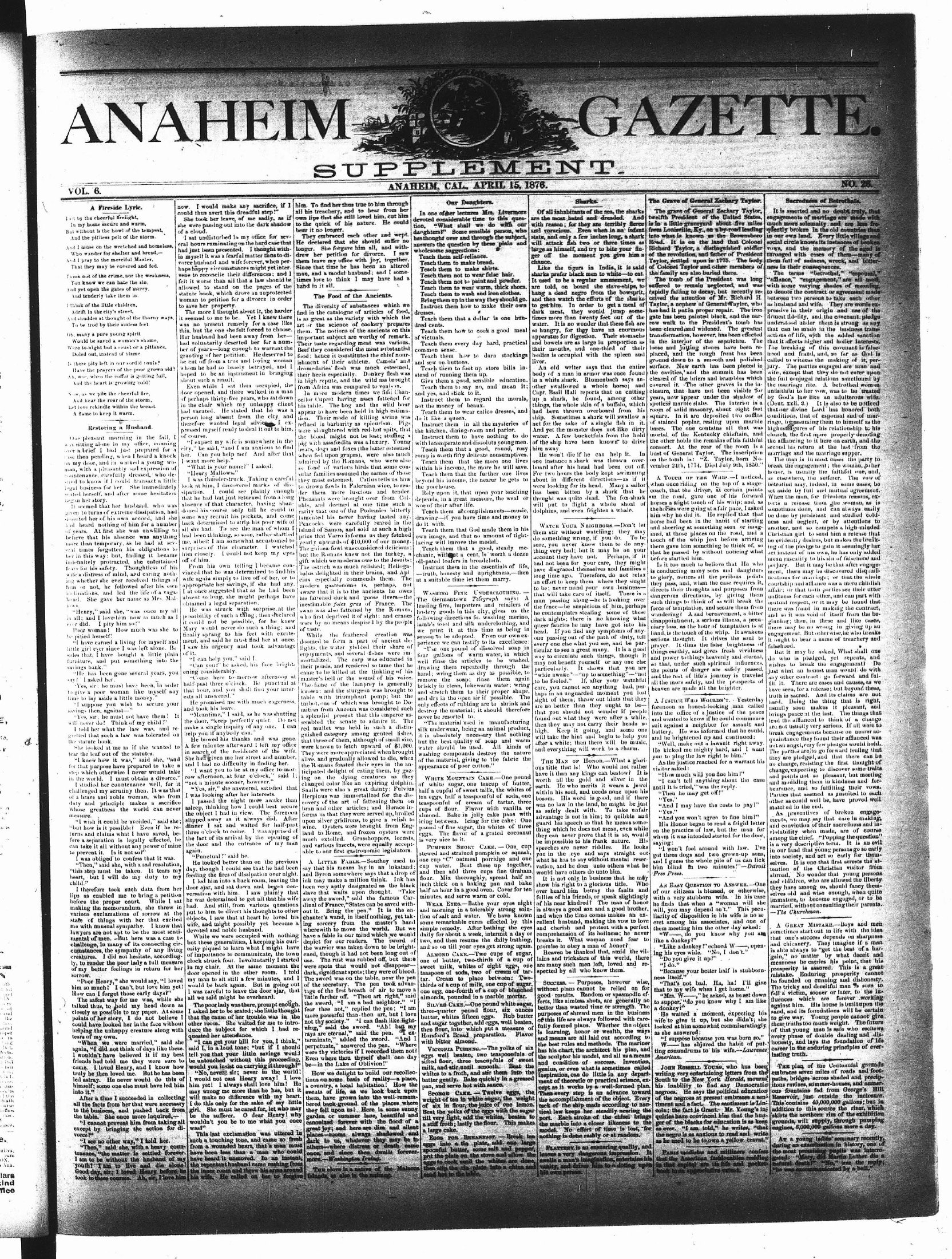
Searchable text
A Fireside Lyric.
I sit by the cheerful firelight,
In my home secure and warm,
But without is the howl of the tempest,
And the pitiless pelt of the storm.
And I muse on the wretched and homeless,
Who wander for shelter and bread,
And I pray to the mereful Master,
That they may be covered and fed.
Think not of the erime, nor the weakness,
You know we can hate the sin,
And yet open the gates of mercy,
And tenderly take them in.
I think of the little children,
Adrift in the city's street,
And shudder at thought of the thorny ways,
To be trod by their sinless feet.
Oh, many a pure young spirit,
Would be saved a woman's shame,
Were to-night but a crust or a pittance,
Doled out, instead of blame.
Is there pity left in our sordid souls?
Have the prayers of the poor grown old?
Ah, woe, when the coffer is getting full,
And the heart is growing cold!
Now, as we pile the cheerful fire,
And hear the roar of the storm,
Let love rekindle within the breast
A flame to keep it warm.
Restoring a Husband.
One pleasant morning in the fall, I was sitting alone in my office, conning over a brief I had just prepared for a case then pending, when I heard a knock on my door, and in walked a young woman with a pleasantly sad expression of now. I would make any sacrifice, if I could thus avert this dreadful step."
She took her leave, of me sadly, as if she were passing out into the dark shadow of a cloud.
I sat undisturbed in my office for several hours ruminating on the hard case that had just been presented. I thought within myself it was a fearful matter thus to divorce husband and wife forever, when perhaps happy circumstances might yet intervene to reconcile their differences; and I felt it worse than all that a law should be allowed to stand on the pages of the statute book, which drove an unprotected woman to petition for a divorce in order to save her property.
The more I thought about it, the harder it seemed to me to be. Yet I knew there was no present remedy for a case like this, but the one she felt forced to choose. Her husband had been away from her—had voluntarily deserted her for a number of years—long enough to warrant the granting of her petition. He deserved to be cut off from a true and loving woman whom he had so basely betrayed, and I hoped to be an instrument in bringing about such a result.
Even while I sat thus occupied, the door opened, and there walked in a man of perhaps thirty-five years, who sat down in the chair which my unhappy client had vacated. He stated that he was a person long absent from the city, and therefore wanted legal advice. I expressed myself ready to deal it out to him, of course.
"I expect my wife is somewhere in the city," he said, "and I am anxious to find her. Can you help me? And after that I want more help."
"What is your name?" I asked.
Restoring a Husband.
One pleasant morning in the fall, I was sitting alone in my office, conning over a brief I had just prepared for a case then pending, when I heard a knock on my door, and in walked a young woman, with a pleasantly sad expression of countenance, carefully dressed, who denied to know if I could transact a little legal business for her. She immediately seated herself, and after some hesitation began her story.
It seemed that her husband, who was given to turns of extreme dissipation, had deserved her of his own accord, and she had heard nothing of him for a number of years. At first she was unwilling to believe that his absence was anything more than temporary, as he had at several times forgotten his obligations to her in this way; but, finding it became indelibly protracted, she entertained fears for his safety. Thoughtless of his wife's distress of mind, and caring nothing whether she ever received tidings of him or not, he followed after his own inclinations, and led the life of a vagabond. She gave her name as Mrs. Malows.
"Henry," said she, "was once my all in all; and I love him now as much as I ever did. I pity him so!" Poor woman! How much was she to be pitied herself!
"I have earned a living for myself and little girl ever since I was left alone. Be sides that, I have bought a little plain furniture, and put something into the savings bank."
"He has been gone several years, you say! I asked her.
"Yes, sir: he must have been, in order to give a poor woman like myself any time to lay aside a little money."
"I suppose you wish to secure your savings then, against—"
"Yes, sir; he must not have them! It will never do! Think of my child!"
I told her what the law was, and regretted that such a law was tolerated on the statute book.
She looked at me as if she wanted to tear the leaf out of the statutes.
"I knew how it was," said she, "and for that purpose have prepared to take a step which otherwise I never would take in the world. I must obtain a divorce."
I studied her countenance well, for it challenged my scrutiny then. It was that of a brave and noble woman, who from duty and principle makes a sacrifice whose greatness the world can never measure.
"I wish it could be avoided," said she; "but how is it possible? Even if he returns and claims what I have saved, before a separation is legally effected, he can take it all without any power of mine to prevent it. Is it not so?"
I was obliged to confess that it was.
Then," said she, with a sad resolution, "this step must be taken. It tears my heart, but I will do my duty to my child."
I therefore took such data from her
Even while I sat thus occupied, the door opened, and there walked in a man of perhaps thirty-five years, who sat down in the chair which my unhappy client had vacated. He stated that he was a person long absent from the city, and therefore wanted legal advice. I expressed myself ready to deal it out to him, of course.
"I expect my wife is somewhere in the city," he said, "and I am anxious to find her. Can you help me? And after that I want more help."
"What is your name?" I asked.
"Henry Mallowa."
I was thunderstruck. Taking a careful look at him, I discovered marks of disgiration. I could see plainly enough that he had but just returned from a long absence of that character, having abandoned his course only till he could in some way recruit his pockets, and come back determined to strip his poor wife of all she had. To see the man of whom I had been thinking, so soon, rather startled me, albeit I am somewhat accustomed to surprises of this character. I watched him closely. I could not keep my eyes off of him.
From his own telling I became convinced that he was determined to find his wife again simply to live off of her, or to appropriate her savings, if she had any. At once suggested that as he had been absent so long, she might perhaps have obtained a legal separation.
He was struck with surprise at the possibility of such a thing; then declared it could not be possible, for he knew Mary would never do such a thing; and finally sprang to his feet with excitement, and said he must find her at once. I saw his urgency and took advantage of it.
"I can help you," said I.
"Can you?" he asked, his face brightening considerably.
"Come here to-morrow afternoon at half-post three o'clock. Be punctual at that hour, and you shall find your interests all answered."
He promised me with much eagerness, and took his leave.
"Meantime," I said, as he was shutting the door, "keep perfectly quiet. Do not make a single inquiry of any one. I can help you if anybody can."
He bowed his thanks and was gone. A few minutes afterward I left my office in search of the residence of the wife. She had given me her street and number, and I had no difficulty in finding her.
"I want you to be at my office to-morrow afternoon, at four o'clock," said I; "not a minute sooner, however."
"Yes, sir," she answered, satisfied that I was looking after her interests.
I passed the night more awake than asleep, thinking how I could best secure the object I had in view. The forenoon slipped away as it always did. After dinner I sat and waited for half-past three o'clock to come. I was apprised of the fact of its arrival by the opening of the door and the entrance of my man again.
"Punctual!" said he.
He looked better than on the previous day, though I could see that he had been feeding the fires of dissipation over night. I led him into a back room, leaving the door ajar, and sat down and began conhoped to be an instrument in bringing about such a result.
Even while I sat thus occupied, the door opened, and there walked in a man of perhaps thirty-five years, who sat down in the chair which my unhappy client had vacated. He stated that he was a person long absent from the city, and therefore wanted legal advice. I expressed myself really to deal it out to him, of course.
"I expect my wife is somewhere in the city," he said, "and I am anxious to find her. Can you help me? And after that I want more help."
"What is your name?" I asked.
"Henry Mallowa."
I was thunderstruck. Taking a careful look at him, I discovered marks of disgression. I could see plainly enough that he had but just returned from a long absence of that character, having abandoned his course only till he could in some way recruit his pockets, and come back determined to strip his poor wife of all she had. To see the man of whom I had been thinking, so soon, rather startled me, albeit I am somewhat accustomed to surprises of this character. I watched him closely. I could not keep my eyes off of him.
From his own telling I became convinced that he was determined to find his wife again simply to live off of her, or to appropriate her savings, if she had any. At once suggested that as he had been absent so long, she might perhaps have obtained a legal separation.
He was struck with surprise at the possibility of such a thing; then declared it could not be possible, for he knew Mary would never do such a thing; and finally sprang to his feet with excitement, and said he must find her at once. I saw his urgency and took advantage of it.
"I can help you," said I.
"Can you?" he asked, his face brightening considerably.
"Come here to-morrow afternoon at half-post three o'clock. Be punctual at that hour, and you shall find your interests all answered."
He promised me with much eagerness, and took his leave.
"Meantime," I said, as he was shutting the door, "keep perfectly quiet. Do not make a single inquiry of any one. I can help you if anybody can."
He bowed his thanks and was gone. A few minutes afterward I left my office in search of the residence of the wife. She had given me her street and number, and I had no difficulty in finding her.
"I want you to be at my office to-morrow afternoon, at four o'clock," said I; "not a minute sooner, however."
"Yes, sir," she answered, satisfied that I was looking after her interests.
I passed the night more awake than asleep, thinking how I could best secure the object I had in view. The forenoon slipped away as it always did. After dinner I sat and waited for half-past three o'clock to come. I was apprised of the fact of its arrival by the opening of the door and the entrance of my man again.
"Punctual!" said he.
He looked better than on the previous day, though I could see that he had been feeding the fires of dissipation over night. I led him into a back room, leaving the door ajar, and sat down and began conhoped to be an instrument in bringing about such a result.
Even while I sat thus occupied, the door opened, and there walked in a man of perhaps thirty-five years, who sat down in the chair which my unhappy client had vacated. He stated that he was a person long absent from the city, and therefore wanted legal advice. I expressed myself really to deal it out to him, of course.
"I expect my wife is somewhere in the city," he said, "and I am anxious to find her. Can you help me? And after that I want more help."
"What is your name?" I asked.
"Henry Mallowa."
I was thunderstruck. Taking a careful look at him, I discovered marks of disgression. I could see plainly enough that he had but just returned from a long absence of that character, having abandoned his course only till he could in some way recruit his pockets, and come back determined to strip his poor wife of all she had. To see the man of whom I had been thinking, so soon, rather startled me, albeit I am somewhat accustomed to surprises of this character. I watched him closely. I could not keep my eyes off of him.
From his own telling I became convinced that he was determined to find his wife again simply to live off of her, or to appropriate her savings, if she had any. At once suggested that as he had been absent so long, she might perhaps have obtained a legal separation.
He was struck with surprise at the possibility of such a thing; then declared it could not be possible, for he knew Mary would never do such a thing; and finally sprang to his feet with excitement, and said he must find her at once. I saw his urgency and took advantage of it.
"I can help you," said I.
"Can you?" he asked, his face brightening considerably.
"Come here to-morrow afternoon at half-post three o'clock. Be punctual at that hour, and you shall find your interests all answered."
He promised me with much eagerness, and took his leave.
"Meantime," I said, as he was shutting the door, "keep perfectly quiet. Do not make a single inquiry of any one. I can help you if anybody can."
He bowed his thanks and was gone. A few minutes afterward I left my office in search of the residence of the wife. She had given me her street and number, and I had no difficulty in finding her.
"I want you to be at my office to-morrow afternoon, at four o'clock," said I; "not a minute sooner, however."
"Yes, sir," she answered, satisfied that I was looking after her interests.
I passed the night more awake than asleep,thinking how I could best secure the object I had in view.The forenoon slipped away as it always did.After dinnerI sat和waitedforhalf-pastthreeo'clocktocome.Iwasapprisedofthefactofitsarrivalbytheopeningofthedoorandtheentranceofmymanagain.
"Punctual!" said he.
He looked better than on the previous day,thoughIcouldseethathehadbeenfeedingthefiresofdissipationovernight.Iledhimintobackroomleavingthedoorajax,andsatdownandconnechedownaboutsucharesult.
Even while I sat thus occupied,the door opened,and there walked in a man of perhaps thirty-five years,who sat down in the chair which my unhappy client had vacated.Here was someone who felt upon grape admired by the Romans so fond of various sular families assume they most esteemed them most esteemed them most esteemed them most esteemed them most esteemed them most esteemed them most esteemed them most esteemed them most esteemed them most esteemed them most esteemed them most esteemed them most esteemed them most esteemed them most esteemed them most esteemed them most esteemed them most esteemed them most esteemed them most esteemed them most esteemed them most esteemed them most esteemed them most esteemed them mostEsteemed them mostEsteemed them mostEsteemed them mostEsteemed them mostEstemed them mostEstemed them mostEstemed them mostEstemed them mostEstemed them mostEstemed them mostEstemed them mostEstemed them mostEstemed them mostEstemed them mostEstemed them mostEstemed them mostEstemed them mostEstemed them mostEstemed them mostEstemed them mostEstemed themmostEstemed themmostEstemedthemmostEstemedthemmostEstemedthemmostEstemedthemmostEstemedthemmostEstemedthemmostEstemedthemmostEstemedthemmostEstemedthemmostEstemedthemmostEstemedthemmostEstemedthemmostEstemedthemmostEstemedthemmostEste medthemmostEste medthemmostEste medthemmost Este medthemmost Este medthemmost Este medthemmost Este medthemmost Este medthemmost Este medthemmost Este medthemmost Este medthemmost Este medthemmost Este medthemmost Este medthemmost Este medthemmost Este medthemmost Este medthemmost Este medthemmost Este medthemmost Este medthemmost Este medthemmost Este medthemmost Este medthemmost Este medthemMost Este medthemmost Este medthemmost Este medthemmost Este medthemmost Este medthemmost Este medthemmost Este medthemmost Este medthemmost Este medthemmost Este medthemmost Este medthemmost Este medthemmost Este medthemmost Este medthemmost Este medthemmost Este medthemmost Este medthemmost Este medthemmost Este medthemmost Este medthemenMost Este medthemenMost Este menMost Este menMost Este menMost Este menMost Este menMost Este menMost Este menMost Este menMost Este menMost Este menMosteste menMosteste menMosteste menMosteste menMosteste menMosteste menMosteste menMosteste menMosteste menMosteste menMosteste menMosteste menMosteste menMosteste menMosteste menMosteste menMosteste menMosteste menMosteste menMosteste menMostesteMen Mosteste Men Mosteste Men Mosteste Men Mosteste Men Mosteste Men Mosteste Men Mosteste Men Mosteste Men Mosteste Men Mosteste Men Mosteste Men Mosteste Men Mosteste Men Mosteste Men Mosteste Men Mosteste Men Mosteste Men Mosteste Men Mosteste Men Mosteste Men Mosteste Men Mosteste Men MoststeMen MoststeMen MoststeMen MoststeMen MoststeMen MoststeMen MoststeMen MoststeMen MoststeMen MoststeMen MoststeMen MoststeMen MoststeMen MoststeMen MoststeMen MoststeMen MoststeMen MoststeMen MoststeMen MoststeMen MoststeMen MoststeMen MoststeMen MoststeMen MoststeMen MoststeMen MoststeMen MoststeMen MoststeMen MoststeMen MoresteMen MoresteMen MoresteMen MoresteMen MoresteMen MoresteMen MoresteMen MoresteMen MoresteMen MoresteMen MoresteMen MoresteMen MoresteMen MoresteMen MoresteMen MoresteMen MoresteMen MoresteMen MoresteMen MoresteMen MoresteMen MoresteMen MoresteMen MoresteMen MoresteemenMore steemenMore steemenMore steemenMore steemenMore steemenMore steemenMore steemenMore steemenMore steemenMore steemenMore steemenMore steemenMore steemenMore steemenMore steemenMore steemenMore steemenMore steemenMore steemenMore steemenMore steemenMore steemenMore steemenMore steemenMore steemenMore steemenMore steemenMore steemenMore steemenMore steemenMore steemenMore steemenMore steemenMorestemenMore steemenMore steemenMore steemenMore steemenMore steemenMore steemenMore steemenMore steemenMore steemenMore steemenMore steemenMore steemanMore steemanMore steemanMore steemanMore steemanMore steemanMore steemanMore steemanMore steemanMore steemanMore steemanMore steemanMore steemanMore steemanMore steemanMore steemanMore steemanMore steemanMore steemanMore sterenMorestemenMorerestemenMorerestemenMorerestemenMorerestemenMorerestemenMorerestemenMorerestemenMorerestemenMorerestemenMorerestemenMorerestemenMorerestemenMorerestemenMorerestemenMorerestemenMorerestemenMorerestemenMorerestemenMorerestemenMorerestemenMorerestemenMorerestemenMorerestemenMorerestemenMorerestemenMorerestemenMorerestemenMorerestemenMorerestemenMorerestemenMorerestemenMorerestemenMorerestemenMorerestemenMorerestemenMorerestemen MorerestemenMorerestemenMorerestemenMorerestemenMorerestemenMoreresteменMoreresτεменMor尔斯τεменMor尔斯τεменMor尔斯τεменMor尔斯τεменMor尔斯τεменMor尔斯τεменMor尔斯τεменMor尔斯τεменMor尔斯τεменMor尔斯τεменMor尔斯τεменMor尔斯τεменMor尔斯τεменMor尔斯τεменMor尔斯τεменMor尔斯τεменMor尔斯τεменMor尔斯τεменMor尔斯τεмен Mor尔斯τεмен Mor尔斯τεмен Mor尔斯τεмен Mor尔斯τεмен Mor尔斯τεмен Mor尔斯τεмен Mor尔斯τεмен Mor尔斯τεмен Mor尔斯τε мен Mor尔斯те мен Mor尔斯те мен Mor尔斯те мен Mor尔斯те мен Mor尔斯те мен Mor尔斯те мен Mor尔斯те мен Mor尔斯те мен Mor尔斯те мен Mor尔斯те мен Mor尔斯те мен Mor尔斯те мен Mor尔斯те мен Mor尔斯те мен Mor尔斯те мен Mor尔斯те мен Mor尔斯те мен Мор尔斯те мен Мор尔斯те мен Мор尔斯те мен Мор尔斯те мен Мор尔斯те мен Мор尔斯те мен Мор尔斯те мен Мор尔斯те мен Мор尔斯те мен Мор尔斯те мен Мор尔斯те мен Мор尔斯те мен Мор尔斯те мен Мор尔斯те мен Мор尔斯те мен Мор尔斯те мен Мор尔斯те мен Мор尔斯те мен Мор罗斯е меньше Мор罗斯е меньше Мор罗斯е меньше Мор罗斯е меньше Мор罗斯е меньше Мор罗斯е меньше Мор罗斯е меньше Мор罗斯е меньше Мор罗斯е менее Мор罗斯е менее Мор罗斯е менее Мор罗斯е менее Мор罗斯е менее Мор罗斯е менее Мор罗斯е менее Мор罗斯е менееМор罗斯е менееМор罗斯е менееМор罗斯е менееМор罗斯е менееМор罗斯е менееМор罗斯е менееМор罗斯е менееМор罗斯е менееМор罗斯е менееМор罗斯е менееМор罗斯е менееМор罗斯е менееМор罗斯е менееМор罗斯е менееМор罗斯е менееМор罗斯е менееМор罗斯е менееМор罗斯е менееМор罗斯е мень.Мог罗斯е меньше.Мог罗斯е smaller.Мог罗斯е smaller.Мог罗斯е smaller.Мог罗斯е smaller.Могronsе smaller.Могronsе smaller.Могronsе smaller.Могronsе smaller.Могronsе smaller.Могronsе smaller.Могronsе smaller.Могronsе smaller.Могronsе smaller.Могronsе smaller.Могrons еsmaller.Могrons еsmaller.Могrons еsmaller.Могrons еsmaller.Могrons еsmaller.Могrons еsmaller.Могrons еsmaller.Могrons еsmaller.Могrons еsmaller.Могrons еsmaller.Могrons еsmaller.Могrons еsmaller.Могrons еsmaller.Могrons еsmaller.Могrons еsmaller.Могrons еsmaller.Могrons еsmaller.Могronsex smaller.Mogronsex smaller.Mogronsex smaller.Mogronsex smaller.Mogronsex smaller.Mogronsex smaller.Mogronsex smaller.Mogronsex smaller.Mogronsex smaller.Mogronsex smaller.Mogronsex smaller.Mogronsex smaller.Mogronsex smaller.Mogronsex smaller.Mogronsex smaller.Mogronsex smaller.Mogronsex smaller.Mogronsex smaller.Mogronsex smaller.Mogronsex smaller.Mogronsex smallest.Mogronsex smallest.Mogronsex smallest.Mogronsex smallest.Mogronsex smallest.Mogronsex smallest.Mogronsex smallest.Mogronsex smallest.Mogronsex smallest.Mogronsex smallest.Mogronsex smallest.Mogronsex smallest.Mogronsex smallest.Mogronsex smallest.Mogronsex smallest.Mogronsex smallest.Mogronsex smallest.Mogronsex smallest.Mogronsex smallest.Mogronsex smallest.Mogronsex smallest.Mogronsex smallest.Mogronsex smallest.Mogronsex smallest.Mogronsex smallest.Mogronsex smallest.Mogronsex smallest.Mogronsex smallest.Mogronsex smallest.Mogronsex smallest.Mogronsex smallest.Mogronsex smallest.Mogronsex smallest.Mogronsex smallest.Mogronsex smallest.Mogronsex smallest.Mogron sex smallest.Mog罗 sex smallest.Мог罗 sex smallest.Мogl罗 sex smallest.Мogl罗 sex smallest.Мogl罗 sex smallest.Мogl罗 sex smallest.Мogl罗 sex smallest.Мogl罗 sex smallest.Мogl罗 sex smallest.Мogl罗 sex smallest.Мogl罗 sex smallest.Мogl罗 sex smallest.Мogl罗 sex smallest.Мogl罗 sex smallest.Мogl罗 sex smallest.Мogl罗 sex smallest.Мogl罗 sex smallest.Мogl罗 sex smallest.Мogl罗 sex smallest.Мogl罗 sex smallest.Мogl罗 sex smallest.Мogl罗 sex smallest.Мogl罗 sex smallest.Мogl罗 sex smallest.$$
A little Fable says that his means and Byron somehow ink may make a miracle evenly applied.
A little Fable says that his means and Byron somehow ink may make a miracle evenly applied.
A little Fable says that his means and Byram somehow ink may make a miracle evenly applied.
A little Fable says that his means and Byram somehow ink may make a miracle evenly applied.
A little Fable says that his means and Byram somehow ink may make a miracle evenly applied.
A little Fable says that his means and Byram somehow ink may make a miracle evenly applied.
A little Fable says that his means and Byram somehow ink may make a miracle evenly applied.
A little Fable says that his means and Byram somehow ink may make a miracle evenly applied.
A little Fable says that his means and Byram somehow ink may make a miracle evenly applied.
A little Fable says that his means and Byram somehow ink may make a miracle evenly applied.
A little Fable says that his means and Byram somehow ink may make a miracle evenly applied.
A little Fable says that his means and Byram somehow ink may make a miracle evenly applied.
A little Fable says that his means and Byram somehow ink may make a miracle evenly applied.
A little Fable says that his means and Byram somehow ink may make a miracle evenly applied.
A little Fable says that his means和Byram somehow ink may make a miracle evenly applied.
A little Fable says that his means和Byram somehow ink may make a miracle evenly applied.
A little Fable says that his means和Byram somehow ink may make a miracle evenly applied.
A little Fable says that his means和Byram somehow ink may make a miracle evenly applied.
A little Fable says that his means和Byram somehow ink may make a miracle evenly applied.
A little Fable says that his means和Byram somehow ink may make a miracle evenly applied.
A little Fable says that his means和Byram somehow ink may make a miracle evenly applied.
A little Fable says that his means和Byram somehow ink may make a miracle evenly applied.
A little Fable says that his means和Byram somehow ink may make a miracle evenly applied.
A little Fable says that his means和Byram somehow ink may make a miracle evenly applied.
A little Fable says that his means和Byram somehow ink may make a miracle evenly applied.
A little Fable says that his means和Byram somehow ink may make a miracle evenly applied.
A little Fable says that his means和Byram somehow ink may make a miracle evenly applied.
A little Fable says that his means和Byram somehow ink may make a miracle evenly applied.
A little Fable says that his means和Byram somehow ink may make a miracle evenly applied.
A little Fable says that his means和Byram somehow ink may make a miracle evenly applied.
A little Fable says that his means和Byram somehow ink may make a miracle evenly applied.
A little Fable says that his means和Byram somehow ink may make a miracle evenly applied.
A little Fable says that his means和Byram somehow ink may make a miracle evenly applied.
A little Fable says that his means和Byram somehow ink may make a miracle evenly applied.
A little Fable says that his means和Byram somehow ink may make a miracle evenly applied.
A little Fable says that his means和Byram somehow ink may make a miracle evenly applied.
A little Fable says that his means和Byram somehow ink may make a miracle evenly applied.
A little Fable says that他的意思是他的意思是他的意思是他的意思是他的意思是他的意思是他的意思是他的意思是他的意思是他的意思是他的意思是他的意思是他的意思是他的意思是他的意思是他的意思是他的意思是他的意思是他的意思是他的意思是他的意思是他的意思是他的意思是他的意思是他的意思是他的意思是他的意思是他的意思是他的意思是他的意思是他的意思是他的意思是他的意思是他的意思
A little Fable says that他的意思是他的意思是他的意思是他的意思是他的意思是他的意思是他的意思是他的意思是他的意思是他的意思是他的意思是他的意思是他的意思是他的意思是他的意思是他的意思是他的意思是他的意思是他的意思是他的意思是他的意思是他的意思是他的意思是他的意思是他的意思是他的意思是他的意思是他的意思是他的意思是他的意思是她的意思是她的意思是她的意思是她的意思是她的意思是她的意思是她的意思是她的意思是她的意思是她的意思是她的意思是她的意思是她的意思是她的意思是她的意思是她的意思是她的意思是她的意思是她的意思是她的意思是她的意思是她的意思是她的意思是她的意思是她的意思是她的意思是她的意思是她的意思是她的意思是她的意思是她的意思是她的意思是她的意思是她的意思是她的意思是她的意思是她的意思是她的意思是她的意思是她的意思是她
A little Fable says that她的意思是她的意思是她的意思是她的意思是她的意思是她的意思是她的意思是她的意思是她的意思是她的意思是她的意思是她的意思是
challenged my scrutiny then. It was that of a brave and noble woman, who from duty and principle makes a sacrifice whose greatness the world can never measure.
"I wish it could be avoided," said she; "but how is it possible? Even if he returns and claims what I have saved, before a separation is legally effected, he can take it all without any power of mine to prevent it. Is it not so?"
I was obliged to confess that it was.
"Then," said she, with a sad resolution, "this step must be taken. It tears my heart, but I will do my duty to my child."
I therefore took such data from her lips as enabled me to bring a petition before the proper court. While I sat making the memorandum, she threw in various exclamations of sorrow at the state of things with her that excited me with unusual sympathy. I know that lawyers are not apt to be the most sentimental of men. But here was a case to challenge, in many of its connecting circumstances, the sympathy of any living creatures. I did not hesitate, accordingly, to render the poor lady a full measure of my better feelings in return for her sorrow.
"Poor Henry," she would say, "I loved him so much! I can't but love him yet! How can I forget those early days?"
The safest way for me was, while she talked thus, to hold my head down as closely as possible to my paper. At some points of her story, I do not believe I could have looked her in the face without helping the unhappy creature along with tears of my own.
"When we were married," said she again, "I did not think of days like these. I wouldn't have believed it if my best friends had told me they were sure to come. I loved Henry, and I know how truly he then loved me. But he has been led astray. He never would do this of himself; some one else must have led him into it."
After a time I succeeded in collecting all the facts from her that were necessary to the business, and pushed back from the table. She once more inquired,
"I cannot prevent him from taking all except by bringing the action for divorce!"
"I see no other way," I told her.
"Then," said she, with a heavy countenance, "the matter is settled forever. I am to be without the husband of my youth! I am to live and die alone! Good day, sir; I laid Henry before he took to these courses. Ah, sir, I love him
I passed the night more awake than asleep, thinking how I could best secure the object I had in view. The foremoon slipped away as it always did. After dinner I sat and waited for half-past three o'clock to come. I was apprised of the fact of its arrival by the opening of the door and the entrance of my man again.
"Punctual!" said he.
He looked better than on the previous day, though I could see that he had been feeding the fires of dissipation over night. I led him into a back room, leaving the door ajar, and sat down and began conversation with him. I saw plainly that he was determined to get all that his wife had. And still, from various questions put to him to divert his thoughts to other objects, I saw that at heart he loved his wife, and might possibly yet become a devoted and noble husband.
While we were occupied with nothing but these generalities, I keeping his curiosity piqued to learn what I might have of importance to communicate, the town clock struck four. Involuntarily I started in my chair. At the same moment the door opened in the other room. I told my man to sit still a few minutes, and I would be back again. But in going out I was careful to leave the door ajar, that all we said might be overheard.
The poor lady was there, prompt enough. I asked her to be seated; she little thought that the cause of her trouble was in the other room. She waited for me to introduce the subject for which I had requested her attendance.
"I can get your bill for you, I think," said I, in a loud tone; "but if I should tell you that your little savings would be untouched without this proceeding, would you insist on carrying it through?"
"No, never sir; never in the world! I would not cast Henry away! I love him yet! I always shall love him! He may wrong me more than he has, but it will make no difference with my heart. I do this only for the sake of my little girl. She must be cared for, let who may be the sufferer. O dear Henry! why wouldn't you be to me what you once was!"
This last exclamation was uttered in such a touching tone, and came so fresh from a wounded heart, that'a man must have been less than a man who could have heard it unmoved. In an instant, the repentant husband came rushing from the inner room and threw his arms around his wife. He called on her to forgive
Shall we were also a boy Herpinus was immature covery of the art of bran and other articles us that they were upon silver gridiron wine. Oysters were land to Rome, and much extolled. O and various insecta able to our first gas
A LITTLE FABLE say that his means and Byron somehow ink make a mih been very aptly des slave that waits u away the sword," said dinal of France,"Stout out it. Bring the chanter's wand, in ing sorcery from wherewith to move have a fable in our depict for our read the warrior was taken ened, though it had use. The rust was were spots that we dark, significant spee The sword was on t of the secretary." tage of the first brew little farther off. "the sword," "I am fear tree not," re more powerful than not thy society." ning," said the rays are eternal," terminate," added perpetuate," answer were thy victories Even where thou t be—in the Lake of
How we delightions on some basis a country, a local events of life, sa them, have grown beread back-ground they fell upon us garden or summer canonized forever great joy; and he places—rooms a dark to us, wha others—where di once, and since more—Washington
IM GAZE
SUPPLEMENT.
ANAHEIM, CAL., APRIL 15, 1876.
If I was if shadow
sevethat withperinterand I be
of the
sected order
burder there like
goose.
neum-att the
need to roman
and I auging
him. To find her thus true to him through all his treachery, and to hear from her own lips that she still loved him, cut him to the quick of his nature. He could bear it no longer.
They embraced each other and wept. He declared that she should suffer no longer. She forgave him all, and withdrew her petition for divorce. I saw them leave my office with joy, together. Since that time he has been an altered man, and a model husband; and I sometimes love to think I may have had a hand in it all.
The Food of the Ancients.
The diversity of substances which we find in the catalogue of articles of food, is as great as the variety with which the art or the science of cookery prepares them. The notions of the ancients on this important subject are worthy of remark. Their taste regarding meat was various. Beef they considered the most substantial food; hence it constituted the chief nourishment of their athlete. Camels' and dromedaries' flesh was much esteemed, their heels especially. Donkey flesh was in high repute, and the wild ass brought from Africa was compared to venison.
In more modern times we find Chancellor Cupret having asses fattened for his table. The hog and the wild boar appear to have been held in high estimation. Their mode of killing swine was refined in barbarity as epicurism. Pigs were slaughtered with red-hot spits, that the blood might not be lost; stuffing a pig with assafeida was a luxury. Young bears, dogs and foxes (the latter esteemed when fed upon grapes), were also much admired by the Romans, who were also so fond of various birds that some con-
Our Daughters.
In one other lectures Mrs. Livermore devoted considerable time to this question, "What shall we do with our daughters?" Some sensible person, who has thought over and through the subject, answers the question by these plain and wholesome suggestions:
Teach them self-reliance.
Teach them to make bread.
Teach them to make shirts.
Teach them not to wear false hair.
Teach them not to paint and powder.
Teach them to wear warm, thick shoes.
Teach them to wash and iron clothes.
Bring them up in the way they should go.
Instruct them how to make their own dresses.
Teach them that a dollar is one hundred cents.
Teach them how to cook a good meal of vietnails.
Teach them every day hard, practical common sense.
Teach them how to darn stockings and sew on buttons.
Teach them to foot up store bills instead of running them up.
Give them a good, sensible education.
Teach them to say no, and mean it; and yes, and stick to it.
Instruct them to regard the morals, not the money of beaux.
Teach them to wear calico dresses, and do it like a queen.
Instruct them in all the mysteries of the kitchen, dining-room and parlor.
Instruct them to have nothing to do with intemperate and dissolute young men.
Teach them that a good, round, rosy romp is worth fifty delicate consumptives.
Teach them that the more one lives within his income, the more he will save.
Sharks.
Of all inhabitants of the sea, the sharks are the most hated and dreaded. And with reason; for they are terribly fierce and voracious. Even when in an infant statis, and only a few inches long, a shark will attack fish two or three times as large as himself, and try to bite your finger off the moment you give him a chance.
Like the tigers in India, it is said sharks prefer black men to white—to eat. It used to be a regular amusement, we are told, on board the slave-ships, to hang a dead negro from the bowsprit, and then watch the efforts of the sharks to get him. In order to get a meal of dark meat, they would jump sometimes more than twenty feet out of the water. It is no wonder that these fish are so hungry, for they have an enormous apparatus for digestion. Their stomachs and bowels are as large in proportion as their months, and one-third of their bodies is occupied with the spleen and liver.
An old writer says that the entire body of a man in armor was once found in a white shark. Blumenbach says another swallowed a whole horse; and Capt. Basil Hall reports that on cutting up a shark, he found, among other things, the whole skin of a buffalo, which had been thrown overboard from his ship. Sometimes a shark will swallow a net for the sake of a single fish in it. And yet the monster does not like dirty water. A few bucketfuls from the hold of the ship have been known to drive him away.
He won't die if he can help it. In one instance a shark was thrown over-board after his head had been cut off.
The Great
The great twelfth H is in a life from Low into what Road. Richard of Colonel the family.
The trough cleared off covered closure, years, no spotless room of square of staining bases. Mortal of the other consort. bust of G on the top vember 20
careful dis-though along aban-baid in come life of som I partled used to catched eyes
con-stand his or to any been have
at the declared knew; and excite once antique
right-hoon at usual at inter-ness, notting do not I can gone, office wife number, other no-mor-aid I;
that be than secure remoon After self-past raised of ing of my man
previous had been night, being the con-
A LITTLE FABLE—Southey used to say that his means lay in an inkstand; and Byron somewhere says that a drop of ink may make a million think. Ink has been very aptly designated as the black heircis especially. Donkey flesh was in high repute, and the wild ass brought from Africa was compared to venison.
In more modern times we find Chancellor Cuprel having asses fattened for his table. The hog and the wild boar appear to have been held in high estimation. Their mode of killing swine was refined in barbarity as epicurism. Pigs were slaughtered with red-hot spits, that the blood might not be lost; stuffing a pig with assafeDITa was a luxury. Young bears, dogs and foxes (the latter esteemed when fed upon grapes), were also much admired by the Romans, who were also so fond of various birds that some consular families assumed the names of those they most esteemed. Catius tells us how to drown fowls in Falernian wine, to render them more luscious and tender. Phæsants were brought over from Colchis, and deemed at one time such a rarity that one of the Ptolemies bitterly lamented his never having tasted any Peacocks were carefully reared in the island of Samos, and sold at such a high price that Värro informs us they fetched yearwards upward of $10,000 of our money. The guinea-fowl was considered delicious; but the Romans knew not the turkey, a gift which we moderns owe to the Jesuita; The ostrich was much rellished; Heliogabalus delighted in their brains, and Apiens especially commends them. The modern gastronomie is, perhaps, not aware that it is to the ancients he owes his fattened duck and goose livers—the instimable foies gras of France. The swan was also fattened by the Romans, who first deprived it of sight; and cranes were by no means despised by the people of taste.
While the feathered creation was doomed to form a part of ancient delights, the water yielded their share of enjoyments, and several fishes were immortalized. The carp was educated in their ponds, and rendered so tame that he came to be killed at the tinkling of his master's bell or the sound of his voice. The fame of the lamprey is generally known; and the sturgeon was brought to table with triumphant pomp; but the turbot, one of which was brought to Dmitian from Ancona was considered such a splendid present that this emperor assembled the senate to admire it. The red mullet was held in such a distinguished category among genteel fishes, that three of them, although of small size, were known to fetch upward of $1,000. They were more appreciated when brought alive, and gradually allowed to die, when the Romans feasted their eyes in the anticipated delight of eating them, by gazing on the dying creatures as they changed color like an expiring dolphin. Snails were also a great dainty; Fulvius Herpinus was immortalized for the discovery of the art of fattening them on bran and other articles; and Horace informs us that they were served up, broiled upon silver gridirons, to give a relish to wine. Oysters were brought from England to Rome, and frozen oysters were much extolled. Grasshoppers, locusts, and various insects, were equally acceptable to our first gastronomic legislators.
WASHING FINE UNDERCLOTHING. —The Germantown Telegraph says: A leading firm, importers and retailers of hosiery goods in this city, gives us the following directions for washing merino lamb's wool and silk underclothing, and we print it at this time as being in season to be adopted. From our own experience we can testify to its excellence: "Use one pound of dissolved soap in four gallons of warm water, in which well rinse the articles to be washed, drawing them repeatedly through the hand; wring them as dry as possible, to remove the soap; rinse them again briskly in clean, lukewarm water; wring and stretch them to their proper shape, and dry in the open air if possible. The only effects of rubbing are to shrink and destroy the material; it should therefore never be resorted to."
"The material used in manufacturing silk underwear, being an animal product, it is absolutely necessary that nothing but the best quality of soap and warm water should be used. All kinds of washing compounds destroy the nature of the material, giving to the fabric the appearance of poor cotton."
WHITE MOUNTAIN CAKE. —One pound of white sugar, one teacup of butter, half a cupful of sweet milk, the whites of ten eggs, half a teaspoonful of cream of tartar, three cups of flour. Flavor with vanilla or almond. Bake in jelly cake pans with icing between. Icing for the cake: One pound of fine sugar, the whites of three eggs. The flavor of a grated cocoanut is very nice to it.
PUMPKIN SHORT CAKE. —One cup stewed and strained pumpkin or squash, one cup "C" oatmeal porridge and one cup water. Beat these up together, and then add three cups fine Graham flour. Mix thoroughly, spread half an inch thick on a baking pan and bake half an hour in a good oven. Carry for ten body of a man in armor was once found in a white shark. Blumenbach says another swallowed a whole horse; and Capt. Basil Hall reports that on cutting up a shark, he found, among other things, the whole skin of a buffalo, which had been thrown overboard from his ship. Sometimes a shark will swallow a net for the sake of a single fish in it. And yet the monster does not like dirty water. A few bucketfuls from the hold of the ship have been known to drive him away.
He won't die if he can help it. In one instance a shark was thrown overboard after his head had been cut off. For two hours the body kept swimming about in different directions—as if it were looking for its head. Many a sailor has been bitten by a shark that he thought was quite dead. The fox-shark will put to flight a whole shoal of dolphins, and even frighten a whale.
WATCH YOUR NEIGHBORS. —Don't let them stir without watching; they may do something wrong; if you do. To be sure, you never knew them to do anything very bad; but it may be on your account they have not. Perhaps, if it had not been for your care, they might have disgraced themselves and families a long time ago. Therefore, do not relax an effort to keep them where ought to be; never mind your own business—that will take care of itself. There is a man passing along—be is looking over the fence—be suspicious of him, perhaps he contemplates stealing some of these dark nights; there is no knowing what queer fancies he may have got into his head. If you find any symptoms of anyone passing out of the path of duty, tell every one else what you see, and be particular to see a great many. It is a good way to circulate such things, though it may not benefit yourself or any one else particularly. It shows that you are "wide awake"—"up to something"—"not to be fooled." If, after your watchful care, you cannot see anything bad, perhaps in an unguarded moment you lost sight of them; throw out hints that they are no better than they ought to be—that you should not wonder if people found out what they were after a while, then they may not carry their heads so high. Keep it going, and some one will take the hint and begin to help you after a while; then there will be music, and everything will work to a charm.
THE MAN OP HONOR. —What a glorious title that is! Who would not rather have it than any kings can bestow? It is worth all the gold and silver in the earth. He who merits it wears a jewel within his soul, and needs none upon his bosom. His word is good, and if there was no law in the land, he might be just as safely dealt with. To take unfair advantage is not in him; to quibble and guard his speech so that he means something which he does not mean, even while they can never prove that it is so, would be impossible to his frank nature. His speeches are never riddles. He looks you in the eye and says straight out what he has to say without mental reservation, and he does unto others what he would have others do unto him.
It is not only in business that he may show his right to a glorious title. Who
A LITTLE FABLE.—Southey used to say that his means lay in an inkstand; and Byron somewhere says that a drop of ink may make a million think. Ink has been very aptly designated as the black slave that waits upon thought. "Take away the sword," said the famous Cardinal of France, "States can be saved without it. Bring the pen." It is the enchanter's wand, in itself nothing, yet taking sorcery from the master's hand wherewith to move the world. But we have a fable in our mind which we would depict for our readers. The sword of the warrior was taken down to be brightened, though it had not been long out of use. The rust was rubbed off, but there were spots that would not disappear—dark, significant spots; they were of blood. The sword was on the table, near the pen of the secretary. The pen took advantage of the first breath of air to move a little farther off. "Thou art right," said the sword, "I am a bad neighbor." "I fear thee not," replied the pen; "I am more powerful than thou art, but I love not thy society." "I can flash like lightning," said the sword. "Ah! but my rays are eternal," said the pen. "I terminate," added the sword. "And I perpetuate," answered the pen. "Where were thy victories if I recorded them not! Even where thou thyself shall one day be—in the Lake of Oblivion."
How we delight to build our recollections on some basis of reality—a place, a country, a local habitation! How the events of life, as we look back upon them, have grown into the well-remembered back-ground of the places where they fell upon us! Here is some sunny garden or summer lane, beautiful and canonized forever with the flood of a great joy; and here are dim and silent places—moons always shadowed and dark to us, whatever they may be to others—where distress or death came once, and since then dwells forevermore.
Washington Irving.
The clove is a native of the Malacca Islands, as also in the nutmeg.
PUMPKIN SHORT CAKE.—One cup stewed and strained pumpkin or squash, one cup "C" oatmeal porridge and one cup water. Beat these up together, and then add three cups fine Graham flour. Mix thoroughly, spread half an inch thick on a baking pan and bake half an hour in a good oven. Cover for ten minutes, and serve warm or cold.
WEAK EYES.—Bathe your eyes night and morning in a tolerably strong solution of salt and water. We have known some remarkable cures effected by this simple remedy. After bathing the eyes daily for about a week, intermit a day or two, and then resume the daily bathing, and so on till your eyes get strong again.
ALMOND CAKE.—Two cups of sugar, one of butter, two-thirds of a cup of sweet milk, whites of eight eggs, one teaspoon of soda, two of cream of tartar. Cream to place between: Two-thirds of a cup of milk, one cup of sugar, one egg, one-fourth of a cup of blanched almonds, pounded in a marble mortar.
SILVER CAKE.—One pound white sugar, three-quarter pound flour, six ounces butter, whites fifteen eggs. Rub butter and sugar together, add eggs, well beaten, then flour, into which put a measure of Horsford's Bread preparation. Flavor with bitter almond.
VICTORIA PUDDING.—The yolks of six eggs well heaten, two teaspoonsfuls of sifted flour, three teacupfuls of sweet milk, and stir until smooth. Beat the whites to a froth, and stir them into the batter gently. Bake quickly in a greased pan, and serve hot with sauce.
SPONGE CAKE.—Twelve eggs, the weight of ten in white sugar, the weight of six in flour, the juices of one lemon. Beat the yolks of the eggs with the sugar till very light, add the whites, heaten to a stiff froth; lastly the flour. This makes a large cake.
EGGS FOR BREAKFAST.—Break ten eggs into a tin plate, add one large spoonful butter, some salt and pepper, put the plate on the store and allow the eggs to cook until the whites are done, then slip the tin plate into a china and send hot to the table.
PLATTERY is an omnipresent quality, and leaves a very dangerous impression. It smells a man's imagination; materializes his vanity; and drives him to dating upon his own persons.
AS EVER OF our own with a he finds will you liarity with cret and them m
like a o
Lik ing his
Do
I do
Bece ness it
That t o
Mrs to suppl e a donk
He w wife to look as she
I su
W i ting co America
JOHN writi ng South his negroo f o f the t iment coln; quirksa ges of as ever the neq ro as he w
GAZETTE.
NO. 26.
The sea, the sharks and dreaded. And the terribly fierce men in an infant chasers long, a shark or three times as to bite your fin if you give him a India, it is said to white—to eat amusement, we the slave-ships, to from the bowsprit, parts of the sharks to get a meal of solid jump some-feet out of the that these fish are have an enormous their stomachs in proportion as the third of their spleen and that the entire war was once found menbach says anwhole horse; and that on cutting aid, among other of a buffalo, which board from his mark will swallow a single fish in it. Does not like dirty oils from the hold known to drive can help it. In wars thrown over- and been cut off on the sea is: "Z. Taylor, born November 24th, 1774. Died July 9th, 1850."
The Grave of General Zachary Taylor.
The grave of General Zachary Taylor, twelfth President of the United States, is in a little graveyard about five miles from Louisville, Ky., on a by-road leading into what is known as the Brownsboro Road. It is on the land that Colonel Richard Taylor, a distinguished soldier of the revolution, and father of President Taylor, settled upon in 1775. The body of Colonel Taylor and other members of the family are also buried there.
The tomb of the President was long suffered to remain neglected, and was rapidly falling to decay, but recently received the attention of Mr. Richard H. Taylor, a nephew of General Taylor, who has had it put in proper repair. The iron gate has been painted black, and the narrow walk to the President's tomb has been cleared and widened. The greatest transformation, however, has been effected in the interior of the sepulchre. The loose and jugging stones have been replaced, and the rough front has been ground down to a smooth and polished surface. New earth has been placed in the cavities, and the summit has been cleared of the briers and brambles which covered it. The other graves in the closure, that have not been visible for years, now appear under the shadow of spotless marble slabs. The interior is a room of solid masonry, about eight feet square. In it are deposited two coffins of stained poplar, resting upon marble bases. The one contains all that was mortal of the Kentucky chieftain, and the other holds the remains of his faithful consort. At the rear of the room is a bust of General Taylor. The inscription on the tomb is: "Z. Taylor, born November 24th, 1774. Died July 9th, 1850."
Sacredness of Betrothal.
It is asserted and no doubt truly, that engagements of marriage are made with much more solemnity and are less frequently broken In the old countries than in our own land. Every little village and social circle knows its instances of broken vows, and the memory of the aged is thronged with cases of them—many of them full of sadness, wreck, and bitterness in their consequences.
The terms "betrothed," "espousal," "affiance," "engagement," are all used with some varying shades of meaning, to denote the contract or agreement made between two persons to take each other as husband and wife. They are words expressive in their origin and use of the firmest tidality, and the covenant pledge understood under them is strong as any that can be made in the business transactions of life, with the added sanction that it affects higher and hollier interests.
The breaking of this covenant is falsehood and fraud, and so far as God is called to witness the making of it, per-jury. The parties engaged are man and wife, except that they do not enter upon the full conjugal relations sanctioned by the marriage rite. A betrothed woman unfaithful to her vow, was to be treated by God's law like an adulterous wife. (Deut. xxii. 3.) It is also to be noticed that our divine Lord has honored both conditions, that of espousal and of marriage, by assuming them to himself as the highest guards of his relationship to his church, the first more properly denoting the alliancing to it here on earth, and the second his return at the last from the marriage and the marriage supper.
The man is in most cases the party to break the engagement; the woman, to her
In was once found mennonch say anthole horse; and is that on cutting among other of a buffalo, which board from his will swallow a single fish in it. Does not like dirty holds from the hold known to drive can help it. In was thrown over and been cut off. My kept swimming directions—as if it had. Many a sailor a shark that he find. The fox-shark whole shoal of whiten a whale.
MORONS.—Don't let touching; they may you do. To be them to do any may be on your own business—itself. There is a life looking over us of him, perhaps some of these no knowing what have got into his symptoms of any path of duty, tell see, and be paranay. It is a good things, though it self or any one else sees that you are something"—"not ever your watchful anything bad, periment you lost about hints that they may ought to be wonder if people were after a while, their heads so big, and some one begin to help you here will be music, work to a charm.
OROR.—What a gloriou would not rather can bestow? It is and silver in the it wears a jewel needs none upon his good, and if there he might be just To take unfair; to quibble and that he means some not mean, even while that it is so, would bank nature. His oddles. He looks says straight out without mental reseranto others what he unto him.
BOROR.—What a gloriou would not rather can bestow? It is and silver in the it wears a jewel needs none upon his good, and if there he might be just To take unfair; to quibble and that he means some not mean, even while that it is so, would bank nature. His oddles. He looks says straight out without mental reseranto others what he unto him.
MORONS.—Don't let touching; they may you do. To be them to do any may be on your own business—itself. There is a life looking over us of him, perhaps some of these no knowing what have got into his symptoms of any path of duty, tell see, and be paranay. It is a good things, though it self or any one else sees that you are something"—"not ever your watchful anything bad, periment you lost about hints that they may ought to be wonder if people were after a while, their heads so big, and some one begin to help you here will be music, work to a charm.
OROR.—What a gloriou would not rather can bestow? It is and silver in the it wears a jewel needs none upon his good, and if there he might be just To take unfair; to quibble and that he means some not mean, even while that it is so, would bank nature. His oddles. He looks says straight out without mental reseranto others what he unto him.
MORONS.—Don't let touching; they may you do. To be them to do any may be on your own business—itself. There is a life looking over us of him, perhaps some of these no knowing what have got into his symptoms of any path of duty, tell see, and be paranay. It is a good things, though it self or any one else sees that you are something"—"not ever your watchful anything bad, periment you lost about hints that they may ought to be wonder if people were after a while, their heads so big, and some one begin to help you here will be music, work to a charm.
OROR.—What a gloriou would not rather can bestow? It is and silver in the it wears a jewel needs none upon his good, and if there he might be just To take unfair; to quibble and that he means some not mean, even while that it is so, would bank nature. His oddles. He looks says straight out without mental reseranto others what he unto him.
MORONS.—Don't let touching; they may you do. To be them to do any may be on your own business—itself. There is a life looking over us of him, perhaps some of these no knowing what have got into his symptoms of any path of duty, tell see, and be paranay. It is a good things, though it self or any one else sees that you are something"—"not ever your watchful anything bad, periment you lost about hints that they may ought to be wonder if people were after a while, their heads so big, and some one begin to help you here will be music, work to a charm.
OROR.—What a gloriou would not rather can bestow? It is and silver in the it wears a jewel needs none upon his good, and if there he might be just To take unfair; to quibble and that he means some not mean, even while that it is so, would bank nature. His oddles. He looks says straight out without mental reseranto others what he unto him.
MORONS.—Don't let touching; they may you do. To be them to do any may be on your own business—itself. There is a life looking over us of him, perhaps some of these no knowing what have got into his symptoms of any path of duty, tell see, and be paranay. It is a good things, though it self or any one else sees that you are something"—"not ever your watchful anything bad, periment you lost about hints that they may ought to be wonder if people were after a while, their heads so big, and some one begin to help you here will be music, work to a charm.
OROR.—What a gloriou would not rather can bestow? It is and silver in the it wears a jewel needs none upon his good, and if there he might be just To take unfair; to quibble and that he means some not mean, even while that it is so, would bank nature. His oddles. He looks says straight out without mental reseranto others what he unto him.
MORONS.—Don't let touching; they may you do. To be them to do any may be on your own business—itself. There is a life looking over us of him, perhaps some of these no knowing what have got into his symptoms of any path of duty, tell see, and be paranay. It is a good things, though it self or any one else sees that you are something"—"not ever your watchful anything bad, periment you lost about hints that they may ought to be wonder if people were after a while, their heads so big, and some one begin to help you here will be music, work to a charm.
OROR.—What a gloriou would not rather can bestow? It is and silver in the它 wears a jewel needs none upon his good, and if there he might be just To take unfair; to quibble and that he means some not mean, even while that it is so, would bank nature. His oddles. He looks says straight out without mental reseranto others what he unto him.
MORONS.—Don't let touching; they may您 do. To be them to do any may be on your own business—itself. There is a life looking over us of him, perhaps some of these no knowing what have got into his symptoms of any path of duty, tell see, and be paranay. It is a good things, though it self or any one else sees that you are something"—"not ever your watchful anything bad, periment you lost about hints that they may ought to be wonder if people were after a while, their heads so big, and some one begin to help you here will be music, work to a charm.
OROR.—What a gloriou would not rather can bestow? It is and silver in the它 we weara jewel needs none upon his good, and if there he might be just To take unfair; to quibble and that he means some not mean, even while that it is so, would bank nature. His oddles. He looks says straight out without mental reseranto others what he unto him.
MORONS.—Don't let touching; they may您 do. To be them to do any may be on your own business—itself. There is a life looking over us of him, perhaps some of these no knowing what have got into his symptoms of any path of duty, tell see, and be paranay. It is a good things, though it self or any one else sees that you are something"—"not ever your watchful anything bad, periment you lost about hints that they may ought to be wonder if people were after a while, their heads so big, and some one begin to help you here will be music, work to a charm.
OROR.—What a gloriou would not rather can bestow? It is and silver in the它 we weara jewel needs none upon his good, and if there he might be just To take unfair; to quibble and that he means some not mean, even while that it is so, would bank nature. His oddles. He looks says straight out without mental reseranto others what he unto him.
MORONS.—Don't let touching; they may您 do. To be them to do any may be on your own business—itself. There is a life looking over us of him, perhaps some of these no knowing what have got into his symptoms of any path of duty, tell see, and be paranay. It is a good things, though it self or any one else sees that you are something"—"not ever your watchful anything bad, periment you lost about hints that they may ought to be wonder if people were after a while, their heads so big, and some one begin to help you here will be music, work to a charm.
OROR.—What a gloriou would not rather can bestow? It is and silver in the它 we weara jewel needs none upon his good, and if there he might be just To take unfair; to quibble and that he means some not mean, even while that it is so, would bank nature. His oddles. He looks says straight out without mental reseranto others what he unto him.
MORONS.—Don't let touching; they may您 do. To be them to do any may be on your own business—itself. There is a life looking over us of him,perhaps some of these no knowing what have got into his symptoms of any path of duty,tell see,and be paranay. It is a good things,though it self or any one else sees that you are something"—"not ever your watchful anything bad,periment you lost about hints that they may ought to be wonder if people were after a while,their heads so big,and some one begin to help you here will be music,work to a charm.
OROR.—What a gloriou would not rather can bestow? It is and silver in the它 we weara jewel needs none upon his good,and if there he might be just To take unfair;to quibble and that he means some not mean,even while that it is so,would bank nature.His oddles.He looks says straight out without mental reseranto others what he unto him.
MORONS.—Don't let touching; they may您 do. To be them to do any may be on your own business—itself. There is a life looking over us of him,perhaps some of these no knowing what have got into his symptoms of any path of duty,tell see,and be paranay.His oddles.He looks says straight out without mental reseranto others what he unto him.
MORONS.—Don't let touching; they may您 do. To be them to do any may be on your own business—itself. There is a life looking over us of him,perhaps some of these no knowing what have got into his symptoms of any path of duty,tell see,and be paranay.His oddles.He looks says straight out without mental reseranto others what he unto him.
MORONS.—Don't let touching; they may您 do. To be them to do any may be on your own business—itself. There is a life looking over us of him,perhaps some of these no knowing what have got into his symptoms of any path of duty,tell see,and be paranay.His oddles.He looks says straight out without mental reseranto others what he unto him.
MORONS.—Don't let touching; they may您 do. To be them to do any may be on your own business—itself. There is a life looking over us of him,perhaps some of these no knowing what have got into his symptoms of any path of duty,tell see,and be paranay.His oddles.He looks says straight out without mental reseranto others what he unto him.
MORONS.—Don't let touching; they may您 do. To be them to do any may be on your own business—itself. There is a life looking over us of him,perhaps some of these no knowing what have got into his symptoms of any path of duty,tell see,and be paranay.His oddles.He looks says straight out without mental reseranto others what he unto him.
MORONS.—Don't let touching; they may您 do.Tobe them to do any may be on your own business—itself.The man is in most cases the party to break the engagement; the woman,gatheror.is usually the faithful one,and.as elsewhere,the sufferer.The vow.of betrothedmay indeed.in some cases;be set aside by full and mutual agreement.The man.for frivolous reasons.exportsa release from the woman.asis sometimes done,and can always easilybe done by persistent and studied coldnessand neglect.or by attentions.to another,and so compelsa high-mindedChristian girlto sendhima releasethathe evidently desires,bbut makesthe breakingofthepledgeto gainit seeminglyheract insteadofhisown,hes onlyaddedmeanrascacitytohissinoffalsehoodandperjury.Butitmaybethatafterengagement,themaybediscovereddisqualificationsformarriage;orthatthewholecourtshipandalliancewasamerechildishaffair;orthatbothpartiessee theirutterunfitnessforeachother,andcanpartwithmutualrespect,或itmaybefoundthattherewasfoundinmakingthecontract,andsoitwasvoidofitselffromthebeginning;then.intheseandlikecases,themaybenowrongingivingupanengagement.Butotherwise,thewhobreakitoughtbearanameoftreacheryandfalsehood.
Butitmaybeasked What shall onedo whois pledged,yet repents,andwishestobreaktheengagement!Dojustwhatan honestmanwoulddowithanyothercontract:goforwardandfullfillitTherearecasesandcauses.aswehaveseen,forsale;but beyondthese,trothisis sacred.And itsclaimsarenothard.Doiningthethingthatisright.usually soon makesitpleasant,andbringpeaceatlast.ThethingthatleadthealliancedtothinkofachangearenotusuallyveryseriousIfallweretobreakengagementsbecauseonnearacquaintancetheyfoundtheiallancedwasnotanangel,very fewpledgeswouldhold.Thepartiesaretogoforwardfeelingthattheyarepledged,andthattherecanbenochange.resistingthefirst thoughtofchange.expectingto discoversometrailsandpointsnotso pleasant,但meetingandmouldingtheinkindnessandforeasure,andsofillingthevows.Partiesthat seemedaspuittedtoeachotherascouldwellbe,haveprovedwellmatchedintheend.
Aspreventivesofbrokenengagements,themay saythatcareinmaking,andconvictionofthesacreduousandviolabilitywhenmade,aofcourseamongthechief."Poppingthequestion"isaverydescriptiveterm.itIsanevilinourlandthatyoungpersonsgosoearlyintosociety,andactsoearlyforthemselvesItisonethatfirstarreststheattentionoftheChristianvisitorfromabroad.No wonderthatyoungpersonsandchildren,theareallowedthelibertytheyhaveamongus,houldfancythem
"Then he may get off!"
"Yes."
"And I may have the costs to pay?"
"Yes."
"And you won't agree to fine him?"
His Honor began to read a frigid letter on the practice of law, but the man for whom it was intended started for the door, saying:
"I won't fool around with law. I've got three dogs and two grown-up sons, and I guess the whole pile of us can lick him blind in two minutes." — Detroit Free Press.
An Easy Question to Answer.—One of our citizens is blessed, or otherwise, with a very stubborn wife. In his case he finds that when a "woman will she will, you may depend on't." This peculiarity of disposition in his wife is no secret among his associates, and one of them meeting him the other day asked:
"W——, do you know why you am like a donkey?"
"Like a donkey!" echoed W——, opening his eyes wide. "No, I don't."
"Do you give it up?"
"I do."
"Because your better half is stubbornness itself."
That's not bad. Ha, ha! I'll give that to my wife when I get home."
Mrs. W——," he asked, as he sat down to supper; "do you know why I am like a donkey?"
He waited a moment, expecting his wife to give it up, but she didn't; she looked at him somewhat commiseratingly as she answered:
"I suppose because you was born so."
W—— has abjured the habit of putting conundrums to his wife. — Lawrence American.
John Russell Young, who has been writing very entertaining letters from the South to the New York Herald, mourns his inability to find any Democratic negroes. He says the political education of the negroes at present embraces a sentiment and a fact. The sentiment is Lincoln; the fact is Grant. Mr. Young's quilies have convinced him that the hunger of the blacks for education is as keen as ever. "I am told," he writes, "that the negro is as anxious to read and write as he used to be to own a yellow cravat."
Paris modifies and millions confess that the American fashionables residing in that capital are its life and pocket-book to an apprehensive extent.
As preventives of broken engagements, we may say that care in making and conviction of their sacredness and inviolability when made, are of course among the chief. "Popping the question" is a very descriptive term. It is an evil in our land that young persons go so early into society, and act so early for themselves. It is one that first arrests the attention of the Christian visitor from abroad. No wonder that young persons and children, who are allowed the liberty they have among us, should fancy themselves old and wise enough, when quite immature, to become engaged, or to be married, without consulting their parents. — The Churchman.
A Great Mistake.—Boys and men sometimes start out in life with the idea that one's success depends on sharpness and chicanery. They imagine if a man is able always to "get the beat of a bargain," no matter by what deceit and meanness he carries his point, that his prosperity is assured. This is a great mistake. Enduring prosperity cannot be founded on cunning and dishonesty. The tricky and deceitful man is sure to fall a victim, sooner or later, to the influences which are forever working against him. His house is built upon the sand, and its foundations will be certain to give way. Young people cannot give these truths too much weight. The future of that young man is safe who eschews every phase of double dealing and dishonesty, and lays the foundation of his career in the enduring principles of everlasting truth.
The plan of the Centennial grounds embraces seven miles of roads and footpaths, bridges across shaded and precipitous ravines, summer-houses, and numerous fountains fed from George's Hill Reservoir, just outside the enclosure. This contains 40,000,000 gallons; but in addition to this source the river, which skirts the northern rim of the exhibition grounds, will supply, through pumping engines, 6,000,000 gallons more a day.
At a young ladies' seminary recently during an examination in history, one of the most promising pupils was interrogated: "Mary, did Martin Luther die a natural death?" "No," was the reply; "he was recommended by a ball."