anaheim-gazette 1876-04-08
Scanned page
Searchable text
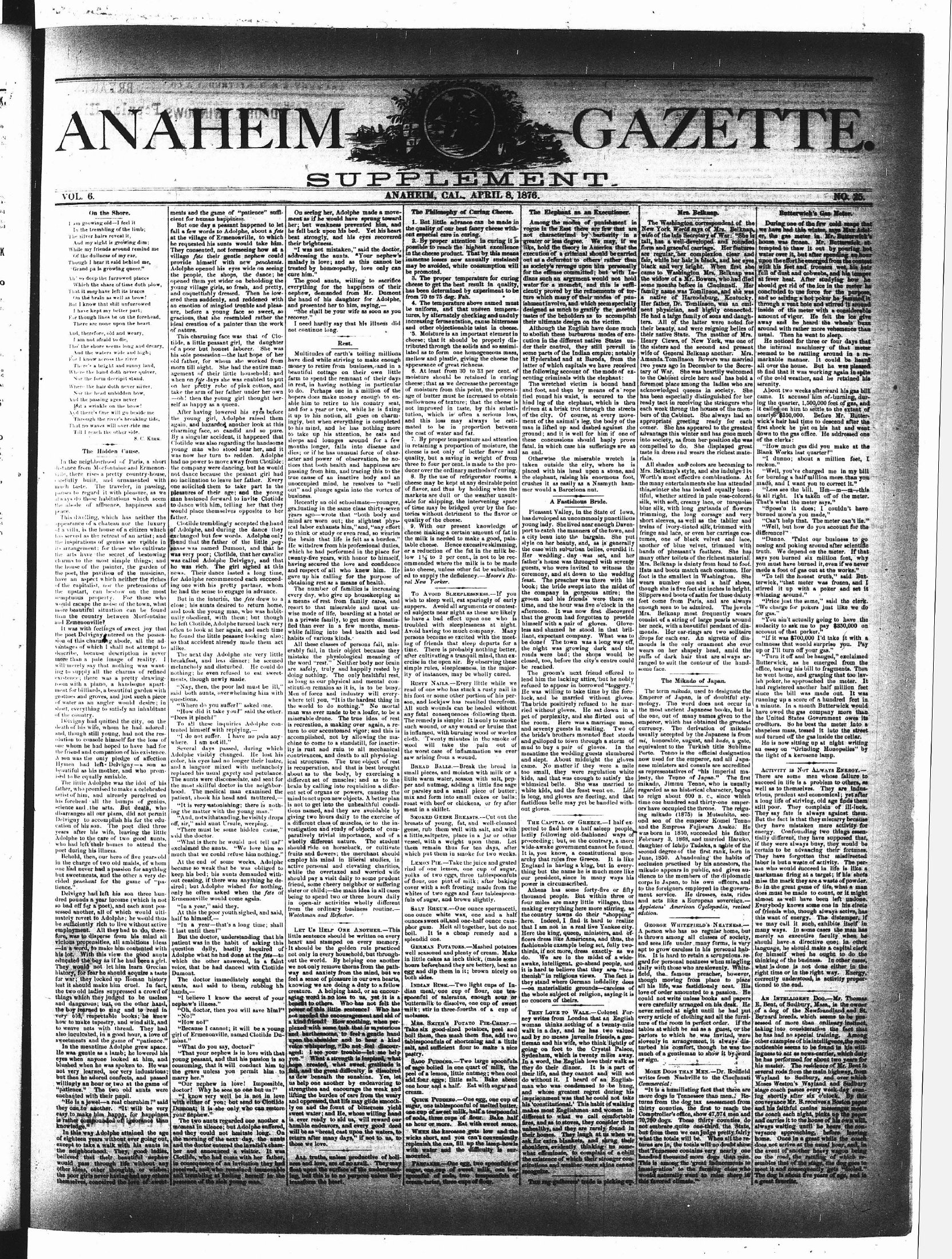
ANAHEIM
VOL. 6.
On the Shore.
I am growing old—I feel it
In the trembling of the limb;
The silver hairs reveal it,
And my sight is growing dim;
While my friends around remind me
Of the dullness of my ear,
Though I hear it said behind me,
Grandpa is growing queer."
Ah! so deep the furrowed places
Which the share of time doth plow,
That it may have left its traces
On the brain as well as brow!
But I know that still unfurrowed
I have kept my better part;
For though lines be on the forehead,
There are none upon the heart.
And, therefore, old and weary,
I am not afraid to die,
The shore seems long and dreary,
And the waters wide and high;
For I know across the river
There's a bright and sunny land,
Where the hand doth never quiver,
Nor the form decripit stand.
Where the hair doth never silver,
Nor the head unbidden bow,
And the passing ages never
Put a wrinkle on the brow!
And there's One will go beside me
Through the river's breaking tide,
That no waves will over ride me
Till I reach the other side.
8. C. Kirk.
The Hidden Cause.
In the neighborhood of Paris, a short distance from Morfontaine and Ermenon-meats and the game of "patience" sufficient for human happiness.
But one day a peasant happened to let fall a few words to Adolphe, about a fete at the village of Ermenoaville, to which he requested his aunts would take him. They consented, not foreseeing how at a village fete their gentle nephew could provide himself with new penchants. Adolphe opened his eyes wide on seeing the people, the shops, the dance; he opened them yet wider on beholding the young village girls, so fresh, and pretty, and coquettishly dressed. Then he lowered them suddenly, and reddened with an emotion of mingled trouble and pleasure, before a young face so sweet, so gracious, that she resembled rather the ideal creation of a painter than the work of nature.
This charming face was that of Clotilde, a little peasant girl, the daughter of a poor but honest laborer. She was his sole possession—the last hope of her old father, for whom she worked from morn till night. She had the entire management of their little household; and when on fete days she was enabled to put on her pretty robe of pink cotton, and take the arm of her father under her own—oh! then the young girl thought herself as happy as a queen.
After having lowered his eyes before the young girl, Adolphe raised them again, and hazarded another look at this charming face, so candid and so pure. By a singular accident, it happened that Clotilde was also regarding the handsome young man who stood near her, and it was now her turn to redden. Adolphe had no power to move away from Clotilde; the company were dancing, but he would
On seeing her, Adolph ment as if he would have her; but weakness prevailed he fell back upon his bed beat strongly, and his their brightness.
"I was not mistaken," addressing the aunts, malady is love; and as treated by homoeopathy cure him."
The good aunts, will everything for the hapless nephew, demanded from the hand of his daughter and presented her to him "She shall be your wife recover."
I need hardly say that not continue long.
Rest.
Multitudes of earth's have died while striving money to retire from bus beautiful cottage on farm to spend the remnants in rest, in having nothing to do. Perhaps one in hopers does make money able him to retire to hi and for a year or two, w it up to his notion, all ingly, but when everythi to his mind, and he has to take up his attention sleeps and lounges are months longer, falls in dies; or if he has unusual acter and power of obsices that both health an
The Hidden Cause.
In the neighborhood of Paris, a short distance from Morfontaine and Ermenonville, there rises a pretty country-house, carefully built, and ornamented with much taste. The traveler, in passing, pauses to regard it with pleasure, as we always do those habitations which seem the abode of allluence, happiness and peace.
This dwelling, which has neither the appearance of a chateau nor the luxury of a villa, is the house of a citizen which has served as the retreat of an artist; and the inspirations of genius are visible in its arrangement; for those who cultivate the arts have the secret of bestowing charms to the most simple things; and the house of the painter, the garden of the poet, the pavilion of the musician, have an aspect which neither the riches of the capitalist, nor the pretensions of the upstart, can bestow on the most semptuous property. For those who would escape the noise of the town, what more beautiful situation can be found than the country between Morfontaine and Ermenonville?
It was with feelings of sweet joy that the poet Delvigny entered on the possession of this charming abode, all the advantages of which I shall not attempt to describe, because description is never more than a pale image of reality. I will merely say that nothing was wanting to supply all the charms of refined existence; there was a pretty drawing-room with a piano, a handsome apartment for billiards, a beautiful garden with grottos and groves, and just such a piece of water as an angler would desire; in short, everything to satisfy an inhabitant of the country.
Delvigny had quitted the city, on the death of his wife, whom he had adored; and though still young, had not the resolution to console himself for the loss of one whom he had hoped to have had for the friend and companion of his existence. A son was the only pledge of affection Hymen had left Delvigny—a son as beautiful as his mother, and who promised to be equally amiable.
The little Adolphe was the idol of his father, who promised to make a celebrated artist of him, and already perceived on his forehead all the bumps of genius, science and the arts. But death, who disarranges all our plans, did not permit Delvigny to accomplish his for the education of his son. The poet died three years after his wife, leaving the little Adolphe to the care of two good aunts, who had left their homes to attend the poet during his illness.
Behold, then, our hero of five years old in the charge of two old maids, of whom one had never had a passion for anything but sweetmeats, and the other a very decided penchant for the game of "patience."
Agreement of their little household; and when on fete days she was enabled to put on her pretty robe of pink cotton, and take the arm of her father under her own—oh! then the young girl thought herself as happy as a queen.
After having lowered his eyes before the young girl, Adolphe raised them again, and hazarded another look at this charming face, so candid and so pure. By a singular accident, it happened that Clotilde was also regarding the handsome young man who stood near her, and it was now her turn to redden. Adolphe had no power to move away from Clotilde; the company were dancing, but he would not dance because the peasant girl had no inclination to leave her father. Every one solicited them to take part in the pleasures of their age; and the young man hastened forward to invite Clotilde to dance with him, telling her that they would place themselves opposite to her father.
Clotilde tremblingly accepted the hand of Adolphe, and during the dance they exchanged but few words. Adolphe only found that the father of the little payanne was named Dumont, and that he was very poor; Clotilde, that her cavalier was called Adolphe Delvigny, and that he was rich. The girl sighed at this news. Their dance lasted a long time, for Adolphe recommenced each succeeding one with his pretty partner, whom he had the sense to engage in advance.
But in the interim, the fete drew to a close; his aunts desired to return home, and took the young man, who was habitually obedient, with them; but though he left Clotilde, Adolphe turned back very often to look at her again, and each time he found the little peasant looking also; so that accident already made them act alike.
The next day Adolphe ate very little breakfast, and less dinner; he seemed melancholy and disturbed. He could do nothing; he even refused to eat sweetmeats, though newly made.
"Nay, then, the poor lad must be ill," said both aunts, overwhelming him with questions.
"Where do you suffer?" asked one.
"How did it take you?" said the other. "Does it pinch?"
To all these inquiries Adolphe contented himself with replying,
"I do not suffer. I have no pain anywhere. I am not ill."
Several days passed, during which Adolphe visibly changed. He lost his color, his eyes had no longer their lustre, and a languor mixed with melancholy replaced his usual gayety and petulance. The aunts were disconsolate, and sent for the most skillful doctor in the neighborhood. The medical man examined the patient, shook his head and muttered,
"It is very astonishing: there is nothing the matter with the young man."
And, notwithstanding, he visibly drops off, sir," said aunt Ursule, weeping.
"There must be some hidden cause," said the doctor.
"What is there he would not tell us?" exclaimed the aunts. "We love him so much that we could refuse him nothing."
At the end of some weeks, Adolphe became so weak that he was obliged to keep his bed; his aunts demanded without ceasing, if there was anything he desired; but Adolphe wished for nothing,
beautiful cottage on the farm to spend the remainder in rest, in having nothing to do. Perhaps one in a hopers does make money able him to retire to his and for a year or two, while it up to his notion, allingly, but when everythings to his mind, and he has to take up his attention sleeps and lounges are months longer, falls in dies; or if he has unusual acuerber and power of obsices that both health and passing from him, and true cause of an inactive unoccupied mind, he rest out" and plunge again in business.
Recently an old school graduating in the same course years ago—wrote that "mind are worn out; their logical labor exhausts him," to think or study or even the brain that life is for He withdrew from his prose which he had performed twenty-five years, with him having secured the love and respect of all who gave up his calling for obtaining rest as a means.
The number of families every day, who give up her means of rest from fear resort to that miserable wise mode of life, boarded in a private family, to get fled than ever in a few while falling into bad habits of various kinds.
All these classes of people fail in their mistake the physiologic word "rest." Neither are safely truly and hard doing nothing. The only as long as our physical acuity remains as it is Men of force and industry where tell you. "It is here the world to do nothing man was ever made to be miserable drone. The truth is recreation, a making ournturn to our accustomed wives accomplished not by any chine to come to bad structures.
The truth is recuperation,and that about as to the body,brain by calling into request set of organs or power mind to act upon new objects not to get into the unfortunate named,and they are giving two hours daily to a different class of muscular vestigation and study of parapertively trivial import wholly different nature should ride on horseback fruits and flowers;the mploy his mind in life active personal and elevate while the overtaxed and should pay a visit daily for friend,some cheery neigh
Delvigny had left his son three hundred pounds a year income (which is not so bad off for a poet), and each aunt possessed another, all of which would ultimately revert to Adolphe; he would thus be sufficiently rich to live without active employment. All they had to do, therefore, was to disperse from his mind all vicious propensities, all ambitions ideas—in a word, to make him contented with his lot. With this view the good aunts educated the boy as if he had been a girl. They would not let him learn Grecian history, for fear he should acquire a taste for war; they locked up Roman history least it should make him cruel. In fact, the two old ladies suppressed a crowd of things which they judged to be useless and dangerous; but, on the other hand, the boy learned to sing and to read in very old, respectable books; he knew how to make tapestry, and wind silk, and to weave nets with thread. They had also incultivated, in a good hour, a love of sweetmeats and the game of "patience."
In the meantime Adolphe grew apace. He was gentle as a lamb; he lowered his eyes when anyone looked at him, and blushed when he was spoken to. He was not very learned, nor very industrious; but then he adored confections, and passed willingly an hour or two at the game of "patience." The two old aunts were enchanted with their pupil.
"He is a jewel—a real cherubim!" said they one to another. "It will be very easy to make him happy, for happiness is rather compounded of ignorance than knowledge."
In this way Adolphe attained the age of eighteen years without ever going out, except to take a walk with his aunts in the neighborhood. They, good ladies, believed that their beautiful asphew would pass through life without any other ideas, other thoughts, or wishes; the poor girls never having had any others themselves, conceived the love of sweet-
The medical man examined the patient, shook his head and muttered,—"It is very astonishing; there is nothing the matter with the young man."
"And, notwithstanding, he visibly drops off, sir," said aunt Ursule, weeping.
"There must be some hidden cause," said the doctor.
"What is there he would not tell us?" exclaimed the aunts. "We love him so much that we could refuse him nothing."
At the end of some weeks, Adolphe became so weak that he was obliged to keep his bed; his aunts demanded without ceasing, if there was anything he desired; but Adolphe wished for nothing, only he often asked when the fete of Ermenonville would come again.
"In a year," said they.
At this the poor youth sighed, and said, half to himself,
"In a year—that's a long time; shall I last until then?"
But the doctor, understanding that his patient was in the habit of asking this question daily, hastily inquired of Adolphe what he had done at the fete—to which the other answered, in a faint voice, that he had danced with Clotilde Dumont.
The doctor immediately sought the aunts, and said to them, rubbing his hands,
"I believe I know the secret of your nephew's illness."
"Oh, doctor, then you will save him?"
"No!"
"How no!"
Because I cannot; it will be a young girl of Ermenonville, named Clotilde Dumont.
"What do you say, doctor?"
That your nephew is in love with that young peasant, and that his passion is so consuming, that it will conduct him to the grave unless you permit him to marry her.
Our nephew in love! Impossible, doctor! Why he sees no one but us!
I know very well he is not in love with either of you; but send Clotilde Dumont; it is she only who can restore your nephew.
The two aunts regarded one another a moment in silence; but Adolphe suffered, and they could not hesitate long. On the morning of the next day, the aunts and the doctor entered the invalid's chamber and announced a visitor. It was Clotilde, who had come with her father, in consequence of an invitation they had received, and who remained immovable and trembling at flashing herself in the presence of the sick young man.
LET US HELP ONE A little sentence should be given to act upon new objects: it is not to get into the unintended names, and they are giving two hours daily to a different class of muscles; vestigation and study of paratively trivial import wholly different nature; should ride on horseback fruits and flowers; the new employ his mind in literary personal and elephant while the overtaxed animal should pay a visit daily to friend, some cheery neighbor sister or child;—the main being to spend two or three in open-air activities from the ordinary business Watchman and Reflector.
On seeing her, Adolphe made a movement as if he would have sprung toward her; but weakness prevented him, and he fell back upon his bed. Yet his heart beat strongly, and his eyes recovered their brightness.
"I was not mistaken," said the doctor, addressing the aunts. "Your nephew's malady is love; and as this cannot be treated by homoeopathy, love only can cure him."
The good aunts, willing to sacrifice everything for the happiness of their nephew, demanded from Mr. Dumont the hand of his daughter for Adolphe, and presented her to him, saying—
"She shall be your wife as soon as you recover."
I need hardly say that his illness did not continue long.
Rest.
Multitudes of earth's toiling millions have died while striving to make enough money to retire from business, and in a beautiful cottage on their own little farm to spend the remnant of their days in rest, in having nothing in particular to do. Perhaps one in a million of the hopers does make money enough to enable him to retire to his country seat, and for a year or two, while he is fixing it up to his notion, all goes on charmingly, but when everything is completed to his mind, and he has nothing more to take up his attention, he eats and sleeps and lounges around for a few months longer, falls into disease and dies; or if he has unusual force of character and power of observation, he noices that both health and happiness are
The Philosophy of Curing Cheese.
1. But little advance can be made in the quality of our best fancy cheese without especial care in curing.
2. By proper attention in curing it is possible to reach the highest excellence in the cheese product. That by this means immense losses now annually sustained may be avoided, while consumption will be promoted.
3. The proper temperature for curing cheese to get the best result in quality, has been determined by experiment to be from 70 to 75 deg. Fah.
4. The temperature above named must be uniform, and that uneven temperatures, by alternately checking and unduly increasing fermentation, cause bitterness and other objectionable taint in cheese.
5. Moisture is an important element in cheese; that it should be properly distributed through the solids and so assimilated as to form one homogeneous mass, mellow and plastic, giving the cheese the appearance of great richness.
6. At least from 30 to 33 per cent. of moisture should be retained in curing cheese; that as we decrease the percentage of moisture from this point, the percentage of butter must be increased to obtain mellowness of texture; that the cheese is not improved in taste, by this substitution, which is often a serious loss, and this loss may always be estimated to be in proportion between the cost of water and fat.
7. By proper temperature and attention in retaining a proportion of moisture, the cheese is not only of better flavor and quality, but a saving in weight of from three to four per cent. is made to the producer over the ordinary methods of cooking.
The Elephant as an Executioner.
Among the modes of punishment in vogue in the East there are few that are not characterized by barbarity in a greater or less degree. We may, if we like, hold the theory in America that the execution of a criminal should be carried out as a deferrent to others rather than as society's revenge upon him personally for the offense committed; but with Indians such an argument would not hold water for a moment, and this is sufficiently proved by the refinements of torture which many of their modes of punishment involve, and which seem specially designed as much to gratify the morbid tastes of the beholders as to accomplish their ultimate design on the victim.
Although the English have done much to abolish these barbarous modes of execution in the different native States under their control, they still prevail in some parts of the Indian empire; notably at Hyderabad and at Baroda, from the latter of which capitals we have received the following account of the mode of executing criminals with the elephant:
The wretched victim is bound hand and foot, and then by means of a rope tied round his waist, is secured to the hind leg of the elephant, which is then driven at a brisk trot through the streets of the city. Of course, at every movement of the animal's leg, the body of the man is lifted up and dashed against the ground; and it is well for him if one of these concussions should haply prove fatal, in which case his sufferings are at an end.
Otherwise the miserable wretch is taken outside the city, where he is all shades New York wife of the last tall, has a form and grate regular fair, while M black and w came to W widow some month family name a native Her father went physician He had a lauter All of their beauty their native Henry Clew the sisters a wife of George Amanda.To two years ago tary of War to the Oabin foremost pla acknowledge has been esp ready tact in each week bers of the O appropriate comer. She advantage th into society compelled t taste in dress rials.
All shades
beautiful cottage on their own little farm to spend the remnant of their days in rest, in having nothing in particular to do. Perhaps one in a million of the hopers does make money enough to enable him to retire to his country seat, and for a year or two, while he is fixing it up to his notion, all goes on charmingly, but when everything is completed to his mind, and he has nothing more to take up his attention, he cats and sleeps and lounges around for a few months longer, falls into disease and dies; or if he has unusual force of character and power of observation, he notices that both health and happiness are passing from him, and tracing this to the true cause of an inactive body and an unoccupied mind, he resolves to "sell out" and plunge again into the vortex of business.
Recently an old schoolmate—younger, graduating in the same class thirty-seven years ago—wrote that "both body and mind are worn out; the slightest physical labor exhausts him," and "any effort to think or study or even read, so wearies the brain that life is felt as a burden." He withdrew from his professional duties, which he had performed in the place for twenty-five years, with honor to himself, having secured the love and confidence and respect of all who knew him. He gave up his calling for the purpose of obtaining rest as a means of health.
The number of families is increasing every day, who give up housekeeping as a means of rest from family cares, and resort to that miserable and most unwise mode of life, boarding at a hotel or in a private family, to get more dissatisfied than ever in a few months, meanwhile falling into bad health and bad habits of various kinds.
All these classes of persons fail, miserably fail, in their object because they mistake the physiological meaning of the word "rest." Neither body nor brain are safely, truly and happily rested by doing nothing. The only healthful rest, as long as physical and mental constitution remains as it is, is to be busy. Men of force and industry will everywhere tell you, "It is the hardest thing in the world to do nothing." No mortal man was ever made to be a loafer, to be a miserable drone. The true idea of rest is recreation, a making over again, a return to our accustomed vigor; and this is accomplished, not by allowing the machine to come to a standstill, for inactivity is rust and ruin to all mechanical contrivances, and death to all physiological structures. The true object of rest is recuperation, and that is best brought about as to the body, by exercising a different set of muscles; and as to the brain by calling into requisition a different set of organs or powers, causing the mind to act upon new objects. A better plan is not to get into the unhealthful conditions named, and they are avoidable by giving two hours daily to the exercise of a different class of muscles, or to the investigation and study of objects of comparatively trivial importance, and of a wholly different nature. The student should ride on horseback, or cultivate fruits and flowers; the merchant should employ his mind in liberal studies, in active personal and elevating charities, while the overtaxed and worried wife should pay a visit daily to some prudent friend, some cheery neighbor or suffering child; the merchant is all in good mood.
6. At least from 30 to 33 per cent. of moisture should be retained in curing cheese; that as we decrease the percentage of moisture from this point, the percentage of butter must be increased to obtain mellowness of texture; that the cheese is not improved in taste, by this substitution, which is often a serious loss, and this loss may always be estimated to be in proportion between the cost of water and fat.
7. By proper temperature and attention in retaining a proportion of moisture, the cheese is not only of better flavor and quality, but a saving in weight of from three to four per cent. is made to the producer over the ordinary methods of curing.
8. By the use of refrigerator rooms a cheese may be kept at any desirable point of flavor, and thus by holding when the markets are dull or the weather unsuitable for shipping, the intervening space of time may be bridged over by the factories without detriment to the flavor or quality of the cheese.
9. With our present knowledge of cheese making a certain amount of fat in the milk is needed to make a good, palatable cheese. Hence excessive skimming, or a reduction of the fat in the milk below 1½ to 2 per cent., is not to be recommended where the milk is to be made into cheese, unless other fat be substituted to supply the deficiency. —Moore's Rural New Yorker.
To Avoid Sleeplessness.—If you wish to sleep well, eat sparingly of early suppers. Avoid all arguments or contest subjects near night as these are likely to have a bad effect upon one who is troubled with sleeplessness at night. Avoid having too much company. Many persons become so excited with the meeting of friends that sleep departs for a time. There is probably nothing better, after cultivating a tranquil mind, than exercise in the open air. By observing these simple rules, sleeplessness, in the majority of instances, may be wholly cured.
Rusty Nails.—Every little while we read of one who has stuck a rusty nail in his foot or some other portion of his person, and lockjaw has resulted therefrom. All such wounds can be healed without any fatal consequences following them. The remedy is simple: It is only to smoke such wound, or any wound or bruise that is inflamed, with burning wood or woolen cloth. Twenty minutes in the smoke of wool will take the pain out of the worst case of inflammation we ever saw arising from a wound.
Bread Balls.—Break the bread in small pieces, and moisten with milk or a little warm water, season with salt, pepper and nutmeg, adding a little fine sage or parsley and a small piece of butter; mix and form into small cakes or balls; roast with beef or chickens, or fry after meat in a skillet.
Smoked Geese Breasts.—Cut out the breasts of young, fat, and well-cleaned geese, rub them well with salt, and with a little saltpetre, place in a jar or other vessel, with a weight upon them. Let them remain thus for ten days, after which put them in smoke for two weeks.
Lemon Pie.—Take the juice and grated rind of one lemon, one cup of sugar, yolks of two eggs, three tablespoonfuls of flour, one pint of milk; after baking cover with a soft frosting made from the following account of the mode of exerting criminals with the elephant:
The wretched victim is bound hand and foot, and then by means of a rope tied round his waist, is secured to the hind leg of the elephant, which is then driven at a brisk trot through the streets of the city. Of course, at every movement of the animal's leg, the body of the man is lifted up and dashed against the ground; and it is well for him if one of these concussions should haply prove fatal, in which case his sufferings are at an end.
Otherwise the miserable wretch is taken outside the city, where he is placed with his head upon a stone, and the elephant, raising his enormous foot, crushes it as easily as a Nasmyth hammer would a Barcelona nut.
A Fastidious Bride.
Pleasant Valley, in the State of Iowa, has developed an uncommonly punctilious young lady. She lived near enough Davenport to catch the manners of the town,and a city bean into the bargain. She put style on her beauty,and is generally the case with suburban belles,overdid it.Her wedding day was set,and her father's house was thronged with seventy guests,the were invited to witness the ceremony,and sit down to the wedding feast. The preacher was there with his book;the bride swept into the midst of the company in gorgeous attire;the groom and his friends were there on time,and the hour was five o'clock in the afternoon. It was now first discovered that the groom had forgotten to provide himself with a pair of gloves.Glove-less and shamed he stood in that brilliant expectant company. What was to be done? The town was a long way off,the night was growing dark and the roads were bad;the shops would be closed,too,before the city's centre could be reached.
The groom's next friend offered to lend him the lacking attire,但他 nobly refused to appear in borrowed "toggery."He was willing to take time by the forelock,and be married without gloves.The bride positively refused to he married without gloves.He sat down in a pet of perplexity,and she flirted out of the room.Here was a marriage mess,and seventy guests in waiting.Two of the bride's brothers mounted fleet steeds and galloped to town through a storm of mud to buy a pair of gloves.In the meantime the wedding guests slumbered and slept.About midnight the gloves came.No matter if they were a mile too small,they were regulation white kids,and that was enough to satisfy the whimsical belle.She was married to white kids,and the feast went on.Life is long,and gloves are fleeting,and that fastidious belle may yet be handled without gloves.
THE CAPITAL OF GREECE.—I half expected to find here a half asleep people lazily following old-fashioned ways of proceeding;but on the contrary,a more wide-awake government cannot be found.Iis you know,a constitutional monarchy that rules free Greece.It is like England in having a king,但 in everything but the name he is much more like our president,since in many ways his power is circumscribed.
The tahion of Warhomson on their own little farm to spend the remnant of their days in rest,在 having nothing in particular do.
All shades Mrs.Belknan Worth,many men this winter,twifely,silk,以 so blue silk,写 trimming,短 sleeves,trains of ivory fringe and lame tunes,一条 another of bands of plum many other Mrs.Belknan Hats和boo foot is the snearws numb though she i Slippers and feet come for enough seen Mrs.Belknan consist of a her neck neck,Hem drops for each mound is tha wears on its knobs on puffs of dark ranged to suse face.
The term Emperor Mormonof mology.The most andthe one out,the emperorwhencurrency.usually acceptit,honor,equivalenttoPorte.Tennnnow usedfornes ministerasrepresentativejusty,theTymikadoJimregardedasasto reignonetimeonehundredorshaveoccursingmilkadondsonofandtheEmpersonbinedwiththeEmperorwasborninFebruary34,daughterofseconddegreeJune1850seclusionpramappositiondiencetothecorpsinJapantotheforeign
LET US HELP ONE ANOTHER.—This little sentence should be written on every heart and stamped on every memory. It should be the golden rule practiced not only in every household, but throughout the world. By helping one another we not only remove thorns from the pathway and anxiety from the mind, but we feel a sense of pleasure in our own hearts, knowing we are doing a duty to a fellow creature. A helping hand, or an encouraging word is no loss to us, yet it is a benefit to others. Who has not felt the power of this little sentence? Who has not needed the encouragement and aid of a kind friend? How soothing, when perplexed with some task that is mysterious and hurthassome, to feel a gentle hand upon the shoulder and to hear a kind voice whispering, "Do not feel discouraged! I see your trouble—let me help you." What a strength is inspired, what hope created, what sweet gratitude is felt, and the great difficulty is dissolved as dew beneath the sunshine. Yes, let us help one another by endeavoring to strengthen and encourage the weak and lifting the burden of care from the weary and oppressed, that life may glide smoothly on and the fount of bitterness yield sweet water; and He, whose willing hand is ever ready to aid us, will reward our humble endeavors, and every good deed will be as "bread cast upon the waters, to return after many days," if not to us, to those we love.
All truths, unless productive of holiness and love, are of no avail. They may float upon the surface of the understanding, but this is to no purpose unless they transform the heart.
SMOKED GEESE BREASTS.—Cut out the breasts of young, fat, and well-cleaned geese, rub them well with salt, and with a little saltpetre, place in a jar or other vessel, with a weight upon them. Let them remain thus for ten days, after which put them in smoke for two weeks.
LEMON PIE.—Take the juice and grated rind of one lemon, one cup of sugar, yolks of two eggs, three tablespoonfuls of flour, one pint of milk; after baking cover with a soft frosting made from the whites of two eggs and four tablespoonfuls of sugar, and brown slightly.
SALT RHEUM.—One ounce spermaceti, one ounce white wax, one and a half ounces sweet oil, and one-half ounce canphor gum. Melt all together, but do not boil. It is a cheap remedy and a splendid one.
GERMAN POTATOES.—Mashed potatoes well seasoned and plenty of cream. Make in little cakes an inch thick, (made some hours beforehand they are better), beat an egg and dip them in it; brown nicely on both sides.
INDIAN RUSK.—Two light cups of Indian meal; one cup of flour, one teaspoonful of saleratus, enough sour or buttermilk to dissolve, one cup of sweet milk; stir in three-fourths of a cup of molasses.
MRS. SMITH'S POTATO PIE-Crust.—Take six good-sized potatoes, peel and boil them, then mash them fine, add two tablespoonfuls of shortening and a little salt, and sufficient flour to make a nice pastry.
SAGO PUDDING.—Two large spoonfuls of sago boiled in one quart of milk, the peel of a lemon, little nutmeg; when cool add four eggs; little salt. Bake about one hour and a half. Eat with sugar and cream.
QUICK PUDDING.—One egg, one cup of sugar, one tablespoonful of melted butter, one cup of sweet milk, half a teaspoonful of soda, three cups of flour. Bake half an hour or more. Eat with sweet sauce.
WHEN THE KEROSene gets low and the wicks short, and you can't conveniently replenish the can, fill up the lamp-howls with water and the difficulty is surmounted.
PAKANEEN.—One egg, two spoonfuls of sugar, one cup of sweet milk, one teaspoonful of soda, two teaspoonfuls of cream-tartar, three cups of flour.
THE CAPITAL OF GREECE.—I half expected to find here a half asleep people lazily following old-fashioned ways of proceeding; but, on the contrary, a more wide-awake government cannot be found. It is, you know, a constitutional monarchy that rules free Greece. It is like England in having a king, but in everything but the name he is much more like our president, since in many ways his power is circumscribed.
Athens has some forty-five or fifty thousand people. But within three or four miles are many little villages, thus making everything here more stirring, as the country towns do their "shopping" here. Indeed, I find it hard to realize that I am not in a real live Yankee city. Here the king, queen, ministers, and officers dress like Americans, and thus the fashionable example being set, fully two-thirds, if not more, dress exactly as we do. We are in the midst of a wide-awake, intelligent, go-ahead people, and it is hard to believe that they are "heathenish" in religious views. The fact is they stand where German infidelity does—on materialistic grounds—careless of the whole subject of religion, saying it is no concern of theirs.
THEY LOVE TO WALK.—Colonel Forney writes from London that an English woman thinks nothing of a twenty-mile walk in a day, and he has two valued and by no means juvenile friends; a gentleman and his wife, who think lightly of going on foot to the Crystal Palace, Sydenham, which is twenty miles away. In a word, the English love their walk as they do their dinner. It is a part of their life, and they cannot and will not do without it. I heard of an Englishman who was condemned to be hung, and whose greatest regret during his imprisonment was that he could not take his "constitutional." This habit of walking makes most Englishmen and women different to what we call comfortable fires, and as to stoves, they consider them unhealthy, and they are rarely found in their homes. They laugh at us when we ask for extra blankets, and shrug their shoulders evidently thinking us somewhat offerminal; to complain of a chill the existence of which their stronger constitutions and weather-worn skins cannot recognize.
The neg-gallows trade is picking up...
GAZETTE.
NO. 25.
Executioner.
punishment in New York that are barbarity in a state may, if we America that the should be carried rather than him personally but with In could not hold this is sufficient of tormentes of punishments specially by the morbid to accomplish the victim.
have done much modes of execution; notablyoda, from the have received the mode of exelephant:
a bound hand man of a rope occurred to the which is then through the streets every move the body of the dead against the him if one of haply prove offerings are at the wretch is where he is
Mrs. Belknap.
The Washington correspondent of the New York World says of Mrs. Belknap, wife of the late Secretary of War: "She is tall, has a well-developed and rounded form and graceful carriage. Her features are regular, her complexion clear and fair, while her hair is black, and her eyes black and very bright. When first she came to Washington Mrs. Belknap was the widow of a Mr. Bowers, who had died some months before in Cincinnati. Her family name was Tomlinson, and she was a native of Harrodaburg, Kentucky. Her father, Dr. Tomlinson, was an eminent physician, and highly connected. He had a large family of sons and daughters. All of the latter were noted for their beauty, and were reigning belles of their native State. The mother of Mrs. Henry Clews, of New York, was one of the sisters and the second and present wife of General Belknap another: Mrs. Amanda Tomlinson Bowers was married two years ago in December to the Secretary of War. She was heartily welcomed to the Cabinet circle here and has held a foremost place among the ladies who are acknowledged queens in society. She has been especially distinguished for her ready tact in receiving the strangers who each week throng the houses of the members of the Cabinet. She always had an appropriate greeting ready for each comer. She has appeared to the greatest advantage this winter and has gone much into society, as from her position she was compelled to do. She displayed great taste in dress and wears the richest materials.
All shades and colors are becoming to Mrs. Belknap.
Butterwick's Gas Meter.
During one of the few cold snaps that we have had this winter, says Mar Adelier, the gas meter in Mr. Butterwick's house was frozen. Mr. Butterwick attempted to thaw it out by pouring hot water over it, but after spending an hour upon the effort he emerged from the contest with his feet and frothers wet, his hair full of dust and cobwebs, and his temper at fever heat. After studying how he should get rid of the ice in the meter he concluded to use force for the purpose, and so seizing a hot poker he jammed it through a vent hole and stirred it around inside of the meter with a considerable amount of vigor. He felt the ice give away and he heard the wheals buzz around with rather more vehemence than usual. Then he went to sleep.
He noticed for three or four days that the internal machinery of that meter seemed to be rattling around in a remarkable manner. It could be heard all over the house. But he was pleased to find that it was working again in spite of the cold weather, and he retained his serenity.
About two weeks afterward his gas bill came. It accused him of burning, during the quarter, 1,500,000 feet of gas, and it called on him to settle to the extent of nearly $350,000. Before Mr. Butterwick's hair had time to descend after the first shock he put on his hat and went down to the gas office. He addressed one of the clerks:
"How much gas did you make at the Blank Works last quarter?"
"I dunno; about a million feet, I reckon."
The wretch is where he is on a stone, and normous foot, as mythy ham-
State of Iowa, only punctilious Davenport the town, and main. She put it is generally overrid it, set, and her with seventy to witness the wedding here with his at midst of attire; there there on clock in the most discovered man to provide gloves. Glove-in that brill-What was to long way off, dark and the would be centre could offered to but he nobly used "toggery."
By the fore-thought gloves. To he mar-that down in airted out of marriage mess, king. Two of fleet steeds a storm of gloves. In the boats slumbered at the gloves were a mile simulation white to satisfy the married to present on. Life living, and that handled with-
The Mikado of Japan.
The term mikado, used to designate the Emperor of Japan, is of doubtful etymology. The word does not occur in the most ancient Japanese books, but is the one, out of many names given to the emperor, which has obtained the greatest currency. The derivation mikado usually accepted by the Japanese is from mi, honorable, august, and kado, a gate, equivalent to the Turkish title Sublime Porte. Tenno is the official designation now used for the emperor, and all Japanese ministers and consuls are accredited as representatives of "his imperial majesty, the Tenno of Japan." The first mikado, Jimmu Tenno, who is usually regarded as an historical character, began to reign about 600 B.C., since which time one hundred and thirty-one emperors have occupied the throne. The reigning mikado (1875) is Mutsuhito, second son of the emperor Komei Tenno and the Empress Fujiwara Asako: He was born in 1850, succeeded his father February 3, 1868, and married Haruko, daughter of Ichijo Tadaka, a noble of the second degree of the first rank, born in June, 1850. Abandoning the habits of seclusion practised by his ancestors, the mikado appears in public, and gives audience to the members of the diplomatic corps in Japan, to his own officers, and to the foreigners employed in the govern-
to find that it was working again in spite of the cold weather, and he retained his serenity.
About two weeks afterward his gas bill came. It accused him of burning, during the quarter, 1,500,000 feet of gas, and it called on him to settle to the extent of nearly $350,000. Before Mr. Butterwick's hair had time to descend after the first shock he put on his hat and went down to the gas office. He addressed one of the clerks:
"How much gas did you make at the Blank Works last quarter?"
"I dunno; about a million feet, I reckon."
"Weill, you've charged me in my bill for burning a half million more than you made, and I want you to correct it."
"Less see the bill. Him—m—m—this is all right. It's taken off of the meter. That's what the meter says."
"Spose'en it does; I couldn't have burned more'n you made."
"Can't help that. The meter can't lie."
"Well, but how do you account for the difference?"
"Dunno. Taint our business to go nosing and poking around after scientific truth. We depend on the meter. If that says you burned six million feet, why you must have burned it, even if we never made a foot of gas out at the works."
"To tell the honest truth," said Butterwick, "that meter was frozen, and I stirred it up with a poker and set it whizzing around."
"Price just the same," said the clerk. "We charge for pokers just like we do for gas."
"You ain't actually going to have the audacity to ask me to pay $350,000 on account of that porker."
"If it was $700,000 I'd take it with a calmness that would surprise you. Pay up or I'll turn off your gas."
"Turn it off and be hanged," exclaimed Butterwick, as he emerged from the office, tearing his bill to fragments. Then he went home, and grasping that too lavish poker, he approached the meter. It had registered another half million feet since the bill was made out. It was running up a score of a hundred feet in a minute. In a month Butterwick would have owed the gas company more than the United States Government owes its creditors. So he beat the meter into a shapeless mass, tossed it into the street and turned off the gas inside the cellar.
He is now sitting up at night writing an essay on "Grinding Monopolies" by the light of a kerosene lamp.
ACTIVITY IS NOT ALWAYS ENERGY.
There are some men whose failure to succeed in life is a problem to others, as well as themselves. They are indistruous, prudent and economical; yet after a long life of striving, old age finds them still poor. They complain of ill-luck. They say fate is always against them. But the fact is that they miscarry because they have mistaken mere activity for energy. Confounding two things essentially different, they have supposed that, if they were always busy, they would be certain to be advancing their fortunes. They have forgotten that misdirected labor is but a waste of activity. The person who would succeed in life is like a markman firing at a target; if his shots miss the mark they are a waste of powder. So in the great game of life, what a man
GEORGE WHITEFIELD'S NEATNESS.—A person who has no regular home, but is thrown among all classes of society, and sees life under many forms, is very apt to grow careless in his personal habits. It is hard to retain a scrupulous regard for personal neatness when mingling daily with those who are slovenly. Whitefield, the famous preacher, however, though moving from place to place all his life, was fastidiously neat. His love of order amounted to a passion. He could not write unless books and papers were carefully arranged on his desk. He never retired at night until he had put every article of clothing and all the furniture of the room in perfect order. If the tables at which he sat as a guest, or the parlors to which he was invited, were slovenly in arrangement, it always disturbed his comfort, though he was too much of a gentleman to show it by word or sign.
MORE DOES THAN MEN.—Dr. Redfield writes from Nashville to the Cincinnati Commercial:
"It is a humiliating fact that there are more dogs in Tennessee than men." Returns from the dog tax assessment from thirty counties, the first to reach the Comptroller's office, show 47,574 men and 70,780 dogs. These thirty counties do not embrace quite one-third the State, but from them we can judge pretty fairly what the totals will be. When all the returns are in, the totals will no doubt show that Tennessee contains very nearly one hundred thousand more dogs than men. This is among the 'great inducements to immigration' to the farming class who would naturally want to raise sheep if this favored climate."
AN INTELLIGENT DOO.—Mr. Thomas E. Bent, of Sudbury, Mass., is the owner of a dog of the Newfoundland and St. Bernard breeds, which seems to be possessed of more than ordinary instinct, taking into consideration the fact that he has had no special training. Among other examples of his intelligence, the most noticeable seems to be found in his willingness to act as news-carrier, which duty he has performed for about two years for his master. The residence of Mr. Bent is several rods from the main highway from Wayland to Sudbury, and over which Moses Weston's Wayland and Sudbury stage coach passes every week-day evening shortly after six o'clock. By this conveyance Mr. B.receives a Boston paper and his faithful canine messenger meets the coach each night, picks up the paper and carries it to the house of his own will, always waiting until he hears the conveyance approaching, before leaving home. Once in a great while the coach does not arrive at the usual hour, and, in the event of another heavy wagon being on the road, the rattling of which resembles that of the stage, the dog goes to meet it and consequently gets "fooled." The dog is about five years of age, and is a great favorite.