anaheim-gazette 1876-04-01
Scanned page
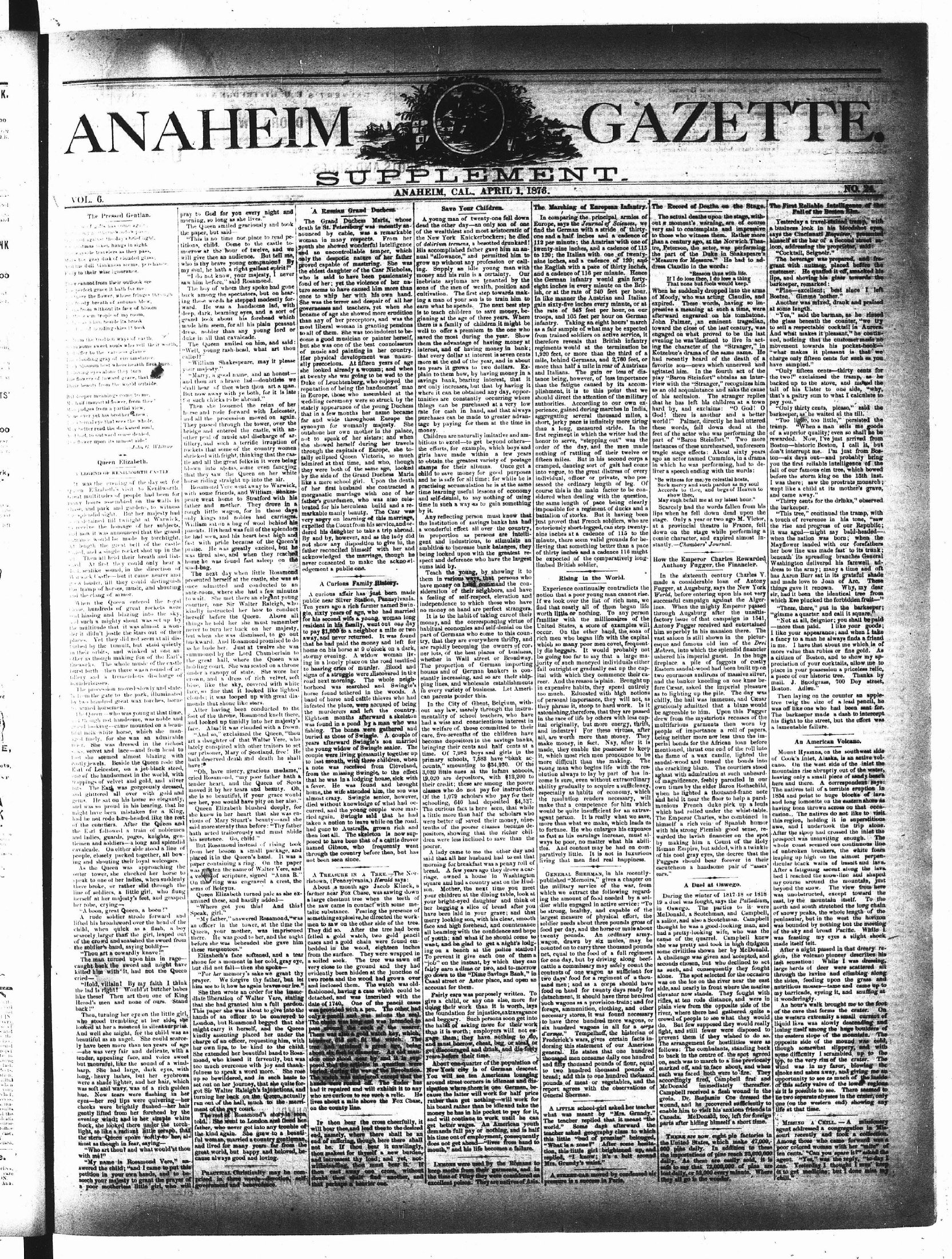
Searchable text
ANAHEIM
VOL. 6.
The Pressed Gentian.
The perfect grace it hath for me,
Where the flower, whose fringes through
Feesty breath of autumn blew,
From without its face of bloom
In the em tropic of my room,
When beside its brook
Of bending skies it took
From the trodion ways of earth,
Some sweet souls who veil their worth,
Offer to the curious glance
Loving gray of circumstance
Tiny blossom best where health fires burn
Loving eyes alone they turn
Flowers of inward grace that hide
The beauty from the world outside.
But deeper meanings come to me,
My half immortal flower, from there?
Male judges from a partial view,
None ever yet his brother knew;
A eternal eye that sees the whole,
May better read the darkened soul,
May hard, to outward sense denied,
Flower upon its untmost side!
John G. Whider
Queen Elizabeth.
pray to God for you every night and morning, so long as she lives."
The Queen smiled graciously and took the paper, but said—
"This is no time nor place to read petitions, child. Come to the castle tomorrow at the hour of twelve, and we will give thee an audience. But tell me, who is thy brave young companion! By my soul, he hath a right gallant spirit!"
"I do not know, your majesty, I never saw him before," said Rosamond.
The boy of whom they spoke had gone back among the spectators, but on hearing those words he stepped modestly forward. He was a handsome lad, with deep, dark, beaming eyes, and a sort of grand look about his forehead which made him seem, for all his plain peasant dress, nobler than any young lord or duke in all that cavalcade.
The Queen smiled on him, and said: "Well, young rash-head, what art thou called?"
William Shakespeare, may it please your majesty.
Marry, a good name, and an honest—and thou art a brave lad—doubtless we shall hear of thee when thou art a man. But now away with ye both, for it is late for such chicks to be abroad.
Then she loosened the reins of her horse and rode forward with Leicester, and all the procession moved on again. They passed through the tower, over the bridge and entered the castle, with another peak of music and discharge of artillery, and such a terrific irruption of rockets that some of the country women shrieked with fright, thinking that the castle and all the great folks in it were blown into atoms, some even fancying death in St. Petersburg.
The Grand Duke death in St. Petersburg nounced by cable, woman in many recess youth she showed wi and an uncontrollable only the despotic proved capable of m the eldest daughter o who is said to have fond of her; yet the nature seems to have ca once to whip her w She was the terror an governesses and teac became of age she shi than any of her prece most liberal woman to all of them. She w come a good musicia but she was one of t of music and painte Her physical develop ally precoelous. At she looked already at twenty she was go Duke of Leuchtenbe reputation of being in Europe (those who wedding ceremony y stately appearance o that in a few month far and wide thro synonym for wom outshone her own n not to speak of h she showed herself through the capitalally eclipsed Queen admired at that tim ther were both of
Queen Elizabeth.
A LEGEND OF KENILWORTH CASTLE
It was the evening of the day set for Queen Elizabeth's visit to Kenilworth. Great multitudes of people had been for many hours assembled on the walls in those and park and gardens, to witness the splendid sight. But her majesty had detained till twilight at Warwick, to receive the homage of her subjects, and now it was announced that the grand entrance would be made by torchlight. At length the great bell of the castle stood, and a single rocket shot up in the air. Then all held their breath and listened. At first they could only hear a loud seakike sound, in the direction of Warwick Castle—but it came nearer and closer, till they could distinguish the tramp of horses, music, and shouting and the clang of armor.
When the Queen entered the royal house, hundreds of great rockets were sent hissing and blazing into the sky, and such a mighty shout was set up by the multitude that it was almost a wonder it didn't jostle the stars out of their places. Yet they did not seem at all disturbed by the tumult, but stood quietly in their orbits, and winked at one another as though making fun of the Earl's fireworks. The whole music of the castle burst forth—then there was a round of artillery and a tremendous discharge of bomberbasses.
The procession moved slowly and stately from the gate to the park, illuminated by two hundred great wax torches, borne by armed horsemen.
The Queen—who was young at that time, although not handsome, was noble and good-looking—came mounted on a beautiful milk white horse, which she managed timely, for she was an admirable maid. She was dressed in the richest stock, velvet and lace—and from head to foot she seemed almost blazing with costly jewels. Beside the Queen rode the Earl of Leicester, on a jet-black steed, one of the handsomest in the world, with trappings of velvet and gold, and silver bits.
The Earl was gorgeously dressed, and glittered all over with gold and gems. He sat on his horse so elegantly, and was so proud in his bearing, that he might have mistaken for a King, had he not rode bare-headed like the rest of the courtiers. After the Queen and the Earl followed a train of noblemen and ladies, guards, pages, knights, gentlemen and soldiers—a long and splendid cavalcade. On either side stood a line of people, closely packed together, all bowing and shouting their loyal welcomes.
As the Queen was approaching the outer tower, she checked her horse to speak to one of her ladies, when suddenly there broke, or rather slid through the floor.
Marry, a good name, and an honest—and thou art a brave lad—doubtless we shall hear of them when thou art a man. But now away with ye both, for it is late for such chicks to be abroad."
Then she loosened the reins of her horse and rode forward with Leicester, and all the procession moved on again. They passed through the tower, over the bridge and entered the castle, with another peak of music and discharge of artillery, and such a terrific irruption of rockets that some of the country women shrieked with fright, thinking that the castle and all the great folks in it were being blown into atoms, some even fancying that they saw the Queen on her white horse riding straight up into the air.
Rosamond Vere went away to Warwick, with some friends, and William Shakespeare went home to Stratford with his father and mother. They drove in a rough little wagon, for in those days only kings and nobles had carriages. William sat on a bag of wool behind his parents. His head was full of the splendors he had seen, and his heart beat high and fast with pride because of the Queen's praise. He was greatly excited, but he was tired also, and when they reached home he was found fast asleep on the wool-bag.
The next day when little Rosamond presented herself at the castle, she was at once admitted and conducted to an ante-room, where she had a few minutes to wait. She met there an elegant young counter, one Sir Walter Raleigh, who kindly instructed her how to conduct herself before the Queen. Above all things he told her she must remember never to turn her back on her majesty, but when she was dismissed, to go out backward. And Rosamond promised to do as he bade her. Just at twelve she was summoned by the Lord Chamberlain to the great hall, where the Queen was holding court. She was seated on a throne under a canopy of state. She wore her crown, and a dress of rich velvet, soft blue, like the sky, covered with white face, so fine that it looked like lighted clouds; it was looped up with great diamonds that shone like stars.
After having been conducted to the foot of the throne, Rosamond knelt there, and looked up timidly into her majesty's face. Alas! it was clouded with a frown. "And so," exclaimed the Queen, "thou art a daughter of that Walter Vere, who lately conspired with other traitors to set our prisoner, Mary of Scotland, free! He hath deserved death and death he shall have!"
"Oh, have mercy, gracious madame," cried Rosamond, "my poor father hath a tender heart, and the Queen of Scots moved it by her tears and beauty. Oh, she is so beautiful, if your grace would see her, you would have pity on her also."
Queen Elizabeth blushed deeply, for she knew in her heart that she was envious of Mary Stuart's beauty—and she said more sternly than before: "Thy father hath acted traitorously and must abide his sentence. Go, child."
But Rosamond instead of rising took from her bosom a small package, and placed it in the Queen's hand. It was a paper containing a ring. On the paper written the name of Walter Vere, and a vexed scripture, signed "Anna R." On the ring was engraved a crest, the arms of Boleyn.
Marry, a good name, and an honest—and thou art a brave lad—doubtless we shall hear of them when thou art a man. But now away with ye both, for it is late for such chicks to be abroad."
Then she loosened the reins of her horse and rode forward with Leicester, and all the procession moved on again. They passed through the tower, over the bridge and entered the castle, with another peak of music and discharge of artillery, and such a terrific irruption of rockets that some of the country women shrieked with fright, thinking that the castle and all the great folks in it were being blown into atoms, some even fancying that they saw the Queen on her white horse riding straight up into the air.
Rosamond Vere went away to Warwick, with some friends, and William Shakespeare went home to Stratford with his father and mother. They drove in a rough little wagon, for in those days only kings and nobles had carriages. William sat on a bag of wool behind his parents. His head was full of the splendors he had seen, and his heart beat high and fast with pride because of the Queen's praise. He was greatly excited, but he was tired also, and when they reached home he was found fast asleep on the wool-bag.
The next day when little Rosamond presented herself at the castle, she was at once admitted and conducted to an ante-room, where she had a few minutes to wait. She met there an elegant young counter, one Sir Walter Raleigh, who kindly instructed her how to conduct herself before the Queen. Above all things he told her she must remember never to turn her back on her majesty, but when she was dismissed, to go out backward. And Rosamond promised to do as he bade her. Just at twelve she was summoned by the Lord Chamberlain to the great hall, where the Queen was holding court. She was seated on a throne under a canopy of state. She wore her crown, and a dress of rich velvet, soft blue, like the sky, covered with white face, so fine that it looked like lighted clouds; it was looped up with great diamonds that shone like stars.
After having been conducted to the foot of the throne, Rosamond knelt there,and looked up timidly into her majesty's face. Alas! it was clouded with a frown.“And so,” exclaimed the Queen,“thou art a daughter of that Walter Vere,who lately conspired with other traitors to set our prisoner,Mary of Scotland,free! He hath deserved death and death he shall have!”
"Oh,have mercy,gracious madame,” cried Rosamond,“my poor father hath a tender heart,and the Queen of Scots moved it by her tears和beauty。Oh,她是so beautiful,if your grace would see her,你 would have pity on her also.”
Queen Elizabeth blushed deeply,for she knew in her heart that she was envious of Mary Stuart's beauty—and she said more sternly than before:“Thy father hath acted traitorously和must abide his sentence。Go,child.”
But Rosamond instead of rising took from her bosom a small package,and placed it in the Queen's hand. It was a paper containing a ring.On the paper written the name of Walter Vere,and a vexed scripture,signed“Anna R.”Onthe ringwasengravedacrest,thearmsofBoleyn.
Marry,agoodname,andan honest—andthouartarthebravehad—doubtlessweshallhearofthemwhenthuwartarthebravehad—doubtlessweshallhearofthemwhenthuwartarthebravehad—doubtlessweshallhearofthemwhenthuwartarthebravehad—doubtlessweshallhearofthemwhenthuwartarthebravehad—doubtlessweshallhearofthemwhenthuwartarthebravehad—doubtlessweshallhearofthemwhenthuwartarthebravehad—doubtlessweshallhearofthemwhenthuwartarthebravehad—doubtlessweshallhearofthemwhenthuwartarthebravehad—doubtlessweshallhearofthemwhenthuwartarthebravehad—doubtlessweshallhearofthemwhenthuwartarthebravehad—doubtlessweshallhearofthemwhenthuwartarthebravehad—doubtlessweshallhearofthemwhenthuwartarthebravehad—doubtlessweshallhearofthemwhenthuwartarthebravehad—doubtlessweshallhearofthemwhenthuwartarthebravehad—doubtlessweshallhearofthemwhenthuwartarthebravehad—doubtlessweshallhearofthemwhenthuwartarthebravehad—doubtlessweshallhearofthemwhenthuwartarthebravehad—doubtlessweshallhearofthemwhenthuwartarthebravehad—doubtlessweshallhearofthemwhenthuwartarthebravehad—doubtlessweshallhearofthemwhenthuwartarthebravehad—doubtlessweshallhearofthemwhenthuwartarthebravehad—doubtlessweshallhearofthemwhenthuwartarthebravehad—doubtlessweshallhearofthemwhenthuwartarthebravehad—doubtlessweshallhearofthemwhenthuwartarthebravehad—doubtlessweshallhearofthemwhenthuwartarthebravehad—doubtlessweshallhearofthemwhenthuwartarthebravehad—doubtlessweshallhearofthemwhenthuwartarthebravehad—doubtlessweshallhearofthemwhenthuwartarthebravehad—doubtlessweshallhearofthemwhenthuwART艺术师
A curious affair
Ten years ago a rickgle,sixtyears offarmistresidentinhisfamilytopay$1,$away,andneverretreatethenadhalfwomenbyfatherreconciledhisacknowledgedtherenewconsentedtotheedgeamentapubliccouncil
A Curious Friend
A curious affair
Ten years ago a rickgle,sixtyears offarmistresidentinhisfamilytopay$1,$away,andneverretreatethenadhalfwomenbyfatherreconciledhisacknowledgedtherenewconsentedtotheedgeamentapubliccouncil
A curious affair
Ten years ago a rickgle,sixtyears offarmistresidentinhisfamilytopay$1,$away,andneverretreatethenadhalfwomenbyfatherreconciledhisacknowledgedtherenewconsentedtotheedgeamentapubliccouncil
A curious affair
Ten years ago a rickgle,sixtyears offarmistresidentinhisfamilytopay$1,$away,andneverretreatethenadhalfwomenbyfatherreconciledhisacknowledgedtherenewconsentedtotheedgeamentapubliccouncil
A curious affair
Ten years ago a rickgle,sixtyears offarmistresidentinhisfamilytopay$1,$away,andneverretreatethenadhalfwomenbyfatherreconciledhisacknowledgedtherenewconsentedtotheedgeamentapubliccouncil
A curious affair
Ten years ago a rickgle,sixtyears offarmistresidentinhisfamilytopay$1,$away,andneverretreatethenadhalfwomenbyfatherreconciledhisacknowledgedtherenewconsentedtotheedgeamentapubliccouncil
A curious affair
Ten years ago a rickgle,sixtyears offarmistresidentinhisfamilytopay$1,$away,andneverretreatethenadhalfwomenbyfatherreconciledhisacknowledgedtherenewconsentedtotheedgeamentapubliccouncil
A curious affair
Ten years ago a rickgle,sixtyears offarmistresidentinhisfamilytopay$1,$away,andneverretreatethenadhalfwomenbyfatherreconciledhisacknowledgedtherenewconsentedtotheedgeamentapubliccouncil
A curious affair
Ten years ago a rickgle,sixtyears offarmistresidentinhisfamilytopay$1,$away,andneverretreatethenadhalfwomenbyfatherreconciledhisacknowledgedtherenewconsentedtotheedgeamentapubliccouncil
A curious affair
Ten years ago a rickgle,sixtyears offarmistresidentinhisfamilytopay$1,$away,andneverretreatethenadhalfwomenbyfatherreconciledhisacknowledgedtherenewconsnedtotheedgeamentapubliccouncil
A curious affair
Ten years ago a rickgle,sixtyears offarmistresidentinhisfamilytopay$1,$away,andneverretreatethenadhalfwomenbyfatherreconciledhisacknowledgedtherenewconsnedtothe edgeamentapubliccouncil
A curious affair
Ten years ago a rickgle,sixtyears offarmistresidentinhis familyto pay$1,$away,andneverretreatethenadhalfwomenbyfatherreconciledhisacknowledgedtherenewconsnedtothe edgeamentapubliccouncil
A curious affair
Ten years ago a rickgle,sixtyears offarmistresidentinhis familyto pay$1,$away,andneverretreatethenadhalfwomenbyfatherreconciledhisacknowledgedtherenewconsnedtothe edgeamentapubliccouncil
A curious affair
Ten years ago a rickgle,sixtyears offarmistresidentinhis familyto pay$1,$away,andneverretreatethenadhalfwomenbyfatherreconciledhisacknowledgedtherenewconsnedtothe edgeamentapubliccouncil
A curious affair
Ten years ago a rickgle,sixtyears offarmistresidentinhis familyto pay$1,$away,andneverretreatethenadhalfwomenbyfatherreconciledhisacknowledgedtherenewconsnedtothe edgeamentapubliccouncil
A curious affair
Ten years ago a rickgle,sixtyears offarmistresidentinhis familyto pay$1,$away,andneverretreatethenadhalfwomenbyfatherreconciledhisacknowledgedtherenewconsnedtothe edgeamentapubliccouncil
A curious affair
Ten years ago a rickgle,sixtyears offarmistresidentinhis familyto pay$1,$away,andneverretreatethenadhalfwomenbyfatherreconciledhisacknowledgedtherenewconsnedtothe edgeamentapubliccouncil
A curious affair
Ten years ago a rickgle,sixtyears offarmistresidentinhis familyto pay$1,$away,andneverretreatethenadhalfwomenbyfatherreconciledhisacknowledgedtherenewconsnedtothe edgeamentapubliccouncil
A curious affair
Ten years ago a rickgle,sixtyears offarmistresidentinhis familyto pay$1,$away,andneverretreatethenadhalfwomenbyfatherreconciledhisacknowledgedtherenewconsnedtothe edgeamentapubliccouncil
A curious affair
Ten years ago a rickgle,sixtyears offarmistresidentinhis familyto pay$1,$away,andneverretreatethenadhalfwomenbyfatherreconciledhisacknowledgedtherenewconsnedtothe edgeamentapubliccouncil
A curious affair
Ten years ago a rickgle,sixtyears offarmistresidentinhis familyto pay$1,$away,andneverretreatethenadhalfwomenbyfatherreconciledhisacknowledgedtherenewconsnedtothe edgeamentapubliccouncil
A curious affair
Ten years ago a rickgle,sixtyears offarmistresidentinhis familyto pay$1,$away,andneverretreatethenadhalfwomenbyfatherreconciledhisacknowledgedtherenewconsnedtothe edgeamentapubliccouncil
A curious affair
Ten years ago a rickgle,sixtyears offarmistresidentinhis familyto pay$1,$away,andneverretreatethenadhalfwomenbyfatherreconciledhisacknowledgedtherenewconsnedtothe edgeamentapubliccouncil
A curious affair
Ten years ago a rickgle,sixtyears offarmistresidentinhis familyto pay$1,$away,andneverretreatethенadhalfwomenbyfatherreconciledhisacknowledgedTHERENOWCONSIDEDTOWHEREAGENTWITHHISLADYANDHISFRIENDSHOPPINGTHEMATTERINGTHEIRSELFINSTUDYOFTHEMATTERINGTHEIRSELFINSTUDYOFTHEMATTERINGTHEIRSELFINSTUDYOFTHEMATTERINGTHEIRSELFINSTUDYOFTHEMATTERINGTHEIRSELFINSTUDYOFTHEMATTERINGTHEIRSELFINSTUDYOFTHEMATTERINGTHEIRSELFINSTUDYOFTHEMATTERINGTHEIRSELFINSTUDYOFTHEMATTERINGTHEIRSELFINSTUDYOFTHEMATTERINGTHEIRSELFINSTUDYOFTHEMATTERINGTHEIRSELFINSTUDYOFTHEMATTERINGTHEIRSELFINSTUDYOFTHEMATTERINGTHEIRSELFINSTUDYOFTHEMATTERINGTHEIRSELFINSTUDYOF THEMATTERINGTHEIRSELFINSTUDYOF THEMATTERINGTHEIRSELFINSTUDYOF THEMATTERINGTHEIRSELFINSTUDYOF THEMATTERINGTHEIRSELFINSTUDYOF THEMATTERINGTHEIRSELFINSTUDYOF THEMATTERINGTHEIRSELFINSTUDYOF THEMATTERINGTHEIRSELFINSTUDYOF THEMATTERINGTHEIRSELFINSTUDYOF THEMATTERINGTHEIRSELFINSTUDYOF THEMATTERINGTHEIRSELFINSTUDYOF THEMATTERINGTHEIRSELFINSTUDYOF THEMATTERINGTHEIRSELFINSTUDYOF THEMATTERINGTHEIRSELFINSTUDYOF THEMATTERINGTHEIRSELFINSTUDYOF THEMATTERINGTHEIRSELFINSTUDYOF THEMATTERINGTHEIRSELFINSTUDYOF THEMATTERINGTHEIRSELFINSTUDYOF THEMATTERINGTHEIRSELFINSTUDYOF THEMATTERINGTHEIRSELFINSTUDYOF THEMATTERINGTHEIRSELFINSTUDYOF THEMATTERINGTHEIRSELFINSTUDYOF THEMATTERINGTHEIRSELFINSTUDYOF THEMATTERINGTHEIRSELFINSTUDYOF THEMATTERINGTHEIRSELFINSTUDYOF THEMATTERINGTHEIRSELFINSTUDYOF THEMATTERINGTHEIRSELFINSTUDYOF THEMATTERINGTHEIRSELFINSTUDYOF THEMATTERINGTHEIRSELFINSTUDYOF THEMATTERINGTHEIRSELFINSTUDYOF THEMATTERINGTHEIRSELFINSTUDYOF THEMATTERINGTHEIRSELFINSTUDYOF THEMATTERINGTHEIRSELFINSTUDYOF THEMATTERINGTHEIRSELFINSTUDYOF THEMATTERINGTHEIRSELFFINStudyingTheirFamilyToBeInTheCityAndShoppingAtTheCourtOfTheCityAndShoppingAtTheCourtOfTheCityAndShoppingAtTheCourtOfTheCityAndShoppingAtTheCourtOfTheCityAndShoppingAtTheCourtOfTheCityAndShoppingAtTheCourtOfTheCityAndShoppingAtTheCourtOfTheCityAndShoppingAtTheCourtOfTheCityAndShoppingAtTheCourtOfTheCityAndShoppingAtTheCourtOfTheCityAndShoppingAtTheCourtOfTheCityAndShoppingAtTheCourtOfTheCityAndShoppingAtTheCourtOfTheCityAndShoppingAtTheCourtOfTheCityAndShoppingAtTheCourtOfTheCityAndShoppingAtTheCourtOfTheCityAndShoppingAtTheCourtOfTheCityAndShoppingAtTheCourtOfTheCityAndShoppingAtTheCourtOfTheCityAndShoppingAtTheCourtOfTheCityAndShoppingAtTheCourtOfTheCityAndShoppingAtTheCourtOfTheCityAndShoppingAtTheCourtOfTheCityAndShoppingAtTheCourtOfTheCityAndShoppingAtTheCourtOfTheCityAndShoppingAtTheCourtOfTheCityAndShoppingAtTheCourtOfTheCityAndShoppingAtTheCourtOfTheCityAndShoppingAtTheCourtOfTheCityAndShoppingAtTheCourtOfTheCityAndShoppingAtTheCourtOfTheCityAndShoppingAtTheCourtOfTheCityAndShoppingAtTheCourtOfThe CityAndShoppingAtTheCourtOfTheCityAndShoppingAtTheCourtOfTheCityAndShoppingAtTheC CourtOfTheCityAndShoppingAtTheC Court Of The City And Shopping At The City And Shopping At The City And Shopping At The City And Shopping At The City And Shopping At The City And Shopping At The City And Shopping At The City And Shopping At The City And Shopping At The City And Shopping At The City And Shopping At The City And Shopping At The City And Shopping At The City And Shopping At The City And Shopping At The City And Shopping At The City And Shopping At The City And Shopping At The City And Shopping At The City And Sh shopping AT The City AND SHOPPING AT THE CITY AND SHOPPING AT THE CITY AND SHOPPING AT THE CITY AND SHOPPING AT THE CITY AND SHOPPING AT THE CITY AND SHOPPING AT THE CITY AND SHOPPING AT THE CITY AND SHOPPING AT THE CITY AND SHOPPING AT THE CITY AND SHOPPING AT THE CITY AND SHOPPING AT THE CITY AND SHOPPING AT THE CITY AND SHOPPING AT THE CITY AND SHOPPING AT THE CITY AND SHOPPING AT THE CITY AND SHOPPING AT THE CITY AND SHOPPING AT THE CITY AND SHOPPING AT THE CITY AND SHOPPING AT THE CITY AND SHOPPING AT THE CITY AND SHOPPING AT THE CITY AND SHOPPING AT THE CITY AND SHOPPINGS AT THE CITY AND SHOPPINGS AT THE CITY AND SHOPPINGS AT THE CITY AND SHOPPINGS AT THE CITY AND SHOPPINGS AT THE CITY AND SHOPPINGS AT THE CITY AND SHOPPINGS AT THE CITY AND SHOPPINGS AT THE CITY AND SHOPPINGS AT THE CITY AND SHOPPINGS AT THE CITY AND SHOPPINGS AT THE CITY AND SHOPPINGS AT THE CITY AND SHOPPINGS AT THE CITY AND SHOPPINGS AT THE CITY AND SHOPPINGS AT THE CITY AND SHOPPINGS AT THE CITY AND SHOPPINGS AT THE CITY AND SHOPPINGS AT THE CITY AND SHOPPINGS AT THE CITY AND SHOPPINGS AT THE CITY AND SHOPPINGS AT THE CITY AND SHOPPINGS AT THE CITY AND SHOPPINGS AT THIS WORLD WHERE A MAN IS SUPERIOR TO A WOMAN WHO IS SUPERIOR TO A WOMAN WHO IS SUPERIOR TO A WOMAN WHO IS SUPERIOR TO A WOMAN WHO IS SUPERIOR TO A WOMAN WHO IS SUPERIOR TO A WOMAN WHO IS SUPERIOR TO A WOMAN WHO IS S
He sat on his horse so elegantly, and was so proud in his bearing, that he might have been mistaken for a King, had he not rode bare-headed like the rest of the courtiers. After the Queen and the Earl followed a train of noblemen and ladies, guards, pages, knights, gentlemen and soldiers—a long and splendid cavalcade. On either side stood a line of people, closely packed together, all bowing and shouting their loyal welcomes.
As the Queen was approaching the outer tower, she checked her horse to speak to one of her ladies, when suddenly there broke, or rather slid through the line of soldiers, a little girl, who flung herself at her majesty's feet, and grasped her robe, crying—
"A boon, great Queen, a boon!"
A rude soldier strode forward and lifted his broadsword over the head of the child, when quick as a flash, a boy scarcely larger than the girl, leaped out of the crowd and snatched the sword from the soldier's hand, saying boldly—
"Thou art a cowardly knave!"
The man turned upon him in rage—caught back the sword and might have killed him with it, had not the Queen cried—
"Hold, villain! By my faith I think the lad is right! Wouldn't butcher babes like these? Then art thou one of King Herod's men and none of ours. Stand back!"
Then, turning her eye on the little girl, who stood trembling at her side, she looked at her moment in silent surprise. And well she might, for the child was as beautiful as an angel. She could scarcely have been more than ten years of age—she was very fair and delicate, with a tender, appealing face, and voice sweet but mournful, like the sound of a wind-harp. She had large, dark eyes, with long, heavy lashes, but her eyebrows were a shade lighter, and her hair, which was soft and wavy, was of a rich golden hue. Now tears were flashing in her eyes—her red lips were quivering—her cheeks were brightly flushed—her hair gently lifted from her forehead by the evening wind; and in her simple white frock, she looked there under the torchlight, so like a radiant little scarp, that the stern Queen spoke softly to her, almost as though in fear, saying—
"Who art thou! and what wouldst thou with me!"
"My name is Rosamond Vere," answered the child; "and I came to put this petition in your own hands, and to beseech your majesty to grant the prayer of a poor motherless little girl, who will moved it by her tones and beauty. Oh she is so beautiful, if your grace would see her, you would have pity on her also."
Queen Elizabeth blushed deeply, for she knew in her heart that she was envious of Mary Stuart's beauty—and she said more sternly than before: "Thy father hath acted traitorously and must abide his sentence. Go, child."
But Rosamond instead of rising took from her bosom a small package, and placed it in the Queen's hand. It was a paper containing a ring. On the paper was written the name of Walter Vere, and a vexed scripture, signed "Anna R." On the ring was engraved a crest, the arms of Boleyn.
Queen Elizabeth turned pale as she examined these, and hastily added—
"Where got you this? And this? Speak, girl."
"My father," answered Rosamond, "was an officer in the tower, at the time the Queen, your mother, was imprisoned there. He was good to her, and the night before she was beheaded she gave him these memorials."
Elizabeth's face softened, and a tear shone for a moment in her cold, gray eye, but did not fall—then she spoke—
"For her memory's sake we grant thy prayer. We forgive thy father, but let him see to it how he again braves our fire."
She then wrote an order for the immediate liberation of Walter Vere, stating that she had granted him a full pardon. This paper she was about to give into the hands of an officer to be conveyed to London, but Rosamond begged that she might carry it herself, and the Queen kindly assenting placed her under the charge of an officer, requesting him, with her own lips, to be kind to the child. She extended her beautiful hand to Rosamond, who kissed it fervently, but was too much overcome with joy and thankfulness to speak a word more.
She rose up so bewildered, and in such haste to set out on her journey, that she quite forgot Sir Walter Raleigh's injunctions, and turning her back on the Queen, actually ran out of the hall, much to the merriment of the gay court.
The rest of Rosamond's story is soon told. She went to London and fixed her father, who never got into any trouble of the kind again. She grew to a beautiful woman, married a country gentleman, and lived for many years far from the great world, but happy and beloved, because always good and loving.
Practical Christianity may be comprised in three words—direction, self-government and benevolence.
A Russian Grand Duchess.
The Grand Duchess Maria, whose death in St. Petersburg was recently announced by cable, was a remarkable woman in many respects. From her youth she showed wonderful intelligence and an uncontrollable temper, which only the despotic nature of her father proved capable of mastering. She was the eldest daughter of the Czar Nicholas, who is said to have been passionately fond of her; yet the violence of her nature seems to have caused him more than once to whip her with his own hand. She was the terror and despair of all her governesses and teachers, yet when she became of age she showed more erudition than any of her preceptors, and was the most liberal woman in granting pensions to all of them. She was too indolent to become a good musician or painter herself, but she was one of the best connoisseurs of music and painting in her country. Her physical development was unusually precocious. At fifteen years of age she looked already a woman; and when at twenty she was going to be wed to the Duke of Leuchtenberg, who enjoyed the reputation of being the handsomest man in Europe, those who assembled at the wedding ceremony were so struck by the stately appearance of the young Duchess that in a few months her name became far and wide throughout Europe the synonym for womanly majesty. She outshone her own mother in the palace, not to speak of her sisters; and when she showed herself during her travels through the capitals of Europe, she totally eclipsed Queen Victoria, so much admired at that time, and who, though they were both of the same age, looked
Save Your Children.
A young man of twenty-one fell down dead the other day—an only son of one of the wealthiest and most aristocratic of the New York Knickerbockers; he died of delirium tremens, a besotted drunkard! His accomplished father gave him an annual "allowance," and permitted him to grow up without any profession or calling. Supply an idle young man with money and his ruin is a certainty. Our inebriate asylums are tenanted by the sons of the men of wealth, position and cultivation. The first step towards making a man of your son is to train him to earn what he spends. The next best step is to teach children to save money, beginning at the age of three years. Where there is a family of children it might be well to offer a premium to the one who saved the most during the year. Show them the advantage of having money at interest, and of having money in bank; that every dollar at interest is seven cents more at the end of the year, and in about ten years it grows to two dollars. Explain to them how, by having money in a savings bank, bearing interest, that it not only increases, but that by having it where it can be obtained any day, opportunities are constantly occurring where things can be purchased at a very low rate for cash in hand, and that always purchases can be made to greater advantage by paying for them at the time in money.
Children are naturally imitative and ambitious to excel—to get beyond others—the efforts, for example, which boys and girls have made within a few years to obtain the greatest variety of postage stamps for their albums. Once get a
The Marching of European Infantry.
In comparing the principal armies of Europe, says the Journal of Sciences, we find the German with a stride of thirty-one and a half inches and a cadence of 112 per minute; the Austrian with one of twenty-nine inches, and a cadence of 115 to 120; the Italian with one of twenty-nine inches, and a cadence of 120; and the English with a pace of thirty inches, and a cadence of 116 per minute. Hence the German infantry would gain forty-eight inches in every minute on the British, or at the rate of 240 feet per hour. In like manner the Austrian and Italian gain sixty-five inches every minute, or at the rate of 345 feet per hour, on our troops, and 105 feet per hour on German infantry. Taking an eight hours' march as a fair sample of what may be expected from trained soldiers on active service, it therefore reveals that British infantry regiments would at the termination be 1,920 feet, or more than the third of a mile, behind Germans, and 2,700 feet, or more than half a mile in rear of Austrians and Italians. The gain or loss of distance being, however, of less importance than the fatigue caused by its accomplishment, it is to this point that we should direct the attention of the military authorities. According to our own experience, gained during marches in India, aggregating several thousand miles, a short, jerky pace is infinitely more tiring than a long, measured stride. In the first regiment in which the writer had the honor to serve, "stepping out" was the order of the day, and the men made nothing of rattling off their twelve or fifteen miles. But in his second corps a cramped, dancing sort of gait had come
A Curious Family History.
A curious affair has just been made public near Silver Station, Pennsylvania. Ten years ago a rich farmer named Swingle, ten years of age, who had married for his second wife a young woman long resident in his family, went out one day to pay $1,800 to a neighbor a mile or two away, and never returned. It was found that he had paid the money and left for home on his horse at 9 o'clock on a dark stormy evening. A widow woman living in a lonely place on the road testified to hearing cries of murder. Blood and signs of a struggle were discovered in the road next morning. The whole neighborhood was searched and Swingle's horse found tethered in the woods. A band of horse and cattle thieves who had infested the place, were accused of being the murderers and left the country. Eighteen months afterward a skeleton was found in a pond by a man who was fishing. The bones were gathered and buried as those of Swingle. A couple of years afterward Swingle's son married the young widow of Swingle senior. The couple were living pleasantly together up to last month, with three children, when a note was received from Cleveland, from the missing Swingle, to the effect that he was in a lodging house, sick with a fever. He was found and brought home, the wife attended him, the son was almost crazy. Swingle senior, however, died without knowledge of what had occurred, and the young couple were married again. Swingle said that he had taken a notion to leave while on the road. Had gone to Australia, grown rich and then lost all. The skeleton is now supposed to have been that of a cattle drover named Gibson, who frequently went through the country before than, but has not been seen since.
A Treasure in a Tree.—The Norristown, (Pennsylvania), Herald says: About a month ago Jacob Klinck, a plain to them how, by having money in a savings bank, bearing interest, that it not only increases, but that by having it where it can be obtained any day, opportunities are constantly occurring where things can be purchased at a very low rate for cash in hand, and that always purchases can be made to greater advantage by paying for them at the time in money.
Children are naturally imitative and ambitious to excel—to get beyond others—the efforts, for example, which boys and girls have made within a few years to obtain the greatest variety of postage stamps for their albums. Once get a child to save money for good purposes and he is safe for all time; for while he is practising accumulation he is at the same time learning useful lessons of economy and self-denial, to say nothing of using time in such a way as to gain something by it.
Any reflecting person must know that the institution of savings banks has had a wonderful effect all over the country, in proportion as persons are intelligent and industrious, to stimulate an ambition to increase bank balances, they being looked upon with the greatest respect and deference who have the largest sums laid by.
Teach the young, by showing it to them in various ways, that persons who have money on hand command the consideration of their neighbors, and have a feeling of self-respect, elevation and independence to which those who have no money on hand are perfect strangers.
It is to the habit of taking care of their money, and the corresponding virtue of habitual economies and self-denial on the part of Germans who come to this country, that they are everywhere thrifty, and are rapidly becoming the owners of corner lots, of the best places of business, whether in Wall street or Broadway. The proportion of German importing houses and of German bankers is constantly increasing, and so are their shipping lines, and wholesale establishments in every variety of business. Let American parents ponder this.
In the City of Ghent, Belgium, without any law, merely through the instrumentality of school teachers, who have had a wise and conscientious interest in the welfare of those committed to their care, five-sevenths of the children have become depositors in the savings banks, bringing their cents and half cents at a time. Of 7,983 boys and girls in the primary schools, 7,583 have "bank accounts" amounting to $54,920. Of the 3,089 little ones at the infant schools, 19,020 are depositors, with $13,200 to their credit; these are among the poorer classes who do not pay for instruction. Of the 1,079 scholars who pay for their schooling, 640 had deposited $4,537. The curious fact is here seen, that while a little more than half the scholars who were better off saved their money, ninths of the poorer classes became depositors, showing that the rich children were less inclined to save than the poorer.
A lady came to me other day and said that all her husband had to eat that morning for breakfast was a penny roll of bread. A few years ago they drove a carriage, owned a house in Washington square and had a country seat on the Hudson Mother next time you meet
The gain or loss of distance being, however, of less importance than the fatigue caused by its accomplishment, it is to this point that we should direct the attention of the military authorities. According to our own experience, gained during marches in India, aggregating several thousand miles, a short jerky pace is infinitely more tiring than a long, measured stride. In the first regiment in which the writer had the honor to serve, "stepping out" was the order of the day, and the men made nothing of rattling off their twelve or fifteen miles. But in his second corps a cramped, dancing sort of gait had come into vogue, to the great distress of every individual, officer or private, who possessed the ordinary length of leg. Of course this is the main factor to be considered when dealing with the question, the same length of pace being clearly impossible for a regiment of ducks and a battalion of storks. But it having been just proved that French soldiers who are notoriously short-legged can step twenty-nine inches at a cadence of 115 to the minute, there seem valid grounds for believing that something better than a pace of thirty inches and a cadence 116 might be expected of the comparatively long-limbed British soldier.
Rising in the World.
Experience continually contradicts the notion that a poor young man cannot rise. If we look over the list of rich men, we find that nearly all of them began life worth little or nothing. To any person familiar with the millionaires of the United States, a score of examples will occur. On the other hand, the sons of rich men who began life with the capital which so many poor men covet, frequently die beggars. It would probably not be going too far to say that a large majority of such moneyed individuals either fail outright or gradually eat up the capital with which they commence their career. And the reason is plain. Brought up in expensive habits, they spend entirely too much. Educated with high notions of personal importance, they will not, as they phrase it, stoop to hard work. Is it astonishing therefore that they are passed in the race of life by others with less capital originally, but more energy, thrift, and industry? For these virtues, after all, are worth more than money. They make money, in fact. Nay, after it is made, they enable the possessor to keep it, which most rich men pronounce to be more difficult than the making. The young man who begins life with the resolution always to lay by part of his income is sure, even without extraordinary ability gradually to acquire a sufficiency especially as habits of economy which the resolution renders necessary will make that a competence for him which would be quite insufficient for an extraagent person. It is really what we save more than what we make, which leads us to fortune. He who enlarges his expenses as fast as his earnings increase must always be poor no matter what his abilities. And content may be had on comparatively little. It is not in luxurious living that men find real happiness.
General Sherman, in his recently published "Memoirs," gives a chapter on the military service of the war from
A TREASURE IN A TREE — The Norristown, (Pennsylvania) Herald says:
About a month ago Jacob Klinck, a farmer near Fox Chase, was sawing down a large chestnut tree when the teeth of the saw came in contact with some metallic substance. Fearing the presence of something explosive, he directed the workman to saw on the other side of the tree. They did so. After the tree had been felled a gold watch, two gold pencil cases and a gold chain were found embedded in the wood, eighteen inches from the surface. They were wrapped in a soiled sock. The tree was sawn off very close to the ground and they had evidently been hidden at the junction of two roots and the wood had grown over and inclosed them. The watch was old-fashioned, having a case which could be detached, and was inscribed with the date of 1740. One of the pencil cases was provided with a pen. The other had only a pencil and was minus the seal. The chain was long and was intended to pass around the neck of the warrior. There was also a gold watch key, which, however, did not fit the watch. The tree had attached a great tap, being about six feet in diameter. An old man sloshed once near by and it is supposed that the soldiers in question were buried during the war of Revolution. The watch was untouched except that the hands was raised off. The finder has had it repaired and will exhibit it to any who are curious to see such a relic. He lives about a mile above the Fox Chase, on the county line.
If thou hear the cross cheerfully, it will bear then, and lead thru to the desired end, namely, where there shall be an end of suffering, though here there shall not be. If thou hear it unwillingly, thou make for yourself a new burden and increase thy load; and yet, notwithstanding, thou must bear it. If thou cast away one cross, without doubt than their find another, and that perhaps a hurrier one.
Lexons were used by the Romans to keep moths from their garments, and in the time of Pliny they were considered an excellent poison. They are natives of Asia.
GENERAL SHERMAN, in his recently-published "Memoirs," gives a chapter on the military service of the war, from which we extract the following regarding the amount of food needed by a soldier while engaged in active service: "To be strong, healthy, and capable of the largest measure of physical effort, the soldier needs about three pounds gross of food per day, and the horse or mule about twenty pounds. An ordinary army-wagon, drawn by six mules, may be counted on to carry three thousand pounds net, equal to the food of a full regiment for one day, but by driving along beef-cattle a commissary may safely count the contents of one wagon as sufficient for two days' food for a regiment of a thousand men; and as a corps should have food on hand for twenty days ready for detachment. It should have three hundred such wagons as a provision-train; and for forage, ammunition, clothing, and other necessary stores, it was found necessary to have three hundred more wagons, or six hundred wagons in all for a corps d'armes." Tempelhoff, the historian of Frederick's wars, gives certain facts indorsing this statement of our American general. He states that one hundred thousand men consume daily one hundred and fifty thousand pounds of flour, equal to two hundred thousand pounds of bread; add this to one hundred thousand pounds of meat or vegetables, and the report agrees with the observations of General Sherman.
A LITTLE school-girl asked her teacher what was meant by "Mrs. Grundy." The teacher replied that it meant "the world." Some days afterward the teacher asked geography class to which this little "bud of promise" belonged. "What is a zone?" After some hesitation, this little girl brightened up, and replied, "I know; it's a halt around Mrs. Grundy's waist."
A swimmer can move by condensed air pressure is a success in Paris.
GAZETTE.
NO. 24
European Infantry.
Principal armies of
National of Sciences,
we have stride of thirtyand a cadence of 115
with one of twentyinces of 120; and
one of thirty inches,
per minute. Hence
would gain fortyminute on the Brittain and Italian
every minute, or at
per hour, on our
eight hours' march
that may be expected
on active service, it
British infantry
the termination be
the third of a
and 2,760 feet, or
in rear of Austrians
in or loss of disof less importance
by its accomphis point that we
mention of the military
going to our own exgreges in India,
thousand miles, a
ninitely more tiring
stride. In the
writer had the
coming out" was the
and the men made
off their twelve or
his second corps a
of gait had come
The Record of Deaths on the Stage.
The actual deaths upon the stage, without a moment's warning, are of course very sad to contemplate and impressive to those who witness them. Rather more than a century ago, at the Norwich Theatre, Peterson, the actor, was performing the part of the Duke in Shakespeare's "Measure for Measure." He had to address Claudio in the words:
"Reason thus with life.
If I do lose thee, I do lose a thing
That none but fools would keep."
When he suddenly dropped into the arms of Moody, who was acting Claudio, and expired. These words, having so impressive a meaning at such a time, were afterward engraved on his tombstone. John Palmer, an eminent tragedian, toward the close of the last century, was engaged on what proved to be the last evening he was destined to live in acting the character of the "Stranger," in Kotzebue's drama of the same name. He had recently heard of the death of a favorite son—news which unnerved and agitated him. In the fourth act of the play "Baron Steinfort" obtains an interview with the "Stranger," recognizes him as an old acquaintance and asks the cause of his seclusion. The stranger replies that he has left his children at a town hard by, and exclaims: "O God! O God! there is another and a better world!" Palmer, directly he had uttered these words, fell down dead at the feet of the actor who was performing the part of "Baron Steinfort." Two more instances of these unrehearsed, unforeseen tragic stage effects: About sixty years ago an actor named Cummins, in a drama in which he was performing, had to delay.
The First Reliable Intelligence of the Fall of the Boston Plain.
Yesterday a travel-sailed tramp, with a business look in his bloodshot eyes, says the Cincinnati Esquiner, presented himself at the bar of a Second street saloon, addressing the proprietor, said:
"Cocktail, Seignoir."
The beverage was prepared, and fragrant with nutmeg, placed before the customer. He qualified it off, smacked his lips, and shoving his glass towards the barkeeper, remarked:
"Fine—excellent; best since I left Boston. Gimme 'mother.'
Another was mixed, drank and praised at some length.
"Yes," said the barman, as he rushed the glass beneath the counter, "we try to sell a respectable cocktail in Anora. And what makes it pleasant," he continued, noticing that the customer made no movement towards his pocket-book—"what makes it pleasant is that we charge only fifteen cents for such as you have sampled."
"Only fifteen cents—thirty cents for the two!" exclaimed the trump, as he backed up to the stove, and moved the tail of his Ulster to one side, "why, that's a paltry sum to what I calculate to pay you."
"Only thirty cents, please," said the barkeeper; as he waited at the till.
"Too little, too little," persisted the trump. "When a man sells me goods of a superior quality; even so shall he be rewarded. Now, I've just arrived from Boston—historic Boston, I call it, but don't interrupt me. I'm just from Boston—six days out—and probably bring you the first reliable intelligence of the fall of our famous alm tree, which bowed."
In the sixteenth century Charles V. made a considerable loan of Antony Fugger, at Augsburg, says the New York World, before entering upon his not very successful campaign against the Algerines. When the mighty Emperor passed through Augsburg after the unsatisfactory issue of that campaign in 1541, Antony Fugger received and entertained him superbly in his mansion there. The vast saloon is still shown in the picturesque and famous old inn of the Drei Mohren, into which the splendid financier ushered his imperial guest. In the huge fireplace a pile of faggots of costly Eastern sandal-wood had been built up on two enormous and irons of massive silver, and the banker kneeling on one knee before Caesar, asked the imperial pleasure as to lighting up the pile. The day was chilly, the hail was immense, and Caesar graciously admitted that a blaze would be agreeable to him. Upon this Fugger drew from the mysterious recesses of the multifarious garments then worn by people of importance a roll of papers, being neither more nor less than the imperial bonds for the African loan before mentioned, thrust one end of the roll into the flame of a wax candle, lighted the sandal-wood and tossed the bonds into the crackling blaze. The courtiers stood aggest with admiration at such unheard-of magnificence, feebly parodied in our own times by the elder Baron Rothschild, when he lighted a thousand-franc note and held it near the floor to help a parsimonious French duke pick up a louis which had rolled under the whist-table. The Emperor Charles, who combined in himself a rich vein of Spanish humor with his strong Flemish good sense, rewarded the lavish financier on the spot by making him a Count of the Holy Roman Empire, but added, with a twinkle of his cool gray eyes, the decree that the Fuggers should bear forever in their escutcheon a handsome pair of "asses" ears.
A Duel at Oswego.
Only fifteen cents—thirty cents for the two! exclaimed the tramp, as he backed up to the stove, and moved the tail of his Ulster to one side, "why, that's a paltry sum to what I calculate to pay you."
Only thirty cents, please," said the barkeeper, as he waited at the till.
Too little, too little," persisted the trump. "When a man sells me goods of a superior quality; even so shall he be rewarded. Now, I've just arrived from Boston—historic Boston, I call it, but don't interrupt me. I'm just from Boston—six days out—and probably bring you the first reliable intelligence of the fall of our famous elm tree, which bowed before the storm king on the 15th inst. I was there; saw the prostrate monarch; wept like a child at its mother's grave, and came away."
Thirty cents for the drinks," observed the barkeeper.
This tree," continued the trump, with a touch of reverence in his tone, "saw the rise and progress of our Republic; it was aged—might say bald-headed—when the nation was born; when the Mayflower landed with our forefathers her bow line was made fast to its trunk; beneath its spreading branches General Washington delivered his farewell address to the army; many a time and oft has Aaron Burr sat in its grateful shade and made love to Joan of Arc. These things gave it renown. Why, my dear sir, had it been the identical tree from which Eve plucked the forbidden fruit—"
There, there," put in the barkeeper; "gimme a quarter, and call it square."
Not at all, Seignior; you shall be paid—more than paid. I like your goods; I like your appearance; and when I take a fancy to a man he always finds a friend in me. I have that about me which is of more value than rubies or fine gold. As a citizen of Boston, and to show my appreciation of your cocktails, allow me to place in your possession a priced relic, a piece of our historic tree. Thanks by mail. J. Snodgrass, 700 Doy street, Boston. Adieu.
Then laying on the counter an apple-tree twig the size of a lead pencil, he was off like one who had been sent for. The barkeeper made a dash to intercept his flight to the street, but the effort was a lamentable failure.
An American Volcano.
Mount Hyannis, on the southwest side of Cook's inlet, Alaska, is an active volcano. On the west side of the inlet the mountains rise abruptly out of the water, leaving only a small piece of sandy beach here and there. A correspondent says: The natives tell of a terrible eruption in 1854 and point to huge blocks of lava and long limestone on the eastern shore as having thrown across on that occasion. The natives do not like to visit this region, holding it in superstitious awe, and I undertook the trip alone. After the ship had crossed the inlet the prospect was uninviting enough. The whole coast seemed one continuous line of unbroken breakers, the white foams leaping up high on the almost perpendicular black walls of basalt and lava. After a fatiguing ascent along the lava bed I reached the snow-line and shaped my course around the mountains, just beyond the snow. The view from here
A Duel at Oswego.
During the winter of 1817-18 or 1818
19 a duel was fought, says the Palladium,
in Oswego. The parties to it were
McDonald, a Scotchman, and Campbell,
a sailor, and also a Scotchman. Campbell
thought he was a good-looking man, and had a pretty-looking wife, who was the cause of the quarrel. Campbell knew she was pretty and took in high dudgeon some civilities shown her by McDonald. A challenge was given and accepted, and seconds chosen, but who declined to act as such, and consequently they fought alone. The spot selected for the occasion was on the ice on the river near the east side, and nearly in front where the marine elevator now stands. They fought with rifles, at ten rods distance, and were in plain view from the opposite side of the river, where there had gathered quite a crowd of people to see what they would do. But few supposed they would really fight, and still fewer were disposed to prevent them if they wished to do so. The arrangement for hostilities were as follows: The combatants, standing back to back in the centre of the spot agreed on, each was to march to a line previously marked off, and to face about, and when each was faced both were to fire. They accordingly fired, Campbell first and McDonald immediately thereafter. Campbell received a flesh wound in the groin. Dr. Benjamin Coe dressed the wound, and he recovered sufficiently to enable him to visit his anxious friends in Canada. McDonald, too, left for foreign parts after hiding himself a short time.
There are now eight pin factories in the United States, which make 47,000-600 pins daily. In addition to these the importation of pins reach 25,000,000 daily. As there are easily sold, it is safe to say that 72,000,000 of pins are lost daily, or 52,000 every minute. Where they all go is the wonder.
Missing a Chill — A missionary agent addressed a congregation in Missouri recently and took a collection. Among those who came forward was a poor colored woman with her "sail" of ten cents. "Can you spare it?" asked the agent. "Yes," was the reply, "to-day I can." Yesterday I thought I may keep it to get medicine; but I done miss my chill."