anaheim-gazette 1876-04-01
Scanned page
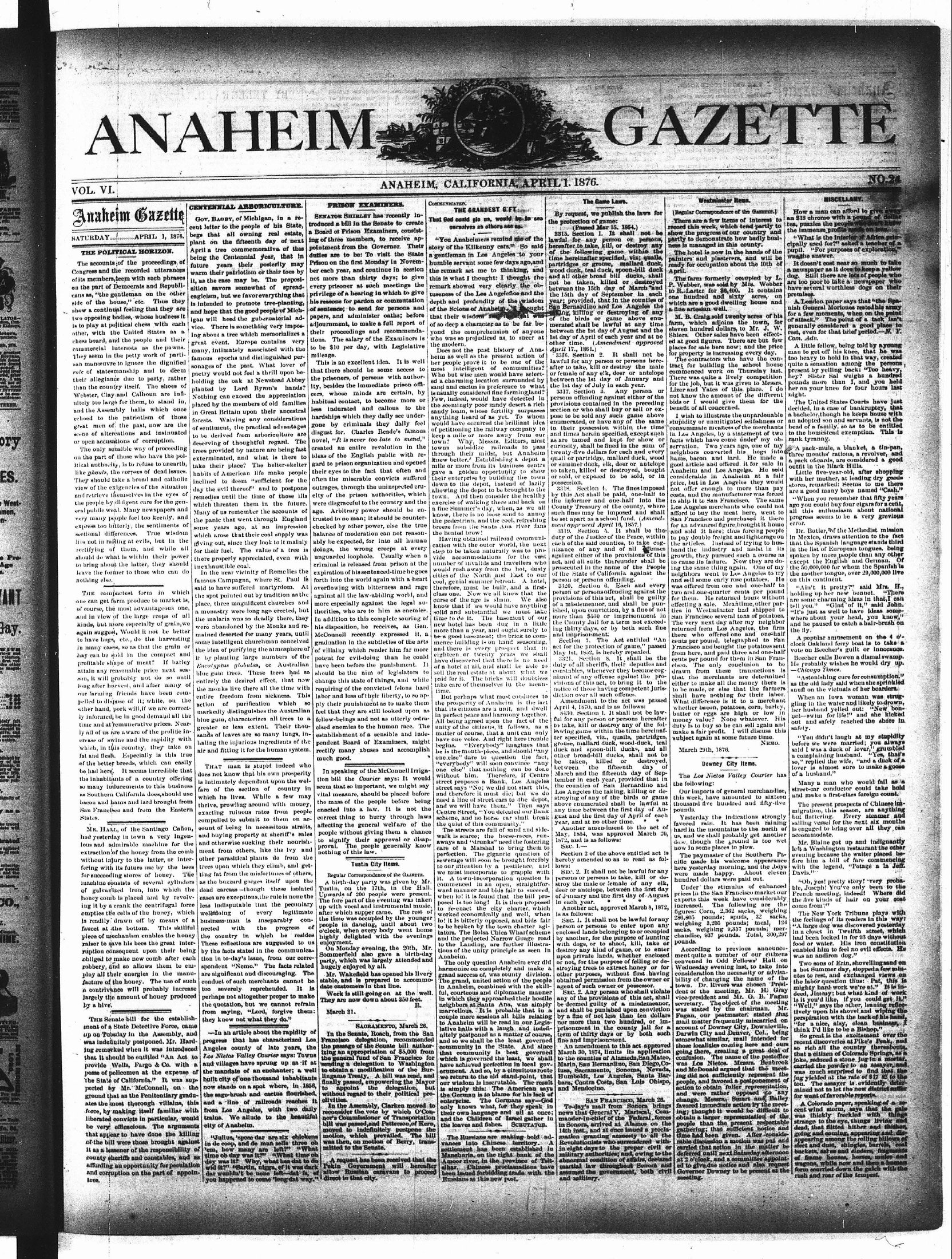
Searchable text
ANAHEIM GAZETTE
SATURDAY APRIL 1, 1876.
THE POLITICAL HORIZON.
The accounts of the proceedings of Congress and the recorded utterances of its members, seem with such phrases on the part of Democrats and Republicans as, "the gentleman on the other side of the house," etc. Thus they show a continual feeling that they are two opposing bodies, whose business it is to play at political chess with each other, with the United States as a chess board, and the people and their commercial interests as the pawns. They seem in the petty work of partisan maneuver to ignore the dignified role of statesmanship and to deem their allegiance due to party, rather than the country itself. The shoes of Webster, Clay and Calhoun are infinitely too large for them, to stand in, and the Assembly halls which once echoed to the patriotism of those great men of the past, now are the scene of altercations and insinuated or open accusations of corruption.
The only sensible way of proceeding on the part of those who have the political authority, is to refuse to unearth, centennial arboriculture.
Gov. Baoby, of Michigan, in a recent letter to the people of his State, begs that all owning real estate, plant on the fifteenth day of next April a tree commemorative of this being the Centennial year, that in future years their posterity may warm their patriotism or their toes by it, as the case may be. The proposition savors somewhat of spread-eagleism, but we favor everything that is intended to promote tree-planting, and hope that the good people of Michigan will head the gubernatorial advice. There is something very imposing about a tree which memorializes a great event. Europe contains very many, intimately associated with the famous epochs and distinguished personages of the past. What lover of poetry would not feel a thrill upon beholding the oak at Newstead Abbey planted by Lord Byron's hands? Nothing can exceed the appreciation placed by the members of old families in Great Britain upon their ancestral forests. Walving any considerations of sentiment, the practical advantages to be derived from arboriculture are deserving of thoughtful regard. The trees provided by nature are being fast exterminated, and what is there to take their place? The helter-skelter
SENATOR SHIRE
produced a bill in a Board of Prisoning of three men pointment from duties are to be Prison on the first ber each year, not more than every prisoner privilege of a he his reasons for pro sentence; to papers, and adjournment, to their proceedings. The salaries to be $10 per mileage.
This is an exe that there should be prisoners, or it besides these cers, whose habitual contact less indurated hardships which gone by crime disgust for. C novel, "It is no created an en ideas of the E gard to prison
role of statesmanship and to deem their allegiance due to party, rather than the country itself. The shoes of Webster, Clay and Calhoun are infinitely too large for them, to stand in, and the Assembly halls which once echoed to the patriotism of those great men of the past, now are the scene of altercations and insinuated or open accusations of corruption.
The only sensible way of proceeding on the part of those who have the political authority, is to refuse to unearth, like ghoul's, the corpses of dead issues. They should take a broad and catholic view of the exigencies of the situation and retrieve themselves in the eyes of the people by diligent care for the general public weal. Many newspapers and very many people feel too keenly, and express too bitterly, the sentiments of sectional differences. True wisdom lies not in railing at evils, but in the rectifying of them, and while all should do what is within their power to bring about the latter, they should leave the former to those who can do nothing else.
The compactest form in which one can get farm produce to market is, of course, the most advantageous one, and in view of the large crops of all kinds, but more especially of grain, we again suggest. Would it not be better to have hogs, etc., do the harvesting in many cases, so as that the grain or hay can be sold in the compact and profitable shape of meat? If barley attain any reasonable price next season, it will probably not do so until long after harvest, and after many of our farming friends have been compelled to dispose of it; while, on the other hand, pork will, if we are correctly informed, be in good demand all the time and at remunerative prices. Nearly all of us are aware of the prolific increase of swine and the rapidity with which, in this country, they take on fat and flesh. Especially is this true of the better breeds, which can easily be had here. It seems incredible that the inhabitants of a country offering so many inducements to this business as Southern California does, should use bacon and hams and lard brought from San Francisco and from the Eastern States.
Mr. Hael, of the Santiago Cañon, had yesterday in town a very ingenious and admirable machine for the extraction of the honey from the comb without injury to the latter, or interfering with its future use by the bees for succeeding stores of honey. The machine consists of several cylinders of whirling iron into which the poetry would not feel a thrill upon holding the oak at Newstead Abbey planted by Lord Byron's hands? Nothing can exceed the appreciation placed by the members of old families in Great Britain upon their ancestral forests. Walving any considerations of sentiment, the practical advantages to be derived from arboriculture are deserving of thoughtful regard. The trees provided by nature are being fast exterminated, and what is there to take their place? The helter-skelter habits of American life make people inclined to deem "sufficient for the day the evil thereof" and to postpone remedies until the time of those ills which threaten them in the future. Many of us remember the accounts of the panic that went through England some years ago, at an impression which arose that their coal supply was giving out, since they look to it mainly for their fuel. The value of a tree is there properly appreciated, even with inexhaustible coal.
In the near vicinity of Rome lies the famous Campagna, where St. Paul is said to have suffered martyrdom. At the spot pointed out by tradition as the place, three magnificent churches and a monastery were long ago erected, but the malaria was so deadly there, they were abandoned by the Monks and remained deserted for many years, until some intelligent churchman conceived the idea of purifying the atmosphere of it by planting large numbers of the Eucalyptus globulus, or Australian blue gum trees. These trees had so entirely the desired effect, that now the monks live there all the time with entire freedom from sickness. This action of purification which so markedly distinguishes the Australian blue gum, characterizes all trees to a greater or less extent. Their thousands of leaves are so many lungs, inhabiting the injurious ingredients of the air and fitting it for the human system.
That man is stupid indeed who does not know that his own prosperity is intimately dependent upon the welfare of the section of country in which he lives. While a few may thrive, prowling around with money, exacting ruinous rates from people compelled to submit to them on account of being in necessitous straits, and buying property at sheriff's sales and otherwise sucking their nourishment from others, like the ivy and other parasitical plants do from the trees upon which they climb, and getting fat from the misfortunes of others, as the buzzard gorges itself upon the dead carcass—though these isolated poetry would not feel a thrill upon beholding the oak at Newstead Abbey planted by Lord Byron's hands? Nothing can exceed the appreciation placed by the members of old families in Great Britain upon their ancestral forests. Walving any considerations of sentiment, the practical advantages to be derived from arboriculture are deserving of thoughtful regard. The trees provided by nature are being fast exterminated, and what is there to take their place? The helter-skelter habits of American life make people inclined to deem "sufficient for the day the evil thereof" and to postpone remedies until the time of those ills which threaten them in the future. Many of us remember the accounts of the panic that went through England some years ago, at an impression which arose that their coal supply was giving out, since they look to it mainly for their fuel. The value of a tree is there properly appreciated, even with inexhaustible coal.
In the near vicinity of Rome lies the famous Campagna, where St. Paul is said to have suffered martyrdom. At the spot pointed out by tradition as the place, three magnificent churches and a monastery were long ago erected, but the malaria was so deadly there, they were abandoned by the Monks and remained deserted for many years, until some intelligent churchman conceived the idea of purifying the atmosphere of it by planting large numbers of the Eucalyptus globulus, or Australian blue gum trees. These trees had so entirely the desired effect, that now the monks live there all the time with entire freedom from sickness. This action of purification which so markedly distinguishes the Australian blue gum, characterizes all trees to a greater or less extent. Their thousands of leaves are so many lungs, inhabiting the injurious ingredients of the air and fitting it for the human system.
In speaking tion bill they seem that so vital measurethe mass of th enacted into correct thing affecting th e people without to signify th proval. The nothing of th
Mr. Hael, of the Santiago Cafon, had yesterday in town a very ingenious and admirable machine for the extraction of the honey from the comb without injury to the latter, or interfering with its future use by the bees for succeeding stores of honey. The machine consists of several cylinders of galvanized iron, into which the honey comb is placed and by revolving it by a crank the centrifugal force empties the cells of the honey, which is readily drawn off by means of a faucet at the bottom. This skillful piece of mechanism enables the honey raiser to save his bees the great interruption consequent upon their being obliged to make new comb after each robbery, and so allows them to employ all their energies in the manufacture of the honey. The use of such a contrivance will probably increase largely the amount of honey produced by a hive.
The Senate bill for the establishment of a State Detective Force, came up on Tuesday in the Assembly, and was indelinitely postponed. Mr. Harding remarked when it was introduced that it should be entitled "An Act to provide Wells, Fargo & Co. with a posse of policemen at the expense of the State of California." It was supported by Mr. McConnell, on the ground that as the Penitentiary graduates the most thorough villains, this force, by making itself familiar with liberated convicts in particular, would be very efficacious. The arguments that appear to have done the killing of the bill were those brought against it as a lessener of the responsibility of county sheriffs and constables, and as affording an opportunity for peculation and corruption on the part of appointees.
In an article about the rapidity of progress that has characterized Los Angeles county of late years, the Los Nietos Valley Courier says: Towns and villages have sprung up as if at the mandate of an enchanter; a well built city of one thousand inhabitants now stands on a spot where, in 1856, the sage-brush and cactus flourished, and a line of railroads reaches it from Los Angeles, with two daily trains. We allude to the beautiful city of Anaheim.
"Julius, 'spose dar are six chickens in de coop, and de man sells three ob'em, how many are left?' "What time ob day was it? Why, what has dat to do wid it?" "Sartin, nigga, if it was dark dar wouldn't be none left—dat is, if you happened to come 'long dat way.'"
ANAHEIM, CALIFORNIA, APRIL 1. 1876.
CULTURE.
In a re-State, estate, of next of this that in city may be tooes by proposi-spreadning that planting, of Mich-erial ad-ay imposi-srializes a nns very with the shed per-lover of pupon be-nd Abbey hands? preciation families ancestral derations advantages culture are ward. The being fast there to ever-skelter
PRISON EXAMINERS.
Senator Shirley has recently introduced a bill in the Senate to create a Board of Prison Examiners, consisting of three members, to receive appointment from the Governor. Their duties are to be: To visit the State Prison on the first Monday in November each year, and continue in session not more than thirty days; to give every prisoner at such meetings the privilege of a hearing in which to give his reasons for pardon or commutation of sentence; to send for persons and papers, and administer oaths; before adjournment, to make a full report of their proceedings and recommendations. The salary of the Examiners is to be $10 per day, with Legislative mileage.
This is an excellent idea. It is well that there should be some access to the prisoners, of persons with authority, besides the immediate prison officers, whose minds are certain, by habitual contact, to become more or less indurated and callous to the hardships which they daily see under-gone by criminals they daily feel disgust for. Charles Reade's famous novel, "It is never too late to mend," created an entire revolution in the ideas of the English public with regard to prison organization and opened the fact that often andCommunicated.
THE GRANDEST GFT.
That God could gie us, would be to see ourselves as others see us.
"You Anaheimers remind me of the story of the Kilkenny cata." So said a gentleman in Los Angeles to your humble servant some few days ago, and the remark set me to thinking, and this is what I thought: I thought the remark showed very clearly the obtuseness of the Los Angelesios and the depth and profundity of the wisdom of the Selons of Anaheim. I thought that their wisdom did not light was of so deep a character as to be far beyond the comprehension of anyone who was so prejudiced as to sneer at the modern.
Does not the past history of Anaheim as well as the present action of her people prove it to be one of the most intelligent of communities? Who but wise men would have selected a charming location surrounded by sand and cactus in preference to what is usually considered fine farming land? Few, indeed, would have detected in the seemingly poor sandy desert a rich sandy loam, whose fertility surpasses anything heard of as yet. To whom would have occurred the brilliant idea of petitioning the railway company to keep a mile or more away from our town? Why, Messrs. Editors, most towns subsidize railroads to pass through their midst, but Anaheim knew better. Establishing a depot a mile or more from its business centre
The Game Laws.
By request, we publish the laws for the protection of game:
(Passed Mar 15. 1854.)
3315. Section 1. It shall not be lawful for any person or persons hereafter to take, kill, or destroy any of the following game within the time hereinafter specified, viz; qualls, partridges or grouse, mallard duck, wood duck, teal duck, spoon-bill duck and all other broad bill ducks, shall not be taken, killed or destroyed between the 15th day of March and the 15th day of September in each year; provided, that in the counties of San Bernardino and Los Angeles the killing, killing or destroying of any of the birds or game above enumerated shall be lawful at any time between the 1st day of August and the 1st day of April of each year and at no other time. (Amendment approved April 17., 1861.)
3316. Section 2. It shall not be lawful for any person or persons hereafter to take, kill or destroy the male or female of any elk, deer or antelope between the 1st day of January and the 1st day of July in each year.
3317. Section 3. Any person or persons offending against either of the provisions contained in the preceding section or who shall buy or sell or expose to be sold any such game above enumerated, or have any of the same in their possession within the time and times herein specified, except such as are tamed and kept for show or curiosity, shall be fined in the sum of twenty-five dollars for each and every quail or partridge, mallard duck, wood or summer duck, elk, deer or antelope
In speaking of the McCounnell Irrigation bill the Courier says: It would seem that so important, we might say vital measure, should be placed before the mass of the people before being enacted into a law. It is not the correct thing to hurry through laws affecting the general welfare of the people without giving them a chance to signify their approval or disapproval. The people generally know nothing of this law.
Tustin City Items.
Regular Correspondence of the Gazette.
A birth-day party was given by Mr. Tustin on the 17th, in the Hall.
Who but wise men would have selected a charming location surrounded by sand and cactus in preference to what is usually considered fine farming land? Few, indeed, would have detected in the seemingly poor sandy desert a rich sandy loam, whose fertility surpasses anything heard of as yet. To whom would have occurred the brilliant idea of petitioning the railway company to keep a mile or more away from our town? Why, Messrs. Editors, most towns subsidize railroads to pass through their midst, but Anaheim knew better. Establishing a depot a mile or more from its business centre gave a golden opportunity to show their enterprise by building the town down to the depot, instead of lazily allowing the depot to be brought to the town. And then consider the healthy exercise of walking there and back on a fine Summer's day, when, as we all know, there is no loose sand to annoy the pedestrian, and the cool, refreshing breeze from the Santa Ana river fans the heated brow!
Having obtained railroad communication with the outer world, the next step to be taken naturally was to provide accommodations for the vast number of invalids and travellers who would rush away from the hot, dusty cities of the North and East to our cool, genial summer retreat. A hotel, therefore, must be built, and a first-class one. Now we all know that the curse of the age is sham. We also know that if we would have anything solid and substantial we must take time to do it. The basement of our new hotel has been dug in a little more than a year, and ought surely to be a good basement; the brick to commence building is on hand seasoning, and there is every prospect that in eighteen or twenty years we shall have discovered that there is no need of a hotel at all, and shall be able to sell the real estate at about what we paid for it. The bricks will doubtless take care of themselves in the meantime.
But perhaps what most conduces to the prosperity of Anaheim is the fact that its citizens are a unit, and dwell in perfect peace and harmony together. All being agreed upon the fact of the unity of the citizens, it follows, as a matter of course, that a unit can only have one voice. And right here trouble begins. "Everybody" imagines that he is the mouth-piece, and should "any one else" dare to question the fact, "everybody" will soon convince "any one else" that nothing can be done without him. Therefore, if Centre street proposes a Bank, Los Angeles street says "No; we did not start this, and therefore it must die; but we do need a line of street cars to the depot, and we will have them." Then says Centre Street, "You defeated our Bank scheme, and no horse car shall break the quiet of this community."
The streets are full of sand and sidewalk is scarce; the horse-races, runaways and "drunks" need the fostering care of a Marshal to bring them to perfection. The gigantic question of sewerage will soon be brought forebly to our attention by a pestilence, and we must incorporate to grapple with it. A town-incorporation question is commenced in an open, straightforward manner and will be fair to everyone.
or female of any elk, deer or antelope between the 1st day of January and the 1st day of July in each year.
3317. Section 3. Any person or persons offending against either of the provisions contained in the preceding section or who shall buy or sell or expose to be sold any such game above enumerated, or have any of the same in their possession within the time and times herein specified, except such as are tamed and kept for show or curiosity, shall be fined in the sum of twenty-five dollars for each and every quail or partridge, mallard duck, wood or summer duck, elk, deer or antelope so taken, killed or destroyed, bought or sold, or exposed to be sold, or in possession.
3318. Section 4. The fines imposed by this Act shall be paid, one-half to the informer and one-half into the County Treasury of the county, where such fines may be imposed and shall be set apart as a school fund. (Amendment approved April 16, 1857.)
3319. Section 5. It shall be the duty of the Justice of the Peace, within each of the said counties, to take cognizance of any and all offenses against either of the provisions of this act, and all suits thereunder shall be prosecuted in the name of the People of the State of California against the person or persons offending.
3320. Section 6. Each and every person or persons offending against the provisions of this act, shall be guilty of a misdemeanor, and shall be punished, upon conviction, by a fine of not more than $500 or imprisonment in the County Jail for a term not exceeding thirty days, or by both such fine and imprisonment.
Section 7. The Act entitled "An act for the protection of game," passed May 1st, 1852, is hereby repealed.
3321. Section 8. It shall be the duty of all sheriffs their deputies and constables whenever they become cognizant of any offense against the provisions of this act, to bring it to the notice of those having competent jurisdiction over all such offenes.
Amendment to the act was passed April 4, 1870, and is as follows:
8430. Section 1. It shall not be lawful for any person or persons hereafter to take, kill or destroy any of the following game within the time hereinafter specified, viz., qualls, partridges, grouse, mallard duck, wood-duck, teal duck and spoon-bill ducks, and all other broad-bill ducks, shall not be taken, killed or destroyed, between the fifteenth day of March and the fifteenth day of September in each year, provided that in the counties of San Bernardino and Los Angeles the taking, killing or destroying of any of the birds or game above enumerated shall be lawful at any time between the first day of August and the first day of April of each year, and at no other time.
Another amendment to the act of May, 1854, was approved March 20, 1872, and is as follows:
SEC. 1—
Section 2 of the above entitled act is hereby amended so as to read as follows:
SEC. 2. It shall not be lawful for any persons or persons to take, kill or destroy the male or female of any elk, deer or antelope between the 1st day of January and the 1st day of July in each year.
Tustin City Items.
Regular Correspondence of the Gazette.
A birth-day party was given by Mr. Tustin, on the 17th, in the Hall. Upwards of 200 people were present. The fore part of the evening was taken up with vocal and instrumental music, after which supper came. The rest of the time was occupied by the younger people in dancing, until about two o'clock, when every body went home highly delighted with the evenings enjoyment.
On Monday evening, the 20th, Mr. Sommerfield also gave a birth-day party, which was largely attended and hugely enjoyed by all.
Mr. Wakefield has opened his livery stable, and is prepared to accommodate customers in that line.
Work is still going on at the well. They are now down about 350 feet.
March 21.
SAORAMENTO, March 26.
In the Senate, Roach, from the San Francisco delegation, recommended the passage of the Senate bill authorizing an appropriation of $5,000 from the general fund of San Francisco for sending a delegation to Washington to obtain a modification of the Burlingame Treaty. A bill was read, and finally passed, empowering the Mayor to appoint the delegation, but without regard to their political proclivities.
In the Assembly, Clarken moved to reconsider the vote by which O'Connor's Commissioner of Transportation bill was passed, and Patterson, of Kern, moved to indefinitely postpone the motion, which prevailed. The bill was then, on motion of Berry, transmitted to the Senate.
A request has been received that the Pekin Government will hereafter allow Russian caravans to proceed direct to that city.
The streets are full of sand and sidewalk is scarce; the horse-races, runaways and "drunks" need the fostering care of a Marshal to bring them to perfection. The gigantic question of sewerage will soon be brought forthly to our attention by a pestilence, and we must incorporate to grapple with it. A town-incorporation question is commenced in an open, straightforward manner and bids fair to succeed, when lo! it is found that the bill proposed is too long! It is then proposed to re-enact the city charter, which worked economically and well, when lo! it is bitterly opposed, and bids fair to be broken by the town charter agitators. The Bolsa Chica Wharf scheme and the projected Narrow Guage road to the Landing, are further illustrations of the unity principle as seen in Anaheim.
The only question Anaheim ever did harmonize on completely and make a grand success of, was county division. The grand, united action of the people in Anaheim, combined with the skillful, courteous and diplomatic manner in which they approached their hostile neighbors at Santa Ana, was simply marvellous. It is probable that in a couple more sessions all bills relating to Anaheim will be read in our Legislative halls with a laugh and indefinitely postponed as a matter of course, and so we shall be the least governed community in the State. And since that community is best governed which is governed the least, we shall have achieved perfection in local government. And so, by a circuitous route we return to the old stand-point, that our wisdom is inscrutable. The result is simply this: The American says the German is to blame for his lack of enterprise. The Germans say—God only knows what, for they speak in their own language and all at once; and the Children of Israel gather in the leaves and fishes. SCRUTATOR.
The Russians are making hold advances into Chinese territory. A settlement has been established in Manahuria, on the right bank of the Amoor river, in the province of Tulalar. Chinese proclamations have been issued forbidding trade with the Russians at this new post.
Los Angeles the taking, killing or destroying of any of the birds or game above enumerated shall be lawful at any time between the first day of August and the first day of April of each year, and at no other time.
Another amendment to the act of May, 1854, was approved March 20, 1872, and is as follows:
SEC. 1.—
Section 2 of the above entitled act is hereby amended so as to read as follows:
SEC. 2. It shall not be lawful for any persons or persons to take, kill or destroy the male or female of any elk, deer or antelope, between the first day of January and the first day of August in each year.
Another act, approved March 8, 1872, is as follows:
SEC. 1. It shall not be lawful for any person or persons to enter upon any enclosed lands belonging to or occupied by another, for the purpose of hunting with dogs, or to shoot, kill, take or destroy any kind of game, or to enter upon private lands, whether enclosed or not, for the purpose of selling or destroying trees to extract honey or for other purposes, without first having obtained permission from the owner or agent of such owner or possessor.
SEC. 2. Any person who shall violate any of the provisions of this act shall be deemed guilty of a misdemeanor, and shall be punished upon conviction by a fine of not less than ten dollars nor more than two hundred, or imprisonment in the county jail for a term of thirty days or by both such fine and imprisonment.
An amendment to this act approved March 30, 1874, limits its application to the counties of Alameda,San Mateo,Marin,Sau Bernardino,San Diego,Colusa,Sacramento,Sonoma,Nevada,Humboldt,Los Angeles,Santa Barbara,Contra Costa,San Luis Obispo,and Mendocino.
SAN FRANCISCO, March 26.
To-day's mail from Sonora brings news that General V.Mariscal, Commander-in-chief of the Federal forces in Sonora, arrived at Alamos on the 14th inst., and at once issued a proclamation granting amnesty to all the Revolutionists who surrendered within eight days to the proper civil or military authorities; and, owing to the abnormal condition of affairs, declared martial law throughout Sonora and assumed the government, both civil and military.
GAZETTE
NO.24
Game Laws.
The publish the laws for this game:
Mar 15, 1854.
1. It shall not be used by person or persons, kill, or destroy any game within the specified viz; qualls, mouse, mallard duck, duck, spoon-bill duck, road bill ducks, shall be killed or destroyed on the day of March and September in each county in the counties of and Los Angeles the day of August and the day of January and July in each year.
2. It shall not be person or persons here- all or destroy the male elk, deer or antelope day of January and July in each year.
3. Any person or dog against either of the claimed in the preceding shall buy or sell or ex- any such game above have any of the same condition within the time specified, except such and kept for show or be found in the sum of dollars for each and every age, mallard duck, wood elk, deer or antelope destroyed bought
Westminster Items.
[Regular Correspondence of the Gazette.]
There are a few items of interest to record this week, which tend partly to show the progress of our country and partly to demonstrate how badly business is managed in this county.
The hotel is now in the hands of the painters and plasterers, and will be ready for occupation about the 10th of April.
The farm formerly occupied by L. P. Webber, was sold by Mrs. Webber to R.: Larter for $6,400. It contains one hundred and sixty acres, on which are a good dwelling house and a fine artesian well.
M. B. Craig sold twenty acres of his farm, which adjoins the town, for eleven hundred dollars, to Mr. J. W. Shiers. Other sales have been effected at good figures. There are but few places for sale here now; and the price for property is increasing every day.
The contractors who have the contract for building the school house commenced work on Thursday last. There was quite a lively competition for the job, but it was given to Messrs. Lizer and Yates of this place. I do not know the amount of the different bids or I would give them for the benefit of all concerned.
I wish to illustrate the unpardonable stupidity or unmitigated selfishness or consummate meanness of the merchants in Los Angeles, by a statement of two facts which have come under my observation. Two years ago, one of my neighbors converted his hogs into hams, bacon and lard. He made a good article and offered it for sale in Los Angeles. He sold
MISCELLANY.
How a man can afford to give away an $18 chrome with a pound of dollar tea, puzzles the people who don't know the immense profiled made on them.
"What is the interior of Africa principally used for?" asked a teacher of a pupil. "For purposes of exploration," was the answer.
It doesn't cost near so much to take a newspaper as it does to keep a yellow dog. Still there are lots of people who are too poor to take a newspaper who have several worthless dogs on their premises.
A London paper says that "the Spanish General Moriones rested his army for a few moments, when on the point of attack." The point of a tank isn't generally considered a good place to rest, even for that brief period.—N. P. Com. Adv.
A little fellow, being told by a young man to get off his knee, that he was too heavy to hold in that way, created quite a sensation among the persons present by yelling back: "Too heavy, hey? Sister Sal weighs a hundred pounds more than I, and you hold her on your knee for four hours last night.
The United States Courts have just decided, in a case of bankruptcy, that a bachelor, though he keeps house with an adopted son and servants, is not the head of a family, so as to be entitled to the homestead exemption. This is rank tyranny.
A pack-mule, a blanket, a tin-pan, three months' rations, a revolver, and a pack of cards, are considered a good outfit in the Black Hills.
3. Any person or being against either of the claimed shall buy or sell or exchange such game above have any of the same condition within the time specified, except such and kept for show or be fixed in the sum of dollars for each and every age, mallard duck, wood elk, deer or antelope or destroyed, bought used to be sold, or in commenced work on Thursday last. There was quite a lively competition for the job, but it was given to Messrs. Lizer and Yates of this place. I do not know the amount of the different bids or I would give them for the benefit of all concerned.
I wish to illustrate the unpardonable stupidity or unmitigated selfishness or consummate meanness of the merchants in Los Angeles, by a statement of two facts which have come under my observation. Two years ago, one of my neighbors converted his hogs into haws, bacon and lard. He made a good article and offered it for sale in Anaheim and Los Angeles. He sold considerable in Anaheim at a fair price, but in Los Angeles they would not offer enough to more than pay costs, and the manufacturer was forced to ship it to San Francisco. The same Los Angeles merchants who could not afford to buy the meat here, went to San Francisco and purchased it there for an advanced figure, brought it home and sold it here; thus forcing people to pay double freight and lighterage on the articles. Instead of trying to husband the industry and assist in its growth, they pursued such a course as to cause its failure. Now they are doing the same thing again. One of my neighbors went to Los Angeles to try and sell some early rose potatoes. He was offered from one and one-half to two and one-quarter cents per pound for them. He returned home without effecting a sale. Meantime, other parties in Westminster had shipped to San Francisco several tons of potatoes. The very next day after my neighbor returned from Los Angeles, the firm there who offered one and one-half cents per pound, telegraphed to San Francisco and bought the potatoes sent from here, and paid three and one-half cents per pound for them in San Francisco. The only conclusion to be drawn from these transactions is that the merchants are determined either to make all the money there is to be made, or else that the farmers shall have nothing for their labor. What difference is it to a merchant whether bacon, potatoes, corn, barley, butter or eggs are high or low in money value? None whatever. His duty is to buy so he can sell again and make a fair profit. I will discuss this subject again at some future time.
March 29th, 1876.
Downey City Items.
The Los Nietos Valley Courier has the following:
Our imports of general merchandise, this week, have amounted to sixteen thousand five hundred and fifty-five pounds.
Yesterday the indications strongly favored rain. It has been raining hard in the mountains to the north of us, and we shall probably get another dose, though the ground is too wet now in some places to plow.
The paymaster of the Southern Pacific made his welcome appearance here yesterday morning, and the boys were made happy. About eleven hundred dollars were paid out.
Under the stimulus of enhanced present by yelling back: "Too heavy, hey? Sister Sal weighs a hundred pounds more than I, and you held her on your knee for four hours last night.
The United States Courts have just decided, in a case of bankruptcy, that a bachelor, though he keeps house with an adopted son and servants, is not the head of a family, so as to be entitled to the homestead exemption. This is rank tyranny.
A pack-mule, a blanket, a tin-pan, three months' ratios, a revolver, and a pack of cards, are considered a good outfit in the Black Hills.
Little five-year-old, after shopping with her mother, at leading dry goods stores, remarked: Seems to me there are a good many boys named "Cash."
"When you remember that fifty years ago you could buy four cigars for a cent, all this enthusiasm about national progress seems to be a very grevious error.
Dr. Butler, of the Methodist mission in Mexico, draws attention to the fact that the Spanish language stands third in the list of European tongues, being spoken by more people than any other except the English and German. Of the 50,000,000 for whom the Spanish is the mother tongue, over 29,000,000 live on this continent.
"Ain't it pretty?" said Mrs. H., holding up her new bonnet. "There are some charming ideas in that I can tell you." "Glad of it," said John. "It's just as well to have ideas somewhere about your head, you know," and he paused to catch a hair-brush on the fly.
A popular amusement on the 4 o'clock Oakland ferry boat is to take a vote on Beecher's guilt or innocence.
Beecher calls Bowen a dismal swamp. He probably wishes he would dry up.
"Astonishing cure for consumption." as the old lady said when she sprinkled snuff on the victuals of her boarders.
When an Iowa woman was struggling in the water and likely to drown, her husband yelled out: "New bonet—swim for life!" and she kicked out and safely reached the shore in safety.
"You didn't laugh at my stupidly before we were married; you always said I was a duck of lover," grumbled a complaining husband. "Yes, that's so," replied the wife, "and a duck of a lover is almost sure to make a goose of a husband."
Many a man who would fall as a street-car conductor could take hold and make a first-class foreign count.
The present prospects of Chinese immigration, this season, are anything but flattering. Every steamer and sailing vessel for the next six months is engaged to bring over all they can accommodate.
Mr. Blaine got up and indignantly left a Washington restaurant the other evening because the waiter placed before him a bill of fare commencing with the legend, "Potage a la Jeff Davis."
"Oh, yes! pretty story! very probable. Joseph! You've only been to the
the above entitled act is
ed so as to read as folshall not be lawful for any
asons to take, kill or depose, between the first day
and the first day of August,
approved March 20,
shall not be lawful for any
asons to take, kill or depose, between the first day
and the first day of August,
approved March 8, 1872,
shall not be lawful for any
asons to enter upon any
is belonging to or occupied
for the purpose of hunting
to shoot, kill, take or
send of game, or to enter
lands, whether enclosed
or purpose of selling or deposing to extract honey or for
fires, without first having
mission from the owner or
owner or possessor.
person who shall violate
provisions of this act, shall
fully of a misdemeanor,
punished upon conviction
not less than ten dollars
in two hundred, or imtain the county jail for a
day or by both such dissonantment.
ment to this application
limits its application
of Alameda, San Mateo,
Bernardino, San Diego, Conento, Sonoma, Nevada,
Los Angeles, Santa BarCoasta, San Luis Obispo,
no.
Our imports of general merchandise,
this week, have amounted to sixteen thousand five hundred and fifty-five pounds.
Yesterday the indications strongly favored rain. It has been raining hard in the mountains to the north of us, and we shall probably get another dose, though the ground is too wet now in some places to plow.
The paymaster of the Southern Pacific made his welcome appearance here yesterday morning, and the boys were made happy. About eleven hundred dollars were paid out.
Under the stimulus of enhanced prices in the San Francisco market our exports this week have considerably increased. The following are the figures: Corn, 2,362 sacks, weighing 280,805 pounds; spuds, 32 sacks, weighing 3,205 pounds; meal, 124 sacks, weighing 9,357 pounds; merchandise, 937 pounds. Total, 300,297 pounds.
According to previous announcement quite a number of our citizens convened in Odd Fellows Hall on Wednesday evening last, to take into consideration the necessity or advisability of changing the name of the town. Dr. Rivers was chosen President of the meeting, Mr. H. Gray vice-president and Mr. G. B. Fagan secretary. The object of the meeting was stated by the chairman. Mr. Fagan, our postmaster, stated that mail matter frequently miscarried on account of Downey City, Downieville, Darwin City and Denver, Col., being somewhat similar, mail intended for those localities coming here and ours going there, creating a great deal of confusion. The name of the postoffice was Los Nietos. Messrs. Benbrook and McDonald argued that the meeting did not sufficiently represent the people, and favored a postponement of action to obtain fuller representation, and were rather opposed to any change. Messrs. Smart and Bailey favored immediate action by the meeting; thought it would be difficult to obtain a larger representation of the people than the present respectable gathering; that sufficient notice and time had been given. After considerable discussion a motion was put and carried that action in the matter be deferred until next Saturday afternoon at 2 o'clock, and a committee appointed to give due notice and also request Governor Downey to be present at the meeting.
The present prospects of Chinese immigration, this season, are anything but flattering. Every steamer and sailing vessel for the next six months is engaged to bring over all they can accommodate.
Mr. Blaine got up and indignantly left a Washington restaurant the other evening because the waiter placed before him a bill of fare commencing with the legend, "Potage a la Jeff. Davis."
"Ob, yes! pretty story! very probable, Joseph! You've only been to the French meeting, indeed! Where did the five kinds of hair on your coat come from?"
The New York Tribune plays with the feelings of its readers in this way: "A large dog was discovered yesterday in a closet in Twelfth street, which had been locked in for 93 days without food or water. His iron constitution enabled him to feel no evil effects. He was an andiron dog."
Two sons of Erin, shovelling sand on a hot Summer day, stopped a few minutes to rest, and exchanged views on the labor question thus: Pat, this is mighty hard work we're at." It is indeed, Jimmy; but what kind of work is it you'd like, if you could get it." Well," says the other, leaning reflectively upon his shovel and wiping the perspiration with the back of his hand," for a nice, ally, clean business, I think I'd like to be a Bishop."
So great is the excitement over the recent discoveries at Pike's Peak, and so rich all the country thereabouts that a citizen of Colorado Springs, as a joke, reduced a stone. Jug in a mortar, carried the powder to an assayer, and was much surprised to find that the jug yielded at the rate of $17.92 to the ton. The assayer is evidently determined not to let the new district suffer for want of favorable reports.
A Colorado paper, speaking of a recent wind storm, says that the pole was thickly freckled with things strange to the eye, things living and dead, that flitted hither and thither going and coming, appearing and disappearing among the rolling hills of steel and dust, shingles, barrels, coal buckets, ashes and cinders, fragments of frame houses, homes, mules and wagons, while now and then a human form scurried down the gulch with the rush and roar of the tempest.