anaheim-gazette 1876-03-25
Scanned page
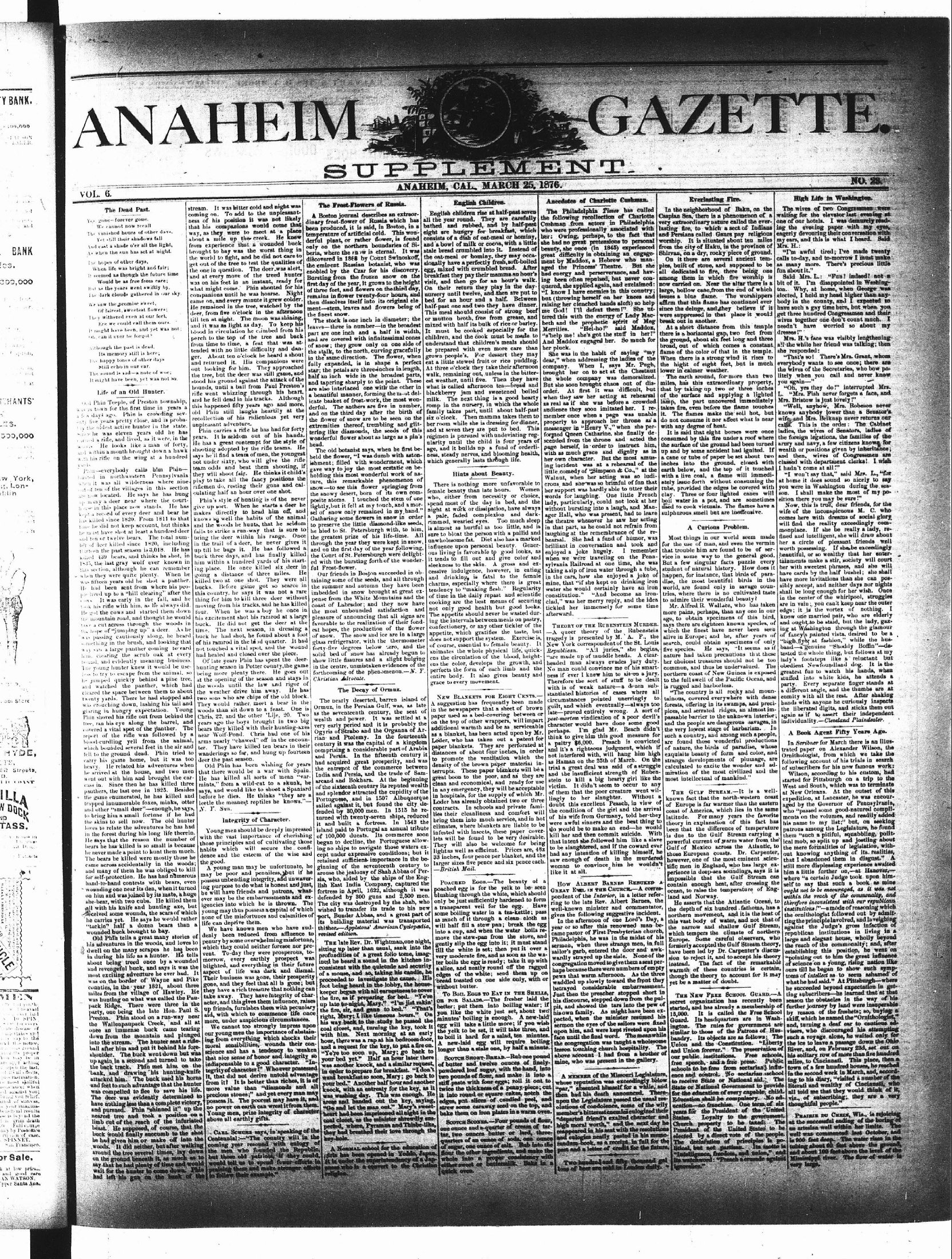
Searchable text
ANAHEIM
VOL. 6.
The Dead Past.
Yes gone—forever gone.
We cannot now recall
The vanished hours of other days.
Yet still their shadows fall
And cast a shade o'er all the light,
As when the sun has set at night.
The hopes of other days,
When life was bright and fair;
It seemed as though the future time
Would be as free from care;
But as the years went swiftly by,
The dark clouds gathered in our sky.
We saw the promise sweet,
Of fairest, sweetest flowers;
They withered even at our feet,
Ere we could call them ours.
It might have been, and yet was not;
Oh, can it ever be forgot?
Although the past is dead.
Its memory still is here;
The happy bones of other days
Still echo in our ear.
The sound is sad—a note of woe;
It might have been, yet was not so.
Life of an Old Hunter.
Old Phin Teeple, of Preston township,
was in town for the first time in years a
fifty days ago. Phin is crowding seventy five years pretty close, and is probably the oldest active hunter in the state.
Since he was eleven years old he has
carried a rifle, and lived, as it were, in the
waters.
He looks like a man of forty,
and within a month brought down a hawk
with his rifle on the wing at a hundred yards.
stream. It was bitter cold and night was coming on. To add to the unpleasantness of his position it was not likely that his companions would come that way, as they were to meet at a place about a mile up the creek. He knew from experience that a wounded buck brought to bay was the worst thing in the world to fight, and he did not care to get out of the tree to test the qualities of the one in question. The deer was alert, and at every move of the treed hunter was on his feet in an instant, ready for what might come. Phin shouted for his companions until he was hoarse. Night came on, and every minute it grew colder. He remained in the tree, watched by the deer, from five o'clock in the afternoon till ten at night. The moon was shining, and it was as light as day. To keep his blood in circulation he climbed from his perch to the top of the tree and back from time to time, a feat that was atteched with no little difficulty and danger. About ten o'clock he heard a shout and returned it. His companions were out looking for him. They approached the tree, but the deer was still game, and stood his ground against the attack of the hounds, until a ball from Paul Preston's rifle went whizzing through his heart, and he fell dead in his tracks. Although this happened fifty years ago and more, old Phin still laughs heartily at the recollection of his ridiculous yet very unpleasant adventure.
Phin carries a rifle he has had for forty years. It is seldom out of his hands. He has a great contempt for the style of shooting adopted by the rifle teams. He says he'll find a team of men, the youngest not under sixty, who will give the rifle team odds and beat them shooting, if
Life of an Old Hunter.
Odin Phin Teeple, of Preston township, was in town for the first time in years a few days ago. Phin is crowding seventy-five years pretty close, and is probably the oldest active hunter in the state. Since he was eleven years old he has carried a rifle, and lived, as it were, in the woods. He looks like a man of forty, and within a month brought down a hawk with his rifle on the wing at a hundred yards.
Phin—everybody calls him Phin—hunted in northwestern Pennsylvania when it was all wilderness where nine out of ten of the villages in this section are now located. He says he has hung up many a deer near where the court-house in this place now stands. He has kept a record of every deer and bear he has killed since 1820. From 1811 to that time he did not keep account, but thinks he must have shot at least a hundred deer and ten or twelve bears. The total number of deer killed since 1820, including thirteen the past season is 3,018. He has killed 439 bears, and thinks he shot, in 1855, the last gray wolf ever known in this section, although he can remember when they were quite plenty. When he was fifteen years old he shot a panther. He had been sent from where his people lived up to a "hill clearing" after the cows. It was early in the fall, and he took his rifle with him, as life always did. He got the cows and started them down the mountain road, and thought he would take a cut across through the woods in the hope of "jumping up" a deer. As he was passing cautiously along, he heard something in the brush, and looking that way saw a large panther coming toward him, clearing the scrub oak at every sound, and evidently meaning business. The young hunter knew it would be useful to try to escape from the animal, so he jumped quickly behind a pine tree, and watched the panther, which had cleared the space between them to about twenty yards. There he had stopped and was crouching down, lashing his tail and glaring in hungry expectation. Young Phin shoved his rifle out from behind the tree, ran his eye along the barrel, and covered a vital spot of the panther. The report of the rifle was followed by a blood-curdling yell from the animal, which bounded several feet in the air and fell to the ground dead. Phin tried to carry his game home, but it was too heavy. He related his adventures when he arrived at the house, and two men went out with him and brought the carcass in. Since then he has killed three panthers, the last one in 1825. Besides the game enumerated, he has killed and trapped innumerable foxes, minks, otter and other "small deer"—enough, he says, to bring him a small fortune if he had the skins to sell now. The old hunter loves to relate the adventures he has had in the forest during his long life therein. He says that the reason the number of bears he has killed is so small is because he never made a point to hunt them much. The bears he killed were mostly those he came across accidentally in the woods; and many of them he was obliged to kill for self-protection. He has had numerous hand-to-hand contests with bears, even wounding one near its den, when it turned out looking at the tree, but the deer was still game, and stood his ground against the attack of the hounds, until a ball from Paul Preston's rifle went whizzing through his heart, and he fell dead in his tracks. Although this happened fifty years ago and more, old Phin still laughs heartily at the recollection of his ridiculous yet very unpleasant adventure.
Phin carries a rifle he has had for forty years. It is seldom out of his hands. He has a great contempt for the style of shooting adopted by the rifle teams. He says he'll find a team of men, the youngest not under sixty, who will give the rifle team odds and beat them shooting, if they will shoot fair. He thinks it child's play to take all the fancy positions the riflemen do, resting their guns and calculating half an hour over one shot.
Phin's style of hunting is of the never give up sort. When he starts a deer he makes directly to head him off, and knows so well the habits of the animal and the woods he hunts, that he seldom fails to strike a run-way that is sure to bring the deer within his range. Once in the trail of a deer, he never gives it up till he bags it. He has followed a buck three days, and has finally killed him within a hundred yards of his starting place. He once killed six deer in going a distance of three miles. He killed two at one shot. They were all bucks. Before game got so scarce in this country, he says it was not a rare thing for him to kill three deer without moving from his tracks, and he has killed four. When he was a boy he once in his excitement shot his ranarod at a large buck. He did not get the deer at the time. The next season, in dressing a buck he had shot, he found about a foot of his ramrod in the hard quarter. It had not touched a vital spot, and the wound had healed and closed over the piece.
Of late years Phin has spent the deer-hunting season in Potter county, the game being more plentiful there. He goes out at the opening of the season and stays in the woods until the law and rigor of the weather drive him away. He has two sons who are chips of the old block. They would rather meet a bear in the woods than sit down to a feast. One is Chris, 22, and the other Lije, 20. Two years ago the boys brought in two big bears they killed with their hunting-axes near Wolf-Pond. Chris had one of his arms nearly "chawed" off in the encounter. They have killed ten bears in their wanderings so far, and hung up fourteen deer the past season.
Old Phin has been wishing for years that there would be a war with Spain. He has killed all sorts of mean "varmints," from a wild-cat to a skunk, he says, and would like to shoot a Spaniard before he dies. He thinks "they are a leetle the meanest reptiles he knows."—N.Y.Sun.
Integrity of Character.
Young men should be deeply impressed with the vast importance of cherishing those principles and of cultivating those habits which will secure the confidence and the esteem of the wise and the good.
A young man may be unfortunate, he may be poor and penniless, but if he possess unbending integrity, and unwavering purpose to do what is honest and just,
star; the petals are half an inch wide and tapering sharply are also interlaced a beautiful manatee basket of frightful. The antheth on and on the third of the flower of snow extremities there tering like diamonds wonderful flowers head.
The old botanist held the flower," ashment"; filled vase gave way to joy holding this most mature, this remains snow—to see this snowy desert posite atoms. I lightly, but it fell sel of snow only Gathering some to preserve the life hied to St. Peter greatest prize through the year and on the first day The Court of St. Peter ed with the bursal Frost-flower.
Our friends in taining some of these summer and imbedded in snaps sense from the W coast of Labradrthe most unbroken pleasure of annov favorable to est hopes,the p of snow.The s glass refrigerator forty-five degree solid bed of sn show little fissure in the centre.un forthcoming of Christian Adroo
Integrity of Character.
Young men should be deeply impressed with the vast importance of cherishing those principles and of cultivating those habits which will secure the confidence and the esteem of the wise and the good.
A young man may be unfortunate, he may be poor and penniless, but if he possesses unbending integrity, and unwavering purpose to do what is honest and just, he will have friends and patrons, whatever may be the embarrassments and exigencies into which he is thrown. The young may thus possess a capital of which none of the misfortunes and calamities of life can deprive them.
We have known men who have suddenly been reduced from affluence to penury by some overwhelming misfortune, which they could neither foresee nor prevent. To-day they were prosperous, tomorrow, every earthly prospect was blighted, and everything in their future aspect of life was dark and dismal. Their business was gone, their prosperity gone, and they feel that all is gone; but they have a rich treasure that nothing can take away. They have Integrity of character, and this gives them influence, raises up friends, furnishes them with pecuniary aid, with which to commence life once more, under auspicious circumstances.
We cannot too strongly impress upon our young men the importance of abstaining from everything which shocks their moral sensibilities, wounds their conscience and has a tendency to weaken that nice sense of honor and integrity so indispensable to a good character. "Integrity of character!" Who ever possessed it, that did not derive untold advantage from it? It is better than riches, it is of more value than "diamonds and all precious stones;" and yet every man may possess it. The poorest may have it; and no power on earth can wrest it from them. Young men, prize integrity of character above all earthly gifts.
Carl Schurz says, in speaking of the Centennial:—"The country will in the coming year resound with enloyage of the men who founded the Republic, but them old patriots; if they could, would tell us to spend fewer efforts in praising them and make stronger efforts to follow their example."
CIM GA
SUPPLEMENT.
ANAHEIM, CAL., MARCH 25, 1876.
The Frost-Flowers of Russia.
A Boston journal describes an extraordinary frost-flower of Russia which has been produced, it is said, in Boston, in a temperature of artificial cold. This wonderful plant, or rather flower, is found only on the northern boundaries of Siberia, where the snow is eternal. It was discovered in 1868 by Count Swinoskoff, the eminent Russian botanist, who was enobled by the Czar for his discovery. Bursting from the frozen snow on the first day of the year, it grows to the height of three feet, and flowers on the third day, remains in flower twenty-four hours, and then dissolves itself into its original element—stem, leaves and flowers being of the finest snow.
The stock is one inch in diameter; the leaves—three in number—in the broadest part are one inch and a half in width, and are covered with infinitessimal cones of snow; they grow only on one side of the stalk, to the north, curving gracefully in the same direction. The flower, when fully expanded, is in shape a perfect star; the petals are three-snches in length, half an inch wide in the broadest parts, and tapering sharply to the point. These are also interlaced one with the other in a beautiful manner, forming the most delicate basket of frost-work, the most wonderful. The anthers are five in number, and on the third day after the birth of the flower of snow are to be seen on the extremities thereof, trembling and glittering like diamonds, the seeds of this wonderful flower about as large as a pin's head.
The old botanist says, when he first held the flower, "I was dumb with astonishment; filled with wonderment, which gave way to joy the most ecstatic on be-
English Children.
English children rise at half-past seven all the year round. They are carefully bathed and rubbed, and by half-past eight are hungry for breakfast, which consists of a dish of oat-meal or hominy, and a bowl of milk or cocoa, with a little stale bread crumbled into it. Instead of the oat-meal or hominy, they may occasionally have a perfectly fresh, soft-boiled egg, mixed with crumbled bread. After breakfast they pay their mamma an hour's visit, and then go for an hour's walk. On their return they play in the day-nursery until twelve, and then are put to bed for an hour and a half. Between half-past one and two they have dinner. This meal should consist of strong beef or mutton broth, free from grease, and mixed with half its bulk of rice or barley. It must be cooked especially for the children, and the cook must be made to understand that children's meals should be prepared with even more care than grown people's. For dessert they may eat a little stewed fruit or rice pudding. At three o'clock they take their afternoon walk, remaining out, unless in the bitterest weather, until five. Then they have what is called afternoon tea—bread and blackberry jam and sweetened boiled milk. The next thing is a good hearty romp in the nursery, in which the whole family takes part, until about half-past six o'clock. Then mamma takes them to her room while she is dressing for dinner, and at seven they are put to bed. This regimen is pursued with undeviating regularity until the child is four years of age, and it builds up a fund of orderliness, steady nerves, and blooming health, which generally lasts through life.
Anecdotes of Charlotte Cashman.
The Philadelphia Times has culled the following recollection of Charlotte Cashman from actors in Philadelphia who were professionally associated with her: Owing, perhaps, to the fact that she had no great pretensions to personal beauty, she once (in 1845) experienced great difficulty in obtaining an engagement by Maddox, a Hebrew who managed the Princess' Theatre. But she had energy and perserverance, and having been often repulsed, but never conquered, she applied again, and exclaimed: "I know I have enemies in this country; but (throwing herself on her knees and raising her clenched hands aloft) so help me God! I'll defeat them!" She uttered this with the energy of Lady Macbeth and the prophetic spirit of Meg Merrilies. "Hel-ho!" said Maddox, "a help me! she's got the stuff in her!" And Maddox engaged her. So much for her pluck.
She was in the habit of saying "my dear," when addressing the ladies of the company. When I, says Mr. Pugh, brought her on to act at the Chestnut the whole company was demoralized. But she soon brought chaos out of disorder. At first it was difficult, but when they saw her acting at rehearsal as real as if she was before a crowded audience they soon imitated her. I remember once when a page was unable properly to approach her throne as a messenger in "Henry V." when she performed Queen Catharine, she finally descended from the throne and acted the page herself, in order to instruct him, with as much grace and dignity as in her own character. But the most amusing incident was at a rehearsal of the
The Decay of Ormuz.
The nearly deserted, barren island of Ormuz, in the Persian Gulf, was as late as seventeenth century, the seat of wealth and power. It was settled at a very early period and it is probably the Ogyris of Strabo and the Organna of Arrian and Ptolemy. In the fourteenth century it was the capital of a kingdom comprising a considerable part of Arabia and Persia. In the fifteenth century it had acquired great prosperity, and was the entrepôt of the commerce between India and Persia, and the trade of Samarcand and Bokhara. At the beginning of the sixteenth century its reputed wealth and splendor attracted the cupidity of the Portuguese, and in 1507 Albuquerque sailed against it, but found the city defended by 80,000 men. In 1515 he returned with twenty-seven ships, reduced it and built a fortress. In 1543 the island paid to Portugal an annual tribute of 100,000 ducats. Its commerce soon began to decline, the Portuguese allowing no ships to navigate those waters except under expressive conditions; but it retained sufficient importance in the beginning of the seventeenth century to arouse the jealousy of Shah Abbas of Persia, who, aided by the ships of the English East India Company, captured the star, the petals three inches in length, half an inch wide in the broadest parts, and tapering sharply to the point. These are also interlaced one with other in a beautiful manner, forming the most delicate basket of frost-work, the most wonderful. The anthers are five in number, and on the third day after the birth of the flower of snow are to be seen on the extremities thereof, trembling and glittering like diamonds, the seeds of this wonderful flower about as large as a pin's head.
The old botanist says, when he first held the flower, "I was dumb with astonishment; filled with wonderment, which gave way to joy the most ecstatic on holding this most wonderful work of nature, this remarkable phenomenon of snow—to see this flower springing from the snowy desert, born of its own composite atoms. I touched the stem of one lightly, but it fell at my touch, and a morsel of snow only remained in my hand." Gathering some flowers in snow in order to preserve the little diamond-like seeds, he hied to St. Petersburgh with, to him, the greatest prize of his life-time. All through the year they were kept in snow, and on the first day of the year following, the Court of St. Petersburgh were delighted with the bursting forth of the wonderful Frost-flower.
Our friends in Boston succeeded in obtaining some of the seeds, and all through the summer and autumn they have been imbedded in snow brought at great expense from the White Mountains and the coast of Labrador; and they now have the most unbounded satisfaction and pleasure of announcing that all signs are favorable to the realization of their fondest hopes, the production of the flower of snow. The snow and ice are in a large glass refrigerator, with the thermometer forty-five degrees below zero, and the solid bed of snow has already begun to show little fissures and a slight bulging in the centre, unmistaken evidences of the forthcoming of the phenomenon.—N.Y. Christian Altocate.
The Decay of Ormuz.
The nearly deserted, barren island of Ormuz, in the Persian Gulf, was as late as seventeenth century, the seat of wealth and power. It was settled at a very early period and it is probably the Ogyris of Strabo and the Organna of Arrian and Ptolemy. In the fourteenth century it was the capital of a kingdom comprising a considerable part of Arabia and Persia. In the fifteenth century it had acquired great prosperity, and was the entrepôt of the commerce between India and Persia, and the trade of Samarcand and Bokharna. At the beginning of the sixteenth century its reputed wealth and splendor attracted the cupidity of the Portuguese, and in 1507 Albuquerque sailed against it, but found the city defended by 80,000 men. In 1515 he returned with twenty-seven ships, reduced it and built a fortress. In 1543 the island paid to Portugal an annual tribute of 100,000 ducats. Its commerce soon began to decline, the Portuguese allowing no ships to navigate those waters except under expressive conditions; but it retained sufficiency in the beginning of the seventeenth century to arouse the jealousy of Shah Abbas of Persia, who, aided by the ships of the English East India Company, captured the star, the petals three inches in length, half an inch wide in the broadest parts, and tapering sharply to the point. These are also interlaced one with other in a beautiful manner, forming the most delicate basket of frost-work, most wonderful. The anthers are five in number, and on the third day after the birth of the flower of snow are to be seen on the extremities thereof, trembling and glittering like diamonds, the seeds of this wonderful flower about as large as a pin's head.
The old botanist says, when he first held the flower, "I was dumb with astonishment; filled with wonderment, which gave way to joy the most ecstatic on holding this most wonderful work of nature, this remarkable phenomenon of snow—to see this flower springing from the snowy desert, born of its own composite atoms. I touched the stem of one lightly, but it fell at my touch, and a morsel of snow only remained in my hand." Gathering some flowers in snow in order to preserve the little diamond-like seeds, he hied to St. Petersburgh with, to him, the greatest prize of his life-time. All through the year they were kept in snow, and on the first day of the year following, the Court of St. Petersburgh were delighted with the bursting forth of the wonderful Frost-flower.
Our friends in Boston succeeded in obtaining some of the seeds, and all through the summer and autumn they have been imbedded in snow brought at great expense from the White Mountains and the coast of Labrador; and they now have the most unbounded satisfaction and pleasure of announcing that all signs are favorable to the realization of their fondest hopes, the production of the flower of snow. The snow and ice are in a large glass refrigerator, with the thermometer forty-five degrees below zero, and the solid bed of snow has already begun to show little fissures and a slight bulging in the centre, unmistaken evidences of the forthcoming of the phenomenon.—N.Y. Christian Altocate.
The Decay of Ormuz.
The nearly deserted, barren island of Ormuz, in the Persian Gulf, was as late as seventeenth century, the seat of wealth and power. It was settled at a very early period and it is probablythe Ogyris of Strabo andthe Organnaof ArrianandPtolemy.Inthefourteenthcenturyitwasthecapitalofakingsom comprisingaconsiderablepartofArabiaandPersia.Inthefifteenthcenturyithadacquiredgreatprosperity,andwastheentrepôtofthecommercebetweenIndiaandPersia,andthetradeofSamarcandBokharna.Atthebeginningofthe十六teenthcenturyitsreputedealthandbeaserviceableablanket,hasbeactuatedupbyMr.Loderwhohas takenoutapatientforpaperblankets Theyareperforatedatt distancesofaboutfourinchesinordertopromotetheventilationwhichthedensityofthebrownpapermaterialinterruptsThesepaperblanketswillbewa grande虏topoor,andastheyarecleanandeconomical,andreadyforuseinanyemergency,theywillbeacceptinhospitals,forksupplyofwhichMr.LoderhasalreadyobtaintworighthedistanceofthevelktobeseenInschoolsandprivatefamilytheircleanlinessandcomfortwillbringthemintuchservice,andinhotclimateswhereblanketsareliabletobefinestedwithinsects,thesepapercoverletswillbefoundtoberverydesirableTheywillalsobewelcomeforbeinglightaswellasefficient.Pricesare,48x33inches,fourpenceperblanket,andthelarger sizesfivepenceandsixpenceeach.BritishMail.
Poached Eggs.-The beautyofa poached egg is forthevelktobeseenwhatiscalledapoachedeggisforthevelktobeseenbutshesohnroughtchaosoutofdisorder.Atfirstitw dificult,butwhen she saw her actingatrehearsalasrealasifshewasbeforea-crowded audiencetheysohnimitatedher.Irememberoncewhenapagewasunableproperlytoproachherthroneasamessengerin"HenryV,"whensheperformedQueenCatharine,she finallydescendedfromthethroneandacttedthepageherself.in-ordertoinstructhimwithasmghraceanddignityasinherowncharacter.BButthemostamusingincidentwasatatrehearsalofthelittlecomedyof"Simpson&Co.,"attheWalnut,hensheractingwasso ludicrous,andshewas sobrimfuloffunthathersupportwashardly abletotutter theirwordsfor laughing。一小ileFrench lady,particularly,couldnotlookatherwithoutburstingintoa laugh,andManagerHall,howshe enjoyedajokeofmine,that"ifshekeptondrinkingwatershewouldcertainhavean iron constitution."Andbecomeanironclad,"washermeryreply,andtheidea tickledherimmenselyforsometimeafterward.
THEORY OF THE RUBENSTEIN MUCHDER.
-A queer theoryoftheRubenstein tragedyispresentedbyM.A.F.,theNewYorkcorrespondentoftheSt.LouisRepublican.“Alljuries,”shebegins"aremadeupinduddleheads.Aclear-headedmanalwaysevadesjuryduty.No mancouldconvincemeoffhissmartnessifeverIknowhimtositonajury.Thethereforesortofstufftobe dealtwithisofweaknature-adivensubstantiatedhistoriesofcaseswhalles circumstancespointedunerringlytoguilt,andwhicheventually~alwaystoo late-provedentirelywrong.Asortofpost-mortemvindicationofapoordevil'scharacter wouldhavedonesomegood perhaps.I'mgladMr.Beach didn'tthinkgivehimthisgoodmeasurefora paltry$6,000.Pesachis convictedandit'sa righteousjudgmentwhichifnotinterferedwith,millhanghimhighasHumanonthe25thMarch.Onthetrialagreatdealwassaidofastruggleandthein insufficientstrengthRubensteintokillabigheartygirllikethevictim。它didn'tseemtocoomtothereumensforwhetheritthoeroughcrewwentwillinglytoherslaughter.Without达oubtthisexcellentPesach,intviewoftheconditionofthegirlandthearrivalofhiswifefromGermany,toldher-theywereawfulsinnersandthebestthing todo wouldbe tomakeanend-hewouldkillherandthencommitsuicide.Withthatintentshefollowedhimlikea slave tobe slaughtered,andIfthecoward ever had any intentionofkillinghimself,hewouldoughofdeathinthemurderedwomantoconvincehimhewouldlikeitatall.
HOW ALBERT BARNES REBUKED A GREAT STREET IN THE CHURCH- A cornerstone for this company
It is youngest sayi whiliview seve nt hail thereto support it.
It consists o ne upa i nch tau l t e s u r n e t h e r o w
It does notwithin
It consists o ne upa i nch tau l t e s u r n e t h e r o w
It does notwithin
It consists o ne upa i nch tau l t e s u r n e t h e r o w
It does notwithin
It consists o ne upa i nch tau l t e s u r n e t h e r o w
It does notwithin
It consists o ne upa i nch tau l t e s u r n e t h e r o w
It does notwithin
It consists o ne upa i nch tau l t e s u r n e t h e r o w
It does notwithin
It consists o ne upa i nch tau l t e s u r n e t h e r o w
It does notwithin
It consists o ne upa i nch tau l t e s u r n e t h e r o w
It does notwithin
It consists o ne upa i nch tau l t e s u r n e t h e r o w
It does notwithin
It consists o ne upa i nch tau l t e s u r n e t h e r o w
It does notwithin
It consists o ne upa i nch tau l t e s u r n e t h e r o w
It does notwithin
It consists o ne upa i nch tau l t e s u r n e t h e r o w
It does notwithin
It consists o ne upa i nch tau l t e s u r n e t h e r o w
It does notwithin
It consists o ne upa i nch tau l t e s u r n e t h e r o w
It does notwithin
It consists o ne upa i nch tau l t e s u r n e t h e r o w
It does notwithin
It consists o ne upa i nch tau l t e s u r n e t h e r o w
It does notwithin
It consists o ne upa i nch tau l t e s u r n e t h e r o w
It does notwithin
It consists o ne upa i nch tau l t e s u r n e t h e r o w
It does notwithin
It consists o ne upa i nch tau l t e s u r n e t h e r o w
It does notwithin
It consists o ne upa i nch tau l t e s u r n e t h e r ro w
It does notwithin
It consists o ne upa i nch tau l t e s u r n.e.t h er ro w
It does notwithin
It consists o ne upa i nch tau l t e s u r n.e.t h er ro w
It does notwithin
It consists o ne upa i nch tau l t e s u r n.e.t h er ro w
It does notwithin
It consists o ne upa i nch tau l t e s u r n.e.t h er ro w
It does notwithin
It consists o ne upa i nch tau l t e s u r.n.e.t h er ro w
It does notwithin
It consists o ne upa i nch tau l t e s u r.n.e.t h er ro w
It does notwithin
It consists o ne upa i nch tau l t e s u r.n.e.t h er ro w
It does notwithin
It consists o ne upa i nch tau l t e s.u.r.n.e.t h er ro w
It does notwithin
It consists o ne upa i nch tau l.t esu.r.n.e.t h er ro w
It does notwithin
It consists o ne upa i ni ch.t esu.r.n.e.t h er ro w
It does notwithin
It consists o ne upa ni ch.t esu.r.n.e.t h er ro w
It does notwithin
ITSdoesnoithinnothingaboutthiscompany
The Decay of Ormuz.
The nearly deserted, barren island of Ormuz, in the Persian Gulf, was late as seventeenth century,the seat of wealth and power. It was settled at a very early period and it is probablythe Ogyris of Strabo andthe Organna.ofArrianandPtolemy.Inthefourteenthcenturyitwasthecapitalofakingsom comprisingaconsiderablepartofArabiaandPersia.Inthefifteenthcenturyithadacquiredgreatprosperity,andwastheentrepottedofthecommercebetweenIndiaandPersia,andthetradeofSamarcandBokharna.Atthebeginningofthe十六teenthcenturyitsreputeedethicsonlytogetherintroductionofthecircuitbetweenIndiaandPersia,andthetradeofSamarcandBokharna.Atthebeginningofthe十六teenthcenturyitsreputeedethicsonlytogetherintroductionofthecircuitbetweenIndiaandPersia,andthetradeofSamarcandBokharna.Atthebeginningofthe十六teenthcenturyitsreputeedethicsonlytogetherintroductionofthecircuitbetweenIndiaandPersia,andthetradeofSamarcandBokharna.Atthebeginningofthe十六teenthcenturyitsreputeedethicsonlytogetherintroductionofthecircuitbetweenIndiaandPersia,andthetradeofSamarcandBokharna.Atthebeginningofthe十六teenthcenturyitsreputeedethicsonlytogetherintroductionofthecircuitbetweenIndiaandPersia,andthetradeofSamarcandBokharna.Atthebeginningofthe十六teenthcenturyitsreputeedethicsonlytogetherintroductionofthecircuitbetweenIndiaandPersia,andthetradeofSamarcandBokharna.Atthebeginningofthe十六teenthcenturyitsreputeedethicsonlytogetherintroductionofthecircuitbetweenIndiaandPersia,andthetradeofSamarcandBokharna.Atthebeginningofthe十六teenthcenturyitsreputeedethicsonlytogetherintroductionofthecircuitbetweenIndiaandPersia,andthetradeofSamarcandBokharna.Atthebeginningofthe十六teenthcenturyitsreputeedethicsonlytogetherintroductionofthecircuitbetweenIndia和Persia,andthetradeofSamarcandBokharna.Atthebeginningofthe十六teenthcenturyitsreputeedethicsonlytogetherintroductionofthecircuitbetweenIndia和Persia,andthetradeofSamarcandBokharna.Atthebeginningofthe十六teenthcenturyitsreputeedethicsonlytogetherintroductionofthecircuitbetweenIndia和Persia,andthetradeofSamarcandBokharna.At.thebeginningofthe十六teenthcenturyitsreputeedethicsonlytogetherintroductionofthecircuitbetweenIndia和Persia,andthetradeofSamarcandBokharna.At.thebeginningofthe十六teenthcenturyitsreputeedethicsonlytogetherintroductionofthecircuitbetweenIndia和Persia,andthetradeofSamarcandBokharna.At.thebeginningofthe十六teenthcenturyitsreputeedethicsonlytogetherintroductionofthecircuitbetweenIndia和Persia,andthetradeofSamarcandBokharna.At.thebeginningOfThe十六teenthcenturyitsreputeedethicsonlytogetherintroductionofthecircuitbetweenIndia和Persia,andthetrade-ofSamarcandBokharna.At.thebeginningOfThe十六teenthcenturyitsreputeedethicsonlytogetherintroductionofthecircuitbetweenIndia和Persia,andthetrade-ofSamarcandBokharna.At.thebeginningOfThe十六teenthcenturyitsreputeedethicsonlytogetherintroductionofthecircuitbetweenIndia和Persia,andthetrade-ofSamarcandBokharna.At.thebeginningOfThe十六teenthcenturyitsreputeedethicsonlytogetherintroductionofthecircuitbetweenIndia和Persia,andthetrade-ofSamarcandBokharna.At.thebeginningOfThe十六teenthcenturyitsreputeedethicsonlytogetherintroductionofthecircuitbetweenIndia和Persia,andthetrade-ofSamarcandBokharna.At.thebeginningOfThe十六teenthcenturyitsreputeedethicsonlytogetherintroductionofthecircuitbetweenIndia和Persia,andthetrade-ofSamarcandBokharna.At.thebeginningOfThe十六teenthcenturyitsreputeedethicsonlytogetherintroductionofthecircuitbetweenIndia和Persia,andthetrade-ofSamarcandBokharna.At.thebeginningOfThe十六teenthcenturyitsreputeedethicsonlytogetherintroductionofthecircuitbetweenIndia和Persia,andthetrade-ofSamarcandBokharna.At.thebeginningOfThe十六teenthcenturyitsreputeedethicsonlytogetherintroductionofthecircuitbetweenIndia和Persia,andthetrade-ofSamarcandBokharna.At.thebeginningOfThe十六teenthcenturyitsreputeedethicsonlytogetherintroductionofthecircuitbetweenIndia和Persia,andthetrade-ofSamarcandBokharna.At.thebeginningOfThe十六teenthcenturyitsreputeedethicsonlytogetherintroductionofthecircuitbetweenIndIA和PersIA,andTheBeginningOfThe第六teenCenturyIsRejectedByThePrincipalOfTheRubensteinMuseumInAveryChurchIsRejectedByThePrincipalOfTheRubensteinMuseumInAveryChurchIsRejectedByThePrincipalOfTheRubensteinMuseumInAveryChurchIsRejectedByThePrincipalOfTheRubensteinMuseumInAveryChurchIsRejectedByThePrincipalOfTheRubensteinMuseumInAveryChurchIsRejectedByThePrincipalOfTheRubensteinMuseumInAveryChurchIsRejectedByThePrincipalOfTheRubensteinMuseumInAveryChurchIsRejectedByThePrincipalOfTheRubensteinMuseumInAveryChurchIsRejectedByThePrincipalOfTheRubensteinMuseumInAveryChurchIsRejectedByThePrincipalOfTheRubensteinMuseumInAveryChurchIsRejectedByThePrincipalOfTheRubensteinMuseumInAveryChurchIsRejectedByThePrincipalOfTheRubensteinMuseumInAveryChurchIsRejectedByThePrincipalOfTheRubensteinMuseumInAveryChurchIsRejectedByThePrincipalOfTheRubensteinMuseumInAveryChurchIsRejectedByThePrincipalOfTheRubensteinMuseumInAveryChurchIsRejectedByThePrincipalOfTheRubensteinMuseumInAveryChurchIsRejectedByThePrincipalOfTheRubensteinMuseumInAveryChurchIsRejectedByThePrincipalOfTheRubensteinMuseumInAveryChurchIsRejectedByThePrincipalOfTheRubensteinMuseumInAveryChurchIsRejectedByThePrincipalOfTheRubensteinMuseumInAveryChurchIsRejectedByThePrincipalOfTheRubensteinMuseumInAveryChurchIsRejectedByThePrincipalOfTheRubensteinMuseumInAveryChurchIsRejectedByThePrincipalOfTheRubensteinMuseumInAveryChurchIsRejectedByThePrincipalOfTheRubensteinMuseumInAveryChurchIsRejectedByThePrincipalOfTheRubensteinMuseumInAveryChurchIsRejectedByThePrincipalOfTheRubensteinMuseumInAveryChurchIsRejectedByThePrincipalOfTheRubensteinMuseumInAveryChurchIsRejectedByThePrincipalOfTheRubensteinMuseumInAveryChurchIsRejectedByThePrincipalOfTheRubensteinMuseumInAveryChurchIsRejectedByThePrincipalOF TheRubensteinMuseumInAveryChurchIsRejectedByThePrincipalOF TheRubensteinMuseumInAveryChurchIsRejectedBY TheRubensteinMuseumInAveryChurchIsRejectedBY TheRubensteinMuseumInAveryChurchIsRejectED BY TheRubensteinMuseumInAveryChurchIsRejectED BY TheRubensteinMuseumInAveryChurchIS RejectED BY TheRubensteinMuseumInAveryChurchIS RejectED BY TheRubensteinMuseumIN AveryChurchIS RejectED BY TheRubensteinMuseumIN AveryChurchIS RejectED BY TheRubensteinMuseumIN AveryChurchIS RejectED BY TheRubensteinMuseumIN AveryChurchIS RejectED BY TheRubensteinMuseumIN AveryChurchIS RejectED BY TheRubensteinMuseumIN AveryCh埔IS RejectED BY TheRubensteinMuseumIN AveryCh埔IS RejectED BY TheRubensteinMuseumIN AveryCh埔IS RejectED BY TheRubensteinM MuseumIN AveryCh埔IS RejectED BY TheRubensteinM MuseumIN AveryCh埔IS RejectED BY TheRubensteinM MuseumIN AveryCh埔IS RejectED BY TheRubensteinM MuseumIN AveryCh埔IS RejectED BY TheRubensteinM MuseumIN AveryCh埔IS RejectED BY TheRubensteinM MuseumIN AveryCh埔IS RejectED BY TheRubensteinM MuseumIN AveryCh埔IS RejectED BY TheRubensteinM MuseumIN AveryCh埔IS RejectED BY TheRubensteinM MuseumIN AveryCh埔IS ReJECTED BY TheRubensteinM MuseumIN AveryCh埔IS ReJECTED BY TheRubensteinM MuseumIN AveryCh埔IS ReJECTED BY TheRubensteinM MuseumIN AveryCh埔IS ReJECTED BY TheRuben SteinMuseumIN AveryCh埔IS ReJECTED BY TheRuben SteinMuseumIN AveryCh埔IS ReJECTED BY TheR
and splendor attracted the cupidity of the Portuguese, and in 1507 Albuquerque sailed against it, but found the city defended by 80,000 men. In 1515 he returned with twenty-seven ships, reduced it and built a fortress. Its commerce soon began to decline, the Portuguese allowing no ships to navigate those waters except under expressive conditions; but it retained sufficient importance in the beginning of the seventeenth century to arouse the jealousy of Shah Abbas of Persia, who, aided by the ships of the English East India Company, captured the fortress in April, 1623, although it was defended by 800 guns and 2,500 men. The city was destroyed by the shah, who wished to transfer its trade to his new port, Bander Abbas, and a great part of its building material was transported thither—Appletons' American Cyclopodia, revised edition.
The late Rev. Dr. Wightman, one night, sitting up later than usual, sank into the profundities of a great folio tome, imagined he heard a sound in the kitchen inconsistent with the quietude and security of a mouse, and so, taking his candle, he proceeded to investigate the cause. His foot being heard in the lobby, the housekeeper began with all earnestness to cover the fire, as if preparing for heat. "Ye're up late ta-night, Mary?" "I'm just rakin' the fire, air, and gas to bed." "That's right, Mary; I like timeous hours." On his way back to the study he passed the coal closet, and turning the key, took it with him. Next morning at an early hour, there was a rap at his bedroom door, and a request for the key, to put a fire on. "Ye're too soon up, Mary; go back to your bed yet." Half an hour later there was another knock, and a similar request, in order to prepare for breakfast. "I don't want breakfast so soon, Mary; go back to your bed." Another half hour and another knock, with an entreaty for the key, as it was washing day. This was enough. He arrose and handed out the key, saying, "Go and let the man out." Mary's sweet heart had been imprisoned all night in the cool closet, as the minister shrewdly suspected, where Pyramus and Thiabe-like they had breathed their love through the key-hole.
A Normal school for the education of girls has been opened in Yeddo, Japan. It is under the supervision of a Japanese who is a convert to the Christian religion.
Poached Eggs.—The beauty of a poached egg is for the yolk to be seen blushing through the white, which should only be just sufficiently hardened to form a transparent veil for the egg. Have some boiling water in a tea-kettle; pass as much of it through a clean cloth as will half fill a stew pan; break the egg into a cup, and when the water boils remove the stew-pan from the stove, and gently slip the egg into it; it must stand till the white is set; then put it over a very moderate fire, and as soon as the water boils the egg is ready; take it up with a slice, and neatly round off the rogged edges of the white; send them up on bread toasted on one side only, with or without butter.
To Boil Eggs To Eat In The Shells, Or For Salads.—The fresher laid the better; put them into boiling water; if you like the white just set, about two minutes' boiling is enough. A new-laid egg will take a little more; if you wish the yelk to be set, it will take three, and to boil it hard for a salad, ten minutes. A new-laid egg will require boiling longer than a stake one, by half a minute.
Scotch Short-Bread.—Rub one pound of batter and twelve ounces of finely-powdered loaf sugar, with the hand, into two pounds of flour, and make it into a stiff paste with four eggs; roll it out to twice the thickness of a penny-piece; cut it into round or square cakes, notch the edges, put aloe of candied peel, and strew some caraway seed on the top, and bake them on iron plates in a warm oven.
Scotch Scoxes.—Four pounds of flour, one ounce and a quarter of cream of tartar, two ounces batter or hard, three-quarters of an ounce of soda, one ounce of sugar, one ounce of salt. Rub into this flour the other ingredients, and make the whole into a proper consistency with either sweet or buttermilk. Bake in a quick oven.
How Albert Barnes Rebuked A Great Eml in The Church.—A correspondent of the Interior, in a letter referring to the late Rev. Albert Barnes, the well-known minister and commentator, gives the following suggestive incident.
In the afternoon of one Lord's Day, a year or so after this renowned man became pastor of First Presbyterian church, Philadelphia, he was in the midst of his sermon, when three strange men, in full sailor's garb, entered the door and awkwardly strayed up the stile. None of the congregation moved to give them a seat perhaps because there were numbers of empty pews that warm afternoon. As the three waddled up slowly toward the front they betrayed considerable embarrassment. Just then the presacher stopped short in his discourse, stepped down from the pulpit, and showed the tars into the pew of his own family. As might have been expected, when the minister resumed his sermon the eyes of the sailors were fixed upon him, and were kept riveted upon his face until the final word. The meanwhile the congregation was tangent a wholesome lesson touching church hospitality. The above account I had from a brother of mine, who was present in the gallery.
A member of the Missouri Legislature whose reputation was exceedingly below "par," absented himself for a while, and then had his death announced. Thereupon the Legislature passed the usual resolutions of condolence, some of the wily member's bitterest enmilies eulogized their "departed friend's exalted character and high moral worth," and the next day he disappeared in his seat with the resolutions and eulogies neatly pasted in his memorial-book as a receipt in full for the past and a letter of credit for the future.
Two hundred and fifty thousand gallons of beer are said in London daily.*
GAZETTE.
NO. 23
Charlotte Cushman.
Times has culled collection of Charlotte Morris in Philadelphia usually associated with capes, to the fact that extensions to personal attentions to personal Hebrew who manned Theatre. But she observance, and hawaiised, but never conjugain, and exclaimed: "Momies in this country; if on her knees and all hands aloft) so help them!" She utnerenergy of Lady Macartney spirit of Meg Moor!" said Maddox, not the stuff in her!" needed her. So much for habit of saying "my seeing the ladies of the I," says Mr. Pugh, he act at the Chestnut Bay was demoralized. That chaos out of distress was difficult, but acting at rehearsal was before a crowded imitated her. I re-read a page was unable reach her throne as a Mary V.," when she permarine, she finally dehorne and acted the order to instruct him, his and dignity as in But the most amus-that a rehearsal of the GAZETTE.
Everlasting Fire.
In the neighborhood of Baku, on the Caspian Sea, there is a phenomenon of a very extraordinary nature called the everlasting fire, to which a sect of Indians and Persians called Gaura pay religious worship. It is situated about ten miles from the city of Haku, in the province of Shirvan, on a dry, rocky piece of ground.
On it there are several ancient temples, built of stone, and supposed to be all dedicated to fire, there being one among them in which fire worship is now carried on. Near the altar there is a large, hollow cane, from the end of which issues a blue flame. The worshippers affirm that this flame has continued ever since the deluge, and they believe if it were suppressed in that place it would break out in another.
At a short distance from this temple there is a horizontal gap, two feet from the ground, about six feet long and three broad, out of which comes a constant flame of the color of that in the temple. When there is a strong wind it rises to the height of eight feet, but is much lower in calmer weather.
The earth around, for more than two miles, has this extraordinary property, that by taking up two or three inches of the surface and applying a lighted lamp, the part uncovered immediately takes fire, even before the flame touches it. The flames make the soil hot, but do not consume it nor affect what is near with any degree of heat.
It is said that eight horses were once consumed by this fire under a roof where the surface of the ground had been turned up and by some accident had ignited. If a cane or tube of paper be set about two inches into the ground, closed with earth below, and the ton of it touched
High Life in Washington.
The wives of two Congressmen were waiting for the elevator last evening at one of our hotels. I was damnely reading the evening paper with my eyes, eagerly devouring their conversation with my ears, and this is what I heard. Said Mrs. H:
"I'm awful tired; I've made twenty calls to-day, and to-morrow I must make as many more. There's precious little fun about it."
Said Mrs. L.: "Fun! indeed! not a bit of it. I'm disappointed in Washington. Why, at home, when George was elected, I held my head higher than anybody in the county, and I expected to have such a gay time here, but when you get three hundred Congressmen and their wives together one don't count much. I needn't have worried so about my dresses!"
Mrs. H.'s face was visibly lengthening all while her friend was talking; then she responded:
"That's so! There's Mrs. Grant, whom everybody wants to see once; there are the wives of the Secretaries, who bow politely when you call and never know you again—"
"Oh, yes they do!" interrupted Mrs. L. "Mrs. Fish never forgets a face, and Mrs. Bristow is just lovely!"
Well, anyhow, Mrs. Robeson never knows anybody lower than a Senator's wife and Mrs. Belknap never returns our caller. This is the order: The Cabinet ladies, the wives of Senators, ladies of the foreign legations, the families of the army and navy, a few citizens known for wealth or positions given by inheritance; and then, wives of Congressmen are classed with department clerks! I wish I hadn't come at all!"
The Chestnut Bay was demoralized. That chaos out of disarray was difficult, but the acting at rehearsal was before a crowded imitated her. I re-read a page was unable to reach her throne as a Mary V., when she permeate, she finally deprived and acted the order to instruct him, and dignity as in But the most amusual at a rehearsal of the Simpson & Co., at the acting was so ludicrous brimful of fun that hardly able to utter their laugh. One little French could not look at her into a laugh, and Man's present, had to leave over he saw her acting could not refrain from remembrance of the re-acting was so ludicrous brimful of fun that hardly able to utter their laugh. One little French could not look at her into a laugh, and Man's present, had to leave over he saw her acting could not refrain from remembrance of the re-acting was so ludicrous brimful of fun that hardly able to utter their laugh.
A Curious Problem.
Most things in our world seem made for the use of man, and even the vermin that trouble him are found to be of service in some way to the general good. But a few singular facts puzzle every student of natural history. How does it happen, for instance, that birds of paradise, the most beautiful birds in the world, are found only in savage countries, where there is no cultivated taste to admire their wonderful beauty?
Mr. Alfred R. Wallace, who has taken more pains, perhaps, than any one in our age, to obtain specimens of this bird, says there are eighteen known species, of which the finest have never been seen alive in Europe; and he, after years of search, could obtain specimens of only five species. He says, "It seems as if nature had taken precautions that these her choice treasures should not be too common, and thus be undervalued. The northern coast of New Guinea is exposed to the full swell of the Pacific Ocean, and is rugged and harborless.
"The country is all rocky and mountainous, covered everywhere with dense forests, offering in its swamps, and precipices, and serrated ridges, an almost impassable barrier to the unknown interior; and the people are dangerous savages, in the very lowest stage of barbarism. In such a country, and among such a people, are found those wonderful productions of nature, the birds of paradise, whose exquisite beauty of form and color, and strange developments of plumage, are calculated to excite the wonder and admiration of the most civilized and the most intellectual of mankind."
THE GULF STREAM.—It is a well-known fact that the north-western coast of Europe is far warmer than the eastern coast of America, which lies in the same latitude. For many years the favorite theory in explanation of this fact has been that the difference of temperature is due to the Gulf Stream carrying a powerful current of warm water from the Gulf of Mexico across the Atlantic, to those European coasts. Dr. Carpenter, however, one of the most eminent scientific men in England, who has large experience in deep-sea soundings, says it is impossible that the Gulf Stream can contain enough heat, after crossing the lower in calmer weather.
The earth around, for more than two miles, has this extraordinary property, that by taking up two or three inches of the surface and applying a lighted lamp, the part uncovered immediately takes fire, even before the flame touches it. The flames make the soil hot, but do not consume it nor affect what is near with any degree of heat.
It is said that eight horses were once consumed by this fire under a roof where the surface of the ground had been turned up and by some accident had ignited. If a cane or tube of paper be set about two inches into the ground, closed with earth below, and the top of it touched with a live coal, a flame will immediately issue forth without consuming the tube, provided the edges be covered with clay. Three or four lighted canes will boil water in a pot, and are sometimes used to cook victuals. The flames have a sulphurous smell but are ineffensive.
A Curious Problem.
Most things in our world seem made for the use of man, and even the vermin that trouble him are found to be of service in some way to the general good. But a few singular facts puzzle every student of natural history. How does it happen, for instance, that birds of paradise, the most beautiful birds in the world, are found only in savage countries, where there is no cultivated taste to admire their wonderful beauty?
Mr. Alfred R. Wallace, who has taken more pains, perhaps, than any one in our age, to obtain specimens of this bird, says there are eighteen known species, of which the finest have never been seen alive in Europe; and he, after years of search, could obtain specimens of only five species. He says, "It seems as if nature had taken precautions that these her choice treasures should not be too common, and thus be undervalued. The northern coast of New Guinea is exposed to the full swell of the Pacific Ocean, and is rugged and harborless.
"The country is all rocky and mountainous, covered everywhere with dense forests, offering in its swamps, and precipices, and serrated ridges, an almost impassable barrier to the unknown interior; and the people are dangerous savages, in the very lowest stage of barbarism. In such a country, and among such a people, are found those wonderful productions of nature, the birds of paradise, whose exquisite beauty of form and color, and strange developments of plumage, are calculated to excite the wonder and admiration of the most civilized and the most intellectual of mankind."
A Book Agent Fifty Years Age.
In Seribner for March there is an illustrated paper on Alexander Wilson, the Ornithologist, from which we take the following account of his trials in search of subscribers for his new famous work:
Wilson according to his custom, had started for Pittsburgh on a trip to the West and South, which was to terminate at New Orleans. At the outset of this expedition, at Lancaster, he was encouraged by the Governor of Pennsylvania, who "passed some good-natured compliments on the volumes," and readily added his name to my list;" but, on seeking patrons among the Legislature, he found them "such a pitiful, squabbling, political mob," so split up and jostling about the mere formalities of legislation without knowing anything of its realities,
I abandoned them in disgust." A still more displeasing experience awaited him a little further on—at Hanover—where "a certain Judge took upon himself to say that such a book as mine
THE GULF STREAM—It is a well-known fact that the north-western coast of Europe is far warmer than the eastern coast of America, which lies in the same latitude. For many years the favorite theory in explanation of this fact has been that the difference of temperature is due to the Gulf Stream carrying a powerful current of warm water from the Gulf of Mexico across the Atlantic, to those European coasts. Dr. Carpenter, however, one of the most eminent scientific men in England, who has large experience in deep-sea soundings, says it is impossible that the Gulf Stream can contain enough heat, after crossing the ocean, to raise the temperature of England and Norway.
He asserts that the Atlantic Ocean, to the depth of six hundred fathoms, has a northern movement, and it is the heat of this vast body of water, and not that of the narrow and shallow Gulf Stream, which tempers the climate of northern Europe. Some careful observers, who formerly accepted the Gulf Stream theory, have been led by Dr. Carpenter's discussion to reject it, and to accept his theory instead. The fact of the remarkable warmth of these countries is certain, though the theory to account for it may yet be a matter of doubt.
THE NEW FREE SCHOOL GUARD—A secret organization has recently been started, and has already a membership of 15,000. It is called the Free School Guard. Its headquarters are in Washington. The rules for government are similar to those of the Patrons of Husbandry. Its objects are as follows: The Union and the Constitution. "Liberty and Union forever." The preservation of our public institutions. Free schools, free speech, and a free press. Public schools to be free from sectarian influence and control. No sectarian school to receive State or National aid. The State or National Government to provide for the education of every capable child. Education shall be compulsory. No education—no franchise. One term of six years for the President of the United States. Loyalty to the government. Church property to be taxed. The President of the United States to be elected by a direct vote of the people. The declaration of principles in political, but not partisan. Its motto is "Intelligence, freedom, and union," and its watchword: "Franchise against ignorance."
PRAIRIE DU CHRIST, Wis., is rejoicing at the successful ending of the haring of an artesian well within her limits. The well was commenced last October, and in 900 feet deep. The water rises in the tubing about 60 feet above the ground, and about 100 feet above the level of the Mississippi river. The flow of water is very large.