anaheim-gazette 1876-03-25
Scanned page
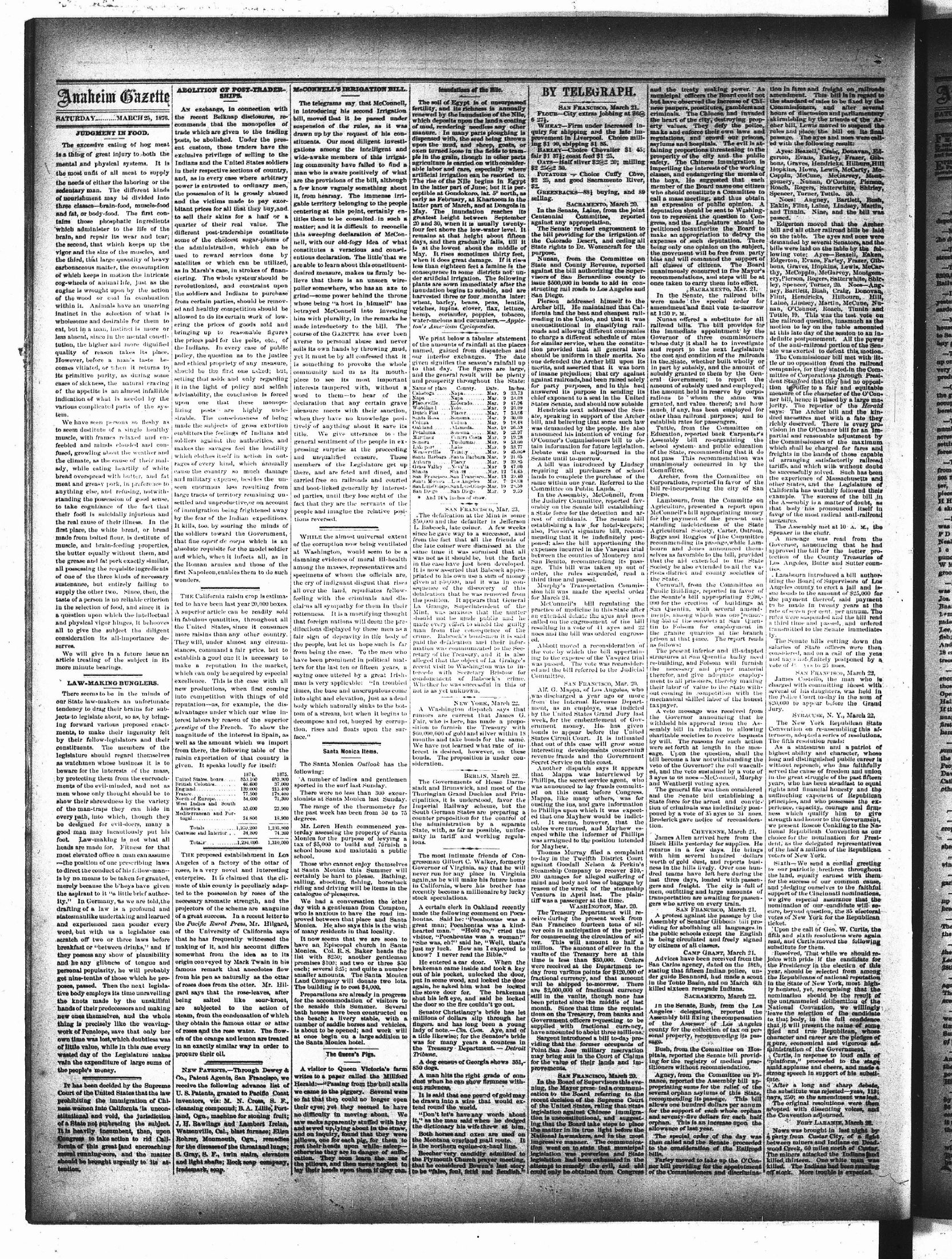
Searchable text
Anaheim Gazette
SATURDAY...MARCH 25, 1876.
JUDGMENT IN FOOD.
The excessive eating of hog meat is a thing of great injury to both the mental and physical systems. It is the most unfit of all meat to supply the needs of either the laboring or the sedentary man. The different kinds of nourishment may be divided into three classes—brain-food, muscle-food and fat, or body-food. The first contains those phosphatic ingredients which administer to the life of the brain, and repair its wear and tear; the second, that which keeps up the vigor and the size of the muscles, and the third, that large quantity of heavy carbonaceous matter, the consumption of which keeps in motion the intricate cog-wheels of animal life, just as the engine is wrought upon by the action of the wood or coal in combustion within it. Animals have an unerring instinct in the selection of what is wholesome and desirable for them to eat, but in a man, instinct is more or less absent, since in the mental constitution, the higher and more dignified quality of reason takes its place. However, before a man's taste becomes vitiated, or when it returns to its primitive purity, as during some cases of sickness, the natural craving of the appetite is an almost infallible indication of what is needed by the various complicated parts of the system.
We have seen persons so fleshy as to seem destitute of a single healthy muscle, with frames relaxed and enfeebled and minds clouded and confused, growling about the weather and the climate, as the cause of their malady, while eating heartily of white
ABOLITION OF POST-TRADERSHIPS.
An exchange, in connection with the recent Belknap disclosures, recommends that the monopolies of trade which are given to the trading posts, be abolished. Under the present custom, these traders have the exclusive privilege of selling to the Indians and the United States soldiers in their respective sections of country, and, as in every case where arbitrary power is entrusted to ordinary men, the possession of it is grossly abused and the victims made to pay exorbitant prices for all that they buy,and to sell their skins for a half or a quarter of their real value. The different post-traderships constitute some of the choicest sugar-plums of the administration, which can be used to reward services done by satellites or which can be utilized, as in Marsh's case, in strokes of financiering. The whole system should be revolutionized, and constraint upon the soldiers and Indians to purchase from certain parties, should be removed and healthy competition should be allowed to do its certain work of lowering the prices of goods sold and bringing up to reasonable figures the prices paid for the pelts, etc., of the Indians. In every case of public policy, the question as to the justice and ethical propriety of any measure, should be the first one asked; but, setting that aside and only regarding it in the light of policy and selfish advisability, the conclusion is forced upon one that these monopolizing posts are highly undesirable. The consciousness of being made the subjects of gross extortion embitters the feelings of Indians and soldiers against the authorities, and makes the savages feel the hostility which clothes itself in action in outrages of every kind, which annually
McCORNELL'S IRRITATION.
The telegrams say in introducing his bill, moved that it suspend of the ratified up by the requisitents. Our most regulations among the wide-awake members living community have man who is aware poise are the provisions of a few know vaguely it, from hearsay. The gable territory belongs centering at this point titles them to be content; and it is difficult this sweeping declaration nell, with our old-fashioned constitutes a veracious declaration. They are able to learn about desired measure, make lie that there is no puller somewhere, whose being "a host betrayed McConnell him with plurality," made introductory to course of the GAZETTE averse to personal soils its own hands by yet it must be by all is something to proclaim community and use piece to see its interests tampered word to them—to declaration that an measure meets with when they have no tivety of anything new title. We give us general sentiment of pressing surprise at and unqualified members of the LA
its primitive purity, as during some cases of sickness, the natural craving of the appetite is an almost infallible indication of what is needed by the various complicated parts of the system.
We have seen persons so fleshy as to seem destitute of a single healthy muscle, with frames relaxed and enfeebled and minds clouded and confused, growling about the weather and the climate, as the cause of their malady, while eating heartily of white bread overspread with butter, and fat meat and greasy pork, in preference to anything else, and refusing, notwithstanding the possession of good sense, to take cognizance of the fact that their food is suicidally injurious and the real cause of their illness. In the first place, the white bread, or bread made from bolted flour, is destitute of muscle, and brain-feeding properties, the butter equally without them, and the grease and fat pork exactly similar, all possessing the requisite ingredients of one of the three kinds of necessary sustenance, but entirely failing to supply the other two. Since, then, the taste of a person is no reliable criterion in the selection of food, and since it is a question upon which the intellectual and physical vigor hinges, it behooves all to give the subject the diligent consideration its all-importance deserves.
We will give in a future issue an article treating of the subject in its more minute bearings.
LAW-MAKING BUNGLERS.
There seems to be in the minds of our State law-makers an unfortunate tendency to drag their brains for subjects to legislate about, so as, by bringing forward various proposed enactments, to make their ingenuity felt by their fellow-legislators and their constituents. The members of the legislature should regard themselves as watchmen whose business it is to beware for the interests of the mass, by protecting them from the encroachments of the evil-minded, and not as men whose only thought should be to show their shrewdness by the variety of the man-traps they can hide in every path, into which, though they be designed for evil-doers, many a good man may incautiously put his foot. Law-making is not what all heads are made for. Fitness for that most elevated office a man can assume—the position of one prescribing laws to direct the conduct of his fellow-man—is by no means to be taken for granted, merely because the b'hoys have given
THE California raisin crop is estimated to have been last year 20,000 boxes. A superior article can be readily sold in fabulous quantities, throughout all the United States, since it consumes more raisins than any other country. They will, under almost any circumstances, command a fair price, but to establish a good one it is necessary to make a reputation in the market, which can only be acquired by especial excellence. This is the case with all new productions, when first coming into competition with things of old reputation—as, for example, the disadvantages under which our wine interest labors by reason of the superior prestige of the French. To show the magnitude of the interest in Spain, as well as the amount which we import from there, the following table of the raisin exportation of that country is given. It speaks loudly for itself:
| | 1874 | 1875 |
| :--- | :--- | :--- |
| United States. boxes | 853,100 | 689,900 |
| British Colonies | 46,600 | 37,000 |
| England | 139,000 | 213,400 |
| France | 77,500 | 178,400 |
| North of Europe | 54,600 | 71,300 |
| West Indies and South America | 53,600 | 23,900 |
| Mediterranean and Portugal | 34,800 | 18,900 |
| Totals | 1,259,200 | 1,235,800 |
| Costwise and Interior | 34,800 | 74,200 |
| Totals | 1,294,000 | 1,310,000 |
The proposed establishment in Los Angeles of a factory of the otter of roses is a very novel and interesting enterprise. It is claimed that the climate of this county is peculiarly adaptable to its primitive purity, as during some cases of sickness, the natural craving of the appetite is an almost infallible indication of what is needed by the various complicated parts of the system.
We have seen persons so fleshy as to seem destitute of a single healthy muscle, with frames relaxed and enfeebled and minds clouded and confused, growling about the weather and the climate, as the cause of their malady, while eating heartily of white bread overspread with butter, and fat meat and greasy pork, in preference to anything else, and refusing, notwithstanding the possession of good sense, to take cognizance of the fact that their food is suicidally injurious and the real cause of their illness. In the first place, the white bread, or bread made from bolted flour, is destitute of muscle, and brain-feeding properties, the butter equally without them, and the grease and fat pork exactly similar, all possessing the requisite ingredients of one of the three kinds of necessary sustenance, but entirely failing to supply the other two. Since, then, the taste of a person is no reliable criterion in the selection of food, and since it is a question upon which the intellectual and physical vigor hinges, it behooves all to give the subject the diligent consideration its all-important deserves.
We will give in a future issue an article treating of the subject in its more minute bearings.
LAW-MAKING BUNGLERS.
There seems to be in the minds of our State law-makers an unfortunate tendency to drag their brains for subjects to legislate about, so as, by bringing forward various proposed enactments, to make their ingenuity felt by their fellow-legislators and their constituents. The members of the legislature should regard themselves as watchmen whose business it is to beware for the interests of the mass, by protecting them from the encroachments of the evil-minded, and not as men whose only thought should be to show their shrewdness by the variety of the man-traps they can hide in every path, into which, though they be designed for evil-doers, many a good man may incautiously put his foot. Law-making is not what all heads are made for. Fitness for that most elevated office a man can assume—the position of one prescribing laws to direct the conduct of his fellow-man—is by no means to be taken for granted, merely because the b'hoys have given
WHILE the almost-of the corruption now at Washington,would damming evidence of among the masses,re specimens of whom all over the land,re feeling with the critic claims all sympathy rottenness. It is a matter that foreign nations would directions displayed by fair sign of depravity people,but let us from being the case. Have been prominent试者 for the last ten o'clock saying once uttered him is very applicable times,the base and use into sight and elevation body which naturally tomof a stream,but decompose and rot,bition,rises and float face."
Santa Monica
The Santa Monica following:
"A number of ladies sported in the surf lace"
There were no less sionists at Santa Monica.
The range of the past week has been degrees.
Mr. Loren Heath terday assessing the Monica for the purpose tax of $5,000 to build school house and m school.
Those who cannot at Santa Monica certainly be hard to sailing,shooting,fishing,riding and driving w
men whose only thought should be to show their shrewdness by the variety of the man-traps they can hide in every path, into which, though they be designed for evil-doers, many a good man may incautiously put his foot. Law-making is not what all heads are made for. Fitness for that most elevated office a man can assume—the position of one prescribing laws to direct the conduct of his fellow-man—is by no means to be taken for granted, merely because the b'hoys have given the aspirant to it "a little brief authority." In Germany, as we are told, the drafting of a law is a profound and statesmanlike undertaking and learned and experienced men ponder every word, but with us a legislator can scratch off two or three laws before breakfast or "between drinks," and if they possess any show of plausibility and he any glibness of tongue and personal popularity, he will probably get nine-tenths of those which he proposes, passed. Then the next legislative body employs its time unravelling the knots made by the unskillful hands of their predecessors and making new ones themselves, and the whole thing is precisely like the weaving-work of Penelope, save that only her own time was lost, which doubtless was of little value, while in this case every wasted day of the Legislature makes vain the expenditure of large sums of the people's money.
It has been decided by the Supreme Court of the United States that the law prohibiting the immigration of Chinese women into California is unconstitutional and void, the jurisdiction of a State not embracing the subject. It is heavily incumbent, then, upon Congress to take action to rid California of this great land encroaching moral running-sore, and the matter should be brought urgently to its attention.
THE proposed establishment in Los Angeles of a factory of the otter of roses, is a very novel and interesting enterprise. It is claimed that the climate of this county is peculiarly adapted to the possession by roses of the necessary aromatic strength, and the projectors of the scheme are sanguine of a great success. In a recent letter to the Pacific Rural Press, Mr. Hilgard, of the University of California says that he has frequently witnessed the making of it, and his account differs somewhat from the idea as to its origin conveyed by Mark Twain in his famous remark that anecdotes flow from his pen as naturally as the otter of roses does from the otter. Mr. Hilgard says that the rose-leaves, after being salted like sour-krout, are subjected to the action of steam, from the condensation of which they obtain the famous otter or attar of roses and the rose water. The flowers of the orange and lemon are treated in an exactly similar way in order to procure their oil.
NEW PATENTS.—Through Dewey & Co., Patent Agents, San Francisco, we receive the following advance list of U.S. Patents, granted to Pacific Coast inventors, viz: M. N. Cross, S. F., cleansing compound; B. A. Lille, Portland, Ogn., machine for stoning fruit; J. H. Rawlings and Lambert Irelan, Watsonville, Cal., blast furnace; Ellen Rohrer, Monmouth, Ogn., remedies for the diseases of the throat and lungs; S. Gray, S. F., twin stairs, elevators and light shafts; Rock soap company, trademark, soap.
A visitor to Queen writes to a paper ca Herald:—"Passing fro me came to the piggy so fat that they could their eyes; yet they no difficulty in move saw sacks apparently and sewed up lying and on inquiry, found pillows, one for each rest their heads upon otherwise they are in cation. They soon lay their hands upon
McConnell's irrigation bill.
The telegrams say that McConnell, in introducing his second irrigation bill, moved that it be passed under suspension of the rules, as it was drawn up by the request of his constituents. Our most diligent investigations among the intelligent and wide-awake members of this irrigating community have failed to find a man who is aware positively of what are the provisions of the bill, although a few know vaguely something about it, from hearsey. The immense irrigable territory belonging to the people centering at this point, certainly entitles them to be consulted in such a matter; and it is difficult to reconcile this sweeping declaration of McConnell, with our old-fogy idea of what constitutes a veracious and conscientious declaration. The little that we are able to learn about this constituent-desired measure, makes us firmly believe that there is an unseen wire-puller somewhere, who has an axe to grind—some power behind the throne whose being "a host in himself" has betrayed McConnell into investing him with plurality, in the remarks he made introductory to the bill. The course of the GAZETTE has ever been averse to personal abuse and never soils its own hands by throwing mud, yet it must be by all confessed that it is something to provoke the whole community and us as its mouthpiece to see its most important interests tampered with, without a word to them—to hear of the declaration that any certain grave measure meets with their sanction, when they have no knowledge positively of anything about it save its title. We give utterance to the general sentiment of the people in expressing surprise at the proceeding and unqualified censure. Those members of the Legislature get up
Immediations of the Mile.
The soil of Egypt is of unassured fertility, and its richness is annually renewed by the inundation of the Nile, which deposits upon the land a coating of mud, rendering needless any other manure. In many parts ploughing is dispensed with, the seed being thrown upon the mud, and sheep, goats, or oxen turned loose in the fields to trample in the grain, though in other parts agriculture is carried on with considerable labor and care, especially where artificial irrigation can be resorted to. The rise of the Nile begins in Egypt in the latter part of June; but it is perceptible at Gondokoro, lat. 5° north, as early as February, at Khartoom in the latter part of March, and at Dongola in May. The inundation reaches its greatest height between September 20 and 30, when it is usually twenty-four feet above the low-water level. It remains at that height about fifteen days, and then gradually falls, till it is at the lowest about the middle of May. It rises sometimes thirty feet, when it does great damage. If it rises less than eighteen feet a famine is the consequence in some districts not under artificial irrigation. The following plants are sown immediately after the inundation begins to subside, and are harvested three or four months later: wheat, barley, beans, peas, lentils, vetches, lupins, clover, flax, lettuce, hemp, coriander, poppies, tobacco, water-melons and cucumbers. —Appleton's American Cyclopodia.
We print below a tabular statement of the amounts of rainfall at the places named, gained from dispatches and our interior exchanges. The date given signifies the season's rainfall up to that day. The figures are large, and the general result will be plenty and prosperity throughout the State:
Name of place County Date Inches.
Cahostoga Napa Mar. 9 33.73
Napa Mar. 9 24.08
Placeville El Dorado Mar. 9 47.96
Woodland Yolo Mar. 9 20.09
Dutch Flat Placer Mar. 7 53.06
Santa Rosa Sonoma Mar. 9 30.00
Colusa Colusa Mar. 9 19.48
Oakland Alameda Mar. 10 26.53
Petaluma Sonoma Mar. 9 23.97
Martinez Cinra Costa Mar. 9 19.28
Sonora Toulumna Mar. 9 30.00
Lakeport Lake Mar. 9 33.77
Weaverville Trinity Mar. 9 45.00
Santa Barbara Santa Barbara Mar. 9 21.05
Auburn Place Mar. 9 39.85
Grass Valley Nevada Mar. 9 47.00
BY TELEGRAPH.
SAN FRANCISCO, March 21.
FLOUR—City extras jobbing at $6@6 27}.
WHEAT—Firm under increased inquiry for shipping and the late improvement in Liverpool. Choice milling $1 90, shipping $1 55.
BARLEY—Choice Chovaller $1 45; fair $1 37}; coast feed $1 25.
OATS—Half silver $2@2 20; milling $2 25@2 30.
POTATOES — Choice Cuffy Obve, $2 25, and good Sacramento River,$2.
GREENBACKS—88} buying, and 89 selling.
SACRAMENTO, March 20.
In the Senate, Laine, from the joint Centennial Committee, reported against any appropriation.
The Senate refused engriment to the bill providing for the irrigation of the Colorado Desert, and ceding all State rights to Dr. Wozencraft for the purpose.
Nunan, from the Committee on State and County Revenue, reported against the bill authorizing the Supervisors of San Bernardino county to issue $500,000 in bonds to aid in constructing rail roads to Los Angeles and San Diego.
Pierson addressed himself to the Archer bill. He maintained that California had the best and cheapest railroad in the Union, and that it was unconstitutional in classifying railroads and allowing different companies to charge a different schedule of rates for similar service, when the constitution provided that all general laws should be uniform in their merits. No one defended the Archer bill upon its merits, and asserted that it was born of insane prejudices; that cry against against railroads had been raised solely for party purposes, and in this had answered its purpose in sending its chief exponent to a seat in the United States Senate, and should now subside.
Hendricks next addressed the Senate, speaking in support of the Archer bill, and believing that some such law was demanded by the people. He also announced his intention of voting for O'Conner's Commissioners bill to obtain information for future legislation. Debate was then adjourned in the Senate until to-norrow.
A bill was introduced by Lindsey
While the almost universal extent of the corruption now being ventilated at Washington, would seem to be a damning evidence of moral ill-health among the masses, representatives and specimens of whom the officials are, the cry of indignant disgust that rises all over the land, repudiates fellow-feeling with the criminals and disclaims all sympathy for them in their rottenness. It is a mortifying thought that foreign nations will deem the predilections displayed by these men as a fair sign of depravity in the body of the people, but let us hope such is far from being the case. To the men who have been prominent in political matters for the last ten or fifteen years, a saying once uttered by a great Irishman is very applicable: "In troubled times, the base and unscrupulous come into sight and elevation, just as a dead body which naturally sinks to the bottom of a stream, but when it begins to decompose and rot, buoyed by corruption, rises and floats upon the surface."
Santa Monica Items.
The Santa Monica Outlook has the following:
A number of ladies and gentlemen sported in the surf last Sunday.
There were no less than 300 excursionists at Santa Monica last Sunday.
The range of the thermometer for the past week has been from 50 to 75 degrees.
Mr. Loren Heath commenced yesterday assessing the property of Santa Monica for the purpose of levying a tax of $5,000 to build and furnish a school house and maintain a public school.
Those who cannot enjoy themselves at Santa Monica this Summer will certainly be hard to please. Bathing, sailing, shooting, fishing, horseback riding and driving will be items in the
SAN FRANCISCO, Mar. 23.
The defalcation at the Mint is some $50,000 and the defaulter is Jefferson L. Babock, late coiner. A few weeks since he gave way to a successor, and from the fact that all the friends of the late coiner were dismissed at the same time it was surmised that all was not as it should be, but the facts in the case have just been developed. It is now asserted that Babock appropriated to his own use a sum of money given at $50,000, and it was in consequence of the discovery of this defalcation that he was removed from the position. It appears that General La Grange, Superintendent of the Mint, was anxious that the matter should not be made public and he made every effort to shield the guilty man from the consequence of the crime. Babock's bonds-men it is said paid the defalcation and their information was communicated to the Secretary of the Treasury, and it is also alleged that the object of La Grange's recent visit to Washington was to intercede with Secretary Bristow for condemnation of Babock's crime. Whether he was successful in this or not is as yet unknown.
NEW YORK, March 22.
A Washington dispatch says that rumors are current that James G. Fair, who is here, has made a proposition to furnish the Treasury with $60,000,000 of gold and silver within 18 months and take bonds for the same. We have not learned what rate of interest is desired, however, on these bonds. The proposition is under consideration.
BERLIN, March 22.
The Governments of Hesse Darmstadt and Brunswick, and most of the Thuringian Grand Duchies and Principalities, it is understood, favor the Imperial Railway scheme, but the South German States are preparing a counter proposition for the control of the administration by a separate State, with, as far as possible, uniformity in tariff and working regulations.
The most intimate friends of Congressman Gilbert C. Walker, former Governor of Virginia, say that he will never run for any place in Virginia again, as he will make his future home in California, where his brother has
Name of place County. Date. Inches.
Calistoga. Napa. Mar. 9 37.33
Napa. Napa. Mar. 9 24.08
Placerville. Edisonado. Mar. 9 47.96
Woolwich. Yolo. Mar. 9 20.09
Dutch Flat. Placer. Mar. 7 53.06
Santa Rosa. Sonoma. Mar. 9 30.00
Colquia. Colquia. Mar. 9 18.48
Oakland. Malmedda. Mar. 10 26.53
Petaluma. Sonoma. Mar. 9 23.97
Martinez. Contra Costa. Mar. 9 19.28
Sonora. Tulolumna. Mar. 9 53.00
Lake port. Lake. Mar. 9 33.77
Weaverville Trinity. Mar. 9 45.06*
Santa Barbara Santa Barbara Mar. 9 21.05
Anburn Place. Mar. 9 39.85
Grass Valley Nevada. Mar. 9 47.00
Shasta Shasta. Mar. 12 74.63
San Francisco San Francisco, Mar. 13 29.40
Santa Monica Los Angeles. Mar. 7 28.08
San Luis Obispo San Luis Obispo, Mar. 10 28.50
San Diego San Diego, Mar. 9 9.59
* And 24½ inches of snow.
SAN FRANCISCO, Mar., 23.
The defalcation at the Mint is some $50,000 and the defaulter is Jefferson L. Babock, late coiner. A few weeks since he gave way to a successor, and from the fact that all the friends of the late coiner were dismissed at the same time it was surmised that all was not as it should be, but the facts in the case have just been developed. It is now asserted that Babock appropriated to his own use a sum of money given at $50,000, and it was in consequence of the discovery of this defalcation that he was removed from the position. It appears that General La Grange, Superintendent of the Mint, was anxious that the matter should not be made public and he made every effort to shield the guilty man from the consequence of the crime. Babock's bonds-men it is said paid the defalcation and their information was communicated to the Secretary of the Treasury, and it is also alleged that the object of La Grange's recent visit to Washington was to intercede with Secretary Bristow for condemnation of Babock's crime. Whether he was successful in this or not is as yet unknown.
NEW YORK, March 22.
A Washington dispatch says that rumors are current that James G. Fair, who is here, has made a proposition to furnish the Treasury with $60,000,000 of gold and silver within 18 months and take bonds for the same. We have not learned what rate of interest is desired, however, on these bonds. The proposition is under consideration.
BERLIN, March 22.
The Governments of Hesse Darmstadt and Brunswick, and most of the Thuringian Grand Duchies and Principalities, it is understood, favor the Imperial Railway scheme, but the South German States are preparing a counter proposition for the control of the administration by a separate State, with, as far as possible, uniformity in tariff and working regulations.
The most intimate friends of Congressman Gilbert C. Walker, formerly Governor of Virginia, say that he will never run for any place in Virginia again, as he will make his future home in California, where his brother has
Name of place County. Date. Inches.
Calistoga .Napa.Mar .93733
Napa.Napa.Mar .92488
Placerville.Edisonado.Mar .94796
Woolwich.Yolo.Mar .92099
Dutch Flat.Placer.Mar .93536
Santa Rosa.Sonoma.Mar .93000
Colquia.Colquia.Mar .91848
Oakland.Malmedda.Mar .102653
Petaluma.Sonoma.Mar .92397
Martinez.Contra Costa.Mar .91928
Sonora.Tulolumna.Mar .95300
Lake port.Lake.Mar .93377
WeavervilleTrinity.Mar .94506*
Santa Barbara.Santa Barbara.Mar .92105
Anburn.Placer.Mar .93985
Grass Valley.Nevada.Mar .94700
Shasta.Shasta.Mar .127463
San Francisco.San Francisco,Mar .132940
Santa Monica.Los Angeles.Mar .72808
San Luis Obispo.San Luis Obispo,Mar .102850
San Diego.San Diego,Mar .959
Murphy's Transportation Commission bill was made the special order for March 24.
McConnell's bill regulating the practice of medicine in this State after an extended debate the ayes and nooes called on the engrossment of the bill resulting in a vote of 41 ayes and 22 nooes and the bill was ordered engrossed.
Abbott moved a reconsideration of the vote by which the bill appertaining to the expense of the Vasquez trial was passed.The vote was reconsidered and the bill referred to the Judicial Committee.
SAN FRANCISCO, Mar., 20.
Alf.G.Mappa.ofLosAngeleswho was discharged a year ago or more fromthe Internal.RevenueDepartmentasanemployeewasindictedbytheUnitedStatesGrandJurylastweekfortheembezzlementofGovernmentmoney.HewasgivenbondstoappearlbeforetheUnitedStatesCircuitCourtItisintimatedthatoutofthiscasewillgrowsomeinterestingdevelopmentsconcerningrevenuefraudsandtheGovernmentSecretServiceonthiscoast.
Another dispatch says it appears that Mappa was interviewed by Phillips,the secret service agent,who was announced to lay fraud committed on this coast before Congress.Mappa ,like many others ,was for oustingthelus,andgaveinformationtoPhillipsuponwhichitwasexpectedthatoneMayhewwouldindicted.itseemshow,thetablewereturned,andMayhewescapedwhiletheinformerofPhillipswasarrangedtopositionintendedforMayhew.
Thomas Murray filed a complaint to-day in the Twelfth District Court against Goodall Nelson & Perkin's Steamship Company to recover $10,-200damagesforalleged sufferingofmindandbodyandlossofbaggagebyreasonofthewreckofthesteamship
There were no less than 300 excursionists at Santa Monica last Sunday.
The range of the thermometer for the past week has been from 50 to 75 degrees.
Mr. Loren Heath commenced yesterday assessing the property of Santa Monica for the purpose of levying a tax of $5,000 to build and furnish a school house and maintain a public school.
Those who cannot enjoy themselves at Santa Monica this Summer will certainly be hard to please. Bathing, sailing, shooting, fishing, horseback riding and driving will be items in the catalogue of pleasures.
We had a conversation the other day with a gentleman from Compton, who is anxious to have the road improved between that place and Santa Monica. He also says this is the wish of many residents in that locality.
It now seems that we are soon to have an Episcopal church in Santa Monica. Col. R. S. Baker heads the list with $250; another gentleman promises $100; and two or three $50 each; several $25; and quite a number smaller amounts. The Santa Monica Land Company will donate two lots. The building is to cost $4,000.
Preparations are already in progress for the accommodation of visitors to the seaside this Summer. Several bath houses have been constructed on the beach; a livery stable, with a number of saddle horses and vehicles, is about to be opened; and work will at once begin on a large addition to the Santa Monica hotel.
The Queen's Pigs.
A visitor to Queen Victoria's farm writes to a paper called the Millford Herald:—"Passing from the bull stalls we came to the piggery. Several were so fat that they could no longer open their eyes; yet they seemed to have no difficulty in moving about. We saw sacks apparently stuffed with hay and sewed up lying about in the straw, and on inquiry, found that they were pillows, one for each pig, for them to rest their heads upon while asleep—otherwise they are in danger of suffocation. They man learn the use of the pillows, and then never neglect to lay their hands upon them if they can.
Thuringian Grand Duchies and Principalities, it is understood, favor the Imperial Railway scheme, but the South German States are preparing a counter proposition for the control of the administration by a separate State, with, as far as possible, uniformity in tariff and working regulations.
The most intimate friends of Congressman Gilbert C. Walker, formerly Governor of Virginia, say that he will never run for any place in Virginia again, as he will make his future home in California, where his brother has recently become a millionaire by lucky stock speculations.
A certain clerk in Oakland recently made the following comment on Pocahontas. Said he: "Pocahontas was a great man; Pocahontas was a kind-hearted man." "Hold on," cried the visitor, "Pocahontas was a woman!" "She was, eh?" said he, "Well, that's just my luck. How am I expected to know? I never read the Bible."
He entered a car door. When the brakeman came inside and took a key out of his pocket, unlocked the door, put in some wood, and locked the door again, he asked him what he locked the stove door for. The brakeman shut his left eye, and said he locked the door so the fire couldn't go out.
Senator Christlancy's bride has let millions of dollars slip through her fingers, and has long been a young lady of note.—Cin. Com. Aye, and of a title likewise; for the Senator's bride was for many years a countess in the Treasury Department. — Detroit Tribune.
A dog census of Georgia shows 351,-850 dogs.
A man hits the right grade of conduct when he can show firmness without rudeness.
It is said that one pound of gold may be drawn into a wire that would extend round the world.
"Don't let's have any words about it," as the man said when he dodged the dictionary his wife threw at him.
Both horses and oxen are used on the Montana overland mail route. It is the northern equine-ox-haul line.
Beechar very candidly admitted to the Plymouth Church prayer meeting, that he considered Bowen's last story to be "false, fool, fetid and fandish."
and the treaty making power. As municipal officers the Board could not but have observed the increase of Chinese paupers, prostitutes, gamblers and criminals. The Chinese had invaded the heart of the city, destroying property values. They defy the police, make and enforce their own laws and regulations, and crowd our prisons, asylums and hospitals. The evil is attaining proportions threatening to the prosperity of the city and the public safety. The Chinese immigration is imperilling the interests of the working classes, and endangering the morals of the boys. He suggested that each member of the Board name one citizen who should constitute a Committee to call a mass meeting, and thus obtain an expression of public opinion. A deputation should be sent to Washington to represent the question to Congress, and the Legislature should be petitioned to authorize the Board to make an appropriation to defray the expenses of such deputation. There being only one opinion on the subject, the movement will be free from party bias and will command the support of all classes of citizens. The Board unanimously concurred in the Mayor's recommendations, and steps will be at once taken to carry them into effect.
SACRAMENTO, Mar. 21.
In the Senate, the railroad bills were made the special order for amendment and final vote to-morrow at 1:30 P.M.
Nunan offered a substitute for all railroad bills. The bill provides for the immediate appointment by the Governor of three commissioners whose duty it shall be to investigate and report to the next Legislature the cost and condition of the railroads in the State, whether built wholly or in part by subsidy, and the amount of subsidy granted to them by the General Government; to report the amount of subsidy used and employed; the amount held in reserve by corporations to whom the same was granted, and value thereof; and how much if any, has been employed for other than railroad purposes; and to establish rates for passengers.
Tuttle, from the Committee on Education, reported back Carpenter's Assembly bill re-organizing the school system- and public education of the State, recommending that it do not pass. This recommendation was unanimously concurred in by the Commissioners.
In regard to the standard of tales to be fixed by the Commissioners, and after several hours of discussion and parliamentary skirmishing by the friends of the Archer bill, Lewis moved to suspend the rules and place the bill on its final passage. The ayes and noes were called with the following result:
Ayes: Beazell, Craig, Donavan, Edgerton, Evans, Earley, Frazer, Gibbons, Graves, Hendricks, Hilburn, Hill Hopkins, Howe, Lewis, McCarty, McCoppin, McCune, McGarvey, Montgomery, Nunan, O'Connor, Pierson, Roach, Rogers, Satterwhite, Shirley, Spencer, Turner, Tuttle. 20.
Noes: Angney, Bartlett, Bush, Eakin, Flint, Laine, Lindsey, Martin, and Tinnin. Nine, and the bill was passed.
Edgerton moved that the Archer bill and all other railroad bills be laid on the table. The ayes and noes were demanded by several Senators, and the bills were laid on the table by the following vote: Ayes—Beazell, Eakin, Edgerton, Evans, Farley, Frazer, Gibbons, Graves, Hopkins, Lewis, McCarthy, McCoppin, McGarvey, Montgomery, Pierson, Rogers, Satterwhite, Shirley, Spencer, Turner. 20. Noes—Angney, Bartlett, Bush, Craig, Donovan, Flint, Hendricks, Hilbourn, Hill Laine, Lindsey Martin McCune Nunan O'Connor Roach Tuttle. 19. This was the test vote on the railroad question. Inasmuch as the motion to lay on the table amounted at this late day of the session to an indefinite postponement. All the power of the anti-railroad portion of the Senate was exerted to defeat this motion.
The Commissioner bill met with little or no opposition from the railroad companies; for they stated in the Committee of Corporations through President Stanford that they had no opposition to a fair and equitable measure of the character of the O'Connor bill; hence it passed by a large majority. The reporter of the Herald says: The Archer bill and the kindled measures met with a fate they richly deserved. There is every provision in the O'Connor bill for an impartial and reasonable adjustment by the Commissioners of the maximum which shall be charged for fares and freights in the hands of those capable of arranging satisfactorily rail tariffs; and which will without doubt
subsidy granted to them by the General Government; to report the amount of subsidy used and employed; the amount held in reserve by corporations to whom the same was granted, and value thereof; and how much if any, has been employed for other than railroad purposes; and to establish rates for passengers.
Tuttle, from the Committee on Education, reported back Carpenter's Assembly bill re-organizing the school system and public education of the State, recommending that it do not pass. This recommendation was unanimously concurred in by the Committee.
Archer, from the Committee on Corporations, reported in favor of the bill re-incorporating the city of San Diego.
Lambourn, from the Committee on Agriculture, presented a report upon McConnell's bill appropriating money for the payment of the present outstanding indebtedness of the State Agricultural Society, Carter, Ostrom, Biggs and Ruggles of the Committee recommending its passage, while Lambourn and Jones announced themselves as favorable to the bill, provided that the aid extended to the State Society be also extended to all the various district and county societies of the State.
Cornwall, from the Committee on Puolic Buildings, reported in favor of the Senate's bill appropriating $200,000 for the erection of buildings at San Quentin, with several amendments among which was one removing 360 of the convicts at San Quentin to Folsom for employment in the granite quarries at the branch prison at that place. The report reads as follows:
The present inferior and ill-adopted structures at San Quentin badly need re-building, and Folsom will furnish the necessary and proper material therefor, and give adequate employment to all prisoners, thereby making their labor of value to the state without coming in competition with the mechanical skilled labor of the honest taxpayer.
A veto message was received from the Governor announcing that he withheld his approval from the Assembly bill in relation to allowing charitable societies to receive bequests by will. The reasons for such action were set forth at length in the message. Upon the question, shall the bill become a law notwithstanding the veto of the Governor? the roll was called, and the veto sustained by a vote of 3 ayes to 68 noes—McConnell, Murphy and Weatherill voting ayes.
The general file was then considered and the Senate bill establishing a State force for the arrest and conviction of criminals was indefinitely postponed by a vote of 35 ayes to 34 noes. Broderick gave notice of reconsideration.
CHEYENNE, March 21.
James Allen arrived here from the Black Hills yesterday for supplies. He returns in a few days. He brings with him several hundred dollars worth of gold dust, and reports business in the bills lively. Over one hundred teams have left here during the last three days, loaded with passengers and freight. The city is full of companies, let they stated in the Committee of Corporations through President Stanford that they had no opposition to a fair and equitable measure of the character of the O'Connor bill, hence it passed by a large majority. The reporter of the Herald says: The Archer bill and the kindred measures met with a fate they richly deserved. There is every provision in the O'Connor bill for an impartial and reasonable adjustment by the Commissioners of the maximum which shall be charged for fares and freights in the hands of those capable of arranging satisfactorily railroad tariffs, and which will without doubt be successfully solved. Such has been the experience of Massachusetts and other States, and the Legislature of California has worthily followed their example. The success of the bill in the Assembly is a matter of doubt, as that body has pronounced itself in favor of the most radical anti-railroad measures.
The Assembly met at 10 A.M., the Speaker in the chair.
A message was read from the Governor, announcing that he had approved the bill for the better protection of the County Treasuries of Los Angeles, Butte and Sutter counties.
Lambourn introduced a bill authorizing the Board of Supervisors of Los Angeles county to erect a jail and issue bonds to the amount of $25,000 for the payment thereof, said payment to be made in twenty years at the rate of seven per cent. per annum. The rules were suspended and the bill read a third time and passed, and ordered transmitted to the Senate immediately.
The Senate bills cutting down the salaries of State officers were then considered, and on a call of the yeas and nays indefinitely postponed by a vote of 42 yes to 25 noes.
SAN FRANCISCO, March 22.
James Costello, the man who is charged with committing incest with several of his daughters, was held in the Police Court to-day in the sum of $20,000 to appear before the Grand Jury.
SYRACUSE, N.Y., March 22.
The New York Republican State Convention on re-assembling this afternoon, adopted a series of resolutions. The fifth resolution reads:
As a statesman and a patriot of highest ability and character, whose long and distinguished public career is without reproach, who has faithfully served the cause of freedom and union in-the great struggle of the past fifteen years, who has been steadfast to equal rights and financial honesty and the unfinishing exponent of Republican principles, and who possesses the experience, capacity, courage and firmness which qualify him to give strength and honor to the Government, we present Roscoe Conkling to the National Republican Convention as our choice for the nomination for President, as the delegated representatives of the half a million of the Republican voters of New York.
Sixth—We send a cordial greeting to our patriotic brethren throughout the land, equally earnest with them for the success of our common cause, and pledging ourselves to the faithful
before Congress,
others, was for
have information
it was expectshould be indictover that the
and Mayhew esmer of Phillips
position intended
a complaint
District Court
on & Perkin's
to recover $10,
gled suffering of
of baggage by
the steamship
st. The plainton, Mar. 20.
artment will resent week from
ten tons of sillen of the period
circulation of silmount to half a
of silver in the
city here at this
$60,000. Orders
Department tota for $120,000 of
and that amount
morrow. There
national currency
though none has
middle of last
time the requistion from banks and
requesting to be
nonal currency,
at three millionabill to-day prooccupants of
mary reservation
Court of Claims
lands and impression Court of Claims
lands and impression Court of Claims
lands and im-
The general tie was then considered
and the Senate bill establishing a State force for the arrest and conviction of criminals was indelibly postponed by a vote of 35 ayes to 34 noes.
Broderick gave notice of reconsideration.
CHEYENNE, March 21.
James Allen arrived here from the Black Hills yesterday for supplies. He returns in a few days. He brings with him several hundred dollars worth of gold dust, and reports business in the hills lively. Over one hundred teams have left here during the last three days, loaded with passengers and freight. The city is full of men, outfitting and large amounts of transportation are awaiting for passengers who arrive on every train.
SAN FRANCISCO, March 21.
A protest against the passage by the Assembly of Senator Gibbons bill providing for abolishing all languages in the public schools except the English is being circulated and freely signed by citizens of all classes.
CAMP GRANT, March 21.
Advices have been received from the San Carlos agency, dated on the 18th, stating that fifteen Indian police, under guide Beannord, had made a scout in the Tonto Basin, and on March 6th killed sixteen renegade Indians.
SACRAMENTO, March 22.
In the Senate, Bush, from the Los Angeles delegation, reported the Assembly bill fixing the compensation of the Assessor of Los Angeles county for the collection of tax on personal property, recommending its passage.
Bush, from the Committee on Hospitals, reported the Senate bill providing for the registry of medical practitioners without recommendation.
Agney, from the Committee on Finance, reported the Assembly bill appropriating sums for the relief of the several orphan asylums of this State, recommending its passage. This bill allows one hundred dollars per annum for the support of each orphan and seventy-five dollars for each half orphan. This is an increase upon the allowance of last year.
The special order of the day was than called and the Senate proceeded to the consideration of the Railroad bills.
Farley moved to lake up the Q'Connor bill providing for the appointment of the Commissioners and discrimina-
rights and financial minority and the unfinishing exponent of Republican principles, and who possesses the experience, capacity, courage and firmness which qualify him to give strength and honor to the Government, we present Roscoe Conkling to the National Republican Convention as our choice for the nomination for President, as the delegated representatives of the half a million of the Republican voters of New York.
Sixth—We send a cordial greeting to our patriotic brethren throughout the land, equally earnest with them for the success of our common cause, and pledging ourselves to the faithful support of the Cincinnati nominations, we give especial assurance that the nomination of our candidate will secure, beyond question, the 35 electoral votes of New York for the Republican ticket.
Upon the call of Geo. W. Curtis, the fifth and sixth resolutions were again read, and Curtis moved the following substitute for them.
Resolved, That while we should refuse with pride if the candidate for the Presidency in the election of this year, should be selected from among the Republicans of national reputation in the State of New York, most highly honored, yet, recognising that the nomination should be the result of the untrammeled deliberation of the National Convention, we willingly leave the selection of the candidate to that body, in the full confidence that it will present the name of some aged and true Republican, whose character and career are the pledges of pure, economical and vigorous administration of the Government.
Curtis, in response to loud calls of "platform," proceeded to the stage amid applause and cheers, and made a strong speech in support of his substitute.
After a long and sharp debate, the substitute was rejected—year, 113; nays, 250; so the amendment was lost.
The original resolutions were then adopted with dissenting voices, and the Convention adjourned.
FORT LARAMIE, March 22.
News was brought in last night by a party from Custar City, of a fight between miners and Indians on Deadwood Creek, 60 miles north of Custar. The miners attacked the Indians and killed thirteen. Que white man was killed. The Indians had been running off stock. More trouble is expected.