anaheim-gazette 1876-03-18
Scanned page
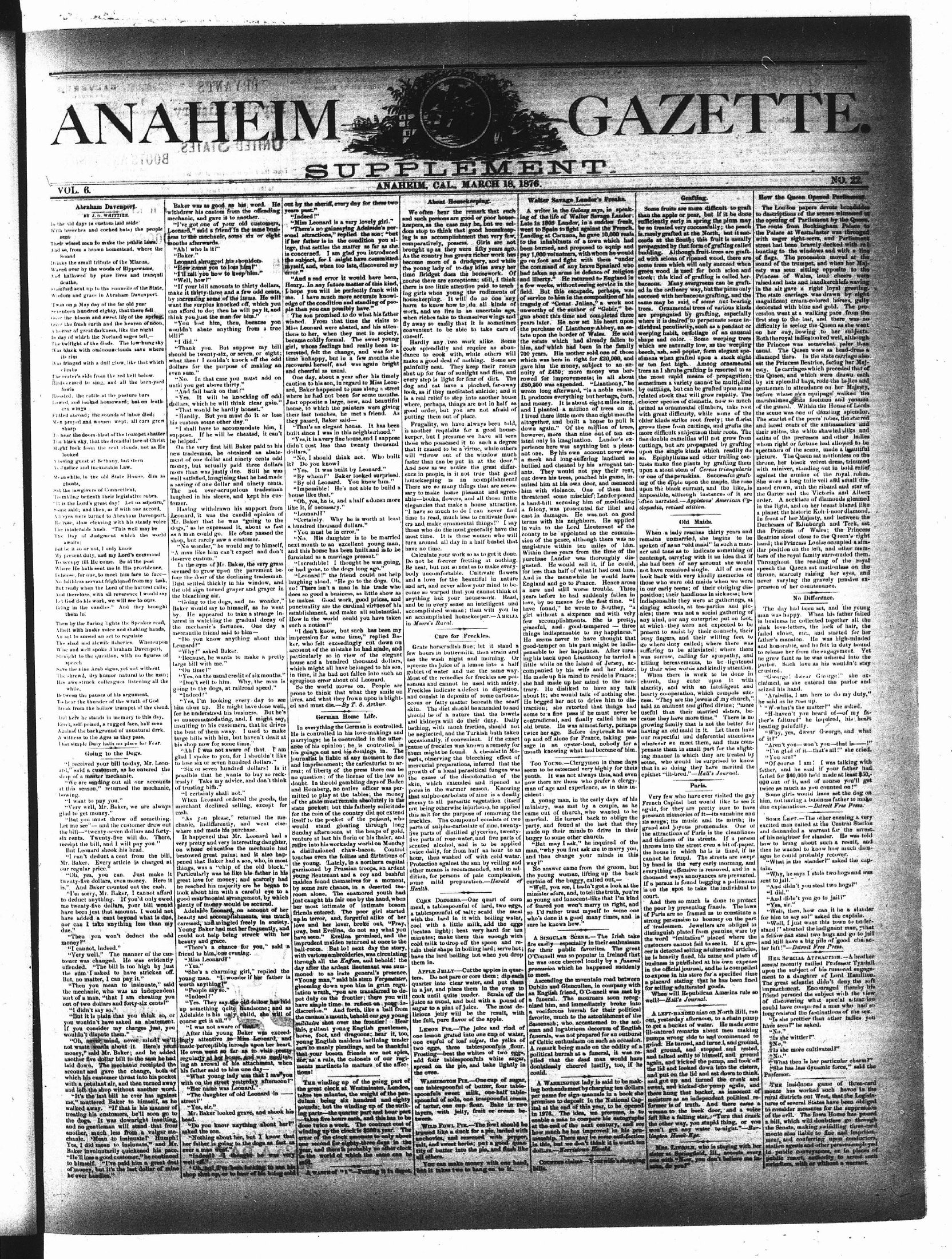
Searchable text
ANAHEIM
VOL. 6.
Abraham Davenport.
BY J. O. WHITTIER.
In the old days (a custom laid aside)
With breeches and cocked hats) the people sent
Their wives men to make the public laws.
And so, from a brown homestead, where the Sound
Drinks the small tribute of the Mlanas,
Waved over by the woods of Rippowame,
And hallowed by pure lives and tranquil deaths.
Stamford sent up to the councils of the State,
Wisdom and grace in Abraham Davenport.
I was on a May day of the far old year
Seventeen hundred eighty, that there fell
Over the bloom and sweet life of the spring,
Over the fresh earth and the heaven of noon,
Ahroror of great darkness, like the night
In day of which the Norland sages tell,
The twilight of the Gods. The low-hung sky
Was black with ominous clouds save where its rim
Was fringed with a dull glow, like that which climbs
The crater's side from the red hell below.
Birds ceased to sing, and all the barn-yard fowls
Roasted; the cattle at the pasture bars
Lowed, and looked homeward; but on leathen wings
Fitted abroad; the sounds of labor died;
Men prayed and women wept; all ears grew sharp
To hear the doom-blast of the trumpet shatter
The black sky, that the dreadful face of Christ
Might look from the rent clouds, not as He looked
Allowing guest at Bethany, but stern
A justice and inexorable law.
Baker was as good as his word. He withdrew his custom from the offending mechanic, and gave it to another.
"I've got one of your old customers, Leonard," said a friend in the same business to the mechanic, some six or eight months afterwards.
"Ah! who is it?"
"Baker."
Leonard shrugged his shoulders.
"How came you to lose him?"
"I'll tell you how to keep him."
"Well, how?"
If your bill amounts to thirty dollars, make it thirty-three and a few odd cents, by increasing some of the items. He will want the surplus knocked off, which you can afford to do; then he will pay it, and think you just the man for him."
"You lost him, then, because you wouldn't abate anything from a true bill?"
"I did."
Thank you. But suppose my bill should be twenty-six, or seven, or eight; what then? I couldn't knock off the odd dollars for the purpose of making an even sum."
No. In that case you must add on until you get above thirty."
And fall back on that!
Yes. It will be knocking off odd dollars, which he will think clear gain."
That would be hardly honest."
Hardly. But you must do it or lose his custom some other day."
I shall have to accommodate him, I suppose. If he will be cheated, it can't be helped."
On the very first bill Baker paid to his new tradesman, he obtained an abatement of one dollar and ninety cents odd money, but actually paid three dollars out by the sheriff, every day years past."
Indeed!"
Miss Leonard is a very serious attraction," replied if her father is in the college, that settles the matter is concerned. I am glad the subject, for I might be myself, and, when too late error."
"And a sad error it won Henry. In any future mass I hope you will be perfect me. I have much more edge of the condition and ple than you can possibly have." The son promised to do wished. From that time Miss Leonard were albedoctions to her, when they became coldly formal. The girl, whose feelings had terrested, felt the change, time unhappy, but in a recover herself, and wander cheerful as usual.
One day, about a year caution to his son, in regal ard, Baker happened to put where he had not been for Just opposite a large, new house, to which the paint their last touches, he may they passed, Baker said— "That's an elegant hous built since I was in this n"
"Yes, it is a very fine hous didn't cost less than two dollars."
No, I should think it? Do you know?
The crater's side from the red hell below.
Birds ceased to sing, and all the barn-yard fowls
Roasted; the cattle at the pasture bars
Lowed, and looked homeward; but on leathern wings
Flitted abroad; the sounds of labor died;
Men prayed and women wept, all cars grew sharp
To hear the doom-blast of the trumpet shatter
The black sky, that the dreadful face of Christ
Might look from the rent clouds, not as He looked
A loving guest at Bethany, but stern
Justice and inexorable law.
Meanwhile, in the old State House, dim as ghosts,
Sat the lawgivers of Connecticut,
Trembling beneath their legislative robes.
"It is the Lord's great day! Let us adjourn," Some said; and then, as if with one accord,
All eyes were turned to Abraham Davenport.
He rose, slow cleaving with his steady voice
The intolerable hush. "This well may be
The Day of Judgment which the world awaits;
But be it so or not, I only know
My present duty, and my Lord's command
To occupy till He come. So at the post
Where He hath sent me in His providence,
I choose, for one, to meet him face to face—No faithless servant frightened from my task.
But ready when the Lord of the harvest calls;
And therefore, with all reverence I would say
Let God do his work, we will see to ours.
Being in the candles." And they brought them in.
Then by the flaring lights the Speaker read,
Albeit with husky voice and shaking hands,
An act to amend an act to regulate
The shad and alewife fisheries. Whereupon
Wise and well spoke Abraham Davenport,
Straight to the question, with no figures of speech
Save the nine Arab signs, yet not without
The shrewd, dry humor natural to the man;
His awe-struck colleagues listening all the while.
Between the pauses of his argument,
To hear the thunder of the wrath of God
Break from the hollow trumpet of the cloud.
And here he stands in memory to this day,
Erect, self-poised, a rugged face, half seen Against the background of unnatural dark.
A witness to the Ages as they pass,
That simple Duty hath no place for Fear.
Going to the Dogs.
"I received your bill to-day, Mr. Leonard," said a customer, as he entered the shop of a master mechanic.
"We are sending out all our accounts at this season," returned the mechanic, bowing.
"I want to pay you."
"Very well, Mr. Baker, we are always glad to get money."
"But you must throw off something. Let me see" — and the customer drew out the bill — "twenty-seven dollars and forty-six cents. Twenty-five will do. There, receipt the bill, and I will pay you."
But Leonard shook his head.
"I can't deduct a cent from the bill, Mr. Baker. Every article is charged at our regular price."
"Oh, yes, you can. Just make it twenty-five dollars, even money. Here it is." And Baker counted out the cash.
Even sum."
"No. In that case you must add on until you get above thirty."
"And fall back on that!"
"Yes. It will be knocking off odd dollars, which he will think clear gain."
"That would be hardly honest."
"Hardly. But you must do it or lose his custom some other day."
"I shall have to accommodate him, I suppose. If he will be cheated, it can't be helped."
On the very first bill Baker paid to his new tradesman, he obtained an abatement of one dollar and ninety cents odd money, but actually paid three dollars more than was justly due. Still he was well satisfied, imagining that he had made a saving of one dollar and ninety cents. The not over-acrupulous tradesman laughed in his sleeve, and kept his customer.
Having withdrawn his support from Leonard, it was the candid opinion of Mr. Baker that he was "going to the dogs," as he expressed it, about as fast as a man could go. He often passed the shop, but rarely saw a customer.
"No wonder," he would say to himself,
"A man like him can't expect and don't deserve custom."
In the eyes of Mr. Baker, the very grass seemed to grow upon the pavement before the door of the declining tradesman. Dust settled thickly in his window, and the old sign turned grayer and grayer in the bleaching air.
"Going to the dogs, and no wonder," Baker would say to himself, as he went by. He appeared to take a strange interest in watching the gradual decay of the mechanic's fortunes. One day a mercantile friend said to him—
"Do you know anything about this Leonard?"
"Why?" asked Baker.
"Because, he wants to make a pretty large bill with me."
"On time?"
"Yes, on the usual credit of six months."
"Don't sell to him. Why, the man is going to the dogs, at railroad speed."
"Indeed?"
"Yes, I'm looking every day to see him close up. He might have done well, for he understood his business. But he's so unaccommodating, and I might say, insulting to his customers, that he drives the best of them away. I used to make large bills with him, but haven't dealt at his shop now for some time."
"Ah! I was not aware of that. I am glad I spoke to you, for I shouldn't like to lose six or seven hundred dollars."
"Six or seven hundred dollars! Is it possible that he wants to buy so recklessly? Take my advice, and don't think of trusting him."
"I certainly shall not."
When Leonard ordered the goods, the merchant declined selling, except for cash.
"As you please," returned the mechanic, indifferently, and went elsewhere and made his purchase.
It happened that Mr. Leonard had a very pretty and very interesting daughter, on whose education the mechanic had bestowed great pains; and it also happened that Baker had a son, who, in most things, was a "chip of the old block." Particularly was he like his father in his great love for money; and scarcely had he reached his majority ere he began to even sum."
One day, about a year caution to his son, in regard to Baker happened to put where he had not been for Just opposite a large new house, to which the paint their last touches, he may they passed, Baker said—
"That's an elegant house built since I was in this mansion." Yes, it is a very fine house didn't cost less than two dollars."
No, I should think it? Do you know?
Yes. It was built by By whom? Baker lied By old Leonard. You Impossible! He's no house like that.
Oh yes, he is, and a little like it, if necessary."
Leonard!
Certainly. Why he is a hundred thousand dollars You must be in error.
No. His daughter is next month to an excellent and this house has been furnished as a marriage pane.
Incredible! I thought or had gone; to the dogs! Leonard!'s friend laughing aloud. "He got no! There isn't a man in does so good a business; he makes Good work; punctuality are the cardinal establishment; and makes How in the world could such a notion?"
"I don't know, but s impression for some timeker, who felt exceedingly account of the mistake b particularly so in view house and a hundred t which might all have been in time; it he had not fag egregious error about old
So the world moves prone to think that whi lives,and what they fro edand must die.-By T
German Homem
In everything the German He is controlled in his marryings; he is controlance of his opinion; he his goings out and his journalist is liable at an and imprisonment; there rest; of liberty of the p no question; of the license doubt. In the old gamble and Homberg, no native mitted to play at the t of the state must remain state pocket; but this f for the coin of the count itself to the pocket of o would stand gloating Sunday afternoons at venture at last his floring retire into his workaday a disillusioned chaw touches even the follies the young. Lately, in garrisoned by Prussian young Hentenant and a maiden found themselves with some rare chance
"I want to pay you."
"Very well, Mr. Baker, we are always glad to get money."
"But you must throw off something. Let me see" — and the customer drew out the bill—"twenty-seven dollars and forty-six cents. Twenty-five will do. There, receipt the bill, and I will pay you."
But Leonard shook his head.
"I can't deduct a cent from the bill, Mr. Baker. Every article is charged at our regular price."
"Oh, yes, you can. Just make it twenty-five dollars, even money. Here it is." And Baker counted out the cash.
"I'm sorry, Mr. Baker, I cannot afford to deduct anything. If you'd only owed me twenty-five dollars, your bill would have been just that amount. I would not have added a cent beyond what is due, nor can I take anything less than my due."
"Then you won't deduct the odd money?"
"I cannot, indeed."
"Very well." The manner of the customer was changed. He was evidently offended. "The bill is too high by just the sum. I asked to have stricken off. But, no matter, I can pay it."
"Then you mean to insinuate," said the mechanic, who was an independent sort of a man, "that I am cheating you out of two dollars and forty-six cents?"
"I didn't say so."
"But it is plain that you think so, or you wouldn't have asked an abatement. If you consider my charges just, you wouldn't dispute them."
"Oh, never mind, never mind! we'll not waste words about it. Here's your money," said Mr. Baker; and he added another five dollar bill to the sum he had laid down. The mechanic recaptured the account and gave the change, both of which his customer thrust into his pocket with a petulant air, and then turned away and left the shop without another word.
"It’s the last bill he ever has against me," muttered Baker to himself, as he walked away. "If that is his manner of treating his customers, he’ll soon go to the dogs. It was downright insulting, and no gentleman will stand that front another, much less from a vulgar mechanic. 'Mean to insinuate?' Humph! Yes, I did mean to insinuate," and Mr. Baker involuntarily quickened his pace. "He’ll lose a good customer," he continued to himself. "I’ve paid him a great deal of money, but it’s the last dollar of mine he ever handles."
"I certainly shall not."
When Leonard ordered the goods, the merchant declined selling, except for cash.
"As you please," returned the mechanic, indifferently, and went elsewhere and made his purchase.
It happened that Mr. Leonard had a very pretty and very interesting daughter, on whose education the mechanic had bestowed great pains; and it also happened that Baker had a son, who, in most things, was a "chip of the old block." Particularly was he like his father in his great love for money; and scarcely had he reached his majority ere he began to look about him with a careful eye to a good matrimonial arrangement, by which plenty of money would be secured.
Adelalde Leonard, on account of her beauty and accomplishments, was much caressed, and ningled freely in society. Young Baker had met her frequently, and could not help being struck with her beauty and grace.
"There’s a chance for you," said a friend to him, one evening.
"Miss Leonard?"
"Yes."
"She’s a charming girl," replied the young man. "I wonder if her father is worth anything!"
"People say so."
"Indeed!"
"Yes. They say the old fellow has held up something quite handsome; and as Adelalde is his only child, she will of course get it all."
"I was not aware of that."
After this young Baker was exceedingly attentive to Miss Leonard, and made perceptible inroads upon her heart. He even went as far as to whisply regularly at her house, and was meditating an avowal of his attachment, when his father said to him one day—
"What young lady was that I saw you with on the street yesterday afternoon?"
"Her name was Leonard."
"The daughter of old Leonard in street!"
"Yes, sir."
Mr. Baker looked grave, and shook his head.
"Do you know anything about her?" asked the son.
"Nothing about her, but I know that her father is going to the dogs as fast as ever a man went."
Indeed! I thought he was very well off.
Oh no! We have lukewarm water in his shop shut up, so to hear of his being cold!
mitted to play at the table of the state must remain state pocket; but this fittes itself to the pocket of its would stand gloating Sunday afternoons at venture at last his flirting into his workaday disillusioned chaw touches even the follies the young. "Lately, in garrisoned by Prussian young Heutenant and a maiden found themselves by some rare chance, in room alone. The easy just caught his fair one her most intimate of friends entered. The up in terror, and forgive love and her lover, he prayed Evelina, does have seen." Evelina is imprudent maiden returns ball-room. But lo1 mans with various embroideries through all the Kaffee day after the ardent life monoed to an irate young man," said his glooming down upon a lation wrath," you are pot duty on the front have simple time to make discretion." And for the cannon’s month, be militaire shot over this gallant young English maiden ears to many pleading that your bosom friend as a rule, the couments martinets in mornings!
out by the sheriff, every day for these two years past."
"Indeed!"
"Miss Leonard is a very lovely girl."
"There's no gainaying Adelaide's personal attractions," replied the son; "but if her father is in the condition you allege, that settles the matter as far as she is concerned. I am glad you introduced the subject, for I might have committed myself, and, when too late, discovered my error."
"And a sad error it would have been, Henry. In any future matter of this kind, I hope you will be perfectly frank with me. I have much more accurate knowledge of the condition and standing of people than you can possibly have."
The son promised to do what his father wished. From that time the visits to Miss Leonard were alated, and his attention to her, when they met in society, became coldly formal. The sweet young girl, whose feelings had really been interested, felt the change, and was for a time unhappy, but in a few months she recovered herself, and was again bright and cheerful as usual.
One day, about a year after his timely caution to his son, in regard to Miss Leonard, Baker happened to pass along a street where he had not been for some months. Just opposite a large, new, and beautiful house, to which the painters were giving their last touches, he met a friend. As they passed, Baker said—
"That's an elegant house. It has been built since I was in this neighborhood."
"Yeah, it is a very fine house, and I suppose didn't cost less than twenty thousand dollars."
"No, I should think not. Who built it? Do you know?
About Housekeeping.
We often hear the remark that such and such persons are good or poor housekeepers, as the case may be, but we seldom stop to think that good housekeeping is an accomplishment that very few, comparatively, possess. Girls are not brought up as they were fifty years ago. As the country has grown richer work has become more of a drudgery, and while the young lady of to-day idles away her time Bridget does the housework. Of course there are exceptions; still, I think there is too little attention paid to teaching girls when young the rudiments of housekeeping. It will do no one any harm to know how to do all kinds of work, and we live in an uncertain age, when riches take to themselves wings and fly away so easily that it is sometimes convenient to be able to take care of oneself.
Hardly any two work alike. Some cook splendidly and require an abundance to cook with, while others will make a good deal of nothing. Some are painfully neat. They keep their rooms shut up for fear of sunlight and flies, and every step is light for fear of dirt. The dog and cat have a pinched, far-away look, as if they meditated suicide; and it is a real relief to step into another house where, perhaps, things are not in half as good order, but you are not afraid of putting them out of place.
Frugality, we have always been told, is another requisite for a good housekeeper, but I presume we have all seen those who possessed it to such a degree that it ceased to be a virtue, while others will "throw out of the window much faster than can be put in at the door." And now as we notice the great differ-
Walter Savage Lander's Freaks.
A writer in the Galaxy says, in speaking of the life of Walter Savage Landor: Late in 1808 Landor, in a sudden freak went to Spain to fight against the French. Landing at Corunna, he gave 10,000 ruals to the inhabitants of a town which had been burned, and proposed to equip and pay 1,000 volunteers, with whom he would go on foot and fight with them "under the command of any brave Spaniard who had taken up arms in defence of religion and liberty." He returned to England in a few weeks without seeing service in the field. But this escapade, perhaps, was of service to him in the composition of his tragedy of "Count Julian," a work not unworthy of the author of "Gebir," begun about this time and completed three years later. He now set his heart upon the purchase of Llanthony Abbey, an estate upon the border of Wales. He sold the estate which had already fallen to him, and which had been in the family 700 years. His mother sold one of those which was hers in right for £20,000, and gave him the money, subject to an annuity of £450; more money was borrowed for improvements; in all about £80,300 was expended. "Llanthony," he wrote long afterward, "is a noble estate. It produces everything but herbage, corn, and money. It is about eight miles long, and I planted a million of trees on it. I lived there little more than eight months altogether, and built a house to pull it down again." Of the million of trees, however, more than nine out of ten existed only in imagination. Landor's experience here anything but a pleasant one. By his own account never was a meek and long-suffering landlord so bullied and cheated by his arrogant ten-fruit than the apples sufficiently eaten he so treated is rarely grafted ceds at the propagated budding. Added with acacia some trees with green wood stock; this kern baccous. Muted in the order succeeding with same may be trees. Ornate are propagated where it is de dividual peculiar weeping habit shape and color which are new beech, ash, cimena when or ten feet tall trees an I share the most rare sometimes by cuttings related stock choice species prized with great dwarf older kinds that grows more difficult due double cuttings but upon the air sapphire tuses make
One day, about a year after his timely caution to his son, in regard to Miss Leouard, Baker happened to pass along a street where he had not been for some months. Just opposite a large, new, and beautiful house, to which the painters were giving their last touches, he met a friend. As they passed, Baker said—
"That's an elegant house. It has been built since I was in this neighborhood."
"Yes, it is a very fine house, and I suppose didn't cost less than twenty thousand dollars."
"No, I should think not. Who built it? Do you know?"
"Yes. It was built by Leonard."
"By whom?" Baker looked surprised.
"By old Leonard. You know him."
"Impossible! He's not able to build a house like that."
"Oh, yes, he is, and a half a dozen more like it, if necessary."
"Leonard!"
"Certainly. Why he is worth at least a hundred thousand dollars."
"You must be in error."
"No. His daughter is to be married next month to an excellent young man, and this house has been built and is to be furnished as a marriage present."
"I incredible! I thought he was going, or had gone, to the dogs long ago."
"Leonard!" the friend could not help laughing aloud. "He go to the dogs. Oh, no! There isn't a man in his trade who does so good a business, as little show as he makes. Good work, good prices, and punctuality are the cardinal virtues of his establishment, and make all substantial. How in the world could you have taken such a notion?"
"I don't know, but such has been my impression for some time," replied Baker, who felt exceedingly cut down on account of the mistake he had made, and particularly so in view of the elegant house and a hundred thousand dollars, which might all have belonged to his son, in time, it he had not fallen into such an egregious error about old Leonard.
So the world moves on. People are prone to think that what they smile on lives, and what they frown upon is blighted and must die.—By T. S. Arthur.
German Home Life.
In everything the German is controlled. He is controlled in his love-making and marrying; he is controlled in the utterance of his opinion; he is controlled in his goings out and his comings in. The journalist is liable at any moment to fine and imprisonment; the caricaturist to arrest; of liberty of the press there can be no question; of the license of the law no doubt. In the old gambling days of Baden and Homberg, no native officer was permitted to play at the tables; the money of the state must remain absolutely in the state pocket; but this fatherly solicitude for the coin of the country did not extend itself to the pocket of the peasant, who would stand gloating through long Sunday afternoons at the heaps of gold, venture at last his florin or his thaler, and retire into his workaday world on Monday a disillusioned chaw-bacon. Control touchs even the follies and flirtations of the young. "Lately, in a northern capital garrisoned by Prussian troops, an ardent young Heutenant and a coy and bashful maiden found themselves for a moment, by some rare chance, in a deserted tea-shop up for fear of sunlight and flies, and every step is light for fear of dirt. The dog and cat have a pinched, far-away look, as if they meditated suicide; and it is a real relief to step into another house where perhaps, things are not in half as good order, but you are not afraid of putting them out of place.
Frugality, we have always been told, is another requisite for a good housekeeper, but I presume we have all seen those who possessed it to such a degree that it ceased to be a virtue, while others will "throw out of the window much faster than can be put in at the door." And now as we notice the great difference in people, is it not true that good housekeeping is an accomplishment? There are so many things that are necessary to make home pleasant and agreeable—books, flowers, and all those little elegancies that make a house attractive. "I have so much to do I can never find time to read, much less to cultivate flowers and make ornamental things." I say those who do the most generally have the most time. It is those women who will turn around all day in a half bushel that have no time.
Calculate your work so as to get it done. Do not be forever fretting at nothing. Be neat, but not so neat as to make everybody uncomfortable. Cultivate flowers and a love for the beautiful in nature and art, and never allow your mind to become so warped that you cannot think of anything but your housework. Read, and be in every sense an intelligent and accomplished woman; then will you be an accomplished housekeeper.—AMELIA in Moore's Rural.
Cure for Freckles.
Grate horseradish fine; let it stand a few hours in buttermilk, then strain and use the wash night and morning. Or squeeze the juice of a lemon into a half goblet of water and use the same way. Most of the remedies for freckles are poisonous and cannot be used with safety. Freckles indicate a defect in digestion and consist in deposits of some carbonaceous or fatty matter beneath the scarf skin. The diet should be attended to and should be of a nature that the bowels and kidneys will do their duty. Daily bathing, with much friction, should not be neglected, and the Turkish bath taken occasionally, if convenient. If the exact cause of freckles was known a remedy for them might be found. A chemist in Moaria, observing the bleeching effect of mercurial preparations, inferred that the growth of a local parasitical fungus was the cause of the discoloration of the skin, which extended and ripened as pores in the warmer season. Knowing that sulpho-carbolate of zinc is a deadly enemy to all parasitic vegetation (itself not being otherwise injurious), he applied this salt for the purpose of removing the freckles. The compound consists of two parts of sulpho-carbolate of zinc, twenty-five parts of distilled glycerine, twenty-five parts of rose-water, and five parts of scented alcohol, and is to be applied twice daily, for from half an hour to an hour, then washed off with cold water. Protection against the sun by veiling and other means is recommended, and in addition, for persons of pale complexion, some mild preparation.—Herald of Health.
unity of £450; more money was borrowed for improvements; in all about £20,300 was expended. "Lianthony," he wrote long afterward, "is a noble estate. It produces everything but herbage, corn, and money. It is about eight miles long, and I planted a million of trees on it. I lived there little more than eight months altogether, and built a house to pull it down again." Of the million of trees, however, more than nine out of ten existed only in imagination. Landor's experience here was anything but a pleasant one. By his own account never was a meek and long-suffering landlord so bullied and cheated by his arrogant tenants. They would not pay their rent, cut down his trees, poached his game, insulted him at his own door, and menaced him with violence. One of them had threatened some mischief; Landor posted a hand-bill accusing him of meditating a felony, was prosecuted for libel and cast in damages. He was not on good terms with his neighbors. He applied in vain to the Lord Lieutenant of the county to be appointed on the commission of the peace, although there was no magistrate within ten miles of him. Within three years from the time of the purchase Landor was thoroughly disgusted. He would sell it, if he could, for less than half of what it had cost him. And in the meanwhile he would leave England and go to France. Hence arose a new and still worse trouble. Three years before he had suddenly fallen in love, by no means for the first time. "I have found," he wrote to Southey, "a girl without a sixpence and with very few accomplishments. She is pretty, graceful, and good-tempered — three things indispensable to my happiness."
He seems never to have thought that good-temper on his part might be indispassible to her happiness. After turning his back upon Lianthony he tarried a little while on the Island of Jersey, accompanied by his wife and her sister. He made up his mind to reside in France; she had made up her mind to the contrary. He disliked to have any talk about it; she would talk of nothing else. He begged her not to drive him to distraction; she retorted that things had come to a fine pass if he must never be contradicted, and finally called him an old brute. He was almost forty, perhaps twice her age. Before daybreak he was up and off alone for France, taking passage in an oyster-boat, nobody for a month knowing what had become of him.
Too Young.-Clergymen in these days seem to be esteemed very highly for their youth. It was not always thus, and even now there are those who prefer a clergyman of age and experience, as in this incident:
A young man, in the early days of his ministry, was met by a couple, as he came out of church, who wanted to be married. He turned back to oblige the party, and found at the last that they made up their minds to drive in their buggy to some other church.
But may I ask: he inquired of the man," why you first ask me to marry you, and then change your minds in this way?
No answer came from the groom, but the young woman lifting up the back curtain of the buggy, called out,
"Well, you see I hadn't got a look at the tree an ammah sometimes after by cutting stock choice specified as ornate with older kinds so grows these more difficult due double cuttings but upon the sinuus.
Epiphyte tuses make up upon a stout or one of these impossible of the epiphyte often narrates clopodia reptile.
When a lady remains unspoken of affection contempts her she had been not have renamed look back with those who wish in our early position; she indispensable singing scholes; there any kind now at which she present to an busy fingergo go where durer suffers due to was sorrowful killing berever by their wrist.
When ther church,the alacrity,and heart-co-opcess." They said an enlist useful than cause they hb growing fun having an on our respect wherever we pensate their ing manner some who that in so epithet "ill"
Very few French Capitals again; for pleasant mornings its songs; in grand and the attractionand tidiness throws into the house if cannot be by hand inside everything thousand wives If a person
The winding up of the going part of the great clock at Westminster, London, takes ten minutes, the weight of the pendulum being six hundred and eighty pounds; but the winding up of the striking parts—the quarter part and hour part—takes five hours each, and this has to be done twice a week. The contract cost of winding up the clock is $200 a year. The error of the clock amounts to only about one second for eighty-three days in the year, and there is probably no other clock in the world of which the same can be said.
A warm of "it"—Putting it in digest.
CORN DODGERS.—One quart of corn meal, a tablespoonful of lard, two eggs, a tablespoonful of salt; scald the meal with the lard in it with boiling water, cool with a little milk, add the eggs (beaten light); beat very hard for ten minutes; make them thin enough with cold milk to drop off the spoon and retain their shape in boiling lard; serve hot; have the lard boiling hot when you drop them in.
APPLE JELLY—Cut the apples in quarters. Do not pare or core them; dip each quarter into clear water, and put them in a jar, and place them in the oven to cook until quite tender. Strain off the juice as usual, and boil with a pound of sugar to a pint of juice. The most delicious jelly will be the result, with the full, pure flavor of the apple.
LEMON PIE.—The juice and rind of one lemon grated into one cup of water, one cupful of loaf sugar, the yolks of two eggs, three tablespoonfuls flour. Prosting—beat the whites of two eggs, add four tablespoonfuls white sugar, spread on the pie, and bake lightly in the oven.
WASHINGTON PIE.—One cup of sugar, one tablespoonful of butter, four tablespoonfuls sweet milk, one-half tablespoonful of soda, one teaspoonful cream of tartar, one cup flour. Bake in two layers, with jelly, fruit or cream between.
WILD FOWL PIE.—The fowl should be trussed like a duck for a pie, larded with anchovies, and seasoned with pepper, salt, and sweet herbs; put a good quantity of butter into the pie, and finish like all others.
You can make money with one hand, but it takes two to hang on to it.
A young man, in the early days of his ministry, was met by a couple, as he came out of church, who wanted to be married. He turned back to oblige the party, and found at the last that they made up their minds to drive in their buggy to some other church.
"But may I ask," he inquired of the man, "why you first ask me to marry you, and then change your minds in this way?"
No answer came from the groom, but the young woman, lifting up the back curtain of the buggy, called out,
"Well, you see, I hadn't got a look at the minister afore, and to tell the truth, you're so young and innocent-like that I'm kind of feared you won't marry us right, and so I'd rather trust myself to some one who's done it a good many times, and is sure he knows how."
A SINGULAR SCENE.—The Irish take fire easily—especially in their enthusiasm for their public favorites. The great O'Connell was so popular in Ireland that he was once cheered loudly by a funeral procession which he happened suddenly to meet.
Ascending the mountain road between Dublin and Glencullen, in company with an English friend, O'Connell was mast by a funeral. The mourners soon recognized him, and immediately broke into a vociferous hurrah for their political favorite, much to the astonishment of the Sassenach; who, accustomed to the solennil and lingubrious decorum of English funerals, was not prepared for an outburst of Celtic enthusiasm on such an occasion.
A remark being made on the oddity of a political hurrah at a funeral, it was replied that the dead man would have doubtlessly cheered lustily, too; if he could.
A WASHINGTON lady is said to be making both ends meet by charging ten dollars per name for sign-mannals in a book she promises to deposit. In the National Capital at the end of this year, to be opened in 1976. The idea, we preamble, is to enable a man to compare his autographs at the end of the next century; and see how much he has improved in his penmanship. There may be some satisfaction in this, but we don't think it is worth ten dollars—Harrison Howd.
Countenance claims—Your wife's shopping hills.
GAZETTE.
NO. 22
Grafting.
Some fruits are more difficult to graft than the apple or pear, but if it be done sufficiently early in spring the plum may be so treated very successfully; the peach is rarely grafted at the North, but it succeeds at the South; this fruit is usually propagated by that form of grafting called budding. Although fruit-trees are grafted with acorns of ripened wood, there are some trees which will only succeed when green wood is used for both scion and stock; this kind of grafting is called herbaceous. Many evergreens can be grafted in the ordinary way, but the pines only succeed with herbaceous grafting, and the same may be said of some nut-bearing trees. Ornamental trees of various kinds are propagated by grafting, especially where it is desired to perpetuate some individual peculiarity, such as a pendant or weeping habit, on foliage of an unusual shape and color. Some weeping trees which are naturally low, as the weeping beech, ash, and poplar, form elegant specimens when grafted upon a stock eight or ten feet high. Among ornamental trees an shrub grafting is resorted to as the most rapid means of propagation; sometimes a variety cannot be multiplied by cuttings, but can be grafted upon some related stock that will grow rapidly. The choice species of clematis, now so much prized as ornamental climbers, take root with great difficulty, while some of the older kinds strike root freely; the florist grows these from cuttings, and grafts the more difficult subjects on their roots. The double camellias will not grow from cuttings, but are propagated by grafting upon the single kinds which readily do so. Epiphyllums and other trailing cactuses make fine plants by grafting them upon a stout stem of Carnea triangularis.
How the Queen Opened Parliament.
The London papers devote broadside to descriptions of the scenes witnessed at the opening of Parliament by the Queen. The route from Buckingham Palace to the Palace at Westminster was through with eager sight-seers, and Parliament street had been bravely decked with rail bunting to the windows and with a line of flags. The procession moved at the sound of the trumpet, and when her Majesty was seen sitting opposite to the Princess of Wales, loud cheers were raised and hats and handkerchiefs waving in the air gave a right loyal greeting. The state carriage was drawn by eight magnificent cream-colored horses, gaily decorated with blue and gold. The procession went at a walking pace from the first step to the last, and there was no difficulty in seeing the Queen as she went on her way, bowing to her subjects. Both the royal ladies looked well, although the Princess was somewhat paler than usual. The Queen wore as head-dress a diamond tiara. In the state carriage also sat the Princess Beatrice, facing her Majesty. In carriages which preceded that of the Queen, and which were drawn each by six splendid bays, rode the ladies and gentlemen in attendance on her Majesty, before whose own equipment walked the marshalmen; gate footmen and yeomen of the guard. Within the House of Lords the scene was one of dazzling splendor. The scarlet of the peers' robes, the starred and laced coats of the ambassadors and their suites, the white shawled silks and satins of the peerresses and other ladies whom right or fortune had allowed to be spectators of the scene, made a beautiful picture. The Queen sat motionless on the throne, her black velvet dress, trimmed with miniver, standing out in bold relief.
They was born in all about Alexandrony," he mentioned, referring to trees and shrubs grazing in the most rapid means of propagation; sometimes a variety cannot be multiplied by cuttings, but can be grafted upon some related stock that will grow rapidly. The choice species of clematis, now so much prized as ornamental climbers, take root with great difficulty, while some of the older kinds strike root freely; the florist grows these from cuttings, and grafts the more difficult subjects on their roots. The fine double camellias will not grow from cuttings, but are propagated by grafting upon the single kinds which readily do so. Epiphyllums and other trailing cactuses make fine plants by grafting them upon a stout stem of Cereus triangularis or one of the pereskias. Successful grafting of the apple upon the maple, the rose upon the black currant, and the like, is impossible, although instances of it are often narrated.—Appletons' American Cyclopodia, revised edition.
Old Maids.
When a lady reaches thirty years and remains unmarried, she begins to be spoken of as an "old maid" in such a manner and tone as to indicate something of contempt, carrying with it an idea that if she had been of any account she would not have remained single. All of us can look back with very kindly memories of those who were old maids when we were in our early teens; of their obliging disposition; their handiness in sickness; how indispensable they were at gatherings, at singing schools, at tea-parties and picnics; there was not a social gathering of any kind, nor any enterprise put on foot, at which they were not expected to be present to assist by their counsels, their busy fingers, and their willing feet to go where duty called; where there was suffering to be alleviated; where there was sorrow, calling for sympathy, and killing bereavements, to be lightened by their wise words and kindly attention.
When there is work to be done in church, they enter upon it with alacrity, and with an intelligent and hearty co-operation, which compels success. "They are the jewels of my church," said an eminent and gifted divine; "more useful than their married sisters, because they have more time." There is no growing family that is not the better for having an old maid in it. Let them have our respectful and deferential attentions wherever we meet them, and thus compensate them in small part for the slighting manner in which they are treated by some, who would be surprised to know that in so doing they have merited the epithet "ill-bred."—Hall's Journal.
Paris.
Very few who have ever visited the gay French Capital but would like to see it again, for they are pretty sure to have pleasant memories of it—its sunshine and its songs; its music and its mirth; its grand and joyous promenades. One of the attractions of Paris is the cleanliness and tidiness of its streets. If a person throws into the street even a bit of paper, the house in which he is fined, if he cannot be found. The streets are swept by hand in the very early morning, and everything offensive is removed, and in a thousand ways annoyances are prevented. If a person is found begging a policeman is on the spot to take the individual to safety.
The Queen, and which were drawn each by six splendid bays, rode the ladies and gentlemen in attendance on her Majesty, before whose own equipage walked the marshalmen state footmen and yeomen of the guard. Within the House of Lords the scene was one of dazzling splendor. The scarlet of the peers' robes, the starred and laced coats of the ambassadors and their suites, the white shawled silks and satins of the peeresses and other ladies whom right or fortune had allowed to be spectators of the scene, made a beautiful picture. The Queen sat motionless on the throne, her black velvet dress, trimmed with miniver, standing out in bold relief against the ermine of the royal robes. She wore a long tulle veil and small diamond crown, with the riband and star of the Garter and the Victoria and Albert order. A necklace of diamonds gleamed in the light, and on her breast blazed like a planet the historic Koh-i-nour diamond. In front of her Majesty, and between the Duchesses of Edinburgh and Teck, sat the Princess of Wales; the Princess Beatrice stood close to the Queen's right hand; the Princess Louise occupied a similar position on the left, and other members of the royal family surrounded them. Throughout the reading of the royal speech the Queen sat motionless on the throne, scarcely raising her eyes, and never varying the gravely pensive expression of her countenance.
No Difference.
The day had been set, and the young man was happy. When his father failed in business he collected together all the pink love-letters, the lock of hair, the faded violet, etc., and started for her father's mansion. He was high-minded and honorable, and he felt in duty bound to release her from the engagement. Yet he grew faint as he was ushered into the parlor. Such love as his wouldn't stay crushed.
"Gworge! dwear Gworge!" she exclaimed, as she entered the parlor and seized his hand.
"Arabella, I am here to do my duty," he said as he rose up.
"W-what's the matter?" she asked.
"H-haven't you heard of—of my father's failure?" he inquired, his heart beating painfully.
"Why, yes, dwear Gworge, and what of it?"
"Aren't you—won't you—that is——!"
"I'm glad of it—that's all!" she cried.
"You are?"
"Of course I am! I was talking with father, and he said if your father had failed for $60,000 he'd made at least $50,-000 out of it, and of course you'll get twice as much as you counted on!!"
Some girls would have set the dog on him, not having a business father to make due explanations.—Detroit Free Press.
Some Left.—The other evening a very excited man called at the Central Station and demanded a warrant for the arrest of his neighbor for slander. He was told how to bring about such a result, and then he wanted to know how much damages he could probably recover.
"What is the slander?" asked the captain.
"Why, he says I stole two hogs and was sent to jail."
"And didn't you steal two hogs?"
Very few who have ever visited the gay French Capital but would like to see it again, for they are pretty sure to have pleasant memories of it—its sunshine and its songs; its music and its mirth; its grand and joyous promenades. One of the attractions of Paris is the cleanliness and tidiness of its streets. If a person throws into the street even a bit of paper, the house in which he is is fined, if he cannot be found. The streets are swept by hand in the very early morning, and everything offensive is removed, and in a thousand ways annoyances are prevented. If a person is found begging a policeman is on the spot to take the individual to court.
And then so much is done to protect the poor by preventing frauds. The laws of Paris are so framed as to constitute a strong persuasive to honesty on the part of tradesmen. Jewellers are obliged to distinguish plated from genuine ware by the word "imitation" placed where the customers cannot fail to see it. If a grocer is detected selling adulterated articles, he is heavily fined, his name and place of business is published at his own expense in the official journal, and he is compelled to expose in his store for a specified time a placard stating that he has been fined for selling adulterated goods.
When will Republican America rule so well?—Hall's Journal.
A LEFT-HANDED man on North Hill, ran out yesterday afternoon, to a chain pump to get a bucket of water. He made some ill-natured remarks about men making pumps wrong side to and commenced to grind. He turned, and turned, and ground, and ground, and stopped and rested, and talked softly to himself, and ground again, and kicked the pump, and took off the lid and looked down into the cistern, and put on the lid and sat down to think. And got up and turned the crank and sweat, and kicked the pump again, and there hung that bucket, as innocent of moisture as an independent political reformer is of truth. And there came a woman to the back door, and a voice fell like a falling star."Turn that crack the other way, you stupid thing, or you won't get any water to night."—Burlington Hook-Eye.
Mrs. Lincoln, who is staying with her sister at Springfield, Ill., accents every one with "Now, you don't believe me insane, do you?"