anaheim-gazette 1876-03-04
Scanned page
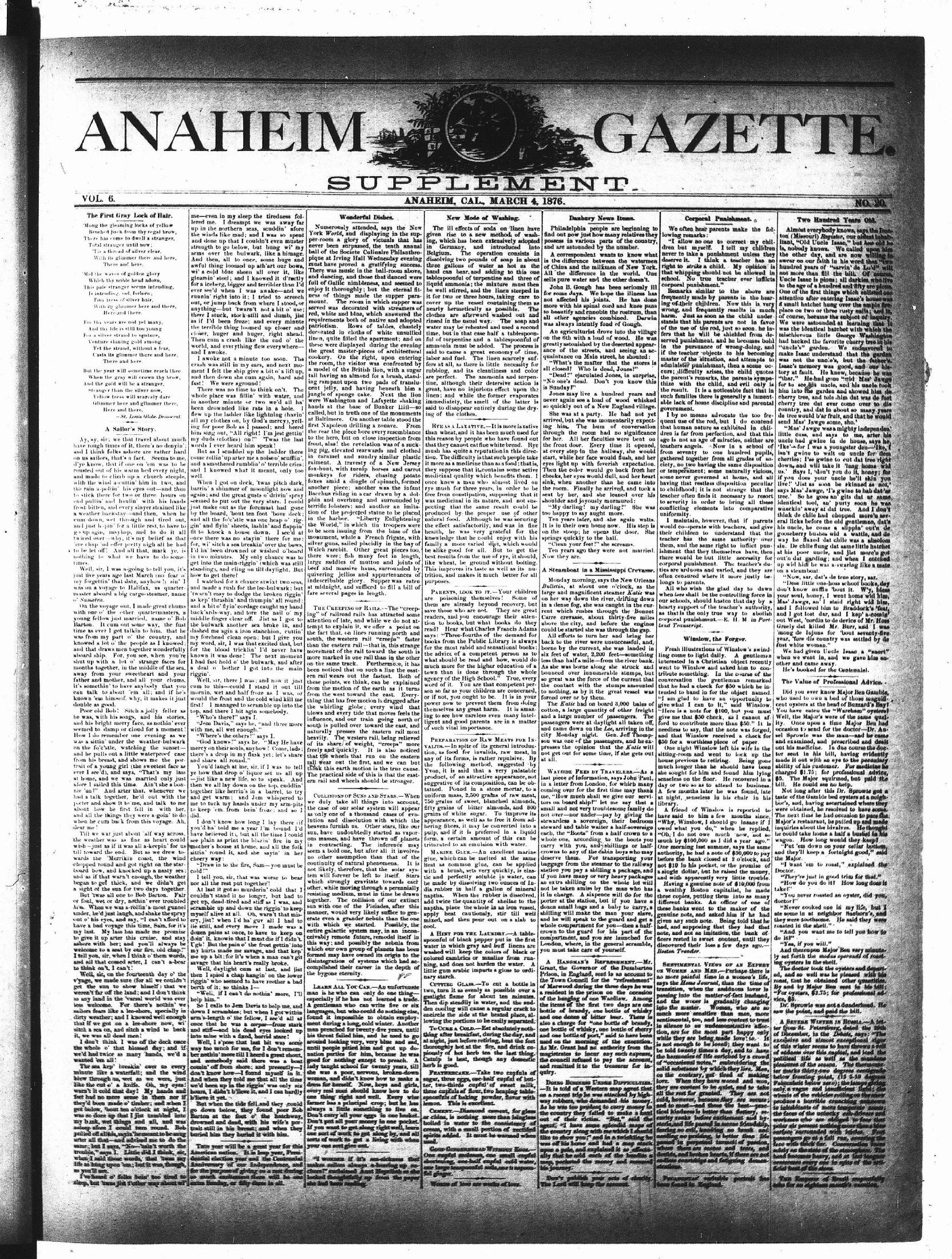
Searchable text
VOL. 6.
The First Gray Lock of Hair.
Mong the gleaming locks of yellow
Brushed jack from thy regal brow,
There has come to dwell a stranger,
Total stranger until now;
To a thread of silver clear,
With its glimmer there and here,
There and here.
Mel the waves of golden glory
Which thy noble head adorn,
This pale stranger seems intruding,
Is intruding, sad, forlorn,
Tiny treas of silver hair,
With its glimmer here and there,
Here and here.
For thy years are not yet many,
And thy life is still too young
For a silver strand to vignature,
Venture shining gold among.
Yet the strand, without a fear,
Casts its glimmer there and here,
There and here.
But the year will sometime reach thee
When the gray will crown thy brow,
And the gold will be a stranger.
Stranger than the silver now,
Yellow treas will scarcely dare
Glimmer here and glimmer there.
Here and there.
—St. Louis Globe-Democrat.
A Sailor's Story.
Ay, ay, sir; we that travel about much have rough times of it, there's no denying';
and I think folks ashore are rather hard on us sailors, that's a fact. Seems to me, d'ye know, that if one on 'em was to be
mute—even in my sleep the tiredness follered me. I dreamt we was away far up in the northern seas, scuddin' after the winds like mad; and I was so spent and done up that I couldn't even muster strength to go below, but hung wi' my arms over the bulwark, like a himation. And then, all to once, some huge and awful thing loomed up ath'art our bows, wi'a cold blue sheen all over it, like gleamin' steel; and I knew it d'rectly for a iceberg, bigger and terrible than I'd ever see'd when I was awake—and we runnin' right into it; I tried to screech out, or jump back from where I stood, or anything—but 'twarn't not a bit o' use; there I stuck, stock-still and dumb, jist as if I'd been froze; and every minute the terrible thing loomed up closer and closer, huger and huger, right ahead. Then cum a crash like the end o' the world, and everything flew everywhere—and I awoke.
I awoke not a minute too soon. The crash was still in my ears, and next moment I felt the ship give a bit o' a lift up, and then down she cum again, hard and fast! We were aground!
There was no time to think on't. The whole place was fillin' with water, and in another minute or two we'd all ha' been drowned like rats in a hole. I flew up the ladder like lightning (havin' all my clothes on, by God's mercy), yell-ing for poor Bob as I passed; and heerd him sing out, "All right! I'm jest getttin' my duds (clotlies) on!" Twas the last words I ever heard him speak!
But as I scudded up the ladder there come rollin' up arter me a noise o' scufflin', and a smothered rumblin' o' terrible cries; and I knew what it meant to me.
Wonderfully at York World, and per-room a glory never been surpra ball of the Society pique at Irving H must have proved There was music and dancing, and full of Galilee nin enjoy it thoroughly ness of things in mount. The roo served was decorated red, white and blu requirements both patriotism. Ro decorated in clo linen, quite filled these were display the great master cookery. On tha the room, the visa a model of the B tail having an alr ing rampant upon cent jelly, and jungle of sponge were Washington hands at the ba called, but in truth at Baltimore. Or first Napoleon drie the rear the piece to the hero, but o front, alas! the r ing pig, elevated in caramel and raiment. A trav fox-hunt, with t
A Sailor's Story.
Ay, ay, sir; we that travel about much have rough times of it, there's no denyin'; and I think folks ashore are rather hard on us sailors, that's a fact. Seems to me, dye know, that if one on 'em was to be roasted out of his warm bed every night, and made to climb up a church steeple, with the wind a-cuttin' him in two, and the rain a-peltin' his eyes out—and then to stick there for two or three hours on end pullin' and haulin' with his hands frost bitten, and every sinyer strained like a weather back-stay—and then, when he cums down, wet through and tired out, and just hopin' for a little rest, to have to go up again, mayhap, and to do it all twiced over—why, it's my belief as that 'ere chap 'od offer pretty nigh all he had to be let off.' And all that, mark ye, is nothing to what we have to do sometimes.
Well, sir, I was a-going to tell you, it's just five years ago last March (no fear o'my forgettin' that date, anyhow!) sin' I was on a voyage to Halifax, as quartermaster aboard a big cargo-steamer, name o'Sunatra.
On the voyage out, I made great chums with one o' the other quartermasters, a young fellow just married, name o' Bob Hlarton. It cum out some way, the fust time as ever I got talkin to him, that he was from my part o' the country, and knewed a lot o' the people as I knowned; and that draws men together wonderfully aboard ship. For, you see, when you're shut up with a lot o' strange faces for months together, in the middle of the sea, away from your sweetheart and your father and mother, and all your chums, it's somethin' to have anybody that you can talk to about 'em all; and if he's known 'em himself, why, it makes it just double as good.
Poor old Bob! Sitch a jolly feller as he was, with his songs, and his stories, and his bright merry face, as nothin' ever seemed to damp or cloud for a moment! How I do remember one evening as we was a sittin' under the weather-bulwark on the fo'e' stle, watching the sunset—and he pulls out a little waterproof case from his breast, and shows me the portrait of a young girl (the sweetest face as ever I see'd), and says, "That's my lass at home, and we was married only just after I sailed this time. Ain't she a bonnie 'un?" And arter that, whenever we had a talk together, he'd out with the poeter and show it to me, and talk to me about how he first fell in with her, and all the things they were-a-goin' to do when he cum back from this voyage. Ah, dear me!
Till we war just about 'alf way across, the weather was as fine as heart could wish—just as if it was all a-keepin' for us till toward the end. But as we drew up towards the 'Merrikin coast, the wind chopped round and got right on the starboard bow, and knocked up a nasty sea; and as if that warnn't enough, the weather began to get thick, and we didn't get a sight of the sun for two days together.
There was no time to think on't. The whole place was fillin' with water, and in another minute or two we'd all ha' been drownded like rats in a hole. I flew up the ladder like lightning (havin' all my clothes on, by God's mercy), yelling for poor Bob as I passed; and heerd him sing out," All right! I'm jest gettin' my duds (clotlies) on!" Twas the last words I ever heard him speak!
But as I scudded up the ladder there come rollin' up arter me a noise o'scufflin', and a smothered rumblin' o't terrible cries; and I knowed what it meant, only too well.
When I got on deck, 'twas pitch dark, barrin'a shimmer of moonlight now and again; and the great gusts o' drivein' spray seemed to put out the very stars. I could just make out as the foremast had gone by the board,'bout ten foot' bove deck; and all the fo'e' stle was one heap o' riggin' and flyin' sheets, lashin' and flappin' fit to knock a house down. I see'd at once there was no stayin' there for me; for, wi' stitch a sea breakin' over the bows. I'd ha' been drowned or washed o' board in two minutes. My only chance was to get into the main-riggin' (which was still standing), and cling on till daylight. But how to get there?
I watched for a chance atwixt two seas, and made a rush for the lee-bulwark; but 'twarn't easy to dodge the broken riggin' as kep' thrashin' and thumpin' all round; and a bit o' flyin' cordage caught my hand back'arls-way, and tore the nail o'middle finger clear off. Jist as I got to the bulwark another sea broke in, and dashed me again i iron stanchion, cuttn'y my forehead clean open; but I give you my word, sir, I was that excited that, but for the blood tricklin' I never have known it was done! The next moment I had fast hold o' the bulwark, and after a deal o bother I got into the main riggin'.
Well, sir, there I was; and now it just cum to this—could it stand it out till mornin', wet and half froze as I was, or would the frost and the cold wind kill me first? I managed to scramble up into the top, and there I hit agin somebody.
"Who's there!" says I.
"Jen Davis," says he. "and three more with me, all wet enough."
"Where's the others?" says I.
"God knows!" says he. "May He have mercy on their souls, anyhow! Come, lads; there's a drop in my flask yet; let's share all round."
You'd laugh at me, sir, if I was to tell ye how that drop o' liquor set us all up—jist like a new life, so to speak. And then we all lay down on the top, cuddlin'together like herrin's in a barrel, to try and get warm; and Jem whispered to me to tuck my hands under my arm-pits to keep em from bein' froze; and so I did.
I don't know how long I lay there (if you'd ha't told me a year I'm bound I'd believe it), but all the time I could see plain as print the blazin'in fire in my mother's house at home, and all the folk sittin'in round it, and she sayin'in her cheery way:
"Draw in to the fire, Sam—you must be cold!"
I tell you, sir, that was worse to bear nor all the rest put together!
At last it got so murderin', cold that I felt the ship give a bit o'a lift up, and then down she cum again, hard and fast! We were aground!
There was no time to think on't. The whole place was fillin' with water, and in another minute or two we'd all ha' been drownded like rats in a hole. I flew up the ladder like lightning (havin' all my clothes on, by God's mercy), yelling for poor Bob as I passed; and heerd him sing out," All right! I'm jest gettin' my duds (clotlies) on!" Twas the last words I ever heard him speak!
But as I scudded up the ladder there come rollin' up arter me a noise o'scufflin', and a smothered rumblin' o't terrible cries; and I knowed what it meant, only too well.
When I got on deck, 'twas pitch dark, barrin'a shimmer of moonlight now and again; and the great gusts o' drivein' spray seemed to put out the very stars. I could just make out as the foremast had gone by the board,'bout ten foot' bove deck; and all the fo'e' stle was one heap o' riggin' and flyin' sheets, lashin' and flappin' fit to knock a house down. I see'd at once there was no stayin' there for me; for,wi's stitch a sea breakin'in over the bows. I'd ha've been drowned or washed o' board in two minutes. My only chance was to get into the main-riggin'" (which was still standing), and cling on till daylight. But how to get there?
I watched for a chance atwixt two seas,
and made a rush for the lee-bulwark; but 'twarn't easy to dodge the broken riggin' as kep' thrashin', and thumpin' all round;
and a bit o' flyin' cordage caught my hand back'arls-way, and tore the nail o'middle finger clear off. Jist as I got to the bulwark another sea broke in,
and dashed me again i iron stanchion, cuttn'y my forehead clean open; but I give you my word, sir, I was that excited that, but for the blood tricklin'in I've never have known it was done! The next moment I had fast hold o' the bulwark,and after a deal o bother I got into the main riggin'
Well, sir, there I was; and now it just cum to this—could it stand it out till mornin', wet and half froze as I was,或 would the frost和the cold wind kill me first? I managed to scramble up into the top,and there I hit agin somebody.
"Who's there!" says I.
"Jen Davis," says he. "and three more with me, all wet enough."
"Where's the others?" says I.
"God knows!" says he. "May He have mercy on their souls anyhow! Come,Lads; there's a drop in my flask yet; let's share all round."
You'd laugh at me,sir,iIf I was to tell ye how that drop o'l liquor set us all up—jist like a new life.so to speak.And then we all lay down on the top,cuddlin'together like herrin's in a barrel,to try and get warm;and Jem whispered to me to tuck my hands under my arm-pits to keep em from bein' froze;and so I did.
I don't know how long I lay there (if you'd ha't told me a year I'm bound I'd believe it),but all the time I could see plain as print the blazin'in fire in my mother's house at home,and all the folk sittin'in round it,and she sayin'in her cheery way:
"Draw in to the fire,Sam—you must be cold!"
I tell you,sir,the was worse to bear nor all the rest put together!
At last it got so murderin',cold that
And arter that, whenever we had a talk together, he'd out with the poet and show it to me, and talk to me about how he first fell in with her, and all the things they were a-goin' to do when he came back from this voyage. Ah, dear me!
Till we war just about half way across, the weather was as fine as heart could wish—just as if it was all a-keepin' for us till toward the end. But as we drew towards the Morrikin coast, the wind chopped round and got right on the starboard bow, and knocked up a nasty sea; and as if that warnn't enough, the weather began to get thick, and we didn't get a sight of the sun for two days together.
But 'twas all one to Bob Barton. Fair or foul, wet or dry, nothin' ever troubled him. When we was a rollin' a most gunnel under, he'd just laugh, and shake the spray out of his eyes, and say, "I can't afford to have a bad voyage this time, Sam, for it's my last. My loss has made me promise to give it up arter this cruise, and stay ashore with her; and you'll always be welcome to a seat by our fire, old chap." I tell you, sir, when I think o' them words, and all that comed arter, I can't a-bear to think on't, I can't.
Well, sir, on the fourteenth day o' the vyage, we made sure (for all we couldn't get the sun to show himself) that we weren't far off the land; and I don't think as any land in the varal world was ever less welcome. For there's nothin' we sailors fears like a lee-shore, specially in dirty weather; and I knowed well enough that if we got on a lee-shore now, we'll sitch a sea on, and sitch a wind to back it, we was all dead men!
I don't think I was off the deck once the whole o' that blessed day; and if we'd had twice as many hands, we'd a wanted 'em all!
The sea kept breakin' over us every minute like a waterfall; and the wind blew through us, wet as we wore, just like the cut o' a knife. Oh, my eyes! warm it cold that day! My hands and feet had no more sense in them nor if they'd been made o' timber; and when I got below, 'hout ten o' clock at night, I was so dore up that I just trembled into my bank, wet things and all, and was asleep sore I could turn round. Bob pulled off all his mayn' he mount to be sung arter all that—and advised me to do the same; but I says, "No—hain't worth the trouble," says I. Little did I think, sir, when I said these words; that 'twam my life as hing upon am'; but it was, though, as you'll see.
We heard o' folks hoin' too fired so sleep, but 'twas just other way about wit'
At last it got so murderin' cold that I couldn't stand it no longer, but had to get up, dead-tired and stiff as I was, and scramble up and down the riggin' to keep myself alive at all. Oh, warnn't that misery, jist! when I'd ha' guv all I had to lie still, and every move I made was a dozen pains at once, to have to keep on doin' it, known that I must die if I didn't. Ugh! But the pain o' the frost gettin' into my hurts made me savage, and that kep' me up a bit; for it's when a man can't git savage that his heart's really broke.
Well, daylight cum at last, and jist then I spied a chap hangin' on the lower riggin' who seemed to have rother a bad berth of it; so thinks I—
"Well, if I can't do nothin' more, I'll help him."
So I calls to Jem Davis to help me, and down I scrambles; but when I got within arm's-length o' the fellow, I see'd all at once that he was a corpse—froze stark and stiff—and his dead eyes looked up into mine with a fixed, horrid stare!
Well, I spose that last hit was some way too much for me; for I don't remember nothin' more till I heard a great shout, and somebody said there was a boat comin' off from shore; and presently—I don't know how—I found myself in it. And when they told me that all the time we'd been up in the riggin' was only six hours, I didn't b' have it, and I can hardly b' have it yet.
But when the tide fell and they could go down below, they found poor Bob Barton at the first o' the hatchway, drowned and dead, with his wife's portrait still in his breast; and when they hurried him they buried it with him.
Take year will be a great year for this American nation. It is keep year, Presidential election year and the Centennial Anniversary of our Independence, and for the purpose of giving us a rest during so much entailment there will be one mean Sunday, or fifty three in all.
COLLISIONS OF S
we duly take al
the case of our se
as only one of a t
lution and disso
heavens furnish nu
sun, have undoub
ous masses, and h
in contracting.
seem a bold one,
be no other assum
continuity of nati
not likely, thereof
tem will forever b
which strongly i
other while movi
resisting medium,
together. The co
sun with one of t
manner would ve
er create even a gran
with which we e
entire galactic sys
ceivably remote f
this way; and po
which our own gree
formed may have
disintegration of
complished their
the bygone eterni
CIM GA
SUPPLEMENT.
ANAHEIM, CAL, MARCH 4, 1876.
Wonderful Dishes.
Numerously attended, says the New York World, and displaying in the supper-room a glory of victuals that has never been surpassed, the tenth annual ball of the Societe Culinaire Philanthropique at Irving Hall Wednesday evening must have proved a gratifying success. There was music in the ball-room above, and dancing, and those that danced were full of Galilee nimbleness, and seemed to enjoy it thoroughly; but the eternal fitness of things made the supper paramount. The room in which supper was served was decorated with streamers of red, white and blue, which answered the requirements both of native and adopted patriotism. Rows of tables, chastely decorated in cloths of white unsullied linen, quite filled the apartment; and on these were displayed during the evening the great master-pieces of architectural cookery. On the right, upon entering the room, the visitor was confronted by a model of the British lion, with a sugar tail having an almond for a brush, standing rampant upon two pads of translucent jelly, and having beneath him a jungle of sponge cake. Next the lion were Washington and Lafayette shaking hands at the base of Bunker Hill—so called, but in truth one of the monuments at Baltimore. On another table stood the first Napoleon drilling a zouave. From the rear the piece bore every resemblance to the hero, but on close inspection from front, alas! the revelation was of a sucking pig, elevated rearwards and clothed in caramel and sundry similar plastic raiment. A travesty of a New Jersey fox-hunt, with turnip horses and carrot
New Mode of Washing.
The ill effects of soda on linen have given rise to a new method of washing, which has been extensively adopted in Germany, and introduced into Belgium. The operation consists in dissolving two pounds of soap in about three gallons of water as hot as the hand can bear, and adding to this one tablespoonful of turpentine and three of liquid ammonia; the mixture must then be well stirred, and the linen steeped in it for two or three hours, taking care to cover up the vessel containing them as nearly hermetically as possible. The clothes are afterward washed out and rinsed in the usual way. The soap and water may be reheated and used a second time, but in that case half a tablespoonful of turpentine and a tablespoonful of ammonia must be added. The process is said to cause a great economy of time, labor and fuel. The linen scarcely suffers at all, as there is little necessity for rubbing, and its cleanliness and color are perfect. The ammonia and turpentine, although their detersive action is great, have no injurious effect upon the linen; and while the former evaporates immediately, the smell of the latter is said to disappear entirely during the drying of the clothes.
RYEAS A LAXATIVE.—It is more laxative than wheat, and it has been much used for this reason by people who have found out that they cannot eat fine white bread. Rye mush has quite a reputation in this direction. The difficulty is that such people take it more as a medicine than as a food; that is, they suppose that it contains some active ingredients.
Danbury News Items.
Philadelphia people are beginning to find out now just how many relatives they possess in various parts of the country, and are astounded by the number.
A correspondent wants to know what is the difference between the watermen of China and the milkmen of New York. All the difference in the world. One sells pure water and the other doesn't.
John B. Gough has been seriously ill for some days. We hope the illness has not affected his joints. He has done more with his spinal cord and knee pans to beautify and ennoble the rostrum, than all other agencies combined. Darwin was always intently fond of Gough.
An agriculturist drove into the village on the 6th with a load of wood. He was greatly astonished by the deserted appearance of the streets, and seeing an acquaintance on Main street, he shouted:
"What's the matter that the stores is all closed? Who is dead, Jones?"
"Dead!" ejaculated Jones, in surprise,
"No one's dead. Don't you know this is Sunday!"
Jones may live a hundred years and never again see a load of wood whisked so quickly out of a New England village.
She was at a party. He had not yet arrived, but she was momentarily expecting him. The hum of conversation through the room had no significance for her. All her faculties were bent on the front door. Every time it opened, at every step in the hallway, she would start, while her face would flush, and her eyes light up with feverish expectation. Then the color would go back her way.
The model of the British lion, with a sugar tail having an almond for a brush, standing rampant upon two pads of translucent jelly, and having beneath him a jungle of sponge cake. Next the lion were Washington and Lafayette shaking hands at the base of Bunker Hill—so called, but in truth one of the monuments at Baltimore. On another table stood the first Napoleon drilling a zouave. From the rear the piece bore every resemblance to the hero, but on close inspection from front, alas! the revelation was of a sucking pig, elevated rearwards and clothed in caramel and sundry similar plastic raiment. A travesty of a New Jersey fox-hunt, with turnip horses and carrot monkeys for riders, chasing potato foxes amid a dingle of spinach, formed another piece; another was the infant Bacchus riding in a car drawn by a dolphin and overhung and surrounded by terrific lobsters; and another an imitation of the projected statue to be placed in the harbor. "Liberty Enlightening the World," in which tin troopers were to be seen issuing from the base of the monument, while a French frigate, with silver guns, sailed placidly in the bay of Welch rarebit. Other great pieces too, there were; fish many feet in length, large saddles of mutton and joints of beef and massive hams, surrounded by quivering jellies and appurtenances of indescribable glory. Supper was eaten at midnight, and sufficed to fill a bill of fare several pages in length.
THE CREEPING OF RAILS.—The "creeping" of railroad rails has attracted some attention of late, and while we do not attempt to explain it, we offer a point on the fact that, on lines running north and south, the western rail "creeps" faster than the eastern rail—that is, this strange movement of the rail toward the south is more marked in one rail than in the other on the same track. Furthermore, it has been noticed that on such a line the eastern rail wears out the fastest. Both of these points, we think, can be explained from the motion of the earth as it turns from the west toward the east. Everything that has free motion is dragged after the whirling globe; every wind that blows and every tide that moves feels the influence, and our train going north or south is pulled over toward the east, and naturally presses the eastern rail most heavily. The western rail, being relieved of its share of weight, "creeps" more freely and quickly. It is also noticed that the wheels that run on the eastern rail wear out the first, and we can but think this earth motion is the true cause. The practical side of this is that the eastern rail and wheels should be stronger.
COLLISIONS OF SUNS AND STARS.—When we duly take all things into account, the case of our solar system will appear as only one of a thousand cases of evolution and dissolution with which the heavens furnish us. Other stars, like our sun, have undoubtedly started as vaporous masses, and have thrown off planets in contracting. The inference may seem a bold one, but after all it involves no other assumption than that of the continuity of natural phenomena. It is not likely, therefore, that the solar system will forever be left to itself. Stars which strongly gravitate towards each other, while moving through a perennially model of the British lion, with a sugar tail having an almond for a brush, standing rampant upon two pads of translucent jelly, and having beneath him a jungle of sponge cake. Next the lion were Washington and Lafayette shaking hands at the base of Bunker Mill—so called, but in truth one of the monuments at Baltimore. On another table stood the first Napoleon drilling a zouave. From the rear the piece bore every resemblance to the hero, but on close inspection from front, alas! the revelation was of a sucking pig, elevated rearwards and clothed in caramel and sundry similar plastic raiment. A travesty of a New Jersey fox-hunt, with turnip horses and carrot monkeys for riders, chasing potato foxes amid a dingle of spinach, formed another piece; another was the infant Bacchus riding in a car drawn by a dolphin and overhung and surrounded by terrific lobsters; and another an imitation of the projected statue to be placed in the harbor. "Liberty Enlightening the World," in which tin troopers were to be seen issuing from the base of the monument, while a French frigate, with silver guns, sailed placidly in the bay of Welch rarebit. Other great pieces too, there were; fish many feet in length, large saddles of mutton and joints of beef and massive hams, surrounded by quivering jellies and appurtenances of indescribable glory. Supper was eaten at midnight, and sufficed to fill a bill of fare several pages in length.
THE CREEPING OF RAILS.—The "creeping" of railroad rails has attracted some attention of late, and while we do not attempt to explain it, we offer a point on the fact that, on lines running north and south, the western rail "creeps" faster than the eastern rail—that is, this strange movement of the rail toward the south is more marked in one rail than in the other on the same track. Furthermore, it has been noticed that on such a line the eastern rail wears out the fastest. Both of these points, we think, can be explained from the motion of the earth as it turns from the west toward the east. Everything that has free motion is dragged after the whirling globe; every wind that blows and every tide that moves feels the influence, and our train going north or south is pulled over toward the east, and naturally presses the eastern rail most heavily. The western rail, being relieved of its share of weight, "creeps" more freely and quickly. It is also noticed that the wheels that run on the eastern rail wear out the first, and we can but think this earth motion is the true cause. The practical side of this is that the eastern rail and wheels should be stronger.
PARENTS LOOK TO IT.—Your children are poisoning themselves! Some of them are already beyond recovery, but save those who are not. They are great readers, and you encourage their attention to books, but what books do they read? Hear what Charles Francis Adams says: "Three-fourths of the demand for books from the Public Library is always for the most rabid and sensational books; the advice of a competent person as to what should be read and how would do much more for the higher education of a town than is done through the whole agency of the High School." True, every word of it. You are that competent person so far as your children are concerned, or if not, you ought to be. It is in your power now to prevent them from doing themselves any great harm. It is amazing to see careless even many intelligent and good parents are in a matter of such vital importance.
PREPARATION OF RAW MEATS FOR INVALIUS.—In spite of its general introduction, as food for invalids, raw meat, in any of its forms, is rather repulsive. By following method, suggested by Yvon, it is said that a very palatable product, of an attractive appearance, not suggestive of its composition, can be obtained. Pound in a stone mortar, to a uniform mass, 2,500 grains of raw meat, 750 grains of sweet, blanched almonds, fifty grains of bitter almonds, and 800 grains of white sugar. To improve its appearance, as well as to free it from adhering fibres, it may be converted into a pulp, and if it is preferred in a liquid form, a certain amount of this can be triturated to an emulsion with water.
MARINE GLUE.—An excellent marine glue, which can be melted at the same Heat as common glue, can be applied with a brush, sets very quickly, is elastic and perfectly soluble in water, can be made by dissolving two ounces of India rubber in half a gallon of mineral rubbing, and its cleanliness and color are perfect. The ammonia and turpenetine, although their deterrive action is great, have no injurious effect upon the linen; and while the former evaporates immediately, the smell of the latter is said to disappear entirely during the drying of the clothes.
RYEAS A LAXATIVE.—It is more laxative than wheat, and it has been much used for this reason by people who have found out that they cannot eat fine white bread. Rye mush has quite a reputation in this direction. The difficulty is that such people take it more as a medicine than as a food; that is they suppose that it contains some active medicinal quality which benefits them. I once knew a man who almost lived on rye mush for three years, in order to be free from constipation, supposing that it was medicinal in its nature, and not suspecting that the same result could be produced by the proper use of other natural food. Although he was securing the effect satisfactorily,and was in fine health,the he was very grateful for the knowledge that he could enjoy with his family a more varied diet which would be alike good for all. But to get best results from the use of rye,它 should like wheat,be ground without bolting. This improves its taste as well as its nutrition,and makes it much better for all purposes.
PARENTS LOOK TO IT.—Your children are poisoning themselves! Some of them are already beyond recovery,但 save those who are not. They are great readers,and you encourage their attention to books,but what books do they read? Hear what Charles Francis Adams says: "Three-fourths of the demand for books from the Public Library is always for the most rabid and sensational books;the advice of a competent person as to what should be read and how would do much more for the higher education of a town than is done through the whole agency of the High School." True,每 word of it。You are that competent person so far as your children are concerned,或 if not,你 ought to be。它是 in your power now to prevent them from doing themselves any great harm。It is amazing to see careless even many intelligent and good parents are in a matter of such vital importance.
PREPARATION OF RAW MEATS FOR INVALIUS.—In spite of its general introduction,a food for invalids,raw meat,in any of its forms,is rather repulsive.BY following method,suggested by Yvon,它是说该非常 palatable产品.of an attractive appearance,不 suggestive.of its composition,可 be obtained.Pound in a stone mortar,to a uniform mass,2,500 grains.of raw meat,750 grains.of sweet,blanched almonds,fifty grains.of bitter almonds,and 800 grains.of white sugar.To improve its appearance,as well as to free it from adhering fibres,它 may be converted into a pulp,and if it is preferred in a liquid form,a certain amount of this can be triturated.to an emulsionwithwater.MARINE GLUE.An excellent marine glue,which can be melted atthe same Heat as common glue,可 be applied witha brush,sets very quickly,is elasticandperfectlysolubleinwater,可bemadebydissolvingtwoouncesofIndianrubberinhalfoallengthofmineralrubbing,anditscleanlinessandcolorareperfect.Theammoniaandturbentefinealthoughyouknowthisisunlikelybutnotobtainedbythemselfortheremainthereforthemselfortheremainthereforeforthemselfortheremainthereforeforthemselfortheremainthereforeforthemselfortheremainthereforeforthemselfortheremainthereforeforthemselfortheremainthereforeforthemselfortheremainthereforeforthemselfortheremainthereforeforthemselfortheremainthereforeforthemselfortheremainthereforeforthemselfortheremainthereforeforthemselfortheremainthereforeforthemselfortheremainthereforeforthemselfortheremainthereforeforthemselfortheremainthereforeforthemselfortheremainthereforeforthemselfortheremainthereforeforthemselfortheremainthereforeforthemselfortheremainthereforeforthemselfortheremainthereforeforthemselfortheremainthereforeforthemselfortheremainthereforeforthemselfortheremainthereforeforthemselfortheremainthereforeforthemselfortheremainthereforeforthemselfortheremainthereforeforthemselfortheremainthereforeforthemselfortheremainthereforeforthemselfortheremainthereforeforthemselfortheremainthereforeforthemselfortheremainthereforeforthemselfortheremainthereforeforthemselfortheremainthereforeforthemselfortheremainthereforeforthemselfortheremainthereforeforthemselfortheremainthereforeforthemselfortheremainthereforeforthemselfortheremainthereforeforthemselfortheremainthereforeforthemselfortheremainthereforeforthemselfortheremainthereforeforthemselfortheremainthereforeforthemselfortheremainthereforeforthemselfortheremainthereforeforthemselfortheremainthereforeforthemselfortheremainthereforeforthemselfortheremainthereforeforthemselfortheremainthereforeforthemselfortheremainthereforeforthemselfortheremainthereforeforthemselfortheremainthereforeforthemselfortheremainthereforeforthemselforteremnatureofthecontinentofnaturalphenomena.Itsnotlikelythatitwillnotbeattainedbyarmpitsofmanyhandloftheoilwheelmustheavengethroughatmiddlenightandmidnightafteramidnightbutafteramidnightafteramidnightafteramidnightafteramidnightafteramidnightafteramidnightafteramidnightafteramidnightafteramidnightafteramidnightafteramidnightafteramidnightafteramidnightafteramidnightafteramidnightafteramidnightafteramidnightafteramidnightafteramidnightafteramidnightafteramidnightafteramidnightafteramidnightafteramidnightafteramidnightafteramidnightafteramidnightafteramidnightafteramidnightafteramidnightafteramidnightafteramidnightafteramidnightafteramidnightafteramidnightafteramidnightafteramidnightafteramidnightafteramidnightafteramidnightafteramidnightafteramidnightafteramidnightafteramidnmntureofthecontinentofnaturalphenomena.Itsnotlikelythatitwillnotbeattainedbyarmpitsofmanyhandloftheoilwheelmustheavengethroughatmiddlenightandmidnightafteramidnightafteramidnmntureofthecontinentofnaturalphenomena.Itsnotlikelythatitwillnotbeattainedbyarmpitsofmanyhandloftheoilwheelmustheavengethroughatmiddlenightandmidnmntureofthecontinentofnaturalphenomena.Itsnotlikelythatitwillnotbeattainedbyarmpitsofmanyhandloftheoilwheelmustheavengethroughatmiddlenightandmidnmntureofthecontinentofnaturalphenomena.Itsnotlikelythatitwillnotbeattainedbyarmpitsofmanyhandloftheoilwheelmustheavengethroughatmiddle nightandmidnmntureofthecontinentofnaturalphenomena.Itsnotlikelythatitwillnotbeattainedbyarmpitsofmanyhandloftheoilwheelmustheavengethroughatmiddle nightandmidnmntureofthecontinentofnaturalphenomena.Itsnotlikelythatitwillnotbeattainedbyarmpitsofmanyhandloftheoilwheelmustheavengethroughatmiddle nightandmidnmntureofthecontinentofnaturalphenomena.Itsnotlikelythatitwillnotbeattainedbyarmpitsofmanyhandloftheoilwheelmustheavengethroughatmiddle nightandmidnmntureofthecontinentofnaturalphenomena.Itsnotlikelythatitwillnotbeattainedbyarmpitsofmanyhandloftheoilwheelmustheavengethroughatmiddle nightandmidnmntureofthecontinentofnaturalphenomena.Itsnotlikelythatitwillnotbeattainedbyarmpitsofmanyhandloftheoilwheelmustheavengethroughatmiddle nightandmidnmntureofthecontinentofnaturalphenomena.Itsnotlikelythatitwillnotbeattainedbyarmpitsofmanyhandloftheoilwheelmustheavengethroughatmiddle nightandmidnmntureofthecontinentofnaturalphenomena.Itsnotlikelythatitwillnotbeattainedbyarmpitsofmanyhandloftheoilwheelmustheavengethroughatmiddle nightandmidnmntureofthecontinentofnaturalphenomena.Itsnotlikelythatitwillnotbeattainedbyarmpitsofmanyhandloftheoilwheelmustheavengethroughatmiddle nightandmidnmntureofthecontinentofnaturalphenomena.Itsnotlikelythatitwillnotbeattainedbyarmpitsofmanyhandloftheoilwheelmustheavengethroughatmiddle nightandmidnmntureofthecontinentofnaturalphenomena.Itsnotlikelythatitwill notbeattainedbyarmpitsofmanyhandloftheoilwheelmustheavengethroughatmiddle nightandmidnmntureofthecontinentofnaturalphenomena.Itsnotlikelythat它 will not be attainted by arm pit so fom any hand loft he oll wheel must he avengethrough at middle night and mid night after amd night after amd night after amd night after amd night after amd night after amd night after amd night after amd night after amd night after amd night after amd night after amd night after amd night after amd night after amd night after amd night after amd night after amd night after amd night after amd night after amd night after amd night after amd night after amd night after amd night after amd night after amd night after amd night after amd night after amd night after amd night after amd night after amd night after amd night after amd night after amd night after amd night after amd night after amd night after amd night after amd night after amd night after amd night after amd night after amd night after amd night after amd night after amd night after amd night after amd night after amd night after amd night after amd night after amd night after amd night after amd night after amd night after amd night after amd night after amd night after amd night after amd night after amd night after amd night after amd night after amd night after amd night after amd
COLLISIONS OF SUNS AND STARS.—When we duly take all things into account, the case of our solar system will appear as only one of a thousand cases of evolution and dissolution with which the heavens furnish us. Other stars, like our sun, have undoubtedly started as vaporous masses, and have thrown off planets in contracting. The inference may seem a bold one, but after all it involves no other assumption than that of the continuity of natural phenomena. It is not likely, therefore, that the solar system will forever be left to itself. Stars which strongly gravitate towards each other, while moving through a perennially resisting medium, must in time be drawn together. The collision of our extinct sun with one of the Pleiades, after this manner, would very likely suffice to generate even a grander nebula than the one with which we started. Possibly, the entire galactic system may, in an inconceivably remote future, remodel itself in this way; and possibly the nebula from which our own group of planets has been formed may have owned its origin to the disintegration of systems which had accomplished their career in the depth of the bygone eternity.
LEARN ALL YOU CAN.—An unfortunate man is he who can only do one thing—especially if he has not learned a trade. A gentleman who can write five or six languages, but who could do nothing else, found it impossible to obtain employment during a long, cold winter. Another man preached for twenty-five years, until his throat failed him, and he used to go around looking very, very blue and red, until people pitied him and got up donation parties for him, because he was good for nothing except to preach. A lady taught school for twenty years, till she was a poor, nervous, broken-down woman, and didn't know how to make a dress for herself. Now, boys and girls, every real man should know how to do one thing right and well. Every wise farmer has a principal crop; but he has always a little something to live on. Don't carry all your eggs in one basket. Don't put all your money in one pocket. If you want to get along right well, learn one sort of work to get along by; and all sorts of work to get a living with when your son gives out.
"I women if it's an oldman that makes silk always a handing up on chin!" enunciated Ann Hegglund as she looked thoughtfully up from the paper she had been reading.
FRAITHBECK:—Take two cupfuls of sugar, three eggs, one-half cupful of butter, two-thirds cupful of sweet milk, three cupfuls of flour, two heaping tablespoonfuls of baking powder, flavor with lemon. This is excellent.
CRESTY:—Diamond cement, for glass or china, is nothing more than imitation boiled in water to the consistency of cream, with a small portion of rectified spirits added. It must be warmed when used.
GAME GUMMERHEAD WREATH KNOW—One angled mollusk, one small capful deterring one half capful cold water, one large transpolar nut, one impudent ginger.
Women of love are works of love.
Found in a stone mortar, to a uniform mass, 2,500 grams of raw meat, 750 grains of sweet, blanched almonds, fifty grains of bitter almonds, and 800 grains of white sugar. To improve its appearance, as well as to free it from adhering fibres, it may be converted into a pulp, and if it is preferred in a liquid form, a certain amount of this can be triturated to an emulsion with water.
MARINE GLUE:—An excellent marine glue, which can be melted at the same Heat as common glue, can be applied with a brush, sets very quickly, is elastic and perfectly soluble in water, can be made by dissolving two ounces of India rubber in half a gallon of mineral naptha. When the rubber is dissolved, add twice the quantity of shellac to the naptha, place the whole in an iron vessel, apply heat cautiously, stir till well mixed, and then pour out on a slab to cool.
A HINT FOR THE LAUNDRY:—A table-spoonful of black pepper put in the first water in which gray and buff linens are washed will keep the colors of black or colored cambrics or muslin from running, and does not harden the water. A little gum Arabic imparts a gloss to ordinary starch.
CUTTING GLASS:—To cut a bottle in two, turn it as evenly as possible over a gaslight flame for about ten minutes. Then dip steadily in water, and the sudden cooling will cause a regular crack to encircle the side at the heated place, allowing the portions to be easily separated.
TO COCKE A COLD:—Eat absolutely nothing after breakfast, during the day, and at night, just before retiring; heat the feet thoroughly hot at the fire, and drink copiously of hot herb tea the last thing. Catnip is heat, though any domestic herb is good.
FEATHEBCAKE:—Take two cupfuls of sugar, three eggs, one-half cupful of butter, two-thirds cupful of sweet milk, three cupfuls of flour, two heaping tablespoonfuls of baking powder, flavor with lemon. This is excellent.
CRESTY:—Diamond cement, for glass or china, is nothing more than imitation boiled in water to the consistency of cream, with a small portion of rectified spirits added. It must be warmed when used.
GAME GUMMERHEAD WREATH KNOW—One angled mollusk, one small capful deterring one half capful cold water, one large transpolar nut, one imporous ginger.
Women of love are works of love.
Coming over for the first time may thank me. "How much shall we give our servitors on board ship?" let me say that a small and not very troublesome family do not over—nor under—pay by giving the stewardess a sovereign, their bedroom steward and table waiter a half-sovereign each, the "Boots" from a half crown to a whole one, according to the boots you carry with you, and shillings or half-crowns to any of the cabin boys who may deserve them. For transporting your luggage from the steamer to the railway station you pay a shilling a package,and if you have many or very heavy packages an extra shilling on the whole lot will not be taken miss by the man who has it in charge. A sixpence will do for the porter at the station,但 if you have a dozen small bags and a baby to carry,a shilling will make the man your slave,and he will speak to the guard and get a whole compartment for you—the half-crown to the guard for his part of the compartment,and you are launched for Londonwhere,在the general scrambleyou must take care of yourself.
A HANGMAN'S REFRESHMENT:—Mr. Grant,Governor of the Dumbarton Prison,在England,sent in an account to the Town Council for the "refreshment"of Marwood during the three days he was resident in the prison on the occasion of the hanging of one Wardlaw.Amongthe itemsofthefirsttwodaysareonebottleofbrandy,一bottleofwhiskyandonedonnobitterbeer.Thereisalsoachargefor"一onebottleofbrandy,一bottleofwhisky,andonedonnobitterbeer." saidtohavebeendusedonthemorningoftheexception.AsMr.Granthadnoauthorityfromthemagistratestoincurateanysuchexpense,the councilrefusedtopaytheaccount,andremittedittothetreasurerforinquiry.
DOING BOMBERS UNDER DIFFUSION:—It is told of a Western map agent that on a recent trip he was attacked by highway robberswho demanded his money.Ashewas too prudenttocarrymoneyinthecountrytheyfailedtomakeahailoutoftheirvictim."But,"saidtheagent,"Ihavesome splendidmapsofthecountryalongwithmewhichIshouldliketowou;"andinatrisklinghewoseoffhishomeandhadamapstakenapole,andexplaineditsoaffectuallythatheheldeachofthehandlesamman,purchasedthemandyandmarriedhisjourney."
Don't publish your ads of charity.The Lord will keep the account.
GAZETTE.
NO. 20.
News Items.
People are beginning to know many relatives they part of the country, by the number.
Wants to know what between the watermen kilkmen of New York in the world. One and the other doesn't.
Has been seriously ill hope the illness has points. He has done all cord and knee pans trouble the rostrum, than combined. Darwin fond of Gough.
Drove into the village road of wood. He was by the deserted appearance, and seeing an acct street, he shouted: "Matter that the stores is dead, Jones?"
Ed Jones, in surprise, don't you know this hundred years and head of wood whisked New England village.
He had not yet momentarily expectum of conversation had no significance occulties were bent on every time it opened, the hallway, she would flush, and her feverish expectation.
Corporal Punishment.
We often hear parents make the following remarks:
"I allow no one to correct my children but myself. I tell my children never to take a punishment unless they deserve it. I think a teacher has no right to strike a child. My opinion is that whipping should not be allowed in school. No true teacher ever inflicts corporal punishment."
Remarks similar to the above are frequently made by parents in the hearing of their children. Now this is very wrong, and frequently results in much harm. Just as soon as the child understands that his parents are not in favor of the use of the rod, just so soon, he infers that he will be shielded from deserved punishment, and he becomes bold in the pursuance of wrong-doing, and if the teacher objects to his becoming master of the situation, and attempts to administer punishment, then a scene occurs; difficulty arises, the child quotes the parent's remarks, the parents sympathize with the child, and evil only is the result. It is a noticeable fact that in such families there is generally a lamentable lack of home discipline and parental government.
I by no means advocate the too frequent use of the rod, but I do contend that human nature as exhibited in children is far from perfection, and that this age is not an age of miracles, neither are teachers angels. Now in a school of from seventy to one hundred pupils, gathered together from all grades of society, no two having the same disposition
Two Hundred Years Old.
Almost everybody knows, says the fronton (Missouri) Register, our oldest inhabitant, "Old Uncle Isaac," but he old he is, nobody knows. We called upon him the other day, and are now willing to swear on our faith in his word that "two hundred years of 'marvin' de Lord" will not more than fill the bill. Of course, Uncle Isaac is plaus; all darkens who live to the age of a hundred and fifty are plaus.
One of the first things which enlisted our attention after entering Isaac's house was a small hatchet hung over the simple fireplace on two or three rusty nails; and it, of course, became the subject of inquiry.
We were astounded at learning that it was the identical hatchet with which the mischievous little George Washington had hacked the favorite cherry tree in his "uncle's" garden. We endeavored to make Isaac understand that the garden was not the uncle's, but the father's Isaac's memory was good, and our history at fault. He knew, because he was "thar." He had gone "old Mas' Jawge for to see his uncle, and his uncle took him into the garden and showed him de cherry tree, and toole him dat was de fast cherry tree dat ever come over to dis country, and dat in about so many years de tree would b'ar fruit, and that he would send Mas' Jawge some, she."
"Mas' Jawge was a mighty independent little cuss, and says to me, arter his uncle had gwine in de house, says he, 'Ike'—for I was a youngster den—Ike, I isn't gwine to wait on uncle for dem cherries; I am gwine to cut dat tree right down, and will take it 'long home wid
Mississippi Crevasse
says the New Orleans one o'clock, as the steamer Katie was the river, drifting down was caught in the curry through the Bonnet out thirty-five miles before the engines was through the gap. Her and bring her are unsuccessful, and, she was landed in 200 feet—something from the river bank. Long she struck and amenable stumps, but once of the current that the stumps amounted the great vessel was them.
board 3,000 bales of quantity of other freight of passengers. The daylight all taken off, the Lee, arriving in the Gen. Jeff Thompson, and he exe-that the Katie will time, if she gets out.
For Travelers—As a station, says John Paul, Idon, for which many first time may thank all we give our servi-let me say that a doublesome family do pay by giving the sign, their bedroom after a half-sovereign from a half crown to a bug to the boots you shillings or half-cabin boys who may transport your camerar to the railway filling a package, and very heavy packages the whole lot will lay the man who has cure; difficulty arises, the child quotes the parent's remarks, the parents sympathize with the child, and evil only is the result. It is a noticeable fact that in such families there is generally a lamentable lack of home discipline and parental government.
I by no means advocate the too frequent use of the rod, but I do contend that human nature as exhibited in children is far from perfection, and that this age is not an age of miracles, neither are teachers angels. Now in a school of from seventy to one hundred pupils, gathered together from all grades of society, no two having the same disposition or temperament; some naturally vigorous, some never governed at home, and all having that restless disposition peculiar to childhood; it is not strange that the teacher often finds it necessary to resort to severity in order to bring all these conflicting elements into comparative uniformity.
I maintain, however, that if parents would cooperate with teachers, and give their children to understand that the teacher has the same authority over them, and the same right to inflict punishment that they themselves have, then there would be but little necessity for corporal punishment. The teacher's duties are arduous and varied, and they are often censured where it more justly belongs to parents.
All who wish the glad day to dawn when love shall be the controlling force in our schools, should hasten that day by a hearty support of the teacher's authority, as that is the only true way to abolish corporal punishment.—E. H. M. in Portland Transcript.
Winslow, the Forger.
Fresh illustrations of Winslow's swindling come to light daily. A gentleman interested in a Christian object recently went to Winslow and asked him to contribute something. In the course of the conversation the gentleman remarked that he had a check for $50 which he intended to hand in for the object named: "I am glad to have an opportunity to give what I can to it," said Winslow. "Here is a note for $100, but you must give me that $50 check, as I cannot afford to contribute more than $50." It is needless to say, that the note was forged, and that Winslow received a check for $50 for a worthless piece of paper.
One night Winslow left his wife in the sitting-room and went to lock up the house previous to retiring. Being gone much longer than he should have been she sought for him and found him lying senseless on the floor. He recovered in a day or two so as to attend to business. A few months later he was found, late at night, senseless in his chair in his library.
A friend of Winslow is reported to have said to him a few months since, "Why, Winslow, I should go insane if I owed what you do," when he replied, "Oh I do not owe much now, not so much by $100,000 as I did a year ago."
One morning last summer, says the same authority, he had a note of $50,000 to pay before the bank closed at 2 o'clock, and not $10 in his pocket, or the promise of a single dollar, but he raised the money, and with apparently very little trouble.
Having a genuine note of $19,000 from cura; difficulty arises, the child quotes the parent's remarks, the parents sympathize with the child, and evil only is the result. It is a noticeable fact that in such families there is generally a lamentable lack of home discipline and parental government.
I by no means advocate the too frequent use of the rod, but I do contend that human nature as exhibited in children is far from perfection, and that this age is not an age of miracles, neither are teachers angels. Now in a school of from seventy to one hundred pupils, gathered together from all grades of society, no two having the same disposition or temperament; some naturally vigious, some never governed at home, and all having that restless disposition peculiar to childhood; it is not strange that the teacher often finds it necessary to resort to severity in order to bring all these conflicting elements into comparative uniformity.
I maintain, however, that if parents would cooperate with teachers, and give their children to understand that the teacher has the same authority over them, and the same right to inflict punishment that they themselves have, then there would be but little necessity for corporal punishment. The teacher's duties are arduous and varied, and they are often censured where it more justly belongs to parents.
All who wish the glad day to dawn when love shall be the controlling force in our schools, should hasten that day by a hearty support of the teacher's authority, as that is the only true way to abolish corporal punishment.—E. H. M. in Portland Transcript.
Winslow, the Forger.
Fresh illustrations of Winslow's swindling come to light daily. A gentleman interested in a Christian object recently went to Winslow and asked him to contribute something. In the course of the conversation the gentleman remarked that he had a check for $50 which he intended to hand in for the object named: "I am glad to have an opportunity to give what I can to it," said Winslow. "Here is a note for $100, but you must give me that $50 check, as I cannot afford to contribute more than $50." It is needless to say, that the note was forged, and that Winslow received a check for $50 for a worthless piece of paper.
One night Winslow left his wife in the sitting-room and went to lock up the house previous to retiring. Being gone much longer than he should have been she sought for him and found him lying senseless on the floor. He recovered in a day or two so as to attend to business. A few months later he was found, late at night, senseless in his chair in his library.
A friend of Winslow is reported to have said to him a few months since, "Why, Winslow, I should go insane if I owed what you do," when he replied, "Oh I do not owe much now, not so much by $100,000 as I did a year ago."
One morning last summer, says the same authority, he had a note of $50,000 to pay before the bank closed at 2 o'clock, and not $10 in his pocket, or the promise of a single dollar, but he raised the money, and with apparently very little trouble.
Having a genuine note of $19,000 from cura; difficulty arises,the child quotes the parent's remarks,the parents sympathize with the child,and evil only is the result. It is a noticeable fact that in such families there is generally a lamentable lack of home discipline and parental government.
I by no means advocate the too frequent use of the rod,but I do contend that human nature as exhibited in children is far from perfection,and that this age is not an age of miracles,neither are teachers angels. Now in a school of from seventy to one hundred pupils,gathered together from all grades of society,no two having the same disposition or temperament;some naturally vigious,some never governed at home,and all having that restless disposition peculiar to childhood;it is not strange that the teacher often finds it necessary to resort to severity in order to bring all these conflicting elements into comparative uniformity.
I maintain,however,that if parents would cooperate with teachers,and give their children to understand that the teacher has the same authority over them,and the same right to inflict punishment that they themselves have,then there would be but little necessity for corporal punishment. The teacher's duties are arduous and varied,and they are often censured where it more justly belongs to parents.
All who wish the glad day to dawn when love shall be the controlling force in our schools,should hasten that day by a hearty support of the teacher's authority,as that is the only true way to abolish corporal punishment.—E. H. M. in Portland Transcript.
Winslow,the Forger.
Fresh illustrations of Winslow's swindling come to light daily. A gentleman interested in a Christian object recently went to Winslow and asked him to contribute something. In the course of the conversation the gentleman remarked that he had a check for $50 which he intended to hand in for the object named: "I am glad to have an opportunity to give what I can to it," said Winslow. "Here is a note for $100,but you must give me that $50 check,as I cannot afford to contribute more than $50." It is needless to say,that the note was forged,and that Winslow received a check for $50 for a worthless piece of paper.
One night Winslow left his wife in the sitting-room and went to lock up the house previous to retiring. Being gone much longer than he should have been she sought for him and found him lying senseless on the floor. He recovered in a day or two so as to attend to business. A few months later he was found,late at night,senseless in his chair in his library.
A friend of Winslow is reported to have said to him a few months since,"Why,Winslow,I should go insane if I owed what you do,”when he replied,“Oh I do not owe much now,not so much by $100,000 as I did a year ago.”
One morning last summer,says the same authority,he had a note of $50,000 to pay before the bank closed at 2 o'clock,and not $10 in his pocket,or the promise of a single dollar,but he raised the money,and with apparently very little trouble.
Having a genuine note of $19,000 from cura; difficulty arises,the child quotes the parent's remarks,the parents sympathize with the child,and evil only is the result. It is a noticeable fact that in such families there is generally a lamentable lack of home discipline and parental government.
I by no means advocate the too frequent use of the rod,but I do contend that human nature as exhibited in children is far from perfection,and that this age is not an age of miracles,neither are teachers angels. Now in a school of from seventy to one hundred pupils,gathered together from all grades of society,no two having the same disposition or temperament;some naturally vigious,some never governed at home,and all having that restless disposition peculiar to childhood;it is not strange that the teacher often finds it necessary to resort to severity in order to bring all these conflicting elements into comparative uniformity.
I maintain,however,that if parents would cooperate with teachers,and give their children to understand that the teacher has the same authority over them,and the same right to inflict punishment that they themselves have,then there would be but little necessity for corporal punishment. The teacher's duties are arduous and varied,and they are often censured where it more justly belongs to parents.
All who wish the glad day to dawn when love shall be the controlling force in our schools,should hasten that day by a hearty support of the teacher's authority,as that is the only true way to abolish corporal punishment.—E. H. M. in Portland Transcript.
Winslow,the Forger.
Fresh illustrations of Winslow's swindling come to light daily. A gentleman interested in a Christian object recently went to Winslow and asked him to contribute something. In the course of the conversation the gentleman remarked that he had a check for $50 which he intended to hand in for the object named: "I am glad to have an opportunity to give what I can to it," said Winslow. "Here is a note for $100,but you must give me that $50 check,as I cannot afford to contribute more than $50." It is needless to say,that the note was forged,and that Winslow received a check for $50 for a worthless piece of paper.
One night Winslow left his wife in the sitting-room and went to lock up the house previous to retiring. Being gone much longer than he should have been she sought for him and found him lying senseless on the floor. He recovered in a day or two so as to attend to business. A few months later he was found,late at night,senseless in his chair in his library.
A friend of Winslow is reported to have said to him a few months since,"Why,Winslow,I should go insane if I owed what you do,”when he replied,“Oh I do not owe much now,not so much by $100,000 as I did a year ago.”
One morning last summer,says the same authority,he had a note of $50,000 to pay before the bank closed at 2 o'clock,and not $10 in his pocket,or the promise of a single dollar,but he raised the money,and with apparently very little trouble.
Having a genuine note of $19,000 from cura; difficulty arises,the child quotes the parent's remarks,the parents sympathize with the child,and evil only is the result. It is a noticeable fact that in such families there is generally a lamentable lack of home discipline and parental government.
I by no means advocate the too frequent use of the rod,but I do contend that human nature as exhibited in children is far from perfection,and that this age is not an age of miracles,neither are teachers angels. Now in a school of from seventy到 nine hundred pupils,气生不息的女孩,天生不息的男孩,天生不息的女孩,天生不息的女孩,天生不息的女孩,天生不息的女孩,天生不息的女孩,天生不息的女孩,天生不息的女孩,天生不息的女孩,天生不息的女孩,天生不息的女孩,天生不息的女孩,天生不息的女孩,天生不息的女孩,天生不息的女孩,天生不息的女孩,天生不息的女孩,天生不息的女孩,天生不息的女孩,天生不息的女孩,天生不息的女孩,天生不息的女孩,天生不息的女孩,天生不息的女孩,天生不息的女孩,天生不息的女孩,天生不息的女孩,天生不息的女孩,天生不息的女孩,天生不息的女孩,天生不息的女孩,天生不息的女孩,天生不息的女孩,天生不息的女孩,天生不息的女孩,天生不息的女孩,天生不息的女孩,天生不息的女孩,天生不息的女孩,天生不息的女孩,天生不息的女孩,天生不息的女孩,天生不息的女孩,天生不息的女孩,天生不息的女孩,天生不息的女孩,天生不息的女孩,天生不息的女孩,天生不息的女孩,天生不息的女孩,天生不息的女孩,天生不息的女孩,天生不息的女孩,天生不息的女孩,天生不息的女孩,天生不息的女孩,天生不息的 girls,天生不息的 girls,天生不息的 girls,天生不息的 girls,天生不息的 girls,天生不息的 girls,天生不息的 girls,天生不息的 girls,天生不息的 girls,天生不息的 girls,天生不息的 girls,天生不息的 girls,天生不息的 girls,天生不息的 girls,天生不息的 girls,天生不息的 girls,天生不息的 girls,天生不息的 girls,天生不息的 girls,天生不息的 girls,天生不息的 girls,天生不变的不变的不变的不变的不变的不变的不变的不变的不变的不变的不变的不变的不变的不变的不变的不变的不变的不变的不变的不变的不变的不变的不变的不变的不变的不变的不变的不变的不变的不变的不变的不变的不变的不变的不变的不变的不变的不变的不变的不变的不变的不变的不变的不变的不变的不变的不变的不变,不变,不变,不变,不变,不变,不变,不变,不变,不变,不变,不变,不变,不变,不变,不变,不变,不变,不变,不变,不变,不变,不变,不变,不变,不变,不变,不变,不变,不变,不变,不变,不变,不变,不变,不变,不变,不变,不変,不変,不変,不変,不変,不変,不変,不変,不変,不変,不変,不変,不変,不変。不変。不変。不変。不変。不変。不変。不変。不変。不変。不変。不変。不変。不変。不変。不変。不変。不変。不変、不変、不変、不変、不変、不変、不変、不変、不変、不変、不変、不変、不変、不変、不変、不変、不変、不変、不変、不変、不変、不変、不変、不変、不変、不変、不変、不変、不変、不変、不変、不変、但不要让它成为一种重复。
A few months later he was found, late at night, penseless in his chair in his library.
A friend of Winslow is reported to have said to him a few months since, "Why, Winslow, I should go insane if I owed what you do," when he replied, "Oh, I do not owe much now, not so much by $100,000 as I did a year ago." One morning last summer, says the same authority, he had a note of $50,000 to pay before the bank closed at 2 o'clock, and not $10 in his pocket, or the promise of a single dollar, but he raised the money, and with apparently very little trouble.
Having a genuine note of $10,000 from a wealthy Boston capitalist, he made three copies, putting them into as many different banks. An officer of one of these banks went to the maker of the genuine note, and asked him if he had given any such note. Being told that he had, and supposing that they had that note, and not an imitation, the bank officers rested in sweet content, until they discovered their loss a few days ago.—Boston Traveler.
Sentimental Views of an Expert on Women and Men—Perhaps there is no more painful time in a woman's life, says the Home Journal, than the time of transition, when the ausdunous lover is passing into the matter-of-fact husband, and the wooer is gradually changing into the master. Women, who are so much more sensitive than men, more sentimental, too, and less content to trust in silence to an undemonstrative affection, are for the most part happy only while they are being made love to it. It is not enough to be loved; they want to be told twenty times a day, and to have the harmonies of life enriched by a crowd of occasional notes, emboldering the solid substance by which they live. Men, on the contrary, get tired of making love. When they have wooed and won, they are content to be quiet, and to take all the rent for granted. They are not cold, however, because they are mature; and to meet—and those the best—practical kindness is better than luxury, security ranks before excitement and by-motion; and life pursued in serene friendship, fusing no evil, knacking no brake and nothing no pricking, is better than life pursued in perpetual turmoil of passion, where there are means and tears, and doubts and hard hearts. If there are not endless courthouses and folging demonstrations.
Pacific national permit has been found in England.
Not long after this Dr. Sprowle got a taste of the Gamble bed oysters at a neighbor's, and, having ascertained where they were obtained, he resolved to have some. The next time he had occasion to pass the Major's restaurant, he pulled up and made inquiries about the bivalves. He thought he could take home a half a bushel in his wagon. How long would they keep?
"Put 'em down on your cellar bottom," and they'll keep a fortnight good," said the Major.
"I want 'em to roast," explained the Doctor.
"They're just in good trim for that."
"How do you do it? How long does it take?"
"You never roasted an oyster, did you, doctor?"
"Never cooked one in my life, but I ate some in at neighbor Hanborn's, and they were toothsome. He said they were roasted in the shell."
"And you want me to tell you how to do it?"
"Yes, if you will."
And thereupon Major Ben vary minutely set forth the modus operandi of rounding oysters in the shell.
The doctor took the oysters and departed, and so well was he pleased with his roast, that he obtained other quantities. By and by Major Ben went in his bill: "For oysters, $2.75; for professional advice,$5.
Dr. Sprowle was not a danderhead. He saw the point, and paid the bill.
A Severe Winter in Boston—a letter from St. Petersburg, dated the 28th of December, in the Debate says: "The exclusive and almost exceptional algae of this winter seems to have thrown a still of adams over this capital, and lead the political life as well as the mundane plumages of the season. The thermometer marks thirty-two degrees contiguous below freezing point; (15 5-19 degrees Fahrenheit below zero); the lamps giving only a vague and insufficient light; the wheels of the vehicles rolling on the more productive a terrible crunching substance to inhabitants of more temperate zones; the faces of the unlucky cannibals and workmen who are obliged to face that polar air present nothing more than a bluish surface surrounded with iceicles. Past passengers go at a full run, according the face with thick fur. Conversations seem solely on the state of the atmosphere. The land becomes heavy, and at least longer maneuver many one in spite of the antifoul heat of the storms.
Two Emperor of Nassau successfully took for an eight-hour month's vacation.