anaheim-gazette 1876-03-04
Scanned page
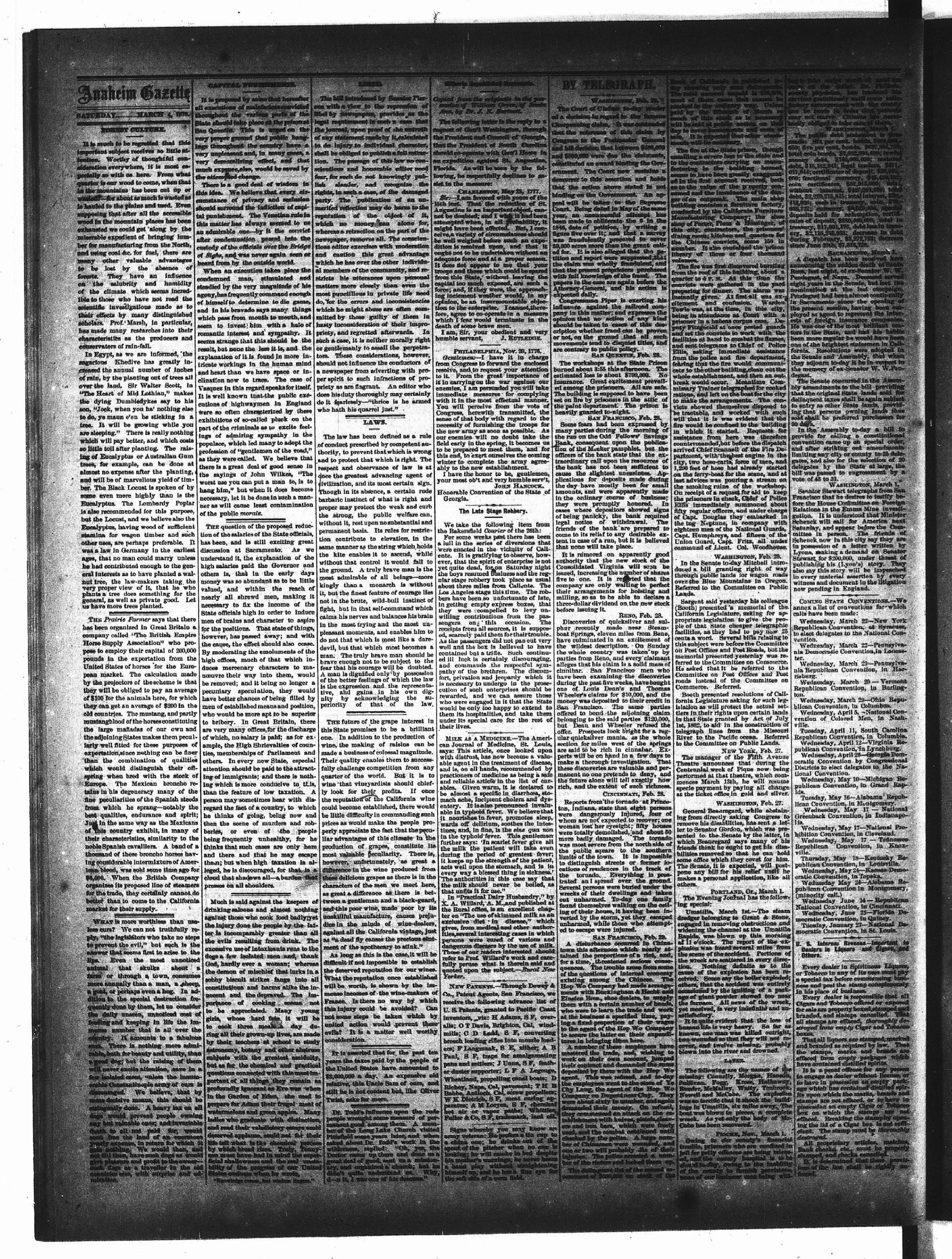
Searchable text
Anaheim Gazette
SATURDAY...MARCH 4, 1870.
Forest Culture
It is much to be regretted that this important subject receives so little attention. Worthy of thoughtful consideration everywhere, it is most especially so with us here. From what quarter is our wood to come, when that in the mountains has been cut up or whittled—for about as much is wasted as is hauled to the plains and used. Even supposing that after all the accessible wood in the mountain places has been exhausted we could get along by the miserable expedient of bringing lumber for manufacturing from the North, and using coal etc. for fuel, there are many other valuable advantages to be lost by the absence of forests. They have an influence on the salubriity and humidity of the climate which seems incredible to those who have not read the scientific investigations made as to their effects by many distinguished scholars. Prof. Marsh, in particular, has made many researches into their characteristics as the producers and conservators of rain-fall.
In Egypt, as we are informed, 'the sagacious Khedive has greatly increased the annual number of inches of rain, by the planting out of trees all over the land. Sir Walter Scott, in "The Heart of Mid Lothian," makes the dying Dumbledykes say to his son, "Jock, when you ha' nothing else to do, ye mann e'en be sticking in a tree. It will be growing while you are sleeping." There is really nothing which will pay better, and which costs so little toll after planting. The raising of Eucalyptus or Australian Gum trees, for example, can be done at
CAPITAL PUBLICATIONS
It is proposed by some that however all executions of malfections occurred throughout the various parts of the state should take place at the prison San Quentin. This is urged on the very proper ground that public hangings throughout the country have a very unpleasant and, in many cases, a very demoralizing effect, and that much expense also, would be saved by the attempted change.
There is a good deal of wisdom in this idea. We believe that every circumstance of privacy and exclusion should surround the infliction of capital punishment. The Venetian rule in this matter has always seemed to us an admirable one—by it the convict after condemnation passed into the custody of the officials over the Bridge of Sighs, and was never again seen or heard from by the outside world.
When an execution takes place the condemned man, stimulated and steadied by the very magnitude of his agony, has frequently command enough of himself to determine to die game, and in his bravado says many things which pass from mouth to mouth, and seem to invest him with a halo of romantic interest and sympathy. It seems strange that this should be the result, but none the less it is, and the explanation of it is found in more intricate workings in the human mind and heart than we have space or inclination now to trace. The case of Vasquez in this regard speaks for itself. It is well known that-the public executions of highwaymen in England were so often characterized by these exhibitions of so-called pluck on the part of the criminals as to excite feelings of admiring sympathy in the populace, which led many to adopt the profession of "gentlemen of the road," as they were called. We believe that there is a great deal of good sense in
creased the annual number of inches of rain, by the planting out of trees all over the land. Sir Walter Scott, in "The Heart of Mid Lothian," makes the dying Dumbledykes say to his son, "Jock, when you ha' nothing else to do, ye maun e'en be sticking in a tree. It will be growing while you are sleeping." There is really nothing which will pay better, and which costs so little till after planting. The raising of Eucalyptus or Australian Gum trees, for example, can be done at almost no expense after the planting, and will be of marvellous yield of timber. The Black Locust is spoken of by some even more highly than the Eucalyptus. The Lombardy Poplar is also recommended for this purpose, but the Locust, and we believe also the Eucalyptus, having wood of sufficient stamina for wagon timber and such other uses, are perhaps preferable. It was a law in Germany in the earliest ages, that no man could marry unless he had contributed enough to the general interests as to have planted a walnut tree, the law-makers taking the very proper view of it, that he who plants a tree does something for the general, as well as private good. Let us have more trees planted.
The Prairie Farmer says that there has been organized in Great Britain a company called "The British Empire Horse Supply Association" who propose to employ their capital of 200,000 pounds in the exportation from the United States of horses for the European market. The calculation made by the projectors of the scheme is that they will be obliged to pay an average of $100 for the animals here, for which they can get an average of $200 in the old countries. The mustang, and partly mustangblood of the horses constituting the large maifadas of our own and the adjoining States makes them peculiarly well fitted for these purposes of exportation, since nothing can be finer than the combination of qualities which would distinguish their offspring when bred with the stock of Europe. The Mexican broncho retains in his degeneracy many of the fine peculiarities of the Spanish steeds from which he sprang—notably the best qualities, endurance and spirit; Just in the same way as the Mexicans of this country exhibit, in many of their characteristics, similarity to the noble Spanish cavaliers. A band of a thousand of these broncho horses having considerable intermixture of American blood, was sold some time ago for $6,000. When the British Company organizes its proposed line of steamers and heart than we have space or inclination now to trace. The case of Vasquez in this regard speaks for itself. It is well known that the public executions of highwaymen in England were so often characterized by these exhibitions of so-called pluck on the part of the criminals as to excite feelings of admiring sympathy in the populace, which led many to adopt the profession of "gentlemen of the road," as they were called. We believe that there is a great deal of good sense in the sayings of John Wilkes, "The worst use you can put a man to, is to hang him," but when it does become necessary, let it be done in such a manner as will cause least contamination of the public morale.
The question of the proposed reduction of the salaries of the State officials, has been, and is still exciting great discussion at Sacramento. As we understand it, the explanation of the high salaries paid the Governor and others is, that in the early days money was so abundant as to be little valued, and within the reach of nearly all shrewd men, making it necessary to fix the income of the State officials high in order to induce men of brains and character to aspire for the positions. That state of things, however, has passed away; and with the cause, the effect should also cease. By moderating the emoluments of the high offices, much of that which induces mercenary characters to maneuver their way into them, would be removed; and it being no longer a pecuniary speculation, they would have better chances of being filled by men of established means and position, who would be more apt to be superior to bribery. In Great Britain, there are very many offices for the discharge of which, no salary is paid; as for example, the High Shrievalties of counties, memberships of Parliament and others. In every new State, especial attention should be paid to the attracting of immigrants; and there is nothing which is more conducive to this, than the feature of low taxation. A person may sometimes hear with disregard the fact of a country, to which he thinks of going, being now and then the scene of murders and robberies, or even of the people being frequently unhealthy, for he thinks that such cases are only here and there and that he may escape them; but when high taxation is alleged, he is discouraged, for that is a cloud that shadows all—a burden that presses on all shoulders.
The law has of conduct prudence to prune and protect respect and dignity. Though in it barbaric instill proper may play the strong without it, it remains permanent contribution same manner; the kite eminently without that ground. Most admire kingly than it, but the fillet not in the best fight; but in calms his neck in the most pleasant mood do not that devil, but that man. The brave enough fear that his A man is disgusted is the expressive and nity by periority.
The future this State proclaim one. In addition wine, the mans made a business Their qualification fully challenge quarter of wine that will look for the reputation could become be little difficult prices as well perly approve illar advantage production most valuable however, due difference in these deliciou characters o
talks in his degeneracy many of the fine peculiarities of the Spanish steeds from which he sprang—notably the best qualities, endurance and spirit; Just in the same way as the Mexicans of this country exhibit, in many of their characteristics, similarity to the noble Spanish cavaliers. A band of a thousand of these broncho horses having considerable intermixture of American blood, was sold some time ago for $2,000. When the British Company organizes its proposed line of steamers for the trade, they certainly cannot do better than to come to the California market for their supply.
WHAT is more worthless than use-less cura? We can not truthfully reply, "the legislators who take no steps to prevent the evil," but such is the answer that seems first to arise to the lips. Even the most unnoticed animal that skulks about a farm or through a town, consumes more annually than a man, a sheep, a goat, or perhaps even a hog. In addition to the special destruction frequently done by them, let us consider the daily unseen, unnoticed cost of feeding and keeping in life the immense number that is all over the country. It amounts to a fabulous sum. There is nothing more admirable both for beauty and utility, than a good dog; but the raising of them will never excite attention, save in a few isolated cases, unless the insumurable Constantpeople army of cura is discouraged. We believe, that by some dissolve means, this should be stringently done. A heavy tax on all dogs would prevent people owning any but valuable ones; and invariable death to all not paid for, would soon fix the land of an enormous yearly expense. In return for which it goes nothing. We would then, and not till then, have such dogs as would give pleasure and profit to the owner—such dogs as a traveller in the old countries seen, with surprise and admiration.
Much is said against the keepers of drinking saloons and almost nothing against those who cook food badly; yet the injury done the people by the latter is incomparably greater than all the evils resulting from drink. The excessive use of intoxicants runs to the dogs a few isolated men and, thank God, hardly ever a woman; whereas the demon of mischief that lurks in a sobby biscuit strikes fangs into all constitutions and harms alike the innocent and the depraved. The importance of cooking seems not to be appreciated. Many young girls, whose hard fate it will be to cook three meals a day during all their grown-up lives, are made by their teachers at school to study astronomy, botany and other abstrate subjects with the greatest assiduity, but as for the chemical and practical questions connected with this most important of all things they remain as profoundly ignificant as Eve was when in the Garden of Eden, she used to prepare for Adam their frugal meal of watermelons and green apples. Many ladies who graduate with distinction, and read their valedictory essays until deserved applause, could not for their life tell what is the chemical process by which bread rises. Truly, Tennyson must have had in mind the superficial shallowness and the real unsustainability of the progress of our United States centuries when he wrote,
"Knowledge comes, but wisdom lingers."
LIMEL.
The bill introduced by Senator Pleasen with a view to the repression of libel by newspaper, provides as the legal requirement in such a case that the journal, upon proof of the untruth of any statement made by it, calculated to do injury to individual character, shall be obliged to publish a full retraction. The passage of this law no conscientious and honorable editor need fear, for such do not knowingly publish slander, and recognize the rights, in such a case, of the damaged party. The publication of an unmerited reflection may do harm to the reputation of the object of it, which no money can stone for, whereas a retraction on the part of the newspaper, removes all. The conscientious editor exercises with moderation and caution this great advantage which he has over the other individual members of the community, and restricts his utterances upon personal matters more closely than even the most punctilious in private life need do, for the errors and inconsistencies which he might abuse are often committed by those guilty of them in hasty inconsideration of their impropriety, and regretted afterwards. In such a case, it is neither morally right or gentlemathy to assail the perpetrators. These considerations, however, should not influence the conductors of a newspaper from advertising with proper spirit to such infractions of propriety as are flagrant. An editor who does his duty thoroughly may certainly do it fearlessly—"thrice is he armed who hath his quarrel just."
LAWS.
The law has been defined as a rule of conduct prescribed by competent authority, to prevent that which is wrong and to protect that which is right. The respect and observance of law is at
WILLIAMS HONORABLE MEMBERS.
Conged from the originals in the prosecution of William Green, of Sunder Acre, by Dr. J. N. Burtnett.
The following letter is the reply to a request of General Washington, through the President and Counsel of Georgia, that the President of South Carolina should co-operate with Gen'l Howe in an expedition against St. Augustine, Florida. As will be seen by the following, he respectfully declines to assist in the measure:
CHARLESTON, May 23, 1777.
Sir—I am favored with yours of the 15th inst. That the reduction of St. Augustine is an important object, cannot be doubted; and I whist it had been attempted when, in all probability, it might have been affected. But, I conceive, a variety of circumstances should be well weighted before such an expedition is required upon, and that it ought not to be undertaken without an adequate force and at a proper season. It does not appear to me that your troops and those which could be spared from this State; without leaving the capital too much exposed, are such a force; and, if they were, the approaching insulture weather would, in my opinion, be an insurmountable objection to the enterprise. I cannot therefore, agree to co-operate in a measure which I fear would terminate in the death of some brave men.
I am Sir, your objection and very humble servant,
J. RUTLEDGE.
PHILADELPHIA, Nov. 20, 1776.
Gentlemen—I have it in charge from Congress to forward the enclosed resolve, and to request your attention to it. From the great importance of it in carrying on the war against our enemies, I am persuaded you will take immediate measures for complying with it in the most effectual manner. You will perceive from the vote of Congress, herewith transmitted, the sense of that body with regard to the necessity of furnishing the troops for the new army as soon as possible. As our enemies will no doubt take the field early in the spring, it becomes us to be prepared to meet them, and for this end, to exert ourselves the coming winter to complete the army agreeably to the new establishment.
BY TELEGRAPH.
WASHINGTON, Feb. 28.
The Court of Chatham today wandered a decision in regard to the famous Champaign claim. It was contended that the reference of this claim by Congress to the Punnambler General and his decision that between $400,000 and $600,000 were due the claims constituted an award binding the Government. The Court now sustains a denouncement to this assertion and holds that the action above stated is not binding on the Government. An appeal will be taken to the Supreme Court. Being dated in May of the same year, an unsuccessful attempt has been made to obliterate the 6 in the 1846 date of petition, by writing a figure five over it; and that a survey was fraudulently prepared to cover 30,000 acres more than the grant called for. It is also alleged that the petition and report were suppressed; that the claim was wholly fraudulent, and that the present proprietor purchased with full knowledge of the fraud. The papers in the case are again before the Attorney-General, and his action is expected daily.
Congressman Piper is exerting his influence against the railroad company in this matter; and expresses the opinion that no action of any kind should be taken in cases of this description whether fraud can be proven or not, on the ground that all such movements tend to claustify titles, and are contrary to public policy.
SAN QUENTIN, Feb. 28.
The workshops at the State Prison burned about 3:55 this afternoon. The estimated loss is about $700,000. No insurance. Great excitement prevailed among the prisoners. All are safe. The building is supposed to have been set on fire by prisoners in the attic of the paint department. The prison is heavily guarded to night.
SAN FRANCISCO, Feb. 28.
Some fears had been expressed by many parties during the morning of the run on the Odd Fellows' Savings Bank, consequent upon the publication of the Meeker pamphlet, but the officers of the bank state that the extraordinary call upon the resources of the bank has not been sufficient to
LAWS.
The law has been defined as a rule of conduct prescribed by competent authority, to prevent that which is wrong and to protect that which is right. The respect and observance of law is at once the greatest advancing agent of civilization, and its most certain sign. Though in its absence, a certain rude barbaric instinct of what is right and proper may protect the weak and curb the strong, the public welfare can without it, rest upon no substantial and permanent basis. Its rules for restriction contribute to elevation, in the same manner as the string which holds the kite enables it to ascend, while without that control it would fall to the ground. A truly brave man is the most admirable of all beings—more kingly than a monarch is without it, but the finest feature of courage lies not in the brute, wild-bull instinct of fight, but in that self-command which calms his nerves and balances his brain in the most trying and the most unpleasant moments, and enables him to do not that which is most like a daredevil, but that which most becomes a man. The truly brave man should be brave enough not to be subject to the fear that his courage will be doubted. A man is dignified only by possession of the better feelings of which the law is the expression and the representative, and gains in his own dignity by acknowledging the superiority of that of the law.
THE FUTURE OF THE GRAPE INTEREST IN THIS STATE PROMISES TO BE A BRILLIANT ONE. In addition to the production of wine, the making of raisins can be made a business of colossal magnitude. Their quality enables them to successfully challenge competition from any quarter of the world. But it is to wine that vineyardists should chiefly look for their profits. If once the reputation of the California wine could become established, there would be little difficulty in commanding such prices as would make the people properly appreciate the fact that the peculiar advantages of this climate in the production of grapes constitute its most valuable peculiarity. There is, however, unfortunately, as great a difference in the wine produced from these delicious grapes as there is in the characters of the men we meet here,
MILK AS A MEDICINE.—The American Journal of Medicine, St. Louis, says: This article, once looked upon with distrust, has now become a valuable agent in the treatment of disease, and is, on all hands, recommended by practitioners of medicine as being a safe and reliable article in the list of curables. Given warm, it is declared to be almost a specific in diarrhoea, stomach ache, Incipient cholera and dysentery. It is also pronounced invaluable in typhoid fever. We believe that it nourishes in fever, promotes sleep, wards off delirium, soothes the intestines, and, in fine, is the sine qua non in the typhoid fever. This gentleman further says: 'In scarlet fever give all the milk the patient will take even during the period of greatest fever; it keeps up the strength of the patient, acts well upon the stomach, and is in every way a blessed thing in sickness.' The authorities in this case say that the milk should never be boiled, as
SAN FRANCISCO, Feb. 28.
Some fears had been expressed by many parties during the morning of the run on the Odd Fellow's Savings Bank, consequent upon the publication of the Meeker pamphlet, but the officers of the bank state that the extraordinary call upon the resources of the bank has not been sufficient to cause the alightest uneasiness. Applications for deposits made during the day have mostly been for small amounts, and were apparently made in the ordinary course of business; they were promptly honored. In cases where depositors showed signs of being panicky, the bank required legal notice of withdrawal. The friends of the bank are prepared to come to its relief to any desirable extent in case of a run, but it is believed that none will take place.
It is rumored on apparently good authority that the new stock of the Consolidated Virginia will soon be issued, increasing the number of shares five to one. It is reported that the company are only waiting to perfect their arrangements for hoisting and milling, so as to be able to declare a three-dollar dividend on the new stock before issuing it.
RENO, Feb. 28.
Discoveries of quicksilver and sulphur recently made near Steamboat Springs, eleven miles from Benehaven culminated in an excitement of the wildest description. On Sunday the whole country was taken up by parties from Reno, and every claimant alleges that his claim is a solid mass of cinnibar. San Francisco men who have been examining the discoveries during the past five weeks, have bought one of Louis Dean's and Thomas Wheeler's claims for $10,000, and the money was deposited to their credit in San Francisco. The same parties offered to bond the adjourning claim belonging to the said parties $120,000, but Dean and Wheeler refused the offer. Prospects look bright for a regular quicksilver mania as the whole section for miles west of the springs are sold to be rich in cinnabar. Experts will be on hand in a few days to make a thorough investigation. That these discoveries are valuable and permanent no one pretends to deny, and the future alone will tell exactly how rich, and the extent of such richness.
CINCINNATI, Feb. 28.
Reports from the tornado at Princeton, Indiana, state that eight persons were dangerously injured, four of whom are not expected to recover; one woman lost her eyesight; fifty houses were totally demolished, and about 50 more badly damaged. The tornado was most severe from the north side of the public square to the southern limits of the town. It is impossible to distinguish streets or former locations of residences in the track of the tornado. Everything is prostrated and I spread over the ground. Several persons were buried under the estimated loss is about $700,000. No insurance. Great excitement prevalenced among the prisoners. All are safe. The building is supposed to have been set on fire by prisoners in the attic of the paint department. The prison is heavily guarded to night.
SAN FRANCISCO, Feb. 28.
Some fears had been expressed by many parties during the morning of the run on the Odd Fellow's Savings Bank, consequent upon the publication of the Meaker pamphlet, but the officers of the bank state that the extraordinary call upon the resources of the bank has not been sufficient to cause the alightest uneasiness. Applications for deposits made during the day have mostly been for small amounts, and were apparently made in the ordinary course of business; they were promptly honored. In cases where depositors showed signs of being panicky, the bank required legal notice of withdrawal. The friends of the bank are prepared to come to its relief to any desirable extent in case of a run, but it is believed that none will take place.
It is rumored on apparently good authority that the new stock of the Consolidated Virginia will soon be issued, increasing the number of shares five to one. It is reported that the company are only waiting to perfect their arrangements for hoisting and milling, so as to be able to declare a three-dollar dividend on the new stock before issuing it.
RENO, Feb. 28.
Discoveries of quicksilver and sulphur recently made near Steamboat Springs, eleven miles from Benehaven culminated in an excitement of the wildest description. On Sunday the whole country was taken up by parties from Reno, and every claimant alleges that his claim is a solid mass of cinnibar. San Francisco men who have been examining the discoveries during the past five weeks, have bought one of Louis Dean's and Thomas Wheeler's claims for $10,000, and the money was deposited to their credit in San Francisco. The same parties offered to bond the adjourning claim belonging to the said parties $120,000, but Dean and Wheeler refused the offer. Prospects look bright for a regular quicksilver mania as the whole section for miles west of the springs are sold to be rich in cinnabar. Experts will be on hand in a few days to make a thorough investigation. That these discoveries are valuable and permanent no one pretends to deny, and the future alone will tell exactly how rich, and the extent of such richness.
CINCINNATI, Feb. 28.
Reports from the tornado at Princeton, Indiana, state that eight persons were dangerously injured, four of whom are not expected to recover; one woman lost her eyesight; fifty houses were totally demolished, and about 50 more badly damaged. The tornado was most severe from the north side of the public square to the southern limits of the town. It is impossible to distinguish streets or former locations of residences in the track of the tornado. Everything is prostrated and I spread over the ground. Several persons were buried under
the reputation of the California wine could become established, there would be little difficulty in commanding such prices as would make the people properly appreciate the fact that the peculiar advantages of this climate in the production of grapes constitute its most valuable peculiarity. There is, however, unfortunately, as great a difference in the wine produced from these delicious grapes as there is in the characters of the men we meet here, as great a difference as there is between a gentleman and a black-guard, and this poor wine, made poor by its unskillful manufacture, causes prejudice in the minds of wine-dealers against all the California vintage, just as "a dead fly causes the precious elmment of the apothecary to stink."
As long as this is the case, it will be difficult if not impossible to establish the deserved reputation for our wines. What the reputation once established will be worth, is shown by the immense incomes of the wine-makers of France. Is there no way by which this injury could be avoided? Can not some steps be taken which by united action would prevent these evils? It is a matter well worthy consideration.
It is asserted that for the past ten years the taxes paid by the people of the United States have amounted to $2,000,000 a day. An expensive old relative, this Uncle Sam of ours, and still he is not content but, like Oliver Twist, asks for more.
Dr. Todd's influence upon the rude people wrought some measure of permanent good among them. A member of the Long Lake Church visited Pittfield some years later, and when asked about Dr. Todd's work in the whitmanism, replied: "Oh, yes, the Doctor came up there and done us a great deal of good, sent us a missionary, and organized a church; but he didn't quite understand us. Why, d—n it, I was one of his demons."
Signs whereby you may know are army veteran: He prefers a tin cup to a china one; he drinks out of the spout of the pitcher when no one is looking; he will smoke in bad despite his mother's warnings; he never hams a hand play without straightening himself up, and he has a fine eye for the soft side of a corn field.
CINCINNATI, Feb. 28.
Reports from the tornado at Princeton, Indiana, state that eight persons were dangerously injured, four of whom are not expected to recover; one woman lost her eyesight; fifty houses were totally demolished, and about 60 more badly damaged. The tornado was most severe from the north side of the public square to the southern limits of the town. It is impossible to distinguish streets or former locations of residences in the track of the tornado. Everything is prostrated and spread over the ground. Several persons were buried under the wrecks of their dwellings and taken out unharmed. To-day one family found themselves walking on the ceiling of their house, it having been inverted by the storm, yet they escaped unharmed, while those who attempted to escape were injured.
SAN FRANCISCO, Feb. 29.
A disturbance occurred in Chinatown this afternoon which nearly attained the proportions of a riot, and for a time, threatened serious consequences. The trouble arose from some of the questions of internal economy existing among the Chinese. The Hop Wo Company had made arrangements with Buckingham & Hecht and Einstein Bros., shoe dealers, to supply them with a certain number of hands, who were to learn the trade and work at the business specified time, paying a fixed proportion of their wages to the agent of the Hop Wo Company to secure the latter on their expenditures in bringing them here.
A number of these employees have mastered the trade, and wishing to work on their own account, jumped their contract and demanded the sum deposited by them with the Hop Wo Agent. This was refused, and to-day the employees went to the store of Ye Chy Lang; the agent of the Hop Wo Company on Departure Clay. They were about sixty in number, and again demanded their money. On refusal they commenced an attack on the establishment with knives, pistols, cleavers and iron bars, which were freely used, and the combat continued until cheaked by the police. A large number of Chinamen were wounded, and one or two will probably die of their injuries. The policemen assisted a number of the rioters and linked them up.
The delinquent list of the second an assessment of $200,000 was sketched of
BILLRAPH.
WASHINGTON, Feb. 28. Claims to-day under the famous clause. It was contended one of this claim by the Postmaster General that between $400,000 were due the claims, award binding the Gov't Court now maintains a fine assertion and holds on above stated is not Government. An application to the Supreme Court in May of the same successful attempt has elaborate the 6 in the petition, by writing it; and that a survey properly prepared to cover more than the grant call so alleged that the part were suppressed; that wholly fraudulent, and not proprietary purchased ledge of the fraud. The case are again before the trial, and his action is to Piper is exerting his insist the railroad conducter; and expresses the no action of any kind in cases of this deser fraud can be proven ground that all such to disquiet titles, and public policy.
MAN QUENTIN, Feb. 28. Appears at the State Prison 1:55 this afternoon. The sale about $700,000. No great excitement prevail-prisoners. All are safe, is supposed to have been prisoners in the attic of apartment. The prison is used to-night.
NAN FRANCISCO, Feb. 28. Had been expressed by during the morning of the Odd Fellow's Savings支ent upon the public-seeker pamphlet, but the bank state that the ex-ull upon the resources of not been sufficient to Bank of California is published today alerting only new delinquents. The total amount upheld in $30,000, most of them cause that cannot be reached in the ordinary way. Unions paid by the fifteenth of March as much of this stock as in necessity will be sold at public auction, on this day to never procure and once of sale. It is expected that other amendments will be necessary.
The fire at the State prison, though entailing a severe loss to the state and to the contracture carrying on manufacturing in the building burned, seems to have been greatly exaggerated in the first account received, both as to the value of the property consumed and the imminence of the danger of an outbreak. The main shop building contains a furniture factory, conducted by the California Furniture Manufacturing Company; the shop of Porter, Flum & Hessinger, of this city, contractors; the plasman-dining room; kitchen and quarters for the Chinese convicts, some 150 in number. It also contained the prison library of three or four thousand volumes.
The fire was first discovered bursting from the roof of this building, about a quarter to 4 p.m. At this time the convicts were gathered in the yard preparing for dinner. The alarm was instantly given. At first all was excitement and confusion. Warden Towle was, at the time, in this city, being in attendance at Court with a prisoner in a habeas corpus case. Deputy Fitzgerald at once posted guards and set the convicts to work with the facilities at hand to combat the flames, and sent telegrams to Chief of Police Ellis, asking immediate assistance from the police and fire department, fearing that the fire would communicate to the other building, clean out the whole establishment, and then an outbreak would occur. Meantime Commissary Trainer telegraphed for cooked rations, and left on the boat for the city to make the arrangements. The convicts showed themselves disposed to be tractable, and worked with such will that it is was evident that the fire would be confined to the building in which it started. Requests for assistance from here was therefore countermanded, but before the dispatch arrived Chief Scannell of the Fire Department, with the best engine in the city, two hose-carts, force of men, and 1,200 feet of hose had already started
The public debt statement is thus made: Six per cash bonds, $995,000,-650; five per rent bonds, $927,844,-700; total coin bonds, $1,022,884,-800; live-fuel money debt, $140,000,-030; natural debt, $13,182,-041; legal tender, $371,-011,-044; certificates of deposit, $88,956,-099; fractional currency, $45,426,-123; coin certificate, $82,915,-000; total without interest, $187,091,-000; total debt, $2,220,215,-847; total interest, $28,-412,-028; cash in treasury, coins, $78,-035,-722; currency, $8,559,-464; special deposits held for redemption; certificates of deposit, $280,400,-600; total in treasury, $17,601,170; debt limits in treasury, $2,118,235,-033; decrease in debt during February, $3,272,731; decrease since June 9th,$7,313,725.
SACRAMENTO, March I.
A dispatch has been received here announcing the sudden death at Santa Rosa last night of ex-Senator W. W. Pendegast, of Napa. Dewand served eight years in the Senate but lost the nomination at the last campaign. Pendegast had been almost continually in Sacramento since the opening of the present session having been employed as agent to represent the interests of foreign insurance companies. He was one of the most brilliant citizens in the State, and had his habits been more regular he would have been one of the brightest statesmen in California. Resolutions were adopted in the Senate and Assembly, that when they adjourn to-day it be in respect to the memory of ex-Senator W. W. Pendegast.
The Senate concurred in the Assembly amendments to the bill providing that the original State lands sold for delinquent taxes shall be again subject to entry as other State lands, providing that persons owning lands thus sold shall be preferred purchasers for 90 days.
In the Assembly to-day a bill to provide for calling a constitutional convention came up on special order, and after striking out amendments limiting any city or county to 25 delegates, and also for the selection of 20 delegates by the State at large, the
No great excitement prevailprisoners. All are safe,
supposed to have been
prisoners in the attic of
department. The prison is
used to night.
NON-FRANCISCO, Feb. 28.
had been expressed by
during the morning of
Odd Fellows' Savings
ment upon the publicakker pamphlet, but the
bank state that the exall upon the resources of
not been sufficient to
lightest uncleanness. Apdeposits made during
mostly been for small
were apparently made
very course of business;
promptly honored. In
depositors showed signs
sticky, the bank required
of withdrawal. The
bank are prepared to
brief to any desirable exran run, but it is believed
to take place.
and on apparently good
at the new stock of the
Virginia will scan be
using the number of shares.
It is reported that the
only waiting to perfect
ments for hoisting and
to be able to declare a
dividend on the new stock
RENO, Feb. 28.
of quicksilver and sully made near Steameleven miles from Beneted in an excitement of
description. On Sunday
country was taken up by
Reno, and every claimant
is claim is a solid mass of
San Francisco men who
claiming the discoveries
last five weeks, have bought
Dean's and Thomas
limits for $10,000, and the
apposited to their credit in
the same parties
and the adjoinning claim.
The said parties $120,000,
and Wheeler refused the
acts look bright for a register mania, as the whole
miles west of the springs rich in cinnabar. Exon hand in a few days to
rough investigation. That
series are valuable and perdue pretends to deny, and one will tell exactly how extent of such richness.
CINCINNATI, Feb. 28.
from the tornado at Princestate that eight persons
seriously injured, four of
of expected to recover; one other eyesight; fifty houses demolished, and about 60 damaged. The tornado were from the north side of square to the southern town. It is impossible with streets or former landmarks in the track of road. Everything is prospread over the ground. Were buried under the carcars to the other building, clean out whole establishment, and then an outbreak would occur. Meantime Commissary Trainer telegraphed for cooked rations, and left on the boat for the city to make the arrangements. The convicts showed themselves disposed to be tractable, and worked with such will that it is was evident that the fire would be confined to the building in which it started. Requests for assistance from here was therefore countermanded, but before the dispatch arrived Chief Scannell of the Fire Department, with the best engine in the city, two hose-carts, force of men, and 1,200 feet of hose had already started on the ferry-boat for the scene, and at last advises was pouring a stream on the smoking ruins of the workshop. On receipt of a request for aid to keep the prisoners in check, Chief of Police Ellis immediately summoned about fifty regular officers, and under charge of Capt. Douglas they embarked in the tug Neptune, in company with eighteen men of the National Guards, Capt. Humphreys, and fifteen of the Union Guard, Capt. Fritz, all under command of Lieut. Col. Woodhouse.
WASHINGTON, Feb. 29.
In the Senate to-day Mitchell introduced a bill granting right of way through public lands for wagon roads over the Blue Mountains in Oregon. Referred to the Committee on Public Lands.
Sargent said yesterday his colleague (Booth) presented a memorial of the California Legislature, asking for appropriate legislation to give the people of that State cheaper telegraphic facilities, as they had to pay now 25 cents a word. Several bills relating to this subject were before the Committee on Post Offices and Post Boals, but the memorial presented yesterday was referred to the Committee on Commerce. He asked that it be referred to the Committee on Post Offices and Post roads instead of the Committee on Commerce. Referred.
Booth presented resolutions of California Legislature asking for such legislation as will protect the actual settlers in their rights upon certain lands in that State granted by Act of July 1st, 1862, to aid in the construction of telegraph lines from the Missouri River to the Pacific ocean. Referred to the Committee on Public Lands.
NEW YORK, Feb. 27.
The manager of the Fifth Avenue Theatre announces that during the Centennial week of Pique now being performed at that theatre, which commences March 13th, he will resume specie payment by paying all change at the ticket office in gold and silver.
WASHINGTON, Feb. 27.
General Beauregard, while abstaining from directly asking Congress to remove his disabilities, has sent a letter to Senator Gordon, which was presented to the Senate by the latter, in which Beauregard says many of his friends think he ought to get his disabilities removed so that he can hold some office which they covet for him. The Senate, it is expected, will postpone any bill for his relief until he makes a personal application, like all others.
The Senate concurred in the Assembly amendments to the bill providing that the original State lands sold for delinquent taxes shall be again subject to entry as other State lands, providing that persons owning lands thus sold shall be preferred purchasers for 00 days.
In the Assembly to-day a bill to provide for calling a constitutional convention came up special order, and after striking out amendments limiting any city or county to 25 delegates, and also for the selection of 20 delegates by the State at large, the bill was passed to engrossment by a vote of 43 to 31.
WASHINGTON, March 1.
Senator Stewart telegraphs from San Francisco that he desires to testify before the House Confirmtee on Foreign Relations in the Emma Mine Investigation. It is understood that Minister Schenck will call for America next Saturday, and appear before the Committee in person. The friends of Schenck now in this city say they are in possession of a letter written by Lyons, making a demand on Senator Stewart for $200,000, under threat of publishing his (Lyon's) story. They also say this story will be impeded in every material assertion by every witness and document in the litigation now pending in England.
COMING STATE CONVENTIONS—We annex a list of conventions for which calls have been made:
Wednesday, March 22—New York Republican Convention, at Syracuse, to elect delegates to the National Convention.
Wednesday, March 22—Pennsylvania Democratic Convention, in Lancaster.
Wednesday, March 29—Pennsylvania Republican Convention, in Harrisburg.
Wednesday, March 29—Vermont Republican Convention, in Burlington.
Wednesday, March 29—Ohio Republican Convention, in Columbus.
Wednesday, April 5—National Convention of Colored Men, in Nashville.
Tuesday, April 11 South Carolina Republican Convention, in Columbia.
Wednesday, April 12 Virginia Republican Convention, in Lynchburg.
Wednesday, April 28 Georgia Democratic Convention by Congressional Districts to elect delegates to the National Convention.
Wednesday, May 10 Michigan Republican Convention, in Grand Rapids.
Tuesday, May 16 Alabama Republican Convention, in Montgomery.
Wednesday, May 17 National Greenback Convention, in Indianapolis.
Wednesday, May 17 National Prohibition Convention, in Cleveland.
Wednesday, May 17 Tennessee Republican Convention, in Knoxville.
Thursday, May 18 Kentucky Republican Convention, in Louisville.
Wednesday, May 24 Kansas Democratic Convention, in Topeka.
Wednesday May 24 Alabama Republican Convention in Montgomery.
On the tornado at Prince-State that eight persons seriously injured, four of them eyesight; fifty houses demolished, and about 50 damaged. The tornado were from the north side of square to the southern town. It is impossible with streets or former foundations in the track of everything in prospread over the ground. Ones were buried under their dwellings and taken out. To-day one family walks on the cellhouse, it having been in the storm, yet they escaped while those who attempt were injured.
AN FRANCISCO, Feb. 29. Finance occurred in China afternoon which nearly attropories of a riot, and threatened serious consummate trouble across some tons of internal economy among the Chinese. The company had made arrangement Buckingham & Hecht and a shoe dealer, to supply certain number of hands, learn the trade and work a specified time, pay proportion of their wages of the Hop Wo Company latter on their expanding them here. Of these employees have no trade, and wishing to their own account, jumped out and demanded the sums them with the Hop Wo was refused, and to-day was went to the store of Ye the agent of the Hop Wo Duponnear Clay. They quietly in number, and again their money. On refusal, issued an attack on the enclave with knives, pistols, cleavers, which were freely on combat continued until the police. A large manmen were wounded, and still probably six of their police armed a minature and linked them up against the second amount of the second amount of the second amount of the second amount of the second amount of the second amount of the second amount of the second amount of the second amount of the second amount of the second amount of the second amount of the second amount of the second amount of the second amount of the second amount of the second amount of the second amount of the second amount of the second amount of the second amount of the second amount of the second amount of the second amount of the second amount of the second amount of the second amount of the second amount of the second amount of the second amount of the second amount of the second amount of the second amount of the second amount of the second amount of the second amount of the second amount of the second amount of the second amount of the second amount of the second amount of the second amount of the second amount of the second amount of the second amount of the second amount of the second amount of the second amount of the second amount of the second amount of the second amount of the second amount of the second amount of the second amount of the second amount of the second amount of the second amount of the second amount of the second amount of the second amount of the secondary amounts.
WASHINGTON, Feb. 27.
General Beauregard, while abstaining from directly asking Congress to remove his disabilities, has sent a letter to Senator Gordon, which was presented to the Senate by the latter, in which Beauregard says many of his friends think he ought to get his disabilities removed so that he can hold some office which they covet for him. The Senate, it is expected, will postone any bill for his relief until he makes a personal application, like all others.
PORTLAND, Or., March 1.
The Evening Journal has following special:
Umatilla, March 1st—The steam dredger belonging to Grant & Stone, engaged in removing obstructions and widening the channel at Umatilla Rapids, was blown up this morning at 11 o'clock. The report of the explosion was heard several miles from the scene of the accident. Portions of the wreck are scattered in every direction. Nothing definite as to the cause of the explosion has been received. Some say the boiler exploded; others, that the accident was entirely consisted by the igniting of a package of giant powder slowed too near the furnace. All news of the wreck, yet received, is very indefinite and unsatisfactory.
It is quite evident that the loss of human life is very heavy. So far as known, one man was killed outright, two wounded so that they will not recover, and twelve missing, probably blown into the river and drowned.
LATER.
The following are the names of the missing: Connelly, Morgan, Hanson, Sullivan, Fogg, Krose, Hathaway, Bonder, McMalley, Walty, Tonbrook, Newell and McCabe. The explosion was so terrible that it shook the buildings in Umatilla, six miles away. The boat was blown to places, a complete wreck. As yet only the body of McCabe has been recovered.
FIORRE, New., March 1.
Owing to our county's financial trouble, prisoners who are confined in jail for petty offenses are being released, and the county hospital is in its cloud in day, owing to its inability of the county to furnish provisions, none of our business men being willful.
Tuesday, May 16—Alabama Republican Convention, in Montgomery.
Wednesday, May 17—National Greenback Convention, in Indianapolis.
Wednesday, May 17—National Prohibition Convention, in Cleveland.
Wednesday, May 17—Tennessee Republican Convention, in Knoxville.
Thursday, May 18—Kentucky Republican Convention, in Louisville.
Wednesday, May 24—Kansas Democratic Convention, in Topeka.
Wednesday May 24—Alabama Republican Convention in Montgomery (minority call.)
Wednesday June 14—Republican National Convention, in Cincinnati.
Wednesday June 21—Florida Democratic Convention, in Quincy.
Tuesday January 27—National Democratic Convention, in St. Louis.
II. & Internas Revenue—Important to Dealers in Liquors and Gigars and Others.
Every dealer in Spirituous Liquors or Tobacco in any of its uses must pay a special tax before commencing business and post his stamp consequently in his place of business.
Every dealer is responsible that all Cigars and Tobacco offered or exposed for sale are properly boxed, stamped and branded, and stamps cancelled. That all stamps are effaced thoroughly destroyed from empty Cigar and Tobacco boxes.
That all liquors are stamped marked and branded as required by law. That the stamps, marks and brands are effaced from empty packages which have contained distilled spirits.
It is a penal offense for any person to engage as dealer without license, or to have in possession an empty package which has contained distilled spirits upon which the marks, brands and stamps are not affixed, or to have in possession an empty Cigar or Tobacco box on which the stamps are not effaced. Breaking the stampphy opening the lid of a Cigar box is not sufficient. The stamp must be thoroughly destroyed.
All proprietary articles matches Bank checks etc., must be properly shapped and checks cancelled.
It is determined that these provisions of the law shall be rightly enforced.