anaheim-gazette 1876-02-26
Scanned page
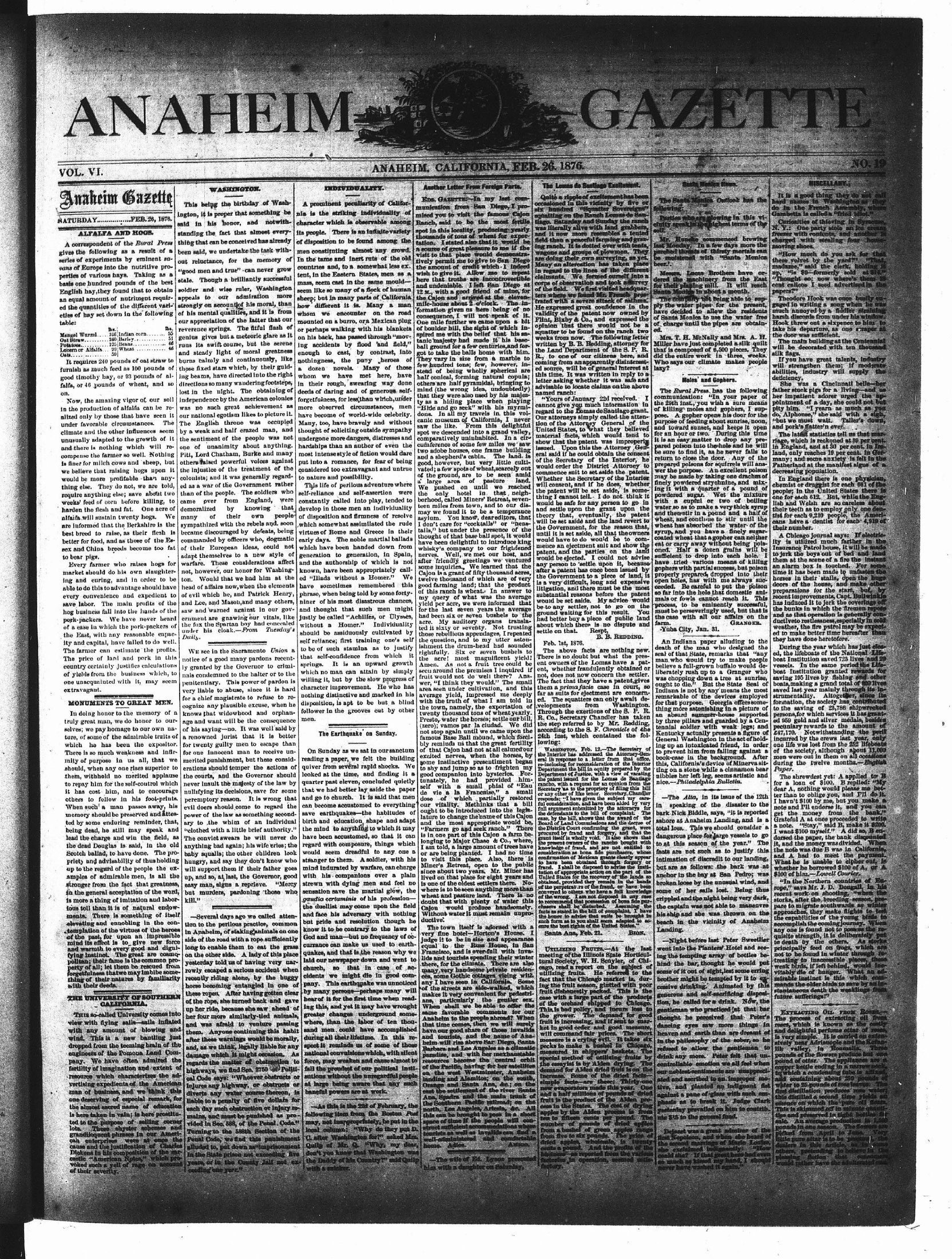
Searchable text
ANAHEIM GAZETTE
SATURDAY...FEB.26, 1876.
ALFALFA AND HOGS.
A correspondent of the Rural Press gives the following as a result of a series of experiments by eminent savans of Europe into the nutritive properties of various hays. Taking as a basis one hundred pounds of the best English hay, they found that to obtain an equal amount of nutriment required the quantities of the different varieties of hay set down in the following table:
| Bs. | Bs. |
| :--- | :--- |
| Mangel Wurzel | Indian corn | 55 |
| Oat Straw | Barley | 51 |
| Potatoes | Beans | 46 |
| Lacern or Alfalfa | Wheat | 46 |
| Oats | Wheat | 50 |
It requires 240 pounds of oat straw to furnish as much feed as 100 pounds of good timothy hay, or 93 pounds of alfalfa, or 40 pounds of wheat, and so on.
Now, the amazing vigor of our soil in the production of alfalfa can be realized only by those that have seen it under favorable circumstances. The climate and the other influences seem unusually adapted to the growth of it and there is nothing which will recompense the farmer so well. Nothing is finer for milch cows and sheep, but
WASHINGTON.
This being the birthday of Washington, it is proper that something be said in his honor, and notwithstanding the fact that almost everything that can be conceived has already been said, we undertake the task without reluctance, for the memory of "good men and true" can never grow stale. Though a brilliantly successful soldier and wise ruler, Washington appeals to our admiration more strongly on account of his moral, than of his mental qualities, and it is from our appreciation of the latter that our reverence springs. The fitful flash of genius gives but a meteoric glare as it runs its swift course, but the serene and steady light of moral greatness burns calmly and continuously, like those fixed stars which, by their guiding beams, have directed into the right directions so many wandering footsteps, lost in the night. The obtaining of independence by the American colonies was no such great achievement as our national egotism likes to picture it. The English throne was occupied by a weak and half crazed man, and the sentiment of the people was not one of unanimity about anything. Pitt, Lord Chatham, Burke and many others raised powerful voices against the injustice of the treatment of the
INDIVIDUAL.
A prominent peculiar is the striking character which is its people. There is of disposition to be men constituting a In the tame and in countries and, to a tent, in the Eastern mass, seem cast in seem like so many sheep; but in many how different it is whom we encounter mounted on a burrow or perhaps walking on his back, has passing accidents by enough to cast, nothingness, the a dozen novels. whom we have in their rough, swedeeds of daring and forgetfulness, for less more observed cliave become of wo Many, too, have broad thought of soliciting undergone more dar hardships than an most intense style o put into a romance considered too extra-
Now, the amazing vigor of our soil in the production of alfalfa can be realized only by those that have seen it under favorable circumstances. The climate and the other influences seem unusually adapted to the growth of it and there is nothing which will recompense the farmer so well. Nothing is finer for milch cows and sheep, but we believe that raising hogs upon it would be more profitable than anything else. They do not, we are told, require anything else; save about two weeks' feed of corn before killing, to harden the flesh and fat. One acre of alfalfa will sustain twenty hogs. We are informed that the Berkshire is the best breed to raise, as their flesh is better for food, and as those of the Essex and China breeds become too fat to bear pigs.
Every farmer who raises hogs for market should do his own slaughtering and curing, and in order to be able to do this to advantage should have every convenience and expedient to save labor. The main profits of the hog business fall into the hands of the pork-packers. We have never heard of a case in which the pork-packers of the East, with any reasonable capacity and capital, have failed to do well. The farmer can estimate the profits. The price of lard and pork in this country certainly justifies calculations of yields from the business which, to one unacquainted with it, may seem extravagant.
MONUMENTS TO GREAT MEN.
In doing honor to the memory of a truly great man, we do honor to ourselves; we pay homage to our own nature, of some of the admirable traits of which he has been the expositor. There is so much weakness and infirmity of purpose in us all, that we should, when any one rises superior to them, withhold no merited applause to repay him for the self-control which it has cost him, and to encourage others to follow in his foot-prints. When such a man passes away, his memory should be preserved and attested by some enduring reminder, that, being dead, he still may speak and lead the charge and win the field, as the dead Douglas is said, in the old Scotch ballad, to have done. The propriety and advisability of thus holding up to the regard of the people the examples of admirable men, is all the stronger from the fact that greatness,
ing beams, have directed into the right directions so many wandering footsteps, lost in the night. The obtaining of independence by the American colonies was no such great achievement as our national egotism likes to picture it. The English throne was occupied by a weak and half crazed man, and the sentiment of the people was not one of unanimity about anything. Pitt, Lord Chatham, Burke and many others raised powerful voices against the injustice of the treatment of the colonists; and it was generally regarded as a war of the Government rather than of the people. The soldiers who came over from England, were demoralized by knowing that many of their own people sympathized with the rebels and soon became discouraged by defeats, being commanded by officers who, dogmatic of their European ideas, could not adapt themselves to a new style of warfare. These considerations affect not, however, our honor for Washington. Would that we had him at the head of affairs now, when the elements of evil which he, and Patrick Henry, and Lee, and Mason,and many others, saw and warned against in our government are gnawing our vitals, like the fox the Spartan boy had concealed under his cloak.—From Tuesday's Daily.
We see in the Sacramento Union a notice of a good many pardons recently granted by the Governor to criminals condemned to the halter or to the penitentiary. This power of pardon is very liable to abuse, since it is hard for a chief magistrate to refuse to recognize any plausible excuse, when he knows that widowhood and orphanage and want will be the consequence of his saying—no. It was well said by a renowned jurist that it is better for twenty guilty men to escape than for one innocent man to receive unmerited punishment, but these considerations should temper the actions of the courts, and the Governor should never insult the majesty of the law by nullifying its decisions, save for some peremptory reason. It is wrong that evil doers should come to regard the power of the law as something secondary to the whim of an individual "clothed with a little brief authority." The convict swears he will never do anything bad again; his wife erries; the baby squalls; the other children look hungry, and say they don't know who will support them if their father goes up, and so, at last, the Governor, good easy man, signs a reprieve. "Mercy whom we have in their rough, swede deeds of daring and forgetfulness, for less more observed cliché have become of woe Many, too, have braved thought of soliciting undergone more daring hardships than an almost intense style of put into a romance considered too extravagant to nature and possible.
This life of perilous self-reliance and constantly called in development in those mans of disposition and which somewhat assists virtues of Rome and early days. The no which have been h generation to genius and the authorship known, have been ed "Illiads without have sometimes phrase, when being niner of his most mind and thought that justly be called "A Home without a Home should be assiduous self reliance; first to be of such stammt that self-confidence springs. It is a which no man can willing it, but by character improver nothing distinctive disposition, is apt follower in the grove men.
The Earthquake
On Sunday as we reading a paper, we quiver from several looked at the time quarter past eleven that we had better and go to church. can become acoustic save earthquakes birth and educationthe mind to anything have been accustomed regard with compass would seem drear stranger to them mind indurated by with his companion strewn with dying
it has cost him, and to encourage others to follow in his foot-prints. When such a man passes away, his memory should be preserved and attested by some enduring reminder, that, being dead, he still may speak and lead the charge and win the field, as the dead Douglas is said, in the old Scotch ballad, to have done. The propriety and advisability of thus holding up to the regard of the people the examples of admirable men, is all the stronger from the fact that greatness, in the general acceptance of the word, is more a thing of imitation and laborious toll than it is of natural endowments. There is something of itself elevating and ennobling in the contemplation of the virtues of the heroes of the past, for upon an impressible mind its effect is to give new force and warmth to every good and dignifying instinct. The great are cosmopolitan; their fame is the common property of all; let them be rescued from forgetfulness that we may imbibe something of their natures by familiarity with their deeds.
THE UNIVERSITY OF SOUTHERN CALIFORNIA.
This so-called University comes into view with flying sails—sails inflated with any amount of blowing and wind. This is a new bantling just dropped from the seeming brain of the engineers of the Pomona Land Company. We have often admired the fertility of imagination and extent of resource which characterizes the advertising expedients of the American man of business, and we think this one deserving of especial remark, for the almost sacred name of education is here taken in vain; is here prostituted to the purpose of selling corner lots. These shyster schemes and grandiloquent phrases in our American enterprises were at once the cause and the justification of Charles Dickens in his composition of the marvelous "American Notes," which provoked such a yell of rage on account of their severity.
Several days ago we called attention to the perilous practice, common in Anaheim, of staking animals on one side of the road with a rope sufficiently long to enable them to eat the grass on the other side. A lady of this place yesterday told us of having very narrowly escaped a serious accident when recently riding alone, by the buggy horse becoming entangled in one of these ropes. After having gotten clear of the rope, she turned back and gave up her ride, because she saw ahead of her four more similarly-tied animals, and was afraid to venture passing them. Anyone continuing this habit after these warnings would be morally, and as we think, legally liable for any damage which it might occasion. As regards the matter of obstruction to highways, we find Sea 2750 Political Code says: "Whoever obstructs or injures any highway, or obstructs or diverts any water course thereon, is liable to a penalty of five dollars for each day such obstruction or injury remains, and must be punished as provided in Sec. 588, of the Penal Code." Turning to the 588th Section of the Penal Code, we find this punishment alluded to, put down as imprisonment in the State prison not exceeding five years, or in the County Jail not exceeding one year."
As this is the following item from may, not inappropriate local column: "C. after Washington Quilp of Mr. C. don't you know that the Daddy of his with a smoker."
ANAHEIM, CALIFORNIA, FEB. 26. 1876.
INDIVIDUALITY.
A prominent peculiarity of California is the striking individuality of character which is observable among its people. There is an infinite variety of disposition to be found among the men constituting almost any crowd. In the tame and inert ruts of the old countries and, to a somewhat less extent, in the Eastern States, men as a mass, seem cast in the same mould—seem like so many of a flock of human sheep; but in many parts of California how different it is. Many a man whom we encounter on the road mounted on a burro, ora Mexican plug or perhaps walking with his blankets on his back, has passed through "moving accidents by flood and field," enough to cast, by contrast, into nothingness, the puny heroes of a dozen novels. Many of those whom we have met here, have in their rough, swearing way done deeds of daring and of generous self-forgetfulness, for less than which, under more observed circumstances, men have become of world-wide celebrity. Many, too, have bravely and without thought of soliciting outside sympathy undergone more dangers, distresses and hardships than an author of even the most intense style of fiction would dare put into a romance, for fear of being considered too extravagant and untrue.
Another Letter From Foreign Parts.
Ens. GAZETTE—In my last communication from San Diego, I promised you to visit the famous Cajon Ranch, said to be the most fertile spot in this locality, producing yearly thousands of tons of wheat for exportation. I stated also that it would be a source of great pleasure to me if the visit to that place would demonstrateively permit me to give to San Diego the amount of credit which I indeed wish to give it. Allow me to repeat here that truths are incontrovertible and undeniable. I left San Diego at 12 m., with a good friend of mine, for the Cajon and arrived at the eleven-mile-house about 2 o'clock. The information given us here being of no consequence, I will not speak of it. One mile further we came upon a bit of boulder hill, the sight of which inspired me with the belief that his satanic majesty had made it his baseball ground for a few centuries, and forgot to take the balls home with him. They vary in size from a marble to few hundred tons; few, however, instead of being wholly spherical are half conical, forming natural copula; others are half pyramidal, bringing to mind (the wrong idea, undoubtedly) that they were also used by his majesty as a hiding place when playing "Hide and go seek" with his myrmidons. In all my travels in this volcanic museum of California, I never saw the like. From this delightful spot we descended into a grand valley, comparatively uninhabited. In a circumference of some few miles we saw two adobe houses, one frame building and a shepherd's cabin. The land is good, however, but very little cultivated: a few apotas of wheat scarcely out
The Lemna de Santiago Enclosure.
Quith a ripple of excitement has been occasioned in this vicinity by five or six hundred "Squatter Sovereigns" squatting on the Ranch Lemna de Santiago. Saturday and Sunday the ranch was literally alive with land grabbers, and it now more resembles a tented field than a peaceful farming and grazing ranch. It is dotted over with teals, wagons and groups of plowmen. They are doing their own surveying, as yet. Many an alteration has taken place in regard to the lines of the different claimants. We formed ourselves into a corps of observation and took a survey of the field. We first visited headquarters where we found Mr. French prestrated with a severe attack of asthma. He expressed great confidence in the validity of the patent now owned by Flint, Bixby & Co., and expressed the opinion that there would not be a squatter to be found on the ranch two weeks from now. The following letter written by B. B. Redding, attorney for the Land Department of the S. P. R., to one of our citizens here, and coming from an apparently disinterested source, will be of general interest at this time. It was written in reply to a letter asking whether it was safe and advisable to locate claims on the above named ranch:
"Yours of January 22d received. I cannot give you much information in regard to the Domas de Santiago grant. Our attorneys simply called the attention of the Attorney General of the United States, to what they believed material facts, which would tend to show that the patent was improperly issued. Upon this the Attorney General said if he could obtain the consent of the Secretary of the Interior, he would order the District Attorney to
whom we have met here, have in their rough, swearing way done deeds of daring and of generous self-forgetfulness, for less than which, under more observed circumstances, men have become of world-wide celebrity. Many, too, have bravely and without thought of soliciting outside sympathy undergone more dangers, distresses and hardships than an author of even the most intense style of fiction would dare put into a romance, for fear of being considered too extravagant and untrue to nature and possibility.
This life of perilous adventure where self-reliance and self-assertion were constantly called into play, tended to develop in those men an individuality of disposition and firmness of resolve which somewhat assimilated the rude virtues of Rome and Greece in their early days. The noble martial ballads which have been handed down from generation to generation, in Spain, and the authorship of which is not known, have been appropriately called "Iliads without a Homer." We have sometimes remembered this phrase, when being told by some forty-niner of his most disastrous chances, and thought that such men might justly be called "Achilles, or Ulysses, without a Homer." Individuality should be assiduously cultivated by self reliance; first training one's self to be of such stamina as to justify that self-confidence from which it springs. It is an upward growth which no man can attain by simply willing it, but by the slow progress of character improvement. He who has nothing distinctive and marked in his disposition, is apt to be but a blind follower in the grooves cut by other men.
The Earthquake on Sunday.
On Sunday as we sat in our sanctum reading a paper, we felt the building quiver from several rapid shocks. We looked at the time, and finding it a quarter past eleven, concluded quietly that we had better lay aside the paper and go to church. It is said that men can become accustomed to everything save earthquakes—the habitudes of birth and education, shape and adapt the mind to anything to which it may have been accustomed, so that it can regard with composure, things which would seem dreadful to any one a stranger to them. A soldier, with his mind indurated by warfare, can charge with his companions over a plain strewn with dying men and feel no stand of being wholly spherical are half conical, forming natural copula; others are half pyramidal, bringing to mind (the wrong idea, undoubtedly) that they were also used by his majesty as a hiding place when playing "Hide and go seek" with his myrmidons. In all my travels in this volcanic museum of California, I never saw the like. From this delightful spot we descended into a grand valley, comparatively uninhabited. In a circumference of some few miles we saw two adobe houses, one frame building and a shepherd's cabin. The land is good, however, but very little cultivated; a few spots of wheat, scarcely out of the ground, are to be seen amid a large area of pasture land. We pushed on until we reached the only hotel in that neighborhood, called Miners' Retreat, seventeen miles from town, and to our dismay we found it to be a temperance asylum. You know, dear editors, that I don't care for "cocktails" or "hens-tails," but under the presence of the thought of that base ball spot, it would have been delightful to introduce king whisky's company to our frightened nerves. Well, we met our host, and after friendly greetings we ventured some inquiries. We learned that the Cajon is a grant of fifty thousand acres, twelve thousand of which are of very good farming land; that the product of this ranch is wheat. In answer to my query of what was the average yield per acre, we informed that for the last seven years the average had been six or seven bushels to the acre. My auditory organs translated it sixty or seventy. Not trusting those rebellious appendages, I repeated the question, and to my utter astonishment the drum-head had sounded rightfully. Six or seven bushels to the acre! most magnificent yield! Amen. As not a fruit tree could be seen around the premises I inquired if fruit would not do well there? Answer, "I think they would." The small area seen under cultivation, and this average yield, impressed me deeply with the truth of what I am told in the town, namely, the exportation of twenty thousand tons of wheat yearly. Presto, water the horses; settle our bill (zero); vamos par la ciudad. We did not stop again until we came upon the famous Base Ball mound, which forebly reminds us that the great fertility of that Cajon had not at all calmed our excited nerves, when the horses, by some instinctive presentiment began to shy and jump so as to frighten my good companion into hysteria. Fortunately, he had provided himself with a small phial of "Eau de vie à la Française," a small dose of which partially restored our vitality. Methinks that a bill ought to be introduced into the legislature to change the name of this Cajon and the most appropriate would be, "Farmers go and seek ranch." There is in one part of this Cajon a farm belonging to Major Chase & Co., where I am told, a large amount of trees have or are being planted. I had no time to visit this place. Also, there is Miner's Retreat, open to the public since about two years. Mr. Miner has lived on that place for eight years and is one of the oldest settlers there. Nowhere is to be seen anything more than stand of being wholly spherical are half conical, forming natural copula; others are half pyramidal, bringing to mind (the wrong idea, undoubtedly) that they were also used by his majesty as a hiding place when playing "Hide and go seek" with his myrmidons. In all my travels in this volcanic museum of California, I never saw the like. From this delightful spot we descended into a grand valley, comparatively uninhabited. In a circumference of some few miles we saw two adobe houses, one frame building and a shepherd's cabin. The land is good, however, but very little cultivated; a few spots of wheat, scarcely out of the ground, are to be seen amid a large area of pasture land. We pushed on until we reached the only hotel in that neighborhood, called Miners' Retreat, seventeen miles from town, and to our dismay we found it to be a temperance asylum. You know, dear editors, that I don't care for "cocktails" or "hens-tails," but under the presence of the thought of that base ball spot, it would have been delightful to introduce king whisky's company to our frightened nerves. Well, we met our host, and after friendly greetings we ventured some inquiries. We learned that the Cajon is a grant of fifty thousand acres, twelve thousand of which are of very good farming land; that the product of this ranch is wheat. In answer to my query of what was the average yield per acre, we informed that for the last seven years the average had been six or seven bushels to the acre. My auditory organs translated it sixty or seventy. Not trusting those rebellious appendages, I repeated the question, and to my utter astonishment the drum-head had sounded rightfully. Six or seven bushels to the acre! most magnificent yield! Amen. As not a fruit tree could be seen around the premises I inquired if fruit would not do well there? Answer, "I think they would." The small area seen under cultivation, and this average yield, impressed me deeply with the truth of what I am told in the town, namely, the exportation of twenty thousand tons of wheat yearly. Presto, water the horses; settle our bill (zero); vamos par la ciudad. We did not stop again until we came upon the famous Base Ball mound, which forebly reminds us that the great fertility of that Cajon had not at all calmed our excited nerves, when the horses, by some instinctive presentiment began to shy and jump so as to frighten my good companion into hysteria. Fortunately, he had provided himself with a small phial of "Eau de vie à la Française," a small dose of which partially restored our vitality. Methinks that a bill ought to be introduced into the legislature to change the name of this Cajon and the most appropriate would be, "Farmers go and seek ranch." There is in one part of this Cajon a farm belonging to Major Chase & Co., where I am told, a large amount of trees have or are being planted. I had no time to visit this place. Also, there is Miner's Retreat, open to the public since about two years. Mr. Miner has lived on that place for eight years and is one of the oldest settlers there. Nowhere is to be seen anything more than stand of being wholly spherical are half conical, forming natural copula; others are half pyramidal, bringing to mind (the wrong idea, undoubtedly) that they were also used by his majesty as a hiding place when playing "Hide and go seek" with his myrmidons. In all my travels in this volcanic museum of California, I never saw the like. From this delightful spot we descended into a grand valley, comparatively uninhabited. In a circumference of some few miles we saw two adobe houses, one frame building and a shepherd's cabin. The land is good, however, but very little cultivated; a few spots of wheat, scarcely out of the ground,are to be seen amid a large area of pasture land. We pushed on until we reached the only hotel in that neighborhood,called Miners' Retreat,seventeen miles from town,and to our dismay we found it to be a temperance asylum. You know,dear editors,that I don't care for "cocktails" or "hens-tails," but under the presence of the thought of that base ball spot,它 would have been delightful to introduce king whisky's company to our frightened nerves. Well,we met our host,and after friendly greetings we ventured some inquiries. We learned that the Cajon is a grant of fifty thousand acres,twelve thousand of which are of very good farming land;that the product of this ranch is wheat. In answer to my query of what was the average yield per acre,we informed that for the last seven years the average had been six or seven bushels to the acre. My auditory organs translated it sixty or seventy. Not trusting those rebellious appendages,I repeated the question,and to my utter astonishment the drum-head had sounded rightfully. Six or seven bushels to the acre! most magnificent yield! Amen. As not a fruit tree could be seen around the premises I inquired if fruit would not do well there? Answer,“I think they would.” The small area seen under cultivation,and this average yield,impressed me deeply with the truth of what I am told in the town,namely,the exportation of twenty thousand tons of wheat yearly. Presto,water the horses; settle our bill (zero); vamos par la ciudad. We did not stop again until we came upon the famous Base Ball mound,which forebly reminds us that the great fertility of that Cajon had not at all calmed our excited nerves,when the horses,by some instinctive presentiment began to shy and jump so as to frighten my good companion into hysteria. Fortunately,he had provided himself with a small phial of "Eau de vie à la Française," a small dose of which partially restored our vitality.Methinks that a bill ought to be introduced into the legislature to change the name of this Cajon and the most appropriate would be,“Farmers go and seek ranch.” There is in one part of this Cajon a farm belonging to Major Chase & Co., where I am told,a large amount of trees have or are being planted.I had no time to visit this place.Also,there is Miner's Retreat,open to the public since about two years.Mr Miner has lived on that place for eight years and is one of the oldest settlers there.Nowhere is to be seen anything more than stand of being wholly spherical are half conical,forming natural copula; others are half pyramidal, bringing to mind (the wrong idea,undoubtedly) that they were also used by his majesty as a hiding place when playing "Hide and go seek" with his myrmidons.In all my travels in this volcanic museum of California,I never saw the like.From this delightful spot we descended into a grand valley,comparatively uninhabited.In a circumference of some few miles we saw two adobe houses,one frame building and a shepherd's cabin.The land is good,however,but very little cultivated;a few spots of wheat,scarcely out of the ground,are to be seen amid a large area of pasture land.Well,we met our host,and after friendly greetings we ventured some inquiries.Methinks that a bill ought to be introduced into the legislature to change the name of this Cajon and the most appropriate would be,“Farmers go and seek ranch.”There is in one part of this Cajon a farm belonging to Major Chase & Co.,where I am told,a large amount of trees have or are being planted.I had no time to visit this place.Also,there is Miner's Retreat,open to the public since about two years.Mr Miner has lived on that place for eight years and is one of the oldest settlers there.Nowhere is to be seen anything more than stand of being wholly spherical are half conical,forming natural copula; others are half pyramidal, bringing to mind (the wrong idea,undoubtedly) that they were also used by his majesty as a hiding place when playing "Hide and go seek" with his myrmidons.In all my travels in this volcanic museum of California,I never saw the like.From this delightful spot we descended into a grand valley,comparatively uninhabited.In a circumference of some few miles we saw two adobe houses,one frame building和a shepherd's cabin.The land is good,however,but very little cultivated;a few spots of wheat,scarcely out of the ground,are to be seen amid a large area of pasture land.Well,we met our host,and after friendly greetings we ventured some inquiries.Methinks that a bill ought to be introduced into the legislature to change the name of this Cajon and the most appropriate would be,“Farmers go and seek ranch.”There is in one part of this Cajon a farm belonging to Major Chase & Co.,where I am told,a large amount of trees have or are being planted.I had no time to visit this place.Also,there is Miner's Retreat,open to the public since about two years.Mr Miner has lived on that place for eight years and is one of the oldest settlers there.Nowhere is to be seen anything more than stand of being wholly spherical are half conical,forming natural copula; others are half pyramidal, bringing to mind (the wrong idea,undoubtedly) that they were also used by his majesty as a hiding place when playing "Hide and go seek" with his myrmidons.In all my travels in this volcanic museum of California,I never saw the like.From this delightful spot we descended into a grand valley,comparatively uninhabited.In a circumference of some few miles we saw two adobe houses,one frame building和a shepherd's cabin.The land is good,however,but very little cultivated;a few spots of wheat,scarcely out of the ground,are to be seen amid a large area of pasture land.Well,we met our host,and after friendly greetings we ventured some inquiries.Methinks that a bill ought to be introduced into the legislature to change the name of this Cajon and the most appropriate would be,“Farmers go and seek ranch.”There is in one part of this Cajon a farm belonging to Major Chase & Co.,where I am told,a large amount of trees have or are being planted.I had no time to visit this place.Also,there is Miner's Retreat,open to the public since about two years.Mr Miner has lived on that place for eight years and is one of the oldest settlers there.Nowhere is to be seen anything more than stand of being wholly spherical are half conical,forming natural copula; others are half pyramidal, bringing to mind (the wrong idea,undoubtedly) that they were also used by his majesty as a hiding place when playing "Hide and go seek" with his myrmidons.In all my travels in this volcanic museum of California,I never saw the like.From this delightful spot we descended into a grand valley,comparatively uninhabited.In a circumference of some few miles we saw two adobe houses,one frame building和a shepherd's cabin.The land is good,however,but very little cultivated;a few spots of wheat,scarcely outofthe ground,aretobeseenalmostdifficultylearnedlittlereasonsbeforethepatentwouldbesideidevelopmentfromWashingtonThroughtheexertionsofthes.S.P.R.E.Cloreofthe24thinstitutewhichcontainedthefollowing:
Washington,Feb.12,-TheSecretaryoftheInteriorhas addressedTheAttorney-Generalinresponsetoaletterfromthatoffice,rerecliningforreconsiderationoftheInteriorDepartmentthebillin EquitypreparedbytheDepartmentofJusticewithaviewofvacatingthepatentissuedfortheLomasofSantaMariawithasuitsforejectmentareconcerned.ThesquatterscanonlyawaitdevelopmentsfromWashingtonThroughtheexertionsofthes.S.P.R.E.Cloreofthe24thinstitutewhichcontainsthefollowing:
Washington,Feb.12,-TheSecretaryoftheInteriorhas addressedTheAttorney-Generalinresponsetoaletterfromthatoffice,rerecliningforreconsiderationoftheInteriorDepartmentthebillin EquitypreparedbytheDepartmentofJusticewithaviewofvacatingthepatentissuedfortheLomasofSantaMariawithasuitsforejectmentareconcerned.ThesquatterscanonlyawaitdevelopmentsfromWashingtonThroughtheexertionsofthes.S.P.R.E.Cloreofthe24thinstitutewhichcontainsthefollowing:
It is said that men can become accustomed to everything save earthquakes—the habitudes of birth and education, shape and adapt the mind to anything to which it may have been accustomed, so that it can regard with composure, things which would seem dreadful to any one a stranger to them. A soldier, with his mind indurated by warfare, can charge with his companions over a plain strewn with dying men and feel no sensation save the martial glow, the gaudia certaminis of his profession—the duellist may come upon the field and face his adversary with nothing but pride and resolution though he know it to be contrary to the laws of God and man—but no frequency of occurrence can make us used to earthquakes, and that is the reason why we laid our newspaper down and went to church, so that in case of accidents we might die in good company. This earthquake was unnoticed by many persons—perhaps many will hear of it for the first time when reading this, and yet it may have wrought greater changes underground somewhere, than the labor of ten thousand men could have accomplished during all their lifetime. In this respect it reminds us of some of those national convulsions which, with silent force, may weaken and cause almost to fall the president of our political institutions without the unregardful people at large being aware that any such harmful powers are at work.
As this is the 22d of February, the following item from the Boston Post may not inappropriately be put in the local column: "Why do they put D.C. after Washington for?" asked Mrs. Quilp of Mr. Q. "Why, my dear, don't you know that Washington was the Daddy of his Country!" said Quilp with a smoker.
The wife of Ed. Lyons presented him with a daughter on Saturday,
UTILIZING FRUITS—At the last meeting of the Illinois State Horticultural Society, W. H. Scyler, of Chicago, read a report on the subject of utilizing fruits. He referred to the fact that the Chicago market is, during the fruit season, glinted with poor fruit dishonestly packed. This is the case with a large part of the products of the oakhard shipped to Chicago. This is bad policy, and incurs loss to the grower. The demand for good fruit is increasing, and if sent to market in good order and good measure, will command fair prices. The short measure is a crying evil. It takes six pecks to make a bushel in Chicago, measured in shippers' baskets. The special method of utilizing fruits by the essayist is by Alden drying. The demand for Alden dried fruit is on the increase. Some of the dried facts—simple facts—are there: Thirty-one new emigrants made this year. One and a half millions of pounds of dried fruit is the product of the Alden process in the States. The cost of drying apples by the Alden process is from ten to fifteen cents per pound. The number of pounds of dried apples from a bushel of green apples range from five to six pounds. The price of dried apples wholesale is twenty cents a pound. And the profits of the business—as reported from the various federals in operation, assumed misfortune.
GAZETTE
NO.19
Santa Monica House.
The Santa Monica Outlook has the following:
Parties who are glowing in this vicinity speak in the highest terms of the soil.
Mr. Hunke commenced brewing last Monday. In a few days more the parched threats of thirsty mortals can be maintained with "Santa Monica beer."
Messrs. Laona Brothers have ordered the machinery from the East for their plating mill. It will reach Santa Monica in about a month.
The company not being able to supply the water pipes for the present, have decided to allow the residents of Santa Monica to use the water free of charge until the pipes are obtained.
Mr. T. H. McNally and Mrs. A. H. Miller have just completed a silk quilt that is composed of 6,500 pieces. They did the entire work in three weeks. Who says our climate makes people lazy?
Moles' and Gopher.
The Rural Press has the following communication: "In your paper of the 29th inst., you wish a sure means of killing moles and gophers, I suppose. A gopher opens his door for the purpose of feeding about sunrise, noon, and toward sunset, and keeps it open for an hour or two. During this time it is an easy matter to drop any prepared poison into the hole and he will be sure to find it, as he never falls to return to close the door. Any of the prepared poisons for squirrels will answer."
MISCELLANY;
It is a good thing they do not call hard names in Washington as they do in the French Assembly; where Gambetta is called a "fried pilot."
Curiosities of thriving in Syrene, N.Y.: One party stole an ice cream frozen with contents, and another is charged with stealing four home-moving shoes.
"How much do you ask for that there volvet by the yard?" "That, madame," said the clerk, holding it up. "Is $0—formerly sold at $14." "Thought so; now where's them 10 cent calls? I seed advertised in the papers?"
Theodore Hook was once busily engaged in writing a song when he was much annoyed by a fiddler straining harsh discords from under his window. Hook threw out a slappe to him to take his departure, as one reporter at the door was sufficient.
The main building at the Centennial will be decorated with ten thousand silk flags.
If you have great talents, industry will strengthen them; if moderate abilities, industry will supply the deficiency.
She was a Cincinnati belle—her father stuck pigs for a living—and as her impatient adorer urged the appointment of a day, she could not but pity him. "I yearn as much as you do, Alphonse," she said with a sigh, "but we must wait. Taller's down, and pork's flatter'n ever."
The latest statistics tell us that marriage, which is reckoned at 80 per cent in England, and at 30 per cent in Ireland, only reaches 19 per cent in Germany; and some anxiety is felt in the Fatherland at the manifest signs of a
The Rural Press has the following communication: "In your paper of the 29th inst., you wish a sure means of killing moles and gophers, I suppose. A gopher opens his door for the purpose of feeding about sunrise, noon, and toward sunset, and keeps it open for an hour or two. During this time it is an easy matter to drop any prepared poison into the hole and he will be sure to find it, as he never falls to return to close the door. Any of the prepared poisons for squirrels will answer the purpose. An excellent poison may be made by taking one drachm of finely powdered strychnine, and mixing it with a quarter of a pound of powdered sugar. Wet the mixture with a cupful or two of boiling water so as to make a very thick syrup and then stir in a pound and a half of wheat, and continue to stir until the wheat has absorbed the water of the syrup, and you have a finely sugar-coated wheat that a gopher can neither eat or carry away without being polished. Half a dozen graffits will be sufficient to drop into each hole. I have tried various means of killing gophers with partial success, but poison properly prepared, dropped into their open holes, has with me always succeeded. Be careful to put the poison so far into the hole that domestic animals or fowls cannot reach it. This process, to be eminently successful, must be perseveringly used, but that is the case with all our affairs on the farm."
Yuba City, Jan. 31.
An Indiana paper alluding to the death of the man who designed the seal of that State, remarks that "any man who would try to make people believe a full-grown buffalo would deliberately rush up to a Granger who was chopping down a tree at sunrise, ought to die." But the State Seal of Indiana is not by any means the most remarkable of the devices employed for that purpose. Georgia offers something more astonishing in a picture of an absurd summer-house supported by three pillars and guarded by a Centennial soldier with weak legs; and Kentucky actually presents a figure of General Washington in the act of holding up an intoxicated friend, in order to prevent him from falling against a book-case in the background. After this, California's device of Minerva sitting on a stone while a cinnamon bear nibbles her left leg, seems artistic and nice.—Philadelphia Bulletin.
"The Alta," in its issue of the 12th in speaking of the disaster to the bark Nick Biddle, says, "it is reported ashore at Anaheim Landing, and is a total loss. This we should consider a dangerous place for large vessels to go to at this season of the year." The facts are not such as to justify this intimation of discredit to our landing, but are as follows: the bark was at anchor in the bay at San Pedro; was broken loose by the unusual wind, and abilities, industry will supply the deficiency.
She was a Cincinnati belle—her father stuck pigs for a living—and as her impatient adorer urged the appointment of a day, she could not but pity him. "I yearn as much as you do, Alphonse," she said with a sigh, "but we must wait. Taller's down, and pork's flatter'n ever.
The latest statistics tell us that marriage, which is reckoned at 80 per cent in England, and at 30 per cent in Ireland, only reaches 19 per cent in Germany; and some anxiety is felt in the Fatherland at the manifest signs of a decreasing population.
In England there is one physician, chemist or druggist for each 601 of the people; in the United States there is one for each 612. But, while the English and Welsh are so careless about their teeth as to employ only one dentist for each 9,210 people, the Americans have a dentist for each 4,910 of their number.
A Chicago journal says: If electricity is utilized much farther in the Insurance Patrol house, it will be made to jerk the boys out of bed and land them at the scene of a fire the instant an alarm box is touched. For some time it has been made to unfasten the horses in their stalls, open the huge doors of the house, and make other preparations for the start, but, by recent improvements, Capt. Bullwinkle has induced it to jerk the coverings off the bunks in which the firemen repose and as that operation is generally conductive restlessness, especially in cold weather, the fire patrol may be expected to make better time hereafter than they have done heretofore.
During the year which has just closed, the lifeboats of the National Lifeboat Institution saved 725 lives and 20 vessels. In the same period the Lifeboat Institution granted rewards for saving 195 lives by fishing and other boats, making a grand total of 620 lives saved last year mainly through its instrumentality. Altogether, since its formation, the society has contributed to the saving of 23,786 shipwrecked persons, for which services it has granted 959 gold and silver medals, besides pecuniary rewards to the amount of £47,170. Notwithstanding the peril incurred by the crews last year, only one life was lost from the 252 lifeboats of the society, although about 11,000 men were out in them on all occasions during the twelve months.—English Paper.
The shrewdest yet: A applied to B for a loan of $100. B replied: "My dear A, nothing would please me better than to oblige you, and I'll do it. I haven't $100 by me, but you make a note and I'll endorse it, and you can get the money from the bank." Grateful A at once proceeded to write a note. "Stay," said B, make $200. I want $100 myself." A did so, B endorsed the paper, the bank discounted it, and the money was divided. When the note was due B was in California, and A had to meet the payment. What he is unable to cipher out, is whether he borrowed $100 of A, or A $100 of him.—Lowell Courier.
"In the Northern countries of Europe," says Mr J. D. Douglass, in his
The Alta, in its issue of the 12th in speaking of the disaster to the bark Nick Biddle, says, "it is reported ashore at Anaheim Landing, and is a total loss. This we should consider a dangerous place for large vessels to go to at this season of the year." The facts are not such as to justify this intimation of discredit to our landing, but are as follows: the bark was at anchor in the bay at San Pedro; was broken loose by the unusual wind, and some of her sails lost. Being thus crippled and the night being very dark, the captain was not able to maneuver his ship and she was thrown on the beach in the vicinity of Anaheim Landing.
Night before last Peter Sweetler went into the Planters Hotel and seeing the tempting array of bottles behind the bar, thought he would put some of it out of sight, lest some erring brother might be tempted by it to excessive drinking. Animated by this generous and self-sacrificing disposition, he called for a drink. Now, the gentleman who practiced that bar thought he perceived that Peter's dancing eyes saw more things in heaven and earth than are dreamt of in the philosophy of the soar, so he refused to allow the gentleman to drink any more. Peter felt that uncontrollable emotion we all feel when our noblest sentiments are unsappreciated and ascribed to an improper native, and planted an indignant flat against a pane of glass with such emphases as to break it. Judge Clark yesterday prevailed on him to contribute $15 to the general fund.
Dejuset was a great admirer of the first Napoleon, and when she heard of the second marriage of Marie Louise, she exclaimed indignantly: "How could she? If that great have had even so much as kissed my hand, I should never have washed it again."
In the Northern countries of Europe," says Mr. J. D. Dougall, in his recent work on shooting, "when the storks, after the breeding season, prepare to migrate southwards as winter approaches, they make flights to test the capabilities of the young birds to accomplish the coming journey. When any one is found not to possess the requisite strength, it is deliberately put to death by the others. As storks principally feed on frogs, which are not to be found in winter through treating to inaccessible places, these weak birds, if left behind, would inevitably die of hunger. What an admirable instinct is this which commands the older birds to save by an instantaneous death the weaklings from future sufferings!"
Extracting Oil from Roses
The process of extracting oil from roses, which is known as the costly and delightful perfume otter of rosehins is very simple. It is carried on extensively near Adrianope and the Kafanil valley, in Roumalia. Three pounds of the flowers produce but one pound of otter. The appliances are a copper bottle ending in a narrow neck which a condensing tube is affixed, and containing about 200 pounds of whiter to 25-pounds of rose leaves. The first distillation produces pure water; this distilled a second time yields an essence on which the pure oil finds. This is skimmed off in minute quantities and preserved in tight bottles for sale. An average production is 1,500 pounds in one season. The flowers are picked from April in June. Very little purse after it is to be pressed; the dealers in this article, as in some others, pretending to believe in the pluing fiction that consumers would rather have the adulterated than