anaheim-gazette 1876-02-19
Scanned page
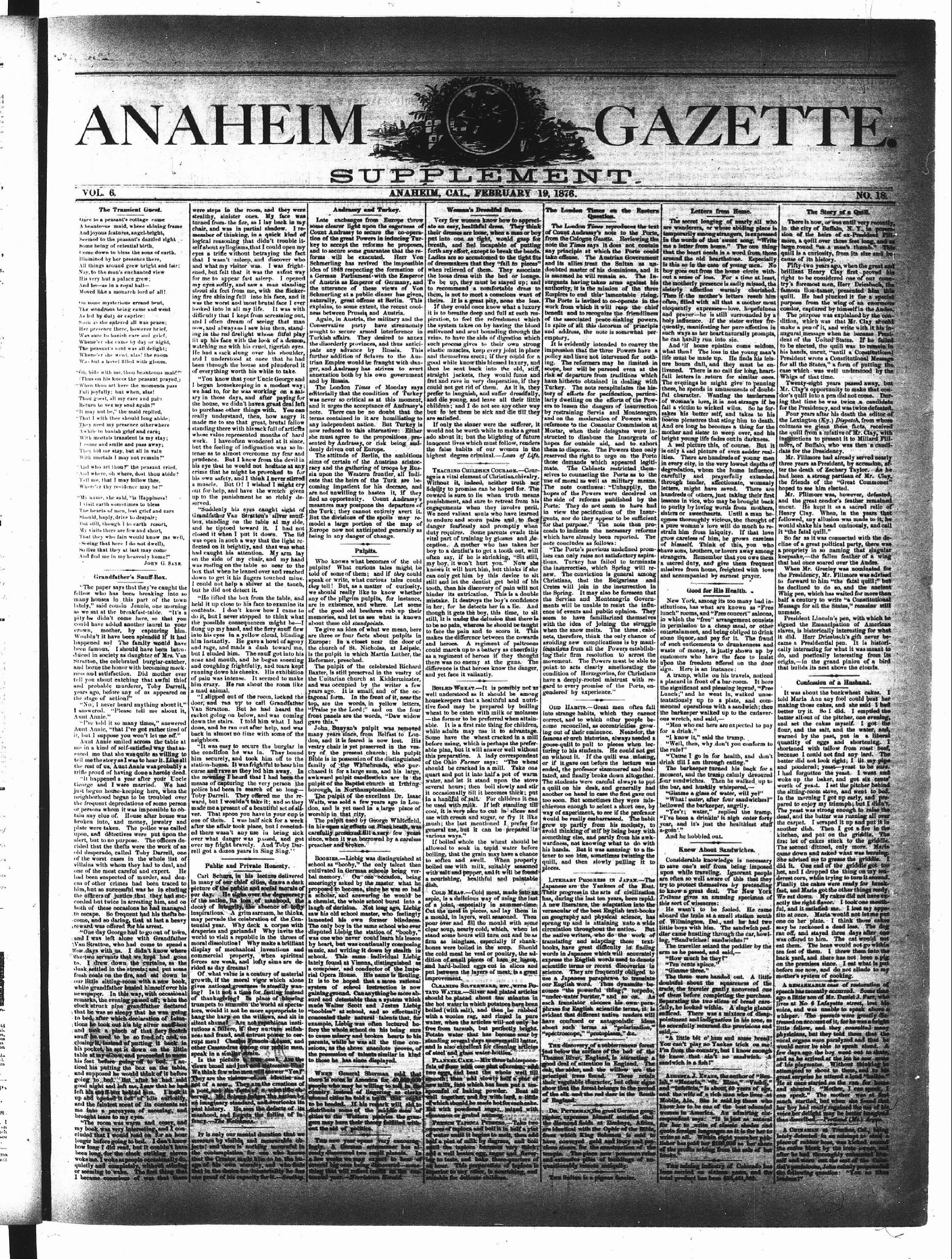
Searchable text
The Transient Guest.
Once to a peasant's cottage came
A beauteous maid, whose shining frame
And joyous features, angel-bright,
Seemed to the peasant's dazzled sight
Some being of celestial birth.
Come down to bless the sons of earth.
Illumined by her presence there,
All things around grew bright and fair;
Nay, to the man's enchanted view
His very but a palace grew;
And he—as in a royal hall—
Moved like a monarch lord of all!
On some mysterious errand bent,
The wondrous being came and went
As led by duty or caprice:
Soon as she entered all was peace;
Her presence there, however brief,
Was sure to banish care and grief;
Whene'er she came by day or night,
The peasant's soul was all delight;
Whene'er she went, alas! the room
Was but a hovel filled with gloom.
"Oh, bide with me, thou beauteous maid!"
(Thus on his knees the peasant prayed.)
"When thou art here the moments pass
Full joyfully; but when, alas!
Thou goest, all my care and pain!
Return to vex my soul again!"
"It may not be," the maid replied,
"That I with thee should long abide;
They need my presence otherwhere
While to banish grief and care;
With mortals transient is my stay;
I come and smile and pass away;
They bid me stay, but all in vain
With mortals I may not remain!"
"And who art thou?" the peasant cried,
were steps in the room, and they were stealthy, sinister ones. My face was turned from-the fire, as I lay back in my chair, and was in partial shadow. I remember of thinking, in a quick kind of logical reasoning that didn't trouble itself about syllogisms, that I could open my eyes a trifle without betraying the fact that I wasn't asleep, and discover who and what my visitor was. I was frightened, but felt that it was the safest way for me to appear fast asleep. I opened my eyes softly, and saw a man standing about six feet from me, with the flickering fire shining full into his face, and it was the worst and most brutal face I ever looked into in all my life. It was with difficulty that I kept from screaming out, and I often dream of seeing that man now, and always as I saw him then, standing in the real firelight whose fitful play lit up his face with the look of a demon watching me with his cruel, tigerish eyes. He had a sack slung over his shoulder, and I understood at once that he had been through the house and plundered it of everything worth his while to take.
"You know that your Uncle George and I began housekeeping in a modest way; we had to, for he was working on a salary in those days, and after paying for the house, we didn't have a great deal left to purchase other things with. You can really understand, then, how angry it made me to see that great, brutal fellow standing there with his sack full of articles whose value represented months of hard work. I have often wondered at it since, but the feeling of indignation was so intense as to almost overcome my fear and prudence. But I knew from the devil in his eye that he would not hesitate at any
Andram
Late exchange some clearer light
Count Andrassy's tion of the great key to accept the and to secure some forms will be Schmerling has idea of 1848 respite a German Parliament of Austria as Eu the utterance of Schmerling at a naturally, great explains, to someness between Prussia.
Again, in Austen Conservative politics sought to secure Turkish affairs. The disorderly prolapse any advance further addition to trian Empire would ger, and Andrassy annexation both and by Russia.
The London editorially that this was never so critic and it urges the note. There can terms contained many independent now reduced to she must agree sent by Andrassy denly driven out.
The attitude o aims of certain racy and the gath
"Oh, hide with me, thou beauteous maid!"
(Thus on his knees the peasant prayed.)
When thou art here the moments pass
Full joyfully; but when, alas!
Thou guest, all my care and palm
Return to vex my soul again!
"It may not be," the maid replied,
"That I with thee should long abide;
They need my presence otherwhere
Awhile to banish grief and care;
With mortals transient is my stay;
I come and smile and pass away;
They bid me stay, but all in vain
With mortals I may not remain."
"And who art thou?" the peasant cried.
"And where, oh where, dost thou abide?"
Tell me, that I may follow these,
Where's thy residence may be!
"My name, she said, 'is Happiness!'
I visit earth sometimes to bless
The hearts of men, least grief and care
Should, haply, drive to despair;
But still, though I to earth resort,
My visits there are few and short,
That they who fain would know me well,
Seeing that here I do not dwell),
So live that they at last may come
And find me in my heavenly home!"
John G. Saxe.
Grandfather's Snuff-Box.
"The paper says that they've caught the fellow who has been breaking into so many houses in this part of the town lately," said cousin Jennie, one morning as we sat at the breakfast-table. "It's a pity he didn't come here, so that you could have added another laurel to your crown, mother, by capturing him. Wouldn't it have been splendid if it had happened so? The family would have been famous. I should have been introduced in society as daughter of Mrs. Van Stratton, the celebrated burglar-catcher, and borne the honor with becoming meekness and satisfaction. Did mother ever tell you about catching that awful thief and probable murderer, Toby Darrell, years ago, before any of us appeared on the stage of action?
"No; I never heard anything about it."
I answered. "Please tell me about it, Aunt Annie."
"I've told it so many times," answered Aunt Annie, "that I've got rather tired of it, but I suppose you won't let me off."
Aunt Annie smiled across the table at me in a kind of self-satisfied way that assured me that she was quite as willing to tell me the story as I was to hear it. Like all the rest of us, Aunt Annie was probably a trifle proud of having done a heroic deed.
"It happened a year after your Uncle George and I were married. We had just begun house-keeping here, when the neighborhood began to be troubled over the frequent depredations of some person or persons whom it was impossible to obtain any clue of. House after house was broken into, and money, jewelry and plate were taken. The police was called upon, and detectives were put upon the alert, but to no purpose. The officers decided that the thefts were the work of an old desperado, called Toby Darrell, one of the worst cases in the whole list of villains with whom they had to deal, and one of the most careful and expert. He had been suspected of murder, and dozens of other crimes had been traced to him but so successful we he in eluding of everything worth his while to take.
"You know that your Uncle George and I began housekeeping in a modest way; we had to, for he was working on a salary in those days, and after paying for the house, we didn’t have a great deal left to purchase other things with. You can really understand, then, how angry it made me to see that great, brutal fellow standing there with his sack full of articles whose value represented months of hard work. I have often wondered at it since, but the feeling of indignation was so intense as to almost overcome my fear and prudence. But I knew from the devil in his eye that he would not hesitate at any crime that he might be provoked to for his own safety, and I think I never stirred a muscle. But O! I wished I might cry out for help, and have the wretch given up to the punishment he so richly deserved.
"Suddenly his eyes caught sight of Grandfather Van Stratton’s silver snuff-box, standing on the table at my side, and he tiptoed toward it. I had not closed it when I put it down. The lid was open in such a way that the light reflected on it brightly, and that was what had caught his attention. My arm lay on the side of my chair, and my hand was resting on the table so near to the box that when he leaned over and reached down to get it his fingers touched mine. I could not help a shiver at the touch, but he did not detect it.
"He lifted the box from the table, and held it up close to his face to examine its contents. I don't know how I came to do it, but I never stopped to think what the possible consequences might be—I flung up my hand, and the fiery snuff flew into his eyes in a yellow cloud, blinding him instantly. He gave a bowl of agony and rage, and made a dash toward me, but I eluded him. The snuff got into his nose and mouth, and he began sneezing and coughing frightfully, and tears kept running down his cheeks. His exhibition of pain was intense. It seemed to make him crazy. He ran about the room like a mad animal.
"I slipped out of the room, locked the door; and ran up to call Grandfather Van Stratton. But he had heard the racket going on below, and was coming down the stairs. I told him what I had done, and he ran out after help, and was back in almost no time with some of the neighbors.
"It was easy to secure the burglar in the condition he was in. They bound him securely, and took him off to the station-house. It was frightful to hear him curse and rave as they led him away. In the morning I heard that I had been the means of capturing the very person she police had been in search of so long—Toby Darrell. They offered me the reward, but I wouldn’t take it; and so they made me a present of a beautiful set of silver. That spoon you have in your cup is one of them. I was half sick for a week after the affair took place, but I concluded there wasn’t any use in being sick over what danger was passed, and got over my fright bravely. And Toby Darrell got a dozen years in Sing Sing."
Public and Private Honesty.
Carl Schurz, in his lecture delivered in many our chief cities, draws a dark picture of the public and social morals of everything worth his while to take.
“You know that your Uncle George and I began housekeeping in a modest way; we had to, for he was working on a salary in those days, and after paying for the house, we didn’t have a great deal left to purchase other things with. You can really understand, then, how angry it made me to see that great, brutal fellow standing there with his sack full of articles whose value represented months of hard work. I have often wondered at it since, but the feeling of indignation was so intense as to almost overcome my fear and prudence. But I knew from the devil in his eye that he would not hesitate at any crime that he might be provoked to for his own safety, and I think I never stirred a muscle. But O! I wished I might cry out for help, and have the wretch given up to the punishment he so richly deserved.
“Suddenly his eyes caught sight of Grandfather Van Stratton’s silver snuff-box, standing on the table at my side, and he tiptoed toward it. I had not closed it when I put it down. The lid was open in such a way that the light reflected on it brightly, and that was what had caught his attention. My arm lay on the side of my chair, and my hand was resting on the table so near to the box that when he leaned over and reached down to get it his fingers touched mine. I could not help a shiver at the touch, but he did not detect it.
"He lifted the box from the table, and held it up close to his face to examine its contents. I don’t know how I came to do it, but I never stopped to think what the possible consequences might be—I flung up my hand, and the fiery snuff flew into his eyes in a yellow cloud, blinding him instantly. He gave a bowl of agony and rage, and made a dash toward me, but I eluded him. The snuff got into his nose and mouth, and he began sneezing and coughing frightfully, and tears kept running down his cheeks. His exhibition of pain was intense. It seemed to make him crazy. He ran about the room like a mad animal."
Who knows what pulpits? What told of some of their speak or write; whether they tell! But as we should really any of the pilgrims are in existence; of the good old memories; and let about these old art.
To give an idea are three or four Europe: In a city the church of St. Isabel the pulpit in Wrexford; is still praised by Unitarian church; and was occupied years ago. It is tigagonal form. In top are the works “Praise ye the Lord front panels are too gave this.”
John Bunyan’s many years since don; and it is feastry chair is yet try of the preses Bible is in possessions family of the Vachased it for a la awkward pulpit o pulpit of the Baptist borough; in Norwich.
The pulpit of Watts; was sold ad don; and is yet u worship in that o
The pulpit used in his open air effec carefully preserved since; when it was preacher and brook
Boobies.-Lieb school as “booby,” cultivated in German memory. O acneringly asked promenade both by Russia.
The London T editorially that this was never so crievant and it urges the note. There can terms contained any independent now reduced to she must agree sent by Andras denly driven out
The attitude o aims of certain oracy and the gatha sia upon the Wc cate that the heir coming impatient are not unwilling find an opportunity measures may poi the Turk; they cai But the division model a large pape Europe now not being in any dan
just begun house-keeping here, when the neighborhood began to be troubled over the frequent depredations of some person or persons whom it was impossible to obtain any clue of. House after house was broken into, and money, jewelry and plate were taken. The police was called upon, and detectives were put upon the alert, but to no purpose. The officers decided that the thefts were the work of an old desperado, called Toby Darrell, one of the worst cases in the whole list of villains with whom they had to deal, and one of the most careful and expert. He had been suspected of murder, and dozens of other crimes had been traced to him, but so successful was he in eluding the officers of justice that they had succeeded but twice in arresting him, and on both of these occasions he had managed to escape. So frequent had his thefts become, and so daring, that at last a heavy reward was offered for his arrest.
"One day George had to go out of town, and I was left alone with Grandfather Van Stratton, who had come to spend a few days with us. I didn't know where the two servants that we kept had gone to. I drew down the curtains, as the dusk settled in the streets; and put some fresh coals on the fire, and sat down in our little sitting-room with a new book, while grandfather busied himself over his newspaper. In this way, with occasional remarks, the evening passed off; when the clock struck nine grandfather declared that he was so sleepy that he was going to bed, after which declaration of latentions he took out his big silver snuff-box and took a plouch of that fiery Scotch anuff he used to be so fond of; and, on closing it, instead of putting it back in his pocket, he set it down on the little table at my allowance, and proceeded to warm his feet before going off to bed. I noticed his putting the box on the table, and supposed he would think of it before going to bed. But after he had said good night and left me, I saw that he had left his snuff-box behind him. I looked it up and opened it out of idle curiosity, and the faintest scent of its contents set me into a paroxysm of screaming, and brought tears to my eyes.
"The room was warm and coney, and my book was very interesting, and I concluded that I would read on for an hour longer before going to bed. I don't know how long I did read, but it couldn't have been long, for the clock striking eleven woke me. I woke up people occasionally do quietly and completely, without stirring or seeming to wake. The first thing that I became conscious of was that there
Toby Darrell. They offered me the reward, but I wouldn't take it; and so they made me a present of a beautiful set of silver. That spoon you have in your cup is one of them. I was half sick for a week after the affair took place, but I concluded there wasn't any use in being sick over what danger was passed, and got over my fright bravely. And Toby Darrell got a dozen years in Sing Sing."
Public and Private Honesty.
Carl Schura, in his lecture delivered in many of our chief cities, draws a dark picture of the public and social morals of pur day. He signs over the degeneracy of the nation, its loss of manhood, the decay of integrity, the absence of lofty inspirations. A grim sarcasm, he thinks may pervade the celebration of the Centennial year. Why deck a corpse with draperies and garlands? Why invite the world to visit a republic in the throes of moral dissolution? Why make a brilliant display of mechanical inventions and commercial property, when spiritual forces are weak, and lofty aims are deided as day dreams?
Of what value is a century of material growth, if the moral vigor which alone gives national greatness is steadily waning? Is it not a time for fasting instead of thanksgiving? In place of blowing trumpets to summon the world as spectators, would it not be more appropriate to hang the harp on the willows, and sit in silent shame? Are not republican institutions a failure, if they nurture self-fashions and fraud, and entrust power to corrupt men! Charles Francis Adams, and other Cassandras among our public men, speak in a similar strain.
Is the picture so true one? Are the views broad and just asatasman-like? We think few men will answer "Yeah!" They are the victims of all liberalist and not of a scar. They are the creations of a post, not the facts of a scientific observer. Mr Schura judges the nation by an imaginary standard, and overlooks its past history. He sees the defects of its manhood, and forgets the fullness of infancy—The Botanists.
It is only our mental duration that we measure by visible and measurable objects; and there is nothing meaningful in the contemplation for one who knows that the Creator made him to be: the image of his own stature, and who finds that in the desire for immortality he has one proof of his capacity for it—Santay.
The pulpit used in his open air affair carefully presumes since, when it was preacher and brothel.
Boobies—Lieber school as "booby cultivated in German memory." One aceriously asked proposed to become a scholar, and as a chemist, the whigh laugh of derision saw his old school lamented his owne only boy in this disputed Liebig twas one who never by heart, but was music, and writing school. This latterly found at Vienna a composer, and aerial Opera House. It is to be hopeful system of school gaining ground. Sard and detestable made Walter Scott "boobies" at schoenecaled their example, Liebig fore the whole act to cause misery parents, while he sessions, as the abject possession of those he has a
When Generals there is room in a people who may country instead around cities he to be headed. It distributes some cities to the Wagner may have thou out the aid of poets.
This new yearingly A German rarely discovered a few weeks we see something big can happen than this will run tennial year—M
CIM GA
SUPPLEMENT.
ANAHEIM, CAL., FEBRUARY 19, 1876.
Andramsy and Turkey.
Late exchanges from Europe throw some clearer light upon the eagerness of Count Andramsy to secure the co-operation of the great Powers in inducing Turkey to accept the reforms he proposes, and to secure some guarantee that the reforms will be executed. Herr Von Schmerling has revived the impossible idea of 1848 respecting the formation of a German Parliament with the Emperor of Austria as Emperor of Germany, and the utterance of these views of Von Schmerling at a public dinner has given, naturally, great offense at Berlin. This explains, to some extent, the recent coolness between Prussia and Austria.
Again, in Austria, the military and the Conservative party have strenuously sought to secure armed interference in Turkish affairs. They desired to annex the disorderly provinces, and thus anticipate any advance by Russia. This further addition of Selaves to the Austrian Empire would be fraught with danger, and Andramsy has striven to avert annexation both by his own government and by Russia.
The London Times of Monday says editorially that the condition of Turkey was never so critical as at this moment, and it urges the acceptance of Andramsy's note. There can be no doubt that the terms contained in it are humiliating to any independent nation. But Turkey is now reduced to this alternative: Either she must agree to the propositions presented by Andramsy, or risk being suddenly driven out of Europe.
The attitude of Berlin, the ambitious aims of certain of the Austrian aristocracy and the gathering of troops by Rus-
Woman's Dreadful Drum.
Very few women know how to appreciate an easy, healthful dress. They think their dresses are loose, when a man or boy put into one as tight, would gasp for breath, and feel incapable of putting forth any effort, except to break the bands. Ladies are so accustomed to the tight fits of dressmakers that they "fall to pieces" when relieved of them. They associate the loose dress with the bed or lounge. To be up, they must be stayed up; and to recommend a comfortable dress to them, is not to meet a conscious want of theirs. It is a great pity, none the less.
If they could once know what a luxury it is to breathe deep and full at each respiration, to feel the refreshment which the system takes on by having the blood enlivened and sent bounding through the veins, to have the aids of digestion which such process gives to their own strong elastic muscles, keep every joint in place and themselves erect; if they could for a good while know this blessed luxury, and then be sent back into the old, stiff, straight jackets, they would fume and fret and rave in very desperation, if they could not get rid of them. As it is, they prefer to languish, and suffer dreadfully, and die young, and leave all their little children; and I do not see any other way but to let them be sick and die till they are satisfied.
If only the sinner were the sufferer, it would not be worth while to make a great ado about it; but the blighting of future innocent lives which must follow, renders the false habits of our women in the highest degree criminal.—Laws of Life,
The London Times on the Eastern Question.
The London Times reproduces the text of Count Andramsy's note to the Porte, from the Cologne Gazette. Reviewing the note the Times says it does not contain any principle at which the Porte could take offense. The Austrian Government and its allies treat the Sultan as doubted master of his dominions, and it is assumed he will remain so. The Insurgents having taken arms against his authority, it is the mission of the three Empires to end this lamentable rising. The Porte is invited to co-operate in the work from which it will reap the chief benefit and to recognize the friendliness of the associated peace-making powers. In spite of all this decorum of principle and address, the note is somewhat peremptory.
It is evidently intended to convey the impression that the three Powers have a policy and have not intervened for nothing. The reformers may be limited in scope, but will be pursued even at the risk of departure from traditions which have hitherto obtained in dealing with Turkey. The note recapitulates the history of efforts for pacification, particularly dwelling on the efforts of the Powers to lessen the dangers of insurrection by restraining Servia and Montenegro, and on the moderation of Powers with reference to the Consular Commission at Mostar, when their delegates were instructed to disabuse the Insurgents of hopes for outside aid, and to exhort them to disperse. The Powers then only reserved the right to urge on the Porte those demands which appeared legitimate.
The Cabinets restricted them.
The London Times of Monday says editorially that the condition of Turkey was never so critical as at this moment, and it urges the acceptance of Andrassy's note. There can be no doubt that the terms contained in it are humiliating to any independent nation. But Turkey is now reduced to this alternative: Either she must agree to the propositions presented by Andrassy, or risk being suddenly driven out of Europe.
The attitude of Berlin, the ambitions aims of certain of the Austrian aristocracy and the gathering of troops by Russia upon the Western frontier, all indicate that the heirs of the Turk are becoming impatient for his decease, and are not unwilling to hasten it, if they find an opportunity. Count Andrassy's measures may postpone the departure of the Turk; they cannot entirely avert it. But the divisions of the spoils may model a large portion of the map of Europe now not anticipated generally as being in any danger of change.
Pulpits.
Who knows what becomes of the old pulpits? What curious tales might be told of some of them; and if they could speak or write, what curious tales could they tell! But as a matter of curiosity, we should really like to know whether any of the pilgrim pulpits, for instance, are in existence, and where. Let some of the good old brethren rub up their memories, and let us see what is known about these old standpoints.
To give an idea of what we mean, here are three or four facts about pulpins in Europe: In a closet near the door of the church of St. Nicholas, at Leipsic, is the pulpit in which Martin Luther, the Reformer, preached.
The pulpit of the celebrated Richard Baxter, is still preserved in the vestry of the Unitarian church at Kidderminster, and was occupied by the writer a few years ago. It is small, and of the octagonal form. In the front of it, near the top, are the words, in yellow letters, "Praise ye the Lord;" and on the four front panels are the words, "Daw widow gave this."
John Bunyan's pulpit was removed many years since, from Belfast to London, and it is feared is now lost. His vestry chair is yet preserved in the vestry of the present church; his pulpit Bible is in possession of the distinguished family of the Whitebeads, who purchased it for a large sum, and his large awkward pulpit candlesticks are in the pulpit of the Baptist church at Irthingborough, in Northamptonshire.
The pulpit of the excellent Dr. Isaac Watts, was sold a few years ago in London, and is yet used in a large place of worship in that city.
The pulpit used by George Whitefield, in his open air efforts on Blackheath, was carefully preserved till a very few years since, when it was borrowed by a careless preacher and broken.
Boobies.—Liebig was distinguished at school as "booby," the only talent then cultivated in German schools being verbal memory. On one occasion, being anneeringly asked by the master, what he proposed to become since he was so bad straight jackets, they would fume and fret and rave in very desperation, if they could not get rid of them. As it is, they prefer to languish, and suffer dreadfully, and die young, and leave all their little children; and I do not see any other way but to let them be sick and die till they are satisfied.
If only the sinner were the sufferer, it would not be worth while to make a great ado about it; but the blighting of future innocent lives which must follow, renders the false habits of our women in the highest degree criminal.—Laws of Life.
Teaching Children Courage.—Courage is a vital element of Christian chivalry. Without it, indeed, neither truth nor fidelity to promise can be hoped for. The coward is sure to lie when truth means punishment, and sure to retreat from his engagements when they involve peril. We need valiant souls who have learned to endure and scorn pain; and to face danger fearlessly and promptly when duty requires. Some parents evade this vital part of training by glosses and deception. A mother who has taken her boy to a dentist's to get a tooth out, will often say, if he is shrinking, "Sit still, my boy, it won't hurt you." Now she knows it will hurt him, but thinks if she can only get him by this device to sit still and let the dentist get hold of his tooth, then his discovery of pain will not hinder its extrication. This is a double mistake. It destroys the boy's confidence in her; for he detects her in a lie. And though it gets the boy, this time, to sit still, it is under the delusion that there is to be no pain, whereas he should be taught to face the pain and to scorn it. This makes the difference between the cowards and heroes. A regiment of paltroons could march up to a battery as cheerfully as a regiment of heroes if they thought there was no enemy at the guns. The difference is that heroes know the danger, and yet face it valiantly.
Boiled Wheat.—It is possibly not as well understood as it should be among housekeepers that a healthful and nutritive food may be prepared by boiling wheat to be eaten with milk or molasses—the former to be preferred when attainable. It is a first rate thing for children, while adults may use it to advantage. Some have the wheat cracked in a mill before using, which is perhaps the preferable plan, but it will answer well without this preparation. A lady correspondent of the Ohio Farmer says: "The wheat should be cracked in a mill. Take one quart and put it into half a pot of warm water, and let it stand upon the stove several hours; then boil slowly and stir it occasionally till it becomes thick; put in a handful of salt. For children it can be used with milk. If left standing till cool, it is very nice to cut in slices and use with cream and sugar, or fry it like mush; the last mentioned I prefer for general use, but it can be prepared in various ways."
If boiled whole the wheat should be allowed to soak in tepid water before boiling, that the grain may have a chance to soften and swell. When properly boiled use with milk, suitably seasoned with salt and pepper, and it will be found a nourishing, healthful and palatable dish.
Risk of departure from traditions which have hitherto obtained in dealing with Turkey. The note recapitulates the history of efforts for pacification, particularly dwelling on the efforts of the Powers to lessen the dangers of insurrection by restraining Servia and Montenegro, and on the moderation of Powers with reference to the Consular Commission at Mostar, when their delegates were instructed to disabuse the Insurgents of hopes for outside aid, and to exhort them to disperse. The Powers then only reserved the right to urge on the Porte those demands which appeared legitimate.
The Cabinets restricted themselves to counseling the Porte as to the use of moral as well as military means. The note continues: "Unhappily, the hopes of the Powers were deceived on the side of reforms published by the Porte. They do not seem to have had in view the pacification of the Insurgents, nor do they appear to be sufficient for that purpose." The note then proceeds to indicate the necessary reforms which have already been reported. The note concludes as follows:
"The Porte's previous undefined promises can only raise not satisfactory aspirations. Turkey has failed to terminate the insurrection, which Spring will renew. The conviction is general among Christians, that the Bulgarians and Cretes will join in the insurrection in the Spring. It may also be foreseen that the Servian and Montenegrin Governments will be unable to resist the influence of events and public opinion. They seem to have familiarized themselves with the idea of joining the struggle when the snow melts. The three cabinets therefore think only chance of avoiding new complications is by manifestations from all the Powers establishing their firm resolution to arrest the movement. The Powers must be able to point to acts clearly ameliorating the condition of Herzegovina, for Christians have a deeply-rooted mistrust with regard to every promise of the Porte, engendered by experience."
Oud Habits.—Great men often fall into strange habits, which they cannot correct, and to which other people become reconciled, as eccentricities growing out of their eminence. Neander,the famous church historian, always needed a goose-quill to pull to pieces when lecturing to his students. He could not get on without it. If if quill was missing, or if if gave out before the lecture was ended,the professor stammered and hesitated,and finally broke down altogether.The students were careful always to put a quill on his desk,and generally had another on hand in case the first gave out too soon.But sometimes they were mischievous enough to select a short one,bay way of experiment,touse if if the professor would be really embarrassed.The habit grew up partly from his modesty,touse thinking of self by being busy with something else,and partly from his awkwardness,not knowing what to do with his hands.But it was amusing to a listener to see him,sometimes twisting the quill,and then slowly pulling it to pieces.
Literary Progress in Japan.-The Japanese are the Yankees of East.
The pulpit of the excellent Dr. Isaac Watts, was sold a few years ago in London, and is yet used in a large place of worship in that city.
The pulpit used by George Whitefield, in his open air efforts on Blackheath, was carefully preserved a very few years since, when it was borrowed by a careless preacher and broken.
Boorines.—Liebig was distinguished at school as "booby," the only talent then cultivated in German schools being verbal memory. On one occasion, being sneeringly asked by the master what he proposed to become, since he was so bad a scholar, and answering he would be a chemist, the whole school burst into a laugh of derision. Not long ago, Liebig saw his old school master, who feelingly lamented his own former blindness. The only boy in the same school who ever disputed Liebig the station of "booby," was one who never could learn his lesson by heart, but was continually composing music, and writing it down by stealth in school. This same individual Liebig lately found at Vienna, distinguished as a composer, and conductor of the Imperial Opera House. His name is Beuling. It is to be hoped that a more rational system of school instruction is now gaining ground. Can anything be more absurd and detestable than a system which made Walter Scott and Justus Liebig "boobies" at school, and so effectually concealed their natural talents that, for example, Liebig was often lectured before the whole school on his being sure to cause misery and broken hearts to his parents, while he was all the time conscious, as the above anecdote proves, of the presumption of talents similar in kind to those he has since displayed.
Whey General Sherman said that there is room in America for 40,000,000 people who may be willing to tell in the country instead of lingering as clerks around chins he told a truth that ought to be headed. If his remark will aid to distribute some of the middle class of cities to the Western prairies the grangers may have their theory fulfilled without the aid of politics.
The new year opens very encouragingly. A German adventurer has already discovered two small planets. In a few weeks we may expect to hear of several big ones being discovered—some thing this will reflect confidently in the annual year—Newton knew.
The pulpit of the excellent Dr. Isaac Watts, was sold a few years ago in London, and is yet used in a large place of worship in that city.
The pulpit used by George Whitefield, in his open air efforts on Blackheath, was carefully preserved a very few years since, when it was borrowed by a careless preacher and broken.
BOORIES.—Liebig was distinguished at school as "booby," the only talent then cultivated in German schools being verbal memory. On one occasion, being sneeringly asked by the master what he proposed to become, since he was so bad a scholar, and answering he would be a chemist, the whole school burst into a laugh of derision. Not long ago, Liebig saw his old school master, who feelingly lamented his own former blindness. The only boy in the same school who ever disputed Liebig the station of "booby," was one who never could learn his lesson by heart, but was continually composing music, and writing it down by stealth in school. This same individual Liebig lately found at Vienna, distinguished as a composer, and conductor of the Imperial Opera House. His name is Beuling. It is to be hoped that a more rational system of school instruction is now gaining ground. Can anything be more absurd and detestable than a system which made Walter Scott and Justus Liebig "boobies" at school, and so effectually concealed their natural talents that, for example, Liebig was often lectured before the whole school on his being sure to cause misery and broken hearts to his parents, while he was all the time conscious, as the above anecdote proves, of the presumption of talents similar in kind to those he has since displayed.
WHY General Sherman said that there is room in America for 40,000,000 people who may be willing to tell in the country instead of lingering as clerks around chins he told a truth that ought to be headed. If his remark will aid to distribute some of the middle class of cities to the Western prairies the grangers may have their theory fulfilled without the aid of politics.
THE PULPIT USED BY GEORGE WHITEFIELD, IN HIS OPEN AIR EFFORTS ON BLACKHEATH, WAS CAREFULLY PREPARED BY A CARELESS PREACHER AND BROKEN.
BOORIES.—Liebig was distinguished at school as "booby," the only talent then cultivated in German schools being verbal memory. On one occasion, being sneeringly asked by the master what he proposed to become, since he was so bad a scholar, and answering he would be a chemist, the whole school burst into a laugh of derision. Not long ago, Liebig saw his old school master, who feelingly lamented his own former blindness. The only boy in the same school who ever disputed Liebig the station of "booby," was one who never could learn his lesson by heart, but was continually composing music, and writing it down by stealth in school. This same individual Liebig lately found at Vienna, distinguished as a composer, and conductor of the Imperial Opera House. His name is Beuling. It is to be hoped that a more rational system of school instruction is now gaining ground. Can anything be more absurd and detestable than a system which made Walter Scott and Justus Liebig "boobies" at school, and so effectually concealed their natural talents that, for example, Liebig was often lectured before the whole school on his being sure to cause misery and broken hearts to his parents, while he was all the time conscious, as the above anecdote proves, of the presumption of talents similar in kind to those he has since displayed.
WHY General Sherman said that there is room in America for 40,000,000 people who may be willing to tell in the country instead of lingering as clerks around chins he told a truth that ought to be headed. If his remark will aid to distribute some of the middle class of cities to the Western prairies the grangers may have their theory fulfilled without the aid of politics.
THE PULPIT USED BY GEORGE WHITEFIELD, IN HIS OPEN AIR EFFORTS ON BLACKHEATH, WAS CAREFULLY PREPARED BY A CARELESS PREACHER AND BROKEN.
BOORIES.—Liebig was distinguished at school as "booby," the only talent then cultivated in German schools being verbal memory. On one occasion, being sneeringly asked by the master what he proposed to become, since he was so bad a scholar, and answering he would be a chemist, the whole school burst into a laugh of derision. Not long ago, Liebig saw his old school master, who feelingly lamented his own former blindness. The only boy in the same school who ever disputed Liewig the station of "booby," was one who never could learn his lesson by heart, but was continually composing music, and writing it down by stealth in school. This same individual Liebig lately found at Vienna, distinguished as a composer, and conductor of the Imperial Opera House. His name is Beuling. It is to be hoped that a more rational system of school instruction is now gaining ground. Can anything be more absurd and detestable than a system which made Walter Scott and Justus Liewig "boobies" at school, and so effectually concealed their natural talents that, for example, Liebig was often lectured before the whole school on his being sure to cause misery and broken hearts to his parents, while he was all the time conscious, as the above anecdote proves, of the presumption of talents similar in kind to those he has since displayed.
WHY General Sherman said that there is room in America for 40,000,000 people who may be willing to tell in the country instead of lingering as clerks around chins he told a truth that ought to be headed. If his remark will aid to distribute some of the middle class of cities to the Western prairies the grangers may have their theory fulfilled without the aid of politics.
THE PULPIT USED BY GEORGE WHITEFIELD, IN HIS OPEN AIR EFFORTS ON BLACKHEATH, WAS CAREFULLY PREPARED BY A CARELESS PREACHER AND BROKEN.
BOORIES.—Liebig was distinguished at school as "booby," the only talent then cultivated in German schools being verbal memory. On one occasion, being sneeringly asked by the master what he proposed to become, since he was so bad a scholar, and answering he would be a chemist, the whole school burst into a laugh of derision. Not long ago, Liebig saw his old school master, who feelingly lamented his own former blindness. The only boy in the same school who ever disputed Liewig the station of "booby," was one who never could learn his lesson by heart, but was continually composing music, and writing it down by stealth in school. This same individual Liewig lately found at Vienna, distinguished as a composer, and conductor of the Imperial Opera House. His name is Beuling. It is to be hoped that a more rational system of school instruction is now gaining ground. Can anything be more absurd and detestable than a system which made Walter Scott and Justus Liewig "boobies" at school, and so effectually concealed their natural talents that, for example, Liewig was often lectured before the whole school on his being sure to cause misery and broken hearts to his parents, while he was all the time conscious, as the above anecdote proves, of the presumption of talents similar in kind to those he has since displayed.
WHY General Sherman said that there is room in America for 40,000,000 people who may be willing to tell in the country instead of lingering as clerks around chins he told a truth that ought to be headed. If his remark will aid to distribute some of the middle class of cities to the Western prairies the grangers may have their theory fulfilled without the aid of politics.
THE PULPIT USED BY GEORGE WHITEFIELD, IN HIS OPEN AIR EFFORTS ON BLACKHEATH, WAS CAREFULLY PREPARED BY A CARELESS PREACHER AND BROKEN.
BOORIES.—Liebig was distinguished at学校 as "booby,"the only talent then cultivated in German schools being verbal memory.On one occasion being sneeringly asked by the master what he proposed to become since he was so bad a scholar,and answering he would be a chemist,and suitably seasoned with salt and pepper,and it will be found a nourishing,健康和 palatable dish.
COLD MEAT.-Cold meat,made into an apic;is a delicious way of using last of a joint,specially in summer-time.Cut the meat in pieces,and lay them in a mould,在 layers well seasoned Then pour over and fill the mould with some clear soup,nearly coldwhich,when let stand some hours will turn out and be as firm as ias glasss,easily if shank-bones were boiled inthe soup.Shouldthe cold meat be veal or poultry,the addition of small pieces of ham or bacon,and hard-boiled eggs cut in slicesand put betweenthe layersofmeat.isa great improvement.
CLEANING SILVERWARE,MTC.,WITH POTATO WATER.-Silver and plated articles should be placed about ten minutesinthe hot waterin which potatoes have been boiled(with salt),and thenbe rubbedwith a woolen rag,and rinsedin pure waterwhenthearticleswillnotonlybe freefrom tarnish,但perfectly bright.Potato waterthathasbecome sourbystandingseveraldaysanaworktbetter,andisalsoexcellentforcleaningarticlesofsteelandglasswater-bottles.
FRANKEL CAKE.-Mix three tablespoonfulsof flourwithone pintofcream;addtwoeggs,andbeatthewholewelltill smooth;thenadd slowlyhalfa pintofnew milk,intothetaplocaheswornvery thick;andawellhottenegg,sugarandflavoringto taste,andakethreequartersofan hourThispreparationoftablesissuperiortoanyother,iisnearthing,andsuitablefordelicatechildren.
FRANCHE TAPOICA PURCHASE.-Take two ouncesof tapoicaand boilitin halfa pintofwateruntilit beginsinmelt,theaddhalfa pintofmilkbydegree,andbowlthetaplocaheswornvery thick;andawellhottenegg,sugarandflavoringto taste,andakethreequartersofan hourThispreparationoftablesissuperiortoanyother,iisnearthing,andsuitablefordelicatechildren.
DR.YETTERMAN,the great German geographer,xpresses himself satisfiedthatthe diamond fieldsat Zimbabwe,Africaare identicalwiththe Ophirofthe Bible,frostwhich King Solomonis saidtohave conveyed goldand ironandprevious stonesforthe constructionofthe temple.Thepastnewpenumbersruledandextendedplainsofbuildingsofunquestionablyremoteantiquity.
TWO FLASHESinapigramster.
GAZETTE.
NO. 16.
Letters from Home.
The secret longing of nearly all who are wanderers, or whose abiding place is temporarily among strangers, is expressed in the words of that sweet song, "Write me a letter from home." The one thing that the heart needs is a word from those around the old hearthstone. Especially is this so in the case of young men. No boy goes out from the home circle without a sense of loss. For a time at least, the motherly presence is saddly missed, the sisterly affection warmly cherished. Then if the mother's letters reach him often, filled with all that a mother most eloquently expresses—love, hopefulness and prayer—he is still surrounded by a holy influence. If the sister writes frequently, manifesting her pure affection in such ways as her heart naturally prompts, he can hardly run into sin.
And if home epistles come seldom, what then? The loss in the young man's life must be made up. He finds his leisure hours dull, and they must be enlivened. There is no call for long, heartfull letters in return for similar ones. The evenings he might give to penning these, he spends in amusements of doubtful character. Wanting the tenderness of woman's love, it is not strange if he fall a victim to wicked wiles. So he forks his better self, and takes to his bosom pleasures that sting him to death. And ere long he becomes a thing for the mother and sister to weep over, and his bright young life fades out in darkness.
A sad picture this, of course. But it is only a sad picture of even sadder realities. There are hundreds of young men in every city, in the very lowest depths of degradation whom the home influences.
The Story of a Quill.
There is now, or was until very recently, in the city of Buffalo, N.Y., a possession of the heirs of ex-President Fillmore, a quill over three feet long, and as large round "as a man's thumb." This quill is a curiosity, from its size and because of its history.
Fifty-two years ago, when the great and brilliant Henry Clay first proved his right to be considered one of our country's foremost men, Herr Driesbach, the famous lion-tamer, presented him this quill. He had plucked it for a special purpose from the wing of an enormous condor, captured by himself in the Andes.
The purpose was explained by the condition, which was that Mr. Clay should make a pen of it, and write with it his inaugural message when he became President of the United States. If he failed to be elected, the quill was to remain in his hands, uncut, "until a Constitutional President wrote a Constitutional Message for all the States," a form of putting the case which was well understood by the Whigs of that time.
Twenty-eight years passed away, but Mr. Clay's opportunity to make that condor's quill into a pen did not come. During that time he was twice a candidate for the Presidency, and was twice defeated.
Four years after his death the editor of the Lexington (Ky.) Dispatch, from whose columns we glean these facts, received the quill from a relative of Mr. Clay, with instructions to present it to Millard Fillmore, of Buffalo, who was then a candidate for the Presidency.
Mr. Fillmore had already served nearly three years as President, by accession, after the death of Zachary Taylor.
Great men often fall in which they cannot reach other people because eccentricities grow inence. Neander, the human, always needed a to piece when lecets. He could not get the quill was missing, before the lecture was stammered and heikke down altogether. Careful always to put it, and generally had case the first gave out times they were misselect a short one, by to see if the professor barrassed. The habit from his awkward what to do with was amusing to a sometimes twisting the slowly pulling it to
Knew About Sandwiches.
Considerable knowledge is necessary to save one's self from being imposed upon while travelling. Ignorant people are often so well aware of this that they try to protect themselves by pretending to be well-versed in the traditions which bind in dealing with recapitulates the hispacification, partinues the efforts of the Powrangers of insurrection via Montenegro, nation of Powers with consular Commission at their delegates were insecure the Insurgents of aid, and to exhort The Powers then only urge on the Porte which appeared legitimate restricted them; the Porte as to the as military means: "Unhappily, the wars were deceived on was published by the not seem to have had occasion of the Insurpeappear to be sufficient. The note then prome necessary reforms been reported. The follows:
serious undefined promoot satisfactory aspira failed to terminate which Spring will reion is general among the Bulgarians and in also be foreseen that Montenegrin Governide to resist the influpublic opinion. They familiarized themselves joining the struggle. The three cabiikk the only chance of publications is by manihe Powrs establishholution to arrest the Powrs must be able to fully ameliorating the govina, for Christians did mistrust with reise of the Porte, enience."
Good for His Health.
New York, among its too many bad institutions, has what are known as "Free lunch" rooms, and "Free concert" saloons, in which the "free" arrangement consists in permission to a cheap meal, or other entertainment, and being obliged to drink some liquor, and pay for it. The fraud of such enticements to drunkness and waste of money, is justly shown up by customers who have the face to insist upon the freedom offered on the door sign. Here is an instance:
A tramp, while on his travels, noticed a placard in front of a bar-room. It bore the significant and pleasing legend, "Free Lunch;" and he went in, walked unnotentatively up to a plate, and commenced operations with a sandwich; then the barkeeper walked up to the cadaverous wretch, and said,
"Men who eat here are expected to pay for a drink."
"I know it," said the trump.
"Well, then, why don't you conform to the rule?"
"Cause I go in for health, and don't drink till I am through eating."
The barkeeper turned his back for a moment, and the tramp calmly devoured four sandwiches. Then he walked up to the bar, and huskily whispered,
"Gimme a glass of water, will ye?"
"What! water, after four sandwiches?" bellowed the barkeeper, angrily.
"Yes'r; water," replied the trump.
"I've been a drinkin' it nigh enter forty year, and it's just the healthiest stuff a-goin'."
And he hobbled out.
Confession of a Husband.
It was about the buckwheat cakes. I told Maria Ann any fool could beat her making those cakes, and she said I had better try it. So I did. I emptied the batter allout of the pitcher, one evening, and set the cakes myself. I got the flour, and the salt, and the water, and warned by the past, put in a liberal quantity of eggs and shortening. I shortened with tallow from roast beef, because I could not find any lard. The batter did not look right; I lit my pipe and powdered; yeast—yeast to be sure. I had forgotten the yeast. I went and woke up the baker, and got six cents' worth of yeast. I set the pitcher behind the slitting-room stove, and went to bed. In the morning I got up early, and prepared to enjoy my triumph; but I didn't. The yeast was strong enough to raise the dead, and the batter was running all over the carpet. I scraped it up and put it in another dish. Then I got a fire in the kitchen, and put on the griddle. The first lot of cakes stuck to the griddle. The second dittoed, only more. Maria came down and asked what was burning. She advised me to grease the griddle. I did it. One end of the griddle got too hot, and I dropped the thing on my tenderest corn, while trying to turn it around. Finally the cakes were ready for breakfast, and Maria got the other things ready."
"Gimme a glass of water, will ye?"
"What! water, after four sandwiches?" bellowed the barkeeper, angrily.
"Yes'r; water," replied the tramp.
"I've been a drinkin' it nigh enter forty year, and it's just the healthiest stuff a-goin'!"
And he hobbled out.
Knew About Sandwiches.
Considerable knowledge is necessary to save one's self from being imposed upon while travelling. Ignorant people are often so well aware of this that they try to protect themselves by pretending to know a great deal. The New York Tribune gives an amusing specimen of this sort of wisecres:
He wasn't to be fooled. He came aboard the train at a small station south of Wilmington, Del., and he had two little boys with him. The sandwich peddler came hustling through the car, howling, "Sandwiches! sandwiches!"
The traveller seized the peddler by the arm as he passed, and said,—
"How much be they!"
"Ten cents apiece."
"Gimme three."
The three were handed out. A little doubtful about the squareness of the trade, the traveler gently uncovered one of them before completing the purchase. Separating the two slices of bread carefully, he looked within. A single glance sufficed. There was a mixture of disappointment and indignation in his tone, as he scornfully returned the provisions and said—
"A little bit e' ham and some bread! You can't play no Yankee trick on me! I'm from the country, but I know enough to know that aln't no sandwich. A sandwich is a fish!"
Acknowledgement, the author of "Bunlah," "Mazarta," "St. Elmo," "Vuohi," and "Infelina," is about 40 years old, and the wife of a rich man who lives at Mobile, Ala. She is said by those who knew her to be one of the best educated women in America. An admiring correspondent says: "It is just as natural for her to write of simple shades and quite foreign languages as it is for her to write all." Within eight years her publisher has paid her $100,000 as her share of the profits arising from the sale of her books."
This mining industry of Colorado has been carried on sixteen years, and the total product has been $523,461,988.
In the morning I got up early, and prepared to enjoy my triumph; but I didn't. The yeast was strong enough to raise the dead, and the batter was running all over the carpet. I scraped it up and put it in another dish. Then I got a fire in the kitchen, and put on the griddle. The first lot of cakes stuck to the griddle. The second dittoed, only more. Maria came down and asked what was burning. She advised me to grease the griddle. I did it. One end of the griddle got too hot, and I dropped the thing on my tenderest corn, while trying to turn it around. Finally the cakes were ready for breakfast, and Maria got the other things ready. We sat down. My cakes did not have exactly the right flavor. I took one mouthful, and it satisfied me. I lost my appetite at once. Maria would not let me put one on her plate. I think those cakes may be reckoned a dead loss. The dog ran off, and stayed three days after one was offered to him. The cat would not eat them. The hen would not go within ten feet of them. I threw them into the back yard, and there has not been a pig on the premises since. I eat what is put before me now, and do not allow to my mother's system of cooking.
A REMARKABLE case of restoration of speech has recently occurred. Some time ago a little son of Mr. Daniel J. Farr, who lives at No 6 Lafayette street, lost his voice, and was unable to speak alone a whisper. The parents were greatly distressed on account of it, fear he was a bright little fellow, and they consulted many physicians, but they told them that the vocal organs were paralyzed and that he would never be able to speak aloud. A few days ago the boy went out to shake, and as he arrived at the les he saw some of his playmates. Without thinking he attempted to shout to them, and to his great surprise he uttered a loud "hailer." He at once started on the run for home and shouted: "Mother, I can speak." I can speak. The mother was at first startled, but when she found that her boy had really regaled the use of his voice her delight may be latter imagined than described—Portland (Mr.) Argus.
A Curryman at Trashen, Cal., being laxly detained in an attempt to snatch a place of rubber hose, was kicked around the entire block by the lea owner, and after he had thoroughly wounded himself and torn out the seat of the chair's pandaloom, John calmly prognounced the following question: "You no likes hound!"