anaheim-gazette 1876-02-19
Scanned page
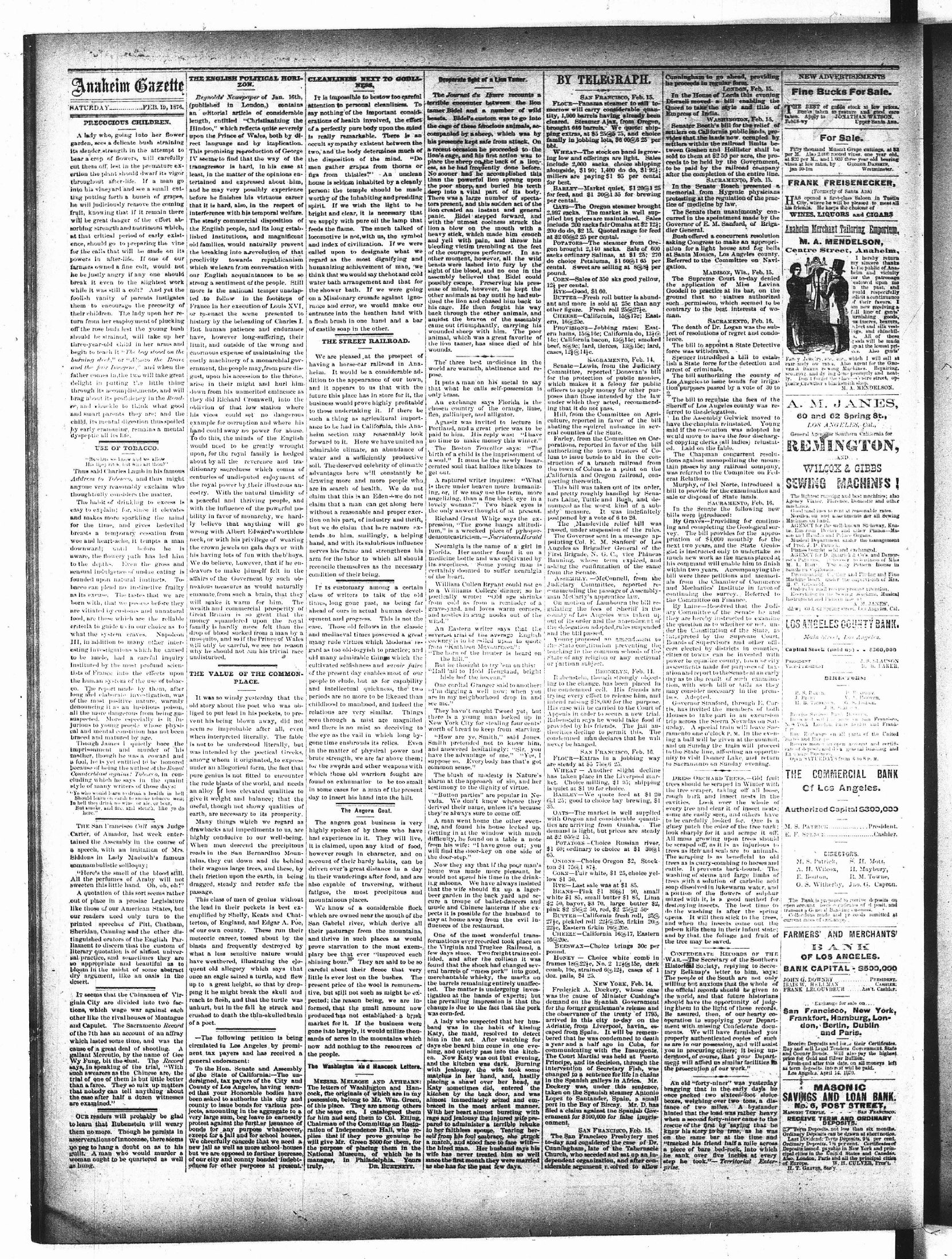
Searchable text
A lady who, going into her flower garden, sees a delicate bush straining its slender strength in the attempt to bear a crop of flowers, will carefully cut them off; lest in the premature exertion the plant should dwarf its vigor throughout after-life. If a man go into his vineyard and see a small cutting putting forth a bunch of grapes, he will judiciously remove the coming fruit, knowing that if it remain there will be great danger of the effort absorbing strength and nutriment which, at that critical period of early existence, should go to preparing the vine for the cails that will be made on its powers in after-life. If one of our farmers owned a fine colt, would not he be justly angry if any one should break it even to the slightest work while it was still a colt? And yet the foolish vanity of parents instigates them to encourage the precocity of their children. The lady upon her return from her employment of plucking off the rose buds lest the young bush should be strained, will take up her three-year-old child in her arms and begin to teach it "The boy stood on the burning deck," or "Monzo the Brave and the four Innocents," and when the father comes in, the two will take great delight in putting the little thing through its accomplishments, and will brag about its proficiency in the Reader, and chuckle to think what good and smart parents they are; and the child, its mental digestion thus spoiled by early eranoming, remains a mental dyspeptic all its life.
USE OF TOBACCO.
"Baschus we know and we allow. His they raise, but who art thou?"
USE OF TOBACCO.
"Basins we know and we allow
His tipe rite, but who art thou?"
Thus said Charles Lamb in his famous Address to Tobacco, and thus might anyone very reasonably exclaim who thoughtfully considers the matter.
The habit of drinking to excess is easy to explain; for, since it elevates and makes more sparkling the mind for the time, and gives bedeviled breasts a temporary cessation from woe and heart-ache, it tempts a man downward; until before he is aware, the flowery path has led him to the depths. Even the gross and sensual indulgence of undue eating is founded upon natural instincts. Tobacco can plead no instinctive frailty as its excuse. The tastes that we are born with, that we possess before they are vitiated by customs and unnatural food, are those which are the reliable criteria to guide us in our choice as to what the system craves. Napoleon III, in addition to many other interesting investigations which he caused to be made, had a careful inquiry instituted by the most profund scientists of France into the effects upon the human system of the use of tobacco. The report made by them, after long and elaborate investigation, was of the most positive nature, warmly denouncing it as an insidious poison, all the more dangerous from being unsuspected. More especially is it injurious to young people whose physical and mental constitution has not been braced and matured by age.
Though James I quietly bore the imprisonment and murder of his mother, though he was a coward and a fool, he is yet entitled to be honored because of being the author of the Royal Counterblast against Tobacco, in concluding which he says in the quaint style of many writers of those days:
"Ye who would learn to drink a health in hell Should learn on earth to smoke tobacco wen; In hell they drink no wine, or ale, or beer. But smoke, and fire, and stench, like ye do here."
THE San Francisco Call says Judge Carter, of Amador, last week entertained the Assembly in the course of a speech, with an imitation of Mrs. Siddons in Lady Maeboth's famous somnambulistic soliloquy;
"Here's the smell of the blood still. All the perfumes of Araby will not sweeten this little hand. Oh, oh, oh!""
THE VALUE OF THE COMMON-PLACE.
It was so windy yesterday that the old story about the poet who was obliged to put lead in his pockets, to prevent his being blown away, did not seem so improbable after all, even when interpreted literally. The fable is not to be understood literally, but was intended by the poetical Greeks, among whom it originated, to express under an allegorical form, the fact that pure genius is not fitted to encounter the rude blasts of the world, and needs an alloy of less elevated qualities to give it weight and balance; that the useful, though not showy qualities of earth, are necessary to its prosperity.
Many things which we regard as drawbacks and impediments to us, are highly conducive to our well-being. When men descend the precipitous roads in the San Bernardino Mountains, they cut down and tie behind their wagons large trees, and these, by their friction upon the earth, in being dragged, steady and render safe the gust, upon his accession to the throne, arise in their might and hurl him down from his unmerited eminence as they did Richard Cromwell, into the oblivion of that low station where his vices could set no dangerous example for corruption and where his hand could sway no power for abuse. To do this, the minds of the English would need to be greatly wrought upon, for the royal family is hedged about by all the reverence and traditionary sacredness which comes of centuries of undisputed enjoyment of the royal power by their illustrous ancestry. With the natural timidity of a peaceful and thriving people, and with the influence of the powerful nobility in favor of monarchy, we hardly believe that anything will go wrong with Albert Edward's worthless neck, or with his privilege of wearing the crown jewels on gala days or with his having lots of fun with the b'boys. We do believe, however, that if he endeavors to make himself felt in the affairs of the Government by such obnoxious measures as would naturally emanate from such a brain, that they will make it warm for him. The wealth and commercial prosperity of Great Britain is so great that the money squandered upon the royal family is hardly more felt than the drop of blood sucked from a man by a mosquito, and so if the Prince of Wales will only be careful, we see no reason why he should not run his trivial race undisturbed.
IT IS customary class of writers times, long gone ahead of ours in opment and procease. Those old and mediaeval t many rude virtu al gard as too old-old many admin cultivated selfish of the present day people to elude, and intellectual periods are no more childhood to min relations are ve seen through a and there is no o the eye as the v gone time enshrine in the matter o brute strength, for the swords a which those olde found on exhumure in some cases fo day to insert his
The angora g highly spoken o had experience it is claimed, up however rough account of their driven over'a grin in their wanderers also capable o
The San Francisco Call says Judge Carter, of Amador, last week entertained the Assembly in the course of a speech, with an imitation of Mrs. Siddons in Lady Maeboth's famous somnambulistic soliloquy;
"Here's the smell of the blood still. All the perfumes of Araby will not sweeten this little hand. Oh, oh, oh!"
A quotation of this sort seems rather out of place in a proslae Legislature like those of our American States, but our readers need only turn to the printed speeches of Pitt, Chatham, Sheridan, Canning and the other distinguished orators of the English Parliament to discern that the custom of literary quotation is of almost universal practice, and sometimes they are so appropriate and beautiful as to bloom in the midst of some abstract dry argument, like an oasis in the desert.
It seems that the Chinamen of Virginia City are divided into two factions, which wage war against each other like the rival houses of Montague and Capulet. The Sacramento Record of the 7th has an account of an affray which lasted some time, and was the cause of a great deal of shooting. A gallant Mercutio, by the name of Gee Wy Fung, bit the stust. The Record says, in speaking of the trial, "With such swearers as the Chinese are, the trial of one of them is but little better than a farce. They so mix up matters that nobody can tell anything about the case after half a dozen witnesses are examined."
Our readers will probably be glad to learn that Rubenstein will weary them no more. Though he persists in asserverations of innocence, there seems no peg to hang a doubt on as to his guilt. A man who would murder a woman ought to be quartered as well as hung.
CLEANLINESS NEXT TO GODLiness.
It is impossible to bestow too careful attention to personal cleanliness. To say nothing of the important considerations of health involved, the effect of a perfectly pure body upon the mind is really remarkable. There is an occult sympathy existent between the two, and the body determines much of the disposition of the mind. "Do men gather grapes from thorns or figs from thistles?" An unclean house is seldom inhabited by a cleanly person: the temple should be made worthy of the inhabiting and presiding spirit. If we wish the light to be bright and clear, it is necessary that we supply with pure oil the lamp that feeds the flame. The much talked of locomotive is not, with us, the symbol and index of civilization. If we were called upon to designate what we regard as the most dignifying and humanizing achievement of man, we think that we would say the hot and cold water bath arrangement and that for the shower bath. If we were going on a Missionary crusade against ignorance and error, we would make our entrance into the heathen land with a flesh brush in one hand and a bar of castile soap in the other.
THE STREET RAILROAD.
We are pleased at the prospect of having a horse-car railroad in Anaheim. It would be a considerable addition to the appearance of our town, and it appears to us that with the future this place has in store for it, the business would prove highly profitable to those undertaking it. If there be such a thing as agricultural importance to be had in California, this Anaheim section may reasonably look forward to it. Here we have united an admirable climate, an abundance of water and a sufficiently productive soil. The deserved celebrity of climatic
DEEPATE sight of a Lion Vanner.
The Journal du Hare recounts a terrible encounter between the lion tamer Bidel and a number of wild beasts. Bidel's custom was to go into the cage of these ferocious animals, accompanied by a sheep, which was by his presence kept safe from attack. On a recent occasion he proceeded to the lion's cage, and his first action was to place the sheep on the back of a lioness, as he had frequently done before. No sooner had he accomplished this than the powerful lion sprang upon the poor sheep, and buried his teeth deep into a vital part of its body. There was a large number of spectators present, and this sudden act of the lion created an instant and general panic. Bidel stepped forward, and with the utmost coolness struck the lion a blow on the mouth with a heavy stick, which made him crouch and yell with pain, and throw his bleeding victim trembling at the feet of the courageous performer. In another moment, however, all the wild beasts were lashed into fury by the sight of the blood, and no one in the assembly believed that Bidel could possibly escape. Preserving his presence of mind, however, he kept the other animals at bay until he had subdued the lion and chased him back to his cage. He then fought his way back through the other animals, and amidst the bravos of the assembly came out triumphantly, carrying his wounded sheep with him. The poor animal, which was a great favorite of the lion tamer, has since died of his wounds.
The three best medicines in the world are warmth, abstinence and repose.
It puts a man on his metal to say that what he calls self-possession is only brass.
An exchange says Florida is the chosen country of the orange, lime, flea, galliniper, and alligator.
Agassiz was invited to lecture in Portland, and a great price was to be paid to him. His reply was: "I have no time to make money this winter."
The Boston Traveller says: "The birth of a child is the imprisonment of a soul." It must be the newly incarcerated soul that halloes like blazes to
BY TELEGRAPH.
SAN FRANCISCO, Feb. 15.
FLOUR—Panama steamer to still tomorrow will carry considerable quantity, 1,900 barrels having already been cleared. Steamer Ajax, from Oregon, brought 648 barrels. We quote: shipping extras, at $5 25@6 75, and choice family in jobbing lots, $6 00@6 25 per bbl.
WHEAT—The stock on hand is growing low and offerings are light. Sales include 2,000 sacks; choice shipping alongside, $1 90; 1,400 do do, $1 92; millers are paying $1 95 per cental for best.
BARLEY—Market quiet, $1 20@1 25 for feed, and $1 20@1 35 for brewing per cental.
OATS—The Oregon steamer brought 2,997 sacks. The market is well supplied but prices are maintained. Sales include 200 sacks fair Omaha at $2 12; 200 do do, $2 15. Quoted range for feed at $2 05@2 25 per cental.
POTATOES—The steamer from Oregon brought 2,140 sacks. Sale of 600 sacks ordinary Salinas, at $1 25; 270 do choice Petaluma, $1 60@1 65 per cental. Sweet are selling at $8@8 per pound.
CORN—Sales of 350 skis good yellow, 12 per cental.
Rye—Good, $1 60.
Butter—Fresh roll butter is abundant and more is sold at 25c than any other figure. Fresh roll $25@27c.
CHEESE—California, 15@17c; Eastern, 16@20c.
PROVISIONS—Jobbing rates: Eastern hams, 15@16c; California do, 13@14c; California bacon, 13@14e; smoked beef, 8@9c; lard, tierces, 13@15c; lard, cases, 12@14c.
SACRAMENTO, Feb. 14.
Senate—Lewis, from the Judiciary Committee, reported Donovan's bill for the protection of public monies, which makes it a felony for public officers to apply money for other purposes than those intended by the law under which they acted, recommending that it do not pass.
Hill, from the Committee on Agriculture, reported in favor of the bill abating the squirrel nuisance in several counties of the State.
Farley, from the Committee on Corporations, reported in favor of the bill authorizing the town trustees of Colusa to issue bonds to aid in the construction of a branch railroad from the town of Colusa to a point on the
It is customary among a certain class of writers to talk of the old times, long gone past, as being far ahead of ours in actual human development and progress. This is not the case. Those old fellows in the classic and mediaeval times possessed a great many rude virtues which Moderns regard as too old-lyish to practice; and old many admirable things which the cultivated selfishness and savoir faire of the present day enables most of our people to elude, but as for capability and intellectual quickness, the two periods are no more to be likened than childhood to manhood, and indeed the relations are very similar. Things seen through a mist are magnified and there is no mist so deceiving to the eye as the vail in which long bygone time enshronds its relies. Even in the matter of physical power and brute strength, we are far above them; for the swords and other weapons with which those old warriors fought are found on exhumation to be too small in some cases for a man of the present day to insert his hand into the hilt.
The Angora Goat.
The angora goat business is very highly spoken of by those who have had experience in it. They will live, it is claimed, upon any kind of food, however rough in character, and on account of their hardy habits, can be driven over a great distance in a day in their wanderings after food, and are also capable of traversing, without helm. It would be a considerable addition to the appearance of our town, and it appears to us that with the future this place has in store for it, the business would prove highly profitable to those undertaking it. If there be such a thing as agricultural importance to be had in California, this Anaheim section may reasonably look forward to it. Here we have united an admirable climate, an abundance of water and a sufficiently productive soil. The deserved celebrity of climatic advantages here will constantly be drawing more and more people who are in search of health. We do not claim that this is an Eden—we do not claim that a man can get along here without a reasonable and proper exertion on his part, of industry and thrift, but we do claim that here nature extends to him, smilingly, a helping hand, and with its salubrious influence nerves his frame and strengthens his arm for the labor to which all should reconcile themselves as the necessary condition of their being.
It puts a man on his metal to say that what he calls self-possession is only brass.
An exchange says Florida is the chosen country of the orange, lime, flea, galliniper, and alligator.
Agassiz was invited to lecture in Portland, and a great price was to be paid to him. His reply was: "I have no time to make money this winter."
The Boston Traveller says: "The birth of a child is the imprisonment of a soul." It must be the newly incarcerated soul that halloes like blazes to get out.
A raptured writer inquires: "What is there under heaven more humanizing, or, if we may use the term, more angelizing, than a fine black eye in a lovely woman?" Two black eyes is the only answer thought of at present.
Richard Grant White says the expression, "The goose hangs altitudium," is a wrecked piece of pythometer-demonteastricism. — NorristownHerald
Neuralgia is the name of a girl in Florida. Her mother found it on a medicine bottle and was captivated by its sweetness. Some young man is certainly doomed to suffer neuralgia of the heart.
William Cullen Bryant could not go to a Williams College dinner; so he poetically wrote: "Old age shrinks from cold as from a reminder of a grave-yard, and loves warm corners, and nesties in snug nooks out of the wind."
An Eastern writer says that the severest trial of the average English cookney is to be called upon to quote from "Kathleen Mayourneen": "The horn of the hunter is heard on the hill."
But he thought to try 'em on this: "Hall tail to Hold Hengland, bright hisse hof the ocean."
One cordial Granger said to another: "I'm digging a well now; when you are in my neighborhood drop in and see me."
They haven't caught Tweed yet, but there is a young man locked up in New York City for stealing four cents' worth of bread to keep from starving.
"How are ye, Smith," said Jones. Smith pretended not to know him, and answered hesitatingly: "Sir, you have the advantage of me." "Yes, I suppose so. Everybody has that's got common sense."
The blush of modesty is Nature's alarm at the approach of sin, and her testimony to the dignity of virtue.
"Button parties" are popular in Nevada. We don't know whence they derived their name, unless it's because they're always sure to come off.
A man went home the other evening, and found his house lecked up. Getting in at the window with much difficulty, he found on a table a note from his wife: "I have gone out; you will find the door-key on one side of the door-step."
Now they say that if the poor man's home was made more pleasant, he would not spend his time in the drinking saloons. We have always insisted that the wife should fix on a larger
Committee, reported Donovan's bill for the protection of public monies, which makes it a felony for public officers than apply money for other purposes than those intended by the law under which they acted, recommending that it do not pass.
Hill, from the Committee on Agriculture, reported in favor of the bill abating the squirrel nuisance in several counties of the State.
Farley, from the Committee on Corporations, reported in favor of the bill authorizing the town trustees of Colusa to issue bonds to aid in the construction of a branch railroad from the town of Colusa to a point on the California and Oregon railroad, connecting therewith.
This bill was taken out of its order, and pretty roughly handled by Senators Laine, Tuttle and Bush, and denounced as the worst kind of a subsidy measure. It was indefinitely postponed by a vote of 6 to 28.
The Mandeville relief bill was passed, under suspension of the rules.
The Governor sent in a message appointing Col. E. M. Sanford of Los Angeles as Brigadier General of the First Brigade, N. G. C., vice Phineas Banning, whose term expired, and asking the confirmation of the same from the Senate.
Assembly. — McConnell, from the Judiciary Committee, reported recommending the passage of Assemblyman McCarty's apprentice law.
On motion of Lambourn the bill regulating the fees of Sheriff in the county of Los Angeles was taken up out of its order and the amendment of the delegation adopted, rules suspended and the bill passed.
Young proposed an amendment to the State constitution preventing the teaching in the common schools of the State of any religion or any sectional or partisan subject.
BrooklynX, Feb. 14.
Rabenstein, though strongly objecting to the change, has been placed in the condemned cell. His friends are trying every effort to release him, and intend raising $18,000 for the purpose. His case will be carried to the Court of Appeals in order to secure a new trial. Rabenstein says he would take food if provided by his friends. The jail authorities decline to permit this. The condemned man declares that he will never be hanged.
San Francisco, Feb. 16.
FLOUR—Extras in a jobbing way are steady at $5 75@6 25.
WHEAT — Another slight decline has taken place in the Liverpool market. Choice milling, $1 95; shipping is quiet at $1 90 for choice.
BARLEY — We quote feed at $1 20 @1 25; good to choice bay brewing, $1 35.
OATS — The market is well supplied with Oregon and considerable quantities are arriving from Omaha. The demand is light, but prices are steady at $2 05@2 15.
POTATOES — Choice Russian river, $1 60; ordinary to choice at $1 30@1 65.
ONIONS —Choice Oregon $2, Stockton $1 75@1 87½.
CORN — Fair white, $1 25; choice yellow $1 30.
RYE — Last sale was at $1 85.
The Angora Goat.
The angora goat business is very highly spoken of by those who have had experience in it. They will live, it is claimed, upon any kind of food, however rough in character, and on account of their hardy habits, can be driven over a great distance in a day in their wanderings after food, and are also capable of traversing, without fatigue, the most precipitous and mountainous places.
We know of a considerable flock which are owned near the mouth of the San Gabriel river, which derive all their pasturage from the mountains, and thrive in such places as would prove starvation to the most exemplary bee that ever "improved each shining hour." They are said to be so careful about their fleece that very little is ever lost on the bushes. The present price of the wool is remunerative, but still not such as might be expected; the reason being, we are informed, that the small amount now produced has not established a brisk market for it. If the business were gone into largely, it would utilize thousands of acres in the mountains which now add nothing to the resources of the people.
The Washington and Hancock Letters.
MESSRS. MELROSE AND ATHEARN: The letters of Washington and Hancock, the originals of which are in my possession, belong to Mr. Wm. Green, of this place. They are among others of the same era. I catalogued them for him and sent them to Col. Ettling, Chairman of the Committee on Registration of Independence Hall, who replies that if they prove genuine he will give Mr. Green $500 for them, for the purpose of placing them in the National Museum, of which he is manager, In Philadelphia. You're truly,
DR. BURNETT.
"Button parties" are popular in Nevada. We don't know whence they derived their name, unless it's because they're always sure to come off.
A man went home the other evening, and found his house locked up. Getting in at the window with much difficulty, he found on a table a note from his wife: "I have gone out; you will find the door-key on one side of the door-step."
Now they say that if the poor man's home was made more pleasant, he would not spend his time in the drinking saloons. We have always insisted that the wife should fix up a lager-beer garden in the back yard and secure a troupe of ballet-dancers and music and Chinese lanterns if she expects it is possible for the husband to stay at home away from the evil influences of the restaurant.
One of the most wonderful transformations ever recorded took place on the Virginia and Truckee Railroad, a few days since. Two freight trains collided, and after the collision it was found that the shock had changed several barrels of "mess pork" into good, merchantable whisky, the marks on the barrels remaining entirely unaffected. The matter is undergoing investigation at the hands of experts; but the prevailing impression is that the change is due to the fact that the pork was corn-fed.
A lady who suspected that her husband was in the habit of kissing Katy, the maid, resolved to detect him in the act. After watching for days she heard him come in one evening, and quietly pass into the kitchen. Now Katy was out that evening, and the kitchen was dark. Burning with jealousy, the wife took some matches in her hand, and hastily placing a shawl over her head, as Katy sometimes did, entered the kitchen by the back door, and was almost immediately seized and embraced in the most ardent manner. With her heart almost bursting with rage and jealousy the injured wife prepared to administer a terrible rebuke to her faithless spouse. Tearing herself from his foul embrace, she struck a match, and stood face to face with—the hired man. Her husband says his wife has never treated him so well since the first month they were married as she has for the past few days.
BARLEY—We quote feed at $1 20 @1 25; good to choice bay brewing, $1 35.
OATS—The market is well supplied with Oregon and considerable quantities are arriving from Omaha. The demand is light, but prices are steady at $2 05@2 15.
POTATOES—Choice Russian river, $1 60; ordinary to choice at $1 30@1 65.
ONIONS—Choice Oregon $2, Stockton $1 75@1 87½.
CORN—Fair white, $1 25, choice yellow $1 30.
Rye—Last sale was at $1 85.
BEANS—Pink $1 80@1 90, small white $1 85, small butter $1 85, Lima $2 50, bayov $3 70, large butter $2, pink $2 25@2 50, red $2 25@2 50.
BUTTER—California fresh roll, $25@27¢c, pickled roll $22¼@25¢c, firkin $20¢c, Eastern firkin $19@20¢c.
CHEESE—California $16@17, Eastern 16@20¢c.
BEESWAX—Choice brings 30¢ per pound.
HONEY — Choice white comb in frames 18@@22¢c, No. 2 12¼@@15¢c, dark comb, 10¢, strained 6@@12¢c, cases of 1 doz. pails,$4 25.
NEW YORK,Feb. 14.
Frederick A. Dockery, whose case was the cause of Minister Cushing's demand on the Spanish Government for the former gentleman's release and the observance of the treaty of 1795 arrived in this city to-day on the Adriatic, from Liverpool, having escaped from Spain. It will be remembered that he was condemned to death a year and a half ago in Cuba, for communicating with the Insurgents. The Court Martial was held at Puerto Principe, and its decision through the intervention of Secretary Fish, was changed to a sentence for life in chains in the Spanish galleys in Africa. Mr. Dockery was, under this sentence, taken on the Spanish steamer Antonio Lopez to Santander, Spain, a small port in the Bay of Biscay. Mr. D. has filed a claim against the Spanish Government for $100,000 for false imprisonment.
SAN FRANCISCO,Feb. 15.
The San Francisco Presbytery met to-day and considered the case of Dr. Cunnfugham, late of the Tabernacle Church, who seceded and set up an independent organization, and after considerable argument resolved to allow
Cunningham to go ahead, providing his proceeds is regular form.
London, Feb. 15.
In the House of Lords this evening Dismelli moved a bill enabling the Queen to take the style and title of Empress of India.
WASHINGTON, Feb. 15.
Senator Booth's bill for the relief of settlers on California public lands, provides that the lands now occupied by settlers within the railroad limits between Goshen and Hollister shall be sold to them at $250 per acre, the proceeds to be held by the Government, to be paid by the railroad company after the completion of the entire line.
SACRAMENTO, Feb. 15.
In the Senate Roach presented a memorial from Hygenic physicians protesting at the regulation of the practice of medicine by law.
The Senate then unanimously concurred in the appointment made by the Governor of E. M. Sanford, of Brigadier General.
Bush offered a concurrent resolution asking Congress to make an appropriation for a light house and fog bells at Santa Monica, Los Angeles county. Referred to the Committee on Navigation.
MADISON, Wls., Feb. 15.
The Supreme Court to-day denied the application of Miss Lavina Goodell to practice at its bar, on the ground that no statues authorized such permission, which seemed to be contrary to the best interests of woman.
SACRAMENTO, Feb. 16.
The death of Dr. Logan was the subject of resolutions of regret and condolence.
The bill to appoint a State Detective force was withdrawn.
Spencer introduced a bill to establish a State force for the detection and arrest of criminals.
The bill authorizing the county of Los Angeles to issue bonds for irrigation purposes passed by a vote of 30 to 2.
The bill to regulate the fees of the Sheriff of Los Angeles county was referred to the delegation.
In the Assembly Gelwick moved to have the chaplain reinstated. Young said if the resolution was adopted he would move to have the four discharged copying clerks (all ladies) reinstated. Laid on the table.
The Chapman concurrent resolutions against monopolizing the mountain passes by any railroad company,
NEW ADVERTISEMENTS
Fine Bucks For Sale.
THE BEST of grade stock at low prices.
Bucks taken to feature and good care taken. Apply to JOXATHAN WATSON.
Feb18-wy
Upper Santa Ana.
For Sale.
Fifty thousand Muscat Grape cuttings, at $2 per M. Also 2,000 rooted vines, one year old, at $20 per M., and 1,000 three year old bearing vines at low rates, by GEORGE DANSKIN,
jan 30-1m
Westminster.
FRANK FREISENECKER,
(Formerly of Santa Ana)
Has opened a first-class Saloon in Tustin City, where he will be pleased to meet all his friends. He keeps the choice of WINES, LIQUORS and CIGARS
Anaheim Merchant Tailoring Emporium,
M. A. MENDELSON,
Centre Street, Anaheim,
I hereby return my sincere thanks to the public of Anaheim and vicinity for the patronage bestowed upon me in the past, and would respectfully solicit a continuance of their favors. I am now resolving a full line of gentle furnishing goods, as inners, beavers, alvet and silk vestings, and chinchillies. All of these goods will be made up at the lowest prices. Also gents!
Fancy Jewelry, etc., which I will sell at exurmely ow rates. Also agent for the Grover & Baker Sewing Machines. Repairing, scouring and drying done promptly and neatly. Don't forget the place - Centre street, opposite Crowther's blacksmith shop.
A. M. JANES,
60 and 62 Spring St.,
LOS ANGELES, Cal.
General Agent Southern California for REMINGTON,
AND
WILCOX & GIBBS
The bill authorizing the county of Los Angeles to issue bonds for irrigation purposes passed by a vote of 30 to 2.
The bill to regulate the fees of the Sheriff of Los Angeles county was referred to the delegation.
In the Assembly Gelwick moved to have the chaplain reinstated. Young said if the resolution was adopted he would move to have the four discharged copying clerks (all ladies) reinstated. Laid on the table.
The Chapman concurrent resolutions against monopolizing the mountain passes by any railroad company, was referred to the Committee on Federal Relations.
Murphy, of Del Norte, introduced a bill to provide for the examination and sale or disposal of State lands.
SACRAMENTO, Feb. 16.
In the Senate the following new bills were introduced:
By Graves—Providing for continuing and completing the Geological survey. The bill provides for the appropriation of $1,000 monthly for the next two years, and the State Geologist is instructed only to undertake so much new work as the means placed at his command will enable him to finish within two years. Accompanying the bill were three petitions and memorials from the Chamber of Commerce and Mechanics' Institute in favor of continuing the survey. Referred to the Committee on Finance.
By Laine—Resolved that the Judiciary Committee of the Senate be and they are hereby instructed to examine the question as to whether or not, under the Constitution of the State, as interpreted by the Supreme Court, Boards of Supervisors and other officers elected by districts in counties, cities or towns can be invested with power to equalize county, town or city assessments made for purposes of taxation and report to the Senate at an early day as to the result of such examination, with such bill or bills as they may consider necessary in the premises. Adopted.
Governor Stanford, through E. Carlis, has invited the members of both Houses to take part in an excursion trip across the Sierra Nevadas on Saturday. A special train will leave Sacramento one o'clock P.M. In the evening a ball will be given at the summit, and on Sunday the train will proceed to the State line, affording an opportunity to visit Donner Lake, and return to Sacramento on Sunday evening.
DRESS ORCHARD TREES.—Old fruit trees should be scraped in Winter with the tree scraper, taking off all loose, rough bark and insect nests in the cavities. Look over the whole of every tree and clear it of insect nests; some are easily seen, and others have to be carefully looked for. One is a glue patch the color of the tree bark; look sharply for it and scrape it off. All moss growing upon trees should be scraped off; as it is as injurious to trees as itch and scab are to animals. The scraping is as beneficial to old trees as is curry-combing to horses and cattle. It prevents bark-bound. The washing of stems and large limbs of trees with a solution of carbolic acid soap dissolved in lukewarm water, and
CONFEDERATE RECORDS OF THE WAR.—The Secretary of the Southern Historical Society, replying to Secretary Belknap's letter to him, says: The people of the South are not only willing but anxious that the whole of the official records should be given to the world, and that future historians should have the opportunity of judging them in the light of those records. Be assured, then, of our hearty cooperation in supplying your Department with missing Confederate documents. We will have furnished you properly authenticated copies of such as are in our possession, and will assist you in procuring others; it being understood, of course, that your Department will afford us similar facilities in the prosecution of our work."
An old "forty-niner" was yesterday bragging that in the early days he once packed two sixteen-foot sluice boxes, weighing over two tons, a distance of two miles. A bystander hinted that the load was rather heavy when a second forty-niner came to the rescue of the first by saying that he knew his story to be true, as he was on the same bar at the time and "tracked his friend half a mile across a piece of bare bed-rock, into which he sank over five inches at every step he took."—Territorial Enterprise.
Authorized Capital $300,000
M. S. PATRICK ... President.
E. F. SPENCE ... Cashier.
DIRECTORS.
M. S. Patrick, S. H. Mott,
A. H. Wilcox, H. Maybury,
E. Boston, R. M. Towne,
O. S. Witherby, Jno. G. Capron.
The Bank is prepared to receive deposits on open account persons residing of deposit, and transact a General Banking business.
Collections made and prices remitted at current rates of exchange.
FARMERS' AND MERCHANTS'
BANK
OF LOS ANGELES.
BANK CAPITAL - $500,000
JOHN G. DOWNEY ... President.
ISAIS W. HELLMAN ... Cashier.
FRANK LECOUVEUR ... Ass't. Cashier.
Exchange for sale on...
San Francisco, New York, Frankfort, Hamburg, London, Berlin, Dublin and Paris.
Receive Deposits and issue their Certificates.
Buy and sell Legal Tenders Government State and County Bonds. Will also pay the highest price for Gold and Silver Bullion.
From and after this date, on all moneys left as term deposits interest will be paid.
Los Angeles, April 14, 1870.
MASONIC
SAVINGS AND LOAN BANK.
No. 6, POST STREET,
MASONIC TEMPLE ... San Francisco.
RECEIVE TERM AND ORDINARY DEPOSITS.
Term Deposits, not less than six months.
Ordinary Deposits can be drawn at short notice.
Last Dividend: Term Deposits, 9½ per cent.
Ordinary Deposits, 7½ per cent.
Certificates of Deposits issued payable in New York and principal cities in the United States and Canada.
Also, London, Paris and all the principal cities of Europe.
H. T. Graves, Sec'y.