anaheim-gazette 1876-02-12
Scanned page
Searchable text
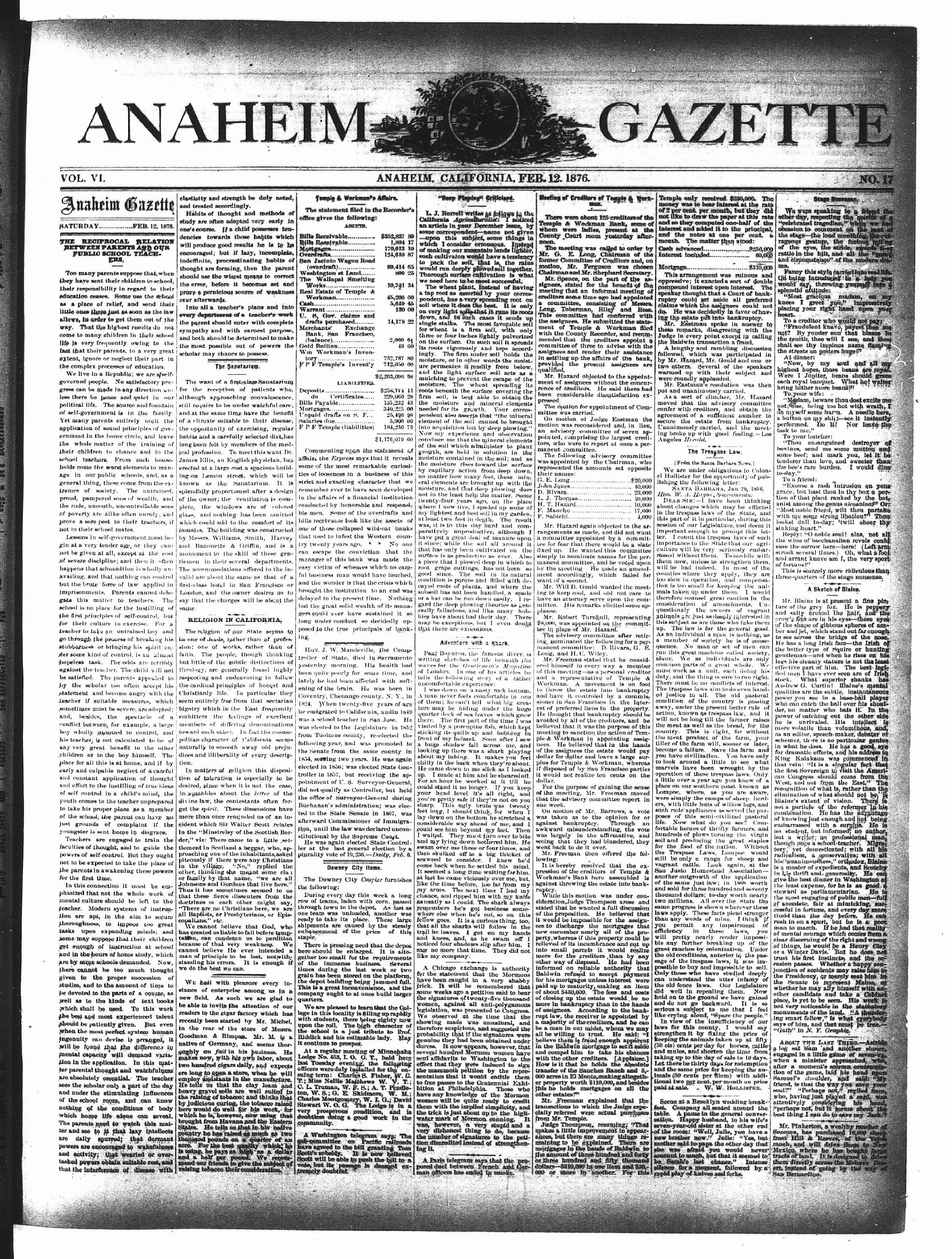
ANAHEIM GAZETTE
SATURDAY...FEB. 12, 1876.
THE RECIPROCAL RELATION BETWEEN PARENTS AND OUR PUBLIC SCHOOL TEACHERS,
Too many parents suppose that, when they have sent their children to school, their responsibility in regard to their education ceases. Some use the school as a place of relief, and send their little ones there just as soon as the law allows, in order to get them out of the way. That the highest results do not come to many children in their school life is very frequently owing to the fact that their parents, to a very great extent, ignore or neglect their part in the complex processes of education.
We live in a Republic; we are self-governed people. No satisfactory progress can be made in any direction unless there be peace and quiet in our political life. The source and fountain of self-government is in the family. Yet many parents entirely obit the application of sound principles of government in the home circle, and leave the whole matter of the training of their children to chance and to the school teachers. From such households come the worst elements to man-
elasticity and strength be duly noted, and treated accordingly.
Habits of thought and methods of study are often adopted very early in one's course. If a child possesses tendencies towards those habits which will produce good results he is to be encouraged; but if lazy, incomplete, indefinite, procrastinating habits of thought are forming, then the parent should use the wisest means to correct the error, before it becomes set and prove a pernicious source of weakness ever afterwards.
Into all a teacher's plans and into every department of a teacher's work the parent should enter with complete sympathy and with earnest purpose, and both should be determined to make the most possible out of powers the scholar may chance to possess.
The Satatarium.
The want of a first-plage Sanatarium for the reception of patients who, although approaching convalescence, still require to be under watchful care, and at the same time have the benefit of a climate suitable to their disease, the opportunity of exercising, regular habits and a carefully selected diet, has long been felt by members of the medical profession. To meet this want Dr. James Ellis, an English physician, has erected at a large cost a spacious build-
We live in a Republic; we are of self-governed people. No satisfactory progress can be made in any direction unless there be peace and quiet in our political life. The source and fountain of self-government is in the family. Yet many parents entirely omit the application of sound principles of government in the home circle, and leave the whole matter of the training of their children to chance and to the school teachers. From such households come the worst elements to manage in our public schools, and, as a general thing, these come from the extremes of society. The untrained, proud, pampered sons of wealth, and the rude, uncouth, uncontrollable sons of poverty are alike often unruly, and prove a sore pest to their teachers, if not to their school mates.
Lessons in self-government must begin at a very tender age, or they cannot be given at all, except at the cost of severe discipline; and then it often happens that admonition is wholly availing, and that nothing can control but the brute force of law applied in imprisonments. Parents cannot delegate this matter to teachers. The school is no place for the instilling of the first principles of self-control, but for their culture in exercise. For a teacher to take an untrained boy and go through the process of breaking his stubbornness or bringing his spirit under some kind of control, is an almost hopeless task. The odds are terribly against the teacher. The child will not be satisfied. The parents appealed to by the scholar too often accept his statement and become angry with the teacher if suitable measures, which sometimes must be severe, are adopted; and, besides, the spectacle of a conflict between, for example, a large boy wholly unsuited to control, and his teacher, is not calculated to be of any very great benefit to the other children or to the boy himself. The place for all this is at home, and if by early and culpable neglect of a careful and constant application of thought and effort to the instilling of true ideas of self control in a child's mind, the youth comes to the teacher unprepared to take his proper place as a member of the school, the parent can have no just grounds of complaint if the youngster is sent home in disgrace.
Teachers are engaged to train the faculties of thought, and to guide the powers of self control. But they ought not to be expected to take the place of the parents in awakening these powers for the first time.
In this connection it must be em-
The want of a first-class Sanatarium for the reception of patients who, although approaching convalescence, still require to be under watchful care, and at the same time have the benefit of a climate suitable to their disease, the opportunity of exercising, regular habits and a carefully selected diet, has long been felt by members of the medical profession. To meet this want Dr. James Ellis, an English physician, has erected at a large cost a spacious building on Lemon street, which will be known as the Sanatarium. It is splendidly proportioned after a design of the owner; the ventilation is complete, the windows are of colored glass, and nothing has been omitted which could add to the comfort of its inmates. The building was constructed by Messrs. Williams, Smith, Harvey and Banonette & Griffin, and is a monument to the skill of these gentlemen in their several departments. The accommodations offered to the invalid are about the same as that of a first-class hotel in San Francisco or London, and the owner desires us to say that the charges will be about the same.
RELIGION IN CALIFORNIA
The religion of our State seems to be one of deeds, rather than of profession; one of works, rather than of faith. The people, though thinking but little of the subtle distinctions of theology, are generally found highly respecting and endeavoring to follow the cardinal principles of honesty and Christianly life. In particular they seem entirely free from that sectarian bigotry which in the East frequently embitters the feelings of excellent members of differing denominations toward each other. In fact the cosmopolitan character of California seems naturally to smooth away old prejudices and illiberality of every description.
In matters of religion this disposition of toleration is especially to be desired, since when it is not the case, in squabbles about the letter of the divine law, the contestants often forget the spirit. These dissensions have more than once reminded us of an incident which Sir Walter Scott relates in the "Minstrelsy of the Scottish Border," viz: There came to a little settlement in Scotland a beggar, who, approaching one of the inhabitants, asked piteously if there were any Christians in the village. "No," replied the other, thinking she meant some clergy or family by that name, "we are all Johnsons and Gordon's that live here."
LIABILITIES
Deposits... do Certification Bills Payable... Mortgages... Unpaid drafts on N Salaries due... F P F Temple (liability)
Commenting upon affairs the Express some of the most ties of looseness in strict and exacting remember ever to be in the affairs of a fi- conducted by honorable men. Some of bills receivable look one of those collapses that used to infest try twenty years ago can escape the co- manager of this bas- easy victim of sche- ful business man ww and the wonder is t brought the institute delayed to the press but the great solid gers could ever ha long under conduct posed to the true pr- ing.
Hon. J. W. Manley troller of State, d yesterday morning been quite poorly fo lately he had been ening of the brain. Coventry, Chenang 1824. When twenthe he emigrated to Cali was a school teacher was elected to the I from Tuolmine coun- following year, and tha- the Senate from tha 1854, serving two y elected in 1856; was troller in 1857, but pointment of U. S. did not qualify as C office of Survey Buchanan's admin- ted to the State Se- afterward Commission , until the law w stitutional by the S.
He was again elec- er at the last gen- plurality vote of 19,
Downey C
The Downey City following:
of self control in a child's mind, the youth comes to the teacher unprepared to take his proper place as a member of the school, the parent can have no just grounds of complaint if the youngster is sent home in disgrace.
Teachers are engaged to train the faculties of thought, and to guide the powers of self control. But they ought not to be expected to take the place of the parents in awakening these powers for the first time.
In this connection it must be emphasized that not the whole work of mental culture should be left to the teacher. Modern systems of instruction are apt, in the aim to secure thoroughness, to impose too great tasks upon expanding minds; and some may suppose that their children get enough of instruction at school and in the hours of home study, which are by some schools demanded. Now, there cannot be too much thought given to the proper succession of studies, and to the amount of time to be devoted to the parts of a course, as well as to the kinds of text books which shall be used. To this work the best and most experienced talent should be patiently given. But even when the most perfect system human ingenuity can devise is arranged, it will be found that the difference in mental capacity will demand variation in the application. In this matter parental thought and watchfulness are absolutely essential. The teacher sees the scholar only a part of the day and under the stimulating influences of the school room, and can know nothing of the conditions of body which home life alone can reveal. The parents need to watch this matter and see to it that lazy intellects are daily spurred; that dormant powers are encouraged to wakefulness and activity; that weared or overtasked powers obtain suitable rest, and that the interference of disease with squabbles about the letter of the divine law, the contestants often forget the spirit. These dissensions have more than once reminded us of an incident which Sir Walter Scott relates in the "Minstrelsy of the Scottish Border," viz: There came to a little settlement in Scotland a beggar, who, approaching one of the inhabitants, asked plightously if there were any Christians in the village, "No," replied the other, thinking she meant some clan or family by that name, "we are all Johnsons and Gordons that live here." Thus it has sometimes seemed to us that these fierce dissenters from the doctrines or each other might say, "There are no Christians here, we are all Baptists, or Presbyterians, or Episcopalians," etc.
We cannot believe that God, who has created us liable to fall before temptation, can condemn us to perdition because of that very weakness. We cannot believe He ever intended a man of principle to be lost, notwithstanding his errors. It is enough if we do the best we can.
We hail with pleasure every instance of enterprise among us in a new field. As such we are glad to be able to invite the attention of our readers to the cigar factory which has recently been started by Mr. Michel, in the rear of the store of Messrs Goodman & Rimpas. Mr. M. is a native of Germany, and seems thoroughly au fait in his business. He makes now, with his own labor, about two hundred cigars daily, and expects ere long to open a store, when he will employ assistants in the manufacture. He tells us that the clay loam and heavy gravel soils are well suited to the raising of tobacco; and thinks that by judicious curing, the tobacco raised here would do well for his work; for which he is, however, now using that brought from Havana and the Eastern States. He tells us that in his native country he has raised as much as two thousand pounds on a quarter of an acre. For the best quality which he is using, he pays as high as a dollar and a half per pound. We recommend our friends to give the subject of raising tobacco their consideration.
ANAHEIM, CALIFORNIA, FEB. 12. 1876.
Temple & Workman's Affairs.
The statement filed in the Recorder's office gives the following:
ASSETS.
Bills Receivable $352,857 89
Bills Receivable 1,894 17
Mortgages 170,613 10
Overdrafts 124,610 87
San Jacinto Wagon Road (overdraft) 89,414 65
Washington at Land 890 25
The Wallapal Smelting Works 10,791 34
Real Estate of Temple & Workman 45,200 00
Cash 5,649 45
Warrant 130 00
U. S. Gov. claims and drafts purchased 14,178 22
Merchants' Exchange Bank, San Francisco, (balance) 2,060 64
Gold Bullion 49 60
Wm Workman's Inventory 732,787 80
F P F Temple's Invent'y 712,050 00
LIABILITIES.
Deposits $254,774 11
do Certificates 229,060 28
Bills Payable 135,232 43
Mortgages 340,225 00
Unpaid drafts on S. F. 25,496 99
Salaries due 5,000 00
F P F Temple (liabilities) 184,230 79
$1,176,019 60
Commenting upon the statement of affairs the Express says that it reveals some of the most remarkable curiosities.
"Deep Plunging" Griffield.
L. J. Burrell writes as follows to the California Agriculturalist: I noticed an article in your December issue, by some correspondent—name not given—upon this subject, some things in which I consider erroneous. Instead of making our mountain lands lighter, such cultivation would have a tendency to pack the soil, that is, the rains would run deeply plowed soil together. Thorough surface cultivation is what we need here to be most successful.
The wheat plant, instead of having a tap root as asserted by your correspondent, has a very spreading root on soil where it does the best. It is only on very light soils that it runs its roots down, and in such cases it sends up single stalks. The most favorable soil for wheat is a firm soil, with only three or four inches lightly pulverized on the surface. On such soil it spreads its roots vigorously and tops accordingly. The firm under soil holds the moisture, or in other words the moisture permeates it readily from below, and the light surface soil acts as a mulching to prevent the escape of the moisture. The wheat spreading its roots beneath the surface covering the firm soil, is best able to obtain the moisture and mineral elements needed for its growth. Your correspondent also asserts that "the mineral element of the soil cannot be brought into acquisition but by deep plowing." Now my experience and observation convince me that the mineral elements of the soil which administer to plant growth, are held in solution in the moisture contained in the soil; and as the moisture rises toward the surface by capillary action opposite.
Meeting of Creditors of Temple & Workman.
There were about 125 creditors of the Temple & Workman Bank, some of whom were ladies, present at the County Court room yesterday afternoon.
The meeting was called to order by Mr. G. E. Long, Chairman of the former Committee of Creditors and, on motion, Mr. Ferguson was chosen Chairman and Mr. Shephard Secretary.
Mr. Spence, on the part of the assignees, stated for the benefit of the meeting that an informal meeting of creditors some time ago had appointed a committee, consisting of Messrs. Long, Toberman, Riley and Ross. This committee had conferred with the assignees. He submitted the statement of Temple & Workman filed with the County Recorder, and recommended that the creditors appoint a committee of three to advise with the assignees and render their assistance in settling up the affairs of the bank, provided the present assignees are qualified.
Mr. Hazard objected to the appointment of assignes without the concurrence of creditors. He said there had been considerable dissatisfaction expressed.
The motion for appointment of Committee was carried.
On motion of Judge Eastman the motion was reconsidered and, in lieu, an advisory committee of seven appointed, comprising the largest creditors, who were to report at once a permanent committee.
The following advisory committee was appointed by the Chairman, who represented the amounts set opposite
Commenting upon the statement of affairs the Express says that it reveals some of the most remarkable curiosities of looseness in a business of this strict and exacting character that we remember ever to have seen developed in the affairs of a financial institution conducted by honorable and responsible men. Some of the overdrafts and bills receivable look like the assets of one of those collapsed wild-cat banks that used to infest the Western country twenty years ago. No one can escape the conviction that the manager of this bank was made the easy victim of schemes which no careful business man would have touched, and the wonder is that the crisis which brought the institution to an end was delayed to the present time. Nothing but the great solid wealth of its managers could ever have sustained it so long under conduct so decidedly opposed to the true principals of banking.
Hon. J. W. Mandeville, the Controller of State, died in Sacramento yesterday morning. His health had been quite poorly for some time, and lately he had been affected with softening of the brain. He was born in Coventry, Chenango county, N. Y., in 1824. When twenty-five years of age he emigrated to California, and in 1849 was a school teacher in San Jose. He was elected to the Legislature in 1852 from Tuolme county, re-elected the following year, and was promoted to the Senate from the same county in 1854, serving two years. He was again elected in 1856; was elected State Controller in 1857, but receiving the appointment of U.S. Surveyor-General, did not qualify as Controller, but held the office of Surveyor-General during Buchanan's administration; was elected to the State Senate in 1867, was afterward Commissioner of Immigration, until the law was declared unconstitutional by the Supreme Court.
He was again elected State Controller at the last general election by a plurality vote of 19,236.—Daily, Feb. 6.
Downey City Items.
The Downey City Courier furnishes the following:
Deposits $254,774 11
do Certificates 229,060 28
Bills Payable 135,232 43
Mortgages 340,225 00
Unpaid drafts on S. F. 25,496 99
Salaries due 5,000 00
F P F Temple (liabilities) 184,230 79
$1,176,019 60
Adventure with a shark.
Paul Boynton, the famous diver, is writing sketches of life beneath the waves for the Gentleman's Magazine of London. In one of his articles he tells the following story of a rather uncomfortable experience:
I was down on a masty rock bottom. A man never feels comfortable in one of them; he can't tell what big creature may be hiding under the huge quarter deck of sea leaves which grow there. The first part of the time I was visited by a porcupine fish, which kept sticking its quills up and bobbing in front of my helmet. Soon after I saw a huge shadow fall across me, and looking up there was a shark playing about my tubing. It makes you feel chilly in the back when they're about. He came down to me slick as I looked up. I made at him and he sheared off. For an hour he worked at it till he could stand it no longer. If you keep your head level it's all right, and you're pretty safe if they're not on you sharp. This ugly brute was twenty feet long, I should think, for when I lay down on the bottom he stretched a considerable way ahead of me, and I could see him beyond my feet. Then I waited. They must turn over to bite and my lying down bothered him. He swam over me three or four times, and then skulked off to a big thicket of seaweed to consider. I knew he'd come back when he settled his mind. It seemed a long time waiting for him. At last he came viciously over me, but, like the time before, too far from my arms.
Mr. Hazard objected to the appointment of assignees without the concurrence of creditors. He said there had been considerable dissatisfaction expressed.
The motion for appointment of Committee was carried.
On motion of Judge Eastman the motion was reconsidered and, in lieu, an advisory committee of seven appointed, comprising the largest creditors, who were to report at once a permanent committee.
The following advisory committee was appointed by the Chairman, who represented the amounts set opposite their names:
G. E. Long $20,000
John Jones 40,000
D. Rivara 23,000
L. J. Thompson 10,000
H. T. Hazard 10,000
F. Mancho 17,000
F. Sabichi 4,000
Mr. Hazard again objected to the arrangements as made, and did not want a committee appointed by a committee for fear that there would be a slate fixed up. He wanted this committee simply to nominate names for the permanent committee, and be voted upon by the meeting. He made an amendment accordingly, which failed for want of a second.
Mr Will D. Gould wanted the meeting to keep cool, and did not care to have an attorney serve upon the committee. His remarks elicited some aplause.
Mr Robert Turnhull, representing $8,000, was appointed on the committee in place of Mr. Hazard.
The advisory committee after retiring dominated the following for a permanent committee: D. Rivara, G. E. Long, and H.C. Wiley.
Mr. Freeman stated that he considered himself in every way a member of this meeting—as a personal creditor and a representative of Temple & Workman. A movement is on foot to throw the estate into bankruptcy and have it controlled by a commissioner in San Francisco in the interest of preferred liens in the property. He thought that bankruptcy should be avoided by all of the creditors, and he believed that it was the purpose of this meeting to sanction the action of Temple & Workman in appointing assignees. He believed that in the hands of the assignees the estate would pay dollar for dollar and leave a large surplus for Temple & Workman, whereas if disposed of by San Francisco parties it would not realize ten cents on the dollar.
For the purpose of gaining the sense of the meeting, Mr. Freeman moved that the advisory committee report in one week.
On motion of Mr. Barrows, a vote was taken as to the opinion for or against bankruptcy. Through an awkward misunderstanding, the vote was largely in the affirmative, and seeing that they had blundered, they went back to do it over.
Mr. Freeman then offered the following:
It is hereby resolved that the expression of the creditors of Temple & Workman's Bank here assembled is against throwing the estate into bankruptcy.
Warm welcome
Mr put at arm's length
As an order
move confederate security
Unanticipated question answered
A little place at Lomphe were senters,
wuch rises poses life.
fortunate hundred soil and for
the T still b vagrant Sau J another of these and so
Downey City Items.
The Downey City Courier furnishes the following:
During every day this week a long row of teams, laden with corn, passed through town to the depot. As fast as one team was unloaded, another was ready to take its place. These large shipments are caused by the steady enhancement of the price of this staple.
There is pressing need that the depot here should be enlarged. It is altogether too small for the requirements of the immense business. Several times during the last week or two grain has been stored on the platform, the depot building being jammed full. This is a great inconvenience, and the company ought to at once build larger quarters.
We are pleased to learn that the College in this locality is filling up rapidly with students, there being eighty now upon the roll. The high character of the school is a just tribute to Prof. Riddick and his estimable lady. May it continue to prosper.
At a regular meeting of Minnehaha Lodge No. 453, I.O. G.T., held here last Tuesday evening, the following officers were duly installed for the ensuing term: Charles S. Fisher, W.C.; Miss Nellie Matthews W.V.T.; C.L. Truman, W.F.S.; A.T. Pendleton, W.S.; G.E. Skidmore, W.M.; Charles Montgomery, W.I.G.; David Stewart W.O.G. The Lodge is in a very prosperous condition, and is doubtless doing a good work in the community.
A Washington telegram says: The sub-committee on Pacific railroads have agreed to the bill granting Tom Scott's rebadly. It is now believed Scott will be able to push the bill to a vote, but its passage is deemed extremely doubtful.
A Chicago exchange is authority for the statement that the Mormons have been caught in a very shabby trick. It will be remembered that some weeks ago a petition said to bear the signatures of twenty-five thousand women, against all anti-polygamous legislation, was presented to Congress. We observed at the time that the showing made was unnatural, and therefore suspicious, and suggested the probability that if the signatures were genuine they had been obtained under duress. It now appears, however, that several hundred Mormon women have sent affidavits to Washington to the effect that they were induced to sign the mammoth petition by the representation that it would entitle them to free passes to the Centennial Exhibition at Philadelphia. Those who have any knowledge of the Mormon women will be quite ready to credit them with the implied simplicity, and the trick is just about up to the high-water mark of Mormon cunning. It was, however, a very stupid and a very dishonest thing to do, because the number of signatures to the petition discredited instead of strengthening it.
A Paris telegram says that the proposed duel between French and German officers has ended in smoke.
On motion of Mr. Barrows, a vote was taken as to the opinion for or against bankruptcy. Through an awkward misunderstanding, the vote was largely in the affirmative, and seeing that they had blundered, they went back to do it over.
Mr. Freeman then offered the following:
It is hereby resolved that the expression of the creditors of Temple & Workman's Bank here assembled is against throwing the estate into bankruptcy.
While this motion was under consideration, Judge Thompson arose and stated that he wanted a full discussion of the proposition. He believed that it would be impossible for the assignes to discharge the mortgages that now encumber nearly all of the property, whereas if this property could be relieved of its incumbrance and cut up into small parcels it would realize more for the creditors than by any other way of disposal. He had been informed on reliable authority that Baldwin refused to accept payment for his mortgages unless interest were paid up to maturity, making an item of about $430,000. The fees and costs of closing up the estate would be no more in bankruptcy than in the hands of assignes. According to the bankrupt law, the receiver is appointed by a majority of the creditors, and he can be a man in our midst, whom we may all be willing to trust. He said: "I believe there is fraud enough apparent in the Baldwin mortgage to serit aside and compel him to take his chances with the other creditors." [Applause.] How is it that he holds the absolute transfer of the Sanchez Ranch and 5,000 acres in El Monte, making altogether property worth $110,000, and besides this he holds mortgages on all the other estates?"
Mr. Freeman explained that the transactions to which the Judge especially referred were actual purchases from Mr. Temple.
Judge Thompson, resuming: "That makes a little improvement in appearances, but there are many things remaining to be explained. There are mortgages in the hands of Baldwin to his amount of three hundred and forty or three hundred and fifty thousand dollars—$210,000 in one item and $30,000 or more in another. For this
GAZETTE
NO. 17
Temple only received $250,000. The money was to bear interest at the rate of 2 per cent. per month, but they did not like to draw the paper at this rate and so they computed one-half of the interest and added it to the principal, and the notes at one per cent. a month. The matter then stood:
Cash advanced.....$250,000
Interest included.....60,000
Mortgage.....$310,000
This arrangement was ruinous and oppressive; it exacted a sort of double compound interest upon interest. The speaker thought that a Court of bankruptcy could set aside all preferred claims which the assignees could not do. He was decidedly in favor of having the estate put into bankruptcy.
Mr. Eastman spoke in answer to these remarks, disagreeing with the Judge in every point except in calling the Baldwin transaction a fraud.
A lengthy and rambling discussion followed, which was participated in by Mr. Hazard, Mr. Gould and one or two others. Several of the speakers warmed up with their subject and were roundly applauded.
Mr. Eastman's resolution was then put and unanimously carried.
As a sort of clincher, Mr. Hazard moved that the advisory committee confer with creditors, and obtain the agreement of a sufficient number to secure the estate from bankruptcy. Unanimously carried, and the meeting broke up with good feeling. — Los Angeles Herald.
The Trespass Law.
[From the Santa Barbara News.]
The Trespass Law.
From the Santa Barbara News.
We are under obligations to Colonel Hollister for the opportunity of publishing the following letter:
SANTA BARBARA, Jan 29, 1876.
Hon. W. A. Hayne, Sacramento.
DEAR SIR: I have been thinking about changes which may be effected in the trespass laws of the State, and this part of it in particular, during this session of our Legislature, and deem it important enough to prompt this letter. I count the trespass laws of such importance to the State that our agriculture will be very seriously embarrassed without them. To meddle with them now, unless to strengthen them, will be bad indeed. In most of the counties where they apply, they are too slow in operation, and compensation is too small for keeping the animals taken up under them. I would therefore counsel great caution in the consideration of amendments. Unquestionally the owners of vagrant animals are just as deeply interested in this subject as are those who take them up. The law is for the general good.
As an individual man is nothing, as a member of society he is of consequence. No man or set of men can run this great machine called society, alone. We as individuals are only common parts of a great whole. We must work as a unit, each doing his duty, and the thing is sure to run right. There must be no conflicts of interest. The trespass laws aim to do even handed justice to all. The old pastoral condition of the country is passing away, under the present better rule of action, known as trespass law, and it will not be long till the farmer raises the meat as well as the bread, for the country. This is right, for without the meat product of the farm, your tiller of the farm will, sooner or later, become a failure. Save the farm and you have civilization. You have only to look around a little to see what marvels have been wrought by the operation of these trespass laws. Only a little over a year ago you knew of a place on our southern coast known as Lompoc, where, as you are aware, were simply the camps of sheep herders, with little huts of willow logs, and such rude appliances as served the purposes of this semi-civilized pastoral life. Now what do you see? Comfortable homes of thrifty farmers, and hundreds of plows turning the virgin soil and producing the great staples for the food of the nation. Without the Trespass Laws, Lompoc would still be only a range for sheep and vagrant cattle. Look again, at the San Justo Homestead Association—another outgrowth of the application of the same just law; in 1868 worth and sold for three hundred and seventy.
To your wife:
"Madam, beware thou dost exclute me not; else, being too hot with wrath, I do myself some harm. A needle here, a button on my shirt—see it instantly performed. Do If! Nor leave the task to me."
To your butcher:
"Thou ensangulined destroyer of bovines, send me some mutton and some beef; and mark you, let it be tenderer than love, and sweeter than the bee's rare burden. I would dine to-day."
To a friend:
"Exouse a rash intrusion on your grace; but hast thou in thy box a portion of that plant ranked by the botanist among the genus nicosina?" Or: "Most noble friend, wilt thou partake with me some strong libation?" Thou lookst dull to-day; 'twil cheer thy sinking heart."
Reply: "O noble soul! alas, not all the wine of bacchanalian revels could ease the sorrow here—here! (Left arm struck several times.) Oh, what a fool and arraunt knave am I, the vory sport of fortune!"
This is scarcely more ridiculous than three-quarters of the stage nonsense.
A Sketch of Blaine.
Mr. Blaine is at present a fine picture of the grey fox. He is peppery and salty around the hair, and the grower's feet are in his eyes—those eyes of the shape of gibbous spheres of amber and jet, which stand out far enough to see across the bridge of the nose. He has a long Irish face—the Irish of the better type of Squire or hunting gentleman—and when he rises on his legs his cleanly stature is not the least effective part of him. The best logified men I have ever seen are of Irish stock. What superior shanks has Andrew G. Curtin! Blaine's mental qualities are the subtle, instantaneous power you see in a base-ball player who can catch the ball over his shoulder, no matter who bats it. In the power of catching out the other side he is unrivaled. His intellect is more volatile than voluminous, and as an editor, speech-maker, debater or schemer, there is no particular genius in what he does. He has a good eye for dramatic effects, and his address to King Kalakaua was goimenced in that vein: "It is a singular fact that the first Sovereign to visit the American Congress should come from the West, and not from the East." The recognition of what is, rather than the elimination of what should not be," is Blaine's extent of vision. There is not a particle of the reformer in his combination. He has the advantage of knowing just enough and not being embarrassed with a surprise. He is no student but informed; no author but a writer; no professional man though once a school-teacher. Migration yet domesticated; with all his radicalism, a conservative; with all his "unanimousness," orthodox Blaine is a master of expedients, and Scotchy in his thrift and generosity. He can give the best dinner in Washington at the least expense, for he is as good a
was under conpension arose and
had a full discussion
He believed that
he would realize
more than by any
He had been
the authority that
accept payment
less interest were
making an item
the fees and costs
state would be no
than in the hands
telling to the banker is appointed by
lititors, and he can
just, whom we may
stest. He said: "I
enough apparent
engage to set it aside
take his chances
[Applause.] holds the absolute
bez Ranch and 5making altogether
10,000, and besides
pages on all the
explained that the
with the Judge expenual purchases
resuming; "That
movement in appearmany things remined. There are
ads of Baldwin to
hundred and forty
fifty thousand
item and $20other. For this
Scene at a Brooklyn wedding breakfast. Company all seated around the table. A pause in the general conversation. Happy husband, to his wife's seven-year-old sister at the other end of the room: "Well, Julie, you have a new brother now." Julie: "Yes, but mother said to papa the other day that she was afraid you would never amount to mash, but that it seemed to be Sarah's last chance." Intense silence for a moment, followed by a rapid play of knives and forks.
Mr. Pinkerton, a wealthy rancher of Sonoma, has purchased 10,000 sheep from Hill & Reaves, of the Teton ranch, and will drive them to New Mexico, where he has bought large tracts of land. It is designed to drive them directly across the Mohave Desert, instead of going by the way of San Bernardino.