anaheim-gazette 1876-02-05
Scanned page
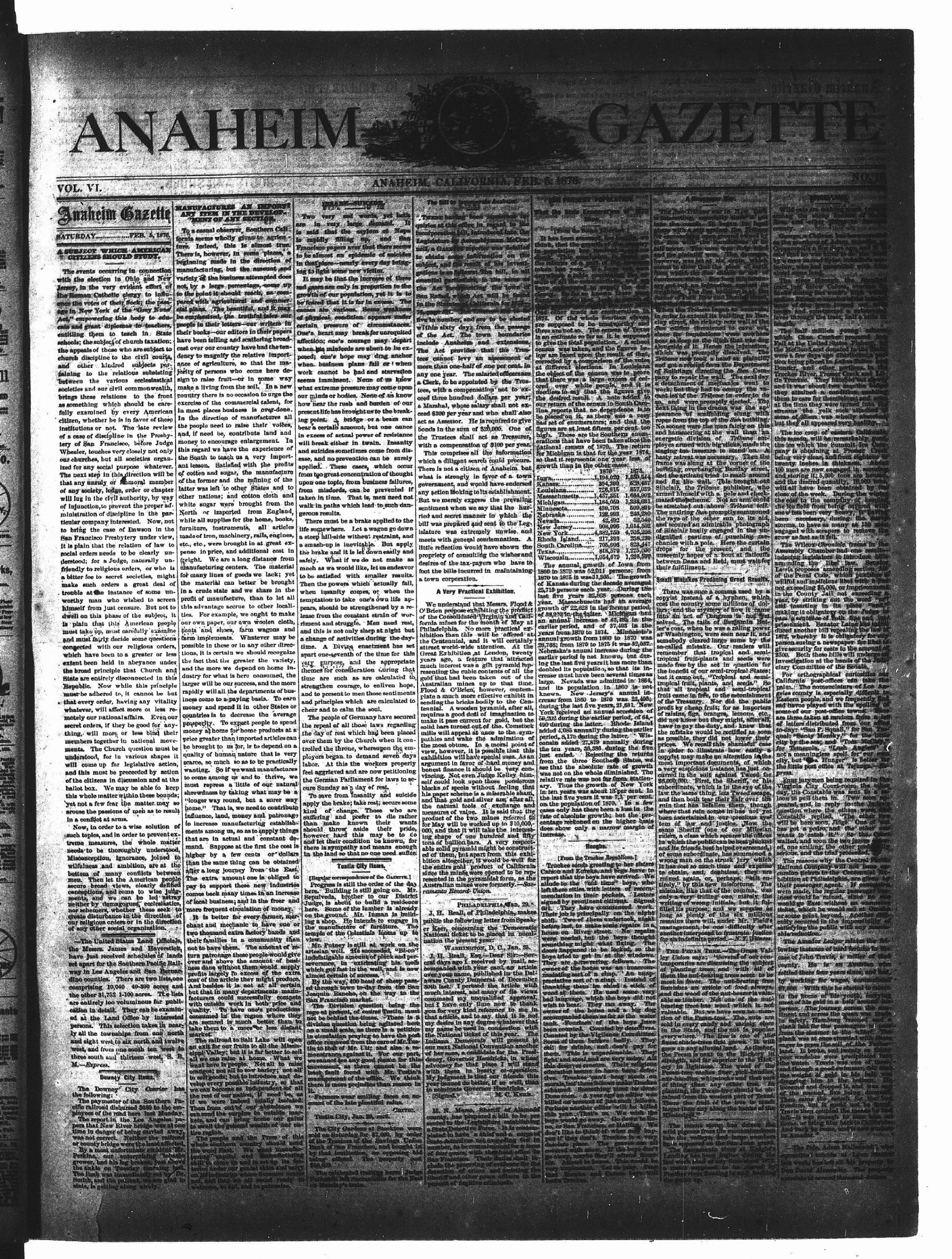
Searchable text
ANAHEIM
VOL. VI.
Anheim Gazette
SATURDAY...FEB. 5, 1876
A SUBJECT WHICH AMERICAN CITIZENS SHOULD STUDY.
The events occurring in connection with the election in Ohio and New Jersey, in the very evident effort of the Roman Catholic clergy to influence the votes of their flock; the passage in New York of the "Gray Nuns Act," empowering this body to educate and grant diplomas to teachers, entitling them to teach in State schools; the subject of church taxation; the appeals of those who are subject to church discipline to the civil courts, and other kindred subjects pertaining to the relations subsisting between the various ecclesiastical societies and our civil commonwealth, brings these relations to the front as something which should be carefully examined by every American citizen, whether he is in favor of these institutions or not. The late review of a case of discipline in the Presbytery of San Francisco, before Judge Wheeler, touches very closely not only our churches, but all societies organized for any social purpose whatever.
MANUFACTURES AN IMPORTANT ITEM IN THE DEVELOPMENT OF ANY SECTION.
To a casual observer, Southern California seems wholly given to agriculture. Indeed, this is almost true. There is, however, in some places, a beginning made in the direction of manufacturing, but the amount and variety of the business attempted does not by a large percentage come up to the point it should reach, as compared with agricultural and commercial plants. The beautiful, and it may be emphasized, the truthful tales our people in their letters—our writers in their books—our editors in their papers have been telling and scattering broadcast over our country have had the tendency to magnify the relative importance of agriculture, so that the majority of persons who come here design to raise fruit—or in some way make a living from the soil. In a new country there is no occasion to urge the exercise of the commercial talent, for in most places business is over-done. In the direction of manufactures all the people need to raise their voices, and, if need be, contribute land and money to encourage enlargement. In this regard we have the experience of the South to teach us a very important lesson. Satisfied with the profits
Two very mild are in very lax is said that the is rapidly filling Francisco papers avail to be almost an epiphany in that place—nearly light some nearness.
It may be that the and gases are only in growth of our population be feared that it is causes are various of physical condition certain pressure One's heart may be affection; one's courage when misdeeds pose; one's hope when business plan cannot be seen imminent. what extreme press our minds or bodies how near the rush present life has bringing point. A bridge bear a certain amount in excess of actual will break either it and suicides sometime ease, and no prevent applied. These c
taining to the relations subsisting between the various ecclesiastical societies and our civil commonwealth, brings these relations to the front as something which should be carefully examined by every American citizen, whether he is in favor of these institutions or not. The late review of a case of discipline in the Presbytery of San Francisco, before Judge Wheeler, touches very closely not only our churches, but all societies organized for any social purpose whatever. The next step in this direction will be that any unruly or immoral member of any society, lodge, order or chapter will ing in the civil authority, by way of injunction, to prevent the proper administration of discipline in the particular company interested. Now, not to bring the case of Dawson in the San Francisco Presbytery under view, it is plain that the relation of law to social orders needs to be clearly understood; for a Judge, naturally unfriendly to religious orders, or who is a bitter foe to secret societies, might make such orders a great deal of trouble at the instance of some unworthy man who wished to screen himself from just censure. But not to dwell on this phase of the subject, it is plain that this American people must take up, must carefully examine and must fairly decide some questions connected with our religious orders, which have been to a greater or less extent been held in abeyance under the broad principle that Church and State are entirely disconnected in this Republic. Now while this principle must be adhered to, it cannot be but that every order, having any vitality whatever, will affect more or less remotely our national affairs. Even our secret orders, if they be good for anything, will more or less bind their members together in national movements. The Church question must be understood, for in various shapes it will come up for legislative action, and this must be preceded by action of the citizens in discussion and at the ballot box. We may be able to keep this whole matter within these bounds; yet not a few fear the matter may so arouse the passions of men as to result in a conflict at arms.
Now, in order to a wise solution of such topics, and in order to prevent extreme measures, the whole matter needs to be thoroughly understood. Misconception, ignorance, joined to wilfulness and ambition, are at the bottom of many conflicts between men. Then let the American people secure broad views, clearly delified
jority of persons who come here designate to raise fruit—or in some way make a living from the soil. In a new country there is no occasion to urge the exercise of the commercial talent, for most places business is over-done. In the direction of manufactures all the people need to raise their voices, and, if need be, contribute land and money to encourage enlargement. In this regard we have the experience of the South to teach us a very important lesson. Satisfied with the profits of cotton and sugar, the manufacture of the former and the rafting of the latter was left to other States and to other nations; and cotton cloth and white sugar were brought from the North or imported from England, while all supplies for the home, books, furniture, instruments, all articles made of iron, machinery, rails, engines, etc., were brought in at great expense in price, and additional cost in freight. We are a long distance from manufacturing centers. The material for many lines of goods we lack; yet the material can better be brought in a crude state and we share in the profit of manufacture, than to let all this advantage accrue to other localities. For example, we ought to make our own paper, our own woolen cloth, boots and shoes, farm wagons and farm implements. Whatever may be possible in these or in any other directions, it is certain we should recognize the fact that the greater the variety, and the more we depend on home industry for what is here consumed, the larger will be our success, and the more rapidly will all the departments of business come to a paying basis. To earn money and spend it in other States or countries is to decrease the average prosperity. To expect people to spend money at home for home products at a price greater than imported articles can be brought to us for, is to depend on a quality of human nature that is very scarce, so much so as to be practically wanting. So if we want manufactures to come among us and to thrive, we must repress a little of our natural shrewdness by taking what may be a "longer way round," but a surer way home." That is, we need to contribute influence, land, money and patronage to increase manufacturing establishments among us, so as to supply things that are in actual and constant demand. Suppose at the first cost is higher by a few cents or dollars than the same thing can be obtained after a long journey from the East. The extra amount one is obliged to pay to support these new industries work cannot be done seems imminent. What extreme press our minds or bodies how near the rush present life has browning point. A bridge bear a certain amount in excess of actual will break either in and suicides sometime ease, and no prevent applied. These cases from too great concern upon one topic, from misdeeds can taken in time. The walk in paths which gerous results.
There must be a life somewhere. In a steep hill-side with a smash-up is inevident brake and it is safely. What if we would do to be satisfied with Then the powers when insanity contemptation to take pears, should be stale lease from the condition and struggle and this is not only a change of activity time. A Divine apart one-seventh very purpose; and themes for consile time are such as strengthen courage and to present to me and principles which cheer and to calm.
The people of Geo the repeal of all thie day of rest wha over them by the troiled the throne ployers began to labor. At this th feel aggrieved and the German Parliar cure Sunday as
To save from ink apply the brake; that kind of change suffering and p pro than make kn should throw a however hard t and let their cond there is sympathy in the land so th
this whole master within these bounds; yet not a few fear the matter may so arouse the passions of men as to result in a conflict at arms.
Now, in order to a wise solution of such topics, and in order to prevent extreme measures, the whole matter needs to be thoroughly understood. Misconception, ignorance, joined to wilfulness and ambition, are at the bottom of many conflicts between men. Then let the American people secure broad views, clearly defined conceptions, and come to wise judgments, and we can be led astray neither by demagogues, ecclesiastics, nor schemers, whether these seek to create disturbance in the direction of our religious orders or in the direction of any other social organization.
The United States Land Officials, the Messrs. James and Haverstick, have just received schedules of lands set apart for the Southern Pacific Railway in Los Angeles and San Bernardino counties. There are two lists one comprising 10,040 40-300 acres and the other 31,752 1-100 acres. The lists are entirely too voluminous for publication in detail. They can be examined at the Land Office by interested persons. This selection takes in nearly all the townships from one north and eight west to six north and twelve west, and from one south ten west to three south and thirteen west. S. B. M.—Express.
Downey City Items.
The Downey City Courier has the following:
The paymaster of the Southern Pacific railroad discharged $800 to the employees of the road here last Monday.
The report in the Los Angeles paper that New River bridge was at one time in danger of being carried away, was not correct. Neither the railroad or county bridge were the least affected.
By a most unfortunate incident Mr. Perkins, our enterprising "tahoe grower," had his leg broken just above the ankle on Tuesday morning last week. The limb was immediately set by Dr. Smith, and the patient we are glad to state, is getting along nicely.
The railroad to Salt Lake will open an exit for our fruits to all the Mississippi Valley; but it is far better to sell all we can raise at home. What we want here is people. Not all to raise orange; not all to sow barley; not all to sell goods; but to introduce and develop every possible industry, so that we can become as independent of all the rest of our nation. If need be, as if we were indeed totally isolated. Then from out of our abundance we can send the surplus to outside markets, and can bring home our gains to exploit the general wealth of our entire region.
The people and the Press of this whole southern country should send the word East. We must manufacturing "capital and manufacturing skill to come on and to set up its facilities under our genial sales and carry on its industries where Summer comes not, and that we all stand ready to welcome, to aid, and to patronize.
To save from apply the brake; kind of change suffering and pearl should throw hard there is sympathy in the land so that
Tustin
[Regular correspondence]
Progress is still here. Building in Sepulveda, broth Judge, is about here. Some of them on the ground. Ing a shop. He is the manufacturer temple of the Oak view.
Mr. Putney is an artesian well. He indemnigable amusement in which got fast in almost certain of By the way, 40 ed through town Joquin Rancho San Francisco m.
The Division rage at present, cannot be behind the division question on a small scale in circulation pra office removed from this to that of Mr. monstrance against we cannot see any movement, as to least fault from management of there is more profit.
Farmers wear count of the late Tustin City, J.
The City Gardens on Saturday of the Trustees of Bank of San Francisco by that institute being affixed $60,000.
The celebrates Full Moon left San Monday's tr
ANAHEIM, CALIFORNIA, FEB. 5, 1876.
Two very and words, yet both are in very large demand. It is said that the syllum at Napa is rapidly filling up, and San Francisco papers aver that there seems to be almost an epidemic of suicides in this place—nearly every day bringing to light some new victim.
It may be that the increase of these and gases are only in proportion to the growth of our population, yet it is to be feared that it is far in excess. The causes are various. Some weakness of physical condition appears under certain pressure of circumstances. One’s heart may break for unrequited affection; one’s courage may depart when his misdeeds are about to be exposed; one’s hope may drag anchor when business plans fail or when work cannot be had and starvation seems imminent. None of us know what extreme pressure may come upon our minds or bodies. None of us know how near the rush and burden of our present life has brought us to the breaking point. A bridge or a beam can bear a certain amount, but one ounce in excess of actual power of resistance will break either in twain. Insanity and suicides sometimes come from disease, and no prevention can be surely applied. These cases, which occur
The bill to incorporate Anaheim.
Transmit having been numerous inquiries at this office in regard to the incorporation bill, introduced into the Legislature by Assemblyman McCannell, a Ganzner reporter was familiar to obtain some information on the subject, and the result of his investigations is as follows: The bill, in all essential particulars, in the sense of the Act incorporating the town of San Rafael, which Act will be found in the Statutes of California for 1874, page 310. The Treasury provides that the Trustees cannot levy an agreement of more than one-half of one per cent. in any one year. The salaried officers are a Clerk, to be appointed by the Trustees, with a compensation not to exceed three hundred dollars per year; a Marshal, whose salary shall not exceed $300 per year and who shall also act as Assessor. He is required to give bonds in the sum of $20,000. One of the Trustees shall act as Treasurer, with a compensation of $100 per year.
This comprises all the information which a diligent search could procure. There is not a citizen of Anaheim but
What the StateEnumerations of 1874 does.
From the Senate Committee.
It has been assumed, for health we think, that the growth of the country in population has resulted in greater death. This conclusion is based on the returns of a part of the population taken last year. We have now unearthed a table pertaining to an audit of all the enumerations, and we have enumerated to supply the deficiency. In fact we know there were fourteen States that did not provide five in number, and are to be elected within sixty days from the passage of the Act. The town boundaries include Anaheim and extensions. The Act provides that the Trustees cannot levy an agreement of more than one-half of one per cent. in any one year. The salaried officers are a Clerk, to be appointed by the Trustees, with a compensation not to exceed three hundred dollars per year; a Marshal, whose salary shall not exceed $300 per year and who shall also act as Assessor. He is required to give bonds in the sum of $20,000. One of the Trustees shall act as Treasurer, with a compensation of $100 per year.
This comprises all the information which a diligent search could procure. There is not a citizen of Anaheim but
work cannot be had and starvation seems imminent. None of us know what extreme pressure may come upon our minds or bodies. None of us know how near the rush and burden of our present life has brought us to the breaking point. A bridge or a beam can bear a certain amount; but one ounce in excess of actual power of resistance will break either in twain. Insanity and suicides sometimes come from disease, and no prevention can be surely applied. These cases which occur from too great concentration of thought upon one topic, from business failures, from misdeeds, can be prevented if taken in time. That is, men need not walk in paths which lead to such dangerous results.
There must be a brake applied to the life somewhere. Let a wagon go down a steep hill-side without restraint, and a smash-up is inevitable. But apply the brake and it is let down easily and safely. What if we do not make as much as we would like, let us endeavor to be satisfied with smaller results. Then the powers which actually fail, when insanity comes, or when the temptation to take one's own life appears, should be strengthened by a release from the constant strain of work and struggle. Men need rest, and this is not only sleep at night but a change of activities during the daytime. A Diving enactment has set apart one-seventh of the time for this very purpose, and the appropriate themes for consiliation during that time are such as are calculated to strengthen courage, to enliven hope, and to present to men those sentiments and principles which are calculated to cheer and to calm the soul.
The people of Germany have secured the repeal of all those laws regarding the day of rest which had been placed over them by the Church when it controlled the throne, whereupon the employers began to demand seven days labor. At this the workers properly feel aggrieved and are now petitioning the German Parliament for laws to secure Sunday as a day of rest.
To save from insanity and suicide apply the brake; take rest; secure some kind of change. Those who are suffering and prefer to die rather than make known their wants should throw aside their pride, however hard this may be to co- and let their condition be known, for there is sympathy and means enough in the land so that no one need suffer any one year. The salaried officers are a Clerk, to be appointed by the Trustees, with a compensation not to exceed three hundred dollars per year; a Marshal, whose salary shall not exceed $300 per year and who shall also act as Assessor. He is required to give bonds in the sum of $20,000. One of the Trustees shall act as Treasurer, with a compensation of $100 per year.
This comprises all the information which a diligent search could procure. There is not a citizen of Anaheim but what is strongly in favor of a town government, and would have endorsed any action looking to its establishment. But we merely express the prevailing sentiment when we say that the hurried and secret manner in which the bill was prepared and sent to the Legislature was extremely unwise and meets with general condemnation. A little reflection would have shown the propriety of consulting the wishes and desires of the tax-payers who have to foot the bills incurred in maintaining a town corporation.
A Very Practical Exhibition.
We understand that Messrs. Flood & O'Brien propose exhibiting the product of the Consolidated Virginia and California mines for the month of May at Philadelphia. No more practical exhibition than this will be offered at the Centennial, and it will certainly attract world-wide attention. At the Great Exhibition at London, twenty years ago, a feature that attracted much interest was a gilt pyramid representing the cubic contents of all the gold that had been taken out of the Australian mines up to that time. Flood & O'Brien, however, contemplate a much more effective exhibit in sending the bricks bodily to the Centennial. A wooden pyramid, after all, requires a good deal of imagination to make it pass current for gold, but the solid bars turned out of the Comstock mills will appeal at once to the sympathies and wake the almigration of the most obtuse. In a moral point of view, however, it is possible that this exhibition will have special uses. As an argument in favor of hard money and honest finance it should be very convincing. Not even Judge Kelley himself could look upon those ponderous blocks of specie without feeling that his paper scheme is a miserable sham, and that gold and silver are after all the natural tools of exchange and measures of value. It is said that the product of the two mines referred to for May will be worked up to $10,000,000, and that it will take the interesting shape of one hundred and fifty tons of bullion bars. A very respectable solid pyramid might be constructed of them, but apart from this exhibition altogether, it would be well for the entire gold product of California since the mines were opened to be represented in the pyramidal form, as the Australian mines were formerly.
Small copy
The copy cost for labs is detailed work on paper meant for framing or displaying.
No soil and energy play staging hasty frames.
No soap and hand washing.
No soap and water spray.
No soap and water spray.
No soap and water spray.
No soap and water spray.
No soap and water spray.
No soap and water spray.
No soap and water spray.
No soap and water spray.
No soap and water spray.
No soap and water spray.
No soap and water spray.
No soap and water spray.
No soap and water spray.
No soap and water spray.
No soap and water spray.
No soap and water spray.
No soap and water spray.
No soap and water spray.
No soap and water spray.
No soap and water spray.
No soap and water spray.
No soap and water spray.
No soap and water spray.
No soap and water spray.
No soap and water spray.
No soap and water spray.
No soap and water spray.
No soap and water spray.
No soap and water spray.
No soap and water spray.
No soap and water spray.
No soap and water spray.
No soap and water spray.
No soap and water spray.
No soap and water spray.
No soap and water spray.
No soap and water spray.
No soap and water spray.
No soap and water spray.
No soap and water spray.
No soap and water spray.
No soap and water spray.
No soap and water spray.
No soap and water spray.
No soap and water spray.
No soap and water spray.
No soap and water spray.
No soap and water spray.
No soap and water spray.
No soap and water spray.
No soap and water spray.
No soap and water spray.
No soap and water spray.
No soap和water spray。
No soap和water喷洒。
No soap和water喷洒。
No soap和water喷洒。
No soap和water喷洒。
No soap和water喷洒。
No soap和water喷洒。
No soap和water喷洒。
No soap和water喷洒。
No soap和water喷洒。
No soap和water喷洒。
No soap和water喷洒。
No soap和water喷洒。
No soap和water喷洒。
No soap和water喷洒。
NO SOAP AND WATER SPRAY
NO SOAP AND WATER SPRAY
NO SOAP AND WATER SPRAY
NO SOAP AND WATER SPRAY
NO SOAP AND WATER SPRAY
NO SOAP AND WATER SPRAY
NO SOAP AND WATER SPRAY
NO SOAP AND WATER SPRAY
NO SOAP AND WATER SPRAY
NO SOAP AND WATER SPRAY
NO SOAP AND WATER SPRAY
NO SOAP AND WATER SPRAY
NO SOAP AND WATER SPRAY
NO SOAP AND WATER SPRAY
NO SOAP AND WATER SPRAY
NO SOAP AND WATER SPRAY
NO SOAP AND WATER SPRAY
NO SOAP AND WATER SPRAY
NO SOAP AND WATER SPRAY
NO SOAP AND WATER SPRAY
NO SOAP AND WATER SPRAY
NO SOAP AND WATER SPRAY
NO SOAP AND WATER SPRAY
NO SOAP AND WATER SPRAY
NO SOAP AND WATER SPRAY
NO SOAP AND WATER SPRAY
NO SOAP AND WATER SPRAY
NO SOAP AND WATER SPRAY
NO SOAP AND WATER SPRAY
NO SOAP AND WATER SPRAY
NO SOAP AND WATER SPRAY
NO SOAP AND WATER SPRAY
NO SOAP AND WATER SPRAY
NO SOAP AND WATER SPray
NO SOAP AND WATER SPray
NO SOAP AND WATER Spray
NO SOAP AND WATER Spray
NO SOAP AND WATER Spray
NO SOAP AND WATER Spray
NO SOAP AND WATER Spray
NO SOAP AND WATER Spray
NO SOAP AND WATER Spray
NO SOAP AND WATER Spray
NO SOAP AND WATER Spray
NO SOAP AND WATER Spray
NO SOAP AND WATER Spray
NO SOAP AND WATER Spray
NO SOAP AND Water Spray
NO Soap And Water Spray
NO Soap And Water Spray
NO Soap And Water Spray
NO Soap And Water Spray
NO Soap And Water Spray
NO Soap And Water Spray
NO Soap And Water Spray
NO Soap And Water Spray
NO Soap And Water Spray
NO Soap And Water Spray
NO Soap And Water Spray
NO Soap And Water Spray
NO Soap And Water Spray
NO Soap And Water Spray
NO Soap And Water Spray
NO Soap And Water Spray
NO Soap And Water Spray
NO Soap And Water Spray
NO Soap And Water Spray
NOSOAP AND WATER SPRAY
The annual growth of Iowa from 1860 to 1870 was 52,011 persons; from 1870 to 1875 it was 31,305. The growth of Kansas during the decade averaged 25,719 persons each year. Massachusetts had an average growth of 22,628 in the former period; of 58,819 in the latter. Michigan had an annual increase of 43,495 in the earlier period, and of 37,493 in the years from 1870 to 1874. Minnesota's annual growth from 1860 to 1870 was 28,763; from 1870 to 1875 it was 32,037. Nebraska's annual increase during the earlier period is not known, but during the last five years it has more than doubled its population; so that its increase must have been several times as large. Nevada was admitted in 1864, and its population in 1860 is not known. New Jersey's annual increase from 1860 to 1870 was 23,406; during the last five years, 21,681. New York received an annual accession of 50,202 during the earlier period, of 64,-490 during the latter. Rhode Island added 4,085 annually during the earlier period, 8,170 during the latter. Wisconsin added 27,879 annually during the ten years, 30,386 during the five just ended. Rejecting the returns from the three Southern States, we see that the absolute rate of growth was not on the whole diminished. The relative rate was not far from stationary. Thus the growth of New York in ten years was about 13 per cent. In the last five years it was 7.3 per cent on the population of 1870. In a few cases only has there been a loss in the rate of absolute growth; but the percentage reckoned on the higher basis does show only a narrow margin of increase.
Ranghaa
[From the Trunkee Republics]
Trunkee sands greeting to her sisters Carson and Eureka, and begs leave to report that she bays have arrived. We alude to the "old time" bays, who left these cities with letters of recom-
To save from insanity and suicide apply the brake; take rest; secure some kind of change. Those who are suffering and prefer to die rather than make known their wants should throw aside their pride, however hard this may be to do and let their condition be known, for there is sympathy and means enough in the land so that no one need suffer.
Tustin City Items.
[Regular correspondence of the GAKETTE.]
Progress is still the order of the day here. Building is still going on. Mr. Sepulveda, brother to our District Judge, is about to build a residence here. Some of the lumber is already on the ground. Mr. Inman is building a shop. He intends to engage in the manufacture of furniture. The temple of the Celestials looms up to view.
Mr. Putney is still at work on the artesian well. He succeeded, "Bl-on" indigestible amount of pluck and perseverance, in extirpating his tools which got fast in the well, and is now almost certain of success.
By the way, 400 head of sheep passed through town to-day from the San Joaquin Rancho, on the way to the San Francisco market.
The Division question being rage at present, of course Tustin must not be behind the times. There is a division question being agitated here on a small scale, as there is a petition in circulation praying to have the post office removed from the care of Mr. Tustin to think of Mr. Utt; and also a monstrance against it. For our part, we cannot see any good reason for this movement, as there cannot be the least fault found with Mr. Tustin's management of the office. We think there is more prejudice than reason in it.
Farmers wear smiling faces on account of the late plantiful ruins.
Critic.
Tustin City, Jan. M., n.d.
The City Gardens at Stockton were sold on Saturday for $7,000, by order of the Trustees of the Savings Union Bank of San Francisco, and bought in by that institution, an opening bid being offered. The property cost $60,000.
The celebrated training home Judge Fullerton left Sacramento for the East on Monday's train.
H. N. Munse, Sheriff of Alameda county, has prepared a bill to be presented to the Legislature establishing a State Detective Force. It is contemplated to have a chief and a corps of State detectives not exceeding ten in number, to be commissioned for a term of five years, with their head office in San Francisco. Their duties shall include the procuring of evidence for the detection of crime and assisting the Sheriff and other police officers in the pursuit of fugitive criminals.
In ten years was about 15 per cent. In the last five years it was 7.3 per cent. on the population of 1870. In a few cases only has there been a loss in the rate of absolute growth; but the percentage reckoned on the higher basis does show only a narrow margin of increase.
Roughs.
[From the Trucker Republican.]
Truckee sends greeting to her sisters Carson and Eureka, and begs leave to report that the boys have arrived. We allude to the "old time" boys, who left these cities with letters of recommendation in their pockets. Letters signed by prominent citizens. Signed 601. They have commenced work. Their job is principally on the night shift. Two of them undertook night before last, to make some repairs in a house on River street. No repairs were needed, but the boys thought something might want fixing. The doors happened to be locked, so the boys tried to get in at the windows. They are persevering fellows. The owner of the house was an unaccompanied sort of a chap. An unappreciative sort of a chap. Instead of thankening them he shaved a skull of wood at them. He used some very bad language, which the boys did not wish to hear. They ran away. The owner of the house and a big dog accompanied them as far as the water tank. Fourteen of the boys have been counted. Counted by detectives. Counted by the Vigilance Committee. Seven of them behave badly. They did for drinks, and don't pay for them. This is unpardonable. They fight and stand, and are very nice. All this degrees consume. Their religious education seems to have been defective. Truckee can't bring much money, but these fellows make Truckee ashamed. Something must be done Dawn soon. A year ago an editor was killed on account of just such follows. Purpose another editor will be killed this year.. That's us. We wish the boys would go away. Go down to Reeve or San Francisco, or Halling. We don't like to think of what may happen if they don't. Truckee is a very desolate place. The graves are all covered with snow. If the boys don't go away, maybe they'll attend funerals. Attain in homes. This would be very unpleasant. Ted no jungle. Praise that Emeka and Gunna have will leave Tustin...
GAZETTE
NO. 18
A NORMAL WAR.
The Sun-Tribune war in New York is intensifying, especially since it got into the courts. It began its legal phase with a still ongoing the Tribune for enforcing upon ground owned by the Sina with the foundations of its talk tower. The man was dug up and the plaintiff won. The damage, however, was set at six cents, which seemed to show that the place of earth front which the Sina shifted is not of economic value. By long this harassment got out an injunction against its neighbor. The Sun building is the center of Park low and Barring street.
When the Tribune began to excavate in order to extend its building to Barclay street, the rickety rear wall of the Sun edifices threatened to cave out, close for foundations were nowhere near as deep as the dish that was dig alongside of it. Hence the injunction, which was promptly dissolved. The Tribune now took a hand on plaintiff, and got a rebellion from the Department of Buildings directing the Sun Company to repair the wall. The next day a detachment of mechanics went to work, but they had to occupy the vacant lot of the Tribune in order to do so, and were promptly ejected. The next thing in the drama was the appearance of scaffolding along with ropes from the top of the Sun building. No sooner were the men fairly on this hammering at the wall than an energetic division of Tribune employees armed with big sticks made the staging too insure to stand on. A hasty retreat was necessary. Then the frame was slung at the corner of the building overhanging Barclay street.
Wild cats are making much trawl among the sheep herds of south Texas and other groups in southern county.
George Chillea has been sworn as the minister of Adam Shalike at Copperopolis a few days ago, and he said that he was hired to do the duty a man named Styles, who had guarded with him about some land.
The river through the Standard Trust just below Coloma overflows. In banks during last week's high water million fishing a number of oysters have turned out onto teams and constructed a substantial leaves through the trout; half a mile in length.
The half million young militia which Chase Conner presented last fall at the United States Fishery, in the McCloud, and donated in the hands were a few days ago distributed, a portion being placed in Lakes Tahoe and Donner, and other portions in the Truckee River, Porter Creek and Little Truckee. They hatched but shortly and it was about two months before they attained a condition enabling them to care for their livestock and even at the time they were turned into fish streams the yolk suck attached in some of them was wholly absorbed but they all appeared very healthy.
The ice crop of eastern California this season will be remarkably good, the ice which the Summit Ice Company is obtaining at Prosper Creek being very clear and from eight feet twenty inches in thickness. About 110 men are now engaged in securing
The ice crop of eastern California this season will be remarkably good the ice which the Summit Ice Company is obtaining at Prosper Creek being very clear and from eight to twenty inches in thickness. About 100 men are now engaged in storing it; 5,000 tons are housed and the desired quantity; 10,000 tons will all have been obtained by the close of the week. During the winter the cost to the company of keeping the ice field from being squared with snow has been very heavy. It has been necessary during the hurricane storms, to have as many as 150 men engaged with scrapers to remove the snow as fast as it fell.
The Wilcox Chronicle freaks in the Assembly Chamber but one result inducing legislators to introduce bills amending the likel law. Senator Lewis proposes amending section 248 of the Penal Code, which punishes willful and malicious libel with a fine not exceeding $5,000, or imprisonment in the County Jail not exceeding a year by striking out the word "off" and inserting in its place "and making it obligatory on the Judge of pass's sentence of both fines and imprisonment. Senator Laine has introduced another bill repealing the law of 1872, whereby it is obligatory for any person suing a newspaper for libel to give security for costs to the amount of $500. Both these bills will undergo an investigation at the hands of the Judicial Committee of the Senate.
For orthographical errors our California post-offices can take the palm. The nomenclature of Los Angeles county is especially difficult in Eastern people, and we frequently find and havoc played with the spelling of some of our post-office towns. There are three taken at random from a list of letters distributed from our office today: "San P. Squall," for San Bernardino; "Santy Moniky," for the Little City by the sea; and "Tom McClay," for Temecula. "Lush Anglow" not a meaningless spell for our own city, but "a Hunger" is better for the little post office at Tajunga—Fairpress.
Four jurymen being required in the Virginia City Court-room, the morning day, the Constable was sent to a jail to pull them in. Two soon appeared, and in reply to the Judicial question where the others were Constable replied, "The other boy will be here soon, Judge. One of him has got a pedro, and the other wants to catch it." So this Constable walked, and soon the two jurymen entered, one smiling, the other probably serious, and the trial proceeded.
The reasons why the Central Railroad Company will not issue excursion tickets to the Centennial Exhibition at Philadelphia, are given in their passenger agent. If someone
The Pecan Tree—The Green Valley Union says: "Several of our contemporaries are discussing the subject of planting trees, and with all of them the nut-bearing trees seem to be most in favor. The nut-heating tree furnishes an article of food always, and the wood of the nut-heater is valuable as timber. Not one of the nut-bearing trees has wood which is not valuable. But we have seen no mention of the pecan-tree. The nuts are sold in every candy and variety stored in the State, and the nut is popular everywhere. The tree is one of the finest shade-trees that grows. It will grow on any alluvial land. As timber, the pecan is next to the Hickory in strength, and far superior to the Hickory in lightness. The wood of the pecan-tree makes finer, pick-handles, axe-handles, whipstocks and that sort of thing than any other tree. In planting, the pecan-tree should be obtained from the western part of Texas. There is fruit of the tree in much larger than any along the banks of the Mississippi."
The recent storm has driven pine trees from the mountain slopes into the valleys, and huge numbers have appeared on the San Juan grass.
The disarmamento river at Knight's Landing has been higher during the last week than any time since 1872. A suit supposed to be shared by Pepper river flooding is now back up.
The Constable was sent to a malloon to pull them in. Two soon appeared, and in reply to the Judging question where the others were Constable replied, "The other two will be here soon, Judge. One of us has got a petro, and the other one wants to catch it." So this Court waited, and soon the two jurors entered, one smiling, the other profusely serious, and the trial proceeded.
The reasons why the Central Pacific Railroad Company will not lease excursion tickets to the Centennial Exhibition at Philadelphia are given by their passenger agent. If consignments were made, the regular passenger business would be ruined, since no one would go East without an accompanying ticket, which he would sell at Glenwood or some point beyond. Another difficulty occurred in the impossibility of satisfying the public with any reasonable reduction.
The Amador Ledger relates the following instance of hard fortune in this case of John Travis, a miller of Mendocino County. He is an Austrian who settled there four years since, and had by working for wages accumulated $1,800. With this he started to return to the home of his youth, carrying most of his gold in a belt around his person. The journey across the open was made in safety. Hamburg launched and a plank laid for the passengers a path from the summer to the winter. The plank was at once showed with these eager to press the sail of the Pathway. It broke, and twenty or thirty poor wretches were precipitated from the water. Travis was one of them, and though a good swimmer, felt that the weight of gold in his belt was dragging him to the bottom. He loosened and dropped it, and was out of the seamed, five being drawn. Then came the search for the lost treasure, but it could not be found. Travis then counted the means he had left—it was enough to take him home, or bring him back to California And back he came, and is now a million in Amader.*
The Pole Adam Malenwich who committee suicide at Lyon Mines last week has left all his property in Dan David Alexander. The property amounts to several thousand dollars.