anaheim-gazette 1876-01-15
Scanned page
Searchable text
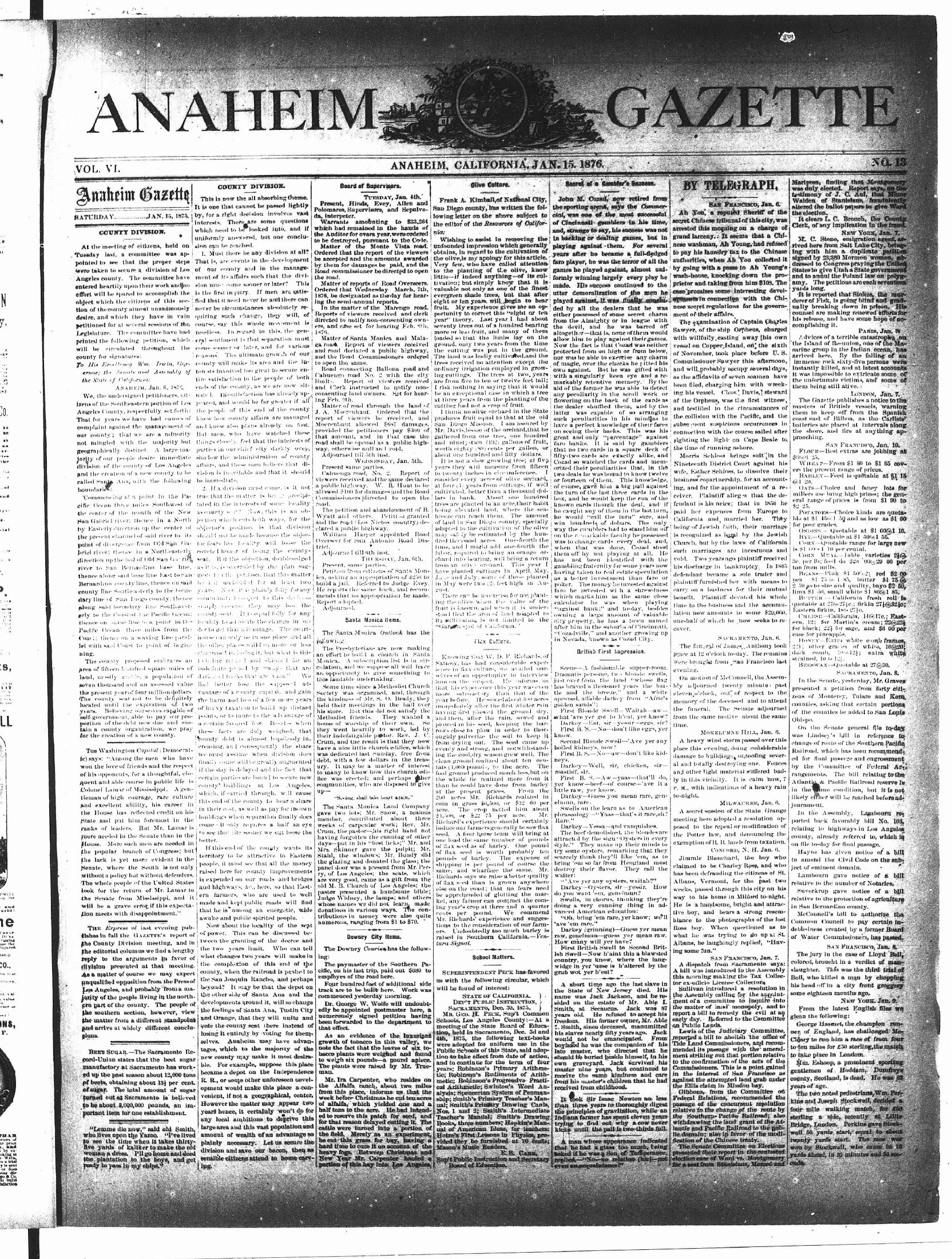
ANAHEIM GAZETTE
SATURDAY JAN. 15, 1875.
COUNTY DIVISION.
At the meeting of citizens, held on Tuesday last, a committee was appointed to see that the proper steps were taken to secure a division of Los Angeles county. The committee have entered heartily upon their work and no effort will be spared to accomplish the object which the citizens of this section of the county almost unanimously desire, and which they have in vain petitioned for at several sessions of the Legislature. The committee have had printed the following petition, which will be circulated throughout the county for signatures:
To His Excellency Wm. Irwin, Governor; the Senate and Assembly of the State of California:
ANAHEIM, Jan. 6, 1872.
We, the undersigned petitioners, citizens of the Southeastern portion of Los Angeles County, respectfully set forth: That for years we have had causes of complaint against the management of our county; that we are a minority not mingled with the majority but geographically distinct. A large majority of our people desire immediate division of the county of Los Angeles
COUNTY DIVISION.
This is now the all absorbing theme. It is one that cannot be passed lightly by, for a right decision involves vast interests. There are some questions which need to be looked into, and if uniformly answered, but one conclusion can be reached.
1. Must there be any division at all?
That is, are events in the development of our county and in the management of its affairs such that the division must come sooner or later? This is the first inquiry. If men are satisfied that it need never be and there can never be circumstances absolutely requiring such change, they will, of course, say this whole movement is needless. In regard to this, the general sentiment is that separation must come sooner or later, and for various reasons. The ultimate growth of our county will make its area and the interests involved too great to secure entire satisfaction to the people of both ends of the county, as we are now situated.
Disatisfaction has already appeared, and would be far greater if all the people of this end of the county knew how county affairs are managed and knew also plans already on foot. But men who have watched these things closely feel that the interests of parties in our chief city darkly over-shadow the administration of county affairs, and these men believe that dis-
We, the undersigned petitioners, citizens of the Southeastern portion of Los Angeles County, respectfully set forth: That for years we have had causes of complaint against the management of our county; that we are a minority not mingled with the majority but geographically distinct. A large majority of our people desire immediate division of the county of Los Angeles and the creation of a new county to be called Santa Ana, with the following boundaries:
Commencing at a point in the Pacific Ocean three miles Southwest of the center of the mouth of the New San Gabriel river; thence in a North by Easterly direction up the center of the present channel of said river to its point of divergence from Old San Gabriel river; thence in a Northeastly direction up the bed of Old San Gabriel river to San Bernardino Base line; thence along said base line East to San Bernardino county line; thence on said county fine Southeasterly to the boundary line of San Diego county; thence along said boundary line Southwestern to the Coast of the Pacific Ocean; thence on same line to a point in the Pacific Ocean three miles from the Coast; thence on a waving line parallel with said Coast to point of beginning.
The county proposed embraces an area of fifteen hundred square miles of land, mostly available, a population of seven thousand and an assessed value the present year of four million dollars. The county seat not to be deligitely located until the expiration of two years. Believing ourselves capable of self-government, able to pay our proportion of the debt now due and sustain a county organization, we pray for the creation of a new county.
Tue Washington Capital (Democratic) says: "Among the men who have won the love of friends and the respect of his opponents, for a thoughtful eloquent and able course in public life is Colonel Lamar of Mississippi. A gentleman of high courage, rare culture and excellent ability, his career in the House has reflected credit on his State and put him foremost in the ranks of leaders. But Mr. Lamar is more needed in the Senate than in the House. More such men are needed in the popular branch of Congress; but the lack is yet more evident in the Senate, where the South is not only without a policy but without defenders. The whole people of the United States look for the future of Mr. Lamar."
Disatisfaction has already appeared, and would be far greater if all the people of this end of the county knew how county affairs are managed and knew also plans already on foot. But men, who have watched these things closely, feel that the interests of parties in our chief city darkly overshadow the administration of county affairs, and these men believe that division is inevitable and that it should be immediate.
2. If a division must come, is it not true that the matter is being precipitated in the interests of some locality as county so? Now, this is an objection which cuts both ways, for the objector's position is that division should not be made because the objector fears his locality will loose the coveted honor of being the county seat. But the objection, double-edged as it is, is overruled by the plan suggested by this petition, that this matter be unbounded for at least two years. Now it is plainly folly for any community to object to this decision simply because they may lose the county seat. It is equal folly for any locally to advocate the change in order to get that advantage. The court-house can only be in one place and all other places will see more or less charrimed in losing it, but what is this taking risk and skimming for an indelible person by always that dark soul tracks that are vain." We had better lose the supposed advantage of a county capital, and gain the harm and loss of a few more years of heavy taxation to build up distant points, or to incur to the advantage of a certain favored few. Besides when these facts are duly weighed, that county debt is almost hopelessly increasing, and consequently the share we must assume when division does finally come will be greatly augmented if the day is delayed and the fact that certain parties are bound to secure new county* buildings at Los Angeles, which, if carried through, will cause this end of the county to bear a share in their cost, as well as pay for its own buildings when separation finally does come—it only requires a half an eye to see that fire sooner we cut loose the better.
If this end of the county wants its territory to be attractive to Eastern people, it must see that all the money raised here for county improvements is expended on our roads and bridges and highways, etc., here, so that East-
The Express of last evening publishes in full the Gazette's report of the County Division meeting, and in the editorial columns we find a lengthy reply to the arguments in favor of division presented at that meeting. As a matter of course we may expect unqualified opposition from the Press of Los Angeles, and probably from a majority of the people living in the northgro part of the county. The people of the southern section, however, view the matter from a different standpoint and arrive at widely different conclusions.
BEEF SUGAR.—The Sacramento Record-Union states that the beet sugar manufactory at Sacramento has worked up the past season about 12,000 tons of beets, obtaining about 134 per cent. of sugar. The total amount of sugar turned out at Sacramento is believed to be about 8,000,000 pounds, an important item for one establishment.
"Lemme die now," said old Smith, who lives upon the Yazoo. "I've lived to see the time when it takes thirty-five yards of kalliker to make the old woman a dress. I'll go home and deed the plantation to the boys, and get ready to pass in my chips."
ANAHEIM, CALIFORNIA, JAN. 15. 1876.
Board of Supervisors.
TUESDAY, Jan. 4th.
Present, Hinds, Evey, Allen and Polomares, Supervisors, and Sepulveda, interpeter.
Warrants amounting to $33,264 which had remained in the hands of the Auditor for over a year, were ordered to be destroyed, pursuant to the Code.
Matter of the Monte Vista road.
Ordered that the report of the viewers be accepted and the amounts awarded by them for damages be paid, and the Road commissioner be directed to open the road.
Matter of reports of Road Overseers.
Ordered that Wednesday March, 7th, 1876, be designated as the day for hearing the semi-annual reports.
In the matter of the Marengo road.
Reports of viewers received and clerk directed to notify non-consenting owners, and case set for hearing Feb. 9th, 1876.
Matter of Santa Monica and Malaga road.
Report of viewers received and road declared a public highway, and the Road Commissioners ordered to open the same.
Road connecting Ballona road and Cahuengo road No. 2 with the city limits.
Report of viewers received and Clerk instructed to notify non-consenting land owners. Not for hearing Feb. 9th.
Matter of road through the land of J. A. Moerenhaut.
Ordered that the report of viewers be received, and Moerenhaut allowed $687 damages provided the petitioners pay $300 of that amount, and in that case the road shall be opened as a public highway, otherwise null and void.
Adjourned till 5th inst.
WEDNESDAY, Jan. 5th.
Present same parties.
Olive Culture.
Frank A. Kimball, of National City, San Diego county, has written the following letter on the above subject to the editor of the Resources of California:
Wishing to assist in removing the unfounded impression which generally obtains, in regard to the cultivation of the olive, is my apology for this article. Very few, who have called attention to the planting of the olive, know little—if indeed anything—of its cultivation; but simply know that it is valuable not only as one of the finest evergreen shade trees, but that after eight or ten years will begin to bear fruit. My experience gives me an opportunity to correct this "eight or ten year" theory. Last year I had about seventy trees out of a hundred bearing more or less fruit, and many of them loaded so that the limbs lay on the ground, only two years from the time the cutting was put in the ground. The land was badly cultivated, and the trees received no attention except the ordinary irrigation employed in growing cuttings. The trees at two years are from five to ten or twelve feet tall; I risk nothing in saying that it would be an exceptional case in which a tree at three years from the planting of the cutting had not a crop of fruit.
I think no olive orchard in the State produces fruit equal to that at the old San Diego Mission. I am assured by Mr. Davis, lessee of the orchard, that he gathered from one tree, one hundred and ninety-two (192) gallons of fruit, worth eighty ($0) cents per gallon, or about one hundred and fifty dollars.
It is not a slow growing tree; at fifteen years they will measure from fifteen.
Secret of a Gambler's Success.
John M. Cozad, now retired from the sporting arena, says the Commercial was one of the most successful of Cincinnati gamblers in his time, and strange to say, his success was not in backing or dealing games, but in playing against them. For several years after he became a full-fledged faro player, he was the terror of all the games he played against, almost uniformly winning largely every play he made. His success continued to the utter demoralization of the men he played against. It was finally concluded by all the dealers that he was either possessed of some secret charm from the Almighty or in league with the devil, and he was barred off altogether—that is, none of them would allow him to play against their games. Now the fact is that Cozad was neither protected from on high or from below, nor was he able to exercise any charm of magic, over the checks he pitted his own against. But he was gifted with a singularly keen eye and a remarkably retentive memory. By the aid of the former he was able to detect any peculiarity in the scroll work or flowering on the back of the cards as the dealer shuffled them, and by the latter was capable of so arranging such peculiarities in his mind as to have a perfect knowledge of their faces on seeing their backs. This was his great and only "percentage" against faro banks. It is said by gamblers that no two cards in a square deck of fifty-two cards are exactly alike, and Cozad so watched the cards and memorized their peculiarities that, in the
The Santa Monica Outlook has following:
The Presbyterians are now making an effort to build a church in Santa Monica. A subscription list is in circulation, and we suppose all will have an opportunity to give something to this landable undertaking.
Some time since a Methodist Church Society was organized, and through the kindness of Mr. S. O. Brady, they held their meetings in the hall over his store. But this did not satisfy the Methodist friends. They wanted a house of worship of their own. So they went heartily to work, led by their indefatigable pastor, Rev. J. C. Crum, and the result is that they now have a nice little church edifice, which was dedicated last Sunday, free from debt, with a few dollars in the treasury. It may be a matter of interest to many how this church edifice was erected; and perhaps other communities, who are disposed to give up—
"Saving shall take heart again."
The Santa Monica Land Company gave two lots: Mr. Snow, a zealous member, contributed about three weeks of carpenter work; Rev. Mr. Crum, the pastor—his right hand not having forgotten the cunning of other days—put in his "best hicks"; Mr. and Mrs. Skinner gave the pulpit; Mr. Stahl, the windows; Mr. Bundy did the glazing and donated the glass; the panel door was a present from Mr. Perry, of Los Angeles; the seats, which are very good, came as a gift from the old M. B. Church of Los Angeles; the matter of road through the land of J. A. Moerenhaut. Ordered that the report of viewers be received, and Moerenhaut allowed $657 damages, provided the petitioners pay $300 of that amount, and in that case the road shall be opened as a public highway, otherwise null and void.
Adjourned till 5th inst.
WEDNESDAY, Jan. 5th.
Present same parties.
Cahuenga road, No. 2. Report of viewers received and the same declared a public highway. W. B. Hunt to be allowed $100 for damages and the Road Commissioners directed to open the road.
The petition and abandonment of B. Wyatt and others. Petition granted and the rooftop (Los Nietos country) declared a public highway.
William Harper appointed Road Overser for San Antonio Road District.
Adjourned till 6th inst.
THURSDAY, Jan. 6th.
Present, same parties.
Petition from citizens of Santa Monica, asking an appropriation of $250 to build a jail. Referred to Judge Evey. He reports the same back, and recommends that no appropriation be made. Report adopted.
Adjourned.
Santa Monica Items.
The Santa Monica Outlook has following:
The Presbyterians are now making an effort to build a church in Santa Monica. A subscription list is in circulation, and we suppose all will have an opportunity to give something to this landable undertaking.
Some time since a Methodist Church Society was organized, and through the kindness of Mr. S. O. Brady, they held their meetings in the hall over his store. But this did not satisfy the Methodist friends. They wanted a house of worship of their own. So they went heartily to work, led by their indefatigable pastor, Rev. J. C. Crum, and the result is that they now have a nice little church edifice, which was dedicated last Sunday, free from debt, with a few dollars in the treasury. It may be a matter of interest to many how this church edifice was erected; and perhaps other communities, who are disposed to give up—
"Saving shall take heart again."
The Santa Monica Land Company gave two lots: Mr. Snow, a zealous member, contributed about three weeks of carpenter work; Rev. Mr. Crum, the pastor—his right hand not having forgotten the cunning of other days—put in his "best hicks"; Mr. and Mrs. Skinner gave the pulpit; Mr. Stahl, the windows; Mr. Bundy did the glazing and donated the glass; the panel door was a present from Mr. Perry, of Los Angeles; the seats, which are very good, came as a gift from the old M. B. Church of Los Angeles; the matter of road through the land of J. A. Moerenhaut. Ordered that the report of viewers be received, and Moerenhaut allowed $657 damages, provided the petitioners pay $300 of that amount, and in that case the road shall be opened as a public highway, otherwise null and void.
Adjourned till 5th inst.
WEDNESDAY, Jan. 5th.
Present same parties.
Cahuenga road, No. 2. Report of viewers received and the same declared a public highway. W. B. Hunt to be allowed $100 for damages and the Road Commissioners directed to open the road.
The petition and abandonment of B. Wyatt and others. Petition granted and the rooftop (Los Nietos country) declared a public highway.
William Harper appointed Road Overser for San Antonio Road District.
Adjourned till 6th inst.
THURSDAY, Jan. 6th.
Present, same parties.
Petition from citizens of Santa Monica, asking an appropriation of $250 to build a jail. Referred to Judge Evey. He reports the same back, and recommends that no appropriation be made. Report adopted.
Adjourned.
Santa Monica Items.
The Santa Monica Outlook has following:
The Presbyterians are now making an effort to build a church in Santa Monica. A subscription list is in circulation, and we suppose all will have an opportunity to give something to this landable undertaking.
Some time since a Methodist Church Society was organized, and through the kindness of Mr. S. O. Brady, they held their meetings in the hall over his store. But this did not satisfy the Methodist friends. They wanted a house of worship of their own. So they went heartily to work, led by their indefatigable pastor, Rev. J. C. Crum, and the result is that they now have a nice little church edifice, which was dedicated last Sunday, free from debt, with a few dollars in the treasury. It may be a matter of interest to many how this church edifice was erected; and perhaps other communities, who are disposed to give up—
"Saving shall take heart again."
The Santa Monica Land Company gave two lots: Mr. Snow, a zealous member, contributed about three weeks of carpenter work; Rev. Mr. Crum, the pastor—his right hand not having forgotten the cunning of other days—put in his "best hicks"; Mr. and Mrs. Skinner gave the pulpit; Mr. Stahl, the windows; Mr. Bundy did the glazing and donated the glass; the panel door was a present from Mr. Perry, of Los Angeles; the seats, which are very good, came as a gift from the old M. B. Church of Los Angeles; the matter of road through the land of J.A.Moerenhaut. Ordered that the report of viewers be received, and Moerenhaut allowed $657 damages, provided the petitioners pay $300 of that amount, and in that case the road shall be opened as a public highway, otherwise null and void.
Adjourned till 5th inst.
WEDNESDAY, Jan. 5th.
Present same parties.
Cahuenga road, No. 2. Report of viewers received and the same declared a public highway.W.B.Hunt to be allowed $100 for damages and the Road Commissioners directed to open the road.
The petition and abandonment of B.Wyatt and others.Petition granted and the rooftop (Los Nietos country) declared a public highway.
William Harper appointed Road Overser for San Antonio Road District.
Adjourned till 6th inst.
THURSDAY, Jan. 6th.
Present, same parties.
Petition from citizens of Santa Monica, asking an appropriation of $250 to build a jail.Referred to Judge Evey.Here reports the same back,and recommends that no appropriation be made.Report adopted.
Adjourned.
British First Impression.
Scene—a fashionable supper-room.Dramatis persone,two blonde swells,just over from the land "whose flag has braved a thousand years,the battle and the breeze,"and a white aproned,a flail darkey from "Afric's golden sands":
First Blonde Swell—Waitah—what 'ave yer got to heat,yer know?
Darkey—Eat,sir-yessir—eggs,sir?
First B.S.-No--don't like eggs,yer know.
Second Blonde Swell—Ave yer any boiled kidneys,now?
First B.S.-No-aw--don't like kidneys,
Darkey—Well,sir,chicken,sir-roastbif,sir.
First B.S.-Aw-yaaas--that'll do,yer know-beef-of course-'ave it a little raw,yer know.
Darkey-Guess you mean rare,genehmun,rare,
Swells on the learn as to Amerlean phraseology-"Yaaas--that's it rare,eh? Rare."
Darkey-Yessa-and vanquishes.
The beef demolished,the blondles are attracted by the sign "Oysters in every style."They make up their minds to try some oysters,marking that they scarcely think they'll like 'em,and to bring 'em so far from England must destroy their flavor.The waiter:
"Ave yer any oysters ,waitah?"
Darkey-Oysters,sir-yessir.How
The Santa Monica Land Company gave two lots; Mr. Snow, a zealous member, contributed about three weeks of carpenter work; Rev. Mr. Crum, the pastor—his right hand not having forgotten the cunning of other days—put in his "best hicks;" Mr. and Mrs. Skinner gave the pulpit; Mr. Stahl, the windows; Mr. Bundy did the glazing and donated the glass; the panel door was a present from Mr. Perry, of Los Angeles; the seats, which are very good, came as a gift from the old M. B. Church of Los Angeles; the pastor presented a handsome bible; Judge Widney, the lamps; and others whose names we did not learn, made donations in various ways. The contributions in money were also quite numerous, ranging from $1 to $70.
Downey City Items.
The Downey Courice has the following:
The paymaster of the Southern Pacific, on his last trip, paid out $880 to employees of the road here.
Four hundred feet of additional side track are to be built here. Work was commenced yesterday morning.
Dr. George W. Wolfe will undoubtedly be appointed postmaster here, a numerously signed petition having been forwarded to the department to that effect.
As an evidence of the luxuriant growth of tobacco in this valley, we note the fact that the leaves of six tobacco plants were weighed and found to weigh six pounds—a pound apiece. The plants were raised by Mr. Trueman.
Mr. Ira Carpenter, who resides on the Alfalfa ranch, about two miles from this place, informs us that the week before Christmas he cut ten acres of alfalfa, which yielded one and a half tons to the acre. He had intended to reserve this patch for seed, and for that reason delayed cutting it. The cattle were turned into a portion of the field. Merely as an experiment, he cut this grass for hay, having a hard time to cure it on account of the heavy fogs. Between Christmas and New Year Mr. Carpenter hauled a portion of this hay into Los Angeles.
School Matters.
SUPERINTENDENT PECK has favored us with the following circular, which will be found of interest:
STATE OF CALIFORNIA.
DEPARTMENT OF EDUCATION,
SACRAMENTO, Dec. 30, 1875.
MR. GEO. H. PECK, Sup't Common Schools, Los Angeles County:—At a meeting of the State Board of Education, held in Sacramento, Dec. 3d and 4th, 1875, the following text-books were adopted for uniform use in the Public Schools of this State, said adoption to take effect from date of action, and to continue for the term of four years; Robinson's Primary Arithmetic; Robinson's Budiments of Arithmetic; Robinson's Progressive Practical Arithmetic; Swinton's Word Analysis; Spencerian System of Penmanship; Smith's Primary Teacher's Manual; Smith's Primary Drawing Canes, Nos. 1 and 2; Smith's Intermediate Teacher's Manual; Smith's Drawing Books, three numbers; Hopkin's Manual of American Ideas, for teachers: Hotze's First Lessons in Physics, provided they be furnished at 70 cents; Mason's Music Readers.
E.K.CARN.
Sup't Public Instruction and Secretary Board of Education.
Darkey—Guess you mean rare, genelmnn, rare.
Swells on the learn as to American phraseology—"Yaus—that's it rare,eh? Rare."
Darkey—Yessa—and vanquishes.
The beef demolished, the blondles are attracted by the sign "Oysters in every style." They make up their minds to try some oysters, remarking that they scarcely think they'll like 'em, as to bring 'em so far from England must destroy their flavor. They call the waiter:
"Ave yer any oysters, waitah?"
Darkey—Oysters, sir—yessir. How do you want 'em, genelmnn?
Swells, in chorus, thinking they're doing a very cunning thing in advanced American education:
"Oh, bring 'em rare, yer know; we'll 'ave 'em rare."
Darkey (grinning)—Guess yer mean raw, genelmnn—guess yer mean raw. How many will yer have?
First British Swell to Second British Swell—Now h'aint this a blawsted country, you know, where the langwidge in yer 'ause is h'altered by the grub wot yer h'eat?
A short time ago the last slave in the State of New Jersey died. His name was Jack Jackson, and he resided on the estate of Mr. Able L. Smith, at Secaucus. Jack was 87 years old. He refused to accept his freedom. His former owner, Mr. Able L. Smith, since deceased, manumitted his slaves nearly fifty years ago. Jack would not be emancipated. From boyhood he was the companion of his late master, who directed that he should be buried beside himself, in his own graveyard. Jack survived his master nine years, but continued to receive the same kindness and care from his master's children that he had received from childhood.
It took Sir Isaac Newton no less than three years to thoroughly digest the principles of gravitation, while an Indiana farmer has spent eleven years trying to find out why a cow never kicks until the pall is two-thirds full.
A man whose appearance indicated that he had a glass too much, being asked if he was a Son of Temperance, replied—"No—no relation (his)—not even an acquaintance!"
GAZETTE
NO. 13
BY TELEGRAPH,
SAN FRANCISCO, Jan. 6.
Ah You, a reputed Sheriff of the secret Chinese tribunal of this city, was arrested this morning on a charge of grand larceny. It seems that a Chinese washman, Ah Young, had refused to pay his laundry tax to the Chinese authorities, when Ah You collected it by going with a posse to Ah Young's wash-house, knocking down the proprietor and taking from him $108. The case promises some interesting developments in connection with the Chinese secret regulations for the government of their affairs.
The examination of Captain Charles Sawyer, of the ship Orpheus, charged with willfully casting away his own vessel on Copper Island, on the sixth of November, took place before U.S. Commissioner Sawyer this afternoon, and will probably occupy several days, as the allidavits of seven seamen have been filed, charging him with wrecking his vessel. Chase Davis, steward of the Orpheus, was the first witness, and testified to the circumstances of the collision with the Pacific, and the subsequent suspicious occurrences in connection with the course sailed after sighting the light on Cape Beale to the time of running ashore.
Morris Schloss brings suit in the Nineteenth District Court against his Mariposa, finding that Montgomery was duly elected. Report says, on the testimony of J. C. Aul, that Minor Walden of Stanislaus, fraudlessly altered the ballot papers to give Ward the election.
It clears L. C. Bronch, the County Clerk, of any implication in the fraud.
NEW YORK, Jan. 7.
M. C. Stone, emigration agent, arrived here from Salt Lake City, bringing with him a duplicate petition signed by 23,380 Mormon women, addressed to Congress praying the United States to give Utah a State government and to annul the Poland law on polygamy. The petitions are each seventeen yards long.
It is reported that Stokes, the murderer of Fisk, is going blind and gradually breaking down in prison. His counsel are making renewed efforts for his release, and have some hope of accomplishing it.
PARIS, Jan. 7.
Advices of a terrible catastrophe on the island of Reunion, one of the Massarine group in the Indian ocean, has arrived here. By the falling of an immense rock sixty-five persons were instantly killed, and at latest accounts it was impossible to extricate some of the unfortunate victims, and some of them being still alive.
LONDON, Jan. 7.
The Gazette publishes a notice to the masters of British vessels, warning them to keep off from the Spanish coast east of Bilboa, as the Carletts' batteries are placed at intervals along the shore, and fire at anything approaching.
SAN FRANCISCO, Jan. 10.
FLOUR—Best extras are jobbing at $900.25.
WHEAR—From $1 80 to $1 95 covers
First impression.
fashionable supper-room,
one, two blonde swells,
the land "whose flag
housands and years the batbreeze," and a white
de darkey from "Afric's
Swell—Waitah—aw—got to h-eat, yer know?
t, sir—yessir—eggs, sir?
No—don't like eggs, yer
de Swell—'Ave yer any
now?
No—aw—don't like kidbell, sir, chicken, sir—
Aw—yaas—that'll do,
self-of course—ave it a
know.
less you mean rare, genlearn as to American
"Yaas—that's it rare, eh?
issa—and vanquishes.
mollished, the blondes are
the sign "Oysters in every
make up their minds to
tars, remarking that they
they'll like 'em, as to
car from England must
flavor. They call the
my oysters, waitah?"
oysters, sir—yessir. How
Morris Schloss brings suit in the Nineteenth District Court against his wife, Esther Schloss, to dissolve their business copartnership, for an accounting, and for the appointment of a receiver. Plaintiff alleges that the defendant is his niece; that in 1856 he paid her expenses from Europe to California and married her. They being of Jewish faith, their marriage is recognized as legal by the Jewish Church, but by the laws of California such marriages are incestuous and void. Two years ago plaintiff received his discharge in bankruptcy. In 1865 defendant became a sole trader and plaintiff furnished her with means to carry on a business for their mutual benefit. Plaintiff devoted his whole time to the business and the accumulation now amounts to some $20,000, one-half of which he now seeks to recover.
SACRAMENTO, Jan. 6.
The funeral of James Anthony took place at 12 o'clock to-day. The remains were brought from San Francisco last evening.
On motion of McConnell, the Assembly adjourned twenty minutes past eleven o'clock, out of respect to the memory of the deceased and to attend the funeral. The Senate adjourned from the same motive about the same time.
MOKELFMNE HILL, Jan. 6.
A heavy wind storm passed over this place this evening, doing considerable damage to buildings, unroofing several and totally destroying one. Fences and other light material suffered badly in this vicinity. It is calm now, 7 P.M., with indications of a heavy rain to-night.
MILWAUKEE, Jan. 6.
A secret session of the State Grange meeting here adopted a resolution opposed to the repeal or modification of the Potter law, and denouncing the exemption of R. t. lands from taxation.
CONCORD, N. H. Jan. 6.
Jimmie Blanchard, the boy who claimed to be Charley Ross, and who has been defrauding the citizens of St. Albans, Vermont, for the past two weeks, passed through this city on his
as the affidavits of seven seamen have been filed, charging him with wrecking his vessel. Chase Davis! steward of the Orpheus, was the first witness, and testified to the circumstances of the collision with the Pacific, and the subsequent suspicious occurrences in connection with the course sailed after sighting the light on Cape Beale to the time of running ashore.
The Gazette publishes a notice to the masters of British vessels, warning them to keep off from the Spanish coast east of Bilboa, as the Carliste batteries are placed at intervals along the shore, and fire at anything approaching.
SAN FRANCISCO, Jan. 10.
Flour—Best extras are jobbing at $600-25.
Wheat—From $1 80 to $1 95 covers the present range of prices.
Barley—Feed is quotable at $1 15 @1 20.
Oats—Choice and fancy lots for millers use bring high prices; the general range of prices is from $1 00 to $2 25.
Potatoes—Choice kinds are quotable at $1 450-1 50 and as low as $1 00 for poor grades.
Oranges—Quotable at $1 00@1 16.
Rye—Quotable at $1 50@1 55.
Corn—Quotable range for large new is $1 00-1 10 per cental.
Corn Meal—Table varieties 2@3e per lb; feed do $28 '00@29 00 per ton from mills.
Beans—Pink $1 50@2; red $2 00pen $1 75@1 85; butter $1 75@2 50 pas size and quality; bayo $2 50 lima $1 50 small white $1 80@1 85.
Butter—California fresh roll is quotable at 27@27 e.; firkin 27@32 o; Eastern firkin, 18@27 e.
Cheese—California, 14@17 e.; Eastern, 12; for Martin's cream; 22@22 for black; 22 for sage, and $6 00 per case for pineapple.
Honey—Extra white comb frames, 22; other graces of white, 10@29 dark comb, 10@12; extra white strained, 10@12.
BEESWAX—Quotable at 27@30.
SACRAMENTO, Jan. 8.
In the Senate yesterday, Mr. Graves presented a petition from forty citizens of Monterey, Tulare and Kern counties, asking that certain portions of the counties be added to San Louis Obispo.
On the Senate general file to-day was Lindsey's bill in reference to change of route of the Southern Pacific Railroad, which has been recommended for final passage and engrossment by the Committee of Federal Ar-rangements. The bill relating to the Atlantic & Pacific Railroad reserve is in the time condition, but it is not likely either will be reached before adjournment.
In the Assembly, Lambourn reported back favorably bill No. 168 relating to highways in Los Angeles county, already referred to, which is on file to-day for final passage.
Hayne has given notice of a bill to amend the Civil Code on the subject of eminent domain.
Lambourn gave notice of a bill relative to the number of Notaries.
MILWAUKEE, Jan. 6.
A secret session of the State Grange meeting here adopted a resolution opposed to the repeal or modification of the Potter law, and denouncing the exemption of R. R. lands from taxation.
CONCORD, N. H. Jan. 6.
Jimmie Blanchard, the boy who claimed to be Charley Ross, and who has been defrauding the citizens of St. Albans, Vermont, for the past two weeks, passed through this city on his way to his home in Milford to-night. He is a handsome, bright and attractive boy, and bears a strong resemblance to the photographs of the lost Ross boy. When questioned as to what he was trying to do up at St. Albans, he laughingly replied, "Having some fun."
SAN FRANCISCO, Jan. 7.
A dispatch from Sacramento says: A bill was introduced in the Assembly this morning making the Tax Collector ex-officio License Collectors.
Sullivan introduced a resolution in the Assembly calling for the appointment of a committee to inquire into the matter of land monopoly, and to report a bill to remedy the evil at an early day. Referred to the Committee on Public Land.
Lewis of the Judiciary Committee, reported a bill to abolish the office of Tide Land Commissioners, and recommended its passage with the amendment striking out that portion relative to the confirmation of the acts of the Commissioners. This is a point gained in the interest of San Francisco against the attempted land grab under the Ellis claim in Mission bay.
Gibbons, from the Committee on Federal Relations, recommended the passage of the concurrent resolution relative to the change of the route by the Southern Pacific Railroad; also withdrawing the land grant of the Atlantic and Pacific Railroad to the public domain; also in favor of the modification of the Chinese treaty.
The Senate Committee on Elections presented their report in the contented election case of Ward vs. Montgomery for a seat from Stanislaws, Memed and
In the Assembly, Lambourn reported back favorably bill No. 180 relating to highways in Los Angeles county, already referred to, which is on file today for final passage.
Hayne has given notice of a bill to amend the Civil Code on the subject of eminent domain.
Lambourn gave notice of a bill relative to the number of Notaries.
Suverkrup gave notice of a bill relative to the protection of agriculture in San Bernardino county.
McConnell's bill to authorize the Common Council to pay certain indebtedness created by a former Board of Water Commissioners, has passed.
SAN FRANCISCO, Jan. 8.
The jury in the case of Lloyd Bell, colored, brought in a verdict of man-slaughter. This was the third trial of Bell, who killed a man by chopping his head off in a city front groggy some eighteen months ago.
NEW YORK, Jan. 9.
From the latest English files we glean the following:
George Hasmet, the champion runner of England, has challenged McClary to run him a race of four to ten miles for £50 sterling, the match to take place in London.
Min. Eshoop, a prominent sporting gentlemen of Hoddam, Dumfrey's county, Scotland, is dead. He was 83 years of age.
The two noted pedestrians, Wm. Perkins and Joseph Stockwell, decided a four mile walking match, for £50 sterling a side, recently at Lillie Bridge, London. Perkins gave Stockwell 50 yards start, equal to about twenty yards start. The race won by Stockwell, who came in 78 yards ahead, in 35 minutes and 30 seconds.